
Psalms 109:28

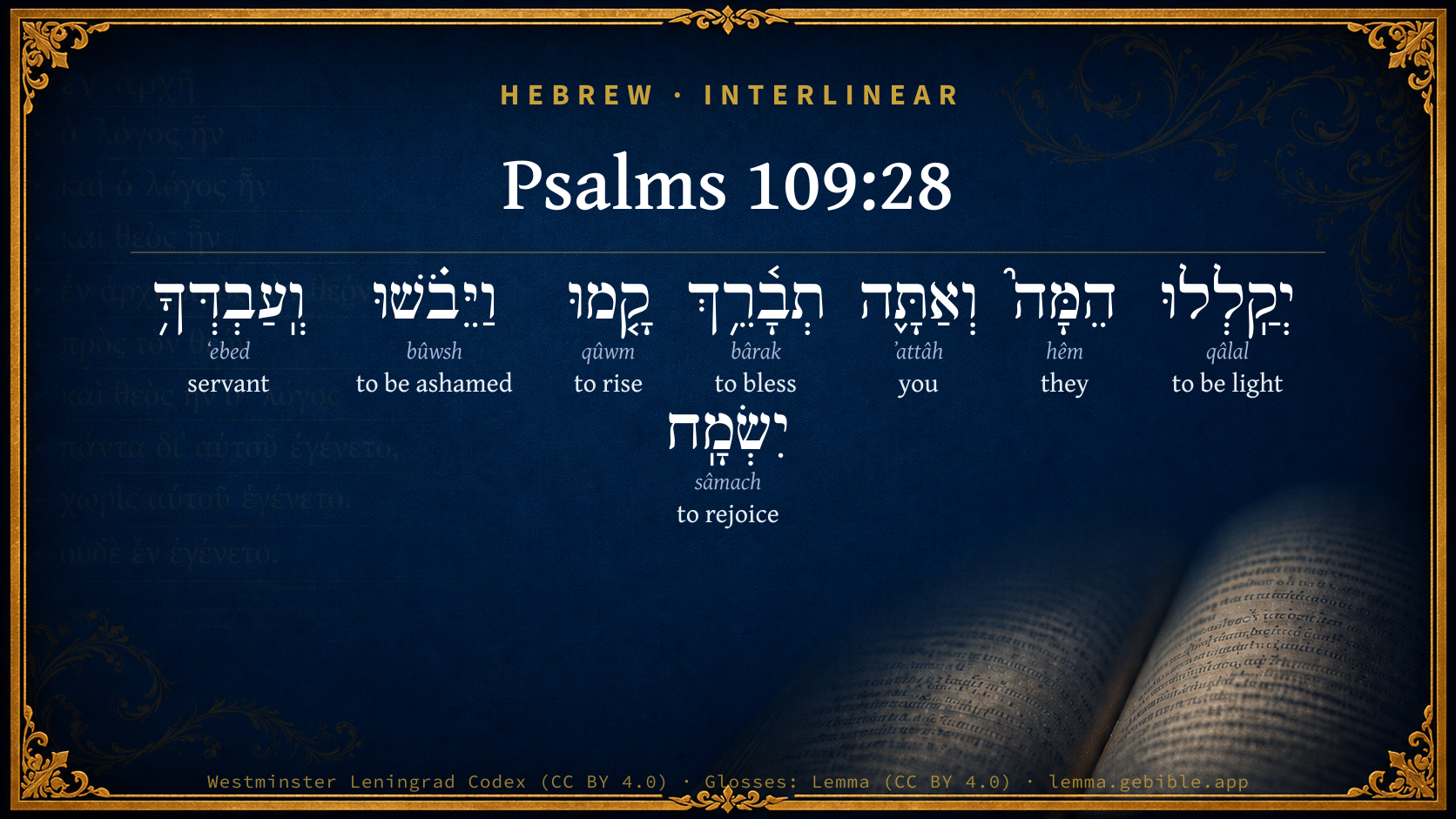
Hebrew (Westminster Leningrad Codex) Psalms 109:28 appears in the Hebrew Old Testament. The text above is from the Westminster Leningrad Codex. Each word links to its Strong’s number, a concise gloss, and parsing drawn from the Open Scriptures Hebrew Bible morphology. Click any word for its full Brown-Driver-Briggs (BDB) entry.
Download image
Cite this verse

Psalms 109:28 (World English Bible). Public Domain. Lemma interlinear Bible study tool, https://lemma.gebible.app/v/psalms/109/28.

Show BibTeX & RIS
BibTeX
RIS
English Translation
They may curse, but you bless. When they arise, they will be shamed, But your servant shall rejoice.
World English Bible · Public Domain
Download a study sheet

One document with this verse’s original text, its word-by-word gloss line, the meaning frame, cross-references with their text, attributed commentary, and full source and license credits — printable, and it pastes into notes with its structure intact.

This verse Autodidact and up

Study sheet (.html) Plain text (.txt)

A passage Seminary Student

Up to 50 verses in one chapter. A passage sheet keeps up to 6 commentary sources and 12 cross-references per verse, in the order this page ranks them, and says so on the sheet whenever that leaves anything out. Ask for a single verse and you get the Autodidact verse sheet above.

Everything on this page stays free to read, with no account — the sheet is a download of what is already on screen, not access to it.

Want to remove ads? Support Godless Engineer
Compare translations 3

The same verse in 3 English versions, stacked beneath the original-language interlinear above. Click any original word for its lexicon entry.

Each is an independent rendering of the whole verse — the interlinear is not word-aligned to these translations.

Highlighted words mark where these versions differ — a whole-verse word diff, not a word-by-word alignment.

  • World English Bible Public Domain
    They may curse, but you bless. When they arise, they will be shamed, But your servant shall rejoice.
  • King James Version Public Domain
    Let them curse, but bless thou: when they arise, let them be ashamed; but let thy servant rejoice.
  • unfoldingWord Literal Text CC BY-SA 4.0
    They, they will curse, but you, you will bless; they arise, but then become ashamed, and your servant will rejoice.

unfoldingWord Literal Text — © unfoldingWord, licensed CC BY-SA 4.0. Word-aligned USFM3 via Door43 (git.door43.org/unfoldingWord/en_ult).

Versions to compare (up to 4)

3 of 4 selected

Show all 18 translations

Every available English version of this verse, each an independent rendering of the whole verse.

  • World English Bible Public Domain
    They may curse, but you bless. When they arise, they will be shamed, But your servant shall rejoice.
  • Berean Standard Bible Public Domain
    Though they curse, You will bless. When they rise up, they will be put to shame, but Your servant will rejoice.
  • Majority Standard Bible Public Domain
    Though they curse, You will bless. When they rise up, they will be put to shame, but Your servant will rejoice.
  • King James Version Public Domain
    Let them curse, but bless thou: when they arise, let them be ashamed; but let thy servant rejoice.
  • American Standard Version (1901) Public Domain
    Let them curse, but bless thou: When they arise, they shall be put to shame, But thy servant shall rejoice.
  • Revised Version (1885) Public Domain
    Let them curse, but bless thou: when they arise, they shall be ashamed, but thy servant shall rejoice.
  • Geneva Bible (1599) Public Domain
    Though they curse, yet thou wilt blesse: they shall arise and be confounded, but thy seruant shall reioyce.
  • Douay-Rheims (1899) Public Domain
    They will curse and thou will bless: let them that rise up against me be confounded: but thy servant shall rejoice.
  • Young's Literal Translation Public Domain
    They revile, and Thou dost bless, They have risen, and are ashamed, And Thy servant doth rejoice.
  • Literal Standard Version CC BY-SA 4.0
    They revile, and You bless, || They have risen, and are ashamed, || And Your servant rejoices.
  • Unlocked Literal Bible CC BY-SA 4.0
    Though they curse me, please bless me; when they attack, may they be put to shame, but may your servant rejoice.
  • unfoldingWord Literal Text CC BY-SA 4.0
    They, they will curse, but you, you will bless; they arise, but then become ashamed, and your servant will rejoice.
  • Darby Bible Public Domain
    Let *them* curse, but bless *thou*; when they rise up, let them be ashamed, and let thy servant rejoice.
  • World Messianic Bible Public Domain
    They may curse, but you bless. When they arise, they will be shamed, but your servant shall rejoice.
  • Webster's Bible Public Domain
    Let them curse, but bless thou: when they arise, let them be ashamed; but let thy servant rejoice.
  • Free Bible Version CC BY-SA 4.0
    When they curse me, you will bless me. When they attack me, you will defeat them. And I, your servant, will be happy.
  • Bible in Basic English Public Domain
    They may give curses but you give blessing; when they come up against me, put them to shame; but let your servant be glad.
  • JPS Tanakh (1917) Public Domain
    Let them curse, but bless Thou; when they arise, they shall be put to shame, but Thy servant shall rejoice.

Literal Standard Version (2020), Covenant Press — licensed CC BY-SA 4.0. Text via the HelloAO Bible API (eBible.org). Unlocked Literal Bible (unfoldingWord) — licensed CC BY-SA 4.0. Text via the HelloAO Bible API (eBible.org). unfoldingWord Literal Text — © unfoldingWord, licensed CC BY-SA 4.0. Word-aligned USFM3 via Door43 (git.door43.org/unfoldingWord/en_ult). Free Bible Version, Dr. Jonathan Gallagher — licensed CC BY-SA 4.0. Text via the HelloAO Bible API (eBible.org).

Word by word

More ways to search: Search by grammar → Find every occurrence → Compare this word →

Practice this passage: Drill this verse → Learn its vocabulary →

יְקַֽלְלוּ
qâlal
H7043
“to be light”
Verb, Piel, Imperfect, 3rd Person, Masculine, Plural
Part of Speech
Verb
Stem
Piel
Form
Imperfect
Person
3rd Person
Gender
Masculine
Number
Plural
Full BDB Definition

Origin: a primitive root

TWOT: 2028

to be slight, be swift, be trifling, be of little account, be light - (Qal) - to be slight, be abated (of water) - to be swift - to be trifling, be of little account - (Niphal) - to be swift, show oneself swift - to appear trifling, be too trifling, be insignificant - to be lightly esteemed - (Piel) - to make despicable - to curse - (Pual) to be cursed - (Hiphil) - to make light, lighten - to treat with contempt, bring contempt or dishonour - (Pilpel) - to shake - to whet - (Hithpalpel) to shake oneself, be moved to and fro
  1. הֵמָּה֮ hêm H1992 “they” Pronoun, Personal, 3rd Person, Masculine, Plural
  2. וְאַתָּ֪ה ʼattâh H859 “and · you” Conjunction + Pronoun, Personal, 2nd Person, Masculine, Singular
  3. תְבָ֫רֵ֥ךְ bârak H1288 “to bless” Verb, Piel, Imperfect, 2nd Person, Masculine, Singular
  4. קָ֤מוּ qûwm H6965 “to rise” Verb, Qal, Perfect, 3rd Person, Common, Plural
  5. וַיֵּבֹ֗שׁוּ bûwsh H954 “and · to be ashamed” Conjunction + Verb, Qal, Sequential Imperfect, 3rd Person, Masculine, Plural
  6. וְֽעַבְדְּךָ֥ ʻebed H5650 “and · servant · your” Conjunction + Noun, Common, Masculine, Singular, Construct + Suffix, Personal, 2nd Person, Masculine, Singular
  7. יִשְׂמָֽח sâmach H8055 “to rejoice” Verb, Qal, Imperfect, 3rd Person, Masculine, Singular

About this verse

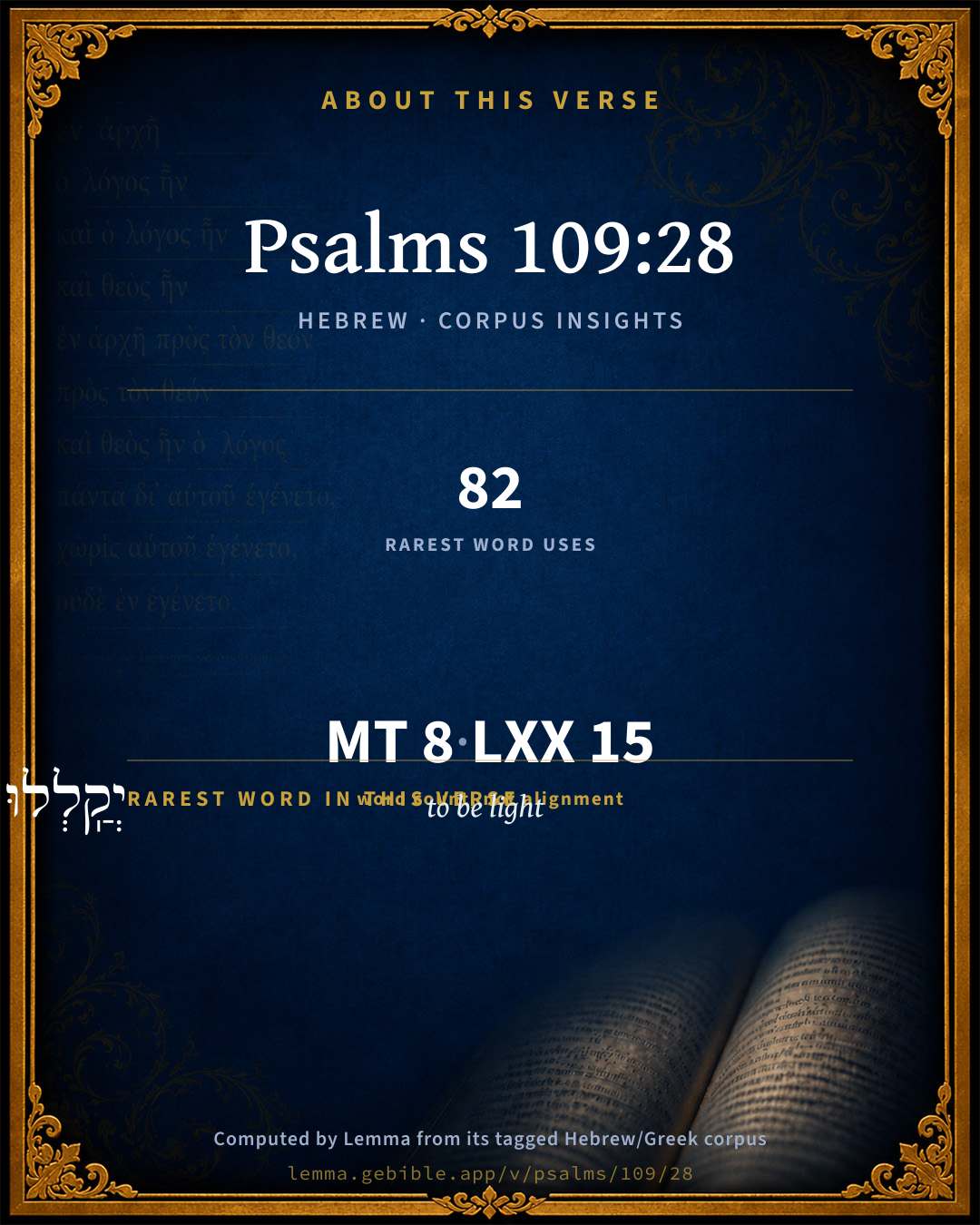
These counts appear in no published source. They are computed here, from the morphology-tagged text and Lemma’s own curated glosses. What Lemma adds →

8
words
8
distinct lemmas
Wisdom
section

Grammatical profile

  • 5 verbs
  • 1 noun
  • 2 pronouns

Verb forms

  • יְקַֽלְלוּ Piel · Imperfect
  • תְבָ֫רֵ֥ךְ Piel · Imperfect
  • קָ֤מוּ Qal · Perfect
  • וַיֵּבֹ֗שׁוּ Qal · Sequential Imperfect
  • יִשְׂמָֽח Qal · Imperfect

Hebrew & Septuagint length

In English translation the verse runs 18 words from the Hebrew and 21 from the Septuagint (LXX English) — closely comparable.

A rough comparison of the two English renderings, which tokenize alike — not a word-level alignment.

Word counts can differ between the Hebrew and the Greek without any difference in meaning — e.g. the Hebrew direct-object marker אֵת has no separate Greek word, and Greek often adds the article ὁ.

In the original languages it is 8 Hebrew tokens and 15 Greek tokens — but the two are counted differently (Hebrew bundles its prefixes and suffixes into one token; the Greek is in lemma form), so that isn’t a like-for-like length.

Cross-references

8

Topical passages linked to Psalms 109:28 in the Treasury of Scripture Knowledge — connected by theme and wording, ordered by reader-vote popularity; previews shown in the World English Bible.

  • Numbers 23:20 Behold, I have received [commandment] to bless: He has blessed, and I can't reverse it.
  • John 16:22 Therefore you now have sorrow, but I will see you again, and your heart will rejoice, and no one will take your joy away from you.
  • Numbers 22:12 God said to Balaam, You shall not go with them; you shall not curse the people; for they are blessed.
  • Psalms 109:17 Yes, he loved cursing, and it came to him. He didn't delight in blessing, and it was far from him.
  • Hebrews 12:2 looking to Jesus, the author and perfecter of faith, who for the joy that was set before him endured the cross, despising shame, and has sat down at the right hand of the throne of God.
  • Numbers 23:23 Surely there is no enchantment with Jacob; Neither is there any divination with Israel: Now shall it be said of Jacob and of Israel, What has God done!
  • 2 Samuel 16:10–13 The king said, What have I to do with you, you sons of Zeruiah? Because he curses, and because Yahweh has said to him, Curse David; who then shall say, Why have you done so?
  • Isaiah 65:13–16 Therefore thus says the Lord Yahweh, Behold, my servants shall eat, but you shall be hungry; behold, my servants shall drink, but you shall be thirsty; behold, my servants shall rejoice, but you shall be disappointed;

Cross-references courtesy of OpenBible.info (CC BY 4.0).

Hebrew and Greek witnesses Masoretic Hebrew ↔ Greek Septuagint

The same verse in the two great witnesses to the Old Testament, shown verse-for-verse.

You’re reading Greek Psalm 108 (Hebrew Psalm 109). The Septuagint counts the superscription, so verse numbers can differ from the Hebrew — chapter-level alignment, not verse-by-verse. Numbering follows Rahlfs.

These are two independent witnesses, not word-aligned to each other, and the Septuagint is shown in lemma (dictionary) form.

Hebrew Psalms 109:28 Masoretic · Westminster Leningrad Codex

יְקַֽלְלוּ הֵמָּה֮ וְאַתָּ֪ה תְבָ֫רֵ֥ךְ קָ֤מוּ וַיֵּבֹ֗שׁוּ וְֽעַבְדְּךָ֥ יִשְׂמָֽח

They may curse, but you bless. When they arise, they will be shamed, But your servant shall rejoice.

World English Bible · Public Domain

Greek LXX Greek Psalm 108:28 Septuagint · lemma form

καταἀράομαι αὐτός καί σύ εὐλογέω ὁ ἐπι ἀναἵστημι ἐγώ αἰσχύνω ὁ δέ δοῦλος σύ εὐφραίνω

Let them curse, but you shall bless: let them that rise up against me be ashamed, but let your servant rejoice.

LXX2012 (modern English Septuagint) · Public Domain

Hebrew: Westminster Leningrad Codex (CC BY 4.0). Greek: Septuagint (public domain); English from LXX2012 (modern English Septuagint) (Public Domain). How the Septuagint differs from the Hebrew →

Commentary

Notes on Psalms 109:28 from classic Christian and Jewish commentators (each source and its license shown beneath its notes). The classic Christian expositions comment on the surrounding passage and are grouped to its opening verse, so a note may address several verses; the Jewish commentaries on the Tanakh (Rashi and others) are per-verse, so they appear only where the commentator wrote on this verse.

Lemma curates 59 commentaries, every one of them public domain or Creative Commons licensed, each selected and text-cleaned for this edition rather than reprinted as found. About our sources →

Ellicott's Commentary for English Readers

(28-31) It is impossible not to notice the anti-climax in these verses, if they are spoken by the same person as Psa_109:16-20, and directed against the same enemies, of whom the one there singled out is the prominent figure. It is not only that the effect is weakened by the change back to the plural number, but the same imprecations are repeated in a diluted and modified form. But perhaps in Psa_109:28 we should drop the optative, and read, “they will curse, but thou dost bless.”

A Bible Commentary for English Readers, edited by Charles John Ellicott (1878–1897) — public domain. Text from a community e-Sword module.

Trapp's Complete Commentary

John Trapp

Psa 109:28 Let them curse, but bless thou: when they arise, let them be ashamed; but let thy servant rejoice.

Ver. 28. Let them curse, but bless thou] Yea, the rather, as 2Sa 16:12; and I wot well that those whom thou blessest shall be blessed, as Isaac once said of his son Jacob, Gen 27:33.

When they arise] To plead their own cause, causa excidant.

John Trapp, A Commentary or Exposition upon All the Books of the Old and New Testament (1647–1656) — public domain. Text from a community e-Sword module.

J. A. Alexander on Psalms

Joseph Addison Alexander

28. (Psa 109:28) They will curse, and thou wilt bless; they have risen up, and shall be shamed, and thy servant shall be glad. The first clause, expressed in our idiom, would be, they may curse, but thou wilt bless. Risen up, i.e. against me, a favourite expression in the Psalms. Shamed, in the pregnant sense of being disappointed, defeated, confounded. Thy servant, i.e. I, as such, in that capacity or character.

Joseph Addison Alexander, The Psalms Translated and Explained (1850) — public domain. Text from a community e-Sword module.

Tyndale Open Study Notes

Tyndale Open Resources

109:28 The Lord’s servant demonstrates loyalty and obedience.

Tyndale Open Study Notes — © Tyndale Open Resources, licensed CC BY-SA 4.0. Text via the HelloAO Bible API.

Geneva Bible (1599)

Geneva Bible translators

They shall gain nothing by cursing me.

Geneva Bible (1599) marginal notes — public domain. Text via Bolls.life.

Adam Clarke's Commentary

Verse 28. Let them curse, but bless thou] See on Ps 109:20: Of the mode of interpretation recommended there, this verse gives additional proof.

Adam Clarke's Commentary on the Bible (1810–1826) — public domain. Text from a community e-Sword/MySword module.

John Calvin's Commentaries

28. They shall curse. Interpreters are divided in their opinions about the meaning of these words. One class would render them as expressive of a desire or wish: Let them curse, provided that thou bless: let them arise, and be clothed with confusion Another class, and with them I readily agree, adopt the future tense of the indicative mood, They shall curse, etc. Should any prefer to understand the passage as indicating, on the part of the Psalmist, his resolution to suffer and submit to the curses of his enemies, I do not oppose their interpretation. In my opinion, however, those who view the words as a prayer, misinterpret them; because David, having already presented his petitions to God, and being secure in his favor, seems now rather to boast that their cursing will do him no harm; for Thou, says he, wilt bless me. By this means, he proves how little and how lightly he regarded the menaces of his enemies, though they might assail him by the poison of the tongue, and the power of the sword. From the example of David, let us learn to form the resolution of engaging God on our side, who can baffle all the designs of our enemies, and inspire us with courage to set at defiance their malice, wickedness, audacity, power, and fury.

And then, indeed, it is that the loving-kindness of God appears, when it banishes from our minds the fears which we entertain of the threatenings of the world. Therefore, relying upon the grace of God, boldly setting at nought the machinations and attacks of his enemies, believing that they could not prevail against God’s blessing, David raises the shout of triumph even in the midst of the battle. This truth is still more impressively inculcated in the succeeding clause of the verse: Though they arise, yet shall they be put to shame. By these words it is obviously his design to intimate that the ungovernable violence of his enemies is not yet subdued, but that he can endure all their fury and foam so long as the hand of God is stretched forth to maintain and defend him; and thus he animates and fortifies himself against all the pride of the world, and, at the same time, by his example emboldens all the faithful, so that they do not feel dejected even when the perverseness of their enemies seems to get the advantage over them, and to menace them with instant destruction. Cherishing such a hope, he trusts that, for the future, he shall be delivered from all his sorrows. Whence let us learn to bear patiently and meekly our trials, until the fit season and the full time, which God hath appointed, arrive for turning our weeping into joy. In the following verse he proceeds in the same strain of exultation, because, though he beholds the ungodly assuming a lofty air, yet, looking beyond the present state of things with the eye of faith, he entertains no doubt that God will frustrate all their designs, and pour contempt upon all their schemes.

John Calvin's Commentaries (1540-1563) — public domain. Text from the Calvin Translation Society English edition (1840s-50s) via the Christian Classics Ethereal Library (ccel.org). Calvin's coverage is partial (roughly two-thirds of the Bible); uncommented books and verses are honest gaps, never fabricated. The 19th-century editor's footnotes and remarks are omitted so the notes are faithfully Calvin's own voice.

The Cambridge Bible for Schools and Colleges

gen. ed. J. J. S. Perowne

28. They may curse, but thou wilt bless:

They arise and are put to shame, but thy servant shall rejoice.

They and thou are emphatically contrasted.

The Cambridge Bible for Schools and Colleges (gen. ed. J. J. S. Perowne; Cambridge University Press, 1878–1918) — public domain. Text from a community e-Sword module.

John Gill's Exposition

Let mine adversaries be clothed with shame,.... This is only explanative of what is said before,

And let them cover themselves with their own confusion as with a mantle: the Arabic version is, "as with a breastplate." Some understand it as a petition of Christ, that they might be brought to repentance for their sins, and so to shame for them; which is an instance of his wondrous grace and goodness; and it is certain he prayed for the forgiveness of his enemies when on the cross, Luk 23:34.

John Gill's Exposition of the Whole Bible (1746–1763) — public domain (CC PDM 1.0). Text via the HelloAO Bible API.

Albert Barnes' Notes on the Bible

Let them curse, but bless thou - See Psa 109:17. Let them continue to curse me, provided thou wilt bless me. I am willing to bear all these reproaches, if I may have thy favor. That favor I value infinitely more than I do theirs; and it is a small matter that I am reviled and cursed by people, if I may secure the favor and friendship of God.

When they arise - When they rise up against me; when they attempt to persecute me.

Let them be ashamed ... - Let them be disappointed; let them not be successful in their designs against me. On the word “ashamed,” see Job 6:20, note; Psa 25:2-3, note.

Albert Barnes' Notes on the Bible (1834–1885) — public domain. Text from a community e-Sword/MySword module.

Matthew Poole's English Annotations

Let them curse; I can patiently bear their curses, as being causeless, and fully compensated by thy blessing. Or, they do and will curse, I expect nothing else from them.

Arise, i.e. bestir themselves against me. Both God and men are oft said to arise when they enter upon any undertaking, as Jos 24:9; Jdg 8:21; 2Ch 13:6; 21:4, &c.

Matthew Poole's English Annotations on the Holy Bible (1683–1685) — public domain. Text from a community e-Sword/MySword module.

The Treasury of David

Charles H. Spurgeon

Ver. 28. Let them curse, but bless thou, or, they will curse and thou wilt bless. Their cursing will then be of such little consequence that it will not matter a straw. One blessing from the Lord will take the poison out of ten thousand curses of men.

When they arise, let them be ashamed. They lift up themselves to deal out another blow, to utter another falsehood, and to watch for its injurious effects upon their victim, but they see their own defeat and are filled with shame.

But let thy servant rejoice. Not merely as a man protected and rescued, but as God's servant in whom his master's goodness and glory are displayed when he is saved from his foes. It ought to be our greatest joy that the Lord is honoured in our experience; the mercy itself ought not so much to rejoice us as the glory which is thereby brought to him who so graciously bestows it.

Ver. 28. Let them curse, but bless thou. Fear not thou, who art a saint, their imprecations; this is but like false fire in the pan of an uncharged gun, it gives a crack, but hurts not; God's blessings will cover thee from their curse. William Gurnall.

Ver. 28. (first clause). Men's curses are impotent, God's blessings are omnipotent. Matthew Henry.

Ver. 28. The divine cure for human ill will; and the saint's temper when he trusts therein"let thy servant rejoice."

Psalms 109:29*

Charles H. Spurgeon's The Treasury of David (1869–1885) — public domain. Psalms only. Text from a community e-Sword/MySword module.

Whedon's Commentary on the Bible

Daniel D. Whedon

28. Let them curse, but bless thou—Hebrew, They will curse and thou wilt bless. The idea is, though they curse thou wilt bless, as 2Sa_16:12, “It may be the Lord will requite me good for his cursing.”

When they arise—Namely, for hostile purposes.

Daniel D. Whedon (gen. ed.), Commentary on the Old and New Testaments (1874–1909) — public domain. Text from a community e-Sword module.

The Pulpit Commentary

Let them curse, but bless thou; i.e. "Let them curse, if they will. What matters it? Provided only that thou blessest." When they arise. When they attempt to put their malevolent designs in act. Let them be ashamed; or, "they shall be ashamed" (Revised Version); i.e. they shall fail so utterly, that they shall be covered with shame. But let thy servant rejoice; rather, but thy servant shall rejoice. "Thy servant" is the psalmist himself. (comp. Psa_69:17) He will rejoice at their failure, which secures his safety.

The Pulpit Commentary (1880–1919), ed. H.D.M. Spence-Jones & Joseph S. Exell — public domain. Text from a community e-Sword module.

unfoldingWord translationNotes

Door43 World Missions Community

Though they curse me

The word "they" refers to the people who accuse David and say bad things about him.

may they be put to shame

This can be stated in active form. AT: "may they be ashamed" or "let them be ashamed" (See: Active or Passive)

but may your servant rejoice

"but may I, your servant, rejoice" or "I am your servant, let me rejoice." David uses the phrase "your servant" to refer to himself.

May my adversaries be clothed ... may they wear

These two phrase have them same meaning and are used together for emphasize how greatly he wishes for them to be ashamed. (See: Parallelism)

be clothed with shame

Here David speaks of them being ashamed as if were clothing they wore. AT: "be very ashamed" (See: Metaphor)

may they wear their shame like a robe

David speaks of them being ashamed as if it were a robe that they wore. AT: "may their shame cover them just like their robe is wrapped around them" (See: Simile)

translationWords

curse

bless

shame

servant

joy

adversary

clothe

robe

unfoldingWord translationNotes — © Distant Shores Media and the Door43 World Missions Community, licensed CC BY-SA 4.0. Source: git.door43.org/Door43/en_tn.

Lesson kit

Teaching starters — assembled from the data on this page, not authored interpretation. Every prompt links to the verse data it draws on. Edit before teaching.

Psalms, in the Wisdom, opens this verse with 8 words (8 distinct Hebrew lemmas). Its most distinctive word is qâlal (“to be light”). A historical commentator’s framing appears above. Read the whole chapter for the surrounding context.

Discussion questions

  1. How does “to be light” (qâlal) shape what this verse is saying?
  2. Numbers 23:20 shares this passage’s theme. How do the two illuminate each other?
  3. These translations render this verse differently; the difference is in the English rendering, not the original. What questions does that raise?
  4. The verb «יְקַֽלְלוּ» is Piel Imperfect. How does its form color the action?
  5. Reading how Ellicott's Commentary for English Readers and Trapp's Complete Commentary read this verse, where do the two commentators agree and where do they part?

Things to notice

Reading settings

Reading text

Shown beneath each verse's original-language words.

Old Testament
Old Testament edition

Read the OT as the Masoretic Hebrew (MT) or the Greek Septuagint (LXX).

English shown for the Greek Septuagint (in the Hebrew ↔ Greek comparison).

Comparing translations? Open the Compare panel on any verse page to stack up to four side by side.