
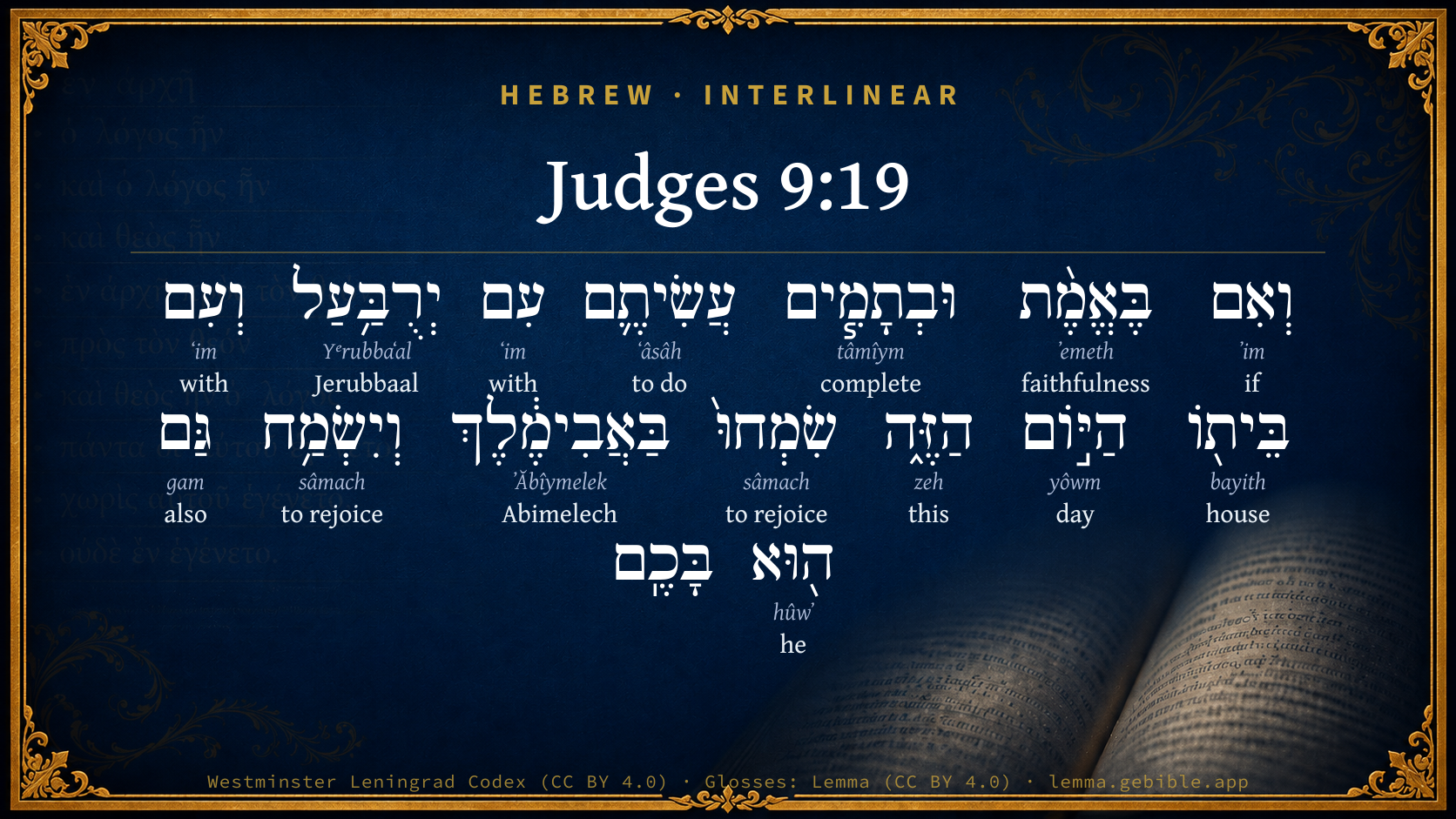
Judges 9:19

Hebrew (Westminster Leningrad Codex) Judges 9:19 appears in the Hebrew Old Testament. The text above is from the Westminster Leningrad Codex. Each word links to its Strong’s number, a concise gloss, and parsing drawn from the Open Scriptures Hebrew Bible morphology. Click any word for its full Brown-Driver-Briggs (BDB) entry.
Download image
Cite this verse

Judges 9:19 (World English Bible). Public Domain. Lemma interlinear Bible study tool, https://lemma.gebible.app/v/judges/9/19.

Show BibTeX & RIS
BibTeX
RIS
English Translation
if you then have dealt truly and righteously with Jerubbaal and with his house this day, then rejoice you in Abimelech, and let him also rejoice in you:
World English Bible · Public Domain
Download a study sheet

One document with this verse’s original text, its word-by-word gloss line, the meaning frame, cross-references with their text, attributed commentary, and full source and license credits — printable, and it pastes into notes with its structure intact.

This verse Autodidact and up

Study sheet (.html) Plain text (.txt)

A passage Seminary Student

Up to 50 verses in one chapter. A passage sheet keeps up to 6 commentary sources and 12 cross-references per verse, in the order this page ranks them, and says so on the sheet whenever that leaves anything out. Ask for a single verse and you get the Autodidact verse sheet above.

Everything on this page stays free to read, with no account — the sheet is a download of what is already on screen, not access to it.

Want to remove ads? Support Godless Engineer
Compare translations 3

The same verse in 3 English versions, stacked beneath the original-language interlinear above. Click any original word for its lexicon entry.

Each is an independent rendering of the whole verse — the interlinear is not word-aligned to these translations.

Highlighted words mark where these versions differ — a whole-verse word diff, not a word-by-word alignment.

  • World English Bible Public Domain
    if you then have dealt truly and righteously with Jerubbaal and with his house this day, then rejoice you in Abimelech, and let him also rejoice in you:
  • King James Version Public Domain
    If ye then have dealt truly and sincerely with Jerubbaal and with his house this day, then rejoice ye in Abimelech, and let him also rejoice in you:
  • unfoldingWord Literal Text CC BY-SA 4.0
    now if you have acted in truth and in integrity with Jerubbaal and with his house this day, rejoice in Abimelech, and may he also rejoice in you.

unfoldingWord Literal Text — © unfoldingWord, licensed CC BY-SA 4.0. Word-aligned USFM3 via Door43 (git.door43.org/unfoldingWord/en_ult).

Versions to compare (up to 4)

3 of 4 selected

Show all 18 translations

Every available English version of this verse, each an independent rendering of the whole verse.

  • World English Bible Public Domain
    if you then have dealt truly and righteously with Jerubbaal and with his house this day, then rejoice you in Abimelech, and let him also rejoice in you:
  • Berean Standard Bible Public Domain
    if you have acted faithfully and honestly toward Jerubbaal and his house this day, then may you rejoice in Abimelech, and he in you.
  • Majority Standard Bible Public Domain
    if you have acted faithfully and honestly toward Jerubbaal and his house this day, then may you rejoice in Abimelech, and he in you.
  • King James Version Public Domain
    If ye then have dealt truly and sincerely with Jerubbaal and with his house this day, then rejoice ye in Abimelech, and let him also rejoice in you:
  • American Standard Version (1901) Public Domain
    if ye then have dealt truly and uprightly with Jerubbaal and with his house this day, then rejoice ye in Abimelech, and let him also rejoice in you:
  • Revised Version (1885) Public Domain
    if ye then have dealt truly and uprightly with Jerubbaal and with his house this day, then rejoice ye in Abimelech, and let him also rejoice in you:
  • Geneva Bible (1599) Public Domain
    If ye then haue delt truely and purely with Ierubbaal, and with his house this day, then reioyce with you.
  • Douay-Rheims (1899) Public Domain
    If therefore you have dealt well, and without fault with Jerobaal, and his house, rejoice ye this day in Abimelech, and may he rejoice in you.
  • Young's Literal Translation Public Domain
    yea, if in truth and in sincerity ye have acted with Jerubbaal and with his house this day, rejoice ye in Abimelech, and he doth rejoice -- even he -- in you;
  • Literal Standard Version CC BY-SA 4.0
    indeed, if in truth and in sincerity you have acted with Jerubba‘al and with his house this day, rejoice in Abimelech, and he rejoices—even he—in you;
  • Unlocked Literal Bible CC BY-SA 4.0
    If you acted with honesty and integrity with Jerub Baal and his house, then you should rejoice in Abimelech, and let him also rejoice in you.
  • unfoldingWord Literal Text CC BY-SA 4.0
    now if you have acted in truth and in integrity with Jerubbaal and with his house this day, rejoice in Abimelech, and may he also rejoice in you.
  • Darby Bible Public Domain
    if you then have acted in good faith and honor with Jerubba'al and with his house this day, then rejoice in Abim'elech, and let him also rejoice in you;
  • World Messianic Bible Public Domain
    if you then have dealt truly and righteously with Jerubbaal and with his house today, then rejoice in Abimelech, and let him also rejoice in you;
  • Webster's Bible Public Domain
    If ye then have dealt truly and sincerely with Jerubbaal and with his house this day, then rejoice ye in Abimelech, and let him also rejoice in you:
  • Free Bible Version CC BY-SA 4.0
    Have you acted sincerely and honestly toward Jerub-baal and his family today? If so, may you be happy with Abimelech, and may he be happy with you too!
  • Bible in Basic English Public Domain
    If then you have done what is true and upright to Jerubbaal and his family this day, may you have joy in Abimelech, and may he have joy in you;
  • JPS Tanakh (1917) Public Domain
    if ye then have dealt truly and uprightly with Jerubbaal and with his house this day, then rejoice ye in Abimelech, and let him also rejoice in you.

Literal Standard Version (2020), Covenant Press — licensed CC BY-SA 4.0. Text via the HelloAO Bible API (eBible.org). Unlocked Literal Bible (unfoldingWord) — licensed CC BY-SA 4.0. Text via the HelloAO Bible API (eBible.org). unfoldingWord Literal Text — © unfoldingWord, licensed CC BY-SA 4.0. Word-aligned USFM3 via Door43 (git.door43.org/unfoldingWord/en_ult). Free Bible Version, Dr. Jonathan Gallagher — licensed CC BY-SA 4.0. Text via the HelloAO Bible API (eBible.org).

Word by word

More ways to search: Search by grammar → Find every occurrence → Compare this word →

Practice this passage: Drill this verse → Learn its vocabulary →

יְרֻבַּ֥עַל
Yᵉrubbaʻal
H3378
“Jerubbaal”
Noun, Proper
Part of Speech
Noun
Type
Proper
Full BDB Definition

Origin: from H7378 and H1168

TWOT: None

Jerubbaal = "let Baal contend" - name given to Gideon by his father when he destroyed the altar of Baal
  1. וְאִם ʼim H518 “and · if” Conjunction + Conjunction
  2. בֶּאֱמֶ֨ת ʼemeth H571 “in/at · faithfulness” Preposition + Noun, Common, Feminine, Singular, Absolute
  3. וּבְתָמִ֧ים tâmîym H8549 “and · in/at · complete” Conjunction + Preposition + Adjective, Adjective, Masculine, Singular, Absolute
  4. עֲשִׂיתֶ֛ם ʻâsâh H6213 “to do” Verb, Qal, Perfect, 2nd Person, Masculine, Plural
  5. עִם ʻim H5973 “with” Preposition
  6. וְעִם ʻim H5973 “and · with” Conjunction + Preposition
  7. בֵּית֖וֹ bayith H1004 “house · his” Noun, Common, Masculine, Singular, Construct + Suffix, Personal, 3rd Person, Masculine, Singular
  8. הַיּ֣וֹם yôwm H3117 “the · day” Particle, Definite Article + Noun, Common, Masculine, Singular, Absolute
  9. הַזֶּ֑ה zeh H2088 “the · this” Particle, Definite Article + Pronoun, Demonstrative, Masculine, Singular
  10. שִׂמְחוּ֙ sâmach H8055 “rejoice” Verb, Qal, Imperative, 2nd Person, Masculine, Plural
  11. בַּאֲבִימֶ֔לֶךְ ʼĂbîymelek H40 “in/at · Abimelech” Preposition + Noun, Proper
  12. וְיִשְׂמַ֥ח sâmach H8055 “and · to rejoice” Conjunction + Verb, Qal, Imperfect, 3rd Person, Masculine, Singular
  13. גַּם gam H1571 “also” Particle, Accusative
  14. ה֖וּא hûwʼ H1931 “he” Pronoun, Personal, 3rd Person, Masculine, Singular

About this verse

These counts appear in no published source. They are computed here, from the morphology-tagged text and Lemma’s own curated glosses. What Lemma adds →

16
words
13
distinct lemmas
Historical
section

Notable vocabulary

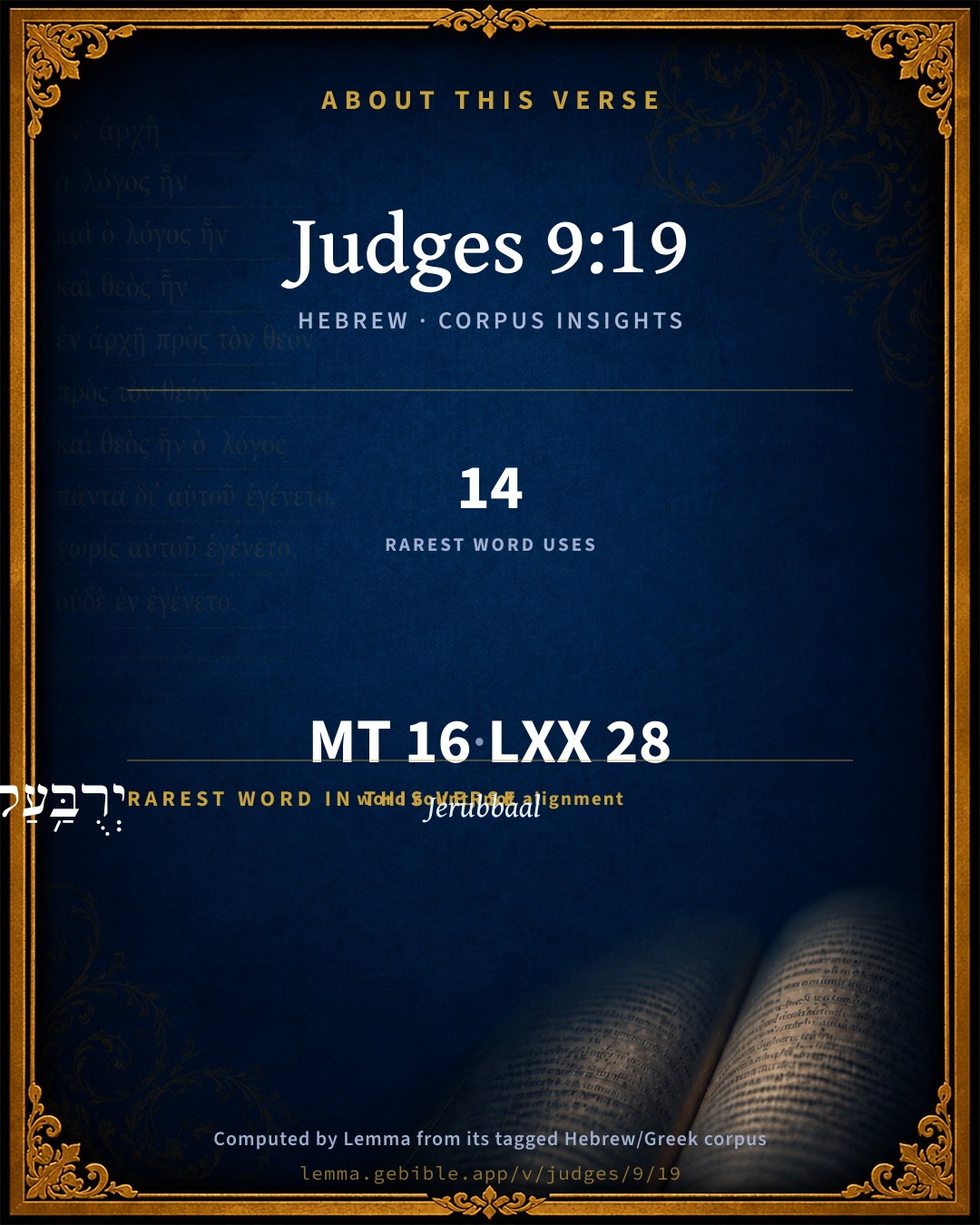
The rarest word here is יְרֻבַּ֥עַל Jerubbaal H3378 — appearing just 14 times in the whole Hebrew Bible.

Shared distinctive vocabulary

יְרֻבַּ֥עַל Jerubbaal H3378 occurs in 13 verses of the Hebrew Bible. Also found in:

Grammatical profile

  • 3 verbs
  • 5 nouns
  • 1 adjective
  • 2 pronouns
  • 3 prepositions
  • 1 conjunction
  • 1 particle

Verb forms

  • עֲשִׂיתֶ֛ם Qal · Perfect
  • שִׂמְחוּ֙ Qal · Imperative
  • וְיִשְׂמַ֥ח Qal · Imperfect

Repetition

Words recur within this verse — often emphatic in Hebrew:

  • שִׂמְחוּ֙ to rejoice H8055 ×2
  • עִם with H5973 ×2

Hebrew & Septuagint length

In English translation the verse runs 28 words from the Hebrew and 27 from the Septuagint (LXX English) — closely comparable.

A rough comparison of the two English renderings, which tokenize alike — not a word-level alignment.

Word counts can differ between the Hebrew and the Greek without any difference in meaning — e.g. the Hebrew direct-object marker אֵת has no separate Greek word, and Greek often adds the article ὁ.

In the original languages it is 16 Hebrew tokens and 28 Greek tokens — but the two are counted differently (Hebrew bundles its prefixes and suffixes into one token; the Greek is in lemma form), so that isn’t a like-for-like length.

Cross-references

3

Topical passages linked to Judges 9:19 in the Treasury of Scripture Knowledge — connected by theme and wording, ordered by reader-vote popularity; previews shown in the World English Bible.

  • Isaiah 8:6 Because this people have refused the waters of Shiloah that go softly, and rejoice in Rezin and Remaliah's son;
  • Philippians 3:3 For we are the circumcision, who worship God in the Spirit, and rejoice in Christ Jesus, and have no confidence in the flesh;
  • James 4:16 But now you glory in your boasting. All such boasting is evil.

Cross-references courtesy of OpenBible.info (CC BY 4.0).

Hebrew and Greek witnesses Masoretic Hebrew ↔ Greek Septuagint

The same verse in the two great witnesses to the Old Testament, shown verse-for-verse.

These are two independent witnesses, not word-aligned to each other, and the Septuagint is shown in lemma (dictionary) form.

Hebrew Judges 9:19 Masoretic · Westminster Leningrad Codex

וְאִם בֶּאֱמֶ֨ת וּבְתָמִ֧ים עֲשִׂיתֶ֛ם עִם יְרֻבַּ֥עַל וְעִם בֵּית֖וֹ הַיּ֣וֹם הַזֶּ֑ה שִׂמְחוּ֙ בַּאֲבִימֶ֔לֶךְ וְיִשְׂמַ֥ח גַּם ה֖וּא בָּכֶֽם

if you then have dealt truly and righteously with Jerubbaal and with his house this day, then rejoice you in Abimelech, and let him also rejoice in you:

World English Bible · Public Domain

Greek LXX Judges 9:19 Septuagint · lemma form

καί εἰ ἐν ἀλήθεια καί τελειότης ποιέω μετά ιεροβααλ καί μετά ὁ οἶκος αὐτός ἐν ὁ ἡμέρα οὗτος εὐφραίνω ἐν αβιμελεχ καί εὐφραίνω καί γέ αὐτός ἐπί σύ

if then you⌃ have done truly and faithfully with Jerobaal, and with his house this day, rejoice you⌃ in Abimelech, and let him also rejoice over you:

LXX2012 (modern English Septuagint) · Public Domain

Hebrew: Westminster Leningrad Codex (CC BY 4.0). Greek: Septuagint (public domain); English from LXX2012 (modern English Septuagint) (Public Domain). How the Septuagint differs from the Hebrew →

Targum (Aramaic paraphrase)

1

The Targum is the ancient Jewish Aramaic paraphrase of the Hebrew Scriptures — an interpretive translation, not the Hebrew text itself. Onkelos (literal) and Pseudo-Jonathan (expansive) render the Torah, and Jonathan the Prophets. Coverage is partial: where no permissively-licensed English translation exists for a verse, only the Aramaic is shown. This is verse-level text, not a word-by-word alignment to the Hebrew.

  1. Targum Jonathan Prophets (Joshua–Malachi)
    וְאִם בְּקוּשְׁטָא וּבִשְׁלֶמְתָּא עֲבַדְתּוּן עִם יְרוּבַּעַל וְעִם בֵּיתֵיהּ יוֹמָא דֵין חֲדוּ בַּאֲבִימֶלֶךְ וְיֶחֱדֵי אַף הוּא בְּכוֹן:

    (no public-domain English translation for this verse)

    Targum Jonathan — Aramaic: “Mikraot Gedolot” (public domain). English: “Sefaria Community Translation” (CC0 1.0 (public-domain dedication)); “London "Chaldee Paraphrase," 1871” (public domain). Text via Sefaria.

Commentary

Notes on Judges 9:19 from classic Christian and Jewish commentators (each source and its license shown beneath its notes). The classic Christian expositions comment on the surrounding passage and are grouped to its opening verse, so a note may address several verses; the Jewish commentaries on the Tanakh (Rashi and others) are per-verse, so they appear only where the commentator wrote on this verse.

Lemma curates 59 commentaries, every one of them public domain or Creative Commons licensed, each selected and text-cleaned for this edition rather than reprinted as found. About our sources →

Trapp's Complete Commentary

John Trapp

Jdg 9:19 If ye then have dealt truly and sincerely with Jerubbaal and with his house this day, [then] rejoice ye in Abimelech, and let him also rejoice in you:

Ver. 19. Then rejoice you in Abimelech.] As I hardly think you ever will; for it is an irony: Mutuum oblectemini, May there be all good correspondency.

John Trapp, A Commentary or Exposition upon All the Books of the Old and New Testament (1647–1656) — public domain. Text from a community e-Sword module.

Geneva Bible (1599)

Geneva Bible translators

That he is your king, and you his subjects.

Geneva Bible (1599) marginal notes — public domain. Text via Bolls.life.

Ellicott's Commentary for English Readers

(19) If ye then have dealt truly.—If your conduct be just and right, I wish you all joy in it.

A Bible Commentary for English Readers, edited by Charles John Ellicott (1878–1897) — public domain. Text from a community e-Sword module.

The Cambridge Bible for Schools and Colleges

gen. ed. J. J. S. Perowne

19. rejoice ye etc.] Ironical: ‘much joy may you have in each other,’ cf. Jdg_9:15 a.

The Cambridge Bible for Schools and Colleges (gen. ed. J. J. S. Perowne; Cambridge University Press, 1878–1918) — public domain. Text from a community e-Sword module.

John Gill's Exposition

If ye then have dealt truly and sincerely with Jerubbaal and his house this day,.... If they could in their consciences think and believe they had done well, and acted the faithful and upright part by him and his family, which he left with them to consider of:

then rejoice ye in Abimelech, and let him also rejoice in you; may you be happy in him as a king, and he be happy in you as his subjects, and live peaceably and comfortably together; and this he suggests as a test of their former conduct, that should this alliance between Abimelech and them be attended with happiness, which he could not believe would be the case, then it would seem that they had done a right part by Gideon and his family; but if they should be unhappy together, as he supposed they would, then it would be clear that they had acted a base and disingenuous part by his father's family.

John Gill's Exposition of the Whole Bible (1746–1763) — public domain (CC PDM 1.0). Text via the HelloAO Bible API.

unfoldingWord translationNotes

Door43 World Missions Community

If you acted with honesty and integrity with Jerub Baal and his house

Jotham offered the possibility that what they did was good, but Jotham does not actually believe what they did was good. AT: "If you treated Jerub Baal and his family as they deserved to be treated" (See: Hypothetical Situations)

Jerub Baal

This is another name for Gideon. It means "let Baal defend himself." See how you translated this in Judges 6:32.

his house

Here "house" refers to family. AT: "his family" (See: Metonymy)

But if not

Jotham offered the opposite possibility that what they did was evil and applied a curse. Jotham does believe what they did was evil. AT: "But if you treated Jerub Baal and his family as they did not deserve to be treated" (See: Hypothetical Situations)

let fire come out from Abimelech and burn up the men of Shechem

Jotham is speaking a curse. He speaks of Abimelech destroying the people of Shechem as if he would burn them with fire. (See: Metaphor)

Let fire come out from the men of Shechem and Beth Millo, to burn up Abimelech

Jotham is speaking a curse. He speaks of the people of Shechem and Beth Millo destroying Abimelech as if they would burn him with fire. (See: Metaphor)

Beth Millo

This is the name of a place. See how you translated this in Judges 9:6.

Beer

This is the name of a city. (See: How to Translate Names)

translationWords

integrity

house

joy

Abimelech

Shechem

Jotham

unfoldingWord translationNotes — © Distant Shores Media and the Door43 World Missions Community, licensed CC BY-SA 4.0. Source: git.door43.org/Door43/en_tn.

Lesson kit

Teaching starters — assembled from the data on this page, not authored interpretation. Every prompt links to the verse data it draws on. Edit before teaching.

Judges, in the Historical, opens this verse with 16 words (13 distinct Hebrew lemmas). Its most distinctive word is Yᵉrubbaʻal (“Jerubbaal”). A historical commentator’s framing appears above. Read the whole chapter for the surrounding context.

Discussion questions

  1. The word Yᵉrubbaʻal carries the sense “Jerubbaal.” How does it shape the verse?
  2. How does Judges 6:32, which shares the word «Jerubbaal», read alongside this verse?
  3. What does the repetition of “to rejoice” (2× in this one verse) do in this verse?
  4. The translations on this page render this verse differently — a whole-verse word diff, not a word-by-word alignment. What might account for the different wordings?
  5. «עֲשִׂיתֶ֛ם» is a Qal Perfect verb. How does that grammatical form shape the action described?
  6. Compare how Trapp's Complete Commentary and Geneva Bible (1599) read this verse. Where do they agree or differ?

Things to notice

Reading settings

Reading text

Shown beneath each verse's original-language words.

Old Testament
Old Testament edition

Read the OT as the Masoretic Hebrew (MT) or the Greek Septuagint (LXX).

English shown for the Greek Septuagint (in the Hebrew ↔ Greek comparison).

Comparing translations? Open the Compare panel on any verse page to stack up to four side by side.