
Proverbs 17:21

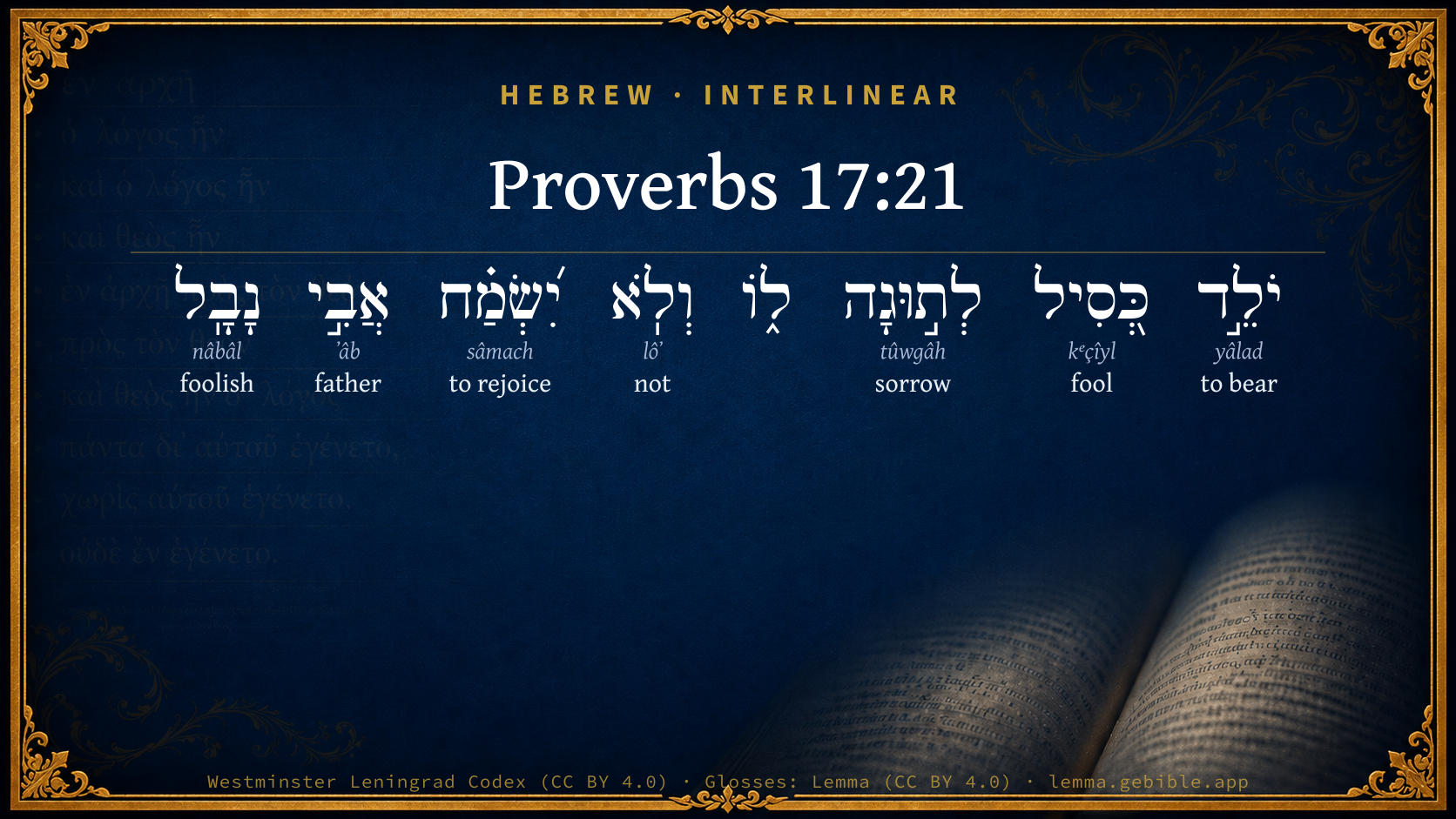
Hebrew (Westminster Leningrad Codex) Proverbs 17:21 appears in the Hebrew Old Testament. The text above is from the Westminster Leningrad Codex. Each word links to its Strong’s number, a concise gloss, and parsing drawn from the Open Scriptures Hebrew Bible morphology. Click any word for its full Brown-Driver-Briggs (BDB) entry.
Download image
Cite this verse

Proverbs 17:21 (World English Bible). Public Domain. Lemma interlinear Bible study tool, https://lemma.gebible.app/v/proverbs/17/21.

Show BibTeX & RIS
BibTeX
RIS
English Translation
He who becomes the father of a fool grieves. The father of a fool has no joy.
World English Bible · Public Domain
Download a study sheet

One document with this verse’s original text, its word-by-word gloss line, the meaning frame, cross-references with their text, attributed commentary, and full source and license credits — printable, and it pastes into notes with its structure intact.

This verse Autodidact and up

Study sheet (.html) Plain text (.txt)

A passage Seminary Student

Up to 50 verses in one chapter. A passage sheet keeps up to 6 commentary sources and 12 cross-references per verse, in the order this page ranks them, and says so on the sheet whenever that leaves anything out. Ask for a single verse and you get the Autodidact verse sheet above.

Everything on this page stays free to read, with no account — the sheet is a download of what is already on screen, not access to it.

Want to remove ads? Support Godless Engineer
Compare translations 3

The same verse in 3 English versions, stacked beneath the original-language interlinear above. Click any original word for its lexicon entry.

Each is an independent rendering of the whole verse — the interlinear is not word-aligned to these translations.

Highlighted words mark where these versions differ — a whole-verse word diff, not a word-by-word alignment.

  • World English Bible Public Domain
    He who becomes the father of a fool grieves. The father of a fool has no joy.
  • King James Version Public Domain
    He that begetteth a fool doeth it to his sorrow: and the father of a fool hath no joy.
  • unfoldingWord Literal Text CC BY-SA 4.0
    One who begets a stupid one, for grief for him, and the father of a worthless one will not rejoice.

unfoldingWord Literal Text — © unfoldingWord, licensed CC BY-SA 4.0. Word-aligned USFM3 via Door43 (git.door43.org/unfoldingWord/en_ult).

Versions to compare (up to 4)

3 of 4 selected

Show all 18 translations

Every available English version of this verse, each an independent rendering of the whole verse.

  • World English Bible Public Domain
    He who becomes the father of a fool grieves. The father of a fool has no joy.
  • Berean Standard Bible Public Domain
    A man fathers a fool to his own grief; the father of a fool has no joy.
  • Majority Standard Bible Public Domain
    A man fathers a fool to his own grief; the father of a fool has no joy.
  • King James Version Public Domain
    He that begetteth a fool doeth it to his sorrow: and the father of a fool hath no joy.
  • American Standard Version (1901) Public Domain
    He that begetteth a fool `doeth it' to his sorrow; And the father of a fool hath no joy.
  • Revised Version (1885) Public Domain
    He that begetteth a fool doeth it to his sorrow: and the father of a fool hath no joy.
  • Geneva Bible (1599) Public Domain
    He that begetteth a foole, getteth himselfe sorow, and the father of a foole can haue no ioy.
  • Douay-Rheims (1899) Public Domain
    A fool is born to his own disgrace: and even his father shall not rejoice in a fool.
  • Young's Literal Translation Public Domain
    Whoso is begetting a fool hath affliction for it, Yea, the father of a fool rejoiceth not.
  • Literal Standard Version CC BY-SA 4.0
    Whoever is begetting a fool has affliction for it, || Indeed, the father of a fool does not rejoice.
  • Unlocked Literal Bible CC BY-SA 4.0
    Whoever is the parent of a fool brings grief to himself; and the father of a fool has no joy.
  • unfoldingWord Literal Text CC BY-SA 4.0
    One who begets a stupid one, for grief for him, and the father of a worthless one will not rejoice.
  • Darby Bible Public Domain
    He that begetteth a fool [doeth it] to his sorrow, and the father of a vile [man] hath no joy.
  • World Messianic Bible Public Domain
    He who becomes the father of a fool grieves. The father of a fool has no joy.
  • Webster's Bible Public Domain
    He that begetteth a fool doeth it to his sorrow: and the father of a fool hath no joy.
  • Free Bible Version CC BY-SA 4.0
    A stupid son brings grief to his father; the father of a child who does stupid things has no joy.
  • Bible in Basic English Public Domain
    He who has an unwise son gets sorrow for himself, and the father of a foolish son has no joy.
  • JPS Tanakh (1917) Public Domain
    He that begetteth a fool doeth it to his sorrow; and the father of a churl hath no joy.

Literal Standard Version (2020), Covenant Press — licensed CC BY-SA 4.0. Text via the HelloAO Bible API (eBible.org). Unlocked Literal Bible (unfoldingWord) — licensed CC BY-SA 4.0. Text via the HelloAO Bible API (eBible.org). unfoldingWord Literal Text — © unfoldingWord, licensed CC BY-SA 4.0. Word-aligned USFM3 via Door43 (git.door43.org/unfoldingWord/en_ult). Free Bible Version, Dr. Jonathan Gallagher — licensed CC BY-SA 4.0. Text via the HelloAO Bible API (eBible.org).

Word by word

More ways to search: Search by grammar → Find every occurrence → Compare this word →

Practice this passage: Drill this verse → Learn its vocabulary →

About this verse

These counts appear in no published source. They are computed here, from the morphology-tagged text and Lemma’s own curated glosses. What Lemma adds →

8
words
7
distinct lemmas
Wisdom
section

Notable vocabulary

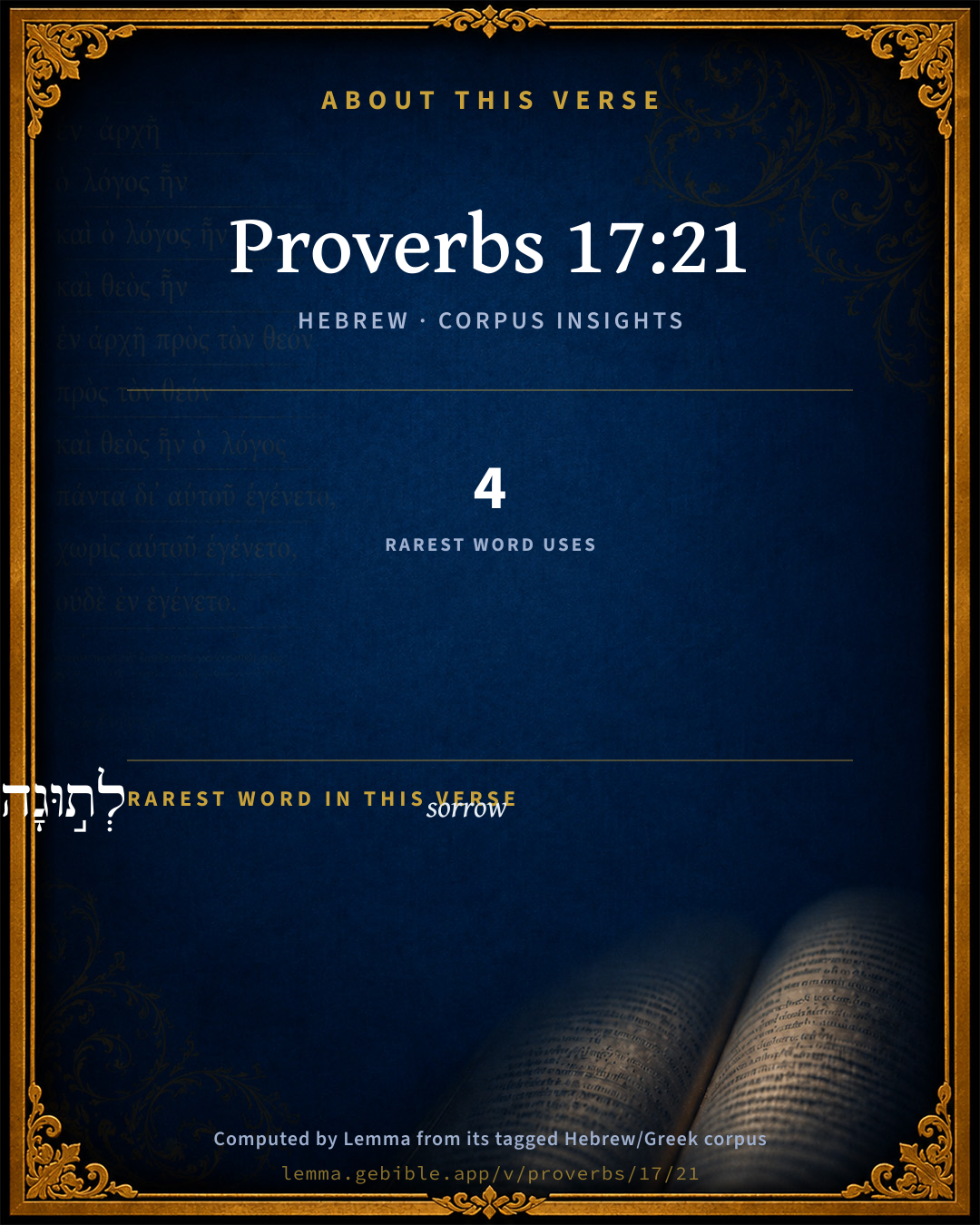
The rarest word here is לְת֣וּגָה sorrow H8424 — appearing just 4 times in the whole Hebrew Bible.

Shared distinctive vocabulary

לְת֣וּגָה sorrow H8424 occurs in 4 verses of the Hebrew Bible. Also found in:

Grammatical profile

  • 2 verbs
  • 2 nouns
  • 2 adjectives
  • 1 preposition
  • 1 particle

Verb forms

  • יֹלֵ֣ד Qal · Participle Active
  • יִ֝שְׂמַ֗ח Qal · Imperfect

Hebrew & Septuagint length

In English translation the verse runs 17 words from the Hebrew and 26 from the Septuagint (LXX English) — the Septuagint runs noticeably longer here. See the side-by-side →

A rough comparison of the two English renderings, which tokenize alike — not a word-level alignment.

Word counts can differ between the Hebrew and the Greek without any difference in meaning — e.g. the Hebrew direct-object marker אֵת has no separate Greek word, and Greek often adds the article ὁ.

Cross-references

11

Topical passages linked to Proverbs 17:21 in the Treasury of Scripture Knowledge — connected by theme and wording, ordered by reader-vote popularity; previews shown in the World English Bible.

  • Proverbs 10:1 The proverbs of Solomon. A wise son makes a glad father; But a foolish son brings grief to his mother.
  • Proverbs 19:13 A foolish son is the calamity of his father. A wife's quarrels are a continual dripping.
  • Genesis 26:34 When Esau was forty years old, he took as wife Judith, the daughter of Beeri the Hittite, and Basemath, the daughter of Elon the Hittite.
  • 1 Samuel 2:32–35 You shall see the affliction of [my] habitation, in all the wealth which [God] shall give Israel; and there shall not be an old man in your house forever.
  • Proverbs 15:20 A wise son makes a father glad, But a foolish man despises his mother.
  • Proverbs 17:25 A foolish son brings grief to his father, And bitterness to her who bore him.
  • Proverbs 23:15–16 My son, if your heart is wise, Then my heart will be glad, even mine:
  • 2 Samuel 18:33 The king was much moved, and went up to the chamber over the gate, and wept: and as he went, thus he said, my son Absalom, my son, my son Absalom! would I had died for you, Absalom, my son, my son!
  • 2 Corinthians 2:3 And I wrote this very thing to you, so that, when I came, I wouldn't have sorrow from them of whom I ought to rejoice; having confidence in you all, that my joy would be shared by all of you.
  • Philemon 1:19–20 I, Paul, write this with my own hand: I will repay it (not to mention to you that you owe to me even your own self besides).
  • 3 John 1:4 I have no greater joy than this, to hear about my children walking in truth.

Cross-references courtesy of OpenBible.info (CC BY 4.0).

Hebrew and Greek witnesses Masoretic Hebrew ↔ Greek Septuagint

The same verse in the two great witnesses to the Old Testament, shown verse-for-verse.

Here the Septuagint runs noticeably longer than the Hebrew — LXX2012 (modern English Septuagint) 26 words vs World English Bible 17. A rough length comparison of the two English translations, not a word-level alignment — read both below.

These are two independent witnesses, not word-aligned to each other, and the Septuagint is shown in lemma (dictionary) form.

Hebrew Proverbs 17:21 Masoretic · Westminster Leningrad Codex

יֹלֵ֣ד כְּ֭סִיל לְת֣וּגָה ל֑וֹ וְלֹֽא יִ֝שְׂמַ֗ח אֲבִ֣י נָבָֽל

He who becomes the father of a fool grieves. The father of a fool has no joy.

World English Bible · Public Domain

Greek LXX Proverbs 17:21 Septuagint · lemma form

καρδία δέ ἄφρων ὀδύνη ὁ κτάομαι αὐτός οὐ εὐφραίνω πατήρ ἐπί υἱός ἀπαίδευτος υἱός δέ φρόνιμος εὐφραίνω μήτηρ αὐτός

and the heart of a fool is grief to its possessor. A father rejoices not over an uninstructed son; but a wise son gladdens his mother.

LXX2012 (modern English Septuagint) · Public Domain

On this verse, The Pulpit Commentary discusses the Septuagint’s reading. Read the note in Commentary ↓

Hebrew: Westminster Leningrad Codex (CC BY 4.0). Greek: Septuagint (public domain); English from LXX2012 (modern English Septuagint) (Public Domain). How the Septuagint differs from the Hebrew →

Commentary

Notes on Proverbs 17:21 from classic Christian and Jewish commentators (each source and its license shown beneath its notes). The classic Christian expositions comment on the surrounding passage and are grouped to its opening verse, so a note may address several verses; the Jewish commentaries on the Tanakh (Rashi and others) are per-verse, so they appear only where the commentator wrote on this verse.

Lemma curates 59 commentaries, every one of them public domain or Creative Commons licensed, each selected and text-cleaned for this edition rather than reprinted as found. About our sources →

Trapp's Complete Commentary

John Trapp

Pro 17:21 He that begetteth a fool [doeth it] to his sorrow: and the father of a fool hath no joy.

Ver. 21. He that begetteth a fool, doeth it to his sorrow.] Solomon might speak this by experience, and wish, as Augustus did, utinam caelebs vixissem, aut orbus periissem. Oh that I had either lived a bachelor or died childless! To "bring forth children to the murderer," {Hos 9:13} children to the devil, that old manslayer; oh, what a grief is this to a pious parent! how much better were a "miscarrying womb, and dry breasts!" What heavy moan made David for his Absalom, dying in his sin! How doth many a miserable mother weep and warble out that mournful ditty of hers in Plutarch over her deceased children, Quo pueri estis profecti? Poor souls, what is become of you!

And the father of a fool hath no joy.] No more than Oedipus had, who cursed his children when he died, and breathed out his last with

“Per coacervatos pereat domus impia luctus.”

No more than William the Conqueror had in his ungracious children, or Henry II, who, finding that his sons had conspired against him with the king of France, fell into a grievous passion, cursing both his sons, and the day wherein himself was born; and in that distemperature departed the world, which himself had so oft distempered. {a}

{a} Daniel, fol. 112.

John Trapp, A Commentary or Exposition upon All the Books of the Old and New Testament (1647–1656) — public domain. Text from a community e-Sword module.

Matthew Henry's Commentary

This expresses that very emphatically which many wise and good men feel very sensibly, what a grievous vexatious thing it is to have a foolish wicked child. See here, 1. How uncertain all our creature-comforts are, so that we are often not only disappointed in them, but that proves the greatest cross in which we promised ourselves most satisfaction. There was joy when a man-child was born into the world, and yet, if he prove vicious, his own father will wish he had never been born. The name of Absalom signifies his father's peace, but he was his greatest trouble. It should moderate the desire of having children, and the delights of their parents in them, that they may prove a grief to them; yet it should silence the murmurings of the afflicted father in that case that if his son be a fool he is a fool of his own begetting, and therefore he must make the best of him, and take it up as his cross, the rather because Adam begets a son in his own likeness. 2. How unwise we are in suffering one affliction (and that of an untoward child as likely as any other) to drown the sense of a thousand mercies: The father of a fool lays that so much to heart that he has no joy of any thing else. For this he may thank himself; there are joys sufficient to counterbalance even that sorrow.

Matthew Henry's Commentary on the Whole Bible (1708–1710) — public domain (CC PDM 1.0). Text via the HelloAO Bible API.

Jamieson, Fausset & Brown

Robert Jamieson, A. R. Fausset & David Brown

(Compare Pro 23:24). Different words are rendered by "fool," both denoting stupidity and impiety.

Jamieson, Fausset & Brown — Commentary Critical and Explanatory on the Whole Bible (1871) — public domain (CC PDM 1.0). Text via the HelloAO Bible API.

Ellicott's Commentary for English Readers

(21) He that begetteth a fool (khesîl).—See above, on Pro_1:32.

The father of a fool (nâbhâl).—See above, on Pro_17:7.

A Bible Commentary for English Readers, edited by Charles John Ellicott (1878–1897) — public domain. Text from a community e-Sword module.

The Cambridge Bible for Schools and Colleges

gen. ed. J. J. S. Perowne

21. a fool … a fool] The Heb. word so rendered is not the same in the two clauses of the verse. The first word in the first clause describes the fool as dull or senseless, or as some think obstinate. The second word points him out as shameless, like Nabal, whose name (the Heb. word here) was descriptive of his character (1Sa_25:25). There is a third Heb. word, used more commonly than either of these in this Book, which regards a fool as one who is perverse, or as some render, weak.

The Cambridge Bible for Schools and Colleges (gen. ed. J. J. S. Perowne; Cambridge University Press, 1878–1918) — public domain. Text from a community e-Sword module.

John Gill's Exposition

He that begetteth a fool doth it to his sorrow,.... As it proves in the issue; though it was joy to him when a man child was born, and took delight in him while in infancy and childhood, and promised himself much happiness in him when at years of discretion; but, instead of that, he departs from his education principles, despises all parental counsels and advice, and goes into all the extravagance of sin and folly; which is an heartbreaking to his godly and religious parents; for this is to be understood; not of an idiot, but of a wicked son, taking bad courses;

and the father of a fool hath no joy; in his son, but sorrow, and has scarce any joy or pleasure in anything else in all his enjoyments; the trouble he is filled with on his account embitters all he has, that he can take no satisfaction, or have any comfort of life; the concern for his son is uppermost in his thoughts, and hinders him from taking that pleasure which otherwise he might enjoy.

John Gill's Exposition of the Whole Bible (1746–1763) — public domain (CC PDM 1.0). Text via the HelloAO Bible API.

Matthew Poole's English Annotations

A fool; not a natural, but a wilful fool, or a wicked son.

The father; and consequently the mother also.

Hath no joy, which parents usually have in the birth of a child, and especially of a son; but hath great cause of sorrow, the contrary being implied in this and such-like expressions, as in Scripture, as Pro 10:2, &c., so also in profane authors; whose words see in my Latin Synopsis.

Matthew Poole's English Annotations on the Holy Bible (1683–1685) — public domain. Text from a community e-Sword/MySword module.

Whedon's Commentary on the Bible

Daniel D. Whedon

21. A fool — A boor; a dolt. Two different words are rendered “fool” in the text. They are akin in sense, but there is a shade of difference between them. The first contains the idea of impiety joined with coarseness; the second, of impiety joined with dullness. Comp. Pro_10:1, and the converse, Pro_23:24; Pro_15:20.

Daniel D. Whedon (gen. ed.), Commentary on the Old and New Testaments (1874–1909) — public domain. Text from a community e-Sword module.

The Pulpit Commentary

He that begetteth a fool doeth it to his sorrow (comp. ver. 25). The words for "fool" in the two clauses are different. Here it is kesil, which implies bold, self-confident folly, the worst form of the vies; in the second hemistich it is nabal, which rather denotes dulness and stupidity, a want of mental power. A conceited, offensive fool causes infinite trouble to his father, both from his need of constant correction, and the watchfulness required to repair the consequences of his foolish actions. There is also the grief at seeing instruction and warning thrown away on a worthless object. Septuagint, "The heart of a fool is a pain to him who possesseth it." The father of a fool hath no joy. The contrast in the ease of a good son is seen Pro_15:20 and in Pro_23:24. The LXX adds a clause from Pro_10:1, with the view of improving the parallelism, "But a prudent son rejoiceth his mother.

Vers. 21-28. Varied experiences of good and evil in life.

We may divide them into the sorrowful, the joyous, and the mixed experiences.

I SAD EXPERIENCES. The sorrow of thankless children. (Vers. 21, 25) To name it is enough for thereto who have known it. It has its analogue in Divine places. How pathetically does the Bible speak of the grief of God over the rebellious children he has nourished and brought up! and of Christ"s lamentation as of a mother over Jerusalem! Let us remember that our innocent earthly sorrows are reflected in the bosom of our God.

II JOYOUS EXPERIENCES. (Ver. 22) The blessing of a cheerful heart, who can overprize it in relation to personal health, to social charm and helpfulness? Contrasted with the troubled spirit, like a parching fever in the bones, it is the perpetual sap of life and source of all its greenness and its fruit. A simple faith is the best known source of cheerfulness. It was a fine remark of a good friend of Dr. Johnson"s, that "he had tried to be a philosopher, but somehow always found cheerfulness creeping in.

III MIXED EXPERIENCES OF HUMAN CHARACTER.

1. The briber. (Ver. 23) How strongly marked is this sin in the denunciations of the Bible! and yet how little the practice seems affected in a land which boasts above others of its love for the Bible! The stealth and so the shame, the evil motive, the perverse result, all are branded here. "He that shaketh his hands from holding of bribes, he shall dwell on high". (Isa_33:15)

2. The quick perception of wisdom and the warning glance of folly. The one sees before him what is to be known or done at once; the other is lost in cloudy musings. The more a man gapes after vanity, the more foolish the heart becomes. In religion we see this temper in the restless roving to and fro, the constant query, "Who will show us any good?" "He is full of business at church; a stranger at home; a sceptic abroad; an observer in the street; everywhere a fool.

3. Harshness in judges. (Ver. 26) Fining and flogging are mentioned. The writer had observed some such scene with the horror of a just man. Inequity or inhumanity in the judge seems an insult against the eternal throne of Jehovah.

4. The wisdom of a calm temper and economy of words. (Vers. 27, 28) An anxiety to talk is the mark of a shallow mind. The knowledge of the season of silence and reserve may be compared to the wisdom of the general who knows when to keep his forces back and when to launch them at the foe. The composed spirit comes from the knowledge that truth will prevail in one way or another, and the time for our utterance will arrive. Lastly, the wisdom of silence, so often preached by great men. Even the fool may gain some credit for wisdom which he does not possess by holding his tongue; and this is an index of the reality. Our great example here is the silence of Jesus, continued for thirty years; out of that silence a voice at length proceeded that will ever vibrate through the world. J.

Vers. 21, 25. See homily on Pro_10:1. C.

The Pulpit Commentary (1880–1919), ed. H.D.M. Spence-Jones & Joseph S. Exell — public domain. Text from a community e-Sword module.

Bridges on Proverbs

Charles Bridges

Among "the vanities, to which the creature is made subject," Solomon elsewhere enumerated one, of which he probably had a feeling experience — leaving the labour of his hand — he knoweth not to whom — whether he shall be a wise man or a fool. (Ecc 2:18-19 .) The latter prospect is here realized. The weeping parent not only finds no joy in the fondly cherished object of his expectation; but a cankering grief embitters all his joys, and often brings him "down with sorrow to the grave."†1 And how is this sorrow aggravated, should there be an unhappy humbling consciousness, that undue indulgence or severity, injudicious treatment, and more than all — neglect of real prayer for the child,†2 and of the diligent improvement of God’s appointed means, virtually suffered the evil propensities to grow to a direful harvest of ruin!

Yet let the godly parent expect everything from prayer — provided it be not palsied by despondency. (Gal 6:9 ; Joh 11:40 .) In the deepest distress never lose hold of the covenant of grace. (Gen 17:7 .) Let the determined faith of a praying mother encourage perseverance. (Mat 15:22-28 .) God exercises faith; but he never fails to honour it. He delays to answer prayer; but every word, every sigh, is registered for acceptance in his best time. Let Solomon’s word be a quickening — not a discouraging — word; "profitable" indeed "for reproof, and for correction;" but not less so "for instruction in righteousness." (2Ti 3:16 .)

Footnotes:

†1 Gen 42:38. Has not many an afflicted parent fellowship with the impassioned cry of Augustus —’Would that I had lived single, or died childless?’

†2 Bishop Sanderson’s Sermon on Rom 15:5 . ’Think none of you, you have sufficiently discharged your parts towards those that are under your charge, if you have instructed them, corrected them when they have done amiss, and rewarded them when they have done well, so long as your fervent prayers for them have been wanting. In vain shall your wrestle with their stubbornness and other corruptions, (though you put forth all your strength) so long as you wrestle with them only. Then, or not at all, shall you wrestle to purpose, when you enter the lists with the Father of Spirits, as Jacob did: wrestling with him by your importunate prayers; and not giving him over, till you have wrung a blessing from him, either for yourselves, or them, or both.’

Charles Bridges, An Exposition of the Book of Proverbs (1846) — public domain. Text from a community e-Sword module.

Kretzmann's Popular Commentary

Paul E. Kretzmann

v. 21. He that begetteth a fool doeth it to his sorrow, he is most unfortunate to have a fool for his son; and the father of a fool hath no joy. Pro 10:1; Pro 18:13.

Paul E. Kretzmann, Popular Commentary of the Bible (1921–1924) — public domain. Text from a community e-Sword module.

unfoldingWord translationNotes

Door43 World Missions Community

A cheerful heart is good medicine

This speaks of a cheerful heart as being good medicine because it makes you feel better. AT: "A cheerful heart is like medicine that makes you feel better" (See: Metaphor)

A cheerful heart

The "heart" represents a person's feelings, attitudes and motivations. AT: "Being cheerful" (See: Metonymy)

a broken spirit

Here the "spirit" represents a person's feelings and emotional state. A broken spirit refers to a poor emotional state. AT: "depression" (See: Metonymy)

dries up the bones

A person's bones represent their physical health and strength. If a person's bones dry up it means that they are very sick and unhealthy. AT: "makes a person unhealthy and weak" (See: Metonymy)

translationWords

fool

joy

heart

spirit

unfoldingWord translationNotes — © Distant Shores Media and the Door43 World Missions Community, licensed CC BY-SA 4.0. Source: git.door43.org/Door43/en_tn.

Lesson kit

Teaching starters — assembled from the data on this page, not authored interpretation. Every prompt links to the verse data it draws on. Edit before teaching.

Proverbs, in the Wisdom, opens this verse with 8 words (7 distinct Hebrew lemmas). Its most distinctive word is tûwgâh (“sorrow”). The Greek Septuagint runs longer here. A historical commentator’s framing appears above. Read the whole chapter for the surrounding context.

Discussion questions

  1. The word tûwgâh carries the sense “sorrow.” How does it shape the verse?
  2. Psalms 119:28 shares the word «sorrow» with this verse. How do the two illuminate each other?
  3. Compared with the Hebrew, the Septuagint runs longer here. What questions does that raise?
  4. These translations render this verse differently; the difference is in the English rendering, not the original. What questions does that raise?
  5. The verb «יֹלֵ֣ד» is Qal Participle Active. How does its form color the action?
  6. Reading how Trapp's Complete Commentary and Matthew Henry's Commentary read this verse, where do the two commentators agree and where do they part?

Things to notice

Reading settings

Reading text

Shown beneath each verse's original-language words.

Old Testament
Old Testament edition

Read the OT as the Masoretic Hebrew (MT) or the Greek Septuagint (LXX).

English shown for the Greek Septuagint (in the Hebrew ↔ Greek comparison).

Comparing translations? Open the Compare panel on any verse page to stack up to four side by side.