
Psalms 34:2

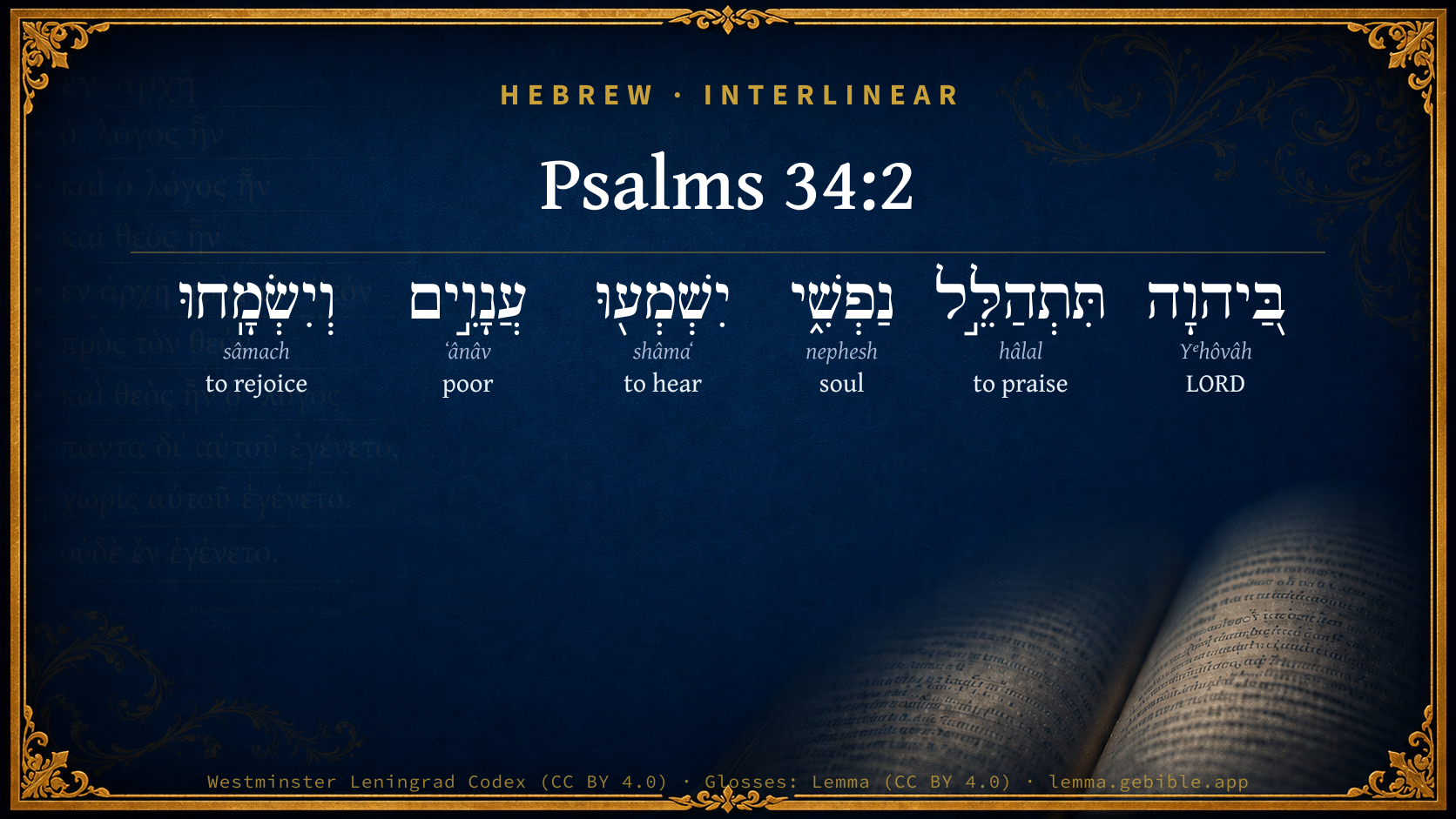
Hebrew (Westminster Leningrad Codex) Psalms 34:2 appears in the Hebrew Old Testament. The text above is from the Westminster Leningrad Codex. Each word links to its Strong’s number, a concise gloss, and parsing drawn from the Open Scriptures Hebrew Bible morphology. Click any word for its full Brown-Driver-Briggs (BDB) entry.
Download image
Cite this verse

Psalms 34:2 (World English Bible). Public Domain. Lemma interlinear Bible study tool, https://lemma.gebible.app/v/psalms/34/2.

Show BibTeX & RIS
BibTeX
RIS
English Translation
My soul shall boast in Yahweh. The humble shall hear of it, and be glad.
World English Bible · Public Domain
Download a study sheet

One document with this verse’s original text, its word-by-word gloss line, the meaning frame, cross-references with their text, attributed commentary, and full source and license credits — printable, and it pastes into notes with its structure intact.

This verse Autodidact and up

Study sheet (.html) Plain text (.txt)

A passage Seminary Student

Up to 50 verses in one chapter. A passage sheet keeps up to 6 commentary sources and 12 cross-references per verse, in the order this page ranks them, and says so on the sheet whenever that leaves anything out. Ask for a single verse and you get the Autodidact verse sheet above.

Everything on this page stays free to read, with no account — the sheet is a download of what is already on screen, not access to it.

Want to remove ads? Support Godless Engineer
Compare translations 3

The same verse in 3 English versions, stacked beneath the original-language interlinear above. Click any original word for its lexicon entry.

Each is an independent rendering of the whole verse — the interlinear is not word-aligned to these translations.

Highlighted words mark where these versions differ — a whole-verse word diff, not a word-by-word alignment.

  • World English Bible Public Domain
    My soul shall boast in Yahweh. The humble shall hear of it, and be glad.
  • King James Version Public Domain
    My soul shall make her boast in the LORD: the humble shall hear thereof, and be glad.
  • unfoldingWord Literal Text CC BY-SA 4.0
    In Yahweh my soul will boast; the humble will hear and rejoice.

unfoldingWord Literal Text — © unfoldingWord, licensed CC BY-SA 4.0. Word-aligned USFM3 via Door43 (git.door43.org/unfoldingWord/en_ult).

Versions to compare (up to 4)

3 of 4 selected

Show all 18 translations

Every available English version of this verse, each an independent rendering of the whole verse.

  • World English Bible Public Domain
    My soul shall boast in Yahweh. The humble shall hear of it, and be glad.
  • Berean Standard Bible Public Domain
    My soul boasts in the LORD; let the oppressed hear and rejoice.
  • Majority Standard Bible Public Domain
    My soul boasts in the LORD; let the oppressed hear and rejoice.
  • King James Version Public Domain
    My soul shall make her boast in the LORD: the humble shall hear thereof, and be glad.
  • American Standard Version (1901) Public Domain
    My soul shall make her boast in Jehovah: The meek shall hear thereof, and be glad.
  • Revised Version (1885) Public Domain
    My soul shall make her boast in the LORD: the meek shall hear thereof, and be glad.
  • Geneva Bible (1599) Public Domain
    My soule shall glory in the Lord: the humble shall heare it, and be glad.
  • Douay-Rheims (1899) Public Domain
    I will bless the Lord at all times, his praise shall be always in my mouth.
  • Young's Literal Translation Public Domain
    In Jehovah doth my soul boast herself, Hear do the humble and rejoice.
  • Literal Standard Version CC BY-SA 4.0
    In YHWH my soul boasts herself, || The humble hear and rejoice.
  • Unlocked Literal Bible CC BY-SA 4.0
    I will praise Yahweh! May the oppressed hear and rejoice.
  • unfoldingWord Literal Text CC BY-SA 4.0
    In Yahweh my soul will boast; the humble will hear and rejoice.
  • Darby Bible Public Domain
    My soul shall make its boast in Jehovah: the meek shall hear, and rejoice.
  • World Messianic Bible Public Domain
    My soul shall boast in the LORD. The humble shall hear of it and be glad.
  • Webster's Bible Public Domain
    \\34:1\\A Psalm of David, when he changed his behavior before Abimelech; who drove him away, and he departed. I will bless the LORD at all times: his praise shall continually be in my mouth.
  • Free Bible Version CC BY-SA 4.0
    From the bottom of my heart I am proud of the Lord; those who are humble will hear and be happy.
  • Bible in Basic English Public Domain
    My soul will say great things of the Lord: the poor in spirit will have knowledge of it and be glad.
  • JPS Tanakh (1917) Public Domain
    (34-3) My soul shall glory in the LORD; the humble shall hear thereof, and be glad.

Literal Standard Version (2020), Covenant Press — licensed CC BY-SA 4.0. Text via the HelloAO Bible API (eBible.org). Unlocked Literal Bible (unfoldingWord) — licensed CC BY-SA 4.0. Text via the HelloAO Bible API (eBible.org). unfoldingWord Literal Text — © unfoldingWord, licensed CC BY-SA 4.0. Word-aligned USFM3 via Door43 (git.door43.org/unfoldingWord/en_ult). Free Bible Version, Dr. Jonathan Gallagher — licensed CC BY-SA 4.0. Text via the HelloAO Bible API (eBible.org).

Word by word

More ways to search: Search by grammar → Find every occurrence → Compare this word →

Practice this passage: Drill this verse → Learn its vocabulary →

About this verse

These counts appear in no published source. They are computed here, from the morphology-tagged text and Lemma’s own curated glosses. What Lemma adds →

6
words
6
distinct lemmas
Wisdom
section

Shared distinctive vocabulary

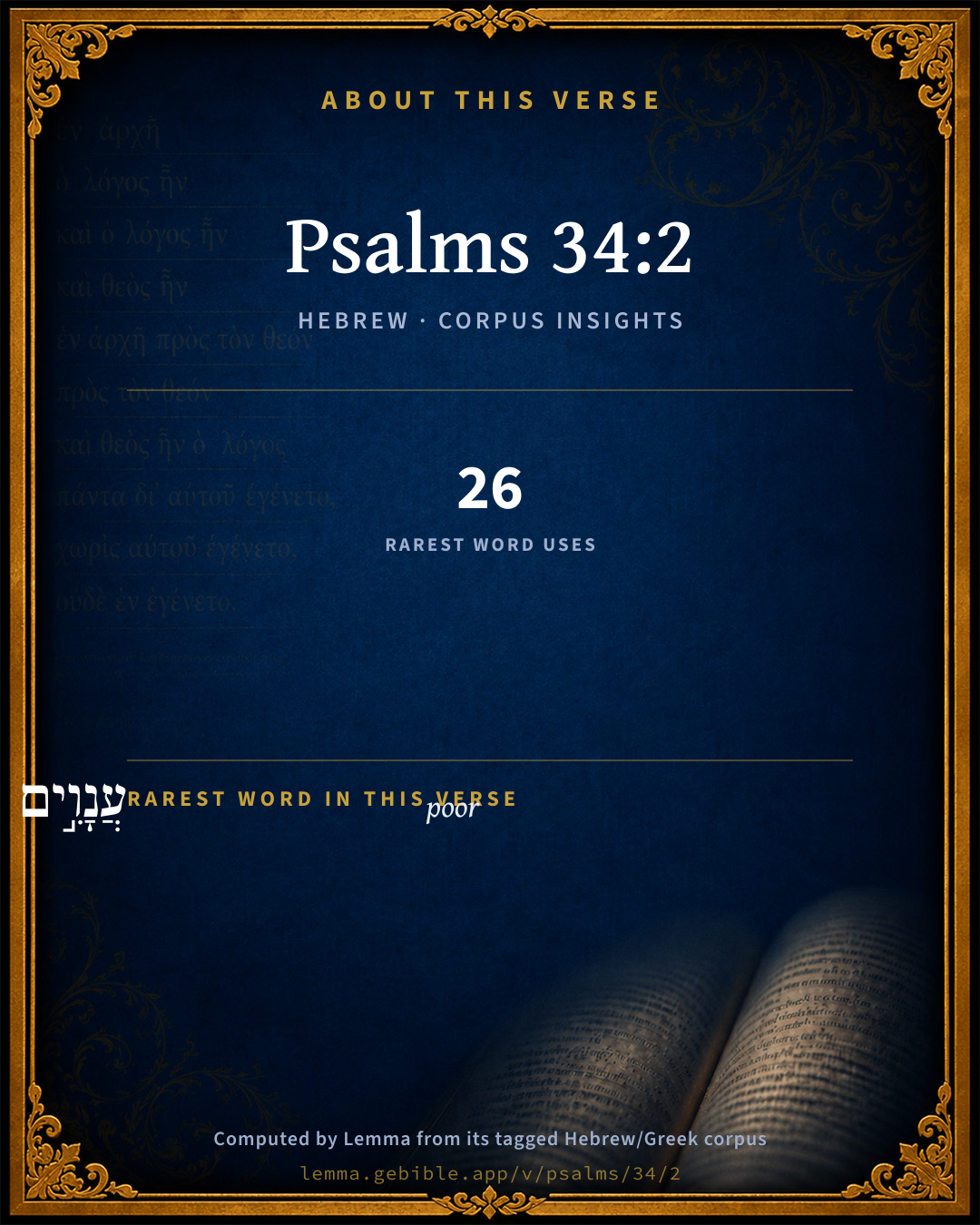
עֲנָוִ֣ים poor H6035 occurs in 24 verses of the Hebrew Bible. Also found in:

Grammatical profile

  • 3 verbs
  • 2 nouns
  • 1 adjective

Verb forms

  • תִּתְהַלֵּ֣ל Hithpael · Jussive
  • יִשְׁמְע֖וּ Qal · Imperfect
  • וְיִשְׂמָֽחוּ Qal · Imperfect

Hebrew & Septuagint length

In English translation the verse runs 15 words from the Hebrew and 14 from the Septuagint (LXX English) — closely comparable.

A rough comparison of the two English renderings, which tokenize alike — not a word-level alignment.

Word counts can differ between the Hebrew and the Greek without any difference in meaning — e.g. the Hebrew direct-object marker אֵת has no separate Greek word, and Greek often adds the article ὁ.

Cross-references

11

Topical passages linked to Psalms 34:2 in the Treasury of Scripture Knowledge — connected by theme and wording, ordered by reader-vote popularity; previews shown in the World English Bible.

  • Jeremiah 9:24 but let him who glories glory in this, that he has understanding, and knows me, that I am Yahweh who exercises loving kindness, justice, and righteousness, in the earth: for in these things I delight, says Yahweh.
  • 1 Corinthians 1:31 that, according as it is written, "He who boasts, let him boast in the Lord."
  • Psalms 119:74 Those who fear you will see me and be glad, Because I have put my hope in your word.
  • Psalms 44:8 In God we have made our boast all day long, We will give thanks to your name forever. Selah.
  • Psalms 22:22–24 I will declare your name to my brothers. In the midst of the assembly, I will praise you.
  • Isaiah 45:25 In Yahweh shall all the seed of Israel be justified, and shall glory.
  • 2 Corinthians 10:17 But "he who boasts, let him boast in the Lord."
  • 1 Timothy 1:15–16 The saying is faithful and worthy of all acceptance, that Christ Jesus came into the world to save sinners; of whom I am chief.
  • Psalms 105:3 Glory in his holy name. Let the heart of those who seek Yahweh rejoice.
  • Psalms 32:5–6 I acknowledged my sin to you. I didn't hide my iniquity. I said, I will confess my transgressions to Yahweh, And you forgave the iniquity of my sin. Selah.
  • Psalms 142:7 Bring my soul out of prison, That I may give thanks to your name. The righteous will surround me, For you will be good to me.

Cross-references courtesy of OpenBible.info (CC BY 4.0).

Hebrew and Greek witnesses Masoretic Hebrew ↔ Greek Septuagint

The same verse in the two great witnesses to the Old Testament, shown verse-for-verse.

You’re reading Greek Psalm 33 (Hebrew Psalm 34). The Septuagint counts the superscription, so verse numbers can differ from the Hebrew — chapter-level alignment, not verse-by-verse. Numbering follows Rahlfs.

These are two independent witnesses, not word-aligned to each other, and the Septuagint is shown in lemma (dictionary) form.

Hebrew Psalms 34:2 Masoretic · Westminster Leningrad Codex

בַּ֭יהוָה תִּתְהַלֵּ֣ל נַפְשִׁ֑י יִשְׁמְע֖וּ עֲנָוִ֣ים וְיִשְׂמָֽחוּ

My soul shall boast in Yahweh. The humble shall hear of it, and be glad.

World English Bible · Public Domain

Greek LXX Greek Psalm 33:2 Septuagint · lemma form

εὐλογέω ὁ κύριος ἐν πᾶς καιρός διά πᾶς ὁ αἴνεσις αὐτός ἐν ὁ στόμα ἐγώ

My soul shall boast herself in the Lord: let the meek hear, and rejoice.

LXX2012 (modern English Septuagint) · Public Domain

On this verse, Ellicott's Commentary for English Readers discusses the Septuagint’s reading. Read the note in Commentary ↓

Hebrew: Westminster Leningrad Codex (CC BY 4.0). Greek: Septuagint (public domain); English from LXX2012 (modern English Septuagint) (Public Domain). How the Septuagint differs from the Hebrew →

Commentary

Notes on Psalms 34:2 from classic Christian and Jewish commentators (each source and its license shown beneath its notes). The classic Christian expositions comment on the surrounding passage and are grouped to its opening verse, so a note may address several verses; the Jewish commentaries on the Tanakh (Rashi and others) are per-verse, so they appear only where the commentator wrote on this verse.

Lemma curates 59 commentaries, every one of them public domain or Creative Commons licensed, each selected and text-cleaned for this edition rather than reprinted as found. About our sources →

Trapp's Complete Commentary

John Trapp

Psa 34:2 My soul shall make her boast in the LORD: the humble shall hear [thereof], and be glad.

Ver. 2. My soul shall make her boast in the Lord] This holy gloriation is a Christian’s duty not to be neglected. The Church in the Canticles is much in it; and so is St Paul. It showeth a heart full of joys unspeakable and full of glory, 1Pe 1:8. And, besides, God is thereby greatly glorified, Jer 9:23-24.

The humble shall hear thereof, and be glad] Not for my sake only, but their own, as conceiving good hope of like deliverance. But, then, they must be as I am, not only humbled, but humble; low, but lowly.

John Trapp, A Commentary or Exposition upon All the Books of the Old and New Testament (1647–1656) — public domain. Text from a community e-Sword module.

The Biblical Illustrator

Joseph S. Exell

Psa_34:2

My soul shall make her boast in the Lord; the humble shall hear thereof and be glad.

Rightful boasting

We all are prone to boast, and often on very slender grounds. The worst are they who boast of their own goodness. We are to glory only in the Lord. Now such rightful boasting includes the elevation of joyous feeling, and the breaking forth of gratitude and praise. And the humble shall hear thereof. Others would tell them, or, if not, the psalmist himself would. Spiritual sadness seeks seclusion, but not so spiritual freedom and joy. Like the return of health and of day, it says to the prisoners, Go forth; to them that are in darkness, Show yourselves. And the effect of this knowledge would be to make them glad. The Lords followers are supposed to be mopish and melancholy; but they have a thousand sources of joy which others know not of. (W. Jay.)

On glorying in God alone

What can better become us, who are the creatures of God, than to bless Him, and depend on Him? What can better become us, as Christians, than to be always praising add magnifying that God, to whose grace we owe our salvation and happiness?

I. the examples of excellent persons (Jer_9:23-24; 1Co_1:29-31). St. Paul himself was an eminent example of his own doctrine; for when, to vindicate himself, he found himself obliged to recount what he had done and suffered in the cause of Christianity, together with his endowments, graces and privileges, he begs pardon for it, calls it the foolishness of boasting, and as nothing less could excuse it, he pleads necessity for it (2Co_11:20). But this apostle, who was thus shy of glorying in his excellencies and advantages, lest he should seem too tender of his own honour, how forward he is to record his infirmities, that he might advance Gods (2Co_12:9). We cannot be Christians unless God be all in all to us; unless we look upon Him as the source and spring of all good, the object of our joy and glory, and the ultimate end of our desires and hopes.

II. we have received all from him. Whether natural endowments, or worldly possessions, all that we are born to, and all that we acquire, judgment, courage, wit, eloquence, wealth, power, favour, and the like, we certainly owe to God. And if we derive all from God, acknowledgment and praise is the least sacrifice we can make Him.

III. We depend so entirely upon God, that we can reap little benefit, nay, we may suffer much prejudice by the most excellent endowments and possessions, unless they be sanctified by his grace, and befriended by his providence (Ecc_9:11). How naturally do riches breed luxury! power tyranny! honour insolence! favour and applause vanity!

IV. To boast in anything but God is a symptom of extreme profaneness and irreligion; for whence can this proceed, but from an understanding darkened by ignorance or infidelity, or from a heart alienated from God, and possessed by some vile idol?

V. The heathen thought that there was an envious daemon, whose peculiar province it was to cast down the vainglorious and insolent; but we Christians are taught that to humble the proud is a work that god delights in (Isa_2:12; Jam_4:6). And why does God take pleasure in this? To assert His sovereignty and dominion, to imprint an awe of His power upon the minds of mankind, and to extort from the proudest and vainest of mortals a confession of their meanness and His majesty.

VI. marks by which we may examine ourselves in reference to this matter.

1. If we have grateful hearts towards God, we shall let slip no occasion which invites us to praise and honour Him. Not only those things that are new and surprising, that are unusual or extraordinary, but also the common and ordinary works of God, and His constant and daily benefits, will affect our hearts with a devout and thankful remembrance of Him.

2. If we truly glory in the Lord, and in nothing else, our admiration and reverence, our love and gratitude will discover themselves, not only in our words, but in our actions. The principle which causes us to be humble and thankful towards God, will keep us from being disrespectful and insolent towards man; and, in general, we shall think it our duty, not only to glorify God by praise and thanksgiving, but also and especially by a right use and employment of His benefits and mercies.

3. The practice of this duty does by degrees advance us to a settled state of pleasure. What can be more delightful than the exercise of love, when the object of it is most perfect? (Psa_63:4-6). (R. Lucas, D. D.)

The Biblical Illustrator, edited by Joseph S. Exell (c. 1880s–1900s) — public domain. Text from a community e-Sword module.

The Treasury of David

Charles H. Spurgeon

Ver. 2. My soul shall make her boast in the Lord. Boasting is a very natural propensity, and if it were used as in this case, the more it were indulged the better. The exultation of this verse is no mere tongue bragging, "the soul" is in it, the boasting is meant and felt before it is expressed. What scope there is for holy boasting in Jehovah! His person, attributes, covenant, promises, works, and a thousand things besides, are all incomparable, unparalleled, matchless; we may cry them up as we please, but we shall never be convicted of vain and empty speech in so doing. Truly he who writes these words of comment has nothing of his own to boast of, but much to lament over, and yet none shall stop him of his boast in God so long as he lives. The humble shall hear thereof, and be glad. They are usually grieved to hear boastings; they turn aside from vauntings and lofty speeches, but boasting in the Lord is quite another matter; by this the most lowly are consoled and encouraged. The confident expressions of tried believers are a rich solace to their brethren of less experience. We ought to talk of the Lord's goodness on purpose that others may be confirmed in their trust in a faithful God.

Ver. 2. My soul shall make her boast in the Lord. Not like the boasting of the Pharisee, so hateful in the eyes of God, so offensive in the ears of the humble; for the humble can hear this boasting and be glad, which they would never do if it were not conformable to the rules of humility. Can any boasting be greater than to say, "I can do all things"? Yet in this boasting there is humility when I add, "In him that strengtheneth me." For though God likes not of boasting, yet he likes of this boasting, which arrogates nothing to ourselves, but ascribes all to him. Sir Richard Baker.

Ver. 2-6. There is somewhat very striking and pleasing in the sudden transitions, and the change of persons, that is observable in these few verses. "My soul shall boast; ""The humble shall hear; " "I sought the Lord; ""They looked to him; ""This poor man cried." There is a force and elegance in the very unconnectedness of the expressions, which, had they been more closely tied by the proper particles, would have been in a great measure lost. Things thus separated from each other, and yet accelerated, discover, as Longinus observes, the earnestness and the vehemency of the inward working of the mind; and though it may seem to interrupt, or disturb the sentence, yet quickens and enforces it. Samuel Chandler, D.D.

Ver. 2. The commendable boaster and his gratified audience.

We may boast of the Lord, in himself, his manifestations of himself, his relationship to us, our interest in him, our expectations from him, etc.

The duty of believers to relate their experience for the benefit of others.

Psalms 34:3*

Ver. 2-6. There is somewhat very striking and pleasing in the sudden transitions, and the change of persons, that is observable in these few verses. "My soul shall boast; ""The humble shall hear; " "I sought the Lord; ""They looked to him; ""This poor man cried." There is a force and elegance in the very unconnectedness of the expressions, which, had they been more closely tied by the proper particles, would have been in a great measure lost. Things thus separated from each other, and yet accelerated, discover, as Longinus observes, the earnestness and the vehemency of the inward working of the mind; and though it may seem to interrupt, or disturb the sentence, yet quickens and enforces it. Samuel Chandler, D.D.

Ver. 2-6. See Psalms on "Ps 34:2" for further information.

Ver. 2-6. See Psalms on "Ps 34:2" for further information.

Ver. 2-6. See Psalms on "Ps 34:2" for further information.

Charles H. Spurgeon's The Treasury of David (1869–1885) — public domain. Psalms only. Text from a community e-Sword/MySword module.

J. A. Alexander on Psalms

Joseph Addison Alexander

3. (Psa 34:2). In Jehovah shall glory my soul; the humble shall hear and rejoice. The first verb is strictly a reflective form, and means to praise one's self, i.e. to boast, or, as denoting a more permanent affection of the mind, to glory, i. e. to exult in the possession and enjoyment of some admired and beloved object. The act of glorying is ascribed to the soul, in order to describe it as done cordially, ex animo.—The humble, as opposed to the proud and the presumptuous, is a general description of God's people, who are naturally interested in the good experienced by the Psalmist, both for his sake and their own. See above, on Psa 22:27 (26), Psa 25:9.

Joseph Addison Alexander, The Psalms Translated and Explained (1850) — public domain. Text from a community e-Sword module.

Geneva Bible (1599)

Geneva Bible translators

They that are beaten down with the experience of their own evils.

Geneva Bible (1599) marginal notes — public domain. Text via Bolls.life.

Jamieson, Fausset & Brown

Robert Jamieson, A. R. Fausset & David Brown

make her boast--"glory" (Psa 105:3; compare Gal 6:14).

humble--"the pious," as in Psa 9:12; Psa 25:9.

Jamieson, Fausset & Brown — Commentary Critical and Explanatory on the Whole Bible (1871) — public domain (CC PDM 1.0). Text via the HelloAO Bible API.

Adam Clarke's Commentary

Verse 2. My soul shall make her boast] Shall set itself to praise the Lord-shall consider this its chief work.

The humble] ענוים anavim, the afflicted, such as David had been.

Adam Clarke's Commentary on the Bible (1810–1826) — public domain. Text from a community e-Sword/MySword module.

John Calvin's Commentaries

2. My soul shall make her boast in Jehovah. The term soul in this place signifies not the vital spirit, but the seat of the affections; as if David had said, I shall always have ground of boasting with my whole heart in God alone, so that I shall never suffer myself to fall into forgetfulness of so great a deliverance. In the second clause he specifies this as the fruit of his thanksgiving, that the afflicted and miserable shall derive from it ground of hope. The Hebrew word ענוים, anavim, which we have rendered humble, signifies not all the afflicted The word ענוים, anavim, may also be rendered the afflicted. Our author in his exposition combines both the ideas of humble and afflicted.

John Calvin's Commentaries (1540-1563) — public domain. Text from the Calvin Translation Society English edition (1840s-50s) via the Christian Classics Ethereal Library (ccel.org). Calvin's coverage is partial (roughly two-thirds of the Bible); uncommented books and verses are honest gaps, never fabricated. The 19th-century editor's footnotes and remarks are omitted so the notes are faithfully Calvin's own voice.

Ellicott's Commentary for English Readers

(2) Humble.—See Note on Psa_9:12. The LXX.

and Vulg., “the meek.” It means here those who have learnt patience in the school of suffering.

A Bible Commentary for English Readers, edited by Charles John Ellicott (1878–1897) — public domain. Text from a community e-Sword module.

The Cambridge Bible for Schools and Colleges

gen. ed. J. J. S. Perowne

2. In the Lord stands emphatically at the beginning of the sentence in the original; in Him, and not in any of the worldling’s objects of self-congratulation (Psa_49:6; Jer_9:23-24), shall be my boast.

the humble &c.] Probably, let the humble (or, meek) hear and be glad. Cp. Psa_5:11. He claims the sympathy of those who have learned humility in the school of suffering. See note on Psa_9:12.

The Cambridge Bible for Schools and Colleges (gen. ed. J. J. S. Perowne; Cambridge University Press, 1878–1918) — public domain. Text from a community e-Sword module.

John Gill's Exposition

My soul shall make her boast in the Lord,.... Not in men, nor in any outward enjoyment, nor in any works of righteousness, but in the Lord; "in the Word of the Lord", as the Targum; in the Lord Jesus Christ; in his wisdom, strength, riches, righteousness, redemption, and salvation; in interest in him, and communion with him: and this is not tongue but soul boasting; and not flashy and selfish, but solid, spiritual, and hearty; and with all the powers and faculties of the soul; see Co1 1:29;

the humble shall hear thereof; either of the deliverance the psalmist had out of the hands of his enemies; or of his blessing and praising the Lord for the same, and making his boast in him as the God of his salvation; or of both: of these humble ones; see Gill on Psa 10:12;

and be glad; for such rejoice with them that rejoice, and are glad at heart that others share in the goodness and grace of God; and also because by such an instance of the divine power and kindness they are encouraged to hope that he will, in his own time, deliver them out of their afflictions and distresses also.

John Gill's Exposition of the Whole Bible (1746–1763) — public domain (CC PDM 1.0). Text via the HelloAO Bible API.

Albert Barnes' Notes on the Bible

My soul shall make her boast in the Lord - I myself will rejoice and exult in him. The word “boast” here refers to that on which a man would value himself; that which would be most prominent in his mind when he endeavored to call to remembrance what he could reflect on with most pleasure. The psalmist here says that when He did this, it would not be wealth or strength to which he would refer; it would not be his rank or position in society; it would not be what he had done, nor what he had gained, as pertaining to this life. His joy would spring from the fact that there was a God; that he was such a God, and that he could regard him as His God. This would be his chief distinction - that on which he would value himself most. Of all the things that we can possess in this world, the crowning distinction is, that we have a God, and that he is such a being as he is.

The humble shall hear thereof - The poor; the afflicted; those who are in the lower walks of life. They should hear that he put his trust in God, and they should find joy in being thus directed to God as their portion and their hope. The psalmist seems to have referred here to that class particularly, because:

(a) they would be more likely to appreciate this than those of more elevated rank, or than those who had never known affliction; and

(b) because this would be specially fitted to impart to them support and consolation, as derived from his own experience.

He had been in trouble. He had been encompassed with dangers. He had been mercifully protected and delivered. He was about to state how it had been done. He was sure that they who were in the circumstances in which he had been would welcome the truths which he was about to state, and would rejoice that there might be deliverance for them also, and that they too might find God a protector and a friend. Calamity, danger, poverty, trial, are often of eminent advantage in preparing the mind to appreciate the nature, and to prize the lessons of religion.

And be glad - Rejoice in the story of my deliverance, since it will lead them to see that they also may find deliverance in the day of trial.

Albert Barnes' Notes on the Bible (1834–1885) — public domain. Text from a community e-Sword/MySword module.

Matthew Poole's English Annotations

My soul shall glory in this, that I have so powerful and so gracious a Lord and Master. The

humble; or, the meek, i.e. the godly, oft called in Scripture by that title; and particularly my friends and favourers in Israel, whom he thus calls in opposition to his proud and furious adversaries in Saul’s court and camp.

Be glad; both for their love to me and to the public good of Israel, which they know that I design and seek above all things; and for the comfort and benefit of my example to them in like straits and difficulties.

Matthew Poole's English Annotations on the Holy Bible (1683–1685) — public domain. Text from a community e-Sword/MySword module.

Whedon's Commentary on the Bible

Daniel D. Whedon

2. Boast in the Lord—The word rendered “boast,” means to shine, to make clear, and also to exclaim aloud. It is commonly the word for praise.

To “boast in the Lord,” is to proclaim aloud his acts towards us, giving him the honour of our deliverances.

Daniel D. Whedon (gen. ed.), Commentary on the Old and New Testaments (1874–1909) — public domain. Text from a community e-Sword module.

The Pulpit Commentary

My soul shall make her boast in the Lord. (comp. Psa_44:8; and for the meaning of "boasting in the Lord," see Jer_9:24, "Let him that glorieth glory in this, that he understandeth and knoweth me, that I am the Lord which executeth loving-kindness, judgment, and righteousness, in the earth The humble shall hear thereof, and be glad. They will anticipate joy for themselves when they hear of my rejoicing.

The Pulpit Commentary (1880–1919), ed. H.D.M. Spence-Jones & Joseph S. Exell — public domain. Text from a community e-Sword module.

John Wesley's Explanatory Notes

Shall boast - Shall glory in this, that I have so powerful and so gracious a master. The humble - The righteous.

John Wesley, Explanatory Notes Upon the Whole Bible (1754–1765) — public domain. Text via the GEBible commentary corpus.

unfoldingWord translationNotes

Door43 World Missions Community

the oppressed

This refers to people who are oppressed. AT: "the oppressed people" (See: Nominal Adjectives)

Praise Yahweh with me

The verb "praise" is a command to a group. AT: "Everyone should praise Yahweh with me"

lift up his name

Here "lift up" is an idiom that refers to exalting Yahweh. AT: "tell people how great he is" (See: Idiom)

his name

Here "his name" refers to Yahweh's character. AT: "his character" (See: Metonymy)

translationWords

oppress

joy

name

unfoldingWord translationNotes — © Distant Shores Media and the Door43 World Missions Community, licensed CC BY-SA 4.0. Source: git.door43.org/Door43/en_tn.

Lesson kit

Teaching starters — assembled from the data on this page, not authored interpretation. Every prompt links to the verse data it draws on. Edit before teaching.

Psalms, in the Wisdom, opens this verse with 6 words (6 distinct Hebrew lemmas). Its most distinctive word is ʻânâv (“poor”). A historical commentator’s framing appears above. Read the whole chapter for the surrounding context.

Discussion questions

  1. What does “poor” (ʻânâv) contribute to the verse as a whole?
  2. How does Numbers 12:3, which shares the word «poor», read alongside this verse?
  3. These translations render this verse differently. What is at stake in choosing one wording over another?
  4. «תִּתְהַלֵּ֣ל» is a Hithpael Jussive verb. How does that grammatical form shape the action described?
  5. Compare how Trapp's Complete Commentary and The Biblical Illustrator read this verse. Where do they agree or differ?

Things to notice

Reading settings

Reading text

Shown beneath each verse's original-language words.

Old Testament
Old Testament edition

Read the OT as the Masoretic Hebrew (MT) or the Greek Septuagint (LXX).

English shown for the Greek Septuagint (in the Hebrew ↔ Greek comparison).

Comparing translations? Open the Compare panel on any verse page to stack up to four side by side.