
Proverbs 15:20

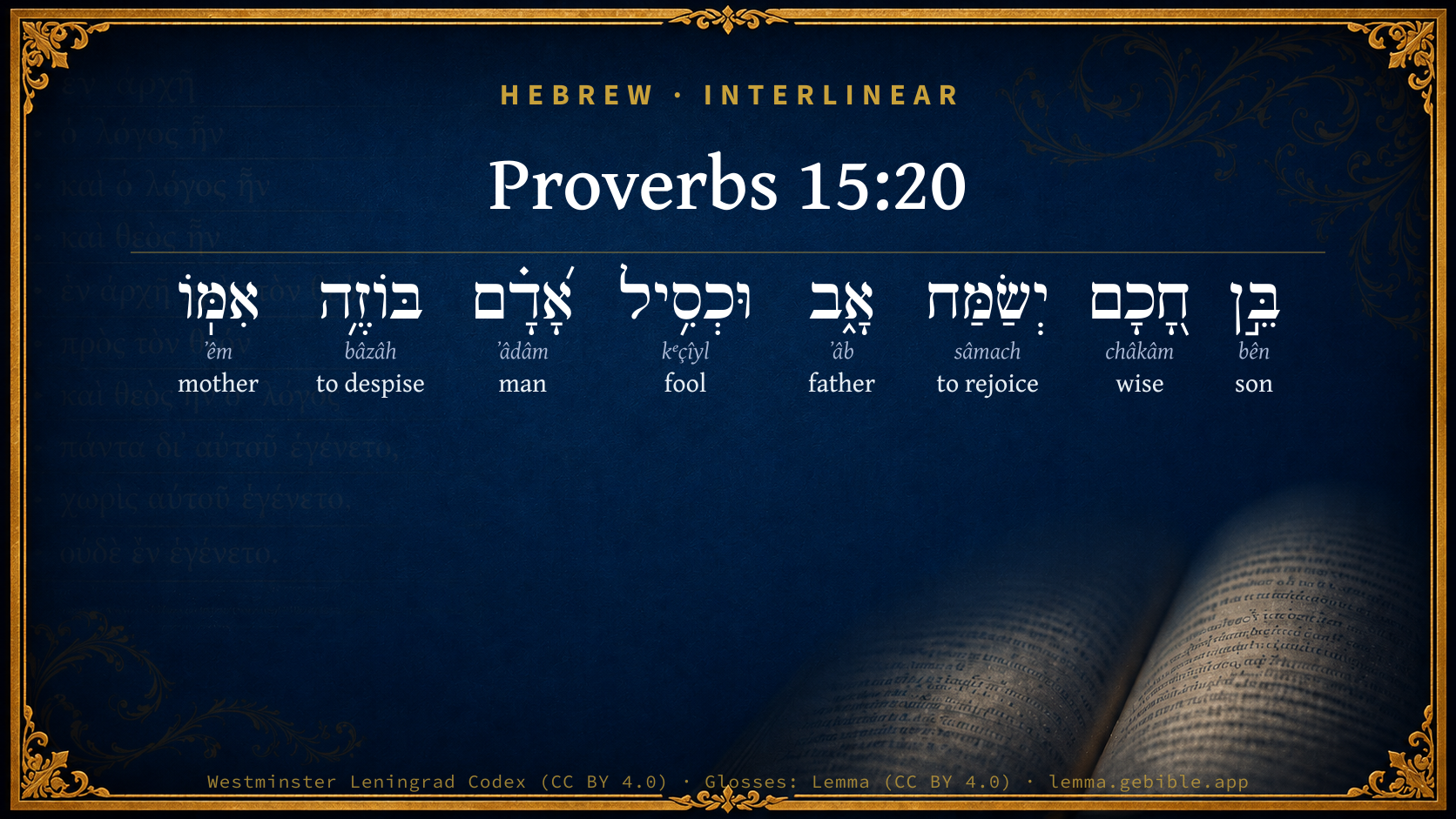
Hebrew (Westminster Leningrad Codex) Proverbs 15:20 appears in the Hebrew Old Testament. The text above is from the Westminster Leningrad Codex. Each word links to its Strong’s number, a concise gloss, and parsing drawn from the Open Scriptures Hebrew Bible morphology. Click any word for its full Brown-Driver-Briggs (BDB) entry.
Download image
Cite this verse

Proverbs 15:20 (World English Bible). Public Domain. Lemma interlinear Bible study tool, https://lemma.gebible.app/v/proverbs/15/20.

Show BibTeX & RIS
BibTeX
RIS
English Translation
A wise son makes a father glad, But a foolish man despises his mother.
World English Bible · Public Domain
Download a study sheet

One document with this verse’s original text, its word-by-word gloss line, the meaning frame, cross-references with their text, attributed commentary, and full source and license credits — printable, and it pastes into notes with its structure intact.

This verse Autodidact and up

Study sheet (.html) Plain text (.txt)

A passage Seminary Student

Up to 50 verses in one chapter. A passage sheet keeps up to 6 commentary sources and 12 cross-references per verse, in the order this page ranks them, and says so on the sheet whenever that leaves anything out. Ask for a single verse and you get the Autodidact verse sheet above.

Everything on this page stays free to read, with no account — the sheet is a download of what is already on screen, not access to it.

Want to remove ads? Support Godless Engineer
Compare translations 3

The same verse in 3 English versions, stacked beneath the original-language interlinear above. Click any original word for its lexicon entry.

Each is an independent rendering of the whole verse — the interlinear is not word-aligned to these translations.

Highlighted words mark where these versions differ — a whole-verse word diff, not a word-by-word alignment.

  • World English Bible Public Domain
    A wise son makes a father glad, But a foolish man despises his mother.
  • King James Version Public Domain
    A wise son maketh a glad father: but a foolish man despiseth his mother.
  • unfoldingWord Literal Text CC BY-SA 4.0
    A wise son gladdens a father, but a stupid man despises his mother.

unfoldingWord Literal Text — © unfoldingWord, licensed CC BY-SA 4.0. Word-aligned USFM3 via Door43 (git.door43.org/unfoldingWord/en_ult).

Versions to compare (up to 4)

3 of 4 selected

Show all 18 translations

Every available English version of this verse, each an independent rendering of the whole verse.

  • World English Bible Public Domain
    A wise son makes a father glad, But a foolish man despises his mother.
  • Berean Standard Bible Public Domain
    A wise son brings joy to his father, but a foolish man despises his mother.
  • Majority Standard Bible Public Domain
    A wise son brings joy to his father, but a foolish man despises his mother.
  • King James Version Public Domain
    A wise son maketh a glad father: but a foolish man despiseth his mother.
  • American Standard Version (1901) Public Domain
    A wise son maketh a glad father; But a foolish man despiseth his mother.
  • Revised Version (1885) Public Domain
    A wise son maketh a glad father: but a foolish man despiseth his mother.
  • Geneva Bible (1599) Public Domain
    A wise sonne reioyceth the father: but a foolish man despiseth his mother.
  • Douay-Rheims (1899) Public Domain
    A wise son maketh a father joyful: but the foolish man despiseth his mother.
  • Young's Literal Translation Public Domain
    A wise son rejoiceth a father. And a foolish man is despising his mother.
  • Literal Standard Version CC BY-SA 4.0
    A wise son makes a father glad. And a foolish man is despising his mother.
  • Unlocked Literal Bible CC BY-SA 4.0
    A wise son brings joy to his father, but a foolish person despises his mother.
  • unfoldingWord Literal Text CC BY-SA 4.0
    A wise son gladdens a father, but a stupid man despises his mother.
  • Darby Bible Public Domain
    A wise son maketh a glad father; but a foolish man despiseth his mother.
  • World Messianic Bible Public Domain
    A wise son makes a father glad, but a foolish man despises his mother.
  • Webster's Bible Public Domain
    A wise son maketh a glad father: but a foolish man despiseth his mother.
  • Free Bible Version CC BY-SA 4.0
    A wise son makes his father happy, but a stupid man despises his mother.
  • Bible in Basic English Public Domain
    A wise son makes a glad father, but a foolish man has no respect for his mother.
  • JPS Tanakh (1917) Public Domain
    A wise son maketh a glad father; but a foolish man despiseth his mother.

Literal Standard Version (2020), Covenant Press — licensed CC BY-SA 4.0. Text via the HelloAO Bible API (eBible.org). Unlocked Literal Bible (unfoldingWord) — licensed CC BY-SA 4.0. Text via the HelloAO Bible API (eBible.org). unfoldingWord Literal Text — © unfoldingWord, licensed CC BY-SA 4.0. Word-aligned USFM3 via Door43 (git.door43.org/unfoldingWord/en_ult). Free Bible Version, Dr. Jonathan Gallagher — licensed CC BY-SA 4.0. Text via the HelloAO Bible API (eBible.org).

Word by word

More ways to search: Search by grammar → Find every occurrence → Compare this word →

Practice this passage: Drill this verse → Learn its vocabulary →

About this verse

These counts appear in no published source. They are computed here, from the morphology-tagged text and Lemma’s own curated glosses. What Lemma adds →

8
words
8
distinct lemmas
Wisdom
section

Shared distinctive vocabulary

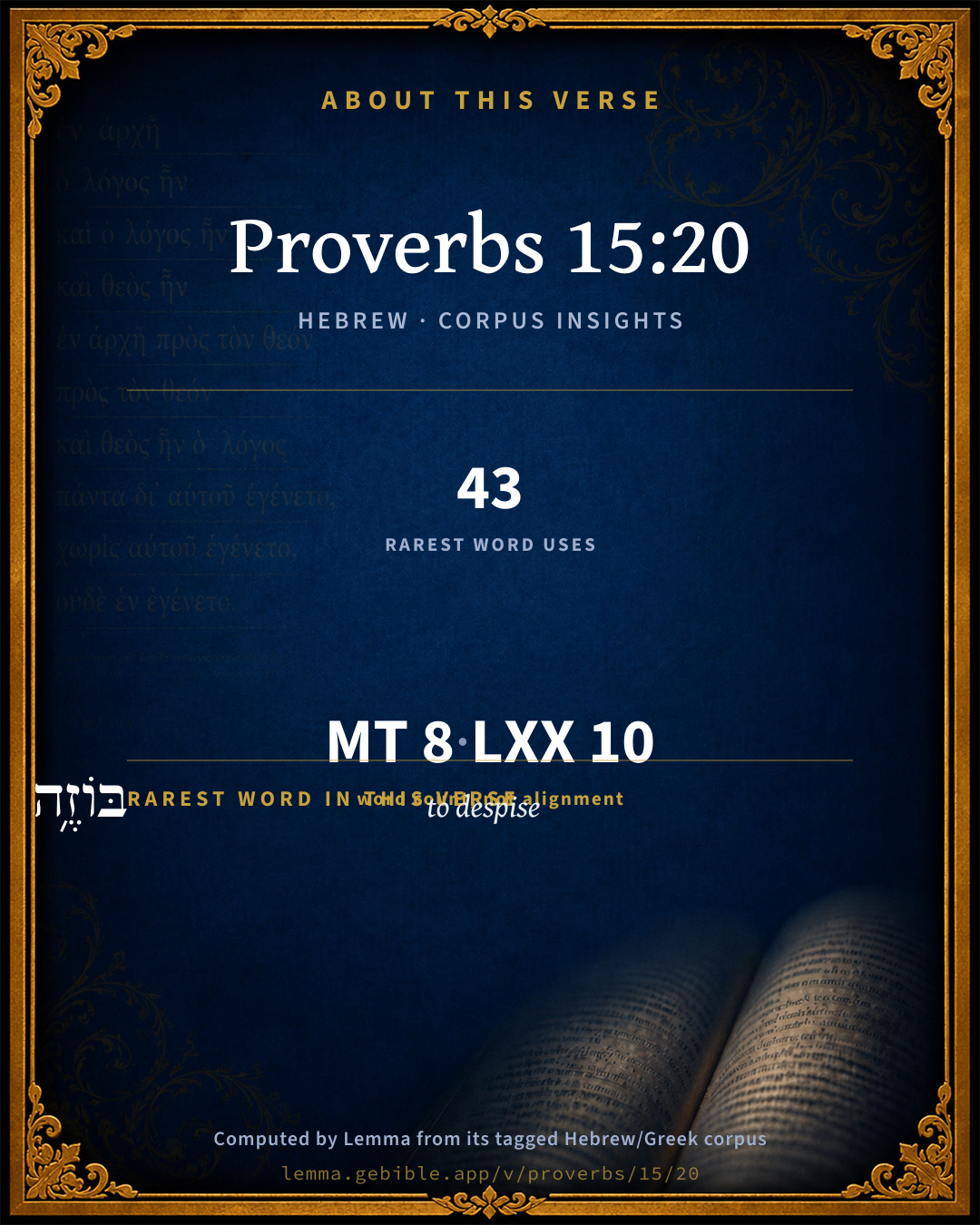
בּוֹזֶ֥ה to despise H959 occurs in 41 verses of the Hebrew Bible. Also found in:

Grammatical profile

  • 2 verbs
  • 4 nouns
  • 2 adjectives

Verb forms

  • יְשַׂמַּח Piel · Imperfect
  • בּוֹזֶ֥ה Qal · Participle Active

Hebrew & Septuagint length

In English translation the verse runs 14 words from the Hebrew and 14 from the Septuagint (LXX English) — the same length.

A rough comparison of the two English renderings, which tokenize alike — not a word-level alignment.

Word counts can differ between the Hebrew and the Greek without any difference in meaning — e.g. the Hebrew direct-object marker אֵת has no separate Greek word, and Greek often adds the article ὁ.

In the original languages it is 8 Hebrew tokens and 10 Greek tokens — but the two are counted differently (Hebrew bundles its prefixes and suffixes into one token; the Greek is in lemma form), so that isn’t a like-for-like length.

Cross-references

11

Topical passages linked to Proverbs 15:20 in the Treasury of Scripture Knowledge — connected by theme and wording, ordered by reader-vote popularity; previews shown in the World English Bible.

  • Proverbs 29:3 Whoever loves wisdom brings joy to his father; But a companion of prostitutes squanders his wealth.
  • Proverbs 10:1 The proverbs of Solomon. A wise son makes a glad father; But a foolish son brings grief to his mother.
  • Proverbs 23:15–16 My son, if your heart is wise, Then my heart will be glad, even mine:
  • Leviticus 19:3 "'Each one of you shall respect his mother and his father. You shall keep my Sabbaths. I am Yahweh your God.
  • 1 Kings 1:48 Also thus said the king, Blessed be Yahweh, the God of Israel, who has given one to sit on my throne this day, my eyes even seeing it.
  • 1 Kings 5:7 It happened, when Hiram heard the words of Solomon, that he rejoiced greatly, and said, Blessed be Yahweh this day, who has given to David a wise son over this great people.
  • Proverbs 23:22 Listen to your father who gave you life, And don't despise your mother when she is old.
  • Exodus 20:12 "Honor your father and your mother, that your days may be long in the land which Yahweh your God gives you.
  • 1 Kings 2:9 Now therefore don't hold him guiltless, for you are a wise man; and you will know what you ought to do to him, and you shall bring his gray head down to Sheol with blood.
  • Proverbs 30:17 The eye that mocks at his father, And scorns obedience to his mother: The ravens of the valley shall pick it out, The young eagles shall eat it.
  • Philippians 2:22 But you know the proof of him, that, as a child serves a father, so he served with me in furtherance of the Gospel.

Cross-references courtesy of OpenBible.info (CC BY 4.0).

Hebrew and Greek witnesses Masoretic Hebrew ↔ Greek Septuagint

The same verse in the two great witnesses to the Old Testament, shown verse-for-verse.

These are two independent witnesses, not word-aligned to each other, and the Septuagint is shown in lemma (dictionary) form.

Hebrew Proverbs 15:20 Masoretic · Westminster Leningrad Codex

בֵּ֣ן חָ֭כָם יְשַׂמַּח אָ֑ב וּכְסִ֥יל אָ֝דָ֗ם בּוֹזֶ֥ה אִמּֽוֹ

A wise son makes a father glad, But a foolish man despises his mother.

World English Bible · Public Domain

Greek LXX Proverbs 15:20 Septuagint · lemma form

υἱός σοφός εὐφραίνω πατήρ υἱός δέ ἄφρων μυκτηρίζω μήτηρ αὐτός

A wise son gladdens his father; but a foolish son sneers at his mother.

LXX2012 (modern English Septuagint) · Public Domain

On this verse, Keil & Delitzsch discusses the Septuagint’s reading. Read the note in Commentary ↓

Hebrew: Westminster Leningrad Codex (CC BY 4.0). Greek: Septuagint (public domain); English from LXX2012 (modern English Septuagint) (Public Domain). How the Septuagint differs from the Hebrew →

Commentary

Notes on Proverbs 15:20 from classic Christian and Jewish commentators (each source and its license shown beneath its notes). The classic Christian expositions comment on the surrounding passage and are grouped to its opening verse, so a note may address several verses; the Jewish commentaries on the Tanakh (Rashi and others) are per-verse, so they appear only where the commentator wrote on this verse.

Lemma curates 59 commentaries, every one of them public domain or Creative Commons licensed, each selected and text-cleaned for this edition rather than reprinted as found. About our sources →

Trapp's Complete Commentary

John Trapp

Pro 15:20 A wise son maketh a glad father: but a foolish man despiseth his mother.

Ver. 20. A wise son maketh a glad father.] {See Trapp on "Pro 10:1"}

John Trapp, A Commentary or Exposition upon All the Books of the Old and New Testament (1647–1656) — public domain. Text from a community e-Sword module.

Joseph Benson's Commentary

Pro 15:20-21. A wise son, &c. — See the note on chap. 10:1, where we have the same proverb. Folly is joy to him that is destitute of wisdom —

He not only works wickedness, but takes pleasure in doing it; but a man of understanding walketh uprightly — Hebrew, יישׁר לכת, directeth, or maketh straight, his going; that is, ordereth all his actions by the rule of God’s word, and delights in so doing, as may be understood from the opposite clause.

Joseph Benson's Commentary on the Old and New Testaments (1811–1818) — public domain. Text from a community e-Sword module.

Keil & Delitzsch

C. F. Keil & F. Delitzsch

This collection of Solomonic proverbs began, Pro 10:1, with a proverb having reference to the observance of the fourth commandment,

(Note: The fifth commandment of the Westminster Shorter Catechism is named as the fourth in Luther's catechism.)

and a second chief section, Pro 13:1, began in the same way. Here a proverb of the same kind designates the beginning of a third chief section. That the editor was aware of this is shown by the homogeneity of the proverbs, Pro 15:19; Pro 12:28, which form the conclusion of the first and second sections. We place together first in this new section, Pro 15:20-23, in which (with the exception of Pro 15:25) the ישׂמח [maketh glad] of the first (Pro 10:1) is continued.

Pro 15:20

20 A wise son maketh a glad father,

And a fool of a man despiseth his mother.

Line first = Pro 10:1. The gen. connection of כּסיל אדם (here and at Pro 21:20) is not superlative the most foolish of men, but like פּרא אדם, Gen 16:12; the latter: a man of the wild ass kind; the former: a man of the fool kind, who is the exemplar of such a sort among men. Piety acting in willing subordination is wisdom, and the contrary exceeding folly.

Pro 15:21

21 Folly is joy to him that is devoid of understanding;

But a man of understanding goeth straight forward.

Regarding חסר־לב, vid., at Pro 6:32 (cf. libı̂b, which in the Samaritan means "dearly beloved," in Syr. "courageous," in Arab. and Aethiop. cordatus); אישׁ תּבוּנה, Pro 10:23, and ישּׁר, with the accus. of the way, here of the going, Pro 3:6 (but not Pro 11:5, where the going itself is not the subject). In consequence of the contrast, the meaning of 21a is different from that of Pro 10:23, according to which sin is to the fool as the sport of a child. Here אוּלת is folly and buffoonery, drawing aside in every kind of way from the direct path of that which is good, and especially from the path of one's duty. This gives joy to the fool; he is thereby drawn away from the earnest and faithful performance of the duties of his calling, and thus wastes time and strength; while, on the contrary, a man of understanding, who perceives and rejects the vanity and unworthiness of such trifling and such nonsense, keeps the straight direction of his going, i.e., without being drawn aside or kept back, goes straight forward, i.e., true to duty, prosecutes the end of his calling. לכת is accus., like Pro 30:29, Mic 6:8.

Pro 15:22

22 A breaking of plans where no counsel is;

But where many counsellors are they come to pass.

On the other side it is also true according to the proverbs, "so viel Kpfe so viel Sinne" [quot homines, tot sententiae], and "viel Rath ist Unrath" [ne quid nimis], and the like. But it cannot become a rule of morals not to accept of counsel that we may not go astray; on the contrary, it is and remains a rule of morals: not stubbornly to follow one's own heart (head), and not obstinately to carry out one's own will, and not in the darkness of wisdom to regard one's own plans as unimproveable, and not needing to be examined; but to listen to the counsel of intelligent and honest friends, and, especially where weighty matters are in hand, not affecting one's own person, but the common good, not to listen merely to one counsellor, but to many. Not merely the organism of the modern state, but also of old the Mosaic arrangement of the Israelitish community, with its representative organization, its courts and councils, rested on the acknowledged justice and importance of the saying uttered in Pro 11:14, and here generalized. הפר, infin. abs. Hiph. of פּרר, to break, with the accus. following, stands here, like הפוך, Pro 12:7, instead of the finite: the thoughts come to a fracture (failure), irrita fiunt consilia. סוד (= יסוד, cf. נוסד Psa 2:2) means properly the being brought close together for the purpose of secret communication and counsel (cf. Arab. sâwada, to press close together = to walk with one privately). The lxx: their plans are unexecuted, οἱ μὴ τιμῶντες συνέδρια, literally Symmachus, διασκεδάζονται λογισμοὶ μὴ ὄντος συμβουλίου. תּקוּם has, after Jer 4:14; Jer 51:29, מחשׁבות as subject. The lxx (besides perverting ברב [by a multitude] into בלב ἐν καρδίαις]), the Syr. and Targ. introduce עצה (Pro 19:21) as subject.

Pro 15:23

23 A man has joy by the right answer of his mouth;

And a word in its season, how fair is it!

If we translate מענה only by "answer," then 23a sounds as a praise of self-complaisance; but it is used of true correspondence (Pro 29:19), of fit reply (Job 32:3, Job 32:5), of appropriate answer (cf. 28a, Pro 16:1). It has happened to one in his reply to hit the nail on its head, and he has joy from that (שׂמחה ב after שׂמח בּ, e.g., Pro 23:24), and with right; for the reply does not always succeed. A reply like this, which, according to circumstances, stops the mouth or bringeth a kiss (Pro 24:26), is a fortunate throw, is a gift from above. The synonymous parallel line measures that which is appropriate, not to that which is to be answered, but from a general point of view as to its seasonableness; עת (= עדת from יעד) is here "the ethically right, becoming time, determined by the laws of wisdom (moral)" (vid., Orelli, Synonyma der Zeit u. Ewigkeit, p. 48), cf. על־אפניו (translated by Luther 'in its time"), Pro 25:11. With מה־טּוב, cf. Pro 16:16; both ideas lie in it: that such a word is in itself well-conditioned and successful, and also that it is welcome, agreeable, and of beneficial influence.

Keil & Delitzsch — Biblical Commentary on the Old Testament (1861–1891) — public domain (CC PDM 1.0). Text via the HelloAO Bible API. (Old Testament only.)

Matthew Henry's Commentary

Observe here, 1. To the praise of good children, that they are the joy of their parents, who ought to have joy of them, having taken so much care and pains about them. And it adds much to the satisfaction of those that are good if they have reason to think that they have been a comfort to their parents in their declining years, when evil days come. 2. To the shame of wicked children, that by their wickedness they put contempt upon their parents, slight their authority, and make an ill requital for their kindness: A foolish son despises his mother, that had most sorrow with him and perhaps had too much indulged him, which makes his sin in despising her the more sinful and her sorrow the more sorrowful.

Matthew Henry's Commentary on the Whole Bible (1708–1710) — public domain (CC PDM 1.0). Text via the HelloAO Bible API.

Jamieson, Fausset & Brown

Robert Jamieson, A. R. Fausset & David Brown

(Compare Pro 10:1).

Jamieson, Fausset & Brown — Commentary Critical and Explanatory on the Whole Bible (1871) — public domain (CC PDM 1.0). Text via the HelloAO Bible API.

The Cambridge Bible for Schools and Colleges

gen. ed. J. J. S. Perowne

20. despiseth] and so maketh her sad, in latent contrast with the first clause of the verse.

The Cambridge Bible for Schools and Colleges (gen. ed. J. J. S. Perowne; Cambridge University Press, 1878–1918) — public domain. Text from a community e-Sword module.

John Gill's Exposition

A wise son maketh a glad father,.... See Gill on Pro 10:1;

but a foolish man despiseth his mother; that bore him and brought him up, and perhaps was too indulgent to him; which aggravates his sin and her sorrow; See Gill on Pro 10:1; or causes her to be despised by others, as Jarchi interprets it; such a man's sin, which is great folly, and shows him to be a foolish man, is highly resented by the Lord, and will be severely punished; see Pro 30:17. The Targum is,

"a foolish son despises his mother;''

and so the Septuagint, Syriac, and Arabic versions, which makes the antithesis more clear; and the Hebrew text designs one grown up to man's estate.

John Gill's Exposition of the Whole Bible (1746–1763) — public domain (CC PDM 1.0). Text via the HelloAO Bible API.

Albert Barnes' Notes on the Bible

To “despise” a mother is to cause her the deepest grief, and is therefore not unfitly contrasted with “making a glad father.”

Albert Barnes' Notes on the Bible (1834–1885) — public domain. Text from a community e-Sword/MySword module.

Matthew Poole's English Annotations

Maketh a glad father, by giving him that honour and obedience which he oweth to him.

Despiseth his mother; whereby he maketh her sad. See Poole "Pro 10:1", where we have the same proverb.

Matthew Poole's English Annotations on the Holy Bible (1683–1685) — public domain. Text from a community e-Sword/MySword module.

Whedon's Commentary on the Bible

Daniel D. Whedon

20. Maketh… glad — Gladdens. This is much the same as Pro_10:1, where see note.

Despiseth his mother — The original is very forcible, and might be rendered, But a fool of a man is hev who treats his mother with contempt, by neglecting her affectionate counsels.

Daniel D. Whedon (gen. ed.), Commentary on the Old and New Testaments (1874–1909) — public domain. Text from a community e-Sword module.

The Pulpit Commentary

Ver. 20-ch. Pro_10:1. A foolish man despiseth his mother, and therefore is "heaviness" to her. Or the verb may mean "shameth." "A foolish man" is literally "a fool of a man."

The Pulpit Commentary (1880–1919), ed. H.D.M. Spence-Jones & Joseph S. Exell — public domain. Text from a community e-Sword module.

Bridges on Proverbs

Charles Bridges

Do not the brightest joys,†1 and the bitterest sorrows†2 in this world of tears, flow from parents’ hearts? Whatever be the delight to see a son prospering in life; the Christian father finds no rest, until a wise son maketh him glad. And here we need not any development of talent, or superior attainment, but the true wisdom; humble and docile, marked (as the contrast suggests) by filial reverence, specially by the cordial choice of that, which "is the beginning of wisdom — the fear of the LORD." Such a son does indeed rejoice his father, as he watches, with equal pleasure and thankfulness, the daily growth and healthiness of his choice vine.

But what if folly, instead of gladdening, despise a mother†3 — her, whose tender love,†4 and yearning faithfulness,†5 are a faint picture of the heart of God? The law of God commands honour†6 and reverence,†7 and the transgression of the law will not be forgotten.†8 But is not this neglect a chastening rebuke for capricious indulgence? What grace and wisdom is needed, that the parents may be a valuable blessing to their children for their highest interests! A single eye is the primary concern.

Footnotes:

†1 Pro 10:1; Pro 23:24 . 1Ki 1:48 .

†2 Pro 17:25. 2Sa 18:33 .

†3 Pro 19:26. Pro 23:22 .

†4 Isa 66:13.

†5 Isa 49:15.

†6 Exo 20:12.

†7 Lev 19:3.

†8 Pro 20:20; Pro 30:17 . Eze 22:7 .

Charles Bridges, An Exposition of the Book of Proverbs (1846) — public domain. Text from a community e-Sword module.

Kretzmann's Popular Commentary

Paul E. Kretzmann

v. 20. A wise son maketh a glad father, Pro 10:1; but a foolish man despiseth his mother, such neglect and contempt of his mother proving him to be a fool of a man, not only on account of the transgression of the Fourth Commandment involved, but because the wisdom and love of a mother serves for The best guidance.

Paul E. Kretzmann, Popular Commentary of the Bible (1921–1924) — public domain. Text from a community e-Sword module.

Rashi

Rabbi Shlomo Yitzchaki (Rashi)

A wise son makes his father happy, but a foolish person despises his mother He causes people to despise his mother.

Rashi on the Tanakh — English translations: “The Judaica Press complete Tanach with Rashi, translated by A. J. Rosenberg” (CC BY 4.0); “Pentateuch with Rashi's commentary by M. Rosenbaum and A.M. Silbermann, 1929-1934” (public domain); “The Metsudah Tanach series, Lakewood, N.J” (CC BY 4.0); and “The Book of Joshua, Metsudah Publications, 1997” (CC BY 4.0). Text via Sefaria.

Lesson kit

Teaching starters — assembled from the data on this page, not authored interpretation. Every prompt links to the verse data it draws on. Edit before teaching.

Proverbs, in the Wisdom, opens this verse with 8 words (8 distinct Hebrew lemmas). Its most distinctive word is bâzâh (“to despise”). A historical commentator’s framing appears above. Read the whole chapter for the surrounding context.

Discussion questions

  1. What does “to despise” (bâzâh) contribute to the verse as a whole?
  2. How does Genesis 25:34, which shares the word «to despise», read alongside this verse?
  3. The translations on this page render this verse differently — a whole-verse word diff, not a word-by-word alignment. What might account for the different wordings?
  4. «יְשַׂמַּח» is a Piel Imperfect verb. How does that grammatical form shape the action described?
  5. Compare how Trapp's Complete Commentary and Joseph Benson's Commentary read this verse. Where do they agree or differ?

Things to notice

Reading settings

Reading text

Shown beneath each verse's original-language words.

Old Testament
Old Testament edition

Read the OT as the Masoretic Hebrew (MT) or the Greek Septuagint (LXX).

English shown for the Greek Septuagint (in the Hebrew ↔ Greek comparison).

Comparing translations? Open the Compare panel on any verse page to stack up to four side by side.