
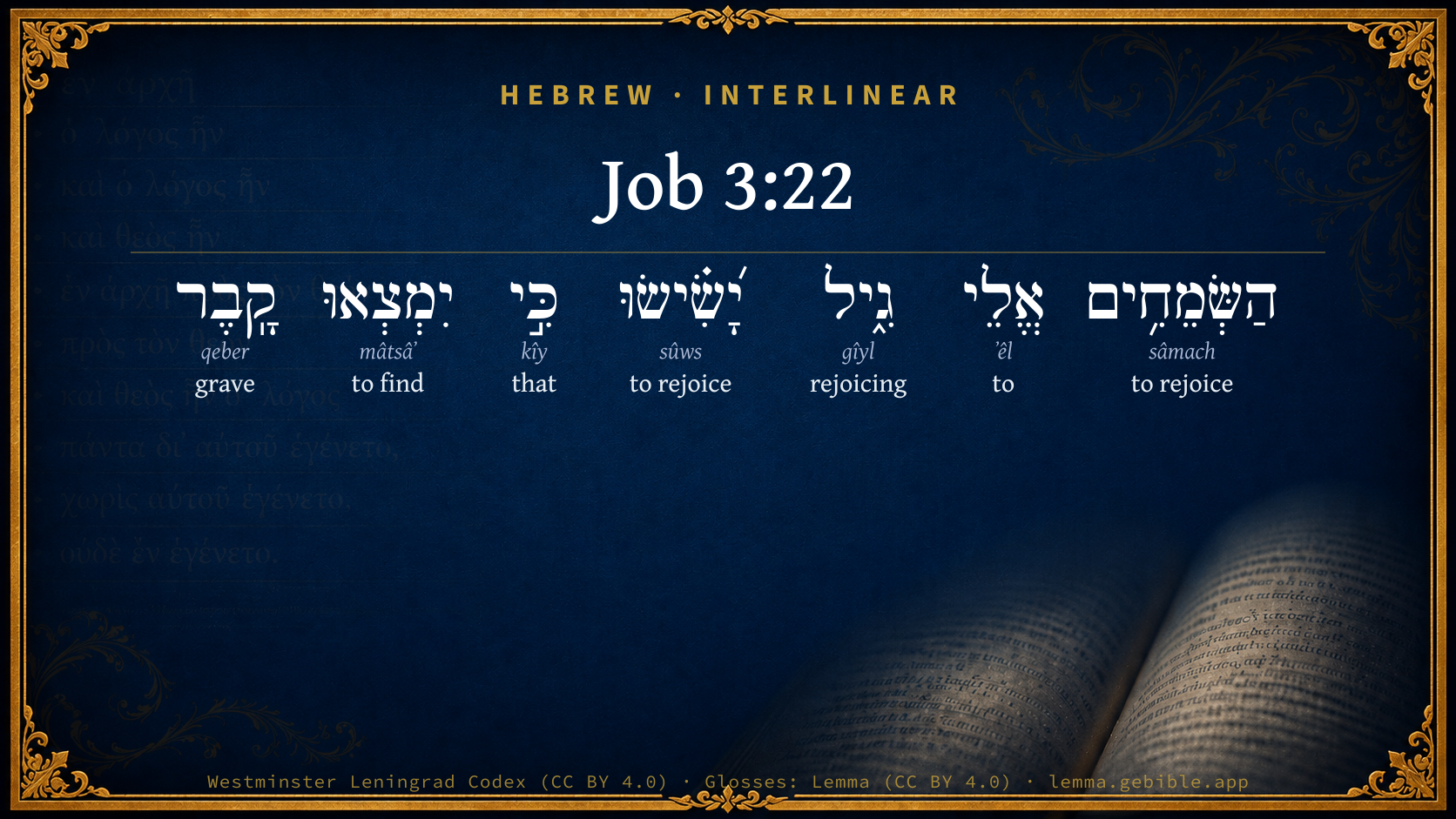
Job 3:22

Hebrew (Westminster Leningrad Codex) Job 3:22 appears in the Hebrew Old Testament. The text above is from the Westminster Leningrad Codex. Each word links to its Strong’s number, a concise gloss, and parsing drawn from the Open Scriptures Hebrew Bible morphology. Click any word for its full Brown-Driver-Briggs (BDB) entry.
Download image
Cite this verse

Job 3:22 (World English Bible). Public Domain. Lemma interlinear Bible study tool, https://lemma.gebible.app/v/job/3/22.

Show BibTeX & RIS
BibTeX
RIS
English Translation
Who rejoice exceedingly, Are glad, when they can find the grave?
World English Bible · Public Domain
Highlights
  • 1 first appearance in the Hebrew Bible
Full analysis ↓
Download a study sheet

One document with this verse’s original text, its word-by-word gloss line, the meaning frame, cross-references with their text, attributed commentary, and full source and license credits — printable, and it pastes into notes with its structure intact.

This verse Autodidact and up

Study sheet (.html) Plain text (.txt)

A passage Seminary Student

Up to 50 verses in one chapter. A passage sheet keeps up to 6 commentary sources and 12 cross-references per verse, in the order this page ranks them, and says so on the sheet whenever that leaves anything out. Ask for a single verse and you get the Autodidact verse sheet above.

Everything on this page stays free to read, with no account — the sheet is a download of what is already on screen, not access to it.

Want to remove ads? Support Godless Engineer
Compare translations 3

The same verse in 3 English versions, stacked beneath the original-language interlinear above. Click any original word for its lexicon entry.

Each is an independent rendering of the whole verse — the interlinear is not word-aligned to these translations.

Highlighted words mark where these versions differ — a whole-verse word diff, not a word-by-word alignment.

  • World English Bible Public Domain
    Who rejoice exceedingly, Are glad, when they can find the grave?
  • King James Version Public Domain
    Which rejoice exceedingly, and are glad, when they can find the grave?
  • unfoldingWord Literal Text CC BY-SA 4.0
    the ones rejoicing unto gladness, and they celebrate when they find a grave,

unfoldingWord Literal Text — © unfoldingWord, licensed CC BY-SA 4.0. Word-aligned USFM3 via Door43 (git.door43.org/unfoldingWord/en_ult).

Versions to compare (up to 4)

3 of 4 selected

Show all 18 translations

Every available English version of this verse, each an independent rendering of the whole verse.

  • World English Bible Public Domain
    Who rejoice exceedingly, Are glad, when they can find the grave?
  • Berean Standard Bible Public Domain
    who rejoice and greatly exult when they can find the grave?
  • Majority Standard Bible Public Domain
    who rejoice and greatly exult when they reach the grave?
  • King James Version Public Domain
    Which rejoice exceedingly, and are glad, when they can find the grave?
  • American Standard Version (1901) Public Domain
    Who rejoice exceedingly, And are glad, when they can find the grave?
  • Revised Version (1885) Public Domain
    Which rejoice exceedingly, and are glad, when they can find the grave?
  • Geneva Bible (1599) Public Domain
    Which ioy for gladnes, and reioyce, when they can finde the graue.
  • Douay-Rheims (1899) Public Domain
    And they rejoice exceedingly when they have found the grave.
  • Young's Literal Translation Public Domain
    Who are glad -- unto joy, They rejoice when they find a grave.
  • Literal Standard Version CC BY-SA 4.0
    Who are glad—to joy, || They rejoice when they find a grave.
  • Unlocked Literal Bible CC BY-SA 4.0
    Why is light given to one who rejoices very much and is glad when he finds the grave?
  • unfoldingWord Literal Text CC BY-SA 4.0
    the ones rejoicing unto gladness, and they celebrate when they find a grave,
  • Darby Bible Public Domain
    Who rejoice even exultingly and are glad when they find the grave? --
  • World Messianic Bible Public Domain
    who rejoice exceedingly, and are glad, when they can find the grave?
  • Webster's Bible Public Domain
    Who rejoice exceedingly, and are glad, when they can find the grave?
  • Free Bible Version CC BY-SA 4.0
    They're so incredibly happy when they reach the grave!
  • Bible in Basic English Public Domain
    Who are glad with great joy, and full of delight when they come to their last resting-place;
  • JPS Tanakh (1917) Public Domain
    Who rejoice unto exultation, and are glad, when they can find the grave? —

Literal Standard Version (2020), Covenant Press — licensed CC BY-SA 4.0. Text via the HelloAO Bible API (eBible.org). Unlocked Literal Bible (unfoldingWord) — licensed CC BY-SA 4.0. Text via the HelloAO Bible API (eBible.org). unfoldingWord Literal Text — © unfoldingWord, licensed CC BY-SA 4.0. Word-aligned USFM3 via Door43 (git.door43.org/unfoldingWord/en_ult). Free Bible Version, Dr. Jonathan Gallagher — licensed CC BY-SA 4.0. Text via the HelloAO Bible API (eBible.org).

Word by word

More ways to search: Search by grammar → Find every occurrence → Compare this word →

Practice this passage: Drill this verse → Learn its vocabulary →

About this verse

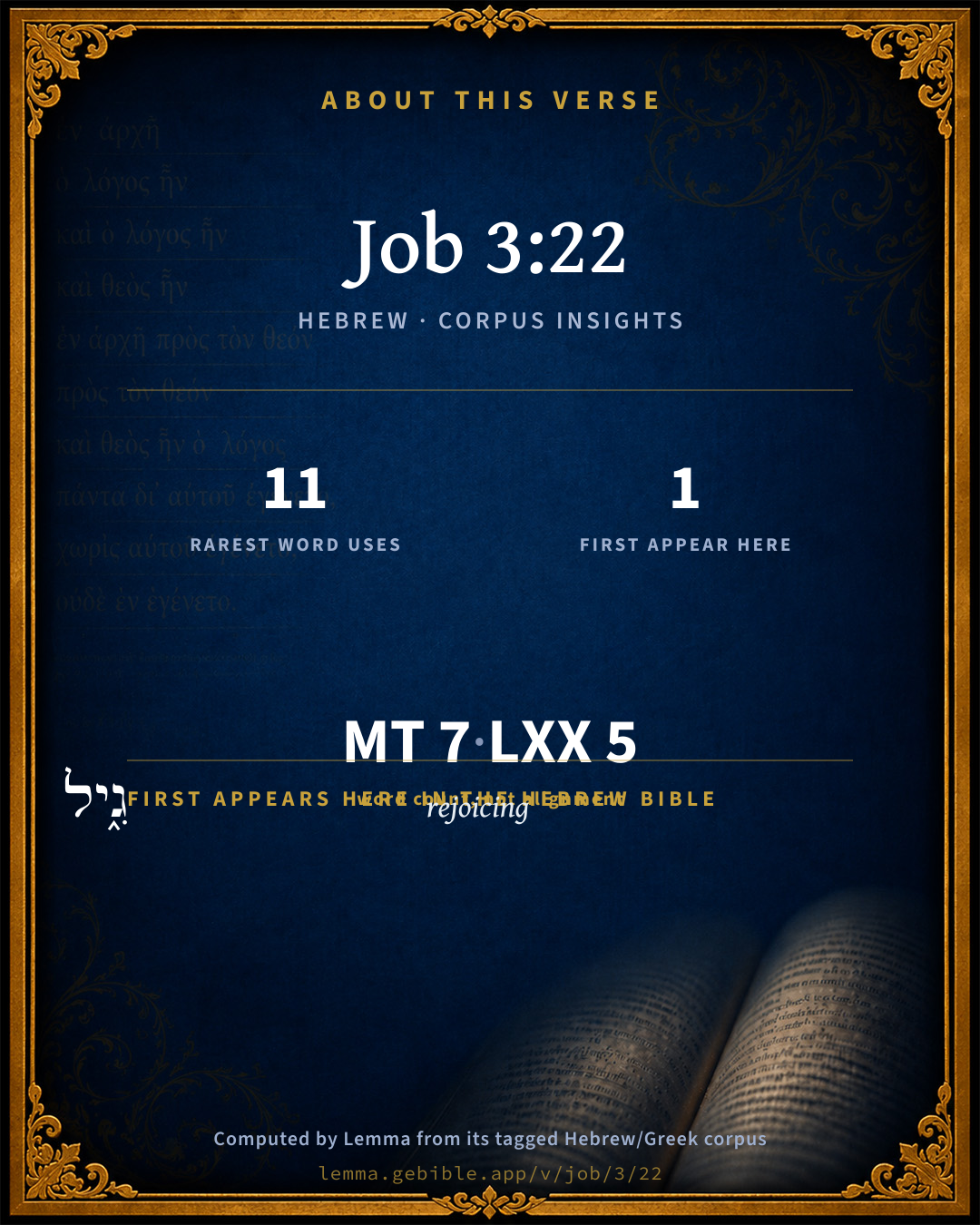
These counts appear in no published source. They are computed here, from the morphology-tagged text and Lemma’s own curated glosses. What Lemma adds →

7
words
7
distinct lemmas
Wisdom
section

Notable vocabulary

The rarest word here is גִ֑יל rejoicing H1524 — appearing just 11 times in the whole Hebrew Bible.

First appearance in Scripture

This word makes its first canonical appearance in the Hebrew Bible here:

  • גִ֑יל rejoicing H1524

Shared distinctive vocabulary

גִ֑יל rejoicing H1524 occurs in 10 verses of the Hebrew Bible. Also found in:

Grammatical profile

  • 2 verbs
  • 2 nouns
  • 1 adjective
  • 1 preposition
  • 1 conjunction

Verb forms

  • יָ֝שִׂ֗ישׂוּ Qal · Imperfect
  • יִמְצְאוּ Qal · Imperfect

Hebrew & Septuagint length

In English translation the verse runs 11 words from the Hebrew and 10 from the Septuagint (LXX English) — closely comparable.

A rough comparison of the two English renderings, which tokenize alike — not a word-level alignment.

Word counts can differ between the Hebrew and the Greek without any difference in meaning — e.g. the Hebrew direct-object marker אֵת has no separate Greek word, and Greek often adds the article ὁ.

In the original languages it is 7 Hebrew tokens and 5 Greek tokens — but the two are counted differently (Hebrew bundles its prefixes and suffixes into one token; the Greek is in lemma form), so that isn’t a like-for-like length.

Hebrew and Greek witnesses Masoretic Hebrew ↔ Greek Septuagint

The same verse in the two great witnesses to the Old Testament, shown verse-for-verse.

These are two independent witnesses, not word-aligned to each other, and the Septuagint is shown in lemma (dictionary) form.

Hebrew Job 3:22 Masoretic · Westminster Leningrad Codex

הַשְּׂמֵחִ֥ים אֱלֵי גִ֑יל יָ֝שִׂ֗ישׂוּ כִּ֣י יִמְצְאוּ קָֽבֶר

Who rejoice exceedingly, Are glad, when they can find the grave?

World English Bible · Public Domain

Greek LXX Job 3:22 Septuagint · lemma form

περιχαρής δέ γίγνομαι ἐάν κατατυγχάνω

and would be very joyful if they should gain it?

LXX2012 (modern English Septuagint) · Public Domain

Hebrew: Westminster Leningrad Codex (CC BY 4.0). Greek: Septuagint (public domain); English from LXX2012 (modern English Septuagint) (Public Domain). How the Septuagint differs from the Hebrew →

Commentary

Notes on Job 3:22 from classic Christian and Jewish commentators (each source and its license shown beneath its notes). The classic Christian expositions comment on the surrounding passage and are grouped to its opening verse, so a note may address several verses; the Jewish commentaries on the Tanakh (Rashi and others) are per-verse, so they appear only where the commentator wrote on this verse.

Lemma curates 59 commentaries, every one of them public domain or Creative Commons licensed, each selected and text-cleaned for this edition rather than reprinted as found. About our sources →

Trapp's Complete Commentary

John Trapp

Job 3:22 Which rejoice exceedingly, [and] are glad, when they can find the grave?

Ver. 22. Which rejoice exceedingly] Joy till they skip again, so Broughton rendereth it. Strange that any should be so glad of death, that last enemy, that slaughterman of nature, and harbinger of hell to the ungodly; but this the devil hideth from them till he hath them where he would have, and whence there is no redemption. What was it else that moved Augustus at his death to call for a round of applause or that made Julian the apostate to die so confidently; and many today that have little reason for it to be so prodigal of their lives, and seemingly fond of death? Is it not because they are fearfully blinded by the god of this present world, 2Co 4:4, who holdeth his black hand before their eyes, lest they should see the evil consequents of death, and be saved? which because they do not, what do they else but rejoice exceedingly (or with exultation, as the word here signifieth) in their woeful bondage, and go dancing to hell in their bolts, not so much as desiring deliverance. A man that is to be hanged next day may dream overnight he shall be set free, nay, that he shall be a king, and rejoice therein accordingly; but the end of such joy is heaviness.

John Trapp, A Commentary or Exposition upon All the Books of the Old and New Testament (1647–1656) — public domain. Text from a community e-Sword module.

Joseph Benson's Commentary

Job 3:22. Which rejoice exceedingly, when they can find the grave — To be thus impatient of life, for the sake of the trouble we meet with, is not only unnatural in itself, but ungrateful to the Giver of life, and shows a sinful indulgence of our own passion. Let it be our great and constant care to get ready for another world: and then let us leave it to God to order the circumstances of our removal thither.

Joseph Benson's Commentary on the Old and New Testaments (1811–1818) — public domain. Text from a community e-Sword module.

Adam Clarke's Commentary

Verse 22. Which rejoice exceedingly.] Literally, They rejoice with joy, and exult when they find the grave.

There is a various reading here in one of Kennicott's MSS., which gives a different sense. Instead of who rejoice, אלי גיל eley gil, with JOY, it has אלי גל eley gal, who rejoice at the TOMB, and exult when they find the grave.

Adam Clarke's Commentary on the Bible (1810–1826) — public domain. Text from a community e-Sword/MySword module.

The Cambridge Bible for Schools and Colleges

gen. ed. J. J. S. Perowne

22. rejoice exceedingly] lit. rejoice even to exultation, Hos_9:1.

The Cambridge Bible for Schools and Colleges (gen. ed. J. J. S. Perowne; Cambridge University Press, 1878–1918) — public domain. Text from a community e-Sword module.

John Gill's Exposition

Which rejoice exceedingly,.... Or, "which joy till they do skip again", as Mr. Broughton renders it, and to the same purport others (d); are so elated as to skip and dance for joy:

and are glad when they can find the grave; which is to be understood either of those who dig in the earth for hid treasure, such as is laid there by men; when they strike and hit upon a grave where they expect to find a booty; it being usual in former times to put much riches into the sepulchres of great personages, as Sanctius on the place observes; so Hyrcanus, opening the sepulchre of David, found in it three thousand talents of silver, as Josephus (e) relates: or rather this is said of the miserable and bitter in soul, who long for death, and seek after it; who, when they perceive any symptoms of its near approach, are exceedingly pleased, and rejoice at it, as when they observe the decays of nature, or any disorder and disease upon them which threaten with death; for this cannot be meant of the dead carrying to the grave, who are insensible of it, and of their being put into it.

(d) "qu laetantur ad choream usque", Schultens, "quasi ad tripudium", Michaelis. (e) Antiqu. l. 13. c. 8. sect. 4. Ed. Hudson.

John Gill's Exposition of the Whole Bible (1746–1763) — public domain (CC PDM 1.0). Text via the HelloAO Bible API.

Albert Barnes' Notes on the Bible

Which rejoice exceedingly - Hebrew “Who rejoice upon joy or exultation” (אל־גיל 'el-gı̂yl), that is, with exceedingly great joy.

When they can find the grave - What an expression! How strikingly does it express the intense desire to die, and the depth of a man’s sorrow, when it becomes a matter of exultation for him to be permitted to lie down in the corruption and decay of the tomb! A somewhat similiar sentiment occurs in Euripides, as quoted by Cicero, Tusc. Quaest. Lib. 1, cap. 48:

Nam nos decebat, doman

Lugere, ubi esset aliquis in lucem editus,

Humanae vitae varia reputantes mala;

At qui labores morte finisset graves

Hunc omni amicos laude et Lactitia exsequi.

Albert Barnes' Notes on the Bible (1834–1885) — public domain. Text from a community e-Sword/MySword module.

Haydock's Catholic Bible Commentary

Grave, full of stores, or the place where they may repose. (Haydock)

George Leo Haydock (1774–1849), Haydock's Catholic Family Bible and Commentary, 1859 edition — public domain. Excludes Psalms (Douay-Rheims chapter numbering differs from Protestant) and Deuterocanonical books (Catholic canon only).

Whedon's Commentary on the Bible

Daniel D. Whedon

22. Rejoice exceedingly — Literally, unto exultation, so as to leap for joy. The same figure occurs in Hos_9:1. As is so frequently the case in Job, this verse furnishes a climax: 1) rejoice; 2) to exultation; 3) bound for joy.

Are glad — ישׂישׂו, according to both Gesenius and Furst, embodies the figure of a horse (סוס) in his joyous gambols. (Compare Job_39:21, where The same word occurs.)

Daniel D. Whedon (gen. ed.), Commentary on the Old and New Testaments (1874–1909) — public domain. Text from a community e-Sword module.

The Pulpit Commentary

Which rejoice exceedingly; literally, to exultation"or "to dancing;" i.e. so that they almost dance with joy. And are glad, when they can find the grave. Job speaks as if he knew of such eases; and, no doubt, the fact of suicide proves that among men there are some who prefer to die rather than live. But suicides are seldom altogether in possession of their senses. Of sane men it may be doubted whether one in a thousand, however miserable, really wishes to die, or is "glad when he can find the grave." In such thoughts as those to which Job here gives expression there is something morbid and unreal.

The Pulpit Commentary (1880–1919), ed. H.D.M. Spence-Jones & Joseph S. Exell — public domain. Text from a community e-Sword module.

John Wesley's Explanatory Notes

Glad, &c. - To be thus impatient of life, for the sake of the trouble we meet with, is not only unnatural in itself, but ungrateful to the giver of life, and shews a sinful indulgence of our own passion. Let it be our great and constant care, to get ready for another world: and then let us leave it to God, to order the circumstances of our removal thither.

John Wesley, Explanatory Notes Upon the Whole Bible (1754–1765) — public domain. Text via the GEBible commentary corpus.

Rashi

Rabbi Shlomo Yitzchaki (Rashi)

Those who are happy over joyous occurrences and rejoice if they find a grave.

over joyous occurrences Because of the joy and the happiness of finding a grave.

Rashi on the Tanakh — English translations: “The Judaica Press complete Tanach with Rashi, translated by A. J. Rosenberg” (CC BY 4.0); “Pentateuch with Rashi's commentary by M. Rosenbaum and A.M. Silbermann, 1929-1934” (public domain); “The Metsudah Tanach series, Lakewood, N.J” (CC BY 4.0); and “The Book of Joshua, Metsudah Publications, 1997” (CC BY 4.0). Text via Sefaria.

Lesson kit

Teaching starters — assembled from the data on this page, not authored interpretation. Every prompt links to the verse data it draws on. Edit before teaching.

Job, in the Wisdom, opens this verse with 7 words (7 distinct Hebrew lemmas). Its most distinctive word is gîyl (“rejoicing”). A historical commentator’s framing appears above. Read the whole chapter for the surrounding context.

Discussion questions

  1. The word gîyl carries the sense “rejoicing.” How does it shape the verse?
  2. The word “rejoicing” first appears here in Scripture. What is being introduced at this debut?
  3. Psalms 43:4 shares the word «rejoicing» with this verse. How do the two illuminate each other?
  4. The translations on this page render this verse differently — a whole-verse word diff, not a word-by-word alignment. What might account for the different wordings?
  5. The verb «יָ֝שִׂ֗ישׂוּ» is Qal Imperfect. How does its form color the action?
  6. Reading how Trapp's Complete Commentary and Joseph Benson's Commentary read this verse, where do the two commentators agree and where do they part?

Things to notice

Reading settings

Reading text

Shown beneath each verse's original-language words.

Old Testament
Old Testament edition

Read the OT as the Masoretic Hebrew (MT) or the Greek Septuagint (LXX).

English shown for the Greek Septuagint (in the Hebrew ↔ Greek comparison).

Comparing translations? Open the Compare panel on any verse page to stack up to four side by side.