
Obadiah 1:12

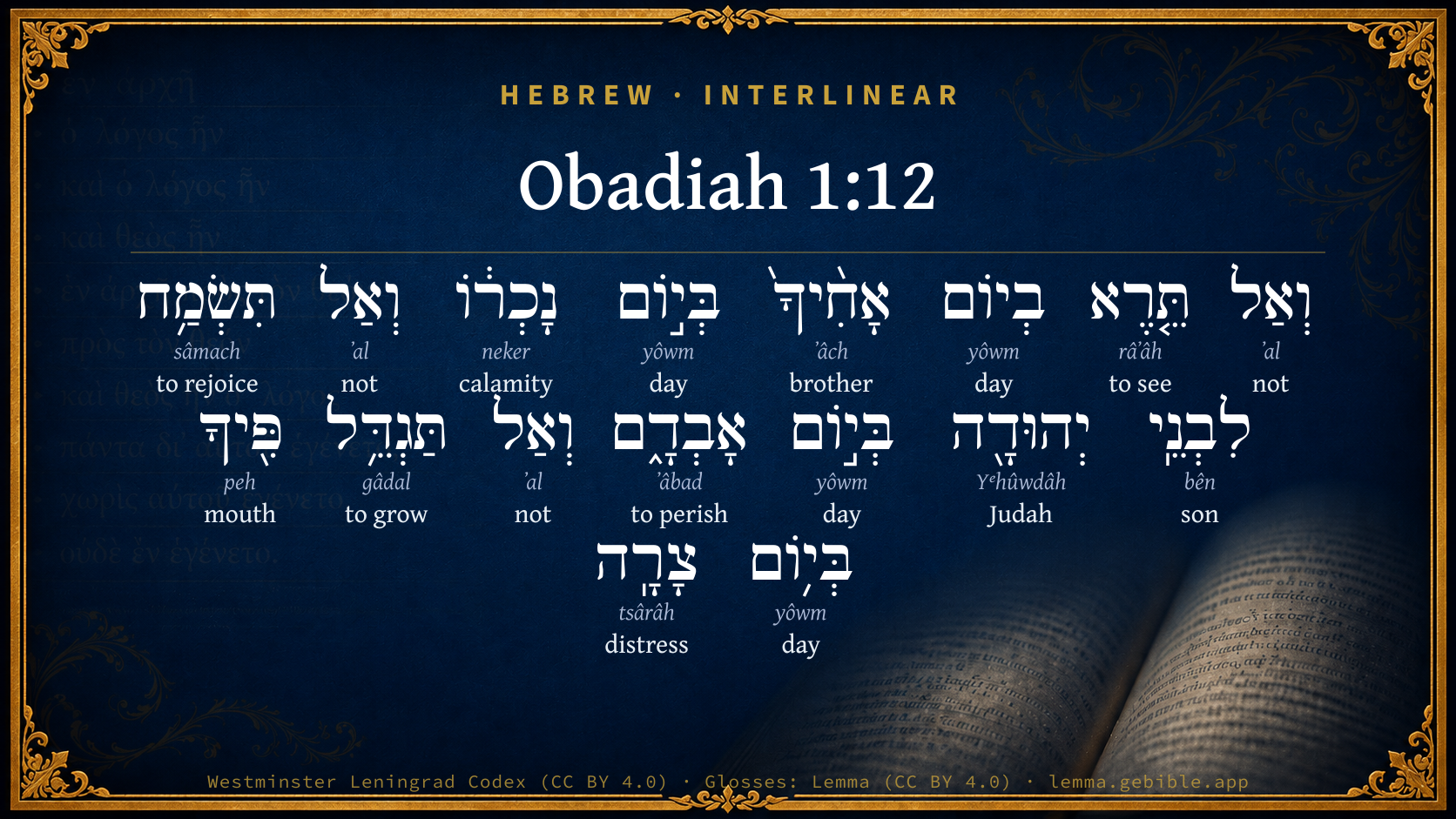
Hebrew (Westminster Leningrad Codex) Obadiah 1:12 appears in the Hebrew Old Testament. The text above is from the Westminster Leningrad Codex. Each word links to its Strong’s number, a concise gloss, and parsing drawn from the Open Scriptures Hebrew Bible morphology. Click any word for its full Brown-Driver-Briggs (BDB) entry.
Download image
Cite this verse

Obadiah 1:12 (World English Bible). Public Domain. Lemma interlinear Bible study tool, https://lemma.gebible.app/v/obadiah/1/12.

Show BibTeX & RIS
BibTeX
RIS
English Translation
But don't look down on your brother in the day of his disaster, and don't rejoice over the children of Judah in the day of their destruction. Don't speak proudly in the day of distress.
World English Bible · Public Domain
Download a study sheet

One document with this verse’s original text, its word-by-word gloss line, the meaning frame, cross-references with their text, attributed commentary, and full source and license credits — printable, and it pastes into notes with its structure intact.

This verse Autodidact and up

Study sheet (.html) Plain text (.txt)

A passage Seminary Student

Up to 50 verses in one chapter. A passage sheet keeps up to 6 commentary sources and 12 cross-references per verse, in the order this page ranks them, and says so on the sheet whenever that leaves anything out. Ask for a single verse and you get the Autodidact verse sheet above.

Everything on this page stays free to read, with no account — the sheet is a download of what is already on screen, not access to it.

Want to remove ads? Support Godless Engineer
Compare translations 3

The same verse in 3 English versions, stacked beneath the original-language interlinear above. Click any original word for its lexicon entry.

Each is an independent rendering of the whole verse — the interlinear is not word-aligned to these translations.

Highlighted words mark where these versions differ — a whole-verse word diff, not a word-by-word alignment.

  • World English Bible Public Domain
    But don't look down on your brother in the day of his disaster, and don't rejoice over the children of Judah in the day of their destruction. Don't speak proudly in the day of distress.
  • King James Version Public Domain
    But thou shouldest not have looked on the day of thy brother in the day that he became a stranger; neither shouldest thou have rejoiced over the children of Judah in the day of their destruction; neither shouldest thou have spoken proudly in the day of distress.
  • unfoldingWord Literal Text CC BY-SA 4.0
    But you should not have looked on the day of your brother, on the day of his misfortune. And you should not have rejoiced over the sons of Judah in the day of their perishing. And you should not have made your mouth great in a day of distress.

unfoldingWord Literal Text — © unfoldingWord, licensed CC BY-SA 4.0. Word-aligned USFM3 via Door43 (git.door43.org/unfoldingWord/en_ult).

Versions to compare (up to 4)

3 of 4 selected

Show all 18 translations

Every available English version of this verse, each an independent rendering of the whole verse.

  • World English Bible Public Domain
    But don't look down on your brother in the day of his disaster, and don't rejoice over the children of Judah in the day of their destruction. Don't speak proudly in the day of distress.
  • Berean Standard Bible Public Domain
    But you should not gloat in that day, your brother’s day of misfortune, nor rejoice over the people of Judah in the day of their destruction, nor boast proudly in the day of their distress.
  • Majority Standard Bible Public Domain
    But you should not gloat in that day, your brother’s day of misfortune, nor rejoice over the people of Judah in the day of their destruction, nor boast proudly in the day of their distress.
  • King James Version Public Domain
    But thou shouldest not have looked on the day of thy brother in the day that he became a stranger; neither shouldest thou have rejoiced over the children of Judah in the day of their destruction; neither shouldest thou have spoken proudly in the day of distress.
  • American Standard Version (1901) Public Domain
    But look not thou on the day of thy brother in the day of his disaster, and rejoice not over the children of Judah in the day of their destruction; neither speak proudly in the day of distress.
  • Revised Version (1885) Public Domain
    But look not thou on the day of thy brother in the day of his disaster, and rejoice not over the children of Judah in the day of their destruction; neither speak proudly in the day of distress.
  • Geneva Bible (1599) Public Domain
    But thou shouldest not haue beholden the day of thy brother, in the day that hee was made a stranger, neither shouldest thou haue reioyced ouer the children of Iudah, in the day of their destruction: thou shouldest not haue spoken proudly in the day of affliction.
  • Douay-Rheims (1899) Public Domain
    But thou shalt not look on in the day of thy brother, in the day of his leaving his country: and thou shalt not rejoice over the children of Juda, in the day of their destruction: and thou shalt not magnify thy mouth in the day of distress.
  • Young's Literal Translation Public Domain
    And -- thou dost not look on the day of thy brother, On the day of his alienation, Nor dost thou rejoice over sons of Judah, In the day of their destruction, Nor make great thy mouth in a day of distress.
  • Literal Standard Version CC BY-SA 4.0
    And—you do not look on the day of your brother, || On the day of his alienation, || Nor do you rejoice over sons of Judah, || In the day of their destruction, || Nor make your mouth great in a day of distress.
  • Unlocked Literal Bible CC BY-SA 4.0
    But do not gloat over your brother's day, in the day of his misfortune, and do not rejoice over the people of Judah in the day of their destruction; do not boast in the day of their distress.
  • unfoldingWord Literal Text CC BY-SA 4.0
    But you should not have looked on the day of your brother, on the day of his misfortune. And you should not have rejoiced over the sons of Judah in the day of their perishing. And you should not have made your mouth great in a day of distress.
  • Darby Bible Public Domain
    But thou shouldest not have looked on the day of thy brother in the day of his disaster; neither shouldest thou have rejoiced over the children of Judah in the day of their destruction; nor have opened wide thy mouth in the day of distress.
  • World Messianic Bible Public Domain
    But don’t look down on your brother in the day of his disaster, and don’t rejoice over the children of Judah in the day of their destruction. Don’t speak proudly in the day of distress.
  • Webster's Bible Public Domain
    But thou shouldst not have looked on the day of thy brother in the day that he became a stranger; neither shouldst thou have rejoiced over the children of Judah in the day of their destruction; neither shouldst thou have spoken proudly in the day of distress.
  • Free Bible Version CC BY-SA 4.0
    You should not have gloated over your brother's day of disaster. You should not have rejoiced over the day of destruction of the sons of Judah. You should not have boasted over the day of their distress.
  • Bible in Basic English Public Domain
    Do not see with pleasure your brother's evil day, the day of his fate, and do not be glad over the children of Judah on the day of their destruction, or make wide your mouth on the day of trouble.
  • JPS Tanakh (1917) Public Domain
    But thou shouldest not have gazed on the day of thy brother in the day of his disaster, neither shouldest thou have rejoiced over the children of Judah in the day of their destruction; neither shouldest thou have spoken proudly in the day of distress.

Literal Standard Version (2020), Covenant Press — licensed CC BY-SA 4.0. Text via the HelloAO Bible API (eBible.org). Unlocked Literal Bible (unfoldingWord) — licensed CC BY-SA 4.0. Text via the HelloAO Bible API (eBible.org). unfoldingWord Literal Text — © unfoldingWord, licensed CC BY-SA 4.0. Word-aligned USFM3 via Door43 (git.door43.org/unfoldingWord/en_ult). Free Bible Version, Dr. Jonathan Gallagher — licensed CC BY-SA 4.0. Text via the HelloAO Bible API (eBible.org).

Word by word

More ways to search: Search by grammar → Find every occurrence → Compare this word →

Practice this passage: Drill this verse → Learn its vocabulary →

נָכְר֔וֹ
neker
H5235
“calamity · his”
Noun, Common, Masculine, Singular, Construct + Suffix, Personal, 3rd Person, Masculine, Singular
Part of Speech
Noun
Type
Common
Gender
Masculine
Number
Singular
State
Construct
Full BDB Definition

Origin: from H5234

TWOT: 1368a

calamity, disaster, misfortune
  1. וְאַל ʼal H408 “and · not” Conjunction + Particle, Negative
  2. תֵּ֤רֶא râʼâh H7200 “to see” Verb, Qal, Jussive, 2nd Person, Masculine, Singular
  3. בְיוֹם yôwm H3117 “in/at · day of” Preposition + Noun, Common, Masculine, Singular, Construct
  4. אָחִ֨יךָ֙ ʼâch H251 “brother · your” Noun, Common, Masculine, Singular, Construct + Suffix, Personal, 2nd Person, Masculine, Singular
  5. בְּי֣וֹם yôwm H3117 “in/at · day of” Preposition + Noun, Common, Masculine, Singular, Construct
  6. וְאַל ʼal H408 “and · not” Conjunction + Particle, Negative
  7. תִּשְׂמַ֥ח sâmach H8055 “to rejoice” Verb, Qal, Jussive, 2nd Person, Masculine, Singular
  8. לִבְנֵֽי bên H1121 “to/for · sons of” Preposition + Noun, Common, Masculine, Plural, Construct
  9. יְהוּדָ֖ה Yᵉhûwdâh H3063 “Judah” Noun, Proper
  10. בְּי֣וֹם yôwm H3117 “in/at · day of” Preposition + Noun, Common, Masculine, Singular, Construct
  11. אָבְדָ֑ם ʼâbad H6 “to perish · them” Verb, Qal, Infinitive Construct + Suffix, Personal, 3rd Person, Masculine, Plural
  12. וְאַל ʼal H408 “and · not” Conjunction + Particle, Negative
  13. תַּגְדֵּ֥ל gâdal H1431 “to grow” Verb, Hiphil, Jussive, 2nd Person, Masculine, Singular
  14. פִּ֖יךָ peh H6310 “mouth · your” Noun, Common, Masculine, Singular, Construct + Suffix, Personal, 2nd Person, Masculine, Singular
  15. בְּי֥וֹם yôwm H3117 “in/at · day of” Preposition + Noun, Common, Masculine, Singular, Construct
  16. צָרָֽה tsârâh H6869 “distress” Noun, Common, Feminine, Singular, Absolute

About this verse

These counts appear in no published source. They are computed here, from the morphology-tagged text and Lemma’s own curated glosses. What Lemma adds →

17
words
12
distinct lemmas
Prophets
section

Notable vocabulary

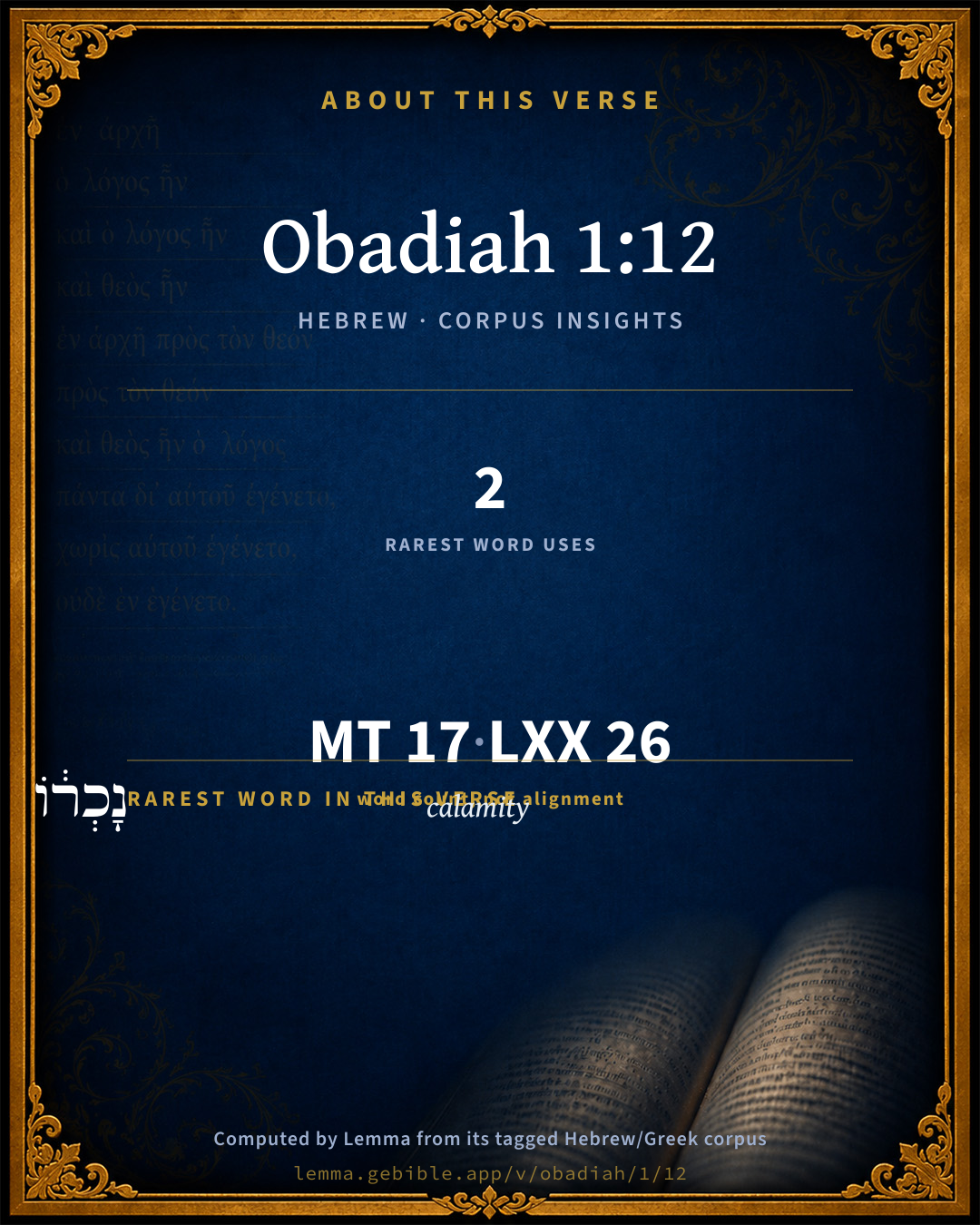
The rarest word here is נָכְר֔וֹ calamity H5235 — appearing just 2 times in the whole Hebrew Bible.

Shared distinctive vocabulary

נָכְר֔וֹ calamity H5235 occurs in 2 verses of the Hebrew Bible. Also found in:

Grammatical profile

  • 4 verbs
  • 10 nouns
  • 3 particles

Verb forms

  • תֵּ֤רֶא Qal · Jussive
  • תִּשְׂמַ֥ח Qal · Jussive
  • אָבְדָ֑ם Qal · Infinitive Construct
  • תַּגְדֵּ֥ל Hiphil · Jussive

Repetition

Words recur within this verse — often emphatic in Hebrew:

  • בְיוֹם day H3117 ×4
  • וְאַל not H408 ×3

Hebrew & Septuagint length

In English translation the verse runs 35 words from the Hebrew and 44 from the Septuagint (LXX English) — closely comparable.

A rough comparison of the two English renderings, which tokenize alike — not a word-level alignment.

Word counts can differ between the Hebrew and the Greek without any difference in meaning — e.g. the Hebrew direct-object marker אֵת has no separate Greek word, and Greek often adds the article ὁ.

In the original languages it is 17 Hebrew tokens and 26 Greek tokens — but the two are counted differently (Hebrew bundles its prefixes and suffixes into one token; the Greek is in lemma form), so that isn’t a like-for-like length.

Cross-references

22

Topical passages linked to Obadiah 1:12 in the Treasury of Scripture Knowledge — connected by theme and wording, ordered by reader-vote popularity; previews shown in the World English Bible.

  • Proverbs 17:5 Whoever mocks the poor reproaches his Maker. He who is glad at calamity shall not be unpunished.
  • Ezekiel 35:15 As you did rejoice over the inheritance of the house of Israel, because it was desolate, so will I do to you: you shall be desolate, Mount Seir, and all Edom, even all of it; and they shall know that I am Yahweh.
  • Micah 4:11 Now many nations have assembled against you, that say, 'Let her be defiled, And let our eye gloat over Zion.'
  • 1 Samuel 2:3 Talk no more so exceeding proudly; Don't let arrogance come out of your mouth; For Yahweh is a God of knowledge, By him actions are weighed.
  • Proverbs 24:17–18 Don't rejoice when your enemy falls. Don't let your heart be glad when he is overthrown;
  • Matthew 27:40–43 and saying, "You who destroy the temple, and build it in three days, save yourself! If you are the Son of God, come down from the cross!"
  • Ezekiel 25:6–7 For thus says the Lord Yahweh: Because you have clapped your hands, and stamped with the feet, and rejoiced with all the despite of your soul against the land of Israel;
  • Micah 7:8–10 Don't rejoice against me, my enemy. When I fall, I will arise. When I sit in darkness, Yahweh will be a light to me.
  • 2 Peter 2:18 For, uttering great swelling words of emptiness, they entice in the lusts of the flesh, by licentiousness, those who are indeed escaping from those who live in error;
  • Job 31:29 "If I have rejoiced at the destruction of him who hated me, Or lifted up myself when evil found him;
  • Psalms 22:17 I can count all of my bones. They look and stare at me.
  • Psalms 31:18 Let the lying lips be mute, Which speak against the righteous insolently, with pride and contempt.
  • Psalms 37:13 The Lord will laugh at him, For he sees that his day is coming.
  • Jude 1:16 These are murmurers and complainers, walking after their lusts (and their mouth speaks proud things), showing respect of persons to gain advantage.
  • Psalms 54:7 For he has delivered me out of all trouble. My eye has seen triumph over my enemies.
  • Psalms 59:10 My God will go before me with his loving kindness. God will let me look at my enemies in triumph.
  • Psalms 92:11 My eye has also seen my enemies. My ears have heard of the wicked enemies who rise up against me.
  • Isaiah 37:24 By your servants have you defied the Lord, and have said, With the multitude of my chariots am I come up to the height of the mountains, to the innermost parts of Lebanon; and I will cut down the tall cedars of it, and the choice fir trees of it; and I will enter into its farthest height, the forest of its fruitful field;
  • Lamentations 4:21 Rejoice and be glad, daughter of Edom, that dwell in the land of Uz: The cup shall pass through to you also; you shall be drunken, and shall make yourself naked.
  • Luke 19:41 When he drew near, he saw the city and wept over it,
  • James 3:5 So the tongue is also a little member, and boasts great things. See how a small fire can spread to a large forest!
  • Revelation 13:5 A mouth speaking great things and blasphemy was given to him. Authority to make war for forty-two months was given to him.

Cross-references courtesy of OpenBible.info (CC BY 4.0).

Hebrew and Greek witnesses Masoretic Hebrew ↔ Greek Septuagint

The same verse in the two great witnesses to the Old Testament, shown verse-for-verse.

These are two independent witnesses, not word-aligned to each other, and the Septuagint is shown in lemma (dictionary) form.

Hebrew Obadiah 1:12 Masoretic · Westminster Leningrad Codex

וְאַל תֵּ֤רֶא בְיוֹם אָחִ֨יךָ֙ בְּי֣וֹם נָכְר֔וֹ וְאַל תִּשְׂמַ֥ח לִבְנֵֽי יְהוּדָ֖ה בְּי֣וֹם אָבְדָ֑ם וְאַל תַּגְדֵּ֥ל פִּ֖יךָ בְּי֥וֹם צָרָֽה

But don't look down on your brother in the day of his disaster, and don't rejoice over the children of Judah in the day of their destruction. Don't speak proudly in the day of distress.

World English Bible · Public Domain

Greek LXX Obadiah 1:12 Septuagint · lemma form

καί μή ἐπιδέω ἡμέρα ἀδελφός σύ ἐν ἡμέρα ἀλλότριος καί μή ἐπιχαίρω ἐπί ὁ υἱός ιουδα ἐν ἡμέρα ἀπώλεια αὐτός καί μή μεγαλορρημονέω ἐν ἡμέρα θλῖψις

And you should not have looked on the day of your brother in the day of strangers; nor should you have rejoiced against the children of Juda in the day of their destruction; neither should you have boasted in the day of their affliction.

LXX2012 (modern English Septuagint) · Public Domain

On this verse, The Pulpit Commentary discusses the Septuagint’s reading. Read the note in Commentary ↓

Hebrew: Westminster Leningrad Codex (CC BY 4.0). Greek: Septuagint (public domain); English from LXX2012 (modern English Septuagint) (Public Domain). How the Septuagint differs from the Hebrew →

Targum (Aramaic paraphrase)

1

The Targum is the ancient Jewish Aramaic paraphrase of the Hebrew Scriptures — an interpretive translation, not the Hebrew text itself. Onkelos (literal) and Pseudo-Jonathan (expansive) render the Torah, and Jonathan the Prophets. Coverage is partial: where no permissively-licensed English translation exists for a verse, only the Aramaic is shown. This is verse-level text, not a word-by-word alignment to the Hebrew.

  1. Targum Jonathan Prophets (Joshua–Malachi)
    וְדַחֲזֵיתָא בְיוֹמָא דְאֲחוּךְ בְּיוֹם תְּבִירֵיהּ וְדַחֲדִיתָא לִבְנֵי יְהוּדָה בְּיוֹם תְּבִירְהוֹן וּדְאַסְגֵיתָא לְמַלָלָא רַבְרְבָן בְּעִדַן עָקָא:

    (no public-domain English translation for this verse)

    Targum Jonathan — Aramaic: “Mikraot Gedolot” (public domain). English: “Sefaria Community Translation” (CC0 1.0 (public-domain dedication)); “London "Chaldee Paraphrase," 1871” (public domain). Text via Sefaria.

Commentary

Notes on Obadiah 1:12 from classic Christian and Jewish commentators (each source and its license shown beneath its notes). The classic Christian expositions comment on the surrounding passage and are grouped to its opening verse, so a note may address several verses; the Jewish commentaries on the Tanakh (Rashi and others) are per-verse, so they appear only where the commentator wrote on this verse.

Lemma curates 59 commentaries, every one of them public domain or Creative Commons licensed, each selected and text-cleaned for this edition rather than reprinted as found. About our sources →

Adam Clarke's Commentary

Verse 12. Thou shouldest not have looked] It shows a malevolent heart to rejoice in the miseries of those who have acted unkindly or wickedly towards us. The Edomites triumphed when they saw the judgments of God fall upon the Jews. This the Lord severely reprehends in Ob 1:12-15. If a man have acted cruelly towards us, and God punish him for this cruelty, and we rejoice in it, we make his crime our own; and then, as we have done, so shall it be done unto us; see Ob 1:15. All these verses point out the part the Edomites took against the Jews when the Chaldeans besieged and took Jerusalem, destroyed the temple, and divided the spoils.

Adam Clarke's Commentary on the Bible (1810–1826) — public domain. Text from a community e-Sword/MySword module.

Trapp's Complete Commentary

John Trapp

Oba 1:12 But thou shouldest not have looked on the day of thy brother in the day that he became a stranger; neither shouldest thou have rejoiced over the children of Judah in the day of their destruction; neither shouldest thou have spoken proudly in the day of distress.

Ver. 12. But thou shouldest not have looked on the day] Unless it were with weeping eyes. Iisdem quibus videmus oculis flemus. Men have the same organ of seeing and of weeping; that when they behold a doleful object, they might weep over it; not as the crocodile doth over the dead body which she had slain before, and afterwards devoureth; but with true tears of compassion, weeping with those that weep. God takes it ill here, that any should once look upon his afflicted people, unless it be to pity and relieve them. He observed Cain’s lowering upon his brother, Gen 4:6, and the Jews’ wagging their heads, Mat 27:39, Rabshakeh’s lofty looks, Isa 37:28, Laban’s change of countenance, Gen 31:2. Men may not look at liberty, and as they list. Vultu saepe laeditur charitas. It was not for nothing, therefore, that in Queen Elizabeth’s days, at a meeting of the borderers in the marches between England and Scotland, about goods unjustly taken, security was given and confirmed on both sides by oath, according to custom and proclamation made, that no man should harm other by word, deed, or look.

When he became a stranger] And fell under a strange punishment, as Job speaketh, Job 31:3, that is, a rare and unheard of misery, monstrosum exilium, Tremellius rendereth it. This was threatened, 2Ch 7:21, and accordingly fulfilled, Lam 1:9. Israel became the world’s wonderment, a famous instance of God’s severity against a people of his wrath and of his curse. Aben Ezra rendereth it, In his strange day, such as he had never seen the like before. Others, when he was banished his own borders, and became a stranger at home: when God seemed to look strange upon him, and to stand aloof, or as a man astonied, that knows not whether he had best help or no, as a mighty man that cannot save, Jer 14:8-9. John Baptist was beheaded in prison without any law, right, or reason, as though God had known nothing at all of him, saith that martyr (Acts & Mon. 1423).

Neither shouldest thou have rejoiced over the children, &c.] For this is to be sick of the devil’s disease, επιχαιρεκακια, and such are assured that they shall not go unpunished, Pro 17:5. God will soon see it, and be displeased, and turn the current of his wrath upon such an offender, Pro 24:18, as he did here upon Edom, for looking with liking on the calamity of his brother, for rejoicing at the downfall of his enemy.

Neither shouldest thou have spoken proudly] Heb. Magnified thy mouth, blustering and breathing out big threats, setting up thine horn on high, and saying, "Rase it, rase it, even to the foundation thereof," Psa 137:7.

“ Diripite, ex imis evertite fundamentis. ”( Buchanan.)

Such a Pyrgopolynicas was Nebuchadnezzar, Isa 10:13, and Alexander the Great, and Antiochus, that little antichrist, Dan 7:8, and that great antichrist of Rome, bellowing with his bulls, and menacing hell to all that adhere not to him. See Rev 13:5-6, and a like phrase to this, Eze 35:13.

John Trapp, A Commentary or Exposition upon All the Books of the Old and New Testament (1647–1656) — public domain. Text from a community e-Sword module.

The Biblical Illustrator

Joseph S. Exell

Oba_1:12-15

But thou shouldst not have looked on the day of thy brother.

The doom of Edom

The commentary on this prophecy is supplied by every traveller who has explored the recesses of the mountain of Esau. Every people that has the privileges of Edom, and like Edom abuses them, is without right to expect a more favourable issue from the hand of God. The general sentiment implied in this prophecy is, that a nation in prosperity abusing its advantages to the injury of less fortunate peoples, or even neglecting them in their distress, incurs by its conduct the displeasure of God. Apply the subject--

1. To the religious character and improvement of England. It is not easy to form an adequate conception of the diffusive and pervading influence of British power. That extraordinary influence is steadily, continually increasing; England is rising to be the great leader of public opinion among the nations. On all great political, commercial, moral, social, and religious questions the world is now looking to Britain. Then we plead with you on behalf of your country. You are the light of your country, and by making it luminous you become, in it, the light of the world.

2. To the conduct of England towards such people as have a peculiar claim upon its regard. The Edomites ought to have assisted, and not oppressed, the Jews. To us the sister island is surely as intimately related as Israel could have been to Edom. As to the colonies, little need be said. As England sows, so shall it reap. (R. Halley, M. A.)

The Biblical Illustrator, edited by Joseph S. Exell (c. 1880s–1900s) — public domain. Text from a community e-Sword module.

Joseph Benson's Commentary

Oba 1:12. But thou shouldest not have looked upon the day of thy brother — On his evil day. Thou oughtest not to have taken pleasure at the sight of thy brother’s calamity. So the expression of looking upon an enemy signifies, in many passages of Scripture, the beholding his fall with satisfaction: see the margin. In the day that he became a stranger — When he was driven from his own inheritance, and went captive into a strange land. Neither shouldest thou have rejoiced over the children of Judah, &c. — In the day when many of them were slain; nor have spoken proudly in the day of distress — Neither shouldest thou have insulted over them when they were in calamity, boasting of thy own felicity, while they were groaning under misery.

Joseph Benson's Commentary on the Old and New Testaments (1811–1818) — public domain. Text from a community e-Sword module.

Keil & Delitzsch

C. F. Keil & F. Delitzsch

"And look not at the day of thy brother on the day of his misfortune; and rejoice not over the sons of Judah in the day of their perishing, and do not enlarge thy mouth in the day of the distress. Oba 1:13. Come not into the gate of my people in the day of their calamity; thou also look not at his misfortune in the day of his calamity, and stretch not out thy hand to his possession in the day of his calamity: Oba 1:14. Nor stand in the cross-road, to destroy his fugitives, nor deliver up his escaped ones in the day of distress." This warning cannot be satisfactorily explained either "on the assumption that the prophet is here foretelling the future destruction of Judah and Jerusalem" (Caspari), or "on the supposition that he is merely depicting an event that has already past" (Hitzig). If the taking and plundering of Jerusalem were an accomplished fact, whether in idea or in reality, as it is shown to be by the perfects בּאוּ and ידּוּ in Oba 1:11, Obadiah could not in that case warn the Edomites against rejoicing over it, or even taking part therein. Hence Drusius, Rosenmller, and others, take the verbs in Oba 1:12-14 as futures of the past: "Thou shouldest not have seen, shouldest not have rejoiced," etc. But this is opposed to the grammar. אל followed by the so-called fut. apoc. is jussive, and cannot stand for the pluperf. conjunct. And Maurer's suggestion is just as untenable, namely, that yōm in Oba 1:11 denotes the day of the capture of Jerusalem, and in Oba 1:12, Oba 1:13 the period after this day; since the identity of יום עמדך (the day of thy standing) in Oba 1:11 with יום אחיך in Oba 1:12 strikes the eye at once. The warning in Oba 1:12-14 is only intelligible on the supposition, that Obadiah has not any particular conquest and plundering of Jerusalem in his mind, whether a future one or one that has already occurred, but regards this as an event that not only has already taken place, but will take place again: that is to say, on the assumption that he rises from the particular historical event to the idea which it embodied, and that, starting from this, he sees in the existing case all subsequent cases of a similar kind. From this ideal standpoint he could warn Edom of what it had already done, and designate the disastrous day which had come upon Judah and Jerusalem by different expressions as a day of the greatest calamity; for what Edom had done, and what had befallen Judah, were types of the future development of the fate of Judah and of the attitude of Edom towards it, which go on fulfilling themselves more and more until the day of the Lord upon all nations, upon the near approach of which Obadiah founds his warning in Oba 1:15. The warning proceeds in Oba 1:12-14 from the general to the particular, or from the lower to the higher. Obadiah warns the Edomites, as Hitzig says, "not to rejoice in Judah's troubles (Oba 1:12), nor to make common cause with the conquerors (Oba 1:13), nor to outdo and complete the work of the enemy (Oba 1:14)." By the cop. Vav, which stands at the head of all the three clauses in Oba 1:12, the warning addressed to the Edomites, against such conduct as this, is linked on to what they had already done.

The three clauses of Oba 1:12 contain a warning in a graduated form against malicious pleasure. ראה with ב, to look at anything with pleasure, to take delight in it, affirms less than שׂמח ב, to rejoice, to proclaim one's joy without reserve. הגדּיל פּה, to make the mouth large, is stronger still, like הגדּיל בּפה, to boast, to do great things with the mouth, equivalent to הרחיב פּה על, to make the mouth broad, to stretch it open, over (against) a person (Psa 35:21; Isa 57:4), a gesture indicating contempt and derision. The object of their malicious pleasure mentioned in the first clause is yōm 'âchı̄khâ, the day of thy brother, i.e., the day upon which something strange happened to him, namely, what is mentioned in Oba 1:11. Yōm does not of itself signify the disastrous day, or day of ruin, either here or anywhere else; but it always receives the more precise definition from the context. If we were to adopt the rendering "disastrous day," it would give rise to a pure tautology when taken in connection with what follows. The expression 'âchı̄khâ (of thy brother) justifies the warning. בּיום נכרו is not in apposition to בּיום אחיך, but, according to the parallelism of the clauses, it is a statement of time. נכר, ἁπ. λεγ. = נכר (Job 31:3), fortuna aliena, a strange, i.e., hostile fate, not "rejection" (Hitzig, Caspari, and others). The expression יום אבדם, the day of their (Judah's sons) perishing, is stronger still; although the perishing ('ăbhōd) of the sons of Judah cannot denote the destruction of the whole nation, since the following word tsrh, calamity, is much too weak to admit of this. Even the word איד, which occurs three times in Oba 1:13, does not signify destruction, but (from the root אוּד, to fall heavily, to load) simply pressure, a burden, then weight of suffering, distress, misfortune (see Delitzsch on Job 18:12). In Oba 1:13 Obadiah warns against taking part in the plundering of Jerusalem. The gate of my people: for the city in which the people dwell, the capital (see Mic 1:9). Look not thou also, a brother nation, upon his calamity, as enemies do, i.e., do not delight thyself thereat, nor snatch at his possessions. The form tishlachnâh, for which we should expect tishlach, is not yet satisfactorily explained (for the different attempts that have been made to explain it, see Caspari). The passages in which nâh is appended to the third pers. fem. sing., to distinguish it from the second person, do not help us to explain it. Ewald and Olshausen would therefore alter the text, and read תּשׁלח יד. But יד is not absolutely necessary, since it is omitted in Sa2 6:6; Sa2 22:17, or Psa 18:17, where shâlach occurs in the sense of stretching out the hand. חילו, his possessions. On the fact itself, compare Joe 3:5. The prominence given to the day of misfortune at the end of every sentence is very emphatic; "inasmuch as the selection of the time of a brother's calamity, as that in which to rage against him with such cunning and malicious pleasure, was doubly culpable" (Ewald). In Oba 1:14 the warning proceeds to the worst crime of all, their seizing upon the Judaean fugitives, for the purpose of murdering them or delivering them up to the enemy. Pereq signifies here the place where the roads break or divide, the cross-road. In Nah 3:1, the only other place in which it occurs, it signifies tearing in pieces, violence. Hisgı̄r, to deliver up (lit., concludendum tradidit), is generally construed with אל (Deu 23:16) or בּיד (Psa 31:9; Sa1 23:11). Here it is written absolutely with the same meaning: not "to apprehend, or so overpower that there is no escape left" (Hitzig). This would affirm too little after the preceding הכרית, and cannot be demonstrated from Job 11:10, where hisgı̄r means to keep in custody.

Keil & Delitzsch — Biblical Commentary on the Old Testament (1861–1891) — public domain (CC PDM 1.0). Text via the HelloAO Bible API. (Old Testament only.)

Tyndale Open Study Notes

Tyndale Open Resources

1:12-14 All societies are held accountable for sins such as those of Edom (see, e.g., the oracles against Israel’s neighbors in Amos 1:3–2:3). Among the sins that the Edomites committed against Judah were sharing with the Babylonians in plundering the land (Obad 1:13) and either killing or repatriating Judah’s fugitives (1:14).

1:12 The tribes of Israel were Edom’s relatives (literally brother; cp. Num 20:14). • Edom and other local nations had apparently deceived themselves into thinking that rapprochement with Nebuchadnezzar in 586 BC would bring them respite. Their time of judgment would come.

Tyndale Open Study Notes — © Tyndale Open Resources, licensed CC BY-SA 4.0. Text via the HelloAO Bible API.

Geneva Bible (1599)

Geneva Bible translators

When the Lord deprived them of their former dignity, and gave them to be carried into captivity.

Geneva Bible (1599) marginal notes — public domain. Text via Bolls.life.

Jamieson, Fausset & Brown

Robert Jamieson, A. R. Fausset & David Brown

looked on--with malignant pleasure, and a brutal stare. So the antitypes, Messiah's foes (). MAURER translates, as the Margin, "thou shouldest not look" any more. English Version agrees with the context better.

the day of thy brother--his day of calamity.

became a stranger--that is, was banished as an alien from his own land. God sends heavy calamities on those who rejoice in the calamities of their enemies (; ). Contrast the opposite conduct of David and of the divine Son of David in a like case ().

spoken proudly--literally, "made great the mouth"; proudly insulting the fallen (, Margin; compare ; ).

Jamieson, Fausset & Brown — Commentary Critical and Explanatory on the Whole Bible (1871) — public domain (CC PDM 1.0). Text via the HelloAO Bible API.

John Calvin's Commentaries

The Prophet enumerates here the kinds of cruelty which the Idumeans exercised towards the Church of God, the children of Abraham, their own kindred. But he speaks by way of prohibition; it is then a personification, by which the Prophet introduces God as the speaker, as though he taught and admonished them on the duties of human kindness. Engraven, indeed, on their hearts ought all these to have been, on account of which he now reproaches them; for by forgetting humanity they had departed from everything right which nature requires. God indeed did not commence by instructing or teaching the Idumeans what were their duties; but the Prophet reminds them of things which must have been well known to them, and were beyond all dispute true.

Hence he says, Thou shouldest not look on in the day of thy brother, in the day of his alienation. The day of Judah he calls that in which God visited him: so the day of Jerusalem is called the day of calamity. Thou shouldest not then look on: we know in what sense this verb, to look on, is usually taken in Scripture; it is applied to men, when they lie in wait, or very anxiously desire anything, or rejoice at what they witness. The Prophet no doubt takes it metaphorically for taking delight in the misery of the chosen people; for, shortly after, he repeats the same word. Thou shouldest not then look on in the day of thy brother, even in the day of his alienation Some take another sense; but I approve of their opinion, who regard this alienation as meaning exile; at the same time, they give not the reason for this metaphor, which is this, — that such a change then took place in the people, that they put on a new appearance. It was then alienation, when God wholly abolished the glory of the kingdom of Judah, and when he took away all his favors, so that the appearance of the people became deformed. In the day then of his alienation, that is, when the Lord stripped him of his ancient dignity.

Thou shouldest not rejoice, he says, over the children of Judah, in the day of their destruction, that is of their ruin; “thou shouldest not make thy mouth great in the day of affliction”. We now perceive what the Prophet means. Though indeed he seems here to show to the Idumeans their duty, he yet reproves them for having neglected all the laws of humanity, and of having been carried away by their own pride and cruelty. It hence follows that they were worthy of that dreadful vengeance which he has already mentioned. In case then the Idumeans complained that God dealt too severely with them, the Prophet here reminds them, that they in many ways sought such a ruin for themselves, — How so? “Were not thou delighted with the calamity of thy brother? Didst not thou laugh when Judah was distressed? And didst not thou speak loftily in ridicule? Was this outrageousness to be endured? Can the Lord now spare thee, as thou hast been so cruel towards thy brother?” And he repeats the name of brother, for the crime was the more atrocious, as it has been already said, as they showed no regard for those of their own blood. But the Prophet often mentions either affliction, or ruin, or calamity, or evils, or adversity; for it is a feeling naturally implanted in us, that when one is distressed, we are touched with pity; even when we see our enemies lie prostrate on the ground, our hatred and anger are extinguished, or at least are abated: and all who see even their enemies ill-treated, become, as it were, other men, that is, they put off the anger with which they were previously inflamed. As then this is what is common almost to all men, it appears that the Idumeans must have been doubly and treble barbarous, when they rejoiced at the calamity of their brethren, and took pleasure in a spectacle so sad and mournful, and even spoke proudly, and jeered the miserable Jews; for this, as we have said, is the meaning of the words, to make great the mouth.

John Calvin's Commentaries (1540-1563) — public domain. Text from the Calvin Translation Society English edition (1840s-50s) via the Christian Classics Ethereal Library (ccel.org). Calvin's coverage is partial (roughly two-thirds of the Bible); uncommented books and verses are honest gaps, never fabricated. The 19th-century editor's footnotes and remarks are omitted so the notes are faithfully Calvin's own voice.

The Cambridge Bible for Schools and Colleges

gen. ed. J. J. S. Perowne

12. Thou shouldest not have looked … have rejoiced … have spoken] rather, look not, rejoice not, speak not. In this verse it is the neutrality of Edom, spoken of as “standing on the other side” in the former part of Oba_1:11, that is condemned. In Oba_1:13-14 his active cooperation with the enemy, his being “as one of them,” is denounced. But in both cases there is a climax. In this verse the complacent looking on deepens into malicious joy, and malicious joy finds expression in derisive mockery. In the following verses, he who before had stood afar, draws near, “enters into the gate” with the victorious foe, “looks on the affliction,” as a close spectator of all its horrors, “lays hands on the spoil,” does not scruple to take part in the pillage of his brother, nor even to waylay the fugitives and deliver them up into the hand of the enemy. “He dehorts them from malicious rejoicing at their brother’s fall, first in look, then in word, then in act, in covetous participation of the spoil, and lastly in murder.” Pusey.

looked on the day] Comp. “the day of Jerusalem.” Psa_137:7. “Malicious gazing on human calamity, forgetful of man’s common origin, and common liability to ill, is the worst form of human hate. It was one of the contumelies of the Cross, They gaze, they look with joy upon Me. Psa_22:17.” Pusey.

became a stranger] i.e. was treated as a stranger, cruelly and unjustly: or was made a stranger by being carried into captivity. The clause however may mean “in the day of his calamity,” or “disaster,” R.V.

rejoiced] “He that is glad at calamities shall not be unpunished.” Pro_17:5.

spoken proudly] lit. “make thy mouth great” in derision and mockery. This may refer either to proud boastful words, or to mocking grimaces and contortions of the mouth.

The Cambridge Bible for Schools and Colleges (gen. ed. J. J. S. Perowne; Cambridge University Press, 1878–1918) — public domain. Text from a community e-Sword module.

John Gill's Exposition

But thou shouldest not have looked on the day of thy brother,.... The day of his calamity, distress, and destruction, as afterwards explained; that is, with delight and satisfaction, as pleased with it, and rejoicing at it; but rather should have grieved and mourned, and as fearing their turn would be next: or, "do not look" (t); so some read it in the imperative, and in like manner all the following clauses:

in the day that he became a stranger; were carried into a strange country, and became strangers to their own: or, "in the day of his alienation" (u); from their country, city, houses, and the house and worship of God; and when strange, surprising, and unheard of things were done unto them, and, among them:

neither shouldest thou have rejoiced over the children of Judah in the day of their destruction; the destruction of the Jews, of the two tribes of Judah and Benjamin, by the Chaldeans: this explains what is meant by the Edomites looking upon the day of the calamity of the Jews, that it was with pleasure and complacency, having had a good will to have destroyed them themselves, but it was not in the power of their hands; and now being done by a foreign enemy, they could not forbear expressing their joy on that occasion, which was very cruel and brutal; and this also shows that Obadiah prophesied after the destruction of Jerusalem by Nebuchadnezzar:

neither shouldest thou have spoken proudly in the day of distress; or "magnified thy mouth" (w); opened it wide in virulent scoffing, and insulting language; saying with the greatest fervour and vehemence, and as loud as it could be said, "rase it, rase it to the foundation thereof", Psa 137:7.

(t) "ne aspicias", Junius & Tremellius; "ne aspicito", Piscator; "ne spectes", Cocceius. (u) "diem alienationis ejus", Junius & Tremellius, Piscator, Mercerus; "in die alienationis ejus", Calvin, Cocceius, Burkius. (w) "et non debebas magnificare os tuum", Pagninus; "ne magnifices", Montanus, Junius & Tremellius; "ne magnificato", Piscator; "ne magno ore utaris", Cocceius.

John Gill's Exposition of the Whole Bible (1746–1763) — public domain (CC PDM 1.0). Text via the HelloAO Bible API.

Albert Barnes' Notes on the Bible

But thou shouldest not - , rather it means, and can only mean , “And look not (i. e., gaze not with pleasure) on the day of thy brother in the day of his becoming a stranger ; and rejoice not over the children of Judah in the day of their destruction; and enlarge not thy mouth in the day of distress. Enter not into the gate of My people in the day of their calamity; look not, thou too, on his affliction in the day of his calamity; and lay not hands on his substance in the day of his calamity; And stand not on the crossway, to cut off his fugitives; and shut not up his remnants in the day of distress.”

Throughout these three verses, Obadiah uses the future only. It is the voice of earnest, emphatic, dehortation and entreaty, not to do what would displease God, and what, if done, would be punished. He dehorts them from malicious rejoicing at their brother’s fall, first in look, then in word, then in act, in covetous participation of the spoil, and lastly in murder. Malicious gazing on human calamity, forgetful of man’s common origin and common liability to ill, is the worst form of human hate. It was one of the contumelies of the Cross, “they gaze, they look” with joy “upon Me.” Psa 22:17. The rejoicing over them was doubtless, as among savages, accompanied with grimaces (as in Psa 35:19; Psa 38:16). Then follow words of insult. The enlarging of the mouth is uttering a tide of large words, here against the people of God; in Ezekiel, against Himself Eze 35:13 : “Thus with your mouth ye have enlarged against Me and have multiplied your words against Me. I have heard.”

Thereon, follows Edom’s coming yet closer, “entering the gate of God’s people” to share the conqueror’s triumphant gaze on his calamity. Then, the violent, busy, laying the hands on the spoil, while others of them stood in cold blood, taking the “fork” where the ways parted, in order to intercept the fugitives before they were dispersed, or to shut them up with the enemy, driving them back on their pursuers. The prophet beholds the whole course of sin and persecution, and warns them against it, in the order, in which, if committed, they would commit it. Who would keep clear from the worst, must stop at the beginning. Still God’s warnings accompany him step by step. At each step, some might stop. The warning, although thrown away on the most part, might arrest the few. At the worst, when the guilt had been contracted and the punishment had ensued, it was a warning for their posterity and for all thereafter.

Some of these things Edom certainly did, as the Psalmist prays Psa 137:7, “Remember, O Lord, to the children of Edom the day of Jerusalem, who said, Lay bare, lay bare, even to the foundation in her.” And Ezekiel Eze 35:5-6 alluding to this language of Obadiah , “because thou hast had a perpetual hatred, and hast shed the blood of the children of Israel by the force of the sword in the time of their calamity, in the time that their iniquity had an end, therefore, as I live, saith the Lord God, I will prepare thee unto blood, and blood shall pursue thee; sith thou hast not hated blood, even blood shall pursue thee.” Violence, bloodshed, unrelenting, deadly hatred against the whole people, a longing for their extermination, had been inveterate characteristics of Esau. Joel and Amos had already denounced God’s judgments against them for two forms of this hatred, the murder of settlers in their own land or of those who were sold to them Joe 3:19; Amo 1:6, Amo 1:9, Amo 1:11.

Obadiah warns them against yet a third, intercepting their fugitives in their escape from the more powerful enemy. “Stand not in the crossway.” Whoso puts himself in the situation to commit an old sin, does, in fact, will to renew it, and will, unless hindered from without, certainly do it. Probably he will, through sin’s inherent power of growth, do worse. Having anew tasted blood, Ezekiel says, that they sought to displace God’s people and remove God Himself Eze 35:10-11. “Because thou hast said, these two nations and these two countries shall be mine, and we will possess it, whereas the Lord was there, therefore, as I live, saith the Lord God, I will even do according to thine anger, and according to thine envy, which thou hast used out of thy hatred against them.”

Albert Barnes' Notes on the Bible (1834–1885) — public domain. Text from a community e-Sword/MySword module.

Haydock's Catholic Bible Commentary

Though shalt not look, &c., or thou shouldst not, &c. It is a reprehension for what they had done, and at the same time a declaration that these things should not pass unpunished. (Challoner) --- God admonishes, and at the same time insinuates that the Idumeans would act quite the reverse. (Worthington) --- Magnify. Literally, thou shalt not speak arrogantly against the children of Juda, as insulting them in their distress, (Challoner) like people mocking. When they shall be themselves afflicted, they shall cease to upbraid the Jews. (Calmet)

George Leo Haydock (1774–1849), Haydock's Catholic Family Bible and Commentary, 1859 edition — public domain. Excludes Psalms (Douay-Rheims chapter numbering differs from Protestant) and Deuterocanonical books (Catholic canon only).

Matthew Poole's English Annotations

Thou shouldest not have looked with secret joy and satisfaction to thy eyes and mind; if thou wouldst have looked, it should have been with tears and grief, not with joy and gladness at the sight: so the word, Psa 37; Psa 44:7; Pro 29:16.

On the day; on the affliction and sad misery which fell upon thy brother Jacob; so day in Scripture, thus absolutely put, doth often signify, Psa 37:13; Mic 7:4.

Became a stranger; having by the misery of war been made a captive, and lost his former right and liberty in his own country, was now looked upon as a stranger, i.e. one who had no more right to any thing in the land.

Neither shouldest thou have rejoiced: this explains the former.

Children of Judah: this expounds brother.

The day of their destruction: this tells us what day meant.

Neither shouldest thou have spoken proudly, vaunting over the Jews, insolently upbraiding and reproaching them with virulent words and exulcerated malice,

in the day of distress, when Jerusalem was taken.

Matthew Poole's English Annotations on the Holy Bible (1683–1685) — public domain. Text from a community e-Sword/MySword module.

The Pulpit Commentary

The prophet complains of the malignant neutrality of the Edomites. Thou shouldest not have looked. In this and the two following verses, al with the future is wrongly translated. It should be rendered throughout, "do not look," "do not rejoice," etc. Obadiah, in view of the past behaviour of Edom, and looking forward to another and more fatal conquest of Jerusalem, warns the Edomitas against repeating this malicious conduct. Septuagint, mh epidhv . Gaze not with pleasure, feast not thine. (Mic_7:10) The day of thy brother; i.e. when some great event befell him explained further in the next clause. Compare "the day of Jerusalem". (Psa_137:7) In the day that he became a stranger; Septuagint, en hmera allotriwn , "in the day of strangers;" Vulgate, in die peregrinationis ejus. The Anglican and Vulgate Versions signify, "in the day that he was carried captive into strange lands;" but most probably the expression should be rendered, "in the day of his calamity." Rejoiced over. (comp. Job_31:29 Pro_17:5 Mic_7:8) Spoken proudly; literally, make thy mouth great; Septuagint, mh megalorrhmonh , "do not boast;" Vulgate, non magnificabis os tuum. Utter a flood of mocking words, probably accompanied with derisive grimaces. There is a climax in this verse first the complacent look, then the malicious pleasure, then words of insult and derision.

Vers. 12-16. Social cruelty: 3. As working in various forms from generation to generation.

"But thou shouldest not have looked on the day of thy brother in the day that he became a stranger," etc. Here we have a sketch of the workings of this cruelty towards Judah when he was in great distress, suffering, and peril.

I CRUELTY HAS VARIOUS FORMS OF WORKING. Look at the forms here.

1. The lack of sympathy when Judah was in distress. "Thou shouldest not have looked," etc. Greatly did Judah need Edom"s sympathy at this time. "Strangers carried away captive their forces;" Babylon entered their country and their city and carried them away as captives. Foreigners entered into his gates and cast lots upon Jerusalem. The city, after a long siege, was broken up; and the great officers of the King of Babylon came and sat at the gates and cast lots on the spoils of Jerusalem. It was indeed a "day of calamity," as it is three times expressed in these verses. Terrible and never to be forgotten was that day when Babylon came with all its forces into Judaea, entered the city, and bore away as captives the inhabitants. Now, in their distress, how did Edom their brother act? They stood and looked carelessly on. Want of sympathy with suffering is a sin in the sight of God. Heaven denounces men, not only for the evil they actually perpetrate, but for the neglect of the good they ought to accomplish. These Edomites were like the priest and the Levite.

2. Positive rejoicing when Judah was in distress. It is said, "they rejoiced over the children of Judah in the day of destruction," they "spoke proudly in the day of distress." They seem to have gloated over their afflictions.

3. Participation in the work of their enemies. They laid their hands on their substance, they cut off those that did escape, they delivered up those that did remain in the clay of their distress. Social cruelty ever has had, and still has, many forms of working. Cold indifference, malignant rejoicing, as well as positive inflictions. See the charge brought against the Edomites on this occasion. (Psa_137:7 Eze_25:12)

II OMNISCIENCE OBSERVES IT IN ALL ITS FORMS. God"s eye was on the Edomites, noted not only their positive acts, but the workings of their inner souls. Sin in all its operations is evermore under the eye of Omniscience. He knows the way each spirit takes. He searcheth all hearts, and understandeth all their thoughts. The ways of man are before the eyes of the Lord, and he pondereth their doings; they "are in every place, beholding the evil and the good." This fact, for an incontrovertible fact it is, should be practically realized. And if practically realized it will have a fourfold effect on the soul.

1. It will stimulate to great spiritual activity. When the eye of an intelligence falls right on us, the glance stirs the soul What soul could sleep if it felt the eye of God ever resting on it?

2. It will restrain from the commission of sin. Did we feel his eye ever onus, should we yield to temptation? "Thou God seest me" is a powerful preventive.

3. It will excite the desire for pardon. God has seen all the errors and sins of the past, and they are great m number and enormity. Since he sees them, they must be either punished or absolved.

4. It will brace the soul in the performance of duty. Moses "endured as seeing him who is invisible." He knows our trials and our difficulties. Therefore let us be magnanimous under trial and brave in danger. Of God all-seeing, "What can escape his eye, deceive his heart omniscient?

III A JUST AND TERRIBLE RETRIBUTION AWAITS IT IN ALL ITS FORMS. "The day of the Lord is near upon all the heathen: as thou hast done, it shall be done unto thee: thy reward shall return upon thine own head," etc. Retribution is a settled law in the material universe. "With what measure ye mete, it shall be measured to you again." There is a rebound in every sin. No crime has ever been committed that does not come back with a terrible rebound on the soul of the author. "They shall drink, and they shall swallow down." To swallow up and to be swallowed up is the world"s destiny. D.T.

The Pulpit Commentary (1880–1919), ed. H.D.M. Spence-Jones & Joseph S. Exell — public domain. Text from a community e-Sword module.

John Wesley's Explanatory Notes

Looked - With joy on the affliction. A stranger - As a stranger, one who had no more right to any thing in the land. Proudly - Vaunting over the Jews, when Jerusalem was taken.

John Wesley, Explanatory Notes Upon the Whole Bible (1754–1765) — public domain. Text via the GEBible commentary corpus.

unfoldingWord translationNotes

Door43 World Missions Community

General Information:

Yahweh continues giving Obadiah his message to Edom.

General Information:

Verses 12-14 consist of a series of negative commands that Yahweh gives to tell the people of Edom how not to treat the Israelites.

do not gloat over

"do not be happy because of" or "do not take pleasure in"

your brother's day

Here "your brother" refers to the people of Israel because Jacob and Esau were brothers.

the day of his misfortune

"the time at which bad things happen to him"

the day

Each of the several occurrences of "day" refer to the time when Babylon attacked and destroyed Jerusalem.

in the day of their destruction

"at the time when their enemies destroy them"

in the day of their distress

"at the time when they suffer"

calamity ... disaster ... ruin

These are all different translations of the same word. If your language has one word that can translate all three of these ideas, you could use it here.

over their affliction

"because of the bad things that happen to them"

do not loot their wealth

"do not take their wealth" "or "do not steal their wealth"

crossroads

a place where two roads come together

to cut down his fugitives

"to kill the people of Israel who are trying to escape" or "to catch those who were trying to escape"

do not deliver up his survivors

"do not capture those who are still alive and give them to their enemies"

translationWords

brother

joy

Judah

boast

people of God

gate

afflicted

ruin

cut off

unfoldingWord translationNotes — © Distant Shores Media and the Door43 World Missions Community, licensed CC BY-SA 4.0. Source: git.door43.org/Door43/en_tn.

Rashi

Rabbi Shlomo Yitzchaki (Rashi)

And you should not have looked on the day of your brother—You should not have looked and stood from afar.

on the day of his being delivered Heb. נָכְרוֹ. On the day of his being delivered into the hands of the heathens. And so does Scripture state concerning Saul: (I Sam. 23:7) “נִכַּר אֹתוֹ אֱלֹהִים בְּיָדְי,” “He has delivered him into my hand.”

Rashi on the Tanakh — English translations: “The Judaica Press complete Tanach with Rashi, translated by A. J. Rosenberg” (CC BY 4.0); “Pentateuch with Rashi's commentary by M. Rosenbaum and A.M. Silbermann, 1929-1934” (public domain); “The Metsudah Tanach series, Lakewood, N.J” (CC BY 4.0); and “The Book of Joshua, Metsudah Publications, 1997” (CC BY 4.0). Text via Sefaria.

Lesson kit

Teaching starters — assembled from the data on this page, not authored interpretation. Every prompt links to the verse data it draws on. Edit before teaching.

Obadiah, in the Prophets, opens this verse with 17 words (12 distinct Hebrew lemmas). Its most distinctive word is neker (“calamity”). A historical commentator’s framing appears above. Read the whole chapter for the surrounding context.

Discussion questions

  1. What does “calamity” (neker) contribute to the verse as a whole?
  2. Job 31:3 shares the word «calamity» with this verse. How do the two illuminate each other?
  3. “day” occurs 4× in this one verse. What is the effect of the repetition?
  4. The translations on this page render this verse differently — a whole-verse word diff, not a word-by-word alignment. What might account for the different wordings?
  5. The verb «תֵּ֤רֶא» is Qal Jussive. How does its form color the action?
  6. Reading how Adam Clarke's Commentary and Trapp's Complete Commentary read this verse, where do the two commentators agree and where do they part?

Things to notice

Reading settings

Reading text

Shown beneath each verse's original-language words.

Old Testament
Old Testament edition

Read the OT as the Masoretic Hebrew (MT) or the Greek Septuagint (LXX).

English shown for the Greek Septuagint (in the Hebrew ↔ Greek comparison).

Comparing translations? Open the Compare panel on any verse page to stack up to four side by side.