
Isaiah 56:7

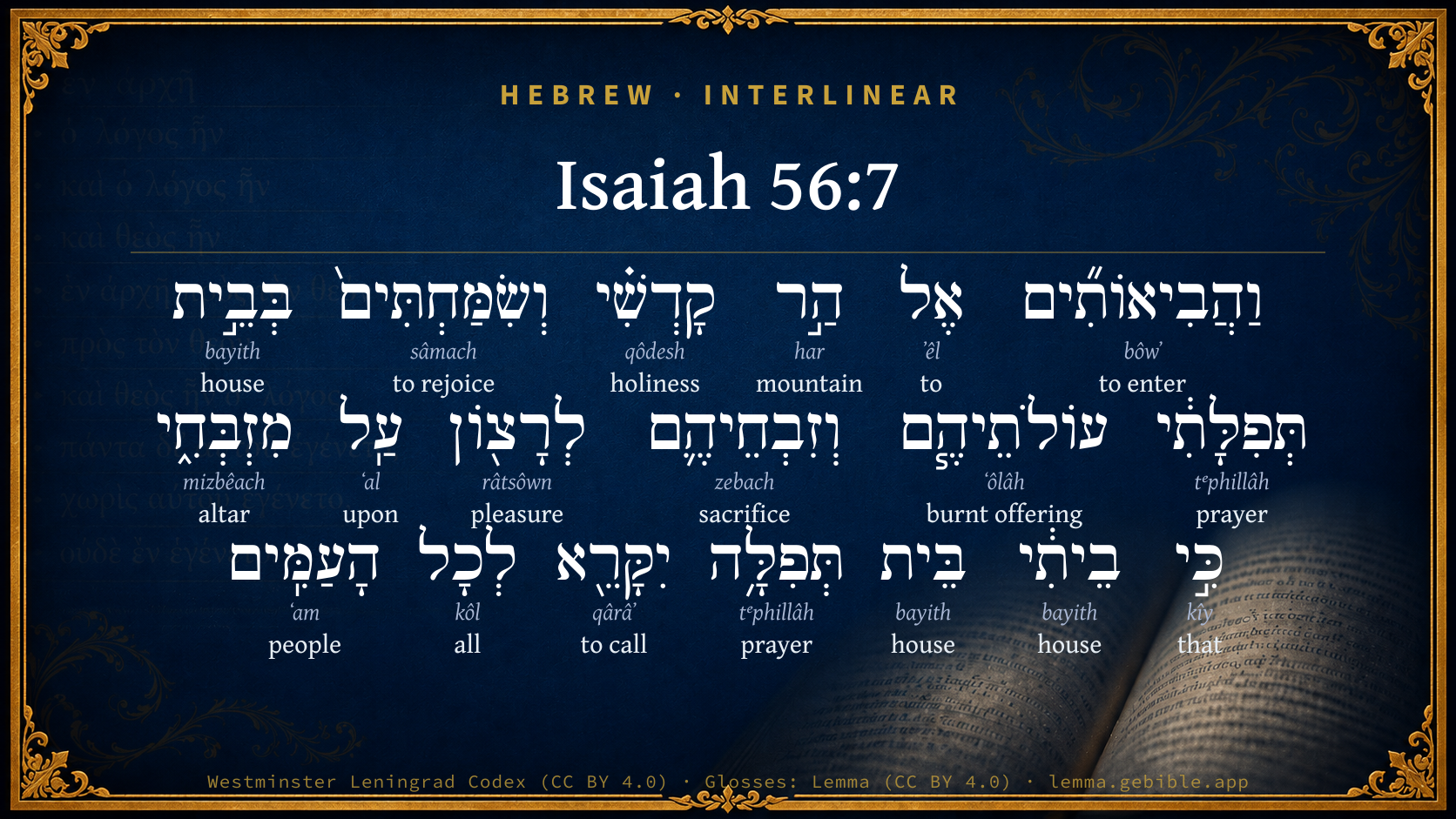
Hebrew (Westminster Leningrad Codex) Isaiah 56:7 appears in the Hebrew Old Testament. The text above is from the Westminster Leningrad Codex. Each word links to its Strong’s number, a concise gloss, and parsing drawn from the Open Scriptures Hebrew Bible morphology. Click any word for its full Brown-Driver-Briggs (BDB) entry.
Download image
Cite this verse

Isaiah 56:7 (World English Bible). Public Domain. Lemma interlinear Bible study tool, https://lemma.gebible.app/v/isaiah/56/7.

Show BibTeX & RIS
BibTeX
RIS
English Translation
even them will I bring to my holy mountain, and make them joyful in my house of prayer: their burnt offerings and their sacrifices shall be accepted on my altar; for my house shall be called a house of prayer for all peoples.
World English Bible · Public Domain
Download a study sheet

One document with this verse’s original text, its word-by-word gloss line, the meaning frame, cross-references with their text, attributed commentary, and full source and license credits — printable, and it pastes into notes with its structure intact.

This verse Autodidact and up

Study sheet (.html) Plain text (.txt)

A passage Seminary Student

Up to 50 verses in one chapter. A passage sheet keeps up to 6 commentary sources and 12 cross-references per verse, in the order this page ranks them, and says so on the sheet whenever that leaves anything out. Ask for a single verse and you get the Autodidact verse sheet above.

Everything on this page stays free to read, with no account — the sheet is a download of what is already on screen, not access to it.

Want to remove ads? Support Godless Engineer
Compare translations 3

The same verse in 3 English versions, stacked beneath the original-language interlinear above. Click any original word for its lexicon entry.

Each is an independent rendering of the whole verse — the interlinear is not word-aligned to these translations.

Highlighted words mark where these versions differ — a whole-verse word diff, not a word-by-word alignment.

  • World English Bible Public Domain
    even them will I bring to my holy mountain, and make them joyful in my house of prayer: their burnt offerings and their sacrifices shall be accepted on my altar; for my house shall be called a house of prayer for all peoples.
  • King James Version Public Domain
    Even them will I bring to my holy mountain, and make them joyful in my house of prayer: their burnt offerings and their sacrifices shall be accepted upon mine altar; for mine house shall be called an house of prayer for all people.
  • unfoldingWord Literal Text CC BY-SA 4.0
    I will bring them to the mountain of my holiness, and I will make them rejoice in the house of my prayer. Their burnt offerings and their sacrifices for acceptance on my altar. For my house will be called a house of prayer for all of the peoples”

unfoldingWord Literal Text — © unfoldingWord, licensed CC BY-SA 4.0. Word-aligned USFM3 via Door43 (git.door43.org/unfoldingWord/en_ult).

Versions to compare (up to 4)

3 of 4 selected

Show all 18 translations

Every available English version of this verse, each an independent rendering of the whole verse.

  • World English Bible Public Domain
    even them will I bring to my holy mountain, and make them joyful in my house of prayer: their burnt offerings and their sacrifices shall be accepted on my altar; for my house shall be called a house of prayer for all peoples.
  • Berean Standard Bible Public Domain
    I will bring them to My holy mountain and make them joyful in My house of prayer. Their burnt offerings and sacrifices will be accepted on My altar, for My house will be called a house of prayer for all the nations.”
  • Majority Standard Bible Public Domain
    I will bring them to My holy mountain and make them joyful in My house of prayer. Their burnt offerings and sacrifices will be accepted on My altar, for My house will be called a house of prayer for all the nations.”
  • King James Version Public Domain
    Even them will I bring to my holy mountain, and make them joyful in my house of prayer: their burnt offerings and their sacrifices shall be accepted upon mine altar; for mine house shall be called an house of prayer for all people.
  • American Standard Version (1901) Public Domain
    even them will I bring to my holy mountain, and make them joyful in my house of prayer: their burnt-offerings and their sacrifices shall be accepted upon mine altar; for my house shall be called a house of prayer for all peoples.
  • Revised Version (1885) Public Domain
    even them will I bring to my holy mountain, and make them joyful in my house of prayer; their burnt offerings and their sacrifices shall be accepted upon mine altar: for mine house shall be called an house of prayer for all peoples.
  • Geneva Bible (1599) Public Domain
    Them wil I bring also to mine holy mountaine, and make them ioyfull in mine House of prayer: their burnt offerings and their sacrifices shall be accepted vpon mine altar: for mine House shall be called an house of prayer for all people.
  • Douay-Rheims (1899) Public Domain
    I will bring them into my holy mount, and will make them joyful in my house of prayer: their holocausts, and their victims shall please me upon my altar: for my house shall be called the house of prayer, for all nations.
  • Young's Literal Translation Public Domain
    I have brought them unto My holy mountain, And caused them to rejoice in My house of prayer, Their burnt-offerings and their sacrifices `Are' for a pleasing thing on Mine altar, For My house, `A house of prayer,' Is called for all the peoples.
  • Literal Standard Version CC BY-SA 4.0
    I have brought them to My holy mountain, || And caused them to rejoice in My house of prayer, || Their burnt-offerings and their sacrifices || [Are] for a pleasing thing on My altar, || For My house is called a house of prayer for all the peoples.”
  • Unlocked Literal Bible CC BY-SA 4.0
    —I will bring to my holy mountain and make them joyful in my house of prayer; their burnt offerings and their sacrifices will be accepted on my altar. For my house will be called a house of prayer for all nations,
  • unfoldingWord Literal Text CC BY-SA 4.0
    I will bring them to the mountain of my holiness, and I will make them rejoice in the house of my prayer. Their burnt offerings and their sacrifices for acceptance on my altar. For my house will be called a house of prayer for all of the peoples”
  • Darby Bible Public Domain
    even them will I bring to my holy mountain, and make them joyful in my house of prayer; their burnt-offerings and their sacrifices shall be accepted upon mine altar: for my house shall be called a house of prayer for all the peoples.
  • World Messianic Bible Public Domain
    I will bring these to my holy mountain, and make them joyful in my house of prayer. Their burnt offerings and their sacrifices will be accepted on my altar; for my house will be called a house of prayer for all peoples.”
  • Webster's Bible Public Domain
    Even them will I bring to my holy mountain, and make them joyful in my house of prayer: their burnt-offerings and their sacrifices shall be accepted upon my altar; for my house shall be called a house of prayer for all people.
  • Free Bible Version CC BY-SA 4.0
    I will bring these foreigners to my holy mountain and make them happy in my house of prayer. I will accept their burnt offerings and sacrifices, because my Temple will be called a house of prayer for all nations.
  • Bible in Basic English Public Domain
    I will make them come to my holy mountain, and will give them joy in my house of prayer; I will take pleasure in the burned offerings which they make on my altar: for my house will be named a house of prayer for all peoples.
  • JPS Tanakh (1917) Public Domain
    Even them will I bring to My holy mountain, and make them joyful in My house of prayer; their burnt-offerings and their sacrifices shall be acceptable upon Mine altar; for My house shall be called a house of prayer for all peoples.

Literal Standard Version (2020), Covenant Press — licensed CC BY-SA 4.0. Text via the HelloAO Bible API (eBible.org). Unlocked Literal Bible (unfoldingWord) — licensed CC BY-SA 4.0. Text via the HelloAO Bible API (eBible.org). unfoldingWord Literal Text — © unfoldingWord, licensed CC BY-SA 4.0. Word-aligned USFM3 via Door43 (git.door43.org/unfoldingWord/en_ult). Free Bible Version, Dr. Jonathan Gallagher — licensed CC BY-SA 4.0. Text via the HelloAO Bible API (eBible.org).

Word by word

More ways to search: Search by grammar → Find every occurrence → Compare this word →

Practice this passage: Drill this verse → Learn its vocabulary →

לְרָצ֖וֹן
râtsôwn
H7522
“to/for · pleasure”
Preposition + Noun, Common, Masculine, Singular, Absolute
Part of Speech
Preposition + Noun
Type
Common
Gender
Masculine
Number
Singular
State
Absolute
Full BDB Definition

Origin: from H7521

TWOT: 2207a

pleasure, delight, favour, goodwill, acceptance, will - goodwill, favour - acceptance - will, desire, pleasure, self-will
  1. וַהֲבִיאוֹתִ֞ים bôwʼ H935 “and · to enter · them” Conjunction + Verb, Hiphil, Sequential Perfect, 1st Person, Common, Singular + Suffix, Personal, 3rd Person, Masculine, Plural
  2. אֶל ʼêl H413 “to” Preposition
  3. הַ֣ר har H2022 “mountain of” Noun, Common, Masculine, Singular, Construct
  4. קָדְשִׁ֗י qôdesh H6944 “holiness · my” Noun, Common, Masculine, Singular, Construct + Suffix, Personal, 1st Person, Common, Singular
  5. וְשִׂמַּחְתִּים֙ sâmach H8055 “and · to rejoice · them” Conjunction + Verb, Piel, Perfect, 1st Person, Common, Singular + Suffix, Personal, 3rd Person, Masculine, Plural
  6. בְּבֵ֣ית bayith H1004 “in/at · house of” Preposition + Noun, Common, Masculine, Singular, Construct
  7. תְּפִלָּתִ֔י tᵉphillâh H8605 “prayer · my” Noun, Common, Feminine, Singular, Construct + Suffix, Personal, 1st Person, Common, Singular
  8. עוֹלֹתֵיהֶ֧ם ʻôlâh H5930 “burnt offerings · their” Noun, Common, Feminine, Plural, Construct + Suffix, Personal, 3rd Person, Masculine, Plural
  9. וְזִבְחֵיהֶ֛ם zebach H2077 “and · sacrifices · their” Conjunction + Noun, Common, Masculine, Plural, Construct + Suffix, Personal, 3rd Person, Masculine, Plural
  10. עַֽל ʻal H5921 “upon” Preposition
  11. מִזְבְּחִ֑י mizbêach H4196 “altar · my” Noun, Common, Masculine, Singular, Construct + Suffix, Personal, 1st Person, Common, Singular
  12. כִּ֣י kîy H3588 “that” Conjunction
  13. בֵיתִ֔י bayith H1004 “house · my” Noun, Common, Masculine, Singular, Construct + Suffix, Personal, 1st Person, Common, Singular
  14. בֵּית bayith H1004 “house of” Noun, Common, Masculine, Singular, Construct
  15. תְּפִלָּ֥ה tᵉphillâh H8605 “prayer” Noun, Common, Feminine, Singular, Absolute
  16. יִקָּרֵ֖א qârâʼ H7121 “to call” Verb, Niphal, Imperfect, 3rd Person, Masculine, Singular
  17. לְכָל kôl H3605 “to/for · all of” Preposition + Noun, Common, Masculine, Singular, Construct
  18. הָעַמִּֽים ʻam H5971 “the · peoples” Particle, Definite Article + Noun, Common, Masculine, Plural, Absolute

About this verse

These counts appear in no published source. They are computed here, from the morphology-tagged text and Lemma’s own curated glosses. What Lemma adds →

19
words
16
distinct lemmas
Prophets
section

Shared distinctive vocabulary

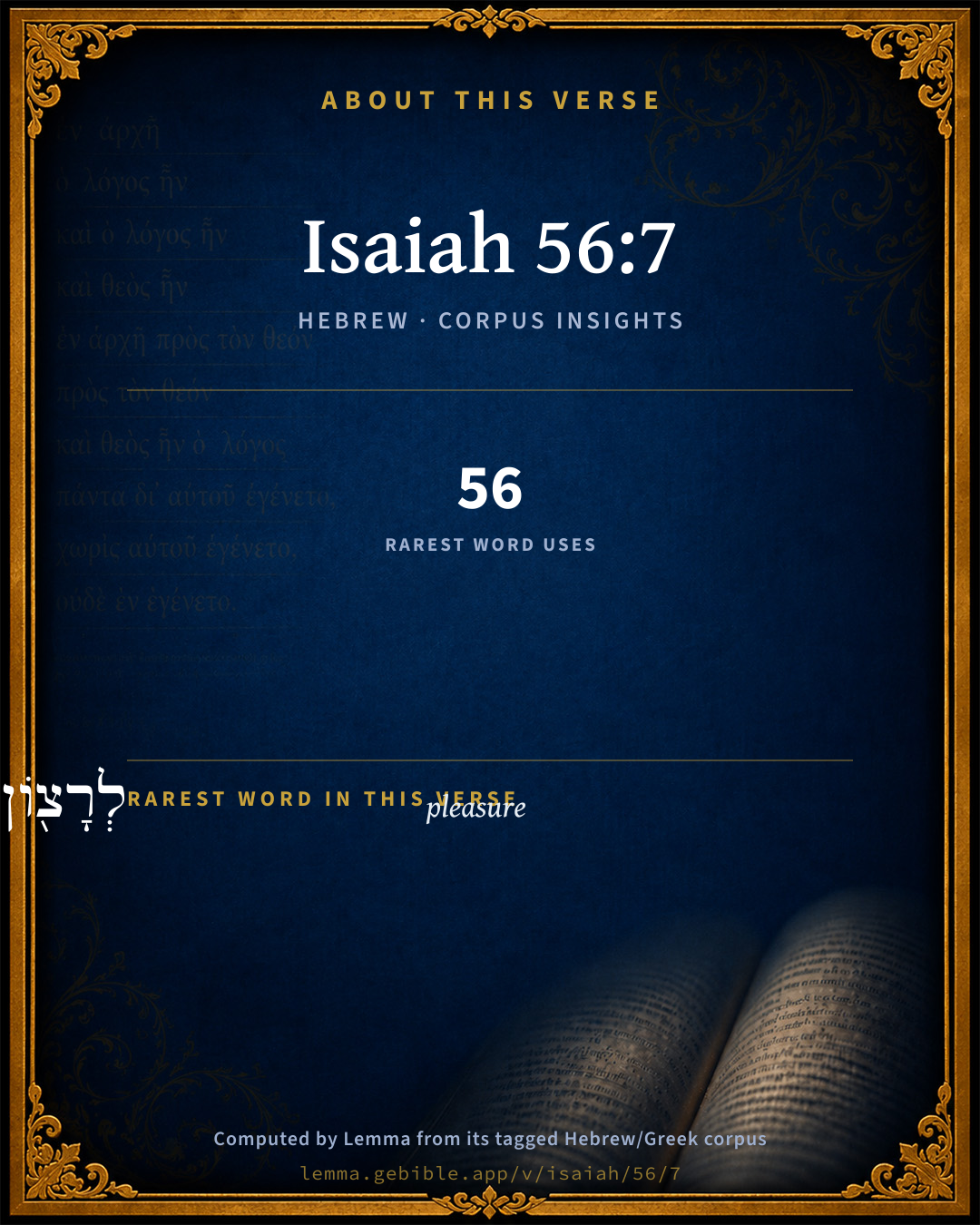
לְרָצ֖וֹן pleasure H7522 occurs in 56 verses of the Hebrew Bible. Also found in:

Grammatical profile

  • 3 verbs
  • 13 nouns
  • 2 prepositions
  • 1 conjunction

Verb forms

  • וַהֲבִיאוֹתִ֞ים Hiphil · Sequential Perfect
  • וְשִׂמַּחְתִּים֙ Piel · Perfect
  • יִקָּרֵ֖א Niphal · Imperfect

Repetition

Words recur within this verse — often emphatic in Hebrew:

  • בְּבֵ֣ית house H1004 ×3
  • תְּפִלָּתִ֔י prayer H8605 ×2

Hebrew & Septuagint length

In English translation the verse runs 43 words from the Hebrew and 42 from the Septuagint (LXX English) — closely comparable.

A rough comparison of the two English renderings, which tokenize alike — not a word-level alignment.

Word counts can differ between the Hebrew and the Greek without any difference in meaning — e.g. the Hebrew direct-object marker אֵת has no separate Greek word, and Greek often adds the article ὁ.

Cross-references

18

Topical passages linked to Isaiah 56:7 in the Treasury of Scripture Knowledge — connected by theme and wording, ordered by reader-vote popularity; previews shown in the World English Bible.

  • Mark 11:17 He taught, saying to them, "Isn't it written, 'My house will be called a house of prayer for all the nations?' But you have made it a den of robbers!"
  • Isaiah 2:2–3 It shall happen in the latter days, that the mountain of Yahweh's house shall be established on the top of the mountains, And shall be raised above the hills; And all nations shall flow to it.
  • Malachi 1:11 For from the rising of the sun even to the going down of the same, my name is great among the nations, and in every place incense will be offered to my name, and a pure offering: for my name is great among the nations," says Yahweh of Hosts.
  • Luke 19:46 saying to them, "It is written, 'My house is a house of prayer,' but you have made it a 'den of robbers'!"
  • Matthew 21:13 He said to them, "It is written, 'My house shall be called a house of prayer,' but you have made it a den of robbers!"
  • Micah 4:1–2 But in the latter days, It will happen that the mountain of Yahweh's temple will be established on the top of the mountains, And it will be exalted above the hills; And peoples will stream to it.
  • Romans 12:1 Therefore I urge you, brothers, by the mercies of God, to present your bodies a living sacrifice, holy, acceptable to God, which is your spiritual service.
  • Psalms 2:6 "Yet I have set my king on my holy hill of Zion."
  • Ephesians 2:11–13 Therefore remember that once you, the Gentiles in the flesh, who are called "uncircumcision" by that which is called "circumcision," (in the flesh, made by hands);
  • John 4:21–23 Jesus said to her, "Woman, believe me, the hour comes, when neither in this mountain, nor in Jerusalem, will you worship the Father.
  • Hebrews 12:22 But you have come to Mount Zion, and to the city of the living God, the heavenly Jerusalem, and to innumerable hosts of angels,
  • Zechariah 8:3 Thus says Yahweh: "I have returned to Zion, and will dwell in the midst of Jerusalem. Jerusalem shall be called 'The City of Truth;' and the mountain of Yahweh of Hosts, 'The Holy Mountain.'"
  • John 12:20–26 Now there were certain Greeks among those that went up to worship at the feast.
  • 1 Timothy 2:8 I desire therefore that the men in every place pray, lifting up holy hands without wrath and doubting.
  • Hebrews 13:15 Through him, then, let us offer up a sacrifice of praise to God continually, that is, the fruit of lips which make confession to his name.
  • 1 Peter 2:5 You also, as living stones, are built up as a spiritual house, to be a holy priesthood, to offer up spiritual sacrifices, acceptable to God through Jesus Christ.
  • Isaiah 66:19–20 I will set a sign among them, and I will send such as escape of them to the nations, to Tarshish, Pul, and Lud, who draw the bow, to Tubal and Javan, to the isles afar off, who have not heard my fame, neither have seen my glory; and they shall declare my glory among the nations.
  • 1 Peter 1:1–2 Peter, an apostle of Jesus Christ, to the chosen ones who are living as strangers in the Dispersion in Pontus, Galatia, Cappadocia, Asia, and Bithynia,

Cross-references courtesy of OpenBible.info (CC BY 4.0).

Hebrew and Greek witnesses Masoretic Hebrew ↔ Greek Septuagint

The same verse in the two great witnesses to the Old Testament, shown verse-for-verse.

These are two independent witnesses, not word-aligned to each other, and the Septuagint is shown in lemma (dictionary) form.

Hebrew Isaiah 56:7 Masoretic · Westminster Leningrad Codex

וַהֲבִיאוֹתִ֞ים אֶל הַ֣ר קָדְשִׁ֗י וְשִׂמַּחְתִּים֙ בְּבֵ֣ית תְּפִלָּתִ֔י עוֹלֹתֵיהֶ֧ם וְזִבְחֵיהֶ֛ם לְרָצ֖וֹן עַֽל מִזְבְּחִ֑י כִּ֣י בֵיתִ֔י בֵּית תְּפִלָּ֥ה יִקָּרֵ֖א לְכָל הָעַמִּֽים

even them will I bring to my holy mountain, and make them joyful in my house of prayer: their burnt offerings and their sacrifices shall be accepted on my altar; for my house shall be called a house of prayer for all peoples.

World English Bible · Public Domain

Greek LXX Isaiah 56:7 Septuagint · lemma form

εἰςἄγω αὐτός εἰς ὁ ὄρος ὁ ἅγιος ἐγώ καί εὐφραίνω αὐτός ἐν ὁ οἶκος ὁ προσευχή ἐγώ ὁ ὁλοκαύτωμα αὐτός καί ὁ θυσία αὐτός εἰμί δεκτός ἐπί ὁ θυσιαστήριον ἐγώ ὁ γάρ οἶκος ἐγώ οἶκος προσευχή καλέω πᾶς ὁ ἔθνος

I will bring them to my holy mountain, and gladden them in my house of prayer: their whole burnt offerings and their sacrifices shall be acceptable upon my altar; for my house shall be called a house of prayer for all nations,

LXX2012 (modern English Septuagint) · Public Domain

On this verse, Adam Clarke's Commentary discusses the Septuagint’s reading. Read the note in Commentary ↓

Hebrew: Westminster Leningrad Codex (CC BY 4.0). Greek: Septuagint (public domain); English from LXX2012 (modern English Septuagint) (Public Domain). How the Septuagint differs from the Hebrew →

Targum (Aramaic paraphrase)

1

The Targum is the ancient Jewish Aramaic paraphrase of the Hebrew Scriptures — an interpretive translation, not the Hebrew text itself. Onkelos (literal) and Pseudo-Jonathan (expansive) render the Torah, and Jonathan the Prophets. Coverage is partial: where no permissively-licensed English translation exists for a verse, only the Aramaic is shown. This is verse-level text, not a word-by-word alignment to the Hebrew.

  1. Targum Jonathan Prophets (Joshua–Malachi)
    וְאַיְתִינוּן לְטוּרָא דְקוּדְשִׁי וְאַחֲדִינוּן בְּבֵית צְלוֹתִי עַלְוַתְהוֹן וְנִכְסַת קוּדְשֵׁיהוֹן יִתַּסְקוּן לְרַעֲוָא עַל מַדְבְּחִי אֲרֵי בֵית מַקְדְשִׁי בֵית צְלוֹ יִתְקְרֵי לְכָל עַמְמַיָא:

    Even them will I bring to my holy mountain, and make them joyful in my house of prayer: their burnt offerings and their holy sacrifices shall be offered up with acceptance upon mine altar; for the house of my sanctuary shall be called an house of prayer for all people.

    Targum Jonathan — Aramaic: “Mikraot Gedolot” (public domain). English: “Sefaria Community Translation” (CC0 1.0 (public-domain dedication)); “London "Chaldee Paraphrase," 1871” (public domain). Text via Sefaria.

Commentary

Notes on Isaiah 56:7 from classic Christian and Jewish commentators (each source and its license shown beneath its notes). The classic Christian expositions comment on the surrounding passage and are grouped to its opening verse, so a note may address several verses; the Jewish commentaries on the Tanakh (Rashi and others) are per-verse, so they appear only where the commentator wrote on this verse.

Lemma curates 59 commentaries, every one of them public domain or Creative Commons licensed, each selected and text-cleaned for this edition rather than reprinted as found. About our sources →

Trapp's Complete Commentary

John Trapp

Isa 56:7 Even them will I bring to my holy mountain, and make them joyful in my house of prayer: their burnt offerings and their sacrifices [shall be] accepted upon mine altar; for mine house shall be called an house of prayer for all people.

Ver. 7. Even them will I bring unto my holy mountain,] i.e., Into my Church, and Church assemblies. Query, Whether eunuchs and strangers were made partakers of all holy services in the second temple, according to the letter? Sure we are that that holy eunuch, {Act 8:26-40} and the rest of the Gentiles, had and still have free admission under the gospel.

And will make them joyful in mine house of prayer.] By their free access unto me, and all good success in their suits. Pray "that your joy may be full." {Joh 16:24} "Draw water with joy out of this well of salvation." {Isa 12:3} "Rejoice evermore," and that you may so do, "pray without ceasing." {1Th 5:16-17}

Their burnt offerings and their sacrifices shall be accepted upon mine altar.] Their evangelical sacrifices of prayer, praise, alms, obedience, &c., shall be accepted through Christ, {Heb 13:10; Heb 13:15} who is the true altar that sanctifieth all that is offered on it. {Rev 8:3-4}

For mine house shall be called, &c.] See on Mat 21:13.

John Trapp, A Commentary or Exposition upon All the Books of the Old and New Testament (1647–1656) — public domain. Text from a community e-Sword module.

The Biblical Illustrator

Joseph S. Exell

Isa_56:7

Even them will I bring to My holy mountain

The house of prayer

If we accept the interpretation that the second Isaiah has given us the prophecies of the restoration, we may regard this chapter as a description of Israel after the return from the Chaldean captivity, and, further, the condition of worship in the reign of the Messiah.

We place before you the whole matter as a plea for Gods house in the present day.

I. THE LOCATION OF WORSHIP. Mine house. With God every where, what need is there of setting apart any particular spot for worship? While all creation is Gods magnificent temple, why should we consecrate any particular place of building for the purpose of worship? We have a promise in the Book itself (Jer_31:33-34). But we must suppose conditions of thought, and degrees of poetry, which do not exist, in order to worship God in the general terms implied in these statements. We infer from the history of public worship that God has adapted its forms to the state of mankind in the various periods of the periods of the past. To-day worship its forms to the state of mankind in the various periods of the past. To-day worship must be conducted with a view to the position of the religious thought which prevails.

1. The first essential element of worship is concentration. The circumstantial in religion must be flamed to centre thought upon God in His nearness to man. The patriarchs altar, the tabernacle of Moses, and the temple of Solomon did this. In the teaching of Christ we meet with an expansion of the geography of worship. The temples on Moriah and Gerizim were doomed, both by the force of circumstances and the Incarnation. God in Christ became the consummation of the central idea of God. But Christ was human as well as Divine. We find Him both in the synagogue and the temple. He drew His disciples together, sometimes into a house, other times on the mountain slopes, or in secluded spots, for instruction and fellowship. He introduced a simplicity into worship which indicated a more spiritual thought than that which obtained when gorgeous ritualism formed its environment. The time had arrived when He would introduce a method by which we would worship the Father in spirit and in truth. But never has Jesus Christ hinted at the probability that such a worship would consist of abstract thought, universal observation, or individual reflection, apart from the offices of time and space. When God and man meet they must meet somewhere. Although the necessity for a restricted spot had passed away, and the whole earth became a consecrated temple, when the eternal Son chose it as His imperial palace, yet the limitations of the spiritual man, while dwelling in a tabernacle of clay, suggest the setting apart of places for worship. In an age when life is at a higher pressure than ever it has been, and consequently, an age when our thoughts are agitated, scattered, embittered, and inflamed, of what incalculable value must the house of prayer be.

2. Our next point is association. We have been told that there is such a thing as abstract thought, but where is abstract life? How far can one go on the path of life without the aid of others? It seems absurd that people should assume so much piety as not to require any association or assistance. If the Hall of Science is needed, why not the Hall of Prayer?

3. Our third plea for the house of prayer is memorial. Every place of worship in England is a witness to the Being of God, and to His providence and salvation. Mine house is a significant designation, showing His acceptance of the gift. It is the language of love in response to the gift of love.

II. THE ESSENCE OF WORSHIP. House of prayer. Prayer is a comprehensive term, having devotion as its central idea. There would have been an appropriateness in calling it the house of praise, for from no other house has so much and so grand music ascended to heaven. It might have been called the house of preaching, because the word is gone forth out of Zion to the ends of the earth. But why did God name it the house of prayer? Under the old dispensation, sacrifice occupied the most prominent place in the services, but even then its name was the house of prayer. Reverence for God is the first step of the ladder. Waiting upon God is the next step. (T Davies, M. A.)

And make them joyful in My house of prayer

My house of prayer

Jesus Christ, when in a sublime act of indignation He drove out the desecrators of the temple, applied the words to the outer courts of that noble material building. But He Himself has taught us not to limit the phrase, but to give it the widest possible meaning. It is not for us to speak of Gods house of prayer as if it were restricted to any one locality, or as if it described any particular kind of structure. Gods house of prayer may be found anywhere, everywhere. Wherever the human heart reaches out with holy longing towards the Divine Father, and craves the blessing of His presence; wherever He unveils the glory of His truth and the beauty of his love, responding to the eager desires of His pleading children, there is His house of prayer. It may be grand in form, or poor and mean; there may be no material structure at all, but the solemn temple of Nature itself, yet shall it; be consecrated for worship by the prayers which ascend to God. Yet, we still find it necessary to establish and set apart places of worship, and because we frequent them for this holiest of purposes, we speak of each of them as a house of prayer. As it is necessary that we should consecrate one day out of the week for the special purposes of religion, so we find it desirable to meet at some regularly appointed spot to engage with our fellows in acts of devotion. And the reasonableness becomes apparent. We want such places for convenience sake. If social religion is to have any existence at all, if the communion of the saints is to be a reality, if there are to be united praise and prayer and instruction in Divine truth, then men and women must know where they are to gather for these purposes. Further, it is not merely a matter of convenience; it is helpful to our spiritual and daily life. We want as places of worship some which are unassociated with our secular affairs--places which seem to stand away from the cares and worries and strivings of our common life--where we can give our minds and hearts a season of rest--an opportunity of calmly, and without distraction, contemplating and estimating the character and meaning, the worth or worthlessness of the work we are doing in the world. Of course this might be done at home, in the shop, in the office, in the chamber, but not so effectually, not so thoroughly, as in the quiet place specially devoted to religious worship. There, seeming to stand at a distance from worldly avocations, we judge them and our relation to them more impartially and honestly. (W. Braden.)

Joyfulness worship

I. THERE SHOULD, BE A NATURAL ASSOCIATION BETWEEN THE TWO. I reach this conclusion by remembering two things.

1. That we, as human beings, have in us the capacity for joy.

2. That the religion we profess, when rightly understood, is a joy-producing religion.

II. WORSHIP IS THE EXPRESSION OF OUR NOBLEST RELIGIOUS FEELINGS IN THE PRESENCE OF GOD. It is not a mere ceremonial act, an observance of prescribed ritual on certain days and in appointed places. It is the going forth of the man towards God. Therefore, our joy must utter itself, ought to utter itself, when we enter into the courts of His house. I believe that the Divine Father has no sympathy with those who would turn His house of prayer into a place for gloomy, and unhappy thoughts, and who would exclude from His service everything pleasant and beautiful. They misunderstand and libel Him by their desire for dreariness If God has taught us anything with distinctness in the outer world of nature it is that He loves all that is pleasant and sweet and joyous. Is there n t something joy-exciting in the very thought and act of worship? This has been the thought of most peoples.

1. The Greeks who worshipped gods of uncertain passions and dispositions, nevertheless seem to have made the worship a season of joy--they wreathed themselves with flowers, they anointed themselves withsweet perfumes, they surrounded their temples with every attraction, they invoked every pleasure they could think of, they sought to make the hour of their worship a charming and beautiful hour. Their joy in this respect was of a sensuous character, more animal than spiritual, and we do not need to imitate them; but even the heathen had the idea of indulging in gladness in the presence of their gods.

2. The same emotion was constantly expressed by the Hebrews. We often regard the religion of the Jews as harsh, stern, dreary, a constant pressure upon the minds and souls of the people. Never was there a greater mistake, as a careful study of their numerous festivals and rites would prove. Remember the worship-literature of the Jews, that magnificent collection of psalms which is one of the most precious treasures handed down to us from the past. It is full of jubilance. Expressions of personal sorrow there are in abundance; but even they are turned into subjects of song.

3. If it was possible for Jews to enjoy worship, if it was natural for them to give expression to gladness of heart when coming into the Divine presence, is there not more abundant reason why we, as Christians, possessing a fuller and purer and more intimate revelation of God, should rejoice before Him?

III. FOR THOSE WHO SEEK TO WORSHIP GOD IN SPIRIT AND IN TRUTH THIS JOY IS ASSURED BY THE PROMISE, I will make them joyful in My house of prayer. Our anticipation of the worship of Gods house, and the manner in which we present ourselves to Him, should be gladsome. Why? Because we go expecting to meet God, and receive the gracious fulfilment of the promise. Our hope of blessing to come already fills us with delight. When we have entered into the engagements of Divine worship, if we have been in the right spirit of desire, God has drawn near us and fulfilled our largest hopes. He has apparently devised the means by which this shall be brought about through the three exercises of our worship--our praise, our prayer, and our study of His truth. These seem in themselves calculated, ordained, consecrated for the very object of exciting our joy.

1. Think of the very act of praise. What does it mean? That we are recalling to mind the Divine mercy, and tenderness, and compassion, and love which have come into our life. We praise God for what He is; for what His works reveal Him to be; for what He has done for us; and you cannot do that without some inspiration of gladness filling your soul. Praise itself springs from and excites to joy.

2. The same glorious result is wrought by means of prayer. That man who has never yet held conscious communion with his God in prayer, has never yet experienced one of the noblest and purest joys of which his nature is capable.

3. And shall I add the same of the other exercise--the study of His truth? As the man who, digging for gold, is flushed with delight when his toil is rewarded by some rich nugget; as the student of Nature, when investigating her secrets, is gladdened as he perceives the traces of some new law, or a possible combination of well-known causes that will produce a new result, so Christians know the thrill of satisfaction that springs from a fresh realization of the meaning of Divine truth. God stands revealed in clearer light, and all the wonders of His work for man through the history of the world, and especially in the person of Christ, are understood and loved as they were never understood or loved before. These awakenings to joy are always taking place in Gods house. One comes there perplexed concerning his path of duty, and to him there is uttered some wise precept, which makes the way clear once more. Another is troubled concerning the terrible mystery of life, its inequalities and sorrows; but to him is revealed the Fatherhood of God, and that means perfect love and assurance of blessedness for man as the ultimate issue of all things. Does not that oppressed soul rejoice? And how many, conscious of unforgiven sin, venture into the holy place. And they see a vision of Calvary with its sacred Victim; the heavens seem to open for them, and they behold the ascended Christ, the Mediator. Who shall measure the joy of these? (W. Braden.)

Mine house shall be called an house of prayer for all people

Gods house

The thing here spoken of is Gods house, described--

I. BY ITS APPROPRIATION UNTO HIM. My house.

II. BY ITS EXTENT OF RECEIPT IN RESPECT OF OTHERS. For all people.

III. BY THE EMPLOYMENT OF ITS INHABITANTS. It shall be called a house of prayer. (J. Owen, D. D.)

The Church of Christ

I. CHRISTS CHURCH OF SAINTS, OF BELIEVERS, IS GODS HOUSE.

II. THE CHURCH OF CHRIST UNDER THE GOSPEL IS TO BE GATHERED OUT OF ALL NATIONS.

III. THERE ARE ESTABLISHED ORDINANCES, AND APPOINTED WORSHIP FOR, THE CHURCH OF CHRIST UNDER THE GOSPEL. (J. Owen, D. D.)

Public worship

I shall endeavour to make it appear that the best homage which we can pay to God is that which is most public.

I. THIS IS THE WAY OF GIVING THE GREATEST HONOUR TO GOD. When a multitude of people meet together to worship the Almighty, and to set forth His praises, it makes some little figure of heaven; it raises our minds to more magnificent conceptions of God, and more fully represents Him to us as the Governor of the world: whereas, if we look upon Him as only intending our private interest, as busied only to serve our present wants, we may be thought to conceive of Him rather as an idol than as that infinite Being whose care and providence are extended to the concerns of the whole creation. To worship God truly is to make Him known to be the Lord of the universe, the common Parent, Preserver, and Benefactor of all mankind; and therefore public assemblies are the best signification of His glorious perfections and vast dominion. They who cannot use their minds to any abstracted ways of thinking, may be wonderfully confirmed and heightened in their acknowledgments and thoughts of a Deity, when they see how the learned and the rich and the honourable, and the greatest persons upon the earth, do bow and kneel before their Maker, and humble themselves in the dust of the sanctuary to witness their profound veneration of an infinite wisdom, power and goodness.

II. THE NATURE OF RELIGION IS SUCH THAT IT ESPECIALLY REQUIRES A PUBLIC EXERCISE. Christians are not to look upon themselves as single persons, of distinct and separate interests; but as members of the same mystical Body, as parts of the same spiritual Society; that they are redeemed as a Church, and are to glorify God as a Church; that their chief blessings are those they enjoy in common.

III. THERE IS NOTHING THAT SO MUCH PROMOTES A SPIRIT OF UNIVERSAL CHARITY AS A DUE ESTEEM AND PRACTICE OF PUBLIC WORSHIP. What can bring us to a greater concern for one another, and more unite our affections, than a frequent meeting at the same place of worship, and joining together in the same duties of religion?

IV. FREQUENTING PUBLIC WORSHIP, WITH THAT PREPARATION AND WITH THOSE DISPOSITIONS WHICH IT REQUIRES, IS THE BEST WAY WHEREBY WE MAY ATTAIN TO SOLID PIETY, We have many times a Divine truth more strongly imprinted on our minds, or more fully confirmed unto us, when our hearts are tender and devout, than when our heads are exercised in the deepest thinking. It is further observable, that men are generally much more subject to impressions and affections when they are assembled than when they are alone. (T. Mannigham, D. D.)

Gods house the house of prayer foe all people

1. In order to the realization of the glorious scene in which the world shall finally be seen prostrate before God in prayer, the first and earliest step necessary was the revelation of the Divine existence; for he that cometh to God must believe that He is. How shall they call upon Him of whom they have not heard?

2. But does He take an interest in the affairs of the world? If not, prayer to Him is useless. In answer to this inquiry Sinai rises to view. God is there, legislating for sinful man. Listen to His law as He proclaims it, and mark how much of it relates directly to your welfare. Apart from the Gospel, nothing in the universe displays the Divine benevolence so much as the giving of the law.

3. But is the great God accessible? That He takes a benevolent interest in human affairs is evident. If, however, the terrors of Sinai are not laid aside--if that is a specimen of His usual state--who can venture to approachHim? The temple on Sion is an answer to the inquiry. Let the people build Me a sanctuary, saith God, that I may dwell among them. This was another stage, a vast advance in the Divine condescension. To show His own sense of its importance, He supplied the model, and selected the spot, and superintended the erection of the building. When completed, the Majesty of Heaven came down and visibly possession. When it was rumoured abroad that the Lord of Heaven had a house upon earth, did not the guilty race come to cast themselves at His feet and sue for mercy?

4. But, it might have been asked in the next place, Will He pardon? Accessible He may be, but is He propitious? Approach and read the inscription over its gates, The house of prayer. Then there is hope for the penitent. Let us enter and ascertain. On crossing the threshold and looking around, we find that it is distributed into three parts. We find ourselves at first in the court of the temple; here the principal objects are a great altar of sacrifice, and a laver in which the sacrifices are washed. What mean that cleansing water, and that bleeding lamb? They say, as plainly as they can, that if without the shedding of blood there is no remission of sins. and that the victim whose blood is shed must be spotless. We advance, find ourselves in the second part, the holy place. Here the principal objects are a golden candlestick, a table of shewbread, and an altar of incense; and what mean these objects? They denote that the sacrifice is accepted, that God propitiated, that He is waiting to illuminate and anoint His worshippers with His Spirit, to feast their souls on living bread, and to accept their praises as grateful incense. But what means that mysterious veil which conceals the third part of the temple, the holiest of all? It denotes that sinful man can fully approach a holy God only through a Divine Mediator, and that that Mediator is not yet come. But we know what is within. There stands the ark of the covenant, and the mercy-seat resting upon it, denoting mercy resting on faithfulness; and there are the cherubim overshadowing the mercy-seat, intimating the reverence with which even mercy itself should be sought, and the profound mystery which it involves. But what means that mass of dazzling light above? It is the symbol of the Divine presence. And why dwells He there? that men may come and fall down before Him, and that He may commune with them from off the mercy-seat. He makes it His rest, that men may come to Him, and make it their rest. Numbers through successive ages availed themselves of His grace.

5. But everything there--gracious as it was, calculated as it was to bring all people in humble prostration before God--existed only in type and promise. It may be asked, therefore, in the next place, Have those types been accomplished? The fulness of time arrives, and, behold, God sending forth His Son! Calvary appears; there, as our Substitute; He is making an infinite compensation for our demerit. The day of Pentecost arrives--behold in its scenes a proof that our Advocate has entered on His office of intercession above, and that His sacrificial plea prevails. Is it then still asked if the ancient promises have been fulfilled? Let the tears of the sinner, the joy of the saint, the success of the Gospel in every subsequent age, bear witness.

6. But, again, admitting that God is thus accessible and gracious, is He thus accessible and gracious to all? Is the Gospel Church less open and free than the Jewish temple? Its gates are never to be shut, night nor day! Its blessings are to be offered without money and without price. My house shall be called a house of prayer for all people. O Thou that hearest prayer, to Thee shall all flesh come.

7. And is there ground to conclude that this sublime result shall be realized? I have sworn by Myself, the word hath gone out of My mouth in righteousness, and shall not return, That unto Me every knee shall bow, and every tongue shall swear. Conclusion--

(1) To this point everything in the mediatorial government of Christ is tending with the directness and force of a law. To this end, therefore, every event in His Church, every movement of His people, should be intentionally subordinated.

(2) The question will be entertained, then, by every Christian mind, How may this sacred place be made most effectually to subserve this great end? By making it literally a house of prayer. The very presence of a church or chapel is to be viewed as a perpetual protest against all prayerlessness and irreligion.

(3) Here everything is to be done with the view of leading to prayer.

(4) Here, too, the salvation of the world, and whatever may be instrumentally necessary to that salvation, should be made the subject of prayer. (J. Harris, D. D.)

The Biblical Illustrator, edited by Joseph S. Exell (c. 1880s–1900s) — public domain. Text from a community e-Sword module.

Tyndale Open Study Notes

Tyndale Open Resources

56:7 burnt offerings and sacrifices: God had previously rejected sinful Israel’s expressions of piety (1:11-13) but would welcome offerings from righteous Gentiles or foreigners. Nationality is worth little without true piety. • a house of prayer for all nations: The Lord would open the doors of the Temple to all nations (see 2:2-4). Jesus rebuked the people for desecrating the Temple and for preventing it from functioning as the house of prayer (Matt 21:13; Mark 11:17).

Tyndale Open Study Notes — © Tyndale Open Resources, licensed CC BY-SA 4.0. Text via the HelloAO Bible API.

Geneva Bible (1599)

Geneva Bible translators

Not only for the Jews, but for all others, Matt. 21:13.

Hereby he meaneth the spiritual service of God, to whom the faithful offer continual thanksgiving, yea themselves and all that they have, as a lively and acceptable sacrifice.

Geneva Bible (1599) marginal notes — public domain. Text via Bolls.life.

Jamieson, Fausset & Brown

Robert Jamieson, A. R. Fausset & David Brown

Even them-- (Eph 2:11-13).

to my holy mountain--Jerusalem, the seat of the Lord's throne in His coming kingdom (Isa 2:2; Jer 3:17).

joyful-- (Rom 5:11).

burnt offerings . . . sacrifices--spiritual, of which the literal were types (Rom 12:1; Heb 13:15; Pe1 2:5).

accepted-- (Eph 1:6).

altar-- (Heb 13:10), spiritually, the Cross of Christ, which sanctifies our sacrifices of prayer and praise.

house . . . for all people--or rather, "peoples." No longer restricted to one favored people (Mal 1:11; Joh 4:21, Joh 4:23; Ti1 2:8). To be fully realized at the second coming (Isa 2:2-4). No longer literal, but spiritual sacrifice, namely, "prayer" shall be offered (Psa 141:2; Psa 51:17; Mal 1:11; Mat 21:13).

Jamieson, Fausset & Brown — Commentary Critical and Explanatory on the Whole Bible (1871) — public domain (CC PDM 1.0). Text via the HelloAO Bible API.

Adam Clarke's Commentary

Verse 7. Shall be accepted] A word is here lost out of the text: it is supplied from the Septuagint, יהיו yihyu, εσονται, "they shall be." - Houbigant.

Adam Clarke's Commentary on the Bible (1810–1826) — public domain. Text from a community e-Sword/MySword module.

Ellicott's Commentary for English Readers

(7) Even them will I bring . . .—The words foreshadow the breaking down of the “middle wall of partition” (Eph_2:14). Every privilege of the Israelite worshipper is to belong also to the proselyte. It is perhaps assumed that the proselyte is circumcised. The development of truth is in such cases gradual, and it was left for St. Paul to complete the work of Isaiah (Rom_2:26-29; Gal_6:15).

A Bible Commentary for English Readers, edited by Charles John Ellicott (1878–1897) — public domain. Text from a community e-Sword module.

The Cambridge Bible for Schools and Colleges

gen. ed. J. J. S. Perowne

7. Foreigners who fulfil these conditions have full access to the sanctuary.

make them joyful] “cause them to rejoice.” The phrase is formed from a common Deuteronomic expression for taking part in the Temple ritual: to “rejoice before Jehovah” (Deu_12:7; Deu_12:12; Deu_12:18, &c.).

my house of prayer] The Temple is the place where prayer is answered; see 1 Kings 8 passim, esp. 1Ki_8:29 f., and 1Ki_8:41-43.

The sacrifices of proselytes are referred to in the Law: Num_15:14 ff.; Lev_22:18 ff; Lev_17:8 ff.

for mine house … people] (R.V., rightly, for all peoples) Cited by our Lord, Mat_21:13; Mar_11:17; Luk_19:46. The emphasis lies on the last words; that the Temple is a house of prayer has been already said, what is now added is that it shall be so to men of all nationalities.

The Cambridge Bible for Schools and Colleges (gen. ed. J. J. S. Perowne; Cambridge University Press, 1878–1918) — public domain. Text from a community e-Sword module.

John Gill's Exposition

Even them will I bring to my holy mountain,.... The church, called a "mountain" for its height, visibility, and immovableness; see Isa 2:2, especially for the latter; the true members of it being such who are interested in the unchangeable love of God, in the immovable grace of election, in the unalterable covenant of grace, are on the Rock Christ Jesus, and are secured by the favour and power of God; and it is called a "Holy One", because in it holy men are, holy doctrines are preached, holy services performed, and the holy God, Father, Son, and Spirit, grant their presence: and hither the Lord "brings" his people; he shows them the way thither; he inclines their minds, and moves their wills, to come hither; he removes the objections that are in their way; he constrains them by his love; and he does it in a very distinguishing way, takes one of a city, and two of a family, and brings them hither; and he who says this is able to do it; and, when he has brought them there, will do for them as follows:

and make them joyful in my house of prayer; or "in the house of my prayer" (p); not made by him, as say the Jews (q); but where prayer is made unto him, and is acceptable with him; every man's closet should be a place of private prayer; and every good man's house a place of family prayer; but a church of God is a house where saints meet together, and jointly pray to the Lord: and here he makes them joyful; by hearing and answering their prayers; by granting his gracious presence; by discovering his love, and shedding it abroad in their hearts; by feeding them with his word and ordinances; by giving them views of Christ, his love and loveliness, fulness, grace, and righteousness: by favouring them with the consolations of his Spirit, and his gracious influences; and by showing them their interest in the blessings of grace and glory:

their burnt offerings and their sacrifices shall be accepted upon mine altar: which is Christ, who is not only the priest that offers up all the sacrifices of his people, but is also the altar on which they are offered up, Heb 13:10, and is the only One, and the most Holy One, which is greater than the gift, and sanctifies every gift that is upon it, and makes both the persons and the offerings of the Lord's people acceptable unto God; for by these offerings and sacrifices are not meant legal but spiritual ones; good deeds, acts of beneficence, rightly performed, with which sacrifices God is well pleased; sacrifices of prayer and praise; and even the persons of saints themselves, their bodies and their souls, when presented, a holy, living, and acceptable sacrifice unto God, Heb 13:15, the prophet here speaks in figures, agreeably to his own time, as Calvin observes, when speaking of Gospel times; so he makes mention of the sabbath before, instead of the Lord's day, or any time of worship under the Gospel dispensation:

for mine house shall be called a house of prayer for all people; Gentiles as well as Jews; the sons of the strangers, as others, are all welcome to the church of God, to come and worship, and pray to the Lord there, and that is in any place where the saints meet together; for holy hands may be lifted up everywhere, without wrath or doubting, Ti1 2:8. The Jews apply this verse to the time when the son of David, the Messiah, shall come (r).

(p) "in domo orationis meae", V. L. Vatablus, Pagninus, Montanus, Vitringa. (q) T. Bab. Beracot, fol. 7. 1. (r) T. Bab. Megillah, fol. 18. 1.

John Gill's Exposition of the Whole Bible (1746–1763) — public domain (CC PDM 1.0). Text via the HelloAO Bible API.

Albert Barnes' Notes on the Bible

Even them will I bring to my holy mountain - (See the notes at Isa 2:3). That is, they should be admitted to the fellowship and privileges of his people.

And make them joyful - In the participation of the privileges of the true religion, and in the service of God, they shall be made happy.

In my house of prayer - In the temple - here called the house of prayer. The language here is all derived from the worship of the Jews, though the meaning evidently is, that under the new dispensation, all nations would be admitted to the privileges of his people, and that the appropriate services of religion which they would offer would be acceptable to God.

Their burnt-offerings - That is, their worship shall be as acceptable as that of the ancient people of God. This evidently contemplates the future times of the Messiah, and the sense is, that in those times, the Gentiles would be admitted to the same privileges of the people of God, as the Jewish nation had been. It is true that proselytes were admitted to the privileges of religion among the Jews, and were permitted to offer burnt-offerings and sacrifices, nor can there be a doubt that they were then acceptable to God. But it is also true that there was a conviction that they were admitted as proselytes, and that there would be a superiority felt by the native-born Jews over the foreigners who were admitted to their society. Under the Jewish religion this distinction was inevitable, and it would involve, in spite of every effort to the contrary, much of the feeling of caste - a sense of superiority on the one hand, and of inferiority on the other; a conviction on the one part that they were the descendants of Abraham, and the inheritors of the ancient and venerable promises, and on the other that they had come in as foreigners, and had been admitted by special favor to these privileges. But all this was to be abolished under the Messiah. No one was to claim superiority on account of any supposed advantage from birth, or nation, or country; no one, however humble he might feel in respect to God and to his own deserts, was to admit into his bosom any sense of inferiority in regard to his origin, his country, his complexion, his former character. All were to have the same near access to God, and the offering of one was to be as acceptable as that of another.

For mine house - This passage is quoted by the Saviour Mat 21:13, to show the impropriety of employing the temple as a place of traffic and exchange. In that passage he simply quotes the declaration that it should be ‘a house of prayer.’ There are two ideas in the passage as used by Isaiah; first, that the temple should be regarded as a house of prayer; and, secondly, that the privileges of that house should be extended to all people. The main design of the temple was that God might be there invoked, and the inestimable privilege of calling on him was to be extended to all the nations of the earth.

Albert Barnes' Notes on the Bible (1834–1885) — public domain. Text from a community e-Sword/MySword module.

Haydock's Catholic Bible Commentary

Prayer. So the temple is justly styled. (Haydock) --- This shall be open to all nations. After the captivity, the Jews condescended to let the Gentiles have a court, and they even suffered some princes to go into the court of the priests, 2 Machabees iii. 33. Physcon wished to penetrate into the inner sanctuary, (3 Machabees; Ecclesiasticus l.) which could not be granted.

George Leo Haydock (1774–1849), Haydock's Catholic Family Bible and Commentary, 1859 edition — public domain. Excludes Psalms (Douay-Rheims chapter numbering differs from Protestant) and Deuterocanonical books (Catholic canon only).

Matthew Poole's English Annotations

To my holy mountain; to my house, as it is explained in the following clause, which stood upon Mount Zion, largely so called, including Mount Moriah. Formerly the Gentiles neither had any desire to come thither, nor were admitted there; but now I will incline their hearts to come, and I will give them admission and free liberty to come into my church.

Make them joyful, by accepting their services, and comforting their hearts with the sense of my love, and pouring down all sorts of blessings upon them.

In my house of prayer; in my temple, in and towards which prayers are daily made and directed unto me, 1Ki 8:28,29.

Their sacrifices shall be accepted upon mine altar; they shall have as free access to my house and altar as the Jews themselves, and their services shall be as acceptable to me as theirs. Evangelical worship is here described under such expressions as agreed to the worship of God which then was in use, as it is Mal 1:11, and elsewhere. See also Rom 12:1; Heb 13:15.

Mine house shall be called an house of prayer for all people; Jews and Gentiles shall have equal freedom of access to my house, and shall there call upon my name. Possibly he may call it

a house of prayer, either to imply that prayer to God, whereof thanksgiving is a part, is a more considerable part of God’s worship than sacrifice, which being considered in itself is little valued by him, as he frequently declareth; or to signify that in the New Testament, when the Gentiles should be called, all other sacrifices should cease, except that of prayer, and such-like spiritual services; which also is confirmed from the nature of the thing. For seeing sacrifices were confined to the temple at Jerusalem, and it was impossible that all nations should resort thither to offer up Levitical sacrifices in such time and manner as God appointed, it was necessary upon supposition of the general conversion of the Gentiles, that that way of worship should be abolished, and such a way prescribed as they were capable of practicing.

Matthew Poole's English Annotations on the Holy Bible (1683–1685) — public domain. Text from a community e-Sword/MySword module.

The Pulpit Commentary

My house of prayer. In Solomon"s address to God at the dedication of the temple, its character, as a house of prayer, is abundantly laid down. (1Ki_8:29-53) And no doubt it was used for the purpose of prayer, as well as for the purpose of sacrifice, from its first erection to its final destruction. But the purpose of sacrifice so far predominated, in fact, over the other, that the expression, "my house of prayer," comes upon us in this place to some extent as a surprise. The prophet seems to anticipate the time when the temple should be emphatically a proseuch the legal sacrifices having received their fulfilment, (Isa_53:10) and being thenceforth superfluous and out of place. For all people; rather, for all the peoples. All the ends of the earth were to see the salvation of God; (Psa_98:3) "All nations were to fall down before him; all people to do him service". (Psa_72:11)

God"s house of prayer for everybody.

"Mine house shall be called a house of prayer for all people." These words were quoted by the Lord Jesus when he drove out the shopkeepers who defiled the temple. (see Mat_21:13) The prophet declares that the "prayers and praises (those spiritual sacrifices) of devout Gentiles shall be as pleasing to God as those of the pious Jews, and no difference shall be made between them; for, though they are Gentiles by birth, yet through grace they shall be looked upon as the believing seed of faithful Abraham, and the praying seed of wrestling Jacob, for in Christ Jesus there is neither Greek nor Jew, circumcision nor uncircumcision." God"s house, the old temple, had been thought of as a place of sacrifices. The new temple, and above all the spiritual temple, the Christian temple, must be thought of as a place of prayer. This contrast gives the following topics.

I THE OLD IDEA OF GOD"S HOUSE WAS A HOUSE OF SACRIFICE. The old worship was one of multiplied and varied rites and ceremonies. It was a round of bodily services; it was honouring God by the devotion to him of the things that men possessed. It had its deeper spiritual meanings, but the prominent things were exact obediences, minute services, gorgeous and impressive spectacles. The "shadow of good things to come.

II THE NEW IDEA OF GOD"S HOUSE IS A HOUSE OF PRAYER. Prayer comprehensively indicates all forms of spiritual worship, of communion with the Divine Being. Illustrate by the essential differences between the Jewish temple and the Christian Church. Even the Jewish worship, when a synagogue could not be built, was held in a proseuche, or place of prayer. It was the work of the prophets to lift men"s minds away from the more formal to the more spiritual associations of God"s house. Explain the senses in which prayer may stand for the whole of Christian worship.

III THE OLD IDEA FITTED GOD"S HOUSE FOR A LIMITED FEW. Just those to whom his particular directions about ritual and sacrifice had been given. If God has to be served by formal acts, they must be such as he requires and has duly explained to us. So God"s house was of old exclusively for Jews.

IV THE NEW IDEA FITS GOD"S HOUSE FOR EVERYBODY. Because prayer is just the great human common place Man. has been satirically, yet truthfully, called "a praying animal." Prayer is characteristic of him. He has uplooking eyes and a yearning heart. When men know the unutterable value of prayer, "then shall the nations from the east and from the west build the last great temple of all the temple of an eternal religion whose foundations shall be wide as the whole nature of man, and whose dome, reaching up to heaven, shall shelter and overshadow the world. R.T.

The Pulpit Commentary (1880–1919), ed. H.D.M. Spence-Jones & Joseph S. Exell — public domain. Text from a community e-Sword module.

John Wesley's Explanatory Notes

Mountain - To my house, which stood upon Mount Zion. Joyful - By accepting their services, and comforting their hearts with the sense of my love. Accepted - They shall have as free access to mine house and altar, as the Jews themselves, and their services shall be as acceptable to me. Evangelical worship is here described under such expressions as agreed to the worship of God which then was in use.

John Wesley, Explanatory Notes Upon the Whole Bible (1754–1765) — public domain. Text via the GEBible commentary corpus.

Rashi

Rabbi Shlomo Yitzchaki (Rashi)

for all peoples Not only for Israel, but also for the proselytes.

Rashi on the Tanakh — English translations: “The Judaica Press complete Tanach with Rashi, translated by A. J. Rosenberg” (CC BY 4.0); “Pentateuch with Rashi's commentary by M. Rosenbaum and A.M. Silbermann, 1929-1934” (public domain); “The Metsudah Tanach series, Lakewood, N.J” (CC BY 4.0); and “The Book of Joshua, Metsudah Publications, 1997” (CC BY 4.0). Text via Sefaria.

Ibn Ezra

Rabbi Abraham ibn Ezra

For mine house shall be called an house of prayer for all people. Compare the prayer of King Solomon (1 Kings 8:41)

Ibn Ezra on the Tanakh — English translations: “Sefaria Community Translation” (CC0 1.0 (public-domain dedication)); “Yalkut, Sifsei Chachomim Chumash, Metsudah Publications, 2009” (CC BY 4.0); and “Commentary of Ibn Ezra on Isaiah - trans. by M. Friedlander, 1873” (public domain). Text via Sefaria.

Lesson kit

Teaching starters — assembled from the data on this page, not authored interpretation. Every prompt links to the verse data it draws on. Edit before teaching.

Isaiah, in the Prophets, opens this verse with 19 words (16 distinct Hebrew lemmas). Its most distinctive word is râtsôwn (“pleasure”). A historical commentator’s framing appears above. Read the whole chapter for the surrounding context.

Discussion questions

  1. The word râtsôwn carries the sense “pleasure.” How does it shape the verse?
  2. How does Genesis 49:6, which shares the word «pleasure», read alongside this verse?
  3. What does the repetition of “house” (3× in this one verse) do in this verse?
  4. The translations on this page render this verse differently — a whole-verse word diff, not a word-by-word alignment. What might account for the different wordings?
  5. «וַהֲבִיאוֹתִ֞ים» is a Hiphil Sequential Perfect verb. How does that grammatical form shape the action described?
  6. Compare how Trapp's Complete Commentary and The Biblical Illustrator read this verse. Where do they agree or differ?

Things to notice

Reading settings

Reading text

Shown beneath each verse's original-language words.

Old Testament
Old Testament edition

Read the OT as the Masoretic Hebrew (MT) or the Greek Septuagint (LXX).

English shown for the Greek Septuagint (in the Hebrew ↔ Greek comparison).

Comparing translations? Open the Compare panel on any verse page to stack up to four side by side.