
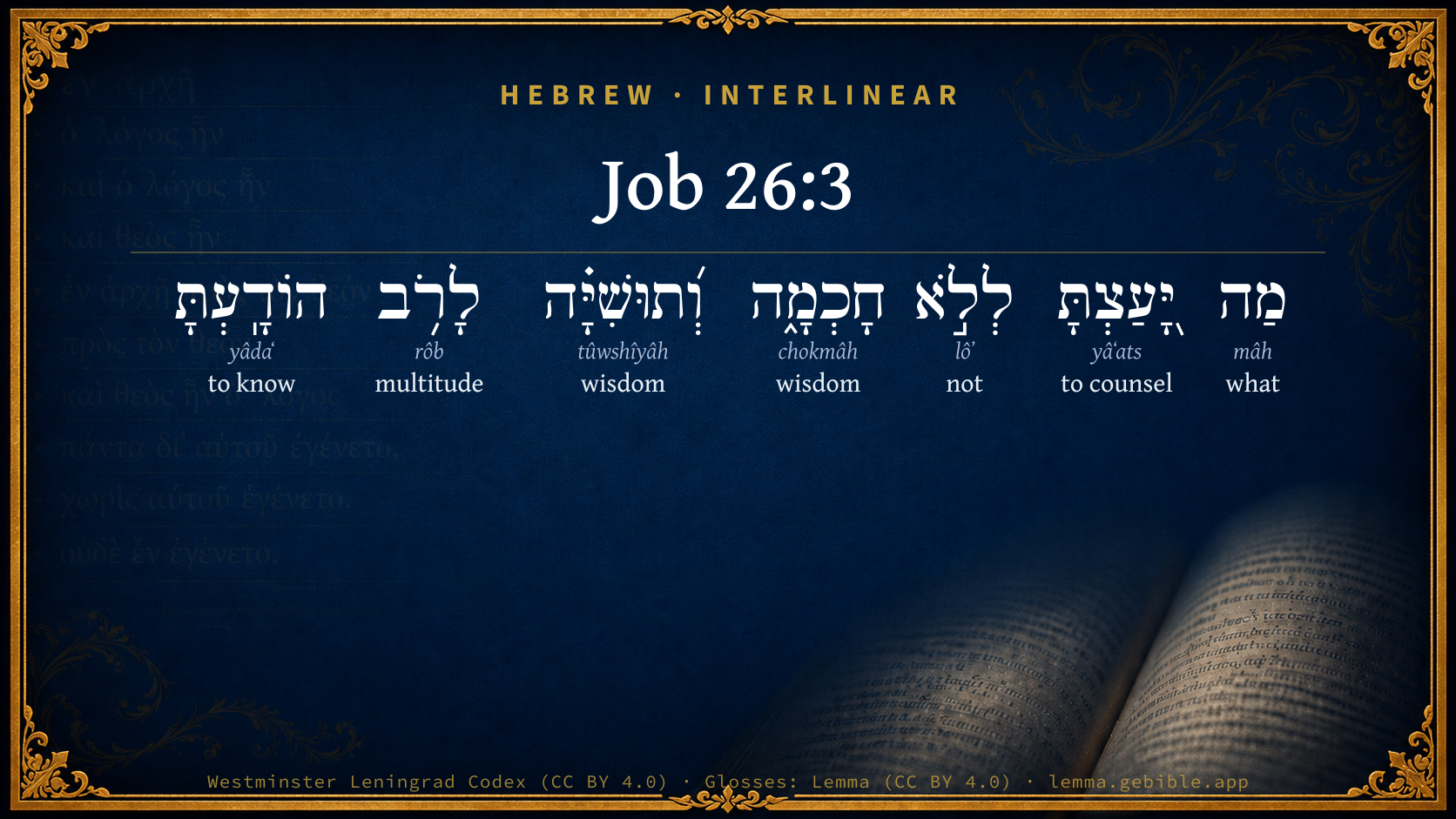
Job 26:3

Hebrew (Westminster Leningrad Codex) Job 26:3 appears in the Hebrew Old Testament. The text above is from the Westminster Leningrad Codex. Each word links to its Strong’s number, a concise gloss, and parsing drawn from the Open Scriptures Hebrew Bible morphology. Click any word for its full Brown-Driver-Briggs (BDB) entry.
Download image
Cite this verse

Job 26:3 (World English Bible). Public Domain. Lemma interlinear Bible study tool, https://lemma.gebible.app/v/job/26/3.

Show BibTeX & RIS
BibTeX
RIS
English Translation
How have you counseled him who has no wisdom, And plentifully declared sound knowledge!
World English Bible · Public Domain
Download a study sheet

One document with this verse’s original text, its word-by-word gloss line, the meaning frame, cross-references with their text, attributed commentary, and full source and license credits — printable, and it pastes into notes with its structure intact.

This verse Autodidact and up

Study sheet (.html) Plain text (.txt)

A passage Seminary Student

Up to 50 verses in one chapter. A passage sheet keeps up to 6 commentary sources and 12 cross-references per verse, in the order this page ranks them, and says so on the sheet whenever that leaves anything out. Ask for a single verse and you get the Autodidact verse sheet above.

Everything on this page stays free to read, with no account — the sheet is a download of what is already on screen, not access to it.

Want to remove ads? Support Godless Engineer
Compare translations 3

The same verse in 3 English versions, stacked beneath the original-language interlinear above. Click any original word for its lexicon entry.

Each is an independent rendering of the whole verse — the interlinear is not word-aligned to these translations.

Highlighted words mark where these versions differ — a whole-verse word diff, not a word-by-word alignment.

  • World English Bible Public Domain
    How have you counseled him who has no wisdom, And plentifully declared sound knowledge!
  • King James Version Public Domain
    How hast thou counselled him that hath no wisdom? and how hast thou plentifully declared the thing as it is?
  • unfoldingWord Literal Text CC BY-SA 4.0
    How you have advised without wisdom! Insight in abundance, you have made known!

unfoldingWord Literal Text — © unfoldingWord, licensed CC BY-SA 4.0. Word-aligned USFM3 via Door43 (git.door43.org/unfoldingWord/en_ult).

Versions to compare (up to 4)

3 of 4 selected

Show all 18 translations

Every available English version of this verse, each an independent rendering of the whole verse.

  • World English Bible Public Domain
    How have you counseled him who has no wisdom, And plentifully declared sound knowledge!
  • Berean Standard Bible Public Domain
    How you have counseled the unwise and provided fully sound insight!
  • Majority Standard Bible Public Domain
    How you have counseled the unwise and provided fully sound insight!
  • King James Version Public Domain
    How hast thou counselled him that hath no wisdom? and how hast thou plentifully declared the thing as it is?
  • American Standard Version (1901) Public Domain
    How hast thou counselled him that hath no wisdom, And plentifully declared sound knowledge!
  • Revised Version (1885) Public Domain
    How hast thou counselled him that hath no wisdom, and plentifully declared sound knowledge!
  • Geneva Bible (1599) Public Domain
    Whome counsellest thou? him that hath no wisedome? thou shewest right well as the thing is.
  • Douay-Rheims (1899) Public Domain
    To whom hast thou given counsel? perhaps to him that hath no wisdom, and thou hast shewn thy very great prudence.
  • Young's Literal Translation Public Domain
    What -- thou hast given counsel to the unwise, And wise plans in abundance made known.
  • Literal Standard Version CC BY-SA 4.0
    How you have given counsel to the unwise, || And made known wise plans in abundance.
  • Unlocked Literal Bible CC BY-SA 4.0
    How you have advised one who has no wisdom and announced to him sound knowledge!
  • unfoldingWord Literal Text CC BY-SA 4.0
    How you have advised without wisdom! Insight in abundance, you have made known!
  • Darby Bible Public Domain
    How hast thou counselled him that hath no wisdom, and abundantly declared the thing as it is!
  • World Messianic Bible Public Domain
    How have you counseled him who has no wisdom, and plentifully declared sound knowledge!
  • Webster's Bible Public Domain
    How hast thou counseled him that hath no wisdom? and how hast thou abundantly declared the thing as it is?
  • Free Bible Version CC BY-SA 4.0
    What good advice you have given to this ignorant man, demonstrating you have so much wisdom.
  • Bible in Basic English Public Domain
    How have you given teaching to him who has no wisdom, and fully made clear true knowledge!
  • JPS Tanakh (1917) Public Domain
    How hast thou counselled him that hath no wisdom, and plentifully declared sound knowledge!

Literal Standard Version (2020), Covenant Press — licensed CC BY-SA 4.0. Text via the HelloAO Bible API (eBible.org). Unlocked Literal Bible (unfoldingWord) — licensed CC BY-SA 4.0. Text via the HelloAO Bible API (eBible.org). unfoldingWord Literal Text — © unfoldingWord, licensed CC BY-SA 4.0. Word-aligned USFM3 via Door43 (git.door43.org/unfoldingWord/en_ult). Free Bible Version, Dr. Jonathan Gallagher — licensed CC BY-SA 4.0. Text via the HelloAO Bible API (eBible.org).

Word by word

More ways to search: Search by grammar → Find every occurrence → Compare this word →

Practice this passage: Drill this verse → Learn its vocabulary →

About this verse

These counts appear in no published source. They are computed here, from the morphology-tagged text and Lemma’s own curated glosses. What Lemma adds →

7
words
7
distinct lemmas
Wisdom
section

Notable vocabulary

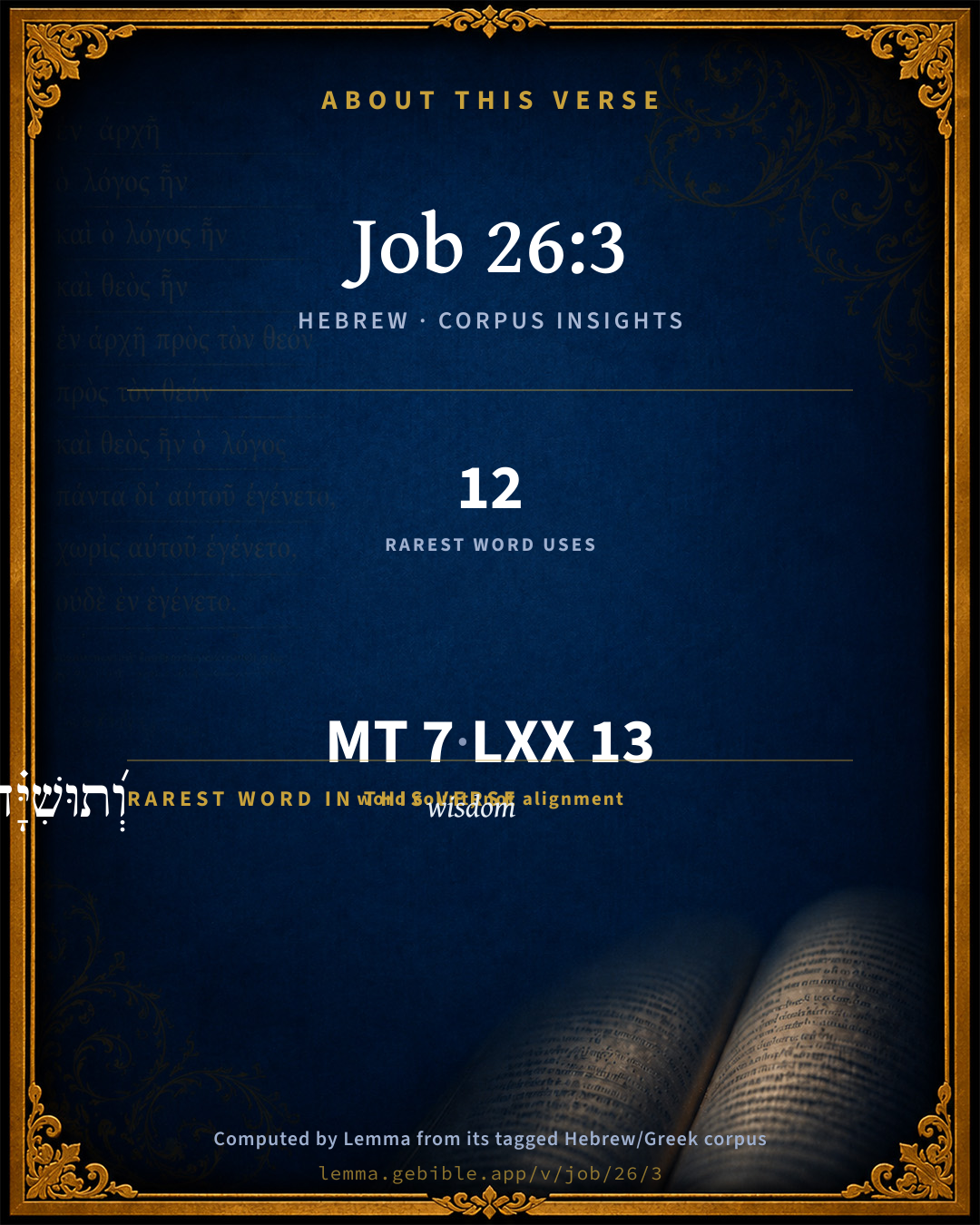
The rarest word here is וְ֝תוּשִׁיָּ֗ה wisdom H8454 — appearing just 12 times in the whole Hebrew Bible.

Shared distinctive vocabulary

וְ֝תוּשִׁיָּ֗ה wisdom H8454 occurs in 12 verses of the Hebrew Bible. Also found in:

Grammatical profile

  • 2 verbs
  • 3 nouns
  • 2 particles

Verb forms

  • יָּ֭עַצְתָּ Qal · Perfect
  • הוֹדָֽעְתָּ Hiphil · Perfect

Hebrew & Septuagint length

In English translation the verse runs 14 words from the Hebrew and 28 from the Septuagint (LXX English) — the Septuagint runs noticeably longer here. See the side-by-side →

A rough comparison of the two English renderings, which tokenize alike — not a word-level alignment.

Word counts can differ between the Hebrew and the Greek without any difference in meaning — e.g. the Hebrew direct-object marker אֵת has no separate Greek word, and Greek often adds the article ὁ.

In the original languages it is 7 Hebrew tokens and 13 Greek tokens — but the two are counted differently (Hebrew bundles its prefixes and suffixes into one token; the Greek is in lemma form), so that isn’t a like-for-like length.

Cross-references

14

Topical passages linked to Job 26:3 in the Treasury of Scripture Knowledge — connected by theme and wording, ordered by reader-vote popularity; previews shown in the World English Bible.

  • Job 6:13 Isn't it that I have no help in me, That wisdom is driven quite from me?
  • Job 12:3 But I have understanding as well as you; I am not inferior to you: Yes, who doesn't know such things as these?
  • Job 13:5 Oh that you would be completely silent! Then you would be wise.
  • Job 15:8–10 Have you heard the secret counsel of God? Do you limit wisdom to yourself?
  • Job 17:10 But as for you all, come on now again; I shall not find a wise man among you.
  • Job 32:11–13 "Behold, I waited for your words, And I listened for your reasoning, While you searched out what to say.
  • Job 33:3 My words shall utter the uprightness of my heart; That which my lips know they shall speak sincerely.
  • Job 33:33 If not, listen to me: Hold your peace, and I will teach you wisdom."
  • Job 38:2 "Who is this who darkens counsel By words without knowledge?
  • Psalms 49:1–4 Hear this, all you peoples. Listen, all you inhabitants of the world,
  • Psalms 71:15–18 My mouth will tell about your righteousness, And of your salvation all day, Though I don't know its full measure.
  • Proverbs 8:6–9 Hear, for I will speak excellent things. The opening of my lips is for right things.
  • Acts 20:20 how I didn't shrink from declaring to you anything that was profitable, teaching you publicly and from house to house,
  • Acts 20:27 for I didn't shrink from declaring to you the whole counsel of God.

Cross-references courtesy of OpenBible.info (CC BY 4.0).

Hebrew and Greek witnesses Masoretic Hebrew ↔ Greek Septuagint

The same verse in the two great witnesses to the Old Testament, shown verse-for-verse.

Here the Septuagint runs noticeably longer than the Hebrew — LXX2012 (modern English Septuagint) 28 words vs World English Bible 14. A rough length comparison of the two English translations, not a word-level alignment — read both below.

These are two independent witnesses, not word-aligned to each other, and the Septuagint is shown in lemma (dictionary) form.

Hebrew Job 26:3 Masoretic · Westminster Leningrad Codex

מַה יָּ֭עַצְתָּ לְלֹ֣א חָכְמָ֑ה וְ֝תוּשִׁיָּ֗ה לָרֹ֥ב הוֹדָֽעְתָּ

How have you counseled him who has no wisdom, And plentifully declared sound knowledge!

World English Bible · Public Domain

Greek LXX Job 26:3 Septuagint · lemma form

τίς συνβουλεύω οὐ ὅς πᾶς σοφία ἤ τίς ἐπιἀκολουθέω οὐ ὅς μέγας δύναμις

To whom have you given counsel? is it not to him who has all wisdom? whom will you follow? is it not one who has the greatest power?

LXX2012 (modern English Septuagint) · Public Domain

Hebrew: Westminster Leningrad Codex (CC BY 4.0). Greek: Septuagint (public domain); English from LXX2012 (modern English Septuagint) (Public Domain). How the Septuagint differs from the Hebrew →

Commentary

Notes on Job 26:3 from classic Christian and Jewish commentators (each source and its license shown beneath its notes). The classic Christian expositions comment on the surrounding passage and are grouped to its opening verse, so a note may address several verses; the Jewish commentaries on the Tanakh (Rashi and others) are per-verse, so they appear only where the commentator wrote on this verse.

Lemma curates 59 commentaries, every one of them public domain or Creative Commons licensed, each selected and text-cleaned for this edition rather than reprinted as found. About our sources →

Trapp's Complete Commentary

John Trapp

Job 26:3 How hast thou counselled [him that hath] no wisdom? and [how] hast thou plentifully declared the thing as it is?

Ver. 3. How hast thou counselled him that hath no wisdom?] q.d. Thou lookest upon me as a fool and an atheist; but this thou dost with far greater folly; for I am not the man thou takest me for, but can say as much for God as thyself, and more too; and if I were such as thou wouldest make of me, I might so continue, for any help I should have by thy counsel. The like hereunto we may say to the Papists and other seducers, who pretend to tender our good, to counsel us for the best, and to wish our salvation.

And how hast thou plentifully declared the thing as it is?] Heb. The essence, or the reason, or the naked truth: q.d. What ado hast thou kept to tell me no more than I knew before? wherein thou hast fairly lost thy labour and missed of thy design, if ever thou intendedst to counsel and comfort me. Very wisely hast thou done it, I must needs say for thee.

John Trapp, A Commentary or Exposition upon All the Books of the Old and New Testament (1647–1656) — public domain. Text from a community e-Sword module.

Joseph Benson's Commentary

Job 26:3. How hast thou counselled him that hath no wisdom? — Me, whom thou takest to be void of understanding, and whom, therefore, thou oughtest to have instructed with wholesome counsels, instead of those impertinent discourses which thou hast delivered. But, as the words, him that hath, are not in the original, the text would be better rendered, Why dost thou counsel without wisdom? And how hast thou plentifully declared the thing as it is? — And the essence, truth, or substance, (so the word ותושׁיה, vethushiah, signifies,) namely, of the thing in question between us, in abundance thou hast made known; thou hast spoken the whole truth, and nothing but the truth, and all that can be said in the matter! A most wise and profound discourse thou hast made, and much to the purpose! An ironical expression as before. But the word לרב, la-rob, which we translate, plentifully, or, in abundance, may be read, la-rib, to contention: and then the clause will bear a clearer sense, thus: Why dost thou discover truth or wisdom for the sake of contention?

Joseph Benson's Commentary on the Old and New Testaments (1811–1818) — public domain. Text from a community e-Sword module.

Geneva Bible (1599)

Geneva Bible translators

But thou dost not apply it to the purpose.

Geneva Bible (1599) marginal notes — public domain. Text via Bolls.life.

Jamieson, Fausset & Brown

Robert Jamieson, A. R. Fausset & David Brown

plentifully . . . the thing as it is--rather, "abundantly--wisdom." Bildad had made great pretensions to abundant wisdom. How has he shown it?

Jamieson, Fausset & Brown — Commentary Critical and Explanatory on the Whole Bible (1871) — public domain (CC PDM 1.0). Text via the HelloAO Bible API.

Ellicott's Commentary for English Readers

(3) The thing as it is?—Rather, How hast thou plentifully declared sound knowledge?

A Bible Commentary for English Readers, edited by Charles John Ellicott (1878–1897) — public domain. Text from a community e-Sword module.

The Cambridge Bible for Schools and Colleges

gen. ed. J. J. S. Perowne

3. plentifully declared the thing as it is] Rather, plentifully, or, abundantly, declared knowledge, or, wisdom. The word is that which occurs in ch. Job_5:12; see notes. “Him that is without power,” “that hath no wisdom” &c., is of course Job himself; and he expresses his admiration of the contribution made by Bildad to the clearing up of his perplexities and the solution of the riddle of his life. It is not quite clear whether Job means to say: “I am weak and unnerved, perplexed and ignorant, and how mightily in all this thou hast helped me!” or, whether he is not thinking with Bildad’s mind and giving bitter expression to the thoughts which that speaker doubtless entertained of his own performance, and of the effect it should have on the person whom he addressed: “Doubtless thou hast abundantly instructed and strengthened the weak and ignorant man before thee!” The former sense is the more natural, the other fits better into connexion with Job_26:4.

The Cambridge Bible for Schools and Colleges (gen. ed. J. J. S. Perowne; Cambridge University Press, 1878–1918) — public domain. Text from a community e-Sword module.

John Gill's Exposition

How hast thou counselled him that hath no wisdom?.... A man deprived of wisdom has need of counsel, and it should be given him; and he does well both to ask and take it; and be it so, as if Job should say, that I am the foolish and unwise creature you take me to be, what counsel and advice have you given me? what a wise counsellor have you shown yourself to be? or rather, what a miserable part have you acted under this character?

and how hast thou plentifully declared the thing as it is? the thing in controversy, set it forth in a clear light, and in a copious manner, when he had not said one word about it, namely, concerning the afflictions of the godly, and the prosperity of the wicked; thus jeering at him, and laughing at the short reply he had made, and which was nothing to the purpose.

John Gill's Exposition of the Whole Bible (1746–1763) — public domain (CC PDM 1.0). Text via the HelloAO Bible API.

Albert Barnes' Notes on the Bible

How hast thou counselled him that hath no wisdom? - As he had undertaken to give counsel to another, and to suggest views that might be adapted to elevate his mind in his depression, and to console him in his sorrows, he had a right to expect more than he had found in his speech.

And how hast thou plentifully declared the thing as it is? - The word rendered “the thing as it is” (תשׁיה tûshı̂yâh) denotes properly a setting upright, uprightness - from ישׁה yāshah; then help, deliverance, Job 6:13; purpose, undertaking, enterprise, Job 5:12; then counsel, wisdom, understanding, Job 11:6; Job 12:16. Here it is synonymous with reason, wisdom, or truth. The word rendered “plentifully” (לרב larôb) means “for multitude,” or abundantly, and the sense here is, that Bildad had made extraordinary pretensions to wisdom, and that this was the result. This short, irrelevant speech was all; a speech that communicated nothing new, and that met none of the real difficulties of the case.

Albert Barnes' Notes on the Bible (1834–1885) — public domain. Text from a community e-Sword/MySword module.

Matthew Poole's English Annotations

Him that hath no wisdom; either,

1. God: thou hast in effect undertaken to teach God how to govern the world. Or rather,

2. Me, whom you take to be a man void of understanding, Job 11:2,3, whom therefore you should have instructed with wholesome counsels, instead of these impertinent discourses; and who indeed do want wisdom, being perfectly at a loss, and not knowing what to say or do.

The thing as it is, Heb. essence, the truth and substance of the thing in question between us; thou hast spoken the whole truth, and nothing but the truth, and all t can be said in the matter. Or,

wisdom, as this word is used, Pro 3:21. A most wise and profound discourse thou hast made, and much to the purpose: an ironical expression, as before.

Matthew Poole's English Annotations on the Holy Bible (1683–1685) — public domain. Text from a community e-Sword/MySword module.

Whedon's Commentary on the Bible

Daniel D. Whedon

Strophe — Job compliments Bildad on his inapposite discourse, which has served not only to exhaust the subject but Bildad himself , Job_26:2-4.

3. Plentifully — Job ridicules the brevity of Bildad’s speech. The first four verses are exquisitely ironical.

Daniel D. Whedon (gen. ed.), Commentary on the Old and New Testaments (1874–1909) — public domain. Text from a community e-Sword module.

The Pulpit Commentary

How hast thou counselled him that hath no wisdom? What counsel or advice is there in anything that thou hast said, by following which I might be benefited? Admitting my own want of wisdom, how hast thou bettered my case? And how hast thou plenteously declared the thing as it is? rather, How hast thou plenteously declared sound knowledge? What can there be said to have been in the way of sound knowledge, or good practical common sense (hyviWj), in the discourse which thou hast addressed to me? a discourse made up of truisms.

The Pulpit Commentary (1880–1919), ed. H.D.M. Spence-Jones & Joseph S. Exell — public domain. Text from a community e-Sword module.

Lesson kit

Teaching starters — assembled from the data on this page, not authored interpretation. Every prompt links to the verse data it draws on. Edit before teaching.

Job, in the Wisdom, opens this verse with 7 words (7 distinct Hebrew lemmas). Its most distinctive word is tûwshîyâh (“wisdom”). The Greek Septuagint runs longer here. A historical commentator’s framing appears above. Read the whole chapter for the surrounding context.

Discussion questions

  1. What does “wisdom” (tûwshîyâh) contribute to the verse as a whole?
  2. Job 5:12 shares the word «wisdom» with this verse. How do the two illuminate each other?
  3. Compared with the Hebrew, the Septuagint runs longer here. What questions does that raise?
  4. These translations render this verse differently; the difference is in the English rendering, not the original. What questions does that raise?
  5. The verb «יָּ֭עַצְתָּ» is Qal Perfect. How does its form color the action?
  6. Reading how Trapp's Complete Commentary and Joseph Benson's Commentary read this verse, where do the two commentators agree and where do they part?

Things to notice

Reading settings

Reading text

Shown beneath each verse's original-language words.

Old Testament
Old Testament edition

Read the OT as the Masoretic Hebrew (MT) or the Greek Septuagint (LXX).

English shown for the Greek Septuagint (in the Hebrew ↔ Greek comparison).

Comparing translations? Open the Compare panel on any verse page to stack up to four side by side.