Ezekiel 27:12

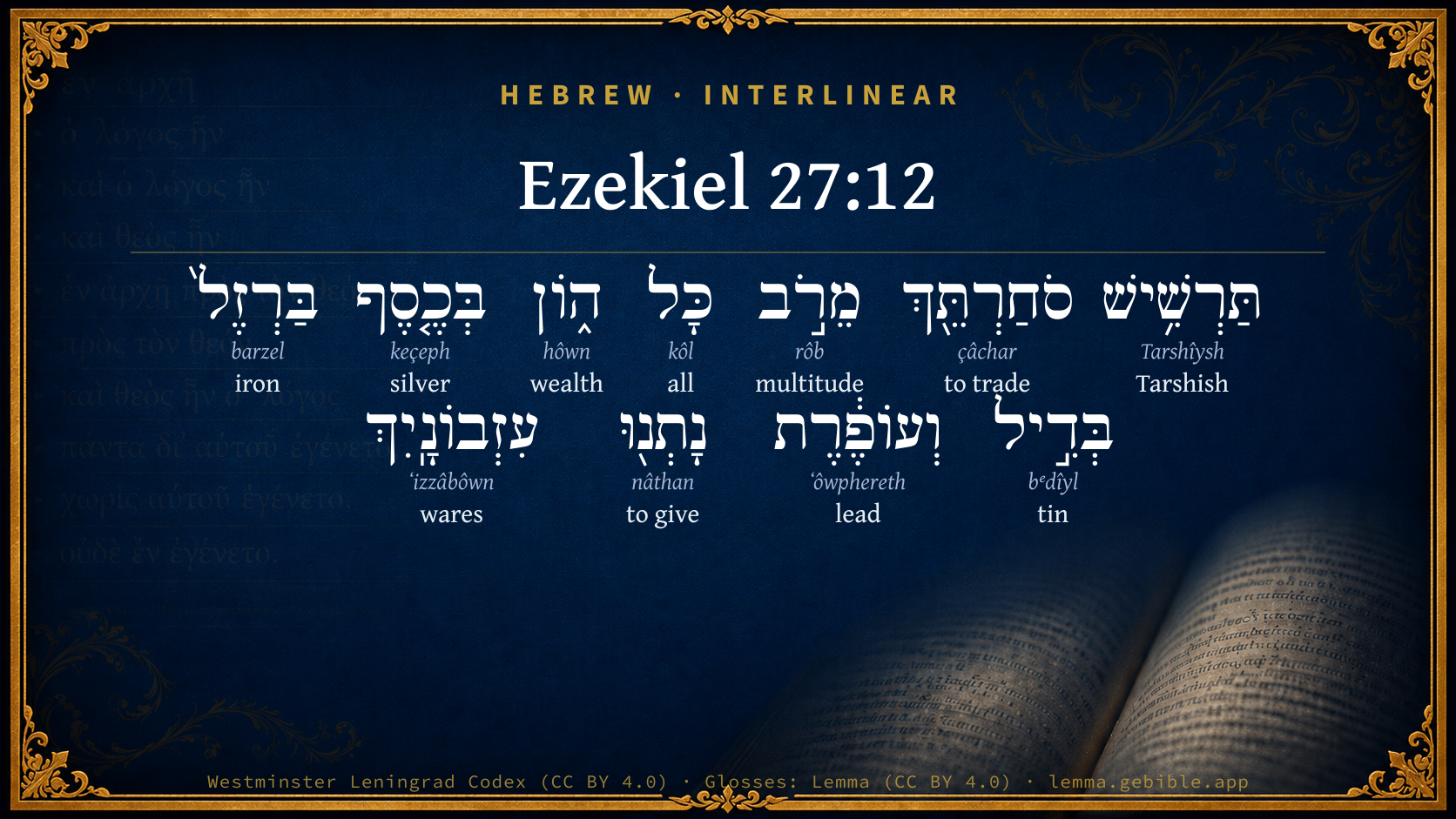
Hebrew (Westminster Leningrad Codex) Ezekiel 27:12 appears in the Hebrew Old Testament. The text above is from the Westminster Leningrad Codex. Each word links to its Strong’s number, a concise gloss, and parsing drawn from the Open Scriptures Hebrew Bible morphology. Click any word for its full Brown-Driver-Briggs (BDB) entry.
Download image
Cite this verse

Ezekiel 27:12 (World English Bible). Public Domain. Lemma interlinear Bible study tool, https://lemma.gebible.app/v/ezekiel/27/12.

Show BibTeX & RIS
BibTeX
RIS
English Translation
Tarshish was your merchant by reason of the multitude of all kinds of riches; with silver, iron, tin, and lead, they traded for your wares.
World English Bible · Public Domain
Highlights
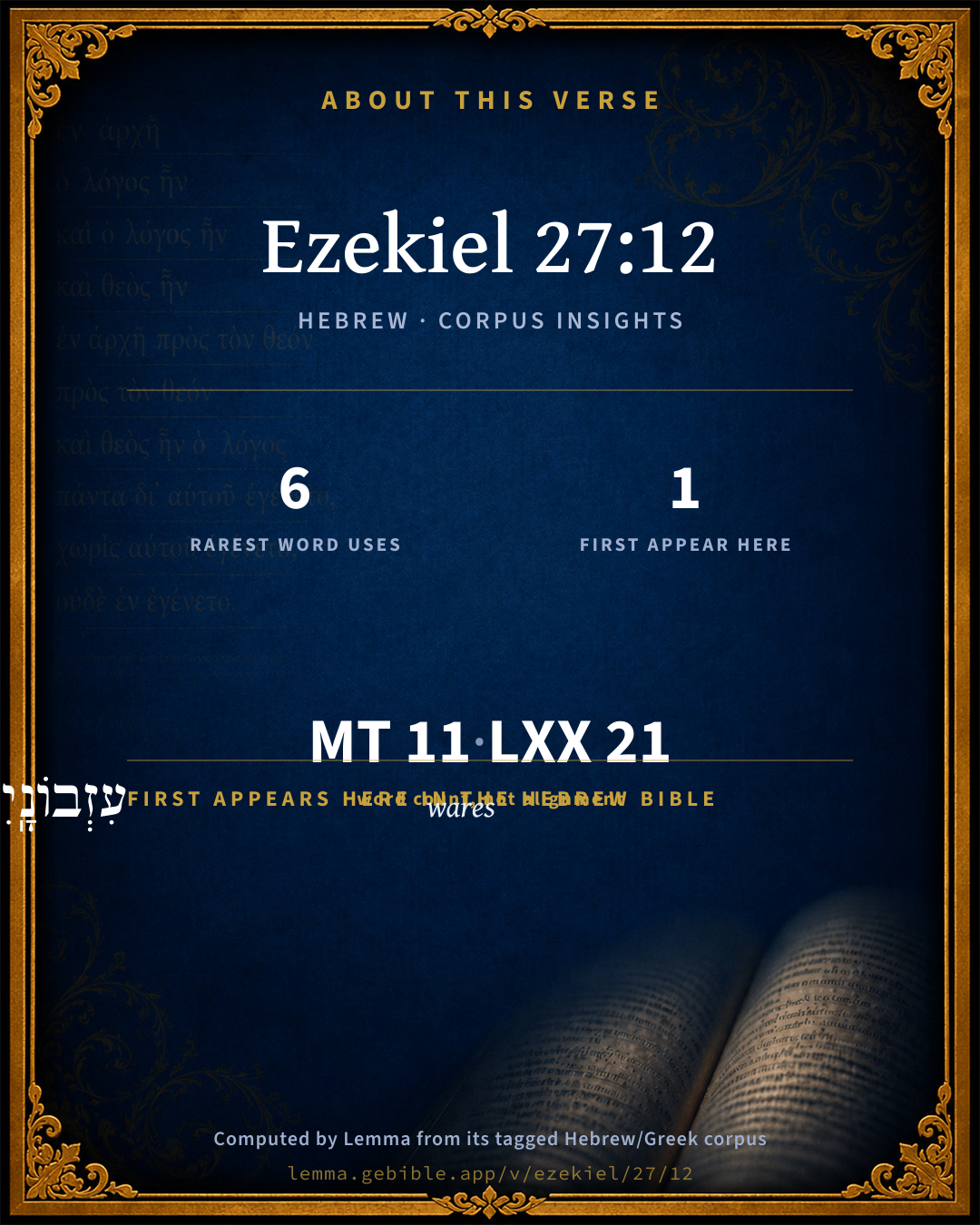
  • 1 first appearance in the Hebrew Bible
Full analysis ↓
Download a study sheet

One document with this verse’s original text, its word-by-word gloss line, the meaning frame, cross-references with their text, attributed commentary, and full source and license credits — printable, and it pastes into notes with its structure intact.

This verse Autodidact and up

Study sheet (.html) Plain text (.txt)

A passage Seminary Student

Up to 50 verses in one chapter. A passage sheet keeps up to 6 commentary sources and 12 cross-references per verse, in the order this page ranks them, and says so on the sheet whenever that leaves anything out. Ask for a single verse and you get the Autodidact verse sheet above.

Everything on this page stays free to read, with no account — the sheet is a download of what is already on screen, not access to it.

Want to remove ads? Support Godless Engineer
Compare translations 3

The same verse in 3 English versions, stacked beneath the original-language interlinear above. Click any original word for its lexicon entry.

Each is an independent rendering of the whole verse — the interlinear is not word-aligned to these translations.

Highlighted words mark where these versions differ — a whole-verse word diff, not a word-by-word alignment.

  • World English Bible Public Domain
    Tarshish was your merchant by reason of the multitude of all kinds of riches; with silver, iron, tin, and lead, they traded for your wares.
  • King James Version Public Domain
    Tarshish was thy merchant by reason of the multitude of all kind of riches; with silver, iron, tin, and lead, they traded in thy fairs.
  • unfoldingWord Literal Text CC BY-SA 4.0
    Tarshish was a trading partner with you because of your abundant wealth of goods to sell: Silver, iron, tin, and lead. They bought and sold your wares!

unfoldingWord Literal Text — © unfoldingWord, licensed CC BY-SA 4.0. Word-aligned USFM3 via Door43 (git.door43.org/unfoldingWord/en_ult).

Versions to compare (up to 4)

3 of 4 selected

Show all 18 translations

Every available English version of this verse, each an independent rendering of the whole verse.

  • World English Bible Public Domain
    Tarshish was your merchant by reason of the multitude of all kinds of riches; with silver, iron, tin, and lead, they traded for your wares.
  • Berean Standard Bible Public Domain
    Tarshish was your merchant because of your great wealth of goods; they exchanged silver, iron, tin, and lead for your wares.
  • Majority Standard Bible Public Domain
    Tarshish was your merchant because of your great wealth of goods; they exchanged silver, iron, tin, and lead for your wares.
  • King James Version Public Domain
    Tarshish was thy merchant by reason of the multitude of all kind of riches; with silver, iron, tin, and lead, they traded in thy fairs.
  • American Standard Version (1901) Public Domain
    Tarshish was thy merchant by reason of the multitude of all kinds of riches; with silver, iron, tin, and lead, they traded for thy wares.
  • Revised Version (1885) Public Domain
    Tarshish was thy merchant by reason of the multitude of all kinds of riches; with silver, iron, tin, and lead, they traded for thy wares.
  • Geneva Bible (1599) Public Domain
    They of Tarshish were thy marchantes for the multitude of all riches, for siluer, yron, tynne, and leade, which they brought to thy faires.
  • Douay-Rheims (1899) Public Domain
    The Carthaginians thy merchants supplied thy fairs with a multitude of all kinds of riches, with silver, iron, tin, and lead.
  • Young's Literal Translation Public Domain
    Tarshish `is' thy merchant, Because of the abundance of all wealth, For silver, iron, tin, and lead, They have given out thy remnants.
  • Literal Standard Version CC BY-SA 4.0
    Tarshish [is] your merchant, || Because of the abundance of all wealth, || They have given silver, iron, tin, and lead [for] your wares.
  • Unlocked Literal Bible CC BY-SA 4.0
    Tarshish was a trading partner with you because of your abundant wealth of goods to sell: Silver, iron, tin, and lead. They bought and sold your wares!
  • unfoldingWord Literal Text CC BY-SA 4.0
    Tarshish was a trading partner with you because of your abundant wealth of goods to sell: Silver, iron, tin, and lead. They bought and sold your wares!
  • Darby Bible Public Domain
    Tarshish dealt with thee by reason of the abundance of all substance; with silver, iron, tin, and lead, they furnished thy markets.
  • World Messianic Bible Public Domain
    “‘“Tarshish was your merchant by reason of the multitude of all kinds of riches. They traded for your wares with silver, iron, tin, and lead.
  • Webster's Bible Public Domain
    Tarshish was thy merchant by reason of the multitude of all kind of riches; with silver, iron, tin, and lead, they traded in thy fairs.
  • Free Bible Version CC BY-SA 4.0
    Tarshish traded with you because you had so much of everything. They paid for your goods with silver, iron, tin, and lead.
  • Bible in Basic English Public Domain
    Tarshish did business with you because of the great amount of your wealth; they gave silver, iron, tin, and lead for your goods.
  • JPS Tanakh (1917) Public Domain
    Tarshish was thy merchant by reason of the multitude of all kinds of riches; with silver, iron, tin, and lead, they traded for thy wares.

Literal Standard Version (2020), Covenant Press — licensed CC BY-SA 4.0. Text via the HelloAO Bible API (eBible.org). Unlocked Literal Bible (unfoldingWord) — licensed CC BY-SA 4.0. Text via the HelloAO Bible API (eBible.org). unfoldingWord Literal Text — © unfoldingWord, licensed CC BY-SA 4.0. Word-aligned USFM3 via Door43 (git.door43.org/unfoldingWord/en_ult). Free Bible Version, Dr. Jonathan Gallagher — licensed CC BY-SA 4.0. Text via the HelloAO Bible API (eBible.org).

Word by word

More ways to search: Search by grammar → Find every occurrence → Compare this word →

Practice this passage: Drill this verse → Learn its vocabulary →

בְּדִ֣יל
bᵉdîyl
H913
“tin”
Noun, Common, Masculine, Singular, Absolute
Part of Speech
Noun
Type
Common
Gender
Masculine
Number
Singular
State
Absolute
Full BDB Definition

Origin: from H914

TWOT: 203c

alloy, tin, dross - of Israel (metaphorically)
  1. תַּרְשִׁ֥ישׁ Tarshîysh H8659 “Tarshish” Noun, Proper
  2. סֹחַרְתֵּ֖ךְ çâchar H5503 “trading · you” Verb, Qal, Participle Active, Feminine, Singular, Construct + Suffix, Personal, 2nd Person, Feminine, Singular
  3. מֵרֹ֣ב rôb H7230 “from · multitude of” Preposition + Noun, Common, Both, Singular, Construct
  4. כָּל kôl H3605 “all of” Noun, Common, Masculine, Singular, Construct
  5. ה֑וֹן hôwn H1952 “wealth” Noun, Common, Masculine, Singular, Absolute
  6. בְּכֶ֤סֶף keçeph H3701 “in/at · silver” Preposition + Noun, Common, Masculine, Singular, Absolute
  7. בַּרְזֶל֙ barzel H1270 “iron” Noun, Common, Masculine, Singular, Absolute
  8. וְעוֹפֶ֔רֶת ʻôwphereth H5777 “and · lead” Conjunction + Noun, Common, Feminine, Singular, Absolute
  9. נָתְנ֖וּ nâthan H5414 “to give” Verb, Qal, Perfect, 3rd Person, Common, Plural
  10. עִזְבוֹנָֽיִךְ ʻizzâbôwn H5801 “wares · your” Noun, Common, Masculine, Plural, Construct + Suffix, Personal, 2nd Person, Feminine, Singular

About this verse

These counts appear in no published source. They are computed here, from the morphology-tagged text and Lemma’s own curated glosses. What Lemma adds →

11
words
11
distinct lemmas
Prophets
section

Notable vocabulary

The rarest word here is בְּדִ֣יל tin H913 — appearing just 6 times in the whole Hebrew Bible.

First appearance in Scripture

This word makes its first canonical appearance in the Hebrew Bible here:

  • עִזְבוֹנָֽיִךְ wares H5801

Shared distinctive vocabulary

בְּדִ֣יל tin H913 occurs in 6 verses of the Hebrew Bible. Also found in:

Grammatical profile

  • 2 verbs
  • 9 nouns

Verb forms

  • סֹחַרְתֵּ֖ךְ Qal · Participle Active
  • נָתְנ֖וּ Qal · Perfect

Hebrew & Septuagint length

In English translation the verse runs 25 words from the Hebrew and 27 from the Septuagint (LXX English) — closely comparable.

A rough comparison of the two English renderings, which tokenize alike — not a word-level alignment.

Word counts can differ between the Hebrew and the Greek without any difference in meaning — e.g. the Hebrew direct-object marker אֵת has no separate Greek word, and Greek often adds the article ὁ.

In the original languages it is 11 Hebrew tokens and 21 Greek tokens — but the two are counted differently (Hebrew bundles its prefixes and suffixes into one token; the Greek is in lemma form), so that isn’t a like-for-like length.

Cross-references

15

Topical passages linked to Ezekiel 27:12 in the Treasury of Scripture Knowledge — connected by theme and wording, ordered by reader-vote popularity; previews shown in the World English Bible.

  • Genesis 10:4 The sons of Javan: Elishah, Tarshish, Kittim, and Dodanim.
  • 1 Kings 10:22 For the king had at sea a navy of Tarshish with the navy of Hiram: once every three years came the navy of Tarshish, bringing gold, and silver, ivory, and apes, and peacocks.
  • Isaiah 23:10 Pass through your land as the Nile, daughter of Tarshish; there is no restraint any more.
  • Ezekiel 38:13 Sheba, and Dedan, and the merchants of Tarshish, with all the young lions of it, shall tell you, Are you come to take the spoil? have you assembled your company to take the prey? to carry away silver and gold, to take away cattle and goods, to take great spoil?
  • 1 Kings 22:48 Jehoshaphat made ships of Tarshish to go to Ophir for gold: but they didn't go; for the ships were broken at Ezion Geber.
  • 2 Chronicles 20:36–37 and he joined himself with him to make ships to go to Tarshish; and they made the ships in Ezion Geber.
  • Psalms 72:10 The kings of Tarshish and of the isles will bring tribute. The kings of Sheba and Seba shall offer gifts.
  • Isaiah 2:16 For all the ships of Tarshish, And for all pleasant imagery.
  • Isaiah 23:6 Pass over to Tarshish; wail, you inhabitants of the coast.
  • Isaiah 23:14 Howl, you ships of Tarshish; for your stronghold is laid waste.
  • Isaiah 60:9 Surely the isles shall wait for me, and the ships of Tarshish first, to bring your sons from far, their silver and their gold with them, for the name of Yahweh your God, and for the Holy One of Israel, because he has glorified you.
  • Jeremiah 10:9 There is silver beaten into plates, which is brought from Tarshish, and gold from Uphaz, the work of the artificer and of the hands of the goldsmith; blue and purple for their clothing; they are all the work of skillful men.
  • Ezekiel 27:16 Syria was your merchant by reason of the multitude of your handiworks: they traded for your wares with emeralds, purple, and embroidered work, and fine linen, and coral, and rubies.
  • Ezekiel 27:18 Damascus was your merchant for the multitude of your handiworks, by reason of the multitude of all kinds of riches, with the wine of Helbon, and white wool.
  • Jonah 1:3 But Jonah rose up to flee to Tarshish from the presence of Yahweh. He went down to Joppa, and found a ship going to Tarshish; so he paid its fare, and went down into it, to go with them to Tarshish from the presence of Yahweh.

Cross-references courtesy of OpenBible.info (CC BY 4.0).

Hebrew and Greek witnesses Masoretic Hebrew ↔ Greek Septuagint

The same verse in the two great witnesses to the Old Testament, shown verse-for-verse.

These are two independent witnesses, not word-aligned to each other, and the Septuagint is shown in lemma (dictionary) form.

Hebrew Ezekiel 27:12 Masoretic · Westminster Leningrad Codex

תַּרְשִׁ֥ישׁ סֹחַרְתֵּ֖ךְ מֵרֹ֣ב כָּל ה֑וֹן בְּכֶ֤סֶף בַּרְזֶל֙ בְּדִ֣יל וְעוֹפֶ֔רֶת נָתְנ֖וּ עִזְבוֹנָֽיִךְ

Tarshish was your merchant by reason of the multitude of all kinds of riches; with silver, iron, tin, and lead, they traded for your wares.

World English Bible · Public Domain

Greek LXX Ezekiel 27:12 Septuagint · lemma form

καρχηδόνιοι ἔμπορος σύ ἀπό πλῆθος πᾶς ἰσχύς σύ ἀργύριον καί χρυσίον καί σίδηρος καί κασσίτερος καί μόλιβος δίδωμι ὁ ἀγορά σύ

The Carthaginians were your merchants because of the abundance of all your strength; they furnished your market with silver, and gold, and iron, and tin, and lead.

LXX2012 (modern English Septuagint) · Public Domain

On this verse, The Cambridge Bible for Schools and Colleges discusses the Septuagint’s reading. Read the note in Commentary ↓

Hebrew: Westminster Leningrad Codex (CC BY 4.0). Greek: Septuagint (public domain); English from LXX2012 (modern English Septuagint) (Public Domain). How the Septuagint differs from the Hebrew →

Targum (Aramaic paraphrase)

1

The Targum is the ancient Jewish Aramaic paraphrase of the Hebrew Scriptures — an interpretive translation, not the Hebrew text itself. Onkelos (literal) and Pseudo-Jonathan (expansive) render the Torah, and Jonathan the Prophets. Coverage is partial: where no permissively-licensed English translation exists for a verse, only the Aramaic is shown. This is verse-level text, not a word-by-word alignment to the Hebrew.

  1. Targum Jonathan Prophets (Joshua–Malachi)
    מִן יַמָא מַיְתָן סְחוֹרָא לְגַוִיךְ מִסְגֵי כָּל עוֹתַר בִּכְסַף בַּרְזֶל עֲבַץ וַאֲבַד יְהָבוּ בְּבֵית גִנְזַיִךְ:

    (no public-domain English translation for this verse)

    Targum Jonathan — Aramaic: “Mikraot Gedolot” (public domain). English: “Sefaria Community Translation” (CC0 1.0 (public-domain dedication)); “London "Chaldee Paraphrase," 1871” (public domain). Text via Sefaria.

Commentary

Notes on Ezekiel 27:12 from classic Christian and Jewish commentators (each source and its license shown beneath its notes). The classic Christian expositions comment on the surrounding passage and are grouped to its opening verse, so a note may address several verses; the Jewish commentaries on the Tanakh (Rashi and others) are per-verse, so they appear only where the commentator wrote on this verse.

Lemma curates 59 commentaries, every one of them public domain or Creative Commons licensed, each selected and text-cleaned for this edition rather than reprinted as found. About our sources →

Ellicott's Commentary for English Readers

(12) Traded in thy fairs.—Tarshish, Tartessus in Spain, was famous in antiquity for the metals enumerated, especially silver. The word for “fairs” occurs only in this chapter (Eze_27:14; Eze_27:16; Eze_27:19; Eze_27:22; Eze_27:33). In the last case it is translated wares, as it should be throughout. The idea of the word is “something left with another in place of something else given in exchange,” in accordance with the habits of ancient commerce, which consisted chiefly in barter. Translate the clause, exchanged for thy wares.

Eze_27:12-23 give a general survey of the nations with whom the Tyrians were connected in commerce, omitting those already mentioned in the previous section. To avoid monotony, the prophet also constantly alternates in the use of synonymous words.

A Bible Commentary for English Readers, edited by Charles John Ellicott (1878–1897) — public domain. Text from a community e-Sword module.

The Cambridge Bible for Schools and Colleges

gen. ed. J. J. S. Perowne

12. The name Tarshish (Tartessus) was given to the district of country lying outside the Straits of Gibraltar on the lower Baetis, the Guadalquiver (Wadi el Kebîr, great river).

with silver … in thy fairs] Rather apparently: silver … they brought as thy wares. There is no evidence that the word means “fairs;” in Eze_27:27; Eze_27:34 the things so named fall into the waters of the sea. The representation is that all things brought to Tyre were hers, the nations offered them to her as tribute (Eze_27:15). Spain was famous for the metals mentioned; cf. for silver, Jer_10:9. Probably Tarshish served as an entrepôt for such products found further north, as in the Cassiterides (Scilly Islands) and Cornwall.

12–25. The market of Tyre

Several things are to be observed in this passage: 1. The representation is not that Tyre is traded with by the nations, though this is the fact lying under the figures employed. The nations are not customers of Tyre. Tyre neither buys nor sells, nor does she exchange one article for another. The nations are her merchants, who bring to her wares from every land; or they are her dependents, and the merchandise which they bring is a tribute which they render her (Eze_27:15). They are her subjects, ministering to her luxury, bringing wares to her, and enriching her. The counterpart to this idea is that she enriches many peoples by bestowing her wealth upon them (Eze_27:33). 2. The passage is artistic. Two words are employed for “to trade,” “to be a merchant.” The words have little difference of sense and are generally used alternately, e.g. one word in Eze_27:12; Eze_27:15-16; Eze_27:18; Eze_27:21, the other in Eze_27:13; Eze_27:15; Eze_27:17; Eze_27:20; Eze_27:22 seq. Two words also are used in the sense of wares or goods, though hardly differing in meaning. These also are used alternately so as to diversify the phraseology, e.g. the one in Eze_27:12; Eze_27:14; Eze_27:16; Eze_27:18; Eze_27:22, the other in Eze_27:13 (15), 17, 19, with other variants of the same sense. Gesen. attributed various senses to these words, as: 1, traffic, trading, 2, fair, market-place, and 3, gain, wealth. The words do not appear to differ in meaning, and neither of the two probably has any other sense than the general one of wares. 3. Again, the language is diversified by the adoption of a variety of constructions. The word “give,” which receives an extraordinary extension of usage in Ez. and in later Heb. in general (cf. its use in the Apocalypse), is employed in the sense of put, bring, render, &c. That it ever means to “sell” (Ges.) is without evidence. The various constructions employed are seen in Eze_27:12; Eze_27:22 (acc. and prep. b, cf Eze_27:13; Eze_27:17); in Eze_27:16; Eze_27:18 (double prep. b), and in Eze_27:14 (double accus.). These different constructions probably all express the same general meaning.

There is much uncertainty in the text, e.g. for “sons of Dedan,” Eze_27:15, LXX. reads, sons of the Rhodians, and for Aram (Syria) Eze_27:16, Syriac reads Edom (so LXX. “man”), in both cases by interchange of the similar letters d and r. Eze_27:19 is certainly out of order, and Eze_27:24 exceedingly obscure. Owing to these obscurities the precise order followed in the enumeration of the nations is involved in some uncertainty. 1. vv, 12–14, the prophet names the nations lying in the widest circle around Tyre, beginning with the furthest west, Tarshish (Spain), and pursuing a line along the north, Javan (Ionia), Tubal (N. of Asia Minor), and Togarmah (Armenia). 2. If Rhodians be read in Eze_27:15, a narrower circle of the Mediterranean coasts would be described. 3. Eze_27:16-19, if Edom be read for Aram, the line traced is from S. to N., along the eastern trade route, Edom, Judah, Damascus. 4. In Eze_27:19 Uzal seems certainly to be the name of a place (A.V. “going to and fro”) in the S. of Arabia, the other names are Arabian, Dedan, Kedar, Sheba and Raamah. 5. The names in Eze_27:23 seq. are more obscure, and it is not certain whether this be the previous line carried further N. or a new line.

The Cambridge Bible for Schools and Colleges (gen. ed. J. J. S. Perowne; Cambridge University Press, 1878–1918) — public domain. Text from a community e-Sword module.

Trapp's Complete Commentary

John Trapp

Eze 27:12 Tarshish [was] thy merchant by reason of the multitude of all [kind of] riches; with silver, iron, tin, and lead, they traded in thy fairs.

Ver. 12. Tarshish,] i.e., The Carthaginians, say some; the citizens of Tarsus, another colony of the Tyrians, say others.

They traded in thy fairs.] Heb., In thy derelictions, because they left their commodities behind them, taking others in exchange; for,

“ Non omnis fert omnia tellus. ”

John Trapp, A Commentary or Exposition upon All the Books of the Old and New Testament (1647–1656) — public domain. Text from a community e-Sword module.

Albert Barnes' Notes on the Bible

The thread broken at Eze 27:8 is taken up, and the various nations are enumerated which traded with Tyre.

Eze 27:12

Tarshish - Tartessus in Spain (marginal references). Spain was rich in the metals named.

Merchant - Especially applied to those who traveled about with caravans to carry on trade (see Gen 23:16).

Fairs - Or, “wares” Eze 27:33. The word occurs only in this chapter. The foreign merchants gave their wares in return for the products delivered to them by Tyre.

Eze 27:13

Jaran - Greece (Ion), including the Grecian colonies in Sicily and Italy.

Tubal, and Meshech - The Tibareni and Moschi, whose lands were on the Caucasian highlands between the Euxine and Caspian Seas (see the marginal reference), were a fine race of men; from thence slaves have been continually sought. Greece too in ancient times was famous for furnishing slaves.

Eze 27:14

Togarmah - Armenia.

Eze 27:15

Dedan - There were two tribes (Shemite and Hamite), each bearing the name of “Dedan” (see Gen 10:7). The Hamite (Ethiopian) Dedan may well have supplied for a payment (rather than “for a present”) horns, ivory, and ebony; the Shemite (Arabians), “clothes for chariots” (see Eze 27:20).

Eze 27:16

Syria - “Aram” here included Mesopotamia; and Babylon was famous for its precious stones. Many read “Edom.”

Emeralds - Rather, carbuncle.

Fine linen - The word (בוץ bûts) was used only in the times of the captivity. It is a Phoenician word, which in Greek assumed the form “byssus,” properly “cotton,” as distinguished from “linen;” the Phoenicians spinning their threads from cotton wool, the Egyptians from flax.

Eze 27:17

Minnith - A city of the Ammonites, whose country was famous for wheat 2Ch 27:5. The wheat was carried through the land of Israel to Tyre.

Pannag - This word occurs nowhere else, and has been very variously explained. Some take it to be “sweetwares.” Others see in it the name of a place, fertile like Minnith, perhaps identical with Pingi on the road from Baalbec to Damascus.

Eze 27:18

Helbon - Chalybon, near Damascus, whose wine was a favorite luxury with Persian kings.

White wool - A product of flocks that grazed in the waste lands of Syria and Arabia.

Eze 27:19

Dan also - Hebrew Vedan, a place in Arabia, not elsewhere mentioned.

Going to and fro - Better as in the margin, a proper name, “Meuzal,” or rather, “from Uzal” which was the ancient name of Senaa the capital of Yemen in Arabia. Greek merchants would carry on commerce between Uzal and Tyre.

Bright iron - literally, “wrought iron;” iron worked into plates smooth and polished. Yemen was famous for the manufacture of sword-blades.

Cassia - The inner bark of an aromatic plant.

Calamus - A fragrant reed-like plant (see Exo 30:23-24). Both are special products of India and Arabia.

Eze 27:20

Dedan - See Eze 27:15. It is remarkable that “Dedan and Sheba” occur both among the descendants of Ham in Gen 10:7, and among the descendants of Abraham and Keturah in Gen 25:3. This seems to indicate that there were distinct nomad tribes bearing the same names of Hamite and of Semitic origin; or it may be that whereas some of the nomad Arabs were Hamite, others Semitic, these were of mixed origin, and so traced up their lineage alike to tiara and Shem. Here we have, at any rate, a number of Arabian nomad tribes mentioned together, and these tribes and their caravans were in those days the regular merchant travelers between east and west. By her ships, Tyre spread over Europe the goods which by these caravans she obtained from India and China.

Precious clothes - Or “clothes of covering,” cloths of tapestry.

Eze 27:21

Kedar - The representative of the pastoral tribes in the northwest of Arabia.

Eze 27:22

Sheba - Sabaea, the richest country of Arabia, corresponded nearly with what is now called Yemen or Arabia Felix.

Raamah - Closely connected with “Sheba,” whose seat is supposed to have been in the neighborhood of the Persian Gulf.

Eze 27:23

Haran - Charrae in Mesopotamia.

Canneh - “Calneh” Gen 10:10, probably Ctesiphon on the Tigris.

Eden - On the Euphrates Isa 37:12. “the merchants of Sheba” Here the towns or tribes that traded with Sheba. Sheba maintained a considerable trade with Mesopotamia.

Chilmad - Possibly Kalwada near Bagdad.

Eze 27:24

All sorts of things - See the margin, “made of cedar” Rather, made fast.

Albert Barnes' Notes on the Bible (1834–1885) — public domain. Text from a community e-Sword/MySword module.

The Biblical Illustrator

Joseph S. Exell

Eze_27:12-23

Tarshish was thy merchant by reason of the multitude of all kinds of riches.

The fairs of Tyre

Let us look in upon a worlds fair at Tyre. Ezekiel leads us through one department, and it is a horse fair. Underfed and overdriven for ages, the horses of today give you no idea of the splendid animals which, rearing and plunging and snorting and neighing, were brought down over the planks of the ships, and led into the worlds fair at Tyre, until Ezekiel, who was a minister of religion, and not supposed to know much about, horses, cried out in admiration, They of the house of Togarmah traded in thy fairs with horses. Here in another department of that worlds fair at Tyre, led on by Ezekiel the prophet, we find everything all ablaze with precious stones. Like petrified snow are the corals; like fragments of fallen sky are the sapphires; and here is a gate a-blush with all colours. What is that aroma we inhale? It is from the chests of cedar which we open, and find them filled with all kinds of fabric. But the aromatics increase as we pass down this lane of enchantment, and here are cassia and frankincense and balm. Led on by Ezekiel the prophet, we come to an agricultural fair, with a display of wheat from Minnith and Pannag, rich as that of our modern Dakota or Michigan. And here is a mineralogical fair, with specimens of iron and silver and tin and lead and gold. But, halt! for here is purple, Tyrian purple, all tints and shades, deep almost unto the black, and bright almost unto the blue; waiting for kings and queens to order it made into robes for coronation day; purple, not like that which is now made from the orchilla weed, but the extinct purple, the lost purple, which the ancients knew how to make out of the gastropod molluscs of the Mediterranean. Oh, look at those casks of wine from Helbon! See those snow banks of wool from the back of sheep that once pastured in Gilead! Oh, the bewildering riches and variety of that worlds fair at Tyre! (T. De Witt Talmage.)

Great fairs universal

But the world has copied these Bible mentioned fairs in all succeeding ages, and it has had its Louis the Sixth fair at Dagobert, and Henry the First fair on St. Bartholomews Day, and Hungarian fairs at Pesth, and Easter fairs at Leipsic, and the Scotch fairs at Perth (bright was the day when I was at one of them), and afterward came the London worlds fair, and the New York worlds fair, and the Vienna worlds fair, and the Parisian worlds fair, and it has been decided that, in commemoration of the discovery of America in 1492, there shall be held in this country in 1892 a worlds fair that shall eclipse all preceding national expositions. (T. De Witt Talmage.)

Damascus was thy merchant in the multitude of thy wares of thy making.

Home industries to be encouraged

It is the wisdom of a nation to encourage art and industry, and not to bear hard upon the handicraft-tradesman; for it contributes much to the wealth and honour of a nation to send abroad wares of their own making, which may bring them in the multitude of riches. (M. Henry,)

The Biblical Illustrator, edited by Joseph S. Exell (c. 1880s–1900s) — public domain. Text from a community e-Sword module.

Joseph Benson's Commentary

Eze 27:12-15. Tarshish was thy merchant — Trafficked with thee. Of Tarshish, see note on Isa 2:16; Isa 23:1. Javan, Tubal, and Meshech — By Javan is to be understood Greece, in which sense Alexander is styled king of Javan, or Greece, Dan 8:21. So the LXX. translate it here, and in that place of Daniel. And all Greece, except Peloponnesus, was anciently called Ionia. Tubal and Meshech are names usually joined together in Scripture. Two of Japhet’s sons are so called, Gen 10:2. Bochart and Bishop Newcome, with others, suppose them to be the people afterward called Tibareni and Moschi, who are generally mentioned together, and were situated near the Euxine sea. They traded the persons of men — In buying and selling slaves in the markets. Bochart observes, that Pontus, to which the Tibareni extended themselves, was remarkable for slaves, and that the Grecian slaves were the most valuable of any. And vessels of brass in thy market — The Hebrew word נחשׁתhere, generally translated brass, likewise signifies steel, and is so rendered by our interpreters, Psa 18:34. And we may very well understand it so here; for the Chalybes, a people so called from their steel manufactures, lived in the neighbourhood of the Tibareni and Moschi, for which reason steel is called the northern iron, Jer 15:12. By Togarmah, Bochart supposes Cappadocia is meant. Michaelis, however, prefers Armenia, which abounded in horses, and among the inhabitants of which a tradition prevailed, that they were descended from Thorgom. By Dedan, the above-mentioned critics, with Bishop Newcome, understand a city in the Persian gulf, now called Daden. To this place the inhabitants of the eastern isles, or seacoasts, brought their wares. Many isles were, or rather, had, the merchandise of thy hand — That is, many isles took thy manufactures, or bought commodities of thee; and, by way of return for them, brought thee in ivory, and other rarities from India, whither they traded. They brought these by way of present, says our translation; but it was rather by way of price, or return, for the commodities exported, and so it is rendered in some versions.

Joseph Benson's Commentary on the Old and New Testaments (1811–1818) — public domain. Text from a community e-Sword module.

Keil & Delitzsch

C. F. Keil & F. Delitzsch

This is followed by a description of the commerce of Tyre with all nations, who delivered their productions in the market of this metropolis of the commerce of the world, and received the wares and manufactures of this city in return. - Eze 27:12. Tarshish traded with thee for the multitude of goods of all kinds; with silver, iron, tin, and lead they paid for thy sales. Eze 27:13. Javan, Tubal, and Meshech, they were thy merchants; with souls of men and brazen vessels they made thy barter. Eze 27:14. From the house of Togarmah they paid horses, riding-horses, and mules for thy sales. Eze 27:15. The sons of Dedan were thy merchants; many islands were at thy hand for commerce; ivory horns and ebony they brought thee in payment. Eze 27:16. Aram traded with thee for the multitude of thy productions; with carbuncle, red purple, and embroidery, and byssus, and corals, and rubies they paid for thy sales. Eze 27:17. Judah and the land of Israel, they were thy merchants; with wheat of Minnith and confectionery, and honey and oil, and balsam they made thy barter. Eze 27:18. Damascus traded with thee in the multitude of thy productions, for the multitude of goods of all kinds, with wine of Chelbon and white wool. Eze 27:19. Vedan and Javan from Uzal gave wrought iron for thy salves; cassia and calamus were for thy barter. Eze 27:20. Vedan was thy merchant in cloths spread for riding. Eze 27:21. Arabia and all the princes of Kedar, they were at thy hand for commerce; lambs and rams and he-goats, in these they traded with thee. Eze 27:22. The merchants of Sheba and Ragmah, they were thy merchants; with all kinds of costly spices and with all kinds of precious stones and gold they paid for thy sales. Eze 27:23. Haran, and Canneh, and Eden, the merchants of Sheba, Asshur, Chilmad, were they merchants; Eze 27:24. They were thy merchants in splendid clothes, in purple and embroidered robes, and in treasures of twisted yarn, in wound and strong cords for thy wares. Eze 27:25. The ships of Tarshish were thy caravans, thy trade, and thou wast filled and glorious in the heart of the seas. - The enumeration of the different peoples, lands, and cities, which carried on trade with Tyre, commences with Tarshish (Tartessus) in the extreme west, then turns to the north, passes through the different lands of Anterior Asia and the Mediterranean to the remotest north-east, and ends by mentioning Tarshish again, to round off the list. But the lands and peoples, which are mentioned in Eze 27:5-11 as furnishing produce and manufactures for the building of Tyre, viz., Egypt and the tribes of Northern Africa, are left out. - To avoid wearisome uniformity in the enumeration, Ezekiel has used interchangeably the synonymous words which the language possessed for trade, besides endeavouring to give life to the description by a variety of turns of expression. Thus סחרתך (Eze 27:12, Eze 27:16, Eze 27:18), סחריך (Eze 27:21), and סחרת ידך (Eze 27:15), or סחרי ידך (Eze 27:21), are interchanged with רכליך (Eze 27:13, Eze 27:15, Eze 27:17, Eze 27:22, Eze 27:24), רכלתך (Eze 27:20, Eze 27:23), and מרכּלתּך (Eze 27:24); and, again, נתן עזבוניך (Eze 27:12, Eze 27:14, Eze 27:22), נתן (Eze 27:16, Eze 27:19), with נתן מערבך (Eze 27:13, Eze 27:17), and בּמערבך היה (Eze 27:19), and השׁיב אשׁכּרך (Eze 27:15). The words סחר, participle of סחר, and רכל, from רכל morf, signify merchants, traders, who travel through different lands for purposes of trade. סחרת, literally, the female trader; and סחרה, literally, trade; then used as abstract for concrete, the tradesman or merchant. רכל, the travelling merchant. - רכלת, the female trader, a city carrying on trade. מרכלת, trade or a place of trade, a commercial town. עזבונים (pluralet.) does not mean a place of trade, market, and profits (Gesenius and others); but according to its derivation from עזב, to leave, relinquish, literally, leaving or giving up, and as Gusset. has correctly explained it, "that which you leave with another in the place of something else which he has given up to you." Ewald, in accordance with this explanation, has adopted the very appropriate rendering Absatz, or sale. נתן עזבוניך, with ב, or with a double accusative, literally, to make thy sale with something, i.e., to pay or to give, i.e., pay, something as an equivalent for the sale; 'נתן בּעזב, to give something for the sale, or the goods to be sold. מערב, barter, goods bartered with נתן, to give bartered goods, or carry on trade by barter.

The following are the countries and peoples enumerated: - תּרשׁישׁ, the Tyrian colony of Tarshish or Tartessus, in Hispania Baetica, which was celebrated for its wealth in silver (Jer 10:9), and, according to the passage before us, also supplied iron, tin, and lead (vid., Plin. Hist. nat. iii. 3 4, xxxiii. 6 31, xxiv. 14 41; Diod. Sic. v. 38). Further particulars concerning Tarshish are to be found in Movers, Phoeniz. II 2, pp. 588ff., and II 3, p. 36. - Javan, i.e., Jania, Greece or Greeks. - Tubal and Meshech are the Tibareni and Moschi of the ancients between the Black and Caspian Seas (see the comm. on Gen 10:2). They supplied souls of men, i.e., slaves, and things in brass. The slave trade was carried on most vigorously by the Ionians and Greeks (see Joel 4:6, from which we learn that the Phoenicians sold prisoners of war to them); and both Greeks and Romans drew their largest supplies and the best slaves from the Pontus (for proofs of this, see Movers, II 3, pp. 81f.). It is probable that the principal supplies of brazen articles were furnished by the Tibareni and Moschi, as the Colchian mountains still contain an inexhaustible quantity of copper. In Greece, copper was found and wrought in Euboea alone; and the only other rich mines were in Cyprus (vid., Movers, II 3, pp. 66, 67). - Eze 27:14. "From the house of Togarmah they paid," i.e., they of the house of Togarmah paid. Togarmah is one of the names of the Armenians (see the comm. on Gen 10:3); and Strabo (XI 14. 9) mentions the wealth of Armenia in horses, whilst that in asses is attested by Herodotus (i. 194), so that we may safely infer that mules were also bred there. - Eze 27:15. The sons of Dedan, or the Dedanites, are, no doubt, the Dedanites mentioned in Gen 10:7 as descendants of Cush, who conducted the carrying trade between the Persian Gulf and Tyre, and whose caravans are mentioned in Isa 21:13. Their relation to the Semitic Dedanites, who are evidently intended in Eze 27:20, and by the inhabitants of Dedan mentioned in connection with Edom in Eze 25:13 and Jer 49:8, is involved in obscurity (see the comm. on Gen 10:7). The combination with איּים רבּים and the articles of commerce which they brought to Tyre, point to a people of southern Arabia settled in the neighbourhood of the Persian Gulf. The many איּים are the islands and coasts of Arabia on the Persian Gulf and Erythraean Sea.

(Note: Movers (II 3, pp. 303ff.) adduces still further evidence in addition to that given above, namely, that "unquestionable traces of the ancient name have been preserved in the region in which the ancient Dedanites are represented as living, partly on the coast in the names Attana, Attene, which have been modified according to well-known laws, - the former, a commercial town on the Persian Gulf, visited by Roman merchants (Plin. vi. 32, 147); the latter, a tract of country opposite to the island of Tylos (Plin. l.c. 49), - and partly in the islands of the Persian Gulf" (p. 304).)

סחרת ידך, the commerce of thy hand, i.e., as abstr. pro concr., those who were ready to thy hand as merchants. קרנות שׁן, ivory horns. This is the term applied to the elephants' tusks (shn) on account of their shape and resemblance to horns, just as Pliny (Hist. nat. xviii. 1) also speaks of cornua elephanti, although he says, in viii. 3 (4), that an elephant's weapons, which Juba calls cornua, are more correctly to be called dentes.

(Note: The Ethiopians also call ivory Karna nage, i.e., cornu elephanti, and suppose that it is from horns, and not from tusks, that ivory comes (vid., Hiob Ludolph, Hist. Aeth. I c. 10).)

The ἁπ. λεγ.. הובנים, Keri הבנים, signifies ἔβενος hebenum, ebony. The ancients obtained both productions partly from India, partly from Ethiopia (Plin. xii. 4 8). According to Dioscor. i. 130, the Ethiopian ebony was preferred to the Indian. השׁיב אשׁכּר to return payment (see the comm. on Psa 72:10).

In Eze 27:16, J. D. Michaelis, Ewald, Hitzig, and others read אדם for ארם, after the lxx and Pesh., because Aram did not lie in the road from Dedan and the איּים to Israel (Eze 27:17), and it is not till Eze 27:18 that Ezekiel reaches Aram. Moreover, the corruption ארם for אדום could arise all the more readily from the simple fact that the defective form אדם only occurs in Ezekiel (Eze 25:14), and is altogether an extraordinary one. These reasons are undoubtedly worthy of consideration; still they are not conclusive, since the enumeration does not follow a strictly geographical order, inasmuch as Damascus is followed in Eze 27:19. by many of the tribes of Southern Arabia, so that Aram might stand, as Hvernick supposes, for Mesopotamian Aram, for which the articles mentioned in Eze 27:16 would be quite as suitable as for Edom, whose chief city Petra was an important place of commerce and emporium for goods. רב מעשׂיך, the multitude of thy works, thy manufactures. Of the articles of commerce delivered by ארם , the red purple, embroidery, and בּוּץ (the Aramaean name for byssus, which appears, according to Movers, to have originally denoted a species of cotton), favour Aram, particularly Babylonia, rather than Edom. For the woven fabrics of Babylonia were celebrated from the earliest times (vid., Movers, II 3, pp. 260ff.); and Babylon was also the oldest and most important market for precious stones (vid., Movers, p. 266). נפך is the carbuncle (see the comm. on Exo 28:18). כּדכּד, probably the ruby; in any case, a precious stone of brilliant splendour (vid., Isa 54:12). ראמות, corals or pearls (vid., Delitzsch on Job 28:18). - Judah (Eze 27:17) delivered to Tyre wheat of Minnith, i.e., according to Jdg 11:33, an Ammonitish place, situated, according to the Onomast., four Roman miles from Heshbon in the direction of Philadelphia. That Ammonitis abounded in wheat, is evident from Ch2 27:5, although the land of Israel also supplied the Tyrians with wheat (Kg1 5:11). The meaning of the ἁπ. λεγ. דם̓̀בנ̓̀ב cannot be definitely ascertained. The rendering confectionery is founded upon the Aramaean פּנק, deliciari, and the Chaldee translation, קוליא, i.e., κολία, according to Hesychius, τὰ ἐκ μέλιτος τρωγάλια, or sweetmeats made from honey. Jerome renders it balsamum, after the μύρων of the lxx; and in Hitzig's opinion, Pannaga (literally, a snake) is a name used in Sanscrit for a sweet-scented wood, which was employed in medicine as a cooling and strengthening drug (?). Honey (from bees) and oil are well-known productions of Palestine. צרי is balsam; whether resina or the true balsam grown in gardens about Jericho (opobalsamum), it is impossible to decide (see my Bibl. Archol. I p. 38, and Movers, II 3, pp. 220ff.). Damascus supplied Tyre with wine of Chelbon. חלבּון still exists in the village of Helbn, a place with many ruins, three hours and a half to the north of Damascus, in the midst of a valley of the same name, which is planted with vines wherever it is practicable, from whose grapes the best and most costly wine of the country is made (vid., Robinson, Biblical Researches). Even in ancient times this wine was so celebrated, that, according to Posidonius (in Athen. Deipnos. i. 22), the kings of Persia drank only Chalybonian wine from Damascus (vid., Strabo, XV 3. 22). צמר צחר, wool of dazzling whiteness; or, according to others, wool of Zachar, for which the Septuagint has ἔρια ἐκ Μιλήτου, Milesian wool.

(Note: According to Movers (II 3, p. 269), צחר is the Sicharia of Aethicus (Cosm. 108): Sicharia regio, quae postea Nabathaea, nuncupatur, silvestris valde, ubi Ismaelitae eminus, - an earlier name for the land of the Nabathaeans, who dwelt in olden time between Palestine and the Euphrates, and were celebrated for their wealth in flocks of sheep.)

Eze 27:19. Various explanations have been given of the first three words. ודן is not to be altered into דּדן, as it has been by Ewald, both arbitrarily and unsuitably with Eze 27:20 immediately following; nor is it to be rendered "and Dan." It is a decisive objection to this, that throughout the whole enumeration not a single land or people is introduced with the copula w. Vedan, which may be compared with the Vaheb of Num 21:14, a place also mentioned only once, is the name of a tribe and tract of land not mentioned elsewhere in the Old Testament. Movers (p. 302) conjectures that it is the celebrated city of Aden (Arab. 'dn). Javan is also the name of an Arabian place or tribe; and, according to a notice in the Kamus, it is a place in Yemen. Tuch (Genesis, p. 210) supposes it to be a Greek (Ionian) settlement, the founders of which had been led by their enterprising spirit to cross the land of Egypt into Southern Arabia. For the purpose of distinguishing this Arabian Javan from Greece itself, or in order to define it more precisely, מעוּזל is appended, which all the older translators have taken to be a proper name. According to the Masoretic pointing מאוּזּה, the word is, no doubt, to be regarded as a participle Pual of אזל, in the sense of spun, from אזל, to spin. But apart from the fact that it would be a surprising thing to find spun goods mentioned in connection with the trade of the Arabian tribes, the explanation itself could not be sustained from the usage of the language; for there is nothing in the dialects to confirm the idea that אזל is a softened form of עזל, inasmuch as they have all עזל (Aram.) and gzl (Arab.), and the Talmudic אזל, texere, occurs first of all in the Gemara, and may possibly have been derived in the first instance from the Rabbinical rendering of our מאוזל by "spun." Even the fact that the word is written with Shurek is against this explanation rather than in its favour; and in all probability its origin is to be traced to the simple circumstance, that in Eze 27:12, Eze 27:14, Eze 27:16 the articles of commerce are always mentioned before נתנוּ עזבוניך, and in this verse they would appear to be omitted altogether, unless they are covered by the word מאוזל. But we can very properly take the following words בּרזל עשׁות as the object of the first hemistich, since the Masoretic accentuation is founded upon the idea that מאוזל is to be taken as the object here. We therefore regard מאוּזל as the only admissible pointing, and take אוּזל as a proper name, as in Gen 10:27 : "from Uzal," the ancient name of Sanaa, the subsequent capital of Yemen. The productions mentioned bear this out. Forged or wrought iron, by which Tuch (l.c. p. 260) supposes that sword-blades from Yemen are chiefly intended, which were celebrated among the Arabs as much as the Indian. Cassia and calamus (see the comm. on Exo 30:23 and Exo 30:24), two Indian productions, as Yemen traded with India from the very earliest times. - Dedan (Eze 27:20) is the inland people of that name, living in the neighbourhood of Edom (cf. Eze 25:13; see the comm. on Eze 27:15). They furnished בּגדי, tapetes straguli, cloths for spreading out, most likely costly riding-cloths, like the middim of Jdg 5:10. ערב and קדר represent the nomad tribes of central Arabia, the Bedouins. For ערב is never used in the Old Testament for the whole of Arabia; but, according to its derivation from ערבה, a steppe or desert, simply for the tribes living as nomads in the desert (as in Isa 13:20; Jer 3:2; cf. Ewald, Grammat. Arab. I p. 5). Kedar, descended from Ishmael, an Arabian nomad tribe, living in the desert between Arabia Petraea and Babylonia, the Cedrei of Pliny (see the comm. on Gen 25:13). They supplied lambs, rams, and he-goats, from the abundance of their flocks, in return for the goods obtained from Tyre.

Jdg 5:22. Next to these the merchants of Sheba and Ragmah (רעמה) are mentioned. They were Arabs of Cushite descent (Gen 10:7) in south-eastern Arabia (Oman); for ,רעמה̔Ρεγμα, was in the modern province of Oman in the bay of the same name in the Persian Gulf. Their goods were all kinds of spices, precious stones, and gold, in which southern Arabia abounded. ראשׁ כּל־בּשׂם, the chief or best of all perfumes (on this use of ראשׁ, see the comm. on Exo 30:23; Sol 4:14), is most likely the genuine balsam, which grew in Yemen (Arabia felix), according to Diod. Sic. iii. 45, along with other costly spices, and grows there still; for Forskal found a shrub between Mecca and Medina, called Abu sham, which he believed to be the true balsam, and of which he has given a botanical account in his Flora Aeg. pp. 79, 80 (as Amyris opobalsamum), as well as of two other kinds. Precious stones, viz., onyx-stones, rubies, agates, and cornelians, are still found in the mountains of Hadramaut; and in Yemen also jaspers, crystals, and many good rubies (vid., Niebuhr, Descript. p. 125, and Seetzen in Zach's Monatl. Corresp. xix. p. 339). And, lastly, the wealth of Yemen in gold is too strongly attested by ancient writers to be called in question (cf. Bochart, Phal. II 28), although this precious metal is no found there now.

In Eze 27:23, Eze 27:24 the trade with Mesopotamia is mentioned. חרן, the Carrhae of the Romans in north-western Mesopotamia (see the comm. on Gen 11:31), was situated at the crossing of the caravan-roads which intersect Mesopotamia; for it was at this point that the two caravan routes from Babylonia and the Delta of the Persian Gulf joined the old military and commercial road to Canaan (Movers, p. 247). The eastern route ran along the Tigris, where Calneh, the later Ktesiphon, and the most important commercial city. It is here called כּנּה (Canneh), contracted from כּלנה (see the comm. on Gen 10:10; Amo 6:2). The western route ran along the Euphrates, past the cities mentioned in Eze 27:23. עדן is not the Syrian, but the Mesopotamian Eden (Kg2 19:12; Isa 37:12), the situation of which has not yet been determined, though Movers (p. 257) has sought for it in the Delta of the Euphrates and Tigris. The singular circumstance that the merchants of Sheba should be mentioned in connection with localities in Mesopotamia, which has given rise both to arbitrary alterations of the text and to various forced explanations, has been explained by Movers (p. 247 compared with p. 139) from a notice of Juba in Pliny's Hist. nat. xii. 17 (40), namely, that the Sabaeans, the inhabitants of the spice country, came with their goods from the Persian Gulf to Carrhae, where they held their yearly markets, and from which they were accustomed to proceed to Gabba (Gabala in Phoenicia) and Palestinian Syria. Consequently the merchants of Sabaea are mentioned as those who carried on the trade between Mesopotamia and Tyre, and are not unsuitably placed in the centre of those localities which formed the most important seats of trade on the two great commercial roads of Mesopotamia.

Asshur and Chilmad, as we have already observed, were on the western road which ran along the Euphrates. כּלמד has already been discovered by Bochart (Phal. I 18) in the Charmande of Xenophon (Anab. i. 5. 10), and Sophaenetus (see Steph. Byz. s.v. Χαρμάνδη), a large and wealthy city in a desert region "beyond the river Euphrates." The Asshur mentioned along with Chilmad, in the midst of purely commercial cities, cannot be the land of Assyria, but must be the emporium Sura (Movers, p. 252), the present Essurieh, which stands upon the bank on this side of the Euphrates above Thapsacus and on the caravan route, which runs from Palmyra past Rusapha (Rezeph, Isa 37:12; Kg2 19:12) to Nicephorium or Rakka, then in a northerly direction to Haran, and bending southwards, runs along the bank of the river in the direction of Chilmad or Charmande (Ritter, Erdk. XI pp. 1081ff.). The articles of commerce from these emporia, which were brought to Tyre by Sabaean caravans, consisted of מּכללים, literally, articles of perfect beauty, either state-dresses (cf. מכלל, Eze 23:12 and Eze 34:4), or more generally, costly works of art (Hvernick). The omission of the copula ו before בּגלומי is decisive is favour of the former, as we may infer from this that 'בגל is intended as an explanatory apposition to מּכללים. גּלומי תכלת ורקמה, cloaks (גּלום connected with χλαμύς) of hyacinth-purple and embroidery, for which Babylonia was celebrated (for proofs of this, see Movers, pp. 258ff.). The words which follow cannot be explained with certainty. All that is evident is, that 'ואר 'בּחבלים חב is appended to בּגנזי בּרומים without a copula, as 'בּגלומי וגו is to בּמּכללים in the first hemistich, and therefore, like the latter, is intended as an explanatory apposition. חבלים does not mean either cloths or threads, but lines or cords. חבשׁים signifies literally bound or would up; probably twisted, i.e., formed of several threads wound together or spun; and ארזים, firm, compact, from Arab. arz, to be drawn together. Consequently 'גּנזי בּרומים וגו can hardly have any other meaning than treasures of spun yarns, i.e., the most valuable yarns formed of different threads. For "treasures" is the only meaning which can be assigned to גּנזים with any certainty on philological grounds, and בּרומים, from בּרם, Arab. brm, contorsit , is either yarn spun from several or various threads, or cloth woven from such threads. But the latter would not harmonize with חבלים. Movers (II 3, pp. 263ff.) adopts a similar conclusion, and adduces evidence that silk yarn, bombyx, and cotton came to Tyre through the Mesopotamian trade, and were there dyed in the splendid Tyrian purples, and woven into cloths, or brought for sale with the dyeing complete. All the other explanations which have been given of these difficult words are arbitrary and untenable; not only the Rabbinical rendering of גּנזי בּרומים, viz., chests of damask, but that of Ewald, "pockets of damask," and that proposed by Hartmann, Hvernick, and others, viz., girdles of various colours, ζῶναι σκιωταί. In Eze 27:25 the description is rounded off with a notice of the lever of this world-wide trade. שׁרות cannot mean "walls" in this instance, as in Jer 5:10, and like שׁוּרות in Job 24:11, because the ships, through which Tyre became so rich, could not be called walls. The word signifies "caravans," after שׁוּר = Arab. sâr (Isa 57:9), corresponding to the Aramaean שׁירא. מערבך might be regarded as an accusative of more precise definition: caravans, with regard to (for) thy bartering trade. At the same time it is more rhetorical to take מערבך as a second predicate: they were thy trade, i.e., the carriers of thy trade. What the caravans were for the emporia of trade on the mainland, the ships of Tarshish were for Tyre, and these on the largest sea-going ships are mentioned instar omnium. By means of these vessels Tyre was filled with goods, and rendered weighty (נכבּד), i.e., rich and glorious. - But a tempest from the east would destroy Tyre with all its glory.

Keil & Delitzsch — Biblical Commentary on the Old Testament (1861–1891) — public domain (CC PDM 1.0). Text via the HelloAO Bible API. (Old Testament only.)

Tyndale Open Study Notes

Tyndale Open Resources

27:12-25 This vast system of transport was all at the service of Tyre’s insatiable appetite for trade. The list of Tyre’s trading partners goes on and on; Tyre was the source of a wide variety of commodities from slaves to horses, saddle blankets to silver, dyes to figs (cp. Rev 18:11-13). The cargo list for the ship is organized according to the different geographic regions with which she conducted trade, covering all points of the compass and including every trading center, major and minor. Virtually every precious object that could be bought or sold found a place somewhere on the list of Tyre’s goods.

27:12 Tarshish was in the distant west, possibly in Spain.

Tyndale Open Study Notes — © Tyndale Open Resources, licensed CC BY-SA 4.0. Text via the HelloAO Bible API.

Jamieson, Fausset & Brown

Robert Jamieson, A. R. Fausset & David Brown

Tarshish--Tartessus in Spain, a country famed for various metals, which were exported to Tyre. Much of the "tin" probably was conveyed by the Phœnicians from Cornwall to Tarshish.

traded in thy fairs--"did barter with thee" [FAIRBAIRN]; from a root, "to leave," something left in barter for something else.

Jamieson, Fausset & Brown — Commentary Critical and Explanatory on the Whole Bible (1871) — public domain (CC PDM 1.0). Text via the HelloAO Bible API.

Adam Clarke's Commentary

Verse 12. Tarshish was thy merchant] After having given an account of the naval and military equipment of this city, he now speaks of the various places and peoples with whom the Tyrians traded, and the different kinds of merchandise imported from those places.

By Tarshish some understand the Carthaginians; some think Tartessus, near the straits of Gibraltar, is meant; others, Tharsis in Cilicia. The place was famous for all the useful metals, silver, iron, tin, and lead. All these they might have had from Britain.

Adam Clarke's Commentary on the Bible (1810–1826) — public domain. Text from a community e-Sword/MySword module.

John Gill's Exposition

Javan designs Greece, as the Septuagint and Vulgate Latin versions render it; especially that part of it called Ionia, from Javan the son of Japheth, Gen 10:2 and Tubal, and Meshech, were also sons of Japheth; the former are the Iberi and Albanians, as Jerom and others, among whom were a city called Thabilaca, by Ptolemy (w); and the latter the Cappadocians, with whom is a city called Mazaca (x).

They traded the persons of men and vessels of brass in thy markets; or, "the souls of men" (y); they bought up men and women in the several countries to which they belonged, or where they traded, and brought them to Tyre, and sold them for slaves; and the Ionian and Grecian slaves were had in great esteem: and the best brass, of which vessels were made, was had from Corinth, Delus, and Aeginetus; according to Pliny (z), Cappadocia was famous for it also: in the first of these merchandises Tyrus was remarkably a type of antichrist, who is said to deal in such wares, the souls of men, Rev 18:13. The word here rendered "markets", Gussetius (a) also observes, does not design the place of commerce, but the act of negotiation or trade; and so it is rendered by many (b).

(w) Geograph. l. 5. c. 12. (x) Joseph. Antiqu. l. 1. c. 6. sect. 1. (y) "animabus hominum", Pagninus, Vatablus, Cocceius, Starckius. (z) Nat. Hist. l. 34. c. 2. (a) Ebr. Comment. p. 642. (b) , Sept.; "negotiationem tuam", Tigurine version; "in commercio tuo", Junius & Tremellius, Piscator, Polanus; "mercaturam tuam", Cocceius.

John Gill's Exposition of the Whole Bible (1746–1763) — public domain (CC PDM 1.0). Text via the HelloAO Bible API.

Haydock's Catholic Bible Commentary

Carthaginians. Hebrew, "Tharsis," in Cilicia; (Genesis x. 4.; Calmet) or distant merchants, who came by sea. (Haydock)

George Leo Haydock (1774–1849), Haydock's Catholic Family Bible and Commentary, 1859 edition — public domain. Excludes Psalms (Douay-Rheims chapter numbering differs from Protestant) and Deuterocanonical books (Catholic canon only).

Matthew Poole's English Annotations

Tarshish; the city or country for the inhabitants; some say Carthaginians, others Tarsus in Cilicia; others with more probability say it is Tartessus, an ancient town on the mouth of the river Baetis; or rather, over against it, in an island, (where Gades, now Cadiz,) a convenient port to export the rich metals that were brought down the Baetis from the country abounding with them, and through which their Baetis ran, and the inhabitants of this Tartessus furnished the Tyrians with them. Spain was full of silver and iron; these were the product of the country.

Tin; it is probable they fetched this from some islands over against the own country is most noted for tin and lead, which some say was fetched by the Phoenicians; if so, for aught I see to the contrary, the Tartessians, who were a people before ever the Tyrians came into those parts, might first trade here, and fetch it hence, and carry it to Tyre, the voyage being neither long or dangerous enough between that island and our Cornwall, to render the thing difficult or the conjecture improbable.

Matthew Poole's English Annotations on the Holy Bible (1683–1685) — public domain. Text from a community e-Sword/MySword module.

Whedon's Commentary on the Bible

Daniel D. Whedon

12. Tarshish was thy merchant — Josephus identifies Tarshish with Tarsus in Cilicia, and this view is still held by reputable Greek scholars, one of whom recently pointed out that from Ramses III to Ibrahim Pasha the Egyptian rulers sought timber for their navies in the Taurus, which would naturally explain why these great vessels were called “ships of Tarshish” (B.S.A., 16:300). Le Page Renouf has argued that Tarshish could not be philologically connected with Tartessus, but must have been a general name for Phoenicia, “the ships of Tarshish” always meaning in Scripture simply Phoenician ships. He quotes Psa_48:7; Isaiah 23, where Tyre is called the “daughter of Tarshish,” and other biblical passages to sustain this conjecture (B.S.A., 16:138). Conder thinks it possible that there were several localities named Tarshish, one on the Asia Minor coast and another in Arabia, but thinks that Solomon’s trade with Tarshish (1Ki_22:48) certainly could not refer to a Spanish port, since Carthage introduced Phoenician trade to Spain, and Carthage was not founded until several centuries after Solomon. He points out that trade with some point in Asia Minor in gold, silver, copper, and bronze (which supposes the existence of tin) is mentioned in the Tel-el-Amarna tablets about 1400 B.C. (The Bible and the East, 1896, p. 163). Semitic scholars are, however, almost unanimous in identifying Tarshish with Tartessus in Spain, which point was celebrated in ancient times for the productions mentioned in this verse. A “ship of Tarshish” does not mean that the ship or its timbers came from Tarshish, but that it traded with Tarshish (compare our East Indiaman, Australian clipper, American liner), and finally, since Tarshish was the extreme western limit of Mediterranean travel, all great merchant-men, whatever seas they sailed, came to be known as “ships of Tarshish” (Eze_27:25; 1Ki_22:48; Isa_2:16). See Sayce, High. Crit., 138; Brown, Hebrew and English Lexicon; Gesenius, last edition; Classical Review, 1895, p. 265.

Traded in thy fairs — Rather, traded for thy wares, or, brought as thy wares. Davidson says: “The representation is that all things brought to Tyre were hers; the nations offered them to her as tribute (Eze_27:15). Spain was famous for the metals mentioned. (Compare for silver Jer_10:9.) Probably Tarshish served as an entrepot for such products found farther north, as in the Cassiterides (Scilly Islands) and Cornwall.” For extended proof of ancient commerce see Introduction to Daniel, III, 2.

Daniel D. Whedon (gen. ed.), Commentary on the Old and New Testaments (1874–1909) — public domain. Text from a community e-Sword module.

The Pulpit Commentary

Tarahish. The description of the city is followed by a catalogue raisonnee of the countries with which she traded. Here we are on more certain ground, there being a general consensus that Tarshish, the Greek Tartessus, indicates the coast of Spain, which was pre-eminent in the ancient world for the metals named. (Jer_10:9) The ships of Tarshish (1Ki_22:48; Isa_2:16) were the larger merchant-vessels that were made for this distant traffic. Like all such names, it was probably used with considerable latitude, and it is worth noting that both the LXX and the Vulgate give Carthaginians. Probably the chief Phoenician colonies in Spain, notably, of course, Carthago Nova, were offshoots from Carthage, in which, by the way, we trace the old Hebrew Kirjath (equivalent to "city"). Traded in thy fairs; better, with the Revised Version, traded for thy wares; i.e. they bartered their mineral treasures for the goods brought by the Tyrian merchants. The same Hebrew word appears in Vers. 14, 16, 19, 22, 23, but is not found elsewhere in the Old Testament, and may have been a technical word in Tyrian commerce. The LXX gives ajgora; the Vulgate, nundinae, which seems to have suggested the Revised Version.

Vers. 12-25. A picture of extensive commercial relations.

was thy merchant by reason of the multitude of all kind of riches," etc. The following topics are suggested for consideration.

I THE DISTRIBUTION OF THE PRODUCTS OF CREATION IN THE VARIOUS COUNTRIES OF THE WORLD. We see from the verses before us that Type drew its supplies from and sent its productions to most or all the places of the then known civilized world. No country can supply its own inhabitants with all the necessaries and luxuries of life. Every country produces something which, if not needful, is desirable for other countries. No one can say to another, "I have no need of thee." In this arrangement we have an evidence of the wisdom and goodness of the Creator.

II THE MUTUAL DEPENDENCE AND INTERCOURSE OF NATIONS ARISING OUT OF THE DISTRIBUTION OF THEIR RESPECTIVE PRODUCTS. Tyre had commercial relations with all the places mentioned in our text. Amongst these different peoples there was a mutual dependence. The interests not even of the mightiest and most extensive empire are absolutely self-contained or independent of others. The strong depend upon the weak at least for some things. Today Great Britain draws supplies for her countless and multifarious wants from every quarter and almost (if we may use the expression) from every corner of the world, and sends her products to every part of the world. This mutual dependence and intercourse of nations helps forward the development and progress of mankind. It contributes to the recognition of excellence in others, though it may be of a type different from our own, to the enlargement of our views and ideas, so the promotion of peace, etc.

III THE DUTY AND INTEREST OF NATIONS TO CULTIVATE PEACEFUL AND FRIENDLY MUTUAL RELATIONS. Mutual dependence and interests should beget mutual consideration. Misunderstandings and wars amongst nations are exceedingly prejudicial to commercial development and prosperity. Wars severely check both the cultivation and the distribution of the products of the countries which are engaged therein. They lay waste lands, they block up ports, they draw men away from peaceful and remunerative industries, and they tax national resources which might otherwise be profitably employed. A just and comprehensive view of commercial relations and the conditions of commercial prosperity would constitute a strong barrier against war and a powerful incentive to international peace and friendship.

War"s a game which, were their subjects wise, Kings would not play at. Nations would do well To extort their truncheons from the puny hands Of heroes, whose infirm and baby minds Are gratified with mischief; and who spoil, Because men suffer it, their toy the world. (Cowper. )

IV THE DIVINE OBSERVATION OF COMMERCIAL RELATIONS AND PRACTICES. This minute and extensive recognition and enumeration of the dealings of Tyre with other places and peoples, in the inspired message of the prophet, implies such observation. God"s law is coextensive with man"s life. No province of our being and activity is beyond his authority. no transactions of our life escape his notice. Well does Matthew Henry say, "This account of the trade of Tyre intimates to us that God"s eye is upon men, and that he takes cognizance of what they do when they are employed in their worldly business, not only when they are at church, praying and hearing, but when they are in their markets and fairs, and upon the exchange, buying and selling, which is a good reason why we should in all our dealings keep a conscience void of offence, and have our eye always upon him whose eye is always upon us." And Scott, "They who engage in commerce should remember that they are the servants of God, and learn to conduct their business according to the precepts of his Word, in submission to his providence, and with an aim to his glory.

V THE SUPREME IMPORTANCE IN COMMERCE OF RIGHTEOUS PRINCIPLES AND PRACTICES. Selfish disregard of the interests of others, (Eze_26:2) proud boasting of her own power, prosperity, and glory (Ver. 3; Eze_28:2-5) and a debasing idolatry, led to the overthrow of Tyre. Apart from righteousness, commercial and all other prosperity will pass away. Tyre was once the most famous city "in the world for trade and commerce. But," as Bishop Newton observes, "trade is a fluctuating thing; it passed from Tyre to Alexandria, from Alexandria to Venice, from Venice to Antwerp, from Antwerp to Amsterdam and London, the English rivaling the Dutch, as the French are now (1754) rivaling both. All nations almost are wisely applying themselves to trade; and it behooves those who are in possession of it to take the greatest care that they do not lose it. It is a plant of tender growth, and requires sun and soil and fine seasons to make it thrive and flourish. It will not grow like the palm tree, which with the more weight and pressure rises the more. Liberty is a friend to that, as that is a friend to liberty. But the greatest enemy to both is licentiousness, which tramples upon all law and lawful authority, encourages riots and tumults, promotes drunkenness and debauchery, sticks at nothing to supply its extravagance, practices every art of illicit gain, ruins credit, ruins trade, and will in the end ruin liberty itself. Neither kingdoms nor commonwealths, neither public companies nor private persons, can long carry on a beneficial flourishing trade without virtue, and what virtue teacheth, sobriety, industry, frugality, modesty, honesty, punctuality, humanity, charity, the love of our country, and the fear of God. The prophets will inform us how the Tyrians lost it; and the like causes will always produce like effects." ("Diss. on the Prophecies," diss. 11) W.J.

The Pulpit Commentary (1880–1919), ed. H.D.M. Spence-Jones & Joseph S. Exell — public domain. Text from a community e-Sword module.

Kretzmann's Popular Commentary

Paul E. Kretzmann

Description of the Commerce of Tyre

v. 12. Tarshish, or Tartessus in Spain, known for the wealth of its silver and other metals, was thy merchant by reason of the multitude of all kind of riches, for which they exchanged their wealth; with silver, iron, tin, and lead they traded in thy fairs, for the wares which Tyre had to offer.

v. 13. Javan, the Ionians of Asia Minor, Tubal, and Meshech, the latter two being countries or states between the Black and the Caspian Sea, they were thy merchants; they traded the persons of men, in the traffic in slaves then practiced, and vessels of brass in thy market, for the copper-mines of eastern Asia Minor were renowned.

v. 14. They of the house of Togarmah, namely, Armenia, traded in thy fairs, in exchanging wares, with horses and horsemen and mules, for Armenia was known in ancient times for its wealth in these products.

v. 15. The men of Dedan, near the Persian Sea, Isa 21:13, were thy merchants, for the location of their country placed them on the great highway between the East and the West; many isles were the merchandise of thine hand, acting as agents in promoting the commerce of Tyre; they brought thee for a present, literally, "to thee as exchange in value," that is, in payment by barter or trade, horns of ivory and ebony.

v. 16. Syria was thy merchant by reason of the multitude of the wares of thy making, the manufacturing industry of Tyre being a very important item in its wealth; they occupied in thy fairs, paying for the wares which they bought in the markets of Tyre, with emeralds, purple, and broidered work, and fine linen, the rich byssus fabric of the Orient, and coral, and agate, or rubies, for Syria was rich in precious stones.

v. 17. Judah and the land of Israel, the entire country of Palestine, they were thy merchants; they traded in thy market wheat of Minnith, a city in the Ammonitish district east of Jordan, and Pannag, which has been defined as a balsam or honey-product, and honey, and oil, and balm, for all of which the country of the Jews was famed.

v. 18. Damascus, the metropolis of Northern Syria, was thy merchant In the multitude of the wares of thy making, that is, also an important customer in buying Tyrian manufactures, for the multitude of all riches, on account of the abundance of the wealth offered, in the wine of Helbon, of Aleppo, famed for its wines, and white wool, of the richest and finest kind.

v. 19. Dan also, or Wedan, probably a district in Arabia, and Javan, in this instance a settlement in Arabia, going to and fro occupied in thy fairs, taking part likewise in the Tyrian trade; bright iron, wrought iron used for sword blades, cassia, a kind of cinnamon, and calamus, likewise an Arabian spice, were in thy market.

v. 20. Dedan, a district in Northern Arabia, was thy merchant in precious clothes for chariots, either the fine tapestries or other ornamental accouterments used on riding-horses and on battle-wagons.

v. 21. Arabia, the entire country as such, and all the princes of Kedar, the sheiks of the interior of Arabia, they occupied with thee, being engaged in trade with Tyre, in lambs and rams and goats; in these were they thy merchants, for as nomadic tribes they depended upon the products of their herds and flocks.

v. 22. The merchants of Sheba, in Arabia Felix, and Raamah, on the Persian Gulf, they were thy merchants; they occupied in thy fairs, in exchanging wares, with chief of all spices, with most excellent perfumes, and with all precious stones and gold, for which the mountains of Yemen were known.

v. 23. Haran, in Mesopotamia, and Canneh, the later Ctesiphon, a commercial center on the Tigris, and Eden, in Mesopotamia, the merchants of Sheba, Asshur, or Assyria, and Chilmad, west of the Euphrates, were thy merchants.

v. 24. These, namely, the entire list as enumerated, were thy merchants in all sorts of things, in blue clothes, fine wrappings or mantles, and broidered work, and in chests of rich apparel, used for storing, bound with cords and made of cedar, among thy merchandise, the value of cedar for this purpose having been known since early days.

v. 25. The ships of Tarshish did sing of thee in thy market, literally, "were thy caravans," thy traffic, for they performed on the sea what caravans did on land in conveying goods; and thou wast replenished, always richly stocked with goods, and made very glorious in the midst of the seas. Note how vivid the prophet’s description of the commerce of Tyre is, how it presents a full, concrete picture of the great trade routes and of the chief articles of manufacture in those days. The description of Tyre’s grandeur, however, serves but as a foil in making her fall stand out all the more glaringly.

Paul E. Kretzmann, Popular Commentary of the Bible (1921–1924) — public domain. Text from a community e-Sword module.

unfoldingWord translationNotes

Door43 World Missions Community

Connecting Statement:

Yahweh continues giving Ezekiel his message to Tyre.

General Information:

The word "your" in these verses refers to Tyre.

Silver, iron, tin, and lead

metals that were used during that time period

your wares

"the things you offered for sale"

Javan

This is the name of a coastal region also known as Ionia. (See: How to Translate Names)

They handled your merchandise

"They traded for your merchandise"

translationWords

Tarshish

silver

Tubal

Meshech

bronze

unfoldingWord translationNotes — © Distant Shores Media and the Door43 World Missions Community, licensed CC BY-SA 4.0. Source: git.door43.org/Door43/en_tn.

Rashi

Rabbi Shlomo Yitzchaki (Rashi)

Tarshish a sea named Tarshish.

with the multitude of all wealth that was in your midst. The merchants were confident that they would find in you the merchandise fit for them.

your aid [Heb. עִזְבוֹנָיִךּ,] your strength and your aid, like (Neh. 3:8): “and they strengthened Jerusalem to the... wall,” and a person’s money is his strength. which sets him up on his feet.

Rashi on the Tanakh — English translations: “The Judaica Press complete Tanach with Rashi, translated by A. J. Rosenberg” (CC BY 4.0); “Pentateuch with Rashi's commentary by M. Rosenbaum and A.M. Silbermann, 1929-1934” (public domain); “The Metsudah Tanach series, Lakewood, N.J” (CC BY 4.0); and “The Book of Joshua, Metsudah Publications, 1997” (CC BY 4.0). Text via Sefaria.

Lesson kit

Teaching starters — assembled from the data on this page, not authored interpretation. Every prompt links to the verse data it draws on. Edit before teaching.

Ezekiel, in the Prophets, opens this verse with 11 words (11 distinct Hebrew lemmas). Its most distinctive word is bᵉdîyl (“tin”). A historical commentator’s framing appears above. Read the whole chapter for the surrounding context.

Discussion questions

  1. How does “tin” (bᵉdîyl) shape what this verse is saying?
  2. This is the first place “wares” appears in Scripture (first appears here). What does its debut here establish?
  3. How does Numbers 31:22, which shares the word «tin», read alongside this verse?
  4. These translations render this verse differently; the difference is in the English rendering, not the original. What questions does that raise?
  5. «סֹחַרְתֵּ֖ךְ» is a Qal Participle Active verb. How does that grammatical form shape the action described?
  6. Compare how Ellicott's Commentary for English Readers and The Cambridge Bible for Schools and Colleges read this verse. Where do they agree or differ?

Things to notice

Reading settings

Reading text

Shown beneath each verse's original-language words.

Old Testament
Old Testament edition

Read the OT as the Masoretic Hebrew (MT) or the Greek Septuagint (LXX).

English shown for the Greek Septuagint (in the Hebrew ↔ Greek comparison).

Comparing translations? Open the Compare panel on any verse page to stack up to four side by side.