
Job 11:2

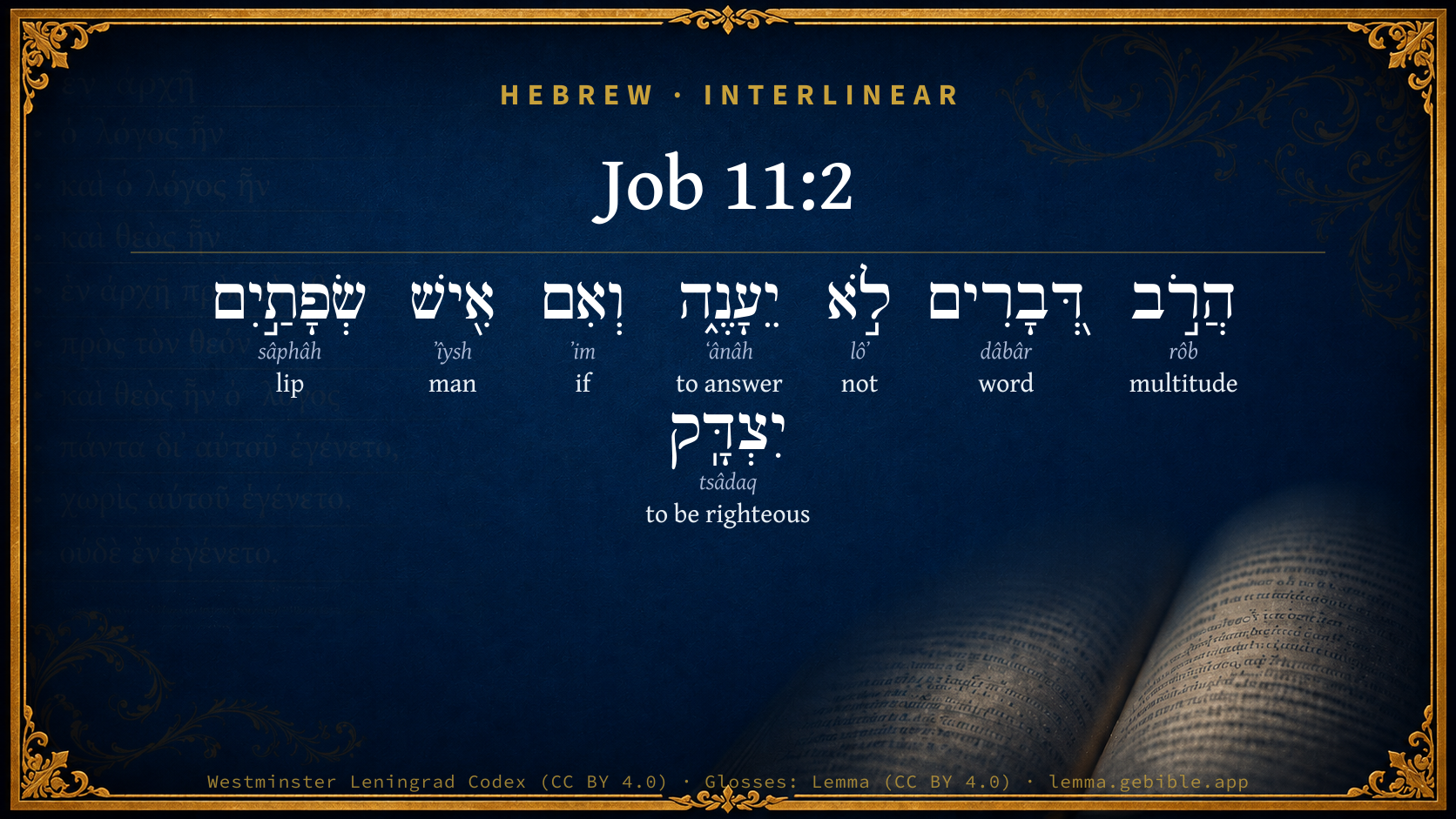
Hebrew (Westminster Leningrad Codex) Job 11:2 appears in the Hebrew Old Testament. The text above is from the Westminster Leningrad Codex. Each word links to its Strong’s number, a concise gloss, and parsing drawn from the Open Scriptures Hebrew Bible morphology. Click any word for its full Brown-Driver-Briggs (BDB) entry.
Download image
Cite this verse

Job 11:2 (World English Bible). Public Domain. Lemma interlinear Bible study tool, https://lemma.gebible.app/v/job/11/2.

Show BibTeX & RIS
BibTeX
RIS
English Translation
"Shouldn't the multitude of words be answered? Should a man full of talk be justified?
World English Bible · Public Domain
Download a study sheet

One document with this verse’s original text, its word-by-word gloss line, the meaning frame, cross-references with their text, attributed commentary, and full source and license credits — printable, and it pastes into notes with its structure intact.

This verse Autodidact and up

Study sheet (.html) Plain text (.txt)

A passage Seminary Student

Up to 50 verses in one chapter. A passage sheet keeps up to 6 commentary sources and 12 cross-references per verse, in the order this page ranks them, and says so on the sheet whenever that leaves anything out. Ask for a single verse and you get the Autodidact verse sheet above.

Everything on this page stays free to read, with no account — the sheet is a download of what is already on screen, not access to it.

Want to remove ads? Support Godless Engineer
Compare translations 3

The same verse in 3 English versions, stacked beneath the original-language interlinear above. Click any original word for its lexicon entry.

Each is an independent rendering of the whole verse — the interlinear is not word-aligned to these translations.

Highlighted words mark where these versions differ — a whole-verse word diff, not a word-by-word alignment.

  • World English Bible Public Domain
    "Shouldn't the multitude of words be answered? Should a man full of talk be justified?
  • King James Version Public Domain
    Should not the multitude of words be answered? and should a man full of talk be justified?
  • unfoldingWord Literal Text CC BY-SA 4.0
    “The multitude of words, will it not be answered? Or if a man of lips will be justified?

unfoldingWord Literal Text — © unfoldingWord, licensed CC BY-SA 4.0. Word-aligned USFM3 via Door43 (git.door43.org/unfoldingWord/en_ult).

Versions to compare (up to 4)

3 of 4 selected

Show all 18 translations

Every available English version of this verse, each an independent rendering of the whole verse.

  • World English Bible Public Domain
    "Shouldn't the multitude of words be answered? Should a man full of talk be justified?
  • Berean Standard Bible Public Domain
    “Should this stream of words go unanswered and such a speaker be vindicated?
  • Majority Standard Bible Public Domain
    “Should this stream of words go unanswered and such a speaker be vindicated?
  • King James Version Public Domain
    Should not the multitude of words be answered? and should a man full of talk be justified?
  • American Standard Version (1901) Public Domain
    Should not the multitude of words be answered? And should a man full of talk be justified?
  • Revised Version (1885) Public Domain
    Should not the multitude of words be answered? and should a man full of talk be justified?
  • Geneva Bible (1599) Public Domain
    Should not the multitude of wordes be answered? or should a great talker be iustified?
  • Douay-Rheims (1899) Public Domain
    Shall not he that speaketh much, hear also? or shall a man full of talk be justified?
  • Young's Literal Translation Public Domain
    Is a multitude of words not answered? And is a man of lips justified?
  • Literal Standard Version CC BY-SA 4.0
    “Is a multitude of words not answered? And is a man of lips justified?
  • Unlocked Literal Bible CC BY-SA 4.0
    “Should not such a multitude of words be answered? Should this man, so full of talk, be believed?
  • unfoldingWord Literal Text CC BY-SA 4.0
    “The multitude of words, will it not be answered? Or if a man of lips will be justified?
  • Darby Bible Public Domain
    Should not the multitude of words be answered? and should a man of much talk be justified?
  • World Messianic Bible Public Domain
    “Shouldn’t the multitude of words be answered? Should a man full of talk be justified?
  • Webster's Bible Public Domain
    Should not the multitude of words be answered? and should a man full of talk be justified?
  • Free Bible Version CC BY-SA 4.0
    “So many words should be answered, shouldn't they? Or is a person proved right by doing a lot of talking?
  • Bible in Basic English Public Domain
    Are all these words to go unanswered? and is a man seen to be right because he is full of talk?
  • JPS Tanakh (1917) Public Domain
    Should not the multitude of words be answered? And should a man full of talk be accounted right?

Literal Standard Version (2020), Covenant Press — licensed CC BY-SA 4.0. Text via the HelloAO Bible API (eBible.org). Unlocked Literal Bible (unfoldingWord) — licensed CC BY-SA 4.0. Text via the HelloAO Bible API (eBible.org). unfoldingWord Literal Text — © unfoldingWord, licensed CC BY-SA 4.0. Word-aligned USFM3 via Door43 (git.door43.org/unfoldingWord/en_ult). Free Bible Version, Dr. Jonathan Gallagher — licensed CC BY-SA 4.0. Text via the HelloAO Bible API (eBible.org).

Word by word

More ways to search: Search by grammar → Find every occurrence → Compare this word →

Practice this passage: Drill this verse → Learn its vocabulary →

יִצְדָּֽק
tsâdaq
H6663
“to be righteous”
Verb, Qal, Imperfect, 3rd Person, Masculine, Singular
Part of Speech
Verb
Stem
Qal
Form
Imperfect
Person
3rd Person
Gender
Masculine
Number
Singular
Full BDB Definition

Origin: a primitive root

TWOT: 1879

to be just, be righteous - (Qal) - to have a just cause, be in the right - to be justified - to be just (of God) - to be just, be righteous (in conduct and character) - (Niphal) to be put or made right, be justified - (Piel) justify, make to appear righteous, make someone righteous - (Hiphil) - to do or bring justice (in administering law) - to declare righteous, justify - to justify, vindicate the cause of, save - to make righteous, turn to righteousness - (Hithpael) to justify oneself
  1. הֲרֹ֣ב rôb H7230 “multitude of” Particle, Interrogative + Noun, Common, Both, Singular, Construct
  2. דְּ֭בָרִים dâbâr H1697 “words” Noun, Common, Masculine, Plural, Absolute
  3. לֹ֣א lôʼ H3808 “not” Particle, Negative
  4. יֵעָנֶ֑ה ʻânâh H6030 “to answer” Verb, Niphal, Imperfect, 3rd Person, Masculine, Singular
  5. וְאִם ʼim H518 “and · if” Conjunction + Conjunction
  6. אִ֖ישׁ ʼîysh H376 “man” Noun, Common, Masculine, Singular, Absolute
  7. שְׂפָתַ֣יִם sâphâh H8193 “lips” Noun, Common, Feminine, Dual, Absolute

About this verse

These counts appear in no published source. They are computed here, from the morphology-tagged text and Lemma’s own curated glosses. What Lemma adds →

8
words
8
distinct lemmas
Wisdom
section

Shared distinctive vocabulary

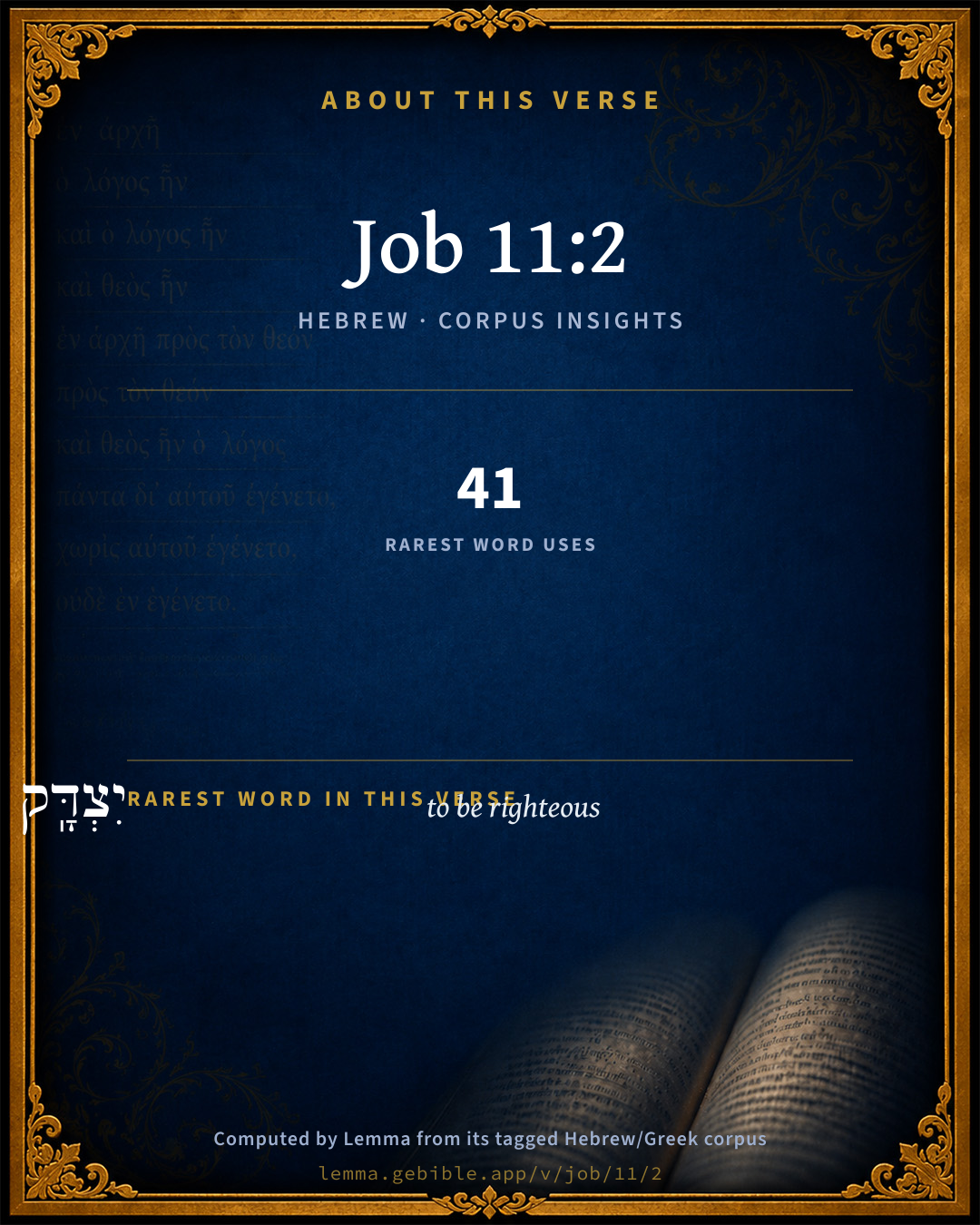
יִצְדָּֽק to be righteous H6663 occurs in 40 verses of the Hebrew Bible. Also found in:

Grammatical profile

  • 2 verbs
  • 4 nouns
  • 1 conjunction
  • 1 particle

Verb forms

  • יֵעָנֶ֑ה Niphal · Imperfect
  • יִצְדָּֽק Qal · Imperfect

Hebrew & Septuagint length

In English translation the verse runs 15 words from the Hebrew and 29 from the Septuagint (LXX English) — the Septuagint runs noticeably longer here. See the side-by-side →

A rough comparison of the two English renderings, which tokenize alike — not a word-level alignment.

Word counts can differ between the Hebrew and the Greek without any difference in meaning — e.g. the Hebrew direct-object marker אֵת has no separate Greek word, and Greek often adds the article ὁ.

Cross-references

7

Topical passages linked to Job 11:2 in the Treasury of Scripture Knowledge — connected by theme and wording, ordered by reader-vote popularity; previews shown in the World English Bible.

  • Job 18:2 "How long will you hunt for words? Consider, and afterwards we will speak.
  • Proverbs 10:19 In the multitude of words there is no lack of disobedience, But he who restrains his lips does wisely.
  • James 1:19 So, then, my beloved brothers, let every man be swift to hear, slow to speak, and slow to anger;
  • Job 8:2 "How long will you speak these things? Shall the words of your mouth be a mighty wind?
  • Job 16:3 Shall vain words have an end? Or what provokes you that you answer?
  • Psalms 140:11 An evil speaker won't be established in the earth. Evil will hunt the violent man to overthrow him.
  • Acts 17:18 Some of the Epicurean and Stoic philosophers also were conversing with him. Some said, "What does this babbler want to say?" Others said, "He seems to be advocating foreign deities," because he preached Jesus and the resurrection.

Cross-references courtesy of OpenBible.info (CC BY 4.0).

Hebrew and Greek witnesses Masoretic Hebrew ↔ Greek Septuagint

The same verse in the two great witnesses to the Old Testament, shown verse-for-verse.

Here the Septuagint runs noticeably longer than the Hebrew — LXX2012 (modern English Septuagint) 29 words vs World English Bible 15. A rough length comparison of the two English translations, not a word-level alignment — read both below.

These are two independent witnesses, not word-aligned to each other, and the Septuagint is shown in lemma (dictionary) form.

Hebrew Job 11:2 Masoretic · Westminster Leningrad Codex

הֲרֹ֣ב דְּ֭בָרִים לֹ֣א יֵעָנֶ֑ה וְאִם אִ֖ישׁ שְׂפָתַ֣יִם יִצְדָּֽק

"Shouldn't the multitude of words be answered? Should a man full of talk be justified?

World English Bible · Public Domain

Greek LXX Job 11:2 Septuagint · lemma form

ὁ ὁ πολύς λέγω καί ἀντιἀκούω ἤ καί ὁ εὔλαλος οἴομαι εἰμί δίκαιος εὐλογέω γεννητός γυνή ὀλιγόβιος

He that speaks much, should also hear on the other side: or does the fluent speaker think himself to be righteous? blessed is the short lived offspring of woman.

LXX2012 (modern English Septuagint) · Public Domain

Hebrew: Westminster Leningrad Codex (CC BY 4.0). Greek: Septuagint (public domain); English from LXX2012 (modern English Septuagint) (Public Domain). How the Septuagint differs from the Hebrew →

Commentary

Notes on Job 11:2 from classic Christian and Jewish commentators (each source and its license shown beneath its notes). The classic Christian expositions comment on the surrounding passage and are grouped to its opening verse, so a note may address several verses; the Jewish commentaries on the Tanakh (Rashi and others) are per-verse, so they appear only where the commentator wrote on this verse.

Lemma curates 59 commentaries, every one of them public domain or Creative Commons licensed, each selected and text-cleaned for this edition rather than reprinted as found. About our sources →

Trapp's Complete Commentary

John Trapp

Job 11:2 Should not the multitude of words be answered? and should a man full of talk be justified?

Ver. 2. Should not the multitude of words be answered?] Should not he who speaketh what he will, hear what he would not? Nunquid qui multa loquitur, non et audiet? (Vulg.) Yes, Job shall now, or you will want of your will; but if Job have talked more than his part came to (the truth is, his speeches are longer than any of those of his three friends, which are all, except that first made by Eliphaz, Job 4:1-21 Job 5:1-27, comprehended in one chapter, whereas his take up by two, three, or more), he may well be excused, considering the sharpness of his disease, the ungentleness of his friends, and the sense of God’s displeasure, which his soul laboured under. Zophar and the rest looked upon him as a wretched hypocrite, and were angry that he would not yield himself so; they accused his former conversation as wicked; what way he had therefore to defend and assert his own integrity, but by words? And must he yet pass for a prattling fellow, a man of lips, a very wordy man, one that loveth to hear himself talk, because he will not be by them outtalked, and overly borne by their false charges? Most sure it is, that profane and profuse babblings are to be avoided, and to bring fulness of matter in fewness of words it is very commendable. Quam multa quam paucis! said Cicero of Brutus’s laconical epistle; how much is here in a little! but, 1. Every man cannot be a short spoken Spartan. It is reported that in Luther’s house was found written, Melancthon hath both matter and words; Luther hath matter, but wants words; Erasmus hath words at will, but wants matter. Every one hath his own share: all are not alike gifted. 2. He is to be accounted talkative who uttereth unprofitable words, and far from the purpose, beside the point; and so Zophar himself was to be blamed in this whole discourse of his, wherein he talketh much, but speaketh little. Concerning the infinite and unsearchable wisdom of God, he argueth truly and gravely, but yet nothing fitly to convince Job, who himself had said as much and more of the same subject. The counsel also that therehence he giveth Job doth little or nothing concern him; it being the same in effect that Eliphaz and Bildad had said before him: Zophar therefore was the locutuleius, the talkative man here mentioned, rather than Job, the lips man, adversus sua ipsius vitia facundus satis; and as Bion was wont to say, that the grammarians of his time could discourse well about the errors of Ulysses, but not at all see their own; so it befell Zophar.

And should a man full of talk be justified?] Heb. A man of lips, so called, as if he were made all of lips, and had no other members. Shall such a one be ever a whit the better thought of? Not among wise men surely, whatever he may amongst his fellow fools; for in multiloquio stultiloquium: in much speaking is much foolishness, some gravel and mud passeth away with much water; some vanity with much talk; it is no wisdom for a man to lay on more words than the matter will well bear. A good orator, saith Plutarch, will see that his words and his matter be matches. And Hesiod saith, that words, as a precious treasure, should be thriftily husbanded and warily wasted: especially since an account is to be rendered, as our Saviour assureth us, Mat 12:36; yea, by thy words (he saith not, for thy words) thou shalt be justified, and by thy words (if superfluous and sinful, waste and wicked) thou shalt be condemned, Mat 12:37.

John Trapp, A Commentary or Exposition upon All the Books of the Old and New Testament (1647–1656) — public domain. Text from a community e-Sword module.

Joseph Benson's Commentary

Job 11:2. Should not the multitude of words be answered? — Truly, sometimes it should not. Silence is the best confutation of impertinence, and puts the greatest contempt upon it. Zophar means, Dost thou think to carry thy cause by thy long, tedious discourses, consisting of empty words, without weight or reason? And should a man full of talk be justified? — Shall we, by our silence, seem to approve of thy errors? Or, shall we think thy cause the better because thou usest more words than we do?

Joseph Benson's Commentary on the Old and New Testaments (1811–1818) — public domain. Text from a community e-Sword module.

Whedon's Commentary on the Bible

Daniel D. Whedon

First division, double strophe — THE APPEARANCE OF GOD WOULD MAKE KNOWN THE TRUTH THAT JOB HAD BEEN TREATED MUCH MORE MILDLY THAN HE DESERVED, Job_11:2-6.

a. Job’s false and boastful assumption of innocence. Job_11:2-4.

2. A man full of talk — Literally, a man of lips. A sneer at Job for loquaciousness, or an insinuation, perhaps, that he is insincere, a man of lips rather than of heart. Theocritus called an oration of Anaximenes a river of words with a drop of sense.

Daniel D. Whedon (gen. ed.), Commentary on the Old and New Testaments (1874–1909) — public domain. Text from a community e-Sword module.

Tyndale Open Study Notes

Tyndale Open Resources

11:2-3 this torrent of words: Verbosity is characteristic of fools (Prov 10:8, 14) and sinners (Prov 10:19), but Job was innocent. • mock God: Zophar viewed Job’s words about God’s justice as sinfully sarcastic (Job 10:2-7, 13-15).

Tyndale Open Study Notes — © Tyndale Open Resources, licensed CC BY-SA 4.0. Text via the HelloAO Bible API.

Geneva Bible (1599)

Geneva Bible translators

Should he persuade by his great talk, that he is just?

Geneva Bible (1599) marginal notes — public domain. Text via Bolls.life.

Adam Clarke's Commentary

Verse 2. Should not the multitude of words be answered?] Some translate, "To multiply words profiteth nothing."

And should a man full of talk be justified] איש שפתים ish sephathayim, "a man of lips," a proper appellation for a great talker: he is "a man of lips," i.e., his lips are the only active parts of his system.

Adam Clarke's Commentary on the Bible (1810–1826) — public domain. Text from a community e-Sword/MySword module.

The Cambridge Bible for Schools and Colleges

gen. ed. J. J. S. Perowne

2. Should not the multitude of words] Or, shall not …? Zophar probably did not demand the parole immediately on Job’s ceasing to speak. A pause was allowed to intervene, and the words with which he commences form his apology for speaking—he replies to Job only lest Job should fancy that by his much speaking he has shewn himself to be in the right, cf. Pro_10:19.

should a man full of talk] Or, shall a man full of talk, lit. a man of lips. Zophar insinuates that Job’s words come merely from his lips; they could not come, as the words of the ancients did, from the heart, ch. Job_8:10; they were mere empty phrases, cf. ch. Job_8:2; Isa_36:5. Job, it must be confessed, had made a long and in some parts vehement oration.

The Cambridge Bible for Schools and Colleges (gen. ed. J. J. S. Perowne; Cambridge University Press, 1878–1918) — public domain. Text from a community e-Sword module.

John Gill's Exposition

Should not the multitude of words be answered?.... Zophar insinuates, that Job was a mere babbler, a talkative man, that had words, but no matter; said a great deal, but there was nothing in what he said; that his words were but wind, yea, in effect that he was a fool, who is commonly full of words, and is known by the multitude of them; and whereas he might think to bear down all before him in this way, and to discourage persons from giving him an answer; this Zophar suggests should not be the case, nor would he be deterred hereby from giving one, which he now undertook: some supply it, as Bar Tzemach, "should not a man of a multitude of words" (s), &c. a verbose man, a dealer in many words, and nothing else, should not he be "answered?" if he uses nothing but words, and there is no argument in them, they seem not to deserve an answer, unless it be to show the emptiness of them, expose a man's folly, and pull down his pride and vanity:

and should a man full of talk be justified? or "a man of lips" (t), an eloquent man, or one that affects to be so; a man of a fine speech, who artfully colours things, and makes a show of wisdom and truth, when there are neither in what he says; is such a man to be justified? he would seem to be in his own eyes at least, if not in the eyes of others, if not answered; he would be thought to have carried his point, to have had the better of the argument, and to have got the victory by dint of words and power of oratory; for this is not to be understood of justification before God; for as no man is heard and accepted by him for his "much speaking", as was the opinion of the Heathens, so neither are any justified on account of their many words, any more than their many works; since, in a multitude of words there are often not only much folly and weakness, but vanities and sins, Pro 10:19; there is indeed a sense in which a man is justified by his words, Mat 12:37; when he confesses Christ, and professes to be justified by his righteousness, and believes in that, and pleads it as his justifying righteousness; he is justified by that righteousness; which is contained in the confession and profession of his faith; but this is not here meant.

(s) "an abundans verbis", Beza; "an multus verbis", Mercerus, so Kimchi & Ben Melech; and most Hebrew writers take for an adjective. (t) "vir labiorum", Montanus, Beza, Drusius, Vatablus, Mercerus, Bolducius, Cocceius, Schmidt, Michaelis.

John Gill's Exposition of the Whole Bible (1746–1763) — public domain (CC PDM 1.0). Text via the HelloAO Bible API.

Albert Barnes' Notes on the Bible

Should not the multitude of words be answered? - As if all that Job had said had been mere words; or as if he was remarkable for mere garrulity.

And should a man full of talk be justified - Margin, as in Hebrew “of lips.” The phrase is evidently a Hebraism, to denote a great talker - a man of mere lips, or empty sound. Zophar asks whether such a man could be justified or vindicated. It will be recollected that taciturnity was with the Orientals a much greater virtue than with us, and that it was regarded as one of the proofs of wisdom. The wise man with them was he who sat down at the feet of age, and desired to learn; who carefully collected the maxims of former times; who diligently observed the course of events; and who deliberated with care on what others had to say. Thus, Solomon says, “In the multitude of words there wanteth not sin: but he that refraineth his lips is wise;” Pro 10:19; so Jam 1:19, “let every man be swift to hear, slow to speak.” It was supposed that a man who said much would say some foolish or improper things, and hence, it was regarded as a proof of prudence to be distinguished for silence. In Oriental countries, and it may be added also, in all countries that we regard as uncivilized, it is unusual and disrespectful to be hasty in offering counsel, to be forward to speak, or to be confident and bold in opinion; see the notes at Job 32:6-7. It was for reasons such as these that Zophar maintained that a man who was full of talk could not be justified in it; that there was presumptive proof that he was not a safe man, or a man who could be vindicated in all that he said.

Albert Barnes' Notes on the Bible (1834–1885) — public domain. Text from a community e-Sword/MySword module.

Haydock's Catholic Bible Commentary

Much. The speeches of Job seemed tedious to him, because he was not of his opinion. (Menochius) --- He might have applied to himself and his friends the fault of talking too much, as they all spoke many things to no purpose, whereas Job went straight to the point. (Worthington)

George Leo Haydock (1774–1849), Haydock's Catholic Family Bible and Commentary, 1859 edition — public domain. Excludes Psalms (Douay-Rheims chapter numbering differs from Protestant) and Deuterocanonical books (Catholic canon only).

Matthew Poole's English Annotations

Dost thou think to carry thy cause by thy long and tedious discourses, consisting of empty words, without weight or reason? Shall we by our silence seem to approve of thy errors? or shall we think thy cause the better, because thou usest more words than we do?

Matthew Poole's English Annotations on the Holy Bible (1683–1685) — public domain. Text from a community e-Sword/MySword module.

The Pulpit Commentary

Should not the multitude of words be answered? A "multitude of words" is often reproved in Scripture, and taken as a sign of either folly (Ecc_5:8) or sin. (Pro_10:19) Job had certainly been somewhat unduly verbose, and laid himself open to the taunt hero launched against him; but neither had brevity been studied by his other friends in their previous answers (ch. 4, 5, and 8), nor is it greatly studied by Zophar here. And should a man full of talk be justified? literally, a man of lips"which may mean either "a great talker" or "a man who makes many professions." There is a widespread prejudice against a great orator, and a widespread notion that a good cause does net need many words.

The provocation of a reply.

Zophar will not take the trouble to be courteous. He rudely addresses Job as a "man full of talk." He has been irritated by the "multitude of words" that Job has poured forth. The very volume of the patriarch"s discourse provokes the man of the world to make a reply.

I THE OVERFLOW OF FEELING FINDS VENT IN A MULTITUDE OF WORDS. Speech is not all calculated and purposeful. Sometimes it is aimless and reckless. It is not always directed to the end of telling some fact or influencing some person. It may be just the irrepressible outcome of emotion. The most taciturn become eloquent when in a passion. Excitement needs a safety-valve. The swollen river must have a vent or it will overflow its banks. The hottest words do not always lead to the most violent actions; but the fire that burns under unnatural restraints is likely to burst forth at length in the most fearful conflagration. Let us be patient with the hasty, passionate words of souls that are deeply moved, not weighing them nicely, nor treasuring them up for future accusation.

II PASSIONATE WORDS CANNOT BE UNDERSTOOD BY THE UNSYMPATHETIC. Zophar is vexed at Job"s eloquence. One reason is that he cannot understand it. The man of the world is always angry with what he cannot comprehend. It annoys him to think that there may be more things in heaven and earth than are dreamed of in his philosophy. The highest poetry is to him but a multitude of words. He is wearied with "The Faery Queene;" "Paradise Lost" is tedious to him. Browning he regards as a juggler with language. Even in Scripture the deepest utterances of psalmist and prophet are but empty words. Christ spoke in brief sententious utterances, graphic if enigmatic; yet even Christ"s discourses are but dead words to those who will not lend a sympathetic ear. We always misjudge our fellow-men when we do not sympathize with them; then the deepest utterances of their hearts are but "sound and fury signifying nothing." A Pilate could never understand the prayers of Gethsemane.

III A MULTITUDE OF WORDS PROVOKES REPLY. Zophar is roused to answer Job with more asperity than he would have shown if the patriarch had maintained the dignified silence with which he had received his friends. This is unreasonable, unkind, wrong; still it is only what must be expected under the circumstances. The world will not be reasonable or kind in its treatment of us. Therefore it may be well for us to be on our guard against noisy opposition beyond what is inevitable. Self-restraint is a grace which brings its own reward. The abandon of passion is certain to lead to vexation of spirit.

IV THE PATIENCE OF GOD ENDURES A MULTITUDE OF WORDS. He does not hear us for our much speaking. There is no virtue in long prayers. (Mat_6:7) But deep feeling will find expression in unceasing prayer. Then our Father listens with more patience than our friends, show to us. Job had good reason to be thankful that he could make his complaints to Heaven. God was more patient than Zophar. He is ever ready to listen to the cries of his children. W.F.A.

The Pulpit Commentary (1880–1919), ed. H.D.M. Spence-Jones & Joseph S. Exell — public domain. Text from a community e-Sword module.

John Wesley's Explanatory Notes

Answered - Truly, sometimes it should not. Silence is the best confutation of impertinence, and puts the greatest contempt upon it.

John Wesley, Explanatory Notes Upon the Whole Bible (1754–1765) — public domain. Text via the GEBible commentary corpus.

Rashi

Rabbi Shlomo Yitzchaki (Rashi)

Zophar’s AnswerShould not...be answered by others because of the multitude of his words?

Rashi on the Tanakh — English translations: “The Judaica Press complete Tanach with Rashi, translated by A. J. Rosenberg” (CC BY 4.0); “Pentateuch with Rashi's commentary by M. Rosenbaum and A.M. Silbermann, 1929-1934” (public domain); “The Metsudah Tanach series, Lakewood, N.J” (CC BY 4.0); and “The Book of Joshua, Metsudah Publications, 1997” (CC BY 4.0). Text via Sefaria.

Lesson kit

Teaching starters — assembled from the data on this page, not authored interpretation. Every prompt links to the verse data it draws on. Edit before teaching.

Job, in the Wisdom, opens this verse with 8 words (8 distinct Hebrew lemmas). Its most distinctive word is tsâdaq (“to be righteous”). The Greek Septuagint runs longer here. A historical commentator’s framing appears above. Read the whole chapter for the surrounding context.

Discussion questions

  1. What does “to be righteous” (tsâdaq) contribute to the verse as a whole?
  2. How does Genesis 38:26, which shares the word «to be righteous», read alongside this verse?
  3. The Septuagint runs longer here than the Hebrew. What might account for the difference?
  4. These translations render this verse differently; the difference is in the English rendering, not the original. What questions does that raise?
  5. «יֵעָנֶ֑ה» is a Niphal Imperfect verb. How does that grammatical form shape the action described?
  6. Compare how Trapp's Complete Commentary and Joseph Benson's Commentary read this verse. Where do they agree or differ?

Things to notice

Reading settings

Reading text

Shown beneath each verse's original-language words.

Old Testament
Old Testament edition

Read the OT as the Masoretic Hebrew (MT) or the Greek Septuagint (LXX).

English shown for the Greek Septuagint (in the Hebrew ↔ Greek comparison).

Comparing translations? Open the Compare panel on any verse page to stack up to four side by side.