

Proverbs 20:6

Hebrew (Westminster Leningrad Codex) Proverbs 20:6 appears in the Hebrew Old Testament. The text above is from the Westminster Leningrad Codex. Each word links to its Strong’s number, a concise gloss, and parsing drawn from the Open Scriptures Hebrew Bible morphology. Click any word for its full Brown-Driver-Briggs (BDB) entry.
Download image
Cite this verse

Proverbs 20:6 (World English Bible). Public Domain. Lemma interlinear Bible study tool, https://lemma.gebible.app/v/proverbs/20/6.

Show BibTeX & RIS
BibTeX
RIS
English Translation
Many men claim to be men of unfailing love, But who can find a faithful man?
World English Bible · Public Domain
Download a study sheet

One document with this verse’s original text, its word-by-word gloss line, the meaning frame, cross-references with their text, attributed commentary, and full source and license credits — printable, and it pastes into notes with its structure intact.

This verse Autodidact and up

Study sheet (.html) Plain text (.txt)

A passage Seminary Student

Up to 50 verses in one chapter. A passage sheet keeps up to 6 commentary sources and 12 cross-references per verse, in the order this page ranks them, and says so on the sheet whenever that leaves anything out. Ask for a single verse and you get the Autodidact verse sheet above.

Everything on this page stays free to read, with no account — the sheet is a download of what is already on screen, not access to it.

Want to remove ads? Support Godless Engineer
Compare translations 3

The same verse in 3 English versions, stacked beneath the original-language interlinear above. Click any original word for its lexicon entry.

Each is an independent rendering of the whole verse — the interlinear is not word-aligned to these translations.

Highlighted words mark where these versions differ — a whole-verse word diff, not a word-by-word alignment.

  • World English Bible Public Domain
    Many men claim to be men of unfailing love, But who can find a faithful man?
  • King James Version Public Domain
    Most men will proclaim every one his own goodness: but a faithful man who can find?
  • unfoldingWord Literal Text CC BY-SA 4.0
    Many a man proclaims, man, his covenant faithfulness, but a man of faithful acts, who can find?

unfoldingWord Literal Text — © unfoldingWord, licensed CC BY-SA 4.0. Word-aligned USFM3 via Door43 (git.door43.org/unfoldingWord/en_ult).

Versions to compare (up to 4)

3 of 4 selected

Show all 18 translations

Every available English version of this verse, each an independent rendering of the whole verse.

  • World English Bible Public Domain
    Many men claim to be men of unfailing love, But who can find a faithful man?
  • Berean Standard Bible Public Domain
    Many a man proclaims his loving devotion, but who can find a trustworthy man?
  • Majority Standard Bible Public Domain
    Many a man proclaims his loving devotion, but who can find a trustworthy man?
  • King James Version Public Domain
    Most men will proclaim every one his own goodness: but a faithful man who can find?
  • American Standard Version (1901) Public Domain
    Most men will proclaim every one his own kindness; But a faithful man who can find?
  • Revised Version (1885) Public Domain
    Most men wilt proclaim every one his own kindness: but a faithful man who can find?
  • Geneva Bible (1599) Public Domain
    Many men wil boast, euery one of his owne goodnes: but who can finde a faithfull man?
  • Douay-Rheims (1899) Public Domain
    Many men are called merciful: but who shall find a faithful man?
  • Young's Literal Translation Public Domain
    A multitude of men proclaim each his kindness, And a man of stedfastness who doth find?
  • Literal Standard Version CC BY-SA 4.0
    A multitude of men each proclaim his kindness, || And a man of steadfastness who finds?
  • Unlocked Literal Bible CC BY-SA 4.0
    Many a person proclaims he is loyal, but who can find one who is faithful?
  • unfoldingWord Literal Text CC BY-SA 4.0
    Many a man proclaims, man, his covenant faithfulness, but a man of faithful acts, who can find?
  • Darby Bible Public Domain
    Most men will proclaim every one his own kindness; but a faithful man who shall find?
  • World Messianic Bible Public Domain
    Many men claim to be men of unfailing love, but who can find a faithful man?
  • Webster's Bible Public Domain
    Most men will proclaim every one his own goodness: but a faithful man who can find?
  • Free Bible Version CC BY-SA 4.0
    Many people tell you they're loyal, but can you find someone really trustworthy?
  • Bible in Basic English Public Domain
    Most men make no secret of their kind acts: but where is a man of good faith to be seen?
  • JPS Tanakh (1917) Public Domain
    Most men will proclaim every one his own goodness; but a faithful man who can find?

Literal Standard Version (2020), Covenant Press — licensed CC BY-SA 4.0. Text via the HelloAO Bible API (eBible.org). Unlocked Literal Bible (unfoldingWord) — licensed CC BY-SA 4.0. Text via the HelloAO Bible API (eBible.org). unfoldingWord Literal Text — © unfoldingWord, licensed CC BY-SA 4.0. Word-aligned USFM3 via Door43 (git.door43.org/unfoldingWord/en_ult). Free Bible Version, Dr. Jonathan Gallagher — licensed CC BY-SA 4.0. Text via the HelloAO Bible API (eBible.org).

Word by word

More ways to search: Search by grammar → Find every occurrence → Compare this word →

Practice this passage: Drill this verse → Learn its vocabulary →

About this verse

These counts appear in no published source. They are computed here, from the morphology-tagged text and Lemma’s own curated glosses. What Lemma adds →

9
words
8
distinct lemmas
Wisdom
section

Notable vocabulary

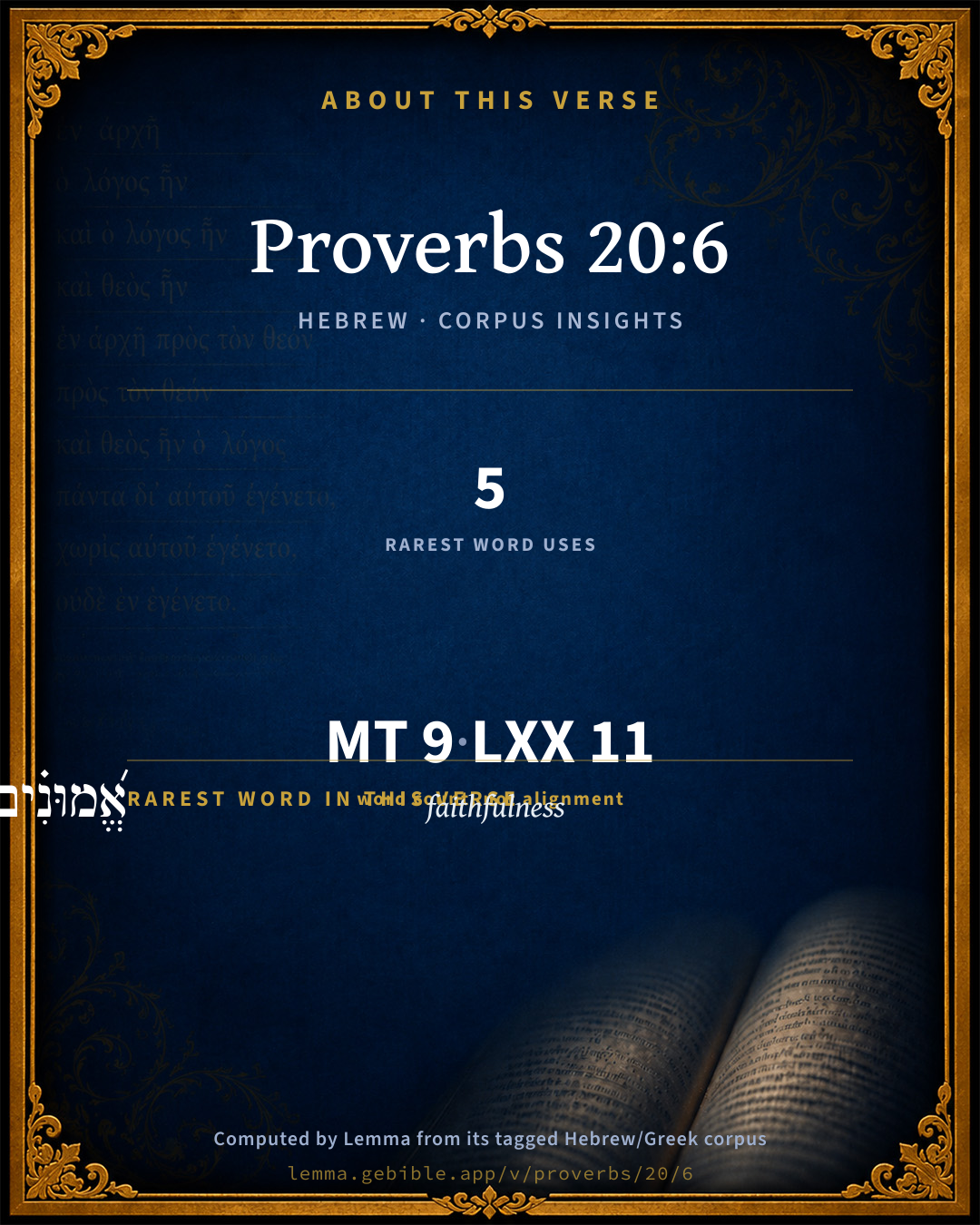
The rarest word here is אֱ֝מוּנִ֗ים faithfulness H529 — appearing just 5 times in the whole Hebrew Bible.

Shared distinctive vocabulary

אֱ֝מוּנִ֗ים faithfulness H529 occurs in 5 verses of the Hebrew Bible. Also found in:

Grammatical profile

  • 2 verbs
  • 6 nouns
  • 1 particle

Verb forms

  • יִ֭קְרָא Qal · Imperfect
  • יִמְצָֽא Qal · Imperfect

Repetition

A word recurs within this verse — often emphatic in Hebrew:

  • אִ֣ישׁ man H376 ×2

Hebrew & Septuagint length

In English translation the verse runs 16 words from the Hebrew and 18 from the Septuagint (LXX English) — closely comparable.

A rough comparison of the two English renderings, which tokenize alike — not a word-level alignment.

Word counts can differ between the Hebrew and the Greek without any difference in meaning — e.g. the Hebrew direct-object marker אֵת has no separate Greek word, and Greek often adds the article ὁ.

In the original languages it is 9 Hebrew tokens and 11 Greek tokens — but the two are counted differently (Hebrew bundles its prefixes and suffixes into one token; the Greek is in lemma form), so that isn’t a like-for-like length.

Cross-references

13

Topical passages linked to Proverbs 20:6 in the Treasury of Scripture Knowledge — connected by theme and wording, ordered by reader-vote popularity; previews shown in the World English Bible.

  • Psalms 12:1 Help, Yahweh; for the godly man ceases. For the faithful fail from among the children of men.
  • Matthew 6:2 Therefore when you do merciful deeds, don't sound a trumpet before yourself, as the hypocrites do in the synagogues and in the streets, that they may get glory from men. Most assuredly I tell you, they have received their reward.
  • Luke 18:8 I tell you that he will avenge them quickly. Nevertheless, when the Son of Man comes, will he find faith on the earth?"
  • Luke 22:33 He said to him, "Lord, I am ready to go with you both to prison and to death!"
  • Proverbs 25:14 As clouds and wind without rain, So is he who boasts of gifts deceptively.
  • Proverbs 27:2 Let another man praise you, And not your own mouth; A stranger, and not your own lips.
  • Luke 18:11 The Pharisee stood and prayed to himself like this: 'God, I thank you, that I am not like the rest of men, extortioners, unrighteous, adulterers, or even like this tax collector.
  • Jeremiah 5:1 Run you back and forth through the streets of Jerusalem, and see now, and know, and seek in the broad places of it, if you can find a man, if there are any who does justly, who seeks truth; and I will pardon her.
  • Micah 7:2 The godly man has perished out of the earth, And there is no one upright among men. They all lie in wait for blood; Every man hunts his brother with a net.
  • Ecclesiastes 7:28 which my soul still seeks; but I have not found: one man among a thousand have I found; but a woman among all those have I not found.
  • Luke 18:28 Peter said, "Look, we have left everything, and followed you."
  • John 1:47 Jesus saw Nathanael coming to him, and said about him, "Behold, an Israelite indeed, in whom is no deceit!"
  • 2 Corinthians 12:11 I have become foolish in boasting. You compelled me, for I ought to have been commended by you, for in nothing was I inferior to the very best apostles, though I am nothing.

Cross-references courtesy of OpenBible.info (CC BY 4.0).

Hebrew and Greek witnesses Masoretic Hebrew ↔ Greek Septuagint

The same verse in the two great witnesses to the Old Testament, shown verse-for-verse.

These are two independent witnesses, not word-aligned to each other, and the Septuagint is shown in lemma (dictionary) form.

Hebrew Proverbs 20:6 Masoretic · Westminster Leningrad Codex

רָב אָדָ֗ם יִ֭קְרָא אִ֣ישׁ חַסְדּ֑וֹ וְאִ֥ישׁ אֱ֝מוּנִ֗ים מִ֣י יִמְצָֽא

Many men claim to be men of unfailing love, But who can find a faithful man?

World English Bible · Public Domain

Greek LXX Proverbs 20:6 Septuagint · lemma form

μέγας ἄνθρωπος καί τίμιος ἀνήρ ἐλεήμων ἀνήρ δέ πιστός ἔργον εὑρίσκω

A man is valuable, and a merciful man precious: but it is hard to find a faithful man.

LXX2012 (modern English Septuagint) · Public Domain

On this verse, The Pulpit Commentary discusses the Septuagint’s reading. Read the note in Commentary ↓

Hebrew: Westminster Leningrad Codex (CC BY 4.0). Greek: Septuagint (public domain); English from LXX2012 (modern English Septuagint) (Public Domain). How the Septuagint differs from the Hebrew →

Commentary

Notes on Proverbs 20:6 from classic Christian and Jewish commentators (each source and its license shown beneath its notes). The classic Christian expositions comment on the surrounding passage and are grouped to its opening verse, so a note may address several verses; the Jewish commentaries on the Tanakh (Rashi and others) are per-verse, so they appear only where the commentator wrote on this verse.

Lemma curates 59 commentaries, every one of them public domain or Creative Commons licensed, each selected and text-cleaned for this edition rather than reprinted as found. About our sources →

Trapp's Complete Commentary

John Trapp

Pro 20:6 Most men will proclaim every one his own goodness: but a faithful man who can find?

Ver. 6. Most men will proclaim every one his own goodness.] As the kings of Egypt would needs be called Eυεργεται, bountiful, or benefactors, {Luk 22:25} many of the Popes Pii and Bonifacii &c. The Turks will needs be styled the only Mussulmans or true believers, as Papists the only Catholics. The Swenkfeldians - Stinkfeldians, Luther called them, from the ill savour of their opinions - intituled themselves with that glorious name, The confessors of the glory of Christ. {a} David George, that monstrous heretic, that was so far from accounting adulteries, fornications, incests, &c., for being any sins, that he did recommend them to his most perfect scholars, as acts of grace and mortification, &c.; yet he was wonderfully confident of the absolute truth of his tenets, and doubted not but that the whole world would soon submit to him and hold with him. He wrote to Charles the emperor, and the rest of the states of Germany, a humble and serious admonition, as he styled it, written by the command of the omnipotent God, diligently to be obeyed, because it contained those things whereupon eternal life did depend. {b}

But a faithful man who can find.] Diaconos paucitas honorabiles fecit, saith Jerome. The paucity of pious persons makes them precious. Perraro grati reperiuntur, saith Cicero. It is hard to find a thankful man. Faithful friends are in this age all for the most part gone in pilgrimage, and their return is uncertain, said the Duke of Buckingham to Bishop Morton in Richard III’s, time. {c}

{a} Schlussenb.

{b} Hist. Dav. Georg.

{c} Daniel’s Hist.

John Trapp, A Commentary or Exposition upon All the Books of the Old and New Testament (1647–1656) — public domain. Text from a community e-Sword module.

The Biblical Illustrator

Joseph S. Exell

Pro_20:6

Most men will proclaim every one his own goodness; but a faithful man, who can find?

On goodness and fidelity

I. What are we to understand by goodness and a faithful man?--Goodness often means the Whole of a virtuous or religious temper. In Scripture it is sometimes limited to good affections, and the proper expression of them in our conduct. Goodness here is kindness; and a faithful man is one sincere and steady in goodness, who really feels benevolent affections, and is uniform and constant in the practical exercise of them.

1. He is faithful in goodness, whose general conduct is kind and beneficent. He is affable and courteous in his ordinary conversation, and never without necessity deliberately says that which may hurt or offend. He does not withhold his bounty till it is wrung from him by importunity. His friendly offices reach mens spiritual necessities.

2. He is faithful in goodness whose goodness flows from an inward, a sincere, and a religious principle. Goodness sufficiently diffusive in its objects and exercises can only be the fruit of the Spirit of God.

3. The man faithful in goodness is steady, constant, and persevering in doing good. Important services to others often require much of diligence, self-denial, and disinterestedness. He does good, expecting nothing again.

II. What is suggested when it is said, A faithful man, who can find?

1. He reminds us that this is a character not to be found among unconverted sinners.

2. Faithfulness in goodness is uncommon.

3. Fidelity in goodness in a strict sense, and in full perfection, is not the character of the best saints on this side the grave.

III. Solomons maxim, that most men will proclaim every one his own goodness. Men are prone to disguise their true characters under a deceitful mask, and profess sentiments and affections to which their hearts are utter strangers. There are some who, in proclaiming their own goodness, cannot be charged with gross hypocrisy. They are self-deluded. Let every one press after the fidelity in goodness, to which every false display of it is opposed. (John Erskine, D. D.)

Self-applause and self-consistency

I. The commonness of self-applause. See it in nations; in churches. Pursue the subject more personally.

1. The profane. These say they mean well; their hearts are good; they are liberal, etc.

2. The Pharisees. What attempts they make to recommend themselves to others!

3. The orthodox. Those who pride themselves on their orthodoxy.

4. The godly. These are often guilty in a measure.

II. The rareness of self-consistency. A man faithful--

1. In his civil concerns.

2. In his friendly connections.

3. To his trusts.

4. To his convictions.

5. To his religious professions.

Enough has been said--

(1) To make Christians thankful that they are not under the law, but under grace.

(2) To induce us to be diffident and humble.

(3) And to seek after the influence of Divine grace. (W. Jay.)

Subtle self-praise

Some, quite as vain, and as ambitious of commendation and praise, knowing that everything of the nature of ostentation is exceedingly unpopular, set about their object with greater art. They devise ways of getting their merits made known so as to avoid the flaw of ostentatious self-display. In company they commend others for the qualities which they conceive themselves specially to possess, or for the doing of deeds which they themselves are sufficiently well known to have done; and they turn the conversation dexterously that way; or they find fault with others for the want of the good they are desirous to get praise for; or they lament over their own deficiencies and failures in the very points in which they conceive their excellence to lie--to give others the opportunity of contradicting them; or, if they have done anything they deem particularly generous and praiseworthy, they introduce some similar case, and bring in, as apparently incidental, the situation of the person or the family that has been the object of their bounty. Somehow, they contrive to get in themselves and their goodness. (R. Wardlaw, D. D.)

A prevalent vice and a rare virtue

I. A prevalent vice. Most men will proclaim every one his own goodness. Self-conceit--men parading their imaginary merits. It is seen in the religious world, in the way in which certain men get their subscriptions trumpeted in reports, and their charitable doings emblazoned in journals. It is seen in the political world.

1. This vice is an obstruction to self-improvement. The man who prides himself on his own cleverness will never get knowledge; who exults in his own virtue will never advance in genuine goodness. Vanity is in one sense the fruit of ignorance.

2. This vice is socially offensive. Nothing is more offensive in society than vanity.

3. This vice is essentially opposed to Christianity. What says Paul? For I say, through the grace given unto me, to every man that is among you, not to think of himself more highly than he ought to think; but to think soberly, according as God hath dealt to every man the measure of faith. What says Christ? Let not thy left hand know what thy right hand doeth.

II. A rare virtue. But a faithful man, who can find? What is faithfulness? The man who in this verse is called faithful is in the next represented as just, walking in his integrity. Each of the three terms represents the same thing.

1. Practically true to our own convictions. Never acting without or against them.

2. Practically true to our own professions. Never breaking promises, swerving from engagements. Now this is a rare virtue. (D. Thomas, D. D.)

Self-laudation

It magnifies and multiplies matters. Loud was the lie which that bell told, hanging in a clock-house at Westminster, and usually rung at the coronation and funeral of princes, having this inscription about it:--

King Edward made me,

Thirty thousand and three,

Take me down and weigh me,

And more you shall find me.

But when this bell was taken down at the dooms-day of abbeys, this and two more were found not to weigh twenty thousand. Many tales of fame are found to shrink accordingly. (W. Fuller.)

The Biblical Illustrator, edited by Joseph S. Exell (c. 1880s–1900s) — public domain. Text from a community e-Sword module.

Joseph Benson's Commentary

Pro 20:6-7. Most men will proclaim every one his own goodness — “Most men are ready enough to claim to themselves a large share of piety and virtue;” but a faithful man who can find? — “Where is that man of true and undissembled virtue to be found, who studies rather to be, than to seem, good?” There are but few such. — Schultens. The just man walketh in his integrity — He proves himself to be righteous, not only by his profession, which is spoken of in the former sentence, but by his upright and unblameable conversation. His children are blessed after him — By virtue of that covenant which God hath made with such men, which is not confined to their persons, but entails blessings upon their posterity.

Joseph Benson's Commentary on the Old and New Testaments (1811–1818) — public domain. Text from a community e-Sword module.

The Preacher's Complete Homiletical Commentary

Joseph S. Exell (gen. ed.)

CRITICAL NOTES.—

Pro_20:6. Miller reads the first clause of this verse, “Much of the mere man one calls his goodness,” i.e., “Much that is merely human.” He allows, however, that the usual rendering conveys a very striking meaning and agrees admirably with the second clause. The Hebrew word means literally abundance of men. Delitzsch translates, “Almost everyone meeteth a man who is gracious unto him; but a man who standeth the test, who findeth such a one?”

Pro_20:7. This verse should be, “He who in his innocence walks uprightly, blessed are his children,” etc.

Pro_20:8. Judgment. Rather justice. Scattereth or winnoweth.

Pro_20:10. Divers weights. Literally, “a stone and a stone, an ephah and an ephah.”

Pro_20:11. Touching the second clause of this verse, Miller says, “It is too terse for English, and we cannot translate it. Nor can we brook the English version. Doings are in the same category with work. How can one be the test of the other? The only room for a proposition is, obviously, for this: ‘A child is known by his doings; and the question, Is he pure? is but the question, Is his work right?’ ”

MAIN HOMILETICS OF THE PARAGRAPH.—Pro_20:6-12

AN UNIVERSAL CHALLENGE, A GENERAL RULE, AND A RARE VIRTUE

I. A double challenge to all men. Who can say, I am pure from my sin? A faithful man, who can find? To the first of these questions the answer must be in the negative.

1. God answers No to it. The testimony of Scriptures is that in His sight “shall no man living be justified” (Psa_143:2): that “all have sinned” (Rom_3:23): that “if we say that we have no sin, we deceive ourselves, and the truth is not in us” (1Jn_1:8). His ability to form a correct judgment rests upon His omniscience—He hath made the “hearing ear and the seeing eye” (Pro_20:12), and shall He not hear and see and know the thoughts of man? (Psa_94:9-10). He is the ideal King who winnows the actions of men. See Miller’s note on Pro_20:8 (Mat_3:12).

2. Man’s experience answers No to it. “Even a child is known by its doings” (Pro_20:11); the actions are like the hands of a clock, which tell to those who look upon them whether all the wheels within are in perfect working order. When we mark at all observantly the actions of even the best of men, we shall be most likely to detect here and there a flaw in their characters—some inconsistencies which tell of moral imperfection—but if not, man needs only to look within with some degree of impartiality to be convinced that his “own heart condemns him” (1Jn_3:20). But to the second challenge we need not give an universal negative. Faithful men are rare, but they can be found. Even Solomon could point to the “just man” who “walked in his integrity,” leaving a blessing behind him. His father David, although he was far from being free from sin, yea, although he sinned deeply and terribly, was yet a man who could appeal to God to witness to his integrity (Psa_7:8)—to the general intent and purpose of his life being toward God and goodness—to his being in the main faithful to his convictions of the right and true. (On this subject see on chap. Pro_11:3, page 196). And although faithful men are still rare enough to need search, they are more common than they were in Solomon’s days. There are many men scattered throughout the world who put duty before worldly interests, and God’s glory before their own, and are thus earning for themselves the well-done of the faithful though not the perfect servant (Mat_25:21). For it is certain that if a man is faithful to himself—if he subjects his own moral condition to that scrutiny which must convince him of his own impurity before a heart-searching and Holy God, and accepts His method of being cleansed from guilt—he will be faithful both to God and man.

“To thine own self be true:

And it must follow as the night the day;

Thou canst not then be false to any man.”

II. A general rule. Another proposition here laid down is, that although absolutely pure men are not to be found, and although faithful men are rare, yet “most men will proclaim everyone his own goodness” (Pro_20:6). There is a natural tendency in men to shrink from a very close inspection of their own motives, and desires, and feelings—they look anywhere rather than within, and, consequently, very few have any conception of their own depravity. They have never measured even their actions, much less their thoughts, by the requirements of God’s law, and consequently, while He pronounces them “wretched, and miserable, and poor,” they are saying, “I am rich, and increased with goods, and have need of nothing” (Rev_3:17-18). Most men are thanking God that “they are not as other men are” when they ought to be smiting their breasts and saying, “God be merciful to me, a sinner” (Luk_18:13). It is this wide-spread self-deception concerning their real condition that renders men so indifferent to God’s method for restoring them, and thus keeps the world in its present state of soul-sickness and death.

For Homiletics on Pro_20:10, see on chap. 11, page 1.

OUTLINES AND SUGGESTIVE COMMENTS

This faithfulness, where it exists, develops itself in two branches; the one suppressing our neighbour’s vanity, and the other our own. The last mentioned is first in order of nature and in relative importance the chief. True faithfulness, like charity, begins at home.… Faithful reproof of another’s foibles is a virtue which some can exercise without an effort. They deal a hearty blow on the head of a luckless brother egotist who stands in the way of their own advancement, and then expect to be praised for faithfulness. But it is Jehu’s driving. The zeal which impels it is not pure.—Arnot.

The meaning is (see Critical Notes for Miller’s rendering) that a man is apt to call mere animal traits, like amiableness, or good nature, by the name of goodness; and the caution is, that seeking deep for piety (Pro_20:5), we should be careful to take up with no such stupid counterfeit. Much of the mere flesh, to borrow a New Testament expression, is kind and honest. There is much of the mere man’s native morality. We must take care not to take that for “goodness.” There is a certain true fidelity that embraces everything. That is religion. It embraces God. It embraces spiritual faithfulness. It may be easily counterfeited. It has been the snare of our race to take “what is of the mere man,” and confound it with it.—Miller.

A faithful man—as a parent—a reprover—an adviser—one “without guile”—who can find? (Mic_7:1-2.) Look close. View thyself in the glass of the Word (Psa_101:6). Does thy neighbour, or thy friend, find thee faithful to him? What does our daily intercourse witness? Is not the attempt to speak what is agreeable often made at the expense of truth? Are not professions of regard sometimes utterly inconsistent with our real feelings? In common life, where gross violations are restrained, a thousand petty offences are allowed, that break down the wall between sin and duty, and, judged by the Divine standard, are indeed guilty steps upon forbidden ground.—Bridges.

But the manner in which men make known what they account their goodness is very various. Some are open with it. They almost literally “proclaim” it upon the housetops. To every individual, and in every company, they speak of it—of what they are, of what they have said, of what they have done, of what they think, and of what they wish and intend to do. And O! if they had but the means, what would they not accomplish!

Some there are who are quite as vain, and as ambitious of commendation and praise—who, knowing that everything of the nature of ostentation is exceedingly unpopular, and lets a man down, and tempts others to pluck his feathers from him—set about their object with greater art. They devise ways of getting their merits made known so as to avoid the flaw of ostentatious self-display. In company, they commend others for the qualities which they conceive themselves specially to possess, or for the doing of deeds which they themselves are sufficiently well known to have done; and they turn the conversation dexterously that way; or they find fault with others for the want of the good they are desirous to get praise for; or they lament over their own deficiencies and failures in the very points in which they conceive their excellence to lie—to give others the opportunity of contradicting them; or, if they have done anything they deem particularly generous and praiseworthy, they introduce some similar case, and bring in, in as apparently accidental and unintentional a way as possible, the situation of the person or the family that has been the object of their bounty.—Wardlaw.

Pro_20:7. Many are the several walks of men in this world—one walketh in his pleasure, as it were in the walks of a garden; another walketh in his profit, and he walketh as it were up and down the exchange; another walketh in troubles, and he walketh as it were in a wood; another walketh in his poverty, and he walketh as it were in a desert; another walketh in his beastly lusts of drunkenness and uncleanness, and he walks as it were in mire and dirt; the just man walketh in his integrity, and he walketh as it were in the holy temple.—Jermin.

Pro_20:8. We must be very careful, then, how we do our sifting. God’s is perfectly complete … He winnows us at a glance. It is important, therefore, that we have something more than “evil,” because “all” that He shall winnow bodily away.—Miller.

Pro_20:9. Behold here the king sitting upon the throne of His judgment, whereof the former verse speaketh! Who can say it, and say it truly? Who will say it, and so be untrue in saying it? Who shall say it, and be so impudent as to say it? For to make clean the heart is His work who hath made the heart, thou who hast made it unclean canst not make it clean.—Jermin.

This proverb is especially noteworthy because, in contrast with the style of conception which is elsewhere predominant in the Proverbs, according to which the imperfection of all human piety is but slightly emphasized, and he who is relatively pious is allowed to pass as righteous, it gives expression to the unsatisfying nature of all moral endeavours, as never conducting to the full extirpation of all sense of guilt, and a perfect feeling of peace with God: it accordingly suggests the need of a higher revelation in which the sense of guilt and of an ever-imperfect fulfilment of duty shall finally be overcome.—Elster, in Lange’s Commentary.

Pro_20:10. Originally, as in Pro_11:1, of dishonesty in actual trade, but here perhaps as a companion to Pro_20:9, with a wider application to all inequality of judgment, to all judging one man by rules which we do not apply to ourselves or to another.—Plumptre.

That whereby thou takest from others shall add unto the weight of thine own punishment; that whereby thou addest in measuring for thyself shall make God to take away from the measure of His mercy towards thee.—Jermin.

Pro_20:11. There is no tree that in growing doth not bend rather to the one side or the other; there is no river which, although it have many windings and turnings, yet in the course of it doth not rather turn one way than another; and so it is in the life of man, even from the childhood of man’s life. Do not judge, therefore, of any man by one work or two, so thou mayest wrong him and deceive thyself.—Jermin.

For Homiletics on Pro_20:13 see on chap. Pro_6:10-11, page 79.

The Preacher's Complete Homiletical Commentary (gen. ed. Joseph S. Exell; Funk & Wagnalls, c. 1892) — public domain (pre-1929). A full-Bible homiletical/sermon-outline anthology covering 65 of 66 books (2 John is absent from the source module). Text from a community e-Sword module.

Tyndale Open Study Notes

Tyndale Open Resources

20:6 True friends are reliable even in difficulties.

Tyndale Open Study Notes — © Tyndale Open Resources, licensed CC BY-SA 4.0. Text via the HelloAO Bible API.

Matthew Henry's Commentary

Note, 1. It is easy to find those that will pretend to be kind and liberal. Many a man will call himself a man of mercy, will boast what good he has done and what good he designs to do, or, at least, what an affection he has to well-doing. Most men will talk a great deal of their charity, generosity, hospitality, and piety, will sound a trumpet to themselves, as the Pharisees, and what little goodness they have will proclaim it and make a mighty matter of it. 2. But it is hard to find those that really are kind and liberal, that have done and will do more than either they speak of or care to hear spoken of, that will be true friends in a strait; such a one as one may trust to is like a black swan.

Matthew Henry's Commentary on the Whole Bible (1708–1710) — public domain (CC PDM 1.0). Text via the HelloAO Bible API.

Jamieson, Fausset & Brown

Robert Jamieson, A. R. Fausset & David Brown

Boasters are unreliable.

goodness--or, "kind disposition."

Jamieson, Fausset & Brown — Commentary Critical and Explanatory on the Whole Bible (1871) — public domain (CC PDM 1.0). Text via the HelloAO Bible API.

Adam Clarke's Commentary

Verse 6. Most men will proclaim] Many men merciful ben clepid: a feithful man forsoth, who schal finde? - Old MS. Bible.

Adam Clarke's Commentary on the Bible (1810–1826) — public domain. Text from a community e-Sword/MySword module.

Ellicott's Commentary for English Readers

(6) Most men will proclaim every one his own goodness.—Will be full of his benevolent intentions, “but a faithful man,” who carries out these promises, “who can find?”

A Bible Commentary for English Readers, edited by Charles John Ellicott (1878–1897) — public domain. Text from a community e-Sword module.

The Cambridge Bible for Schools and Colleges

gen. ed. J. J. S. Perowne

6. goodness] i.e. bounty, A.V. marg., or kindness, R.V. Fair promises are common, but faithful performance of them is rare. Comp. 2Co_8:11; 2Co_9:4.

The first clause of the verse is otherwise rendered: Many a man will meet one that is kind to him, R.V. marg., but, as the next clause adds, seldom one that he can trust.

The Cambridge Bible for Schools and Colleges (gen. ed. J. J. S. Perowne; Cambridge University Press, 1878–1918) — public domain. Text from a community e-Sword module.

John Gill's Exposition

Most men will proclaim everyone his own goodness,.... As the Pharisee did, in Luk 18:11; and as the Pharisees in common did; who did all their works to be seen of men, and made clean the outside of the cup and platter; and were very careful to appear outwardly righteous to men, Mat 23:5. And indeed this is the general cast of men; everyone is proclaiming his goodness to others, and would be thought to be good men; and cannot be easy with doing a good action, unless it is known, and particularly acts of beneficence and alms deeds; and are like the Pharisees, who, on such occasions, sounded a trumpet before them, Mat 6:2. And the word may be rendered, "his mercy" (b), or his kindness to the poor: the Targum renders it,

"many of the children of men are called merciful men;''

and so the Vulgate Latin version; and they like to be so called and accounted, whether they are so or not;

but a faithful man who can find? who answers to the character he gives of himself, or others upon his own representation give him; who is as good as his word, and, having promised assistance and relief, gives it; and who, having boasted that he has done a kindness to such an one and such an one, does the same likewise to another when applied to; or who sticks to his friend, and does not forsake him in his adversity, but supports and supplies him whom he knew in prosperity; it is hard and rare to find such a man; see Psa 12:1. Or, though every man is talking of his good works, and boasting of his goodness, it is difficult to find an Israelite indeed, in whom the true grace of God is.

(b) "misericordiam suam", Pagninus, so some in Vatablus; "unius cujusque misericordiam", Mercerus, Gejerus.

John Gill's Exposition of the Whole Bible (1746–1763) — public domain (CC PDM 1.0). Text via the HelloAO Bible API.

Albert Barnes' Notes on the Bible

Goodness - With the special sense of bounty, beneficence. Contrast promise and performance. People boast of their liberality, yet we look in vain for the fulfillment of actual obligations.

Albert Barnes' Notes on the Bible (1834–1885) — public domain. Text from a community e-Sword/MySword module.

Haydock's Catholic Bible Commentary

Faithful. Few continue steady to their engagements or friends, whom they will assist to a certain point. In God these two virtues always go together, Psalm lxxxiv. 11. But they are rarely found in men. (Calmet)

George Leo Haydock (1774–1849), Haydock's Catholic Family Bible and Commentary, 1859 edition — public domain. Excludes Psalms (Douay-Rheims chapter numbering differs from Protestant) and Deuterocanonical books (Catholic canon only).

Matthew Poole's English Annotations

Most men are forward to profess religion, and speak of their own good deeds; but a faithful man, one who is indeed what he seemeth and professeth himself to be,

who can find? there are but few such to be found.

Matthew Poole's English Annotations on the Holy Bible (1683–1685) — public domain. Text from a community e-Sword/MySword module.

Whedon's Commentary on the Bible

Daniel D. Whedon

6. Most… proclaim… own goodness — Will make known, or publish, his own kindness. The point seems to be, that there are many professors of virtue and religion; but a true man, a truly virtuous and pious man, being unobtrusive, is hard to find. The expression מי ימצא, (mi yimtsa,) who can find? according to a Hebrew idiom, may have the force of a wish: O that I might find a faithful man. Comp. Pro_13:17; Pro_14:5; Pro_31:10. For the general meaning, see Psa_116:11; Rom_3:4.

Daniel D. Whedon (gen. ed.), Commentary on the Old and New Testaments (1874–1909) — public domain. Text from a community e-Sword module.

The Pulpit Commentary

Most men will proclaim every one his own goodness; chesed, "kindness," "mercy," "liberality," as in Pro_19:22. So Ewald and others, Hitzig and Kamphausen translate, "Many a man one names his dear friend;" Delitzsch and Nowack prefer, "Most men meet a man who is gracious to them;" i.e. it is common enough to meet a man who seems benevolent and well disposed. Vulgate, "Many men are called merciful;" Septuagint, "Man is a great thing, and a merciful man is a precious thing." The renderings of most modern commentators imply the statement that love and mercy are common enough, at least in outward expression. The Authorized Version pronounces that men are ready enough to parade and boast of their liberality, like the hypocrites who were said proverbially to sound a trumpet when they performed their alms-deeds. (Mat_6:2) Commenting on the Greek rendering of the clause given above, St. Chrysostom observes, "This is the true character of man to be merciful; yea, rather the character of God to show mercy...Those who answer not to this description, though they partake of mind, and are never so capable of knowledge, the Scripture refuses to acknowledge them as men, but calls them dogs, and horses, and serpents, and foxes, and wolves, and if there be any animals more contemptible" ("Hom. 4 in Phil." and "Hom. 13 in 1 Tim.," Oxford transl.). The contrast between show, or promise, and performance is developed in the second clause. But a faithful man who can find? The faithfulness intended is fidelity to promises, the practical execution of the vaunted benevolence; this is rare indeed, so that a psalmist could cry, "I said in my haste, All men are liars". (Psa_116:11; comp. Rom_3:4) Lesetre refers to Massillon"s sermon, "Sur la Gloire Humaine," where we read (the preacher, of course, rests on the Latin Version), "Ces hommes vertueux dont le monde se fait tant d"honneur, n"ont au fond souvent pour eux que l"erreur publique. Amis fideles, je le veux; mais c"est le gout, la vanite ou Pin teret, qui les lie; et dans leur amis, ils n"amient qu"eux-memes En un mot, dit l"Ecriture, on les appelle misericordieux, ils ont toutes les vertus pour le public; mais n"etant pas fideles a Dieu, ils n"en ont pas une seule pour eux-memes."

The Pulpit Commentary (1880–1919), ed. H.D.M. Spence-Jones & Joseph S. Exell — public domain. Text from a community e-Sword module.

Keil & Delitzsch

C. F. Keil & F. Delitzsch

6 Almost every one meeteth a man who is gracious to him;

But a man who standeth the test, who findeth such a one?

As ציר אמונים, Pro 13:17, signifies a messenger in whom there is confidence, and עד אמונים, Pro 14:5, a witness who is altogether truthful, so אישׁ אמוּנים is a man who remains true to himself, and maintains fidelity toward others. Such an one it is not easy to find; but patrons who make promises and awaken expectations, finally to leave in the lurch him who depends on them - of such there are many. This contrast would proceed from 6a also, if we took קרא in the sense of to call, to call or cry out with ostentation: multi homines sunt quorum suam quisque humanitatem proclamat (Schelling, Fleischer, Ewald, Zckler, and also, e.g., Meri). But אישׁ חסדּו is certainly to be interpreted after Pro 11:17, Isa 57:1. Recognising this, Hitzig translates: many a man one names his dear friend; but in point of style this would be as unsuitable as possible. Must יקרא then mean vocat? A more appropriate parallel word to מצא is קרא = קרה, according to which, with Oetinger, Heidenheim, Euchel, and Lwenstein, we explain: the greater part of men meet one who shows himself to them (to this or that man) as אישׁ חסד, a man well-affectioned and benevolent; but it is rare to find one who in his affection and its fruits proves himself to be true, and actually performs that which was hoped for from him. Luther translates, with the Syr. and Targ. after Jerome: Viel Menschen werden From gerhmbt [many men are reputed pious]; but if יקרא were equivalent to יקּרא, then אישׁ חסד ought to have been used instead of אישׁ חסדו. The lxx read רב אדם יקר אישׁ חסד, man is something great, and a compassionate man is something precious; but it costs trouble to find out a true man. The fundamental thought remains almost the same in all these interpretations and readings: love is plentiful; fidelity, rare; therefore חסד, of the right kind, after the image of God, is joined to אמת.

Keil & Delitzsch — Biblical Commentary on the Old Testament (1861–1891) — public domain (CC PDM 1.0). Text via the HelloAO Bible API. (Old Testament only.)

Bridges on Proverbs

Charles Bridges

The last Proverb shewed the depth of the heart; this its deceitfulness and pride. Hear a man’s own estimate of himself, and we need no further proof of his want of self-knowledge. (Pro 16:2 .) Even the ungodly proclaims his own goodness. "Jehu took no heed to walk in the way of the LORD." Still — said he — "Come, see my zeal for the LORD."†1 Absalom, while treason was at work within, "stole the hearts" of the people by his loud pretensions to goodness.†2 The whole nation, while given up to all manner of iniquity, boasted of its integrity.†3 The Pharisee proclaimed his goodness at the corner of the streets;†4 yea — even in the presence of his God.†5 Such is the blindness of a self-deceiving heart! Lord! teach me to remember — "That which is highly esteemed among men is abomination in the sight of God."†6

After all, however, does not this glass, honestly used, exhibit more resemblance to our own features, than we would readily admit? We all condemn the open boasting of the Pharisee. But too often we eagerly catch at the good opinion of the world. Contrivance is made to gain the shadowy prize! A seeming backwardness is only, in order that others may bring us forward. Care is taken, that it be known that we were the authors, or at least, that we had a considerable part in some work, that might raise our name in the Church. Sometimes we are too ready to take a degree of credit to ourselves, which we do not honestly deserve;†7 while we shrink from real reproach and obloquy for the gospel’s sake.

In opposition to this self-complacent goodness, Solomon, an accurate observer of human nature, exclaims almost in despondency — A faithful man — as a parent — a reprover — an adviser — one "without guile" — who can find? (Mic 7:1-2 .) Look close. View thyself in the glass of the word. (Psa 101:6 .) Does thy neighbor, or thy friend, find thee faithful to him? What does our daily intercourse witness? Is not the attempt to speak what is agreeable often made at the expense of truth? Are not professions of regard sometimes utterly inconsistent with our real feelings? In common life, where gross violations are restrained, a thousand petty offenses are allowed, that break down the wall between sin and duty, and, judged by the Divine standard, are indeed guilty steps upon forbidden ground. Never let it be forgotten, that the sound influence of the social virtues can only be maintained by the graces of the gospel. Never let the Christian professor deem moral integrity to be a low attainment. The man of God bursts forth into fervent praise for upholding grace in this path. (Psa 41:11-12 .) For indeed, what can bring greater honour to God, than the proof manifested in the conduct of his people, that their daily transactions are animated with the soul of integrity, that their word is unchangeable? Never does godliness shine more bright, than in "shewing all good fidelity in all things." (Tit 2:10 .)

Footnotes:

†1 2Ki 10:16, 2Ki 10:19-31 .

†2 2Sa 15:1-6 .

†3 Jer 2:23, Jer 2:35 ; Jer 5:1 . Compare Rom 2:17-23 .

†4 Mat 6:1, Mat 6:2, Mat 6:5, Mat 6:16 ; Mat 23:5 . Compare Pro 27:2 .

†5 Luk 18:11-12.

†6 Luk 16:15.

†7 Pro 25:14. Thus Lysias, the chief captain, represented to the governor, that he had interposed for Paul from his zeal for a Roman citizen, when the simple truth was, that he was ignorant of the fact at the time, and was about to scourge him as a rebel. Act 23:27, with Act 21:38 ; Act 22:24 .

Charles Bridges, An Exposition of the Book of Proverbs (1846) — public domain. Text from a community e-Sword module.

Kretzmann's Popular Commentary

Paul E. Kretzmann

v. 6. Most men will proclaim every one his own goodness, literally, "Many a man meets a man of his pleasantness," for an outward show of pleasantness, an amiable exterior, is not unusual; but a faithful man, one upon whom one may depend in time of need, who can find? Such faithfulness is rare.

Paul E. Kretzmann, Popular Commentary of the Bible (1921–1924) — public domain. Text from a community e-Sword module.

Rashi

Rabbi Shlomo Yitzchaki (Rashi)

Many people call upon the man who promises them kindness There are many people who rely on their friends who promise them kindness, and they call them at the time of their straits.

but who can find a trustworthy man? who promises and keeps his promise.

who promises them kindness Heb. איש חסדו, lit. a man of his kindness, who promises him to do kindness.

Rashi on the Tanakh — English translations: “The Judaica Press complete Tanach with Rashi, translated by A. J. Rosenberg” (CC BY 4.0); “Pentateuch with Rashi's commentary by M. Rosenbaum and A.M. Silbermann, 1929-1934” (public domain); “The Metsudah Tanach series, Lakewood, N.J” (CC BY 4.0); and “The Book of Joshua, Metsudah Publications, 1997” (CC BY 4.0). Text via Sefaria.

Lesson kit

Teaching starters — assembled from the data on this page, not authored interpretation. Every prompt links to the verse data it draws on. Edit before teaching.

Proverbs, in the Wisdom, opens this verse with 9 words (8 distinct Hebrew lemmas). Its most distinctive word is ʼêmûwn (“faithfulness”). A historical commentator’s framing appears above. Read the whole chapter for the surrounding context.

Discussion questions

  1. How does “faithfulness” (ʼêmûwn) shape what this verse is saying?
  2. How does Deuteronomy 32:20, which shares the word «faithfulness», read alongside this verse?
  3. What does the repetition of “man” (2× in this one verse) do in this verse?
  4. These translations render this verse differently; the difference is in the English rendering, not the original. What questions does that raise?
  5. «יִ֭קְרָא» is a Qal Imperfect verb. How does that grammatical form shape the action described?
  6. Compare how Trapp's Complete Commentary and The Biblical Illustrator read this verse. Where do they agree or differ?

Things to notice

Reading settings

Reading text

Shown beneath each verse's original-language words.

Old Testament
Old Testament edition

Read the OT as the Masoretic Hebrew (MT) or the Greek Septuagint (LXX).

English shown for the Greek Septuagint (in the Hebrew ↔ Greek comparison).

Comparing translations? Open the Compare panel on any verse page to stack up to four side by side.