Ezekiel 31:9

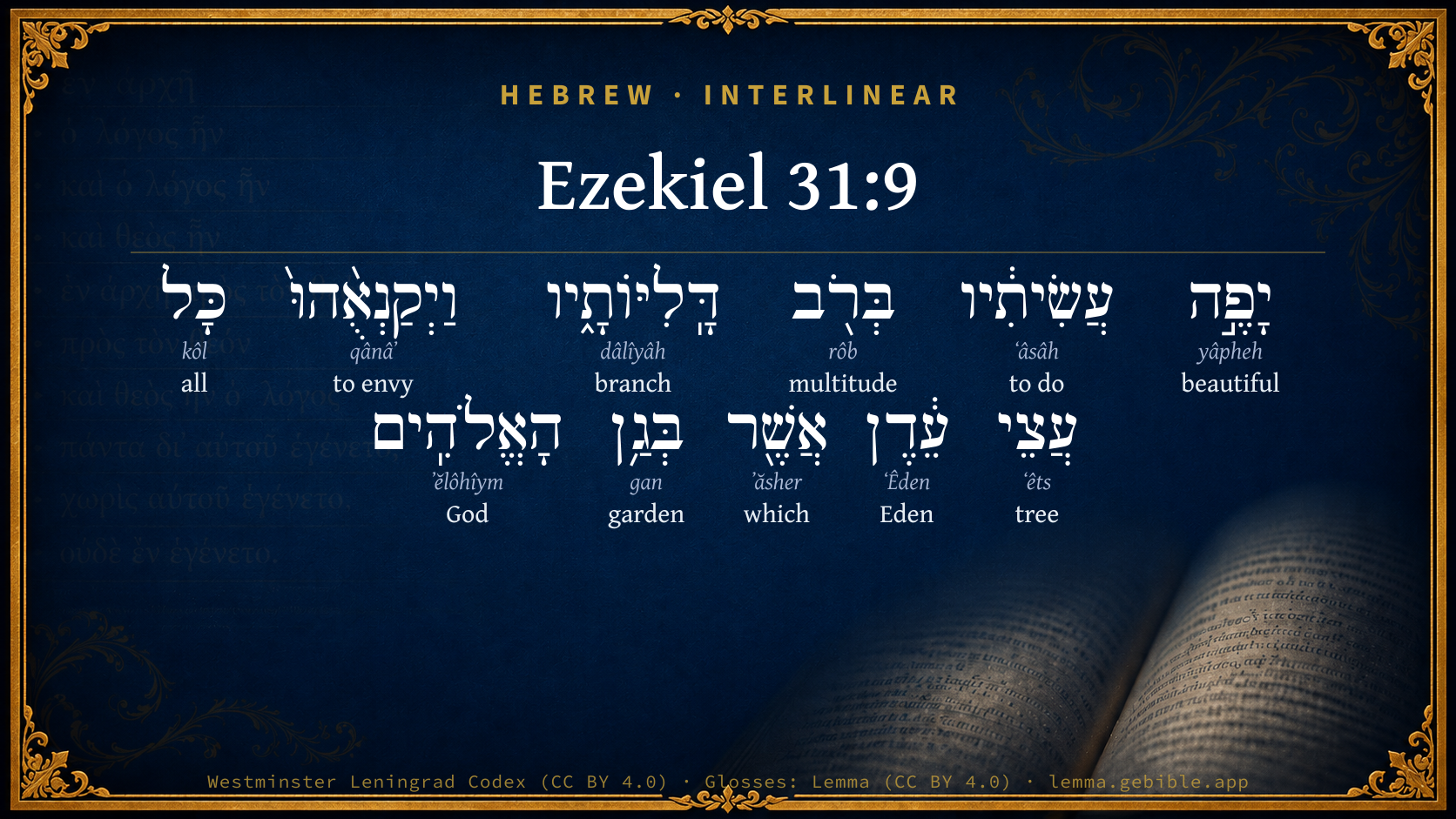
Hebrew (Westminster Leningrad Codex) Ezekiel 31:9 appears in the Hebrew Old Testament. The text above is from the Westminster Leningrad Codex. Each word links to its Strong’s number, a concise gloss, and parsing drawn from the Open Scriptures Hebrew Bible morphology. Click any word for its full Brown-Driver-Briggs (BDB) entry.
Download image
Cite this verse

Ezekiel 31:9 (World English Bible). Public Domain. Lemma interlinear Bible study tool, https://lemma.gebible.app/v/ezekiel/31/9.

Show BibTeX & RIS
BibTeX
RIS
English Translation
I made it beautiful by the multitude of its branches, so that all the trees of Eden, that were in the garden of God, envied it.
World English Bible · Public Domain
Download a study sheet

One document with this verse’s original text, its word-by-word gloss line, the meaning frame, cross-references with their text, attributed commentary, and full source and license credits — printable, and it pastes into notes with its structure intact.

This verse Autodidact and up

Study sheet (.html) Plain text (.txt)

A passage Seminary Student

Up to 50 verses in one chapter. A passage sheet keeps up to 6 commentary sources and 12 cross-references per verse, in the order this page ranks them, and says so on the sheet whenever that leaves anything out. Ask for a single verse and you get the Autodidact verse sheet above.

Everything on this page stays free to read, with no account — the sheet is a download of what is already on screen, not access to it.

Want to remove ads? Support Godless Engineer
Compare translations 3

The same verse in 3 English versions, stacked beneath the original-language interlinear above. Click any original word for its lexicon entry.

Each is an independent rendering of the whole verse — the interlinear is not word-aligned to these translations.

Highlighted words mark where these versions differ — a whole-verse word diff, not a word-by-word alignment.

  • World English Bible Public Domain
    I made it beautiful by the multitude of its branches, so that all the trees of Eden, that were in the garden of God, envied it.
  • King James Version Public Domain
    I have made him fair by the multitude of his branches: so that all the trees of Eden, that were in the garden of God, envied him.
  • unfoldingWord Literal Text CC BY-SA 4.0
    I made it beautiful with its many branches and all the trees of Eden that were in the garden of God envied it.

unfoldingWord Literal Text — © unfoldingWord, licensed CC BY-SA 4.0. Word-aligned USFM3 via Door43 (git.door43.org/unfoldingWord/en_ult).

Versions to compare (up to 4)

3 of 4 selected

Show all 18 translations

Every available English version of this verse, each an independent rendering of the whole verse.

  • World English Bible Public Domain
    I made it beautiful by the multitude of its branches, so that all the trees of Eden, that were in the garden of God, envied it.
  • Berean Standard Bible Public Domain
    I made it beautiful with its many branches, the envy of all the trees of Eden, which were in the garden of God.’
  • Majority Standard Bible Public Domain
    I made it beautiful with its many branches, the envy of all the trees of Eden, which were in the garden of God.’
  • King James Version Public Domain
    I have made him fair by the multitude of his branches: so that all the trees of Eden, that were in the garden of God, envied him.
  • American Standard Version (1901) Public Domain
    I made it fair by the multitude of its branches, so that all the trees of Eden, that were in the garden of God, envied it.
  • Revised Version (1885) Public Domain
    I made him fair by the multitude of his branches: so that all the trees of Eden, that were in the garden of God, envied him.
  • Geneva Bible (1599) Public Domain
    I made him faire by the multitude of his branches: so that all the trees of Eden, that were in the garden of God, enuied him.
  • Douay-Rheims (1899) Public Domain
    For I made him beautiful and thick set with many branches: and all the trees of pleasure, that were in the paradise of God, envied him.
  • Young's Literal Translation Public Domain
    Fair I have made him in the multitude of his thin shoots, And envy him do all trees of Eden that `are' in the garden of God.
  • Literal Standard Version CC BY-SA 4.0
    I have made him beautiful in the multitude of his thin shoots, || And all trees of Eden that [are] in the garden of God envy him.
  • Unlocked Literal Bible CC BY-SA 4.0
    I made it beautiful with its many branches and all the trees of Eden that were in the garden of God envied it.
  • unfoldingWord Literal Text CC BY-SA 4.0
    I made it beautiful with its many branches and all the trees of Eden that were in the garden of God envied it.
  • Darby Bible Public Domain
    I had made him fair by the multitude of his branches; and all the trees of Eden, that were in the garden of God, envied him.
  • World Messianic Bible Public Domain
    I made it beautiful by the multitude of its branches, so that all the trees of Eden, that were in the garden of God, envied it.’
  • Webster's Bible Public Domain
    I have made him fair by the multitude of his branches: so that all the trees of Eden, that were in the garden of God, envied him.
  • Free Bible Version CC BY-SA 4.0
    I made it beautiful with its many branches. All the trees of Eden in God's garden envied it.
  • Bible in Basic English Public Domain
    I made it beautiful with its mass of branches: so that all the trees in the garden of God were full of envy of it.
  • JPS Tanakh (1917) Public Domain
    I made it fair by the multitude of its branches; so that all the trees of Eden, that were in the garden of God, envied it.

Literal Standard Version (2020), Covenant Press — licensed CC BY-SA 4.0. Text via the HelloAO Bible API (eBible.org). Unlocked Literal Bible (unfoldingWord) — licensed CC BY-SA 4.0. Text via the HelloAO Bible API (eBible.org). unfoldingWord Literal Text — © unfoldingWord, licensed CC BY-SA 4.0. Word-aligned USFM3 via Door43 (git.door43.org/unfoldingWord/en_ult). Free Bible Version, Dr. Jonathan Gallagher — licensed CC BY-SA 4.0. Text via the HelloAO Bible API (eBible.org).

Word by word

More ways to search: Search by grammar → Find every occurrence → Compare this word →

Practice this passage: Drill this verse → Learn its vocabulary →

דָּֽלִיּוֹתָ֑יו
dâlîyâh
H1808
“branches · his”
Noun, Common, Feminine, Plural, Construct + Suffix, Personal, 3rd Person, Masculine, Singular
Part of Speech
Noun
Type
Common
Gender
Feminine
Number
Plural
State
Construct
Full BDB Definition

Origin: from H1802

TWOT: 431d

branch, bough - of Israel (figuratively) (used with olive tree, vine, cedar tree)
  1. יָפֶ֣ה yâpheh H3303 “beautiful” Adjective, Adjective, Masculine, Singular, Absolute
  2. עֲשִׂיתִ֔יו ʻâsâh H6213 “to do · him” Verb, Qal, Perfect, 1st Person, Common, Singular + Suffix, Personal, 3rd Person, Masculine, Singular
  3. בְּרֹ֖ב rôb H7230 “in/at · multitude of” Preposition + Noun, Common, Both, Singular, Construct
  4. וַיְקַנְאֻ֨הוּ֙ qânâʼ H7065 “and · to envy · him” Conjunction + Verb, Piel, Sequential Imperfect, 3rd Person, Masculine, Plural + Suffix, Personal, 3rd Person, Masculine, Singular
  5. כָּל kôl H3605 “all of” Noun, Common, Masculine, Singular, Construct
  6. עֲצֵי ʻêts H6086 “trees of” Noun, Common, Masculine, Plural, Construct
  7. עֵ֔דֶן ʻÊden H5731 “Eden” Noun, Proper
  8. אֲשֶׁ֖ר ʼăsher H834 “which” Particle, Relative
  9. בְּגַ֥ן gan H1588 “in/at · garden of” Preposition + Noun, Common, Both, Singular, Construct
  10. הָאֱלֹהִֽים ʼĕlôhîym H430 “the · God(s)” Particle, Definite Article + Noun, Common, Masculine, Plural, Absolute

About this verse

These counts appear in no published source. They are computed here, from the morphology-tagged text and Lemma’s own curated glosses. What Lemma adds →

11
words
11
distinct lemmas
Prophets
section

Notable vocabulary

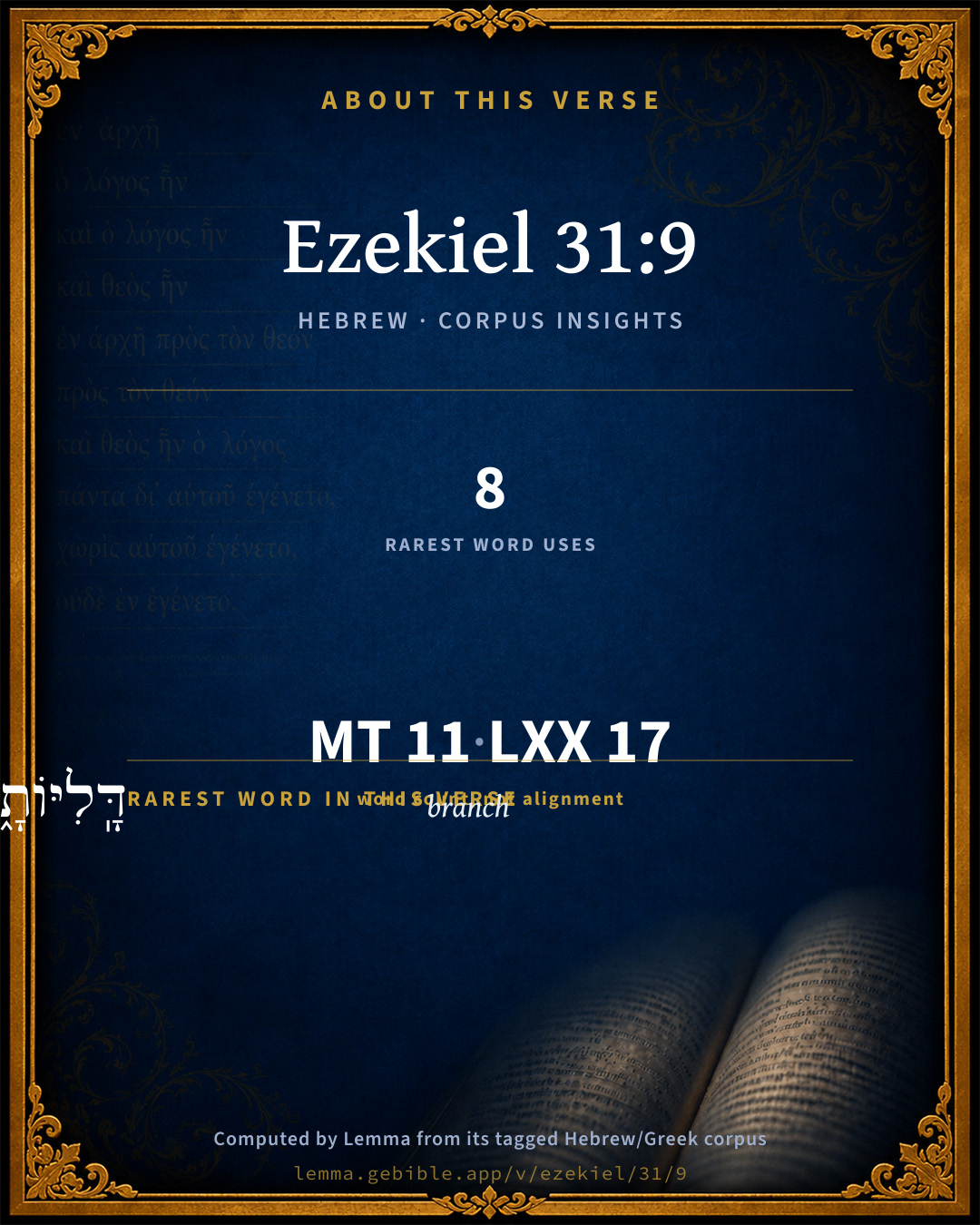
The rarest word here is דָּֽלִיּוֹתָ֑יו branch H1808 — appearing just 8 times in the whole Hebrew Bible.

Shared distinctive vocabulary

דָּֽלִיּוֹתָ֑יו branch H1808 occurs in 8 verses of the Hebrew Bible. Also found in:

Grammatical profile

  • 2 verbs
  • 7 nouns
  • 1 adjective
  • 1 particle

Verb forms

  • עֲשִׂיתִ֔יו Qal · Perfect
  • וַיְקַנְאֻ֨הוּ֙ Piel · Sequential Imperfect

Hebrew & Septuagint length

In English translation the verse runs 26 words from the Hebrew and 17 from the Septuagint (LXX English) — the Septuagint runs noticeably shorter here. See the side-by-side →

A rough comparison of the two English renderings, which tokenize alike — not a word-level alignment.

Word counts can differ between the Hebrew and the Greek without any difference in meaning — e.g. the Hebrew direct-object marker אֵת has no separate Greek word, and Greek often adds the article ὁ.

In the original languages it is 11 Hebrew tokens and 17 Greek tokens — but the two are counted differently (Hebrew bundles its prefixes and suffixes into one token; the Greek is in lemma form), so that isn’t a like-for-like length.

Cross-references

25

Topical passages linked to Ezekiel 31:9 in the Treasury of Scripture Knowledge — connected by theme and wording, ordered by reader-vote popularity; previews shown in the World English Bible.

  • Genesis 13:10 Lot lifted up his eyes, and saw all the plain of the Jordan, that it was well watered every where, before Yahweh destroyed Sodom and Gomorrah, like the garden of Yahweh, like the land of Egypt, as you go to Zoar.
  • Psalms 75:6–7 For neither from the east, nor from the west, Nor yet from the south, comes exaltation.
  • Isaiah 51:3 For Yahweh has comforted Zion; he has comforted all her waste places, and has made her wilderness like Eden, and her desert like the garden of Yahweh; joy and gladness shall be found therein, thanksgiving, and the voice of melody.
  • Ezekiel 28:13 You were in Eden, the garden of God; every precious stone adorned you: ruby, topaz, emerald, chrysolite, onx, jasper, sapphire, turquoise, and beryl. Gold work of tambourines and of pipes was in you. In the day that you were created they were prepared.
  • Daniel 2:37–38 You, O king, are king of kings, to whom the God of heaven has given the kingdom, the power, and the strength, and the glory;
  • Genesis 2:8–9 Yahweh God planted a garden eastward, in Eden, and there he put the man whom he had formed.
  • Genesis 26:14 He had possessions of flocks, possessions of herds, and a great household. The Philistines envied him.
  • Genesis 37:11 His brothers envied him; but his father kept this saying in mind.
  • Exodus 9:16 but indeed for this cause I have made you stand: to show you my power, and that my name may be declared throughout all the earth;
  • Judges 9:8–20 The trees went forth on a time to anoint a king over them; and they said to the olive tree, Reign you over us.
  • 1 Samuel 18:15 When Saul saw that he behaved himself very wisely, he stood in awe of him.
  • Psalms 96:12–13 Let the field and all that is in it exult! Then all the trees of the woods shall sing for joy
  • Proverbs 27:4 Wrath is cruel, And anger is overwhelming; But who is able to stand before jealousy?
  • Ecclesiastes 4:4 Then I saw all the labor and achievement that is the envy of a man's neighbor. This also is vanity and a striving after wind.
  • Isaiah 55:12 For you shall go out with joy, and be led forth with peace: the mountains and the hills shall break forth before you into singing; and all the trees of the fields shall clap their hands.
  • Ezekiel 16:14 Your renown went forth among the nations for your beauty; for it was perfect, through my majesty which I had put on you, says the Lord Yahweh.
  • Ezekiel 17:22 Thus says the Lord Yahweh: I will also take of the lofty top of the cedar, and will set it; I will crop off from the topmost of its young twigs a tender one, and I will plant it on a high and lofty mountain:
  • Ezekiel 17:24 All the trees of the field shall know that I, Yahweh, have brought down the high tree, have exalted the low tree, have dried up the green tree, and have made the dry tree to flourish; I, Yahweh, have spoken and have done it.
  • Ezekiel 31:16 I made the nations to shake at the sound of his fall, when I cast him down to Sheol with those who descend into the pit; and all the trees of Eden, the choice and best of Lebanon, all that drink water, were comforted in the lower parts of the earth.
  • Ezekiel 31:18 To whom are you thus like in glory and in greatness among the trees of Eden? yet shall you be brought down with the trees of Eden to the lower parts of the earth: you shall lie in the midst of the uncircumcised, with those who are slain by the sword. This is Pharaoh and all his multitude, says the Lord Yahweh.
  • Daniel 2:21 He changes the times and the seasons; he removes kings, and sets up kings; he gives wisdom to the wise, and knowledge to those who have understanding;
  • Daniel 4:22–25 it is you, O king, that are grown and become strong; for your greatness is grown, and reaches to the sky, and your dominion to the end of the earth.
  • Daniel 5:20–23 But when his heart was lifted up, and his spirit was hardened so that he dealt proudly, he was deposed from his kingly throne, and they took his glory from him:
  • Zechariah 11:2 Wail, fir tree, for the cedar has fallen, Because the stately ones are destroyed. Wail, you oaks of Bashan, For the strong forest has come down.
  • James 4:5–6 Or do you think that the Scripture says in vain, "The Spirit who lives in us yearns jealously"?

Cross-references courtesy of OpenBible.info (CC BY 4.0).

Hebrew and Greek witnesses Masoretic Hebrew ↔ Greek Septuagint

The same verse in the two great witnesses to the Old Testament, shown verse-for-verse.

Here the Septuagint runs noticeably shorter than the Hebrew — LXX2012 (modern English Septuagint) 17 words vs World English Bible 26. A rough length comparison of the two English translations, not a word-level alignment — read both below.

These are two independent witnesses, not word-aligned to each other, and the Septuagint is shown in lemma (dictionary) form.

Hebrew Ezekiel 31:9 Masoretic · Westminster Leningrad Codex

יָפֶ֣ה עֲשִׂיתִ֔יו בְּרֹ֖ב דָּֽלִיּוֹתָ֑יו וַיְקַנְאֻ֨הוּ֙ כָּל עֲצֵי עֵ֔דֶן אֲשֶׁ֖ר בְּגַ֥ן הָאֱלֹהִֽים

I made it beautiful by the multitude of its branches, so that all the trees of Eden, that were in the garden of God, envied it.

World English Bible · Public Domain

Greek LXX Ezekiel 31:9 Septuagint · lemma form

διά ὁ πλῆθος ὁ κλάδος αὐτός καί ζηλόω αὐτός ὁ ξύλον ὁ παράδεισος ὁ τρυφή ὁ θεός

because of the multitude of his branches: and the trees of God's paradise of delight envied him.

LXX2012 (modern English Septuagint) · Public Domain

On this verse, The Cambridge Bible for Schools and Colleges discusses the Septuagint’s reading. Read the note in Commentary ↓

Hebrew: Westminster Leningrad Codex (CC BY 4.0). Greek: Septuagint (public domain); English from LXX2012 (modern English Septuagint) (Public Domain). How the Septuagint differs from the Hebrew →

Targum (Aramaic paraphrase)

1

The Targum is the ancient Jewish Aramaic paraphrase of the Hebrew Scriptures — an interpretive translation, not the Hebrew text itself. Onkelos (literal) and Pseudo-Jonathan (expansive) render the Torah, and Jonathan the Prophets. Coverage is partial: where no permissively-licensed English translation exists for a verse, only the Aramaic is shown. This is verse-level text, not a word-by-word alignment to the Hebrew.

  1. Targum Jonathan Prophets (Joshua–Malachi)
    שַׁפִּיר עֲבִידְתֵּיהּ בִּסְגֵי גִבָּרוֹהִי וְזָעוּ מִן קֳדָמוֹהִי כָּל מַלְכֵי קֶדֶם בִּתְקוֹף גְבוּרָא דַהֲוַת עִמֵהּ מִן קֳדָם יְיָ:

    (no public-domain English translation for this verse)

    Targum Jonathan — Aramaic: “Mikraot Gedolot” (public domain). English: “Sefaria Community Translation” (CC0 1.0 (public-domain dedication)); “London "Chaldee Paraphrase," 1871” (public domain). Text via Sefaria.

Commentary

Notes on Ezekiel 31:9 from classic Christian and Jewish commentators (each source and its license shown beneath its notes). The classic Christian expositions comment on the surrounding passage and are grouped to its opening verse, so a note may address several verses; the Jewish commentaries on the Tanakh (Rashi and others) are per-verse, so they appear only where the commentator wrote on this verse.

Lemma curates 59 commentaries, every one of them public domain or Creative Commons licensed, each selected and text-cleaned for this edition rather than reprinted as found. About our sources →

The Cambridge Bible for Schools and Colleges

gen. ed. J. J. S. Perowne

9. have made him fair] I made him fair. But the idea of his beauty being conferred by God is foreign to the connexion. His stateliness was due to his great waters, beside which he was planted; it was the fruit of nature, which in this passage is rather contrasted with God. The words are wanting in LXX., and may be a marginal gloss on “beauty,” which a reader attributed to God. If the words be omitted, the last clause of Eze_31:8 should probably be closely connected with Eze_31:9 : “and no tree in the garden of God was like unto him, because of (in) the multitude of his branches.”

The Cambridge Bible for Schools and Colleges (gen. ed. J. J. S. Perowne; Cambridge University Press, 1878–1918) — public domain. Text from a community e-Sword module.

Trapp's Complete Commentary

John Trapp

Eze 31:9 I have made him fair by the multitude of his branches: so that all the trees of Eden, that [were] in the garden of God, envied him.

Ver. 9. So that all the trees of Eden … envied him.] Summa petit livor. The tallest trees are weakest in the tops, and envy always aimeth at the highest.

John Trapp, A Commentary or Exposition upon All the Books of the Old and New Testament (1647–1656) — public domain. Text from a community e-Sword module.

Jamieson, Fausset & Brown

Robert Jamieson, A. R. Fausset & David Brown

I . . . made him--It was all due to My free grace.

Jamieson, Fausset & Brown — Commentary Critical and Explanatory on the Whole Bible (1871) — public domain (CC PDM 1.0). Text via the HelloAO Bible API.

John Gill's Exposition

I have made him fair by the multitude of his branches,.... Or provinces, the extensiveness of his dominions: all his power and strength, riches and wealth, grandeur and glory, and the vast dominions he was possessed of, were all from the Lord; as whatever kings have are, though they are too apt to ascribe it to themselves; but all are from him, by whom kings reign:

so that all the trees of Eden, that were in the garden of God, envied him; all the kings of the earth, though they dared not openly speak against him, or oppose him; yet they inwardly grieved at and secretly grudged his grandeur and majesty, superior to theirs, and wished themselves in his stead; and could gladly have done anything, were it in their power, to eclipse his glory, and bring him lower. This is the case of all that are in any eminence, or are conspicuous to others, or in any exalted station above others, be it what it will; whether they have superior gifts and endowments of mind; or greater riches, and larger possessions; or are in high places of honour, trust, and profit. The Targum is,

"I have made him beautiful by the multitude of his mighty ones; and all the kings of the east trembled before him, because of the strength of his power, which he had from the Lord.''

John Gill's Exposition of the Whole Bible (1746–1763) — public domain (CC PDM 1.0). Text via the HelloAO Bible API.

Matthew Poole's English Annotations

I have made him fair; all this greatness, wealth, and glory I have given him.

By the multitude of his branches; the numbers of his provinces, and multitude of his subjects, high and low, great and small.

Envied him; either did when they saw his greatness, or would have envied if they had seen it; or if there may be a seeming justifiableness in wondering at another’s glory, and wishing it our own, here it might be found.

Matthew Poole's English Annotations on the Holy Bible (1683–1685) — public domain. Text from a community e-Sword/MySword module.

Rashi

Rabbi Shlomo Yitzchaki (Rashi)

all the trees of Eden i.e., all the praiseworthy kings.

Rashi on the Tanakh — English translations: “The Judaica Press complete Tanach with Rashi, translated by A. J. Rosenberg” (CC BY 4.0); “Pentateuch with Rashi's commentary by M. Rosenbaum and A.M. Silbermann, 1929-1934” (public domain); “The Metsudah Tanach series, Lakewood, N.J” (CC BY 4.0); and “The Book of Joshua, Metsudah Publications, 1997” (CC BY 4.0). Text via Sefaria.

Lesson kit

Teaching starters — assembled from the data on this page, not authored interpretation. Every prompt links to the verse data it draws on. Edit before teaching.

Ezekiel, in the Prophets, opens this verse with 11 words (11 distinct Hebrew lemmas). Its most distinctive word is dâlîyâh (“branch”). The Greek Septuagint runs shorter here. A historical commentator’s framing appears above. Read the whole chapter for the surrounding context.

Discussion questions

  1. How does “branch” (dâlîyâh) shape what this verse is saying?
  2. Jeremiah 11:16 shares the word «branch» with this verse. How do the two illuminate each other?
  3. Compared with the Hebrew, the Septuagint runs shorter here. What questions does that raise?
  4. These translations render this verse differently; the difference is in the English rendering, not the original. What questions does that raise?
  5. The verb «עֲשִׂיתִ֔יו» is Qal Perfect. How does its form color the action?
  6. Reading how The Cambridge Bible for Schools and Colleges and Trapp's Complete Commentary read this verse, where do the two commentators agree and where do they part?

Things to notice

Reading settings

Reading text

Shown beneath each verse's original-language words.

Old Testament
Old Testament edition

Read the OT as the Masoretic Hebrew (MT) or the Greek Septuagint (LXX).

English shown for the Greek Septuagint (in the Hebrew ↔ Greek comparison).

Comparing translations? Open the Compare panel on any verse page to stack up to four side by side.