
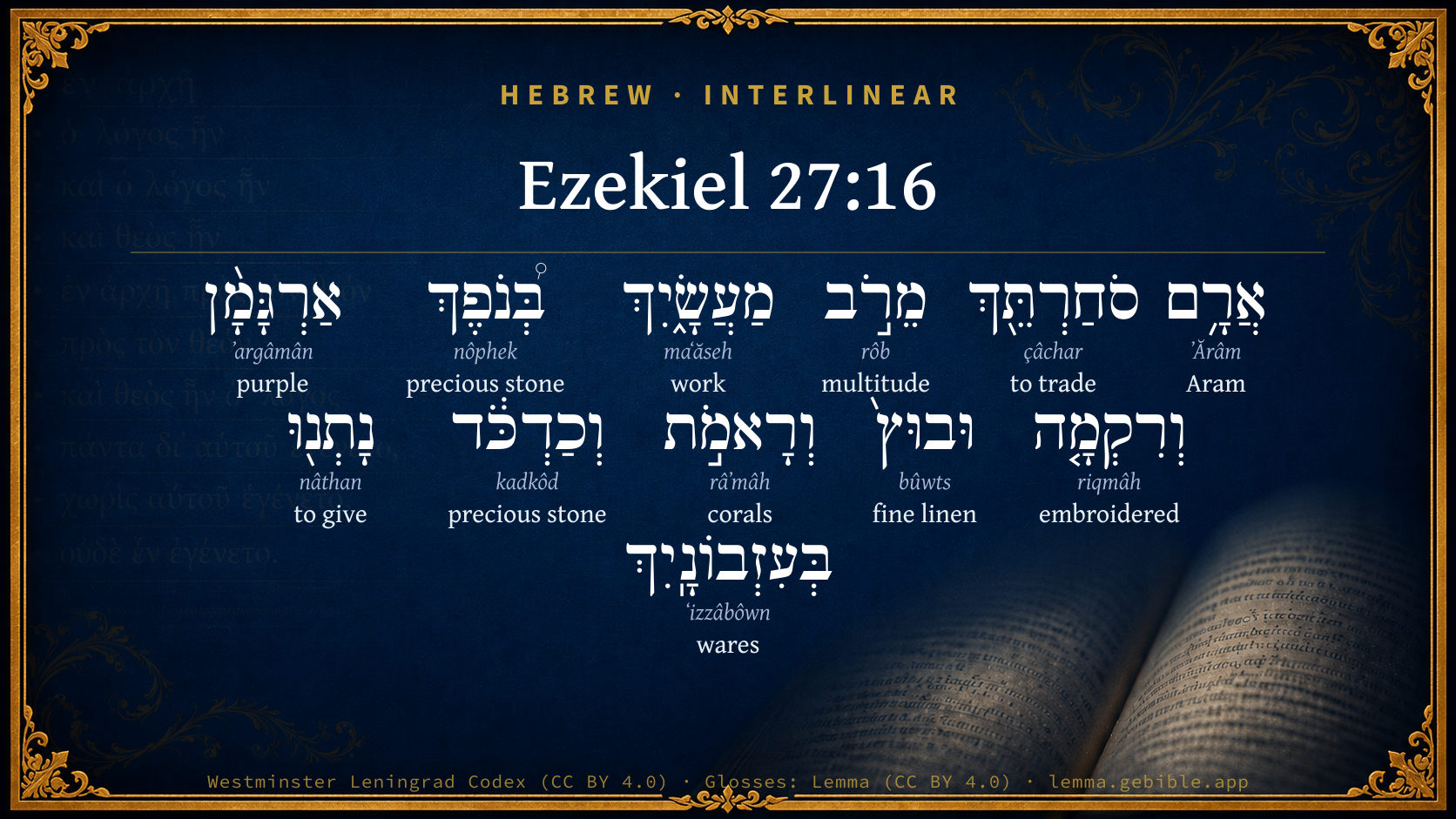
Ezekiel 27:16

Hebrew (Westminster Leningrad Codex) Ezekiel 27:16 appears in the Hebrew Old Testament. The text above is from the Westminster Leningrad Codex. Each word links to its Strong’s number, a concise gloss, and parsing drawn from the Open Scriptures Hebrew Bible morphology. Click any word for its full Brown-Driver-Briggs (BDB) entry.
Download image
Cite this verse

Ezekiel 27:16 (World English Bible). Public Domain. Lemma interlinear Bible study tool, https://lemma.gebible.app/v/ezekiel/27/16.

Show BibTeX & RIS
BibTeX
RIS
English Translation
Syria was your merchant by reason of the multitude of your handiworks: they traded for your wares with emeralds, purple, and embroidered work, and fine linen, and coral, and rubies.
World English Bible · Public Domain
Download a study sheet

One document with this verse’s original text, its word-by-word gloss line, the meaning frame, cross-references with their text, attributed commentary, and full source and license credits — printable, and it pastes into notes with its structure intact.

This verse Autodidact and up

Study sheet (.html) Plain text (.txt)

A passage Seminary Student

Up to 50 verses in one chapter. A passage sheet keeps up to 6 commentary sources and 12 cross-references per verse, in the order this page ranks them, and says so on the sheet whenever that leaves anything out. Ask for a single verse and you get the Autodidact verse sheet above.

Everything on this page stays free to read, with no account — the sheet is a download of what is already on screen, not access to it.

Want to remove ads? Support Godless Engineer
Compare translations 3

The same verse in 3 English versions, stacked beneath the original-language interlinear above. Click any original word for its lexicon entry.

Each is an independent rendering of the whole verse — the interlinear is not word-aligned to these translations.

Highlighted words mark where these versions differ — a whole-verse word diff, not a word-by-word alignment.

  • World English Bible Public Domain
    Syria was your merchant by reason of the multitude of your handiworks: they traded for your wares with emeralds, purple, and embroidered work, and fine linen, and coral, and rubies.
  • King James Version Public Domain
    Syria was thy merchant by reason of the multitude of the wares of thy making: they occupied in thy fairs with emeralds, purple, and broidered work, and fine linen, and coral, and agate.
  • unfoldingWord Literal Text CC BY-SA 4.0
    Aram was a dealer in your many products; they provided emeralds, purple, colored cloth, fine fabric, pearls, and rubies as your merchandise.

unfoldingWord Literal Text — © unfoldingWord, licensed CC BY-SA 4.0. Word-aligned USFM3 via Door43 (git.door43.org/unfoldingWord/en_ult).

Versions to compare (up to 4)

3 of 4 selected

Show all 18 translations

Every available English version of this verse, each an independent rendering of the whole verse.

  • World English Bible Public Domain
    Syria was your merchant by reason of the multitude of your handiworks: they traded for your wares with emeralds, purple, and embroidered work, and fine linen, and coral, and rubies.
  • Berean Standard Bible Public Domain
    Aram was your customer because of your many products; they exchanged turquoise, purple, embroidered work, fine linen, coral, and rubies for your wares.
  • Majority Standard Bible Public Domain
    Aram was your customer because of your many products; they exchanged turquoise, purple, embroidered work, fine linen, coral, and rubies for your wares.
  • King James Version Public Domain
    Syria was thy merchant by reason of the multitude of the wares of thy making: they occupied in thy fairs with emeralds, purple, and broidered work, and fine linen, and coral, and agate.
  • American Standard Version (1901) Public Domain
    Syria was thy merchant by reason of the multitude of thy handiworks: they traded for thy wares with emeralds, purple, and broidered work, and fine linen, and coral, and rubies.
  • Revised Version (1885) Public Domain
    Syria was thy merchant by reason of the multitude of thy handyworks: they traded for thy wares with emeralds, purple, and broidered work, and fine linen, and coral, and rubies.
  • Geneva Bible (1599) Public Domain
    They of Aram were thy marchants for the multitude of thy wares: they occupied in thy faires with emerauds, purple, and broidred worke, and fine linen, and corall, and pearle.
  • Douay-Rheims (1899) Public Domain
    The Syrian was thy merchant: by reason of the multitude of thy works, they set forth precious stones, and purple, and broidered works, and fine linen, and silk, and chodchod in thy market.
  • Young's Literal Translation Public Domain
    Aram `is' thy merchant, Because of the abundance of thy works, For emerald, purple, and embroidery, And fine linen, and coral, and agate, They have given out thy remnants.
  • Literal Standard Version CC BY-SA 4.0
    Aram [is] your merchant, || Because of the abundance of your works, || They have given emerald, purple, and embroidery, || And fine linen, and coral, and agate for your wares.
  • Unlocked Literal Bible CC BY-SA 4.0
    Aram was a dealer in your many products; they provided emeralds, purple, colored cloth, fine fabric, pearls, and rubies as your merchandise.
  • unfoldingWord Literal Text CC BY-SA 4.0
    Aram was a dealer in your many products; they provided emeralds, purple, colored cloth, fine fabric, pearls, and rubies as your merchandise.
  • Darby Bible Public Domain
    Syria dealt with thee for the multitude of thy handiworks: they traded in thy markets with carbuncles, purple, and broidered work, and fine linen, and corals, and rubies.
  • World Messianic Bible Public Domain
    “‘“Syria was your merchant by reason of the multitude of your handiworks. They traded for your wares with emeralds, purple, embroidered work, fine linen, coral, and rubies.
  • Webster's Bible Public Domain
    Syria was thy merchant by reason of the multitude of the wares of thy making: they occupied in thy fairs with emeralds, purple, and broidered work, and fine linen, and coral, and agate.
  • Free Bible Version CC BY-SA 4.0
    The Arameans traded with you because you had so much merchandise. They provided turquoise, purple cloth, embroidery, fine linen, coral, and red jasper in exchange for your goods.
  • Bible in Basic English Public Domain
    Edom did business with you because of the great number of things which you made; they gave emeralds, purple, and needlework, and the best linen and coral and rubies for your goods.
  • JPS Tanakh (1917) Public Domain
    Aram was thy merchant by reason of the multitude of thy wealth; they traded for thy wares with carbuncles, purple, and richly woven work, and fine linen, and coral, and rubies.

Literal Standard Version (2020), Covenant Press — licensed CC BY-SA 4.0. Text via the HelloAO Bible API (eBible.org). Unlocked Literal Bible (unfoldingWord) — licensed CC BY-SA 4.0. Text via the HelloAO Bible API (eBible.org). unfoldingWord Literal Text — © unfoldingWord, licensed CC BY-SA 4.0. Word-aligned USFM3 via Door43 (git.door43.org/unfoldingWord/en_ult). Free Bible Version, Dr. Jonathan Gallagher — licensed CC BY-SA 4.0. Text via the HelloAO Bible API (eBible.org).

Word by word

More ways to search: Search by grammar → Find every occurrence → Compare this word →

Practice this passage: Drill this verse → Learn its vocabulary →

וְרָאמֹ֣ת
râʼmâh
H7215
“and · corals”
Conjunction + Noun, Common, Feminine, Plural, Absolute
Part of Speech
Conjunction + Noun
Type
Common
Gender
Feminine
Number
Plural
State
Absolute
Full BDB Definition

Origin: from H7213

TWOT: 2096b

corals
  1. אֲרָ֥ם ʼĂrâm H758 “Aram” Noun, Proper
  2. סֹחַרְתֵּ֖ךְ çâchar H5503 “trading · you” Verb, Qal, Participle Active, Feminine, Singular, Construct + Suffix, Personal, 2nd Person, Feminine, Singular
  3. מֵרֹ֣ב rôb H7230 “from · multitude of” Preposition + Noun, Common, Both, Singular, Construct
  4. מַעֲשָׂ֑יִךְ maʻăseh H4639 “works · your” Noun, Common, Masculine, Plural, Construct + Suffix, Personal, 2nd Person, Feminine, Singular
  5. בְּ֠נֹפֶךְ nôphek H5306 “in/at · precious stone” Preposition + Noun, Common, Masculine, Singular, Absolute
  6. אַרְגָּמָ֨ן ʼargâmân H713 “purple” Noun, Common, Masculine, Singular, Absolute
  7. וְרִקְמָ֤ה riqmâh H7553 “and · embroidered” Conjunction + Noun, Common, Feminine, Singular, Absolute
  8. וּבוּץ֙ bûwts H948 “and · fine linen” Conjunction + Noun, Common, Masculine, Singular, Absolute
  9. וְכַדְכֹּ֔ד kadkôd H3539 “and · precious stone” Conjunction + Noun, Common, Masculine, Singular, Absolute
  10. נָתְנ֖וּ nâthan H5414 “to give” Verb, Qal, Perfect, 3rd Person, Common, Plural
  11. בְּעִזְבוֹנָֽיִךְ ʻizzâbôwn H5801 “in/at · wares · your” Preposition + Noun, Common, Masculine, Plural, Construct + Suffix, Personal, 2nd Person, Feminine, Singular

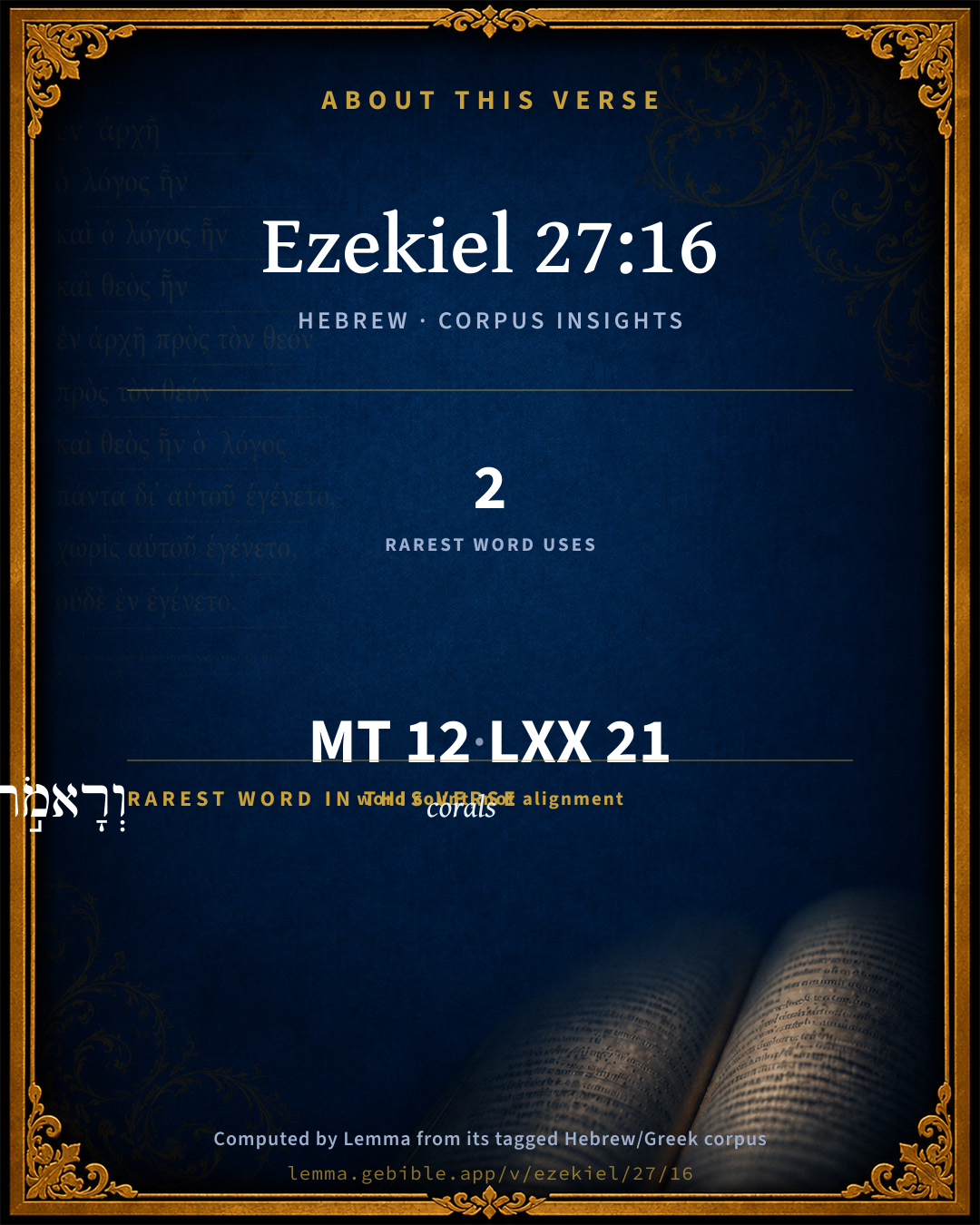
About this verse

These counts appear in no published source. They are computed here, from the morphology-tagged text and Lemma’s own curated glosses. What Lemma adds →

12
words
12
distinct lemmas
Prophets
section

Notable vocabulary

The rarest word here is וְרָאמֹ֣ת corals H7215 — appearing just 2 times in the whole Hebrew Bible.

Shared distinctive vocabulary

וְרָאמֹ֣ת corals H7215 occurs in 2 verses of the Hebrew Bible. Also found in:

Grammatical profile

  • 2 verbs
  • 10 nouns

Verb forms

  • סֹחַרְתֵּ֖ךְ Qal · Participle Active
  • נָתְנ֖וּ Qal · Perfect

Hebrew & Septuagint length

In English translation the verse runs 30 words from the Hebrew and 25 from the Septuagint (LXX English) — closely comparable.

A rough comparison of the two English renderings, which tokenize alike — not a word-level alignment.

Word counts can differ between the Hebrew and the Greek without any difference in meaning — e.g. the Hebrew direct-object marker אֵת has no separate Greek word, and Greek often adds the article ὁ.

In the original languages it is 12 Hebrew tokens and 21 Greek tokens — but the two are counted differently (Hebrew bundles its prefixes and suffixes into one token; the Greek is in lemma form), so that isn’t a like-for-like length.

Cross-references

8

Topical passages linked to Ezekiel 27:16 in the Treasury of Scripture Knowledge — connected by theme and wording, ordered by reader-vote popularity; previews shown in the World English Bible.

  • Judges 10:6 The children of Israel again did that which was evil in the sight of Yahweh, and served the Baals, and the Ashtaroth, and the gods of Syria, and the gods of Sidon, and the gods of Moab, and the gods of the children of Ammon, and the gods of the Philistines; and they forsook Yahweh, and didn't serve him.
  • Ezekiel 28:13 You were in Eden, the garden of God; every precious stone adorned you: ruby, topaz, emerald, chrysolite, onx, jasper, sapphire, turquoise, and beryl. Gold work of tambourines and of pipes was in you. In the day that you were created they were prepared.
  • Genesis 10:22 The sons of Shem: Elam, Asshur, Arpachshad, Lud, and Aram.
  • Genesis 28:5 Isaac sent Jacob away. He went to Paddan Aram to Laban, son of Bethuel the Syrian, Rebekah's brother, Jacob's and Esau's mother.
  • 2 Samuel 8:5 When the Syrians of Damascus came to help Hadadezer king of Zobah, David struck of the Syrians two and twenty thousand men.
  • 2 Samuel 10:6 When the children of Ammon saw that they were become odious to David, the children of Ammon sent and hired the Syrians of Beth Rehob, and the Syrians of Zobah, twenty thousand footmen, and the king of Maacah with one thousand men, and the men of Tob twelve thousand men.
  • 2 Samuel 15:8 For your servant vowed a vow while I abode at Geshur in Syria, saying, If Yahweh shall indeed bring me again to Jerusalem, then I will serve Yahweh.
  • Isaiah 7:1–8 It happened in the days of Ahaz the son of Jotham, the son of Uzziah, king of Judah, that Rezin the king of Syria, and Pekah the son of Remaliah, king of Israel, went up to Jerusalem to war against it, but could not prevail against it.

Cross-references courtesy of OpenBible.info (CC BY 4.0).

Hebrew and Greek witnesses Masoretic Hebrew ↔ Greek Septuagint

The same verse in the two great witnesses to the Old Testament, shown verse-for-verse.

These are two independent witnesses, not word-aligned to each other, and the Septuagint is shown in lemma (dictionary) form.

Hebrew Ezekiel 27:16 Masoretic · Westminster Leningrad Codex

אֲרָ֥ם סֹחַרְתֵּ֖ךְ מֵרֹ֣ב מַעֲשָׂ֑יִךְ בְּ֠נֹפֶךְ אַרְגָּמָ֨ן וְרִקְמָ֤ה וּבוּץ֙ וְרָאמֹ֣ת וְכַדְכֹּ֔ד נָתְנ֖וּ בְּעִזְבוֹנָֽיִךְ

Syria was your merchant by reason of the multitude of your handiworks: they traded for your wares with emeralds, purple, and embroidered work, and fine linen, and coral, and rubies.

World English Bible · Public Domain

Greek LXX Ezekiel 27:16 Septuagint · lemma form

ἄνθρωπος ἐμπορία σύ ἀπό πλῆθος ὁ συμμικτός σύ στακτή καί ποίκιλμα ἐκ θαρσις καί ραμωθ καί χορχορ δίδωμι ὁ ἀγορά σύ

even men as your merchandise, from the multitude of your trading population, myrrh and embroidered works from Tharsis: Ramoth also and Chorchor furnished your market.

LXX2012 (modern English Septuagint) · Public Domain

On this verse, The Cambridge Bible for Schools and Colleges discusses the Septuagint’s reading. Read the note in Commentary ↓

Hebrew: Westminster Leningrad Codex (CC BY 4.0). Greek: Septuagint (public domain); English from LXX2012 (modern English Septuagint) (Public Domain). How the Septuagint differs from the Hebrew →

Targum (Aramaic paraphrase)

1

The Targum is the ancient Jewish Aramaic paraphrase of the Hebrew Scriptures — an interpretive translation, not the Hebrew text itself. Onkelos (literal) and Pseudo-Jonathan (expansive) render the Torah, and Jonathan the Prophets. Coverage is partial: where no permissively-licensed English translation exists for a verse, only the Aramaic is shown. This is verse-level text, not a word-by-word alignment to the Hebrew.

  1. Targum Jonathan Prophets (Joshua–Malachi)
    מִן אֲרָם מַיְתָן סְחוֹרָא לְגַוִיךְ מִסָגִי עוּתְרִיךְ בִּתַכְרִיכִין דְאַרְגְוָן וּרְקָם וּבוּץ צִיוּרִין וְאַבְנִין טָבִין וּמַרְגָלִין יְהָבוּ בְּבֵית גִנְזָיִךְ:

    (no public-domain English translation for this verse)

    Targum Jonathan — Aramaic: “Mikraot Gedolot” (public domain). English: “Sefaria Community Translation” (CC0 1.0 (public-domain dedication)); “London "Chaldee Paraphrase," 1871” (public domain). Text via Sefaria.

Commentary

Notes on Ezekiel 27:16 from classic Christian and Jewish commentators (each source and its license shown beneath its notes). The classic Christian expositions comment on the surrounding passage and are grouped to its opening verse, so a note may address several verses; the Jewish commentaries on the Tanakh (Rashi and others) are per-verse, so they appear only where the commentator wrote on this verse.

Lemma curates 59 commentaries, every one of them public domain or Creative Commons licensed, each selected and text-cleaned for this edition rather than reprinted as found. About our sources →

The Cambridge Bible for Schools and Colleges

gen. ed. J. J. S. Perowne

16. For Syria (Aram) the Syr. reads Edom, and so in effect LXX. (interchange of d and r as Eze_27:15). If Edom be read the line pursued would be from S. to N., Edom, Eze_27:16, Judah, Eze_27:17, Damascus, Eze_27:18. The verse is otherwise peculiar in beginning with a precious stone, then passing on to stuffs and ending with precious stones.

wares of thy making] Rather; by reason of the multitude of thy works, i.e. not those wrought by Tyre, but those which the nations wrought and brought to her, all of which are considered hers.

occupied in thy fairs] Rather: emeralds … they brought as thy wares. The “emerald” according to others is the carbuncle. “Coral” may be “pearls.” The two things may have been confused; both were fished in the Persian Gulf. The “agate” may be the ruby. The precious stones might seem in favour of Edom, but the fine linen is more naturally the Syrian byssus. LXX. omits all the textile fabrics with the exception of broidered work; and the text must be held uncertain.

The Cambridge Bible for Schools and Colleges (gen. ed. J. J. S. Perowne; Cambridge University Press, 1878–1918) — public domain. Text from a community e-Sword module.

Trapp's Complete Commentary

John Trapp

Eze 27:16 Syria [was] thy merchant by reason of the multitude of the wares of thy making: they occupied in thy fairs with emeralds, purple, and broidered work, and fine linen, and coral, and agate.

Ver. 16. The wares of thy making.] Heb., Works. The Tyrians were ingenious workmen, as Hiram, whom Solomon therefore so admired that he called him his father.

And agate.] Or, Chrysoprasus, or crystal, or carbuncle, or onyx. Jerome confesseth that he knoweth not what to call it.

John Trapp, A Commentary or Exposition upon All the Books of the Old and New Testament (1647–1656) — public domain. Text from a community e-Sword module.

Joseph Benson's Commentary

Eze 27:16-20. Syria was thy merchant, &c. — From what is said here, we may conclude that the inhabitants of Tyre were exceedingly industrious, skilful in arts, and politic; for here almost all nations are described as bringing their respective commodities to Tyre, to give in exchange for the wares or manufactures of that place; which shows to what a vast height they carried their manufactures, and what immense profits they must have gained, since, it seems, they were able to purchase all kinds of precious stones, and the richest commodities of the world, with their own manufactures. Judah and Israel were thy merchants — Both the kingdom of the two tribes, and that of the ten. They traded in thy market wheat of Minnith — Minnith was a place belonging to the Ammonites, Jdg 11:33, and was noted for excellent wheat, great quantities of which the Jews brought to Tyre, the Tyrians having none of their own growth, but being supplied therewith by the Jews and Israelites, from the growth of their own or the neighbouring countries: see 1Ki 5:9-11; Ezr 3:7; Act 12:20. And Pannag — This is a word not elsewhere to be found, supposed by some to be the name of a place; by others, more probably, taken for some rich ointment, or gum. The Vulgate translates it balsam. In the wine of Helbon — Helbon is supposed to be that part of Syria which is called Chalybonitis by Ptolemy; and white wool — Bochart understands this to be wool of a bright purple colour. The LXX. and Chaldee render it, wool from Miletus, a place famous for that commodity. Dan also, &c. — Grotius thinks that Dan in the kingdom of Israel can scarcely be meant here; and finds that a city called Dana is placed by Ptolemy in the island of Ceylon. Dedan, &c., in precious clothes for chariots — Either these were rich coverings which were flung over the horses when harnessed to chariots, or else coverings for the seats of the chariots.

Joseph Benson's Commentary on the Old and New Testaments (1811–1818) — public domain. Text from a community e-Sword module.

Geneva Bible (1599)

Geneva Bible translators

Or, silk.

Or, works.

Or, carbuncle.

Geneva Bible (1599) marginal notes — public domain. Text via Bolls.life.

Jamieson, Fausset & Brown

Robert Jamieson, A. R. Fausset & David Brown

"Syria was thy mart for the multitude," &c. For "Syria" the Septuagint reads "Edom." But the Syrians were famed as merchants.

occupied--old English for "traded"; so in Luk 19:13.

agate--Others translate, "ruby," "chalcedony," or "pearls."

Jamieson, Fausset & Brown — Commentary Critical and Explanatory on the Whole Bible (1871) — public domain (CC PDM 1.0). Text via the HelloAO Bible API.

Adam Clarke's Commentary

Verse 16. Syria] These were always a mercantile people. For the precious stones mentioned here See Clarke on Ex 28:17.

Adam Clarke's Commentary on the Bible (1810–1826) — public domain. Text from a community e-Sword/MySword module.

Ellicott's Commentary for English Readers

(16) Emeralds.—The precious stone intended here, and in Exo_28:18, is now generally understood to be the carbuncle. The word for “fine linen” is not that of Eze_27:7, but a Phœnician word, occurring only in the books written in the time of the captivity. It is thought to mean cotton, for the woven fabrics of which Babylon was famous. Agate (marg., chrysoprase) is probably the ruby, or certainly some stone of brilliancy (Isa_54:12)

A Bible Commentary for English Readers, edited by Charles John Ellicott (1878–1897) — public domain. Text from a community e-Sword module.

John Gill's Exposition

Judah, and the land of Israel, they were thy merchants,.... The inhabitants of Judah and Israel; the two tribes of Judah and Benjamin, and the other ten tribes of Israel, they all merchandised with the Tyrians, being near unto them:

they traded in thy market wheat of Minnith; the name of a place, Jdg 11:33, where probably the best wheat grew; so the Targum renders it; the Tyrians were supplied with wheat from the land of Israel, in the times of Solomon, long before this, Kg1 5:11 as they were in the times of Herod, long after, Act 12:20, it was four miles from Esbus or Heshbon, in the way to Philadelphia, according to Eusebius:

and Pannag; which some take to be the name of a place, where the best wheat also was; which some say was Phoenicia, or the land of Canaan. The Septuagint render it "ointments": and the Latin interpreter of the Targum "balsam"; with which agrees Josephus ben Gorion (k), who says that at Jericho grew the balsam tree, from whence came a precious oil, which oil is "pannag": and Hillerus (l) translates it balsam: it follows,

and honey, and oil: with which the land of Canaan abounded; for it was a land of oil olive and honey, a land that flowed with milk and honey, Deu 8:8 so that they had enough for themselves, and to spare for their neighbours, and which they carried to the market of Tyre:

and balm; or balsam, of which there was plenty at Gilead, and near Jericho, however at the latter; we read of the balm of Gilead, Jer 8:22. The Septuagint and Vulgate Latin versions render it "rosin"; and so the Targum; and this the Tyrians might make use of in their ships (m). The balm, or balsam plant, was peculiar to Judea, as Pliny (n); at least it was the place of it until transplanted into other countries; and so says Solinus (o).

(k) Hist. 1. 4. c. 22. p. 379. (l) Onomastic. Sacr. p. 903. (m) Vid. Scheffer. de Militia Navali, p. 43. 319. (n) Nat. Hist. l. 12. c. 25. (o) Polyhistor. c. 48.

John Gill's Exposition of the Whole Bible (1746–1763) — public domain (CC PDM 1.0). Text via the HelloAO Bible API.

Haydock's Catholic Bible Commentary

Syrian: always much addicted to commerce. (St. Jerome) --- Septuagint read Adam for Aram, as if the traffic in men was meant: (Calmet) "ivory, and to those who brought, thou gavest thy rewards. (16) Men of thy traffic," &c. (Haydock) --- Linen. Hebrew buts, "silk" extracted from the pinna fish, 1 Paralipomenon xv. 27. Silk. Hebrew ramoth, may rather denote unicorns, Job xxviii. 18. (Calmet) --- Chodchod. It is the Hebrew name for some precious stone, but of what kind in particular, interpreters are not agreed. (Challoner) --- Some say the carbuncle, &c. St. Jerome renders it the jasper, Isaias liv. 12. (Worthington) --- Here he confesses he knows not the meaning. (Calmet)

George Leo Haydock (1774–1849), Haydock's Catholic Family Bible and Commentary, 1859 edition — public domain. Excludes Psalms (Douay-Rheims chapter numbering differs from Protestant) and Deuterocanonical books (Catholic canon only).

Matthew Poole's English Annotations

The multitude of the wares of thy making; the abundance of the Tyrian manufacture for all uses, which the Syrians could have no where else.

With emeralds; rather, for emeralds, a rich and lovely stone; or carbuncles, as others have it.

Purple, or violet-coloured, clothes. Broidered work: see Eze 27:7.

Fine linen: see Eze 27:7.

Coral; men guess this may be rubies, carbuncles, or chalcedonies; or crystal, with which they made looking-glasses.

Agate; a stone well known to us, but not so well known whether it exactly translate the Hebrew כדכד here used; some say it is the chrysoprase, a stone mixed with gold colour and green, and some such mixture may be seen in some agates.

Matthew Poole's English Annotations on the Holy Bible (1683–1685) — public domain. Text from a community e-Sword/MySword module.

Whedon's Commentary on the Bible

Daniel D. Whedon

16. Syria — Hebrews, Aram. Many expositors follow the Peshito, “Edom;” but there is no good reason for leaving the Hebrew.

Aram-Naharim was the ancient name for a very wide region, embracing at least western Mesopotamia and northern Syria, and is constantly mentioned in the Assyrian texts. The Aramaeans are now known to have been the controlling element in Syria and Arabia as well as Mesopotamia, though the Assyrians did not call the populations west of the Euphrates Aramaeans, but Hittites or Amorites. Certainly the products named were widely scattered. Emeralds (or, carbuncles), coral (perhaps, pearls), and agate (or, ruby), would naturally be Edomite (compare Job_28:16; Job_28:19); the purple, and broidered work might be the wrought garments for which Babylon was famous (Eze_23:6; Jos_7:21), while the fine linen might be the Syrian byssus. The Syrians probably learned how to make this fine gauze from the Greeks. The Greeks called it καρπασος (Est_1:6), and probably from its manufacture one town in Cyprus was called Karpaseia. (Compare Hastings’s Dictionary of the Bible, vol. 1.)

Daniel D. Whedon (gen. ed.), Commentary on the Old and New Testaments (1874–1909) — public domain. Text from a community e-Sword module.

The Pulpit Commentary

Syria; Hebrew, Aram. The LXX which gives ajnqrwpouv, seems to have read Adam (equivalent to "man"), another instance of the fact just referred to. And this has led many commentators (Michaelis, Ewald, Hitzig, Furst) to conjecture, following the Peshito Version, that Edom must have been the true reading. As regards the products named, we know too little of the commerce of Edom to say whether it included them in its exports, and the fact that the broidered work of Babylon had been famous from of old, (Jos_7:21) and that it was also the oldest emporium for precious stones, may be urged in favor of the present reading, and of taking Aram in its widest sense as including Mesopotamia. On the other hand, the mention of onyx, sapphire, coral, pearls, topaz, in Job_28:16-19, the local coloring of which is essentially Idumaean, supports the conjectural emendation. Emeralds. (comp. Exo_28:18) Some writers identify it with the carbuncle. It meets us again in Eze_28:13. The fine linen (butz) is different from that of Ver. 7 (shesh) and appears only in the later books of the Old Testament (2Ch_3:14; Est_1:6, etal.) It was probably the byssus of the Greeks, made of cotton, while the Egyptian fabric was of flax. Coral. The Hebrew (ramoth) occurs only here and in Job_28:18."coral" is the traditional Jewish interpretation, but the LXX transliterates, and the Vulgate gives secure. Agate is found here and in Isa_54:12, and has been identified with the ruby or carbuncle. in Exo_28:19 and Exo_39:12 the English represents a different Hebrew word.

The Pulpit Commentary (1880–1919), ed. H.D.M. Spence-Jones & Joseph S. Exell — public domain. Text from a community e-Sword module.

John Wesley's Explanatory Notes

The multitude - The abundance of the Tyrian manufactures.

John Wesley, Explanatory Notes Upon the Whole Bible (1754–1765) — public domain. Text via the GEBible commentary corpus.

unfoldingWord translationNotes

Door43 World Missions Community

Connecting Statement:

Yahweh continues giving Ezekiel his message to Tyre.

General Information:

The words "you" and "your" in these verses refer to Tyre.

Aram was a dealer

Here "Aram" refers to the people of Aram. AT: "The people of Aram were dealers" (See: Metonymy)

dealer

"trader"

emeralds

An emerald is a type of green precious stone.

purple

Here purple cloth or yarn is referred to by just its color. AT: "purple cloth" or "purple yarn" (See: Nominal Adjectives)

pearls

beautiful beads of hard white material that come from creatures in the sea

rubies

A ruby is a type of red precious stone.

Judah and the land of Israel were trading with you

Here "Judah and the land of Israel" refers to the people of those places. AT: "The people of Judah and Israel were trading with you" (See: Metonymy)

Minnith ... Helbon ... Zahar

These were names of places. (See: How to Translate Names)

cakes

The meaning of the Hebrew word translated here as "cakes" is uncertain. Other versions may translate it as another type of food.

balsam

a sweet-smelling gum or resin that comes from a tree

enormous wealth

"abundant wealth" or "great wealth"

translationWords

Aram

kingdom of Judah

kingdom of Israel

wheat

honey

oil

Damascus

wine

unfoldingWord translationNotes — © Distant Shores Media and the Door43 World Missions Community, licensed CC BY-SA 4.0. Source: git.door43.org/Door43/en_tn.

Rashi

Rabbi Shlomo Yitzchaki (Rashi)

Aram was your merchant [dealing] with the precious stones mentioned in the verse, and “purple cloth, embroidery, and fine linen.”

because of the multitude of your works because they knew that your princes and dignitaries accumulate many works of beauty and glory for [use as] ornaments

with carbuncle [Heb. שְּׁנֹפֶךּ,] e c(h)arbuncle in Old French.

Rashi on the Tanakh — English translations: “The Judaica Press complete Tanach with Rashi, translated by A. J. Rosenberg” (CC BY 4.0); “Pentateuch with Rashi's commentary by M. Rosenbaum and A.M. Silbermann, 1929-1934” (public domain); “The Metsudah Tanach series, Lakewood, N.J” (CC BY 4.0); and “The Book of Joshua, Metsudah Publications, 1997” (CC BY 4.0). Text via Sefaria.

Lesson kit

Teaching starters — assembled from the data on this page, not authored interpretation. Every prompt links to the verse data it draws on. Edit before teaching.

Ezekiel, in the Prophets, opens this verse with 12 words (12 distinct Hebrew lemmas). Its most distinctive word is râʼmâh (“corals”). A historical commentator’s framing appears above. Read the whole chapter for the surrounding context.

Discussion questions

  1. How does “corals” (râʼmâh) shape what this verse is saying?
  2. How does Job 28:18, which shares the word «corals», read alongside this verse?
  3. These translations render this verse differently; the difference is in the English rendering, not the original. What questions does that raise?
  4. «סֹחַרְתֵּ֖ךְ» is a Qal Participle Active verb. How does that grammatical form shape the action described?
  5. Compare how The Cambridge Bible for Schools and Colleges and Trapp's Complete Commentary read this verse. Where do they agree or differ?

Things to notice

Reading settings

Reading text

Shown beneath each verse's original-language words.

Old Testament
Old Testament edition

Read the OT as the Masoretic Hebrew (MT) or the Greek Septuagint (LXX).

English shown for the Greek Septuagint (in the Hebrew ↔ Greek comparison).

Comparing translations? Open the Compare panel on any verse page to stack up to four side by side.