
Proverbs 16:8

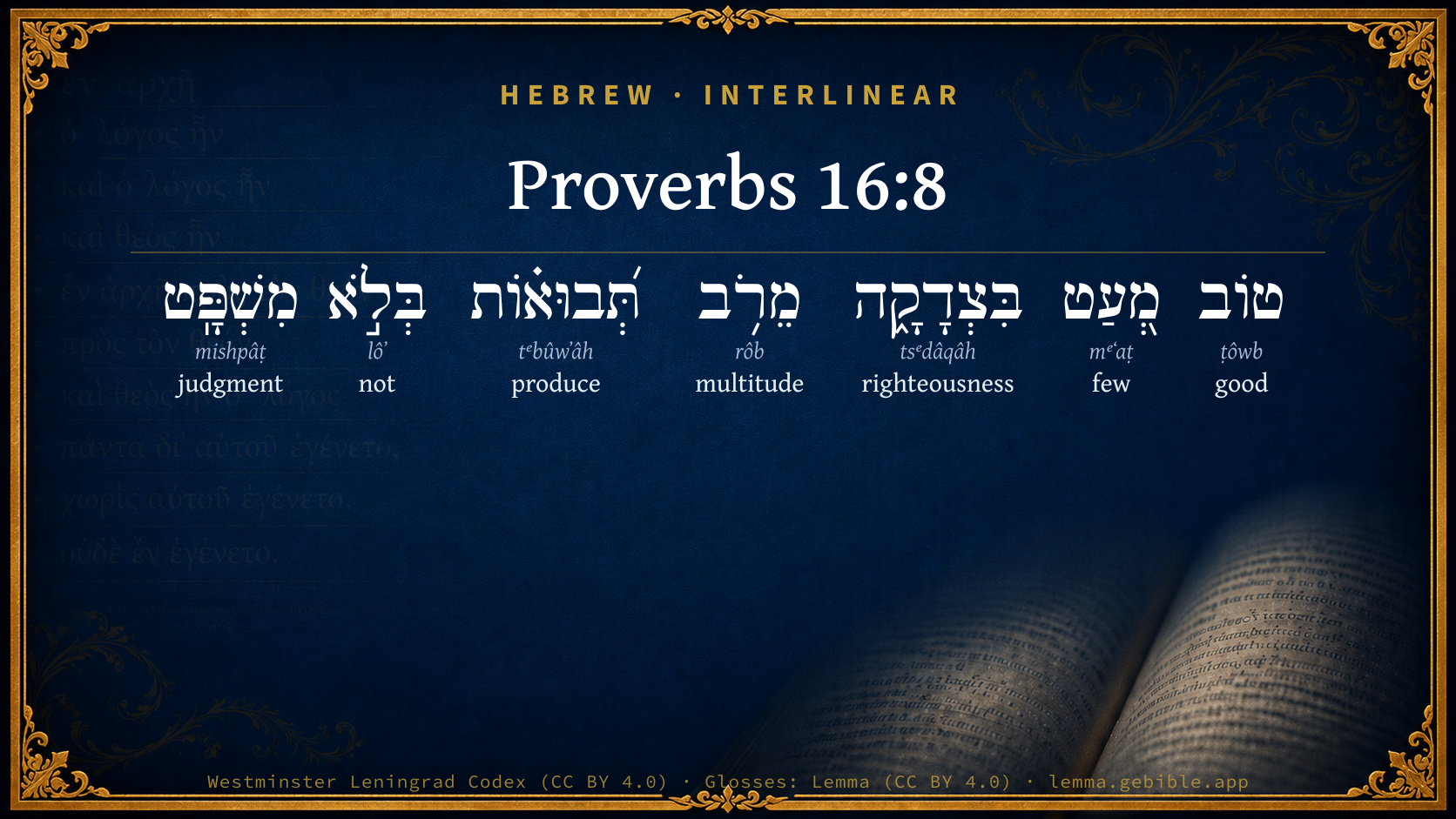
Hebrew (Westminster Leningrad Codex) Proverbs 16:8 appears in the Hebrew Old Testament. The text above is from the Westminster Leningrad Codex. Each word links to its Strong’s number, a concise gloss, and parsing drawn from the Open Scriptures Hebrew Bible morphology. Click any word for its full Brown-Driver-Briggs (BDB) entry.
Download image
Cite this verse

Proverbs 16:8 (World English Bible). Public Domain. Lemma interlinear Bible study tool, https://lemma.gebible.app/v/proverbs/16/8.

Show BibTeX & RIS
BibTeX
RIS
English Translation
Better is a little with righteousness, Than great revenues with injustice.
World English Bible · Public Domain
Download a study sheet

One document with this verse’s original text, its word-by-word gloss line, the meaning frame, cross-references with their text, attributed commentary, and full source and license credits — printable, and it pastes into notes with its structure intact.

This verse Autodidact and up

Study sheet (.html) Plain text (.txt)

A passage Seminary Student

Up to 50 verses in one chapter. A passage sheet keeps up to 6 commentary sources and 12 cross-references per verse, in the order this page ranks them, and says so on the sheet whenever that leaves anything out. Ask for a single verse and you get the Autodidact verse sheet above.

Everything on this page stays free to read, with no account — the sheet is a download of what is already on screen, not access to it.

Want to remove ads? Support Godless Engineer
Compare translations 3

The same verse in 3 English versions, stacked beneath the original-language interlinear above. Click any original word for its lexicon entry.

Each is an independent rendering of the whole verse — the interlinear is not word-aligned to these translations.

Highlighted words mark where these versions differ — a whole-verse word diff, not a word-by-word alignment.

  • World English Bible Public Domain
    Better is a little with righteousness, Than great revenues with injustice.
  • King James Version Public Domain
    Better is a little with righteousness than great revenues without right.
  • unfoldingWord Literal Text CC BY-SA 4.0
    Better a little with righteousness than an abundance of produce with no justice.

unfoldingWord Literal Text — © unfoldingWord, licensed CC BY-SA 4.0. Word-aligned USFM3 via Door43 (git.door43.org/unfoldingWord/en_ult).

Versions to compare (up to 4)

3 of 4 selected

Show all 18 translations

Every available English version of this verse, each an independent rendering of the whole verse.

  • World English Bible Public Domain
    Better is a little with righteousness, Than great revenues with injustice.
  • Berean Standard Bible Public Domain
    Better a little with righteousness than great gain with injustice.
  • Majority Standard Bible Public Domain
    Better a little with righteousness than great gain with injustice.
  • King James Version Public Domain
    Better is a little with righteousness than great revenues without right.
  • American Standard Version (1901) Public Domain
    Better is a little, with righteousness, Than great revenues with injustice.
  • Revised Version (1885) Public Domain
    Better is a little with righteousness than great revenues with injustice.
  • Geneva Bible (1599) Public Domain
    Better is a litle with righteousnesse, then great reuenues without equitie.
  • Douay-Rheims (1899) Public Domain
    Better is a little with justice, than great revenues with iniquity.
  • Young's Literal Translation Public Domain
    Better `is' a little with righteousness, Than abundance of increase without justice.
  • Literal Standard Version CC BY-SA 4.0
    Better [is] a little with righteousness, || Than abundance of increase without justice.
  • Unlocked Literal Bible CC BY-SA 4.0
    Better is a little with what is right, than a large income with injustice.
  • unfoldingWord Literal Text CC BY-SA 4.0
    Better a little with righteousness than an abundance of produce with no justice.
  • Darby Bible Public Domain
    Better is a little with righteousness, than great revenues without right.
  • World Messianic Bible Public Domain
    Better is a little with righteousness, than great revenues with injustice.
  • Webster's Bible Public Domain
    Better is a little with righteousness, than great revenues without right.
  • Free Bible Version CC BY-SA 4.0
    Better to have just a little and be honest than to have a lot and be dishonest.
  • Bible in Basic English Public Domain
    Better is a little with righteousness, than great wealth with wrongdoing.
  • JPS Tanakh (1917) Public Domain
    Better is a little with righteousness than great revenues with injustice.

Literal Standard Version (2020), Covenant Press — licensed CC BY-SA 4.0. Text via the HelloAO Bible API (eBible.org). Unlocked Literal Bible (unfoldingWord) — licensed CC BY-SA 4.0. Text via the HelloAO Bible API (eBible.org). unfoldingWord Literal Text — © unfoldingWord, licensed CC BY-SA 4.0. Word-aligned USFM3 via Door43 (git.door43.org/unfoldingWord/en_ult). Free Bible Version, Dr. Jonathan Gallagher — licensed CC BY-SA 4.0. Text via the HelloAO Bible API (eBible.org).

Word by word

More ways to search: Search by grammar → Find every occurrence → Compare this word →

Practice this passage: Drill this verse → Learn its vocabulary →

About this verse

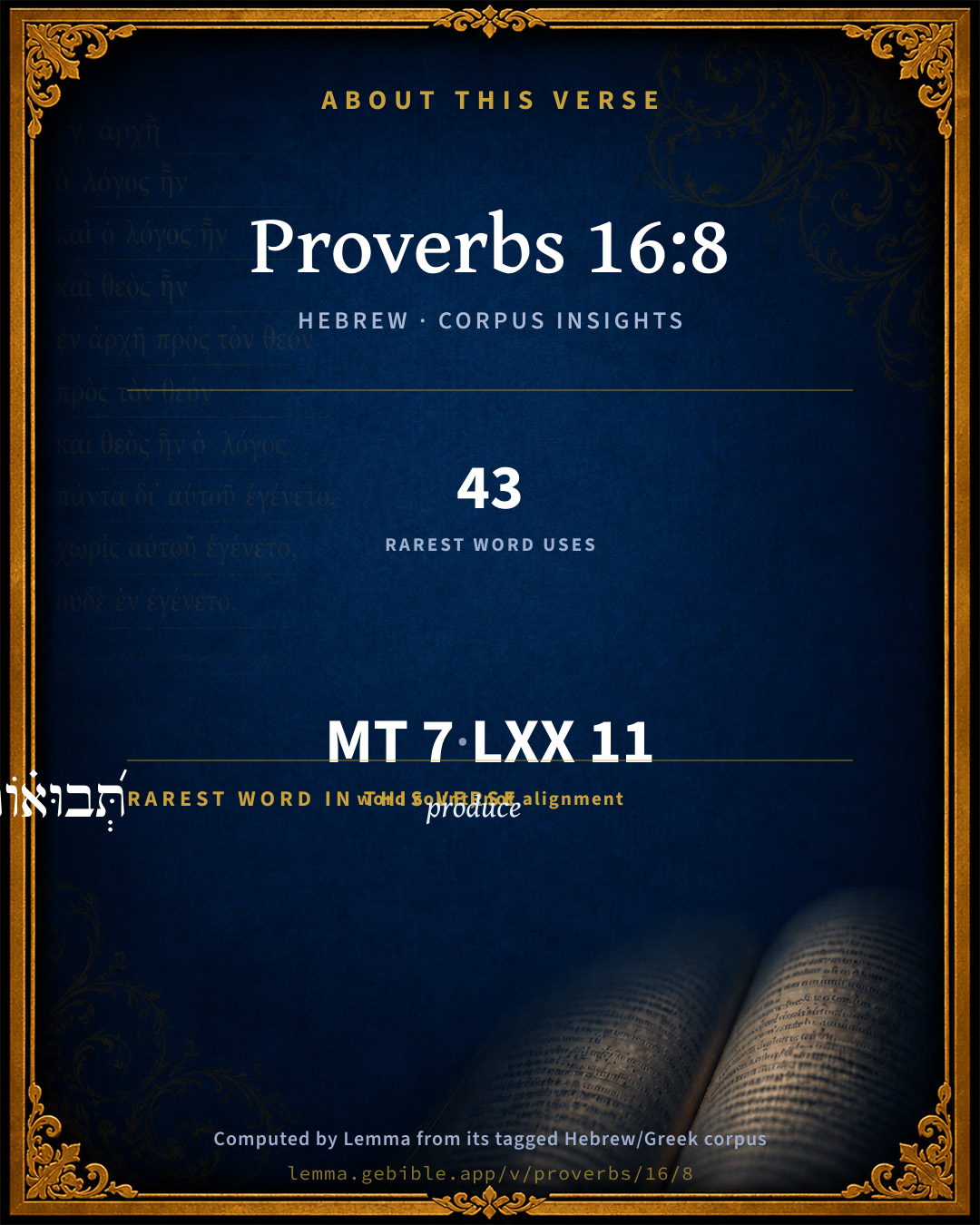
These counts appear in no published source. They are computed here, from the morphology-tagged text and Lemma’s own curated glosses. What Lemma adds →

7
words
7
distinct lemmas
Wisdom
section

Shared distinctive vocabulary

תְּ֝בוּא֗וֹת produce H8393 occurs in 40 verses of the Hebrew Bible. Also found in:

Grammatical profile

  • 5 nouns
  • 1 adjective
  • 1 particle

Hebrew & Septuagint length

In the original languages it is 7 Hebrew tokens and 11 Greek tokens — but the two are counted differently (Hebrew bundles its prefixes and suffixes into one token; the Greek is in lemma form), so that isn’t a like-for-like length.

Cross-references

6

Topical passages linked to Proverbs 16:8 in the Treasury of Scripture Knowledge — connected by theme and wording, ordered by reader-vote popularity; previews shown in the World English Bible.

  • Psalms 37:16 Better is a little that the righteous has, Than the abundance of many wicked.
  • Proverbs 15:16 Better is little, with the fear of Yahweh, Than great treasure with trouble.
  • 1 Timothy 6:6–9 But godliness with contentment is great gain.
  • Jeremiah 17:11 As the partridge that sits on [eggs] which she has not laid, so is he who gets riches, and not by right; in the midst of his days they shall leave him, and at his end he shall be a fool.
  • Proverbs 21:6–7 Getting treasures by a lying tongue Is a fleeting vapor for those who seek death.
  • Micah 6:10 Are there yet treasures of wickedness in the house of the wicked, And a short ephah that is accursed?

Cross-references courtesy of OpenBible.info (CC BY 4.0).

Hebrew and Greek witnesses Masoretic Hebrew ↔ Greek Septuagint

The same verse in the two great witnesses to the Old Testament, shown verse-for-verse.

These are two independent witnesses, not word-aligned to each other, and the Septuagint is shown in lemma (dictionary) form.

Hebrew Proverbs 16:8 Masoretic · Westminster Leningrad Codex

טוֹב מְ֭עַט בִּצְדָקָ֑ה מֵרֹ֥ב תְּ֝בוּא֗וֹת בְּלֹ֣א מִשְׁפָּֽט

Better is a little with righteousness, Than great revenues with injustice.

World English Bible · Public Domain

Greek LXX Proverbs 16:8 Septuagint · lemma form

βδέλυγμα βασιλεύς ὁ ποιέω κακός μετά γάρ δικαιοσύνη ἑτοιμάζω θρόνος ἀρχή

No English rendering of this Greek verse — the small residue in the structurally divergent books.

On this verse, The Pulpit Commentary discusses the Septuagint’s reading. Read the note in Commentary ↓

Hebrew: Westminster Leningrad Codex (CC BY 4.0). Greek: Septuagint (public domain); English from a public-domain English Septuagint. How the Septuagint differs from the Hebrew →

Commentary

Notes on Proverbs 16:8 from classic Christian and Jewish commentators (each source and its license shown beneath its notes). The classic Christian expositions comment on the surrounding passage and are grouped to its opening verse, so a note may address several verses; the Jewish commentaries on the Tanakh (Rashi and others) are per-verse, so they appear only where the commentator wrote on this verse.

Lemma curates 59 commentaries, every one of them public domain or Creative Commons licensed, each selected and text-cleaned for this edition rather than reprinted as found. About our sources →

Trapp's Complete Commentary

John Trapp

Pro 16:8 Better [is] a little with righteousness than great revenues without right.

Ver. 8. Better is a little with righteousness, &c.] A small stock well gotten is more comfortably enjoyed and bequeathed to posterity than a cursed hoard of evil gotten goods. The reason why people "please not God, and are contrary to all men" - as this verse refers to the former - is, because they prefer gain before God, and care not how they wrong men so they may have it. See Pro 15:16.

John Trapp, A Commentary or Exposition upon All the Books of the Old and New Testament (1647–1656) — public domain. Text from a community e-Sword module.

Joseph Benson's Commentary

Pro 16:8. Better is a little, &c. — A small estate, honestly gotten and usefully employed, is much to be preferred before vast incomes, gathered by oppression, and kept without the exercise of mercy and charity. This was, in effect, said before, Pro 15:16, (where see the note,) and is here repeated, partly because of the great importance and usefulness of this truth, and partly because men are very hardly brought to a serious belief of it.

Joseph Benson's Commentary on the Old and New Testaments (1811–1818) — public domain. Text from a community e-Sword module.

Tyndale Open Study Notes

Tyndale Open Resources

16:8 Better to have little: See also 15:16.

Tyndale Open Study Notes — © Tyndale Open Resources, licensed CC BY-SA 4.0. Text via the HelloAO Bible API.

Matthew Henry's Commentary

Here, 1. It is supposed that an honest good man may have but a little of the wealth of this world (all the righteous are not rich), - that a man may have but little, and yet may be honest (though poverty is a temptation to dishonesty, Pro 30:9, yet not an invincible one), - and that a man may grow rich, for a while, by fraud and oppression, may have great revenues, and those got and kept without right, may have no good title to them nor make any good use of them. 2. It is maintained that a small estate, honestly come by, which a man is content with, enjoys comfortably, serves God with cheerfully, and puts to a right use, is much better and more valuable than a great estate ill-got, and then ill-kept or ill-spent. It carries with it more inward satisfaction, a better reputation with all that are wise and good; it will last longer, and will turn to a better account in the great day, when men will be judged, not according to what they had, but what they did.

Matthew Henry's Commentary on the Whole Bible (1708–1710) — public domain (CC PDM 1.0). Text via the HelloAO Bible API.

Jamieson, Fausset & Brown

Robert Jamieson, A. R. Fausset & David Brown

(Compare Pro 15:6, Pro 15:16-17).

Jamieson, Fausset & Brown — Commentary Critical and Explanatory on the Whole Bible (1871) — public domain (CC PDM 1.0). Text via the HelloAO Bible API.

The Cambridge Bible for Schools and Colleges

gen. ed. J. J. S. Perowne

8. without right] Rather, with injustice, R.V., as preserving better the parallelism. Comp. Pro_15:16.

The Cambridge Bible for Schools and Colleges (gen. ed. J. J. S. Perowne; Cambridge University Press, 1878–1918) — public domain. Text from a community e-Sword module.

John Gill's Exposition

Better is a little with righteousness,.... Gotten in a righteous way, held by a righteous claim, used in a righteous manner, attended with a life of righteousness and holiness; and also along with an interest in the righteousness of Christ, which renders acceptable unto God, yields peace and comfort, and entitles to eternal glory and happiness. A truly righteous man may have but little of this world's goods; but his small pittance is better

than great revenues without right; obtained in an unjust way; detained from the right owner of them, and used in an unrighteous manner, in a course of sin and wickedness: or, "without judgment" (e); how to make use of them aright, and without a righteousness that will justify them at the day of judgment; See Gill on Pro 15:16. A little the true church of Christ enjoys in the wilderness; having Christ and his grace, Christ and his righteousness, is better than all the revenues of the church of Rome gotten by the unlawful methods they are; and which, in one hour will come to nought, Rev 18:17.

(e) "absque judicio", Pagninus, Montanus.

John Gill's Exposition of the Whole Bible (1746–1763) — public domain (CC PDM 1.0). Text via the HelloAO Bible API.

Matthew Poole's English Annotations

This was in effect said before, Pro 15:16, and is here repeated, partly because of the great importance and usefulness of this truth, and partly because men are very hardly brought to a serious belief of it.

Matthew Poole's English Annotations on the Holy Bible (1683–1685) — public domain. Text from a community e-Sword/MySword module.

Whedon's Commentary on the Bible

Daniel D. Whedon

8. Without right — משׁפשׂ, (mishpat,) rectitude. The word means what is just, lawful, conformable to law; and which is better than great incomes obtained unlawfully, unjustly. Comp. Pro_15:16; Psa_37:16.

Daniel D. Whedon (gen. ed.), Commentary on the Old and New Testaments (1874–1909) — public domain. Text from a community e-Sword module.

The Pulpit Commentary

Better is a little with righteousness. (Pro_15:16 Psa_37:16) "Righteousness" may mean here a holy life or just dealing; as without right, or, with injustice, in the second clause, may refer either generally wickedness, or specially to fraud and oppression. (Jer_22:13) Says Theognis Bouleo d eusebewn oligoiv sumasin oikein, H ploutein adikwv crhmata pasamenov . "Wish thou with scanty means pious to live, Rather than rich with large, ill-gotten wealth.

Another maxim says to the same effect Leptwv kalwv zhn kreisson h lamprwv kakwv ..

Septuagint, "Better is small getting (lhqiv ) with righteousness, than great revenues with iniquity". (see on Pro_15:29)

The Pulpit Commentary (1880–1919), ed. H.D.M. Spence-Jones & Joseph S. Exell — public domain. Text from a community e-Sword module.

Keil & Delitzsch

C. F. Keil & F. Delitzsch

Five proverbs of the king, together with three of righteousness in action and conduct:

8 Better is a little with righteousness,

Than rich revenues with unrighteousness.

The cogn. proverb Pro 15:16 commences similarly. Of רב תּבוּאות, multitude or greatness of income, vid., Pro 14:4 : "unrighteous wealth profits not." The possessor of it is not truly happy, for sin cleaves to it, which troubles the heart (conscience), and because the enjoyment which it affords is troubled by the curses of those who are injured, and by the sighs of the oppressed. Above all other gains rises ἡ εὐσέβεια μετ ̓ αὐταρκείας (Ti1 6:6).

Keil & Delitzsch — Biblical Commentary on the Old Testament (1861–1891) — public domain (CC PDM 1.0). Text via the HelloAO Bible API. (Old Testament only.)

Bridges on Proverbs

Charles Bridges

We have before had this Proverb in substance (Pro 15:16 ); save that the treasures are more distinctly shewn to be revenues without right. It seems almost too plain to need illustration. Yet so blind is the love of gain, that it looks only at its own selfish end, and the present moment; and fancies, what never can be, enjoyment†1 and security.†2 Retributive justice is at hand.†3 Far better is the little with righteousness. Was not the widow of Zarephath richer with her scanty fare, than Jezebel in her royal attire;†4 the poor prophet, sharing her pittance, than the King with his revenues without right;†5 Zaccheus, when reduced to his comparative little with righteousness, than with his former abundance of "the unrighteous Mammon"?†6 If the sight of a man’s possession stirs envy, his scantiness of enjoyment might shortly melt it away in compassion. We learn the valuable lesson - The fewer desires, the more quiet. This is the present manifestation. Much more clearly will the day declare it. The little righteously employed will then find a gracious acceptance.†7 The treasures of wickedness will be found treasures of wrath eternal.†8

Few however possess great revenues. But the most trifling acquisitions without right will canker. Beware of the hair-breadth deviation from straight principle. "Mortify that member of the earth," which "is idolatry" (Col 3:5 ) against God, and "the root of all evil" to ourselves. (1Ti 6:10 .) Godliness is great riches in this life; what will it be in eternity! (1Ti 5:6 ; 1Ti 4:8 .)

Footnotes:

†1 Psa 127:2. Ecc 5:12 .

†2 Pro 10:3; Pro 21:6-7 . Jer 17:11 .

†3 Jas 5:4.

†4 1Ki 17:10 . 2Ki 9:32-37 .

†5 1Ki 21:19, with 1Ki 17:15

†6 Luk 19:2, Luk 19:8 .

†7 Mat 25:34-40. Luk 16:9 .

†8 Hab 2:6, Hab 2:9, Hab 2:12 . Jas 5:1-3 .

Charles Bridges, An Exposition of the Book of Proverbs (1846) — public domain. Text from a community e-Sword module.

Kretzmann's Popular Commentary

Paul E. Kretzmann

v. 8. Better is a little with righteousness, small possessions gained and kept with a good conscience, than great revenues, a large income and great wealth, without right, having been gained by oppression and iniquity.

Paul E. Kretzmann, Popular Commentary of the Bible (1921–1924) — public domain. Text from a community e-Sword module.

Lesson kit

Teaching starters — assembled from the data on this page, not authored interpretation. Every prompt links to the verse data it draws on. Edit before teaching.

Proverbs, in the Wisdom, opens this verse with 7 words (7 distinct Hebrew lemmas). Its most distinctive word is tᵉbûwʼâh (“produce”). A historical commentator’s framing appears above. Read the whole chapter for the surrounding context.

Discussion questions

  1. The word tᵉbûwʼâh carries the sense “produce.” How does it shape the verse?
  2. Genesis 47:24 shares the word «produce» with this verse. How do the two illuminate each other?
  3. These translations render this verse differently. What is at stake in choosing one wording over another?
  4. Reading how Trapp's Complete Commentary and Joseph Benson's Commentary read this verse, where do the two commentators agree and where do they part?

Things to notice

Reading settings

Reading text

Shown beneath each verse's original-language words.

Old Testament
Old Testament edition

Read the OT as the Masoretic Hebrew (MT) or the Greek Septuagint (LXX).

English shown for the Greek Septuagint (in the Hebrew ↔ Greek comparison).

Comparing translations? Open the Compare panel on any verse page to stack up to four side by side.