
Lamentations 1:5

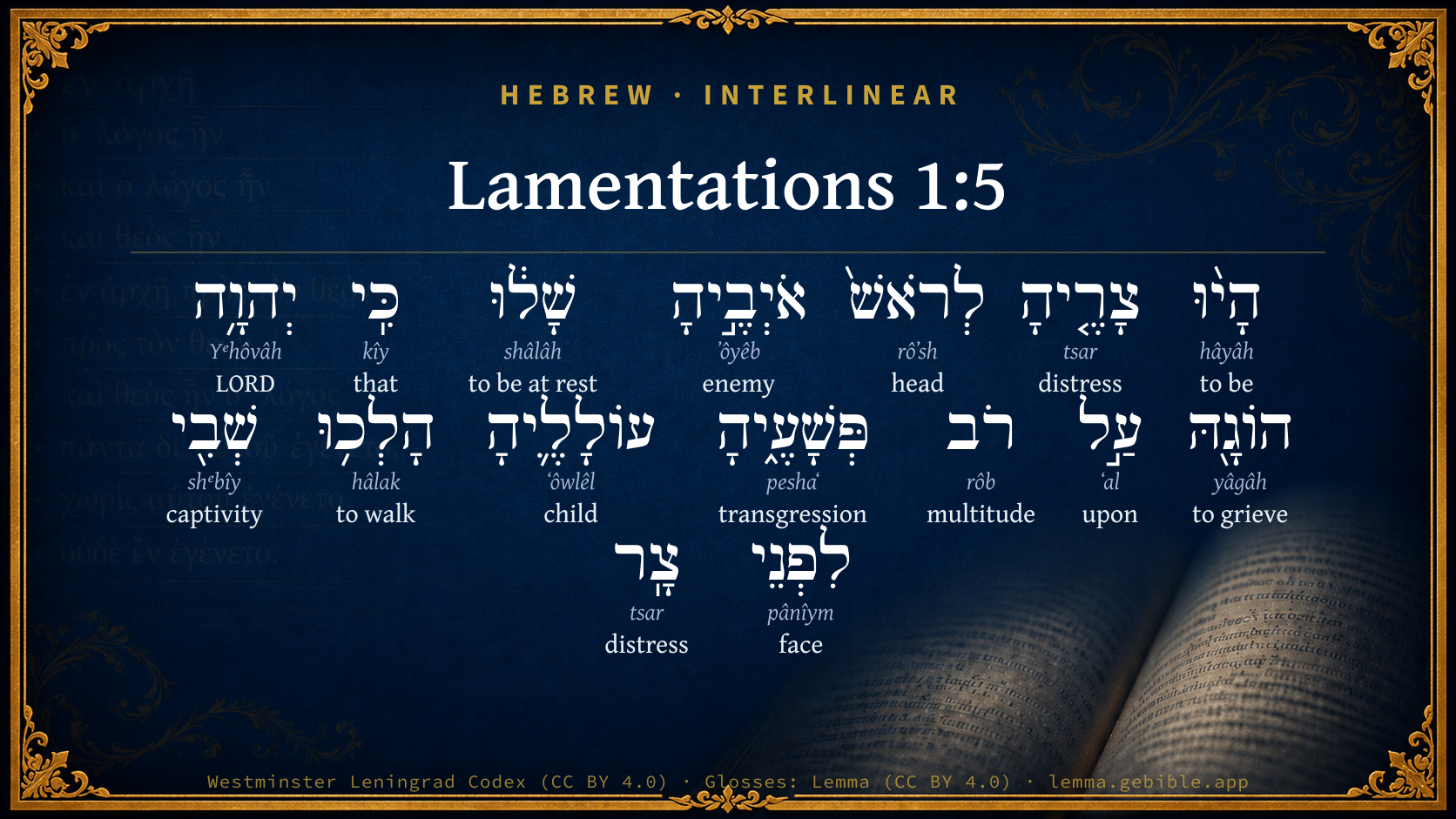
Hebrew (Westminster Leningrad Codex) Lamentations 1:5 appears in the Hebrew Old Testament. The text above is from the Westminster Leningrad Codex. Each word links to its Strong’s number, a concise gloss, and parsing drawn from the Open Scriptures Hebrew Bible morphology. Click any word for its full Brown-Driver-Briggs (BDB) entry.
Download image
Cite this verse

Lamentations 1:5 (World English Bible). Public Domain. Lemma interlinear Bible study tool, https://lemma.gebible.app/v/lamentations/1/5.

Show BibTeX & RIS
BibTeX
RIS
English Translation
Her adversaries are become the head, her enemies prosper; For Yahweh has afflicted her for the multitude of her transgressions: Her young children are gone into captivity before the adversary.
World English Bible · Public Domain
Download a study sheet

One document with this verse’s original text, its word-by-word gloss line, the meaning frame, cross-references with their text, attributed commentary, and full source and license credits — printable, and it pastes into notes with its structure intact.

This verse Autodidact and up

Study sheet (.html) Plain text (.txt)

A passage Seminary Student

Up to 50 verses in one chapter. A passage sheet keeps up to 6 commentary sources and 12 cross-references per verse, in the order this page ranks them, and says so on the sheet whenever that leaves anything out. Ask for a single verse and you get the Autodidact verse sheet above.

Everything on this page stays free to read, with no account — the sheet is a download of what is already on screen, not access to it.

Want to remove ads? Support Godless Engineer
Compare translations 3

The same verse in 3 English versions, stacked beneath the original-language interlinear above. Click any original word for its lexicon entry.

Each is an independent rendering of the whole verse — the interlinear is not word-aligned to these translations.

Highlighted words mark where these versions differ — a whole-verse word diff, not a word-by-word alignment.

  • World English Bible Public Domain
    Her adversaries are become the head, her enemies prosper; For Yahweh has afflicted her for the multitude of her transgressions: Her young children are gone into captivity before the adversary.
  • King James Version Public Domain
    Her adversaries are the chief, her enemies prosper; for the LORD hath afflicted her for the multitude of her transgressions: her children are gone into captivity before the enemy.
  • unfoldingWord Literal Text CC BY-SA 4.0
    Her adversaries have become the head; her enemies are prospering, for Yahweh has afflicted her over the greatness of her transgressions. Her children have gone away as captives before the adversary. WAW

unfoldingWord Literal Text — © unfoldingWord, licensed CC BY-SA 4.0. Word-aligned USFM3 via Door43 (git.door43.org/unfoldingWord/en_ult).

Versions to compare (up to 4)

3 of 4 selected

Show all 18 translations

Every available English version of this verse, each an independent rendering of the whole verse.

  • World English Bible Public Domain
    Her adversaries are become the head, her enemies prosper; For Yahweh has afflicted her for the multitude of her transgressions: Her young children are gone into captivity before the adversary.
  • Berean Standard Bible Public Domain
    Her foes have become her masters; her enemies are at ease. For the LORD has brought her grief because of her many transgressions. Her children have gone away as captives before the enemy.
  • Majority Standard Bible Public Domain
    Her foes have become her masters; her enemies are at ease. For the LORD has brought her grief because of her many transgressions. Her children have gone away as captives before the enemy.
  • King James Version Public Domain
    Her adversaries are the chief, her enemies prosper; for the LORD hath afflicted her for the multitude of her transgressions: her children are gone into captivity before the enemy.
  • American Standard Version (1901) Public Domain
    Her adversaries are become the head, her enemies prosper; For Jehovah hath afflicted her for the multitude of her transgressions: Her young children are gone into captivity before the adversary.
  • Revised Version (1885) Public Domain
    Her adversaries are become the head, her enemies prosper; for the LORD hath afflicted her for the multitude of her transgressions: her young children are gone into captivity before the adversary.
  • Geneva Bible (1599) Public Domain
    Her aduersaries are the chiefe, and her enemies prosper: for the Lord hath afflicted her, for the multitude of her transgressions, and her children are gone into captiuitie before the enemie.
  • Douay-Rheims (1899) Public Domain
    He. Her adversaries are become her lords, her enemies are enriched: because the Lord hath spoken against her for the multitude of her iniquities: her children are led into captivity: before the face of the oppressor.
  • Young's Literal Translation Public Domain
    Her adversaries have become chief, Her enemies have been at ease, For Jehovah hath afflicted her, For the abundance of her transgressions, Her infants have gone captive before the adversary.
  • Literal Standard Version CC BY-SA 4.0
    Her adversaries have become chief, || Her enemies have been at ease, || For YHWH has afflicted her, || For the abundance of her transgressions, || Her infants have gone captive before the adversary.
  • Unlocked Literal Bible CC BY-SA 4.0
    Her adversaries have become her master; her enemies prosper. Yahweh has afflicted her for her many sins. Her little children go into captivity to her adversary.
  • unfoldingWord Literal Text CC BY-SA 4.0
    Her adversaries have become the head; her enemies are prospering, for Yahweh has afflicted her over the greatness of her transgressions. Her children have gone away as captives before the adversary. WAW
  • Darby Bible Public Domain
    Her adversaries have become the head, her enemies prosper; for Jehovah hath afflicted her for the multitude of her transgressions: her children are gone into captivity before the adversary.
  • World Messianic Bible Public Domain
    Her adversaries have become the head. Her enemies prosper; for the LORD has afflicted her for the multitude of her transgressions. Her young children have gone into captivity before the adversary.
  • Webster's Bible Public Domain
    Her adversaries are the chief, her enemies prosper; for the LORD hath afflicted her for the multitude of her transgressions: her children are gone into captivity before the enemy.
  • Free Bible Version CC BY-SA 4.0
    Those who hated her now control her; her enemies enjoy life, because the Lord has made her suffer due to all her sins of rebellion. Her children have been taken away as prisoners of the enemy.
  • Bible in Basic English Public Domain
    Those who are against her have become the head, everything goes well for her haters; for the Lord has sent sorrow on her because of the great number of her sins: her young children have gone away as prisoners before the attacker.
  • JPS Tanakh (1917) Public Domain
    Her adversaries are become the head, her enemies are at ease; for the LORD hath afflicted her for the multitude of her transgressions; her young children are gone into captivity before the adversary.

Literal Standard Version (2020), Covenant Press — licensed CC BY-SA 4.0. Text via the HelloAO Bible API (eBible.org). Unlocked Literal Bible (unfoldingWord) — licensed CC BY-SA 4.0. Text via the HelloAO Bible API (eBible.org). unfoldingWord Literal Text — © unfoldingWord, licensed CC BY-SA 4.0. Word-aligned USFM3 via Door43 (git.door43.org/unfoldingWord/en_ult). Free Bible Version, Dr. Jonathan Gallagher — licensed CC BY-SA 4.0. Text via the HelloAO Bible API (eBible.org).

Word by word

More ways to search: Search by grammar → Find every occurrence → Compare this word →

Practice this passage: Drill this verse → Learn its vocabulary →

שָׁל֔וּ
shâlâh
H7951
“to be at rest”
Verb, Qal, Perfect, 3rd Person, Common, Plural
Part of Speech
Verb
Stem
Qal
Form
Perfect
Person
3rd Person
Gender
Common
Number
Plural
Full BDB Definition

Origin: a primitive root

TWOT: 2392

to be at rest, prosper, be quiet, be at ease - (Qal) - to be or have quiet - to be at ease, prosper
  1. הָי֨וּ hâyâh H1961 “to be” Verb, Qal, Perfect, 3rd Person, Common, Plural
  2. צָרֶ֤יהָ tsar H6862 “distresses · her” Noun, Common, Masculine, Plural, Construct + Suffix, Personal, 3rd Person, Feminine, Singular
  3. לְרֹאשׁ֙ rôʼsh H7218 “to/for · head” Preposition + Noun, Common, Masculine, Singular, Absolute
  4. אֹיְבֶ֣יהָ ʼôyêb H341 “enemy · her” Verb, Qal, Participle Active, Masculine, Plural, Construct + Suffix, Personal, 3rd Person, Feminine, Singular
  5. כִּֽי kîy H3588 “that” Conjunction
  6. יְהוָ֥ה Yᵉhôvâh H3068 “LORD” Noun, Proper
  7. הוֹגָ֖הּ yâgâh H3013 “to grieve · her” Verb, Hiphil, Perfect, 3rd Person, Masculine, Singular + Suffix, Personal, 3rd Person, Feminine, Singular
  8. עַ֣ל ʻal H5921 “upon” Preposition
  9. רֹב rôb H7230 “multitude of” Noun, Common, Both, Singular, Construct
  10. פְּשָׁעֶ֑יהָ peshaʻ H6588 “transgressions · her” Noun, Common, Masculine, Plural, Construct + Suffix, Personal, 3rd Person, Feminine, Singular
  11. עוֹלָלֶ֛יהָ ʻôwlêl H5768 “children · her” Noun, Common, Masculine, Plural, Construct + Suffix, Personal, 3rd Person, Feminine, Singular
  12. הָלְכ֥וּ hâlak H1980 “to walk” Verb, Qal, Perfect, 3rd Person, Common, Plural
  13. שְׁבִ֖י shᵉbîy H7628 “captivity” Noun, Common, Both, Singular, Absolute
  14. לִפְנֵי pânîym H6440 “to/for · face(s) of” Preposition + Noun, Common, Both, Plural, Construct
  15. צָֽר tsar H6862 “distress” Noun, Common, Masculine, Singular, Absolute

About this verse

These counts appear in no published source. They are computed here, from the morphology-tagged text and Lemma’s own curated glosses. What Lemma adds →

16
words
15
distinct lemmas
Prophets
section

Notable vocabulary

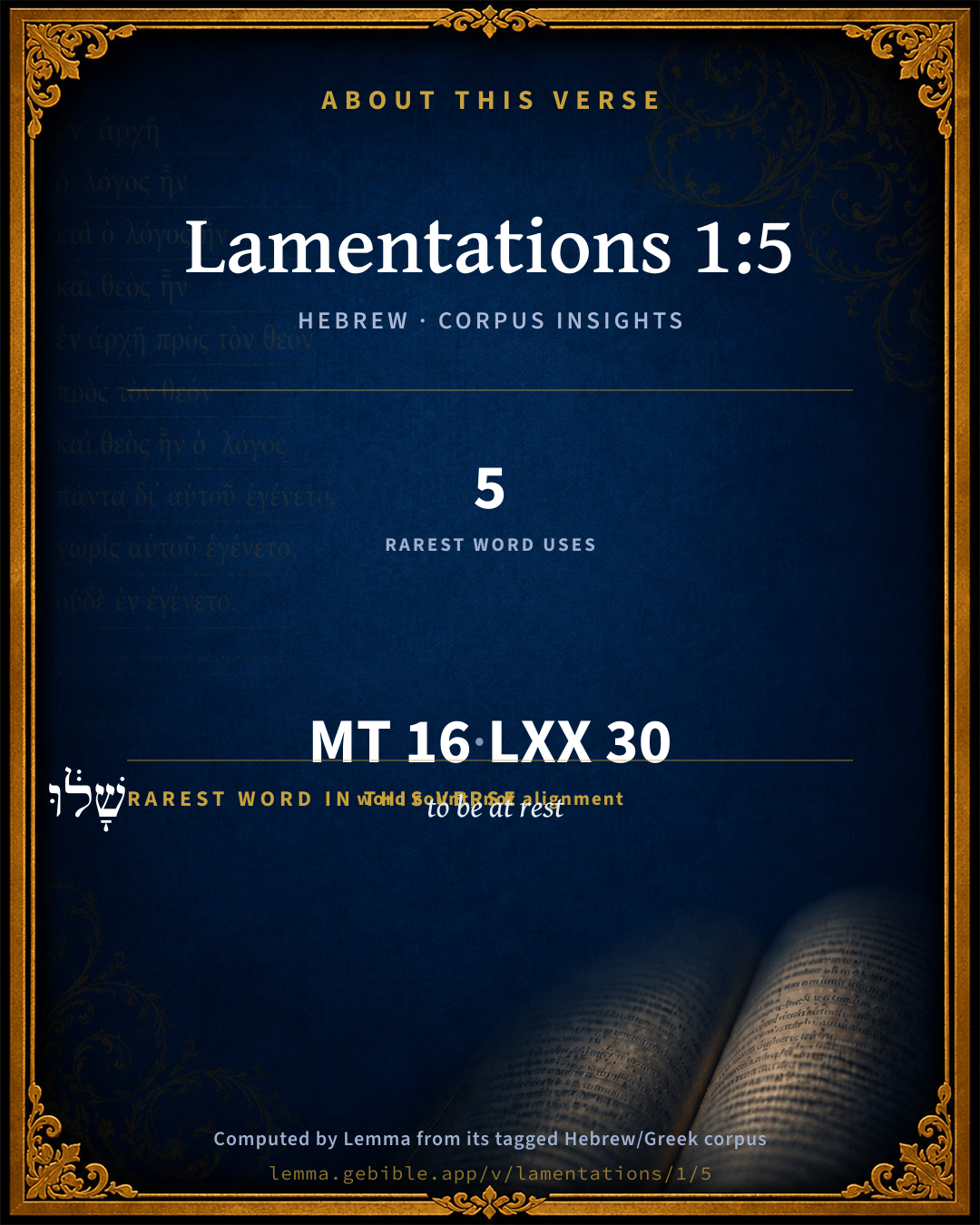
The rarest word here is שָׁל֔וּ to be at rest H7951 — appearing just 5 times in the whole Hebrew Bible.

Shared distinctive vocabulary

שָׁל֔וּ to be at rest H7951 occurs in 5 verses of the Hebrew Bible. Also found in:

Grammatical profile

  • 5 verbs
  • 9 nouns
  • 1 preposition
  • 1 conjunction

Verb forms

  • הָי֨וּ Qal · Perfect
  • אֹיְבֶ֣יהָ Qal · Participle Active
  • שָׁל֔וּ Qal · Perfect
  • הוֹגָ֖הּ Hiphil · Perfect
  • הָלְכ֥וּ Qal · Perfect

Repetition

A word recurs within this verse — often emphatic in Hebrew:

  • צָרֶ֤יהָ distress H6862 ×2

Hebrew & Septuagint length

In English translation the verse runs 30 words from the Hebrew and 38 from the Septuagint (LXX English) — closely comparable.

A rough comparison of the two English renderings, which tokenize alike — not a word-level alignment.

Word counts can differ between the Hebrew and the Greek without any difference in meaning — e.g. the Hebrew direct-object marker אֵת has no separate Greek word, and Greek often adds the article ὁ.

In the original languages it is 16 Hebrew tokens and 30 Greek tokens — but the two are counted differently (Hebrew bundles its prefixes and suffixes into one token; the Greek is in lemma form), so that isn’t a like-for-like length.

Cross-references

32

Topical passages linked to Lamentations 1:5 in the Treasury of Scripture Knowledge — connected by theme and wording, ordered by reader-vote popularity; previews shown in the World English Bible.

  • Deuteronomy 32:15–27 But Jeshurun grew fat, and kicked: You have grown fat, you are grown thick, you are become sleek; Then he forsook God who made him, Lightly esteemed the Rock of his salvation.
  • Psalms 90:7–8 For we are consumed in your anger. We are troubled in your wrath.
  • Jeremiah 30:14–15 All your lovers have forgotten you; they don't seek you: for I have wounded you with the wound of an enemy, with the chastisement of a cruel one, for the greatness of your iniquity, because your sins were increased.
  • Jeremiah 39:9 Then Nebuzaradan the captain of the guard carried away captive into Babylon the residue of the people who remained in the city, the deserters also who fell away to him, and the residue of the people who remained.
  • Ezekiel 8:17–18 Then he said to me, Have you seen [this], son of man? Is it a light thing to the house of Judah that they commit the abominations which they commit here? for they have filled the land with violence, and have turned again to provoke me to anger: and, behold, they put the branch to their nose.
  • Ezekiel 9:9 Then said he to me, The iniquity of the house of Israel and Judah is exceeding great, and the land is full of blood, and the city full of wrestling [of judgment]: for they say, Yahweh has forsaken the land, and Yahweh doesn't see.
  • Leviticus 26:15–46 and if you shall reject my statutes, and if your soul abhors my ordinances, so that you will not do all my commandments, but break my covenant;
  • Deuteronomy 4:25–27 When you shall father children, and children's children, and you shall have been long in the land, and shall corrupt yourselves, and make an engraved image in the form of anything, and shall do that which is evil in the sight of Yahweh your God, to provoke him to anger;
  • Deuteronomy 28:15–68 But it shall come to pass, if you will not listen to the voice of Yahweh your God, to observe to do all his commandments and his statutes which I command you this day, that all these curses shall come on you, and overtake you.
  • Deuteronomy 29:18–28 lest there should be among you man, or woman, or family, or tribe, whose heart turns away this day from Yahweh our God, to go to serve the gods of those nations; lest there should be among you a root that bears gall and wormwood;
  • Deuteronomy 31:16–18 Yahweh said to Moses, Behold, you shall sleep with your fathers; and this people will rise up, and play the prostitute after the strange gods of the land, where they go to be among them, and will forsake me, and break my covenant which I have made with them.
  • Deuteronomy 31:29 For I know that after my death you will utterly corrupt yourselves, and turn aside from the way which I have commanded you; and evil will happen to you in the latter days; because you will do that which is evil in the sight of Yahweh, to provoke him to anger through the work of your hands.
  • 2 Chronicles 36:14–16 Moreover all the chiefs of the priests, and the people, trespassed very greatly after all the abominations of the nations; and they polluted the house of Yahweh which he had made holy in Jerusalem.
  • Nehemiah 9:33–34 However you are just in all that is come on us; for you have dealt truly, but we have done wickedly;
  • Psalms 80:6 You make us a source of contention to our neighbors. Our enemies laugh among themselves.
  • Psalms 89:42 You have exalted the right hand of his adversaries. You have made all of his enemies rejoice.
  • Isaiah 63:18 Your holy people possessed [it] but a little while: our adversaries have trodden down your sanctuary.
  • Jeremiah 5:3–9 O Yahweh, don't your eyes look on truth? you have stricken them, but they were not grieved; you have consumed them, but they have refused to receive correction: they have made their faces harder than a rock; they have refused to return.
  • Jeremiah 5:29 Shall I not visit for these things? says Yahweh; shall not my soul be avenged on such a nation as this?
  • Jeremiah 12:7 I have forsaken my house, I have cast off my heritage; I have given the dearly beloved of my soul into the hand of her enemies.
  • Jeremiah 23:14 In the prophets of Jerusalem also I have seen a horrible thing: they commit adultery, and walk in lies; and they strengthen the hands of evil-doers, so that none does return from his wickedness: they are all of them become to me as Sodom, and the inhabitants of it as Gomorrah.
  • Jeremiah 44:21–22 The incense that you burned in the cities of Judah, and in the streets of Jerusalem, you and your fathers, your kings and your princes, and the people of the land, didn't Yahweh remember them, and didn't it come into his mind?
  • Jeremiah 52:27–30 The king of Babylon struck them, and put them to death at Riblah in the land of Hamath. So Judah was carried away captive out of his land.
  • Lamentations 1:18 Yahweh is righteous; for I have rebelled against his commandment: Please hear all you peoples, and see my sorrow: My virgins and my young men are gone into captivity.
  • Lamentations 2:17 Yahweh has done that which he purposed; he has fulfilled his word that he commanded in the days of old; He has thrown down, and has not pitied: He has caused the enemy to rejoice over you; he has exalted the horn of your adversaries.
  • Lamentations 3:39–43 Why does a living man complain, a man for the punishment of his sins?
  • Lamentations 3:46 All our enemies have opened their mouth wide against us.
  • Ezekiel 22:24–31 Son of man, tell her, You are a land that is not cleansed, nor rained on in the day of indignation.
  • Daniel 9:7–16 Lord, righteousness belongs to you, but to us confusion of face, as at this day; to the men of Judah, and to the inhabitants of Jerusalem, and to all Israel, who are near, and who are far off, through all the countries where you have driven them, because of their trespass that they have trespassed against you.
  • Micah 3:9–12 Please listen to this, you heads of the house of Jacob, And rulers of the house of Israel, Who abhor justice, And pervert all equity.
  • Micah 7:8–10 Don't rejoice against me, my enemy. When I fall, I will arise. When I sit in darkness, Yahweh will be a light to me.
  • Zephaniah 3:1–8 Woe to her who is rebellious and polluted, the oppressing city!

Cross-references courtesy of OpenBible.info (CC BY 4.0).

Hebrew and Greek witnesses Masoretic Hebrew ↔ Greek Septuagint

The same verse in the two great witnesses to the Old Testament, shown verse-for-verse.

These are two independent witnesses, not word-aligned to each other, and the Septuagint is shown in lemma (dictionary) form.

Hebrew Lamentations 1:5 Masoretic · Westminster Leningrad Codex

הָי֨וּ צָרֶ֤יהָ לְרֹאשׁ֙ אֹיְבֶ֣יהָ שָׁל֔וּ כִּֽי יְהוָ֥ה הוֹגָ֖הּ עַ֣ל רֹב פְּשָׁעֶ֑יהָ עוֹלָלֶ֛יהָ הָלְכ֥וּ שְׁבִ֖י לִפְנֵי צָֽר

Her adversaries are become the head, her enemies prosper; For Yahweh has afflicted her for the multitude of her transgressions: Her young children are gone into captivity before the adversary.

World English Bible · Public Domain

Greek LXX Lamentations 1:5 Septuagint · lemma form

γίγνομαι ὁ θλίβω αὐτός εἰς κεφαλή καί ὁ ἐχθρός αὐτός εὐθηνέω ὅτι κύριος ταπεινόω αὐτός ἐπί ὁ πλῆθος ὁ ἀσέβεια αὐτός ὁ νήπιος αὐτός πορεύομαι ἐν αἰχμαλωσία κατά πρόσωπον θλίβω

HE. Her oppressors are become the head, and her enemies have prospered; for the Lord has afflicted her because of the multitude of her sins: her young children are gone into captivity before the face of the oppressor.

LXX2012 (modern English Septuagint) · Public Domain

On this verse, Keil & Delitzsch discusses the Septuagint’s reading. Read the note in Commentary ↓

Hebrew: Westminster Leningrad Codex (CC BY 4.0). Greek: Septuagint (public domain); English from LXX2012 (modern English Septuagint) (Public Domain). How the Septuagint differs from the Hebrew →

Commentary

Notes on Lamentations 1:5 from classic Christian and Jewish commentators (each source and its license shown beneath its notes). The classic Christian expositions comment on the surrounding passage and are grouped to its opening verse, so a note may address several verses; the Jewish commentaries on the Tanakh (Rashi and others) are per-verse, so they appear only where the commentator wrote on this verse.

Lemma curates 59 commentaries, every one of them public domain or Creative Commons licensed, each selected and text-cleaned for this edition rather than reprinted as found. About our sources →

Trapp's Complete Commentary

John Trapp

Lam 1:5 Her adversaries are the chief, her enemies prosper; for the LORD hath afflicted her for the multitude of her transgressions: her children are gone into captivity before the enemy.

Ver. 5. Her adversaries are the chief.] Heb, Are for the head. This was threatened. {Deu 28:13-14; Deu 28:43-44} This, when it happens, is a great grief to the godly. Therefore the prophet Nahum, for the comfort of God’s Israel, is wholly in setting forth the destruction of their enemies, the Assyrians.

Her enemies prosper.] See Jer 12:1. They prevail, and do what they wish; so that there seemeth to be neither hope of better, nor place for worse.

For the Lord hath afflicted her.] Not so much her adversaries and enemies, or her oppressors and haters, as the words properly signify - that is, those that oppress them in action, and hate them in affection. {a}

Her children are gone into captivity.] Those that were able to go; for the rest were slain. {Lam 4:9}

Before the enemy.] Driven before them, as cattle.

{a} Cavet Scriptura ne haec potestas detur adversariis. - Oecolamp.

John Trapp, A Commentary or Exposition upon All the Books of the Old and New Testament (1647–1656) — public domain. Text from a community e-Sword module.

The Biblical Illustrator

Joseph S. Exell

Lam_1:5

Her adversaries are the chief, her enemies prosper.

The adversaries of the good

1. The cause apparent of all the miseries of Gods people is the prospering and prevailing of their enemies.

2. It often comes to pass that the wicked prosper in all things of this life, and the godly contrary (Psa_73:4; Job_21:7).

(1) God will, by giving them prosperity, make the wicked without excuse.

(2) The godly being assured of Gods favour and yet pinched, they may the more earnestly bend their affections to the inheritance which is prepared for them.

3. It is the natural disposition of the wicked towards the godly to oppress them in action and hate them in affliction.

4. The wicked never prevail against the godly, further than the Lord giveth strength unto them (Job_1:11-12; 1Ki_22:22; Mat_8:31-32). This teaches us--

(1) To he more patient towards the instruments, and not to be as the dog that snatcheth at the stone cast at him, not regarding the thrower.

(2) To seek the cause of our afflictions in ourselves, for else the just Judge of the world would not correct us.

5. All our afflictions come from the Lord, who is the chief worker thereof.

6. It is the sin of the godly that causeth the Lord to lay all their troubles upon them (Dan_9:6; Neh_1:6).

7. When God withdraweth His strength from His servants, they fall into many grievous sins, one after another.

8. When God meaneth to punish man, He will not spare to deprive him of that which is more dear unto him.

9. The wicked bear such malice unto the truth that when they get the advantage they spate neither age nor sex, thinking to root out the godly from under heaven. (J. Udall.)

The Biblical Illustrator, edited by Joseph S. Exell (c. 1880s–1900s) — public domain. Text from a community e-Sword module.

The Preacher's Complete Homiletical Commentary

Joseph S. Exell (gen. ed.)

EXEGETICAL NOTES.—

(ה) Lam_1:5. Her adversaries are become the head, as was threatened if unfaithful to the Lord (Deu_28:44); her enemies prosper, are in peace, and rest secure, knowing that all resistance is over, so completely has she been crushed. This was brought about not by their might, but because Jehovah has afflicted her for the greatness of her transgressions; and the sufferings befall the most innocent also; her young children have gone captives, the most ominous of all her disasters, driven like a band of the enslaved in Africa, before the adversary.

(ו) Lam_1:6. She has not only been harried of her most precious and tender charges, also from the daughter of Zion is departed all her beauty. God Himself, whose Shechinah made Zion the perfection of beauty, no longer shined there; no longer was there a worship of Him in the beauty of holiness, and even her princes are become like harts that do not find pasture; enfeebled by the scanty diet of the close siege, they have lost vigour, and go without strength when chased before the pursuer, so as to be easily caught. This is in evident allusion to the flight and capture of the King and his men of war, within a few miles from Jerusalem, when it was besieged by the Chaldean army (2Ki_25:3-5).

(ז) Lam_1:7. Again a change of aspect is presented. Already the city ruined, the people exiled, the holy mountain desecrated have been regarded. Now the poet gives the name of the city, which he shrank from pronouncing before, and uses it as a generic, all-embracing term, Jerusalem remembers, adding an item of pungency to her deep sufferings, in the days of her affliction and—a probable meaning of the following word is wanderings, as in margin of Revised Version here. In chap. Lam_3:19, where the same word is again employed, the margin gives outcast state as a fresh rendering. That of the Speaker’s Commentary is to be preferred—homelessness, describing the state of the Jews cast out of their homes and driven into banishment; all her pleasant things which were from the days of old. By the rivers of Babylon, there we sat down, yea, we wept when we remembered Zion. “Sorrow’s crown of sorrow is remembering happier things.” When her people fell into the band of the adversary, and there is no helper to her; the adversaries see her, they sneer at her cessations (desolations in Revised Version). This last Hebrew word occurs only here. Its root means to cease, and so this derivative is applied, as by Plumptre, to “the enforced Sabbaths of untitled land, and the Sabbaths conspicuous for the absence of any religious rites.” This seems far-fetched, except as to the latter part, and this should be considered as but a portion of the Jewish customs which had been discontinued. If Romans derided the Jews for cessation from work on the seventh day of the week, Babylonians would not. They may have mocked at the faith of Israel in the supremacy of Jehovah, seeing they regarded Him as a subjugated national deity; but “it was no subject of wonder to the Babylonians that the Jews celebrated a weekly day of rest, as they had one of their own (sabbatu)”—(Cheyne).

HOMILETICS

THE TANTALISING INDIFFERENCE OF THE ENEMIES OF THE CHURCH

(Lam_1:5-7)

I. They contentedly enjoy the fruits of their conquest. “Her adversaries are the chief; her enemies prosper.” Her foes have become her masters; her enemies enjoy quiet prosperity—Geikie (Lam_1:5). Judea has become so utterly crushed that her conquerors revel in their spoils without fear of resistance, or any attempt at reprisals on the part of the vanquished. If we allow our vices to become our masters, we have the chagrin of seeing them rioting in indulgence while we are powerless to interpose.

II. They have no concern to know the cause of the Church’s calamities. “For the Lord hath afflicted her for the multitude of her transgressions” (Lam_1:5). What of that? It is no concern of theirs to pry into moral causes. The invaders wish to strike a blow at imperious Egypt. Judah stands in the way, and, becoming troublesome, must be crushed. They knew not, nor did they care to know, that they were but instruments in the hands of a Higher Power to punish a nation for its sins. It was brought home to Judah that her disasters were provoked by her manifold transgressions, and it was an aggravation of her sufferings that her enemies were utterly regardless and apparently ignorant of all this. Had they understood it, they might have shown more pity.

III. They are indifferent to the sufferings they inflict. “Her children are gone into captivity. Her princes have become like harts … without strength before the pursuer” (Lam_1:5-6). The young children are driven before the adversary, not as a flock of lambs which follow the shepherd, but for sale as slaves. The princes are hunted down to exhaustion. In the ancient sculptures nothing is more affecting than the mournful processions so often depicted of tender women and young children driven in gangs as captives before their heartless conquerors. In olden times the treatment of prisoners of war was characterised by the most brutal cruelty. They were regarded as an encumbrance, and were often butchered wholesale to save further trouble. They were subjected to degradations from which death would have been a merciful relief.

IV. They make no allowance for the feelings of the conquered regarding their losses. “From the daughter of Zion all her beauty is departed. Jerusalem remembered all her pleasant things that she had in the days of old” (Lam_1:6-7). In the midst of her distress Jerusalem remembered the happiness of former days, when the Temple stood out in all the beauty of its architecture, and as the symbol of holiest worship; when the throne was the centre of imperial power and magnificence; when the land was prosperous, and the people united and content. Now the Temple is shattered past recognition, the most distinguished citizens are in exile, the land is desolate, and the people plunged in misery. But all this is nothing to her enemies; they heed not what their victims have lost; they are more interested in what their conquests have gained.

V. They make sport of the Church’s utter discomfiture. “The adversaries saw her, and did mock at her Sabbaths,” her calamities, her ruined circumstances (Geikie; Henderson). The more literal meaning is her Sabbatisms. Foreigners ridiculed the custom of the Jews in ceasing from labour every seventh day, and attributed their ruin to what appeared to them a strange, fanatical practice. Oh, had those Sabbaths been as faithfully observed in spirit as they were in form, how different would have been the career of Judah! The Church is familiar with the scoffs of unbelievers. While she is true to God, they are powerless to harm. It is when she is conscious of unfaithfulness that they begin to irritate.

LESSONS.—

1. It is a hard time for the Church when her enemies triumph.

2. God is the refuge of the Church in time of trouble. He is never indifferent to her sufferings.

3. The Church should learn to make the best of prosperous times.

GERM NOTES ON THE VERSES

Lam_1:5. “Her adversaries are the chief; her enemies prosper.” New masters:

1. Soon make evident their newly-acquired superiority.

2. Rule with severity when actuated by a spirit of enmity.

3. Enjoy without compunction the prosperity secured by the ruin of others.

—“The Lord afflicted her for the multitude of her transgressions.” Sin:

1. Is a transgression of the law of God.

2. Has a tendency to multiply itself.

3. Is a prolific source of trouble.

4. Is punished by the Being against whom it is committed.

Lam_1:5-6. National disaster. I. Involves the suffering of innocent children. “Her children are gone into captivity before the enemy” (Lam_1:5). II. Quenches the splendour of its reputation. “From the daughter of Zion all her beauty is departed” (Lam_1:6). III. Degrades and harasses its most illustrious rulers. “Her princes are become like harts that find no pasture, and they are gone without strength before the pursuer” (Lam_1:6).

Lam_1:7. Sad memories.

1. When contrasting present miseries with former joys.

2. When reflecting on the suddenness and completeness of our calamities.

3. When mingled with the heartless mockery of the authors of our misfortunes.

ILLUSTRATIONS.—Lessons from the world’s treatment. Three men are my friends, He that loves me, he that hates me, and he that is indifferent to me. Who loves me teaches me tenderness; who hates me teaches me caution; who is indifferent to me teaches me self-reliance.

Loose talk leads to loose conduct. Indulgence in verbal vices soon encourages corresponding vices in conduct. Let any one talk about any mean or vile practice with familiar tone, and do you suppose, when the opportunity occurs for committing the mean or vile act, he will be as strong against it as before? It is by no means an unknown thing that men of correct lives talk themselves into sensuality, crime, and perdition. Bad language easily runs into bad deeds. Select any iniquity you please, suffer yourself to converse in its dialect, to use its slang, to speak in the character of one who relishes it, and I need not tell you how soon your moral sense will lower down to its level. Becoming intimate with it, you lose your horror of it. To be too much with bad men and in bad places is not only unwholesome to man’s morality, but unfavourable to his faith and trust in God. It is not every man who could live as Lot did in Sodom, and then be fit to go out of it under God’s convoy.—The Christian Commonwealth.

New masters: Tyranny not permanent. By the volcanic eruption among the Tonga group in 1885, a new island was formed. When it was visited a few years after, the soil below the surface was still hot, the temperature at a depth of seven feet being 100° Fahr., while at the surface it was only 74°. With the exception of two young cocoa-nut trees, which seemed not very hardy, there was no vegetation but a few bunches of grass, and a moth and small sandpiper constituted the animal population. It is thought the island will disappear in a few years, as the waves are rapidly wearing the shore-line away. Such has been the history of many a vaunted human tyranny. Its policy was inaugurated with noise and heat, and threatened to revolutionise the existing order. But when it had spent its force and cooled down, it revealed its barrenness, and, worn away with the ever-active waves of time, it at length disappeared.—The Scottish Pulpit.

Sin a poison. What poison one fang of the old serpent will throw into our moral system! Look around and see how many have been poisoned with the desire for strong drink, with lust, with avarice, with pride, with anger, with unbelief. Fiery serpents are among us, and many die of their venom. If we tolerate the least sin, it is a burning drop in the veins of the soul. One touch of the fangs of this serpent will work immeasurable sorrow, even if the soul be saved from death. It is only the power of God that keeps us from being destroyed by this viper. Had he his will, he is a spirit so malignant that no heir of heaven would survive. O God, keep Thine own! Deliver us from the evil one!—C. H. Spurgeon.

Sin defies law. A woman named Guerin, in a rage of jealousy, murdered her unfaithful husband. Going to a villa where she learnt he was living with another woman, she stood at the door and called his name. Hearing her voice, he went out to speak to her, and had scarcely crossed the threshold when she stabbed him in the abdomen. He staggered back into the house, and after a few minutes crawled to the window and said in a feeble voice, “Kiss our child, for all is over.” The recital of this incident in the court in Paris, told as a woman could tell it, and she a principal actor in the scene, and the evidence adduced that Madame Guerin had borne an irreproachable character and was an excellent mother, so moved the jury that they acquitted her without a moment’s hesitation, amid a storm of applause from the public in court. A gush of sentiment disarmed the rigour of the law and choked the voice of vengeance. One wrong does not justify another. But sin defies law and justice, and spreads confusion wherever it reigns.—The Scottish Pulpit.

Avoid the example of the bad. I would desire all young men often to remember the saying of Lactantius, “He who imitates the bad cannot be good.” Young men, in these professing times, stand between good and bad examples, as Hercules in his dream stood between virtue and vice, solicited by both. Choose you must who to follow. Oh, that you were all so wise as to follow the best! Life, heaven, happiness, eternity, hang upon it.

Sad memories. A small boat was picked up one morning on the north shore at Troon. It had the appearance of having broken away from a vessel during a great gale in the Clyde. It is a dangerous moment when a young man breaks away from the happy associations of his early life, whether in church or home. Chafing under restraint, he plunges heedlessly into the wide world in search of a larger liberty. Unaccustomed to self-control, he is swayed by every varying current, drifts out to sea, and is ultimately picked up a partial wreck on some far-off shore. Then it is that he is tormented with painful memories; he sees his folly, and laments his reckless severance from the moral restrictions of a happier time. “It is good for a man that he bear the yoke in his youth.”—The Scottish Pulpit.

Memory and music. Music touches every key of memory, and stirs all the hidden springs of sorrow and joy. We love it for what it makes us forget, and for what it makes us remember.

Beware of melancholy. Never give way to melancholy; resist it steadily, for the habit will encroach. A lady was once given two-and-twenty recipes against melancholy. One was a bright fire, another to remember all the pleasant things said to her, another to keep a box of plums on the mantelpiece and a kettle simmering on the hob. She thought this mere trifling at the moment, but did in after life discover how true it is that these little pleasures often banish melancholy better than higher and more exalted objects, and that no means ought to be thought too trifling which can oppose it either in ourselves or others.

The Preacher's Complete Homiletical Commentary (gen. ed. Joseph S. Exell; Funk & Wagnalls, c. 1892) — public domain (pre-1929). A full-Bible homiletical/sermon-outline anthology covering 65 of 66 books (2 John is absent from the source module). Text from a community e-Sword module.

Tyndale Open Study Notes

Tyndale Open Resources

1:5 for her many sins: Judah’s sins before the Babylonian invasion are outlined in 2 Kgs 21:1-9, 16; 24:3-4 (cp. 2 Chr 33:1-10, 22-23 and 2 Chr 36:11-16). Similarly, a list of Israel’s sins before Assyria destroyed it is found in 2 Kgs 17:14-23.

Tyndale Open Study Notes — © Tyndale Open Resources, licensed CC BY-SA 4.0. Text via the HelloAO Bible API.

Geneva Bible (1599)

Geneva Bible translators

That is, have rule over her, Deut. 28:41.

Geneva Bible (1599) marginal notes — public domain. Text via Bolls.life.

Jamieson, Fausset & Brown

Robert Jamieson, A. R. Fausset & David Brown

the chief--rule her (Deu 28:43-44).

adversaries . . . prosper; for the Lord--All the foes' attempts would have failed, had not God delivered His people into their hands (Jer 30:15).

Jamieson, Fausset & Brown — Commentary Critical and Explanatory on the Whole Bible (1871) — public domain (CC PDM 1.0). Text via the HelloAO Bible API.

Adam Clarke's Commentary

Verse 5. Her adversaries are the chief] They have now supreme dominion over the whole land.

Adam Clarke's Commentary on the Bible (1810–1826) — public domain. Text from a community e-Sword/MySword module.

John Calvin's Commentaries

He first says that her enemies had become the head; and by this expression he doubtless means power; and this way of speaking he borrowed from Moses, for these are his words,

“Thou shalt be the head and not the tail, in a high place, not obscure.” (Deuteronomy 28:13.)

He then says, that enemies were the head, that is, ruled over them. And the opposite of that is to be understood, even that they had become the tail, that is, were under the feet as it were of their enemies. And he says that her enemies had acted successfully, even because Jehovah had afflicted her. He here laments after the common practice, as ungodly men are wont to do; but he mixes instruction with his mourning, and shews that God, in a state of things so turbulent and confused, appeared as a righteous judge. He then recalled them to the consideration of God’s hand, when he said that her enemies had acted successfully, because God had afflicted her. Jerome renders the words, “because Jehovah hath spoken.” He derives the verb from הגה, ege, which means to speak or to meditate. But this is an evident mistake, as we shall find another presently in this very chapter. There is no doubt but that the Prophet intimates that the cause of all evils was, that God had afflicted her, even on account of the greatness of her impieties, or of her sins. He now then begins to shew that there is no reason why the Jews should be swallowed up with grief and despair, if only they considered whence their evils proceeded. He thus begins to call their attention to God’s judgment. This indeed of itself would not have been sufficient; but he afterwards points out a fruitful source of consolation. But we shall see these things mentioned in their due order.

John Calvin's Commentaries (1540-1563) — public domain. Text from the Calvin Translation Society English edition (1840s-50s) via the Christian Classics Ethereal Library (ccel.org). Calvin's coverage is partial (roughly two-thirds of the Bible); uncommented books and verses are honest gaps, never fabricated. The 19th-century editor's footnotes and remarks are omitted so the notes are faithfully Calvin's own voice.

Ellicott's Commentary for English Readers

(5) Her adversaries are the chief.—Literally, have become the head (Deu_28:13).

Her enemies prosper.—Better, are at ease, secure from every resistance on her part. “Before the enemy,” driven, i.e., as slaves are driven.

A Bible Commentary for English Readers, edited by Charles John Ellicott (1878–1897) — public domain. Text from a community e-Sword module.

The Cambridge Bible for Schools and Colleges

gen. ed. J. J. S. Perowne

5. are become the head] There may be a reference to Deu_28:13; Deu_28:44.

prosper] lit. are at peace. Cp. Jer_12:1 (“are … at ease”).

for the multitude, etc.] The acknowledgement that Israel’s calamities were the requital for her sin recurs frequently in this poem (Lam_1:8; Lam_1:18; Lam_1:20; Lam_1:22).

before the adversary] either driven like a flock of cattle on the occasion of the actual deportation, or possibly (as the writer may be dealing with a time many years subsequent) sold by their parents owing to their extreme penury.

The Cambridge Bible for Schools and Colleges (gen. ed. J. J. S. Perowne; Cambridge University Press, 1878–1918) — public domain. Text from a community e-Sword module.

John Gill's Exposition

Her adversaries are the chief,.... Or, "for the head" (n); or are the head, as was threatened, Deu 28:44; and now fulfilled; the Chaldeans having got the dominion over the Jews, and obliged them to be subject to them:

her enemies prosper; in wealth and riches, in grandeur and glory; live in ease and tranquillity, enjoying all outward felicity and happiness; while Zion was in distress; which was an aggravation of it; and yet this was but righteous judgment:

for the Lord hath afflicted her; who is righteous in all his ways: the Chaldeans were but instruments; the evil was from the Lord, according to his will and righteous determination, as appears by what follows:

for the multitude of her transgressions: her children are gone into captivity before the enemy; that is, the inhabitants of Jerusalem and Judea were carried captive by the enemy, and drove before them as a flock of sheep, and that for the sins of the nation; and these not a few, but were very numerous, as Mordecai and Ezekiel, and others, who were carried captive young with Jeconiah, as well as many now.

(n) "in caput", Vatablus, Junius & Tremellius, Piscator; "facti sunt caput", Cocceius.

John Gill's Exposition of the Whole Bible (1746–1763) — public domain (CC PDM 1.0). Text via the HelloAO Bible API.

Albert Barnes' Notes on the Bible

Are the chief ... prosper - Or, “are become the head”... are at rest. Judaea is so entirely crushed that her enemies did not need to take precautions against resistance on her part.

Children - i. e. “young children,” who are driven before the enemy (literally the adversary), not as a flock of lambs which follow the shepherd, but for sale as slaves.

Albert Barnes' Notes on the Bible (1834–1885) — public domain. Text from a community e-Sword/MySword module.

Haydock's Catholic Bible Commentary

Lords. Literally, "at the head," (Haydock) which Moses had threatened, Deuteronomy xxvi. 1, 43. (Calmet) --- This would be most cutting. (Worthington)

George Leo Haydock (1774–1849), Haydock's Catholic Family Bible and Commentary, 1859 edition — public domain. Excludes Psalms (Douay-Rheims chapter numbering differs from Protestant) and Deuterocanonical books (Catholic canon only).

Matthew Poole's English Annotations

God hath fulfilled his threatening, Deu 28:43; the enemy is got

above us, and

we are brought very low, for the multitude of our sins, directly contrary to his promise in case of obedience, Lam 1:13. Not only our young and old men, but the little children, have been driven like sheep before the enemy into a miserable captivity.

Matthew Poole's English Annotations on the Holy Bible (1683–1685) — public domain. Text from a community e-Sword/MySword module.

Whedon's Commentary on the Bible

Daniel D. Whedon

5. Are the chief — The mighty, and therefore rule her.

Prosper — Literally, are at rest; an expressive figure.

Children… before the enemy — In ancient sculptures such mournful processions of women and tender children are often engraved.

Daniel D. Whedon (gen. ed.), Commentary on the Old and New Testaments (1874–1909) — public domain. Text from a community e-Sword module.

The Pulpit Commentary

Are the chief; rather, are become the head. Comp. Deu_28:44, where, as a part of the curse of Israel"s rebellion, it is foretold that "he the stranger shall become the head, and thou shalt become the tail." Before the enemy. Like a herd of cattle.

The Pulpit Commentary (1880–1919), ed. H.D.M. Spence-Jones & Joseph S. Exell — public domain. Text from a community e-Sword module.

Keil & Delitzsch

C. F. Keil & F. Delitzsch

Her adversaries or oppressors, in relation to her, have become the head (and Judah thus the tail), as was threatened, Deu 28:44; whereas, according to Deu 28:13 in that same address of Moses, the reverse was intended. Her enemies, knowing that their power is supreme, and that Judah has been completely vanquished, are quite at ease, secure (שׁלוּ, cf. Jer 12:1). This unhappy fate Zion has brought on herself through the multitude of her own transgressions. Her children (עוללים, children of tender age) are driven away by the enemy like a flock. The comparison to a flock of lambs is indicated by לפני. But Zion has not merely lost what she loves most (the tender children), but all her glory; so that even her princes, enfeebled by hunger, cannot escape the pursuers, who overtake them and make them prisoners. Like deer that find no pasture, they flee exhausted before the pursuer. כּאיּלים has been rendered ὡς κριοὶ by the lxx, and ut arietes by the Vulgate; hence Kalkschmidt, Bttcher (Aehrenl. S. 94), and Thenius would read כּאילים, against which Rosenmller has remarked: perperam, nam hirci non sunt fugacia animalia, sed cervi. Raschi had already indicated the point of the comparison in the words, quibus nullae vires sunt ad effugiendum, fame eorum robore debilitato. The objections raised against כּאיּלים as the correct reading are founded on the erroneous supposition that the subject treated of is the carrying away of the princes into exile; and that for the princes, in contrast with the young, no more suitable emblem could be chosen than the ram. But רודף does not mean "the driver," him who leads or drives the captives into exile, but "the pursuer," who runs after the fugitive and seeks to catch him. The words treat of the capture of the princes: the flight of the king and his princes at the taking of Jerusalem (Kg2 25:3.) hovered before the writer's mind. For such a subject, the comparison of the fugitive princes to starved or badly fed rams is inappropriate; but it is suitable enough to compare them with harts which had lost all power to run, because they had been unable to find any pasture, and בּלא־כח (without strength, i.e., in weakness) are pursued and caught.

Keil & Delitzsch — Biblical Commentary on the Old Testament (1861–1891) — public domain (CC PDM 1.0). Text via the HelloAO Bible API. (Old Testament only.)

Rashi

Rabbi Shlomo Yitzchaki (Rashi)

are at ease dwell in tranquility.

has afflicted her caused her grief, and this is an expression of grief.

Rashi on the Tanakh — English translations: “The Judaica Press complete Tanach with Rashi, translated by A. J. Rosenberg” (CC BY 4.0); “Pentateuch with Rashi's commentary by M. Rosenbaum and A.M. Silbermann, 1929-1934” (public domain); “The Metsudah Tanach series, Lakewood, N.J” (CC BY 4.0); and “The Book of Joshua, Metsudah Publications, 1997” (CC BY 4.0). Text via Sefaria.

Ibn Ezra

Rabbi Abraham ibn Ezra

"Hayu tzareha" (היו צריה) - Each one was in distress, individually, and likewise, we have "Banot tze'adah alai shor" (בנות צעדה עלי שור) - Each one of them walked over me, individually.

"Shelo" (שלו) - It derives from the root "shalom" (שלום), meaning peace or tranquility.

"Hogeh" (הוגה) - It comes from the intensive form of the verb "higan" (הגן), which means to protect or defend. Similarly, "tagi'un nafshi" (תגיון נפשי) means psychological defense or protection.

"Halchu shavi" (הלכו שבי) - It is lacking the letter "bet" (ב), as in "hanimtzah beit Adonai" (הנמצא בית ה') meaning "that which is found in the house of the Lord."

Ibn Ezra on the Tanakh — English translations: “Sefaria Community Translation” (CC0 1.0 (public-domain dedication)); “Yalkut, Sifsei Chachomim Chumash, Metsudah Publications, 2009” (CC BY 4.0); and “Commentary of Ibn Ezra on Isaiah - trans. by M. Friedlander, 1873” (public domain). Text via Sefaria.

Lesson kit

Teaching starters — assembled from the data on this page, not authored interpretation. Every prompt links to the verse data it draws on. Edit before teaching.

Lamentations, in the Prophets, opens this verse with 16 words (15 distinct Hebrew lemmas). Its most distinctive word is shâlâh (“to be at rest”). A historical commentator’s framing appears above. Read the whole chapter for the surrounding context.

Discussion questions

  1. How does “to be at rest” (shâlâh) shape what this verse is saying?
  2. How does Job 3:26, which shares the word «to be at rest», read alongside this verse?
  3. What does the repetition of “distress” (2× in this one verse) do in this verse?
  4. The translations on this page render this verse differently — a whole-verse word diff, not a word-by-word alignment. What might account for the different wordings?
  5. «הָי֨וּ» is a Qal Perfect verb. How does that grammatical form shape the action described?
  6. Compare how Trapp's Complete Commentary and The Biblical Illustrator read this verse. Where do they agree or differ?

Things to notice

Reading settings

Reading text

Shown beneath each verse's original-language words.

Old Testament
Old Testament edition

Read the OT as the Masoretic Hebrew (MT) or the Greek Septuagint (LXX).

English shown for the Greek Septuagint (in the Hebrew ↔ Greek comparison).

Comparing translations? Open the Compare panel on any verse page to stack up to four side by side.