
1 Chronicles 29:21

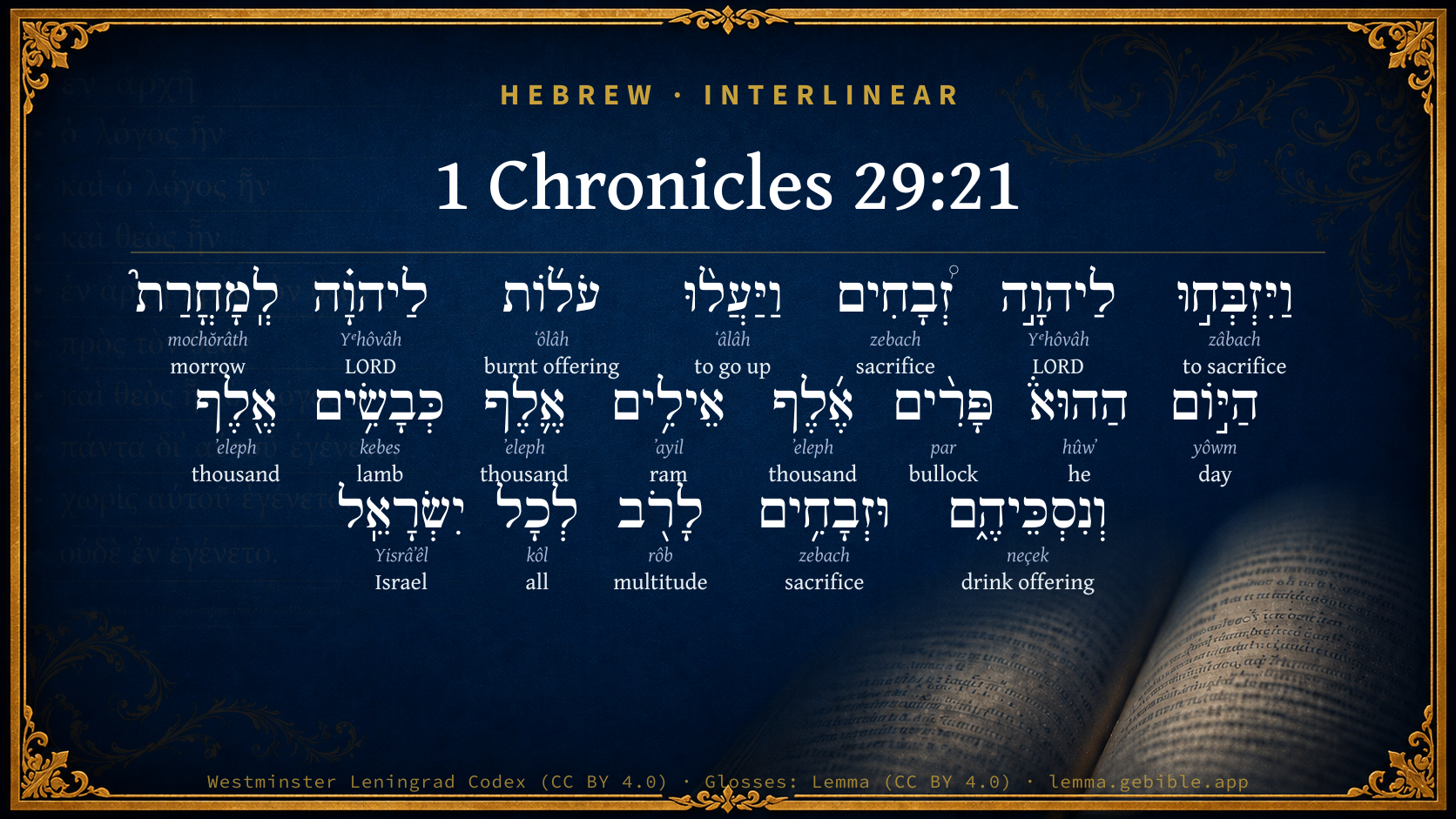
Hebrew (Westminster Leningrad Codex) 1 Chronicles 29:21 appears in the Hebrew Old Testament. The text above is from the Westminster Leningrad Codex. Each word links to its Strong’s number, a concise gloss, and parsing drawn from the Open Scriptures Hebrew Bible morphology. Click any word for its full Brown-Driver-Briggs (BDB) entry.
Download image
Cite this verse

1 Chronicles 29:21 (World English Bible). Public Domain. Lemma interlinear Bible study tool, https://lemma.gebible.app/v/1-chronicles/29/21.

Show BibTeX & RIS
BibTeX
RIS
English Translation
They sacrificed sacrifices to Yahweh, and offered burnt offerings to Yahweh, on the next day after that day, even one thousand bulls, one thousand rams, and one thousand lambs, with their drink-offerings, and sacrifices in abundance for all Israel,
World English Bible · Public Domain
Download a study sheet

One document with this verse’s original text, its word-by-word gloss line, the meaning frame, cross-references with their text, attributed commentary, and full source and license credits — printable, and it pastes into notes with its structure intact.

This verse Autodidact and up

Study sheet (.html) Plain text (.txt)

A passage Seminary Student

Up to 50 verses in one chapter. A passage sheet keeps up to 6 commentary sources and 12 cross-references per verse, in the order this page ranks them, and says so on the sheet whenever that leaves anything out. Ask for a single verse and you get the Autodidact verse sheet above.

Everything on this page stays free to read, with no account — the sheet is a download of what is already on screen, not access to it.

Want to remove ads? Support Godless Engineer
Compare translations 3

The same verse in 3 English versions, stacked beneath the original-language interlinear above. Click any original word for its lexicon entry.

Each is an independent rendering of the whole verse — the interlinear is not word-aligned to these translations.

Highlighted words mark where these versions differ — a whole-verse word diff, not a word-by-word alignment.

  • World English Bible Public Domain
    They sacrificed sacrifices to Yahweh, and offered burnt offerings to Yahweh, on the next day after that day, even one thousand bulls, one thousand rams, and one thousand lambs, with their drink-offerings, and sacrifices in abundance for all Israel,
  • King James Version Public Domain
    And they sacrificed sacrifices unto the LORD, and offered burnt offerings unto the LORD, on the morrow after that day, even a thousand bullocks, a thousand rams, and a thousand lambs, with their drink offerings, and sacrifices in abundance for all Israel:
  • unfoldingWord Literal Text CC BY-SA 4.0
    And they sacrificed sacrifices to Yahweh and they offered burnt offerings to Yahweh on the morrow of that day, 1,000 bulls, 1,000 rams, 1,000 lambs, and their drink offerings and sacrifices to abundance for all of Israel.

unfoldingWord Literal Text — © unfoldingWord, licensed CC BY-SA 4.0. Word-aligned USFM3 via Door43 (git.door43.org/unfoldingWord/en_ult).

Versions to compare (up to 4)

3 of 4 selected

Show all 18 translations

Every available English version of this verse, each an independent rendering of the whole verse.

  • World English Bible Public Domain
    They sacrificed sacrifices to Yahweh, and offered burnt offerings to Yahweh, on the next day after that day, even one thousand bulls, one thousand rams, and one thousand lambs, with their drink-offerings, and sacrifices in abundance for all Israel,
  • Berean Standard Bible Public Domain
    The next day they offered sacrifices and presented burnt offerings to the LORD: a thousand bulls, a thousand rams, and a thousand lambs, along with their drink offerings, and other sacrifices in abundance for all Israel.
  • Majority Standard Bible Public Domain
    The next day they offered sacrifices and presented burnt offerings to the LORD: a thousand bulls, a thousand rams, and a thousand lambs, along with their drink offerings, and other sacrifices in abundance for all Israel.
  • King James Version Public Domain
    And they sacrificed sacrifices unto the LORD, and offered burnt offerings unto the LORD, on the morrow after that day, even a thousand bullocks, a thousand rams, and a thousand lambs, with their drink offerings, and sacrifices in abundance for all Israel:
  • American Standard Version (1901) Public Domain
    And they sacrificed sacrifices unto Jehovah, and offered burnt-offerings unto Jehovah, on the morrow after that day, even a thousand bullocks, a thousand rams, and a thousand lambs, with their drink-offerings, and sacrifices in abundance for all Israel,
  • Revised Version (1885) Public Domain
    And they sacrificed sacrifices unto the LORD, and offered burnt offerings unto the LORD, on the morrow after that day, even a thousand bullocks, a thousand rams, and a thousand lambs, with their drink offerings, and sacrifices in abundance for all Israel;
  • Geneva Bible (1599) Public Domain
    And they offred sacrifices vnto the Lord, and on the morowe after that day, they offered burnt offrings vnto the Lord, euen a thousande yong bullocks, a thousand rammes and a thousand sheepe, with their drinke offrings, and sacrifices in abundance for all Israel.
  • Douay-Rheims (1899) Public Domain
    And they sacrificed victims to the Lord: and they offered holocausts the next day, a thousand bullocks, a thousand rams, a thousand lambs, with their libations, and with every thing prescribed most abundantly for all Israel.
  • Young's Literal Translation Public Domain
    And they sacrifice to Jehovah sacrifices, and cause to ascend burnt-offerings to Jehovah on the morrow of that day, bullocks a thousand, rams a thousand, lambs a thousand, and their oblations, even sacrifices in abundance, for all Israel.
  • Literal Standard Version CC BY-SA 4.0
    And they sacrifice sacrifices to YHWH, and cause burnt-offerings to ascend to YHWH on that next day: one thousand bullocks, one thousand rams, one thousand lambs, and their oblations, and sacrifices in abundance for all Israel.
  • Unlocked Literal Bible CC BY-SA 4.0
    On the next day, they made sacrifices to Yahweh and offered burnt offerings to him. They offered a thousand bulls, a thousand rams, and a thousand lambs, with their drink offerings and sacrifices in abundance for all Israel.
  • unfoldingWord Literal Text CC BY-SA 4.0
    And they sacrificed sacrifices to Yahweh and they offered burnt offerings to Yahweh on the morrow of that day, 1,000 bulls, 1,000 rams, 1,000 lambs, and their drink offerings and sacrifices to abundance for all of Israel.
  • Darby Bible Public Domain
    And they sacrificed sacrifices to Jehovah, and offered up burnt-offerings to Jehovah, on the morrow after that day: a thousand bullocks, a thousand rams, a thousand lambs, with their drink-offerings, and sacrifices in abundance for all Israel.
  • World Messianic Bible Public Domain
    They sacrificed sacrifices to the LORD and offered burnt offerings to the LORD on the next day after that day, even one thousand bulls, one thousand rams, and one thousand lambs, with their drink offerings and sacrifices in abundance for all Israel,
  • Webster's Bible Public Domain
    And they sacrificed sacrifices to the LORD, and offered burnt-offerings to the LORD, on the morrow after that day, even a thousand bullocks, a thousand rams, and a thousand lambs, with their drink-offerings, and sacrifices in abundance for all Israel:
  • Free Bible Version CC BY-SA 4.0
    The following day they presented sacrifices and burnt offerings to the Lord: one thousand bulls, one thousand rams, and one thousand lambs, with their drink offerings and plenty of sacrifices for all of Israel.
  • Bible in Basic English Public Domain
    And they made offerings to the Lord, and gave burned offerings to the Lord, on the day after, a thousand oxen, a thousand sheep, and a thousand lambs, with their drink offerings, and a great wealth of offerings for all Israel.
  • JPS Tanakh (1917) Public Domain
    And they sacrificed sacrifices unto the LORD, and offered burnt-offerings unto the LORD, on the morrow after that day, even a thousand bullocks, a thousand rams, and a thousand lambs, with their drink-offerings, and sacrifices in abundance for all Israel;

Literal Standard Version (2020), Covenant Press — licensed CC BY-SA 4.0. Text via the HelloAO Bible API (eBible.org). Unlocked Literal Bible (unfoldingWord) — licensed CC BY-SA 4.0. Text via the HelloAO Bible API (eBible.org). unfoldingWord Literal Text — © unfoldingWord, licensed CC BY-SA 4.0. Word-aligned USFM3 via Door43 (git.door43.org/unfoldingWord/en_ult). Free Bible Version, Dr. Jonathan Gallagher — licensed CC BY-SA 4.0. Text via the HelloAO Bible API (eBible.org).

Word by word

More ways to search: Search by grammar → Find every occurrence → Compare this word →

Practice this passage: Drill this verse → Learn its vocabulary →

לְֽמָחֳרַת֮
mochŏrâth
H4283
“to/for · morrow of”
Preposition + Noun, Common, Feminine, Singular, Construct
Part of Speech
Preposition + Noun
Type
Common
Gender
Feminine
Number
Singular
State
Construct
Full BDB Definition

Origin: from the same as H4279

TWOT: 1185b

the morrow, the day after
  1. וַיִּזְבְּח֣וּ zâbach H2076 “and · to sacrifice” Conjunction + Verb, Qal, Sequential Imperfect, 3rd Person, Masculine, Plural
  2. לַיהוָ֣ה Yᵉhôvâh H3068 “to/for · LORD” Preposition + Noun, Proper
  3. זְ֠בָחִים zebach H2077 “sacrifices” Noun, Common, Masculine, Plural, Absolute
  4. וַיַּעֲל֨וּ ʻâlâh H5927 “and · to go up” Conjunction + Verb, Hiphil, Sequential Imperfect, 3rd Person, Masculine, Plural
  5. עֹל֜וֹת ʻôlâh H5930 “burnt offerings” Noun, Common, Feminine, Plural, Absolute
  6. לַיהוָ֗ה Yᵉhôvâh H3068 “to/for · LORD” Preposition + Noun, Proper
  7. הַיּ֣וֹם yôwm H3117 “the · day” Particle, Definite Article + Noun, Common, Masculine, Singular, Absolute
  8. הַהוּא֒ hûwʼ H1931 “the · he” Particle, Definite Article + Pronoun, Personal, 3rd Person, Masculine, Singular
  9. פָּרִ֨ים par H6499 “bullocks” Noun, Common, Masculine, Plural, Absolute
  10. אֶ֜לֶף ʼeleph H505 “thousand” Adjective, Cardinal number, Both, Singular, Absolute
  11. אֵילִ֥ים ʼayil H352 “rams” Noun, Common, Masculine, Plural, Absolute
  12. אֶ֛לֶף ʼeleph H505 “thousand” Adjective, Cardinal number, Both, Singular, Absolute
  13. כְּבָשִׂ֥ים kebes H3532 “lambs” Noun, Common, Masculine, Plural, Absolute
  14. אֶ֖לֶף ʼeleph H505 “thousand” Adjective, Cardinal number, Both, Singular, Absolute
  15. וְנִסְכֵּיהֶ֑ם neçek H5262 “and · drink offerings · their” Conjunction + Noun, Common, Masculine, Plural, Construct + Suffix, Personal, 3rd Person, Masculine, Plural
  16. וּזְבָחִ֥ים zebach H2077 “and · sacrifices” Conjunction + Noun, Common, Masculine, Plural, Absolute
  17. לָרֹ֖ב rôb H7230 “to/for · multitude” Preposition + Noun, Common, Both, Singular, Absolute
  18. לְכָל kôl H3605 “to/for · all of” Preposition + Noun, Common, Masculine, Singular, Construct
  19. יִשְׂרָאֵֽל Yisrâʼêl H3478 “Israel” Noun, Proper

About this verse

These counts appear in no published source. They are computed here, from the morphology-tagged text and Lemma’s own curated glosses. What Lemma adds →

20
words
16
distinct lemmas
Historical
section

Shared distinctive vocabulary

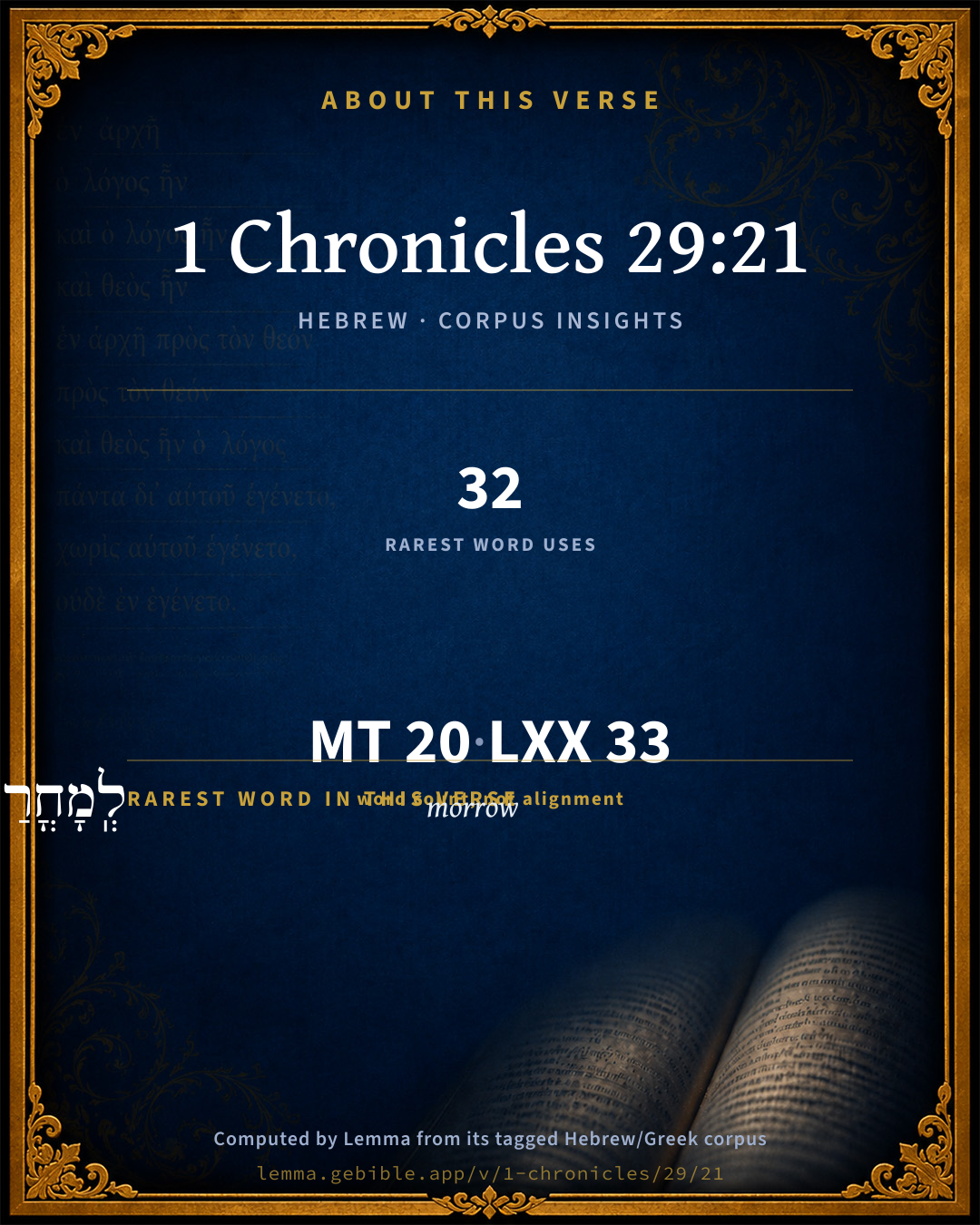
לְֽמָחֳרַת֮ morrow H4283 occurs in 32 verses of the Hebrew Bible. Also found in:

Grammatical profile

  • 2 verbs
  • 14 nouns
  • 3 adjectives
  • 1 pronoun

Verb forms

  • וַיִּזְבְּח֣וּ Qal · Sequential Imperfect
  • וַיַּעֲל֨וּ Hiphil · Sequential Imperfect

Repetition

Words recur within this verse — often emphatic in Hebrew:

  • אֶ֜לֶף thousand H505 ×3
  • לַיהוָ֣ה LORD H3068 ×2
  • זְ֠בָחִים sacrifice H2077 ×2

Hebrew & Septuagint length

In English translation the verse runs 39 words from the Hebrew and 41 from the Septuagint (LXX English) — closely comparable.

A rough comparison of the two English renderings, which tokenize alike — not a word-level alignment.

Word counts can differ between the Hebrew and the Greek without any difference in meaning — e.g. the Hebrew direct-object marker אֵת has no separate Greek word, and Greek often adds the article ὁ.

In the original languages it is 20 Hebrew tokens and 33 Greek tokens — but the two are counted differently (Hebrew bundles its prefixes and suffixes into one token; the Greek is in lemma form), so that isn’t a like-for-like length.

Cross-references

7

Topical passages linked to 1 Chronicles 29:21 in the Treasury of Scripture Knowledge — connected by theme and wording, ordered by reader-vote popularity; previews shown in the World English Bible.

  • Numbers 15:7 and for the drink-offering you shall offer the third part of a hin of wine, of a sweet savor to Yahweh.
  • 2 Chronicles 7:4–9 Then the king and all the people offered sacrifice before Yahweh.
  • Ezra 6:17 They offered at the dedication of this house of God one hundred bulls, two hundred rams, four hundred lambs; and for a sin-offering for all Israel, twelve male goats, according to the number of the tribes of Israel.
  • Leviticus 23:13 The meal offering with it shall be two tenth parts of an ephah of fine flour mingled with oil, an offering made by fire to Yahweh for a sweet savor; and the drink offering with it shall be of wine, the fourth part of a hin.
  • Numbers 15:5 and wine for the drink-offering, the fourth part of a hin, shall you prepare with the burnt offering, or for the sacrifice, for each lamb.
  • Numbers 15:10 and you shall offer for the drink-offering half a hin of wine, for an offering made by fire, of a sweet savor to Yahweh.
  • 1 Kings 8:62–65 The king, and all Israel with him, offered sacrifice before Yahweh.

Cross-references courtesy of OpenBible.info (CC BY 4.0).

Hebrew and Greek witnesses Masoretic Hebrew ↔ Greek Septuagint

The same verse in the two great witnesses to the Old Testament, shown verse-for-verse.

These are two independent witnesses, not word-aligned to each other, and the Septuagint is shown in lemma (dictionary) form.

Hebrew 1 Chronicles 29:21 Masoretic · Westminster Leningrad Codex

וַיִּזְבְּח֣וּ לַיהוָ֣ה זְ֠בָחִים וַיַּעֲל֨וּ עֹל֜וֹת לַיהוָ֗ה לְֽמָחֳרַת֮ הַיּ֣וֹם הַהוּא֒ פָּרִ֨ים אֶ֜לֶף אֵילִ֥ים אֶ֛לֶף כְּבָשִׂ֥ים אֶ֖לֶף וְנִסְכֵּיהֶ֑ם וּזְבָחִ֥ים לָרֹ֖ב לְכָל יִשְׂרָאֵֽל

They sacrificed sacrifices to Yahweh, and offered burnt offerings to Yahweh, on the next day after that day, even one thousand bulls, one thousand rams, and one thousand lambs, with their drink-offerings, and sacrifices in abundance for all Israel,

World English Bible · Public Domain

Greek LXX 1 Chronicles 29:21 Septuagint · lemma form

καί θύω δαυίδ ὁ κύριος θυσία καί ἀναφέρω ὁλοκαύτωμα ὁ θεός ὁ ἐπαύριον ὁ πρῶτος ἡμέρα μόσχος χίλιοι κριός χίλιοι ἀρνός χίλιοι καί ὁ σπονδή αὐτός καί θυσία εἰς πλῆθος πᾶς ὁ ἰσραήλ

And David sacrificed to the Lord, and offered up whole burnt offerings to the Lord on the morrow after the first day, a thousand calves, a thousand rams, a thousand lambs, and their drink-offerings, and sacrifices in abundance for all Israel.

LXX2012 (modern English Septuagint) · Public Domain

On this verse, Haydock's Catholic Bible Commentary discusses the Septuagint’s reading. Read the note in Commentary ↓

Hebrew: Westminster Leningrad Codex (CC BY 4.0). Greek: Septuagint (public domain); English from LXX2012 (modern English Septuagint) (Public Domain). How the Septuagint differs from the Hebrew →

Commentary

Notes on 1 Chronicles 29:21 from classic Christian and Jewish commentators (each source and its license shown beneath its notes). The classic Christian expositions comment on the surrounding passage and are grouped to its opening verse, so a note may address several verses; the Jewish commentaries on the Tanakh (Rashi and others) are per-verse, so they appear only where the commentator wrote on this verse.

Lemma curates 59 commentaries, every one of them public domain or Creative Commons licensed, each selected and text-cleaned for this edition rather than reprinted as found. About our sources →

Trapp's Complete Commentary

John Trapp

1Ch 29:21 And they sacrificed sacrifices unto the LORD, and offered burnt offerings unto the LORD, on the morrow after that day, [even] a thousand bullocks, a thousand rams, [and] a thousand lambs, with their drink offerings, and sacrifices in abundance for all Israel:

Ver. 21. A thousand bullocks.] This was beyond those heathenish hecatombs, {a} for which some are so renowned in histories.

{a} A great public sacrifice (properly of a hundred oxen) among the ancient Greeks and Romans, and hence extended to the religious sacrifices of other nations; a large number of animals offered or set apart for a sacrifice.

John Trapp, A Commentary or Exposition upon All the Books of the Old and New Testament (1647–1656) — public domain. Text from a community e-Sword module.

Joseph Benson's Commentary

1Ch 29:21. They sacrificed sacrifices unto the Lord — Before the ark which was there. In abundance for all Israel — Either, 1st, On behalf of all Israel, to praise God in their names, to procure God’s presence and blessing for them all. Or, 2d, So many sacrifices, that the feasts which were, according to custom, made of the remainders of them, were abundantly sufficient for all the Israelites that were then present, and desired to partake of them.

Joseph Benson's Commentary on the Old and New Testaments (1811–1818) — public domain. Text from a community e-Sword module.

Tyndale Open Study Notes

Tyndale Open Resources

29:21-25 Sacrifices followed the speeches and prayers at Solomon’s coronation. Solomon and Zadok were anointed, and Solomon acceded to the throne. Zadok was not beginning his priestly role but was being dedicated to serve in the Temple itself. (The descendants of Zadok are mentioned in Ezek 40:46; 43:19; 44:15; 48:11.)

Tyndale Open Study Notes — © Tyndale Open Resources, licensed CC BY-SA 4.0. Text via the HelloAO Bible API.

Geneva Bible (1599)

Geneva Bible translators

Meaning, all kind of liquor which they mingled with their sacrifices, as wine, oil, etc.

Geneva Bible (1599) marginal notes — public domain. Text via Bolls.life.

Jamieson, Fausset & Brown

Robert Jamieson, A. R. Fausset & David Brown

they sacrificed . . . And did eat and drink--After the business of the assembly was over, the people, under the exciting influence of the occasion, still remained, and next day engaged in the performance of solemn rites, and afterwards feasted on the remainder of the sacrifices.

Jamieson, Fausset & Brown — Commentary Critical and Explanatory on the Whole Bible (1871) — public domain (CC PDM 1.0). Text via the HelloAO Bible API.

Adam Clarke's Commentary

Verse 21. With their drink-offerings] The Targum says a thousand drink-offerings, making these libations equal in number to the other offerings.

And sacrifices] These were peace-offerings, offered for the people, and on the flesh of which they feasted.

Adam Clarke's Commentary on the Bible (1810–1826) — public domain. Text from a community e-Sword/MySword module.

Ellicott's Commentary for English Readers

(21) On the morrow after that day (lĕmohŏrath hayyôm hahû); here only. (Comp. Jon_4:7.) That is, on the day after the assembly.

A thousand bullocks . . .—Heb., Bullocks a thousand, rams a thousand, &c., according to the later mode of speech; and their libations (Psa_16:4; Exo_29:40; Lev_23:13).

And sacrifices in abundance for all Israel.—The word “sacrifices” (zĕbâhîm) occurred in a general sense at the beginning of the verse. Here, in connexion with burnt-offerings, it has the special meaning of “thank-offerings” (shĕlâmîm; Authorised Version, “peace-offerings,” Deu_12:6). See for both kinds of sacrifice, Lev_1:1 sqq.; Exo_20:24; Exo_24:5.

For all Israel.—So that every one present might partake of the sacrificial meal. (Comp. Notes on 1Ch_16:2-3; Deu_12:7; 1Sa_1:3-8; 1Sa_1:13.)

A Bible Commentary for English Readers, edited by Charles John Ellicott (1878–1897) — public domain. Text from a community e-Sword module.

The Cambridge Bible for Schools and Colleges

gen. ed. J. J. S. Perowne

21. And they sacrificed] Cp. 1Ch_16:1-3.

The Cambridge Bible for Schools and Colleges (gen. ed. J. J. S. Perowne; Cambridge University Press, 1878–1918) — public domain. Text from a community e-Sword module.

John Gill's Exposition

And they did eat and drink before the Lord on that day with great gladness,.... Before the ark of the Lord, which was in the tabernacle David had pitched for it:

and they made Solomon the son of David king the second time; the first was upon Adonijah's rebellion, and was done in the presence only of the inhabitants of Jerusalem; but this was done by and in the presence of all the great personages in the land:

and anointed him unto the Lord to be the chief governor; under his father during his lifetime, and then to reign in his own right:

and Zadok to be priest; high priest; which office yet he did not exercise till after the death of David, when Abiathar was thrust out by Solomon.

John Gill's Exposition of the Whole Bible (1746–1763) — public domain (CC PDM 1.0). Text via the HelloAO Bible API.

Albert Barnes' Notes on the Bible

With their drink offerings - i. e., with the drink-offerings appropriate to each kind of burnt-offering, and required by the Law to accompany them (see Num 15:5, Num 15:7,Num 15:10, etc.).

Sacrifices - or, “thank-offerings,” as the same word is translated in 2Ch 29:31; 2Ch 33:16. Of “peace-offerings for thanksgivings” only a small part was the priest’s; the sacrificer and his friends feasted on the remainder Lev 7:15, Lev 7:29, Lev 7:34.

Albert Barnes' Notes on the Bible (1834–1885) — public domain. Text from a community e-Sword/MySword module.

Haydock's Catholic Bible Commentary

CHAPTER XXIX.

And with. Hebrew and Septuagint, "and their sacrifices of wine and victims, (or peace-offerings, to be eaten by the people.; Calmet) in abundance for all Israel." (Haydock)

George Leo Haydock (1774–1849), Haydock's Catholic Family Bible and Commentary, 1859 edition — public domain. Excludes Psalms (Douay-Rheims chapter numbering differs from Protestant) and Deuterocanonical books (Catholic canon only).

Matthew Poole's English Annotations

Unto the Lord; before the ark which was there.

For all Israel; either,

1. On the behalf of all Israel, to praise God in their names, to procure God’s presence and blessing for them all. Or,

2. So many, that the feasts which, after the manner, were made of the remainders of the sacrifices, were abundantly sufficient for all the Israelites which were then present and desired to partake of them; or for all the governors of Israel there assembled, who may well pass under the name of all Israel, because they represented them all.

Matthew Poole's English Annotations on the Holy Bible (1683–1685) — public domain. Text from a community e-Sword/MySword module.

The Pulpit Commentary

Vers. 21-25. These verses record "the sacrifices and drink offerings" by which all the service of this day was ratified as it were on the following day; also the solemn "anointing of Solomon to the Lord as chief governor, and of Zadok as priest," with the visible enthronement of Solomon, and the submission to him "of all Israel, of all the princes and mighty men, and also of all the sons of David". (1Ki_1:49-53)

In this verse the distinction is to be noticed between the sacrifices of thank offerings ( those of burnt offerings ( and their drink offerings, i.e the drink offerings that went w ith them ( For the first of these the more specific Hebrew word is (Lev_7:20 Lev_9:4) or jbz, (Lev_3:1 Lev_7:11, Lev_7:13, Lev_7:15; Num_7:17) The breast and right shoulder were the priest"s share. All the rest belonged to the person who sacrificed, and his friends, and must be eaten the same or the next day. (Lev_7:11-18, Lev_7:29-34) Other particulars may be found in Smith"s "Bible Dictionary," 3:1470, 1471. The last clause of our verse tells us how ample was the feast provided by these sacrifices on this occasion, being in abundance for all Israel The burnt offering is first mentioned in Gen_8:20; it is the only sacrifice that the Book of Genesis (see Gen_15:9, etc.; Gen_22:2, etc.) knows. The offering (hj; n]mi) of Gen_4:4 is somewhat obscure, but does not appear to have been a sacrifice of blood. This sacrifice was one which was wholly consumed on the altar of fire, and supposed to ascend to heaven. The chief kinds of burnt offerings were

(1) the daily (Exo_29:38-42; Num_28:3-8)

(2) the sabbath; (Num_28:8-10)

(3) that at the new moon, the Day of Atonement, the three great festivals and the Feast of Trumpets. (Num_28:11-31; Num_29:1-39)

Beside these, there were the several kinds of freewill and private burnt offerings. The first, seventh, and eighth chapters of Leviticus contain full accounts of the ceremonial. The drink offering is spoken of as early as Gen_35:14; but those to which reference is here made as appertaining to the before-mentioned sacrifices are more explicitly spoken of in such passages as Exo_29:40 Lev_23:13; Num_6:17 Num_15:5-24 Num_28:10-14.

The Pulpit Commentary (1880–1919), ed. H.D.M. Spence-Jones & Joseph S. Exell — public domain. Text from a community e-Sword module.

Keil & Delitzsch

C. F. Keil & F. Delitzsch

And they did eat and drink before the Lord on that day with great gladness,.... Before the ark of the Lord, which was in the tabernacle David had pitched for it:

and they made Solomon the son of David king the second time; the first was upon Adonijah's rebellion, and was done in the presence only of the inhabitants of Jerusalem; but this was done by and in the presence of all the great personages in the land:

and anointed him unto the Lord to be the chief governor; under his father during his lifetime, and then to reign in his own right:

and Zadok to be priest; high priest; which office yet he did not exercise till after the death of David, when Abiathar was thrust out by Solomon.

Keil & Delitzsch — Biblical Commentary on the Old Testament (1861–1891) — public domain (CC PDM 1.0). Text via the HelloAO Bible API. (Old Testament only.)

Rashi

Rabbi Shlomo Yitzchaki (Rashi)

on the morrow of that day the day of this assembly, when David spoke all his words, for on that day they had no time, because when they left the assembly, they were busy until night buying sacrificial animals, and on the morrow, “they slaughtered sacrifices, etc.”

a thousand bulls, a thousand rams, a thousand lambs, and their libations On the pattern of (Num. 7:17): “five rams, five he-goats, etc.,” one quantity for them all.

and numerous sacrifices It is customary for Scripture to speak in this manner; when it speaks of two or three things, it leaves the first one until the end and explains the last one immediately, and so (Gen. 31:33): “And Laban came into Jacob’s tent... and came into Rachel’s tent.” Now was it not already stated, “And Laban came into Jacob’s tent,” which was Rachel’s tent? However, “and did not find” refers to the maidservants, mentioned last, and then he explains the first matter, “... and he went out of Leah’s tent” first, and he “came into Rachel’s tent.” From Leah’s tent he went to Rachel’s tent, but because he had to say other things about this, “And Rachel had taken, etc.” and consequently, it is inappropriate to say, “... and in the tent of the two maidservants and did not find.” Here too, he had other things to say about the sacrifices, namely...

Rashi on the Tanakh — English translations: “The Judaica Press complete Tanach with Rashi, translated by A. J. Rosenberg” (CC BY 4.0); “Pentateuch with Rashi's commentary by M. Rosenbaum and A.M. Silbermann, 1929-1934” (public domain); “The Metsudah Tanach series, Lakewood, N.J” (CC BY 4.0); and “The Book of Joshua, Metsudah Publications, 1997” (CC BY 4.0). Text via Sefaria.

Lesson kit

Teaching starters — assembled from the data on this page, not authored interpretation. Every prompt links to the verse data it draws on. Edit before teaching.

1 Chronicles, in the Historical, opens this verse with 20 words (16 distinct Hebrew lemmas). Its most distinctive word is mochŏrâth (“morrow”). A historical commentator’s framing appears above. Read the whole chapter for the surrounding context.

Discussion questions

  1. What does “morrow” (mochŏrâth) contribute to the verse as a whole?
  2. How does Genesis 19:34, which shares the word «morrow», read alongside this verse?
  3. What does the repetition of “thousand” (3× in this one verse) do in this verse?
  4. These translations render this verse differently; the difference is in the English rendering, not the original. What questions does that raise?
  5. «וַיִּזְבְּח֣וּ» is a Qal Sequential Imperfect verb. How does that grammatical form shape the action described?
  6. Compare how Trapp's Complete Commentary and Joseph Benson's Commentary read this verse. Where do they agree or differ?

Things to notice

Reading settings

Reading text

Shown beneath each verse's original-language words.

Old Testament
Old Testament edition

Read the OT as the Masoretic Hebrew (MT) or the Greek Septuagint (LXX).

English shown for the Greek Septuagint (in the Hebrew ↔ Greek comparison).

Comparing translations? Open the Compare panel on any verse page to stack up to four side by side.