
Lamentations 3:32

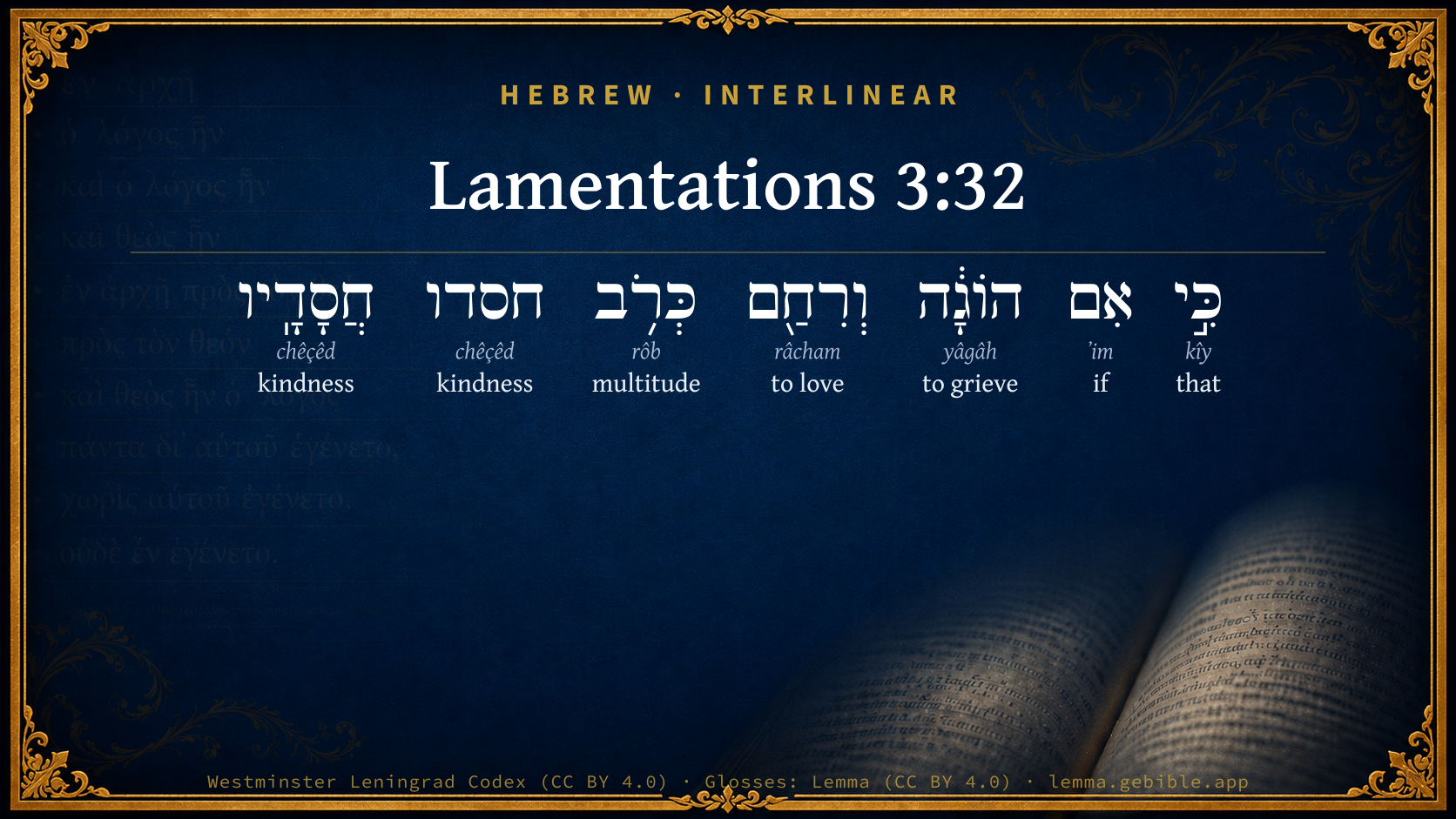
Hebrew (Westminster Leningrad Codex) Lamentations 3:32 appears in the Hebrew Old Testament. The text above is from the Westminster Leningrad Codex. Each word links to its Strong’s number, a concise gloss, and parsing drawn from the Open Scriptures Hebrew Bible morphology. Click any word for its full Brown-Driver-Briggs (BDB) entry.
Download image
Cite this verse

Lamentations 3:32 (World English Bible). Public Domain. Lemma interlinear Bible study tool, https://lemma.gebible.app/v/lamentations/3/32.

Show BibTeX & RIS
BibTeX
RIS
English Translation
For though he cause grief, yet will he have compassion according to the multitude of his loving kindnesses.
World English Bible · Public Domain
Download a study sheet

One document with this verse’s original text, its word-by-word gloss line, the meaning frame, cross-references with their text, attributed commentary, and full source and license credits — printable, and it pastes into notes with its structure intact.

This verse Autodidact and up

Study sheet (.html) Plain text (.txt)

A passage Seminary Student

Up to 50 verses in one chapter. A passage sheet keeps up to 6 commentary sources and 12 cross-references per verse, in the order this page ranks them, and says so on the sheet whenever that leaves anything out. Ask for a single verse and you get the Autodidact verse sheet above.

Everything on this page stays free to read, with no account — the sheet is a download of what is already on screen, not access to it.

Want to remove ads? Support Godless Engineer
Compare translations 3

The same verse in 3 English versions, stacked beneath the original-language interlinear above. Click any original word for its lexicon entry.

Each is an independent rendering of the whole verse — the interlinear is not word-aligned to these translations.

Highlighted words mark where these versions differ — a whole-verse word diff, not a word-by-word alignment.

  • World English Bible Public Domain
    For though he cause grief, yet will he have compassion according to the multitude of his loving kindnesses.
  • King James Version Public Domain
    But though he cause grief, yet will he have compassion according to the multitude of his mercies.
  • unfoldingWord Literal Text CC BY-SA 4.0
    For though he causes grief, he will have compassion according to the abundance of his covenant faithfulness.

unfoldingWord Literal Text — © unfoldingWord, licensed CC BY-SA 4.0. Word-aligned USFM3 via Door43 (git.door43.org/unfoldingWord/en_ult).

Versions to compare (up to 4)

3 of 4 selected

Show all 18 translations

Every available English version of this verse, each an independent rendering of the whole verse.

  • World English Bible Public Domain
    For though he cause grief, yet will he have compassion according to the multitude of his loving kindnesses.
  • Berean Standard Bible Public Domain
    Even if He causes grief, He will show compassion according to His abundant loving devotion.
  • Majority Standard Bible Public Domain
    Even if He causes grief, He will show compassion according to His abundant loving devotion.
  • King James Version Public Domain
    But though he cause grief, yet will he have compassion according to the multitude of his mercies.
  • American Standard Version (1901) Public Domain
    For though he cause grief, yet will he have compassion according to the multitude of his lovingkindnesses.
  • Revised Version (1885) Public Domain
    For though he cause grief, yet will he have compassion according to the multitude of his mercies.
  • Geneva Bible (1599) Public Domain
    But though he sende affliction, yet will he haue compassion according to the multitude of his mercies.
  • Douay-Rheims (1899) Public Domain
    Caph. For if he hath cast off, he will also have mercy, according to the multitude of his mercies.
  • Young's Literal Translation Public Domain
    For though He afflicted, yet He hath pitied, According to the abundance of His kindness.
  • Literal Standard Version CC BY-SA 4.0
    For though He afflicted, yet He has pitied, || According to the abundance of His kindness.
  • Unlocked Literal Bible CC BY-SA 4.0
    but though he causes grief, he will have compassion according to the abundance of his steadfast love.
  • unfoldingWord Literal Text CC BY-SA 4.0
    For though he causes grief, he will have compassion according to the abundance of his covenant faithfulness.
  • Darby Bible Public Domain
    but if he have caused grief, he will have compassion according to the multitude of his loving-kindnesses:
  • World Messianic Bible Public Domain
    For though he causes grief, yet he will have compassion according to the multitude of his loving kindnesses.
  • Webster's Bible Public Domain
    But though he causeth grief, yet will he have compassion according to the multitude of his mercies.
  • Free Bible Version CC BY-SA 4.0
    Even though he may bring sadness, he shows us mercy because his trustworthy love is so great.
  • Bible in Basic English Public Domain
    For though he sends grief, still he will have pity in the full measure of his love.
  • JPS Tanakh (1917) Public Domain
    For though He cause grief, yet will He have compassion according to the multitude of His mercies.

Literal Standard Version (2020), Covenant Press — licensed CC BY-SA 4.0. Text via the HelloAO Bible API (eBible.org). Unlocked Literal Bible (unfoldingWord) — licensed CC BY-SA 4.0. Text via the HelloAO Bible API (eBible.org). unfoldingWord Literal Text — © unfoldingWord, licensed CC BY-SA 4.0. Word-aligned USFM3 via Door43 (git.door43.org/unfoldingWord/en_ult). Free Bible Version, Dr. Jonathan Gallagher — licensed CC BY-SA 4.0. Text via the HelloAO Bible API (eBible.org).

Word by word

More ways to search: Search by grammar → Find every occurrence → Compare this word →

Practice this passage: Drill this verse → Learn its vocabulary →

About this verse

These counts appear in no published source. They are computed here, from the morphology-tagged text and Lemma’s own curated glosses. What Lemma adds →

7
words
6
distinct lemmas
Prophets
section

Notable vocabulary

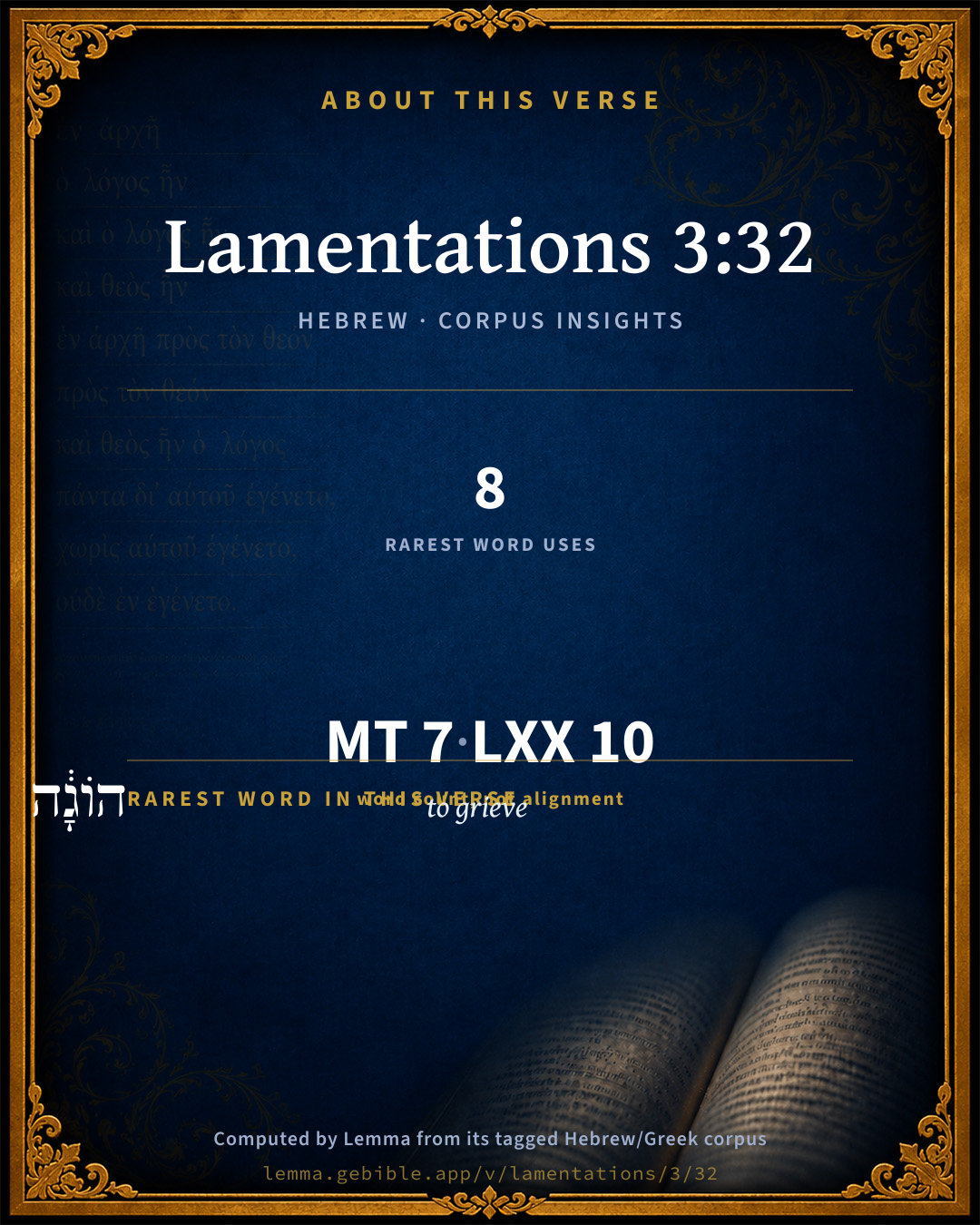
The rarest word here is הוֹגָ֔ה to grieve H3013 — appearing just 8 times in the whole Hebrew Bible.

Shared distinctive vocabulary

הוֹגָ֔ה to grieve H3013 occurs in 8 verses of the Hebrew Bible. Also found in:

Grammatical profile

  • 2 verbs
  • 3 nouns
  • 2 conjunctions

Verb forms

  • הוֹגָ֔ה Hiphil · Perfect
  • וְרִחַ֖ם Piel · Sequential Perfect

Repetition

A word recurs within this verse — often emphatic in Hebrew:

  • חסדו kindness H2617 ×2

Hebrew & Septuagint length

In English translation the verse runs 18 words from the Hebrew and 18 from the Septuagint (LXX English) — the same length.

A rough comparison of the two English renderings, which tokenize alike — not a word-level alignment.

Word counts can differ between the Hebrew and the Greek without any difference in meaning — e.g. the Hebrew direct-object marker אֵת has no separate Greek word, and Greek often adds the article ὁ.

In the original languages it is 7 Hebrew tokens and 10 Greek tokens — but the two are counted differently (Hebrew bundles its prefixes and suffixes into one token; the Greek is in lemma form), so that isn’t a like-for-like length.

Cross-references

12

Topical passages linked to Lamentations 3:32 in the Treasury of Scripture Knowledge — connected by theme and wording, ordered by reader-vote popularity; previews shown in the World English Bible.

  • Psalms 78:38 But he, being merciful, forgave iniquity, and didn't destroy them. Yes, many times he turned his anger away, And didn't stir up all his wrath.
  • Psalms 30:5 For his anger is but for a moment; His favor is for a lifetime. Weeping may stay for the night, But joy comes in the morning.
  • Psalms 103:11 For as the heavens are high above the earth, So great is his loving kindness toward those who fear him.
  • Exodus 3:7 Yahweh said, "I have surely seen the affliction of my people who are in Egypt, and have heard their cry because of their taskmasters, for I know their sorrows.
  • Judges 10:16 They put away the foreign gods from among them, and served Yahweh; and his soul was grieved for the misery of Israel.
  • Psalms 106:43–45 Many times he delivered them, But they were rebellious in their counsel, And were brought low in their iniquity.
  • Hosea 11:8 "How can I give you up, Ephraim? How can I hand you over, Israel? How can I make you like Admah? How can I make you like Zeboiim? My heart is turned within me, My compassion is aroused.
  • Jeremiah 31:20 Is Ephraim my dear son? is he a darling child? for as often as I speak against him, I do earnestly remember him still: therefore my heart yearns for him; I will surely have mercy on him, says Yahweh.
  • Luke 15:20 "He arose, and came to his father. But while he was still far off, his father saw him, and was moved with compassion, and ran, and fell on his neck, and kissed him.
  • 2 Kings 13:23 But Yahweh was gracious to them, and had compassion on them, and had respect to them, because of his covenant with Abraham, Isaac, and Jacob, and would not destroy them, neither cast he them from his presence as yet.
  • Lamentations 3:22 [It is of] Yahweh's loving kindnesses that we are not consumed, because his compassion doesn't fail.
  • Exodus 2:23 It happened in the course of those many days, that the king of Egypt died, and the children of Israel sighed because of the bondage, and they cried, and their cry came up to God because of the bondage.

Cross-references courtesy of OpenBible.info (CC BY 4.0).

Hebrew and Greek witnesses Masoretic Hebrew ↔ Greek Septuagint

The same verse in the two great witnesses to the Old Testament, shown verse-for-verse.

These are two independent witnesses, not word-aligned to each other, and the Septuagint is shown in lemma (dictionary) form.

Hebrew Lamentations 3:32 Masoretic · Westminster Leningrad Codex

כִּ֣י אִם הוֹגָ֔ה וְרִחַ֖ם כְּרֹ֥ב חסדו חֲסָדָֽיו

For though he cause grief, yet will he have compassion according to the multitude of his loving kindnesses.

World English Bible · Public Domain

Greek LXX Lamentations 3:32 Septuagint · lemma form

ὅτι ὁ ταπεινόω οἰκτείρω κατά ὁ πλῆθος ὁ ἔλεος αὐτός

CHAPH. For he that has brought down will pity, and that according to the abundance of his mercy.

LXX2012 (modern English Septuagint) · Public Domain

Hebrew: Westminster Leningrad Codex (CC BY 4.0). Greek: Septuagint (public domain); English from LXX2012 (modern English Septuagint) (Public Domain). How the Septuagint differs from the Hebrew →

Commentary

Notes on Lamentations 3:32 from classic Christian and Jewish commentators (each source and its license shown beneath its notes). The classic Christian expositions comment on the surrounding passage and are grouped to its opening verse, so a note may address several verses; the Jewish commentaries on the Tanakh (Rashi and others) are per-verse, so they appear only where the commentator wrote on this verse.

Lemma curates 59 commentaries, every one of them public domain or Creative Commons licensed, each selected and text-cleaned for this edition rather than reprinted as found. About our sources →

Trapp's Complete Commentary

John Trapp

Lam 3:32 But though he cause grief, yet will he have compassion according to the multitude of his mercies.

Ver. 32. For though he cause grief.] As sometimes he doth "in very faithfulness," and that he may be true to his people’s souls.

Yet he will have compassion.] He will repent and return, and leave a blessing behind him, that is certain. {Joe 2:14}

John Trapp, A Commentary or Exposition upon All the Books of the Old and New Testament (1647–1656) — public domain. Text from a community e-Sword module.

Jamieson, Fausset & Brown

Robert Jamieson, A. R. Fausset & David Brown

The punishments of the godly are but for a time.

Jamieson, Fausset & Brown — Commentary Critical and Explanatory on the Whole Bible (1871) — public domain (CC PDM 1.0). Text via the HelloAO Bible API.

John Calvin's Commentaries

We saw in the last Lecture that the best and the only true remedy for sorrows is, when the faithful are convinced that they are chastised only by the paternal hand of God, and that, the end of all their evils will be blessed. Now this they cannot of themselves assume; but God comes to their aid, and declares that he will not be angry for ever with his children. For this promise extends generally to the whole Church,

“For a moment I afflicted thee, in the time of mine indignation, but with perpetual mercies will I follow thee,” (Isaiah 54:7, 8)

and again,

“I will visit their iniquities with a rod, yet my mercy I will not take away from them” (Psalm 89 33, 84.)

When therefore the faithful feel assured that their punishment is only for a time, then they lay hold on hope, and thus receive invaluable comfort in all their evils.

Jeremiah now pursues the same subject, even that God will shew compassion according to the multitude of his mercies, though he causes sorrow to men. This may indeed be generally explained as to all mankind; but, as we have said, God has promised this to his own Church. All miseries, regarded in themselves, are tokens of the wrath and curse of God; but as all things turn out for good and for salvation to the children of God, when they embrace this truth, that God, as the Prophet Habakkuk says, remembers mercy in wrath, (Habakkuk 3:2,) so they restrain themselves and do not despond, nor are they overwhelmed with despair. We now then understand the Prophet’s object in saying, that though God afflicts he yet remembers mercy.

But we must at the same time bear in mind what I have before shewed, that the faithful are exposed to various evils, because it is profitable for them to be chastised by God’s hand. Hence appears the necessity of this doctrine, for were we exempt frown all adversities, this admonition would be superfluous. But as it cannot be but that God will smite us with his rods, not only because we deserve to be smitten, but also because it is expedient, it is necessary to flee to this consolation which is offered to us, even that God having afflicted us with grief will again shew us compassion, even according to the multitude of his mercies He confirms the truth of what he alleges by a reference to the very nature of God himself. Hence, that the faithful might not debate with themselves whether God would be propitious to them, after having inflicted on them a temporary punishment, the Prophet comes to their aid, and sets before them the mercy of God, or rather mercies, in the plural number; as though he had said, that it could not be that God should deny himself, and that therefore he would be always merciful to his people; for otherwise his mercy would be obliterated, yea, that mercy which is inseparable from his eternal essence and divinity.

And hence, when God is pleased briefly to shew what he is, he sets forth his mercy and patience; for except his goodness and mercy meet us, when we come to him, dread would immediately absorb all our thoughts; but when God comes forth as if clothed and adorned with mercy, we may then entertain hope of salvation; and though conscious of evil, yet while we recumb on God’s mercy, we shall never lose the hope of salvation. We not: apprehend the Prophet’s meaning. It follows, —

John Calvin's Commentaries (1540-1563) — public domain. Text from the Calvin Translation Society English edition (1840s-50s) via the Christian Classics Ethereal Library (ccel.org). Calvin's coverage is partial (roughly two-thirds of the Bible); uncommented books and verses are honest gaps, never fabricated. The 19th-century editor's footnotes and remarks are omitted so the notes are faithfully Calvin's own voice.

John Gill's Exposition

To crush under his feet all the prisoners of the earth. These words, with what follow in Lam 3:35; either depend upon the preceding, and are to be connected with them, "he doth not afflict", &c. Lam 3:33; though he lays his hand on men, he do not crush them under his feet, or break them in pieces, and utterly destroy them, even such, and all such, as are bound in affliction and iron; or, in a spiritual sense, such as are prisoners to sin, Satan, and the law, as all men by nature are; he does not crush these to pieces, though they deserve it, at least not "all" of them; for he proclaims in the Gospel liberty to the captives, and says, by the power of his grace, to the prisoners, go forth, and encourages the prisoners of hope to turn to their strong hold: and also, though he afflicts, he does no injustice to them, does not turn aside their right, or subvert their cause, Job 8:3; or rather these depend upon, and are to be connected with, the last clause of Lam 3:36; "the Lord approveth not": as he does not do these things himself, he do not approve of them in others; that they should use captives cruelly, trample upon them like mire in the streets, or as the dust of their feet; particularly regard may be had to the Jews in Babylon, used ill by those that detained them; for though it was by the will of God they were carried captive, yet the Chaldeans exceeded due bounds in their usage of them, and added affliction to their affliction, which the Lord approved not of, but resented, Zac 1:15.

.

Lamentations 3:35

lam 3:35

lam 3:35

lam 3:35To turn aside the right of a man,.... The Targum is, of a poor man; not to do him justice in a court of judicature; to cause judgment to incline to the wrong side; to give the cause against a man, to give a wrong sentence; this is disapproved of by the Lord, and forbidden by him:

before the face of the most High; either before the most high God, he being present and among the gods, the judges, when they pass sentence; and yet, to pass a wrong one in his presence, without any regard to him, or fear of him, must be provoking to him: or, "before a superior" (f), as some render it; before a judge that sits upon the bench; endeavouring by unjust charges, wrong pleas, and false witnesses, to deprive a man of his right; see Ecc 5:8.

(f) "coram facie superioris", Junius & Tremellius.

John Gill's Exposition of the Whole Bible (1746–1763) — public domain (CC PDM 1.0). Text via the HelloAO Bible API.

Matthew Poole's English Annotations

But though, as a prudent parent, he may see reason to cause grief in and to afflict his own people, yet as a tender good father, that pitieth his children in misery, he will have compassion upon them, having not only mercies, but a multitude or abundance of mercies.

Matthew Poole's English Annotations on the Holy Bible (1683–1685) — public domain. Text from a community e-Sword/MySword module.

Rashi

Rabbi Shlomo Yitzchaki (Rashi)

Though he cause grief If a man brings grief upon himself because of his iniquity, afterwards—He will yet have compassion according to the abundance of His kindness.

The words הוֹגָה וְיָגֶה are expressions of תּוּגָה, grief.

Rashi on the Tanakh — English translations: “The Judaica Press complete Tanach with Rashi, translated by A. J. Rosenberg” (CC BY 4.0); “Pentateuch with Rashi's commentary by M. Rosenbaum and A.M. Silbermann, 1929-1934” (public domain); “The Metsudah Tanach series, Lakewood, N.J” (CC BY 4.0); and “The Book of Joshua, Metsudah Publications, 1997” (CC BY 4.0). Text via Sefaria.

Lesson kit

Teaching starters — assembled from the data on this page, not authored interpretation. Every prompt links to the verse data it draws on. Edit before teaching.

Lamentations, in the Prophets, opens this verse with 7 words (6 distinct Hebrew lemmas). Its most distinctive word is yâgâh (“to grieve”). A historical commentator’s framing appears above. Read the whole chapter for the surrounding context.

Discussion questions

  1. What does “to grieve” (yâgâh) contribute to the verse as a whole?
  2. How does Job 19:2, which shares the word «to grieve», read alongside this verse?
  3. What does the repetition of “kindness” (2× in this one verse) do in this verse?
  4. These translations render this verse differently; the difference is in the English rendering, not the original. What questions does that raise?
  5. «הוֹגָ֔ה» is a Hiphil Perfect verb. How does that grammatical form shape the action described?
  6. Compare how Trapp's Complete Commentary and Jamieson, Fausset & Brown read this verse. Where do they agree or differ?

Things to notice

Reading settings

Reading text

Shown beneath each verse's original-language words.

Old Testament
Old Testament edition

Read the OT as the Masoretic Hebrew (MT) or the Greek Septuagint (LXX).

English shown for the Greek Septuagint (in the Hebrew ↔ Greek comparison).

Comparing translations? Open the Compare panel on any verse page to stack up to four side by side.