
Job 4:14

Hebrew (Westminster Leningrad Codex) Job 4:14 appears in the Hebrew Old Testament. The text above is from the Westminster Leningrad Codex. Each word links to its Strong’s number, a concise gloss, and parsing drawn from the Open Scriptures Hebrew Bible morphology. Click any word for its full Brown-Driver-Briggs (BDB) entry.
Download image
Cite this verse

Job 4:14 (World English Bible). Public Domain. Lemma interlinear Bible study tool, https://lemma.gebible.app/v/job/4/14.

Show BibTeX & RIS
BibTeX
RIS
English Translation
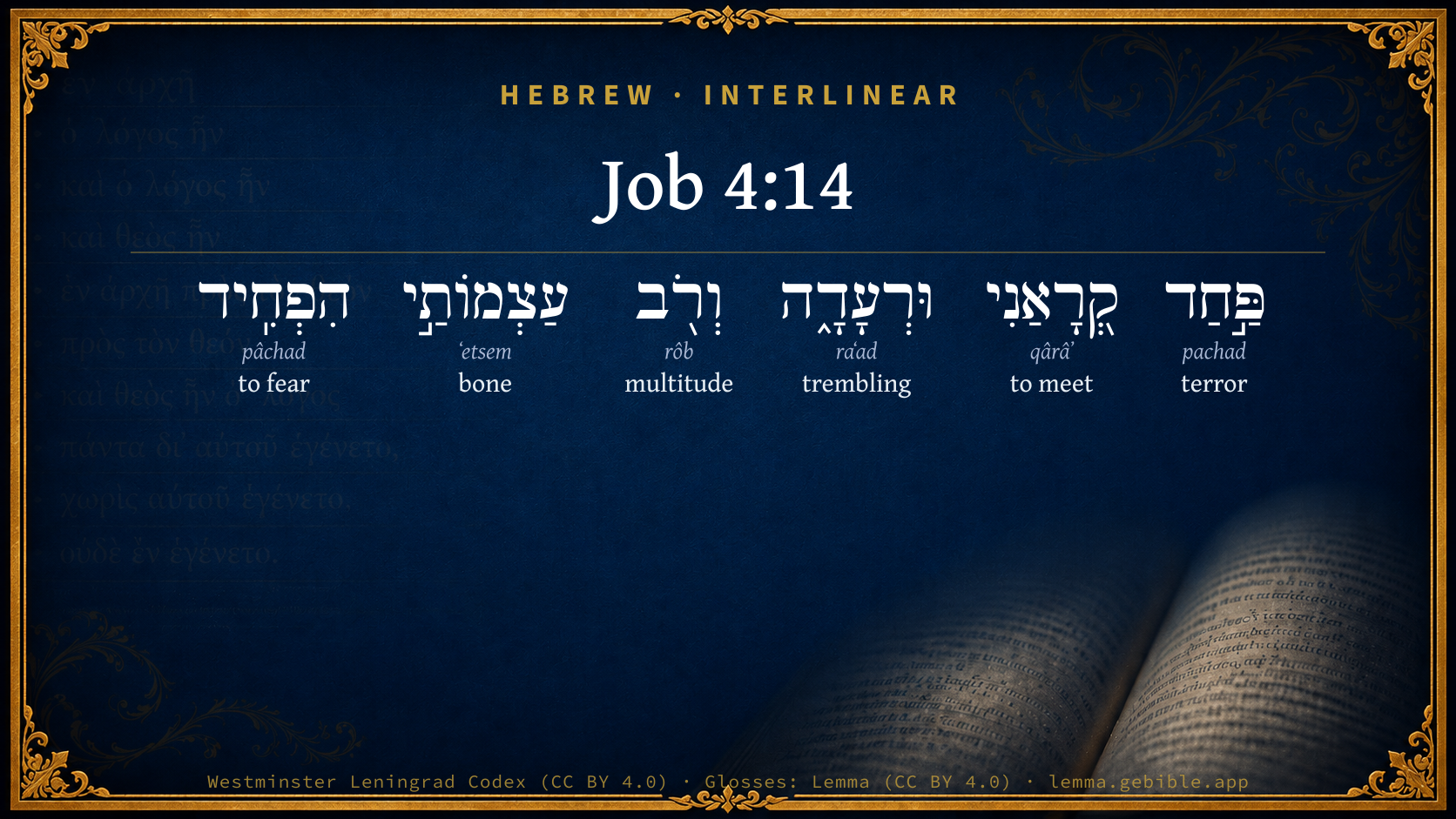
Fear came on me, and trembling, Which made all my bones shake.
World English Bible · Public Domain
Download a study sheet

One document with this verse’s original text, its word-by-word gloss line, the meaning frame, cross-references with their text, attributed commentary, and full source and license credits — printable, and it pastes into notes with its structure intact.

This verse Autodidact and up

Study sheet (.html) Plain text (.txt)

A passage Seminary Student

Up to 50 verses in one chapter. A passage sheet keeps up to 6 commentary sources and 12 cross-references per verse, in the order this page ranks them, and says so on the sheet whenever that leaves anything out. Ask for a single verse and you get the Autodidact verse sheet above.

Everything on this page stays free to read, with no account — the sheet is a download of what is already on screen, not access to it.

Want to remove ads? Support Godless Engineer
Compare translations 3

The same verse in 3 English versions, stacked beneath the original-language interlinear above. Click any original word for its lexicon entry.

Each is an independent rendering of the whole verse — the interlinear is not word-aligned to these translations.

Highlighted words mark where these versions differ — a whole-verse word diff, not a word-by-word alignment.

  • World English Bible Public Domain
    Fear came on me, and trembling, Which made all my bones shake.
  • King James Version Public Domain
    Fear came upon me, and trembling, which made all my bones to shake.
  • unfoldingWord Literal Text CC BY-SA 4.0
    fear happened to me, and trembling, and it frightened all my bones.

unfoldingWord Literal Text — © unfoldingWord, licensed CC BY-SA 4.0. Word-aligned USFM3 via Door43 (git.door43.org/unfoldingWord/en_ult).

Versions to compare (up to 4)

3 of 4 selected

Show all 18 translations

Every available English version of this verse, each an independent rendering of the whole verse.

  • World English Bible Public Domain
    Fear came on me, and trembling, Which made all my bones shake.
  • Berean Standard Bible Public Domain
    fear and trembling came over me and made all my bones shudder.
  • Majority Standard Bible Public Domain
    fear and trembling came over me and made all my bones shudder.
  • King James Version Public Domain
    Fear came upon me, and trembling, which made all my bones to shake.
  • American Standard Version (1901) Public Domain
    Fear came upon me, and trembling, Which made all my bones to shake.
  • Revised Version (1885) Public Domain
    Fear came upon me, and trembling, which made all my bones to shake.
  • Geneva Bible (1599) Public Domain
    Feare came vpon me, and dread which made all my bones to tremble.
  • Douay-Rheims (1899) Public Domain
    Fear seized upon me, and trembling, and all my bones were affrighted:
  • Young's Literal Translation Public Domain
    Fear hath met me, and trembling, And the multitude of my bones caused to fear.
  • Literal Standard Version CC BY-SA 4.0
    Fear has met me, and trembling, || And the multitude of my bones caused to fear.
  • Unlocked Literal Bible CC BY-SA 4.0
    It was at night when fear and trembling came upon me, and all my bones shook.
  • unfoldingWord Literal Text CC BY-SA 4.0
    fear happened to me, and trembling, and it frightened all my bones.
  • Darby Bible Public Domain
    Fear came on me, and trembling, and made all my bones to shake;
  • World Messianic Bible Public Domain
    fear came on me, and trembling, which made all my bones shake.
  • Webster's Bible Public Domain
    Fear came upon me, and trembling, which made all my bones to shake.
  • Free Bible Version CC BY-SA 4.0
    I became terrified and trembled; all my bones were shaking.
  • Bible in Basic English Public Domain
    Fear came on me and shaking, and my bones were full of trouble;
  • JPS Tanakh (1917) Public Domain
    Fear came upon me, and trembling, and all my bones were made to shake.

Literal Standard Version (2020), Covenant Press — licensed CC BY-SA 4.0. Text via the HelloAO Bible API (eBible.org). Unlocked Literal Bible (unfoldingWord) — licensed CC BY-SA 4.0. Text via the HelloAO Bible API (eBible.org). unfoldingWord Literal Text — © unfoldingWord, licensed CC BY-SA 4.0. Word-aligned USFM3 via Door43 (git.door43.org/unfoldingWord/en_ult). Free Bible Version, Dr. Jonathan Gallagher — licensed CC BY-SA 4.0. Text via the HelloAO Bible API (eBible.org).

Word by word

More ways to search: Search by grammar → Find every occurrence → Compare this word →

Practice this passage: Drill this verse → Learn its vocabulary →

About this verse

These counts appear in no published source. They are computed here, from the morphology-tagged text and Lemma’s own curated glosses. What Lemma adds →

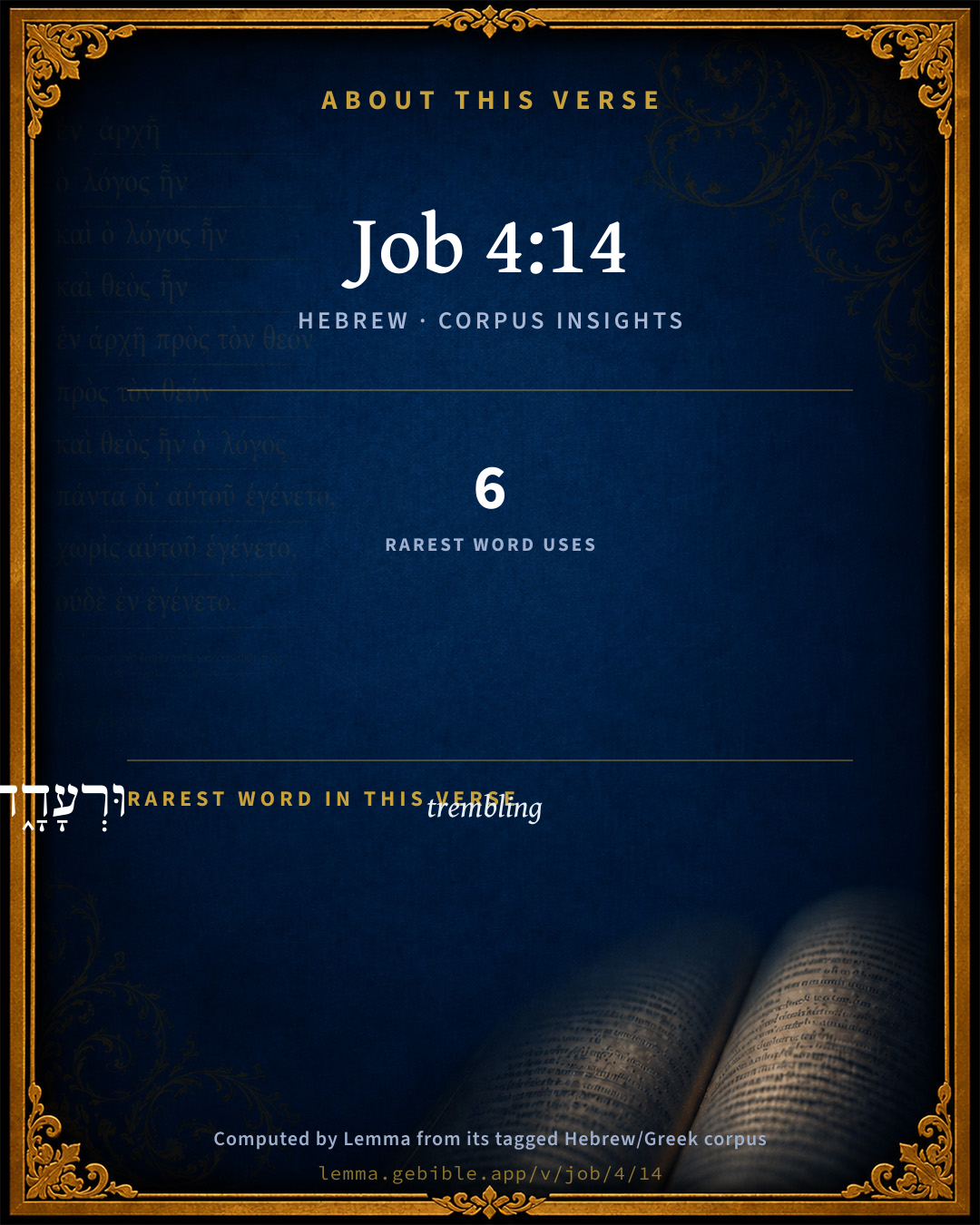
6
words
6
distinct lemmas
Wisdom
section

Notable vocabulary

The rarest word here is וּרְעָדָ֑ה trembling H7461 — appearing just 6 times in the whole Hebrew Bible.

Shared distinctive vocabulary

וּרְעָדָ֑ה trembling H7461 occurs in 6 verses of the Hebrew Bible. Also found in:

Grammatical profile

  • 2 verbs
  • 4 nouns

Verb forms

  • קְ֭רָאַנִי Qal · Perfect
  • הִפְחִֽיד Hiphil · Perfect

Hebrew & Septuagint length

In English translation the verse runs 12 words from the Hebrew and 13 from the Septuagint (LXX English) — closely comparable.

A rough comparison of the two English renderings, which tokenize alike — not a word-level alignment.

Word counts can differ between the Hebrew and the Greek without any difference in meaning — e.g. the Hebrew direct-object marker אֵת has no separate Greek word, and Greek often adds the article ὁ.

Cross-references

9

Topical passages linked to Job 4:14 in the Treasury of Scripture Knowledge — connected by theme and wording, ordered by reader-vote popularity; previews shown in the World English Bible.

  • Job 33:19 He is chastened also with pain on his bed, With continual strife in his bones;
  • Revelation 1:17 When I saw him, I fell at his feet like a dead man. He laid his right hand on me, saying, "Don't be afraid. I am the first and the last,
  • Job 7:14 Then you scar me with dreams, And terrify me through visions:
  • Psalms 119:120 My flesh trembles for fear of you. I am afraid of your judgments.
  • Isaiah 6:5 Then I said, "Woe is me! For I am undone, because I am a man of unclean lips, and I dwell in the midst of a people of unclean lips: for my eyes have seen the King, Yahweh of Hosts!"
  • Daniel 10:11 He said to me, Daniel, you man greatly beloved, understand the words that I speak to you, and stand upright; for to you am I now sent. When he had spoken this word to me, I stood trembling.
  • Habakkuk 3:16 I heard, and my body trembled. My lips quivered at the voice. Rottenness enters into my bones, and I tremble in my place, Because I must wait quietly for the day of trouble, For the coming up of the people who invade us.
  • Luke 1:12 Zacharias was troubled when he saw him, and fear fell upon him.
  • Luke 1:29 But when she saw him, she was greatly troubled at the saying, and considered what kind of salutation this might be.

Cross-references courtesy of OpenBible.info (CC BY 4.0).

Hebrew and Greek witnesses Masoretic Hebrew ↔ Greek Septuagint

The same verse in the two great witnesses to the Old Testament, shown verse-for-verse.

These are two independent witnesses, not word-aligned to each other, and the Septuagint is shown in lemma (dictionary) form.

Hebrew Job 4:14 Masoretic · Westminster Leningrad Codex

פַּ֣חַד קְ֭רָאַנִי וּרְעָדָ֑ה וְרֹ֖ב עַצְמוֹתַ֣י הִפְחִֽיד

Fear came on me, and trembling, Which made all my bones shake.

World English Bible · Public Domain

Greek LXX Job 4:14 Septuagint · lemma form

φρίκη δέ ἐγώ συνἀντάω καί τρόμος καί μεγάλως ἐγώ ὁ ὀστέον συνσείω

horror and trembling seized me, and caused all my bones greatly to shake.

LXX2012 (modern English Septuagint) · Public Domain

On this verse, Albert Barnes' Notes on the Bible discusses the Septuagint’s reading. Read the note in Commentary ↓

Hebrew: Westminster Leningrad Codex (CC BY 4.0). Greek: Septuagint (public domain); English from LXX2012 (modern English Septuagint) (Public Domain). How the Septuagint differs from the Hebrew →

Commentary

Notes on Job 4:14 from classic Christian and Jewish commentators (each source and its license shown beneath its notes). The classic Christian expositions comment on the surrounding passage and are grouped to its opening verse, so a note may address several verses; the Jewish commentaries on the Tanakh (Rashi and others) are per-verse, so they appear only where the commentator wrote on this verse.

Lemma curates 59 commentaries, every one of them public domain or Creative Commons licensed, each selected and text-cleaned for this edition rather than reprinted as found. About our sources →

Trapp's Complete Commentary

John Trapp

Job 4:14 Fear came upon me, and trembling, which made all my bones to shake.

Ver. 14. Fear came on me, and trembling] Fear in the inward man, and trembling in the outward. And this is God’s method still: the more he draweth nigh to any man the more doth rottenness enter into his bones, and he is horribly afraid of God’s judgments, with David; he trembleth at his word, with Josiah, that it may be the more efficacious in his soul. "Let us have grace" (saith the apostle), "whereby we may serve God acceptably with reverence and godly fear: for even our God also" (and not the God of the Jews only) "is a consuming fire," Heb 12:28-29. Aξιωματικωτατος μεν εστιν ο βασιλευς ημων, saith Basil. Our King will be served like himself, served in state; and although he alloweth us a humble familiarity, yet he expecteth our reverential fear; acquainted he will be with us in our walks of obedience; but yet he takes state upon him in his ordinances, and will be trembled at in the addresses we make unto his majesty; he looks we should bring with us a legal faith and a legal repentance, as well as an evangelical; and that we should work out our salvation with fear and trembling, Php 2:12. Terrors and humiliations prepare and posture the heart for revelations; never is it right till a man lie low at God’s feet, putting his mouth in the dust, and crying out, Speak, Lord, for thy servant heareth: there shall be only fear to make them understand the hearing, Isa 28:19; fear met Eliphaz, and made way for the heavenly vision.

Which made all my bones to shake] Heb. The multitude of my bones, or the number of my bones, how many soever they be, and they are as many (say the Hebrews) as there are affirmative precepts in the law. These pillars of my body shook sore, and threatened a downfall.

- Gelidusque per ima cucurrit

Ossa tremor. - (Aeneid ii.)

John Trapp, A Commentary or Exposition upon All the Books of the Old and New Testament (1647–1656) — public domain. Text from a community e-Sword module.

Joseph Benson's Commentary

Job 4:14. Fear came upon me, and trembling — The Hebrew is very poetical, namely, Fear called me, or called to me. Job expresses himself in similar language, Job 17:14. I have said, קראתי, karati, literally, I have called to corruption. Thus also Jer 30:5, We have heard a voice of trembling, of fear. As in a poem every thing is, or ought to be, alive, so fear is here represented as a person, who comes up to Eliphaz, and speaks to, and arrests him, as an officer of justice. Which made all my bones to shake — Which affected me to such a degree that my mind and body lost all power, and my very bones shook and trembled. It should seem, before he either heard or saw any thing, he was seized with this terror.

Joseph Benson's Commentary on the Old and New Testaments (1811–1818) — public domain. Text from a community e-Sword module.

Tyndale Open Study Notes

Tyndale Open Resources

4:14 Fear is common in God’s presence (Gen 15:12; Dan 8:17-18; 10:8-10), but God tells his people not to be afraid (Gen 15:1; 26:24; Isa 40:9; 44:8). • Eliphaz’s bones trembled like those of a prophet with terrible news to deliver (Jer 23:9; Hab 3:16).

Tyndale Open Study Notes — © Tyndale Open Resources, licensed CC BY-SA 4.0. Text via the HelloAO Bible API.

Geneva Bible (1599)

Geneva Bible translators

In these visions which God showeth to his creatures, there is ever a certain fear joined, that the authority thereof might be had in greater reverence.

Geneva Bible (1599) marginal notes — public domain. Text via Bolls.life.

The Cambridge Bible for Schools and Colleges

gen. ed. J. J. S. Perowne

14. Eliphaz depicts graphically the circumstances in which he received the message from heaven. In the dead night, in the midst of his perplexing thoughts upon his bed, a supernatural terror suddenly seized him. Then he was conscious of a breath passing before him, Job_4:15. Then he seemed to perceive a figure in his presence, too dim, however, to be discerned; and at last a whisper of a voice gave utterance to the awful words that expressed the relations of man to God, Job_4:16. So awful were the impressions of that night, that Eliphaz in recalling the circumstances almost feels himself in the midst of them again, and he falls into the present tense in describing them: a breath passeth before my face … an image is before mine eyes … and I hear a voice, &c.

The Cambridge Bible for Schools and Colleges (gen. ed. J. J. S. Perowne; Cambridge University Press, 1878–1918) — public domain. Text from a community e-Sword module.

John Gill's Exposition

Then a spirit passed before my face,.... Which some interpret of a wind (q), a blustering wind, that blew strong in his face; and so the Targum renders it, a stormy wind, such an one as Elijah perceived when the Lord spoke to him, though he was not in that, Kg1 19:11; or such a whirlwind, out of which the Lord spake to Job, Job 38:1; or rather, as Jarchi, an angel, an immaterial spirit, one of Jehovah's ministering spirits, clothed in an human form, and which passed and repassed before Eliphaz, that he might take notice of it:

the hair of my flesh stood up; erect, through surprise and dread; which is sometimes the case, when anything astonishing and terrible is beheld; the blood at such times making its way to the heart, for the preservation of that, leaves the external members of the body cold, and the skin of the flesh, in which the hair is, being contracted by the impetuous influx of the nervous fluid, causes the hair to stand upright, particularly the hair of the head, like the prickles or hedgehogs (r); which has been usual at the sight of an apparition (s).

(q) "ventus", Vatablus, Cocceius, Schmidt, Broughton. (r) "Obstupui, steteruntque comae----". Virgil. Aeneid. l. 2. ver. 774. & l. 3. ver. 48. "arrectaeque horrore comae". Aeneid. 4. ver. 286. & l. 12. ver. 888. (s) Vid. Scheuchzer. Physic. Sacr. p. 665.

John Gill's Exposition of the Whole Bible (1746–1763) — public domain (CC PDM 1.0). Text via the HelloAO Bible API.

Albert Barnes' Notes on the Bible

Fear came upon me - Margin, “Met me.” The Chaldee Paraphrase renders this, “a tempest,” זיקא. The Septuagint, φρίκη frikē - “shuddering,” or “horror.” The sense is, that he became greatly alarmed at the vision.

Which made all my bones to shake - Margin, as in Hebrew, the multitude of my bones. A similar image is employed by Virgil,

Obstupuere auimis, gelidusque per ima cucurrit

Ossa tremor;

Aeneid ii. 120.

“A cold tremor ran through all their bones.”

Albert Barnes' Notes on the Bible (1834–1885) — public domain. Text from a community e-Sword/MySword module.

Matthew Poole's English Annotations

Fear came upon me; either caused by the apparition following; or sent by God to humble him, and to prepare him for the more diligent attention to, reverent reception of; and ready compliance with, the Divine message.

Matthew Poole's English Annotations on the Holy Bible (1683–1685) — public domain. Text from a community e-Sword/MySword module.

Whedon's Commentary on the Bible

Daniel D. Whedon

14. All my bones — Literally, the multitude of my bones. Virgil similarly describes the effects of horror, — “gelidus per ima cucurrit ossa tremor,” (AEneid, 2:120,) — through the inmost bones an icy tremor ran.

Daniel D. Whedon (gen. ed.), Commentary on the Old and New Testaments (1874–1909) — public domain. Text from a community e-Sword module.

The Pulpit Commentary

Fear came upon me, and trembling; compare the "horror of great darkness" which fell upon Abraham. (Gen_15:12) Our nature shrinks from direct contact with the spiritual world, and our earthly frame shudders at the unearthly presence. Which made the multitude of my bones to shake; or, which made my bones greatly to shake (so the LXX" Professor Lee, and others).

The Pulpit Commentary (1880–1919), ed. H.D.M. Spence-Jones & Joseph S. Exell — public domain. Text from a community e-Sword module.

unfoldingWord translationNotes

Door43 World Missions Community

General Information:

The writer uses parallelism in these verses, conveying a single idea using different statements to emphasize Eliphaz's fear. (See: Parallelism)

fear and trembling came upon me

Here fear and trembling are spoken of as if they were objects that could come to a person. AT: "I began to be afraid and to tremble" (See: Metaphor)

the hair of my flesh stood up

This indicates great fear.

the hair of my flesh

"the hair on my body"

translationWords

fear

spirit

face

flesh

unfoldingWord translationNotes — © Distant Shores Media and the Door43 World Missions Community, licensed CC BY-SA 4.0. Source: git.door43.org/Door43/en_tn.

Rashi

Rabbi Shlomo Yitzchaki (Rashi)

terror befell me from the spirit that came to me. and the spirit was an angel. as it is stated (Ps. 104:4): “He makes his angels spirits.”

Rashi on the Tanakh — English translations: “The Judaica Press complete Tanach with Rashi, translated by A. J. Rosenberg” (CC BY 4.0); “Pentateuch with Rashi's commentary by M. Rosenbaum and A.M. Silbermann, 1929-1934” (public domain); “The Metsudah Tanach series, Lakewood, N.J” (CC BY 4.0); and “The Book of Joshua, Metsudah Publications, 1997” (CC BY 4.0). Text via Sefaria.

Lesson kit

Teaching starters — assembled from the data on this page, not authored interpretation. Every prompt links to the verse data it draws on. Edit before teaching.

Job, in the Wisdom, opens this verse with 6 words (6 distinct Hebrew lemmas). Its most distinctive word is raʻad (“trembling”). A historical commentator’s framing appears above. Read the whole chapter for the surrounding context.

Discussion questions

  1. The word raʻad carries the sense “trembling.” How does it shape the verse?
  2. Exodus 15:15 shares the word «trembling» with this verse. How do the two illuminate each other?
  3. These translations render this verse differently; the difference is in the English rendering, not the original. What questions does that raise?
  4. The verb «קְ֭רָאַנִי» is Qal Perfect. How does its form color the action?
  5. Reading how Trapp's Complete Commentary and Joseph Benson's Commentary read this verse, where do the two commentators agree and where do they part?

Things to notice

Reading settings

Reading text

Shown beneath each verse's original-language words.

Old Testament
Old Testament edition

Read the OT as the Masoretic Hebrew (MT) or the Greek Septuagint (LXX).

English shown for the Greek Septuagint (in the Hebrew ↔ Greek comparison).

Comparing translations? Open the Compare panel on any verse page to stack up to four side by side.