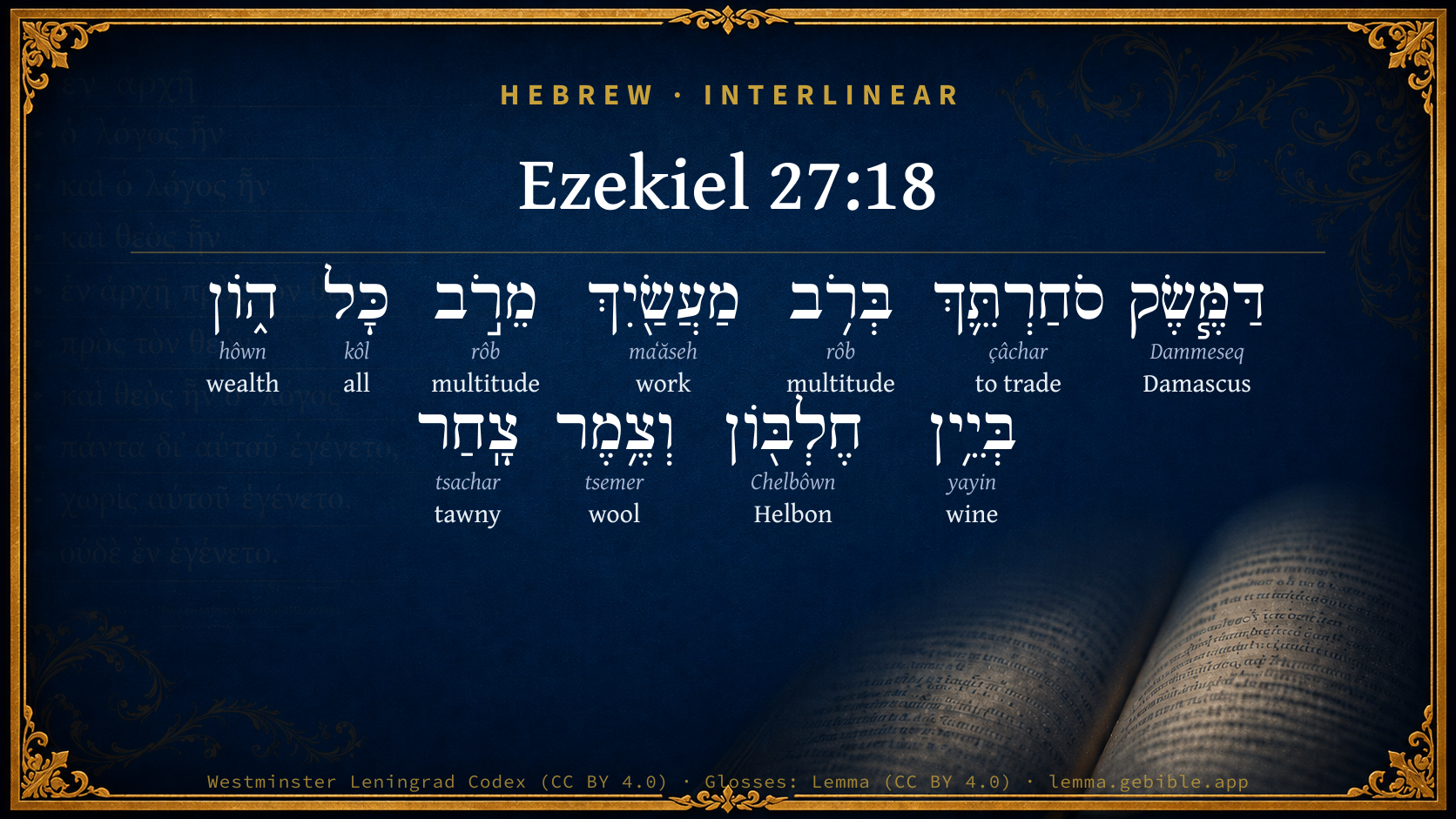
Ezekiel 27:18

Hebrew (Westminster Leningrad Codex) Ezekiel 27:18 appears in the Hebrew Old Testament. The text above is from the Westminster Leningrad Codex. Each word links to its Strong’s number, a concise gloss, and parsing drawn from the Open Scriptures Hebrew Bible morphology. Click any word for its full Brown-Driver-Briggs (BDB) entry.
Download image
Cite this verse

Ezekiel 27:18 (World English Bible). Public Domain. Lemma interlinear Bible study tool, https://lemma.gebible.app/v/ezekiel/27/18.

Show BibTeX & RIS
BibTeX
RIS
English Translation
Damascus was your merchant for the multitude of your handiworks, by reason of the multitude of all kinds of riches, with the wine of Helbon, and white wool.
World English Bible · Public Domain
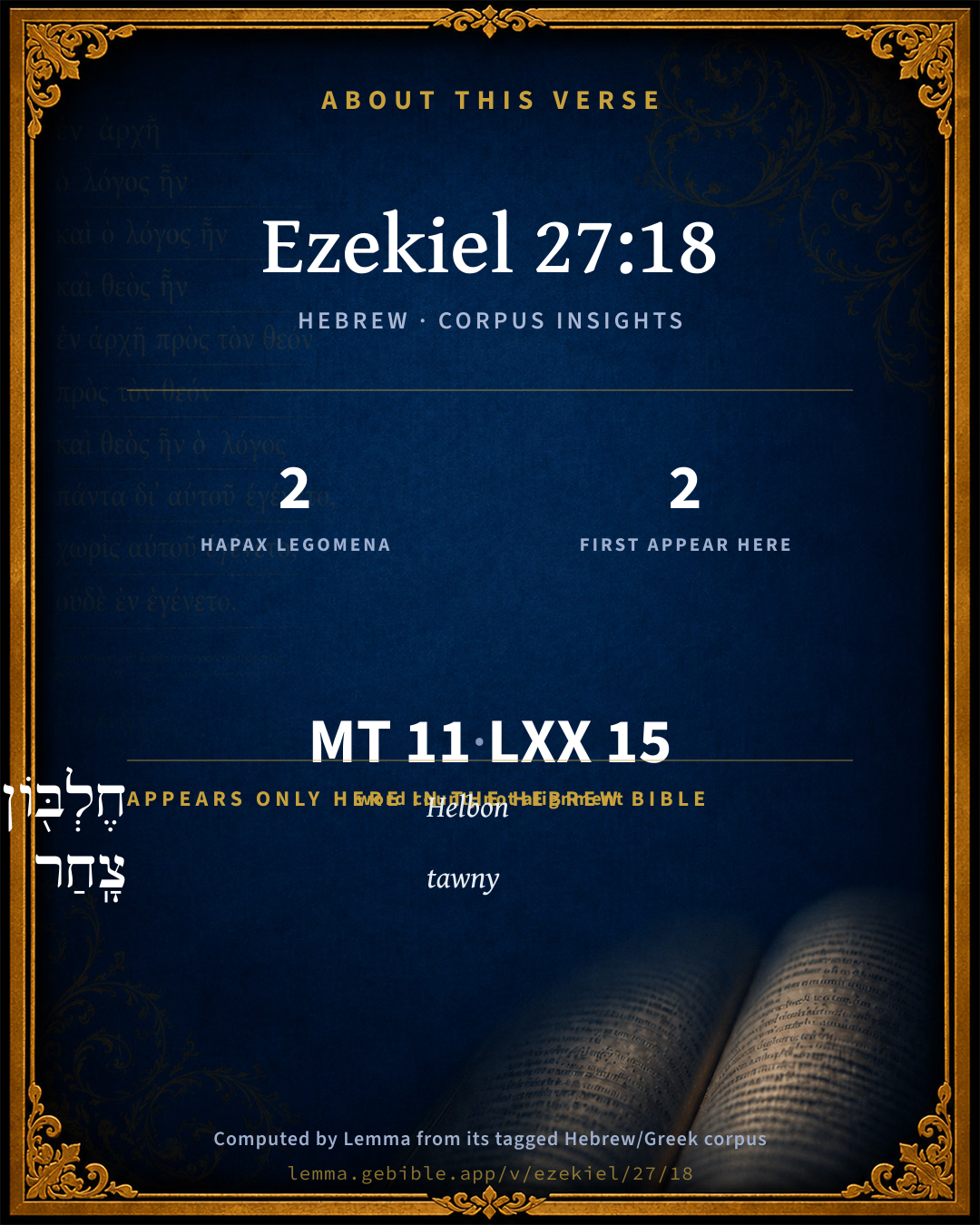
Highlights
  • 2 hapax legomena — only here in the Hebrew Bible
  • 2 first appearances in the Hebrew Bible
Full analysis ↓
Download a study sheet

One document with this verse’s original text, its word-by-word gloss line, the meaning frame, cross-references with their text, attributed commentary, and full source and license credits — printable, and it pastes into notes with its structure intact.

This verse Autodidact and up

Study sheet (.html) Plain text (.txt)

A passage Seminary Student

Up to 50 verses in one chapter. A passage sheet keeps up to 6 commentary sources and 12 cross-references per verse, in the order this page ranks them, and says so on the sheet whenever that leaves anything out. Ask for a single verse and you get the Autodidact verse sheet above.

Everything on this page stays free to read, with no account — the sheet is a download of what is already on screen, not access to it.

Want to remove ads? Support Godless Engineer
Compare translations 3

The same verse in 3 English versions, stacked beneath the original-language interlinear above. Click any original word for its lexicon entry.

Each is an independent rendering of the whole verse — the interlinear is not word-aligned to these translations.

Highlighted words mark where these versions differ — a whole-verse word diff, not a word-by-word alignment.

  • World English Bible Public Domain
    Damascus was your merchant for the multitude of your handiworks, by reason of the multitude of all kinds of riches, with the wine of Helbon, and white wool.
  • King James Version Public Domain
    Damascus was thy merchant in the multitude of the wares of thy making, for the multitude of all riches; in the wine of Helbon, and white wool.
  • unfoldingWord Literal Text CC BY-SA 4.0
    Damascus was a trader of all your products, of all your enormous wealth, and of the wine of Helbon and the wool of Zahar.

unfoldingWord Literal Text — © unfoldingWord, licensed CC BY-SA 4.0. Word-aligned USFM3 via Door43 (git.door43.org/unfoldingWord/en_ult).

Versions to compare (up to 4)

3 of 4 selected

Show all 18 translations

Every available English version of this verse, each an independent rendering of the whole verse.

  • World English Bible Public Domain
    Damascus was your merchant for the multitude of your handiworks, by reason of the multitude of all kinds of riches, with the wine of Helbon, and white wool.
  • Berean Standard Bible Public Domain
    Because of your many products and your great wealth of goods, Damascus traded with you wine from Helbon, wool from Zahar,
  • Majority Standard Bible Public Domain
    Because of your many products and your great wealth of goods, Damascus traded with you wine from Helbon, wool from Zahar,
  • King James Version Public Domain
    Damascus was thy merchant in the multitude of the wares of thy making, for the multitude of all riches; in the wine of Helbon, and white wool.
  • American Standard Version (1901) Public Domain
    Damascus was thy merchant for the multitude of thy handiworks, by reason of the multitude of all kinds of riches, with the wine of Helbon, and white wool.
  • Revised Version (1885) Public Domain
    Damascus was thy merchant for the multitude of thy handyworks, by reason of the multitude of all kinds of riches; with the wine of Helbon, and white wool.
  • Geneva Bible (1599) Public Domain
    They of Damascus were thy marchants in ye multitude of thy wares, for the multitude of all riches, as in the wine of Helbon and white wooll.
  • Douay-Rheims (1899) Public Domain
    The men of Damascus were thy merchants in the multitude of thy works, in the multitude of divers riches, in rich wine, in wool of the best colour.
  • Young's Literal Translation Public Domain
    Damascus `is' thy merchant, For the abundance of thy works, Because of the abundance of all wealth, For wine of Helbon, and white wool.
  • Literal Standard Version CC BY-SA 4.0
    Damascus [is] your merchant, || For the abundance of your works, || Because of the abundance of all wealth, || For wine of Helbon, and white wool.
  • Unlocked Literal Bible CC BY-SA 4.0
    Damascus was a trader of all your products, of all your enormous wealth, and of the wine of Helbon and the wool of Zahar.
  • unfoldingWord Literal Text CC BY-SA 4.0
    Damascus was a trader of all your products, of all your enormous wealth, and of the wine of Helbon and the wool of Zahar.
  • Darby Bible Public Domain
    Damascus dealt with thee because of the multitude of thy handiworks, by reason of the abundance of all substance, with wine of Helbon, and white wool.
  • World Messianic Bible Public Domain
    “‘“Damascus was your merchant for the multitude of your handiworks by reason of the multitude of all kinds of riches, with the wine of Helbon, and white wool.
  • Webster's Bible Public Domain
    Damascus was thy merchant in the multitude of the wares of thy making, for the multitude of all riches; in the wine of Helbon, and white wool.
  • Free Bible Version CC BY-SA 4.0
    Because you had many different products, in fact so much of everything, Damascus traded with you using wine from Helbon, wool from Zahar.
  • Bible in Basic English Public Domain
    Damascus did business with you because of the great amount of your wealth, with wine of Helbon and white wool.
  • JPS Tanakh (1917) Public Domain
    Damascus was thy merchant for the multitude of thy wealth, by reason of the multitude of all riches, with the wine of Helbon, and white wool.

Literal Standard Version (2020), Covenant Press — licensed CC BY-SA 4.0. Text via the HelloAO Bible API (eBible.org). Unlocked Literal Bible (unfoldingWord) — licensed CC BY-SA 4.0. Text via the HelloAO Bible API (eBible.org). unfoldingWord Literal Text — © unfoldingWord, licensed CC BY-SA 4.0. Word-aligned USFM3 via Door43 (git.door43.org/unfoldingWord/en_ult). Free Bible Version, Dr. Jonathan Gallagher — licensed CC BY-SA 4.0. Text via the HelloAO Bible API (eBible.org).

Word by word

More ways to search: Search by grammar → Find every occurrence → Compare this word →

Practice this passage: Drill this verse → Learn its vocabulary →

חֶלְבּ֖וֹן
Chelbôwn
H2463
“Helbon”
Noun, Proper
Part of Speech
Noun
Type
Proper
Full BDB Definition

Origin: from H2459

TWOT: None

Helbon = "fertile" - a town a few miles northwest of Damascus, modern 'Helbon', still noted for its fine grapes
  1. דַּמֶּ֧שֶׂק Dammeseq H1834 “Damascus” Noun, Proper
  2. סֹחַרְתֵּ֛ךְ çâchar H5503 “trading · you” Verb, Qal, Participle Active, Feminine, Singular, Construct + Suffix, Personal, 2nd Person, Feminine, Singular
  3. בְּרֹ֥ב rôb H7230 “in/at · multitude of” Preposition + Noun, Common, Both, Singular, Construct
  4. מַעֲשַׂ֖יִךְ maʻăseh H4639 “works · your” Noun, Common, Masculine, Plural, Construct + Suffix, Personal, 2nd Person, Feminine, Singular
  5. מֵרֹ֣ב rôb H7230 “from · multitude of” Preposition + Noun, Common, Both, Singular, Construct
  6. כָּל kôl H3605 “all of” Noun, Common, Masculine, Singular, Construct
  7. ה֑וֹן hôwn H1952 “wealth” Noun, Common, Masculine, Singular, Absolute
  8. בְּיֵ֥ין yayin H3196 “in/at · wine of” Preposition + Noun, Common, Masculine, Singular, Construct
  9. וְצֶ֥מֶר tsemer H6785 “and · wool of” Conjunction + Noun, Common, Masculine, Singular, Construct
  10. צָֽחַר tsachar H6713 “tawny” Noun, Common, Masculine, Singular, Absolute

About this verse

These counts appear in no published source. They are computed here, from the morphology-tagged text and Lemma’s own curated glosses. What Lemma adds →

11
words
10
distinct lemmas
Prophets
section

Notable vocabulary

2 hapax legomena — words that appear only here in the entire Hebrew Bible:

  • חֶלְבּ֖וֹן Helbon H2463
  • צָֽחַר tawny H6713

First appearance in Scripture

These words make their first canonical appearance in the Hebrew Bible here:

  • חֶלְבּ֖וֹן Helbon H2463
  • צָֽחַר tawny H6713

Shared distinctive vocabulary

וְצֶ֥מֶר wool H6785 occurs in 16 verses of the Hebrew Bible. Also found in:

Grammatical profile

  • 1 verb
  • 10 nouns

Verb forms

  • סֹחַרְתֵּ֛ךְ Qal · Participle Active

Repetition

A word recurs within this verse — often emphatic in Hebrew:

  • בְּרֹ֥ב multitude H7230 ×2

Hebrew & Septuagint length

In English translation the verse runs 28 words from the Hebrew and 31 from the Septuagint (LXX English) — closely comparable.

A rough comparison of the two English renderings, which tokenize alike — not a word-level alignment.

Word counts can differ between the Hebrew and the Greek without any difference in meaning — e.g. the Hebrew direct-object marker אֵת has no separate Greek word, and Greek often adds the article ὁ.

In the original languages it is 11 Hebrew tokens and 15 Greek tokens — but the two are counted differently (Hebrew bundles its prefixes and suffixes into one token; the Greek is in lemma form), so that isn’t a like-for-like length.

Cross-references

6

Topical passages linked to Ezekiel 27:18 in the Treasury of Scripture Knowledge — connected by theme and wording, ordered by reader-vote popularity; previews shown in the World English Bible.

  • Isaiah 7:8 For the head of Syria is Damascus, and the head of Damascus is Rezin; and within sixty-five years Ephraim shall be broken in pieces, so that it shall not be a people;
  • Genesis 14:15 He divided himself against them by night, he and his servants, and struck them, and pursued them to Hobah, which is on the left hand of Damascus.
  • Genesis 15:2 Abram said, "Lord Yahweh, what will you give me, seeing I go childless, and he who will inherit my estate is Eliezer of Damascus?"
  • 1 Kings 11:24–25 He gathered men to him, and became captain over a troop, when David killed them [of Zobah]: and they went to Damascus, and lived therein, and reigned in Damascus.
  • Ezekiel 47:16–18 Hamath, Berothah, Sibraim, which is between the border of Damascus and the border of Hamath; Hazer Hatticon, which is by the border of Hauran.
  • Acts 9:2 and asked for letters from him to the synagogues of Damascus, that if he found any who were of the Way, whether men or women, he might bring them bound to Jerusalem.

Cross-references courtesy of OpenBible.info (CC BY 4.0).

Hebrew and Greek witnesses Masoretic Hebrew ↔ Greek Septuagint

The same verse in the two great witnesses to the Old Testament, shown verse-for-verse.

These are two independent witnesses, not word-aligned to each other, and the Septuagint is shown in lemma (dictionary) form.

Hebrew Ezekiel 27:18 Masoretic · Westminster Leningrad Codex

דַּמֶּ֧שֶׂק סֹחַרְתֵּ֛ךְ בְּרֹ֥ב מַעֲשַׂ֖יִךְ מֵרֹ֣ב כָּל ה֑וֹן בְּיֵ֥ין חֶלְבּ֖וֹן וְצֶ֥מֶר צָֽחַר

Damascus was your merchant for the multitude of your handiworks, by reason of the multitude of all kinds of riches, with the wine of Helbon, and white wool.

World English Bible · Public Domain

Greek LXX Ezekiel 27:18 Septuagint · lemma form

δαμασκός ἔμπορος σύ ἐκ πλῆθος πᾶς δύναμις σύ οἶνος ἐκ χελβων καί ἔριον ἐκ μίλητος

The people of Damascus were your merchants by reason of the abundance of all your power; wine out of Chelbon, and wool from Miletus; and they brought wine into your market.

LXX2012 (modern English Septuagint) · Public Domain

On this verse, The Pulpit Commentary discusses the Septuagint’s reading. Read the note in Commentary ↓

Hebrew: Westminster Leningrad Codex (CC BY 4.0). Greek: Septuagint (public domain); English from LXX2012 (modern English Septuagint) (Public Domain). How the Septuagint differs from the Hebrew →

Targum (Aramaic paraphrase)

1

The Targum is the ancient Jewish Aramaic paraphrase of the Hebrew Scriptures — an interpretive translation, not the Hebrew text itself. Onkelos (literal) and Pseudo-Jonathan (expansive) render the Torah, and Jonathan the Prophets. Coverage is partial: where no permissively-licensed English translation exists for a verse, only the Aramaic is shown. This is verse-level text, not a word-by-word alignment to the Hebrew.

  1. Targum Jonathan Prophets (Joshua–Malachi)
    מִן דַמֶשֶׂק מַיְתָן סְחוֹרָה לְגַוִיךְ בִּסְגֵי עוֹתְרִין מִסְגֵי כָּל עוֹתַר בַּחֲמַר חֵילַת מְבַשֵׁל וַעֲמַר מֵילַת כְּבֵינָא:

    (no public-domain English translation for this verse)

    Targum Jonathan — Aramaic: “Mikraot Gedolot” (public domain). English: “Sefaria Community Translation” (CC0 1.0 (public-domain dedication)); “London "Chaldee Paraphrase," 1871” (public domain). Text via Sefaria.

Commentary

Notes on Ezekiel 27:18 from classic Christian and Jewish commentators (each source and its license shown beneath its notes). The classic Christian expositions comment on the surrounding passage and are grouped to its opening verse, so a note may address several verses; the Jewish commentaries on the Tanakh (Rashi and others) are per-verse, so they appear only where the commentator wrote on this verse.

Lemma curates 59 commentaries, every one of them public domain or Creative Commons licensed, each selected and text-cleaned for this edition rather than reprinted as found. About our sources →

Tyndale Open Study Notes

Tyndale Open Resources

27:18 Helbon was a town ten miles north of Damascus. Zahar may have been nearby, although its exact location is unknown.

Tyndale Open Study Notes — © Tyndale Open Resources, licensed CC BY-SA 4.0. Text via the HelloAO Bible API.

Jamieson, Fausset & Brown

Robert Jamieson, A. R. Fausset & David Brown

Helbon--or Chalybon, in Syria, now Aleppo; famed for its wines; the Persian monarchs would drink no other.

Jamieson, Fausset & Brown — Commentary Critical and Explanatory on the Whole Bible (1871) — public domain (CC PDM 1.0). Text via the HelloAO Bible API.

Adam Clarke's Commentary

Verse 18. Damascus wine of Helbon] Now called by the Turks Haleb, and by us Aleppo.

White wool.] Very fine wool: wool of a fine quality. Some think Milesian wool is meant.

Adam Clarke's Commentary on the Bible (1810–1826) — public domain. Text from a community e-Sword/MySword module.

Ellicott's Commentary for English Readers

(18) Wine of Helbon.—Helbon is identified with a village of the same name, three and a half hours north of Damascus, rich in ruins, and still devoted to the culture of the vine, from which the costliest wine of the country was made. It was probably the same with the wine of Chalybon, so much prized in Persia.

A Bible Commentary for English Readers, edited by Charles John Ellicott (1878–1897) — public domain. Text from a community e-Sword module.

The Cambridge Bible for Schools and Colleges

gen. ed. J. J. S. Perowne

18. wares of thy making] the multitude of thy works, i.e. the works done for Tyre, all of which are hers.

multitude of all riches] or, because of every kind of riches.

wine of Helbon] This is repeatedly mentioned as a choice wine in the Assyrian inscriptions (Schrad. KAT. p. 425). The Persian kings also preferred it on their table. Cf. Hos_14:7, Son_8:11. The place is identified with Chalbûn, N.E. of Damascus.

white wool] Possibly, wool of Zachar, though a place of this name is unknown.

The Cambridge Bible for Schools and Colleges (gen. ed. J. J. S. Perowne; Cambridge University Press, 1878–1918) — public domain. Text from a community e-Sword module.

John Gill's Exposition

Dan also and Javan, going to and fro, occupied in thy fairs,.... Either the inhabitants of the tribe of Dan in general; or of Laish, sometime called Dan, and in later times Caesarea Philippi, which was in that tribe: though Grotius thinks that Taprobane, or the isle of Zeilan, is meant, where, and not in Dan, were the things after mentioned, in plenty; and where also, according to Ptolemy (t), was a city called Dana or Dagana: and Bochart takes Javan not to be Greece, but a people of a country in Arabia, the metropolis of which was Uzal; and so he renders it, as some of the Greek versions do, Javan of Uzal, or Asel, to distinguish it from the other Javan, Eze 27:13, where also, and not in Greece, the sweet spices grew, which these are said to trade in:

bright iron, cassia, and calamus, were in thy market; brought from the above places; polished iron or steel, and the sweet spices of cassia and calamus, or the aromatic cane or reed, which came from afar, Jer 6:20.

(t) Geograph. l. 7. c. 4.

John Gill's Exposition of the Whole Bible (1746–1763) — public domain (CC PDM 1.0). Text via the HelloAO Bible API.

Haydock's Catholic Bible Commentary

Rich. Hebrew Chelbon; perhaps the city Chelba, Judges i. 31. The kings of Persia used this wine, and planted vines at Damascus on purpose.

George Leo Haydock (1774–1849), Haydock's Catholic Family Bible and Commentary, 1859 edition — public domain. Excludes Psalms (Douay-Rheims chapter numbering differs from Protestant) and Deuterocanonical books (Catholic canon only).

Matthew Poole's English Annotations

Damascus; a very ancient and wealthy city of Syria, and the royal city.

The wares of thy making; see the phrase Eze 27:16.

For the multitude of all riches: though the Tyrians had many rich and lovely commodities, yet it pleased the Damascenes to bring chiefly two of their commodities in exchange, richest wines to please the palate of the luxurious Tyrians, and finest wool to clothe their pride.

Halbon; this place I meet no where else; Ptolemy hath Chalinonis in Syria, perhaps they may be it. Others, to save trouble, make it a common name; sweet, or smooth, or fat wine; for

Helbon comes from a word that signifies fat.

Matthew Poole's English Annotations on the Holy Bible (1683–1685) — public domain. Text from a community e-Sword/MySword module.

Whedon's Commentary on the Bible

Daniel D. Whedon

18. Damascus — This city, the wonder of the ancient world, still remains great because of its three highways — running to Egypt, Arabia, and Persia. It has been from the dawn of history the capital and chief city of Syria, and celebrated because “of the multitude of all kinds of riches” (R.V.). Schrader gives several texts in which the wine of Helbon is mentioned. Nebuchadnezzar brought his wine from the “country of Helbon” (Hi-il-bu-nu), and Strabo mentions that this was the favorite wine of the Persian kings. The locality has been identified with Halbun, very near Damascus, a place still celebrated for the finest vineyards in Syria.

Daniel D. Whedon (gen. ed.), Commentary on the Old and New Testaments (1874–1909) — public domain. Text from a community e-Sword module.

The Pulpit Commentary

Damascus. The chief expert of the great capital of Syria was the wine of Helbon. The name occurs only here in the Old Testament. The LXX gives Chel-ben; the Vulgate, as if it described the quality of the wine, vinum pingue. It has been identified with Aleppo and with Chalyben, but both of these places are too remote from Damascus, and Mr. J. R. Porter ("Dict. Bible," s.v.) finds it in a place a few miles from Damascus, still bearing the name, and famous as producing the finest grapes in Syria. Strabo (Ezekiel 15. p. 735) names the wine of Chalybon as the favorite drink of the Persian kings, and Athenaeus (1:22) says the same of the wine of Damascus. The name appears in Egyptian monuments in conjunction with Kedes, as a Hittite city, and Brugsch ("Geogr. AEgypt., " 2:45) agrees with Porter as to its position. White wool. The adjective has been taken as a proper name (Smend) "wool of Zachar,"the region being identified with Nabatheaea, which was famous for its sheep. The LXX gives wool of Miletus," the city most famous in Greek commerce for its woollen fabrics.

The Pulpit Commentary (1880–1919), ed. H.D.M. Spence-Jones & Joseph S. Exell — public domain. Text from a community e-Sword module.

Rashi

Rabbi Shlomo Yitzchaki (Rashi)

with white wine [Heb. בְּיֵין חֶלְבּוֹן,] cooked white wine, and Menachem (p. 89) connects it with (Ps. 147:14): “the best (חֵלֶב) of the wheat,” an expression of goodness

and white wool [Heb. צָחֹר.] [Jonathan renders:] “fine white covered wool.” On the day the lamb is born, and its mother cleanses it by licking it, they make a cover and wrap it around it with clasps so that that its wool be clean.

צָחֹר means white, like (Jud. 5:10): “white (צִרוֹרוֹת) donkeys.

Rashi on the Tanakh — English translations: “The Judaica Press complete Tanach with Rashi, translated by A. J. Rosenberg” (CC BY 4.0); “Pentateuch with Rashi's commentary by M. Rosenbaum and A.M. Silbermann, 1929-1934” (public domain); “The Metsudah Tanach series, Lakewood, N.J” (CC BY 4.0); and “The Book of Joshua, Metsudah Publications, 1997” (CC BY 4.0). Text via Sefaria.

Lesson kit

Teaching starters — assembled from the data on this page, not authored interpretation. Every prompt links to the verse data it draws on. Edit before teaching.

Ezekiel, in the Prophets, opens this verse with 11 words (10 distinct Hebrew lemmas). Its most distinctive word is Chelbôwn (“Helbon”). A historical commentator’s framing appears above. Read the whole chapter for the surrounding context.

Discussion questions

  1. How does “Helbon” (Chelbôwn) shape what this verse is saying?
  2. 2 words here appear nowhere else in the Hebrew Bible. Why might the author reach for such rare wording?
  3. 2 words make their first appearance in Scripture here. What does this debut establish?
  4. How does Leviticus 13:47, which shares the word «wool», read alongside this verse?
  5. What does the repetition of “multitude” (2× in this one verse) do in this verse?
  6. These translations render this verse differently. What is at stake in choosing one wording over another?
  7. «סֹחַרְתֵּ֛ךְ» is a Qal Participle Active verb. How does that grammatical form shape the action described?
  8. Compare how Tyndale Open Study Notes and Jamieson, Fausset & Brown read this verse. Where do they agree or differ?

Things to notice

  • 2 words in this verse appear nowhere else in the Hebrew Bible.
  • 2 words make their first canonical appearance in Scripture here.
  • This verse counts 11 Hebrew ↔ 15 Greek words.
  • These translations choose different wording for 14 words in this verse.
  • “multitude” occurs 2× in this single verse.

Reading settings

Reading text

Shown beneath each verse's original-language words.

Old Testament
Old Testament edition

Read the OT as the Masoretic Hebrew (MT) or the Greek Septuagint (LXX).

English shown for the Greek Septuagint (in the Hebrew ↔ Greek comparison).

Comparing translations? Open the Compare panel on any verse page to stack up to four side by side.