
Nahum 3:4

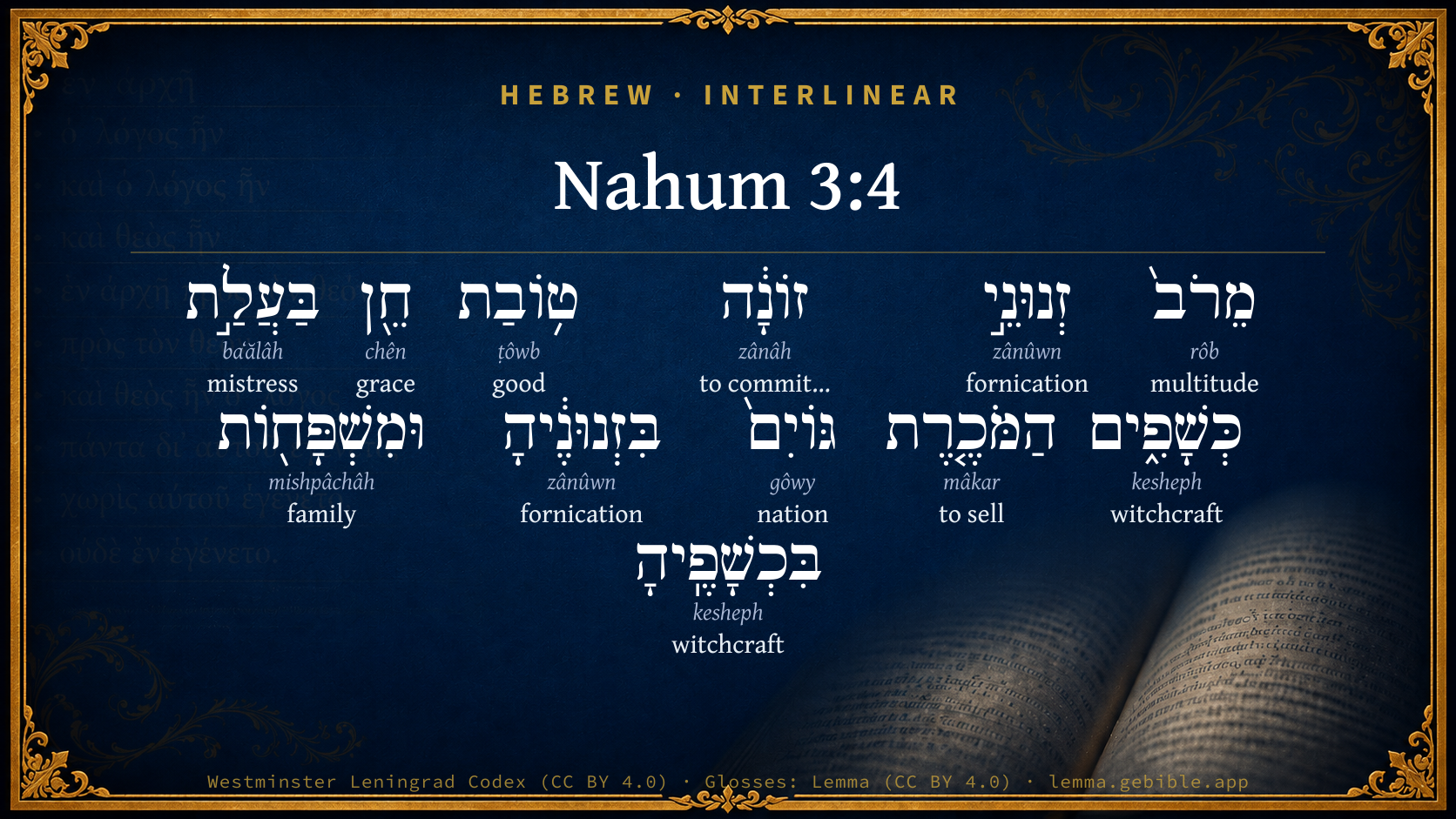
Hebrew (Westminster Leningrad Codex) Nahum 3:4 appears in the Hebrew Old Testament. The text above is from the Westminster Leningrad Codex. Each word links to its Strong’s number, a concise gloss, and parsing drawn from the Open Scriptures Hebrew Bible morphology. Click any word for its full Brown-Driver-Briggs (BDB) entry.
Download image
Cite this verse

Nahum 3:4 (World English Bible). Public Domain. Lemma interlinear Bible study tool, https://lemma.gebible.app/v/nahum/3/4.

Show BibTeX & RIS
BibTeX
RIS
English Translation
because of the multitude of the prostitution of the alluring prostitute, the mistress of witchcraft, who sells nations through her prostitution, and families through her witchcraft.
World English Bible · Public Domain
Download a study sheet

One document with this verse’s original text, its word-by-word gloss line, the meaning frame, cross-references with their text, attributed commentary, and full source and license credits — printable, and it pastes into notes with its structure intact.

This verse Autodidact and up

Study sheet (.html) Plain text (.txt)

A passage Seminary Student

Up to 50 verses in one chapter. A passage sheet keeps up to 6 commentary sources and 12 cross-references per verse, in the order this page ranks them, and says so on the sheet whenever that leaves anything out. Ask for a single verse and you get the Autodidact verse sheet above.

Everything on this page stays free to read, with no account — the sheet is a download of what is already on screen, not access to it.

Want to remove ads? Support Godless Engineer
Compare translations 3

The same verse in 3 English versions, stacked beneath the original-language interlinear above. Click any original word for its lexicon entry.

Each is an independent rendering of the whole verse — the interlinear is not word-aligned to these translations.

Highlighted words mark where these versions differ — a whole-verse word diff, not a word-by-word alignment.

  • World English Bible Public Domain
    because of the multitude of the prostitution of the alluring prostitute, the mistress of witchcraft, who sells nations through her prostitution, and families through her witchcraft.
  • King James Version Public Domain
    Because of the multitude of the whoredoms of the wellfavoured harlot, the mistress of witchcrafts, that selleth nations through her whoredoms, and families through her witchcrafts.
  • unfoldingWord Literal Text CC BY-SA 4.0
    From the many harlotries of the prostitute, pleasing in beauty, the mistress of witchcraft, the seller of nations through her prostitution, and peoples through her witchcraft.

unfoldingWord Literal Text — © unfoldingWord, licensed CC BY-SA 4.0. Word-aligned USFM3 via Door43 (git.door43.org/unfoldingWord/en_ult).

Versions to compare (up to 4)

3 of 4 selected

Show all 18 translations

Every available English version of this verse, each an independent rendering of the whole verse.

  • World English Bible Public Domain
    because of the multitude of the prostitution of the alluring prostitute, the mistress of witchcraft, who sells nations through her prostitution, and families through her witchcraft.
  • Berean Standard Bible Public Domain
    because of the many harlotries of the harlot, the seductive mistress of sorcery, who betrays nations by her prostitution and clans by her witchcraft.
  • Majority Standard Bible Public Domain
    because of the many harlotries of the harlot, the seductive mistress of sorcery, who betrays nations by her prostitution and clans by her witchcraft.
  • King James Version Public Domain
    Because of the multitude of the whoredoms of the wellfavoured harlot, the mistress of witchcrafts, that selleth nations through her whoredoms, and families through her witchcrafts.
  • American Standard Version (1901) Public Domain
    because of the multitude of the whoredoms of the well-favored harlot, the mistress of witchcrafts, that selleth nations through her whoredoms, and families through her witchcrafts.
  • Revised Version (1885) Public Domain
    because of the multitude of the whoredoms of the well favoured harlot, the mistress of witchcrafts, that selleth nations through her whoredoms, and families through her witchcrafts.
  • Geneva Bible (1599) Public Domain
    Because of the multitude of the fornications of the harlot that is beautifull, and is a mistresse of witchcraft, and selleth the people thorow her whoredome, and the nations thorowe her witchcrafts.
  • Douay-Rheims (1899) Public Domain
    Because of the multitude of the fornications of the harlot that was beautiful and agreeable, and that made use of witchcraft, that sold nations through her fornications, and families through her witchcrafts.
  • Young's Literal Translation Public Domain
    Because of the abundance of the fornications of an harlot, The goodness of the grace of the lady of witchcrafts, Who is selling nations by her fornications, And families by her witchcrafts.
  • Literal Standard Version CC BY-SA 4.0
    Because of the abundance of the fornications of a harlot, || The goodness of the grace of the lady of witchcrafts, || Who is selling nations by her fornications, || And families by her witchcrafts.
  • Unlocked Literal Bible CC BY-SA 4.0
    This is happening because of the lustful actions of the beautiful prostitute, the expert in witchcraft, who sells nations through her prostitution, and peoples through her acts of witchcraft.
  • unfoldingWord Literal Text CC BY-SA 4.0
    From the many harlotries of the prostitute, pleasing in beauty, the mistress of witchcraft, the seller of nations through her prostitution, and peoples through her witchcraft.
  • Darby Bible Public Domain
    -- Because of the multitude of the fornications of the well-favoured harlot, mistress of sorceries, that selleth nations through her fornications, and families through her sorceries,
  • World Messianic Bible Public Domain
    because of the multitude of the prostitution of the alluring prostitute, the mistress of witchcraft, who sells nations through her prostitution, and families through her witchcraft.
  • Webster's Bible Public Domain
    Because of the multitude of the lewd deeds of the well-favored harlot, the mistress of witchcrafts, that selleth nations through her lewd deeds, and families through her witchcrafts.
  • Free Bible Version CC BY-SA 4.0
    All this happens because the repeated prostitution of Nineveh the prostitute, the beautiful mistress with her deadly charms who seduces nations into slavery by her prostitution and her witchcraft.
  • Bible in Basic English Public Domain
    Because of all the false ways of the loose woman, expert in attraction and wise in secret arts, who takes nations in the net of her false ways, and families through her secret arts.
  • JPS Tanakh (1917) Public Domain
    Because of the multitude of the harlotries of the well-favoured harlot, the mistress of witchcrafts, that selleth nations through her harlotries, and families through her witchcrafts.

Literal Standard Version (2020), Covenant Press — licensed CC BY-SA 4.0. Text via the HelloAO Bible API (eBible.org). Unlocked Literal Bible (unfoldingWord) — licensed CC BY-SA 4.0. Text via the HelloAO Bible API (eBible.org). unfoldingWord Literal Text — © unfoldingWord, licensed CC BY-SA 4.0. Word-aligned USFM3 via Door43 (git.door43.org/unfoldingWord/en_ult). Free Bible Version, Dr. Jonathan Gallagher — licensed CC BY-SA 4.0. Text via the HelloAO Bible API (eBible.org).

Word by word

More ways to search: Search by grammar → Find every occurrence → Compare this word →

Practice this passage: Drill this verse → Learn its vocabulary →

בַּעֲלַ֣ת
baʻălâh
H1172
“mistress of”
Noun, Common, Feminine, Singular, Construct
Part of Speech
Noun
Type
Common
Gender
Feminine
Number
Singular
State
Construct
Full BDB Definition

Origin: from of H1167

TWOT: 262b

mistress, female owner - sorceress, necromancer (noun of relationship)
  1. מֵרֹב֙ rôb H7230 “from · multitude of” Preposition + Noun, Common, Both, Singular, Construct
  2. זְנוּנֵ֣י zânûwn H2183 “fornication of” Noun, Common, Masculine, Plural, Construct
  3. זוֹנָ֔ה zânâh H2181 “committing fornication” Verb, Qal, Participle Active, Feminine, Singular, Absolute
  4. ט֥וֹבַת ṭôwb H2896 “good of” Adjective, Adjective, Feminine, Singular, Construct
  5. חֵ֖ן chên H2580 “grace” Noun, Common, Masculine, Singular, Absolute
  6. כְּשָׁפִ֑ים kesheph H3785 “witchcrafts” Noun, Common, Masculine, Plural, Absolute
  7. הַמֹּכֶ֤רֶת mâkar H4376 “the · selling” Particle, Definite Article + Verb, Qal, Participle Active, Feminine, Singular, Absolute
  8. גּוֹיִם֙ gôwy H1471 “nations” Noun, Common, Masculine, Plural, Absolute
  9. בִּזְנוּנֶ֔יהָ zânûwn H2183 “in/at · fornication · her” Preposition + Noun, Common, Masculine, Plural, Construct + Suffix, Personal, 3rd Person, Feminine, Singular
  10. וּמִשְׁפָּח֖וֹת mishpâchâh H4940 “and · families” Conjunction + Noun, Common, Feminine, Plural, Absolute
  11. בִּכְשָׁפֶֽיהָ kesheph H3785 “in/at · witchcrafts · her” Preposition + Noun, Common, Masculine, Plural, Construct + Suffix, Personal, 3rd Person, Feminine, Singular

About this verse

These counts appear in no published source. They are computed here, from the morphology-tagged text and Lemma’s own curated glosses. What Lemma adds →

12
words
10
distinct lemmas
Prophets
section

Notable vocabulary

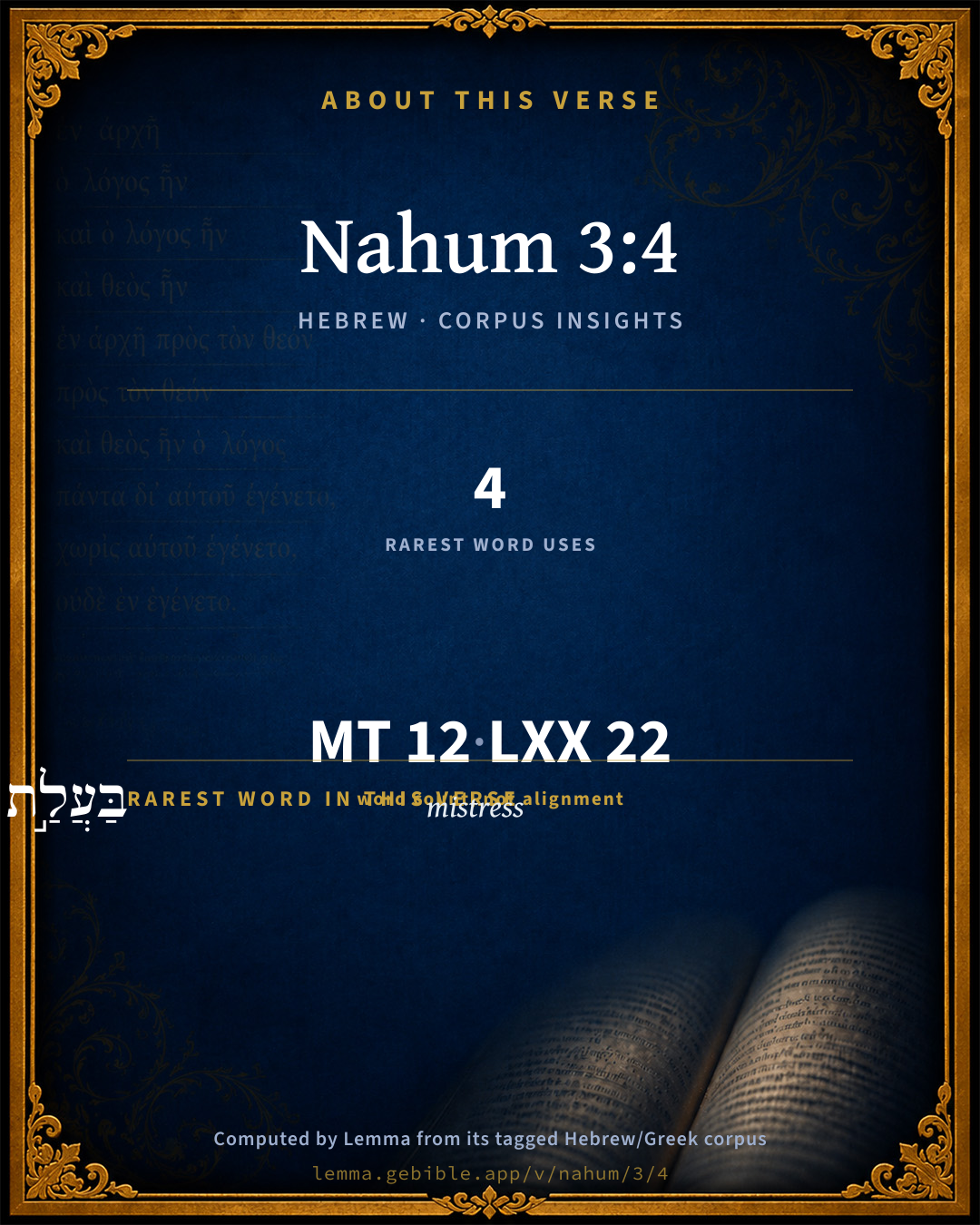
The rarest word here is בַּעֲלַ֣ת mistress H1172 — appearing just 4 times in the whole Hebrew Bible.

Shared distinctive vocabulary

בַּעֲלַ֣ת mistress H1172 occurs in 3 verses of the Hebrew Bible. Also found in:

Grammatical profile

  • 2 verbs
  • 9 nouns
  • 1 adjective

Verb forms

  • זוֹנָ֔ה Qal · Participle Active
  • הַמֹּכֶ֤רֶת Qal · Participle Active

Repetition

Words recur within this verse — often emphatic in Hebrew:

  • זְנוּנֵ֣י fornication H2183 ×2
  • כְּשָׁפִ֑ים witchcraft H3785 ×2

Hebrew & Septuagint length

In English translation the verse runs 26 words from the Hebrew and 28 from the Septuagint (LXX English) — closely comparable.

A rough comparison of the two English renderings, which tokenize alike — not a word-level alignment.

Word counts can differ between the Hebrew and the Greek without any difference in meaning — e.g. the Hebrew direct-object marker אֵת has no separate Greek word, and Greek often adds the article ὁ.

In the original languages it is 12 Hebrew tokens and 22 Greek tokens — but the two are counted differently (Hebrew bundles its prefixes and suffixes into one token; the Greek is in lemma form), so that isn’t a like-for-like length.

Cross-references

8

Topical passages linked to Nahum 3:4 in the Treasury of Scripture Knowledge — connected by theme and wording, ordered by reader-vote popularity; previews shown in the World English Bible.

  • Isaiah 47:9 but these two things shall come to you in a moment in one day, the loss of children, and widowhood; in their full measure shall they come on you, in the multitude of your sorceries, and the great abundance of your enchantments.
  • Isaiah 47:12–13 Stand now with your enchantments, and with the multitude of your sorceries, in which you have labored from your youth; if so be you shall be able to profit, if so be you may prevail.
  • Ezekiel 16:25–29 You have built your lofty place at the head of every way, and have made your beauty an abomination, and have opened your feet to everyone who passed by, and multiplied your prostitution.
  • Revelation 17:1–5 One of the seven angels who had the seven bowls came and spoke with me, saying, "Come here. I will show you the judgment of the great prostitute who sits on many waters,
  • Revelation 18:2–3 He cried with a mighty voice, saying, "Fallen, fallen is Babylon the great, and she has become a habitation of demons, a prison of every unclean spirit, and a prison of every unclean and hateful bird!
  • Revelation 18:9 The kings of the earth, who committed sexual immorality and lived wantonly with her, will weep and wail over her, when they look at the smoke of her burning,
  • Revelation 18:23 The light of a lamp will shine no more at all in you. The voice of the bridegroom and of the bride will be heard no more at all in you; for your merchants were the princes of the earth; for with your sorcery all the nations were deceived.
  • Isaiah 23:15–17 It shall come to pass in that day, that Tyre shall be forgotten seventy years, according to the days of one king: after the end of seventy years it shall be to Tyre as in the song of the prostitute.

Cross-references courtesy of OpenBible.info (CC BY 4.0).

Hebrew and Greek witnesses Masoretic Hebrew ↔ Greek Septuagint

The same verse in the two great witnesses to the Old Testament, shown verse-for-verse.

These are two independent witnesses, not word-aligned to each other, and the Septuagint is shown in lemma (dictionary) form.

Hebrew Nahum 3:4 Masoretic · Westminster Leningrad Codex

מֵרֹב֙ זְנוּנֵ֣י זוֹנָ֔ה ט֥וֹבַת חֵ֖ן בַּעֲלַ֣ת כְּשָׁפִ֑ים הַמֹּכֶ֤רֶת גּוֹיִם֙ בִּזְנוּנֶ֔יהָ וּמִשְׁפָּח֖וֹת בִּכְשָׁפֶֽיהָ

because of the multitude of the prostitution of the alluring prostitute, the mistress of witchcraft, who sells nations through her prostitution, and families through her witchcraft.

World English Bible · Public Domain

Greek LXX Nahum 3:4 Septuagint · lemma form

ἀπό πλῆθος πορνεία πόρνη καλός καί ἐπιχαρής ἡγέομαι φάρμακον ὁ πωλέω ἔθνος ἐν ὁ πορνεία αὐτός καί φυλή ἐν ὁ φάρμακον αὐτός

because of the abundance of fornication: she is a fair harlot, and well-favoured, skilled in sorcery, that sells the nations by her fornication, and peoples by her sorceries.

LXX2012 (modern English Septuagint) · Public Domain

On this verse, The Pulpit Commentary discusses the Septuagint’s reading. Read the note in Commentary ↓

Hebrew: Westminster Leningrad Codex (CC BY 4.0). Greek: Septuagint (public domain); English from LXX2012 (modern English Septuagint) (Public Domain). How the Septuagint differs from the Hebrew →

Targum (Aramaic paraphrase)

1

The Targum is the ancient Jewish Aramaic paraphrase of the Hebrew Scriptures — an interpretive translation, not the Hebrew text itself. Onkelos (literal) and Pseudo-Jonathan (expansive) render the Torah, and Jonathan the Prophets. Coverage is partial: where no permissively-licensed English translation exists for a verse, only the Aramaic is shown. This is verse-level text, not a word-by-word alignment to the Hebrew.

  1. Targum Jonathan Prophets (Joshua–Malachi)
    מִסְגִיאוּת אִתְרְגוּשַׁת קַרְתָּא דְהִיא כְּטַעַיְתָא נַפְקַת בָּרָא שַׁפִּירַת רֵיווּ יָדְעָא חָרְשִׁין דִמְכָרָא עַמְמַיָא בְּטַעֲוָתָהָא וּמַלְכוּתָא בַּחֲרָשָׁהָא:

    (no public-domain English translation for this verse)

    Targum Jonathan — Aramaic: “Mikraot Gedolot” (public domain). English: “Sefaria Community Translation” (CC0 1.0 (public-domain dedication)); “London "Chaldee Paraphrase," 1871” (public domain). Text via Sefaria.

Commentary

Notes on Nahum 3:4 from classic Christian and Jewish commentators (each source and its license shown beneath its notes). The classic Christian expositions comment on the surrounding passage and are grouped to its opening verse, so a note may address several verses; the Jewish commentaries on the Tanakh (Rashi and others) are per-verse, so they appear only where the commentator wrote on this verse.

Lemma curates 59 commentaries, every one of them public domain or Creative Commons licensed, each selected and text-cleaned for this edition rather than reprinted as found. About our sources →

The Cambridge Bible for Schools and Colleges

gen. ed. J. J. S. Perowne

4. multitude of the whoredoms] The phrase “whoredom” when used of Israel meant, first, infidelity to Jehovah, God of Israel, by serving other gods; then it was applied to alliances and political intercourse with other nations, partly because such trust in other nations betrayed distrust of Jehovah and falsehood to Him, and partly because the political influence of powerful states like Assyria and Babylon was naturally followed by an invasion of their customs and religious ideas, as was seen in the decline of the kingdom of Judah; and finally, mere political or commercial intercourse of one nation with another was called “whoredom,” even when the religious idea was not involved. In this weaker sense the term seems employed here, viz. of political intercourse; in Isa_23:17 it is used of commercial intercourse. Comp. Eze_16:26-29; Eze_23:40 seq.

the wellfavoured harlot] “Wellfavoured” means beautiful, though the phrase has perhaps ceased to be usual in common language; in the northern dialect “weel fa’art” is still common for good-looking. Beauty or charm is a point in the harlot; the reference perhaps is less to the splendour and riches of the imperial city than to the dazzling prestige of the empire, which fascinated weaker states and rulers, as for example in the case of Ahaz.

mistress of witchcrafts] i.e. that practiseth sorceries. Reference is to the arts of statecraft, the influences used upon the nations, which act on them like the charms and incantations and drugs of the sorceress.

That selleth nations] The expression to sell, viz. into bondage, appears used in a general sense, to deliver over, i.e. to destruction, as Est_7:4; cf. Isa_50:1; Isa_52:3. The common Arab. verb to which Hitzig appeals, to use guile, craft, to beguile, is not a trans. verb but requires a prep. after it, and in any case its use is improbable.

And families] i.e. peoples, as Amo_3:1-2, “the whole family which I brought up from the land of Egypt.” Cf. Jer_1:15.

4–7. Moral reason of Nineveh’s downfall

Nah_3:4-7 give the explanation of this overwhelming disaster. There is a pause, however, between Nah_3:3-4; the close connexion of R.V. is rather unnatural. Nah_3:4 seq. proceeds with more calmness.

The Cambridge Bible for Schools and Colleges (gen. ed. J. J. S. Perowne; Cambridge University Press, 1878–1918) — public domain. Text from a community e-Sword module.

Trapp's Complete Commentary

John Trapp

Nah 3:4 Because of the multitude of the whoredoms of the wellfavoured harlot, the mistress of witchcrafts, that selleth nations through her whoredoms, and families through her witchcrafts.

Ver. 4. Because of the multitude of the whoredoms of the wellfavoured harlot] Specious, and therefore gracious with her paramours; of a fair countenance, but foul condition; like Aurelia Orestilla, that had beauty, but no good property, Cuius prater formam nihil unquam bonus laudavit (Sallust.). Chrysippus called beauty the flower of virtue; but that is not generally true. Diogenes saw cause to say to some fair women in his time, O quam bona domus, sed malus hospes, Here is a fair house, but an ill inhabitant. Nineveh is the well favoured harlot here spoken of; her very name signifieth a fair habitation. Jerome and others interpret it, she was indeed urbs formosa et famosa, fair and famous, but foolish and filthy. Meretrix meretricissima; she multiplied her whoredoms, both corporal and spiritual; for these are seldom sundered; as we see in that once well favoured, but now withered, whore of Rome, Rev 17:1. Roma inverted is amor ; preposterous love, unnatural filthiness, is there as commonly practised as idolatry. And as a common harlot paints and decks herseff to please her lovers, so did Nineveh, so doth Rome in her pompous and men-pleasing worships. I have read of a lady in Paris, that when she saw the bravery of a procession to a saint she cried out, Oh, how fine is our religion beyond that of the Huguenots! And Sir Walter Raleigh was wont to say, that were he to choose a religion for fleshly liberty and lasciviousness, he would choose Popery, which is indeed an alluring, tempting, bewitching religion, none like it.

The mistress of witchcrafts] Harlots are many of them enchantresses; and have their philtra, their love potions, wherewith to ensnare men, and to draw them on to lewdness, and to take away their hearts, Hos 4:11. Athenaeus brings in Plato bewailing himself, that he was taken so much with a filthy harlot. And Aelian tells of a whore that boasted to Socrates that she could easily get followers from him, not he from her. Of Samson and Hercules (whom some think to have been the same) those two verses verified,

“ Nam potuit lenam, potuit superare leaenam:

Quem fera non potuit vincere; vicit hera. ”

Think the same of idolatry also, and of those sorceries, whereby the purple whore hath deceived all nations, as St John (in allusion to this place) saith of her, Rev 18:23; for in that book of the Revelation the Holy Ghost borrows all the elegance and flowers in the story of the Old Testament, thereby to set out the story of the New in succeeding ages.

That selleth nations through her whoredoms] Maketh prize of them, as those impostors did, 2Ti 3:6, and then make sale of them as her slaves, 2Pe 2:3, or otherwise use them at her pleasure, as homely as the whore of Babylon now doth those her slaves and souls of men, Rev 18:13, whom she sits upon, even upon peoples, nations, multitudes, and tongues, Rev 17:15, tyrannizing over their consciences, and appointing them to very mean offices, as that posture of hers, in sitting upon them, seemeth to import.

John Trapp, A Commentary or Exposition upon All the Books of the Old and New Testament (1647–1656) — public domain. Text from a community e-Sword module.

Joseph Benson's Commentary

Nah 3:4. Because of the multitude, &c. — That is, this judgment is executed upon Nineveh because of the multitude of her whoredoms, by which idolatrous rites seem to be meant, for they are generally called whoredoms in the Scripture. Nineveh is called a well-favoured harlot, because, by her example and influence, she drew in other places to practise the same idolatries and other vices of which she was guilty. That selleth nations through her whoredoms — That makes whole nations a prey to their enemies, by encouraging them to worship idols, and thereby exposing themselves to the wrath of God: or by teaching them the arts of softness and effeminacy, and so rendering them weak and defenceless. As the violence and injustice of the Ninevites had been represented under the emblem of a lion, the prophet here paints their irregularities, their idolatry, and corruption, under the idea of a prostitute enticing men to commit lewdness.

Joseph Benson's Commentary on the Old and New Testaments (1811–1818) — public domain. Text from a community e-Sword module.

Tyndale Open Study Notes

Tyndale Open Resources

3:4 mistress of deadly charms: The Assyrians charmed other nations with wealth and promises of safety and prosperity but then victimized them through military might and economic exploitation. Therefore, their punishment was a just recompense for their deeds (see Prov 24:12; Joel 3:4-8; Rev 18:6; 20:12).

Tyndale Open Study Notes — © Tyndale Open Resources, licensed CC BY-SA 4.0. Text via the HelloAO Bible API.

Geneva Bible (1599)

Geneva Bible translators

He compareth Nineveh to an harlot, which by her beauty and subtlety enticeth young men, and bringeth them to destruction.

Geneva Bible (1599) marginal notes — public domain. Text via Bolls.life.

Jamieson, Fausset & Brown

Robert Jamieson, A. R. Fausset & David Brown

Because of the multitude of the whoredoms--This assigns the reason for Nineveh's destruction.

of the well-favoured harlot--As Assyria was not a worshipper of the true God, "whoredoms" cannot mean, as in the case of Israel, apostasy to the worship of false gods; but, her harlot-like artifices whereby she allured neighboring states so as to subject them to herself. As the unwary are allured by the "well-favored harlot's" looks, so Israel, Judah (for example, under Ahaz, who, calling to his aid Tiglath-pileser, was made tributary by him, Kg2 16:7-10), and other nations, were tempted by the plausible professions of Assyria, and by the lure of commerce (Rev 18:2-3), to trust her.

witchcrafts-- (Isa 47:9, Isa 47:12). Alluding to the love incantations whereby harlots tried to dement and ensnare youths; answering to the subtle machinations whereby Assyria attracted nations to her.

selleth--deprives of their liberty; as slaves used to be sold: and in other property also sale was a usual mode of transfer. MAURER understands it of depriving nations of their freedom, and literally selling them as slaves to distant peoples (Joe 3:2-3, Joe 3:6-8). But elsewhere there is no evidence that the Assyrians did this.

families--peoples.

Jamieson, Fausset & Brown — Commentary Critical and Explanatory on the Whole Bible (1871) — public domain (CC PDM 1.0). Text via the HelloAO Bible API.

Adam Clarke's Commentary

Verse 4. Because of the multitude of the whoredoms] Above, the Ninevites were represented under the emblem of a lion tearing all to pieces; here they are represented under the emblem of a beautiful harlot or public prostitute, enticing all men to her, inducing the nations to become idolatrous, and, by thus perverting them, rendering them also objects of the Divine wrath.

Mistress of witchcrafts, that selleth nations through her whoredoms] Using every means to excite to idolatry; and being, by menace or wiles, successful in all.

Adam Clarke's Commentary on the Bible (1810–1826) — public domain. Text from a community e-Sword/MySword module.

John Calvin's Commentaries

The Prophet mentions again the cause why God would execute so dreadful a vengeance on that city, which yet procured by its splendor so much glory and respect among all people: and God seems in a manner to have but little regard for the order of the world when he thus overturns great cities. For since he is the Creator of the whole world, it seems to be his proper office to protect its various parts, especially those which excel in beauty, for they seem to deserve a higher regard. When therefore any splendid city is demolished, such thoughts as these occur to us, — That God is either delighted with the ruin of the world, or is asleep in heaven, and that thus all things revolve by chance and contingency. Therefore the Prophet shows, that God had just reasons for decreeing the ruin of Nineveh, and for deforming that beauty, that it might not deceive the eyes of men. Hence he compares Nineveh to a harlot. The similitude seems not to be very suitable: but yet if we take a nearer view of things, the Prophet could not have more fitly nor more strikingly set forth the condition of that city. He had before mentioned its barbarous cruelty, and said, that it was the den of lions, and that savage and bloody wild beasts dwelt there. He now begins to speak of the frauds and crafty artifices by which the kings of this world attain for themselves both wealth and power. The Prophet then makes the city Nineveh to be like a harlot for this reason, — because it had not only brought under its power neighboring nations by threats and terrors, and also by cruelty, but because it had ensnared many by oblique arts and fraudulent means, by captious dealings and allurements. This is the reason why it is now called a harlot by the Prophet.

The Prophets of God seem indeed to speak but with little reverence of great cities and empires: but we know that it rightly belongs to the Spirit of God, that in exercising his own jurisdiction, he should uncover the base deeds of the whole world, which otherwise would lie concealed and even under the appearance of virtues deceive the eyes and senses of the simple: and as men so much flatter themselves, and are inebriated with their own delusions, it is necessary that those who are too self-indulgent and delicate should be roughly handled. As then kings ever set up their own splendor that they may dazzle the eyes of the simple, and seem to have their own greatness as a beautiful covering, the Spirit of God divests them of these masks. This then is the reason why the Prophet speaks here, in no very respectful terms, of that great monarchy which had attracted the admiration of all nations. For when the Spirit of God adopts a humble and common mode of speaking, men, blinded by their vices, will not acknowledge their own baseness; nay, they will even dare to set up in opposition those things which cover their disgraceful deeds: but the Spirit of God breaks through all these things, and dissipates those delusions by which men impose on themselves.

Such is the reason for this similitude; On account of the multitude, he says, of the whoredoms of the harlot, who excels in favor It is said by way of concession that Nineveh was in great favor, that is, that by her beauty she had allured to herself many nations, like a harlot who attains many lovers: and thus the Prophet allows that Nineveh was beautiful. But he adds that she was the mistress of sorceries כשף, casheph, means sorcery, and also juggling: we may then render כשפים, cashaphim, used here, juggleries, (praestigias — sleights of hand.) But the Prophet seems to allude to filters or amatory potions, by which harlots dementate youths. As then harlots not only attract notice by their beauty and bland manners and other usual ways; but they also in a manner fascinate unhappy youths, and use various arts and delusions; so the Prophet under this word comprehends all the deceits practiced by harlots; as though he said, “This harlot was not only beautiful, but also an enchantress, who by her charms deceived unhappy nations like a strumpets who dementates unhappy youths, who do not take care of themselves.”

He afterwards adds, Who sells nations by her whoredoms, and tribes by her sorceries Though Nahum still carries on the same metaphor, he yet shows more clearly what he meant by whoredoms and sorceries, — even the crafts of princes, by which they allure their neighbors, and then reduce them to bondage. Then all the counsels of kings (which they call policies) are here, by the Spirit of God, called sorceries or juggleries, and also meretricious arts. This reproof, as I have already said, many deem to have been too severe; for so much majesty shone forth then in the Assyrians, that they ought, as they think, to have been more respectfully treated. But it behaved the Spirit of God to speak in this forcible language: for there is no one who does not applaud such crafty proceedings. Where any one, without mentioning princes, to ask, Is it right to deceive, and then by lies, deceptions, perjuries, cavils, and other arts, to make a cover for things? — were this question asked, the prompt answer would be, that all these things are as remote as possible from virtue, as nothing becomes men more than ingenuous sincerity. But when princes appear in public, and make this pretense, that the world must be ruled with great prudence, that except secret counsels be taken, all kingdoms would immediately fall into ruin, — this veil covers all their shameful transactions, so that it becomes lawful for them, and even praiseworthy, to deceive one party, to circumvent another, and a third to oppress by means of deception. Since then princes are praised for their craftiness, this is the reason why the Prophet here takes away, as it were by force, the mask, under which they hide their base proceedings; “They are,” he says, “meretricious arts, and they are sorceries and juggleries.”

It is of one city, it is true, that he speaks here; but the Prophet no doubt describes in this striking representation how kingdoms increase and by what crafty means, — first, by robberies, — and then by artful dealings, such as would by no means become honest men in the middle class of life. But princes could never succeed, except they practiced such artifices. We yet see how they are described here by the Spirit of God, — that they are like strumpets given to juggleries, and to other base and filthy arts, which he calls whoredoms. But I have said, that the meaning of the Prophet can be more clearly elicited from the second clause of the verse, when he says that the Ninevites made a merchandise of the nations. We see indeed even at this day that princes disturb the whole world at their pleasure; for they deliver up innocent people to one another, and shamefully sell them, while each hunts after his own advantage, without any shame; that he may increase his own power, he will deliver others into the hand of an enemy. Since then there are crafty proceedings of this kind carried on too much at this day, there is no need that I should attempt to explain at any length the meaning of the Prophet. I wish that examples were to be sought at a distance. Let us proceed —

John Calvin's Commentaries (1540-1563) — public domain. Text from the Calvin Translation Society English edition (1840s-50s) via the Christian Classics Ethereal Library (ccel.org). Calvin's coverage is partial (roughly two-thirds of the Bible); uncommented books and verses are honest gaps, never fabricated. The 19th-century editor's footnotes and remarks are omitted so the notes are faithfully Calvin's own voice.

Ellicott's Commentary for English Readers

(4-6) Because of the multitude.—In the idolatry and superstition of Nineveh the prophet finds the cause of her destruction. Perversion of religious instinct is frequently denounced under the same figure in Scripture. Here, however, a more literal interpretation is possible, since there is reason to believe the religious rites of Assyria were characterised, like those of Babylon, by gross sensuality. According to Herod, i. 199, the Babylonian worship of Beltis or Mylitta was connected with a system of female prostitution, which was deemed “most shameful” even by the heathen historian. Compare also the Apocryphal Book of Bar_6:43. The same deity was worshipped in Assyria. Professor Rawlinson writes: “It would seem to follow almost as a matter of course that the worship of the same identical goddess in the adjoining country included a similar usage. It may be to this practice that the prophet Nahum alludes when he denounces Nineveh as a ‘well-favoured harlot,’ the multitude of whose harlotries was notorious” (Five Great Monarchies, ii. 41).

A Bible Commentary for English Readers, edited by Charles John Ellicott (1878–1897) — public domain. Text from a community e-Sword module.

John Gill's Exposition

Because of the multitudes of the whoredoms of the wellfavoured harlot,.... Meaning Nineveh; which, as it was an ancient city, was a well built one; full of stately and beautiful buildings, the seat of the kings of Assyria, and the metropolis of the nation, and abounded with wealth and riches; perhaps here may be an allusion to the name of the city, and to the signification of it; for Nineveh may have its name from the beauty of it, and be read, in Hebrew, or and may signify a beautiful or pleasant habitation; so Hillerus (x) and Cocceius (y) give the etymology of it; which agrees with its delightful situation on the banks of the river Tigris, and the stately edifices in it, as the king's palace, and others; just as Zion is said to be "beautiful for situation, the joy of the whole earth", Psa 48:2 and the epithet of "well favoured" well agrees with a harlot, whose beauty is engaging and ensnaring, as Lais, and others; particularly Semiramis, the wife of Ninus, from whom it is generally thought Nineveh had its name, was first a harlot, and one of exceeding beauty, who surpassed all others in it; on account of which she was beloved by the king of Assyria, and after a short time made his wife, and then he delivered the government of the kingdom to her (z); yea, Sardanapalus the Last, and at this time the present king of the Assyrians, was very effeminate, used to dress himself in women's clothes, imitate a woman's voice, and paint his face, and even his whole body; and, by other tricks and enticements of harlots, made himself more lascivious, and behaved more lewdly, than any harlot (a); in short, all the Assyrian women must be harlots, since they were obliged once in their lifetime to lie with a stranger in the temple of Venus, whom the Assyrians call Mylitta, as Herodotus (b) and Strabo (c) relate; to all which here may be an allusion: and particularly the inhabitants of this city had all the arts of address and insinuation to deceive others as harlots have; and both men and women very probably were given to whoredom and adultery in a literal sense as is generally the case where luxury and intemperance abound; and especially were grossly guilty of idolatry, which in Scripture is frequently expressed by whoredom and adultery; worshipping Bel, Nisroch and other deities and which was highly provoking to God; and therefore for these things, his judgements came upon them, before and after described:

the mistress of witchcrafts: thoroughly versed in such wicked and devilish practices, literally understood; see Isa 47:9 for the Assyrians, as well as the Babylonians and Chaldeans, were addicted to such diabolical arts, as appears from a passage in Theocritus (d), which Grotius has also quoted; where one is represented saying that she kept in her box or chest very pernicious poisons, which she had learned from an Assyrian guest. The allusion seems to be to philtres, and other tricks used by harlots to besot young men, and bewitch and captivate them: likewise this city and its inhabitants were well versed in all the arts of flattery, deceit, and carnal policy; and in all the charms of wealth, riches, luxury, and sensuality, the pomp of superstition and idolatry, to draw in kingdoms and nations into subjection to them:

that selleth nations through her whoredoms, and families through her witchcrafts; enslaved whole kingdoms, and brought them under her power and dominion, to be her vassals; and was the instrument, not only of corporeal servitude, but of their selling themselves to work wickedness, by committing spiritual fornication or idolatry; into which multitudes were led by her influence and example, and particularly the kingdoms and families of Israel and Judah; see Kg2 16:10. In these whoredoms and witchcrafts, as well as in her bloodthirstiness, lies, and oppression, Nineveh was a type of the whore of Rome; see Rev 17:1.

(x) Onomastic. Sacr. p. 304, 431, 898. (y) Comment. in Jonam, c. 1. 2. (z) Diodor. Sicul. l. 2. p. 93. 107. Ed. Rhodoman. (a) Ibid. p. 109, 110. (b) Clio, sive. l. 1. c. 199. (c) Geograph. l. 16. p. 513. (d) Pharmaceutria, sive Idyll. 2. prope finem.

John Gill's Exposition of the Whole Bible (1746–1763) — public domain (CC PDM 1.0). Text via the HelloAO Bible API.

Albert Barnes' Notes on the Bible

Because of the multitude of the whoredoms of the well-favored harlot - There are “multitudes of slain” because of the “multitude of whoredoms” and love of the creature instead of the Creator. So to Babylon Isaiah saith, “they (loss of children and widowhood) shall come upon thee in their perfection for the multitude of thy sorceries, for the great abundance of thine enchantments” Isa 47:9. The actual use of “enchantments,” for which Babylon was so infamous, is not elsewhere attributed to the Assyrians. But neither is the word elsewhere used figuratively; nor is Assyria, in its intimate relation to Babylon, likely to have been free from the longing, universal in pagandom, to obtain knowledge as to the issue of events which would affect her. She is, by a rare idiom, entitled “mistress of enchantments,” having them at her command, as instruments of power. Mostly, idolatries and estrangement from God are spoken of as “whoredoms,” only in respect of those who, having been taken by God as His own, forsook Him for false gods.

But Jezebel too, of whose offences Jehu speaks under the same two titles 2Ki 9:22, was a pagan. And such sins were but part of that larger all-comprehending sin, that man, being made by God for Himself, when he loves the creature instead of the Creator, divorces himself from God. Of this sin world empires, such as Nineveh, were the concentration. Their being was one vast idolatry of self and of “the god of this world.” All, art, fraud, deceit, protection of the weak against the strong 2Ki 16:7-9; 2Ch 28:20-21, promises of good Isa 36:16-17, were employed, together with open violence, to absorb all nations into it. The one end of all was to form one great idol-temple, of which the center and end was man, a rival worship to God, which should enslave all to itself and the things of this world. Nineveh and all conquering nations used fraud as well as force, enticed and entangled others, and so sold and deprived them of freedom. (see Joe 3:3).

Nor are people less sold and enslaved, because they have no visible master. False freedom is the deepest and most abject slavery. All sinful nations or persons extend to others the infection of their own sins. But, chiefly, the “wicked world,” manifoldly arrayed with fair forms, and “beautiful in the eyes of those who will not think or weigh how much more beautiful the Lord and Creator of all,” spreads her enticements on all sides “the lust of the flesh, and the lust of the eye, and the pride of life,” “her pomps and vanities,” worldly happiness and glory and majesty, and ease and abundance, deceives and sells mankind into the power of Satan. It is called well-favored (literally, good of grace), because the world has a real beauty, nor , “unless there were a grace and beauty in the things we love, could they draw us to them.” They have their beauty, because from God; then are they deformed, when “things hold us back from God, which, unless they were in God, were not at all.”

We deform them, if we love them for our own sakes, not in Him; or for the intimations they give of Him. : “Praise as to things foul has an intensity of blame. As if one would speak of a skilled thief, or a courageous robber, or a clever cheat. So though he calls Nineveh a well-favored harlot, this will not be for her praise, (far from it!) but conveys the heavier condenmation. As they, when they would attract, use dainty babblings, so was Nineveh a skilled artificer of ill-doing, well provided with means to capture cities and lands and to persuade them what pleased herself.” She selleth not nations only but families, drawing mankind both as a mass, and one by one after her, so that scarce any escape.

The adultery of the soul from God is the more grieveus, the nearer God has brought any to Himself, in priests worse than in the people, in Christians than in Jews, in Jews than in pagan; yet God espoused mankind to Him when He made him. His dowry were gifts of nature. If this be adultery, how much sorer, when betrothed by the Blood of Christ, and endowed with the gift of the Spirit!

Albert Barnes' Notes on the Bible (1834–1885) — public domain. Text from a community e-Sword/MySword module.

Haydock's Catholic Bible Commentary

Harlot. Ninive is cruel and impure, engaging others in idolatry and witchcraft. (Calmet) --- Sold, forcing them to adopt her manners, Romans vii. 14.

George Leo Haydock (1774–1849), Haydock's Catholic Family Bible and Commentary, 1859 edition — public domain. Excludes Psalms (Douay-Rheims chapter numbering differs from Protestant) and Deuterocanonical books (Catholic canon only).

Matthew Poole's English Annotations

Because, & c.; God is just, Nineveh hath deserved all this.

The multitude of the whoredoms; her crafts and her policies, in which she resembled those lewd women; as they by their wiles abuse and deceive men, so did Nineveh, or the Assyrian kingdom, deceive, impoverish, and enslave nations by state policies: so Isa 23:17; Rev 17:2. Or else, by whoredoms here may be meant idolatries, which were multiplied by the many people that served the Assyrian idols, or by their multiplying of idols, which probably they did by taking into the muster-roll of their gods those idols which the conquered nations worshipped: or whoredoms literally understood; for this sin undoubtedly did abound where wealth, luxury, ease, and long continuance of these, were to be found.

Well-favoured; the glory of their state and government, or the splendour of their idols, temples, and sacrifices, or the comeliness and beauty of the lewd and whorish women among them.

Witchcrafts; bewitching policies, and enchanting counsels, confederacies, and promised favours; or it may be literally taken for witchcrafts or necromancies, which sin abounded no doubt among the Assyrians.

Selleth; disposeth of them as imperiously and absolutely as men do slaves which they buy; or else, drawing them into the wars for pay, exposed them to slaughter by the enemies’ sword, as if they had bought their persons to sell their lives, that thereby their own countrymen and citizens might be spared and escape. Or

selleth, i.e. occasioneth them to abound in sin, for which God in his just judgment selleth them into the enemies’ hand.

Nations; whole kingdoms.

Whoredoms: see above.

And families through her witchcrafts: either it is an elegant illustration of the former passage, or perhaps it may intimate the seducing of some particular and eminent families to engage themselves in a hereditary and perpetual service to the Assyrian idols, or to witchcrafts, in which the devil imitated God’s institution, in taking a family to his service; so the chief families had the authority of ruling, and the burden of all idolatrous priesthood. Gr. Tholosun. de Rep. lib. 4. sect. 9, and lib. 8. c. 2. sect. 6,8.

Matthew Poole's English Annotations on the Holy Bible (1683–1685) — public domain. Text from a community e-Sword/MySword module.

The Pulpit Commentary

The cause is given that has brought this punishment. Because of the multitude of the whoredoms. This term is commonly applied to idolatry, the swerving from the true God and turning to false deities; and it is thought that it cannot be used in that sense here, as Assyria had always worshipped idols, and could not be said to have forsaken or proved false to the Lord. Hence Hitzig, Keil, and others refer the term to the treacherous friendship and crafty politics by which Nineveh ensnared other states, seeking really only her own interests. (comp. Isa_23:17) But this habit of treachery has been already mentioned in ver. 1 (where see note); and, as Knabenbauer remarks, the Assyrians used no meretricious blandishments to effect their conquests, but the cruel arts of war and the stern ordeal of the sword. It is scarcely probable that the prophet would omit idolatry among the crimes of the Assyrians that called for vengeance, as all their wars were carried on in the name of their gods, and the monarchs professed to be under Divine protection and influence. The term "whoredom" is applied to the idolatry, not only of the Israelites, but to that of Jezebel, (2Ki_9:22) who was always a heathen. The idolatry of the Assyrians may very well be so called, because it was a wilful ignoring of the light of nature and natural religion. (see RAPC Wis 13:1 Rom_1:19, etc.) They were careful, too, wherever they carried their arms, to erect there symbols of their deities, and to compel conquered nations to receive them and pay them Divine honour. With this idolatrous worship was associated that gross immorality which even Herodotus (1:199) termed utterly disgraceful. (comp. RAPC Bar 6:43) Rightly is Nineveh called the well favoured harlot; for her splendour and magnificence were unsurpassed, dazzling all beholders and hiding the rottenness that lay below the surface. The mistress of witchcrafts. She was skilful in employing every art to seduce nations to her side. We hear much of magic in connection with Babylon and the Chaldeans, but not in reference especially to Assyria. The expression here is metaphorical, alluding to the secret practices which she employed to gain her ends and to make her rule attractive. (comp. Rev_18:2, Rev_18:3) That selleth nations. Depriving them of freedom and making them tributary, or, in some cases, actually selling the inhabitants as slaves. (comp. Deu_32:30 Joe_3:3 Amo_1:6, Amo_1:7) Families. Not only nations in the aggregate, but smaller bodies, individuals, so that none escape. Septuagint, laouv , "peoples."

The Pulpit Commentary (1880–1919), ed. H.D.M. Spence-Jones & Joseph S. Exell — public domain. Text from a community e-Sword module.

John Wesley's Explanatory Notes

The whoredom - The idolatries, which were multiplied by the many people that served the Assyrian idols. And whoredoms literally understood, did undoubtedly abound, where wealth, luxury, ease, and long continuance of these were to be found. Well-favoured - Glorious in their state and government, and in the splendour of their idols, temples, and sacrifices. Of witchcrafts - Bewitching policies; or it may be taken for witchcrafts or necromances, which abounded among the Assyrians. That selleth - That dispose of them as imperiously, and absolutely as men do slaves. And families - This may intimate the seducing of some particular and eminent families to an hereditary service of the Assyrian idols, or to witchcrafts, in which the devil imitated God's institution, in taking a family to his service.

John Wesley, Explanatory Notes Upon the Whole Bible (1754–1765) — public domain. Text via the GEBible commentary corpus.

Rashi

Rabbi Shlomo Yitzchaki (Rashi)

Because of the many harlotries of the harlot—Because of the extensive flattery of the city, for they knew how to seduce the kings of the earth to join them, and they would eventually subordinate [these kings] to them.

Rashi on the Tanakh — English translations: “The Judaica Press complete Tanach with Rashi, translated by A. J. Rosenberg” (CC BY 4.0); “Pentateuch with Rashi's commentary by M. Rosenbaum and A.M. Silbermann, 1929-1934” (public domain); “The Metsudah Tanach series, Lakewood, N.J” (CC BY 4.0); and “The Book of Joshua, Metsudah Publications, 1997” (CC BY 4.0). Text via Sefaria.

Lesson kit

Teaching starters — assembled from the data on this page, not authored interpretation. Every prompt links to the verse data it draws on. Edit before teaching.

Nahum, in the Prophets, opens this verse with 12 words (10 distinct Hebrew lemmas). Its most distinctive word is baʻălâh (“mistress”). A historical commentator’s framing appears above. Read the whole chapter for the surrounding context.

Discussion questions

  1. The word baʻălâh carries the sense “mistress.” How does it shape the verse?
  2. 1 Samuel 28:7 shares the word «mistress» with this verse. How do the two illuminate each other?
  3. “fornication” occurs 2× in this one verse. What is the effect of the repetition?
  4. The translations on this page render this verse differently — a whole-verse word diff, not a word-by-word alignment. What might account for the different wordings?
  5. The verb «זוֹנָ֔ה» is Qal Participle Active. How does its form color the action?
  6. Reading how The Cambridge Bible for Schools and Colleges and Trapp's Complete Commentary read this verse, where do the two commentators agree and where do they part?

Things to notice

Reading settings

Reading text

Shown beneath each verse's original-language words.

Old Testament
Old Testament edition

Read the OT as the Masoretic Hebrew (MT) or the Greek Septuagint (LXX).

English shown for the Greek Septuagint (in the Hebrew ↔ Greek comparison).

Comparing translations? Open the Compare panel on any verse page to stack up to four side by side.