
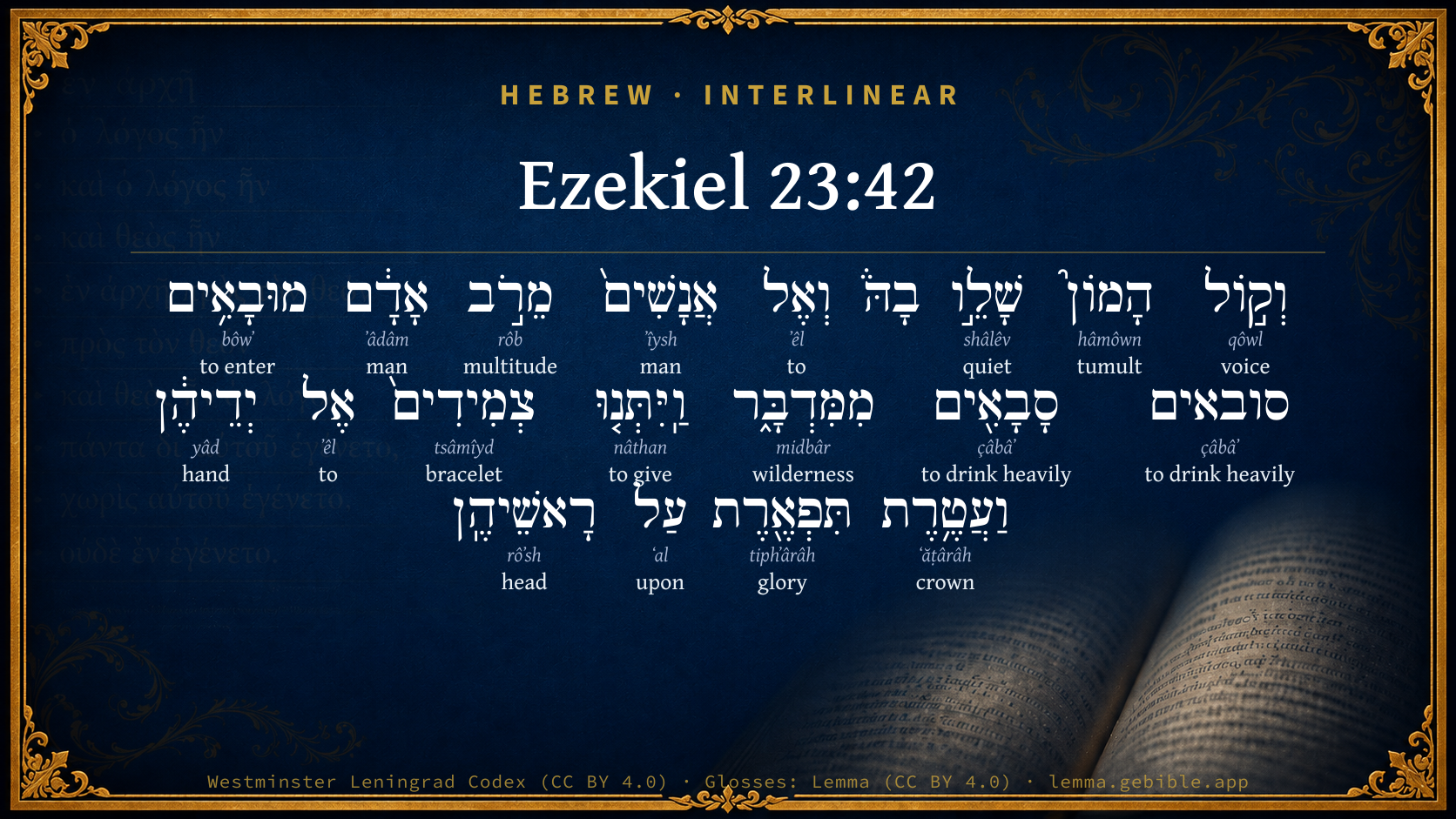
Ezekiel 23:42

Hebrew (Westminster Leningrad Codex) Ezekiel 23:42 appears in the Hebrew Old Testament. The text above is from the Westminster Leningrad Codex. Each word links to its Strong’s number, a concise gloss, and parsing drawn from the Open Scriptures Hebrew Bible morphology. Click any word for its full Brown-Driver-Briggs (BDB) entry.
Download image
Cite this verse

Ezekiel 23:42 (World English Bible). Public Domain. Lemma interlinear Bible study tool, https://lemma.gebible.app/v/ezekiel/23/42.

Show BibTeX & RIS
BibTeX
RIS
English Translation
The voice of a multitude being at ease was with her: and with men of the common sort were brought drunkards from the wilderness; and they put bracelets on the hands of them [twain], and beautiful crowns on their heads.
World English Bible · Public Domain
Download a study sheet

One document with this verse’s original text, its word-by-word gloss line, the meaning frame, cross-references with their text, attributed commentary, and full source and license credits — printable, and it pastes into notes with its structure intact.

This verse Autodidact and up

Study sheet (.html) Plain text (.txt)

A passage Seminary Student

Up to 50 verses in one chapter. A passage sheet keeps up to 6 commentary sources and 12 cross-references per verse, in the order this page ranks them, and says so on the sheet whenever that leaves anything out. Ask for a single verse and you get the Autodidact verse sheet above.

Everything on this page stays free to read, with no account — the sheet is a download of what is already on screen, not access to it.

Want to remove ads? Support Godless Engineer
Compare translations 3

The same verse in 3 English versions, stacked beneath the original-language interlinear above. Click any original word for its lexicon entry.

Each is an independent rendering of the whole verse — the interlinear is not word-aligned to these translations.

Highlighted words mark where these versions differ — a whole-verse word diff, not a word-by-word alignment.

  • World English Bible Public Domain
    The voice of a multitude being at ease was with her: and with men of the common sort were brought drunkards from the wilderness; and they put bracelets on the hands of them [twain], and beautiful crowns on their heads.
  • King James Version Public Domain
    And a voice of a multitude being at ease was with her: and with the men of the common sort were brought Sabeans from the wilderness, which put bracelets upon their hands, and beautiful crowns upon their heads.
  • unfoldingWord Literal Text CC BY-SA 4.0
    So the sound of a noisy crowd was around her; including all kinds of men, even Sabeans were brought in from the wilderness, and they put bracelets on their hands and beautiful crowns on their heads.

unfoldingWord Literal Text — © unfoldingWord, licensed CC BY-SA 4.0. Word-aligned USFM3 via Door43 (git.door43.org/unfoldingWord/en_ult).

Versions to compare (up to 4)

3 of 4 selected

Show all 18 translations

Every available English version of this verse, each an independent rendering of the whole verse.

  • World English Bible Public Domain
    The voice of a multitude being at ease was with her: and with men of the common sort were brought drunkards from the wilderness; and they put bracelets on the hands of them [twain], and beautiful crowns on their heads.
  • Berean Standard Bible Public Domain
    accompanied by the sound of a carefree crowd. Drunkards were brought in from the desert along with men from the rabble, who put bracelets on your wrists and beautiful crowns on your head.
  • Majority Standard Bible Public Domain
    accompanied by the sound of a carefree crowd. Drunkards were brought in from the desert along with men from the rabble, who put bracelets on your wrists and beautiful crowns on your head.
  • King James Version Public Domain
    And a voice of a multitude being at ease was with her: and with the men of the common sort were brought Sabeans from the wilderness, which put bracelets upon their hands, and beautiful crowns upon their heads.
  • American Standard Version (1901) Public Domain
    And the voice of a multitude being at ease was with her: and with men of the common sort were brought drunkards from the wilderness; and they put bracelets upon the hands of them `twain', and beautiful crowns upon their heads.
  • Revised Version (1885) Public Domain
    And the voice of a multitude being at ease was with her: and with men of the common sort were brought drunkards from the wilderness; and they put bracelets upon the hands of them twain, and beautiful crowns upon their heads.
  • Geneva Bible (1599) Public Domain
    And a voyce of a multitude being at ease, was with her: and with the men to make the company great were brought men of Saba from the wildernes, which put bracelets vpon their hands, and beautifull crownes vpon their heads.
  • Douay-Rheims (1899) Public Domain
    And there was in her the voice of a multitude rejoicing: and to some that were brought of the multitude of men, and that came from the desert, they put bracelets on their hands, and beautiful crowns on their heads.
  • Young's Literal Translation Public Domain
    And the voice of a multitude at ease `is' with her, And unto men of the common people are brought in Sabeans from the wilderness, And they put bracelets on their hands, And a beauteous crown on their heads.
  • Literal Standard Version CC BY-SA 4.0
    And the voice of a multitude at ease [is] with her, || And Sabeans from the wilderness are brought in to men of the common people, || And they put bracelets on their hands, || And a beautiful crown on their heads.
  • Unlocked Literal Bible CC BY-SA 4.0
    So the sound of a noisy crowd was around her; including all kinds of men, even Sabeans were brought in from the wilderness, and they put bracelets on their hands and beautiful crowns on their heads.
  • unfoldingWord Literal Text CC BY-SA 4.0
    So the sound of a noisy crowd was around her; including all kinds of men, even Sabeans were brought in from the wilderness, and they put bracelets on their hands and beautiful crowns on their heads.
  • Darby Bible Public Domain
    And the voice of a multitude living carelessly was with her; and with people of the common sort were brought Sabeans from the wilderness, and they put bracelets upon their hands, and a beautiful crown upon their heads.
  • World Messianic Bible Public Domain
    “The voice of a multitude being at ease was with her. With men of the common sort were brought drunkards from the wilderness; and they put bracelets on their hands, and beautiful crowns on their heads.
  • Webster's Bible Public Domain
    And a voice of a multitude being at ease was with her: and with the men of the common sort were brought Sabeans from the wilderness, who put bracelets upon their hands, and beautiful crowns upon their heads.
  • Free Bible Version CC BY-SA 4.0
    The room was full of the noise of people partying. Drunk men were brought in from the desert along with some common people and they put bracelets on your wrists and beautiful crowns on your head.
  • Bible in Basic English Public Domain
    ... and they put jewels on her hands and beautiful crowns on her head.
  • JPS Tanakh (1917) Public Domain
    And the voice of a multitude being at ease was therein; and for the sake of men, they were so many, brought drunken from the wilderness, they put bracelets upon their hands, and beautiful crowns upon their heads.

Literal Standard Version (2020), Covenant Press — licensed CC BY-SA 4.0. Text via the HelloAO Bible API (eBible.org). Unlocked Literal Bible (unfoldingWord) — licensed CC BY-SA 4.0. Text via the HelloAO Bible API (eBible.org). unfoldingWord Literal Text — © unfoldingWord, licensed CC BY-SA 4.0. Word-aligned USFM3 via Door43 (git.door43.org/unfoldingWord/en_ult). Free Bible Version, Dr. Jonathan Gallagher — licensed CC BY-SA 4.0. Text via the HelloAO Bible API (eBible.org).

Word by word

More ways to search: Search by grammar → Find every occurrence → Compare this word →

Practice this passage: Drill this verse → Learn its vocabulary →

סובאים
çâbâʼ
H5433
“drinking heavily”
Verb, Qal, Participle Active, Masculine, Plural, Absolute
Part of Speech
Verb
Stem
Qal
Form
Participle Active
Gender
Masculine
Number
Plural
State
Absolute
Full BDB Definition

Origin: a primitive root

TWOT: 1455

to drink heavily or largely, imbibe - (Qal) - to imbibe - wine-bibber, drunkard (participle) (substantive)
  1. וְק֣וֹל qôwl H6963 “and · voice” Conjunction + Noun, Common, Masculine, Singular, Absolute
  2. הָמוֹן֮ hâmôwn H1995 “tumult” Noun, Common, Masculine, Singular, Absolute
  3. שָׁלֵ֣ו shâlêv H7961 “quiet” Adjective, Adjective, Masculine, Singular, Absolute
  4. וְאֶל ʼêl H413 “and · to” Conjunction + Preposition
  5. אֲנָשִׁים֙ ʼîysh H376 “men” Noun, Common, Masculine, Plural, Absolute
  6. מֵרֹ֣ב rôb H7230 “from · multitude of” Preposition + Noun, Common, Both, Singular, Construct
  7. אָדָ֔ם ʼâdâm H120 “man” Noun, Common, Masculine, Singular, Absolute
  8. מוּבָאִ֥ים bôwʼ H935 “entered” Verb, Hophal, Participle Passive, Masculine, Plural, Absolute
  9. סָבָאִ֖ים çâbâʼ H5433 “drunkards” Noun, Common, Masculine, Plural, Absolute
  10. מִמִּדְבָּ֑ר midbâr H4057 “from · wilderness” Preposition + Noun, Common, Masculine, Singular, Absolute
  11. וַֽיִּתְּנ֤וּ nâthan H5414 “and · to give” Conjunction + Verb, Qal, Sequential Imperfect, 3rd Person, Masculine, Plural
  12. צְמִידִים֙ tsâmîyd H6781 “bracelets” Noun, Common, Masculine, Plural, Absolute
  13. אֶל ʼêl H413 “to” Preposition
  14. יְדֵיהֶ֔ן yâd H3027 “hands · their” Noun, Common, Both, Dual, Construct + Suffix, Personal, 3rd Person, Feminine, Plural
  15. וַעֲטֶ֥רֶת ʻăṭârâh H5850 “and · crown of” Conjunction + Noun, Common, Feminine, Singular, Construct
  16. תִּפְאֶ֖רֶת tiphʼârâh H8597 “glory” Noun, Common, Feminine, Singular, Absolute
  17. עַל ʻal H5921 “upon” Preposition
  18. רָאשֵׁיהֶֽן rôʼsh H7218 “heads · their” Noun, Common, Masculine, Plural, Construct + Suffix, Personal, 3rd Person, Feminine, Plural

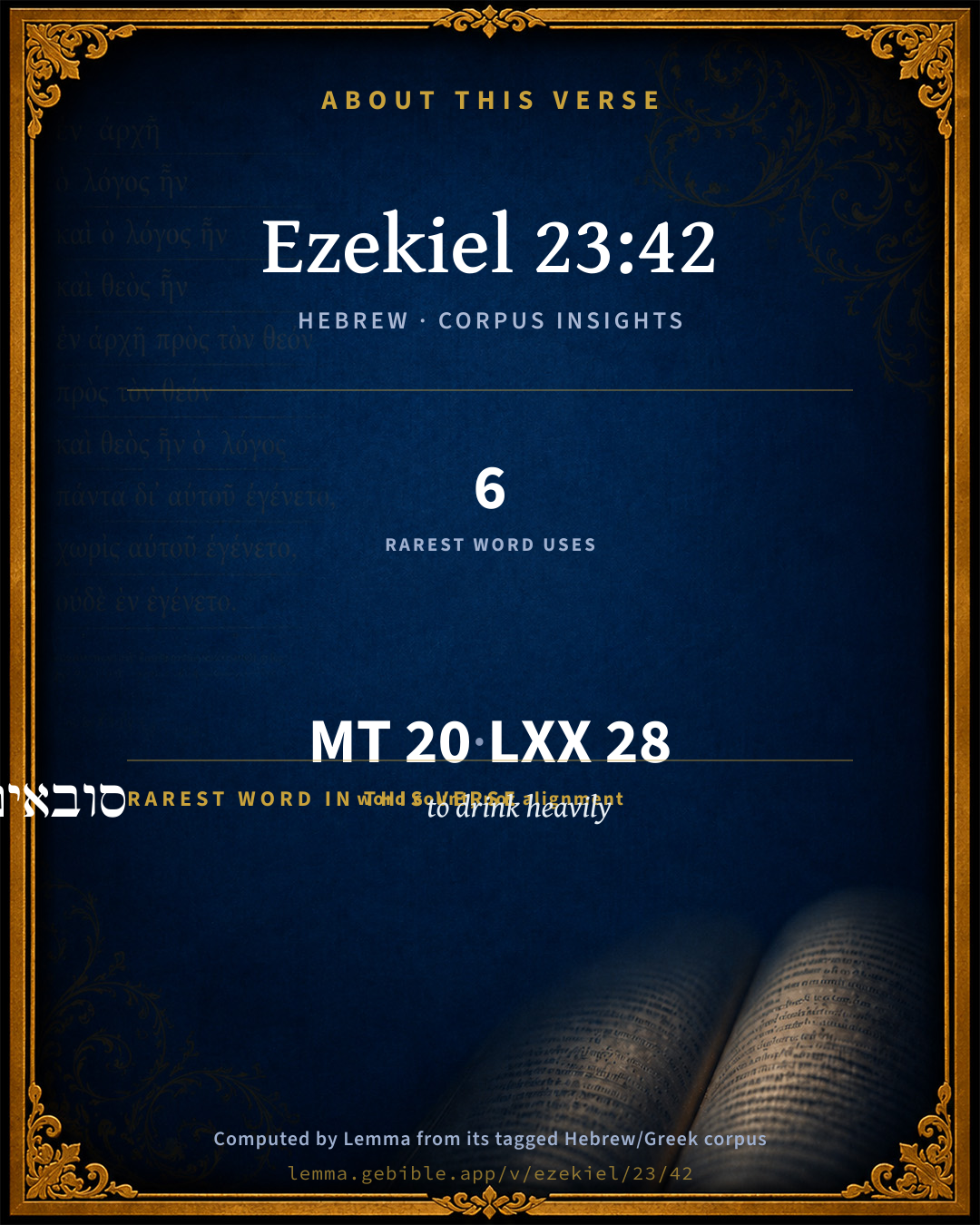
About this verse

These counts appear in no published source. They are computed here, from the morphology-tagged text and Lemma’s own curated glosses. What Lemma adds →

20
words
17
distinct lemmas
Prophets
section

Notable vocabulary

The rarest word here is סובאים to drink heavily H5433 — appearing just 6 times in the whole Hebrew Bible.

Shared distinctive vocabulary

סובאים to drink heavily H5433 occurs in 5 verses of the Hebrew Bible. Also found in:

Grammatical profile

  • 3 verbs
  • 12 nouns
  • 1 adjective
  • 4 prepositions

Verb forms

  • מוּבָאִ֥ים Hophal · Participle Passive
  • סובאים Qal · Participle Active
  • וַֽיִּתְּנ֤וּ Qal · Sequential Imperfect

Repetition

Words recur within this verse — often emphatic in Hebrew:

  • סובאים to drink heavily H5433 ×2
  • וְאֶל to H413 ×2

Hebrew & Septuagint length

In English translation the verse runs 40 words from the Hebrew and 36 from the Septuagint (LXX English) — closely comparable.

A rough comparison of the two English renderings, which tokenize alike — not a word-level alignment.

Word counts can differ between the Hebrew and the Greek without any difference in meaning — e.g. the Hebrew direct-object marker אֵת has no separate Greek word, and Greek often adds the article ὁ.

In the original languages it is 20 Hebrew tokens and 28 Greek tokens — but the two are counted differently (Hebrew bundles its prefixes and suffixes into one token; the Greek is in lemma form), so that isn’t a like-for-like length.

Cross-references

9

Topical passages linked to Ezekiel 23:42 in the Treasury of Scripture Knowledge — connected by theme and wording, ordered by reader-vote popularity; previews shown in the World English Bible.

  • Ezekiel 16:11–12 I decked you with ornaments, and I put bracelets on your hands, and a chain on your neck.
  • Genesis 24:30 It happened, when he saw the ring, and the bracelets on his sister's hands, and when he heard the words of Rebekah his sister, saying, "This is what the man said to me," that he came to the man. Behold, he was standing by the camels at the spring.
  • Exodus 32:6 They rose up early on the next day, and offered burnt offerings, and brought peace-offerings; and the people sat down to eat and to drink, and rose up to play.
  • Exodus 32:18–19 He said, "It isn't the voice of those who shout for victory, neither is it the voice of those who cry for being overcome; but the noise of those who sing that I hear."
  • Job 1:15 and the Sabeans attacked, and took them away. Yes, they have killed the servants with the edge of the sword, and I alone have escaped to tell you."
  • Hosea 13:6 According to their pasture, so were they filled; They were filled, and their heart was exalted. Therefore they have forgotten me.
  • Joel 3:8 And I will sell your sons and your daughters into the hands of the children of Judah, And they will sell them to the men of Sheba, To a faraway nation, For Yahweh has spoken it."
  • Amos 6:1–6 Woe to those who are at ease in Zion, And to those who are secure on the mountain of Samaria, The notable men of the chief of the nations, To whom the house of Israel come!
  • Revelation 12:3 Another sign was seen in heaven. Behold, a great red dragon, having seven heads and ten horns, and on his heads seven crowns.

Cross-references courtesy of OpenBible.info (CC BY 4.0).

Hebrew and Greek witnesses Masoretic Hebrew ↔ Greek Septuagint

The same verse in the two great witnesses to the Old Testament, shown verse-for-verse.

These are two independent witnesses, not word-aligned to each other, and the Septuagint is shown in lemma (dictionary) form.

Hebrew Ezekiel 23:42 Masoretic · Westminster Leningrad Codex

וְק֣וֹל הָמוֹן֮ שָׁלֵ֣ו בָהּ֒ וְאֶל אֲנָשִׁים֙ מֵרֹ֣ב אָדָ֔ם מוּבָאִ֥ים סובאים סָבָאִ֖ים מִמִּדְבָּ֑ר וַֽיִּתְּנ֤וּ צְמִידִים֙ אֶל יְדֵיהֶ֔ן וַעֲטֶ֥רֶת תִּפְאֶ֖רֶת עַל רָאשֵׁיהֶֽן

The voice of a multitude being at ease was with her: and with men of the common sort were brought drunkards from the wilderness; and they put bracelets on the hands of them [twain], and beautiful crowns on their heads.

World English Bible · Public Domain

Greek LXX Ezekiel 23:42 Septuagint · lemma form

καί φωνή ἁρμονία ἀνακρούω καί πρός ἀνήρ ἐκ πλῆθος ἄνθρωπος ἥκω ἐκ ὁ ἔρημος καί δίδωμι ψέλιον ἐπί ὁ χείρ αὐτός καί στέφανος καύχησις ἐπί ὁ κεφαλή αὐτός

and they raised a sound of music, and that with men coming from the wilderness out of a multitude of men, and they put bracelets on their hands, and a crown of glory on their heads;

LXX2012 (modern English Septuagint) · Public Domain

On this verse, The Cambridge Bible for Schools and Colleges discusses the Septuagint’s reading. Read the note in Commentary ↓

Hebrew: Westminster Leningrad Codex (CC BY 4.0). Greek: Septuagint (public domain); English from LXX2012 (modern English Septuagint) (Public Domain). How the Septuagint differs from the Hebrew →

Targum (Aramaic paraphrase)

1

The Targum is the ancient Jewish Aramaic paraphrase of the Hebrew Scriptures — an interpretive translation, not the Hebrew text itself. Onkelos (literal) and Pseudo-Jonathan (expansive) render the Torah, and Jonathan the Prophets. Coverage is partial: where no permissively-licensed English translation exists for a verse, only the Aramaic is shown. This is verse-level text, not a word-by-word alignment to the Hebrew.

  1. Targum Jonathan Prophets (Joshua–Malachi)
    וְקַל אִתְרְגוּשְׁתְּהוֹן דִי שְׁלַן שְׁלֵיוָא בְהוֹן וְלִתְקוֹף גִבָּרִין מִסְגֵי אֱנָשָׁא אָתָן מִסְחוֹר סְחוֹר מִמַדְבְּרָא וִיהָבוּ שֵׁירִין עַל יְדֵיהוֹן וְכֶתֶר דְתוּשְׁבְּחָתָא עַל רֵישֵׁיהוֹן:

    (no public-domain English translation for this verse)

    Targum Jonathan — Aramaic: “Mikraot Gedolot” (public domain). English: “Sefaria Community Translation” (CC0 1.0 (public-domain dedication)); “London "Chaldee Paraphrase," 1871” (public domain). Text via Sefaria.

Commentary

Notes on Ezekiel 23:42 from classic Christian and Jewish commentators (each source and its license shown beneath its notes). The classic Christian expositions comment on the surrounding passage and are grouped to its opening verse, so a note may address several verses; the Jewish commentaries on the Tanakh (Rashi and others) are per-verse, so they appear only where the commentator wrote on this verse.

Lemma curates 59 commentaries, every one of them public domain or Creative Commons licensed, each selected and text-cleaned for this edition rather than reprinted as found. About our sources →

Trapp's Complete Commentary

John Trapp

Eze 23:42 And a voice of a multitude being at ease [was] with her: and with the men of the common sort [were] brought Sabeans from the wilderness, which put bracelets upon their hands, and beautiful crowns upon their heads.

Ver. 42. And a voice of a multitude being at ease.] Or, Being jolly and jocund, as at brothel houses.

And with the men of the common, sort.] Heb., To the men. The basest and most abject people also were taken into confederacy; even Arabians, Ethiopians, Tartars, so cheap didst thou make thyself, so fond wast thou of their fopperies.

John Trapp, A Commentary or Exposition upon All the Books of the Old and New Testament (1647–1656) — public domain. Text from a community e-Sword module.

Geneva Bible (1599)

Geneva Bible translators

Which should teach the manner of worshipping their gods.

Geneva Bible (1599) marginal notes — public domain. Text via Bolls.life.

Jamieson, Fausset & Brown

Robert Jamieson, A. R. Fausset & David Brown

Sabeans--Not content with the princely, handsome Assyrians, the sisters brought to themselves the rude robber hordes of Sabeans (Job 1:15). The Keri, or Margin, reads "drunkards."

upon their hands--upon the hands of the sisters, that is, they allured Samaria and Judah to worship their gods.

Jamieson, Fausset & Brown — Commentary Critical and Explanatory on the Whole Bible (1871) — public domain (CC PDM 1.0). Text via the HelloAO Bible API.

Adam Clarke's Commentary

Verse 42. And a voice of a multitude] This seems to be an account of an idolatrous festival, where a riotous multitude was assembled, and fellows of the baser sort, with bracelets on their arms and chaplets on their heads, performed the religious rites.

Adam Clarke's Commentary on the Bible (1810–1826) — public domain. Text from a community e-Sword/MySword module.

Ellicott's Commentary for English Readers

(42) A voice of a multitude being at ease was with her.—The words “voice of a multitude,” wherever else they occur (1Sa_4:14; Isa_13:4; Isa_33:3; Dan_10:6), mean a loud tumult, and even the word here used for “multitude,” when alone, always means a boisterous multitude. Translate The voice of the tumult was stilled thereat: i.e., the tumult of the invading army was stilled by the gifts of Israel, a fact of which there is frequent record in the history. The phrase translated “with her” is rendered “thereby” in Gen_24:14.

Men of the common sort is better rendered in the margin, the multitude of men; and “Sabeans” is not a proper name, but, as in the margin, drunkards. They are represented as from the wilderness, not as their home, but as the region through which they passed in marching to Judæa. The whole sense of the verse is that the conquerors attacking the land were satisfied with heavy tribute, and having received this, many of the warriors gave themselves up to drunkenness and debauchery, decking out their tributary with meretricious ornaments.

A Bible Commentary for English Readers, edited by Charles John Ellicott (1878–1897) — public domain. Text from a community e-Sword module.

The Cambridge Bible for Schools and Colleges

gen. ed. J. J. S. Perowne

42. being at ease] If the reading be correct “at ease” must refer to careless living, a sense which the word has not elsewhere. LXX. renders: and a sound of music they raised; but though the word “multitude” may mean sound or noise when joined to songs (Eze_26:13; Amo_5:23), it can hardly of itself mean music. LXX. may have read “they sang” for “at ease:” “and with a loud noise (Dan_10:6) they sang”—a sense not suitable seeing the musicians must have been the harlots themselves, Isa_23:15-16. For the idea of multitude cf. Jer_5:7 end. If music were referred to the words would be better attached to the previous verse.

was with her] Rather: therein or therewith. LXX. om.

and with the men … Sabeans] and with men. For Sabeans Heb. text reads “drunkards,” as marg., and from the nature of the passage, which speaks of a general practice, reference to any particular nation is less probable. Read as R.V. “and with (in addition to) men … were brought drunkards from the wilderness; and they put bracelets” &c. Even for these vulgar guests the harlots, so indiscriminate was their whoredom, put bracelets on their hands and decked themselves. The idea that it was “men of the common sort” who adorned the harlots with bracelets as their hire (A.V. &c.) has little to recommend it, cf. Eze_16:31 seq. (the verb “they put” is mas. because fem. is not in use, Est_1:20). Even in Muhammed’s days the Arabs were addicted to drunkenness. LXX. om. “drunkards,” which might be a duplicate of “brought,” and certainly the mention of two classes here is rather improbable, the common sort and those brought from the wilderness might rather be the same, viz. the vulgar and petty peoples in contrast to the larger and nobler such as Babylon. The omission makes the clause difficult to construe. Corn, reconstructs the clause after Pro_7:16, making it a description of the “bed of love” (Eze_23:17), but with little probability. If the adulterous act be anywhere referred to it is in Eze_23:43.

The Cambridge Bible for Schools and Colleges (gen. ed. J. J. S. Perowne; Cambridge University Press, 1878–1918) — public domain. Text from a community e-Sword module.

John Gill's Exposition

And a voice of a multitude being at ease was with her,.... With Aholibah, with the two tribes of Judah and Benjamin: or, "in her", in Jerusalem; or "in it", or "about it" (h); the bed, or table, or both: these were either the people of the many nations that came in great numbers with the ambassadors, as their retinue, and for the greater splendour of them; and who came, not to make war, but in a peaceable way, being invited to come; or these were a confluence of the Jewish people, who came from all parts to see the public entry of these ambassadors; who were quite easy with it, since they came as the ambassadors of their allies and friends, in whose alliance they thought themselves safe and happy; and therefore welcomed them with their loud huzzas:

and with the men of the common sort were brought Sabeans from the wilderness; or, "and with men because of a multitude of men" (i); that is, with those men that came from several parts on this occasion, for the sake of a greater number, and of making a greater appearance, the Sabeans that dwelt in the desert of Arabia were fetched from thence; or their neighbours round about Moab and Ammon, that dwelt in the wilderness, were sent for, and brought to make the solemnity the greater; so Jarchi; and to this sense the Targum renders it,

"because of the multitude of men that came round about on every side from the wilderness,''

Some render it, "drunkards from the wilderness" (k); a parcel of drunken fellows that lived in the wilderness, rustic, brutish, people; these were brought as fit persons to drink healths, and roar on this occasion:

which put bracelets upon their hands, and beautiful crowns upon their heads; that is, the Jews put these ornaments upon the hands and heads of these men of the common sort, and the Sabeans with them, and these poor country drunken fellows too, that they might make the better appearance when they met and huzzaed the ambassadors at their entry; or which Sabeans and other foreigners put these ornaments on Aholah and Aholibah, and enticed them to the worship of their idols, and taught them idolatry.

(h) "in ea", Pagninus, Montanus, Vatablus, Junius & Tremellius, Polanus; "in illa", Cocceius, Starckius, "in illo", Piscator; "circa eam", a Lapide. (i) "et cum viris ut multiplicarent homines" Pagninus; "ut adessent multi homines", Munster; "prae multitudine hominum", Tigurine version, Cocceius, Starckius; "propter multiplicare homines", Vatablus. (k) "ebrosi ex deserto", Junius & Tremellius, Piscator, Polanus; so R. Sol. Urbin. Ohel Moed, fol. 99. 1.

John Gill's Exposition of the Whole Bible (1746–1763) — public domain (CC PDM 1.0). Text via the HelloAO Bible API.

Albert Barnes' Notes on the Bible

A voice ... - Or, The voice of the tumult was stilled thereby. The tumultuous cries of the invading army were stilled by these gifts. Others render being at ease, “living carelessly.”

Of the common sort - See the margin - a multitudinous crowd.

Sabeans - Better as in the margin. The Chaldaeans were noted for their intemperance and revellings.

The wilderness - The desert tract which the Chalaeans had to pass from the north of Mesopotamia to the holy land. This verse describes the temporary effects of the alliance of Israel and Judah with the Assyrians and Babylonians. All became quiet, the allies received gifts (incense and oil) from Israel and Judah, and these in turn brought riches to Palestine, “bracelets upon their” (i. e., Aholah’s and Aholibah’s) “hands,” and crowns “upon their heads.”

Albert Barnes' Notes on the Bible (1834–1885) — public domain. Text from a community e-Sword/MySword module.

Haydock's Catholic Bible Commentary

And that. Protestants, "Sabeans (marginal note and Septuagint, drunkards) from," &c. Any were admitted (Haydock) to the priesthood and to her favours, even the most rustic and deformed, 3 Kings xii. 32.

George Leo Haydock (1774–1849), Haydock's Catholic Family Bible and Commentary, 1859 edition — public domain. Excludes Psalms (Douay-Rheims chapter numbering differs from Protestant) and Deuterocanonical books (Catholic canon only).

Matthew Poole's English Annotations

A voice of a multitude; a shout for joy, that there was a treaty of peace between the Jews and the Chaldeans, or songs of gladness for the peace made, and confirmed, not in God’s name, but in the name of the idols.

Being at ease; free now from the fears of any wars to disquiet them.

Was with her; about the altar first, where the peace was sworn; about her bed next, where she feasted her new allies, that were great princes and nobles.

And with the men; and to these worthy the name of men, or beside these great and famous ones. Et avec ces hommes, as the French version.

Were brought Sabeans; messengers were sent to, or received, or entertained and caressed, from the roaring Sabeans, who lived on robberies, and spoiling the merchants; these were brought to Jerusalem from the wilderness, deserts of Arabia, a rude, barbarous, and idolatrous scum of men, described by their ill properties in geographers: of these were they that destroyed Job’s servants: in the verse described by their ornaments, bracelets about necks and arms, and crowns on their heads, which some think they bestowed upon this harlot.

Matthew Poole's English Annotations on the Holy Bible (1683–1685) — public domain. Text from a community e-Sword/MySword module.

Whedon's Commentary on the Bible

Daniel D. Whedon

42. And a voice of a multitude being at ease was with her — The LXX. reads, And with a loud noise did they sing therein.

And with the men… Sabeans — Hebrews with men… drunkards. From the earliest days harlotry and drunkenness have been closely associated.

Daniel D. Whedon (gen. ed.), Commentary on the Old and New Testaments (1874–1909) — public domain. Text from a community e-Sword module.

The Pulpit Commentary

A voice of a multitude, etc. The word for "multitude" is strictly tumult, and Keil and Currey render, The voice of tumult became still," sc. the threats of the alien powers whom Judah courted were for a time hushed by the tributes thus paid to them. With the men of the common sort; literally, as in the margin, of the multitude of men. Sabeans from the wilderness. The Revised Version, with Keil and almost all recent commentators, follows the margin, drunkards (LXX, oijnwmenoi). "Sabeans" rests on a Jewish rendering of the text, but, as a people, the Sabeans, who dwelt south of Meroe, though named in Isa_45:14, were too remote to come within the horizon of the parable. What Ezekiel dwells on is the ever-growing degradation of the harlot city. Not only the officers of the Chaldeans, but the mixed multitude, the very drunkards from the wilderness of Babylon, were admitted to her embraces. Possibly the word may point to the false gods to whom libations of wine were offered, but I incline to refer it rather to those who got drunk at their idol-festivals even in Jerusalem. Drunkenness was one of the vices of the Babylonians, and the prophets, who admired the Rechabites and the Nazarites (Amo_2:11) must have looked on Judah"s participation in that sin as a measureless degradation. The bracelets and crowns symbolize the wealth and prestige which the Chaldean alliance was supposed to bring with it.

The Pulpit Commentary (1880–1919), ed. H.D.M. Spence-Jones & Joseph S. Exell — public domain. Text from a community e-Sword module.

John Wesley's Explanatory Notes

A voice - A shout for joy, that there was a treaty of peace between the Jews, and the Chaldeans.

John Wesley, Explanatory Notes Upon the Whole Bible (1754–1765) — public domain. Text via the GEBible commentary corpus.

unfoldingWord translationNotes

Door43 World Missions Community

General Information:

Yahweh continues to refer to the cities of Jerusalem and Samaria as if they were two prostitutes. (See: Metaphor)

So the sound of a noisy crowd was around her

The sound of the crowd is used to refer to the crowd of people. AT: "So there was a noisy crowd around her" (See: Metonymy)

was around her ... on their hands

"was around her ... on her and her sister's hands." This verse begins by referring to one of the sisters but the situation is probably the same for both sisters. If one sister must be specified in your language, refer to Oholibah here. In the second part of the verse it switches back to referring to both sisters with the word "their."

Sabeans were brought

This can be stated in active form. The word "Sabeans" refers to people from Sheba. AT: "Sabeans had come" (See: Active or Passive and How to Translate Names)

they put bracelets

The word "they" refers to the men.

translationWords

drunk

desert

crown

unfoldingWord translationNotes — © Distant Shores Media and the Door43 World Missions Community, licensed CC BY-SA 4.0. Source: git.door43.org/Door43/en_tn.

Rashi

Rabbi Shlomo Yitzchaki (Rashi)

And the sound of a multitude of many nanons were in her; not a multitude that came for war, but the voice of a tranquil multitude.

for the sake of men [Heb. וְאֶל אֶנָשִׁים,] for the sake of men. That multitude was of men, not of animals.

of the many people who were in her midst, who were brought to commit adultery, from the desert.

those dwelling all around [Heb. סָבָאִים,] people who lived around her. Of her neighbors, Ammon and Moab, and so did [Jonathan] render סָבָאִים “from all around.”

they placed Oholah and Oholibah [placed] bracelets on their hands to adorn themselves in order to commit adultery; i.e., Ammon and Moab, since they are many, she adorns and beautifies herself for them, and because they are her neighbors, she beautifies herself before their eyes with her ornaments; therefore, Oholah and Oholibah put bracelets on their hands in order to be beautiful in the eyes of the adulterers. The “vav” of וַיִתְּנוּ is superfluous, like that of (Exod. 15:2): “The strength and the cutting of God was (וַיְהִי) my salvation,” and like that of (ibid. 9:21): “But whoever did not take the word of the Lord to heart left (וַיַעֲזֹב).”

Rashi on the Tanakh — English translations: “The Judaica Press complete Tanach with Rashi, translated by A. J. Rosenberg” (CC BY 4.0); “Pentateuch with Rashi's commentary by M. Rosenbaum and A.M. Silbermann, 1929-1934” (public domain); “The Metsudah Tanach series, Lakewood, N.J” (CC BY 4.0); and “The Book of Joshua, Metsudah Publications, 1997” (CC BY 4.0). Text via Sefaria.

Lesson kit

Teaching starters — assembled from the data on this page, not authored interpretation. Every prompt links to the verse data it draws on. Edit before teaching.

Ezekiel, in the Prophets, opens this verse with 20 words (17 distinct Hebrew lemmas). Its most distinctive word is çâbâʼ (“to drink heavily”). A historical commentator’s framing appears above. Read the whole chapter for the surrounding context.

Discussion questions

  1. The word çâbâʼ carries the sense “to drink heavily.” How does it shape the verse?
  2. Proverbs 23:20 shares the word «to drink heavily» with this verse. How do the two illuminate each other?
  3. “to drink heavily” occurs 2× in this one verse. What is the effect of the repetition?
  4. The translations on this page render this verse differently — a whole-verse word diff, not a word-by-word alignment. What might account for the different wordings?
  5. The verb «מוּבָאִ֥ים» is Hophal Participle Passive. How does its form color the action?
  6. Reading how Trapp's Complete Commentary and Geneva Bible (1599) read this verse, where do the two commentators agree and where do they part?

Things to notice

Reading settings

Reading text

Shown beneath each verse's original-language words.

Old Testament
Old Testament edition

Read the OT as the Masoretic Hebrew (MT) or the Greek Septuagint (LXX).

English shown for the Greek Septuagint (in the Hebrew ↔ Greek comparison).

Comparing translations? Open the Compare panel on any verse page to stack up to four side by side.