Psalms 52:7

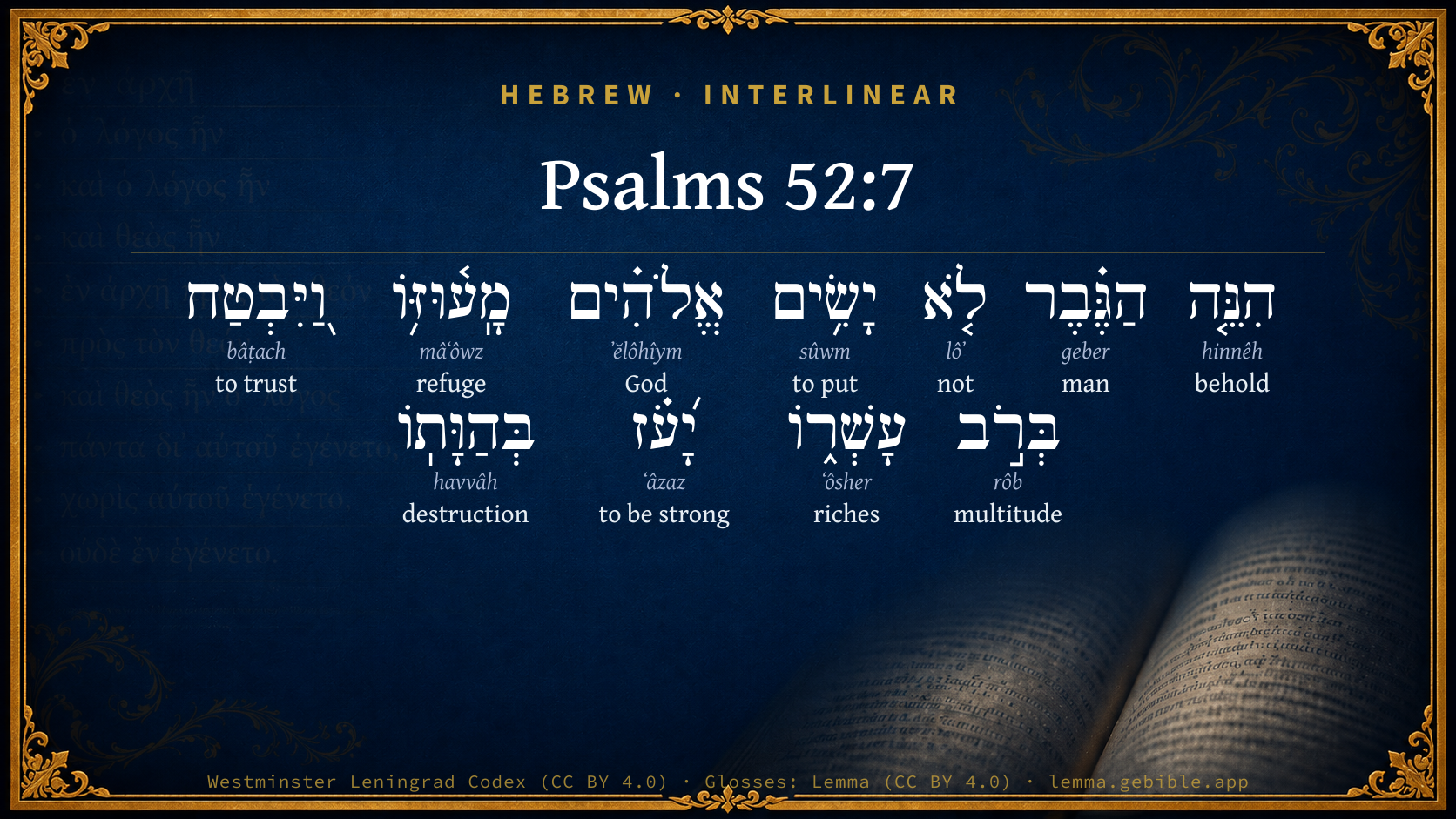
Hebrew (Westminster Leningrad Codex) Psalms 52:7 appears in the Hebrew Old Testament. The text above is from the Westminster Leningrad Codex. Each word links to its Strong’s number, a concise gloss, and parsing drawn from the Open Scriptures Hebrew Bible morphology. Click any word for its full Brown-Driver-Briggs (BDB) entry.
Download image
Cite this verse

Psalms 52:7 (World English Bible). Public Domain. Lemma interlinear Bible study tool, https://lemma.gebible.app/v/psalms/52/7.

Show BibTeX & RIS
BibTeX
RIS
English Translation
"Behold, this is the man who didn't make God his strength, But trusted in the abundance of his riches, And strengthened himself in his wickedness."
World English Bible · Public Domain
Download a study sheet

One document with this verse’s original text, its word-by-word gloss line, the meaning frame, cross-references with their text, attributed commentary, and full source and license credits — printable, and it pastes into notes with its structure intact.

This verse Autodidact and up

Study sheet (.html) Plain text (.txt)

A passage Seminary Student

Up to 50 verses in one chapter. A passage sheet keeps up to 6 commentary sources and 12 cross-references per verse, in the order this page ranks them, and says so on the sheet whenever that leaves anything out. Ask for a single verse and you get the Autodidact verse sheet above.

Everything on this page stays free to read, with no account — the sheet is a download of what is already on screen, not access to it.

Want to remove ads? Support Godless Engineer
Compare translations 3

The same verse in 3 English versions, stacked beneath the original-language interlinear above. Click any original word for its lexicon entry.

Each is an independent rendering of the whole verse — the interlinear is not word-aligned to these translations.

Highlighted words mark where these versions differ — a whole-verse word diff, not a word-by-word alignment.

  • World English Bible Public Domain
    "Behold, this is the man who didn't make God his strength, But trusted in the abundance of his riches, And strengthened himself in his wickedness."
  • King James Version Public Domain
    Lo, this is the man that made not God his strength; but trusted in the abundance of his riches, and strengthened himself in his wickedness.
  • unfoldingWord Literal Text CC BY-SA 4.0
    “Behold, the man did not make God his refuge, but he trusted in the abundance of his wealth; he was strong in his calamity.”

unfoldingWord Literal Text — © unfoldingWord, licensed CC BY-SA 4.0. Word-aligned USFM3 via Door43 (git.door43.org/unfoldingWord/en_ult).

Versions to compare (up to 4)

3 of 4 selected

Show all 18 translations

Every available English version of this verse, each an independent rendering of the whole verse.

  • World English Bible Public Domain
    "Behold, this is the man who didn't make God his strength, But trusted in the abundance of his riches, And strengthened himself in his wickedness."
  • Berean Standard Bible Public Domain
    “Look at the man who did not make God his refuge, but trusted in the abundance of his wealth and strengthened himself by destruction.”
  • Majority Standard Bible Public Domain
    “Look at the man who did not make God his refuge, but trusted in the abundance of his wealth and strengthened himself by destruction.”
  • King James Version Public Domain
    Lo, this is the man that made not God his strength; but trusted in the abundance of his riches, and strengthened himself in his wickedness.
  • American Standard Version (1901) Public Domain
    Lo, this is the man that made not God his strength, But trusted in the abundance of his riches, And strengthened himself in his wickedness.
  • Revised Version (1885) Public Domain
    Lo, this is the man that made not God his strength; but trusted in the abundance of his riches, and strengthened himself in his wickedness.
  • Geneva Bible (1599) Public Domain
    Beholde the man that tooke not God for his strength, but trusted vnto the multitude of his riches, and put his strength in his malice.
  • Douay-Rheims (1899) Public Domain
    Therefore will God destroy thee for ever: he will pluck thee out, and remove thee from thy dwelling place: and thy root out of the land of the living.
  • Young's Literal Translation Public Domain
    `Lo, the man who maketh not God his strong place, And trusteth in the abundance of his riches, He is strong in his mischiefs.'
  • Literal Standard Version CC BY-SA 4.0
    “Behold, the man who does not make God his strong place, || And trusts in the abundance of his riches, || He is strong in his mischiefs.”
  • Unlocked Literal Bible CC BY-SA 4.0
    “See, this is a man who did not make God his refuge, but he trusted in the abundance of his wealth, and he was strong when he destroyed others.”
  • unfoldingWord Literal Text CC BY-SA 4.0
    “Behold, the man did not make God his refuge, but he trusted in the abundance of his wealth; he was strong in his calamity.”
  • Darby Bible Public Domain
    Behold the man that made not God his strength, but put confidence in the abundance of his riches, [and] strengthened himself in his avarice.
  • World Messianic Bible Public Domain
    “Behold, this is the man who didn’t make God his strength, but trusted in the abundance of his riches, and strengthened himself in his wickedness.”
  • Webster's Bible Public Domain
    \\52:5\\God shall likewise destroy thee for ever, he shall take thee away, and pluck thee out of thy dwelling-place, and root thee out of the land of the living. Selah.
  • Free Bible Version CC BY-SA 4.0
    “See what happens to those who don't go to God for help but instead rely on their great wealth and strength—which only brings their destruction!”
  • Bible in Basic English Public Domain
    See, this is the man who did not make God his strength, but had faith in his goods and his property, and made himself strong in his wealth.
  • JPS Tanakh (1917) Public Domain
    (52-9) 'Lo, this is the man that made not God his stronghold; but trusted in the abundance of his riches, and strengthened himself in his wickedness.'

Literal Standard Version (2020), Covenant Press — licensed CC BY-SA 4.0. Text via the HelloAO Bible API (eBible.org). Unlocked Literal Bible (unfoldingWord) — licensed CC BY-SA 4.0. Text via the HelloAO Bible API (eBible.org). unfoldingWord Literal Text — © unfoldingWord, licensed CC BY-SA 4.0. Word-aligned USFM3 via Door43 (git.door43.org/unfoldingWord/en_ult). Free Bible Version, Dr. Jonathan Gallagher — licensed CC BY-SA 4.0. Text via the HelloAO Bible API (eBible.org).

Word by word

More ways to search: Search by grammar → Find every occurrence → Compare this word →

Practice this passage: Drill this verse → Learn its vocabulary →

יָ֝עֹ֗ז
ʻâzaz
H5810
“to be strong”
Verb, Qal, Imperfect, 3rd Person, Masculine, Singular
Part of Speech
Verb
Stem
Qal
Form
Imperfect
Person
3rd Person
Gender
Masculine
Number
Singular
Full BDB Definition

Origin: a primitive root

TWOT: 1596

to be strong - (Qal) to be strong, prevail - (Hiphil) to make firm, strengthen
  1. הִנֵּ֤ה hinnêh H2009 “behold” Particle, Demonstrative
  2. הַגֶּ֗בֶר geber H1397 “the · man” Particle, Definite Article + Noun, Common, Masculine, Singular, Absolute
  3. לֹ֤א lôʼ H3808 “not” Particle, Negative
  4. יָשִׂ֥ים sûwm H7760 “to put” Verb, Qal, Imperfect, 3rd Person, Masculine, Singular
  5. אֱלֹהִ֗ים ʼĕlôhîym H430 “God(s)” Noun, Common, Masculine, Plural, Absolute
  6. מָֽע֫וּזּ֥וֹ mâʻôwz H4581 “refuge · his” Noun, Common, Masculine, Singular, Construct + Suffix, Personal, 3rd Person, Masculine, Singular
  7. וַ֭יִּבְטַח bâṭach H982 “and · to trust” Conjunction + Verb, Qal, Sequential Imperfect, 3rd Person, Masculine, Singular
  8. בְּרֹ֣ב rôb H7230 “in/at · multitude of” Preposition + Noun, Common, Both, Singular, Construct
  9. עָשְׁר֑וֹ ʻôsher H6239 “riches · his” Noun, Common, Masculine, Singular, Construct + Suffix, Personal, 3rd Person, Masculine, Singular
  10. בְּהַוָּתֽוֹ havvâh H1942 “in/at · destruction · his” Preposition + Noun, Common, Feminine, Singular, Construct + Suffix, Personal, 3rd Person, Masculine, Singular

About this verse

These counts appear in no published source. They are computed here, from the morphology-tagged text and Lemma’s own curated glosses. What Lemma adds →

11
words
11
distinct lemmas
Wisdom
section

Notable vocabulary

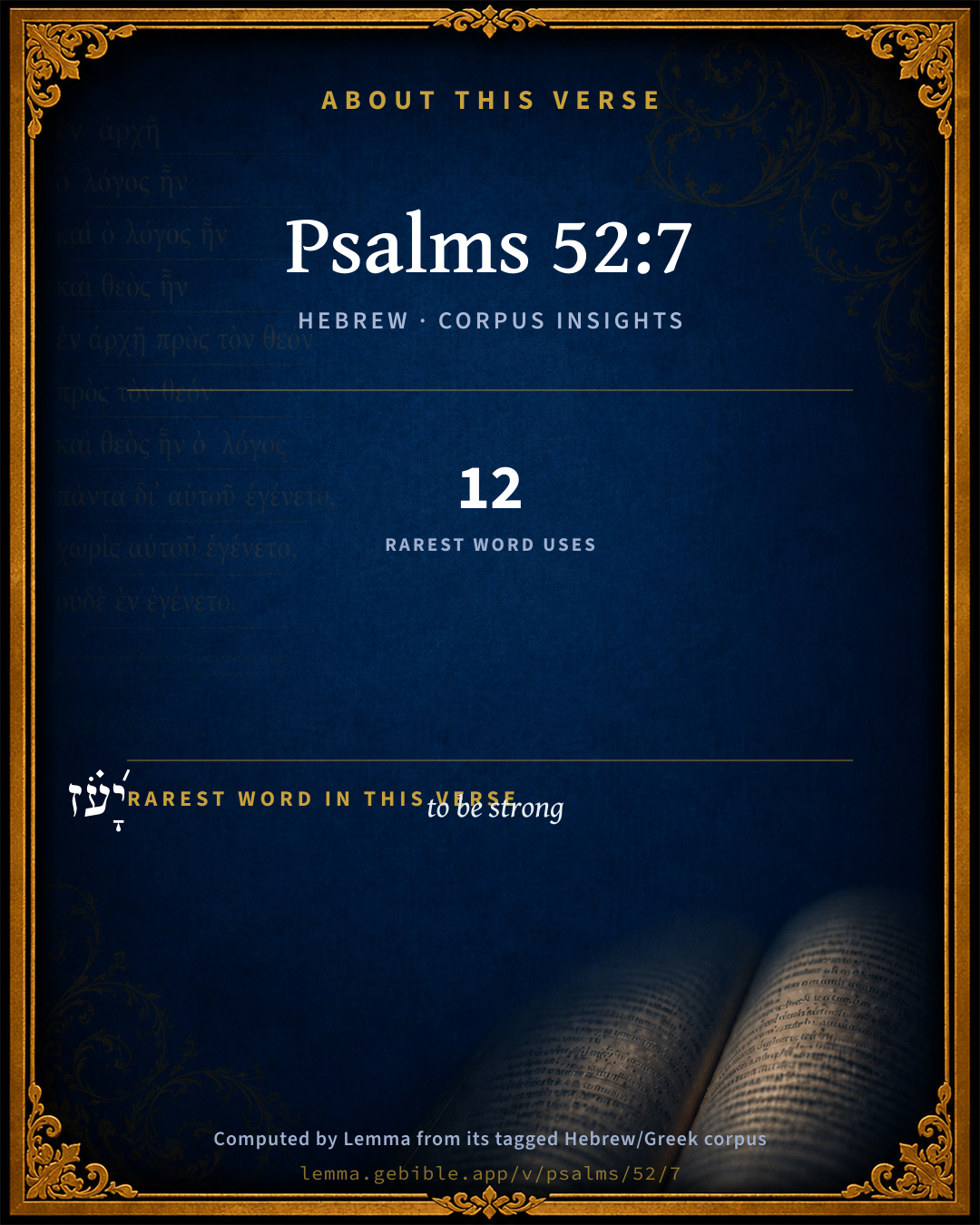
The rarest word here is יָ֝עֹ֗ז to be strong H5810 — appearing just 12 times in the whole Hebrew Bible.

Shared distinctive vocabulary

יָ֝עֹ֗ז to be strong H5810 occurs in 12 verses of the Hebrew Bible. Also found in:

Grammatical profile

  • 3 verbs
  • 6 nouns
  • 2 particles

Verb forms

  • יָשִׂ֥ים Qal · Imperfect
  • וַ֭יִּבְטַח Qal · Sequential Imperfect
  • יָ֝עֹ֗ז Qal · Imperfect

Hebrew & Septuagint length

In English translation the verse runs 25 words from the Hebrew and 23 from the Septuagint (LXX English) — closely comparable.

A rough comparison of the two English renderings, which tokenize alike — not a word-level alignment.

Word counts can differ between the Hebrew and the Greek without any difference in meaning — e.g. the Hebrew direct-object marker אֵת has no separate Greek word, and Greek often adds the article ὁ.

Cross-references

12

Topical passages linked to Psalms 52:7 in the Treasury of Scripture Knowledge — connected by theme and wording, ordered by reader-vote popularity; previews shown in the World English Bible.

  • Jeremiah 17:5 Thus says Yahweh: Cursed is the man who trusts in man, and makes flesh his arm, and whose heart departs from Yahweh.
  • Ecclesiastes 8:8 There is no man who has power over the spirit to contain the spirit; neither does he have power over the day of death. There is no discharge in war; neither shall wickedness deliver those who practice it.
  • Psalms 49:6–20 Those who trust in their wealth, And boast in the multitude of their riches--
  • Psalms 73:18–20 Surely you set them in slippery places. You throw them down to destruction.
  • Job 31:24–25 "If I have made gold my hope, And have said to the fine gold, 'You are my confidence;'
  • John 19:5 Jesus therefore came out, wearing the crown of thorns and the purple garment. Pilate said to them, "Behold, the man!"
  • Psalms 62:9–10 Surely men of low degree are just a breath, And men of high degree are a lie. In the balances they will go up. They are together lighter than a breath.
  • Psalms 146:3–5 Don't put your trust in princes, Each a son of man in whom there is no help.
  • Isaiah 14:16–17 Those who see you shall gaze at you, they shall consider you, [saying], "Is this the man who made the earth to tremble, who shook kingdoms;
  • Hosea 12:7–8 A merchant has dishonest scales in his hand. He loves to defraud.
  • 1 Timothy 6:17 Charge those who are rich in this present world that they not be haughty, nor have their hope set on the uncertainty of riches, but on the living God, who richly provides us with everything to enjoy;
  • Psalms 73:7–11 Their eyes bulge with fat. Their minds pass the limits of conceit.

Cross-references courtesy of OpenBible.info (CC BY 4.0).

Hebrew and Greek witnesses Masoretic Hebrew ↔ Greek Septuagint

The same verse in the two great witnesses to the Old Testament, shown verse-for-verse.

You’re reading Greek Psalm 51 (Hebrew Psalm 52). The Septuagint counts the superscription, so verse numbers can differ from the Hebrew — chapter-level alignment, not verse-by-verse. Numbering follows Rahlfs.

These are two independent witnesses, not word-aligned to each other, and the Septuagint is shown in lemma (dictionary) form.

Hebrew Psalms 52:7 Masoretic · Westminster Leningrad Codex

הִנֵּ֤ה הַגֶּ֗בֶר לֹ֤א יָשִׂ֥ים אֱלֹהִ֗ים מָֽע֫וּזּ֥וֹ וַ֭יִּבְטַח בְּרֹ֣ב עָשְׁר֑וֹ יָ֝עֹ֗ז בְּהַוָּתֽוֹ

"Behold, this is the man who didn't make God his strength, But trusted in the abundance of his riches, And strengthened himself in his wickedness."

World English Bible · Public Domain

Greek LXX Greek Psalm 51:7 Septuagint · lemma form

διά οὗτος ὁ θεός κατααἱρέω σύ εἰς τέλος ἐκτίλλω σύ καί μεταναστεύω σύ ἀπό σκήνωμα καί ὁ ῥίζωμα σύ ἐκ γῆ ζάω διάψαλμα

Behold the man who made not God his help; but trusted in the abundance of his wealth, and strengthened himself in his vanity.

LXX2012 (modern English Septuagint) · Public Domain

Hebrew: Westminster Leningrad Codex (CC BY 4.0). Greek: Septuagint (public domain); English from LXX2012 (modern English Septuagint) (Public Domain). How the Septuagint differs from the Hebrew →

Commentary

Notes on Psalms 52:7 from classic Christian and Jewish commentators (each source and its license shown beneath its notes). The classic Christian expositions comment on the surrounding passage and are grouped to its opening verse, so a note may address several verses; the Jewish commentaries on the Tanakh (Rashi and others) are per-verse, so they appear only where the commentator wrote on this verse.

Lemma curates 59 commentaries, every one of them public domain or Creative Commons licensed, each selected and text-cleaned for this edition rather than reprinted as found. About our sources →

Trapp's Complete Commentary

John Trapp

Psa 52:7 Lo, [this is] the man [that] made not God his strength; but trusted in the abundance of his riches, [and] strengthened himself in his wickedness.

Ver. 7. Lo, this is the man] Or, rather, now the monster to be pointed at; once so mighty, now so miserable, O quantum haec Niobe, &c., what a strange change is here, &c. As the true Israelite is pointed out with a Behold, for imitation, Joh 1:47, so is this counterfeit Israelite for detestation.

That made not God his strength] But carried the matter as if he had been some petty god within himself.

But trusted in the abundance, &c.] Never true to those that trusted them.

And strengthened himself in his wickedness] Heb. in his woeful evil, in his putting many poor creatures to their "Woe is me!"

John Trapp, A Commentary or Exposition upon All the Books of the Old and New Testament (1647–1656) — public domain. Text from a community e-Sword module.

The Treasury of David

Charles H. Spurgeon

Ver. 7. Lo. Look ye here, and read the epitaph of a mighty man, who lorded it proudly during his little hour, and set his heel upon the necks of the Lord's chosen. This is the man that made not God his strength. Behold the man! The great vainglorious man. He found a fortress, but not in God; he gloried in his might, but not in the Almighty. Where is he now? How has it fared with him in the hour of his need? Behold his ruin, and be instructed. But trusted in the abundance of his riches, and strengthened himself in his wickedness. The substance he had gathered, and the mischiefs he had wrought, were his boast and glory. Wealth and wickedness are dreadful companions; when combined they make a monster. When the devil is master of money bags, he is a devil indeed. Beelzebub and Mammon together heat the furnace seven times hotter for the child of God, but in the end that shall work out their own destruction. Wherever we see today a man great in sin and substance, we shall do well to anticipate his end, and view this verse as the divine in memoriam.

Ver. 7. Lo, this is the man that made not God his strength. David having showed (Ps 52:5-6) the wicked man, by the righteous judgment of God rooted out of the land of the living, shows us in the next verse, the righteous man at once fearing and laughing at this sight, as also pointing at him saying, Lo, this is the man that made not God his strength. The words are a divine but cutting sarcasm. The original is geber, which signifieth a strong, valiant man: as we say in English, Lo, this is the brave and gallant man you wot of! But who was this for a man? He was one, saith he, that trusted in the abundance of his riches. Oh! It is hard to abound in riches and not to trust in them. Hence that caution (Ps 62:10): If riches increase, set not your heart upon them. Now, what is the setting the heart upon riches but our rejoicing and trusting in them? And because the heart of man is so easily persuaded into this sinful trust upon riches, therefore the apostle is urgent with Timothy to persuade all rich men--not only mere worldly rich men, but godly rich men--against it; yea, he urges Timothy to persuade rich men against two sins, which are worse than all the poverty in the world, yet the usual attendants of riches--pride and confidence: Charge them that are rich in this world, that they be not highminded. 1Ti 6:17. Joseph Caryl.

Ver. 7-8. Perhaps some of you have been long professors, and yet come to little growth in love to God, humility, heavenly mindedness, mortification; and it is worth the digging to see what lies at the root of your profession, whether there be not a legal principle that hath too much influenced you. Have you not thought to carry all with God from your duties and services, and too much laid up your hopes in your own actings? Alas! this is as so much dead earth, which must be thrown out, and gospel principles laid in the room thereof. Try but this course, and try whether the spring of thy grace will not come on apace. David gives an account how he came to stand and flourish when some that were rich and mighty, on a sudden withered and came to nothing. Lo, saith he, this is the man that made not God his strength; but trusted in the abundance of his riches. But I am like a green olive tree in the house of God: I trust in the mercy of God for ever and ever. While others trust in the riches of their own righteousness and services, and make not Christ their strength, do thou renounce all, and trust in the mercy of God in Christ, and thou shalt be like a green olive when they fade and wither. William Gurnall.

Ver. 7-8. The worldling like an uprooted tree, the believer a vigorous well planted olive.

Psalms 52:8*

Ver. 7-8. See Psalms on "Ps 52:7" for further information.

Ver. 7-8. The worldling like an uprooted tree, the believer a vigorous well planted olive.

Charles H. Spurgeon's The Treasury of David (1869–1885) — public domain. Psalms only. Text from a community e-Sword/MySword module.

J. A. Alexander on Psalms

Joseph Addison Alexander

9. (Psa 52:7). Behold the man (who) will not make God his strength, but will trust in the increase of his wealth, (and) will be strong in his wickedness. This may be regarded as the language of the laughers mentioned in Psa 52:8 (6). Behold the man, see to what he is reduced. The effect of the behold is similar to that of the interrogation in Isa 14:16. The word translated man is not one of the usual terms, but one implying strength or power, so that its use here gives a kind of sarcastic import to the passage. See the analogous use of an opposite expression in Psa 8:5 (4), Psa 10:18. The future expresses fixed determination and anticipated perseverance in refusing. Make, literally place or set. See above, on Psa 40:5 (4). His strength, or more exactly, his stronghold or fortress. See above, on Psa 27:1; Psa 37:39; Psa 43:2. Increase, or simply abundance, greatness. See above, on Psa 5:8 (7), Psa 51:3 (1). The word translated wickedness is the singular of that translated mischiefs in Psa 52:4 (2) above. It seems to signify particularly an inclination fo malicious mischief.

Joseph Addison Alexander, The Psalms Translated and Explained (1850) — public domain. Text from a community e-Sword module.

Geneva Bible (1599)

Geneva Bible translators

Or, in his substance.

Geneva Bible (1599) marginal notes — public domain. Text via Bolls.life.

Jamieson, Fausset & Brown

Robert Jamieson, A. R. Fausset & David Brown

for trusting in riches and being strong in "wickedness."

wickedness--literally, "mischief" (Psa 52:2), instead of trusting in God.

the man--literally, "the mighty man," or "hero" (Psa 52:1).

Jamieson, Fausset & Brown — Commentary Critical and Explanatory on the Whole Bible (1871) — public domain (CC PDM 1.0). Text via the HelloAO Bible API.

Adam Clarke's Commentary

Verse 7. Made not God his strength] Did not make God his portion.

In the abundance of his riches] Literally, in the multiplication of his riches. He had got much, he hoped to get more, and expected that his happiness would multiply as his riches multiplied. And this is the case with most rich men.

Strengthened himself in his wickedness.] Loved money instead of God; and thus his depravity, being increased, was strengthened.

Crescit amor nummi, quantum ipsa pecunia crescit.

"In proportion to the increase of wealth, so is the love of it."

Where is the religious man, in whose hands money has multiplied, who has not lost the spirit of piety in the same ratio? To prevent this, and the perdition to which it leads, there is no way but opening both hands to the poor.

Adam Clarke's Commentary on the Bible (1810–1826) — public domain. Text from a community e-Sword/MySword module.

John Calvin's Commentaries

7. Lo! this is the man that made not God his strength Some think that these words are given as what should afterwards be proverbially applied to Doeg; but they would not appear to have been intended in that restricted signification. They merely express the improvement which the people of God would make of the judgment. It would teach them, on the one hand, to be patient under the insolence of the ungodly, which is so speedily humbled; and, on the other, to beware of indulging a similarly infatuated spirit themselves. They would laugh at their destruction, yet not in the way of insulting over them, but rejoicing more and more in the confidence of the help of God, and denying themselves more cheerfully to the vain pleasures of this world. This is the lesson to be learned from such dispensations of providence: they should recall our wandering affections to God. The verse is introduced with an exclamation, Lo! this is the man, etc.; for David would have us to look upon this one instance as representing to our eyes, in a vivid manner, the end of all who despise the Lord; and it may be remarked, that it is no small point of practical wisdom thus to generalise individual providences. The two clauses, made not God his strength, and, trusted in the abundance of his riches, stand mutually connected; for none can be said sincerely to repose upon God but he who has been emptied of all confidence in his own resources. So long as men imagine that they have something of their own in which they can boast, they will never resort to God: just in proportion as we arrogate to ourselves do we derogate from him; and it is not only wealth, but any other earthly possession, which, by engrossing our confidence, may prevent us from inquiring after the Lord. The noun הוה, havah, which most interpreters have rendered wickedness, and some slaughter or destruction, seems, in this place, rather to mean substance. Such repetitions of the same sentiment in different words are common with the Psalmist; and, according to this translation, the verse will flow connectedly, reading, that the man who trusts in his riches, and strengthens himself in his substance, defrauds God of his just glory.

John Calvin's Commentaries (1540-1563) — public domain. Text from the Calvin Translation Society English edition (1840s-50s) via the Christian Classics Ethereal Library (ccel.org). Calvin's coverage is partial (roughly two-thirds of the Bible); uncommented books and verses are honest gaps, never fabricated. The 19th-century editor's footnotes and remarks are omitted so the notes are faithfully Calvin's own voice.

The Cambridge Bible for Schools and Colleges

gen. ed. J. J. S. Perowne

7. The words of the righteous. There is a touch of sarcasm in the use of the word geber (akin to gibbor, Psa_52:1) for man (as perhaps in Isa_22:17, see R.V. marg.), denoting a man in his full vigour.

that made not God his strength] Or, stronghold. The tense implies that it was the constant habit of his mind.

but trusted &c.] Cp. Psa_49:6.

in his wickedness] The singular of the word rendered mischiefs (R.V. very wickedness) in Psa_52:2. It may here mean greed, or covetousness. But the rendering of the Targ. and the Syr. in his wealth (whence A.V. marg. substance), seems to represent a slightly different reading, which agrees well with the parallel, in the abundance of his riches.

The Cambridge Bible for Schools and Colleges (gen. ed. J. J. S. Perowne; Cambridge University Press, 1878–1918) — public domain. Text from a community e-Sword module.

John Gill's Exposition

Lo, this is the man that made not God his strength,.... The Targum renders it, "that made not the Word of the Lord his strength". These are the words the righteous would say, when they should see the destruction of Doeg: see the man, the mighty man, and his end; what all his ill gotten honour and riches are come to; and what his wickedness, deceit, and cruelty, have brought upon him. The righteous make the Lord their strength, put their trust in him, in whom is everlasting strength; do all they do in his strength; fly to him as their "strong hold", as the word (b) may be rendered; thither they run, and are safe: but the rich man's wealth is his strong city, Pro 18:10; there he thinks himself safe, and places his confidence in it, as follows:

but trusted in the abundance of his riches; See Gill on Psa 49:6; so the antichristian whore is represented as boasting of her riches and honour, and trusting in them, that they would always continue, Rev 18:7; like the fool in Luk 12:19;

and strengthened himself in his wickedness; encouraged and hardened himself in sin, gave up himself to it; and, by art obstinate continuance in it, strengthened the vicious habits contracted; stretched out his hand against God, and strengthened himself against the Almighty; went on in a daring manner, promising himself impunity; and as if his wickedness was his strength, his safeguard and protection: or in his mammon, his wealth and substance; as the Targum interprets it; and so R. Saadiah Gaon (c), and with which the Syriac version agrees; and then the sense is the same with the other clause. But, alas! what are all such forces of strength, when wrath comes forth from the Lord of hosts? Job 36:18.

(b) "arcem suam", Cocceius; "presidium, munimemtum", Michaelis. (c) Apud Kimchi in loc.

John Gill's Exposition of the Whole Bible (1746–1763) — public domain (CC PDM 1.0). Text via the HelloAO Bible API.

Albert Barnes' Notes on the Bible

Lo, this is the man that made not God his strength - That is, the righteous Psa 52:6 would say this. They would designate him as a man who had not made God his refuge, but who had trusted in his own resources. The result would be that he would he abandoned by God, and that those things on which he had relied would fail him in the day of calamity. He would be pointed out as an instance of what must occur when a man does not act with a wise reference to the will of God, but, confiding in his own strength and resources, pursues his own plans of iniquity.

But trusted in the abundance of his riches - See the notes at Psa 49:6. From this it would seem that Doeg was a rich man, and that, as a general thing, in his life, and in his plans of evil, he felt confident in his wealth. He had that spirit of arrogance and self-confidence which springs from the conscious possession of property where there is no fear of God; and into all that he did he carried the sense of his own importance as derived from his riches. In the particular matter referred to in the psalm the meaning is, that he would perform the iniquitous work of giving “information” with the proud and haughty feeling springing from wealth and from self-importance - the feeling that he was a man of consequence, and that whatever such a man might do would be entitled to special attention.

And strengthened himself in his wickedness - Margin, “substance.” This is the same word which in Psa 52:1 is rendered “mischief.” The idea is, that he had a malicious pleasure in doing wrong, or in injuring others, and that by every art, and against all the convictions and remonstrances of his own conscience, he endeavored to confirm himself “in” this unholy purpose and employment.

Albert Barnes' Notes on the Bible (1834–1885) — public domain. Text from a community e-Sword/MySword module.

Matthew Poole's English Annotations

The man: these are the triumphant words of the righteous. This is the great and famous man, take special notice of him, and of his doleful end.

That made not God his strength that trusted and feared Saul more than God, and was willing to purchase Saul’s favour with God’s displeasure.

Trusted in the abundance of his riches; thought himself secure in his great and growing wealth, without God’s protection or blessing.

Matthew Poole's English Annotations on the Holy Bible (1683–1685) — public domain. Text from a community e-Sword/MySword module.

Whedon's Commentary on the Bible

Daniel D. Whedon

7. The righteous now speak. Lo, this is the man—Literally, Behold the strong man, or the hero. The same word is rendered, in Psa_52:1, “mighty man.” The moral points in the history of this fallen man are, He made not God his strength; he trusted in the abundance of his riches, for acquiring which his office and rank gave great opportunity, 1Sa_21:7; 1Sa_22:9; and he strengthened himself in his wickedness; that is, in the success of his wicked devices. Worldly men might ascribe his downfall to political causes, as the death of Saul and the transfer of the kingdom to David, but faith discerns in it the avenging hand of God.

Daniel D. Whedon (gen. ed.), Commentary on the Old and New Testaments (1874–1909) — public domain. Text from a community e-Sword module.

The Pulpit Commentary

Lo, this is the man that made not God his strength. The root of Doeg"s wickedness was want of trust in God, and consequent alienation from him. But trusted in the abundance of his riches. This led on to an excessive trust in riches, and greediness of gain. To obtain wealth he became Saul"s unscrupulous tool, the willing instrument of his cruelty. No doubt Saul richly rewarded him. And strengthened himself in his wickedness; or, in his substance (Cheyne).

The man on whom God"s just judgment descends.

"Lo, this is the man," etc. The destruction of a human being, however depraved, the loss of a soul, however guilty, is matter, not of triumph, but of lamentation. God has no pleasure in the death of a sinner. But the overthrow of tyranny and injustice, the just punishment of high-handed crime, the downfall of God-defying and man-despising pride, is matter of satisfaction and thanksgiving. "There is such a thing as a righteous hatred, a righteous scorn. There is such a thing as a shout of righteous joy at the downfall of the tyrant and the oppressor; at the triumph of righteousness and truth over wrong and falsehood" (Perowne). See this expressed in the poems of Byron and Southey on the downfall of Napoleon. This is the spirit of this psalm not revenge or cruelty, but triumph in the vindication of righteousness. Here are three principal features in the portrait of the man on whom God"s just judgment descends. Proud unbelief; covetous worldliness; obstinate, perverse impenitence.

I PROUD UNBELIEF. "Made not God his strength." This is a far deadlier sin than people are apt to think. It is practical denial of our dependence on him "whose our breath is;" "in whom we live, and move, and have our being." It is the cutting off, as far as thought, affection, will, and conscience are concerned, of the tree from its root, the stream from its fountain. The Bible always regards unbelief as springing from man"s moral nature; a defect of the heart. In our day it is looked at as intellectual; scientific; created into a philosophy under the name of agnosticism. The universe is supposed to be a riddle without a key; human spirits, orphans; human life, a wandering without an aim, a guide, a hope, a home. How is it that any feeling heart or thoughtful mind can accept this dark creed, and not be bowed down in constant sorrow by the horror and desolate misery of it?

II COVETOUS WORLDLINESS. "Trusted in the abundance of his riches." The unbeliever here described is not a speculative agnostic, but one who does "not like to retain God in his knowledge"; (Rom_1:28) because his whole heart is taken up with selfish greed. (1Jn_2:15)

III OBSTINATE IMPENITENCE. "Strengthened himself in his wickedness." Makes his own will his law; turns a deaf car to reproof, warning, Divine truth, mercy, love. What must be the end? What can it be? Do not let us deceive ourselves. The warnings of Christ"s gospel are as faithful as its promises. (Heb_10:26, etc.; 2Pe_3:9) The cross itself, the hope and refuge of repentant sinners, is God"s chief witness against sin; and warning of the guilt, folly, danger, of persevering in unbelief, worldliness, and impenitence.

The Pulpit Commentary (1880–1919), ed. H.D.M. Spence-Jones & Joseph S. Exell — public domain. Text from a community e-Sword module.

Scofield Reference Notes

C. I. Scofield

trusted (See Scofield "Psa 2:12").

The Scofield Reference Bible (1917 edition), notes by C. I. Scofield — public domain. Text from a community e-Sword module.

Rashi

Rabbi Shlomo Yitzchaki (Rashi)

shall tear you down Heb. יתצך, an expression of demolition (נתיצה).

He will break you Heb. יחתך, an expression of breaking.

and pluck you Heb. ויסחך, and shall tear you out.

and uproot you He shall uproot after you, to tear out all the roots; esraciner or esraziner in Old French, to uproot, deraciner in modern French.

Rashi on the Tanakh — English translations: “The Judaica Press complete Tanach with Rashi, translated by A. J. Rosenberg” (CC BY 4.0); “Pentateuch with Rashi's commentary by M. Rosenbaum and A.M. Silbermann, 1929-1934” (public domain); “The Metsudah Tanach series, Lakewood, N.J” (CC BY 4.0); and “The Book of Joshua, Metsudah Publications, 1997” (CC BY 4.0). Text via Sefaria.

Lesson kit

Teaching starters — assembled from the data on this page, not authored interpretation. Every prompt links to the verse data it draws on. Edit before teaching.

Psalms, in the Wisdom, opens this verse with 11 words (11 distinct Hebrew lemmas). Its most distinctive word is ʻâzaz (“to be strong”). A historical commentator’s framing appears above. Read the whole chapter for the surrounding context.

Discussion questions

  1. How does “to be strong” (ʻâzaz) shape what this verse is saying?
  2. Judges 3:10 shares the word «to be strong» with this verse. How do the two illuminate each other?
  3. These translations render this verse differently. What is at stake in choosing one wording over another?
  4. The verb «יָשִׂ֥ים» is Qal Imperfect. How does its form color the action?
  5. Reading how Trapp's Complete Commentary and The Treasury of David read this verse, where do the two commentators agree and where do they part?

Things to notice

Reading settings

Reading text

Shown beneath each verse's original-language words.

Old Testament
Old Testament edition

Read the OT as the Masoretic Hebrew (MT) or the Greek Septuagint (LXX).

English shown for the Greek Septuagint (in the Hebrew ↔ Greek comparison).

Comparing translations? Open the Compare panel on any verse page to stack up to four side by side.