
Psalms 106:45

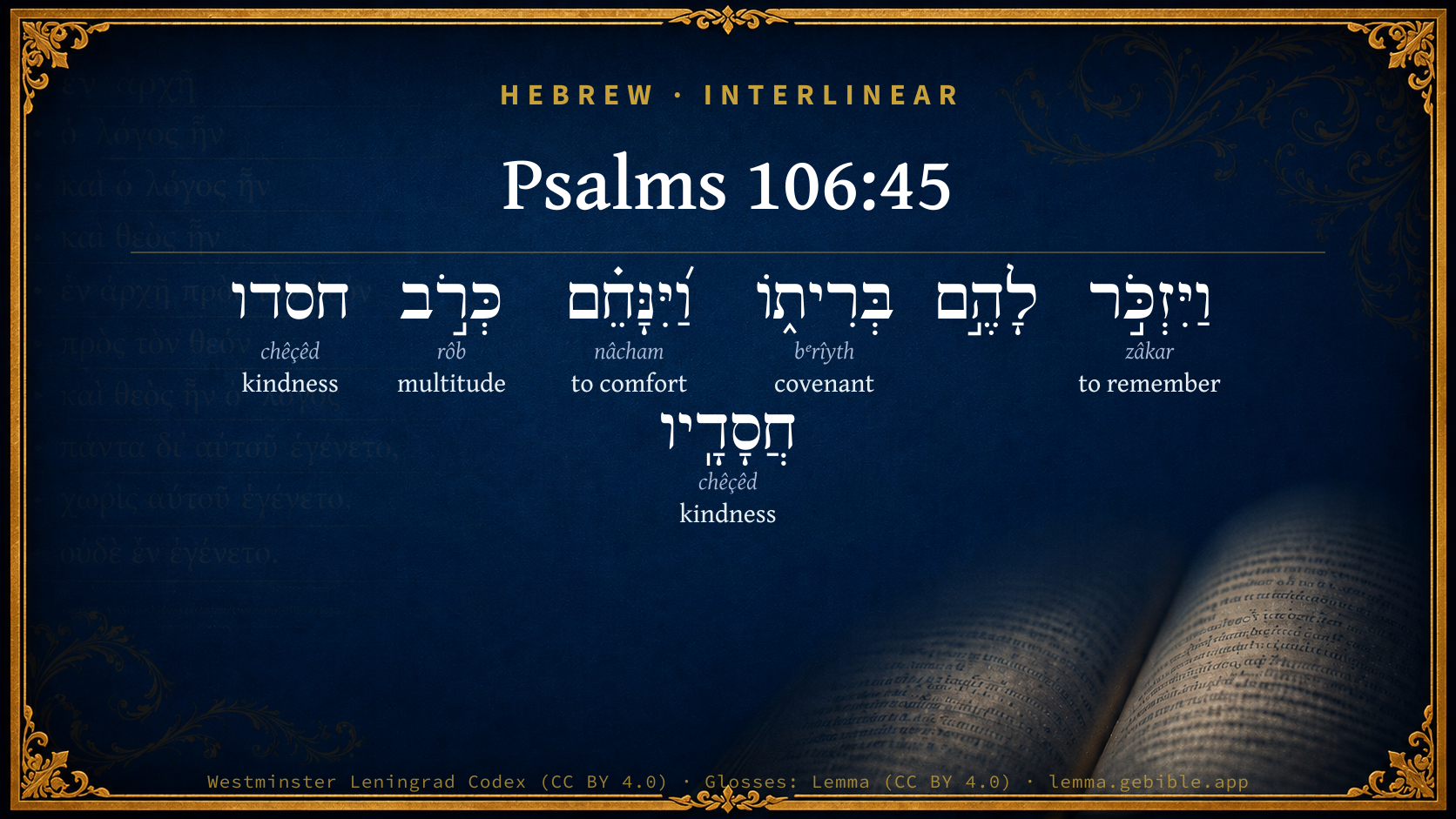
Hebrew (Westminster Leningrad Codex) Psalms 106:45 appears in the Hebrew Old Testament. The text above is from the Westminster Leningrad Codex. Each word links to its Strong’s number, a concise gloss, and parsing drawn from the Open Scriptures Hebrew Bible morphology. Click any word for its full Brown-Driver-Briggs (BDB) entry.
Download image
Cite this verse

Psalms 106:45 (World English Bible). Public Domain. Lemma interlinear Bible study tool, https://lemma.gebible.app/v/psalms/106/45.

Show BibTeX & RIS
BibTeX
RIS
English Translation
He remembered for them his covenant, And repented according to the multitude of his loving kindnesses.
World English Bible · Public Domain
Download a study sheet

One document with this verse’s original text, its word-by-word gloss line, the meaning frame, cross-references with their text, attributed commentary, and full source and license credits — printable, and it pastes into notes with its structure intact.

This verse Autodidact and up

Study sheet (.html) Plain text (.txt)

A passage Seminary Student

Up to 50 verses in one chapter. A passage sheet keeps up to 6 commentary sources and 12 cross-references per verse, in the order this page ranks them, and says so on the sheet whenever that leaves anything out. Ask for a single verse and you get the Autodidact verse sheet above.

Everything on this page stays free to read, with no account — the sheet is a download of what is already on screen, not access to it.

Want to remove ads? Support Godless Engineer
Compare translations 3

The same verse in 3 English versions, stacked beneath the original-language interlinear above. Click any original word for its lexicon entry.

Each is an independent rendering of the whole verse — the interlinear is not word-aligned to these translations.

Highlighted words mark where these versions differ — a whole-verse word diff, not a word-by-word alignment.

  • World English Bible Public Domain
    He remembered for them his covenant, And repented according to the multitude of his loving kindnesses.
  • King James Version Public Domain
    And he remembered for them his covenant, and repented according to the multitude of his mercies.
  • unfoldingWord Literal Text CC BY-SA 4.0
    And he remembered his covenant with them and relented because of the abundance of his covenant faithfulness.

unfoldingWord Literal Text — © unfoldingWord, licensed CC BY-SA 4.0. Word-aligned USFM3 via Door43 (git.door43.org/unfoldingWord/en_ult).

Versions to compare (up to 4)

3 of 4 selected

Show all 18 translations

Every available English version of this verse, each an independent rendering of the whole verse.

  • World English Bible Public Domain
    He remembered for them his covenant, And repented according to the multitude of his loving kindnesses.
  • Berean Standard Bible Public Domain
    And He remembered His covenant with them, and relented by the abundance of His loving devotion.
  • Majority Standard Bible Public Domain
    And He remembered His covenant with them, and relented by the abundance of His loving devotion.
  • King James Version Public Domain
    And he remembered for them his covenant, and repented according to the multitude of his mercies.
  • American Standard Version (1901) Public Domain
    And he remembered for them his covenant, And repented according to the multitude of his lovingkindnesses.
  • Revised Version (1885) Public Domain
    And he remembered for them his covenant, and repented according to the multitude of his mercies.
  • Geneva Bible (1599) Public Domain
    And he remembred his couenant towarde them and repented according to the multitude of his mercies,
  • Douay-Rheims (1899) Public Domain
    And he was mindful of his covenant: and repented according to the multitude of his mercies.
  • Young's Literal Translation Public Domain
    And remembereth for them His covenant, And is comforted, According to the abundance of His kindness.
  • Literal Standard Version CC BY-SA 4.0
    And remembers His covenant for them, || And is comforted, || According to the abundance of His kindness.
  • Unlocked Literal Bible CC BY-SA 4.0
    He called to mind his covenant with them and relented because of his steadfast love.
  • unfoldingWord Literal Text CC BY-SA 4.0
    And he remembered his covenant with them and relented because of the abundance of his covenant faithfulness.
  • Darby Bible Public Domain
    And he remembered for them his covenant, and repented according to the multitude of his loving-kindnesses;
  • World Messianic Bible Public Domain
    He remembered for them his covenant, and repented according to the multitude of his loving kindnesses.
  • Webster's Bible Public Domain
    And he remembered for them his covenant, and repented according to the multitude of his mercies.
  • Free Bible Version CC BY-SA 4.0
    He remembered the agreement he had made with them, and he held back because of his great kindness and love.
  • Bible in Basic English Public Domain
    And kept in mind his agreement with them, and in his great mercy gave them forgiveness.
  • JPS Tanakh (1917) Public Domain
    And He remembered for them His covenant, and repented according to the multitude of His mercies.

Literal Standard Version (2020), Covenant Press — licensed CC BY-SA 4.0. Text via the HelloAO Bible API (eBible.org). Unlocked Literal Bible (unfoldingWord) — licensed CC BY-SA 4.0. Text via the HelloAO Bible API (eBible.org). unfoldingWord Literal Text — © unfoldingWord, licensed CC BY-SA 4.0. Word-aligned USFM3 via Door43 (git.door43.org/unfoldingWord/en_ult). Free Bible Version, Dr. Jonathan Gallagher — licensed CC BY-SA 4.0. Text via the HelloAO Bible API (eBible.org).

Word by word

More ways to search: Search by grammar → Find every occurrence → Compare this word →

Practice this passage: Drill this verse → Learn its vocabulary →

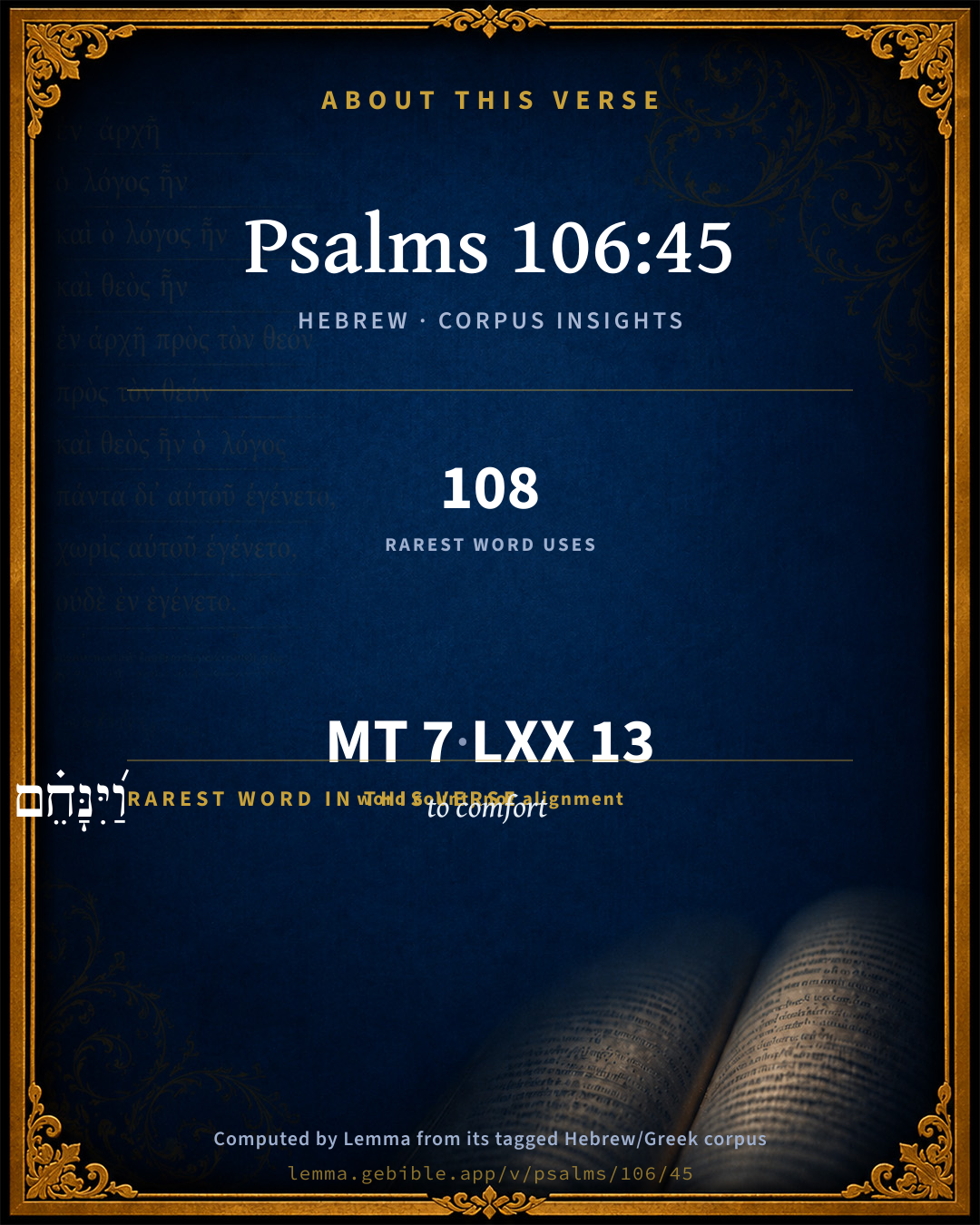
וַ֝יִּנָּחֵ֗ם
nâcham
H5162
“and · to comfort”
Conjunction + Verb, Niphal, Sequential Imperfect, 3rd Person, Masculine, Singular
Part of Speech
Conjunction + Verb
Stem
Niphal
Form
Sequential Imperfect
Person
3rd Person
Gender
Masculine
Number
Singular
Full BDB Definition

Origin: a primitive root

TWOT: 1344

to be sorry, console oneself, repent, regret, comfort, be comforted - (Niphal) - to be sorry, be moved to pity, have compassion - to be sorry, rue, suffer grief, repent - to comfort oneself, be comforted - to comfort oneself, ease oneself - (Piel) to comfort, console - (Pual) to be comforted, be consoled - (Hithpael) - to be sorry, have compassion - to rue, repent of - to comfort oneself, be comforted - to ease oneself
  1. וַיִּזְכֹּ֣ר zâkar H2142 “and · to remember” Conjunction + Verb, Qal, Sequential Imperfect, 3rd Person, Masculine, Singular
  2. בְּרִית֑וֹ bᵉrîyth H1285 “covenant · his” Noun, Common, Feminine, Singular, Construct + Suffix, Personal, 3rd Person, Masculine, Singular
  3. כְּרֹ֣ב rôb H7230 “like/as · multitude of” Preposition + Noun, Common, Both, Singular, Construct
  4. חסדו chêçêd H2617 “kindness · his” Noun, Common, Masculine, Singular, Construct + Suffix, Personal, 3rd Person, Masculine, Singular
  5. חֲסָדָֽיו chêçêd H2617 “kindnesses · his” Noun, Common, Masculine, Plural, Construct + Suffix, Personal, 3rd Person, Masculine, Singular

About this verse

These counts appear in no published source. They are computed here, from the morphology-tagged text and Lemma’s own curated glosses. What Lemma adds →

7
words
5
distinct lemmas
Wisdom
section

Grammatical profile

  • 2 verbs
  • 4 nouns
  • 1 preposition

Verb forms

  • וַיִּזְכֹּ֣ר Qal · Sequential Imperfect
  • וַ֝יִּנָּחֵ֗ם Niphal · Sequential Imperfect

Repetition

A word recurs within this verse — often emphatic in Hebrew:

  • חסדו kindness H2617 ×2

Hebrew & Septuagint length

In English translation the verse runs 16 words from the Hebrew and 14 from the Septuagint (LXX English) — closely comparable.

A rough comparison of the two English renderings, which tokenize alike — not a word-level alignment.

Word counts can differ between the Hebrew and the Greek without any difference in meaning — e.g. the Hebrew direct-object marker אֵת has no separate Greek word, and Greek often adds the article ὁ.

In the original languages it is 7 Hebrew tokens and 13 Greek tokens — but the two are counted differently (Hebrew bundles its prefixes and suffixes into one token; the Greek is in lemma form), so that isn’t a like-for-like length.

Cross-references

17

Topical passages linked to Psalms 106:45 in the Treasury of Scripture Knowledge — connected by theme and wording, ordered by reader-vote popularity; previews shown in the World English Bible.

  • Psalms 105:8 He has remembered his covenant forever, The word which he commanded to a thousand generations,
  • 2 Kings 13:23 But Yahweh was gracious to them, and had compassion on them, and had respect to them, because of his covenant with Abraham, Isaac, and Jacob, and would not destroy them, neither cast he them from his presence as yet.
  • Exodus 32:14 Yahweh repented of the evil which he said he would do to his people.
  • Judges 2:18 When Yahweh raised them up judges, then Yahweh was with the judge, and saved them out of the hand of their enemies all the days of the judge: for it repented Yahweh because of their groaning by reason of those who oppressed them and vexed them.
  • Lamentations 3:32 For though he cause grief, yet will he have compassion according to the multitude of his loving kindnesses.
  • Leviticus 26:40–42 "'If they confess their iniquity, and the iniquity of their fathers, in their trespass which they trespassed against me, and also that, because they walked contrary to me,
  • Psalms 51:1 Have mercy on me, God, according to your loving kindness. According to the multitude of your tender mercies, blot out my transgressions.
  • Psalms 69:16 Answer me, Yahweh, for your loving kindness is good. According to the multitude of your tender mercies, turn to me.
  • Isaiah 63:7 I will make mention of the loving kindnesses of Yahweh, [and] the praises of Yahweh, according to all that Yahweh has bestowed on us, and the great goodness toward the house of Israel, which he has bestowed on them according to his mercies, and according to the multitude of his loving kindnesses.
  • Luke 1:71–72 Salvation from our enemies, and from the hand of all who hate us;
  • Psalms 90:13 Relent, Yahweh! How long? Have compassion on your servants!
  • Hosea 11:8 "How can I give you up, Ephraim? How can I hand you over, Israel? How can I make you like Admah? How can I make you like Zeboiim? My heart is turned within me, My compassion is aroused.
  • Deuteronomy 32:36 For Yahweh will judge his people, Repent himself for his servants; When he sees that [their] power is gone, There is none [remaining], shut up or left at large.
  • 2 Samuel 24:16 When the angel stretched out his hand toward Jerusalem to destroy it, Yahweh repented him of the evil, and said to the angel who destroyed the people, It is enough; now stay your hand. The angel of Yahweh was by the threshing floor of Araunah the Jebusite.
  • Psalms 135:14 For Yahweh will judge his people, And have compassion on his servants.
  • Amos 7:3 Yahweh relented concerning this. "It shall not be," says Yahweh.
  • Amos 7:6 Yahweh relented concerning this. "This also shall not be," says the Lord Yahweh.

Cross-references courtesy of OpenBible.info (CC BY 4.0).

Hebrew and Greek witnesses Masoretic Hebrew ↔ Greek Septuagint

The same verse in the two great witnesses to the Old Testament, shown verse-for-verse.

You’re reading Greek Psalm 105 (Hebrew Psalm 106). The Septuagint counts the superscription, so verse numbers can differ from the Hebrew — chapter-level alignment, not verse-by-verse. Numbering follows Rahlfs.

These are two independent witnesses, not word-aligned to each other, and the Septuagint is shown in lemma (dictionary) form.

Hebrew Psalms 106:45 Masoretic · Westminster Leningrad Codex

וַיִּזְכֹּ֣ר לָהֶ֣ם בְּרִית֑וֹ וַ֝יִּנָּחֵ֗ם כְּרֹ֣ב חסדו חֲסָדָֽיו

He remembered for them his covenant, And repented according to the multitude of his loving kindnesses.

World English Bible · Public Domain

Greek LXX Greek Psalm 105:45 Septuagint · lemma form

καί μιμνήσκω ὁ διαθήκη αὐτός καί μεταμελέω κατά ὁ πλῆθος ὁ ἔλεος αὐτός

And he remembered his covenant, and repented according to the multitude of his mercy.

LXX2012 (modern English Septuagint) · Public Domain

Hebrew: Westminster Leningrad Codex (CC BY 4.0). Greek: Septuagint (public domain); English from LXX2012 (modern English Septuagint) (Public Domain). How the Septuagint differs from the Hebrew →

Commentary

Notes on Psalms 106:45 from classic Christian and Jewish commentators (each source and its license shown beneath its notes). The classic Christian expositions comment on the surrounding passage and are grouped to its opening verse, so a note may address several verses; the Jewish commentaries on the Tanakh (Rashi and others) are per-verse, so they appear only where the commentator wrote on this verse.

Lemma curates 59 commentaries, every one of them public domain or Creative Commons licensed, each selected and text-cleaned for this edition rather than reprinted as found. About our sources →

Trapp's Complete Commentary

John Trapp

Psa 106:45 And he remembered for them his covenant, and repented according to the multitude of his mercies.

Ver. 45. And he remembered for them his covenant] Which could not be vacated or abolished by the wickedness of men, but stood firm and inviolable, inasmuch as God is faithful and merciful.

And repented] That is, changed his severity into clemency. God’s repentance is not a change of his will, but of his work, Mutatio rei, non Dei.

John Trapp, A Commentary or Exposition upon All the Books of the Old and New Testament (1647–1656) — public domain. Text from a community e-Sword module.

The Biblical Illustrator

Joseph S. Exell

Psa_106:45

He remembered for them His covenant.

--

Gods remembrance of His covenant

I. Then the covenant exists.

1. The covenant is in its own nature everlasting. By everything that is permanent in the universe, and by everything that is permanent in the Godhead, we are made to know that the covenant of grace is a fixed and settled thing, and abides to-day as it ever has done; for there is no variableness nor turning with Him from whom every good gift comes down. The promises in Christ Jesus are Yea and Amen, to the glory of God by us. Heaven and earth shall pass away; but not one jot or tittle of the law shall fail, much less shall the covenant of Divine grace be disannulled.

2. Well may the covenant of grace be everlasting, for it was made with deliberation and foresight. God made it, knowing all that would happen in time or eternity.

3. The covenant was sealed and ratified in the most solemn manner. Jesus has gone into heaven bearing with Him the blood of sprinkling. Can God deny His promise to His bleeding Son?

4. The Divine glory is wrapped up in it. The Lord cannot break His word, nor forego His designs, nor forget His promises. Think not so. The crown jewels of God are staked and pawned upon the carrying out of the covenant of grace.

5. Furthermore, it is not possible for God to break a covenant. When you and I stand and tremble before a Divine promise for fear it should not be fulfilled, we cast a slur upon the truth, faithfulness, and immutability of God. Has He ever changed? Has He ever been false?

II. This covenant is too often forgotten by us.

1. Are not Gods people at this day chargeable with forgetting the covenant by their unspiritual carelessness?

2. Sometimes, too--and in the case of Israel it was so--we get away from that covenant by wanton sin, or by negligent omission of most delightful duty. This ought to yield in our hearts a harvest of repentance. It should bind us to God with intense affection that should tend towards perpetual sanctification from this day and onward.

3. These people had forgotten their God for another reason, namely, in the depth of their sorrow. A great sorrow stuns men, and makes them forget the best sources of consolation. A little blow will cause great pain; but I have frequently heard in reports of assaults that far more serious blows have occasioned no pain whatever, because they have destroyed consciousness. So do extreme distresses rob men of their wits, and cause them to forget the means of relief. Under the chastening rod, the smart is remembered, and the healing promise is forgotten.

III. Though we forget the covenant, yet God remembers His covenant: He remembered for them His covenant. Even though these people had so grievously provoked Him, He remembers His covenant so as to find in it a reason for pardoning their sin, and dealing with them in a way of mercy. He meets the flood of their sins with the flood of His faithfulness. O friend, God must remember His covenant; fur He can never forget what the making of that covenant has cost Him. It cost Him His Only-begotten: the eternal Son, the Well-beloved, must die the death of the cross that the covenant may be established.

IV. If God remembers for us His covenant, let us remember it. What is the covenant? Here is one form of it: I am God Almighty; walk before me, and be thou perfect. The Lord God Almighty gives Himself up to be our portion, and we are to yield ourselves to Him, to walk before Him in perfect obedience. This also is the covenant: I will be their God, and they shall be My people. Say not, I am poor. Not so, for God is yours, and so all things are yours. Say not, I am weak. Not so, God Almighty is yours: when you are weak, then you are strong. But I have no wisdom. Is not the Lord Jesus made of God unto us wisdom, righteousness, and sanctification? He that hath God hath everything. Wilt thou belittle thy God and limit the Holy One of Israel? Come, find thine all in God. This is thy part of the covenant, to accept God as being to thee what He says He is. (C. H. Spurgeon.)

The Biblical Illustrator, edited by Joseph S. Exell (c. 1880s–1900s) — public domain. Text from a community e-Sword module.

J. A. Alexander on Psalms

Joseph Addison Alexander

45. (Psa 106:45) And he has remembered for them his covenant, and repented according to the abundance of his mercy. For them, i.e. in their favour, for their benefit. It does not qualify covenant, but remembered. With the first clause compare Lev 26:42; Lev 26:45, Psa 105:8; Psa 105:42; with the second, Num 14:19, Psa 5:7; Psa 69:13, Neh 13:22. The common version of the last word (mercies) rests upon the marginal or masoretic reading; the more ancient text is mercy.

Joseph Addison Alexander, The Psalms Translated and Explained (1850) — public domain. Text from a community e-Sword module.

Tyndale Open Study Notes

Tyndale Open Resources

106:45 He remembered . . . and relented: Unlike Israel, the Lord is faithful to his covenant (105:8).

Tyndale Open Study Notes — © Tyndale Open Resources, licensed CC BY-SA 4.0. Text via the HelloAO Bible API.

Geneva Bible (1599)

Geneva Bible translators

Not that God is changeable in himself, but that then he seemeth to us to repent when he altereth his punishment, and forgiveth us.

Geneva Bible (1599) marginal notes — public domain. Text via Bolls.life.

John Calvin's Commentaries

45. And he remembered God’s being mindful of his covenant is here assigned as the cause of his great mercy and long-suffering. In that covenant, he not only declares that there is a gracious pardon for transgressions, but he also adverts to the perverse blindness of those who were not brought back by such remedies to the covenant, in which they were well aware that their safety was placed. But above all, he charges them with ingratitude; because, when deserving to perish, they did not acknowledge that they were indebted to the mercy of God alone for their preservation. This observation is strengthened by the next clause of the verse, in which he says that God had spared them according to the greatness of his mercies For the greatness of the punishment which their sins deserved, may be inferred from the great treasures of his loving-kindness, which God had to open in order to procure their redemption. The word to repent expresses no change in God, but only in the mode of administering his corrections. It may seem as if God altered his purpose, when he mitigates punishment, or withdraws his hand from executing his judgments. The Scripture, however, accommodating itself to our weak and limited capacity, speaks only after the manner of men.

John Calvin's Commentaries (1540-1563) — public domain. Text from the Calvin Translation Society English edition (1840s-50s) via the Christian Classics Ethereal Library (ccel.org). Calvin's coverage is partial (roughly two-thirds of the Bible); uncommented books and verses are honest gaps, never fabricated. The 19th-century editor's footnotes and remarks are omitted so the notes are faithfully Calvin's own voice.

The Cambridge Bible for Schools and Colleges

gen. ed. J. J. S. Perowne

45. Cp. Lev_26:41-42.

repented] Cp. Psa_90:13.

The Cambridge Bible for Schools and Colleges (gen. ed. J. J. S. Perowne; Cambridge University Press, 1878–1918) — public domain. Text from a community e-Sword module.

John Gill's Exposition

He made them also to be pitied of all those that carried them captives. He not only pitied them himself, but caused them to be pitied by others, even by their enemies; he has the hearts of all men in his hands, and can turn them as he pleases; as he sometimes turned their hearts to hate his people, Psa 105:25, so he turned them to pity them, as he promised he would when they turned to him, Ch2 30:9, so he did, by stirring up Cyrus to proclaim liberty to them, and his successors to encourage and assist in rebuilding their city and temple.

, so he did, by stirring up Cyrus to proclaim liberty to them, and his successors to encourage and assist in rebuilding their city and temple.

Psalms 106:47

psa 106:47

psa 106:47

psa 106:47Save us, O Lord our God,.... Here the psalmist represents the people in captivity, and represents them as praying for deliverance; as well knowing that none but God could save them: and a prayer of this nature, with respect to spiritual salvation, supposes danger, and a sense of it; that they are not able to save themselves, nor any creature able to save them; only the Lord, who is both willing and able; and of this kind is the prayer of faith.

And gather us from among the Heathen; in Babylon, and other countries; See Gill on the title note "Ps 106:1".

To give thanks unto thy holy name; bring us out of captivity to our own land, to Jerusalem, to the temple there to give thanks to thy holy name for the merciful deliverance of us; see Psa 122:4.

And to triumph in thy praise; in thy salvation, in thy wondrous works, worthy of praise; or while praising thee: the word signifies to glory therein; and such who are sensible of the mercies they receive from the Lord will make their boast of him and them, and glory; see Psa 34:1.

John Gill's Exposition of the Whole Bible (1746–1763) — public domain (CC PDM 1.0). Text via the HelloAO Bible API.

Albert Barnes' Notes on the Bible

And he remembered for them his covenant - His solemn promises made to their fathers. He remembered that covenant in their behalf; or, on account of that, he came and blessed them. He had made gracious promises to the patriarchs; he had promised to be the God of their posterity; he had his own great purposes to accomplish through their nation in the distant future; and on these accounts, he came and blessed them.

And repented - He averted impending judgments. He checked and arrested the calamities which he was bringing upon them for their sins. He acted toward them as though his mind had been changed; as though he was sorry for what he was doing. The word “repent” can be applied to God in no other sense than this. It cannot be applied to him in the sense that he felt or admitted that he had done wrong; or that he had made a mistake; or that he had changed his mind or purposes; or that he intended to enter on a new course of conduct; but it may be applied to him in the sense that his treatment of people is “as if” he had changed his mind, or “as if” he were sorry for what he had done: that is, a certain course of things which had been commenced, would be arrested and changed to meet existing circumstances, because “they” had changed - though all must have been foreseen and purposed in his eternal counsels.

According to the multitude of his mercies - The greatness of his mercy; the disposition of his nature to show mercy; the repeated instances in which he had shown mercy in similar circumstances.

Albert Barnes' Notes on the Bible (1834–1885) — public domain. Text from a community e-Sword/MySword module.

Matthew Poole's English Annotations

His covenant; the covenant made with their father which, notwithstanding their horrible violation of it. made good unto them, and in consideration thereof delivered them.

Repented; changed his course and dealing with them, as penitent persons usually do. See Poole "Gen 6:6".

Matthew Poole's English Annotations on the Holy Bible (1683–1685) — public domain. Text from a community e-Sword/MySword module.

The Treasury of David

Charles H. Spurgeon

Ver. 45. And he remembered for them his covenant. The covenant is the sure foundation of mercy, and when the whole fabric of outward grace manifested in the saints lies in ruins this is the fundamental basis of love which is never moved, and upon it the Lord proceeds to build again a new structure of grace. Covenant mercy is sure as the throne of God.

And repented according to the multitude of his mercies. He did not carry out the destruction which he had commenced. Speaking after the manner of men he changed his mind, and did not leave them to their enemies to be utterly cut off, because he saw that his covenant would in such a case have been broken. The Lord is so full of grace that he has not only mercy but mercies, yea a multitude of them, and these hive in the covenant and treasure up good for the erring sons of men.

Psalms 106:46*

Charles H. Spurgeon's The Treasury of David (1869–1885) — public domain. Psalms only. Text from a community e-Sword/MySword module.

Whedon's Commentary on the Bible

Daniel D. Whedon

45. And he remembered for them his covenant— “Behold the goodness and severity of God!” The closing descriptions of the divine tenderness are exceedingly touching, as his judgments are fearful.

Repented—A term, as applied to God, wholly anthropopathic, and by this accommodation to our infirmity sets forth the divine pity. The word simply means that God changed his administration with regard to them—as if he had changed his feelings—from condign judgment to compassion, in order that by every method he might win them back to him.

Daniel D. Whedon (gen. ed.), Commentary on the Old and New Testaments (1874–1909) — public domain. Text from a community e-Sword module.

The Pulpit Commentary

And he remembered for them his covenant. According to the promise in Lev_26:42. And repented according to the multitude of his mercies. (comp. Exo_32:14 2Sa_24:16 1Ch_21:15 Jer_26:19, etc.) The expression is anthropomorphic, and must be understood so as not to clash with the declaration, "God is not a man, that he should repent". (1Sa_15:29)

The Pulpit Commentary (1880–1919), ed. H.D.M. Spence-Jones & Joseph S. Exell — public domain. Text from a community e-Sword module.

John Wesley's Explanatory Notes

Repented - Changed his course and dealing with them.

John Wesley, Explanatory Notes Upon the Whole Bible (1754–1765) — public domain. Text via the GEBible commentary corpus.

Rashi

Rabbi Shlomo Yitzchaki (Rashi)

And He remembered His covenant On account of repentance.

and He relented in accordance with His abundant kindness On account of the end, when He heard, “Save us, etc.” Moses, too, included them in one verse (Deut. 4:30): “In this distress that will befall you etc.”

Rashi on the Tanakh — English translations: “The Judaica Press complete Tanach with Rashi, translated by A. J. Rosenberg” (CC BY 4.0); “Pentateuch with Rashi's commentary by M. Rosenbaum and A.M. Silbermann, 1929-1934” (public domain); “The Metsudah Tanach series, Lakewood, N.J” (CC BY 4.0); and “The Book of Joshua, Metsudah Publications, 1997” (CC BY 4.0). Text via Sefaria.

Lesson kit

Teaching starters — assembled from the data on this page, not authored interpretation. Every prompt links to the verse data it draws on. Edit before teaching.

Psalms, in the Wisdom, opens this verse with 7 words (5 distinct Hebrew lemmas). Its most distinctive word is nâcham (“to comfort”). A historical commentator’s framing appears above. Read the whole chapter for the surrounding context.

Discussion questions

  1. What does “to comfort” (nâcham) contribute to the verse as a whole?
  2. Psalms 105:8 shares this passage’s theme. How do the two illuminate each other?
  3. “kindness” occurs 2× in this one verse. What is the effect of the repetition?
  4. These translations render this verse differently; the difference is in the English rendering, not the original. What questions does that raise?
  5. The verb «וַיִּזְכֹּ֣ר» is Qal Sequential Imperfect. How does its form color the action?
  6. Reading how Trapp's Complete Commentary and The Biblical Illustrator read this verse, where do the two commentators agree and where do they part?

Things to notice

Reading settings

Reading text

Shown beneath each verse's original-language words.

Old Testament
Old Testament edition

Read the OT as the Masoretic Hebrew (MT) or the Greek Septuagint (LXX).

English shown for the Greek Septuagint (in the Hebrew ↔ Greek comparison).

Comparing translations? Open the Compare panel on any verse page to stack up to four side by side.