Deuteronomy 28:47

Hebrew (Westminster Leningrad Codex) Deuteronomy 28:47 appears in the Hebrew Old Testament. The text above is from the Westminster Leningrad Codex. Each word links to its Strong’s number, a concise gloss, and parsing drawn from the Open Scriptures Hebrew Bible morphology. Click any word for its full Brown-Driver-Briggs (BDB) entry.
Download image
Cite this verse

Deuteronomy 28:47 (World English Bible). Public Domain. Lemma interlinear Bible study tool, https://lemma.gebible.app/v/deuteronomy/28/47.

Show BibTeX & RIS
BibTeX
RIS
English Translation
Because you didn't serve Yahweh your God with joyfulness, and with gladness of heart, by reason of the abundance of all things;
World English Bible · Public Domain
Download a study sheet

One document with this verse’s original text, its word-by-word gloss line, the meaning frame, cross-references with their text, attributed commentary, and full source and license credits — printable, and it pastes into notes with its structure intact.

This verse Autodidact and up

Study sheet (.html) Plain text (.txt)

A passage Seminary Student

Up to 50 verses in one chapter. A passage sheet keeps up to 6 commentary sources and 12 cross-references per verse, in the order this page ranks them, and says so on the sheet whenever that leaves anything out. Ask for a single verse and you get the Autodidact verse sheet above.

Everything on this page stays free to read, with no account — the sheet is a download of what is already on screen, not access to it.

Want to remove ads? Support Godless Engineer
Compare translations 3

The same verse in 3 English versions, stacked beneath the original-language interlinear above. Click any original word for its lexicon entry.

Each is an independent rendering of the whole verse — the interlinear is not word-aligned to these translations.

Highlighted words mark where these versions differ — a whole-verse word diff, not a word-by-word alignment.

  • World English Bible Public Domain
    Because you didn't serve Yahweh your God with joyfulness, and with gladness of heart, by reason of the abundance of all things;
  • King James Version Public Domain
    Because thou servedst not the LORD thy God with joyfulness, and with gladness of heart, for the abundance of all things;
  • unfoldingWord Literal Text CC BY-SA 4.0
    Because you did not serve Yahweh your God with joyfulness and with gladness of heart from the abundance of everything,

unfoldingWord Literal Text — © unfoldingWord, licensed CC BY-SA 4.0. Word-aligned USFM3 via Door43 (git.door43.org/unfoldingWord/en_ult).

Versions to compare (up to 4)

3 of 4 selected

Show all 18 translations

Every available English version of this verse, each an independent rendering of the whole verse.

  • World English Bible Public Domain
    Because you didn't serve Yahweh your God with joyfulness, and with gladness of heart, by reason of the abundance of all things;
  • Berean Standard Bible Public Domain
    Because you did not serve the LORD your God with joy and gladness of heart in all your abundance,
  • Majority Standard Bible Public Domain
    Because you did not serve the LORD your God with joy and gladness of heart in all your abundance,
  • King James Version Public Domain
    Because thou servedst not the LORD thy God with joyfulness, and with gladness of heart, for the abundance of all things;
  • American Standard Version (1901) Public Domain
    Because thou servedst not Jehovah thy God with joyfulness, and with gladness of heart, by reason of the abundance of all things;
  • Revised Version (1885) Public Domain
    because thou servedst not the LORD thy God with joyfulness, and with gladness of heart, by reason of the abundance of all things:
  • Geneva Bible (1599) Public Domain
    Because thou seruedst not the Lord thy God with ioyfulnesse and with a good heart for the abundance of all things.
  • Douay-Rheims (1899) Public Domain
    Because thou didst not serve the Lord thy God with joy and gladness of heart, for the abundance of all things:
  • Young's Literal Translation Public Domain
    `Because that thou hast not served Jehovah thy God with joy, and with gladness of heart, because of the abundance of all things --
  • Literal Standard Version CC BY-SA 4.0
    Because that you have not served your God YHWH with joy and with gladness of heart, because of the abundance of all things—
  • Unlocked Literal Bible CC BY-SA 4.0
    Because you did not worship Yahweh your God with joyfulness and gladness of heart when you were in prosperity,
  • unfoldingWord Literal Text CC BY-SA 4.0
    Because you did not serve Yahweh your God with joyfulness and with gladness of heart from the abundance of everything,
  • Darby Bible Public Domain
    Because thou servedst not Jehovah thy God with joyfulness, and with gladness of heart, for the abundance of everything,
  • World Messianic Bible Public Domain
    Because you didn’t serve the LORD your God with joyfulness and with gladness of heart, by reason of the abundance of all things;
  • Webster's Bible Public Domain
    Because thou didst not serve the LORD thy God with joyfulness and with gladness of heart, for the abundance of all things:
  • Free Bible Version CC BY-SA 4.0
    Because you did not serve the Lord your God with happiness and with a joyful attitude,
  • Bible in Basic English Public Domain
    Because you did not give honour to the Lord your God, worshipping him gladly, with joy in your hearts on account of all your wealth of good things;
  • JPS Tanakh (1917) Public Domain
    because thou didst not serve the LORD thy God with joyfulness, and with gladness of heart, by reason of the abundance of all things;

Literal Standard Version (2020), Covenant Press — licensed CC BY-SA 4.0. Text via the HelloAO Bible API (eBible.org). Unlocked Literal Bible (unfoldingWord) — licensed CC BY-SA 4.0. Text via the HelloAO Bible API (eBible.org). unfoldingWord Literal Text — © unfoldingWord, licensed CC BY-SA 4.0. Word-aligned USFM3 via Door43 (git.door43.org/unfoldingWord/en_ult). Free Bible Version, Dr. Jonathan Gallagher — licensed CC BY-SA 4.0. Text via the HelloAO Bible API (eBible.org).

Word by word

More ways to search: Search by grammar → Find every occurrence → Compare this word →

Practice this passage: Drill this verse → Learn its vocabulary →

וּבְט֣וּב
ṭûwb
H2898
“and · in/at · goodness of”
Conjunction + Preposition + Noun, Common, Masculine, Singular, Construct
Part of Speech
Conjunction + Preposition + Noun
Type
Common
Gender
Masculine
Number
Singular
State
Construct
Full BDB Definition

Origin: from H2895

TWOT: 793b

goods, good things, goodness - good things - goods, property - fairness, beauty, joy, prosperity, goodness (abstract) - goodness (of taste, discernment) - goodness (of God) (abstract)
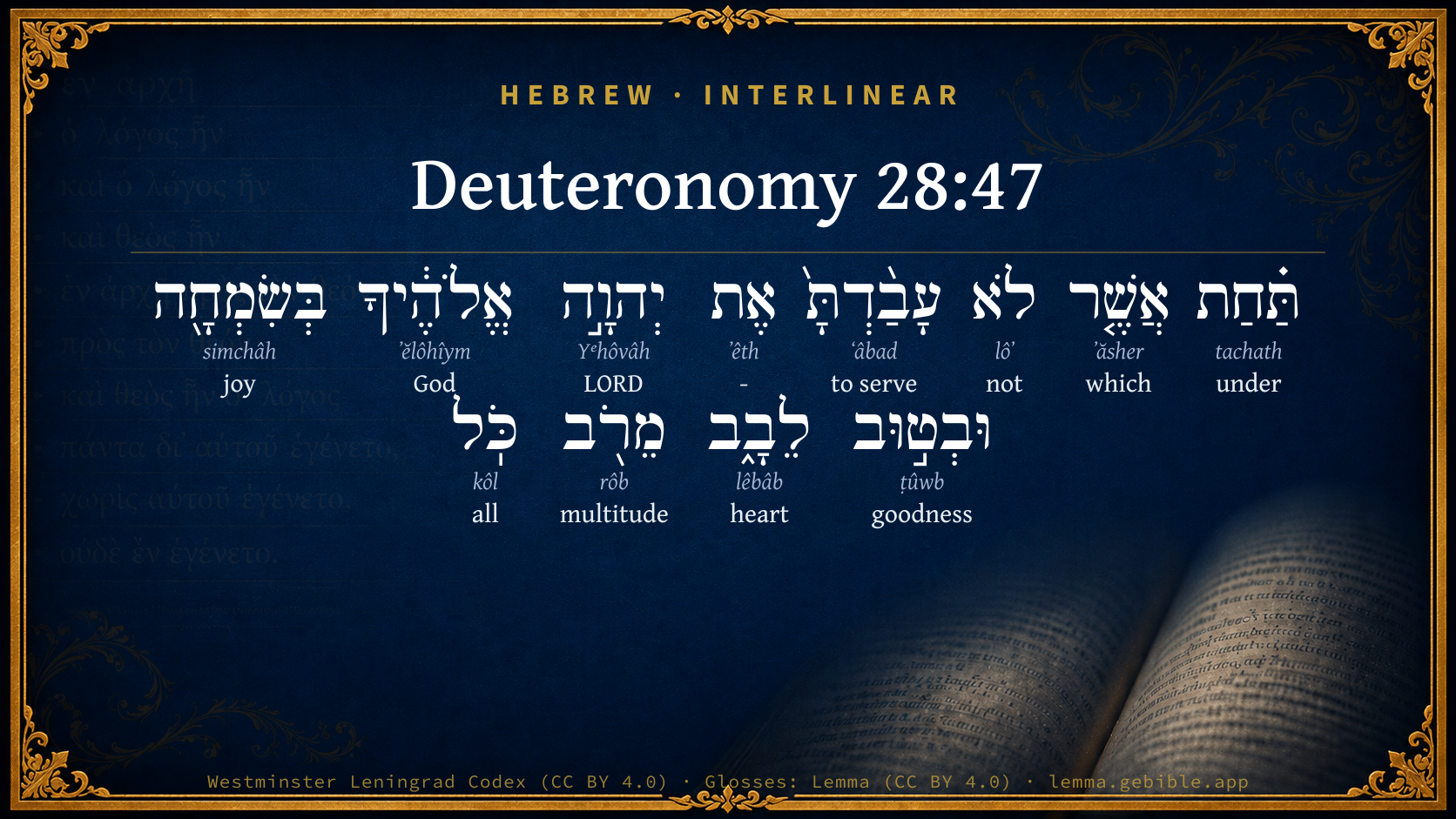
  1. תַּ֗חַת tachath H8478 “under” Preposition
  2. אֲשֶׁ֤ר ʼăsher H834 “which” Particle, Relative
  3. לֹא lôʼ H3808 “not” Particle, Negative
  4. עָבַ֨דְתָּ֙ ʻâbad H5647 “to serve” Verb, Qal, Perfect, 2nd Person, Masculine, Singular
  5. אֶת ʼêth H853 “-” Particle, Direct Object
  6. יְהוָ֣ה Yᵉhôvâh H3068 “LORD” Noun, Proper
  7. אֱלֹהֶ֔יךָ ʼĕlôhîym H430 “God(s) · your” Noun, Common, Masculine, Plural, Construct + Suffix, Personal, 2nd Person, Masculine, Singular
  8. בְּשִׂמְחָ֖ה simchâh H8057 “in/at · joy” Preposition + Noun, Common, Feminine, Singular, Absolute
  9. לֵבָ֑ב lêbâb H3824 “heart” Noun, Common, Masculine, Singular, Absolute
  10. מֵרֹ֖ב rôb H7230 “from · multitude of” Preposition + Noun, Common, Both, Singular, Construct
  11. כֹּֽל kôl H3605 “all” Noun, Common, Masculine, Singular, Absolute

About this verse

These counts appear in no published source. They are computed here, from the morphology-tagged text and Lemma’s own curated glosses. What Lemma adds →

12
words
12
distinct lemmas
Pentateuch
section

Shared distinctive vocabulary

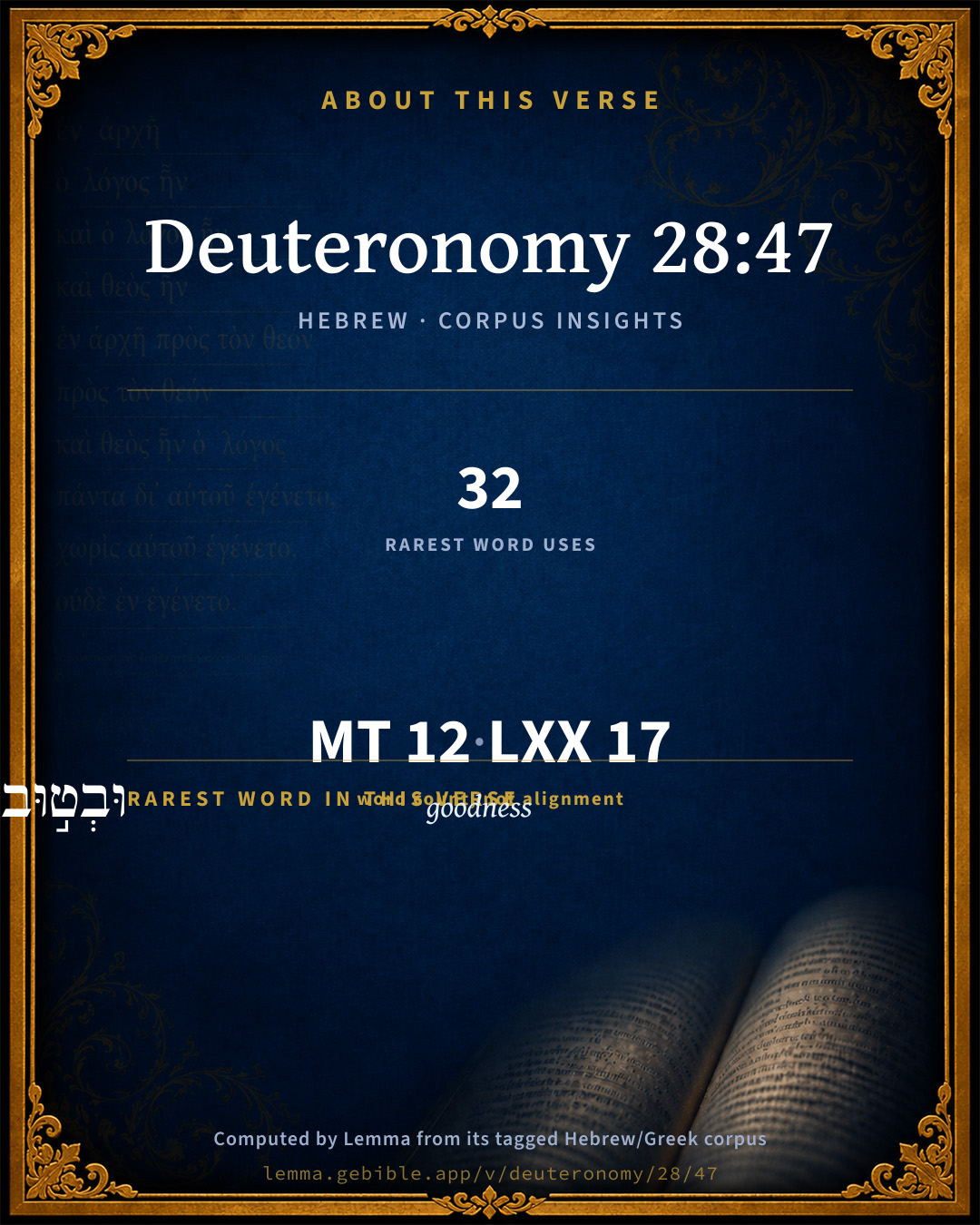
וּבְט֣וּב goodness H2898 occurs in 31 verses of the Hebrew Bible. Also found in:

Grammatical profile

  • 1 verb
  • 7 nouns
  • 1 preposition
  • 3 particles

Verb forms

  • עָבַ֨דְתָּ֙ Qal · Perfect

Hebrew & Septuagint length

In English translation the verse runs 22 words from the Hebrew and 22 from the Septuagint (LXX English) — the same length.

A rough comparison of the two English renderings, which tokenize alike — not a word-level alignment.

Word counts can differ between the Hebrew and the Greek without any difference in meaning — e.g. the Hebrew direct-object marker אֵת has no separate Greek word, and Greek often adds the article ὁ.

In the original languages it is 12 Hebrew tokens and 17 Greek tokens — but the two are counted differently (Hebrew bundles its prefixes and suffixes into one token; the Greek is in lemma form), so that isn’t a like-for-like length.

Cross-references

5

Topical passages linked to Deuteronomy 28:47 in the Treasury of Scripture Knowledge — connected by theme and wording, ordered by reader-vote popularity; previews shown in the World English Bible.

  • Deuteronomy 16:11 and you shall rejoice before Yahweh your God, you, and your son, and your daughter, and your man-servant, and your maid-servant, and the Levite who is within your gates, and the foreigner, and the fatherless, and the widow, who are in the midst of you, in the place which Yahweh your God shall choose, to cause his name to dwell there.
  • Deuteronomy 12:7–12 and there you shall eat before Yahweh your God, and you shall rejoice in all that you put your hand to, you and your households, in which Yahweh your God has blessed you.
  • Nehemiah 9:35–37 For they have not served you in their kingdom, and in your great goodness that you gave them, and in the large and fat land which you gave before them, neither turned they from their wicked works.
  • 1 Timothy 6:17–19 Charge those who are rich in this present world that they not be haughty, nor have their hope set on the uncertainty of riches, but on the living God, who richly provides us with everything to enjoy;
  • Deuteronomy 32:13–15 He made him ride on the high places of the earth, He ate the increase of the field; He made him to suck honey out of the rock, Oil out of the flinty rock;

Cross-references courtesy of OpenBible.info (CC BY 4.0).

Hebrew and Greek witnesses Masoretic Hebrew ↔ Greek Septuagint

The same verse in the two great witnesses to the Old Testament, shown verse-for-verse.

These are two independent witnesses, not word-aligned to each other, and the Septuagint is shown in lemma (dictionary) form.

Hebrew Deuteronomy 28:47 Masoretic · Westminster Leningrad Codex

תַּ֗חַת אֲשֶׁ֤ר לֹא עָבַ֨דְתָּ֙ אֶת יְהוָ֣ה אֱלֹהֶ֔יךָ בְּשִׂמְחָ֖ה וּבְט֣וּב לֵבָ֑ב מֵרֹ֖ב כֹּֽל

Because you didn't serve Yahweh your God with joyfulness, and with gladness of heart, by reason of the abundance of all things;

World English Bible · Public Domain

Greek LXX Deuteronomy 28:47 Septuagint · lemma form

ἀντί ὅς οὐ λατρεύω κύριος ὁ θεός σύ ἐν εὐφροσύνη καί ἀγαθός καρδία διά ὁ πλῆθος πᾶς

because you did not serve the Lord your God with gladness and a good heart, because of the abundance of all things.

LXX2012 (modern English Septuagint) · Public Domain

Hebrew: Westminster Leningrad Codex (CC BY 4.0). Greek: Septuagint (public domain); English from LXX2012 (modern English Septuagint) (Public Domain). How the Septuagint differs from the Hebrew →

Targum (Aramaic paraphrase)

2

The Targum is the ancient Jewish Aramaic paraphrase of the Hebrew Scriptures — an interpretive translation, not the Hebrew text itself. Onkelos (literal) and Pseudo-Jonathan (expansive) render the Torah, and Jonathan the Prophets. Coverage is partial: where no permissively-licensed English translation exists for a verse, only the Aramaic is shown. This is verse-level text, not a word-by-word alignment to the Hebrew.

  1. Targum Onkelos Torah (Genesis–Deuteronomy)
    חֳלָף דִי לָא פְלַחְתָּא קֳדָם יְיָ אֱלָהָךְ בְּחֶדְוָא וּבְשַׁפִּירוּת לִבָּא מִסְגֵי כֹּלָא

    (no public-domain English translation for this verse)

    Targum Onkelos — Aramaic: “Onkelos Genesis” (public domain); “Onkelos Exodus” (public domain); “Onkelos Leviticus” (public domain); “Onkelos Numbers” (public domain); “Onkelos Deuteronomy” (public domain). English: “Sefaria Community Translation” (CC0 1.0 (public-domain dedication)); “J.W. Etheridge. The Targums of Onkelos and Jonathan Ben Uzziel on the Pentateuch. London: Longmans, Green, 1862” (public domain). Text via Sefaria.

  2. Targum Pseudo-Jonathan Torah (Genesis–Deuteronomy)
    חוֹלַף דְלָא פְלַחְתּוּן קֳדָם יְיָ אֱלָהָכוֹן בְּחֶדְוָוא וּבִשְׁפִּירוּת לִבָּא מִסוֹגְעֵי כָּל טוּבָא

    for that you would not serve before the Lord your God cheerfully, with rightness of heart for the abundance of all good.

    Targum Pseudo-Jonathan — Aramaic: “Targum Jonathan on Genesis” (public domain); “Targum Jonathan on Exodus” (public domain); “Targum Jonathan on Leviticus” (public domain); “Targum Jonathan on Numbers” (public domain); “Targum Jonathan on Deuteronomy” (public domain). English: “The Targum of Jonathan ben Uzziel, trans. J. W. Etheridge, London, 1862” (public domain). Text via Sefaria.

Commentary

Notes on Deuteronomy 28:47 from classic Christian and Jewish commentators (each source and its license shown beneath its notes). The classic Christian expositions comment on the surrounding passage and are grouped to its opening verse, so a note may address several verses; the Jewish commentaries on the Tanakh (Rashi and others) are per-verse, so they appear only where the commentator wrote on this verse.

Lemma curates 59 commentaries, every one of them public domain or Creative Commons licensed, each selected and text-cleaned for this edition rather than reprinted as found. About our sources →

Trapp's Complete Commentary

John Trapp

Deu 28:47 Because thou servedst not the LORD thy God with joyfulness, and with gladness of heart, for the abundance of all [things];

Ver. 47. For the abundance all things.] Aristotle was wont to tax his Athenians, Quod cum duas res invenissent, frumenta ac leges, frumentis ut erentur, legibus nequaquam; imo moribus suis quam legibus uti mallent, as Valerius Maximus addeth, {a} Sure it is, that as these Jews of old, so we to this day are much to be blamed, for that we live in God’s good land, but not by God’s good laws.

{a} Laert., lib. v. cap. 1.

John Trapp, A Commentary or Exposition upon All the Books of the Old and New Testament (1647–1656) — public domain. Text from a community e-Sword module.

The Biblical Illustrator

Joseph S. Exell

Deu_28:47

Because thou servedst not the lord.

Right service

The text brings before us a subject essentially important--that as the service of the Lord Jesus Christ must be such as answered the great end that was to be brought about, and did answer it, so the object of the service of the people of God is to bring them into possession of what the Lord has for them. Let us take a two-fold view of this service.

1. First, then, the true service of the Lord; it must be by faith in the Lord Jesus Christ. Let us hear what the Scriptures say upon this, for it is a most essential matter: either we are serving God as Abel did, acceptably; or as Cain did, not acceptably. We cannot serve God by the works of the law; for the apostle saith, Whatsoever the law saith--and I may mention two things which it saith: first, that he that offendeth in one point is guilty of the whole. Now, that one thing said by the law is enough to stop the mouth of anyone. Then again, it saith, Cursed is he that continueth not in all things written in the book of the law to do them. There are three things especially essential to serve God acceptably; these must be knowledge, faith, and love. You cannot do without these three. It is true, there are many other excellencies arising from them.

2. Now, a word or two upon this--to serve Him with joyfulness and with gladness of heart. I think we need the spirit of prayer upon this subject. So then may the Lord give us the spirit of prayer, that we may pray to be quickened, and to be made more and more lively in the service and ways of the Lord; for it is sure well to repay us; as saith David, In keeping His ways there is indeed great reward; a reward that far surpasseth gold, even much fine gold; and there is a sweetness therein sweeter than honey and the honeycomb. So, I say, we need the spirit of prayer for the Lord to keep us more and more in His blessed ways. (J. Wells.)

The Biblical Illustrator, edited by Joseph S. Exell (c. 1880s–1900s) — public domain. Text from a community e-Sword module.

MacLaren's Expositions of Holy Scripture

Alexander MacLaren

Deuteronomy

A CHOICE OF MASTERS

Deu 28:47 - Deu 28:48.

The history of Israel is a picture on the large scale of what befalls every man.

A service-we are all born to obedience, to depend on and follow some person or thing. There is only a choice of services; and he who boasts himself free is but a more abject slave, as the choice for a nation is either the rule of settled order and the sanctities of an established law, or the usurpation of a mob and the intolerable tyranny of unbridled and irresponsible force.

I. The service of God or the service of our enemies.

Israel was the servant in turn of Egypt, Philistia, Edom, Assyria, Babylon, Syria, and Rome. It was every invader’s prey. God’s invisible arm was its only guard from these, and an all-sufficient guard as long as it leaned on Him. When it turned from Him it fell under their yoke. Its lawful Lord loved it; its tyrants hated it.

So with us. We have to serve God or enemies. Our lusts, our passions, the world, evil habits-in a word, our sins ring us round. God is the only defence against them.

The contrast between the one and the many-a king or an ochlocracy. The contrast of the loving Lord and the hostile sins.

II. A service which is honour or a service which is degradation.

God alone is worthy of our absolute submission and service. How low a man sinks when he is ruled by any lesser authority! Such obedience is a crime against the dignity of human nature, and the soul is not without a galling sense of this now and then, when its chains rattle.

III. A service which is freedom because it is rendered by love, or a service which is hard slavery.

‘With joy for the abundance of all things.’ How sin palls upon us, and yet we commit it. The will is overborne, conscience is stifled.

IV. A service which feeds the spirit or a service which starves it.

The soul can only in God get what it wants. Prison fare is what it receives in the other service. The unsatisfying character of all sin; it cloys, and yet leaves one hungry. It is ‘that which satisfieth not.’ ‘Broken cisterns which hold no water.’

V. A service which is life or a service which is death.

The dark forebodings of the text grow darker as it goes on. The grim slavery which it threatens as the only alternative to joyful service of God is declared to be lifelong ‘penal servitude,’ and not only is there no deliverance from it, but it directly tends to wear away the life of the hopeless slaves. For the words that follow our text are ‘and he shall put a yoke of iron upon thy neck, until he have destroyed thee.’ That is dismally true in regard to any and every life that has shaken off the service of God which is perfect freedom, and has persisted in the service of sin. Such service is suicidal; it rivets an iron yoke on our necks, and there is no locksmith who can undo the shackles and lift it off, so long as we refuse to take service with God. Stubbornly rebellious wills forge their own fetters. Like many a slave-owner, our tyrants have a cruel delight in killing their slaves, and our sins not only lead to death, but are themselves death.

But there is a bright possibility before the most down-trodden vassal of sin. ‘The bond-servant abideth not in the house for ever.’ He is not a son of the house, but has been brought into it, stolen from his home. He may be carried back to his Father’s house, and there ‘have bread enough and to spare,’ if a deliverer can be found. And He has been found. Christ the Son makes us free, and if we trust Him for our emancipation we ‘shall be free indeed,’ ‘that we, being delivered out of the hand of our enemies, should serve Him without fear, in holiness and righteousness before Him all our days.’

Alexander MacLaren, Expositions of Holy Scripture (1904–1910) — public domain. Text from a community e-Sword module.

The Cambridge Bible for Schools and Colleges

gen. ed. J. J. S. Perowne

47. This should be a new sentence opening a new paragraph.

Because thou hast not served the Lord thy God] or worshipped.

with joyfulness, and with gladness of heart] Characteristic of the temper of D; 12. 7, 12, 18, Deu_16:11; Deu_16:14 f. (be altogether joyful), Deu_26:11; cp. Isa_65:13 f.

by reason of the abundance, etc.] Cp. Deu_6:10-12, Deu_8:11-18.

47–57. A Further Development of the Curses

Invasion by a far-off, unknown nation, who shall ruthlessly devastate the land and besiege Israel’s cities; with the horrors of his siege. All this is not threatened conditionally on the possible disobedience of the people, but predicted absolutely because of their actual failure to serve God.

The Cambridge Bible for Schools and Colleges (gen. ed. J. J. S. Perowne; Cambridge University Press, 1878–1918) — public domain. Text from a community e-Sword module.

John Gill's Exposition

And he shall eat the fruit of thy cattle,.... Larger and lesser, oxen and sheep, as their calves and lambs, and kids of the goat:

and the fruit of thy land; their wheat, barley, figs, grapes, pomegranates, olives, and dates:

until thou be destroyed; the land of Judea, and all the increase of it: this being before said, Deu 28:31; and here repeated, shows that the same should be fulfilled at different times, as by the Chaldeans, so by the Romans; whose nation, or army, with their general at the head of them, may be more especially here intended by "he", that should eat up their fruit until utter destruction was brought upon them:

which also shall not leave thee either corn, wine, or oil, or the increase of thy kine, or flocks of thy sheep, until he have destroyed thee; all being consumed by the Roman army. There is a promise and prophecy, that though this would be the case, as it has been, there shall be a time when it shall be so no more; see Isa 62:8.

John Gill's Exposition of the Whole Bible (1746–1763) — public domain (CC PDM 1.0). Text via the HelloAO Bible API.

Haydock's Catholic Bible Commentary

Things: as in gratitude thou oughtest to have done. On the contrary, the more the Jews were cherished by God, the more insolent they became, chap. xxxii. 15.

George Leo Haydock (1774–1849), Haydock's Catholic Family Bible and Commentary, 1859 edition — public domain. Excludes Psalms (Douay-Rheims chapter numbering differs from Protestant) and Deuterocanonical books (Catholic canon only).

Matthew Poole's English Annotations

Or,

in the abundance of all things; for this is opposed to in hunger, in thirst, &c., Deu 28:48. And the Hebrew men oft signifies in, as Exo 25:18; Job 19:26; Psa 72:16.

Matthew Poole's English Annotations on the Holy Bible (1683–1685) — public domain. Text from a community e-Sword/MySword module.

The Pulpit Commentary

Vers. 47-57. Fourth group. In order still more to impress on the minds of the people the evil and danger of rebellion and apostasy, Moses enlarges on the calamities that would ensue on their being given up to the power of the heathen. Because they would not serve Jehovah their God, they should be delivered to be servants to their enemies.

The Pulpit Commentary (1880–1919), ed. H.D.M. Spence-Jones & Joseph S. Exell — public domain. Text from a community e-Sword module.

unfoldingWord translationNotes

Door43 World Missions Community

General Information:

Moses speaks to the Israelites as if they were one man, so the words "you" and "your" here are singular. (See: Forms of You)

joyfulness and gladness of heart

Here "joyfulness" and "gladness of heart" mean the same thing. They emphasize that the people should have been very glad to worship Yahweh. (See: Doublet)

He will put a yoke of iron on your neck

This is a metaphor for Yahweh allowing the enemy to treat the Israelites cruelly and make them slaves. (See: Metaphor)

translationWords

worship

God

joy

heart

prosper

servant

adversary

send

yoke

unfoldingWord translationNotes — © Distant Shores Media and the Door43 World Missions Community, licensed CC BY-SA 4.0. Source: git.door43.org/Door43/en_tn.

Rashi

Rabbi Shlomo Yitzchaki (Rashi)

מרב כל means: while you possessed all good things.

Rashi on the Tanakh — English translations: “The Judaica Press complete Tanach with Rashi, translated by A. J. Rosenberg” (CC BY 4.0); “Pentateuch with Rashi's commentary by M. Rosenbaum and A.M. Silbermann, 1929-1934” (public domain); “The Metsudah Tanach series, Lakewood, N.J” (CC BY 4.0); and “The Book of Joshua, Metsudah Publications, 1997” (CC BY 4.0). Text via Sefaria.

Lesson kit

Teaching starters — assembled from the data on this page, not authored interpretation. Every prompt links to the verse data it draws on. Edit before teaching.

Deuteronomy, in the Pentateuch, opens this verse with 12 words (12 distinct Hebrew lemmas). Its most distinctive word is ṭûwb (“goodness”). A historical commentator’s framing appears above. Read the whole chapter for the surrounding context.

Discussion questions

  1. What does “goodness” (ṭûwb) contribute to the verse as a whole?
  2. Genesis 24:10 shares the word «goodness» with this verse. How do the two illuminate each other?
  3. The translations on this page render this verse differently — a whole-verse word diff, not a word-by-word alignment. What might account for the different wordings?
  4. The verb «עָבַ֨דְתָּ֙» is Qal Perfect. How does its form color the action?
  5. Reading how Trapp's Complete Commentary and The Biblical Illustrator read this verse, where do the two commentators agree and where do they part?

Things to notice

Reading settings

Reading text

Shown beneath each verse's original-language words.

Old Testament
Old Testament edition

Read the OT as the Masoretic Hebrew (MT) or the Greek Septuagint (LXX).

English shown for the Greek Septuagint (in the Hebrew ↔ Greek comparison).

Comparing translations? Open the Compare panel on any verse page to stack up to four side by side.