
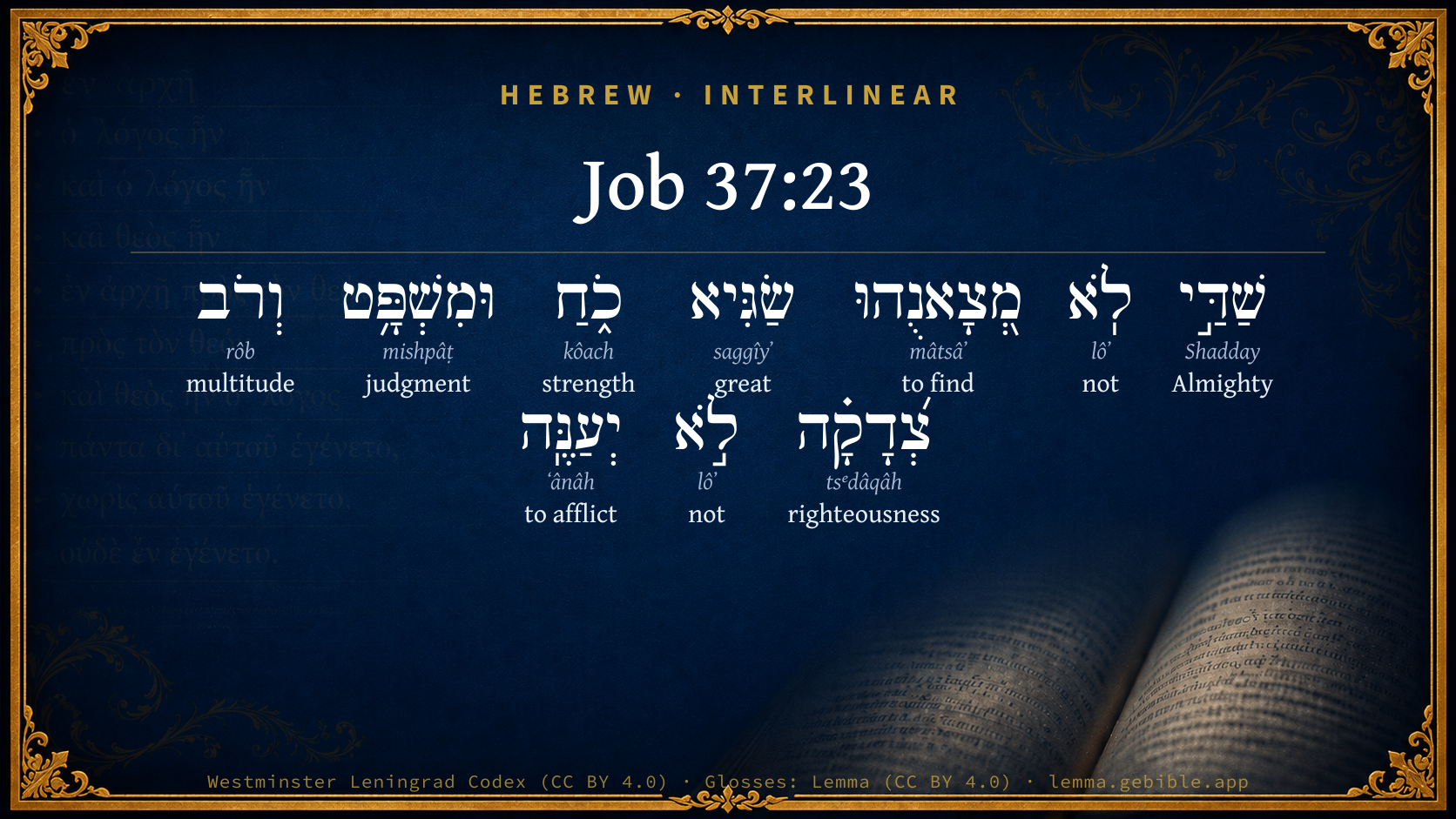
Job 37:23

Hebrew (Westminster Leningrad Codex) Job 37:23 appears in the Hebrew Old Testament. The text above is from the Westminster Leningrad Codex. Each word links to its Strong’s number, a concise gloss, and parsing drawn from the Open Scriptures Hebrew Bible morphology. Click any word for its full Brown-Driver-Briggs (BDB) entry.
Download image
Cite this verse

Job 37:23 (World English Bible). Public Domain. Lemma interlinear Bible study tool, https://lemma.gebible.app/v/job/37/23.

Show BibTeX & RIS
BibTeX
RIS
English Translation
We can't reach the Almighty, He is exalted in power; In justice and great righteousness he will not oppress.
World English Bible · Public Domain
Download a study sheet

One document with this verse’s original text, its word-by-word gloss line, the meaning frame, cross-references with their text, attributed commentary, and full source and license credits — printable, and it pastes into notes with its structure intact.

This verse Autodidact and up

Study sheet (.html) Plain text (.txt)

A passage Seminary Student

Up to 50 verses in one chapter. A passage sheet keeps up to 6 commentary sources and 12 cross-references per verse, in the order this page ranks them, and says so on the sheet whenever that leaves anything out. Ask for a single verse and you get the Autodidact verse sheet above.

Everything on this page stays free to read, with no account — the sheet is a download of what is already on screen, not access to it.

Want to remove ads? Support Godless Engineer
Compare translations 3

The same verse in 3 English versions, stacked beneath the original-language interlinear above. Click any original word for its lexicon entry.

Each is an independent rendering of the whole verse — the interlinear is not word-aligned to these translations.

Highlighted words mark where these versions differ — a whole-verse word diff, not a word-by-word alignment.

  • World English Bible Public Domain
    We can't reach the Almighty, He is exalted in power; In justice and great righteousness he will not oppress.
  • King James Version Public Domain
    Touching the Almighty, we cannot find him out: he is excellent in power, and in judgment, and in plenty of justice: he will not afflict.
  • unfoldingWord Literal Text CC BY-SA 4.0
    The Almighty, we do not find him! great power, and he does not oppress justice and an abundance of righteousness.

unfoldingWord Literal Text — © unfoldingWord, licensed CC BY-SA 4.0. Word-aligned USFM3 via Door43 (git.door43.org/unfoldingWord/en_ult).

Versions to compare (up to 4)

3 of 4 selected

Show all 18 translations

Every available English version of this verse, each an independent rendering of the whole verse.

  • World English Bible Public Domain
    We can't reach the Almighty, He is exalted in power; In justice and great righteousness he will not oppress.
  • Berean Standard Bible Public Domain
    The Almighty is beyond our reach; He is exalted in power! In His justice and great righteousness He does not oppress.
  • Majority Standard Bible Public Domain
    The Almighty is beyond our reach; He is exalted in power! In His justice and great righteousness He does not oppress.
  • King James Version Public Domain
    Touching the Almighty, we cannot find him out: he is excellent in power, and in judgment, and in plenty of justice: he will not afflict.
  • American Standard Version (1901) Public Domain
    `Touching' the Almighty, we cannot find him out He is excellent in power; And in justice and plenteous righteousness he will not afflict.
  • Revised Version (1885) Public Domain
    Touching the Almighty, we can not find him out; he is excellent in power: and in judgment and plenteous justice he will not afflict.
  • Geneva Bible (1599) Public Domain
    It is the Almightie: we can not finde him out: he is excellent in power and iudgement, and aboundant in iustice: he afflicteth not.
  • Douay-Rheims (1899) Public Domain
    We cannot find him worthily: he is great in strength, and in judgment, and in justice, and he is ineffable.
  • Young's Literal Translation Public Domain
    The Mighty! we have not found Him out, High in power and judgment, He doth not answer! And abundant in righteousness,
  • Literal Standard Version CC BY-SA 4.0
    The Mighty! We have not found Him out, || High in power and judgment, || He does not answer! And abundant in righteousness,
  • Unlocked Literal Bible CC BY-SA 4.0
    As for the Almighty, we cannot find him! He is great in power; he does not oppress justice and abundant righteousness.
  • unfoldingWord Literal Text CC BY-SA 4.0
    The Almighty, we do not find him! great power, and he does not oppress justice and an abundance of righteousness.
  • Darby Bible Public Domain
    The Almighty, we cannot find him out: excellent in power, and in judgment, and in abundance of justice, he doth not afflict.
  • World Messianic Bible Public Domain
    We can’t reach the Almighty. He is exalted in power. In justice and great righteousness, he will not oppress.
  • Webster's Bible Public Domain
    Touching the Almighty, we cannot find him out: he is excellent in power, and in judgment, and in abundance of justice: he will not afflict.
  • Free Bible Version CC BY-SA 4.0
    We cannot approach the Almighty for he is far beyond us in power and justice, and doing right.
  • Bible in Basic English Public Domain
    There is no searching out of the Ruler of all: his strength and his judging are great; he is full of righteousness, doing no wrong.
  • JPS Tanakh (1917) Public Domain
    The Almighty, whom we cannot find out, is excellent in power, yet to judgment and plenteous justice He doeth no violence.

Literal Standard Version (2020), Covenant Press — licensed CC BY-SA 4.0. Text via the HelloAO Bible API (eBible.org). Unlocked Literal Bible (unfoldingWord) — licensed CC BY-SA 4.0. Text via the HelloAO Bible API (eBible.org). unfoldingWord Literal Text — © unfoldingWord, licensed CC BY-SA 4.0. Word-aligned USFM3 via Door43 (git.door43.org/unfoldingWord/en_ult). Free Bible Version, Dr. Jonathan Gallagher — licensed CC BY-SA 4.0. Text via the HelloAO Bible API (eBible.org).

Word by word

More ways to search: Search by grammar → Find every occurrence → Compare this word →

Practice this passage: Drill this verse → Learn its vocabulary →

About this verse

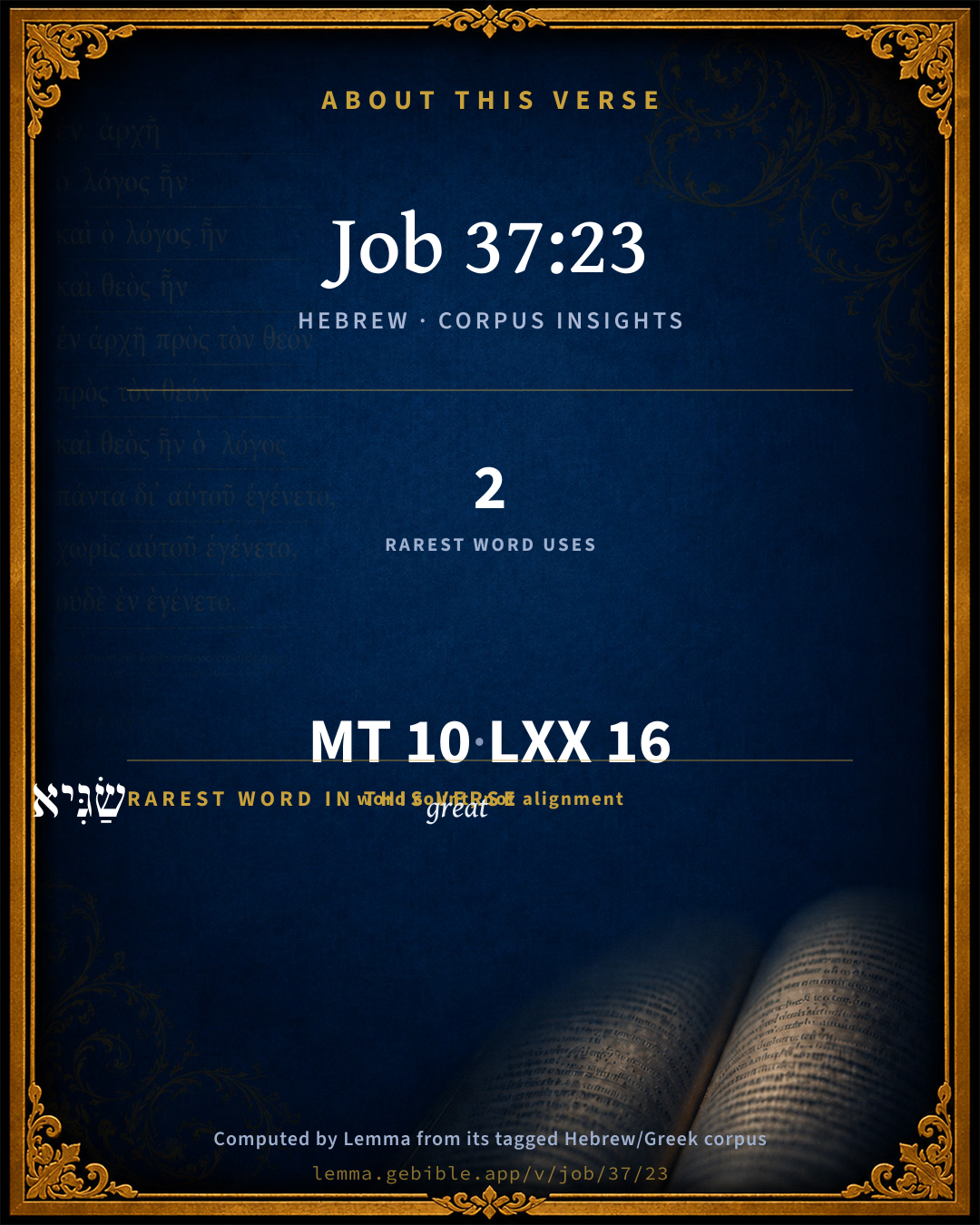
These counts appear in no published source. They are computed here, from the morphology-tagged text and Lemma’s own curated glosses. What Lemma adds →

10
words
9
distinct lemmas
Wisdom
section

Notable vocabulary

The rarest word here is שַׂגִּיא great H7689 — appearing just 2 times in the whole Hebrew Bible.

Shared distinctive vocabulary

שַׂגִּיא great H7689 occurs in 2 verses of the Hebrew Bible. Also found in:

Grammatical profile

  • 2 verbs
  • 5 nouns
  • 1 adjective
  • 2 particles

Verb forms

  • מְ֭צָאנֻהוּ Qal · Perfect
  • יְעַנֶּֽה Piel · Imperfect

Repetition

A word recurs within this verse — often emphatic in Hebrew:

Hebrew & Septuagint length

In English translation the verse runs 19 words from the Hebrew and 23 from the Septuagint (LXX English) — closely comparable.

A rough comparison of the two English renderings, which tokenize alike — not a word-level alignment.

Word counts can differ between the Hebrew and the Greek without any difference in meaning — e.g. the Hebrew direct-object marker אֵת has no separate Greek word, and Greek often adds the article ὁ.

In the original languages it is 10 Hebrew tokens and 16 Greek tokens — but the two are counted differently (Hebrew bundles its prefixes and suffixes into one token; the Greek is in lemma form), so that isn’t a like-for-like length.

Cross-references

30

Topical passages linked to Job 37:23 in the Treasury of Scripture Knowledge — connected by theme and wording, ordered by reader-vote popularity; previews shown in the World English Bible.

  • Romans 11:33 Oh the depth of the riches both of the wisdom and the knowledge of God! How unsearchable are his judgments, and his ways past tracing out!
  • 1 Timothy 6:16 who alone has immortality, dwelling in unapproachable light; whom no man has seen, nor can see: to whom be honor and eternal power. Amen.
  • Job 36:5 "Behold, God is mighty, and doesn't despise anyone. He is mighty in strength of understanding.
  • Psalms 99:4 The King's strength also loves justice. You do establish equity. You execute justice and righteousness in Jacob.
  • Lamentations 3:32–33 For though he cause grief, yet will he have compassion according to the multitude of his loving kindnesses.
  • Job 9:4 God who is wise in heart, and mighty in strength: Who has hardened himself against him, and prospered?
  • Job 11:7 "Can you fathom the mystery of God? Or can you probe the limits of the Almighty?
  • Psalms 30:5 For his anger is but for a moment; His favor is for a lifetime. Weeping may stay for the night, But joy comes in the morning.
  • Proverbs 30:3–4 I have not learned wisdom, Neither do I have the knowledge of the Holy One.
  • Isaiah 45:21 Declare you, and bring [it] forth; yes, let them take counsel together: who has shown this from ancient time? who has declared it of old? Haven't I, Yahweh? and there is no God else besides me, a just God and a Savior; there is no one besides me.
  • Isaiah 63:9 In all their affliction he was afflicted, and the angel of his presence saved them: in his love and in his pity he redeemed them; and he bore them, and carried them all the days of old.
  • Ezekiel 18:23 Have I any pleasure in the death of the wicked? says the Lord Yahweh; and not rather that he should return from his way, and live?
  • Ezekiel 18:32 For I have no pleasure in the death of him who dies, says the Lord Yahweh: therefore turn yourselves, and live.
  • Job 8:3 Does God pervert justice? Or does the Almighty pervert righteousness?
  • Job 9:19 If it is a matter of strength, behold, he is mighty! If of justice, 'Who,' says he, 'will summon me?'
  • Job 12:13 "With God is wisdom and might. He has counsel and understanding.
  • Job 16:7–17 But now, God, you have surely worn me out. You have made desolate all my company.
  • Job 26:14 Behold, these are but the outskirts of his ways. How small a whisper do we hear of him! But the thunder of his power who can understand?"
  • Job 36:26 Behold, God is great, and we don't know him. The number of his years is unsearchable.
  • Job 37:19 Teach us what we shall tell him; For we can't make our case by reason of darkness.
  • Psalms 36:5–7 Your loving kindness, Yahweh, is in the heavens. Your faithfulness reaches to the skies.
  • Psalms 62:11 God has spoken once, Twice I have heard this, That power belongs to God.
  • Psalms 65:6 Who by his power forms the mountains, Having armed yourself with strength;
  • Psalms 66:3 Tell God, "How awesome are your deeds! Through the greatness of your power, your enemies submit themselves to you.
  • Psalms 93:1 Yahweh reigns! He is clothed with majesty! Yahweh is armed with strength. The world also is established. It can't be moved.
  • Psalms 146:6–7 Who made heaven and earth, The sea, and all that is in them; Who keeps truth forever;
  • Ecclesiastes 3:11 He has made everything beautiful in its time. He has also set eternity in their hearts, yet so that man can't find out the work that God has done from the beginning even to the end.
  • Matthew 6:13 Bring us not into temptation, but deliver us from the evil one. For yours is the Kingdom, the power, and the glory forever. Amen.'
  • Luke 10:22 Turning to the disciples, he said, "All things have been delivered to me by my Father. No one knows who the Son is, except the Father, and who the Father is, except the Son, and he to whomever the Son desires to reveal him."
  • Hebrews 12:10 For they indeed, for a few days, punished us as seemed good to them; but he for our profit, that we may be partakers of his holiness.

Cross-references courtesy of OpenBible.info (CC BY 4.0).

Hebrew and Greek witnesses Masoretic Hebrew ↔ Greek Septuagint

The same verse in the two great witnesses to the Old Testament, shown verse-for-verse.

These are two independent witnesses, not word-aligned to each other, and the Septuagint is shown in lemma (dictionary) form.

Hebrew Job 37:23 Masoretic · Westminster Leningrad Codex

שַׁדַּ֣י לֹֽא מְ֭צָאנֻהוּ שַׂגִּיא כֹ֑חַ וּמִשְׁפָּ֥ט וְרֹב צְ֝דָקָ֗ה לֹ֣א יְעַנֶּֽה

We can't reach the Almighty, He is exalted in power; In justice and great righteousness he will not oppress.

World English Bible · Public Domain

Greek LXX Job 37:23 Septuagint · lemma form

καί οὐ εὑρίσκω ἄλλος ὅμοιος ὁ ἰσχύς αὐτός ὁ ὁ δίκαιος κρίνω οὐ οἴομαι ἐπιἀκούω αὐτός

and we do not find another his equal in strength: as for him that judges justly, do you not think that he listens?

LXX2012 (modern English Septuagint) · Public Domain

Hebrew: Westminster Leningrad Codex (CC BY 4.0). Greek: Septuagint (public domain); English from LXX2012 (modern English Septuagint) (Public Domain). How the Septuagint differs from the Hebrew →

Commentary

Notes on Job 37:23 from classic Christian and Jewish commentators (each source and its license shown beneath its notes). The classic Christian expositions comment on the surrounding passage and are grouped to its opening verse, so a note may address several verses; the Jewish commentaries on the Tanakh (Rashi and others) are per-verse, so they appear only where the commentator wrote on this verse.

Lemma curates 59 commentaries, every one of them public domain or Creative Commons licensed, each selected and text-cleaned for this edition rather than reprinted as found. About our sources →

Trapp's Complete Commentary

John Trapp

Job 37:23 [Touching] the Almighty, we cannot find him out: [he is] excellent in power, and in judgment, and in plenty of justice: he will not afflict.

Ver. 23. Touching the Almighty we cannot find him out] Heb. The Almighty. The nominative case put absolute; q.d. in short, as for the Almighty (that nomen Maiestativum, majestic name, as Tertullian phraseth it), we cannot comprehend him, any more than we can the main ocean in a cockle shell. And whereas we can say, as here, that he is excellent in power, and in judgment, and in plenty of justice, Ista de Deo dicimus, quia non invenimus melius quod dicamus (August.); We say these things of God, because we have nothing better to say of him, and must owe the rest unto our thoughts, although, indeed, he is above all name and above all notion. In searching after God, saith Chrysostom, I am like a man digging in a deep spring, I stand here, and the water riseth upon me, and I stand there, and still the water riseth upon me. To Thomas Aquinas, busy in this search, was showed (they say) a deep pit in the edge of the sea (which empty it, and carry away the water as oft as they will), it is still filled with other. It is a knowledge that passeth knowledge, Eph 3:19. That which in measure is pleasant and profitable, being too much inquired into, proves unsavoury and unsafe.

He will not afflict] viz. Willingly, Lam 3:33, or causelessly, 1Pe 1:6; or, He will not answer; viz. every one that questioneth the justice of his proceedings, as Job, in his heat, had done. The Seventy render the question, Will he not answer? sc. those that call upon him in truth, since he is excellent in power and in judgment? &c. Sure he will.

John Trapp, A Commentary or Exposition upon All the Books of the Old and New Testament (1647–1656) — public domain. Text from a community e-Sword module.

The Biblical Illustrator

Joseph S. Exell

Job_37:23

Touching the Almighty, we cannot find Him out.

An unknown quantity

It is well that there should be an immeasurable and unknown quantity in life and in creation. Even the unknown has its purposes to serve; rightly received, it will heighten veneration; it will reprove unholy ambition; it will teach man somewhat of what he is, of what he can do and can not do, and therefore may save him from the wasteful expenditure of a good deal of energy. Touching the Almighty, we cannot find Him out. All space leads up to the infinite. There comes a time when men can measure no longer; they throw down their instrument, and say, This is useless; we are but adding cypher to cypher, and we can proceed no further. Space has run up into infinity, and infinity cannot be measured. Nearly all the words, the greater words, that we use in our thinking and converse, run up into religious greatness. Take the word time. We reckon time in minutes and hours, in days and weeks and months and years and centuries, and we have gone so far as to speak of millenniums; but we soon tire; arithmetic can only help us to a certain point. Here again we draw up the measuring line or calculating standard, and we say, It is useless, for time has passed into eternity. These are facts in philosophy and in science, in nature and in experience,--space rising into infinity; time ascending into eternity: the foot of the ladder is upon earth, but the head of the ladder is lost in infinite distance. Take the word love. To what uses we put it! We call it by tuneful names; it charms us, it dissipates our solitude, it creates for us companionship, interchange of thought, reciprocation of trust, so that one life helps another, completing it in a thousand ways, great or small. But there comes a point even in love where contemplation can go no further; there it rests--yea, there it expires, for love has passed into sacrifice; it has gone up by way of the Cross. Always in some minor degree there has been a touch of sacrifice in every form of love, but all these minor ways have culminated in the last tragedy, the final crucifixion, and love has died for its object. So space has gone into infinity, time into eternity, love into sacrifice. Now take the word man. Does the term terminate in itself--is the term man all we know of being? We have spoken of spirit, angel, archangel; rationally or poetically, or by inspiration, we have thought of seraphim and cherubim, mighty winged ones, who burn and sing before the eternal throne, and still we have felt that there was something remaining beyond, and man is ennobled, glorified, until he passes into the completing term--God. They, therefore, are superficial and foolish who speak of space, time, love, man, as if these were self-completing terms; they are but the beginnings of the real thought, little vanishing signs, disappearing when the real thing signified comes into view, falling before it into harmonious and acceptable preparation and homage. So then, faith may be but the next thing after reason. It may be difficult to distinguish sometimes as to where reason stops and faith begins; but faith has risen before it, round about it; faith is indebted to reason; without reason there could have been no faith. Why not, therefore, put reason down amongst the terms, and so complete for the present our category, and say, space, time, love, man, reason,--for there comes a point in the ascent of reason where reason itself tires, and says, May I have wings now? I can walk no longer, I can run no more; and yet how much there is to be conquered, compassed, seized, and enjoyed! and when reason so prays, what if reason be transfigured into faith, and if we almost see the holy image rising to become more like the Creator, and to dwell more closely and lovingly in His presence? All the great religious terms, then, have what may be called roots upon the earth, the sublime words from which men often fall back in almost ignorant homage amounting to superstition. Begin upon the earth; begin amongst ourselves; take up our words and show their real meaning, and give a hint of their final issue. He who lives so, will have no want of companionship; the mind that finds in all these human, social, alphabetical signs of great religious quantities and thoughts, will have riches unsearchable, an inheritance incorruptible, undefiled, and that fadeth not away. Why dwarf our words? Why deplete them of their richer and more vital meanings? Why not rather follow them in an ascending course, and rejoice in their expansion, and in their riches? The religious teacher is called upon to operate in this direction, so far as he can influence the minds of his hearers; it is not his to take out of words all their best significations, but rather to charge every human term with some greater thought, to find in every word a seed, in every seed a harvest, it may be of wheat, it may be of other food, but always meant for the satisfaction and strengthening of our noblest nature. (Joseph Parker, D. D.)

The inscrutable

Inscrutable--first connect this word with two other words, responsibility and goodness. Did you say that only decrees that are indicated by overwhelming misfortunes are inscrutable? Why, everything, the simplest, runs towards and finally runs into the inscrutable. The more we know the more are we brought into consciousness of the unknown, of the unknowable. Behold, we know not anything, says the poet, and as he contemplates the good that shall fall at last--far off--at last, to all, he adds, So runs my dream: but what am I? Ah, there is the inscrutable thing. What am I? What are you? Is not each of us an enigma? What strange, various, sometimes contradictory, opposing, conflicting influences and forces have gone to make us the curious bundles of inconsistencies that we are! Heredity, circumstances, companionships, and so on, we say, have all gone to mould us, to cabin us, to confine us, to expand us, or to contract us; to constitute, to define our liberty. Myself--thyself, that is the inscrutable. And yet, for thyself thou art responsible! Whatever theorists may argue or however they may talk, society--the world--holds a man responsible for himself, the inscrutable. That it is the inscrutable does not deny the responsibility. Neither does it with regard to the world in general. At every point we feel ourselves fall against the inscrutable. There is not a day, there is not a condition in life in which we are not brought face to face with that which we cannot understand. Everywhere, and in all things there is the inscrutable, and there is a responsibility for the world. There is somewhere a will that is responsible for it. There is a government in it. The world is a charge to some will, because if there is one thing that asserts itself in this world it is will power. Things may be very strange, and they often are so strange that we get bewildered, even frightened; but the very strangest thing that could be, that which is disowned by the whole universe, by a certain stream of tendency that runs through the whole universe, would be that it is all a disorder, a blind drive and drift. Most certainly it is not that. If you realise that you are responsible for the mass of inscrutability that you call yourself, why should you hesitate to recognise that there is providence--that is, a mind supremely responsible for the wide, vast inscrutableness which we call the world? But are not the inscrutable decrees which make it hard to submit incompatible with a perfect goodness? Ah, you are putting a question on which treatises without number have been written since the world began, and treatises without number may be written still, and the question puzzle on. It is one not to be discussed now. Only, I pray you to note two things. There is always a voice whispering that goodness will have the last word, even in what is overwhelming. An appalling calamity happens. Yes, Terrible, terrible, you say; but that appalling calamity calls attention--attention that would not have been called if it had not been appalling--to evils that can be remedied and should be remedied. It sets people in motion for remedies. There is immediate suffering, and it may be on even a terrible scale, but there is immediate gain, on a far greater scale, for the world. The prince cut off in the flower of his age, your boy taken away in the flower of his days--ah, broken hearts, indeed; but see how this young prince, taken away, has preached to the whole nation, he has united the empire in a wonderful sympathy, and so from a wide induction it might be proved temporal loss transformed into spiritual and moral gains. Even when you feel that the iron hand of judgment has descended terribly, there is a touch of the velvet in that hand which speaks of mercy. And further, when you speak of perfect goodness, remember that you and I do not know what perfect goodness is. We know only in part. Our point of view is that of very limited conception. We speak of nature, but who knows all nature? We speak of providence, but who knows all providence? We would need to bring in eternity, the eternity in which God works. But one full of promise, cut off in the flower of his age! Well, well. But does not this suggest that a promise cannot be lost? Nothing--nothing is lost. Potencies are not destroyed. There is a potency in that life which surely, surely is not annihilated. May not the call hence be a way of bidding the young man arise into a higher and nobler royalty? And those bereaved, may it not be a way of purifying and cleansing in the fire, bidding them to arise and live more earnestly, and live more nobly, and grasp the crown of life which the Lord has promised? We cannot tell all that perfect goodness means. The surgeon hesitates not to thrust his knife into the quivering flesh, and the poor patient cries. It is agony, but agony for future blessing; and so is there not many an agony for a future blessing, with an eternal weight of glory before it? Ah, we must be still, or if not still we must stretch hands of faith, lame hands of faith, and gather dust and chaff, and call to what we feel is Lord of all. (J. M. Lang, D. D.)

God a mystery

Ignorance of the modes of the Divine operation forms no ground for doubting the Divine intervention in human affairs. Touching the Almighty, we cannot find Him out, because our faculties are unable to comprehend infinity; but this disability no more warrants us in questioning the fact of His active providence, than would the mystery of the works of a watch warrant us in denying their existence or active operations. Consider this remark of Elihu in reference to the Almighty. As to His being. Its nature is wrapt in impenetrable mystery. We know that God is a Spirit, but what a spirit is we know not. Our ideas on this subject are negative; we know what a spirit is not. In the Scriptures no attempt is made to define the Divine nature. It is described only by its attributes and perfections. But as to the Divine attributes, we are in equal ignorance. We call God omnipotent, omniscient, eternal, infinite; but all we can understand by these terms is, that He is not limited as to power, knowledge, time, and space. Nor are we much more enlightened as to the work of creation. With the broad fact we are acquainted, but of the mode we know nothing. But how matter came into existence, and the mode by which it was formed into these various shapes, we are entirely ignorant. If we presume to penetrate the ways of providence, we find ourselves equally involved. Beyond the bare fact we are lost. God is shrouded in mystery. And what is life? Of what is it composed? Where does it reside? On what combinations does it depend? How untraceable are the dispensations of providence as to the affairs of men! The history of the world is an enigma. Nor is God less concealed in the operations of grace. And the mode in which Christianity has been propagated is full of mystery. As to the future, we are in almost equal ignorance. Think also of the permission of evil in the world; the condition of the soul in its intermediate state; and of humanity after judgment. What our text teaches is, that ignorance of the mode of the providential dispensations forms no justification for disbelief of their Divine origin, nor for doubts of their equity. Many things are mysterious, because too abstruse for our faculties; but assuredly God is originating and directing them in a spirit of wisdom and goodness, which will make them issue in benefit to all. The more mysterious the Almighty is, the more we are bidden to study Him. His works and His Word are the deep things of God, of which a superficial reading is worse than useless. What subjects there are for meditation! The grandest and most interesting beyond all others--subjects which concern the High and Mighty One, creation, providence, grace, the things of time and eternity, life, death, and resurrection--subjects which even the angels desire to look into. But let our studies be conducted with cautious reverence. Generally, freedom of inquiry is safe; but there are points into which it is dangerous to pry. Usually, all facts are open to inspection, but not speculation on mode and means. (J. Budgeon, M. A.)

Inscrutable providence

It is no uncommon thing in these times to hear people saying that it seemed as if God was careless--as if He had forgotten His people. Men call upon God, but call upon Him to all appearance in vain. He does not hear them; at least, no answer comes. But God did hear, and did answer. There is mystery regarding the why of Gods working, and there is mystery regarding the how. We cannot explain the one or the other. The path is invisible to us; but the path is there. Chemists and students of nature generally hold that there is nothing in nature deserving the name of providence; that force is eternal and that all things go on in obedience to immutable law. But these students of nature presume too much. It is a way they have. Self-conceit has made them blind. There is much in nature which they do not know, and much which they can not know. Can they indicate the lightnings track or trace the course of the wind? Even admitting that science has made a change in mens minds regarding material phenomena, what is to be said of the mind itself? Why was George Washington saved amid the wreck of Braddocks command? What if Major Andre had not been captured? How different the history of those later years if General Grant had been shot at Belmont! At that critical moment of the cornfield what restrained the hands of the Confederates that they did not fire? And at a brief period thereafter what tempted him to leave his tent and thus avoid the fatal bullet? What is it that so miraculously preserves the equality of the sexes? But these are stray examples of which there are millions. There is mystery everywhere. There are three things which it is well always to bear in mind when thinking of the ways of God. First, God may interfere in the affairs of the world without men knowing it; second, God may influence motives without men knowing it; third, God may touch the secret and subtle springs of nature without men knowing it. Experience is a better teacher than science. (Judson Sage, D. D.)

He is excellent in power, and in judgment.--

God excellent

He is excellent . . . in judgment. Is there any judgment displayed in the distribution of things? Is the globe ill-made? Are all things in chaos? Is there anywhere the sign of a plummet line, a measuring tape? Are things apportioned as if by a wise administrator? How do things fit one another? Who has hesitated to say that the economy of nature, so far as we know it, is a wondrous economy? Explain it as men may, we all come to a common conclusion, that there is a marvellous fitness of things, a subtle relation and interrelation, a harmony quite musical, an adaptation which though it could never have been invented by our reason, instantly secures the sanction of our understanding as being good, fit, and wholly wise. And in plenty of justice. Now Elihu touches the moral chord. It is most noticeable that throughout the whole of the Bible the highest revelations are sustained by the strongest moral appeals. If the Bible dealt only in ecstatic contemplations, in religious musings, in poetical romances, we might rank it with other sacred books, and pay it what tribute might be due to fine literary inventiveness and expression; but whatever there may be in the Bible supernatural, transcendental, mysterious, there is also judgment, right, justice: everywhere evil is burned with unquenchable fire, and right is commended and honoured as being of the quality of God. The moral discipline of Christianity sustains its highest imaginings. Let there be no divorce between what is spiritual in Christianity and what is ethical,--between the revelation sublime and the justice concrete, social, as between man and man; let the student keep within his purview all the parts and elements of this intricate revelation, and then let him say how the one balances the other, and what cooperation and harmony result from the interrelation of metaphysics, spiritual revelations, high imaginings, and simple duty, and personal sacrifice, industry as of stewardship, of trusteeship. This is the view which Elihu takes. God to him was excellent in power, and in judgment, and in plenty of justice; He will not afflict. A curious expression this, and differently rendered. Some render it, He will not answer; or, He will not be called upon to answer for His ways; He will give an account of Himself to none; there is a point beyond which He will not permit approach. Yet the words as they stand in the Authorised Version are supported by many collateral passages, and therefore may be taken as literal in this instance. He will not willingly afflict; He is no tyrant; He is not a despot who drinks the wine of blood, and thrives on the miseries of His creation: when He chastens it is that He may purify and ennoble the character, and bring before the vision of man lights and promises which otherwise would escape his attention. Affliction as administered by God is good; sorrow has its refining and enriching uses. The children of God are indeed bowed down, sorely chastened, visited by disappointments; oftentimes they lay their weary heads upon pillows of thorns. Nowhere is that denied in the Bible; everywhere is it patent in our own open history; and yet Christianity has so wrought within us, as to its very spirit and purpose, that we can accept affliction as a veiled angel, and sorrow as one of Gods night angels, coming to us in cloud and gloom, and yet in the darkest sevenfold midnight of loneliness whispering to us Gospel words, and singing to us in tender, minor tones as no other voice ever sang to the orphaned heart. Christians can say this; Christians do say this. They say it not the less distinctly because there are men who mock them. They must take one of two courses; they must follow out their own impressions and realisations of spiritual ministry within the heart; or they must, forsooth, listen to men who do not know them, and allow their piety to be sneered away, and their deepest spiritual realisations to be mocked out of them, or carried away by some wind of fools laughter. They have made up their minds to be more rational; they have resolved to construe the events of their own experience, and to accept the sacred conclusion, and that conclusion is that God does not willingly afflict the children of men, that the rod is in a Fathers hand, that no chastening for the present seemeth to be joyous, but grievous, nevertheless, afterward it worketh out the peaceable fruit of righteousness unto them which are exercised thereby. Believe me, they are not to be laughed out of that position. They are reasonable men, men of great sagacity, men of affairs, men who can deal with questions of state and empire; and they, coming into the sanctuary--the inmost, sacred sanctuary--are not ashamed to pray. This is the strength of Christian faith. When the Christian is ashamed of his Lord the argument for Christianity is practically, and temporarily, at least, dead. Why do we not speak more distinctly as to the results of our own observation and experience? Great abstract truths admit of being accented by personal testimony. Come and hear, all ye that fear God, said one, and I will declare what He hath done for my soul. If a witness will confine himself to what he himself has known, felt and handled of the Word of Life, then in order to destroy the argument you must first destroy his character. (Joseph Parker, D. D.)

In plenty of justice.

The excellence of the Divine justice

Perhaps the foremost characteristic of God that men are tempted to disparage is His justice. They do not relish that which is opposed to their enjoyment, and to the successful issue of their purposes. And as they have a sense of guilt, and cannot fail to see that their conduct brings them into conflict with the Almighty, since He must be offended with the violation of His law, they first wish that He were not the righteous Being that He is, and then they deny Him this essential quality. By so weak a process is it they create a God to their liking.

1. Justice ranks high from its own inherent character. In the old mythology of Greece the Goddess of Justice sat by the side of Jupiter. In all lands the tribunals of justice are next the altars of religion. When men would ask for that which they prize the most among their fellow men, they ask for justice. When the Athenians would most honour Aristides, they called him the just. Justice is the parent of many virtues. The moral sense of every man pronounces the excellence of this noblest virtue. It is excellent in God. It gives a sense of security and repose that our God is a God of justice.

2. Justice is an attribute essential to the complete revelation of God. This quality some men deny in God; if they do not deny it, they degrade it. The first excellence in a judge is that he be just. God administers His government with no respect of persons, and with an undeviating regard to the principles of equity.

3. Justice guards the manifold interests of the Divine empire. Justice to each and all is the result of only the choicest wisdom. No neglect, or partiality, or injustice, can be charged against Him.

4. Justice ministers to the greatest happiness of Gods subjects. This sense of the Divine justice gives solace in the trials of the world.

5. Justice admits the exercise of mercy. Biblical theology allows no rivalry between these two cardinal attributes of God. God has devised an atonement of such a character that, on the one hand, the majesty and sanctity of His law are vindicated, and on the other hand, a full pardon can be granted to sinners who embrace this Divine provision. That which it would not be safe to do in civil society, it is safe to do under this Divine plan for human redemption.

6. Justice demands the punishment of the guilty. Under the economy of grace it demands the punishment of the finally impenitent. It is a strange infatuation that has seized some minds, sensible on every other subject, that there is to be no suitable punishment of sin hereafter. They claim that God is too good to inflict merited penalty; that the doctrine of eternal punishment is a censure upon His fatherhood; that hell has no place under the Divine administration. But sin is here, and suffering is here. Sin causes suffering now, and the penalties of wrong-doing are before our eyes everywhere. The hardest problem is not to account for hell and future punishment, but it is to account for sin and suffering at all. Under the government of a supremely good and powerful God, why is there sin and its necessary woe? We know that sin is. We know that dreadful penalty is. If sin shall go into the future life, if it shall wax great and strong there, if it shall forever lift its defiance against the eternal throne, it will bear--it must bear--its eternal penalty. It is not the eternity of sin, nor the eternity of punishment, which challenges our belief, it is not the duration of them, but the existence of them. Of their existence we know. If, then, endless sinning continues, endless punishment should. God is just. He has issued a just law, harmonious with His own character, as an authoritative guide to men. Inasmuch as they have all broken this law, He has graciously devised, if we may say so, a plan of salvation, by which they can be pardoned and justified, while yet the law is sustained. Now, if they reject this plan, if they will not be saved through Christ, if they prefer to stand on the old basis of the law, it only remains that judgment shall be given by the law. It demands perfect obedience. It imposes death as the penalty of sin. The law, with its announced penalty, God, as a just God, must sustain. The unbeliever in Christ, must, therefore, meet the penalty. There is no recourse. Divine justice demands the punishment of the guilty. It will inflict upon no one more than he deserves. (Burdett Hart, D. D.)

.

The Biblical Illustrator, edited by Joseph S. Exell (c. 1880s–1900s) — public domain. Text from a community e-Sword module.

Tyndale Open Study Notes

Tyndale Open Resources

37:23 cannot imagine the power of the Almighty: Cp. 11:7; 26:14; Rom 11:33; 1 Tim 6:16. • he is just and righteous: Cp. Job 9:4, 19; 12:13; Pss 62:11; 66:3; 93:1; 99:4.

Tyndale Open Study Notes — © Tyndale Open Resources, licensed CC BY-SA 4.0. Text via the HelloAO Bible API.

Geneva Bible (1599)

Geneva Bible translators

Meaning, without cause.

Geneva Bible (1599) marginal notes — public domain. Text via Bolls.life.

Jamieson, Fausset & Brown

Robert Jamieson, A. R. Fausset & David Brown

afflict--oppressively, so as to "pervert judgment" as Job implied (see on Job 8:3); but see on Job 37:21, end of note. The reading, "He answereth not," that is, gives no account of His dealings, is like a transcriber's correction, from Job 33:13, Margin.

Jamieson, Fausset & Brown — Commentary Critical and Explanatory on the Whole Bible (1871) — public domain (CC PDM 1.0). Text via the HelloAO Bible API.

Adam Clarke's Commentary

Verse 23. Touching the Almighty, we cannot find him out] This is a very abrupt exclamation, and highly descriptive of the state of mind in which Elihu was at this time; full of solemnity, wonder, and astonishment, at his own contemplation of this "great First Cause, least understood." The ALMIGHTY! we cannot find him out.

Excellent in power and in judgment] We must not pretend to comprehend his being, the mode of his existence, the wisdom of his counsels, nor the mysteries of his conduct.

He will not afflict.] לא יענה la yeanneh, he will not ANSWER. He will give account of none of his matters to us. We cannot comprehend his motives, nor the ends he has in view.

Adam Clarke's Commentary on the Bible (1810–1826) — public domain. Text from a community e-Sword/MySword module.

Ellicott's Commentary for English Readers

(23) Touching the Almighty, we cannot find him out.—He is excellent, or mighty, in power and justice, &c.

A Bible Commentary for English Readers, edited by Charles John Ellicott (1878–1897) — public domain. Text from a community e-Sword module.

The Cambridge Bible for Schools and Colleges

gen. ed. J. J. S. Perowne

23. According to the original the members of the verse stand thus;

The Almighty! we cannot find him out; who is great in power,

And in justice and fulness of righteousness: he will not afflict.

The connexion shews that afflict has the sense of afflict unjustly, or oppress. Taken thus the verse has a certain halting movement. Hence others take the word “afflict” in the sense of wrest or do violence to, rendering the second clause, and justice and fulness of righteousness he will not pervert (Ew.).

Elihu returns here at the end of his discourse to the thought of God with which he started, ch. Job_36:5, “Behold God is mighty, and despiseth not any.” This is the thought of God that fills all his discourses; God’s power is ever conjoined with righteousness, and He unjustly afflicts or oppresses none.

23, 24. Elihu sums up his teaching regarding the greatness of God, which is ever conjoined with righteousness. It is befitting men, therefore, not to judge Him, but to fear Him, for He regards not them that are wise in their own understanding.

The Cambridge Bible for Schools and Colleges (gen. ed. J. J. S. Perowne; Cambridge University Press, 1878–1918) — public domain. Text from a community e-Sword module.

John Gill's Exposition

Touching the Almighty,.... Or with respect to God, who is almighty; with whom nothing is impossible; who can do and does do all things he pleases, and more than we can ask or think; and who is all sufficient, as this word is by some rendered; has enough of every thing in himself and of himself to make him happy; and needs not any of his creatures, nor anything they can do or give him, but has a sufficiency for himself and them;

we cannot find him out; found he may be in his works, and especially in his Son, the express image of his person; in whom he makes himself known as the God of grace: but he is not to be found out to perfection; neither by the light of nature, which is very dim, and by which men grope after him, if haply they may find him; nor even by the light of grace in the present state: and there are many things in God quite out of the reach of man, and ever will be, fully to comprehend; as the modes of the subsistence of the three Persons in the Godhead; the eternity and immensity of God; with all secret things, which belong not to us to inquire curiously into;

he is excellent in power; or great and much in it; which is displayed in the works of creation and sustentation of the world; in the redemption and conversion of his people; in the support, protection, and preservation of them; and in the destruction of his and their enemies;

and in judgment; in the government of the world in so righteous a manner; in the judgments he executes on wicked men; and as he will appear to be in the general judgment of the world, at the great day, which will be a righteous one;

and in plenty of justice; being most just, righteous in all his ways, and holy in all his works; distributing justice to all, acting according to the rules of it, in all things and towards all persons; so that though he is great in power, he does not abuse that power, to do things that are not just;

he will not afflict; without a just cause and reason for it; nor willingly, but with reluctance; nor never beyond deserts, nor more than he gives strength to bear; and only for the good of his people, and in love to them. Some render it, "he will not answer" (b); or give an account of his matters, or the reason of his dealings with men.

(b) "non respondebit", Tigurine version; so some in Mercerus and Drusius.

John Gill's Exposition of the Whole Bible (1746–1763) — public domain (CC PDM 1.0). Text via the HelloAO Bible API.

Albert Barnes' Notes on the Bible

Touching the Almighty, we cannot find him out - See the notes at Job 11:7-9. This sentiment accords with all that Elihu had said, and indeed is what he designed particularly to enforce. But it has a special emphasis here, where God is seen approaching in visible splendor, encompassed with clouds and tempests, and seated on a throne of burnished gold. Such a God, Elihu says, it was impossible to comprehend. His majesty was overwhelming, The passage is much more impressive and solemn, and accords much better with the original, by omitting the words which our translators have introduced and printed in italics. It would then be,

The Almighty! - We cannot find him out!

Great in power, and in justice, and in righteouness!

Thus, it expresses the overwhelming emotion, the awe, the alarm produced on the mind of one who saw God approaching in the sublimity of the storm.

He is excellent in power - He excels, or is vast and incomprehensible in power.

And in judgment - That is, in justice.

And in plenty of justice - Hebrew, “in multitude of righteousness.” The meaning is, that there was an overflowing fulness of righteousness; his character was entirely righteous, or that trait abounded in him.

He will not afflict - Or, he will not oppress, he will not crush. It was true that he “did afflict” people, but the idea is, that there was not harshness or oppression in it. He would not do it for the mere sake of producing affliction, or when it was not deserved. Some manuscipts vary the reading here so as to mean “he will not answer;” that is, he will not give any account of what he does. The change has relation only to the points, but the above is the usual interpretation, and accords well with the connection.

Albert Barnes' Notes on the Bible (1834–1885) — public domain. Text from a community e-Sword/MySword module.

Haydock's Catholic Bible Commentary

Worthily. Hebrew, "the Almighty, we cannot find him out," (Haydock) or comprehend his nature or mysteries. (Calmet)

George Leo Haydock (1774–1849), Haydock's Catholic Family Bible and Commentary, 1859 edition — public domain. Excludes Psalms (Douay-Rheims chapter numbering differs from Protestant) and Deuterocanonical books (Catholic canon only).

Matthew Poole's English Annotations

We cannot find him out, to wit, to perfection, as it is expressed, Job 11:7. We cannot comprehend him; his being, power, wisdom, justice, and his counsels proceeding from them, are past our finding out; and therefore it is most absurd and intolerable that thou, O Job, presumest to censure what thou dost not understand.

He is excellent in power; and therefore as he doth not need any unrighteous action to advance himself, so he cannot do it, because all such things are acts and evidences of impotency or weakness.

In judgment, i.e. in the just and righteous administration of judgment, as this word is oft used, and as the thing itself and the following words plainly evince. And this he adds, to intimate that although God had indeed a power to crush Job, or any other man, yet he never did nor can exercise that power unjustly or tyrannically, as Job seemed to insinuate.

In plenty of justice; in great and perfect justice, such as no man can justly reproach.

He will not afflict, to wit, without just cause, and above measure; as it may and must be limited, both from the foregoing words, and from Job’s complaint, which was of that very thing; and from the nature of the thing, because otherwise this proposition, that God

will not afflict, is not simply and universally true. Or these last words may be joined with the former; and so some render the place,

he is excellent in power, and, or but, or

yet, he will not afflict any man with judgment and much (i.e. too much)

justice, i.e. with extremity or rigour of justice.

Matthew Poole's English Annotations on the Holy Bible (1683–1685) — public domain. Text from a community e-Sword/MySword module.

Whedon's Commentary on the Bible

Daniel D. Whedon

23. Touching the Almighty… he will not afflict — The Almighty! We cannot find him out; great (is he) in power, but right and the fulness of justice he will not pervert. A most worthy ascription to Deity. His infinite power is restricted by his sense of right and justice. “The incomprehensibility and infinite perfection of God silence all objections to his government.” — Scott. Thus the great difficulties stated by Job are met and answered. The humblest may cherish trust in God that “he will not afflict willingly,” for chastisement and trial, which arise from the dark and unsearchable depths, really come from the divine heart. In place of He will not afflict, (he will not pervert, יענה,) Hirtzel and Rosenmuller read, “He answers not,” when arraigned by the puny mind of man.

We cannot find him out — See note on Job_11:7, and “Garbett’s Bampton,” (1867,) lec. 4.

Daniel D. Whedon (gen. ed.), Commentary on the Old and New Testaments (1874–1909) — public domain. Text from a community e-Sword module.

The Pulpit Commentary

Touching the Almighty, we cannot find him out. This is the "conclusion of the whole matter." God is inscrutable, and man must hide his face before him and not presume to judge him. He is also excellent in power, and in judgment, and in plenty of justice. His moral perfection is on a par with his might and majesty. He will not afflict; rather, he will not answer; i.e. he will not account to men for his doings, or condescend to justify himself in their eyes. His acts cannot but be righteous.

The mystery of God.

We cannot find out God. In his great strength and perfect equity he will render an account to no man. Here is a mystery, but one that is saved from terror by a sufficient revelation to reassure us of the true righteousness of God.

I THE MYSTERY IS IN THE ACTION OF GOD. His nature is mysterious. But we are not distressed by the difficulty of comprehending it, for we know it must be beyond our grasp, and we may be content to live in peace without solving the most abstruse problems of theology. It is very different with the action of God. This affects us closely. We see it in our common life in the world. Yet here too is mystery.

1. Nature is a mystery. Not only cannot we understand its origin, but we cannot see whither it is tending. The great machine rolls on to a future beyond our imagination. What is God doing with it? How is he using all the pain and failure of it?

2. Providence is a mystery. We cannot see why God acts as he does, giving prosperity to one and adversity to another without reasons that we cat, discover. Why does he permit the simple, honest man to fail, and the clever rogue to succeed?

3. Religion is a mystery. There are mysterious doctrines in it; these we can endure. But there are also mysterious experiences. We cannot understand the dark days of strange thoughts and sad feelings, the weariness and failure, through which we have to pass.

II THE CHARACTER OF GOD IS REVEALED TO US. Let us be fair and see what is known before we sit down and despair over the mystery of God. It is better to fix our eyes on the light we have than to brood in helpless melancholy over the darkness that surrounds it on every side. Now we know what it most concerns us to know about God. We need not understand the exact process if we can see the end. But if the character of God is revealed, we may be sure that the end of God"s actions will agree with it. God has made himself known to us as perfect righteousness. That is enough. Then all he does must be righteous plenty of justice." We can trust God for what he is, even when we do not understand what he does.

III THE MYSTERY OF GOD IS IN HARMONY WITH THE REVELATION OF GOD. There is a close connection between the two. They do not contradict one another. On the contrary, the revelation leads up to the mystery. That revelation shows equity. Now, equity implies a fair treatment of all things. It is not a simple notion like love or anger. It God is just, he must take into account others besides the one person he is dealing with, and more than the pleasure or pain of the present moment. Large issues are at stake, wide interests are involved. These must go beyond our small world of observation. Therefore, because we believe in the equity of God, we must expect him to act in mystery. It is not for us to call him to account. The idea of dome so suggests an unworthy doubt. We should trust his righteousness without asking him to solve the mystery of his action. W.F.A.

The Pulpit Commentary (1880–1919), ed. H.D.M. Spence-Jones & Joseph S. Exell — public domain. Text from a community e-Sword module.

John Wesley's Explanatory Notes

Find - We cannot comprehend him: his power, wisdom, justice, and his counsels proceeding from them are past our finding out. Power - Therefore as he doth not need any unrighteous action to advance himself, so he cannot do it, because all such things are acts of weakness. Judgment - In the just administration of judgment, he never did, nor can exercise that power unjustly, as Job seemed to insinuate. Afflict - Without just cause.

John Wesley, Explanatory Notes Upon the Whole Bible (1754–1765) — public domain. Text via the GEBible commentary corpus.

unfoldingWord translationNotes

Door43 World Missions Community

we cannot find him

Possible meanings are 1) "we cannot approach him" or 2) this is a metaphor in which Elihu speaks of a person's being unable to fully understand God as if he could not find God. AT: "we cannot comprehend him" (See: Metaphor)

those who are wise in their own minds

Here "minds" represents the person's thoughts. AT: "those who are wise in their own thinking" or "those who consider themselves to be wise" (See: Metonymy)

translationWords

Almighty

power

righteous

oppress

wise

mind

unfoldingWord translationNotes — © Distant Shores Media and the Door43 World Missions Community, licensed CC BY-SA 4.0. Source: git.door43.org/Door43/en_tn.

Rashi

Rabbi Shlomo Yitzchaki (Rashi)

We have not found the Almighty great in power to arouse His judgments upon the creatures with the greatness of His power, but with clemency. He makes atonements for the creatures with small things, according to their ability: a handful of [fine flour from] a meal offering, a half shekel, turtle doves and young pigeons, cattle and flocks; and He did not burden them to seek a wild ox or an antelope.

and with judgment Sufferings.

He does not afflict the creatures excessively. Likewise, He does nor afflict them to [force them into] becoming overly righteous to an impossible extent, but each man according to his ability.

Rashi on the Tanakh — English translations: “The Judaica Press complete Tanach with Rashi, translated by A. J. Rosenberg” (CC BY 4.0); “Pentateuch with Rashi's commentary by M. Rosenbaum and A.M. Silbermann, 1929-1934” (public domain); “The Metsudah Tanach series, Lakewood, N.J” (CC BY 4.0); and “The Book of Joshua, Metsudah Publications, 1997” (CC BY 4.0). Text via Sefaria.

Lesson kit

Teaching starters — assembled from the data on this page, not authored interpretation. Every prompt links to the verse data it draws on. Edit before teaching.

Job, in the Wisdom, opens this verse with 10 words (9 distinct Hebrew lemmas). Its most distinctive word is saggîyʼ (“great”). A historical commentator’s framing appears above. Read the whole chapter for the surrounding context.

Discussion questions

  1. The word saggîyʼ carries the sense “great.” How does it shape the verse?
  2. Job 36:26 shares the word «great» with this verse. How do the two illuminate each other?
  3. “not” occurs 2× in this one verse. What is the effect of the repetition?
  4. The translations on this page render this verse differently — a whole-verse word diff, not a word-by-word alignment. What might account for the different wordings?
  5. The verb «מְ֭צָאנֻהוּ» is Qal Perfect. How does its form color the action?
  6. Reading how Trapp's Complete Commentary and The Biblical Illustrator read this verse, where do the two commentators agree and where do they part?

Things to notice

Reading settings

Reading text

Shown beneath each verse's original-language words.

Old Testament
Old Testament edition

Read the OT as the Masoretic Hebrew (MT) or the Greek Septuagint (LXX).

English shown for the Greek Septuagint (in the Hebrew ↔ Greek comparison).

Comparing translations? Open the Compare panel on any verse page to stack up to four side by side.