Exodus 15:7

Hebrew (Westminster Leningrad Codex) Exodus 15:7 appears in the Hebrew Old Testament. The text above is from the Westminster Leningrad Codex. Each word links to its Strong’s number, a concise gloss, and parsing drawn from the Open Scriptures Hebrew Bible morphology. Click any word for its full Brown-Driver-Briggs (BDB) entry.
Download image
Cite this verse

Exodus 15:7 (World English Bible). Public Domain. Lemma interlinear Bible study tool, https://lemma.gebible.app/v/exodus/15/7.

Show BibTeX & RIS
BibTeX
RIS
English Translation
In the greatness of your excellency, you overthrow those who rise up against you: You send forth your wrath. It consumes them as stubble.
World English Bible · Public Domain
Highlights
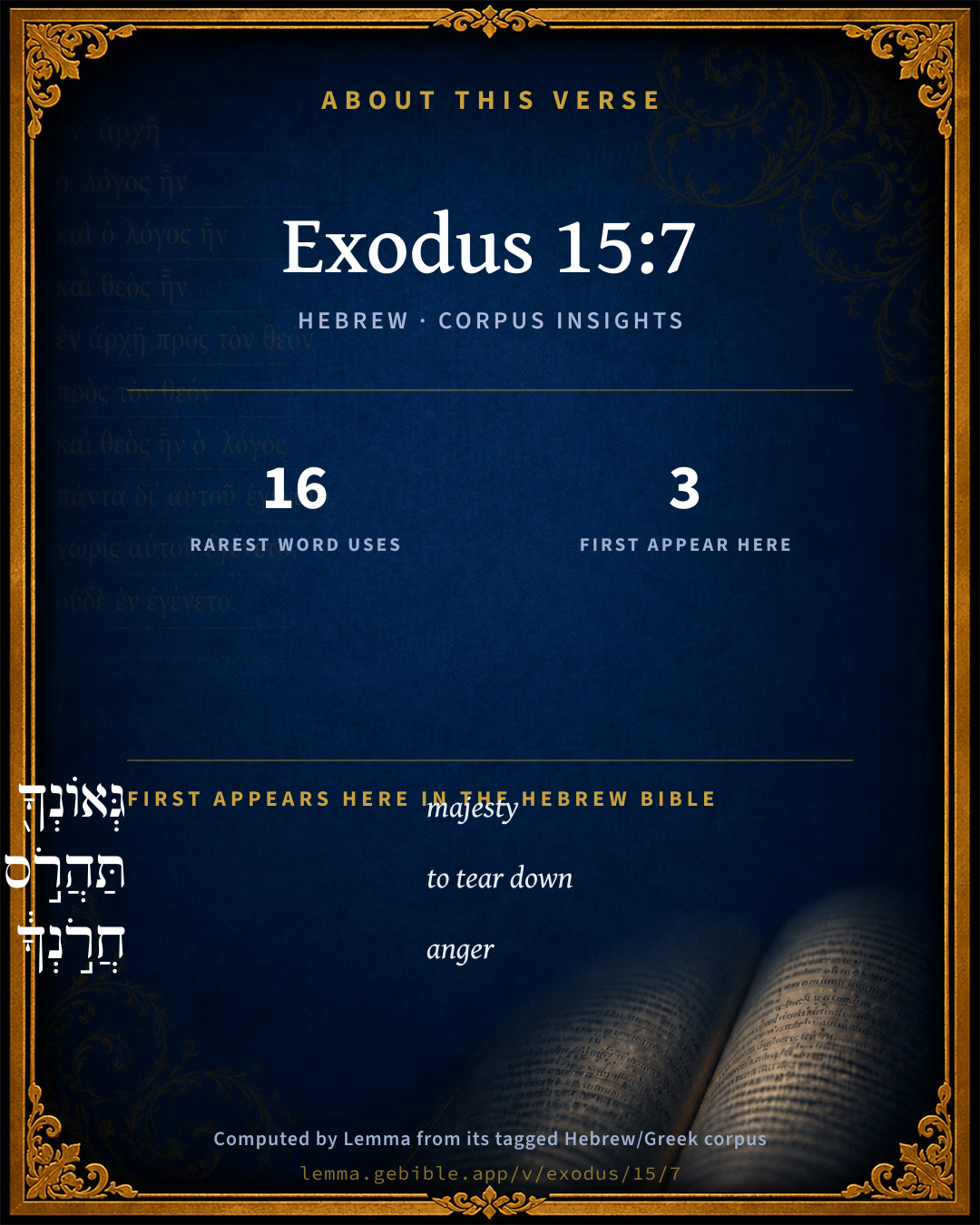
  • 3 first appearances in the Hebrew Bible
Full analysis ↓
Download a study sheet

One document with this verse’s original text, its word-by-word gloss line, the meaning frame, cross-references with their text, attributed commentary, and full source and license credits — printable, and it pastes into notes with its structure intact.

This verse Autodidact and up

Study sheet (.html) Plain text (.txt)

A passage Seminary Student

Up to 50 verses in one chapter. A passage sheet keeps up to 6 commentary sources and 12 cross-references per verse, in the order this page ranks them, and says so on the sheet whenever that leaves anything out. Ask for a single verse and you get the Autodidact verse sheet above.

Everything on this page stays free to read, with no account — the sheet is a download of what is already on screen, not access to it.

Want to remove ads? Support Godless Engineer
Compare translations 3

The same verse in 3 English versions, stacked beneath the original-language interlinear above. Click any original word for its lexicon entry.

Each is an independent rendering of the whole verse — the interlinear is not word-aligned to these translations.

Highlighted words mark where these versions differ — a whole-verse word diff, not a word-by-word alignment.

  • World English Bible Public Domain
    In the greatness of your excellency, you overthrow those who rise up against you: You send forth your wrath. It consumes them as stubble.
  • King James Version Public Domain
    And in the greatness of thine excellency thou hast overthrown them that rose up against thee: thou sentest forth thy wrath, which consumed them as stubble.
  • unfoldingWord Literal Text CC BY-SA 4.0
    And in the abundance of your majesty you overthrow those who rise up against you. You send out your heat; it devours them like stubble.

unfoldingWord Literal Text — © unfoldingWord, licensed CC BY-SA 4.0. Word-aligned USFM3 via Door43 (git.door43.org/unfoldingWord/en_ult).

Versions to compare (up to 4)

3 of 4 selected

Show all 18 translations

Every available English version of this verse, each an independent rendering of the whole verse.

  • World English Bible Public Domain
    In the greatness of your excellency, you overthrow those who rise up against you: You send forth your wrath. It consumes them as stubble.
  • Berean Standard Bible Public Domain
    You overthrew Your adversaries by Your great majesty. You unleashed Your burning wrath; it consumed them like stubble.
  • Majority Standard Bible Public Domain
    You overthrew Your adversaries by Your great majesty. You unleashed Your burning wrath; it consumed them like stubble.
  • King James Version Public Domain
    And in the greatness of thine excellency thou hast overthrown them that rose up against thee: thou sentest forth thy wrath, which consumed them as stubble.
  • American Standard Version (1901) Public Domain
    And in the greatness of thine excellency thou overthrowest them that rise up against thee: Thou sendest forth thy wrath, it consumeth them as stubble.
  • Revised Version (1885) Public Domain
    And in the greatness of thine excellency thou overthrowest them that rise up against thee: Thou sendest forth thy wrath, it consumeth them as stubble.
  • Geneva Bible (1599) Public Domain
    And in thy great glorie thou hast ouerthrowen them that rose against thee: thou sentest forth thy wrath, which consumed them as the stubble.
  • Douay-Rheims (1899) Public Domain
    And in the multitude of they glory thou hast put down thy adversaries: thou hast sent thy wrath, which hath devoured them like stubble.
  • Young's Literal Translation Public Domain
    And in the abundance of Thine excellency Thou throwest down Thy withstanders, Thou sendest forth Thy wrath -- It consumeth them as stubble.
  • Literal Standard Version CC BY-SA 4.0
    And in the abundance of Your excellence || You throw down Your withstanders, || You send forth Your wrath—It consumes them as stubble.
  • Unlocked Literal Bible CC BY-SA 4.0
    In great majesty you overthrew those who rose up against you. You sent out your wrath; it consumed them like stubble.
  • unfoldingWord Literal Text CC BY-SA 4.0
    And in the abundance of your majesty you overthrow those who rise up against you. You send out your heat; it devours them like stubble.
  • Darby Bible Public Domain
    And by the greatness of thine excellency thou hast overthrown thine adversaries: Thou sentest forth thy burning wrath, it consumed them as stubble.
  • World Messianic Bible Public Domain
    In the greatness of your excellency, you overthrow those who rise up against you. You send out your wrath. It consumes them as stubble.
  • Webster's Bible Public Domain
    And in the greatness of thy excellence thou hast overthrown them that rose up against thee: thou sentest forth thy wrath, which consumed them as stubble.
  • Free Bible Version CC BY-SA 4.0
    By your majestic power you destroyed those who opposed you. Your anger blazed out and burned them up like stubble.
  • Bible in Basic English Public Domain
    When you are lifted up in power, all those who come against you are crushed: when you send out your wrath, they are burned up like dry grass.
  • JPS Tanakh (1917) Public Domain
    And in the greatness of Thine excellency Thou overthrowest them that rise up against Thee; Thou sendest forth Thy wrath, it consumeth them as stubble.

Literal Standard Version (2020), Covenant Press — licensed CC BY-SA 4.0. Text via the HelloAO Bible API (eBible.org). Unlocked Literal Bible (unfoldingWord) — licensed CC BY-SA 4.0. Text via the HelloAO Bible API (eBible.org). unfoldingWord Literal Text — © unfoldingWord, licensed CC BY-SA 4.0. Word-aligned USFM3 via Door43 (git.door43.org/unfoldingWord/en_ult). Free Bible Version, Dr. Jonathan Gallagher — licensed CC BY-SA 4.0. Text via the HelloAO Bible API (eBible.org).

Word by word

More ways to search: Search by grammar → Find every occurrence → Compare this word →

Practice this passage: Drill this verse → Learn its vocabulary →

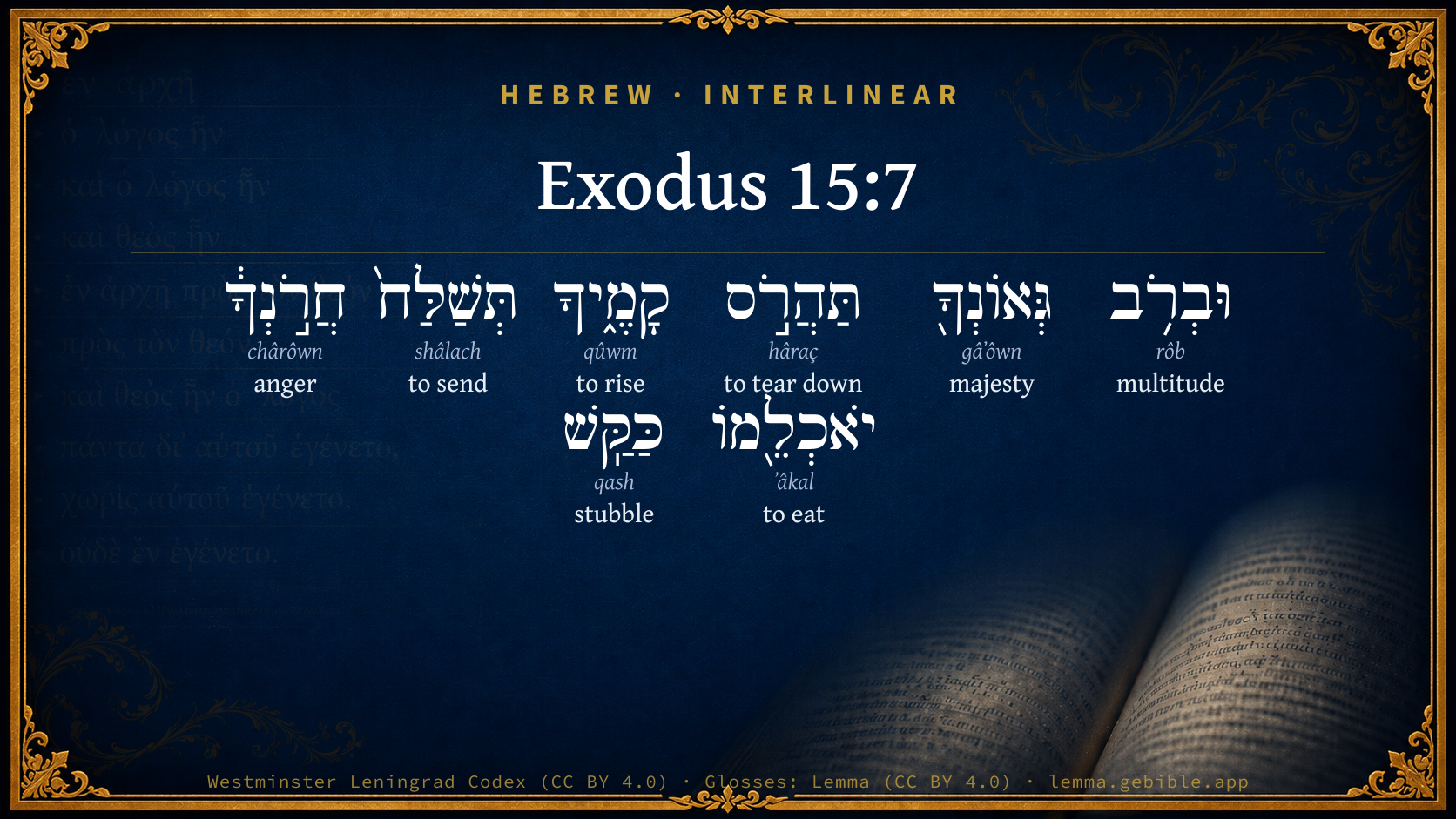
כַּקַּֽשׁ
qash
H7179
“like/as the · stubble”
Preposition, Determined + Noun, Common, Masculine, Singular, Absolute
Part of Speech
Preposition + Noun
Type
Common
Gender
Masculine
Number
Singular
State
Absolute
Full BDB Definition

Origin: from H7197

TWOT: 2091a

stubble, chaff
  1. וּבְרֹ֥ב rôb H7230 “and · in/at · multitude of” Conjunction + Preposition + Noun, Common, Both, Singular, Construct
  2. גְּאוֹנְךָ֖ gâʼôwn H1347 “majesty · your” Noun, Common, Masculine, Singular, Construct + Suffix, Personal, 2nd Person, Masculine, Singular
  3. תַּהֲרֹ֣ס hâraç H2040 “to tear down” Verb, Qal, Imperfect, 2nd Person, Masculine, Singular
  4. קָמֶ֑יךָ qûwm H6965 “rising · you” Verb, Qal, Participle Active, Masculine, Plural, Construct + Suffix, Personal, 2nd Person, Masculine, Singular
  5. תְּשַׁלַּח֙ shâlach H7971 “to send” Verb, Piel, Imperfect, 2nd Person, Masculine, Singular
  6. חֲרֹ֣נְךָ֔ chârôwn H2740 “anger · your” Noun, Common, Masculine, Singular, Construct + Suffix, Personal, 2nd Person, Masculine, Singular
  7. יֹאכְלֵ֖מוֹ ʼâkal H398 “to eat · them” Verb, Qal, Imperfect, 3rd Person, Masculine, Singular + Suffix, Personal, 3rd Person, Masculine, Plural

About this verse

These counts appear in no published source. They are computed here, from the morphology-tagged text and Lemma’s own curated glosses. What Lemma adds →

8
words
8
distinct lemmas
Pentateuch
section

Notable vocabulary

The rarest word here is כַּקַּֽשׁ stubble H7179 — appearing just 16 times in the whole Hebrew Bible.

First appearance in Scripture

These words make their first canonical appearance in the Hebrew Bible here:

  • גְּאוֹנְךָ֖ majesty H1347
  • תַּהֲרֹ֣ס to tear down H2040
  • חֲרֹ֣נְךָ֔ anger H2740

Shared distinctive vocabulary

כַּקַּֽשׁ stubble H7179 occurs in 16 verses of the Hebrew Bible. Also found in:

Grammatical profile

  • 4 verbs
  • 4 nouns

Verb forms

  • תַּהֲרֹ֣ס Qal · Imperfect
  • קָמֶ֑יךָ Qal · Participle Active
  • תְּשַׁלַּח֙ Piel · Imperfect
  • יֹאכְלֵ֖מוֹ Qal · Imperfect

Hebrew & Septuagint length

In English translation the verse runs 24 words from the Hebrew and 24 from the Septuagint (LXX English) — the same length.

A rough comparison of the two English renderings, which tokenize alike — not a word-level alignment.

Word counts can differ between the Hebrew and the Greek without any difference in meaning — e.g. the Hebrew direct-object marker אֵת has no separate Greek word, and Greek often adds the article ὁ.

Cross-references

24

Topical passages linked to Exodus 15:7 in the Treasury of Scripture Knowledge — connected by theme and wording, ordered by reader-vote popularity; previews shown in the World English Bible.

  • Isaiah 5:24 Therefore as the tongue of fire devours the stubble, And as the dry grass sinks down in the flame, So their root shall be as rottenness, And their blossom shall go up as dust; Because they have rejected the law of Yahweh of Hosts, And despised the word of the Holy One of Israel.
  • Malachi 4:1 "For, behold, the day comes, it burns as a furnace; and all the proud, and all who work wickedness, will be stubble; and the day that comes will burn them up," says Yahweh of Hosts, "that it shall leave them neither root nor branch.
  • Isaiah 47:14 Behold, they shall be as stubble; the fire shall burn them; they shall not deliver themselves from the power of the flame: it shall not be a coal to warm at, nor a fire to sit before.
  • Deuteronomy 33:26 There is none like God, Jeshurun, Who rides on the heavens for your help, In his excellency on the skies.
  • Psalms 83:13 My God, make them like tumbleweed; Like chaff before the wind.
  • Psalms 148:13 Let them praise the name of Yahweh, For his name alone is exalted. His glory is above the earth and the heavens.
  • Isaiah 5:16 But Yahweh of Hosts is exalted in justice, And God the Holy One is sanctified in righteousness.
  • Isaiah 37:29 Because of your raging against me, and because your arrogance is come up into my ears, therefore will I put my hook in your nose, and my bridle in your lips, and I will turn you back by the way by which you came.
  • Exodus 9:16 but indeed for this cause I have made you stand: to show you my power, and that my name may be declared throughout all the earth;
  • Psalms 59:13 Consume them in wrath. Consume them, and they will be no more. Let them know that God rules in Jacob, To the ends of the earth. Selah.
  • Psalms 68:33 To him who rides on the heaven of heavens, which are of old; Behold, he utters his voice, a mighty voice.
  • Psalms 78:49–50 He threw on them the fierceness of his anger, Wrath, indignation, and trouble, And a band of angels of evil.
  • Isaiah 37:17 Turn your ear, Yahweh, and hear; open your eyes, Yahweh, and behold; and hear all the words of Sennacherib, who has sent to defy the living God.
  • Isaiah 37:23 Whom have you defied and blasphemed? and against whom have you exalted your voice and lifted up your eyes on high? [even] against the Holy One of Israel.
  • Isaiah 37:36 The angel of Yahweh went forth, and struck in the camp of the Assyrians one hundred and eighty-five thousand; and when men arose early in the morning, behold, these were all dead bodies.
  • Isaiah 37:38 It happened, as he was worshipping in the house of Nisroch his god, that Adrammelech and Sharezer his sons struck him with the sword; and they escaped into the land of Ararat. Esar Haddon his son reigned in his place.
  • Jeremiah 10:6 There is none like you, Yahweh; you are great, and your name is great in might.
  • Micah 4:11 Now many nations have assembled against you, that say, 'Let her be defiled, And let our eye gloat over Zion.'
  • Nahum 1:9–12 What do you plot against Yahweh? He will make a full end. Affliction won't rise up the second time.
  • Zechariah 2:8 For thus says Yahweh of hosts: 'For honor he has sent me to the nations which plundered you; for he who touches you touches the apple of his eye.
  • Zechariah 14:3 Then Yahweh will go out and fight against those nations, as when he fought in the day of battle.
  • Zechariah 14:8 It will happen in that day, that living waters will go out from Jerusalem; half of them toward the eastern sea, and half of them toward the western sea; in summer and in winter will it be.
  • Matthew 3:12 His winnowing fork is in his hand, and he will thoroughly cleanse his threshing floor. He will gather his wheat into the barn, but the chaff he will burn up with unquenchable fire."
  • Acts 9:4 He fell on the earth, and heard a voice saying to him, "Saul, Saul, why do you persecute me?"

Cross-references courtesy of OpenBible.info (CC BY 4.0).

Hebrew and Greek witnesses Masoretic Hebrew ↔ Greek Septuagint

The same verse in the two great witnesses to the Old Testament, shown verse-for-verse.

These are two independent witnesses, not word-aligned to each other, and the Septuagint is shown in lemma (dictionary) form.

Hebrew Exodus 15:7 Masoretic · Westminster Leningrad Codex

וּבְרֹ֥ב גְּאוֹנְךָ֖ תַּהֲרֹ֣ס קָמֶ֑יךָ תְּשַׁלַּח֙ חֲרֹ֣נְךָ֔ יֹאכְלֵ֖מוֹ כַּקַּֽשׁ

In the greatness of your excellency, you overthrow those who rise up against you: You send forth your wrath. It consumes them as stubble.

World English Bible · Public Domain

Greek LXX Exodus 15:7 Septuagint · lemma form

καί ὁ πλῆθος ὁ δόξα σύ συντρίβω ὁ ὑπεναντίος ἀποστέλλω ὁ ὀργή σύ καί καταἐσθίω αὐτός ὡς καλάμη

And in the abundance of your glory you have broken the adversaries to pieces: you sent forth your wrath, it devoured them as stubble.

LXX2012 (modern English Septuagint) · Public Domain

Hebrew: Westminster Leningrad Codex (CC BY 4.0). Greek: Septuagint (public domain); English from LXX2012 (modern English Septuagint) (Public Domain). How the Septuagint differs from the Hebrew →

Targum (Aramaic paraphrase)

2

The Targum is the ancient Jewish Aramaic paraphrase of the Hebrew Scriptures — an interpretive translation, not the Hebrew text itself. Onkelos (literal) and Pseudo-Jonathan (expansive) render the Torah, and Jonathan the Prophets. Coverage is partial: where no permissively-licensed English translation exists for a verse, only the Aramaic is shown. This is verse-level text, not a word-by-word alignment to the Hebrew.

  1. Targum Onkelos Torah (Genesis–Deuteronomy)
    וּבִסְגֵי תָקְפָּךְ תְּבַרְתָּנוּן לִדְקָמוּ עַל עַמָךְ שַׁלַחְתָּ רוּגְזָךְ שֵׁיצִנוּן כְּנוּרָא לְקַשָׁא:

    (no public-domain English translation for this verse)

    Targum Onkelos — Aramaic: “Onkelos Genesis” (public domain); “Onkelos Exodus” (public domain); “Onkelos Leviticus” (public domain); “Onkelos Numbers” (public domain); “Onkelos Deuteronomy” (public domain). English: “Sefaria Community Translation” (CC0 1.0 (public-domain dedication)); “J.W. Etheridge. The Targums of Onkelos and Jonathan Ben Uzziel on the Pentateuch. London: Longmans, Green, 1862” (public domain). Text via Sefaria.

  2. Targum Pseudo-Jonathan Torah (Genesis–Deuteronomy)
    וּבְסוּגֵי גֵּיפְתָנוּתָךְ תְּפַכֵר שׁוּרֵי בַּעֲלֵי דְבָבֵיהוֹן דְּעַמָּךְ תְּגָרֵי בְהוֹן תְּקוֹף רוּגְזָךְ תְּגַמֵּר יַתְהוֹן הֵי כְנוּרָא בָּעֲרָא שַׁלְטָא בְּקַשָׁא

    And in the plenitude and greatness of Thy majesty Thou hast destroyed the walls of the enemies of Thy people. Thou wilt pour upon them Thy fierce anger, Thou wilt consume them as the burning fire prevails over the stubble.

    Targum Pseudo-Jonathan — Aramaic: “Targum Jonathan on Genesis” (public domain); “Targum Jonathan on Exodus” (public domain); “Targum Jonathan on Leviticus” (public domain); “Targum Jonathan on Numbers” (public domain); “Targum Jonathan on Deuteronomy” (public domain). English: “The Targum of Jonathan ben Uzziel, trans. J. W. Etheridge, London, 1862” (public domain). Text via Sefaria.

Commentary

Notes on Exodus 15:7 from classic Christian and Jewish commentators (each source and its license shown beneath its notes). The classic Christian expositions comment on the surrounding passage and are grouped to its opening verse, so a note may address several verses; the Jewish commentaries on the Tanakh (Rashi and others) are per-verse, so they appear only where the commentator wrote on this verse.

Lemma curates 59 commentaries, every one of them public domain or Creative Commons licensed, each selected and text-cleaned for this edition rather than reprinted as found. About our sources →

Trapp's Complete Commentary

John Trapp

Exo 15:7 And in the greatness of thine excellency thou hast overthrown them that rose up against thee: thou sentest forth thy wrath, [which] consumed them as stubble.

Ver. 7. That rose up against thee.] Because against thine. There is a league, offensive and defensive, betwixt God and his people.

John Trapp, A Commentary or Exposition upon All the Books of the Old and New Testament (1647–1656) — public domain. Text from a community e-Sword module.

Joseph Benson's Commentary

Exo 15:7. In the greatness of thine excellency — Thy great and excellent power. Excellency, or highness, (as the word גאון, here used, properly means,) belongs in the most eminent and unqualified sense to Jehovah, who is superlatively high and excellent in all his attributes.

Joseph Benson's Commentary on the Old and New Testaments (1811–1818) — public domain. Text from a community e-Sword module.

Geneva Bible (1599)

Geneva Bible translators

Those, that are enemies to God’s people, are his enemies.

Geneva Bible (1599) marginal notes — public domain. Text via Bolls.life.

Adam Clarke's Commentary

Verse 7. In the greatness of thine excellency] To this wonderful deliverance the Prophet Isaiah refers, Isa 63:11-14: "Then he remembered the days of old, Moses and his people, saying, Where is he that brought them up out of the sea with the shepherd of his flock? Where is he that put his Holy Spirit within him? That led them by the right hand of Moses with his glorious arm, dividing the water before them, to make himself an everlasting name? That led them through the deep, as a horse in the wilderness, that they should not stumble? As a beast goeth down into the valley, the Spirit of the LORD caused him to rest; so didst thou lead thy people, to make thyself a glorious name."

Adam Clarke's Commentary on the Bible (1810–1826) — public domain. Text from a community e-Sword/MySword module.

The Cambridge Bible for Schools and Colleges

gen. ed. J. J. S. Perowne

7. in the greatness of thy majesty] cognate with ‘risen up majestically’ in v. 1: cf. Isa_2:10; Isa_2:19; Isa_2:21; Isa_24:14, where the same word (gâ’ôn) is rendered majesty in both AV. and RV. The retention of excellency in RV. is unfortunate. It is true, in 1611, when the AV. was made, it still had the etymological force (Lat. excello, to rise up out of) of surpassingness, pre-eminence; but even that is an imperfect rendering of the Heb. here; and now the word suggests little more than a mild type of superiority, just as the cognate ‘excellent’ has been weakened into a term of mild commendation, superior, meritorious. See the note on both ‘excellency’ and ‘excellent’ in the writer’s Joel and Amos (in the Camb. Bible), p. 238 f., or (with a fuller synopsis of their occurrences, including those in the N.T.) in his Daniel, p. 33 f.

thou didst break down them that rose up against thee] viz. like a wall or building (Jdg_6:25 ‘throw down’; Eze_26:4; Eze_26:12; and frequently): the solid, compact masses of the foe are represented as broken to pieces, and thrown in ruins on the earth. The figure is more forcible than when we speak of an army being ‘overthrown.’ The word is quite different from the one rendered ‘overthrew’ in Exo_14:27.

Thou sentest forth thy wrath, it consumed (or devoured: lit. ate) them as stubble] God’s wrath is pictured as a fire, consuming the foe as quickly as if they were dry stubble (cf. Isa_5:24, Oba_1:18, Nah_1:10).

The Cambridge Bible for Schools and Colleges (gen. ed. J. J. S. Perowne; Cambridge University Press, 1878–1918) — public domain. Text from a community e-Sword module.

John Gill's Exposition

And in the greatness of thine excellency,.... Christ has an excellency in him, a greatness of excellency, a superlative one; he has a more excellent name and nature than the angels, being a divine Person; and a more excellent ministry, as man and Mediator, than any of the sons of men, as prophet, priest, and King; and is superlatively excellent in his operations, has wrought out a most excellent righteousness, offered up a more excellent sacrifice than ever was offered, and obtained a great, glorious, and excellent salvation for his people; in consequence of which is what is next asserted:

thou hast overthrown them that rose up against thee; against his person and his people, who are in such strict union with him as to be reckoned as himself; and those that rise up against them, he reckons as rising up against him, or as his enemies; and both the one and the other are overthrown by him, as were those that rose up against him in person when on earth, as Herod, Pontius Pilate, the people of the Jews, with the Gentiles, and as will be antichrist and his followers, and all the spiritual enemies of the people of God:

thou sentest forth thy wrath, which consumed them as stubble; the wrath of the Lord God Almighty is like fire, and wicked men are as chaff and stubble; and as those cannot stand before fire, but are suddenly and quickly consumed with it; so neither can the wicked, the enemies of Christ and his people, stand before the wrath of the Lamb, when the great day of it is come, but must be presently destroyed by it; see Isa 51:20.

John Gill's Exposition of the Whole Bible (1746–1763) — public domain (CC PDM 1.0). Text via the HelloAO Bible API.

Haydock's Catholic Bible Commentary

Wrath. A tempest of lightning. See Isaias lxiii. 11; Habacuc iii. 15.

George Leo Haydock (1774–1849), Haydock's Catholic Family Bible and Commentary, 1859 edition — public domain. Excludes Psalms (Douay-Rheims chapter numbering differs from Protestant) and Deuterocanonical books (Catholic canon only).

Matthew Poole's English Annotations

In the greatness of thine excellency; by thy great and glorious power.

As stubble; as easily, and as speedily, and as irrecoverably.

Matthew Poole's English Annotations on the Holy Bible (1683–1685) — public domain. Text from a community e-Sword/MySword module.

The Pulpit Commentary

Thou hast overthrown, etc. Here again the verbs are future. Translate wilt overthrow," or "thou overthrowest them that rise up against thee; thou (wilt send) sendest forth thy wrath, which consumes them as stubble." The metaphor in the last clause was one known to the Egyptians.

The Pulpit Commentary (1880–1919), ed. H.D.M. Spence-Jones & Joseph S. Exell — public domain. Text from a community e-Sword module.

John Wesley's Explanatory Notes

In the greatness of thine excellency - By thy great and excellent power.

John Wesley, Explanatory Notes Upon the Whole Bible (1754–1765) — public domain. Text via the GEBible commentary corpus.

Rashi

Rabbi Shlomo Yitzchaki (Rashi)

וברב גאנך AND THROUGH THE GREATNESS OF THINE EXCELLENCY: if the hand alone crushes the spirit of the enemy, then when He raises it aloft IN THE GREATNESS OF HIS EXCELLENCY surely then HE WILL OVERTHROW THEM THAT RISE UP AGAINST HIM; and if through the greatness of His excellency alone His enemies are overthrown, how much more sure is it that when HE SENDETH FORTH THE FIERCENESS OF HIS WRATH against them IT WILL CONSUME THEM].

תהרס means, Thou always overthrowest קמיך i. e. those that rise up against thee. And who are those who rise up against Him? They are those who rise up against Israel; and similarly it says, (Psalms 83:3, 4) “For, lo, thine enemies are in an uproar!” And what is this uproar? “against thy people they take crafty counsel”, and on this account — because they are Israel's enemies — it calls them the enemies of the Omnipresent (Mekhilta).

Rashi on the Tanakh — English translations: “The Judaica Press complete Tanach with Rashi, translated by A. J. Rosenberg” (CC BY 4.0); “Pentateuch with Rashi's commentary by M. Rosenbaum and A.M. Silbermann, 1929-1934” (public domain); “The Metsudah Tanach series, Lakewood, N.J” (CC BY 4.0); and “The Book of Joshua, Metsudah Publications, 1997” (CC BY 4.0). Text via Sefaria.

Lesson kit

Teaching starters — assembled from the data on this page, not authored interpretation. Every prompt links to the verse data it draws on. Edit before teaching.

Exodus, in the Pentateuch, opens this verse with 8 words (8 distinct Hebrew lemmas). Its most distinctive word is qash (“stubble”). A historical commentator’s framing appears above. Read the whole chapter for the surrounding context.

Discussion questions

  1. What does “stubble” (qash) contribute to the verse as a whole?
  2. 3 words make their first appearance in Scripture here. What does this debut establish?
  3. How does Exodus 5:12, which shares the word «stubble», read alongside this verse?
  4. The translations on this page render this verse differently — a whole-verse word diff, not a word-by-word alignment. What might account for the different wordings?
  5. «תַּהֲרֹ֣ס» is a Qal Imperfect verb. How does that grammatical form shape the action described?
  6. Compare how Trapp's Complete Commentary and Joseph Benson's Commentary read this verse. Where do they agree or differ?

Things to notice

Reading settings

Reading text

Shown beneath each verse's original-language words.

Old Testament
Old Testament edition

Read the OT as the Masoretic Hebrew (MT) or the Greek Septuagint (LXX).

English shown for the Greek Septuagint (in the Hebrew ↔ Greek comparison).

Comparing translations? Open the Compare panel on any verse page to stack up to four side by side.