Isaiah 57:10

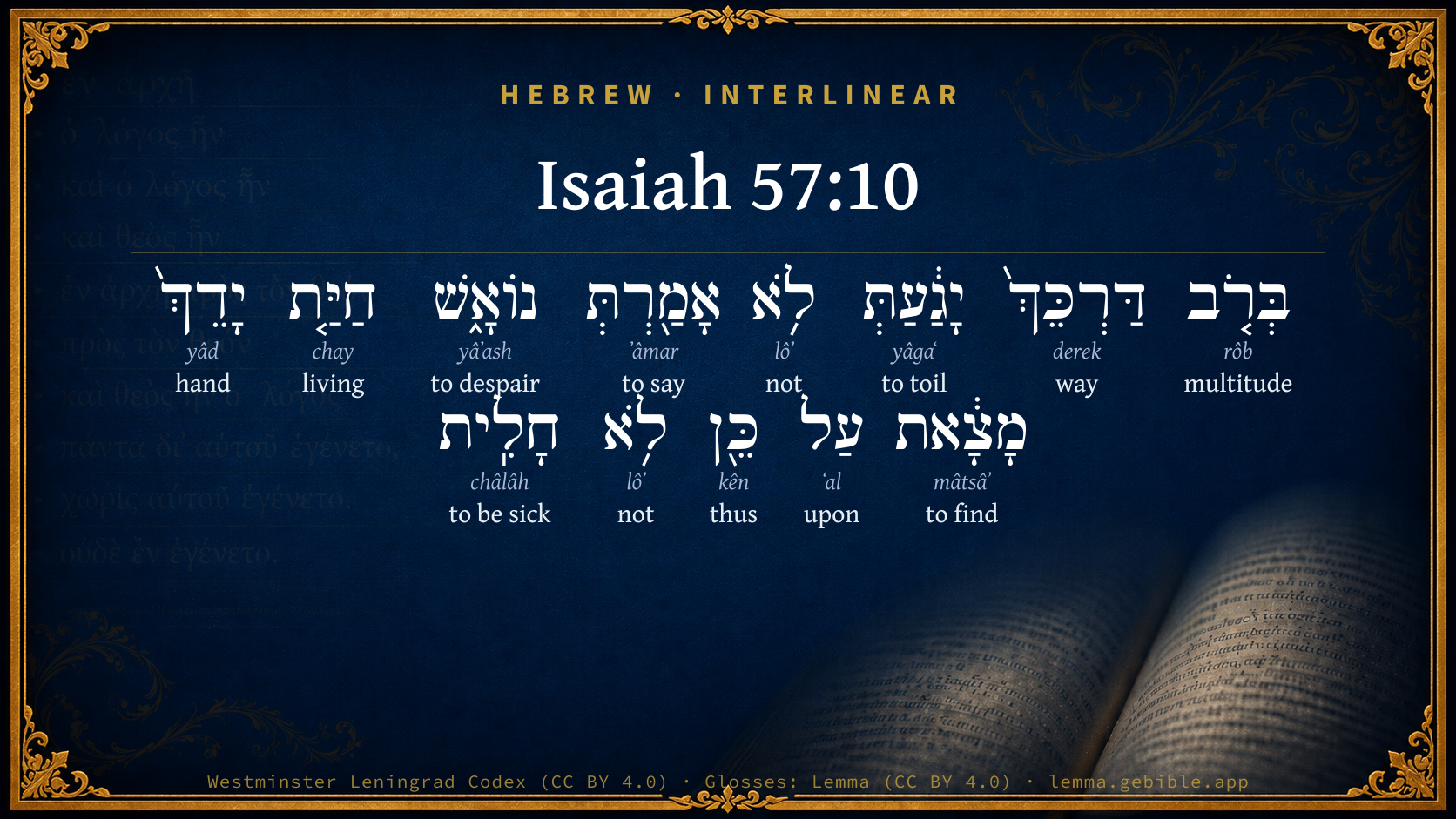
Hebrew (Westminster Leningrad Codex) Isaiah 57:10 appears in the Hebrew Old Testament. The text above is from the Westminster Leningrad Codex. Each word links to its Strong’s number, a concise gloss, and parsing drawn from the Open Scriptures Hebrew Bible morphology. Click any word for its full Brown-Driver-Briggs (BDB) entry.
Download image
Cite this verse

Isaiah 57:10 (World English Bible). Public Domain. Lemma interlinear Bible study tool, https://lemma.gebible.app/v/isaiah/57/10.

Show BibTeX & RIS
BibTeX
RIS
English Translation
You were wearied with the length of your way; yet you didn't say, It is in vain: you found a reviving of your strength; therefore you weren't faint.
World English Bible · Public Domain
Download a study sheet

One document with this verse’s original text, its word-by-word gloss line, the meaning frame, cross-references with their text, attributed commentary, and full source and license credits — printable, and it pastes into notes with its structure intact.

This verse Autodidact and up

Study sheet (.html) Plain text (.txt)

A passage Seminary Student

Up to 50 verses in one chapter. A passage sheet keeps up to 6 commentary sources and 12 cross-references per verse, in the order this page ranks them, and says so on the sheet whenever that leaves anything out. Ask for a single verse and you get the Autodidact verse sheet above.

Everything on this page stays free to read, with no account — the sheet is a download of what is already on screen, not access to it.

Want to remove ads? Support Godless Engineer
Compare translations 3

The same verse in 3 English versions, stacked beneath the original-language interlinear above. Click any original word for its lexicon entry.

Each is an independent rendering of the whole verse — the interlinear is not word-aligned to these translations.

Highlighted words mark where these versions differ — a whole-verse word diff, not a word-by-word alignment.

  • World English Bible Public Domain
    You were wearied with the length of your way; yet you didn't say, It is in vain: you found a reviving of your strength; therefore you weren't faint.
  • King James Version Public Domain
    Thou art wearied in the greatness of thy way; yet saidst thou not, There is no hope: thou hast found the life of thine hand; therefore thou wast not grieved.
  • unfoldingWord Literal Text CC BY-SA 4.0
    In the greatness of your way you become tired; you do not say, ‘Despairing!’ You find the life of your hand; therefore you do not weaken. q1

unfoldingWord Literal Text — © unfoldingWord, licensed CC BY-SA 4.0. Word-aligned USFM3 via Door43 (git.door43.org/unfoldingWord/en_ult).

Versions to compare (up to 4)

3 of 4 selected

Show all 18 translations

Every available English version of this verse, each an independent rendering of the whole verse.

  • World English Bible Public Domain
    You were wearied with the length of your way; yet you didn't say, It is in vain: you found a reviving of your strength; therefore you weren't faint.
  • Berean Standard Bible Public Domain
    You are wearied by your many journeys, but you did not say, “There is no hope!” You found renewal of your strength; therefore you did not grow weak.
  • Majority Standard Bible Public Domain
    You are wearied by your many journeys, but you did not say, “There is no hope!” You found renewal of your strength; therefore you did not grow weak.
  • King James Version Public Domain
    Thou art wearied in the greatness of thy way; yet saidst thou not, There is no hope: thou hast found the life of thine hand; therefore thou wast not grieved.
  • American Standard Version (1901) Public Domain
    Thou wast wearied with the length of thy way; yet saidst thou not, It is in vain: thou didst find a quickening of thy strength; therefore thou wast not faint.
  • Revised Version (1885) Public Domain
    Thou wast wearied with the length of thy way; yet saidst thou not, There is no hope: thou didst find a quickening of thy strength; therefore thou wast not faint.
  • Geneva Bible (1599) Public Domain
    Thou weariedst thy selfe in thy manifolde iourneys, yet saydest thou not, There is no hope: thou hast found life by thine hand, therefore thou wast not grieued.
  • Douay-Rheims (1899) Public Domain
    Thou hast been wearied in the multitude of thy ways: yet thou saidst not: I will rest: thou hast found life of thy hand, therefore thou hast not asked.
  • Young's Literal Translation Public Domain
    In the greatness of thy way thou hast laboured, Thou hast not said, `It is desperate.' The life of thy hand thou hast found, Therefore thou hast not been sick.
  • Literal Standard Version CC BY-SA 4.0
    You have labored in the greatness of your way, || You have not said, It is desperate. You have found the life of your hand, || Therefore you have not been sick.
  • Unlocked Literal Bible CC BY-SA 4.0
    You were tired from your long journey, but you never said, “It is hopeless.” You found life in your hand; therefore you did not weaken.
  • unfoldingWord Literal Text CC BY-SA 4.0
    In the greatness of your way you become tired; you do not say, ‘Despairing!’ You find the life of your hand; therefore you do not weaken. q1
  • Darby Bible Public Domain
    Thou wast wearied by the multitude of thy ways; [but] thou saidst not, It is of no avail. Thou didst find a quickening of thy strength; therefore thou wast not sick [of it].
  • World Messianic Bible Public Domain
    You were wearied with the length of your ways; yet you didn’t say, ‘It is in vain.’ You found a reviving of your strength; therefore you weren’t faint.
  • Webster's Bible Public Domain
    Thou art wearied in the greatness of thy way; yet saidst thou not, There is no hope: thou hast found the life of thy hand; therefore thou wast not grieved.
  • Free Bible Version CC BY-SA 4.0
    You wore yourselves out by such running around, but you didn't give up and say, “It's hopeless!” You found new strength and so didn't become weak.
  • Bible in Basic English Public Domain
    You were tired with your long journeys; but you did not say, There is no hope: you got new strength, and so you were not feeble.
  • JPS Tanakh (1917) Public Domain
    Thou wast wearied with the length of thy way; yet saidst thou not: 'There is no hope'; thou didst find a renewal of thy strength, therefore thou wast not affected.

Literal Standard Version (2020), Covenant Press — licensed CC BY-SA 4.0. Text via the HelloAO Bible API (eBible.org). Unlocked Literal Bible (unfoldingWord) — licensed CC BY-SA 4.0. Text via the HelloAO Bible API (eBible.org). unfoldingWord Literal Text — © unfoldingWord, licensed CC BY-SA 4.0. Word-aligned USFM3 via Door43 (git.door43.org/unfoldingWord/en_ult). Free Bible Version, Dr. Jonathan Gallagher — licensed CC BY-SA 4.0. Text via the HelloAO Bible API (eBible.org).

Word by word

More ways to search: Search by grammar → Find every occurrence → Compare this word →

Practice this passage: Drill this verse → Learn its vocabulary →

נוֹאָ֑שׁ
yâʼash
H2976
“despairing”
Verb, Niphal, Participle Active, Masculine, Singular, Absolute
Part of Speech
Verb
Stem
Niphal
Form
Participle Active
Gender
Masculine
Number
Singular
State
Absolute
Full BDB Definition

Origin: a primitive root

TWOT: 833

to despair - (Niphal) to be despaired, be desperate - (Piel) to cause to despair - it is hopeless!
  1. בְּרֹ֤ב rôb H7230 “in/at · multitude of” Preposition + Noun, Common, Both, Singular, Construct
  2. דַּרְכֵּךְ֙ derek H1870 “way · your” Noun, Common, Both, Singular, Construct + Suffix, Personal, 2nd Person, Feminine, Singular
  3. יָגַ֔עַתְּ yâgaʻ H3021 “to toil” Verb, Qal, Perfect, 2nd Person, Feminine, Singular
  4. לֹ֥א lôʼ H3808 “not” Particle, Negative
  5. אָמַ֖רְתְּ ʼâmar H559 “to say” Verb, Qal, Perfect, 2nd Person, Feminine, Singular
  6. חַיַּ֤ת chay H2416 “living of” Noun, Common, Feminine, Singular, Construct
  7. יָדֵךְ֙ yâd H3027 “hand · your” Noun, Common, Both, Singular, Construct + Suffix, Personal, 2nd Person, Feminine, Singular
  8. מָצָ֔את mâtsâʼ H4672 “to find” Verb, Qal, Perfect, 2nd Person, Feminine, Singular
  9. עַל ʻal H5921 “upon” Preposition
  10. כֵּ֖ן kên H3651 “thus” Particle, Demonstrative
  11. לֹ֥א lôʼ H3808 “not” Particle, Negative
  12. חָלִֽית châlâh H2470 “to be sick” Verb, Qal, Perfect, 2nd Person, Feminine, Singular

About this verse

These counts appear in no published source. They are computed here, from the morphology-tagged text and Lemma’s own curated glosses. What Lemma adds →

13
words
12
distinct lemmas
Prophets
section

Notable vocabulary

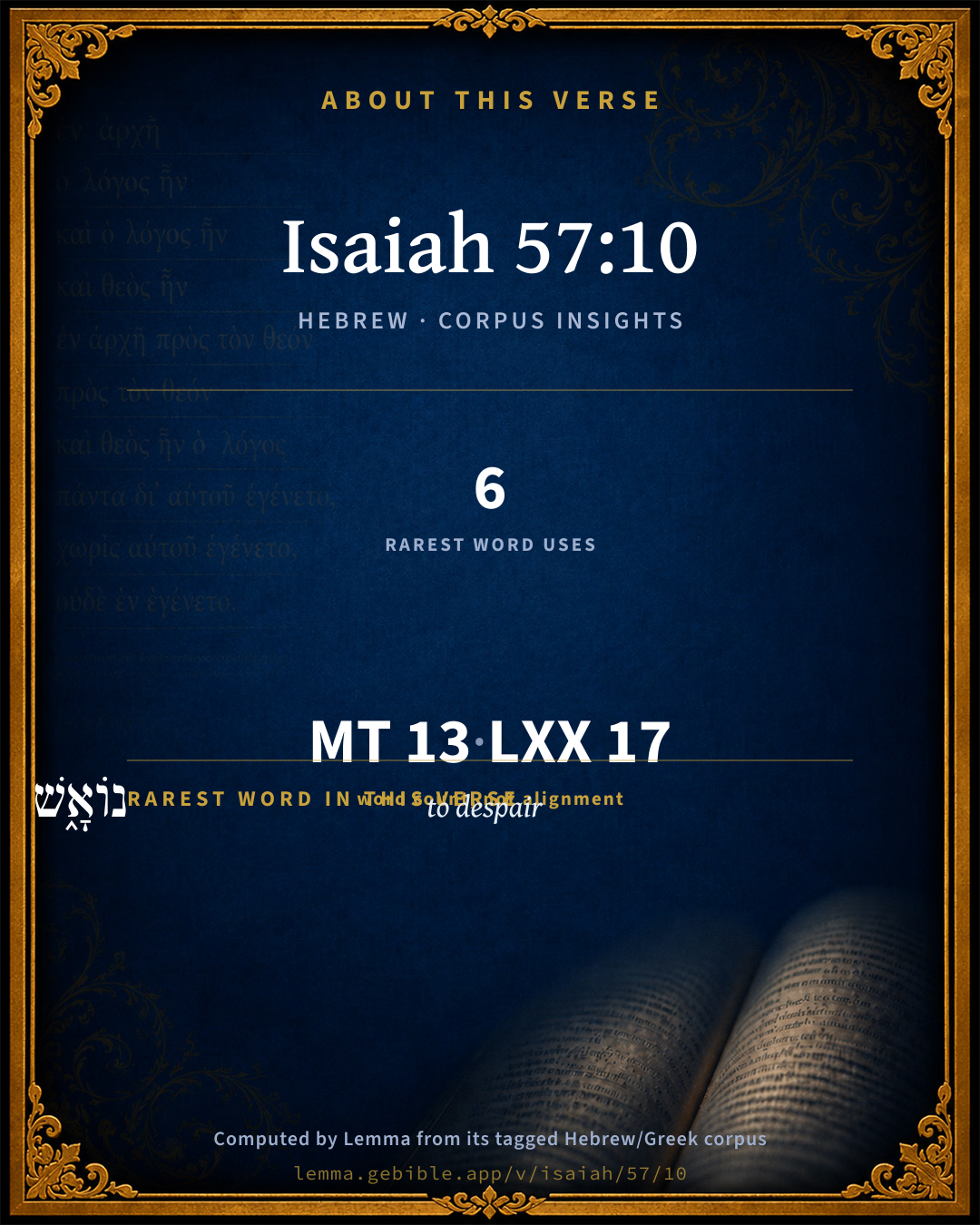
The rarest word here is נוֹאָ֑שׁ to despair H2976 — appearing just 6 times in the whole Hebrew Bible.

Shared distinctive vocabulary

נוֹאָ֑שׁ to despair H2976 occurs in 6 verses of the Hebrew Bible. Also found in:

Grammatical profile

  • 5 verbs
  • 4 nouns
  • 1 preposition
  • 3 particles

Verb forms

  • יָגַ֔עַתְּ Qal · Perfect
  • אָמַ֖רְתְּ Qal · Perfect
  • נוֹאָ֑שׁ Niphal · Participle Active
  • מָצָ֔את Qal · Perfect
  • חָלִֽית Qal · Perfect

Repetition

A word recurs within this verse — often emphatic in Hebrew:

Hebrew & Septuagint length

In English translation the verse runs 28 words from the Hebrew and 30 from the Septuagint (LXX English) — closely comparable.

A rough comparison of the two English renderings, which tokenize alike — not a word-level alignment.

Word counts can differ between the Hebrew and the Greek without any difference in meaning — e.g. the Hebrew direct-object marker אֵת has no separate Greek word, and Greek often adds the article ὁ.

In the original languages it is 13 Hebrew tokens and 17 Greek tokens — but the two are counted differently (Hebrew bundles its prefixes and suffixes into one token; the Greek is in lemma form), so that isn’t a like-for-like length.

Cross-references

12

Topical passages linked to Isaiah 57:10 in the Treasury of Scripture Knowledge — connected by theme and wording, ordered by reader-vote popularity; previews shown in the World English Bible.

  • Jeremiah 2:25 Withhold your foot from being unshod, and your throat from thirst: but you said, It is in vain; no, for I have loved strangers, and after them will I go.
  • Jeremiah 18:12 But they say, It is in vain; for we will walk after our own devices, and we will do everyone after the stubbornness of his evil heart.
  • Jeremiah 5:3 O Yahweh, don't your eyes look on truth? you have stricken them, but they were not grieved; you have consumed them, but they have refused to receive correction: they have made their faces harder than a rock; they have refused to return.
  • 2 Chronicles 28:22–23 In the time of his distress did he trespass yet more against Yahweh, this same king Ahaz.
  • Isaiah 47:13 You are wearied in the multitude of your counsels: let now the astrologers, the star-gazers, the monthly prognosticators, stand up, and save you from the things that shall come on you.
  • Jeremiah 2:36 Why go you about so much to change your way? you shall be ashamed of Egypt also, as you were ashamed of Assyria.
  • Jeremiah 3:3 Therefore the showers have been withheld, and there has been no latter rain; yet you have a prostitute's forehead, you refused to be ashamed.
  • Jeremiah 9:5 They will deceive everyone his neighbor, and will not speak the truth: they have taught their tongue to speak lies; they weary themselves to commit iniquity.
  • Jeremiah 44:17–18 But we will certainly perform every word that is gone forth out of our mouth, to burn incense to the queen of the sky, and to pour out drink-offerings to her, as we have done, we and our fathers, our kings and our princes, in the cities of Judah, and in the streets of Jerusalem; for then had we plenty of food, and were well, and saw no evil.
  • Ezekiel 24:12 She has wearied [herself] with toil; yet her great rust doesn't go forth out of her; her rust doesn't [go forth] by fire.
  • Habakkuk 2:13 Behold, isn't it of Yahweh of Hosts that the peoples labor for the fire, and the nations weary themselves for vanity?
  • Romans 7:9 I was alive apart from the law once, but when the commandment came, sin revived, and I died.

Cross-references courtesy of OpenBible.info (CC BY 4.0).

Hebrew and Greek witnesses Masoretic Hebrew ↔ Greek Septuagint

The same verse in the two great witnesses to the Old Testament, shown verse-for-verse.

These are two independent witnesses, not word-aligned to each other, and the Septuagint is shown in lemma (dictionary) form.

Hebrew Isaiah 57:10 Masoretic · Westminster Leningrad Codex

בְּרֹ֤ב דַּרְכֵּךְ֙ יָגַ֔עַתְּ לֹ֥א אָמַ֖רְתְּ נוֹאָ֑שׁ חַיַּ֤ת יָדֵךְ֙ מָצָ֔את עַל כֵּ֖ן לֹ֥א חָלִֽית

You were wearied with the length of your way; yet you didn't say, It is in vain: you found a reviving of your strength; therefore you weren't faint.

World English Bible · Public Domain

Greek LXX Isaiah 57:10 Septuagint · lemma form

ὁ πολυοδία σύ κοπιάω καί οὐ εἶπον παύω ἐνἰσχύω ὅτι πράσσω οὗτος διά οὗτος οὐ καταδέω ἐγώ

You have wearied yourself with your many ways; yet you said not, I will cease to strengthen myself: for you have done these things; therefore you have not supplicated me.

LXX2012 (modern English Septuagint) · Public Domain

On this verse, Albert Barnes' Notes on the Bible discusses the Septuagint’s reading. Read the note in Commentary ↓

Hebrew: Westminster Leningrad Codex (CC BY 4.0). Greek: Septuagint (public domain); English from LXX2012 (modern English Septuagint) (Public Domain). How the Septuagint differs from the Hebrew →

Targum (Aramaic paraphrase)

1

The Targum is the ancient Jewish Aramaic paraphrase of the Hebrew Scriptures — an interpretive translation, not the Hebrew text itself. Onkelos (literal) and Pseudo-Jonathan (expansive) render the Torah, and Jonathan the Prophets. Coverage is partial: where no permissively-licensed English translation exists for a verse, only the Aramaic is shown. This is verse-level text, not a word-by-word alignment to the Hebrew.

  1. Targum Jonathan Prophets (Joshua–Malachi)
    בְּסַגִיאוּת אוֹרְחָתִיךְ לָאֵית לָא אֲמַרְתְּ לְמִתַּב נִכְסִין סַגִיאִין אַסְגֵית עַל כֵּן לָא סַבַּרְתְּ לְמֵיתָב:

    Thou hast wearied thyself in the greatness of thy way; yet thou didst not thinks to return the many treasures thou hast multiplied, wherefore thou thoughtest not to repent.

    Targum Jonathan — Aramaic: “Mikraot Gedolot” (public domain). English: “Sefaria Community Translation” (CC0 1.0 (public-domain dedication)); “London "Chaldee Paraphrase," 1871” (public domain). Text via Sefaria.

Commentary

Notes on Isaiah 57:10 from classic Christian and Jewish commentators (each source and its license shown beneath its notes). The classic Christian expositions comment on the surrounding passage and are grouped to its opening verse, so a note may address several verses; the Jewish commentaries on the Tanakh (Rashi and others) are per-verse, so they appear only where the commentator wrote on this verse.

Lemma curates 59 commentaries, every one of them public domain or Creative Commons licensed, each selected and text-cleaned for this edition rather than reprinted as found. About our sources →

Trapp's Complete Commentary

John Trapp

Isa 57:10 Thou art wearied in the greatness of thy way; [yet] saidst thou not, There is no hope: thou hast found the life of thine hand; therefore thou wast not grieved.

Ver. 10. Thou art wearied in the greatness of thy way.] Great pains thou hast taken to small purpose, and yet thou thinkest and hopest, but groundlessly, that

Thou hast found the life of thy hand.] A sure way of subsistence; thy desired help and safety.

John Trapp, A Commentary or Exposition upon All the Books of the Old and New Testament (1647–1656) — public domain. Text from a community e-Sword module.

The Biblical Illustrator

Joseph S. Exell

Isa_57:10

Thou art wearied in the greatness of thy way

The weariness of sin

The text is a striking representation of the sinners conduct in fruitless efforts to obtain happiness anywhere but from heaven.

He wanders from object to object, he becomes weary in his pursuit, yet he will not abandon it.

I. HE PURSUES A WEARISOME COURSE. Nothing is so wearisome as fruitless efforts for happiness.

1. The sensual course for happiness is a wearisome one. The voluptuary and the debauchee very soon show exhaustion.

2. The secular course for happiness is a wearisome one. He who seeks happiness in the pursuit of gain will soon find it wearisome.

3. The intellectual course for happiness is a wearisome one. He who looks for true happiness in study and research will soon find it a weariness.

4. The superstitious course is a wearisome one. Millions are sinking into religious superstition--pilgrimages, penances, prayers, and devotional routine. What millions are found wearied in this path!

II. THOUGH THE COURSE IS WEARISOME HE PERSEVERES. Yet saidst thou not, There is no hope. Although Israel was wearied in seeking foreign help, still it continued; so with the sinner. To persevere in these wearisome methods for happiness is very foolish.

1. Because they will never become easier than they are. On the contrary, he who pursues these methods of happiness will become more and more weary on his way.

2. Because there is a pleasant way to true happiness. What is that? The loving surrender of your nature to God. The religious way to happiness is pleasant, because--

(1) It is worthy of your nature.

(2) Agreeable to your conscience.

(3) Promising to your hope.

Her ways are ways of pleasantness and all her paths are peace. How suited is the invitation of Christ to the wearied millions of earth who are seeking for happiness in wrong directions: Come unto Me, all ye, etc. (Homilist.)

Mans weary way

I. THE WAY WHICH IS HERE SUGGESTED TO US. Thou art wearied in the greatness of thy way. The way which the Israelites took was their own way as distinguished from Gods way. The way in which a man is walking, and by which he is seeking for salvation, until he has found peace through Christ, is more or less directly his own way.

II. THIS WAY, WHICH IS MANS OWN WAY, IS SPOKEN OF AS A GREAT WAY. Thou art weaned in the greatness of thy way. Looking at salvation as It Is in Itself, at the deliverance which is desired, a great deliverance is necessary; looking to the efforts which man will make to effect and attain this deliverance, great efforts are evidently necessary, and great efforts are frequently made. Micah speaks of a man giving thousands of rams and ten thousands of rivers of oil, yea, giving the life of his firstborn for the sin of his soul, if perchance he may save that soul. And it is perfectly marvellous to see the efforts which men have made, and arc making, in false religions, to secure that which they desire, namely, their souls salvation.

III. THIS WAY OF MANS OWN SEEKING IS A WEARY WAY. What disappointments the Israelites met with! So with a man seeking, salvation in his own way as distinct from Gods way. Just in proportion as a man is in earnest, just in proportion to the depth of his convictions of sin and righteousness, just in proportion to the sense which he has of the holiness of God, and the realities of eternity, will be the mans dissatisfaction with his own efforts and his own acts of self-denial.

IV. Although this is a weary way, and an unsatisfying way, yet IT HAS IN IT SOME PROMISES OF SUCCOUR AND SOME POWER OF SATISFACTION, WHICH PREVENTS THE MAN FROM WHOLLY DESPAIRING. The man finds life to his hand. There is enough in what he is doing, there is enough in what he is finding, to prevent him from wholly despairing. These persons are not prepared to say there is no hope; they are not prepared to despair of salvation in the manner in which they are seeking it; they are not wholly cast down. Therefore thou wast not grieved, not wholly disheartened. They go on persevering and pressing forward, hoping that a brighter day will come. Contrast with this way of man Gods way. The way of salvation sought and followed by the Jews resembles very much the way of salvation which the natural heart of man follows when he pursues and seeks that salvation; but now, what is, the way which God would have us to walk in, as contrasted with this way of mans own devising? That which marks Gods way, and distinguishes it especially from mans way, is this--that mans way is a way of fear and dread, while Gods way is a way of love. But how,you will say, are we to pass from this state, which is mans natural state of seeking for salvation, to that state which is described as Gods method of seeking and conferring salvation? The prophet tells us (verses 18, 19). (E. Bayley, M. A.)

The life of thine hand

The life of thine hand may mean, a revival of thy vigour. (A. B.Davidson, D. D.)

Yet saidst thou not, There is no hope

Hope, yet no hope: no hope, yet hope

(with Jer_18:12, And they said, There is no hope, etc.):--The subtlety of the human heart exerts itself to the utmost to prevent that heart from trusting in the Saviour, and while evil is always cunning, it shows itself to be supremely so in its efforts to guard the Cross against the approaches of sinners. By the Cross, as the Saviour said, the thoughts of many hearts are revealed. There are two phases in spiritual life which well illustrate the deceitfulness of the heart. The first is that described in my first text, in which the man, though wearied in his many attempts, is not and cannot be convinced of the hopelessness of self-salvation. When you shall have hunted the man out of this, you will then meet with a new difficulty, which is described in the second text. Finding there is no hope in himself, the man draws the unwarrantable conclusion that there is no hope for him in God. It is self-righteousness in both cases. In the one case it is the soul content with self-righteousness, in the second place it is man sullenly preferring to perish rather than receive the righteousness of Christ.

I. We have to speak of A HOPE WHICH IS NO HOPE. Thou art wearied in the greatness of thy way; yet saidst thou not, There is no hope, etc. This well pictures the pursuit of men after satisfaction in earthly things. They are content because they have found the life of their hand. Living from hand to mouth is enough for them; that they are still alive, that they possess present comforts and present enjoyments, this contents the many. As for the future, they say, Let it take care of itself. They have no foresight for their eternal state; the present hour absorbs them.

1. The text applies very eminently to, those who are seeking salvation by ceremonies.

2. A great mass of people, even though they reject priestcraft, make themselves priests, and rely upon their good works. The way of salvation by works, if it were possible, would be a very wearisome way. How many good works would carry a man to heaven, would be a question which it were very hard to answer.

3. Many are looking for salvation to another form of self-deception, namely the way of repentance and reformation.

II. We shall now turn to the second text. And they said, There is no hope, etc. Here we have No HOPE--AND YET HOPE. When the sinner has at last been driven by stress of weather from the roadstead of his own confidence, then he flies to the dreary harbour of despair. Despair is the mother of all sorts of evil. When a man sates,. There is no hope of heaven for me; then he throws the reins upon the neck of his lusts, and goes on from bad to worse. There is hope for you in Him whom God has provided to be the Saviour of such as you are. (C. H. Spurgeon.)

The Biblical Illustrator, edited by Joseph S. Exell (c. 1880s–1900s) — public domain. Text from a community e-Sword module.

Joseph Benson's Commentary

Isa 57:10. Thou art wearied with the greatness of thy way — Thou hast not eased, or relieved, but only tired thyself with all thy tedious journeys and laborious endeavours. Yet sayest thou not, There is no hope — And yet thou didst not perceive that thy labour was lost, and that thy case was not mended, but made more desperate by these practices. Thou hast found the life of thy hand — Thou hast sometimes found success in these ways; or, thou falsely supposest that thy hand is strengthened thereby. Therefore thou wast not grieved — Therefore thou didst not repent of thy sin and folly herein, but didst persist and applaud thyself in such courses.

Joseph Benson's Commentary on the Old and New Testaments (1811–1818) — public domain. Text from a community e-Sword module.

The Preacher's Complete Homiletical Commentary

Joseph S. Exell (gen. ed.)

THE SOUL’S WEARINESS IN ITS SINFUL WAY

Isa_57:10. Thou art wearied in the greatness of thy way, &c.

There is a littleness and there is a greatness in men’s sins. Some people are mean, timid in wickedness, would indulge passions more freely if they dared. But there is a force and boldness about the sins of others; they disregard public opinion, rush impetuously along broad roads, &c. Whilst we condemn, we also mourn, because such strength and manhood are wasted in the “greatness of their way.”

The text refers to a period of great iniquity in Jewish history during Manasseh’s reign. The light of Divine truth had not utterly faded away, so the nation was full of unrest and misery, and yet would not retrace its steps, and make its peace with God. Pathetic is this picture of the misery of sin.

I. THE SOUL’S WEARINESS IN IT SINFUL WAY.

Various are the causes of weariness.

1. The attempt of the creature to be independent of the Creator. A sinful life is an attempt to do without God. But our noblest instincts impel us to lean upon the power and love of God. Dependence is stamped upon every faculty and fibre of our nature. Who then can wonder that men grow weary when they strive to live an independent, self-sufficient life? The creature can no more do without the Creator, than streamlet without fountain, or branch without tree.

2. A sense of the unworthiness of a sinful life. No one can be really happy without some degree of self-respect. Other persons can laud a man to the skies, but it spoils all if in his heart he despises his own motives and conduct. Self-contempt is a source of keenest misery. There are moments of clear insight, when many a Christless man sees the utter disproportion between the life which he leads, and the nature God has given him—between what he is and what he was meant to be, and might be. When he thus begins to despise himself he is “wearied.”

3. The efforts of an outraged nature to avenge itself. It is impossible for a man to ill-treat himself without his very nature protesting against the injury. There are forces of pain which start into activity as soon as the evil is done. The body avenges its own wrongs—so also the soul. Give it error when it needs truth; husks of worldly pleasure when it hungers for bread of life, and a cry of discontent and pain will break forth from the injured soul. So the path of sin is a tiresome road, and men often grow “wearied.”

II. THE SOUL’S PERSISTENCE IN ITS SINFUL WAY.

Weary but persistent. Many things impel men to pursue the road even when faint.—

1. The marvellous vitality of hope. Hope is like a hardy plant, which may be trampled under foot, but presently springs up into fresh life and beauty. Men are often baffled, deceived, achieve grand results, led on by living energy of hope. Yet all great things draw greatly astray when wrongly directed. So hope impels men to persist in folly and sin. Disappointed, wearied, they still persevere.—-

2. Dislike to confess failure. It seems a degradation to many a man to admit that he has made a mistake. Pride often leads the sinner to persist in his way. Weary at heart, yearning for a nobler life, still it is hard work for him to humble himself, to go back, to say, “I have sinned.”—

3. Ignorance of God’s character. Some think they are beyond Divine mercy—that God is “altogether such an one” as themselves—impatient and unforgiving toward those who have wronged Him. Weary souls would sometimes eagerly return to Him, and seek His grace, if they only saw into the depths of His heart and knew the truth.

CONCLUSION.—There is a Divine purpose in pain and weariness. God makes the sinner’s way difficult, so that he may be led to forsake it. When we cry, “There is no hope,” then there is hope through Christ, who was once wearied in the greatness of His way.—F. W. Mays, M.A.: The Homiletic Magazine, vol. vii. p. 145.

Isa_57:11-12. I. Hypocrisy. Fearless, false, inconsiderate, presumptuous. II. Its exposure. Certain, full. Its righteousness, nought; its works, wicked; its hopes, vain.

Isa_57:12. I. Men’s righteousness. II. Its exposure. III. Its worthlessness.

Isa_57:13-16. I. The insufficiency of human confidences. II. The all-sufficiency of God.

Isa_57:13. I. False confidences. Cannot save. Will be swept away. End in destruction and misery. II. True confidence. Fixed in God. Enjoys present blessings. Inherits future happiness.

Isa_57:14. I. The stumbling-blocks. Inconsistencies. Errors. Divisions. False professors. II. Their removal. Necessary. Imperative. Personal.—Dr. Lyth.

The Preacher's Complete Homiletical Commentary (gen. ed. Joseph S. Exell; Funk & Wagnalls, c. 1892) — public domain (pre-1929). A full-Bible homiletical/sermon-outline anthology covering 65 of 66 books (2 John is absent from the source module). Text from a community e-Sword module.

Geneva Bible (1599)

Geneva Bible translators

He derideth their unprofitable diligence, which thought to have made all sure, and yet were deceived.

Although thou sawest all thy labors to be in vain, yet wouldest thou never acknowledge thy fault, and leave off.

Geneva Bible (1599) marginal notes — public domain. Text via Bolls.life.

Jamieson, Fausset & Brown

Robert Jamieson, A. R. Fausset & David Brown

greatness of . . . way--the length of thy journey in seeking strange gods, or else foreign aid (Jer 2:23-24). Notwithstanding thy deriving no good from these long journeys (so, "send . . . far off," Isa 57:9), thou dost not still give up hope (Jer 2:25; Jer 18:12).

hast found . . . life of . . . hand--for "thou still findest life (that is, vigor) enough in thy hand" to make new idols [MAURER], or to seek new alliance ("hand" being then taken for strength in general).

grieved--rather, "therefore thou art not weak" [MAURER]; inasmuch as having "life in thy hand," thou art still strong in hope.

Jamieson, Fausset & Brown — Commentary Critical and Explanatory on the Whole Bible (1871) — public domain (CC PDM 1.0). Text via the HelloAO Bible API.

Adam Clarke's Commentary

Verse 10. Yet saidst thou not, There is no hope - "Thou hast said, There is hope"] In one of the MSS. at Koningsberg, collated by Lilienthal, the words לא אמרת lo amarta, are left in the text unpointed, as suspected; and in the margin the corrector has written ותאמרי vattomari. Now if we compare Jer 2:25 and Jer 18:12, we shall find that the subject is in both places quite the same with this of Isaiah; and the sentiment expressed, that of a desperate resolution to continue at all hazards in their idolatrous practices; the very thing that in all reason we might expect here. Probably, therefore, the latter is the true reading in this place. - L.

Adam Clarke's Commentary on the Bible (1810–1826) — public domain. Text from a community e-Sword/MySword module.

Ellicott's Commentary for English Readers

(10) Thou art wearied in the greatness of thy way . . .—Better, with the length of thy journey—i.e., with the long embassies to Assyria, and to Babylon, as for the time the residence of its kings. For “there is no hope,” read, there is no result, or profit. Judah would not acknowledge that the negotiations were fruitless.

Thou hast found the life of thine hand . . .—The words arc a literal rendering, and convey the meaning, Thou didst renew the strength of thine hand—i.e., Judah found a fancied increase of power in the alliance she was seeking, and therefore did not repent of her ignominious diplomacy.

A Bible Commentary for English Readers, edited by Charles John Ellicott (1878–1897) — public domain. Text from a community e-Sword module.

The Cambridge Bible for Schools and Colleges

gen. ed. J. J. S. Perowne

10, 11. Although wearied by these idolatries they have persisted in them with an infatuation which has blinded them to their desperate situation, and rendered them indifferent to the fear of Jehovah.

in the greatness of thy way] i.e. “through thy much wandering,” thy multifarious religious observances.

There is no hope] Lit. “desperatum est”; cf. Jer_2:25; Jer_18:12 (with a somewhat different shade of meaning).

thou didst find the life of thine hand] A very obscure and variously explained phrase. R.V. a quickening (i.e. renewal) of thy strength is perhaps the most feasible interpretation, but the peculiar expression is hardly accounted for, unless it be a current proverb.

thou wast not grieved] lit. sick, weak and faint. Comp. Jer_5:3, “Thou hast smitten them and they did not become sick,” i.e. did not feel weak.

The Cambridge Bible for Schools and Colleges (gen. ed. J. J. S. Perowne; Cambridge University Press, 1878–1918) — public domain. Text from a community e-Sword module.

John Gill's Exposition

Thou art wearied in the greatness of thy way,.... Or, "in the multiplicity of thy ways" (u): which were so many, as were enough to make her weary; the steps which were taken to obtain so much power over kings and kingdoms, which was gradually got with great pains and artifice, and to amass such vast treasures, and to enlarge her interest, and spread her religion in the world; the multitude of stratagems devised, and vast number of men employed, and embassies made to carry her point everywhere. Jarchi's note is,

"to fulfil thy desires, and to enlarge thy substance:''

yet saidst thou not, there is no hope; as men in a good cause are apt to do, upon every difficulty that arises; but here, in this case, though the cause was very bad, yet when schemes did not take, or not so soon as wished for and expected, new difficulties arose, and opposition made; yet no cost nor pains were spared to gain the point in view, and establish a kingdom and hierarchy; which at last succeeded: this expresses the resolution, constancy, and pertinency of the bishops of Rome in their ambitious views and claims of power, who would not give out, nor despair of arriving at what they aimed at; and which, through great fatigue and labour, they attained unto:

thou hast found the life of thine hand; that which was sought for and laboured after; sovereignty over all bishops and churches; power over kings and kingdoms; and an universal empire over consciences, as well as over churches and nations; and also immense treasure and riches to support the pope, cardinals, priests, &c.; and perhaps giving life to the image of the beast that it should speak, and cause those that would not worship it to be killed, may be included, Rev 13:15. The Targum is,

"thou hast multiplied (or as other copies) thou hast found great riches.''

Jarchi's note is,

"the necessity of thine hands, thou hast found prosperity in thy works:''

therefore thou wast not grieved; at the toil and labour used, pains taken, and weariness contracted; the issue was an over recompence for all the trouble and difficulty that attended it: or, "therefore thou wast not sick" (w); of the undertaking; did not despond in mind, or languish without hope of succeeding, finding ground was gained; and at last things went according to wishes; and then it caused no grief to reflect upon the fatigue and trouble that had been endured; and also grieved not at the idolatry introduced, nor repented of it; see Rev 9:20, So the Targum interprets it of impenitence.

(u) "in multitudine viae tuae", Pagninus, Montanus. (w) "non aegrotasti", Pagninus, Montanus, "non aegrotas", Junius & Tremellius, Piscator.

John Gill's Exposition of the Whole Bible (1746–1763) — public domain (CC PDM 1.0). Text via the HelloAO Bible API.

Albert Barnes' Notes on the Bible

Thou art wearied in the greatness of thy way - That is, in the length of thy journeys in order to procure foreign aid. Thou hast traveled to distant nations for this purpose, and in doing it, hast become weary without securing the object in view.

Yet saidst thou not, There is no hope - ‘Thou didst not say it is to be despaired of (נואשׁ nô'âsh), or it is vain. Though repulsed in one place, you applied to another; though weary, you did not give it up. Instead of returning to God and seeking his aid, you still sought human alliances, and supposed you would find assistance from the help of people.’ This is a striking illustration of the conduct of people in seeking happiness away from God. They wander from object to object; they become weary in the pursuit, yet they do not abandon it; they still cling to hope though often repulsed - and though the world gives them no permanent comfort - though wealth, ambition, gaiety, and vice all fail in imparting the happiness which they sought, yet they do not give it up in despair. They still feel that it is to be found in some other way than by the disagreeable necessity of returning to God, and they wander from object to object, and from land to land, and become exhausted in the pursuit, and still are not ready to say, ‘there is no hope, we give it up in despair, and we will now seek happiness in God.’

Thou hast found the life of thine hand - Margin, ‘Living.’ Lowth, ‘Thou hast found the support of thy life by thy labor.’ Noyes, ‘Thou yet findest life in thy hand. Much diversity of opinion has prevailed in regard to the interpretation of this passage. Vitringa interprets the whole passage of their devotion to idols, and supposes that this means that they had borne all the expense and difficulty and toil attending it because it gratified their hearts, and because they found a pleasure in it which sustained them. Calvin supposes that it is to be understood ironically. ‘Why didst thou not repent and turn to me? Why didst thou not see and acknowledge thy madness? It was because thou didst find thy life in thy hand. All things prospered and succeeded according to thy desire, and conferred happiness.’ The Septuagint renders it, ‘Because in full strength (ἐνισχύουσα enischuousa) thou hast done this; therefore thou shouldst not supplicate me.’ Jerome explains it to mean, ‘because they have done the things referred to in the previous verses, therefore they had not supplicated the Lord, trusting more in their own virtues than in God.’ The Syriac renders it, ‘The guilt of thy hand has contracted rust for thee, therefore thou hast not offered supplication.’ The Chaldee renders it, ‘Thou hast amassed wealth, therefore thou didst not repent.’ Kimchi explains it to mean, ‘Thou hast found something which is as pleasant to thee as the food is which is the life of man.’ The phrase ‘life of thy hand’ occurs nowhere else.

The hand is the instrument by which we execute our purposes; and by the life of the hand here, there seems to be meant that which will give full and continued employment. They had found in these things that which effectually prevented them from repenting and returning to God. ‘They had relied on their own plans rather than on God; they had sought the aid of foreign powers; they had obtained that which kept them from absolute despair, and from feeling their need of the assistance of God. Or, if it refers to their idol-worship, as Vitringa supposes, then it means that, not withstanding all the trouble, toil, and expense which they had experienced, they had found so much to gratify them that they continued to serve them, and were unwilling to return to God.

Therefore thou wast not grieved - Lowth, ‘Thou hast not utterly fainted.’ The word used here (חלה châlâh) means “to be polished”; then to be worn down in strength; to be weak or exhausted Jdg 16:7; then to be sick, diseased, made weak. Here it means, that either by the aid Which they had obtained by foreign alliances, or by the gratification experienced in the service of idols, they had found so much to uphold them that they had not been in utter despair. And the passage may teach the general truth, that not withstanding all the trials and disappointments of life, still sinners find so much comfort in the ways of sin, that they are not utterly overwhelmed in despair. They still find the ‘life of their hand in them.’ If a plan fails, they repeat it, or they try another. In the pursuits of ambition, of wealth, and of fashion, notwithstanding all the expense, and irksomeness, and disappointment, they find a kind of pleasure which sustains them, and enough success to keep them from returning to God. It is this imperfect pleasure and success which the world gives amidst all its disappointments, and this hope of less diminished joys and more ample success. in schemes of gain, and pleasure, and ambition, that sustains the votaries of this world in their career, and keeps them from seeking the pure and unmingled pleasures of religion. When the world becomes all gloom, and disappointment, and care, then there is felt the necessity of a better portion, and the mind is turned to God. Or when, as is more common, the mind becomes convinced that all the joys which the world can give - allowing the utmost limit to what is said by its friends of its powers - are poor and trifling compared with the joys which flow from the eternal friendship of God, then the blessings of salvation are sought with a full heart; and then man comes and consecrates the fullness of his energies and his immortal vigor to the service of the God that made him.

Albert Barnes' Notes on the Bible (1834–1885) — public domain. Text from a community e-Sword/MySword module.

Haydock's Catholic Bible Commentary

Rest. They were obstinate before the coming of Nabuchodonosor, and of the Romans. --- Asked. Confiding in their own strength.

George Leo Haydock (1774–1849), Haydock's Catholic Family Bible and Commentary, 1859 edition — public domain. Excludes Psalms (Douay-Rheims chapter numbering differs from Protestant) and Deuterocanonical books (Catholic canon only).

Matthew Poole's English Annotations

Thou art wearied in the greatness of thy way; thou hast not eased or relieved, but only tired thyself with all thy tedious journeys and laborious endeavours.

Yet saidst thou not, There is no hope; and yet thou wast so stupid under all thy discouragements and disappointments, that thou didst not perceive that thy labour was lost, and that thy case was not mended, but made worse and desperate by these practices.

Thou hast found the life of thine hand; thou hast found (i.e. thou falsely imaginest that thou hast found, or shalt assuredly find by these courses) the life (i.e. the strength and rigour) of thine hand, that thine hand is strengthened by these practices; or, life by thine hand, i.e. by these endeavours and applications of thyself to others for help. Or, thou hast sometimes found success in these ways.

Therefore thou wast not grieved; therefore thou didst not repent of thy sin and folly herein, but didst persist and applaud thyself in such courses.

Matthew Poole's English Annotations on the Holy Bible (1683–1685) — public domain. Text from a community e-Sword/MySword module.

The Pulpit Commentary

Thou art wearied in the greatness of thy way. Judah had travelled far from God, seeking aid from all quarters, and might well be "wearied" with her quest; but she would not confess her weariness she would not say. There is no hope; she stirred up her remaining strength, and persisted in her course, not suffering herself to "grieve.

HOMILIES BY W.M. STATHAM Ver. 10. The weariness of life.

"Thou art wearied." What do we mean by "weariness"? Look at the word. It means "to wear;" not to wear out, but to wear away, to exhaust the nervous sensibilities, the tissues of brain and heart. So we use the word in relation to mind. We become worn and weary. St. Paul felt this. It is not lassitude which comes from indifference, but the exhaustion felt by the earnest and. the faithful soul. Let us thank God for restorative power. In nature how blessed this is! The weary traveller, unable to drag his tired limbs one step further through the leaden air and under the copper sky of the East, laves his limbs in the limpid stream, and lies down to rest. When the sun fills the east with rosy light he is up and. off again the birds sing, the air is full of vitality; freshened and cheered, he is young once morel So with grace. God has provided refreshment for us all. We need. not despair of reaching the goal. "They shall return, and come to Zion with songs and everlasting joy upon their head." We have the ever-open fountain of a Saviour"s precious blood, to which we can come for cleansing and renewal; the Holy Ghost to quicken and inspire; and the Word of God, which is spirit and life"Come, let us anew our journey pursue.

I WEARINESS COMES WITH TEMPORARY DISAPPOINTMENT AND DEFEAT. I say "temporary," because God himself has promised to perfect that which concerneth us. The top-stone shall be put on the temple of character with shoutings of "Grace, grace unto it." The way of perfection is just the way which wearies us. The building for immortality cannot be completed in a day. Moreover, the stones are living stones. We are disappointed that the building does not progress quickly and easily. And we are human as well as Divine. We have citizenship and home to deal with. We are related to friends and to children. Think of Rebekah! She said, "I am weary of my life because of the daughters of Heth. If Jacob take a wife of the daughters of Heth such as these?" The motherly anxiety was at work. She knew how slight her power was in such a sphere as that of her boy"s love; and she knew what life-issues depended on that. As we get older we feel "limitations" of power. We can counsel and pray, but we cannot command. The mind looks with sorrow on the feeble sceptre of the will! We stand outside events, and all we can do is so little.

Disappointment is a school wherein we learn humility and trust in God. Disappointment is a cloud, and we wait till the heavens are clear and the all-revealing light comes again. But we are defeated, too, in ourselves; in others. "Depart from me," Peter said; "for I am a sinful man, O Lord." "Oppressed with sin and woe A burdened heart I bear.

But first defeat has made many a true general, has quickened many inventors, like Watt, Stephenson, and Brunel, and the vanquished one has become the victor in after-hours. Still, weariness comes to student, explorer, scientist, and missionary, to philanthropist saddened with ingratitude, and to disciple following the Lord. But this is not the weariness of sin; that not only exhausts, but destroys.

II WEARINESS COMES WITH SELF-DISCOVERY. We become more revealed to ourselves. The volcano tells what is in the earth. The lightning reveals the latent electricity in the air. Passions and lusts reveal terrible possibilities in good men. David said, "I am weary with my groaning; all the night make I my bed to swim;" and again, "I am weary of my crying; my throat is dried: mine eyes fail while I wait for my God." Conflict with sin in all its forms is weary, weary work.

1. The roots are so hidden. Like some garden weeds, they have roots that never seem uprooted, long white threads that interlace the earth and strangle other plants.

2. The battle is so varied. Like Stanley"s passage of the falls, enemies on both banks and on the island mid-stream cannibals who cry, "Meat, meat!" Scripture speaks of enemies who devour our souls. "Their sleep is taken away, unless they cause some to fall.

3. The avengements are so real. There is no escaping the voice! "Thou art the man!" And the soul cannot pretend not to hear. It turns pale. Scepticism says, "It is not a real voice!" How does scepticism know? The induction, is so wide and comprehensive. All men feel it after sin. Take Divine advice. "Be not deceived; God is not mocked: for whatsoever a man soweth, that shall he also real)." Weariness, you say, then, is to be expected. Yes; think of the cry of St. Paul. "Who shall deliver me from the body of this death?" The answer is, "Christ Christ alone." "We are more than conquerors through him that loved us." More than conquerors! Yes, because we do not leave a desolate province. The gospel is a creator as well as a conqueror. "The desert shall rejoice and blossom as the rose.

III WEARINESS COAXES WITH UNBELIEF. It was so in the old world, and so it will be in the new. The Greeks had an underlying sadness in their outwardly beautiful life, as Luthardt so well shows in his volume on the Christian evidences. It is faith which gives life and zest. Thomas Carlyle says in his essay on Diderot, "All epochs, wherein unbelief, under whatever form soever, maintains its sorry victory, should they ever for a moment glitter with a sham splendour, vanish from the eyes of posterity; because no one chooses to burden himself with study of the unfruitful." So he shows us how French philosophism vanished into non-entity. Yes, that is it; there is non-entity, no-being in unbelief. What a glorious creed is the Christian creed meeting all deepest necessities of sin, and want, and sorrow, and immortal instinct,. by its doctrines of Divine atonement, fatherhood, sympathetic brotherhood, and eternal life! Who can be weary when he believes in One who is himself the revelation of the Father? Bringing life and immortality to light, Christ has made this world more beautiful. There is a deeper life even in human love. As Esther Lyon says, in "Felix Holt," "One likes a beyond everywhere." Men must be weary who have lost faith.

1. Round of same duties without a goal.

2. Growth a mockery merging into weakness.

3. Health into pain.

Vision into dimness. Thought into blank! If this age becomes an unbelieving age, its joy-bells will all be muffled, its fruit will all wither. It is faith that foresees, foretastes, and forestores.

IV WEARINESS COMES FROM SOLITUDE. The regiment is thinning, thinning, in which you started. You have seen many arms of the soldiers "dip below the downs" into the valley. You are beginning in a human sense to feel solitary. Yes; it is not enough to give help even to the poor; you must visit the fatherless and widows in their afflictions. Show them a face. An old woman was once speaking to me of a young visitor who was timid and shy, and could not pray with her! "What did she do then?" I said. "Oh, she looked at me, and it did me good!" Yes; the face is a revelation. The Master was weary in solitude: "What! could ye not watch with me one hour?" So was St. Paul: "At Athens alone." We cannot take the poet"s recipe"Bury our dead joys, And live above them with a loving world.

No; it is ignoble to forget them. But the Christian is never alone. The Saviour is near. "I will not leave you comfortless: I will come to you." God grant that all our solitude may be lightened by his presence, all our weariness refreshed by his love. Into green pastures he will lead us, by still waters he will talk to us. And all the weary and heavy-laden may find rest in him. W.M.S.

Weariness in sinful error.

Whether the guilty error of Israel consisted in its departure into idolatry, or in its having recourse to the arm of flesh instead of to the power of its Divine Redeemer, we reach the same conclusion, viz.

I THAT SIN GOES TO TEDIOUS LENGTHS IN ITS WANDERING FROM GOD. It is "wearied in the greatness of its way." Whatever may be the particular course which iniquity may take whether it moves in the direction of disbelief, or of covetousness, or of any one of the vices, or of worldliness it goes far enough to find that the path of sinful error is a long and tedious road, that it is one in which the soul finds no lasting satisfaction, that there continually recurs a sense of want and spiritual craving, a hungering of the heart for that which is not supplied. Their name is legion who find their own chosen course of sin a weary round, an unsatisfying pursuit.

II THAT, SPITE OF ITS OWN WEARINESS, ST PERSISTS IN" ITS UNHALLOWED PATH. It is weary enough, yet it "says not, There is no hope." It finds just enough to maintain some kind of existence life of thine hand to go on without being altogether changed and restored. Are there not multitudes of men who are dragging on a weary life, profoundly dissatisfied with what they are in themselves and what they are accomplishing, and yet allowing themselves to continue in their guilty course? The path of sin is a very pitiable one; it is no wonder

III THAT IT CALLS DOWN A STRONG DIVINE REPROACH. (Ver. 11.) God reproaches his erring children:

1. That they have given themselves up to that which is utterly unworthy of their devotion: "Whom hast thou feared?

2. That they have neglected the strong claims he has on their worship and service he who has laid them under such deep obligations and has held out to them such glorious prospects; "Hast not remembered me." Nor must it be forgotten

IV THAT GOD"S SILENCE, AS WELL AS HIS SPEECH, IS AN ARGUMENT FOR RETURN. "Have not 1 held my peace... and thou fearest me not?

1. God"s silence is strangely and grievously misinterpreted. (Ps 50 Ps 21)

2. Instead of making it an encouragement to sin, it ought to be employed as an opportunity for repentance. It is a Divine pause, in order that, while it lasts, the guilty may reconsider and return.

3. God"s silence is temporary; it is imposed on himself by a strong and merciful restraint. But it cannot be very long continued; the interests of righteousness demand that it shall be broken. Let not the impenitent presume "For tho" mercy be kind and its patience endure, To the path of repentance it seeks to allure, And they who are deaf to its voice may be sure That God will not always be silent. Oh, Time brings the hour we shall soon all be there When the Judge on his judgment-throne shall appear, And his sentence of mercy or wrath shall declare, And then win no longer be silent. C.

The weariness of sinful ways.

Cheyne thinks the first reference of this verse is to the ceaseless quest of the nation, in this its troublous time, for help and protection, including, of course, embassies to foreign kings, and also every other specimen of untheocratic policy. "Nothing could convince these idolatrous Jews of the folly of their misplaced trust and vain confidence." Barnes given the following suggestive note on the general application of the passage: "This is a striking illustration of the conduct of men in seeking happiness away from God. They wander from object to object; they become weary in the pursuit, yet they do not abandon it; they still cling to hope though often repulsed, and though the world gives them no permanent comfort, though wealth, ambition, gaiety, and vice all fail in imparting the happiness which they sought, yet they do not give it up in despair. They still feel that it is to be found in some other way than by the disagreeable necessity of returning to God, and they wander from object to object, and from land to land, and become exhausted in the pursuit, and still are not ready to say, " There is no hope; we give it up in despair, and we will now seek happiness in God. Matthew Henry keenly, if somewhat quaintly, says, "Prosperity in sin is a great bar to conversion from sin." Henderson puts in a good sentence the immediate and local association of the verse: "The idolatrous Jews wearied themselves with their unhallowed practices; but finding that they had not entirely exhausted their strength, they would not give up their pursuits as hopeless, but rather emboldened themselves in wickedness.

I IT IS A FACT SINFUL WAYS DO WEARY US. Illustrate the pursuit of pleasure by means of self-indulgence. Or the "quest of the chief good" on purely human lines (illustrate this from the Book of Ecclesiastes). Or the mastery of evil by effort of serf-will. Or the effort to get eternal life by our own doings and strivings. In every case we are soon left wearied out and sick at heart.

II THIS FACT MEN ARE SLOW TO RECOGNIZE. They will not say, "There is no hope." By all kinds of delusions men persuade themselves to try once again. The last thing men will give up is hope in themselves and their own self-schemes.

III MAN"S CHANCE COMES ONLY WHEN HE IS HUMBLE ENOUGH TO RECOGNIZE THIS FACT. He must he willing to say, "Myself I cannot save." Then, turning to God, he will say, "Thou canst save, and thou alone. R.T.

The Pulpit Commentary (1880–1919), ed. H.D.M. Spence-Jones & Joseph S. Exell — public domain. Text from a community e-Sword module.

John Wesley's Explanatory Notes

Wearied - Thou hast not eased, but tired thyself with thy tedious journey. Yet - And yet thou didst not perceive that thy labour was lost. Hast found - Thou hast sometimes found success in these ways. Not grieved - Therefore thou didst not repent of thy sin herein.

John Wesley, Explanatory Notes Upon the Whole Bible (1754–1765) — public domain. Text via the GEBible commentary corpus.

J. A. Alexander on Isaiah

Joseph Addison Alexander

In the greatness of thy way (or the abundance of thy travel) thou hast labored; (but) thou hast not said, There is no hope. Thou hast found the life of thy hand; therefore thou art not weak.” Whether ‘way’ be understood as a figure for the whole course of life, or as involving a specific allusion to the journeys mentioned in v. 9, the general sense is still the same, viz. that no exertion in the service of her false gods could weary or discourage her. This is so obviously the meaning of the whole, that the common version ‘thou art wearied’, seems to be precluded, the rather as the verb may be used to denote the cause as well as the effect, (i.e., exertion no less than fatigue). The essential idea conveyed by the obscure phrase ‘life of thy hand’ is that of strength. In translation this essential sense may be conveyed under several different forms: ‘Thou hast found thy hand still alive, or still able to sustain life, etc.’

Joseph Addison Alexander, The Prophecies of Isaiah (1846–1847; New York: Scribner, 1870–1878) — public domain. Text from a community e-Sword module.

Rashi

Rabbi Shlomo Yitzchaki (Rashi)

With the length of your way you became wearied You engaged in your necessities, in the filling of your lust, to increase your wealth.

you did not say, “Despair.” I will despair of these and I will no longer care to engage in them, but I will pay my attention to Torah and precepts.

The power of your hand you found Heb. חַיַּת, the necessity of your hand you have found; you have succeeded in your deeds.

therefore, you were not stricken ill Your heart was not stricken ill to worry about My service, to engage in the Torah. חַיַּת is an Arabic word, meaning necessity.

Rashi on the Tanakh — English translations: “The Judaica Press complete Tanach with Rashi, translated by A. J. Rosenberg” (CC BY 4.0); “Pentateuch with Rashi's commentary by M. Rosenbaum and A.M. Silbermann, 1929-1934” (public domain); “The Metsudah Tanach series, Lakewood, N.J” (CC BY 4.0); and “The Book of Joshua, Metsudah Publications, 1997” (CC BY 4.0). Text via Sefaria.

Ibn Ezra

Rabbi Abraham ibn Ezra

In the greatness of thy ways, which thou didst frequent, and in which thou hast wearied thyself, without saying: נואש there is no hope, my heart is despairing; (comp. שאול ונואש ממני and Saul shall despair of me (1 Sam. 27:2)); thou thoughtest that thy exertion might still be of some use.

חית The life, that is, the strength. Thou hast found the life of thine hand, when thou hadst wearied thyself; therefore thou wast not grieved.

Ibn Ezra on the Tanakh — English translations: “Sefaria Community Translation” (CC0 1.0 (public-domain dedication)); “Yalkut, Sifsei Chachomim Chumash, Metsudah Publications, 2009” (CC BY 4.0); and “Commentary of Ibn Ezra on Isaiah - trans. by M. Friedlander, 1873” (public domain). Text via Sefaria.

Lesson kit

Teaching starters — assembled from the data on this page, not authored interpretation. Every prompt links to the verse data it draws on. Edit before teaching.

Isaiah, in the Prophets, opens this verse with 13 words (12 distinct Hebrew lemmas). Its most distinctive word is yâʼash (“to despair”). A historical commentator’s framing appears above. Read the whole chapter for the surrounding context.

Discussion questions

  1. The word yâʼash carries the sense “to despair.” How does it shape the verse?
  2. 1 Samuel 27:1 shares the word «to despair» with this verse. How do the two illuminate each other?
  3. “not” occurs 2× in this one verse. What is the effect of the repetition?
  4. The translations on this page render this verse differently — a whole-verse word diff, not a word-by-word alignment. What might account for the different wordings?
  5. The verb «יָגַ֔עַתְּ» is Qal Perfect. How does its form color the action?
  6. Reading how Trapp's Complete Commentary and The Biblical Illustrator read this verse, where do the two commentators agree and where do they part?

Things to notice

Reading settings

Reading text

Shown beneath each verse's original-language words.

Old Testament
Old Testament edition

Read the OT as the Masoretic Hebrew (MT) or the Greek Septuagint (LXX).

English shown for the Greek Septuagint (in the Hebrew ↔ Greek comparison).

Comparing translations? Open the Compare panel on any verse page to stack up to four side by side.