

Proverbs 13:23

Hebrew (Westminster Leningrad Codex) Proverbs 13:23 appears in the Hebrew Old Testament. The text above is from the Westminster Leningrad Codex. Each word links to its Strong’s number, a concise gloss, and parsing drawn from the Open Scriptures Hebrew Bible morphology. Click any word for its full Brown-Driver-Briggs (BDB) entry.
Download image
Cite this verse

Proverbs 13:23 (World English Bible). Public Domain. Lemma interlinear Bible study tool, https://lemma.gebible.app/v/proverbs/13/23.

Show BibTeX & RIS
BibTeX
RIS
English Translation
An abundance of food is in poor people's fields, But injustice sweeps it away.
World English Bible · Public Domain
Highlights
  • 1 first appearance in the Hebrew Bible
Full analysis ↓
Download a study sheet

One document with this verse’s original text, its word-by-word gloss line, the meaning frame, cross-references with their text, attributed commentary, and full source and license credits — printable, and it pastes into notes with its structure intact.

This verse Autodidact and up

Study sheet (.html) Plain text (.txt)

A passage Seminary Student

Up to 50 verses in one chapter. A passage sheet keeps up to 6 commentary sources and 12 cross-references per verse, in the order this page ranks them, and says so on the sheet whenever that leaves anything out. Ask for a single verse and you get the Autodidact verse sheet above.

Everything on this page stays free to read, with no account — the sheet is a download of what is already on screen, not access to it.

Want to remove ads? Support Godless Engineer
Compare translations 3

The same verse in 3 English versions, stacked beneath the original-language interlinear above. Click any original word for its lexicon entry.

Each is an independent rendering of the whole verse — the interlinear is not word-aligned to these translations.

Highlighted words mark where these versions differ — a whole-verse word diff, not a word-by-word alignment.

  • World English Bible Public Domain
    An abundance of food is in poor people's fields, But injustice sweeps it away.
  • King James Version Public Domain
    Much food is in the tillage of the poor: but there is that is destroyed for want of judgment.
  • unfoldingWord Literal Text CC BY-SA 4.0
    Much food the unplowed field of poor ones, but there is being swept away by no justice.

unfoldingWord Literal Text — © unfoldingWord, licensed CC BY-SA 4.0. Word-aligned USFM3 via Door43 (git.door43.org/unfoldingWord/en_ult).

Versions to compare (up to 4)

3 of 4 selected

Show all 18 translations

Every available English version of this verse, each an independent rendering of the whole verse.

  • World English Bible Public Domain
    An abundance of food is in poor people's fields, But injustice sweeps it away.
  • Berean Standard Bible Public Domain
    Abundant food is in the fallow ground of the poor, but without justice it is swept away.
  • Majority Standard Bible Public Domain
    Abundant food is in the fallow ground of the poor, but without justice it is swept away.
  • King James Version Public Domain
    Much food is in the tillage of the poor: but there is that is destroyed for want of judgment.
  • American Standard Version (1901) Public Domain
    Much food `is in' the tillage of the poor; But there is that is destroyed by reason of injustice.
  • Revised Version (1885) Public Domain
    Much food is in the tillage of the poor: but there is that is destroyed by reason of injustice.
  • Geneva Bible (1599) Public Domain
    Much foode is in the fielde of the poore: but the fielde is destroyed without discretion.
  • Douay-Rheims (1899) Public Domain
    Much food is in the tillage of fathers: but for others it is gathered with out judgment.
  • Young's Literal Translation Public Domain
    Abundance of food -- the tillage of the poor, And substance is consumed without judgment.
  • Literal Standard Version CC BY-SA 4.0
    Abundance of food—the tillage of the poor, || And substance is consumed without judgment.
  • Unlocked Literal Bible CC BY-SA 4.0
    An unplowed field owned by the poor could produce much food, but it is swept away by injustice.
  • unfoldingWord Literal Text CC BY-SA 4.0
    Much food the unplowed field of poor ones, but there is being swept away by no justice.
  • Darby Bible Public Domain
    Much food is in the tillage of the poor; but there is that is lost for want of judgment.
  • World Messianic Bible Public Domain
    An abundance of food is in poor people’s fields, but injustice sweeps it away.
  • Webster's Bible Public Domain
    Much food is in the tillage of the poor: but there is that is destroyed for want of judgment.
  • Free Bible Version CC BY-SA 4.0
    The unplowed ground of the poor could produce a lot of food, but it's stolen through injustice.
  • Bible in Basic English Public Domain
    There is much food in the ploughed land of the poor; but it is taken away by wrongdoing.
  • JPS Tanakh (1917) Public Domain
    Much food is in the tillage of the poor; but there is that is swept away by want of righteousness.

Literal Standard Version (2020), Covenant Press — licensed CC BY-SA 4.0. Text via the HelloAO Bible API (eBible.org). Unlocked Literal Bible (unfoldingWord) — licensed CC BY-SA 4.0. Text via the HelloAO Bible API (eBible.org). unfoldingWord Literal Text — © unfoldingWord, licensed CC BY-SA 4.0. Word-aligned USFM3 via Door43 (git.door43.org/unfoldingWord/en_ult). Free Bible Version, Dr. Jonathan Gallagher — licensed CC BY-SA 4.0. Text via the HelloAO Bible API (eBible.org).

Word by word

More ways to search: Search by grammar → Find every occurrence → Compare this word →

Practice this passage: Drill this verse → Learn its vocabulary →

About this verse

These counts appear in no published source. They are computed here, from the morphology-tagged text and Lemma’s own curated glosses. What Lemma adds →

8
words
8
distinct lemmas
Wisdom
section

Notable vocabulary

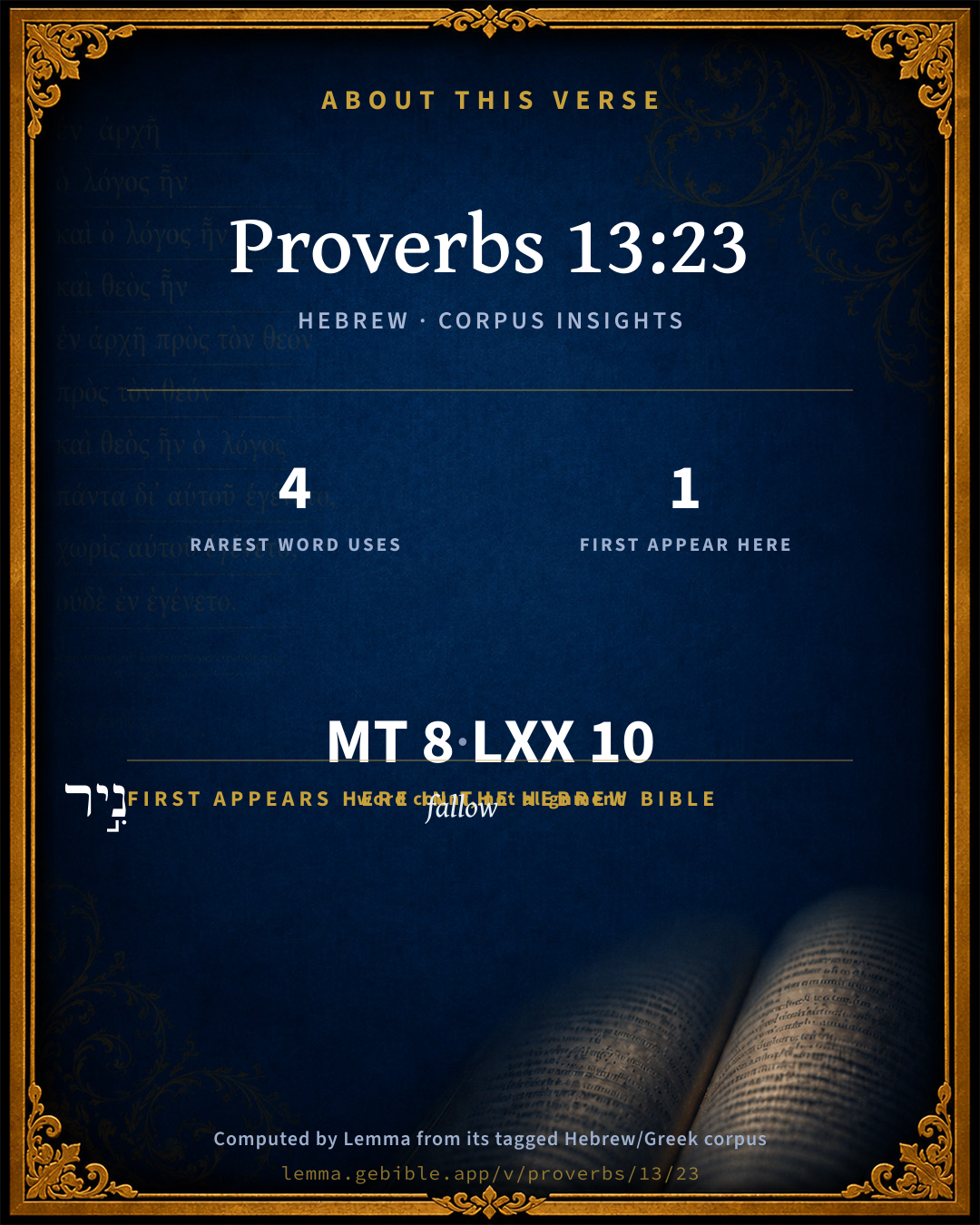
The rarest word here is נִ֣יר fallow H5215 — appearing just 4 times in the whole Hebrew Bible.

First appearance in Scripture

This word makes its first canonical appearance in the Hebrew Bible here:

  • נִ֣יר fallow H5215

Shared distinctive vocabulary

נִ֣יר fallow H5215 occurs in 4 verses of the Hebrew Bible. Also found in:

Grammatical profile

  • 2 verbs
  • 4 nouns
  • 2 particles

Verb forms

  • רָאשִׁ֑ים Qal · Participle Active
  • נִ֝סְפֶּ֗ה Niphal · Participle Active

Hebrew & Septuagint length

In English translation the verse runs 14 words from the Hebrew and 14 from the Septuagint (LXX English) — the same length.

A rough comparison of the two English renderings, which tokenize alike — not a word-level alignment.

Word counts can differ between the Hebrew and the Greek without any difference in meaning — e.g. the Hebrew direct-object marker אֵת has no separate Greek word, and Greek often adds the article ὁ.

In the original languages it is 8 Hebrew tokens and 10 Greek tokens — but the two are counted differently (Hebrew bundles its prefixes and suffixes into one token; the Greek is in lemma form), so that isn’t a like-for-like length.

Cross-references

11

Topical passages linked to Proverbs 13:23 in the Treasury of Scripture Knowledge — connected by theme and wording, ordered by reader-vote popularity; previews shown in the World English Bible.

  • Proverbs 12:11 He who tills his land shall have plenty of bread, But he who chases fantasies is void of understanding.
  • Proverbs 28:19 One who works his land will have an abundance of food; But one who chases fantasies will have his fill of poverty.
  • Ecclesiastes 5:9 Moreover the profit of the earth is for all. The king profits from the field.
  • Psalms 112:5 It is well with the man who deals graciously and lends. He will maintain his cause in judgment.
  • Ecclesiastes 8:5–6 Whoever keeps the commandment shall not come to harm, and his wise heart will know the time and procedure.
  • Proverbs 27:18 Whoever tends the fig tree shall eat its fruit. He who looks after his master shall be honored.
  • Proverbs 27:23–27 Know well the state of your flocks, And pay attention to your herds:
  • Proverbs 6:6–11 Go to the ant, you sluggard. Consider her ways, and be wise;
  • Proverbs 11:5–6 The righteousness of the blameless will direct his way, But the wicked shall fall by his own wickedness.
  • Proverbs 12:14 A man shall be satisfied with good by the fruit of his mouth. The work of a man's hands shall be rewarded to him.
  • Jeremiah 8:7–10 Yes, the stork in the sky knows her appointed times; and the turtle-dove and the swallow and the crane observe the time of their coming; but my people don't know Yahweh's law.

Cross-references courtesy of OpenBible.info (CC BY 4.0).

Hebrew and Greek witnesses Masoretic Hebrew ↔ Greek Septuagint

The same verse in the two great witnesses to the Old Testament, shown verse-for-verse.

These are two independent witnesses, not word-aligned to each other, and the Septuagint is shown in lemma (dictionary) form.

Hebrew Proverbs 13:23 Masoretic · Westminster Leningrad Codex

רָב אֹ֭כֶל נִ֣יר רָאשִׁ֑ים וְיֵ֥שׁ נִ֝סְפֶּ֗ה בְּלֹ֣א מִשְׁפָּֽט

An abundance of food is in poor people's fields, But injustice sweeps it away.

World English Bible · Public Domain

Greek LXX Proverbs 13:23 Septuagint · lemma form

δίκαιος ποιέω ἐν πλοῦτος ἔτος πολύς ἄδικος δέ ἀποὀλλύω συντόμως

The righteous shall spend many years in wealth: but the unrighteous shall perish suddenly.

LXX2012 (modern English Septuagint) · Public Domain

On this verse, Haydock's Catholic Bible Commentary discusses the Septuagint’s reading. Read the note in Commentary ↓

Hebrew: Westminster Leningrad Codex (CC BY 4.0). Greek: Septuagint (public domain); English from LXX2012 (modern English Septuagint) (Public Domain). How the Septuagint differs from the Hebrew →

Commentary

Notes on Proverbs 13:23 from classic Christian and Jewish commentators (each source and its license shown beneath its notes). The classic Christian expositions comment on the surrounding passage and are grouped to its opening verse, so a note may address several verses; the Jewish commentaries on the Tanakh (Rashi and others) are per-verse, so they appear only where the commentator wrote on this verse.

Lemma curates 59 commentaries, every one of them public domain or Creative Commons licensed, each selected and text-cleaned for this edition rather than reprinted as found. About our sources →

Trapp's Complete Commentary

John Trapp

Pro 13:23 Much food [is in] the tillage of the poor: but there is [that is] destroyed for want of judgment.

Ver. 23. Much food is in the tillage of the poor.] of the poet is well known, Laudato ingentia rura, exiguum colito. {a} It is best for a man to have no more than he can master and make his best of. The ground should be weaker than he that tills it, saith Columella. {b} The earth is a fruitful mother, and "brings forth meat for them by whom it is dressed." {Heb 6:7}

But there is that is destroyed for want of judgment.] - viz., In ploughing and sowing, {Isa 28:26} or in managing and husbanding what he hath gotten, for the best. For non minor est virtus quam quaerere, parta tueri. We must be good husbands, and see that condus be fortior promo, our comings in be more than our layings out. Bonus servatius facit bonum bonifacium, saith the Dutchman in his blunt proverb, A good saver makes a well doer.

{a} Virgil, Geog., lib. ii.

{b} Lib. i. cap. 3.

John Trapp, A Commentary or Exposition upon All the Books of the Old and New Testament (1647–1656) — public domain. Text from a community e-Sword module.

The Biblical Illustrator

Joseph S. Exell

Pro_13:23

Much food is in the tillage of the poor: but there is that is destroyed for want of judgment.

The responsibility, cultivation, and harvest of small gifts

Palestine was a land of small peasant proprietors, and the institution of the Jubilee was intended to prevent the acquisition of large estates by any Israelite. The consequence, as intended, was a level of modest prosperity. It was the tillage of the poor, the careful, diligent husbandry of the man who had only a little patch of land to look after, that filled the storehouses of the Holy Land. Hence the proverb of our text arose. In all work it is true that the bulk of the harvested results are due, not to the large labours of the few, but to the minute, unnoticed toils of the many. Small service is true service, and the aggregate of such produces large crops. Spade husbandry gets most out of the ground. Much may be made of slender gifts, small resources, and limited opportunities if carefully calculated. This text is a message to ordinary, mediocre people, without much ability or influence.

I. It teaches the responsibility of small gifts. It is no mere accident that in our Lords great parable He represents the man with the one talent as the hider of his gift. There is a certain pleasure in the exercise of any kind of gift, be it of body or mind; but when we know that we are but very slightly gifted by Him, there is a temptation to say, Oh, it does not matter much whether I contribute my share to this, that, or the other work or no. I am but a poor man. My half-crown will make but a small difference in the total. I am possessed of very little leisure. The few minutes that I can spare for individual cultivation, or for benevolent work, will not matter at all. I am only an insignificant unit; nobody pays any attention to my opinion. It does not in the least signify whether I make my influence felt in regard of social, religious, or political questions, and the like. I can leave all that to the more influential men. It is a good deal easier for me to wrap up this talent--which, after all, is only a threepenny-bit, and not a talent,--and put it away and do nothing. Yes, but then you forget that there is a great responsibility for the use of the smallest, as there is for the use of the largest, and that although it did not matter very much what you do to anybody but yourself, it matters all the world to you. But then, beside that, my text tells you that it does matter whether the poor man sets himself to make the most of his little patch of ground or not. There is much food in the tillage of the poor. The slenderly endowed are the immense majority. The great men and wise men and mighty men and wealthy men may be counted by units, but the men that are not very much of anything are to be counted by millions. And unless we can find some stringent law of responsibility that applies to them, the bulk of the human race will be under no obligation to do anything either for God or for their fellows, or for themselves. Let me remind you, too, how the same virtues and excellences can be practised in the administering of the smallest, as in that of the greatest gifts. He that is faithful in that which is least is faithful also in much. If you do not utilise the capacity possessed you increase the crop of weeds from its uncultivated clods. We never palm off a greater deception on ourselves than when we try to hoodwink conscience by pleading narrow gifts as an excuse for boundless indolence, and to persuade ourselves that if we could do more we should be less inclined to do nothing. All service coming from the same motive and tending to the same end is the same with God.

II. But now, note again how there must be diligent cultivation of the small gifts. The inventor of this proverb had looked carefully and sympathetically at the way in which the little peasant proprietors worked; and he saw in that a pattern for all life. There will usually be little waste time, and few neglected opportunities of working in the case of the peasant whose subsistence, with that of his family, depends on the diligent and wise cropping of the little patch that does belong to him. And so if you and I have to take our place in the ranks of the two-talented men, the commonplace run of ordinary people, the more reason for us to enlarge our gifts by a sedulous diligence, by a keen look-out for all opportunities of service, and above all by a prayerful dependence upon Him from whom alone comes the power to toil, and who alone gives the increase. The less we are conscious of large gifts the more we should be bowed in dependence on Him from whom cometh every good and perfect gift, and the more earnestly should we use that slender possession which God may have given us. Industry applied to small natural capacity will do far more than larger power rusted away by sloth. Who are they who have done the most in this world for God and for men? The largely endowed men? Not many wise, not many mighty, not many noble are called. The coral insect is microscopic, but it will build up from the profoundest depth of the ocean a reef against which the whole Pacific may dash in vain. It is the small gifts that, after all, are the important ones. So let us cultivate them the more earnestly, the more humbly we think of our own capacity. Play well thy part; there all the honour lies. God, who has builded up some of the towering Alps out of mica flakes, builds up His Church out of infinitesimally small particles--slenderly endowed men touched by the consecration of His love.

III. Lastly, let me remind you of the harvest reaped from these slender gifts when sedulously tilled. Two great results of such conscientious cultivation and use of small resources and opportunities may be suggested as included in that abundant food of which the text speaks. The faithfully used faculty increases. To him that hath shall be given. Oh, if I had a wider sphere how I would flame in it, and fill it. Then twinkle your best in your little sphere, and that will bring a wider one some time or other. Fill your place; and if you, like Paul, have borne witness for the Master in little Jerusalem, He will not keep you there, but carry you to bear witness for Him in imperial Rome itself. (A. Maclaren, D. D.)

The Biblical Illustrator, edited by Joseph S. Exell (c. 1880s–1900s) — public domain. Text from a community e-Sword module.

Joseph Benson's Commentary

Pro 13:23. Much food is in the tillage of the poor — A poor man many times, through God’s blessing upon his endeavours, makes a plentiful provision for himself and family out of a few acres of land, which he manages judiciously and honestly; but there is that is destroyed for want of judgment — There are some whose far larger estates are wasted for want of skill, care, industry, and the divine blessing upon their labours. This is the other sentence of this chapter, (see on Pro 13:10,) which Melancthon selected for the observation of his scholars; “the latter part of which,” says Bishop Patrick, “he renders differently from all that I have read: (namely, thus:) There is much food in the furrows of the poor, and others heap up without any measure, that is, to no purpose, when a little will suffice; which is a wise saying, but not agreeable to the Hebrew text.”

Joseph Benson's Commentary on the Old and New Testaments (1811–1818) — public domain. Text from a community e-Sword module.

The Preacher's Complete Homiletical Commentary

Joseph S. Exell (gen. ed.)

CRITICAL NOTES.—

Pro_13:23. “Tillage,” rather “fallow ground” or “a new field,” land which requires hard labour.

MAIN HOMILETICS OF Pro_13:23

LAND AND ITS TILLERS

I. That untilled land (see Critical Notes) possesses a latent power to produce food. There are many things in nature in which there exists a latent power to minister to man’s needs; but his hand must be put forth to arouse the sleeping power. There is heat in coal to warm him, but he must kindle the coal before it will put it forth. So in the earth, there are stores of life-giving power wrapped up in its bosom, but the hand of man must till it before it will yield him food. And it will yield food to the poor man as well as to the rich; his hard toil will be rewarded by receiving bread for his labour.

II. That though much food is to be got out of the land by the poor man, yet more is to be got out of it by the rich. This is implied in the contrast, though it is not directly expressed.—(See Fausset’s Note in the Comments.) The poor man cannot spend so much upon his land as the rich man can. He can give little beside hard labour, while the man who possesses wealth can call in every appliance to increase the fruitfulness of the land. It is well known that the more liberally a land is farmed the more abundant will be the crop.

III. Yet want of judgment—i.e., a sense of justice, often leads a rich man to neglect to cultivate his land so as to increase its power of yielding food. All landowners are responsible to God for a right use of His earth. Holding in their hands, as they do, the power of making food abundant or scarce, they have much for which to give an account to Him whose stewards they are. When they turn into hunting-grounds and parks for their own exclusive use acres of land which, if cultivated, would yield much food, and thus lighten the burdens of their poorer fellow-creatures, they “destroy it for want of judgment,” or “justice.”

OUTLINES AND SUGGESTIVE COMMENTS

By the rule of interpretation by the contrast of opposites, and by supplying the wanting member in one clause from its opposite expressed in the other clause, the sense is, “But there is food (wealth) possessed by rich men that is destroyed for want of honesty in its acquisition and its employment.” The poor man’s (honest) labour forms the contrast to the rich man’s “want of justice” in his acquisitions. The newly tilled land of the poor forms the contrast to the rich man’s possessions held for some time.—Fausset.

What is the practical or extended application? If talents lie inactive, or if their activity is not wisely directed, a rich harvest is destroyed for want of judgment. The same ruin flows from a neglect of religious advantages. The harvest of grace withers into a famine. Slothful professor! rouse thyself to till the ground; else thou wilt starve for want of food. Then let thy roused energy be directed by a sound judgment; for want of which, the fruits of industry, temporal, intellectual, and spiritual, will run to waste.—Bridges.

There seems an interesting connection between the former verse and this. Talk of inheritances! says the poor man, with his scanty means and daily hard toil; we have no inheritance, either from our fathers, or for our children: all is homely with us, and likely to remain so. Well, says Solomon, the poor man is not without his consolations, even of a temporal nature, “much food is in the tillage of the poor.” The maxim is not to be confined to the one kind of labour specified, but extends equally to all the different modes in which the poor make their daily bread. The poor peasant, who cultivates his plot industriously and by “the sweat of his brow,” will, through the Divine blessing, procure thereby an ample supply of food for himself and his family, and industry and tidy economy will make the cottage fireside and table snug and comfortable, and its lowly tenants will enjoy plenty, though in a plain and homely form. On the other hand, how often in the case of those who obtain inheritances may the poor see the saying verified, “There is that is destroyed for want of judgment.” By prodigality, by bad management, they waste their fortunes. Their lands are extensive, but unproductive; or if productive, the product is mis-spent and squandered; it goes, no one can tell how. To such persons the homely comfort of the poor is a just object of envy; far more, in many cases, than the wealth of the rich is to the poor.—Wardlaw.

The proverbial sense is, that a little is made much by God’s blessing and pains, and that much is made little by wickedness and carelessness.—Jermin.

The Preacher's Complete Homiletical Commentary (gen. ed. Joseph S. Exell; Funk & Wagnalls, c. 1892) — public domain (pre-1929). A full-Bible homiletical/sermon-outline anthology covering 65 of 66 books (2 John is absent from the source module). Text from a community e-Sword module.

MacLaren's Expositions of Holy Scripture

Alexander MacLaren

Proverbs

THE TILLAGE OF THE POOR

Pro 13:23.

Palestine was a land of small peasant proprietors, and the institution of the Jubilee was intended to prevent the acquisition of large estates by any Israelite. The consequence, as intended, was a level of modest prosperity. It was ‘the tillage of the poor,’ the careful, diligent husbandry of the man who had only a little patch of land to look after, that filled the storehouses of the Holy Land. Hence the proverb of our text arose. It preserves the picture of the economical conditions in which it originated, and it is capable of, and is intended to have, an application to all forms and fields of work. In all it is true that the bulk of the harvested results are due, not to the large labours of the few, but to the minute, unnoticed toils of the many. Small service is true service, and the aggregate of such produces large crops. Spade husbandry gets most out of the ground. The labourer’s allotment of half an acre is generally more prolific than the average of the squire’s estate. Much may be made of slender gifts, small resources, and limited opportunities if carefully cultivated, as they should be, and as their very slenderness should stimulate their being.

One of the psalms accuses ‘the children of Ephraim’ because, ‘being armed and carrying bows, they turned back in the day of battle.’ That saying deduces obligation from equipment, and preaches a stringent code of duty to those who are in any direction largely gifted. Power to its last particle is duty, and not small is the crime of those who, with great capacities, have small desire to use them, and leave the brunt of the battle to half-trained soldiers, badly armed.

But the imagery of the fight is not sufficient to include all aspects of Christian effort. The peaceful toil of the ‘husbandman that labours’ stands, in one of Paul’s letters, side by side with the heroism of the ‘man that warreth.’ Our text gives us the former image, and so supplements that other.

It completes the lesson of the psalm in another respect, as insisting on the importance, not of the well endowed, but of the slenderly furnished, who are immensely in the majority. This text is a message to ordinary, mediocre people, without much ability or influence.

I. It teaches, first, the responsibility of small gifts.

It is no mere accident that in our Lord’s great parable He represents the man with the one talent as the hider of his gift. There is a certain pleasure in doing what we can do, or fancy we can do, well. There is a certain pleasure in the exercise of any kind of gift, be it of body or mind; but when we know that we are but very slightly gifted by Him, there is a temptation to say, ‘Oh! it does not matter much whether I contribute my share to this, that, or the other work or no. I am but a poor man. My half-crown will make but a small difference in the total. I am possessed of very little leisure. The few minutes that I can spare for individual cultivation, or for benevolent work, will not matter at all. I am only an insignificant unit; nobody pays any attention to my opinion. It does not in the least signify whether I make my influence felt in regard of social, religious, or political questions, and the like. I can leave all that to the more influential men. My littleness at least has the prerogative of immunity. My little finger would produce such a slight impact on the scale that it is indifferent whether I apply it or not. It is a good deal easier for me to wrap up my talent-which, after all, is only a threepenny bit, and not a talent-and put it away and do nothing.’

Yes, but then you forget, dear friend! that responsibility does not diminish with the size of the gifts, but that there is as great responsibility for the use of the smallest as for the use of the largest, and that although it does not matter very much to anybody but yourself what you do, it matters all the world to you.

But then, besides that, my text tells us that it does matter whether the poor man sets himself to make the most of his little patch of ground or not. ‘There is much food in the tillage of the poor.’ The slenderly endowed are the immense majority. There is a genius or two here and there, dotted along the line of the world’s and the Church’s history. The great men and wise men and mighty men and wealthy men may be counted by units, but the men that are not very much of anything are to be counted by millions. And unless we can find some stringent law of responsibility that applies to them, the bulk of the human race will be under no obligation to do anything either for God or for their fellows, or for themselves. If I am absolved from the task of bringing my weight to bear on the side of right because my weight is infinitesimal, and I am only one in a million, suppose all the million were to plead the same excuse; what then? Then there would not be any weight on the side of the right at all. The barns in Palestine were not filled by farming on a great scale like that pursued away out on the western prairies, where one man will own, and his servants will plough a furrow for miles long, but they were filled by the small industries of the owners of tiny patches.

The ‘tillage of the poor,’ meaning thereby not the mendicant, but the peasant owner of a little plot, yielded the bulk of the ‘food.’ The wholesome old proverb, ‘many littles make a mickle,’ is as true about the influence brought to bear in the world to arrest evil and to sweeten corruption as it is about anything besides. Christ has a great deal more need of the cultivation of the small patches that He gives to the most of us than He has even of the cultivation of the large estates that He bestows on a few. Responsibility is not to be measured by amount of gift, but is equally stringent, entire, and absolute whatsoever be the magnitude of the endowments from which it arises.

Let me remind you, too, how the same virtues and excellences can be practised in the administering of the smallest as in that of the greatest gifts. Men say-I dare say some of you have said-’Oh! if I were eloquent like So-and-so; rich like somebody else; a man of weight and importance like some other, how I would consecrate my powers to the Master! But I am slow of speech, or nobody minds me, or I have but very little that I can give.’ Yes! ‘He that is faithful in that which is least is faithful also in much.’ If you do not utilise the capacity possessed, to increase the estate would only be to increase the crop of weeds from its uncultivated clods. We never palm off a greater deception on ourselves than when we try to hoodwink conscience by pleading bounded gifts as an excuse for boundless indolence, and to persuade ourselves that if we could do more we should be less inclined to do nothing. The most largely endowed has no more obligation and no fairer field than the most slenderly gifted lies under and possesses.

All service coming from the same motive and tending to the same end is the same with God. Not the magnitude of the act, but the motive thereof, determines the whole character of the life of which it is a part. The same graces of obedience, consecration, quick sympathy, self-denying effort may be cultivated and manifested in the spending of a halfpenny as in the administration of millions. The smallest rainbow in the tiniest drop that hangs from some sooty eave and catches the sunlight has precisely the same lines, in the same order, as the great arch that strides across half the sky. If you go to the Giant’s Causeway, or to the other end of it amongst the Scotch Hebrides, you will find the hexagonal basaltic pillars all of identically the same pattern and shape, whether their height be measured by feet or by tenths of an inch. Big or little, they obey exactly the same law. There is ‘much food in the tillage of the poor.’

II. But now, note, again, how there must be a diligent cultivation of the small gifts.

The inventor of this proverb had looked carefully and sympathetically at the way in which the little peasant proprietors worked; and he saw in that a pattern for all life. It is not always the case, of course, that a little holding means good husbandry, but it is generally so; and you will find few waste corners and few unweeded patches on the ground of a man whose whole ground is measured by rods instead of by miles. There will usually be little waste time, and few neglected opportunities of working in the case of the peasant whose subsistence, with that of his family, depends on the diligent and wise cropping of the little patch that does belong to him.

And so, dear brethren! if you and I have to take our place in the ranks of the one-talented men, the commonplace run of ordinary people, the more reason for us to enlarge our gifts by a sedulous diligence, by an unwearied perseverance, by a keen look-out for all opportunities of service, and above all by a prayerful dependence upon Him from whom alone comes the power to toil, and who alone gives the increase. The less we are conscious of large gifts the more we should be bowed in dependence on Him from whom cometh ‘every good and perfect gift’; and who gives according to His wisdom; and the more earnestly should we use that slender possession which God may have given us. Industry applied to small natural capacity will do far more than larger power rusted away by sloth. You all know that it is so in regard of daily life, and common business, and the acquisition of mundane sciences and arts. It is just as true in regard to the Christian race, and to the Christian Church’s work of witness.

Who are they who have done the most in this world for God and for men? The largely endowed men? ‘Not many wise, not many mighty, not many noble are called.’ The coral insect is microscopic, but it will build up from the profoundest depth of the ocean a reef against which the whole Pacific may dash in vain. It is the small gifts that, after all, are the important ones. So let us cultivate them the more earnestly the more humbly we think of our own capacity. ‘Play well thy part; there all the honour lies.’ God, who has builded up some of the towering Alps out of mica-flakes, builds up His Church out of infinitesimally small particles-slenderly endowed men touched by the consecration of His love.

III. Lastly, let me remind you of the harvest reaped from these slender gifts when sedulously tilled.

Two great results of such conscientious cultivation and use of small resources and opportunities may be suggested as included in that abundant ‘food’ of which the text speaks.

The faithfully used faculty increases. ‘To him that hath shall be given.’ ‘Oh! if I had a wider sphere how I would flame in it, and fill it!’ Then twinkle your best in your little sphere, and that will bring a wider one some time or other. For, as a rule, and in the general, though with exceptions, opportunities come to the man that can use them; and roughly, but yet substantially, men are set in this world where they can shine to the most advantage to God. Fill your place; and if you, like Paul, have borne witness for the Master in little Jerusalem, He will not keep you there, but carry you to bear witness for Him in imperial Rome itself.

The old fable of the man who told his children to dig all over the field and they would find treasure, has its true application in regard to Christian effort and faithful stewardship of the gifts bestowed upon us. The sons found no gold, but they improved the field, and secured its bearing golden harvests, and they strengthened their own muscles, which was better than gold. So if we want larger endowments let us honestly use what we possess, and use will make growth.

The other issue, about which I need not say more than a word, is that the final reward of all faithful service-’Enter thou into the joy of thy Lord’ is said, not to the brilliant, but to the ‘faithful’ servant. In that great parable, which is the very text-book of this whole subject of gifts and responsibilities and recompense, the men who were entrusted with unequal sums used these unequal sums with equal diligence, as is manifest by the fact that they realised an equal rate of increase. He that got two talents made two more out of them, and he that had five did no more; for he, too, but doubled his capital. So, because the poorer servant with his two, and the richer with his ten, had equally cultivated their diversely-measured estates, they were identical in reward; and to each of them the same thing is said: ‘Enter thou into the joy of thy Lord.’ It matters little whether we copy some great picture upon a canvas as big as the side of a house, or upon a thumbnail; the main thing is that we copy it. If we truly employ whatsoever gifts God has given to us, then we shall be accepted according to that we have, and not according to that we have not.

Alexander MacLaren, Expositions of Holy Scripture (1904–1910) — public domain. Text from a community e-Sword module.

Tyndale Open Study Notes

Tyndale Open Resources

13:23 Hard work does not always bring prosperity (cp. 10:4-6; 12:11; 13:4) because injustice occurs in the world.

Tyndale Open Study Notes — © Tyndale Open Resources, licensed CC BY-SA 4.0. Text via the HelloAO Bible API.

Geneva Bible (1599)

Geneva Bible translators

God blesseth the labor of the poor, and consumeth their goods which are negligent, because they think they have enough.

Geneva Bible (1599) marginal notes — public domain. Text via Bolls.life.

Matthew Henry's Commentary

See here, 1. How a small estate may be improved by industry, so that a man, by making the best of every thing, may live comfortably upon it: Much food is in the tillage of the poor, the poor farmers, that have but a little, but take pains with that little and husband it well. Many make it an excuse for their idleness that they have but a little to work on, a very little to be doing with; but the less compass the field is of the more let the skill and labour of the owner be employed about it, and it will turn to a very good account. Let him dig, and he needs not beg. 2. How a great estate may be ruined by indiscretion: There is that has a great deal, but it is destroyed and brought to nothing for want of judgment, that is, prudence in the management of it. Men over-build themselves or over-buy themselves, keep greater company, or a better table, or more servants, than they can afford, suffer what they have to go to decay and do not make the most of it; by taking up money themselves, or being bound for others, their estates are sunk, their families reduced, and all for want of judgment.

Matthew Henry's Commentary on the Whole Bible (1708–1710) — public domain (CC PDM 1.0). Text via the HelloAO Bible API.

Jamieson, Fausset & Brown

Robert Jamieson, A. R. Fausset & David Brown

The laboring poor prosper more than those who injudiciously or wickedly strive, by fraud and violence, to supersede the necessity of lawful labor.

Jamieson, Fausset & Brown — Commentary Critical and Explanatory on the Whole Bible (1871) — public domain (CC PDM 1.0). Text via the HelloAO Bible API.

Adam Clarke's Commentary

Verse 23. That is destroyed for want of judgment.] O, how much of the poverty of the poor arises from their own want of management! They have little or no economy, and no foresight. When they get any thing, they speedily spend it; and a feast and a famine make the chief varieties of their life.

Adam Clarke's Commentary on the Bible (1810–1826) — public domain. Text from a community e-Sword/MySword module.

Ellicott's Commentary for English Readers

(23) Tillage.—Properly, the newly-made field, on which much labour has been expended. The poor hardworking man, by God’s blessing, gains an abundant living, while many (rich persons) are ruined for their neglect of what is right.

A Bible Commentary for English Readers, edited by Charles John Ellicott (1878–1897) — public domain. Text from a community e-Sword module.

The Cambridge Bible for Schools and Colleges

gen. ed. J. J. S. Perowne

23. for want of judgment] Rather, by reason of injustice, R.V. The contrast is between substance gained by honest toil and substance lost by injustice: a poor man by hard labour makes his newly cultivated field yield him much; but you may see a rich man brought to ruin by dishonest practices. Comp. Jas_5:1-6.

The Cambridge Bible for Schools and Colleges (gen. ed. J. J. S. Perowne; Cambridge University Press, 1878–1918) — public domain. Text from a community e-Sword module.

John Gill's Exposition

Much food is in the tillage of the poor,.... The poor are generally employed in tilling land; from whose labours in ploughing and sowing much food arises to men, bread to the eater, and seed to the sower: or a poor farmer, that has but a small farm, a few acres of land, to till; yet through his diligence and industry, with the blessing of God upon it, he gets a comfortable livelihood for himself and family; much food, or a sufficiency of it for the present year, and seed to sow land again the following year;

but there is that is destroyed for want of judgment; or discretion in tilling his land, and managing the affairs of husbandry, which is God's gift, Isa 28:26; or, "through injustice" (w), as some render it; for want of doing that which is right and just; not paying his labourers their hire and wages, as he ought, and so it is blasted, and comes to ruin. This may be spiritually applied. By the "poor" may be understood the poor ministers of the Gospel; who, though poor, make many rich, Co2 6:10; much spiritual food is to be had under their labours and ministrations, they being employed in cultivating the churches: or else the poor saints and poor churches themselves may be meant; who are tilled by them, among whom is plenty of spiritual provisions; as in the poor Protestant churches, who, though in the wilderness, are nourished for a time, and times, and half a time, when there is no food in the apostate church of Rome: and so by the "tillage" may be meant the church of Christ itself, which is "God's husbandry", Co1 3:9; his agriculture, his tillage, his arable land; which he has separated and distinguished from the wide world, and employs his power and care about. For he is the husbandman, Joh 15:1; it is he that breaks up the fallow ground of men's hearts; that makes the ground good which he tills; who sows the seed of the word, and the seed of his grace there; who waters it with the dews of his grace, and causes his people to grow as the corn, and ripens them for glory: and when the harvest is come, the end of the world or of life, he sends his reapers, his angels, to gather them, the wheat, into his garner. And he employs the ministers of the word as under husbandmen, as labourers under him and with him; these are the ploughmen that hold the plough of the Gospel, and manage that; these are his sowers that go forth, bearing the precious seed of the word, and sow it under his direction; and these water the ground that is sown and planted; their doctrines distil as the rain and dew upon it; and these bring in their sheaves with joy at last. And now in this tillage is much spiritual food; in God's husbandry, the church, are the word and ordinances, in which are milk for babes, and meat for strong men, salutary, wholesome, nourishing, and strengthening food; here Christ, the best food, is set forth to faith to feed upon; true and real food, meat and drink indeed, spiritual, savoury, satisfying food; soul reviving, refreshing, and nourishing food; here is plenty of it, enough and to spare: and yet there are some that are destroyed for want of spiritual judgment and discerning; who take the poison of false teachers instead of the food to be had under a Gospel ministry; so the followers of the man of sin are given up to believe a lie and be damned; for want of judgment, they receive the grossest absurdities, and perish; as others also give in to damnable heresies, denying the deity, satisfaction, and righteousness of Christ, and other soul destroying notions; see Hos 4:6.

(w) "ob non jus", Vatablus; i.e. "ob injustitiam", Michaelis; "sine justitia", Gejerum.

John Gill's Exposition of the Whole Bible (1746–1763) — public domain (CC PDM 1.0). Text via the HelloAO Bible API.

Albert Barnes' Notes on the Bible

The contrast is the ever recurring one between honest poverty and dishonest wealth. “The new-plowed field of the poor is much food, but there are those, who, though rich, perish through their disregard of right.”

Albert Barnes' Notes on the Bible (1834–1885) — public domain. Text from a community e-Sword/MySword module.

Haydock's Catholic Bible Commentary

Fathers. Heirs often lose their property by their misconduct. Hebrew and (Haydock) Chaldean read, "of the poor," who till their land better than those who have too large farms. (Menochius) --- Nature requires but little. (Calmet) --- Septuagint, "the just shall spend many years in affluence: but the unjust are cut off at once." (Haydock)

George Leo Haydock (1774–1849), Haydock's Catholic Family Bible and Commentary, 1859 edition — public domain. Excludes Psalms (Douay-Rheims chapter numbering differs from Protestant) and Deuterocanonical books (Catholic canon only).

Matthew Poole's English Annotations

Much food is in the tillage of the poor; poor and mean persons, by their diligent labours in tillage or other employments, and God’s blessing upon them, ofttimes grow rich.

Destroyed; or, consumed, to wit, in his estate, brought to poverty.

For want of judgment; either,

1. For want of discretion and convenient care and diligence in tilling his land, and in managing his affairs, which he neglects himself, and leaves to the care of others; whereas poor men are forced by their necessities to look to their own concerns, and to use their utmost diligence in them. Or rather,

2. By injustice, as this phrase is used, Pro 16:8; Jer 17:11; 22:13; Eze 22:29. Nor do I find it in any other scripture. By his frauds, rapines, and oppressions, and other unjust and wicked practices, whereby he seeks to enrich himself, as refusing and scorning to get an estate by honest labours. So this agrees with what is said Pro 13:11.

Matthew Poole's English Annotations on the Holy Bible (1683–1685) — public domain. Text from a community e-Sword/MySword module.

Whedon's Commentary on the Bible

Daniel D. Whedon

23. Much food is in the tillage of the poor — Their “tillage” or ploughing, as Miller renders, brings from the earth much food. The meaning is, that the industrious poor have their wants supplied by the blessings of Providence on their hard but honest toil; whereas the unjust perish, because of their injustice or oppression. Comp. Pro_12:11; Pro_16:8; Jer_17:11; Jer_22:13; Eze_22:29.

Daniel D. Whedon (gen. ed.), Commentary on the Old and New Testaments (1874–1909) — public domain. Text from a community e-Sword module.

The Pulpit Commentary

Much food is in the tillage (tilled ground) of the poor. (Pro_12:11) The word rendered "tillage" (nir) means ground worked for the first time, and therefore that on which much labour is bestowed. Hence the Vulgate rightly renders, novalibus. It occurs in Jer_4:3 and Hos_10:12, where our version has "fallow ground." The poor, but righteous man, who industriously cultivates his little plot of ground, secures a good return, and is happy in eating the labour of his hands. (Psa_128:2) Intend of "the poor," the Vulgate has, "the fathers," taking in this sense; so that the meaning would be that children who properly cultivate their paternal or hereditary fields obtain good crops. But the Authorized Version rendering is doubtless preferable. There is that is destroyed for want of judgment; rather, as the Revised Version, by reason of injustice. Rich men are often brought to ruin by their disregard of right and justice (mishpat). Some (poor men) are amply supplied by honest labour; others (rich) lose all by wrong dealing. Vulgate, "For others it (food) is gathered contrary to justice;" Septuagint, quite astray, The righteous shall pass many years in wealth; but the unrighteous shall suddenly perish which seems to be an explanation or amplification of ver. 22.

The Pulpit Commentary (1880–1919), ed. H.D.M. Spence-Jones & Joseph S. Exell — public domain. Text from a community e-Sword module.

John Wesley's Explanatory Notes

The poor - Poor persons by their diligent labours, and God's blessing often grow rich. Destroyed - Or, consumed, brought to poverty, for want of discretion.

John Wesley, Explanatory Notes Upon the Whole Bible (1754–1765) — public domain. Text via the GEBible commentary corpus.

Keil & Delitzsch

C. F. Keil & F. Delitzsch

Connected with Pro 13:22 there now follow two proverbs regarding sustenance, with one intervening regarding education.

23 The poor man's fresh land gives food in abundance,

And many are destroyed by iniquity.

The Targ. and Theodotion (μέγας) translate רב, but the Masora has רב־ with short Kametz, as Pro 20:6; Ecc 1:8 (cf. Kimchi under רבב). The rendering: multitudo cibi est ager pauperum, makes the produce the property of the field (= frugum fertilis). ניר .)s is the new field (novale or novalis, viz., ager), from ניר, to make arable, fruitful; properly to raise up, viz., by grubbing and freeing of stones (סקּל). But why, asks Hitzig, just the new field? As if no answer could be given to this question, he changes ניר into ניב, and finds in 23a the description of a rentier, "a great man who consumes the income of his capital." But how much more intelligible is the new field of the poor man than these capitals (ראשׁים) with their per cents (ניב)! A new field represents to us severe labour, and as belonging to a poor man, a moderate field, of which it is here said, that notwithstanding its freshly broken up fallow, it yet yields a rich produce, viz., by virtue of the divine blessing, for the proverb supposes the ora et labora. Regarding ראשׁים = רשׁים, vid., at Pro 10:4. Jerome's translation, patrum (properly, heads), follows a false Jewish tradition. In the antithesis, 23b, one is tempted to interpret ישׁ in the sense of Pro 8:21 [substance, wealth], as Schultens, opulentia ipsa raditur quum non est moderamen, and Euchel: that which is essentially good, badly managed, goes to ruin. But ישׁ and וישׁ at the beginning of a proverb, or of a line of a proverb, in every case means est qui. That a wealthy person is meant, the contrast shows. נספּה, which denotes anything taken away or gathered up, has the same meaning here as at Sa1 27:1 : est qui (Fl. quod, but the parallel does not demand this) abripiatur, i.e., quasi turbine auferatur et perdatur; the word reminds us of סופה, whirlwind, but in itself it means only something smooth and altogether carried off. The בּ is here as at Gen 19:15; elsewhere בּלא משׁפּט means with injustice (properly, not-right), Pro 16:8, Jer 22:13; Eze 22:29; here it is not the ב of the means, but of the mediate cause. While the (industrious and God-fearing) poor man is richly nourished from the piece of ground which he cultivates, many a one who has incomparably more than he comes by his unrighteousness down to a state of beggary, or even lower: he is not only in poverty, but along with this his honour, his freedom, and the very life of his person perish.

Keil & Delitzsch — Biblical Commentary on the Old Testament (1861–1891) — public domain (CC PDM 1.0). Text via the HelloAO Bible API. (Old Testament only.)

Bridges on Proverbs

Charles Bridges

The produce of the soil is the fruit of industry. (Pro 12:11 . Gen 3:19 .) Much food is in the tillage of the poor; because, being wholly dependent on their own exertions, they spare no pains or labour. So that by careful husbandry they may gain support from a small plot; while a large and fertile estate may be destroyed for want of judgment. (Pro 24:30-34 .) Indeed, for want of prudent management the richest tillage may come to waste. Egypt with her abundant crops would have been destroyed, but for Joseph’s judgment in preserving the much food in the tillage. (Gen 41:33-36 .) Solomon’s prudent administration of his household restrained waste and extravagance. (1Ki 4:27-28 .) Even our Divine Master, in the distribution of the food, directed, that "the fragments should be gathered up, that nothing be lost" (Joh 6:12 ), or destroyed for want of care and judgment.

But what is the practical and extended application? If talents lie inactive, or if their activity is not wisely directed, a rich harvest is destroyed for want of judgment. The same ruin flows from the neglect of religious advantages. The harvest of grace withers into a famine. Slothful professor! rouse thyself to till the ground; else wilt thou starve for want of food. Then let thy roused energy be directed by a sound judgment; for want of which, the fruits of industry, temporal, intellectual, and spiritual, will run to waste.

Charles Bridges, An Exposition of the Book of Proverbs (1846) — public domain. Text from a community e-Sword module.

Kretzmann's Popular Commentary

Paul E. Kretzmann

v. 23. Such food Is in the till-age of the poor, that is, he who with much labor clears and breaks up land, tilling it with all diligence, will be rewarded with a rich harvest; but there is that is destroyed for want of judgment, for lack of uprightness, attempting to gain by fraud and violence what he ought to obtain by lawful labor.

Paul E. Kretzmann, Popular Commentary of the Bible (1921–1924) — public domain. Text from a community e-Sword module.

unfoldingWord translationNotes

Door43 World Missions Community

An unplowed field

"A field that is not prepared for food production" or "An empty field not ready for planting"

but it is swept away by injustice

"Swept away" represents completely removing something. This can be stated in active from. AT: "but injustice takes away that food" or "but unjust people take the food away" (See: Metaphor and Active or Passive)

is careful to instruct him

"makes sure to instruct him"

translationWords

just

discipline

love

unfoldingWord translationNotes — © Distant Shores Media and the Door43 World Missions Community, licensed CC BY-SA 4.0. Source: git.door43.org/Door43/en_tn.

Rashi

Rabbi Shlomo Yitzchaki (Rashi)

An abundance of food is the result of the plowing of the poor I saw in the great Masorah [on the words רב אכל]: The word רב appears thirty-three times with a “kamatz,” but this one has a short “kamatz,” and it is joined to the word אכל, food, with a “makkaf” (hyphen); and I saw there that אכל is vowelized with a “pattah” (i.e., a “segol” which is a small “pattah”), and it is accented on the first syllable, as in (Gen. 41:35): “all the food (אכל) of the good years.” According to its vowelization, this is its interpretation: Much grain comes to the world through the plowing of the poor people; i.e., much Torah emanates from pupils whose teachers learn from them through their debate concerning the halachah.

and some perish And many of them perish from the world because [they have] no propriety, for they do not behave properly; and concerning the grain, some grain suffers because of its owner, who does not separate its tithes and its gifts for the poor as is proper. Our Sages explained in tractate Hagigah (4b) “And some perish without justice,” concerning the messenger of the angel of death, who changes one name for another and causes the death of one whose time has not come. But, if it [this explanation] is so, the end of the verse has nothing to do with its beginning.

Rashi on the Tanakh — English translations: “The Judaica Press complete Tanach with Rashi, translated by A. J. Rosenberg” (CC BY 4.0); “Pentateuch with Rashi's commentary by M. Rosenbaum and A.M. Silbermann, 1929-1934” (public domain); “The Metsudah Tanach series, Lakewood, N.J” (CC BY 4.0); and “The Book of Joshua, Metsudah Publications, 1997” (CC BY 4.0). Text via Sefaria.

Lesson kit

Teaching starters — assembled from the data on this page, not authored interpretation. Every prompt links to the verse data it draws on. Edit before teaching.

Proverbs, in the Wisdom, opens this verse with 8 words (8 distinct Hebrew lemmas). Its most distinctive word is nîyr (“fallow”). A historical commentator’s framing appears above. Read the whole chapter for the surrounding context.

Discussion questions

  1. How does “fallow” (nîyr) shape what this verse is saying?
  2. The word “fallow” first appears here in Scripture. What is being introduced at this debut?
  3. Proverbs 21:4 shares the word «fallow» with this verse. How do the two illuminate each other?
  4. The translations on this page render this verse differently — a whole-verse word diff, not a word-by-word alignment. What might account for the different wordings?
  5. The verb «רָאשִׁ֑ים» is Qal Participle Active. How does its form color the action?
  6. Reading how Trapp's Complete Commentary and The Biblical Illustrator read this verse, where do the two commentators agree and where do they part?

Things to notice

Reading settings

Reading text

Shown beneath each verse's original-language words.

Old Testament
Old Testament edition

Read the OT as the Masoretic Hebrew (MT) or the Greek Septuagint (LXX).

English shown for the Greek Septuagint (in the Hebrew ↔ Greek comparison).

Comparing translations? Open the Compare panel on any verse page to stack up to four side by side.