
Psalms 150:2

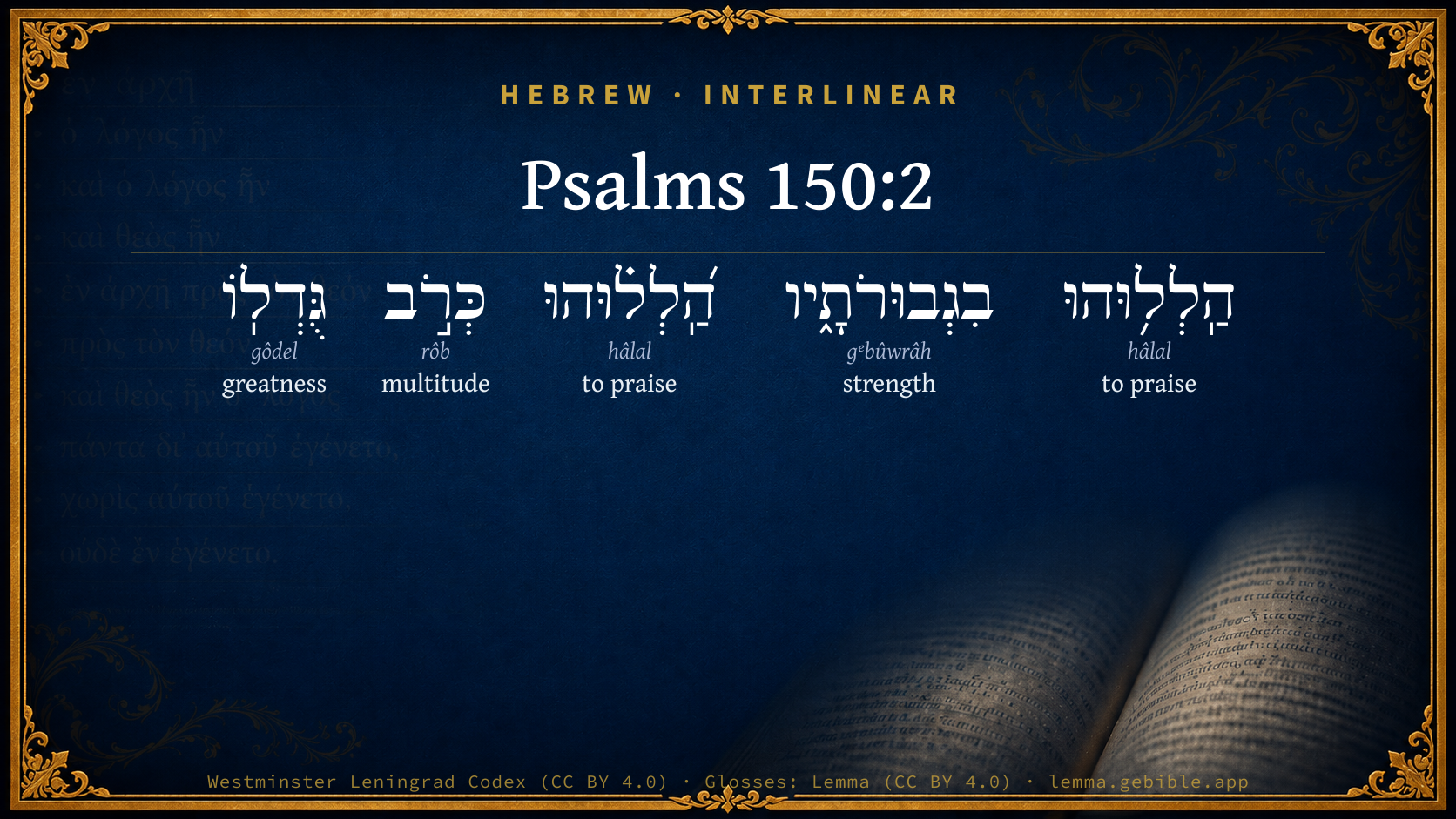
Hebrew (Westminster Leningrad Codex) Psalms 150:2 appears in the Hebrew Old Testament. The text above is from the Westminster Leningrad Codex. Each word links to its Strong’s number, a concise gloss, and parsing drawn from the Open Scriptures Hebrew Bible morphology. Click any word for its full Brown-Driver-Briggs (BDB) entry.
Download image
Cite this verse

Psalms 150:2 (World English Bible). Public Domain. Lemma interlinear Bible study tool, https://lemma.gebible.app/v/psalms/150/2.

Show BibTeX & RIS
BibTeX
RIS
English Translation
Praise him for his mighty acts! Praise him according to his excellent greatness!
World English Bible · Public Domain
Download a study sheet

One document with this verse’s original text, its word-by-word gloss line, the meaning frame, cross-references with their text, attributed commentary, and full source and license credits — printable, and it pastes into notes with its structure intact.

This verse Autodidact and up

Study sheet (.html) Plain text (.txt)

A passage Seminary Student

Up to 50 verses in one chapter. A passage sheet keeps up to 6 commentary sources and 12 cross-references per verse, in the order this page ranks them, and says so on the sheet whenever that leaves anything out. Ask for a single verse and you get the Autodidact verse sheet above.

Everything on this page stays free to read, with no account — the sheet is a download of what is already on screen, not access to it.

Want to remove ads? Support Godless Engineer
Compare translations 3

The same verse in 3 English versions, stacked beneath the original-language interlinear above. Click any original word for its lexicon entry.

Each is an independent rendering of the whole verse — the interlinear is not word-aligned to these translations.

Highlighted words mark where these versions differ — a whole-verse word diff, not a word-by-word alignment.

  • World English Bible Public Domain
    Praise him for his mighty acts! Praise him according to his excellent greatness!
  • King James Version Public Domain
    Praise him for his mighty acts: praise him according to his excellent greatness.
  • unfoldingWord Literal Text CC BY-SA 4.0
    Praise him for his mighty deeds; praise him according to the abundance of his greatness.

unfoldingWord Literal Text — © unfoldingWord, licensed CC BY-SA 4.0. Word-aligned USFM3 via Door43 (git.door43.org/unfoldingWord/en_ult).

Versions to compare (up to 4)

3 of 4 selected

Show all 18 translations

Every available English version of this verse, each an independent rendering of the whole verse.

  • World English Bible Public Domain
    Praise him for his mighty acts! Praise him according to his excellent greatness!
  • Berean Standard Bible Public Domain
    Praise Him for His mighty acts; praise Him for His excellent greatness.
  • Majority Standard Bible Public Domain
    Praise Him for His mighty acts; praise Him for His excellent greatness.
  • King James Version Public Domain
    Praise him for his mighty acts: praise him according to his excellent greatness.
  • American Standard Version (1901) Public Domain
    Praise him for his mighty acts: Praise him according to his excellent greatness.
  • Revised Version (1885) Public Domain
    Praise him for his mighty acts: praise him according to his excellent greatness.
  • Geneva Bible (1599) Public Domain
    Prayse ye him in his mightie Actes: prayse ye him according to his excellent greatnesse.
  • Douay-Rheims (1899) Public Domain
    Praise ye him, all his angels: praise ye him, all his hosts.
  • Young's Literal Translation Public Domain
    Praise Him in His mighty acts, Praise Him according to the abundance of His greatness.
  • Literal Standard Version CC BY-SA 4.0
    Praise Him in His mighty acts, || Praise Him according to the abundance of His greatness.
  • Unlocked Literal Bible CC BY-SA 4.0
    Praise him for his mighty acts; praise him for his surpassing greatness.
  • unfoldingWord Literal Text CC BY-SA 4.0
    Praise him for his mighty deeds; praise him according to the abundance of his greatness.
  • Darby Bible Public Domain
    Praise him in his mighty acts; praise him according to the abundance of his greatness.
  • World Messianic Bible Public Domain
    Praise him for his mighty acts! Praise him according to his excellent greatness!
  • Webster's Bible Public Domain
    Praise him for his mighty acts: praise him according to his excellent greatness.
  • Free Bible Version CC BY-SA 4.0
    Praise him for the amazing things he does! Praise him for how wonderfully great he is!
  • Bible in Basic English Public Domain
    Give him praise for his acts of power: give him praise in the measure of his great strength.
  • JPS Tanakh (1917) Public Domain
    Praise Him for His mighty acts; praise Him according to His abundant greatness.

Literal Standard Version (2020), Covenant Press — licensed CC BY-SA 4.0. Text via the HelloAO Bible API (eBible.org). Unlocked Literal Bible (unfoldingWord) — licensed CC BY-SA 4.0. Text via the HelloAO Bible API (eBible.org). unfoldingWord Literal Text — © unfoldingWord, licensed CC BY-SA 4.0. Word-aligned USFM3 via Door43 (git.door43.org/unfoldingWord/en_ult). Free Bible Version, Dr. Jonathan Gallagher — licensed CC BY-SA 4.0. Text via the HelloAO Bible API (eBible.org).

Word by word

More ways to search: Search by grammar → Find every occurrence → Compare this word →

Practice this passage: Drill this verse → Learn its vocabulary →

About this verse

These counts appear in no published source. They are computed here, from the morphology-tagged text and Lemma’s own curated glosses. What Lemma adds →

5
words
4
distinct lemmas
Wisdom
section

Notable vocabulary

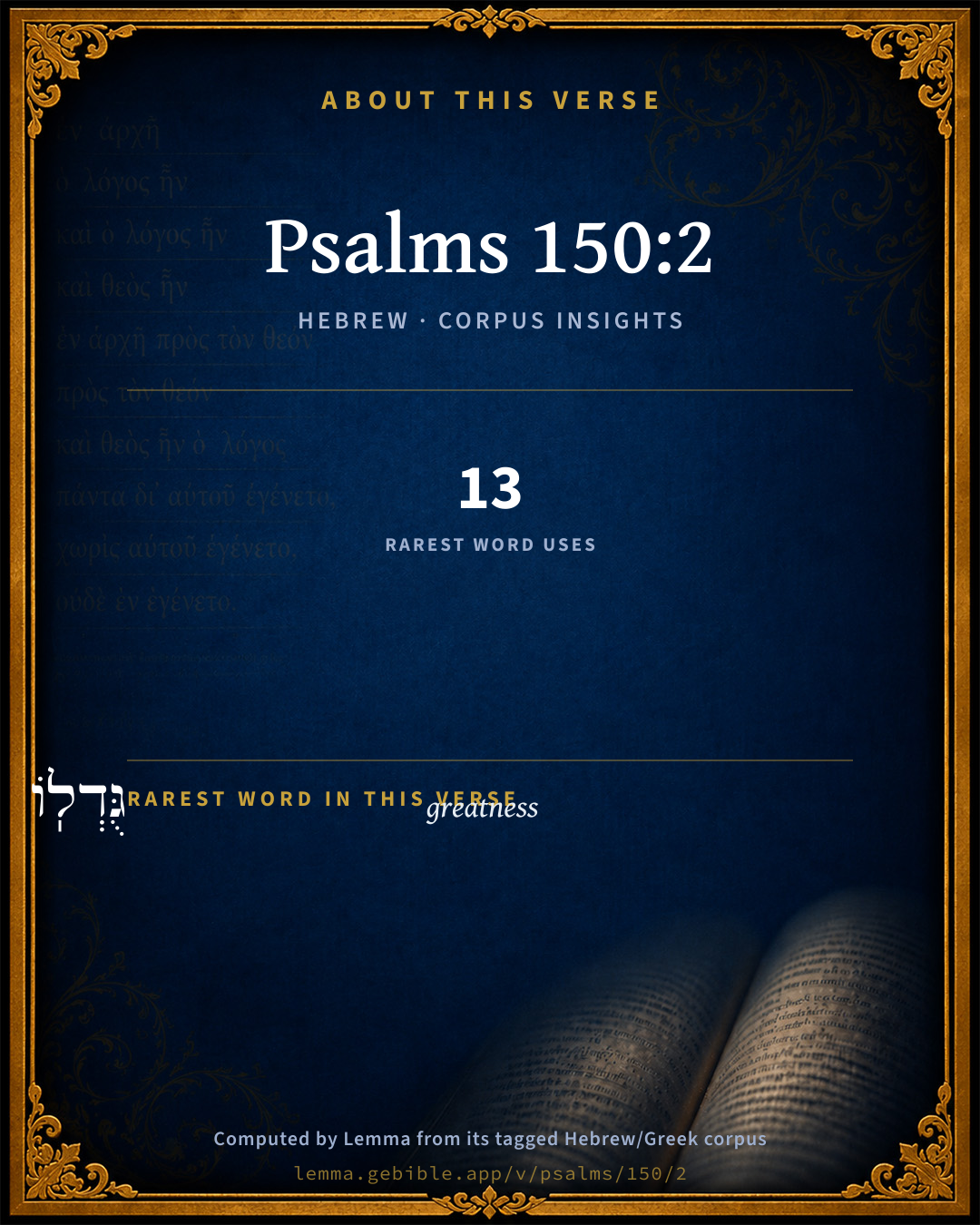
The rarest word here is גֻּדְלֽוֹ greatness H1433 — appearing just 13 times in the whole Hebrew Bible.

Shared distinctive vocabulary

גֻּדְלֽוֹ greatness H1433 occurs in 13 verses of the Hebrew Bible. Also found in:

Grammatical profile

  • 2 verbs
  • 3 nouns

Verb forms

  • הַֽלְל֥וּהוּ Piel · Imperative
  • הַֽ֝לְל֗וּהוּ Piel · Imperative

Repetition

A word recurs within this verse — often emphatic in Hebrew:

  • הַֽלְל֥וּהוּ to praise H1984 ×2

Hebrew & Septuagint length

In English translation the verse runs 13 words from the Hebrew and 15 from the Septuagint (LXX English) — closely comparable.

A rough comparison of the two English renderings, which tokenize alike — not a word-level alignment.

Word counts can differ between the Hebrew and the Greek without any difference in meaning — e.g. the Hebrew direct-object marker אֵת has no separate Greek word, and Greek often adds the article ὁ.

Cross-references

7

Topical passages linked to Psalms 150:2 in the Treasury of Scripture Knowledge — connected by theme and wording, ordered by reader-vote popularity; previews shown in the World English Bible.

  • Deuteronomy 3:24 Lord Yahweh, you have begun to show your servant your greatness, and your strong hand: for what god is there in heaven or in earth, that can do according to your works, and according to your mighty acts?
  • Jeremiah 32:17–19 Ah Lord Yahweh! behold, you have made the heavens and the earth by your great power and by your outstretched arm; there is nothing too hard for you,
  • Psalms 145:3 Great is Yahweh, and greatly to be praised! His greatness is unsearchable.
  • Psalms 145:5–6 Of the glorious majesty of your honor, Of your wondrous works, I will meditate.
  • Revelation 15:3–4 They sang the song of Moses, the servant of God, and the song of the Lamb, saying, "Great and marvelous are your works, Lord God, the Almighty; Righteous and true are your ways, you King of the nations.
  • Psalms 96:4 For great is Yahweh, and greatly to be praised! He is to be feared above all gods.
  • Psalms 145:12 To make known to the sons of men his mighty acts, The glory of the majesty of his kingdom.

Cross-references courtesy of OpenBible.info (CC BY 4.0).

Hebrew and Greek witnesses Masoretic Hebrew ↔ Greek Septuagint

The same verse in the two great witnesses to the Old Testament, shown verse-for-verse.

You’re reading Greek Psalm 150 (Hebrew Psalm 150). The Septuagint counts the superscription, so verse numbers can differ from the Hebrew — chapter-level alignment, not verse-by-verse. Numbering follows Rahlfs.

These are two independent witnesses, not word-aligned to each other, and the Septuagint is shown in lemma (dictionary) form.

Hebrew Psalms 150:2 Masoretic · Westminster Leningrad Codex

הַֽלְל֥וּהוּ בִגְבוּרֹתָ֑יו הַֽ֝לְל֗וּהוּ כְּרֹ֣ב גֻּדְלֽוֹ

Praise him for his mighty acts! Praise him according to his excellent greatness!

World English Bible · Public Domain

Greek LXX Greek Psalm 150:2 Septuagint · lemma form

αἰνέω αὐτός ἐπί ὁ δυναστεία αὐτός αἰνέω αὐτός κατά ὁ πλῆθος ὁ μεγαλωσύνη αὐτός

Praise him on account of his mighty acts: praise him according to his abundant greatness.

LXX2012 (modern English Septuagint) · Public Domain

Hebrew: Westminster Leningrad Codex (CC BY 4.0). Greek: Septuagint (public domain); English from LXX2012 (modern English Septuagint) (Public Domain). How the Septuagint differs from the Hebrew →

Commentary

Notes on Psalms 150:2 from classic Christian and Jewish commentators (each source and its license shown beneath its notes). The classic Christian expositions comment on the surrounding passage and are grouped to its opening verse, so a note may address several verses; the Jewish commentaries on the Tanakh (Rashi and others) are per-verse, so they appear only where the commentator wrote on this verse.

Lemma curates 59 commentaries, every one of them public domain or Creative Commons licensed, each selected and text-cleaned for this edition rather than reprinted as found. About our sources →

Trapp's Complete Commentary

John Trapp

Psa 150:2 Praise him for his mighty acts: praise him according to his excellent greatness.

Ver. 2. Praise him for his mighty acts] Those wonderful effects of his creative and providential omnipotence.

Praise him according to his excellent greatness] Or, Greatness of greatness; which yet can never be done, but must be endeavoured. Propound the highest pitch and best patterns.

John Trapp, A Commentary or Exposition upon All the Books of the Old and New Testament (1647–1656) — public domain. Text from a community e-Sword module.

Joseph Benson's Commentary

Psa 150:2. Praise him for his mighty acts — Hebrew, בגבורתיו, for his mightinesses; for all the instances of his might shown in the dispensations of his providence and grace; the power he hath exerted in creating, upholding, and governing the world, and in redeeming and saving the human race. Praise him according to his excellent greatness — Or, as Dr. Hammond renders כרב גדלו, according to the multitude of his magnificence — Not that our praises can bear any proportion to God’s greatness, for it is infinite, but because he is greater than we can express or conceive, we must raise our conceptions and expressions to the highest degree to which we can attain. We must not be afraid of saying too much in the praises of God, as we often do in praising even great and good men; all the danger is, of our saying too little; and therefore when he have done our utmost we must own, that though we have praised him in consideration of his excellent greatness, yet not in proportion to it.

Joseph Benson's Commentary on the Old and New Testaments (1811–1818) — public domain. Text from a community e-Sword module.

J. A. Alexander on Psalms

Joseph Addison Alexander

2. (Psa 150:2) Praise him for his mighty acts! Praise him according to his plenitude of greatness! His mighty acts, literally his rnights or powers. See above, on Psa 145:4. For, literally in them, i.e. praise him as exhibited and viewed in these. The corresponding particle means like, in accordance with, in proportion to, in a manner worthy of his greatness. The last phrase in Hebrew is peculiarly expressive, consisting of the two strongest terms denoting magnitude, the abstract forms of much and great; which might be rendered, if our usage suffered it, muchness of greatness.

Joseph Addison Alexander, The Psalms Translated and Explained (1850) — public domain. Text from a community e-Sword module.

Adam Clarke's Commentary

Verse 2. For his mighty acts] Whether manifested in creation, government, mercy or justice.

His excellent greatness.] כרב גדלו kerob gudlo, according to the multitude of his magnitude, or of his majesty. [Anglo-Saxon]; After the manyfoldness of his mickleness. - Anglo-Saxon. After the mykelnes of his greathede. - Old Psalter. Let the praise be such as is becoming so great, so holy, and so glorious a Being.

Adam Clarke's Commentary on the Bible (1810–1826) — public domain. Text from a community e-Sword/MySword module.

Ellicott's Commentary for English Readers

(2) Mighty acts . . . excellent greatness.—The one displayed on earth, the other manifested in heaven. (See preceding Note.)

A Bible Commentary for English Readers, edited by Charles John Ellicott (1878–1897) — public domain. Text from a community e-Sword module.

The Cambridge Bible for Schools and Colleges

gen. ed. J. J. S. Perowne

2. for his mighty acts] Cp. Psa_106:2; Psa_145:4; Psa_145:11-12.

according to the abundance of his greatness] Cp. 1Ch_29:11, “Thine is the greatness and the might.”

The Cambridge Bible for Schools and Colleges (gen. ed. J. J. S. Perowne; Cambridge University Press, 1878–1918) — public domain. Text from a community e-Sword module.

John Gill's Exposition

Praise him for his mighty acts,.... The creation of all things out of nothing; the sustaining of all beings; the government of the world; the redemption of man by Christ, and the wonderful works done by him on earth; the work of grace upon the hearts of his people, and the preservation of them in grace to glory;

praise him according to his excellent greatness; or, "according to the multitude of his greatness" (t); which appears in his nature, perfections, and work, and these both of providence and grace; and in proportion hereunto, and according to the abilities of creatures, angels, and men, is he to be praised; which is giving him the honour due unto his name; see Psa 96:8.

(t) "secundum multudinem magnitudinie ejus", V. L. Montanus, Gejerus; so Ainsworth.

John Gill's Exposition of the Whole Bible (1746–1763) — public domain (CC PDM 1.0). Text via the HelloAO Bible API.

Albert Barnes' Notes on the Bible

Praise him for his mighty acts - See the notes at Psa 145:4 : “One generation shall praise thy works to another, and shall declare thy mighty acts.” The Hebrew word is the same. The reference is to that which displays the power of God; the things which manifest his omnipotence.

Praise him according to his excellent greatness - Hebrew, the multitude of his greatness. Let the praise in elevation correspond with this; let it be such as shall properly express this; let all be employed that will contribute to make this known, or that will be appropriate to this. Hence, the psalmist proceeds to call on all to make use of everything, by instrument and voice, that would in any manner set forth the praise of God.

Albert Barnes' Notes on the Bible (1834–1885) — public domain. Text from a community e-Sword/MySword module.

Matthew Poole's English Annotations

As his infinite majesty deserves to be praised.

Matthew Poole's English Annotations on the Holy Bible (1683–1685) — public domain. Text from a community e-Sword/MySword module.

The Treasury of David

Charles H. Spurgeon

Ver. 2. Praise him for his mighty acts. Here is a reason for praise. In these deeds of power we see himself. These doings of his omnipotence are always on behalf of truth and righteousness. His works of creation, providence, and redemption, all call for praise; they are his acts, and his acts of might, therefore let him be praised for them.

Praise him according to his excellent greatness. His being is unlimited, and his praise should correspond therewith. He possesses a multitude or a plenitude of greatness, and therefore he should be greatly praised. There is nothing little about God, and there is nothing great apart from him. If we were always careful to make our worship fit and appropriate for our great Lord how much better should we sing! How much more reverently should we adore! Such excellent deeds should have excellent praise.

Ver. 2. Praise him for his mighty acts, etc. The reasons of that praise which it becomes all intelligent creatures, and especially redeemed men, to render to Jehovah, are here assigned. We are to praise Jehovah "in his sanctuary", in the place where his glory dwells, where his holiness shines forth with ineffable splendour; we are to praise him in the wide expanse over which he has spread the tokens of his power, whether in the heaven above, or in the earth beneath; we are to praise him for those omnipotent acts whereby he hath shown himself to be above all gods; we are to praise him in a manner suited to the excellent majesty of a Being whom all the heavens adore, and who is wonderful in counsel and excellent in working. His holiness, the infinity of his operations, the miraculous power which he has displayed, the unspotted excellence of his administration, call for loudest songs of praise from all whose reason enables them to rise to the contemplation of the great Supreme. John Morison.

Ver. 2. Praise him acceding to his excellent greatness. There is required special understanding and knowledge of the nature and worth of the mercy for which the duty of praise is undertaken; for God will not be praised confusedly, but distinctly and proportionably to his dispensation: Praise him according to his wondrous works; which is to be the prime and proper matter of their high praises, even his more proper and peculiar high acts, then to be remembered, as is largely expressed in Moses' praise for the particular mercy of coming safe through the Red Sea (Ex 15:1-27); and Deborah's high praise for deliverance from the host of Sisera (Jud 5:1-31); where the chiefest and highest part of the celebration and exaltation of God in his praise consists in the declaration and commemoration of the particulars of God's special goodness in their present deliverance. Thus, you see the first thing that God looks for is proportionable praise, great praise for a great God, doing great things, and high praises for a high God, doing high things. Samuel Fairclough.

Ver. 2. Praise him according to his excellent greatness, or, as the words may bear, "according to his muchness of greatness"; for when the Scripture saith, "God is great", this positive is to be taken as a superlative. "God is great", that is, he is greatest, he is greater than all; so great that all persons and all things are little, yea, nothing before him. Isa 40:15: "Behold, the nations are (to him but) as a drop of a bucket, and are counted as the small dust of the balance: behold, he taketh up the isles as a very little thing. And Lebanon is not sufficient to burn, nor the beasts thereof sufficient for a burnt offering. All nations before him are as nothing; and they are counted to him less than nothing, and vanity." How great is God, in comparison of whom the greatest things are little things, yea, the greatest things are nothing! Joseph Caryl.

Ver. 2. His excellent greatness. Wherein the greatness of God is specially excellent, and where it is best seen.

Ver. 2. Praise him for his mighty acts.

1. For us. Election. Redemption. Inspiration.

2. In us. The work of enlightenment in the understanding; purification in the heart; quickening in the conscience; subjugation in the will.

3. By us. Thought through us; felt through us; spoke through us; worked through us. To him be all the glory! W.J.

Ver. 2. Praise him according to his excellent greatness.

1. Reverently, according to the greatness of his being.

2. Gratefully, according to the greatness of his love.

3. Retrospectively, according to the greatness of his gifts.

4. Prospectively, according to the greatness of his promises. W.J.

Ver. 2. What the exhortation requires.

1. That men should study God's works, and observe the glory of God in them.

2. That they should meditate on his greatness till they realize its excellence.

3. That they should openly proclaim the honour due to him.

4. That they should not contradict in their life the praise they speak. J.F.

Psalms 150:3*

Charles H. Spurgeon's The Treasury of David (1869–1885) — public domain. Psalms only. Text from a community e-Sword/MySword module.

Whedon's Commentary on the Bible

Daniel D. Whedon

2. Mighty acts… excellent greatness—These are named as reasons for this coextensive, universal praise.

Daniel D. Whedon (gen. ed.), Commentary on the Old and New Testaments (1874–1909) — public domain. Text from a community e-Sword module.

The Pulpit Commentary

Praise him for his mighty acts; i.e. for the great acts of his providence, especially for his deliverances of Israel. Praise him according to his excellent greatness; rather, his abounding greatness (Kay); or, his manifold greatness (Cheyne).

Things to praise God for.

For excellent greatness," read "muchness of greatness." Praise is to be offered in recognition both of God"s inherent power, and of its manifestation in mighty acts.

I PRAISE IS CALLED FOR BY DIVINE POWER. He who knows God knows him through a series of mighty, wonderful acts, interventions, provisions, deliverances, punishings, all of which produce overwhelming impressions of almighty power. Illustration may be taken from

(1) the Divine creations;

(2) the Divine maintainings;

(3) the Divine redemptions.

Divine power is seen in God"s ordering and controlling the gigantic forces of nature and the lawless willfulness of man. Modern artistic and poetic feeling, perhaps responding to the revelations of the microscope, can find Divine power in the gentle and the minute; but Hebrew genius dealt almost exclusively with the august, tremendous, and awful in nature; so power in God was the thing most impressed on the Hebrew mind as the inspiration of praise. And still a necessary ground of entire Confidence in God is a conviction of his absolute and unquestionable almightiness everywhere, and in relation to everything. We praise him because we feel sure that our God is mightier than the mightiest.

II PRAISE IS CALLED FOR BY DIVINE CHARACTER BEHIND POWER. "Excellent greatness." An adjective is applied which directs us to moral quality. God must never be thought of as we think of giants. We are altogether absorbed by thinking of their bodily size and strength; it does not matter to us whether they hi, re either mental faculty or moral character. Some think of God as a mere embodiment of august and awful power. He is not known aright, nor can he be praised aright, until the character inspiring the exercise of his power is apprehended. Then we realize that he stands in relation to us, and for his gracious relations we praise him in the highest. R.T.

The Pulpit Commentary (1880–1919), ed. H.D.M. Spence-Jones & Joseph S. Exell — public domain. Text from a community e-Sword module.

Lesson kit

Teaching starters — assembled from the data on this page, not authored interpretation. Every prompt links to the verse data it draws on. Edit before teaching.

Psalms, in the Wisdom, opens this verse with 5 words (4 distinct Hebrew lemmas). Its most distinctive word is gôdel (“greatness”). A historical commentator’s framing appears above. Read the whole chapter for the surrounding context.

Discussion questions

  1. What does “greatness” (gôdel) contribute to the verse as a whole?
  2. Numbers 14:19 shares the word «greatness» with this verse. How do the two illuminate each other?
  3. “to praise” occurs 2× in this one verse. What is the effect of the repetition?
  4. These translations render this verse differently; the difference is in the English rendering, not the original. What questions does that raise?
  5. The verb «הַֽלְל֥וּהוּ» is Piel Imperative. How does its form color the action?
  6. Reading how Trapp's Complete Commentary and Joseph Benson's Commentary read this verse, where do the two commentators agree and where do they part?

Things to notice

  • These translations choose different wording for 4 words in this verse.
  • “to praise” occurs 2× in this single verse.
  • 4 distinct Hebrew lemmas span 5 words in this verse.

Reading settings

Reading text

Shown beneath each verse's original-language words.

Old Testament
Old Testament edition

Read the OT as the Masoretic Hebrew (MT) or the Greek Septuagint (LXX).

English shown for the Greek Septuagint (in the Hebrew ↔ Greek comparison).

Comparing translations? Open the Compare panel on any verse page to stack up to four side by side.