
Hosea 9:7

Hebrew (Westminster Leningrad Codex) Hosea 9:7 appears in the Hebrew Old Testament. The text above is from the Westminster Leningrad Codex. Each word links to its Strong’s number, a concise gloss, and parsing drawn from the Open Scriptures Hebrew Bible morphology. Click any word for its full Brown-Driver-Briggs (BDB) entry.
Download image
Cite this verse

Hosea 9:7 (World English Bible). Public Domain. Lemma interlinear Bible study tool, https://lemma.gebible.app/v/hosea/9/7.

Show BibTeX & RIS
BibTeX
RIS
English Translation
The days of visitation have come. The days of reckoning have come. Israel will consider the prophet to be a fool, And the man who is inspired to be insane, Because of the abundance of your sins, And because your hostility is great.
World English Bible · Public Domain
Highlights
  • 1 first appearance in the Hebrew Bible
Full analysis ↓
Download a study sheet

One document with this verse’s original text, its word-by-word gloss line, the meaning frame, cross-references with their text, attributed commentary, and full source and license credits — printable, and it pastes into notes with its structure intact.

This verse Autodidact and up

Study sheet (.html) Plain text (.txt)

A passage Seminary Student

Up to 50 verses in one chapter. A passage sheet keeps up to 6 commentary sources and 12 cross-references per verse, in the order this page ranks them, and says so on the sheet whenever that leaves anything out. Ask for a single verse and you get the Autodidact verse sheet above.

Everything on this page stays free to read, with no account — the sheet is a download of what is already on screen, not access to it.

Want to remove ads? Support Godless Engineer
Compare translations 3

The same verse in 3 English versions, stacked beneath the original-language interlinear above. Click any original word for its lexicon entry.

Each is an independent rendering of the whole verse — the interlinear is not word-aligned to these translations.

Highlighted words mark where these versions differ — a whole-verse word diff, not a word-by-word alignment.

  • World English Bible Public Domain
    The days of visitation have come. The days of reckoning have come. Israel will consider the prophet to be a fool, And the man who is inspired to be insane, Because of the abundance of your sins, And because your hostility is great.
  • King James Version Public Domain
    The days of visitation are come, the days of recompence are come; Israel shall know it: the prophet is a fool, the spiritual man is mad, for the multitude of thine iniquity, and the great hatred.
  • unfoldingWord Literal Text CC BY-SA 4.0
    The days of punishment have come; the days of retribution have come. Israel will know! The prophet a fool; the man of the spirit is insane, because of the abundance of your iniquity and great hostility.

unfoldingWord Literal Text — © unfoldingWord, licensed CC BY-SA 4.0. Word-aligned USFM3 via Door43 (git.door43.org/unfoldingWord/en_ult).

Versions to compare (up to 4)

3 of 4 selected

Show all 18 translations

Every available English version of this verse, each an independent rendering of the whole verse.

  • World English Bible Public Domain
    The days of visitation have come. The days of reckoning have come. Israel will consider the prophet to be a fool, And the man who is inspired to be insane, Because of the abundance of your sins, And because your hostility is great.
  • Berean Standard Bible Public Domain
    The days of punishment have come; the days of retribution have arrived—let Israel know it. The prophet is called a fool, and the inspired man insane, because of the greatness of your iniquity and hostility.
  • Majority Standard Bible Public Domain
    The days of punishment have come; the days of retribution have arrived—let Israel know it. The prophet is called a fool, and the inspired man insane, because of the greatness of your iniquity and hostility.
  • King James Version Public Domain
    The days of visitation are come, the days of recompence are come; Israel shall know it: the prophet is a fool, the spiritual man is mad, for the multitude of thine iniquity, and the great hatred.
  • American Standard Version (1901) Public Domain
    The days of visitation are come, the days of recompense are come; Israel shall know it: the prophet is a fool, the man that hath the spirit is mad, for the abundance of thine iniquity, and because the enmity is great.
  • Revised Version (1885) Public Domain
    The days of visitation are come, the days of recompence are come; Israel shall know it: the prophet is a fool, the man that hath the spirit is mad, for the multitude of thine iniquity, and because the enmity is great.
  • Geneva Bible (1599) Public Domain
    The daies of visitation are come: the daies of recompence are come: Israel shall knowe it: the Prophet is a foole: the spiritual man is mad, for the multitude of thine iniquitie: therefore the hatred is great.
  • Douay-Rheims (1899) Public Domain
    The days of visitation are come, the days of repaying are come: know ye, O Israel, that the prophet was foolish, the spiritual man was mad, for the multitude of thy iniquity, and the multitude of thy madness.
  • Young's Literal Translation Public Domain
    Come in have the days of inspection, Come in have the days of recompence, Israel doth know! a fool `is' the prophet, Mad `is' the man of the Spirit, Because of the abundance of thine iniquity, And great `is' the hatred.
  • Literal Standard Version CC BY-SA 4.0
    The days of inspection have come in, || The days of repayment have come in, Israel knows! The prophet [is] a fool, || Mad [is] the man of the spirit, || Because of the abundance of your iniquity, || And great [is] the hatred.
  • Unlocked Literal Bible CC BY-SA 4.0
    The days for punishment are coming; the days for retribution are coming. Let all Israel know these things. The prophet is a fool, and the inspired man is insane, because of your great iniquity and great hostility.
  • unfoldingWord Literal Text CC BY-SA 4.0
    The days of punishment have come; the days of retribution have come. Israel will know! The prophet a fool; the man of the spirit is insane, because of the abundance of your iniquity and great hostility.
  • Darby Bible Public Domain
    The days of visitation are come; the days of recompence are come: Israel shall know [it]: the prophet is a fool, the inspired man is mad, because of the greatness of thine iniquity, and the great enmity.
  • World Messianic Bible Public Domain
    The days of visitation have come. The days of reckoning have come. Israel will consider the prophet to be a fool, and the man who is inspired to be insane, because of the abundance of your sins, and because your hostility is great.
  • Webster's Bible Public Domain
    The days of visitation are come, the days of recompense are come; Israel shall know it: the prophet is a fool, the spiritual man is mad, for the multitude of thy iniquity, and the great hatred.
  • Free Bible Version CC BY-SA 4.0
    The time of punishment has come; the day of retribution has arrived. Let Israel know! You say the prophet is a fool, the man of the Spirit is mad, because your sin and hostility is so great.
  • Bible in Basic English Public Domain
    The days of punishment, the days of reward are come; Israel will be put to shame; the prophet is foolish, the man who has the spirit is off his head, because of your great sin.
  • JPS Tanakh (1917) Public Domain
    The days of visitation are come, the days of recompense are come, Israel shall know it. The prophet is a fool, the man of the spirit is mad! For the multitude of thine iniquity, the enmity is great.

Literal Standard Version (2020), Covenant Press — licensed CC BY-SA 4.0. Text via the HelloAO Bible API (eBible.org). Unlocked Literal Bible (unfoldingWord) — licensed CC BY-SA 4.0. Text via the HelloAO Bible API (eBible.org). unfoldingWord Literal Text — © unfoldingWord, licensed CC BY-SA 4.0. Word-aligned USFM3 via Door43 (git.door43.org/unfoldingWord/en_ult). Free Bible Version, Dr. Jonathan Gallagher — licensed CC BY-SA 4.0. Text via the HelloAO Bible API (eBible.org).

Word by word

More ways to search: Search by grammar → Find every occurrence → Compare this word →

Practice this passage: Drill this verse → Learn its vocabulary →

מַשְׂטֵמָֽה
masṭêmâh
H4895
“enmity”
Noun, Common, Feminine, Singular, Absolute
Part of Speech
Noun
Type
Common
Gender
Feminine
Number
Singular
State
Absolute
Full BDB Definition

Origin: from the same as H7850

TWOT: 2251a

animosity, enmity
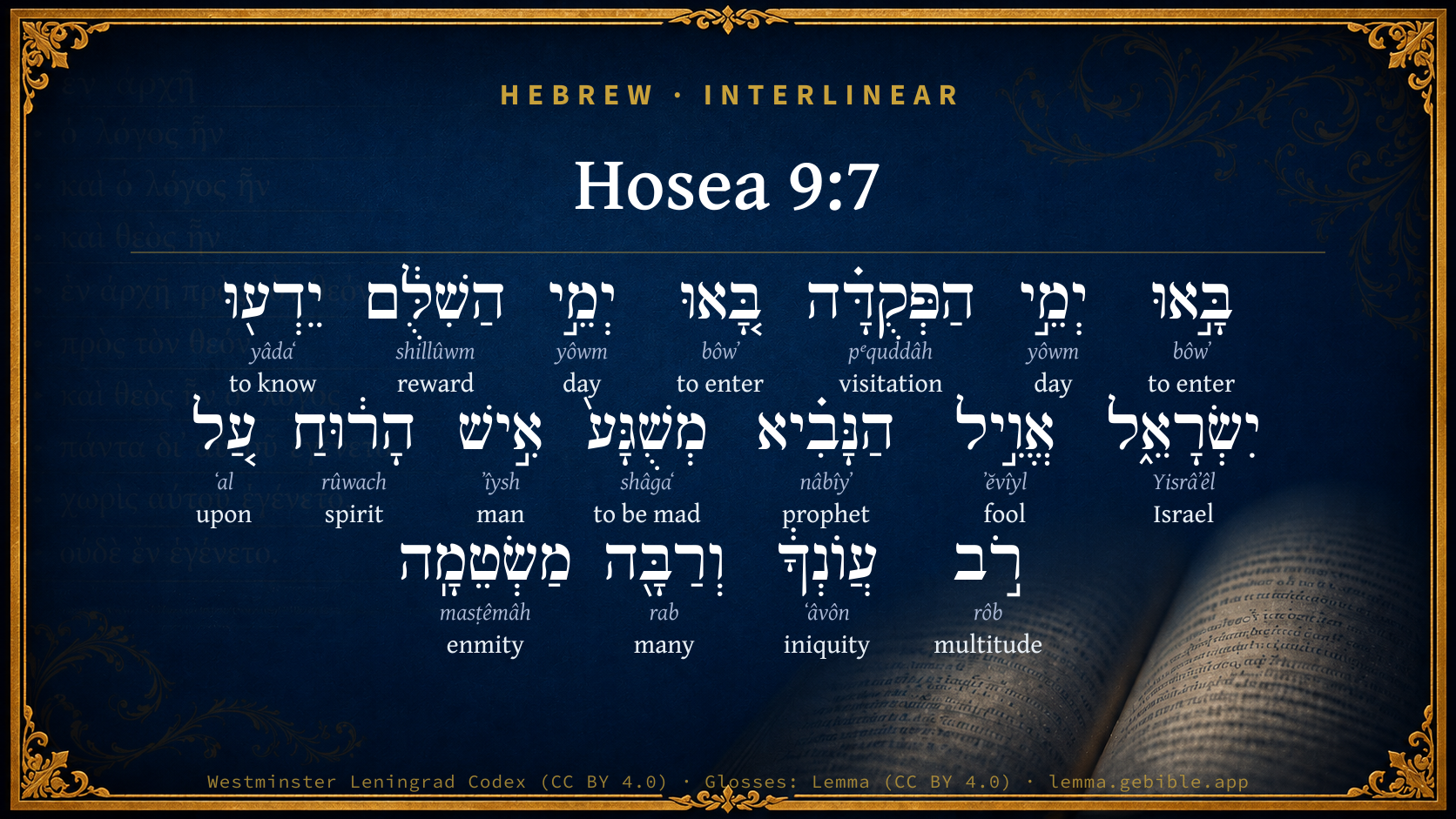
  1. בָּ֣אוּ bôwʼ H935 “to enter” Verb, Qal, Perfect, 3rd Person, Common, Plural
  2. יְמֵ֣י yôwm H3117 “days of” Noun, Common, Masculine, Plural, Construct
  3. הַפְּקֻדָּ֗ה pᵉquddâh H6486 “the · visitation” Particle, Definite Article + Noun, Common, Feminine, Singular, Absolute
  4. בָּ֚אוּ bôwʼ H935 “to enter” Verb, Qal, Perfect, 3rd Person, Common, Plural
  5. יְמֵ֣י yôwm H3117 “days of” Noun, Common, Masculine, Plural, Construct
  6. הַשִׁלֻּ֔ם shillûwm H7966 “the · reward” Particle, Definite Article + Noun, Common, Masculine, Singular, Absolute
  7. יֵדְע֖וּ yâdaʻ H3045 “to know” Verb, Qal, Imperfect, 3rd Person, Masculine, Plural
  8. יִשְׂרָאֵ֑ל Yisrâʼêl H3478 “Israel” Noun, Proper
  9. אֱוִ֣יל ʼĕvîyl H191 “fool” Adjective, Adjective, Masculine, Singular, Absolute
  10. הַנָּבִ֗יא nâbîyʼ H5030 “the · prophet” Particle, Definite Article + Noun, Common, Masculine, Singular, Absolute
  11. מְשֻׁגָּע֙ shâgaʻ H7696 “mad” Verb, Pual, Participle Passive, Masculine, Singular, Absolute
  12. אִ֣ישׁ ʼîysh H376 “man of” Noun, Common, Masculine, Singular, Construct
  13. הָר֔וּחַ rûwach H7307 “the · spirit” Particle, Definite Article + Noun, Common, Both, Singular, Absolute
  14. עַ֚ל ʻal H5921 “upon” Preposition
  15. רֹ֣ב rôb H7230 “multitude of” Noun, Common, Both, Singular, Construct
  16. עֲוֺנְךָ֔ ʻâvôn H5771 “iniquity · your” Noun, Common, Both, Singular, Construct + Suffix, Personal, 2nd Person, Masculine, Singular
  17. וְרַבָּ֖ה rab H7227 “and · many” Conjunction + Adjective, Adjective, Feminine, Singular, Absolute

About this verse

These counts appear in no published source. They are computed here, from the morphology-tagged text and Lemma’s own curated glosses. What Lemma adds →

18
words
16
distinct lemmas
Prophets
section

Notable vocabulary

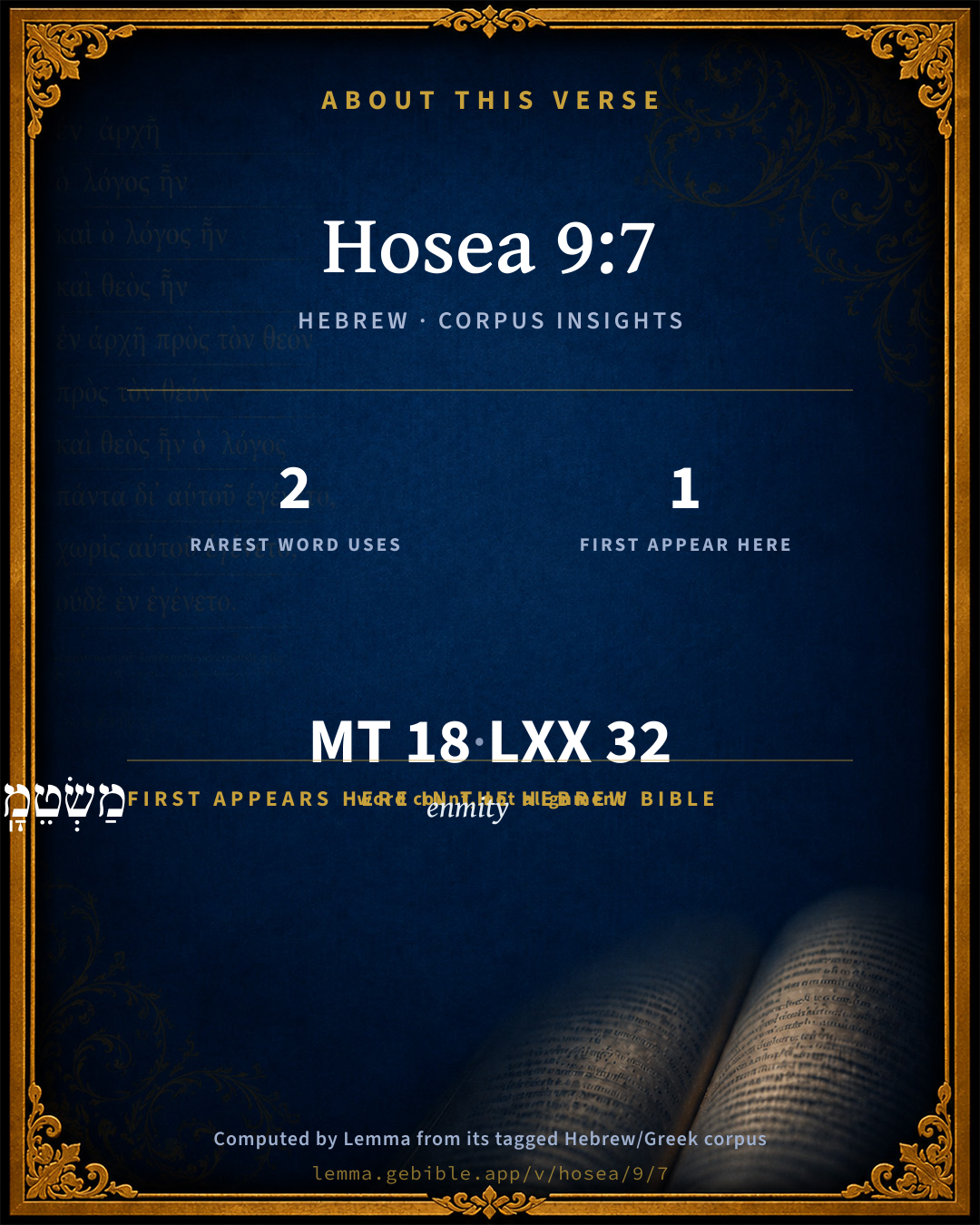
The rarest word here is מַשְׂטֵמָֽה enmity H4895 — appearing just 2 times in the whole Hebrew Bible.

First appearance in Scripture

This word makes its first canonical appearance in the Hebrew Bible here:

  • מַשְׂטֵמָֽה enmity H4895

Shared distinctive vocabulary

מַשְׂטֵמָֽה enmity H4895 occurs in 2 verses of the Hebrew Bible. Also found in:

Grammatical profile

  • 4 verbs
  • 11 nouns
  • 2 adjectives
  • 1 preposition

Verb forms

  • בָּ֣אוּ Qal · Perfect
  • בָּ֚אוּ Qal · Perfect
  • יֵדְע֖וּ Qal · Imperfect
  • מְשֻׁגָּע֙ Pual · Participle Passive

Repetition

Words recur within this verse — often emphatic in Hebrew:

  • בָּ֣אוּ to enter H935 ×2
  • יְמֵ֣י day H3117 ×2

Hebrew & Septuagint length

In English translation the verse runs 43 words from the Hebrew and 40 from the Septuagint (LXX English) — closely comparable.

A rough comparison of the two English renderings, which tokenize alike — not a word-level alignment.

Word counts can differ between the Hebrew and the Greek without any difference in meaning — e.g. the Hebrew direct-object marker אֵת has no separate Greek word, and Greek often adds the article ὁ.

In the original languages it is 18 Hebrew tokens and 32 Greek tokens — but the two are counted differently (Hebrew bundles its prefixes and suffixes into one token; the Greek is in lemma form), so that isn’t a like-for-like length.

Cross-references

34

Topical passages linked to Hosea 9:7 in the Treasury of Scripture Knowledge — connected by theme and wording, ordered by reader-vote popularity; previews shown in the World English Bible.

  • Acts 26:24–25 As he thus made his defense, Festus said with a loud voice, "Paul, you are crazy! Your great learning is driving you insane!"
  • Micah 7:4 The best of them is like a brier. The most upright is worse than a thorn hedge. The day of your watchmen, Even your visitation, has come; Now is the time of their confusion.
  • 2 Kings 9:11 Then Jehu came forth to the servants of his lord: and one said to him, Is all well? why came this mad fellow to you? He said to them, You know the man and what his talk was.
  • Mark 3:21 When his friends heard it, they went out to seize him: for they said, "He is insane."
  • Isaiah 10:3 What will you do in the day of visitation, and in the desolation which shall come from far? to whom will you flee for help? and where will you leave your glory?
  • Jeremiah 10:15 They are vanity, a work of delusion: in the time of their visitation they shall perish.
  • Lamentations 2:14 Your prophets have seen for you false and foolish visions; They have not uncovered your iniquity, to bring back your captivity, But have seen for you false oracles and causes of banishment.
  • Ezekiel 13:3 Thus says the Lord Yahweh, Woe to the foolish prophets, who follow their own spirit, and have seen nothing!
  • Ezekiel 14:9–10 If the prophet be deceived and speak a word, I, Yahweh, have deceived that prophet, and I will stretch out my hand on him, and will destroy him from the midst of my people Israel.
  • 2 Corinthians 5:13 For if we are beside ourselves, it is for God. Or if we are of sober mind, it is for you.
  • Jeremiah 29:26 Yahweh has made you priest in the place of Jehoiada the priest, that there may be officers in the house of Yahweh, for every man who is mad, and makes himself a prophet, that you should put him in the stocks and in shackles.
  • Ezekiel 13:10 Because, even because they have seduced my people, saying, Peace; and there is no peace; and when one builds up a wall, behold, they daub it with whitewash:
  • Micah 2:11 If a man walking in a spirit of falsehood lies: 'I will prophesy to you of wine and of strong drink;' He would be the prophet of this people.
  • Luke 21:22 For these are days of vengeance, that all things which are written may be fulfilled.
  • 2 Thessalonians 2:10–12 and with all deception of wickedness for those who are being lost, because they didn't receive the love of the truth, that they might be saved.
  • Isaiah 26:11 Yahweh, your hand is lifted up, yet they don't see: but they shall see [your] zeal for the people, and be disappointed; yes, fire shall devour your adversaries.
  • Isaiah 34:8 For Yahweh has a day of vengeance, a year of recompense for the cause of Zion.
  • Isaiah 44:25 who frustrates the signs of the liars, and makes diviners mad; who turns wise men backward, and makes their knowledge foolish;
  • Jeremiah 6:14 They have healed also the hurt of my people slightly, saying, Peace, peace; when there is no peace.
  • Jeremiah 8:11 They have healed the hurt of the daughter of my people slightly, saying, Peace, peace; when there is no peace.
  • Jeremiah 11:23 and there shall be no remnant to them: for I will bring evil on the men of Anathoth, even the year of their visitation.
  • Jeremiah 16:18 First I will recompense their iniquity and their sin double, because they have polluted my land with the carcasses of their detestable things, and have filled my inheritance with their abominations.
  • Jeremiah 23:16–17 Thus says Yahweh of Hosts, Don't listen to the words of the prophets who prophesy to you: they teach you vanity; they speak a vision of their own heart, and not out of the mouth of Yahweh.
  • Jeremiah 46:21 Also her hired men in the midst of her are like calves of the stall; for they also are turned back, they are fled away together, they didn't stand: for the day of their calamity is come on them, the time of their visitation.
  • Ezekiel 7:2–7 You, son of man, thus says the Lord Yahweh to the land of Israel, An end: the end is come on the four corners of the land.
  • Ezekiel 12:22–28 Son of man, what is this proverb that you have in the land of Israel, saying, The days are prolonged, and every vision fails?
  • Ezekiel 25:17 I will execute great vengeance on them with wrathful rebukes; and they shall know that I am Yahweh, when I shall lay my vengeance on them.
  • Ezekiel 38:23 I will magnify myself, and sanctify myself, and I will make myself known in the eyes of many nations; and they shall know that I am Yahweh.
  • Hosea 9:8 A prophet watches over Ephraim with my God. A fowler's snare is on all of his paths, And hostility in the house of his God.
  • Amos 8:2 He said, "Amos, what do you see?" I said, "A basket of summer fruit." Then Yahweh said to me, "The end has come on my people Israel. I will not again pass by them any more.
  • Zephaniah 1:14–18 The great day of Yahweh is near. It is near, and hurries greatly, the voice of the day of Yahweh. The mighty man cries there bitterly.
  • Zephaniah 3:4 Her prophets are arrogant and treacherous people. Her priests have profaned the sanctuary. They have done violence to the law.
  • Zechariah 11:15–17 Yahweh said to me, "Take for yourself yet again the equipment of a foolish shepherd.
  • Revelation 16:19 The great city was divided into three parts, and the cities of the nations fell. Babylon the great was remembered in the sight of God, to give to her the cup of the wine of the fierceness of his wrath.

Cross-references courtesy of OpenBible.info (CC BY 4.0).

Hebrew and Greek witnesses Masoretic Hebrew ↔ Greek Septuagint

The same verse in the two great witnesses to the Old Testament, shown verse-for-verse.

These are two independent witnesses, not word-aligned to each other, and the Septuagint is shown in lemma (dictionary) form.

Hebrew Hosea 9:7 Masoretic · Westminster Leningrad Codex

בָּ֣אוּ יְמֵ֣י הַפְּקֻדָּ֗ה בָּ֚אוּ יְמֵ֣י הַשִׁלֻּ֔ם יֵדְע֖וּ יִשְׂרָאֵ֑ל אֱוִ֣יל הַנָּבִ֗יא מְשֻׁגָּע֙ אִ֣ישׁ הָר֔וּחַ עַ֚ל רֹ֣ב עֲוֺנְךָ֔ וְרַבָּ֖ה מַשְׂטֵמָֽה

The days of visitation have come. The days of reckoning have come. Israel will consider the prophet to be a fool, And the man who is inspired to be insane, Because of the abundance of your sins, And because your hostility is great.

World English Bible · Public Domain

Greek LXX Hosea 9:7 Septuagint · lemma form

ἥκω ὁ ἡμέρα ὁ ἐκδίκησις ἥκω ὁ ἡμέρα ὁ ἀνταπόδοσις σύ καί κακόω ἰσραήλ ὥσπερ ὁ προφήτης ὁ παρα ἐκἵστημι ἄνθρωπος ὁ πνευματοφόρος ὑπό ὁ πλῆθος ὁ ἀδικία σύ πληθύνω μανία σύ

The days of vengeance are come, the days of your recompense are come; and Israel shall be afflicted as the prophet that is mad, as a man deranged: by reason of the multitude of your iniquities your madness has abounded.

LXX2012 (modern English Septuagint) · Public Domain

On this verse, Haydock's Catholic Bible Commentary discusses the Septuagint’s reading. Read the note in Commentary ↓

Hebrew: Westminster Leningrad Codex (CC BY 4.0). Greek: Septuagint (public domain); English from LXX2012 (modern English Septuagint) (Public Domain). How the Septuagint differs from the Hebrew →

Targum (Aramaic paraphrase)

1

The Targum is the ancient Jewish Aramaic paraphrase of the Hebrew Scriptures — an interpretive translation, not the Hebrew text itself. Onkelos (literal) and Pseudo-Jonathan (expansive) render the Torah, and Jonathan the Prophets. Coverage is partial: where no permissively-licensed English translation exists for a verse, only the Aramaic is shown. This is verse-level text, not a word-by-word alignment to the Hebrew.

  1. Targum Jonathan Prophets (Joshua–Malachi)
    אֲתוֹ יוֹמֵי סְעוּרָנָא אֲתוֹ יוֹמֵי תוּשְׁלָמַת חוֹבִין יֵדְעוּן דְבֵית יִשְׂרָאֵל דַהֲווֹ מִתְנַבָּן לְהוֹן נְבִיֵי קוּשְׁטָא וּמְשַׁעֲמָמִין לְהוֹן נְבִיֵי שִׁקְרָא עַל דְאַסְגִיאוּ חוֹבָךְ וְתַקִיפוּ חֶטְאָךְ:

    (no public-domain English translation for this verse)

    Targum Jonathan — Aramaic: “Mikraot Gedolot” (public domain). English: “Sefaria Community Translation” (CC0 1.0 (public-domain dedication)); “London "Chaldee Paraphrase," 1871” (public domain). Text via Sefaria.

Commentary

Notes on Hosea 9:7 from classic Christian and Jewish commentators (each source and its license shown beneath its notes). The classic Christian expositions comment on the surrounding passage and are grouped to its opening verse, so a note may address several verses; the Jewish commentaries on the Tanakh (Rashi and others) are per-verse, so they appear only where the commentator wrote on this verse.

Lemma curates 59 commentaries, every one of them public domain or Creative Commons licensed, each selected and text-cleaned for this edition rather than reprinted as found. About our sources →

Matthew Henry's Commentary

For their further awakening, it is here threatened,

I. That the destruction spoken of shall come speedily. They shall have no reason to hope for a long reprieve, for the judgment slumbers not; it is at the door (Hos 9:7): The days of visitation have come, and there shall be no more delay; the days of recompence have come, which they have been so often warned to expect; their prophets have told them that destruction would come, and now it has come, and the time of the divine patience has expired. Note, 1. The day of God's judgments is both a day of visitation, in which men's sins are enquired into and brought to light, and a day of recompence, in which men's doom will be passed, and a reward given to every man according to his work; the strict visitation is in order to a just retribution. 2. This day of visitation and recompence is hastening on apace. It is sure; it is near; as if it had already come.

II. That hereby they shall be made ashamed of their sentiments concerning their prophets. When the day of visitation comes Israel shall know it, shall be made to know that by sad experience which they would not know by instruction. Israel shall know then what an evil and bitter thing it is to depart from God, and what a fearful thing it is to fall into his hands. When thy hand is lifted up they will not see, but they shall see. Israel shall know the difference between true prophets and false. 1. They shall know then that the pretenders to prophecy, who flattered them in their sins, and rocked them asleep in their security, and told them that they should have peace though they went on, however they pretended to be spiritual men (as Ahab's prophets did, Kg1 22:24) were fools and madmen, and not true prophets; they deceived themselves and those to whom they prophesied. But why would God suffer his people Israel to be imposed upon by those false prophets? He answers, "It is for the multitude of thy iniquity which, in contempt of the divine law, thou hast persisted in, and, for the great hatred of the true prophets, that reproved thee, in God's name, for it." Note, Because men receive not the love of the truth, but conceive a hatred of it, and by the multitude of their iniquities bid defiance to it, therefore God shall send them strong delusions, to believe a lie, so strong that they shall not be undeceived till the day of visitation and recompence comes, which will convince them of the folly and madness of those that seduced them and of their own folly and madness in suffering themselves to be seduced by them. 2. They shall know then whether the true prophets, that were really spiritual men, guided by the Spirit of God, were such as they called and counted them, fools and madmen; and they shall be convinced that they were so far from being so that they were the wise men of their times, and God's faithful ambassadors to them. When Israel saw that none of Samuel's words fell to the ground they knew he was established to be a prophet (Sa1 3:20); and so here, when God fulfils the word of his messengers, by bringing the days of recompence they foretold, then those that despised and ridiculed them, and thought Bedlam the fittest place for them, will be ashamed of the multitude of their iniquities of that kind, and of their great hatred, for which God brings upon them this swift destruction. Mocking the messengers of the Lord was the sin they were punished for, and so made ashamed of.

III. That hereby the wickedness of the false prophets themselves shall be manifested to their shame (Hos 9:8): "The watchman of Ephraim was with my God; he had been formerly. They had a set of worthy good ministers, that kept close to God and maintained communion with him; but now they have a race of corrupt, malignant, persecuting prophets, that are the ring-leaders of all mischief." Or, "The watchman of Ephraim now pretends to have been with my God, and prefaces his lies with, Thus saith the Lord; but he is a snare of a fowler in all his ways, and is cunning to draw the simple into sin and the upright into trouble; and he is so full of hatred and enmity to goodness and good men that he has become hatred itself in the house of his God, or against the house of his God." Note, Wicked prophets are the worst of men; their sins against God are most heinous, and their plots against religion most dangerous. They may boast that they are watchmen, speculators, and, as far as speculation goes, they may be right, and with my God, may have their heads full of good notions; but look into their lives, and they are the snare of a fowler in all their ways, catching for themselves and making a prey of others; look into their hearts, and they are hatred in the house of my God, very malicious and spiteful against good ministers and good people. Woe unto thee, O land! unto thee, O church! that hast such watchmen, such prophets, that are seers, but not doers! Corruptio optimi est pessima - The best things, when corrupted, become the worst.

IV. That God will now reckon with them for the sins of their fathers, which they have trod in the steps of, Hos 9:9, Hos 9:10. 1. They were as bad as their fathers: They have deeply corrupted themselves; they are rooted and riveted in sin; they are far gone in the depths of Satan (Isa 31:6), so that it is next to impossible that they should be recovered; the stain of their corruption is deep, not to be got out; it is as scarlet and crimson, or as the spots of the leopard: and it is their own fault; they have corrupted themselves, have polluted and hardened their own hearts, as in the days of Gibeah, when the Levite's concubine was abused to death by the men of Gibeah and the whole tribe of Benjamin patronised the villany; that was a time of deep corruption indeed, and such were the present days. Lewdness and wickedness were as impudent and daring now as in the days of Gibeah; and therefore what can be expected but such a vengeance as was then taken on Gibeah? Every tribe is now as bad as the tribe of Benjamin then was, and therefore may expect to be brought as low as that tribe then was. 2. They shall therefore be reckoned with for their fathers' sins: He will remember their iniquity and visit their sins, the iniquity they have by kind and by entail, the sin that runs in the blood; the sin of the father shall now be visited upon the children. Hence God takes occasion to upbraid them with the degeneracy and apostasy of their ancestors, their perfidiousness and base ingratitude, Hos 9:10. Here observe, (1.) The great honour God put upon Israel when he first formed them into a people: I found Israel like grapes in the wilderness. He took as much delight and pleasure in them as a poor traveller would do if he found grapes in a wilderness, where he most needed them and least expected them. Or when they were in the wilderness he found them as grapes, not precious in themselves, but precious to him, and pleasant as the first-ripe grapes to the lord of the vineyard. They were precious in his sight, and honourable (Isa 43:4); he planted them a choice vine, a right seed (Jer 2:21), and found them no better than he himself made them, good grapes at first. I saw them with pleasure, as the first-ripe in the fig-tree at the first time. Good people are compared to the good things that are first ripe, Jer 24:2. One then is worth more than many afterwards. This intimates the delight God took in them and in doing them good, not for their sakes, but because he loved their fathers. He preserved them carefully, as a man does the first and choicest fruits of his vineyard. Now when he put all this honour upon them, and they stood so fair for preferment, one would think they should have maintained their excellency; but, (2.) See the great disgrace they put upon themselves. God set them apart for himself as a peculiar people, but they went to Baal-peor, joined with the Moabites in sacrificing to that dirty dunghill deity (Num 25:2, Num 25:3), and they separated themselves unto that shame, that shameful idol, so Baal-peor was in a particular manner, if (as should seem) the whoredom which the people committed with the daughters of Moab was a part of the service done to Baal-peor. Note, Whatever those separate themselves to that forsake God it will certainly be a shame to them, first or last. Their abominations are here said to be as they loved; their practices which were an abomination to God were as the best-beloved of their souls. Or when they had once forsaken God they multiplied their abominations, their idols and abominable idolatries, at their pleasure. This was the way of their fathers; God had done well for them, but they had acted ungratefully towards him, and in the same manner had the present generation deeply corrupted themselves.

Matthew Henry's Commentary on the Whole Bible (1708–1710) — public domain (CC PDM 1.0). Text via the HelloAO Bible API.

Trapp's Complete Commentary

John Trapp

Hos 9:7 The days of visitation are come, the days of recompence are come; Israel shall know [it]: the prophet [is] a fool, the spiritual man [is] mad, for the multitude of thine iniquity, and the great hatred.

Ver. 7. The days of visitation are come] A visitation that is like to prove a vexation; for every transgression and disobedience, that is, omission and commission, shall receive a just recompense of reward from the God of recompenses (so he is called, Jer 51:56), whose eyes behold, his eyelids try the children of men, Psa 11:4; the former points out his knowledge, the latter his judgment, or his critical descant in his visitation or inquisition, the days whereof are set, Stat sua cuique dies, and Israel’s days are come, are come, it is repeated for more assurance, as "Babylon is fallen, is fallen," certo, cito, penitus; and as Eze 7:5-7, the prophet tells them, "The end is come, is come, is come"; and so some ten or twelve times, that he might beat it into them, and awaken them out of the snare of the devil. The wicked’s happiness will take its end surely and swiftly; but it is hard persuading them so; and the Jews, as they were ever noted for obstinate and overweening, so to this day they are light, aerial, and Satanical, apt to work themselves into the fool’s paradise of a sublime dotage. But they shall know it to be so as I have said, by woeful experience, that mistress of fools.

Israel shall know it] sc. To his sorrow, he shall pay for his learning, buy his wit, open his eyes (as the mole doth) when death is upon him, oculos incipit aperire moriendo (Plin.); roar and look upward, Isa 8:21, as the hog doth when the knife is at his throat. O Lord (saith the same prophet, Isa 26:11), "when thy hand is lifted up" (and thy hand is a mighty hand, Jas 4:10, it falls heavy), "they will not see," they wink wilfully, or seek straws to put out their eyes with, as Bernard hath it, Festucam quaerunt unde oculos sibi eruant; " but they shall see," will they nill they, "and be ashamed" of their former oscitancy, or rather obstinacy, when that hand of God, which was lifted up in threatening, shall fall down in punishing, and the "fire of thine enemies shall devour them"; how much more at that last and great visitation, that terrible day of retribution, when they shall answer for all, with the flames about their ears. Tunc sentient magno suo malo, then shall they feel, to their eternal woe, the truth of all the threatenings, which till then they heard, and read, as a man doth an almanac prognostications of wind or foul weather, which he thinks may come to pass, and it may be not; and give nothing so much credit to them as the prior of St Bartholomew’s, in London, did to an idle and addle-headed {a} astrologer, when he went and built him a house at Harrowon-the-hill to secure himself from a supposed flood that that astrologer foretold.

The prophet is a fool, &c.] φανλος, a naughty man: the Hebrew word here is evil, and signifieth a rash and unadvised fellow, that is headstrong and headlong; such were their false prophets that promised peace when war was at their gates, and made all fair weather before them when the tempest of God’s wrath was even bursting out upon them; such a tempest as should never be blown over. These should now appear to be fools, or rather impostors, that had brought the credulous people into a fool’s paradise.

The spiritual man is mad] Heb. the man of the spirit, or ventosus, the windy man, that uttereth vain and empty conceits, humani cerebelli Minervas, the brats of his own brain, light, airy nothings, the disease of this age, full of flashes and figments, idle speculations of "men of corrupt minds, and destitute of the truth." These pretend altogether to the spirit, and would be thought the only spiritual men; as the Swenkfeldians (whom, for their ill favour, Luther called Stenckfeldians), who bewitched many with those glorious words (which were ever in their mouths) of illumination, revelation, the inward and spiritual man, &c., and entitled themselves the confessors of the glory of Christ. So the enthusiasts and Anabaptists, what boast make they of the spirit; professing that they will deliver nothing but what they have immediately revealed to them from heaven. Munzer (their ringleader) wrote a base book against Luther (which he dedicateth to King Jesus), wherein Lutherum flagellat quod euthusiasmorum spiritu careat et nil nisi carnalia sapiat, he falls foul upon Luther, as wanting the spirit of revelation, and one that savoureth nothing but carnal things. All his followers look upon Luther as more pestiferous than the pope; and for Calvin they say (and I have heard it), that it had been happy for the Church if he had never been born. It was their practice of old (as Leo Judae observed in his epistle before Bullinger’s book against the Catabaptists), and is still, to discourage and disparage Christ’s faithful ministers all they can, as carnal, and not relishing the things of the spirit; the right offspring they are of those ancient heretics called Messalanii (the same with the Euchites and Enthusiasts), who, in A.D. 371, professed to be wholly made up of the spirit, gave themselves much to sleep, and called their dreams and wild phantasies prophecies and revelations.

For the multitude of thine iniquity, and the great hatred] Heb. the great Satanic hatred that thou hast borne against God and thy neighbour, but especially God’s faithful prophets, whom thou heartily hatedst for their plain dealing; as Ahab did Micaiah, because he never spoke good to him. It is very probable that Micaiah was that disguised prophet who brought Ahab the fearful message of displeasure and death, for dismissing Benhadad; for the which he was ever since fasted in prison, deep in disgrace. Lo, this is the world’s wages. Truth breeds hatred, great hatred, as the text hath it, devilish hatred, and this is through the multitude of men’s iniquities, the overflow of sins, which wretched men hold so dear to themselves, that they cannot but rage against those that disclaim against them, and proclaim hell fire against their hateful practices; they cannot stand still to have their eyes picked out, how should they? say. Now, for such, what wonder is it if God in justice give them up to the efficacy of error that they may believe a lie, since they would not receive the love of the truth? 2Th 2:11, ut infatuati seducantur, et seducti iudicentur (Augustin in loc.), that being infatuated they may be seduced, and being seduced, perish? what wonder also if he deliver them up, as to "strong delusions," so to "vile affections," and abominable actions, that they may receive in themselves that recompense of their error that is meet, Rom 1:27. What marvel, if men that will not endure sound doctrine be left to seducers? if those that have itching ears meet with clawing preachers? if such as turn away their ears from the truth, be turned to fables and fopperies? 2Ti 4:3-4. It is for the multitude of men’s iniquities, and especially for their great hatred to the truth, that the Church is so pestered with impostors, {2Pe 2:1-2} who bring in "damnable heresies," even denying the Lord that bought them. Do not our modern seducers so among us, when (among other portentous opinions held by them) they stick not to affirm, that Christ is a carnal or fleshly thing; that those that are grown Christians may go to God immediately without a Christ; that Christ did not rise again, &c. Others contemn him by the notion of the man dying at Jerusalem - Oh horrible! (Dr Homes’ Character of the Present Times, 200.) There was a time when the popes were so notoriously naughty as to speak thus basely of Christ; to deny, or at least to doubt the immortality of the soul, the resurrection of the body, &c.; and then a poor popeling cried out, that the sins of that synagogue were so great, as that it deserved not to be ruled by any other than reprobates. Certain it is, that God plagues contempt of the truth (that great gospel sin) with an inundation of errors and enormities.

{a} Applied contemptuously to one whose intellect seems muddled. ŒD

John Trapp, A Commentary or Exposition upon All the Books of the Old and New Testament (1647–1656) — public domain. Text from a community e-Sword module.

The Biblical Illustrator

Joseph S. Exell

Hos_9:7

The days of visitation are come, the days of recompence are come.

Days of recompence

The passionate anguish that breathes in these words gives its colour to the whole book of Hoseas prophecies. His language, and the movements of his thoughts, are far removed from the simplicity and self-control which characterise the prophecy of Amos. Indignation and sorrow, tenderness and severity, faith in the sovereignty of Jehovahs love and a despairing sense of Israels infidelity, are woven together in a sequence which has no logical plan, but is determined by the battle and alternate victory of contending emotions; and the swift transitions, the fragmentary, unbalanced utterance, the half-developed allusions, that make his prophecy so difficult to the commentator, express the agony of this inward conflict. Hosea, above all other prophets, is a man of deep affections, of a gentle, poetic nature. His heart is too true and tender to snap the bonds of kindred and country, or mingle aught of personal bitterness with the severity of Jehovahs words. Alone in the midst of a nation that knows not Jehovah, without disciple or friend, without the solace of domestic affection--for even his home was full of shame and sorrow--he yet clings to Israel with inextinguishable love. The doom which he proclaims against his people is the doom of all that is dearest to him on earth; his heart is ready to break with sorrow, his very reason totters under the awful vision of judgment, his whole prophecy is a long cry of anguish, as again and again he renews his appeal to the heedless nation that is running headlong to destruction. But it is all in vain. The weary years roll out, the signs of Israels dissolution thicken, and still his words find no audience. Like a silly dove fluttering in the toils, Ephraim turns now to Assyria, now to Egypt, but they return not to Jehovah their God, and seek not Him for all this. Still the prophet stands alone in his recognition of the true cause of the multiplied distresses of his nation, and still it is his task to preach repentance to deaf ears, to declare a judgment in which only himself believes. (W. Robertson Smith, LL. D.)

The prophet is a fool, and the spiritual man is mad.

Charge against religious ministers

What the prophet means is this. When the predicted retribution had come, Israel would learn that the prosperity which some of the prophets had predicted (Eze_13:10) proved them infatuated fools. This charge against religious ministers is--sometimes too true.

1. There are men of weak minds; utterly incapable of taking a harmonious view of truth, or even forming a clear and complete conception of any great principle.

2. There are men of irrational theologies. They propound theological dogmas which are utterly incongruous with human reason, and therefore un-Biblical and un-Divine.

3. There are men of silly rituals.

II. Often a scoffing calumny. The ideal preacher is the wisest and most philosophical man of his age.

1. He aims at the highest end.

2. He works in the right direction.

3. He employs the best means. The best is not legislation, art, poetry, rhetoric, but love. This is the Cross, the power of God unto salvation. (Homilist.)

Spiritual madness

Literally, the man of the lying spirit, the man who: was determined to deceive the nations: that prophet is declared to be a fool, and that spiritual man is mad. In other scriptures another spiritual man is also said to be mad. Christ was so charged. Paul was declared to be mad, The apostles had to vindicate themselves against daily charges of insanity. Why so? Simply because they were spiritual men. There is a madness without which there is no greatness. Talent is never mad, genius is seldom sane; respectability is always decorous, enthusiasm sometimes makes a new map of the world every day, lining it and pencilling it according to an eccentricity not to be brought within rules and mechanical proprieties. Enthusiasm is another name for the kind of madness which is described in the Scriptures. It is not the professing Christian who is mad. He may be too sagacious; he may be too shrewd; he may be but a calculator. Men of mechanical piety never helped the cause of the Son of God. We should have more progress if we had more madness; we should make a great impression if we had more enthusiasm. The spiritual man is necessarily mad in the estimation of the worldly man. The spiritual man is mad, because he says that mind is greater than what we know by the name of matter. The religious or spiritual man is mad because he trusts to a spirit. The spiritual man sees the invisible, and is not to be laughed out of his spiritual ecstasy. (Joseph Parker, D. D.)

A converted woman accounted as mad

Rev. John Robertson says: During the revivals of 1859, a woman living in an Aberdeenshire village with her mother and sister was converted, and was full of enthusiasm. She went from door to door pleading with the people to let the Lord Jesus into their hearts. The mother and sister had a consultation together, and they came to the sad conclusion that Mary was mad. The village doctor, and with him the doctor of a neighbouring village, was called in. They consulted, and they came to the same conclusion, and thereupon signed the schedule for her admission to a lunatic asylum, simply because she besought one and all of those whom she loved to come to Jesus. On the night preceding the day upon which she was to be sent to the asylum the sister and the mother had strange thoughts, and when they met in the morning the mother said to her daughter, Do you know, I have just been wondering all night whether it is Mary that is mad, or we. Well, do you know, mother, replied the daughter, I have just been wondering the same thing. They thought deeply, and searched their hearts, until they came to the conclusion that it was not Mary, but they themselves who were mad. Brownley North says that he took tea with the whole family, and with the relations on both sides of the house, about twenty-three in all, who, through Marys pleading, had been led to Christ.

The Biblical Illustrator, edited by Joseph S. Exell (c. 1880s–1900s) — public domain. Text from a community e-Sword module.

Joseph Benson's Commentary

Hos 9:7. The days of visitation are come — The days of punishment, or retribution, are at hand. This resembles the well-known line of Virgil: —

Venit summa dies et ineluctabile tempus Dardaniæ. — — — ÆN. lib. 2. 50:324.

The fatal day, th’ appointed hour is come, The time of Troy’s irrevocable doom.

Israel shall know it — The Hebrew is only, Israel shall know, namely, that I have spoken the truth; that is, in denouncing misery and calamity against them, as the Chaldee supplies the ellipsis. God’s judgments upon the ten tribes shall be so evident, that the most incredulous shall not be able to deny it. Others interpret this clause in connection with the following words, thus: Israel shall know that the prophet was foolish, that the man of the spirit was mad, namely, who encouraged the Israelites to continue in their sins, by promising them peace and prosperity notwithstanding their corrupt manners. Bishop Horsley’s translation of the passage is peculiarly spirited and sublime: The days of visitation are come! The days of retribution are come! Israel shall know it. Stupid is the prophet! The man of the spirit is gone mad! “Stupid,” he remarks, “if he himself discerneth not the signs of the times. Gone mad, if, aware of the impending judgment, he flatters the people with delusive hopes; and by that conduct makes himself an instrument in bringing on that public ruin, in which he himself must be involved.” For the multitude of thine iniquity, and the great hatred — Namely, which thou deservest. Or probably the sense is, as Bishop Horsley’s version gives it, In proportion to the greatness of thine iniquity, great also is the vengeance.

Joseph Benson's Commentary on the Old and New Testaments (1811–1818) — public domain. Text from a community e-Sword module.

Keil & Delitzsch

C. F. Keil & F. Delitzsch

"The days of visitation are come, the days of retribution are come; Israel will learn: a fool the prophet, a madman the man of spirit, for the greatness of thy guilt, and the great enmity. Hos 9:8. A spy is Ephraim with my God: the prophet a snare of the bird-catcher in all his ways, enmity in the house of his God. Hos 9:9. They have acted most corruptly, as in the days of Gibeah: He remembers their iniquity, visits their sins." The perfects in Hos 9:7 are prophetic. The time of visitation and retribution is approaching. Then will Israel learn that its prophets, who only predicted prosperity and good (Eze 13:10), were infatuated fools. אויל וגו introduces, without kı̄, what Israel will experience, as in Hos 7:2; Amo 5:12. It does not follow, from the use of the expression 'ı̄sh rūăch, that the reference is to true prophets. 'Ish rūăch (a man of spirit) is synonymous with the 'ı̄sh hōlēkh rūăch (a man walking in the spirit) mentioned in Mic 2:11 as prophesying lies, and may be explained from the fact, that even the false prophets stood under the influence of a superior demoniacal power, and were inspired by a rūăch sheqer ("a lying spirit," Kg1 22:22). The words which follow, viz., "a fool is the prophet," etc., which cannot possibly mean, that men have treated, despised, and persecuted the prophets as fools and madmen, are a decisive proof that the expression does not refer to true prophets. על רב עונך is attached to the principal clauses, השּׁלּם ... בּאוּ. The punishment and retribution occur because of the greatness of the guilt of Israel. In ורבּה the preposition על continues in force, but as a conjunction: "and because the enmity is great" (cf. Ewald, 351, a). Mastēmâh, enmity, not merely against their fellow-men generally, but principally against God and His servants the true prophets. This is sustained by facts in Hos 9:8. The first clause, which is a difficult one and has been interpreted in very different ways, "spying is Ephraim עם אלהי" (with or by my God), cannot contain the thought that Ephraim, the tribe, is, according to its true vocation, a watchman for the rest of the people, whose duty it is to stand with the Lord upon the watch-tower and warn Israel when the Lord threatens punishment and judgment (Jerome, Schmidt); for the idea of a prophet standing with Jehovah upon a watch-tower is not only quite foreign to the Old Testament, but irreconcilable with the relation in which the prophets stood to Jehovah. The Lord did indeed appoint prophets as watchmen to His people (Eze 3:17); but He does take His own stand upon the watch-tower with them. Tsâphâh in this connection, where prophets are spoken of both before and after, can only denote the eager watching on the part of the prophets for divine revelations, as in Hab 2:1, and not their looking out for help; and עם אלהי cannot express their fellowship or agreement with God, if only on account of the suffix "my God," in which Hosea contrasts the true God as His own, with the God of the people. The thought indicated would require אלהיו, a reading which is indeed met with in some codices, but is only a worthless conjecture. עם denotes outward fellowship here: "with" = by the side of. Israel looks out for prophecies or divine revelations with the God of the prophet, i.e., at the side of Jehovah; in other words, it does not follow or trust its own prophets, who are not inspired by Jehovah. These are like snares of a bird-catcher in its road, i.e., they cast the people headlong into destruction. נביא stands at the head, both collectively and absolutely. In all its ways there is the trap of the bird-catcher: i.e., all its projects and all that it does will only tend to ensnare the people. Hostility to Jehovah and His servants the true prophets, is in the house of the God of the Israelites, i.e., in the temple erected for the calf-worship; a fact of which Amos (Amo 7:10-17) furnishes a practical example. Israel has thereby fallen as deeply into abomination and sins as in the days of Gibeah, i.e., as at the time when the abominable conduct of the men of Gibeah in connection with the concubine of a Levite took place, as related in Judg. 19ff., in consequence of which the tribe of Benjamin was almost exterminated. The same depravity on the part of Israel will be equally punished by the Lord now (cf. Hos 8:13).

Keil & Delitzsch — Biblical Commentary on the Old Testament (1861–1891) — public domain (CC PDM 1.0). Text via the HelloAO Bible API. (Old Testament only.)

Tyndale Open Study Notes

Tyndale Open Resources

9:7 Apostate Israelites refused to believe God’s words of judgment as delivered by the prophets and mockingly cried that the prophets were crazy.

Tyndale Open Study Notes — © Tyndale Open Resources, licensed CC BY-SA 4.0. Text via the HelloAO Bible API.

Geneva Bible (1599)

Geneva Bible translators

Then they shall know that they were deluded by them, who challenged to themselves to be their prophets and spiritual men.

Geneva Bible (1599) marginal notes — public domain. Text via Bolls.life.

Jamieson, Fausset & Brown

Robert Jamieson, A. R. Fausset & David Brown

visitation--vengeance: punishment (Isa 10:3).

Israel shall know it--to her cost experimentally (Isa 9:9).

the prophet is a fool--The false prophet who foretold prosperity to the nation shall be convicted of folly by the event.

the spiritual man--the man pretending to inspiration (Lam 2:14; Eze 13:3; Mic 3:11; Zep 3:4).

for the multitude of thine iniquity, &c.--Connect these words with, "the days of visitation . . . are come"; "the prophet . . . is mad," being parenthetical.

the great hatred--or, "the great provocation" [HENDERSON]; or, "(thy) great apostasy" [MAURER]. English Version means Israel's "hatred" of God's prophets and the law.

Jamieson, Fausset & Brown — Commentary Critical and Explanatory on the Whole Bible (1871) — public domain (CC PDM 1.0). Text via the HelloAO Bible API.

Adam Clarke's Commentary

Verse 7. The days of visitation] Of punishment are come.

The prophet is a fool] Who has pretended to foretell, on Divine authority, peace and plenty; for behold all is desolation.

The spiritual man] איש הרוח ish haruach, the man of spirit, who was ever pretending to be under a Divine afflatus.

Is mad] He is now enraged to see every thing falling out contrary to his prediction.

Adam Clarke's Commentary on the Bible (1810–1826) — public domain. Text from a community e-Sword/MySword module.

John Calvin's Commentaries

The Prophet, by saying that the days of visitation had come, intended to shake off from hypocrites that supine torpor of which we have often spoken; for as they were agitated by their own lusts, and were in a state of continual fervour, so they hardened themselves against God’s judgement, and, as it were, covered themselves over with hardness. It was then necessary to deal roughly with them in order to break down such stubbornness. This is the reason that the Prophet repeats so often and in so many forms what might be expressed in this one sentence — That God would be a just avenger. Hence he cries out here, that the days of visitation had come. For when the Lord spared them, as sacred history relates, and as we said at the beginning, (and under the king Jeroboam the second, the son of Joash, their affairs were prosperous,) their pride and contempt of God the more increased. Since then they thought themselves to be now beyond the reach of harm, the Prophet declares that the days had come. And there is here an implied contrast in reference to the time during which the Lord had borne with them; for as the Lord had not immediately visited their sins, they thought that they had escaped. But the Prophet here distinguishes between time and time: “You have hitherto thought,” he says, “that you are at peace with God; as if he, by conniving at the sins of men, denied himself, so as not to discharge any more the office of a judge: nay, there is another thing to be here considered, and that is, that God has certain days of visitation, which he has fixed for himself; and these days are now come.”

And he again teaches the same thing, The days of retribution have come He uses another word, that they might know that they could not go unpunished for having in so many ways provoked God. For as the Lord disappoints not the hope of his people, who honour him; so also there is a reward laid up for the ungodly, who regard as nothing his judgement. “God will then repay you what you have deserved, though for a time it may please him to suspend his judgement.”

Then he says, Israel shall know This is the wisdom of fools, as it is said even in an old proverb; and Homer has also said, παθων δε τε νήπιος εγνω, (Even the foolish knows when he suffers.) The foolish is not wise, except when he suffers. Hence the Prophet says, that Israel, when afflicted, would then perceive that instruction had been despised, and that all warnings had been trifled with, at least had not been regarded. Israel then shall know; that is, he shall at length, when too late, understand that he had to do with God, even when the time of repentance shall be no more. The meaning then is that as the ungodly reject the word of God, and obey not wise admonitions and counsels, they shall at length be taken to another school, where God teaches not by the mouth but by the hand. Whosoever then does not now willingly submit to his teaching, shall find God to be a judge, and shall not escape his hand.

They who join what follows elicit this meaning, Israel shall know the Prophet to be foolish, the man of the spirit to be mad; that is, Israel shall then understand that he was deluded by flatteries, when the false Prophets promised that all things would be prosperous. We indeed know that they catched at those prophecies which pleased their ears; for which Micah also reproves them; hence he calls those who gave hope of a better state of things, the Prophets of wine and oil and wheat, (Micah 2:11.) The world wishes to be ever thus deceived. Since then there were many in Israel, who by their impositions deceived the miserable, he says, Israel shall at last know that he has been deluded by his own teachers. If we receive this sense, there is then here a reproof to Israel for thinking that the vengeance of God was in some way restrained, when the false Prophets said that he was pacified, and that there was no danger to be feared. For do not men in this way stultify themselves? And how gross is their stupidity, when they think that God’s hands are tied, when men are silent, or when they perfidiously turn the truth into a lie? And yet even at this day this disease prevails in the world, as it has prevailed almost in all ages. For what do the ungodly seek, but to be let alone in their sins? When mouths are closed, they think that they have gained much. This madness the Prophet derides, intimating that those profane men, who have such delicate ears, that they can bear no words of reproof, shall at last know what they had gained by hiring prophets to flatter them. We hence see, in short, that the adulations, by which the ungodly harden themselves against God, will be to them the occasion of a twofold destruction; for such fallacies dementate them, so that they much more boldly provoke against themselves the wrath of God.

But if we read the two clauses apart, the rendering will be this, “The Prophet is a fool, the man of the spirit is mad.” And as to the matter itself, there is not much difference. I will not then dwell on the subject; for when we are agreed as to the design of the Prophet and the truth remains the same, it is vain, at least it is of no benefit, to labour very anxiously about the form of the sentence. If then we begin a sentence with these words, אויל הנביא, avil enebia, the sense will be this, “I know that the Prophets promise impunity to you; but they who thus hide your sins, and cover them over as with plasters, are insane men, yea, they are wholly infatuated. There is then no reason why their flatteries should delight you; for the event will show that they are mere absurdities and idle ravings.” We now see that there is no great difference in the sense: for this remains still unaltered, that there were many flatterers among the people, who made it their business to lie, that they might thus procure the favour of the people; and this ambition has prevailed in all ages: and sometimes also cupidity or avarice takes such hold on men, that they use a meretricious tongue, and excuse all vices however grievous, and elude all threatening. This is what the Prophet shows in the first place; and then he shows, that men without any advantage indulge their vices, when there is no one severely to reprove them, or boldly to exhort them to repent; and that though all the Prophets should give them hope of safety they should yet perish: for men cannot by their silence restrain God from executing at last his judgement. Nay, we must remember this, that God spares men when he does not spare them; that is, when he chastises them, when he reproves their sins, and when he constrains them by terror, he then would spare them. And again, when God spares, he does not spare; that is, when he connives at their sins, and leaves men to their own will, to grow wanton at their pleasure, without any yoke or bridle, he then by no means spares them, for he destines them for destruction.

“The man of the spirit,” some render “the man of the wind;” and some “the fanatical man;” but they are in my judgement mistaken; for the Prophet, I doubt not, uses a respectful term, but yet by way of concession. He then calls those the men of the spirit who were by their office prophets, but who abused that title, as those who at this day call themselves pastors when they are really rapacious wolves. The Prophets, as we know, always declared that they did not speak from their own minds but what the Spirit of God dictated to them. Hence they were men of the Spirit, that is, spiritual men: for the genitive case, we know, was used by the Hebrews to express what we designate by an adjective. The Prophets then were the men of the Spirit. He concedes this name, in itself illustrious and honourable, to impostors; but in the same sense as when I speak generally of teachers; I then include the false as well as the true. This then is the real meaning of the expression, as we may gather from the context: for he says the same thing twice, אויל הנביא, avil enebia, Fool is the Prophet, and then, משגע איש הרוח, moshigo aish eruch, Mad is the man of the spirit As he spoke of a Prophet, so he now mentions the same by calling him a man of the spirit, or a spiritual man.

At the end of the verse he adds, For the multitude of thine iniquity, for great hatred, or, much hatred; for it may be rendered in these two ways. Here the Prophet shows, that though the false Prophets stultified by their fallacies the people, yet this could by no means avail for an excuse or for extenuating the fault of the people. How so? Because they suffered the punishment of their own impiety. For whence comes it, that the Lord takes away his light from us, that after having once shown to us the way of salvation, he turns suddenly his back on us, and suffers us to go astray to our perdition? How does this happen? Doubtless, because we are unworthy of that light, which was a witness to us of God’s favour. For as much then as men through their own fault procure such a judgement to themselves, the Lord neither blinds them nor gives to Satan the power of deluding them, except when they deserve such a treatment. Hence the Prophet says, For the multitude of thine iniquity, and for thy crimes, by which thou hast excited against thyself the wrath and hatred of God. We hence see how frivolous are the pretences by which men clear themselves, when they object and say that they have been deceived and that if their teachers had been faithful and honest, they would have willingly obeyed God. When therefore men make these objections, the ready answer is this, that they had been deprived of true and faithful teachers, because they had refused the favour offered to them, and extinguished the light, and as Paul says, preferred a lie to the truth; and that they had been deceived by false Prophets, because they willingly hastened to ruin when the Lord called them to salvation. We now then understand the import of what is here taught.

The Prophet says, in the first place, that the day of vengeance was now at hand, because the Lord by forbearance could prevail nothing with the obstinate. He then adds, that as all threatenings were despised by the people, and as they were deaf to every instruction, they would at length know that God had not spoken in vain but would perceive that their were justly treated; for the Lord would not now teach them by his word, but by scourges. He adds, in the third place, that the Prophet was foolish and delirious, and also, that they who boasted themselves to be the men of the spirit were mad: by which expressions he meant that the flatteries, by which the people were lulled asleep were foolish; for God would not fail at last, when the time came, to execute his office. And, lastly he reminds them that this would happen through the fault of the people, that there was no reason for them to trace or to ascribe the cause of the evil to any thing else; for this blindness was their just punishment. The Lord would have never permitted Satan thus to prevail in his own inheritance, had not the people, by the immense filth of their sins, provoked God for a long time, and as it were with a determined purpose. It now follows —

John Calvin's Commentaries (1540-1563) — public domain. Text from the Calvin Translation Society English edition (1840s-50s) via the Christian Classics Ethereal Library (ccel.org). Calvin's coverage is partial (roughly two-thirds of the Bible); uncommented books and verses are honest gaps, never fabricated. The 19th-century editor's footnotes and remarks are omitted so the notes are faithfully Calvin's own voice.

Ellicott's Commentary for English Readers

(7) The latter part of the verse should be translated Crazed is the prophet, mad the inspired one, because of the multitude of thy iniquity, while persecution is increased. The prophet is crazed either in the depraved public opinion that Hosea scornfully describes, or, he is driven mad, distracted, by the persecutions to which he is subjected. The latter is more probable. (Comp. the following verse.) Other commentators, including Maurer and Hitzig (preceded by Jerome and many Jewish as well as Christian expositors) take the words for prophet in this verse as signifying “false prophet,” and would connect the clauses thus:—“Israel shall recognise that the prophet (who prophesied good to them) is a fool, the inspired one a madman, because of,” &c. But it is doubtful whether the Hebrew for “inspired one” (îsh harûach) can bear this unfavourable sense, with the definite article affixed (comp. 1Ki_22:21, Heb.); so Nowack. The passage is very difficult, and no decisive superiority can be claimed for any rendering yet proposed.

A Bible Commentary for English Readers, edited by Charles John Ellicott (1878–1897) — public domain. Text from a community e-Sword module.

The Cambridge Bible for Schools and Colleges

gen. ed. J. J. S. Perowne

7. are come] Rather, come. The sense is that the days of punishment shall surely come (the tense is the prophetic perfect).

shall know it] i.e. by experience; as Isa_9:9. Another view of these words (in connexion with the following clause) is, ‘Israel shall perceive (but too late) how it has been deceived by its prophets.’ But a false prophet would never be called a ‘man of the spirit’, but rather ‘one that followeth his own spirit’ (Eze_13:3); and neither ‘a fool’ nor ‘mad’ suggests the idea of falsehood or hypocrisy.

the prophet is a fool, the spiritual man is mad] These words evidently convey a reproach, for though ‘mad’ might be taken in a good sense (= frenzied with sorrow, as Deu_28:34), ‘a fool’ could hardly be. But if so, introductory words must have dropped out of the text, such as ‘who say in their pride.’ ‘The spiritual man’ is, literally, ‘the man of the Spirit’, i.e. ‘the inspired man’, Sept. ἄνθρωπος ὁ πνευματοφόρος. ‘Mad’, or ‘a madman’, ‘a fanatic’, is a term applied disparagingly to a prophet’s disciple in 2Ki_9:11, and to Jeremiah by an opponent in Jer_29:26. The expression was doubtless received from those early times, in which the acts performed by prophets were often strange and startling.

for the multitude …] Rather, for the greatness of thine Iniquity, and because the enmity hath been great. These words are to be connected with the preceding. Israel spoke thus because its iniquity was great, and great also the enmity which certain classes (probably) felt towards the higher prophets. The priests and the lower class of prophets would be at one in their hostility to Hosea. More is said of this feud in the next verse.

The Cambridge Bible for Schools and Colleges (gen. ed. J. J. S. Perowne; Cambridge University Press, 1878–1918) — public domain. Text from a community e-Sword module.

John Gill's Exposition

The watchman of Ephraim was with my God,.... Formerly the watchmen of Ephraim, or the prophets of Israel, were with the true God, whom the prophet calls his God; as Elijah and Elisha, who had communion and intimacy with him; had revelations and instructions from him; and were under the direction and inspiration of his Spirit, and prophesied in his name things according to his will, and for the good of his people: or "the watchman of Ephraim should be with my God"; on his side, and promote his worship and service, his honour and interest; and give the people warning from him, having heard the word at his mouth: but now they were not with him, nor for him, nor did as they should: or one that bore this character of a watchman in the ten tribes, pretended to be such a one, and would be thought to be with God, and to have his mind and will, and to be sincere for his glory:

but the prophet is a snare of a fowler in all his ways; the false prophet, the same with the watchman, instead of guiding and directing Ephraim in the right way in which he should go, lays snares for him in all the ways he takes, to lead him wrong, and draw him into sin, particularly into idolatry, both by his doctrine and example:

and hatred in the house of his God; and so became detestable and execrable it the house of his own god, the calf at Bethel, in the temple there: prophesying such things as in the event prove false, and drawing into such practices as brought on ruin and desolation. The Targum interprets it, of laying snares for their prophets, their true prophets; and Kimchi and Jarchi of slaying Zechariah the prophet in the temple.

John Gill's Exposition of the Whole Bible (1746–1763) — public domain (CC PDM 1.0). Text via the HelloAO Bible API.

Albert Barnes' Notes on the Bible

The days of visitation are come - The false prophets had continually hood-winked the people, promising them that those days would never come. “They had put far away the evil day” Amo 6:3. Now it was not at hand only. In God’s purpose, those “days” were “come,” irresistible, inevitable, inextricable; days in which God would visit, what in His long-suffering, He seemed to overlook, and would “recompense each according to his works.”

Israel shall know it - Israel would not know by believing it; now it should “know,” by feeling it.

The prophet is a fool, the spiritual man is mad - The true prophet gives to the false the title which they claimed for themselves, “the prophet” and “the man of the spirit.” Only the event showed what spirit was in them, not the spirit of God but a lying spirit. The people of the world called the true prophets, “mad,” literally, maddened, “driven mad,” , as Festus thought of Paul; “Thou art beside thyself; much learning doth make thee mad” Act 26:24. Jehu’s captains called by the same name the young prophet whom Elisha sent to anoint him. “Wherefore came this mad fellow unto thee?” 2Ki 9:11. Shemaiah, the false prophet, who deposed God’s priest, set false priests to “be officers in the house of the Lord,” to have an oversight as to “every man who is mad and maketh himself a prophet,” calling Jeremiah both a false prophet and a “madman” (Jer 29:25-26. The word is the same).

The event was the test. Of our Lord Himself, the Jews blaspbemed, “He hath a devil and is mad” Joh 10:20. And long afterward, “madness,” “phrensy” were among the names which the pagan gave to the faith in Christ . As Paul says, that “Christ crucified” was “to the Greeks” and to “them that perish, foolishness,” and that the “things of the Spirit of God, are foolishness to the natural man, neither can he know” them, “because they are spiritually discerned” 1Co 1:18, 1Co 1:23; 1Co 2:14. The man of the world and the Christian judge of the same things by clean contrary rules, use them for quite contrary ends. The slave of pleasure counts him mad, who foregoes it; the wealthy trader counts him mad, who gives away profusely. In these days, profusion for the love of Christ has been counted a ground for depriving a man of the care of his property. One or the other is mad. And worldlings must count the Christian mad; else they must own themselves to be so most fearfully. In the Day of Judgment, Wisdom says, “They, repenting and groaning for anguish of spirit, shall say within themselves, This was he whom we had sometimes in derision and a proverb of reproach. We fools counted his life madness, and his end to be without honor. How is he numbered among the children of God, and his lot is among the saints!” (Wisd. 5:3-6).

For the multitude of thine iniquity and the great hatred - The words stand at the close of the verse, as the reason of all which had gone before. Their “manifold iniquity” and their “great hatred” of God were the ground why the “days of visitation” and “recompense” should “come.” They were the ground also, why God allowed such prophets to delude them. The words, “the great hatred,” stand quite undefined, so that they may signify alike the hatred of Ephraim against God and good people and His true prophets, or God’s hatred of them. Yet it, most likely, means, “their” great hatred, since of them the prophet uses it again in the next verse. The sinner first neglects God; then, as the will of God is brought before him, he willfully disobeys Him; then, when, he finds God’s will irreconcilably at variance with his own, or when God chastens him, he hates Him, and (the prophet speaks out plainly) “hates” Him “greatly.”

Albert Barnes' Notes on the Bible (1834–1885) — public domain. Text from a community e-Sword/MySword module.

Haydock's Catholic Bible Commentary

Mad. Israel shall promise itself all prosperity, not being inspired by God, but full of madness. (Worthington) --- There were many false prophets. The true ones were often accounted idols, 4 Kings ix. 11., and Ezechiel iii. 25. (Calmet) --- "What is said respecting Israel, in this prophet, must be understood of heretics, who being truly mad, utter falsehoods against God. (St. Jerome) --- Septuagint, "and Israel shall be hurt like the prophet beside himself, the man having (or hurried away by) the spirit." (Haydock)

George Leo Haydock (1774–1849), Haydock's Catholic Family Bible and Commentary, 1859 edition — public domain. Excludes Psalms (Douay-Rheims chapter numbering differs from Protestant) and Deuterocanonical books (Catholic canon only).

Matthew Poole's English Annotations

The days of visitation are come, the days of recompence are come: the prophet doubleth the same thing, both to confirm the certainty of it, and to awaken the stupid Israelites: the days of God’s just displeasure, in which he will punish, and render to these incorrigible idolaters and abominable debauchees as their wickedness deserveth, are come, they are very near, within four years at most.

Israel shall know it; Israel will not believe it, though God hath often told them of it, but when it is come, and they feel it, they shall then know indeed, as fools know when they smart for their folly.

The prophet is a fool; their false prophets were all, to a man of them, fools and rash, judging by present greatness or alliances of Israel, not observing what were their sins and God’s wrath. Now when Hosea preached what was contained in this 9th chapter, Israel had made a league with So king of Egypt, cast off the Assyrian, and not sought to God, but vainly trusted to the Egyptian succours; now any wise man might imagine that likely which the prophet Hosea did foretell as certain, that the Assyrian with all his power would fall upon the revolters; none but fools would promise such a people a time of safety when the war was falling upon their heads.

The spiritual man, that pretends to be full of the Spirit of prophecy, and foretells good to them, whom we thought a true prophet; but. now find by sad experience that we believed a madman, one much out of his wits; yet were we more, to believe what he promised.

For the multitude of thine iniquity: God was highly displeased with the multitude of their iniquities, and began his punishments in giving them over to believe the lies of their false prophets, and to expect what peace these prophets did promise.

And the great hatred which God had against your sins and ways: you would walk in ways which God hated, yet would have prophets to foretell peace and plenty; such you have had as described Mic 2:11, and you believed them; and God, out of his just dislike, suffered this to be, left you to your choice.

Matthew Poole's English Annotations on the Holy Bible (1683–1685) — public domain. Text from a community e-Sword/MySword module.

The Pulpit Commentary

Vers. 7-9. These verses describe the season and source of punishment. The days of visitation are come, the days of recompense are come.

Commentators have appropriately compared the Vergilian "Venit summa dies, et irreluctabile tempus," equivalent to" The final day and inevitable hour is come." Israel shall know (it): the prophet is a fool, the spiritual man is mad. Here the prophet and the man of the spirit (margin) are

(1) the false prophets which pretended to inspiration, and flattered the people with false hopes and vain promises of safety and prosperity; and thus helped to confirm them in their sinful courses. The object of Israel"s knowledge, though not introduced by ki, is the folly of such false prophets, and the madness of such pretenders to prophetic inspiration. That ish ruach may be used of a false prophet as well as of a true one is proved from ish holekh ruach, a man walking in the spirit, applied by Mic_2:11 to one of these pretenders: "If a man walking in the spirit and falsehood do lie, saying, I will prophesy unto thee of wine and of strong drink; he shall even be the prophet of this people." Israel is doomed to know by bitter experience the folly and madness of those prophets who deceived and duped the people by lies soon detected, and their own folly and madness in giving ear to the delusive prospects they held forth. This explanation agrees with Kimchi"s comment: "Then shall they confess, and say to the prophets of lies, who had led them astray, and had said to them, Peace (in time of greatest peril) then shall they say unto them, A fool the prophet, a madman the man of spirit." The predicate precedes the subject for emphasis, and the article prefixed to the subject exhausts the class of those false prophets.

(2) Aben Ezra, Ewald, and many others understand the prophet and spiritual man to mean true prophets, which the people called fools and madmen, and treated is such, contemning and persecuting them. Thus Aben Ezra: "The days of recompense are come to you from God, who will recompense you who said to the prophet of God, He is a fool, and to the man in whom the spirit of God was, He is mad." The word me shuggah is properly the participle Paul used as a substantive, and kindred in meaning to mantiv of the Greek, from mainomai , to be frenzied.

In confirmation of

(1) setup. Eze_13:10 and Jer_28:15; and in favor of 2Ki_9:11.

The Septuagint has kai kakwyhsetai , equivalent to "And shall be afflicted," taking, according to Jerome, yod for ray, and daleth for resh; while Jerome himself translates scitote, as if reading Wd. For the multitude of thine iniquity, and the great hatred. The source of all was sin. The visitation threatened, which was retributive a recompense was for the greatness of their iniquity. The last clause is thus dependent on and closely connected with the first, l ruling the construction first as a preposition, then as a conjunction: "And because the enmity is great." Ewald says, "If the first member states a reason (e.g. by using the preposition l, on account of, because of, and the following infinitive), the meaning requires that, whenever a finite verb follows, the conjunction "because" shall be employed in forming the continuation." The hatred was

(a) that of Israel against their fellow-men, and their God or his prophetic messengers; though others

(b) understand it of the hatred of God against transgressors who had provoked his just indignation. The first exposition (a) suits the context, and is supported by the following verse. The watchman of Ephraim was with my God. This rendering is manifestly inaccurate, as the first noun is in the absolute, not in the construct state; the right rendering, therefore, is either, "A watchman is Ephraim with my God;" or, "The watchman, O Ephraim, is with my God.

(2) If we adopt Aben Ezra"s explanation of the prophet and spiritual man as true prophets whom the people jeeringly and scornfully called fools, fanatics, and madmen, the meaning of this clause of the next verse presents little difficulty. The prophet makes common cause with these divided prophets: his God was their God, and, however men treated them, they were under Divine protection. The sense of the ira, with, in this case is well given by Pusey as follows: "The true prophet was at all times frith God. He was with God, as holden by God, watching or looking out and on into the future by the help of God. He was with God, as walking with God in a constant sense of his presence, and in continual communion with him. He was with God, as associated by God with himself in teaching, warning, correcting, exhorting his people, as the apostle says, We then are workers together with him. In the next clause the false prophet is described by way of contrast as a snare.

(3) The word hpwOx is properly a participle, and Ephraim is thus exhibited by the prophet as on the outlook,

(a) not for counsel and help beside or apart from God, as Gesenius understands it; but

(b) as on the outlook for revelations and prophecies along with my God; i.e. Ephraim, not satisfied with the genuine prophets, had prophets of his own, which spake to the people according to their wish. This exposition is in the main supported by Rashi and Kimchi: the former says, "They appoint for themselves prophets of their own;" and Kimchi more fully thus, "Ephraim has appointed for himself a watchman (or seer) at the side of his God; and he is the false prophet who speaks his prophecy in the name of his God." (But) the prophet is a snare of a fowler in (over) all his ways, and hatred in the house of his God. Whether we adopt (1) or (2) as the explanation of the first clause, we may understand the prophet of this clause as

(1) the false prophet who by way of contrast if we accept (1), or by way of continuation if we prefer (2) is like the snare of a bird-catcher over all the people"s path, to entangle, entrap, and draw them into destruction

(a) He is, moreover, inspired with hostility a man of rancorous spirit against God and his true prophets. "This prophet of lies," says Aben Ezra, "is a snare of the bird-catcher." Similarly Kimchi says in his exposition, "This prophet is for Ephraim on all his ways as the snare of the bird-catcher that catcheth the fowls; so they catch Ephraim in the words of their prophets.

(2) Some understand "prophet" in the middle clause of the verse as the true prophet, and the snare as the hostility and traps which the people prepared for the messengers of God; so Rashi: "For the true prophets they lay snares to catch them." According to this exposition we must render, "As for the prophet, the snare of the bird-catcher is over all his ways.

(b) In the last clause, "house of his God," may mean the temple of the true God, or the idol-temple; thus Aben Ezra: "Enmity is in the house of his god;" while Kimchi thinks either sense admissible: "We may understand ya hyb of the house of the calves, which were his god, and the false prophet acted there as prophet, and caused enmity between himself and God; or we may explain it of the house of the true God, that is, the house of the sanctuary." Thus the hostility may refer to the prophet himself, of which he is the subject as (a) or the object according to Kimchi just cited, or the detestable idol-worship, or perhaps the Divine displeasure against the false prophet and the people led astray by him. They have deeply corrupted themselves, as in the days of Gibeah. The historical event here alluded to was the abominable and infamous treatment of the Levite"s concubine by the men of Gibeah. This was the foulest blot on Israel"s history during all the rule of the judges. For the loathsome particulars, Judges 19. may be consulted. The construction is peculiar. The two verbs yv yh are coordinated appositionally; "The leading verb, which in meaning is the leading one, is subordinated more palpably by being placed alongside of the preceding verb without a joining and" (Ewald). The former verb is often constructed with an infinitive, and sometimes with a noun. Some trace the reference, as already stated, (1) to the enormity of the men of Gibeah in relation to the Levite"s concubine; others to the election of Saul, who was of Gibeah, to be king. Rashi mentions both: "Some say it was Gibeah of Benjamin in the matter of the concubine; but others say it was Gibeah of Saul, when they demanded for themselves a king and rebelled against the words of the prophet." Therefore he will remember their iniquity, he will visit their sins. The sin of Gibeah was fearfully avenged; its punishment re-suited in almost the total extinction of a tribe in Israel that of Benjamin. And as Israel had paralleled that of the men of Gibeah, he gives them to understand first implicitly that like punishment would overtake them, then he explicitly denounces visitation for their iniquity and retribution for their sin. The clause thus closes, as it commenced, with the sad note of coming calamity.

Vers. 7-9. There is no joy, any more than peace, to the sinner.

However men put away from them the evil day, they can neither stave it off altogether nor delay its coming.

I THE CERTAINTY OF THE DIVINE JUDGMENTS OVERTAKING SINNERS. In the previous verse the prophetic past is used, to intimate that, though the event predicted had not yet taken place, yet was it as sure of accomplishment as if it had already occurred. Here the words "are come" are repeated to apprise sinners of its certainty; thus we read in the same tense, and with like repetition, "Babylon is fallen, is fallen." So also in Eze_7:6, "An end is come, the end is come... behold, it is come;" while in the verse preceding, and in the one succeeding, the same expression is repeated to impress men with the fact of the threatened judgments being both sure and near, and thus prevent self-deception.

II THE CHARACTER OF THE DIVINE JUDGMENTS.

1. They are days of Divine visitation. Men"s sins shall be searched out and brought to light; they shall be scrutinized by the omniscient and heart-searching God.

2. They are days of recompense, when not only shall an exact account be taken, but a just recompense of reward dealt out to each according as his work shall be. The recompense shall correspond to the visitation; the stricter the former, the juster and more exact the latter.

3. They are days near at hand, so near as well as certain that they are spoken of as already come.

III THE CONDUCT OF THE PROPHET. If, as some suppose, the prophet here mentioned is

(1) the false prophet, he deluded the people with false hopes, and God gave the people over to strong delusion that they might believe a lie They awake not out of their day-dream until roused by the visitation and recompense of the Almighty. God, by afflictive dispensations, has to stir men up when milder means have failed. But

(2) the prophet mentioned may be a true prophet, and it may only be in the estimation of the people that he is fool and madman. In this case, those that thus treated him with contempt and ridicule shall be awakened by the visitations of the Almighty to a sense of their sin and shame. Then

(3) shall they know, as stated in the first clause, not only the nearness and certainty of the Divine visitation and recompense, but shall also know that a prophet had been among them, that he had discernment of the times, and had faithfully conveyed to them the message of God. They

(4) shall know too, to their cost and by bitter experience, many things about God, about his ambassadors, and about their own heartless misconduct. They shall know, says an old divine, these things:

1. What a great God they had to deal with.

1. How vile a thing sin is.

2. The vanity of all their shirtings.

3. The dreadfulness of Divine wrath.

4. The faithfulness of God"s prophets.

5. The wisdom of those who dared not do as they did.

6. The folly and vanity of all the false prophets that did before seduce them.

IV THE CAUSE OF ALL THEIR ERRORS WAS THE MULTITUDE OF THEIR SINS. Faults in their life, as is not unusual with wicked men, bred errors in the brain. Their iniquity had been great and aggravated, and, in addition to their multiplied iniquity, they were just objects of hatred and subjects of the same at once "hateful and hating." Besides their vile heart and wicked life, they hated God, his ambassadors, his ways, and. all godliness. Could they fail to be children of wrath while their carnal mind was thus enmity to God? It was reasonable that God should abandon such persons to prophets of lies, to deceive and undo their souls; or, on the other hand, it was in keeping with the malignity of their hearts and the malice of their nature to calumniate the prophets of the Lord and vilify them as fools and madmen; while the fact of accounting them so, aggravated their sins, hastened the fast-coming visitation, and intensified the recompense of reward.

Vers. 7, 8. The true and the false prophet.

Accepting the Authorized Version here as substantially correct, we interpret these verses as referring to both classes. Ver. 7 makes mention, in a parenthesis, of the false prophet. The first clause of ver. 8 refers to the true prophet; and the remainder of the verse contrasts the character of the false prophet with his. The theme thus suggested is an instructive and profitable one.

I THE TRUE AND THE FALSE PROPHET ARE OFTEN CONTEMPORARIES. One of Satan"s favorite methods for the support of his kingdom seems in all ages to have been to caricature the works of the Almighty, and to induce men to accept the counterfeit and reject the real. Whenever, accordingly, the Lord raised up a true prophet, Satan at the same time sent forth false prophets. Thus Moses, at the beginning of his career, had to contend with" the magicians of Egypt;" and, towards the close of it, against the influence of Balaam, who, although constrained to utter true predictions, was all the while the Anti-Moses. In like manner, Elijah confronted at Carmel four hundred and fifty prophets of Baal; and Micaiah at Samaria other four hundred. (1Ki_22:6-28) Elisha also lived contemporaneously with false prophets. (2Ki_3:11-13 2Ki_10:19) Hosea, as he himself testifies both here and elsewhere, (Hos_4:5) was impeded and thwarted in his life-work by many impostors. And at last, when God incarnated himself in Jesus Christ as the supreme Prophet of the Church, the devil took care to send into the world "false Christs and false prophets." After nearly nineteen centuries of the gospel, Mohammedanism yet lives as the religion of "the false prophet," and in our day there are still pretenders to the dignity of" the Mahdi," or Moslem Messiah. In "the last time" there have already been "many antichrists;" and, before the Christian dispensation of truth shall close, the Antichrist par excellence must yet be revealed. (1Jn_2:18)

II THE WORK OF THE TRUE PROPHET. (Ver. 8) It is that of a spiritual "watchman," stationed on the watch-tower of faith and prayer. He stands there, concentrating his gaze upon the unseen, that he may obtain Divine revelations of mercy or judgment, and report such to the people. (Eze_3:17 Eze_33:7 Hab_2:1) God sent many such watchmen to the chosen nation. He sent some even to the ten tribes the two writing prophets Hosed and Amos; such great prophets of action as Elijah and Elisha; besides also Ahijah, Micaiah, Jonah, etc. These "watchmen of Ephraim" were "with God," in the sense of being:

1. Serif by God. His Spirit called them to their office, put his words into their mouth, and even caused them sometimes to feel as if their own consciousness were absorbed into that of God.

2. Helped by God. He infused into their hearts the courage and strength which they needed boldly to speak his Word to a "gainsaying people," who hated them for their faithfulness.

3. Responsible to God. For the prophets would have to give account to him of the manner in which they had announced the revelations vouchsafed to them for the nation"s guidance. Moses had been "with God," for "the Lord knew him face to face". (Deu_34:10) Elijah had been "with God," for he spoke of him as Jehovah, "before whom I stand". (1Ki_17:1) Elisha was called "a holy man of God". (2Ki_4:9) Hosea"s name means salvation; and the name reflected the substance of his ultimate message, that of the redeeming love of Jehovah. And similarly still, under the gospel dispensation, the minister of Jesus Christ is to stand among men as a witness for "the things which are not seen," a watchman whose eye searches the invisible, and who points with his finger towards eternity and God. Every preacher should deliver his message as David Hume, the infidel, remarked that John Brown of Haddington did: "That old man preaches as if Christ were at his elbow.

III THE CHARACTER OF THE FALSE PROPHET. The northern kingdom abounded in such persons in the time of Hosea. They professed to be prophets, i.e. for-speakers; but they did not really speak for God. They called themselves "spiritual men men of the spirit; but the spirit which possessed them was an evil and a lying spirit. Their pretended prophecies were soothing and flattering, all the while that the land reeked with idolatry and unmentionable vices. The false prophets "prophesied out of their own hearts," and "saw nothing" of the vision of the Lord. (Eze_13:2, Eze_13:3) At the very hour when the sword was about to come upon the land, and the throne was tottering to its fall, they derided the earnest warnings of the true prophets, and hoodwinked the people into the persuasion that all would yet be well. Thus the fake prophet, so far from being in any good sense a "watchman." was to the people; "snare of a fowler in all their ways;" and, with many a specious and plausible pretext, he allured the poor silly people to their ruin. When, at length, that ruin rushed upon them, it was demonstrated that the prophet who had misled them with the expectation of prosperity was a "fool" and "mad." Amid the horrors of their captivity in Assyria they would have leisure to reflect upon the folly of the impostors whom they had allowed to delude them. In these latter times, also, there are false prophets enough who are as "a snare of a fowler," and whom ever and again events prove to be "fools" and "mad." What mischief, e.g., was wrought in Europe by the infidel writings of Voltaire and Rousseau! What a snare, to a certain class of minds, has Comte been! How many unwary souls have been beguiled by Strauss and Renan! How sadly is the welfare of the Lord"s flock put in jeopardy by the revival of sacerdotalism in Churches professedly Protestant! Who can estimate the harm that is done to the cause of God by the baleful influence of ungodly and unfaithful ministers? Such, wherever found, are "a snare" to the people. Their example tends to drive souls away from God, and to drag them down to perdition.

IV HOW THE TRUE PROPHET IS TO BE DISTINGUISHED FROM THE FALSE.

1. The false prophet, when the times are evil, speaks smooth things." He justifies the people"s misdeeds, and fails to rebuke prevailing sins. He is a blind watchman; a dumb dog that cannot bark loving to slumber; and a greedy dog, which can never have enough. So he flatters the people, promises them peace, and tries to make matters pleasant all round. The true prophet, on the other hand, without thinking of his safety or of his means of subsistence, always "prophesies right things;" and in an evil time "cries aloud, spares not, lifts up his voice like a trumpet, and shows the people their transgressions.

2. The false prophet comes "before, Christ"; (Joh_10:8) i.e. he aims at intercepting men"s view of him as the one Mediator, and does his work in opposition to the will and cause of Christ. The true prophet, on the other hand, never forgets that it is Christ who has sent him, and that "the testimony of Jesus is the spirit of prophecy.

3. The false prophet attracts ungodly men to his teaching, and attaches them as his followers; "but the sheep will not hear him." His impostures are detected by those who enjoy the teaching of the Holy Spirit. (1Jn_4:1-6) The true prophet, on the other hand, gathers around him those who are spiritually minded, and suffers persecution from the ungodly. (e.g. Amo_7:10, Amo_7:11)

4. The false prophet shall be finally branded as an impostor when "the days of recompense" shall have come (ver. 7). Thus the field of Ramothgilead decided whether Micaiah or the four hundred prophets of Ahab had prophesied truly. And on the day of judgment the Lord Jesus shall say to many who have professed to prophesy in his Name, I never knew you; depart from me, ye that work iniquity". (Mat_7:22, Mat_7:23) The true prophet, on the other hand, "shah rest, and stand in his lot at the end of the Daniel. (Dan_12:13) Ere long thy feet shall stand Within the city of the Blessed One; Thy perils past, thy heritage secure, Thy tears all wiped away thy joy for ever sure. C.J.

The sin of desiring God"s prophets.

Every preacher of righteousness has to endure now and again the misunderstanding or the misrepresentation of some of those whom he addresses in the Name of the Lord. It is not to be desired that all men should speak well of him. The servant is not above his Master, and no calumny was too base, no blasphemy too enormous, for the enemies of Jesus to assail him with.

I THE PREACHES OF RIGHTEOUSNESS OFTEN MEETS WITH SLIGHT AND WITH CONTEMPT FROM MEN.

1. The charges brought: "The prophet is a fool, the spiritual man is mad." Hosea and other prophets, from Noah down to the last of the order, had to contend with such foolish and wicked calumnies. As a shield for their own folly, sinners profess to find folly in those who rebuke them.

2. The motives which prompt to such charges. Sometimes it is done by the mistake of the unspiritual, who, to their shame, know no better, because of their insensibility to Divine realities, because of the low level upon which they live. Sometimes by the malice and calumnious willfulness of opponents of truth and goodness, who hate nothing so much as to be rebuked for their evil deeds.

3. The conduct which calls forth such charges. Usually the real ground of hostility to prophets and to faithful preachers has been the interference which has aimed rebukes at prevalent sins. Thus the real fools and madmen are not the ministers of God"s word, but those who despise it and blaspheme.

II THE PREACHER OF RIGHTEOUSNESS WILL NEVERTHELESS BE VINDICATED BY GOD. Whilst unbelieving and impenitent sinners make a mock at sin, and jeer at those who condemn sin, God, the righteous Judge, observes the treatment with which his servants meet.

1. God approves and advances his faithful messengers, None can serve him faithfully and be neglected or passed over. The good and faithful servant, who has been deemed a madman by those themselves infatuated and mentally intoxicated, shall be commended and exalted in due time.

2. God will himself punish the mockers in the days of visitation and. recompense. "He, that being often reproved hardeneth his neck, shall suddenly be destroyed, and that without remedy. T.

Charge against religious ministers.

"The prophet is a fool, and the spiritual man is mad." What the prophet means here seems to be this that when the predicted retribution had come Israel would learn that the prosperity which some of the prophets had predicted (Eze_13:10) proved them infatuated fools. Although some render the expression, "the spiritual man is mad," a mad man the man of spirit, the man of the spirit is frantic, the idea seems to be the same as that conveyed in our version, viz. that the man pretending to have spiritual inspiration and prophesying was mad. We may take the words as a charge against religious ministers, and make two observations.

I IT IS A CHARGE THAT IS SOMETIMES TOO TRUE. There have been religious ministers in all ages, and there are still in connection even with Christianity, who are foolish and mad.

1. There are men of weak minds. There are men in the ministry utterly incapable, not only of taking a harmonious view of truth, but even of forming a clear and complete conception of any great principle. We say not a word in disparagement of men of small cerebral power and feeble understanding. Heaven made them what they are; but they were never intended for the ministry. In the ministry they do enormous mischief. Their silly sentimentalities, their crude notions, their inane conceptions, bring the pulpit into contempt. They are fools.

2. There are men of irrational theologies. There are men who, though not always naturally weak-minded, nevertheless propound theological dogmas which are utterly incongruous with human reason, and therefore unbiblical and un-Divine. The doctrines that multitudes of men are predestined to eternal misery, that Christ"s death procured the love of God, that all that men require to make them good and happy for ever is to believe in something that took place eighteen hundred years ago, such dogmas as these are often propounded in pulpits, and they are utterly foolish; they strike against the common sense of humanity, and have no foundation in the teaching of him who is the Wisdom of God." The prophet that talks such things is a fool," and the spiritual man is "mad.

3. There are men of silly rituals. The crossings, the kneelings, the bowings, the robings, the upholstering, the grimacings, which constitute much of the ministry of a large number of what are called Protestant ministers, justify the people in calling them fools and madmen. The outside world is constantly pointing to the pulpit, and saying, The prophet is a fool, and the spiritual man is mad." Alas! that there should be any cause for ill.

II IT IS A CHARGE THAT IS OFTEN A SCOFFING CALUMNY. The unregenerate world have from the beginning identified preaching with folly and fanaticism. The general impression today in England is that preachers are intellectually a feeble folk, effeminate, lackadaisical, unfit for the business of the world. Now, an ideal preacher of Christianity, instead of being a "fool" or "mad," is the wisest and most philosophic man of his age, and that for three reasons.

1. He aims at the highest end. What is that? To make himself and his fellow-men what they ought to be in relation to themselves, in relation to society, in relation to the universe, and in relation to God. Men are wrong in all these respects, and their wrongness is the cause of all the crimes and miseries of the world.

2. He works in the right direction. Where does.he begin this work of moral reformation? At the heart. "Out of the heart are the issues of life." All human institutions, conduct, actions, flow from the likings and dislikings of the human heart, He deals therefore as a philosopher with the fontal sympathies and antipathies of the soul. To clear the stream he goes to the fountain, to strengthen the tree he goes to the roots, to improve the productions of the world he works upon the soil.

3. He employs the best means. What are the best means to touch the heart effectively, to give its sympathies a new and right direction? Legislation, art, poetry, rhetoric? No; LOVE. What love? Human, angelic? No; too weak. Divine love. Divine love, not merely in nature, nor in propositions, but in example, the example of God himself. This is moral omnipotence, this is the Cross, this is the power of God unto salvation. Let no man say that the ideal minister is a fool; the man who says it is a fool I saw one man, armed simply with God"s Word, Enter the souls of many fellow-men, And pierce them sharply as a two-edged sword, While conscience echoed back his words again, Till, even as showers of fertilizing rain Sink through the bosom of the valley clod, So their hearts opened to the wholesome pain, And hundreds knelt upon the flowery sod One good man"s earnest prayer the link "twixt them and God. (Caroline Norton.) D.T.

Vers. 7, 8. Prophet and prophet.

We are disposed to prefer the view which takes ver. 7 to refer to the true prophet, Hosea himself; and ver. 8 to the prophets Ephraim had set up for himself alongside of the true. is a watcher with along with, but independently of my God prophets who were as "the snare of a fowler" to the people.

I THE TRUE PROPHET. (Ver. 7)

1. What he saw. The days of visitation are come, the days of recompense are come." The true prophet saw, and did not hesitate to declare in the ears of all, the fall extent of the ruin which was soon to overwhelm the nation. He did not, like the false prophets, say, "Peace, peace," when there was no. (Jer_8:11) He told the awful truth. The event verified his words. God"s messengers are faithful.

2. What he felt. "The prophet is a fool, the spiritual man is mad." (Cf. Robertson Smith"s "Prophets of Israel," p. 157.) The words may express at once:

(1) The judgment passed on the prophet by his contemporaries. They thought him beside himself". (cf. Act_26:24 2Co_5:13) They set down his excited utterances as ravings.

(2) The sympathetic anguish which actually made the prophet feel as one beside himself. "Hosea was a stranger among his own people, oppressed by continual contact with their sin, lacerated at heart by the bitterness of their enmity, till his reason seemed ready to give way under the trial.

3. His moral mission. "For the multitude of thine iniquities, and the great hatred." His eye pierced to the moral cause of the judgments that were impending. He read their origin in the people"s sin, and in their hatred of what was good. A. true prophet is known by the intensity of his grasp upon moral truth.

II THE FALSE PROPHET. (Ver. 8) The prophets in whom Ephraim trusted were:

1. Self-constituted. "The watchman of Ephraim was with my God," or, "Ephraim is a watchman," etc. Ephraim was not content with the prophets God gave him. He must have prophets alter his own heart. He must be a "watchman" on his own account. The false prophet thus ran without being. (Jer_23:21) He was not, like the true prophet, a "man of the spirit." If any spirit was in him, it was a lying spirit.

2. Ensnarers of the people. "The prophet is the snare of a fowler in all his ways." They snared the people to their ruin

(1) by their teaching, promising peace and prosperity when there was none;

(2) by their example, encouraging the people in their idolatries and follies;

(3) by making light of the moral element in conduct. They "strengthened the hands of the wicked, that he should not return from his wicked way, by promising him life". (Eze_13:22) They flattered the people"s wishes; felt none of that agonizing sympathy with them which made Hosea seem as one mad; kept away from all denunciation of their sins. They were hirelings, whose own the sheep were not, and who cared not for the sheep. (Joh_10:12, Joh_10:13) They were a snare "in all their ways out and out in everything they did.

3. Themselves as bad as the rest. "Hatred in the house of his God." Professing to speak in God"s Name, the prophet was full of malignant hatred of God, and of those who spoke in God"s Name. J.O. (cf. Amo_7:10-13)

The Pulpit Commentary (1880–1919), ed. H.D.M. Spence-Jones & Joseph S. Exell — public domain. Text from a community e-Sword module.

John Wesley's Explanatory Notes

The prophet - The false prophet. The spiritual man - That pretends to be full of the spirit of prophecy. For thine iniquity - God began his punishments in giving them over to believe their false prophets. The great hatred - Which God had against your sins.

John Wesley, Explanatory Notes Upon the Whole Bible (1754–1765) — public domain. Text via the GEBible commentary corpus.

unfoldingWord translationNotes

Door43 World Missions Community

General Information:

Hosea the prophet is speaking.

The days for punishment are coming; the days for retribution are coming

Hosea says these two similar phrases to emphasize that Yahweh will soon judge the people of Israel for their evil deeds. (See: Parallelism)

The prophet is a fool, and the inspired man is insane

These phrases mean basically the same thing. Possible meanings are 1) that the people regarded the prophets as madmen or 2) that the prophets had become crazy because of the sins that the people had committed. (See: Parallelism)

The prophet is a fool, and the inspired man is insane

Here "prophet" and "inspired man" both mean a person who claims to receive messages from God. It is implied that these people are false prophets and only thought they received messages from God. (See: Doublet and Assumed Knowledge and Implicit Information)

because of your great iniquity and great hostility

The phrases "great iniquity" and "great hostility" share similar meanings. The iniquity of the people manifested itself in hostility towards Yahweh and his prophets. (See: Doublet)

translationWords

punish

Israel

know

prophet

fool

iniquity

unfoldingWord translationNotes — © Distant Shores Media and the Door43 World Missions Community, licensed CC BY-SA 4.0. Source: git.door43.org/Door43/en_tn.

Rashi

Rabbi Shlomo Yitzchaki (Rashi)

the visitation When your sins will be visited.

recompense the payment of sins.

the prophet shall be a fool Even some of their true prophets will be fools, e.g. Hananiah son of Azzur, who was originally a true prophet.

and the hatred is great which the Holy One, blessed be He, hates your deeds.

Rashi on the Tanakh — English translations: “The Judaica Press complete Tanach with Rashi, translated by A. J. Rosenberg” (CC BY 4.0); “Pentateuch with Rashi's commentary by M. Rosenbaum and A.M. Silbermann, 1929-1934” (public domain); “The Metsudah Tanach series, Lakewood, N.J” (CC BY 4.0); and “The Book of Joshua, Metsudah Publications, 1997” (CC BY 4.0). Text via Sefaria.

Lesson kit

Teaching starters — assembled from the data on this page, not authored interpretation. Every prompt links to the verse data it draws on. Edit before teaching.

Hosea, in the Prophets, opens this verse with 18 words (16 distinct Hebrew lemmas). Its most distinctive word is masṭêmâh (“enmity”). A historical commentator’s framing appears above. Read the whole chapter for the surrounding context.

Discussion questions

  1. The word masṭêmâh carries the sense “enmity.” How does it shape the verse?
  2. The word “enmity” first appears here in Scripture. What is being introduced at this debut?
  3. Hosea 9:8 shares the word «enmity» with this verse. How do the two illuminate each other?
  4. “to enter” occurs 2× in this one verse. What is the effect of the repetition?
  5. The translations on this page render this verse differently — a whole-verse word diff, not a word-by-word alignment. What might account for the different wordings?
  6. The verb «בָּ֣אוּ» is Qal Perfect. How does its form color the action?
  7. Reading how Matthew Henry's Commentary and Trapp's Complete Commentary read this verse, where do the two commentators agree and where do they part?

Things to notice

Reading settings

Reading text

Shown beneath each verse's original-language words.

Old Testament
Old Testament edition

Read the OT as the Masoretic Hebrew (MT) or the Greek Septuagint (LXX).

English shown for the Greek Septuagint (in the Hebrew ↔ Greek comparison).

Comparing translations? Open the Compare panel on any verse page to stack up to four side by side.