
Isaiah 47:9

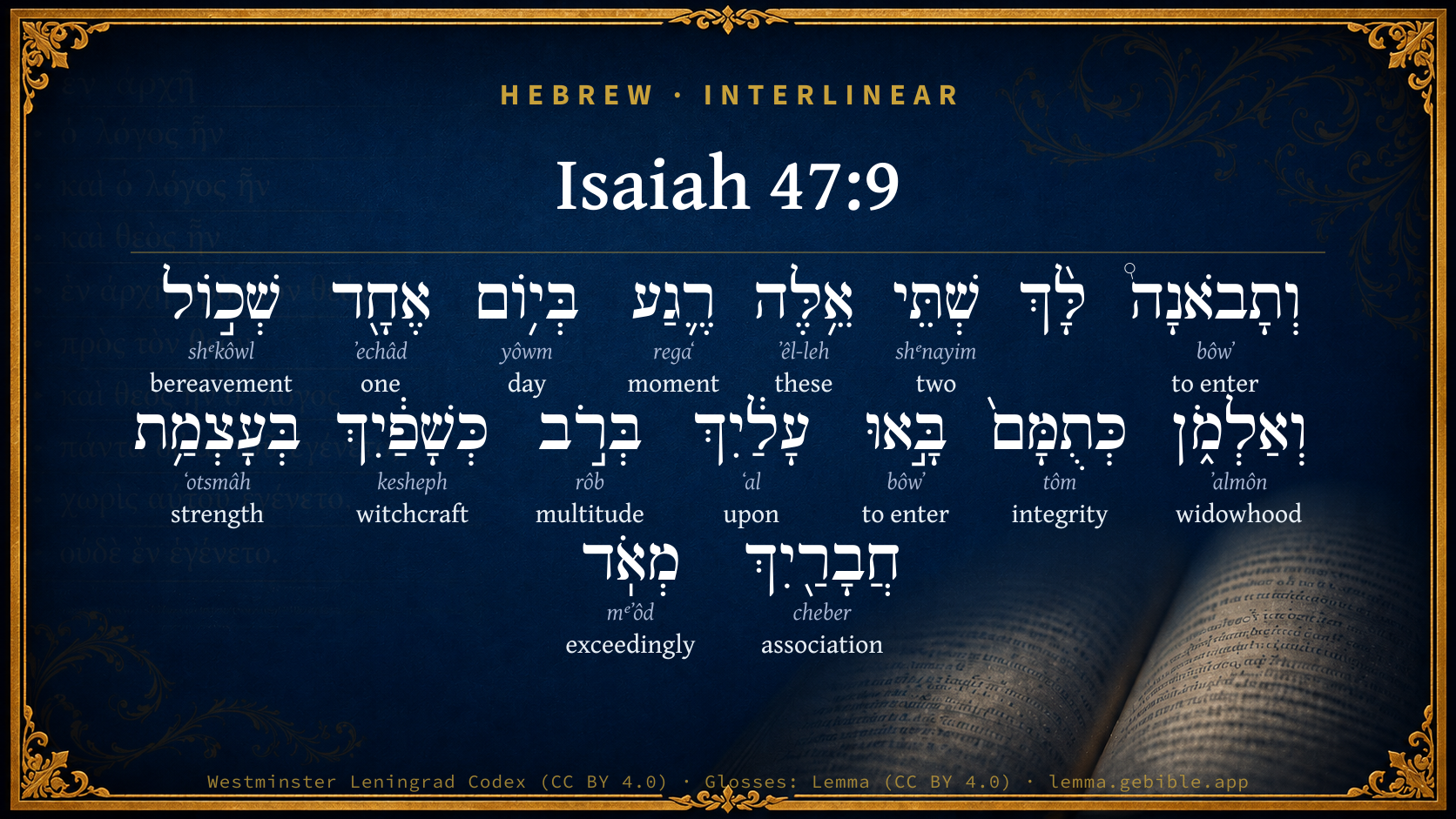
Hebrew (Westminster Leningrad Codex) Isaiah 47:9 appears in the Hebrew Old Testament. The text above is from the Westminster Leningrad Codex. Each word links to its Strong’s number, a concise gloss, and parsing drawn from the Open Scriptures Hebrew Bible morphology. Click any word for its full Brown-Driver-Briggs (BDB) entry.
Download image
Cite this verse

Isaiah 47:9 (World English Bible). Public Domain. Lemma interlinear Bible study tool, https://lemma.gebible.app/v/isaiah/47/9.

Show BibTeX & RIS
BibTeX
RIS
English Translation
but these two things shall come to you in a moment in one day, the loss of children, and widowhood; in their full measure shall they come on you, in the multitude of your sorceries, and the great abundance of your enchantments.
World English Bible · Public Domain
Highlights
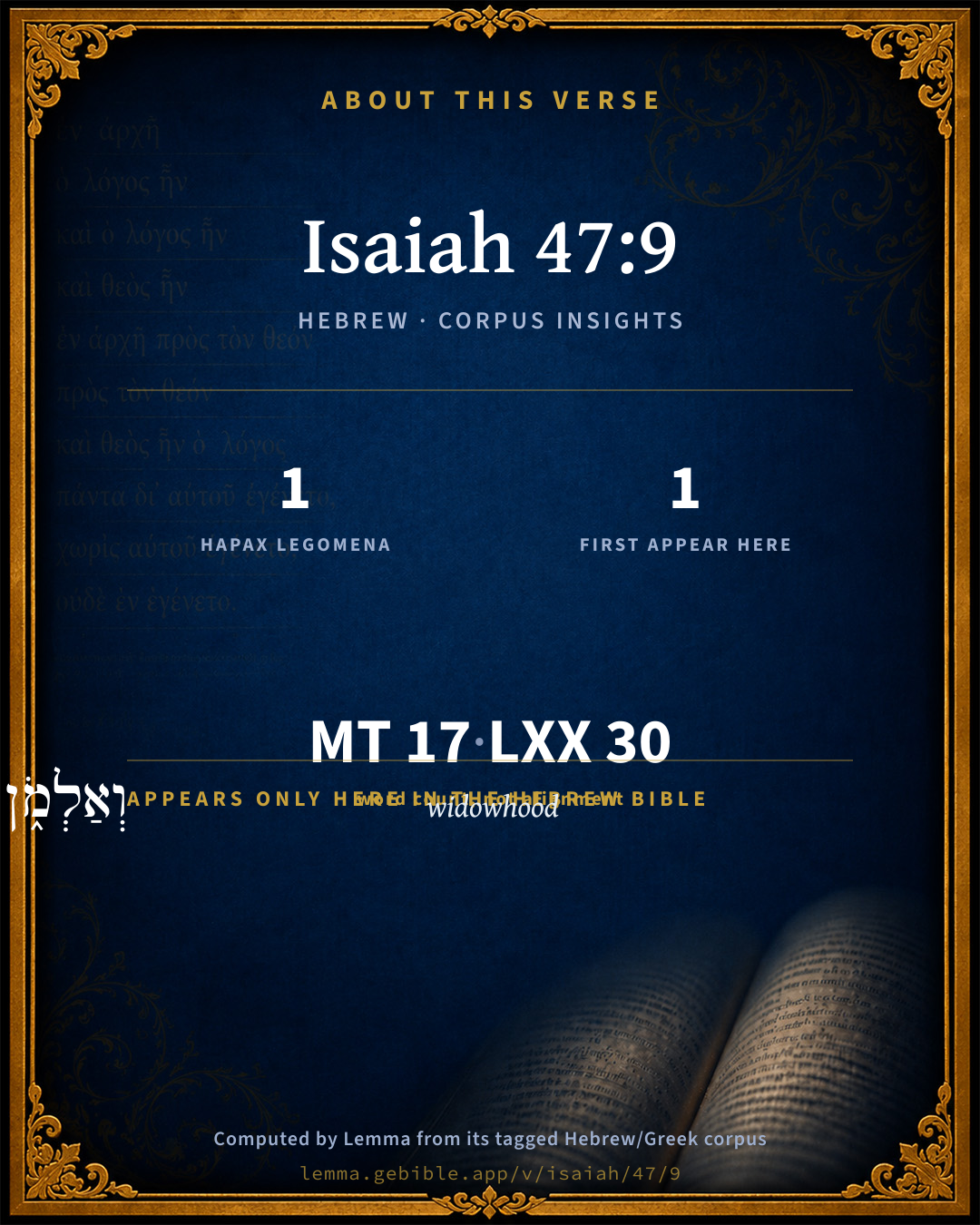
  • 1 hapax legomenon — only here in the Hebrew Bible
  • 1 first appearance in the Hebrew Bible
Full analysis ↓
Download a study sheet

One document with this verse’s original text, its word-by-word gloss line, the meaning frame, cross-references with their text, attributed commentary, and full source and license credits — printable, and it pastes into notes with its structure intact.

This verse Autodidact and up

Study sheet (.html) Plain text (.txt)

A passage Seminary Student

Up to 50 verses in one chapter. A passage sheet keeps up to 6 commentary sources and 12 cross-references per verse, in the order this page ranks them, and says so on the sheet whenever that leaves anything out. Ask for a single verse and you get the Autodidact verse sheet above.

Everything on this page stays free to read, with no account — the sheet is a download of what is already on screen, not access to it.

Want to remove ads? Support Godless Engineer
Compare translations 3

The same verse in 3 English versions, stacked beneath the original-language interlinear above. Click any original word for its lexicon entry.

Each is an independent rendering of the whole verse — the interlinear is not word-aligned to these translations.

Highlighted words mark where these versions differ — a whole-verse word diff, not a word-by-word alignment.

  • World English Bible Public Domain
    but these two things shall come to you in a moment in one day, the loss of children, and widowhood; in their full measure shall they come on you, in the multitude of your sorceries, and the great abundance of your enchantments.
  • King James Version Public Domain
    But these two things shall come to thee in a moment in one day, the loss of children, and widowhood: they shall come upon thee in their perfection for the multitude of thy sorceries, and for the great abundance of thine enchantments.
  • unfoldingWord Literal Text CC BY-SA 4.0
    For the two of these will come to you a moment, in one day, bereavement and widowhood. According to their fulness they will come upon you, in the abundance of your sorceries, in the great power of your spells.

unfoldingWord Literal Text — © unfoldingWord, licensed CC BY-SA 4.0. Word-aligned USFM3 via Door43 (git.door43.org/unfoldingWord/en_ult).

Versions to compare (up to 4)

3 of 4 selected

Show all 18 translations

Every available English version of this verse, each an independent rendering of the whole verse.

  • World English Bible Public Domain
    but these two things shall come to you in a moment in one day, the loss of children, and widowhood; in their full measure shall they come on you, in the multitude of your sorceries, and the great abundance of your enchantments.
  • Berean Standard Bible Public Domain
    These two things will overtake you in a moment, in a single day: loss of children, and widowhood. They will come upon you in full measure, in spite of your many sorceries and the potency of your spells.
  • Majority Standard Bible Public Domain
    These two things will overtake you in a moment, in a single day: loss of children, and widowhood. They will come upon you in full measure, in spite of your many sorceries and the potency of your spells.
  • King James Version Public Domain
    But these two things shall come to thee in a moment in one day, the loss of children, and widowhood: they shall come upon thee in their perfection for the multitude of thy sorceries, and for the great abundance of thine enchantments.
  • American Standard Version (1901) Public Domain
    but these two things shall come to thee in a moment in one day, the loss of children, and widowhood; in their full measure shall they come upon thee, in the multitude of thy sorceries, and the great abundance of thine enchantments.
  • Revised Version (1885) Public Domain
    but these two things shall come to thee in a moment in one day, the loss of children, and widowhood: in their full measure shall they come upon thee, despite of the multitude of thy sorceries, and the great abundance of thine enchantments.
  • Geneva Bible (1599) Public Domain
    But these two thinges shall come to thee suddenly on one day, the losse of children and widowhoode: they shall come vpon thee in their perfection, for the multitude of thy diuinations, and for the great abundance of thine inchanters.
  • Douay-Rheims (1899) Public Domain
    These two things shall come upon thee suddenly in one day, barrenness and widowhood. All things are come upon thee, because of the multitude of thy sorceries, and for the great hardness of thy enchanters.
  • Young's Literal Translation Public Domain
    And come in to thee do these two things, In a moment, in one day, childlessness and widowhood, According to their perfection they have come upon thee, In the multitude of thy sorceries, In the exceeding might of thy charms.
  • Literal Standard Version CC BY-SA 4.0
    And these two things come to you, || In a moment, in one day: childlessness and widowhood, || They have come on you according to their perfection, || In the multitude of your sorceries, || In the exceeding might of your charms.
  • Unlocked Literal Bible CC BY-SA 4.0
    But these two things will come to you in a moment in one day: the loss of children and widowhood; in full force they will come on you, despite your sorceries and your many incantations and amulets.
  • unfoldingWord Literal Text CC BY-SA 4.0
    For the two of these will come to you a moment, in one day, bereavement and widowhood. According to their fulness they will come upon you, in the abundance of your sorceries, in the great power of your spells.
  • Darby Bible Public Domain
    yet these two things shall come upon thee in a moment, in one day, loss of children and widowhood; they shall come upon thee in full measure for the multitude of thy sorceries, for the great abundance of thine enchantments.
  • World Messianic Bible Public Domain
    But these two things will come to you in a moment in one day: the loss of children and widowhood. They will come on you in their full measure, in the multitude of your sorceries, and the great abundance of your enchantments.
  • Webster's Bible Public Domain
    But these two things shall come to thee in a moment in one day, the loss of children, and widowhood: they shall come upon thee in their perfection, for the multitude of thy sorceries, and for the great abundance of thy enchantments.
  • Free Bible Version CC BY-SA 4.0
    But both these things will happen to you in quick succession! In just one day you will lose your children and become a widow. You will have this experience in its totality, in spite of all your witchcraft, in spite of all your magic spells.
  • Bible in Basic English Public Domain
    But these two things will come on you suddenly in one day, the loss of children and of husband: in full measure they will come on you, for all your secret arts, and all your wonders.
  • JPS Tanakh (1917) Public Domain
    But these two things shall come to thee in a moment in one day, the loss of children, and widowhood; in their full measure shall they come upon thee, for the multitude of thy sorceries, and the great abundance of thine enchantments.

Literal Standard Version (2020), Covenant Press — licensed CC BY-SA 4.0. Text via the HelloAO Bible API (eBible.org). Unlocked Literal Bible (unfoldingWord) — licensed CC BY-SA 4.0. Text via the HelloAO Bible API (eBible.org). unfoldingWord Literal Text — © unfoldingWord, licensed CC BY-SA 4.0. Word-aligned USFM3 via Door43 (git.door43.org/unfoldingWord/en_ult). Free Bible Version, Dr. Jonathan Gallagher — licensed CC BY-SA 4.0. Text via the HelloAO Bible API (eBible.org).

Word by word

More ways to search: Search by grammar → Find every occurrence → Compare this word →

Practice this passage: Drill this verse → Learn its vocabulary →

וְאַלְמֹ֑ן
ʼalmôn
H489
“and · widowhood”
Conjunction + Noun, Common, Masculine, Singular, Absolute
Part of Speech
Conjunction + Noun
Type
Common
Gender
Masculine
Number
Singular
State
Absolute
Full BDB Definition

Origin: from H481 as in H488

TWOT: 104

widowhood
  1. וְתָבֹאנָה֩ bôwʼ H935 “and · to enter” Conjunction + Verb, Qal, Imperfect, 3rd Person, Feminine, Plural
  2. שְׁתֵּי shᵉnayim H8147 “two” Adjective, Cardinal number, Feminine, Dual, Construct
  3. אֵ֥לֶּה ʼêl-leh H428 “these” Pronoun, Demonstrative, Common, Plural
  4. רֶ֛גַע regaʻ H7281 “moment” Noun, Common, Masculine, Singular, Absolute
  5. בְּי֥וֹם yôwm H3117 “in/at · day” Preposition + Noun, Common, Masculine, Singular, Absolute
  6. אֶחָ֖ד ʼechâd H259 “one” Adjective, Cardinal number, Masculine, Singular, Absolute
  7. שְׁכ֣וֹל shᵉkôwl H7908 “bereavement” Noun, Common, Masculine, Singular, Absolute
  8. כְּתֻמָּם֙ tôm H8537 “like/as · integrity · their” Preposition + Noun, Common, Masculine, Singular, Construct + Suffix, Personal, 3rd Person, Masculine, Plural
  9. בָּ֣אוּ bôwʼ H935 “to enter” Verb, Qal, Perfect, 3rd Person, Common, Plural
  10. עָלַ֔יִךְ ʻal H5921 “upon · you” Preposition + Suffix, Personal, 2nd Person, Feminine, Singular
  11. בְּרֹ֣ב rôb H7230 “in/at · multitude of” Preposition + Noun, Common, Both, Singular, Construct
  12. כְּשָׁפַ֔יִךְ kesheph H3785 “witchcrafts · your” Noun, Common, Masculine, Plural, Construct + Suffix, Personal, 2nd Person, Feminine, Singular
  13. בְּעָצְמַ֥ת ʻotsmâh H6109 “in/at · strength of” Preposition + Noun, Common, Feminine, Singular, Construct
  14. חֲבָרַ֖יִךְ cheber H2267 “associations · your” Noun, Common, Masculine, Plural, Construct + Suffix, Personal, 2nd Person, Feminine, Singular
  15. מְאֹֽד mᵉʼôd H3966 “exceedingly” Adverb

About this verse

These counts appear in no published source. They are computed here, from the morphology-tagged text and Lemma’s own curated glosses. What Lemma adds →

17
words
15
distinct lemmas
Prophets
section

Notable vocabulary

1 hapax legomenon — a word that appears only here in the entire Hebrew Bible:

  • וְאַלְמֹ֑ן widowhood H489

First appearance in Scripture

This word makes its first canonical appearance in the Hebrew Bible here:

  • וְאַלְמֹ֑ן widowhood H489

Shared distinctive vocabulary

שְׁכ֣וֹל bereavement H7908 occurs in 3 verses of the Hebrew Bible. Also found in:

Grammatical profile

  • 2 verbs
  • 9 nouns
  • 2 adjectives
  • 1 pronoun
  • 2 prepositions
  • 1 adverb

Verb forms

  • וְתָבֹאנָה֩ Qal · Imperfect
  • בָּ֣אוּ Qal · Perfect

Repetition

A word recurs within this verse — often emphatic in Hebrew:

  • וְתָבֹאנָה֩ to enter H935 ×2

Hebrew & Septuagint length

In English translation the verse runs 42 words from the Hebrew and 33 from the Septuagint (LXX English) — closely comparable.

A rough comparison of the two English renderings, which tokenize alike — not a word-level alignment.

Word counts can differ between the Hebrew and the Greek without any difference in meaning — e.g. the Hebrew direct-object marker אֵת has no separate Greek word, and Greek often adds the article ὁ.

In the original languages it is 17 Hebrew tokens and 30 Greek tokens — but the two are counted differently (Hebrew bundles its prefixes and suffixes into one token; the Greek is in lemma form), so that isn’t a like-for-like length.

Cross-references

21

Topical passages linked to Isaiah 47:9 in the Treasury of Scripture Knowledge — connected by theme and wording, ordered by reader-vote popularity; previews shown in the World English Bible.

  • Psalms 73:19 How they are suddenly destroyed! They are completely swept away with terrors.
  • 1 Thessalonians 5:3 For when they are saying, "Peace and safety," then sudden destruction will come on them, like birth pains on a pregnant woman; and they will in no way escape.
  • Isaiah 47:12–13 Stand now with your enchantments, and with the multitude of your sorceries, in which you have labored from your youth; if so be you shall be able to profit, if so be you may prevail.
  • Nahum 3:4 because of the multitude of the prostitution of the alluring prostitute, the mistress of witchcraft, who sells nations through her prostitution, and families through her witchcraft.
  • Revelation 18:8–10 Therefore in one day her plagues will come: death, mourning, and famine; and she will be utterly burned with fire; for the Lord God who has judged her is strong.
  • Ruth 1:5 Mahlon and Chilion died both of them; and the woman was left of her two children and of her husband.
  • Ruth 1:20 She said to them, "Don't call me Naomi, call me Mara; for the Almighty has dealt very bitterly with me.
  • Isaiah 13:18–22 [Their] bows shall dash the young men in pieces; and they shall have no pity on the fruit of the womb; their eye shall not spare children.
  • Isaiah 14:22–23 I will rise up against them, says Yahweh of Hosts, and cut off from Babylon name and remnant, and son and son's son, says Yahweh.
  • Isaiah 51:18–19 There is none to guide her among all the sons whom she has brought forth; neither is there any who takes her by the hand among all the sons who she has brought up.
  • Jeremiah 51:29 The land trembles and is in pain; for the purposes of Yahweh against Babylon do stand, to make the land of Babylon a desolation, without inhabitant.
  • Jeremiah 51:62–64 and say, Yahweh, you have spoken concerning this place, to cut it off, that none shall dwell therein, neither man nor animal, but that it shall be desolate forever.
  • Daniel 2:2 Then the king commanded to call the magicians, and the enchanters, and the sorcerers, and the Chaldeans, to tell the king his dreams. So they came in and stood before the king.
  • Daniel 4:7 Then came in the magicians, the enchanters, the Chaldeans, and the soothsayers; and I told the dream before them; but they did not make known to me the interpretation of it.
  • Daniel 5:7 The king cried aloud to bring in the enchanters, the Chaldeans, and the soothsayers. The king spoke and said to the wise men of Babylon, Whoever shall read this writing, and show me the interpretation of it, shall be clothed with purple, and have a chain of gold about his neck, and shall be the third ruler in the kingdom.
  • Luke 7:12–13 Now when he drew near to the gate of the city, behold, one who was dead was carried out, the only son of his mother, and she was a widow. Many people of the city were with her.
  • Revelation 9:20–21 The rest of mankind, who were not killed with these plagues, didn't repent of the works of their hands, that they wouldn't worship demons, and the idols of gold, and of silver, and of brass, and of stone, and of wood; which can neither see, nor hear, nor walk.
  • Revelation 18:21–23 A mighty angel took up a stone like a great millstone and cast it into the sea, saying, "Thus with violence will Babylon, the great city, be thrown down, and will be found no more at all.
  • Revelation 21:8 But for the cowardly, unbelieving, sinners, abominable, murderers, sexually immoral, sorcerers, idolaters, and all liars, their part is in the lake that burns with fire and sulfur, which is the second death."
  • Revelation 22:15 Outside are the dogs, the sorcerers, the sexually immoral, the murderers, the idolaters, and everyone who loves and practices falsehood.
  • 2 Thessalonians 2:9–10 even he whose coming is according to the working of Satan with all power and signs and lying wonders,

Cross-references courtesy of OpenBible.info (CC BY 4.0).

Hebrew and Greek witnesses Masoretic Hebrew ↔ Greek Septuagint

The same verse in the two great witnesses to the Old Testament, shown verse-for-verse.

These are two independent witnesses, not word-aligned to each other, and the Septuagint is shown in lemma (dictionary) form.

Hebrew Isaiah 47:9 Masoretic · Westminster Leningrad Codex

וְתָבֹאנָה֩ לָּ֨ךְ שְׁתֵּי אֵ֥לֶּה רֶ֛גַע בְּי֥וֹם אֶחָ֖ד שְׁכ֣וֹל וְאַלְמֹ֑ן כְּתֻמָּם֙ בָּ֣אוּ עָלַ֔יִךְ בְּרֹ֣ב כְּשָׁפַ֔יִךְ בְּעָצְמַ֥ת חֲבָרַ֖יִךְ מְאֹֽד

but these two things shall come to you in a moment in one day, the loss of children, and widowhood; in their full measure shall they come on you, in the multitude of your sorceries, and the great abundance of your enchantments.

World English Bible · Public Domain

Greek LXX Isaiah 47:9 Septuagint · lemma form

νῦν δέ ἥκω ἐξαίφνης ἐπί σύ ὁ δύο οὗτος ἐν εἷς ἡμέρα χηρεία καί ἀτεκνία ἥκω ἐξαίφνης ἐπί σύ ἐν ὁ φαρμακία σύ ἐν ὁ ἰσχύς ὁ ἐπαοιδός σύ σφόδρα

But now these two things shall come upon you suddenly in one day, the loss of children and widowhood shall come suddenly upon you, for your sorcery, for the strength of your enchantments,

LXX2012 (modern English Septuagint) · Public Domain

On this verse, Adam Clarke's Commentary discusses the Septuagint’s reading. Read the note in Commentary ↓

Hebrew: Westminster Leningrad Codex (CC BY 4.0). Greek: Septuagint (public domain); English from LXX2012 (modern English Septuagint) (Public Domain). How the Septuagint differs from the Hebrew →

Targum (Aramaic paraphrase)

1

The Targum is the ancient Jewish Aramaic paraphrase of the Hebrew Scriptures — an interpretive translation, not the Hebrew text itself. Onkelos (literal) and Pseudo-Jonathan (expansive) render the Torah, and Jonathan the Prophets. Coverage is partial: where no permissively-licensed English translation exists for a verse, only the Aramaic is shown. This is verse-level text, not a word-by-word alignment to the Hebrew.

  1. Targum Jonathan Prophets (Joshua–Malachi)
    וְיָתְיָן לִיךְ תַּרְתֵּין אִלֵין זְמַן בְּיוֹמָא חַד תְּכַל וְאַרְמְלוּ כִּדְשָׁלְמָן יֵיתוּן עֲלָךְ בִּסְגִיאוּת חָרָשָׁךְ בִּתְקוֹף קְסָמָךְ לַחֲדָא:

    But these two things shall come to thee, in an appointed time, in one day, loss of children, and widowhood: they shall come upon thee in their perfection: notwithstanding the multitude of thy sorceries, notwithstanding the great strength of thine enchantments.

    Targum Jonathan — Aramaic: “Mikraot Gedolot” (public domain). English: “Sefaria Community Translation” (CC0 1.0 (public-domain dedication)); “London "Chaldee Paraphrase," 1871” (public domain). Text via Sefaria.

Commentary

Notes on Isaiah 47:9 from classic Christian and Jewish commentators (each source and its license shown beneath its notes). The classic Christian expositions comment on the surrounding passage and are grouped to its opening verse, so a note may address several verses; the Jewish commentaries on the Tanakh (Rashi and others) are per-verse, so they appear only where the commentator wrote on this verse.

Lemma curates 59 commentaries, every one of them public domain or Creative Commons licensed, each selected and text-cleaned for this edition rather than reprinted as found. About our sources →

Trapp's Complete Commentary

John Trapp

Isa 47:9 But these two [things] shall come to thee in a moment in one day, the loss of children, and widowhood: they shall come upon thee in their perfection for the multitude of thy sorceries, [and] for the great abundance of thine enchantments.

Ver. 9. But these two things shall come upon thee in a moment.] Accidit in puncto, &c. Babylon was suddenly taken in one night, as the prophet had foretold, {Isa 21:9} and as the history testifieth {Dan 5:30} Periit inter pocula.

For the multitude of thy sorceries.] Thy taking upon thee to divine of each man’s life and fortune by the stars and horoscope, for which profession the Chaldeans were famous. But what a madness was it in Cardanus, who by the like skill went about to demonstrate that it was fatal to our Saviour Christ to die the death of the cross. {a}

{a} Alsted. Encycl., lib. xxx. cap. 10.

John Trapp, A Commentary or Exposition upon All the Books of the Old and New Testament (1647–1656) — public domain. Text from a community e-Sword module.

Joseph Benson's Commentary

Isa 47:9. These two things shall come to thee — The very two things that thou didst set at defiance; loss of children and widowhood — Both thy princes and thy people shall be cut off, so that thou shalt be no more a government, and no more a nation. They shall come in their perfection — In the highest degree: thy king and kingdom shall be utterly and irretrievably destroyed. This prophecy was twice fulfilled; “having been accomplished the very night that Babylon was taken, when the Persians slew the king himself and a great number of the Babylonians: it was fulfilled a second time, when that city was besieged by Darius. Being determined to hold out to the last extremity, they took all their women, and each man choosing one of them, whom he liked best, out of his own family, they strangled all the rest, that unnecessary mouths might not consume their provision. By means of this shocking expedient they sustained a siege and all the efforts of Darius for twenty months, and the city was at last taken by stratagem. As soon as Darius made himself master of the place, he ordered three thousand of the principal men to be crucified; and thus this prophecy was signally fulfilled, both by the hands of the Babylonians themselves, and by the cruelties exercised upon them by their conquerors.” — Bishop Newton. For the multitude of thy sorceries — For thy superstitious and magical practices, which were very frequent in Babylon, as we see below, (Isa 47:12-13,) and as has been observed before. Hebrew, in the multitude, &c., or, as Dr. Waterland renders it, “Notwithstanding the multitude of thy sorceries, and the force of thy enchantments;” notwithstanding all thy diabolical artifices, whereby thou thinkest to foresee all dangers, and to secure thyself from them.

Joseph Benson's Commentary on the Old and New Testaments (1811–1818) — public domain. Text from a community e-Sword module.

Tyndale Open Study Notes

Tyndale Open Resources

47:9 Witchcraft and magic were commonly used in an attempt to ward off evil and to secure a happy future.

Tyndale Open Study Notes — © Tyndale Open Resources, licensed CC BY-SA 4.0. Text via the HelloAO Bible API.

Geneva Bible (1599)

Geneva Bible translators

So that thy punishment shall be so great, as is possible to be imagined.

Geneva Bible (1599) marginal notes — public domain. Text via Bolls.life.

Jamieson, Fausset & Brown

Robert Jamieson, A. R. Fausset & David Brown

in a moment--It should not decay slowly, but be suddenly and unexpectedly destroyed; in a single night it was taken by Cyrus. The prophecy was again literally fulfilled when Babylon revolted against Darius; and, in order to hold out to the last, each man chose one woman of his family, and strangled the rest, to save provisions. Darius impaled three thousand of the revolters.

in . . . perfection--that is, "in full measure."

for . . . for--rather, "notwithstanding the . . . notwithstanding"; "in spite of" [LOWTH]. So "for" (Num 14:11). Babylon was famous for "expiations or sacrifices, and other incantations, whereby they tried to avert evil and obtain good" [DIODORUS SICULUS].

Jamieson, Fausset & Brown — Commentary Critical and Explanatory on the Whole Bible (1871) — public domain (CC PDM 1.0). Text via the HelloAO Bible API.

Adam Clarke's Commentary

Verse 9. These two things shall come to thee in. a moment] That is, suddenly. Belshazzar was slain; thus the city became metaphorically a widow, the husband - the governor of it, being slain. In the time in which the king was slain, the Medes and Persians took the city, and slew many of its inhabitants, see Da 5:30-:31. When Darius took the city, he is said to have crucified three thousand of its principal inhabitants.

In their perfection - "On a sudden"] Instead of בתמם bethummam, "in their perfection," as our translation renders it, the Septuagint and Syriac read, in the copies from which they translated, פתאם pithom, suddenly; parallel to רגע rega, in a moment, in the preceding alternate member of the sentence. The concurrent testimony of the Septuagint and Syriac, favoured by the context, may be safely opposed to the authority of the present text.

For the multitude - "Notwithstanding the multitude"] ברב berob. For this sense of the particle ב beth, see Nu 14:11.

Adam Clarke's Commentary on the Bible (1810–1826) — public domain. Text from a community e-Sword/MySword module.

Ellicott's Commentary for English Readers

(9) In their perfection.—Better, in their completeness. She should taste the full bitterness of widowhood and bereavement.

For the multitude of thy sorceries.—Better, in spite of . . .

A Bible Commentary for English Readers, edited by Charles John Ellicott (1878–1897) — public domain. Text from a community e-Sword module.

The Cambridge Bible for Schools and Colleges

gen. ed. J. J. S. Perowne

9. widowhood] is simply a figure for desolation, which is not to be pressed by asking the question, Who was the husband? The reference could hardly be to the king (for which there are no analogies), still less to the foreign nations with whom she trafficked.

in their perfection] i.e. in their full measure (R.V.).

for the multitude] Better: in spite of, &c. (as in ch. Isa_5:25 &c., “for all this”). Strict rhythm would here be restored by transposing the two clauses: “for the great abundance …—for the multitude …”

The Cambridge Bible for Schools and Colleges (gen. ed. J. J. S. Perowne; Cambridge University Press, 1878–1918) — public domain. Text from a community e-Sword module.

John Gill's Exposition

But these two things shall come to thee in a moment on one day,.... Suddenly, at once, at one and the same time. The destruction of Babylon was very sudden; the city was taken by surprise, before the inhabitants were aware of it, while the king and his nobles were regaling themselves at a feast; that very night Belshazzar was slain, and Darius the Mede took the kingdom, Dan 5:30 and so those two things she boasted of would never be her lot came upon her together and at once: "the loss of children, and widowhood"; bereaved of her king, and the whole royal family, and of her people in great numbers, who were either slain, or carried captive; or, however, the kingdom was transferred from them to another people. When Babylon was taken by Cyrus, according to Xenophon (k), not only the king was slain, but those that were about him; and orders were presently given to the inhabitants to keep within doors, and to slay all that were found without. Though Dr. Prideaux (l) thinks this prophecy had its accomplishment when Babylon was besieged by Darius, who, to save provisions, slew all their own women, wives, sisters, daughters, and all their children, reserving only one wife and maidservant to a man; and when it was taken, Darius ordered three thousand of the principal inhabitants to be crucified. And in much such language is the destruction of mystical Babylon expressed, when God shall "kill her children with death; her plagues shall come in one day, death, and mourning, and famine", Rev 2:23,

they shall come upon thee in their perfection; those evils and calamities shall be fully accomplished, not in part only, but in whole; she should have no king to govern, nor anything like one; should have no share of government; and her children or subjects should be entirely destroyed:

for the multitude of thy sorceries, and for the great abundance of thine enchantments; which the Chaldeans were very famous for; this is another reason given for their destruction; see Dan 2:2, or, "in the multitude of thy sorceries" (m), &c.; notwithstanding these, her destruction should come upon her, which her sorcerers and enchanters could neither foresee nor prevent. Sorceries are ascribed to mystical Babylon, and as the cause of her ruin, Rev 9:21.

(k) Cyropaedia, 1. 7. sect. 23. (l) Connexion, &c. part 1. B. 3. p. 188, 189. (m) "in multitudine maleficiorum tuorum", Munster, Montanus; "in multitudine praestigiarum", Cocceius.

John Gill's Exposition of the Whole Bible (1746–1763) — public domain (CC PDM 1.0). Text via the HelloAO Bible API.

Albert Barnes' Notes on the Bible

In a moment, in one day - This is designed, undoubtedly, to describe the suddenness with which Babylon would be destroyed. It would not decay slowly, and by natural causes, but it would not decay slowly, and by natural causes, but it would be suddenly and unexpectedly destroyed. How strikingly this was fulfilled, it is not needful to pause to state (see Isa. 13, note; Isa 14:1, note) In the single night in which Babylon was taken by Cyrus, a death-blow was given to all her greatness and power, and at that moment a train of causes was originated which did not cease to operate until it became a pile of ruins.

The loss of children, and widowhood - Babylon would be in the situation of a wife and a mother who is instantaneously deprived of her husband, and bereft of all her children.

They shall come upon thee in their perfection - In full measure; completely; entirely. You shall know all that is meant by this condition. The state referred to is that of a wife who is suddenly deprived of her husband, and who, at the same time, and by the same stroke, is bereft of all her children. And the sense is, that Babylon would know all that was meant by such a condition, and would experience the utmost extremity of grief which such a condition involved.

For the multitude of thy sorceries - This was one of the reasons why God would thus destroy her, that sorceries and enchantments abounded there. Lowth, however, renders this, ‘Notwithstanding the multitude of thy sorceries.’ So Noyes, ‘In spite of thy sorceries.’ The Hebrew is, ‘in the multitude (ברב berôb) of thy sorceries.’ Jerome renders it, ‘On account of (“propter”) the multitude of thy sorceries.’ The Septuagint: ‘In (ἐν en) thy sorcery.’ Perhaps the idea is, that sorcery and enchantment abounded, and that these calamities would come notwithstanding all that they could do. They would come in the very midst of the abounding necromancy and enchantments, while the people practiced these arts, and while they depended on them. That this trust in sorcery was one cause why these judgments would come upon them, is apparent from Isa 47:10-11. And that they would not be able to protect the city, or that these judgments would come in spite of all their efforts, is apparent from Isa 47:13. The idea is exactly expressed by a literal translation of the Hebrew. They would come upon her in, that is, “in the very midst” of the multitude of sorceries and enchantments. The word rendered here ‘sorceries,’ means magic, incantation, and is applied to the work of magicians (2Ki 9:22; Neh 3:4; Mic 5:11; compare Exo 7:2; Deu 18:10; Dan 2:2; Mal 3:5). Magic, it is well known, abounded in the East, and indeed this may be regarded as the birthplace of the art (see the note at Isa 2:6).

And for the great abundance of thine enchantments - Hebrew, ‘And in the strength;’ that is, in the full vigor of thine enchantments. While they would abound, and while they would exert their utmost power to preserve the city. The word rendered ‘enchantments,’ means properly society, company, community - from being associated, or bound together; and then spells, or enchantments, from the notion that they bound or confined the object that was the subject of the charm. The idea was that of controlling, binding, or restraining anyone whom they pleased, by the power of a spell.

Albert Barnes' Notes on the Bible (1834–1885) — public domain. Text from a community e-Sword/MySword module.

Haydock's Catholic Bible Commentary

Two. The empire and the people shall be removed at once. --- Enchanters; princes or magicians, who gave them evil counsel, ver. 12.

George Leo Haydock (1774–1849), Haydock's Catholic Family Bible and Commentary, 1859 edition — public domain. Excludes Psalms (Douay-Rheims chapter numbering differs from Protestant) and Deuterocanonical books (Catholic canon only).

Matthew Poole's English Annotations

In their perfection; in the highest degree. Thy king and kingdom shall be utterly and eternally destroyed.

For the multitude of thy sorceries, and for the great abundance of thine enchantments; for thy superstitious and magical practices, which were very frequent there, as we see Isa 47:12,13, and as was observed before. Or, as it is in the Hebrew, in the multitude of thy sorceries, &c.; in the midst of and notwithstanding all thy diabolical artifices, whereby thou thinkest to foresee any dangers, and to secure thyself from them.

Matthew Poole's English Annotations on the Holy Bible (1683–1685) — public domain. Text from a community e-Sword/MySword module.

The Pulpit Commentary

In a moment in one day. The day of the capture of the city by Cyrus, which was the third of Marchesvan, B.C. 539. Then, "in a moment," Babylon lost the whole of her prestige, ceased to reign, ceased to be an independent power, became a "widow," had a portion of her population turn from her, was brought down to the dust. Loss of children, and widowhood came upon her in their perfection; i.e. "in the full extent of their bitterness" (Cheyne). Not that Cyrus imitated her common practice by carrying off her entire population; on the contrary, she continued for more than two centuries to be a flourishing and populous town. Twice she revolted from Darius Hystaspis ("Beh. Ins.," col. 1. par. 16; col 3, par. 13), once, perhaps, from Xerxes (Ctes., "Ext. Pers," Alexander the Great found her walls and her great buildings in ruins, but still she was a considerable place. Cyrus, however, no doubt, carried off a portion of her population, which thenceforth begun to dwindle, and continually became less and less as time went on, until she sank into a solitude. That extreme desolation which the prophets paint in such vivid colours (Isa_14:22, 23 Jer_50:10, Jer_50:15, Jer_50:38-40) was potentially contained in the capture by Cyrus, which was the work of a single day. For the multitude of thy sorceries... of thine enchantments. (comp. ver. 13; and see also Dan_2:2 Dan_5:7) The word here translated "sorceries" probably means "incantations" or "enchantments," while that translated "enchantments" means "spells." The addiction of the Babylonians to marc is largely attested by the classical writers, and has been proved beyond a doubt by the lately discovered native remains. By these it appears that their magic fell under three principal heads:

(1) the preparation and use of spells and talismans, which were written forms engraved on stone or impressed on clay, and worn on the person or attached to the object on which their influence was to be exerted;

(2) the composition and recitation of formulae of incantation, which were supposed to act as charms, and to drive away demons and diseases; and

(3) the taking of observations and framing of tables of prognostics and of omens for general use, together with the casting of horoscopes for the special advantage of individuals (see Rawlinson"s "Egypt and Babylon," p. 58; and comp. Lenor, mant, "La Magic chez les Chaldaens," and Professor Sayce"s papers in the "Transactions of the Society of Bibl. Archaeol.," vol. 3:p. 145, et seqq.; vol. 4:p. 302, et seqq. ). The first and second forms of marc are glanced at in the present passage; the third is noticed in ver. 13.

The Pulpit Commentary (1880–1919), ed. H.D.M. Spence-Jones & Joseph S. Exell — public domain. Text from a community e-Sword module.

John Wesley's Explanatory Notes

Perfection - In the highest degree.

John Wesley, Explanatory Notes Upon the Whole Bible (1754–1765) — public domain. Text via the GEBible commentary corpus.

J. A. Alexander on Isaiah

Joseph Addison Alexander

“And they shall come to thee.” The form of expression seems to have some reference to the phrase ‘I shall not know’ in the preceding verse. As if he had said, they shall no longer be unknown or at a distance, they shall come near to thee. These two, or both these (things) from which she thought herself secure forever. ‘Suddenly.’ The Hebrew word is a noun, and originally means the twinkling of an eye and then a moment, but is often used adverbially in the sense of suddenly. That it has the derivative sense here, may be inferred from the addition of the words ‘in one day’, which would be a striking anticlimax if it strictly meant a moment or the twinkling of an eye. Loss of children and widowhood, as in the verse preceding, are explained by most interpreters as figures for the loss of king and people. ‘In their perfection’, literally, according to it, (i.e., in the fullest measure possible), implying total loss and destitution. ‘They have come upon thee.’ The English Version makes it future like the verb in the preceding clause; but this is wholly arbitrary. According to the principle already stated and exemplified so often, it is best to give the word its proper meaning, and to understand it not as a mere repetition of what goes before, but as an addition to it, or at least a variation in the mode of exhibition. What he at first saw coming, he now sees actually come, and describes it accordingly. “In the multitude of thy enchantments, in the abundance of thy spells (or charms).” The parallel terms, though applied to the same objects, are of different origin, the first denoting primarily prayers or acts of worship, and then superstitious rites; the other specifically meaning bans or spells (from a word signifying to bind), with reference, as some suppose, to the outward act of tying magical knots, but as the older writers think, to the restraining or constraining influence supposed to be exerted on the victim or even on the gods themselves. The prevalence of these arts in ancient Babylon is explicitly affirmed by Diodorus Siculus, and assumed as a notorious fact by other ancient writers.

Joseph Addison Alexander, The Prophecies of Isaiah (1846–1847; New York: Scribner, 1870–1878) — public domain. Text from a community e-Sword module.

Rashi

Rabbi Shlomo Yitzchaki (Rashi)

these two that you said that you would not sit as a widow and you would not know bereavement, shall suddenly come upon you.

bereavement of your inhabitants.

and widowhood of your king. Any burial of children or exile of the people of a land is called bereavement.

in their full measure All of them, complete in their decree, the bereavement and the widowhood.

your charms Heb. חֲבָרַיִךְ. An expression of sorcery. Comp. (Deut. 18:11) “And a charmer (וְחֹבֵר חָבֶר).”

Rashi on the Tanakh — English translations: “The Judaica Press complete Tanach with Rashi, translated by A. J. Rosenberg” (CC BY 4.0); “Pentateuch with Rashi's commentary by M. Rosenbaum and A.M. Silbermann, 1929-1934” (public domain); “The Metsudah Tanach series, Lakewood, N.J” (CC BY 4.0); and “The Book of Joshua, Metsudah Publications, 1997” (CC BY 4.0). Text via Sefaria.

Ibn Ezra

Rabbi Abraham ibn Ezra

These two. The loss of the kingdom and the death of the children.

כתמם In their perfection. When the evils were complete. תמם is an infinitive. —All these evils came over thee for the multitude of thy sorceries, etc.

Ibn Ezra on the Tanakh — English translations: “Sefaria Community Translation” (CC0 1.0 (public-domain dedication)); “Yalkut, Sifsei Chachomim Chumash, Metsudah Publications, 2009” (CC BY 4.0); and “Commentary of Ibn Ezra on Isaiah - trans. by M. Friedlander, 1873” (public domain). Text via Sefaria.

Lesson kit

Teaching starters — assembled from the data on this page, not authored interpretation. Every prompt links to the verse data it draws on. Edit before teaching.

Isaiah, in the Prophets, opens this verse with 17 words (15 distinct Hebrew lemmas). Its most distinctive word is ʼalmôn (“widowhood”). A historical commentator’s framing appears above. Read the whole chapter for the surrounding context.

Discussion questions

  1. How does “widowhood” (ʼalmôn) shape what this verse is saying?
  2. 1 word here appears nowhere else in the Hebrew Bible. Why might the author reach for such rare wording?
  3. This is the first place “widowhood” appears in Scripture (first appears here). What does its debut here establish?
  4. How does Psalms 35:12, which shares the word «bereavement», read alongside this verse?
  5. What does the repetition of “to enter” (2× in this one verse) do in this verse?
  6. The translations on this page render this verse differently — a whole-verse word diff, not a word-by-word alignment. What might account for the different wordings?
  7. «וְתָבֹאנָה֩» is a Qal Imperfect verb. How does that grammatical form shape the action described?
  8. Compare how Trapp's Complete Commentary and Joseph Benson's Commentary read this verse. Where do they agree or differ?

Things to notice

  • 1 word in this verse appears nowhere else in the Hebrew Bible.
  • 1 word makes its first canonical appearance in Scripture here.
  • This verse counts 17 Hebrew ↔ 30 Greek words.
  • These translations choose different wording for 17 words in this verse.
  • “to enter” occurs 2× in this single verse.

Reading settings

Reading text

Shown beneath each verse's original-language words.

Old Testament
Old Testament edition

Read the OT as the Masoretic Hebrew (MT) or the Greek Septuagint (LXX).

English shown for the Greek Septuagint (in the Hebrew ↔ Greek comparison).

Comparing translations? Open the Compare panel on any verse page to stack up to four side by side.