
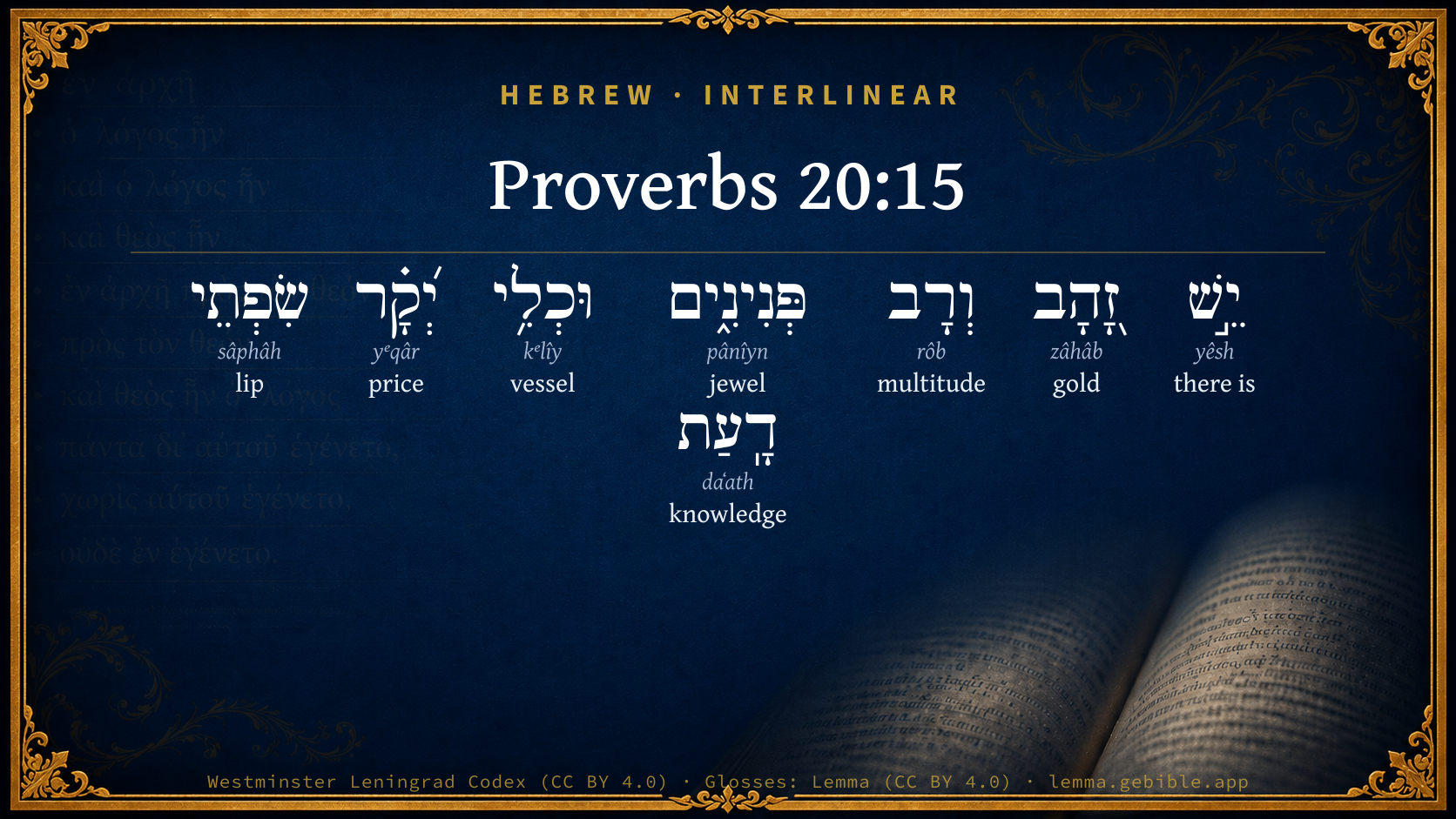
Proverbs 20:15

Hebrew (Westminster Leningrad Codex) Proverbs 20:15 appears in the Hebrew Old Testament. The text above is from the Westminster Leningrad Codex. Each word links to its Strong’s number, a concise gloss, and parsing drawn from the Open Scriptures Hebrew Bible morphology. Click any word for its full Brown-Driver-Briggs (BDB) entry.
Download image
Cite this verse

Proverbs 20:15 (World English Bible). Public Domain. Lemma interlinear Bible study tool, https://lemma.gebible.app/v/proverbs/20/15.

Show BibTeX & RIS
BibTeX
RIS
English Translation
There is gold and abundance of rubies; But the lips of knowledge are a rare jewel.
World English Bible · Public Domain
Download a study sheet

One document with this verse’s original text, its word-by-word gloss line, the meaning frame, cross-references with their text, attributed commentary, and full source and license credits — printable, and it pastes into notes with its structure intact.

This verse Autodidact and up

Study sheet (.html) Plain text (.txt)

A passage Seminary Student

Up to 50 verses in one chapter. A passage sheet keeps up to 6 commentary sources and 12 cross-references per verse, in the order this page ranks them, and says so on the sheet whenever that leaves anything out. Ask for a single verse and you get the Autodidact verse sheet above.

Everything on this page stays free to read, with no account — the sheet is a download of what is already on screen, not access to it.

Want to remove ads? Support Godless Engineer
Compare translations 3

The same verse in 3 English versions, stacked beneath the original-language interlinear above. Click any original word for its lexicon entry.

Each is an independent rendering of the whole verse — the interlinear is not word-aligned to these translations.

Highlighted words mark where these versions differ — a whole-verse word diff, not a word-by-word alignment.

  • World English Bible Public Domain
    There is gold and abundance of rubies; But the lips of knowledge are a rare jewel.
  • King James Version Public Domain
    There is gold, and a multitude of rubies: but the lips of knowledge are a precious jewel.
  • unfoldingWord Literal Text CC BY-SA 4.0
    There is gold and an abundance of corals, but lips of knowledge a vessel of preciousness.

unfoldingWord Literal Text — © unfoldingWord, licensed CC BY-SA 4.0. Word-aligned USFM3 via Door43 (git.door43.org/unfoldingWord/en_ult).

Versions to compare (up to 4)

3 of 4 selected

Show all 18 translations

Every available English version of this verse, each an independent rendering of the whole verse.

  • World English Bible Public Domain
    There is gold and abundance of rubies; But the lips of knowledge are a rare jewel.
  • Berean Standard Bible Public Domain
    There is an abundance of gold and rubies, but lips of knowledge are a rare treasure.
  • Majority Standard Bible Public Domain
    There is an abundance of gold and rubies, but lips of knowledge are a rare treasure.
  • King James Version Public Domain
    There is gold, and a multitude of rubies: but the lips of knowledge are a precious jewel.
  • American Standard Version (1901) Public Domain
    There is gold, and abundance of rubies; But the lips of knowledge are a precious jewel.
  • Revised Version (1885) Public Domain
    There is gold, and abundance of rubies: but the lips of knowledge are a precious jewel.
  • Geneva Bible (1599) Public Domain
    There is golde, and a multitude of precious stones: but the lips of knowledge are a precious iewel.
  • Douay-Rheims (1899) Public Domain
    There is gold, and a multitude of jewels: but the lips of knowledge are a precious vessel.
  • Young's Literal Translation Public Domain
    Substance, gold, and a multitude of rubies, Yea, a precious vessel, `are' lips of knowledge.
  • Literal Standard Version CC BY-SA 4.0
    Substance, gold, and a multitude of rubies, || Indeed, a precious vessel, [are] lips of knowledge.
  • Unlocked Literal Bible CC BY-SA 4.0
    There is gold and an abundance of costly stones, but lips of knowledge are a precious jewel.
  • unfoldingWord Literal Text CC BY-SA 4.0
    There is gold and an abundance of corals, but lips of knowledge a vessel of preciousness.
  • Darby Bible Public Domain
    There is gold, and a multitude of rubies; but the lips of knowledge are a precious Jewel.
  • World Messianic Bible Public Domain
    There is gold and abundance of rubies, but the lips of knowledge are a rare jewel.
  • Webster's Bible Public Domain
    There is gold, and a multitude of rubies: but the lips of knowledge are a precious jewel.
  • Free Bible Version CC BY-SA 4.0
    There's gold and plenty of expensive gemstones, but talking sense is a more valuable jewel.
  • Bible in Basic English Public Domain
    There is gold and a store of corals: but the lips of knowledge are a jewel of great price.
  • JPS Tanakh (1917) Public Domain
    There is gold, and a multitude of rubies; but the lips of knowledge are a precious jewel.

Literal Standard Version (2020), Covenant Press — licensed CC BY-SA 4.0. Text via the HelloAO Bible API (eBible.org). Unlocked Literal Bible (unfoldingWord) — licensed CC BY-SA 4.0. Text via the HelloAO Bible API (eBible.org). unfoldingWord Literal Text — © unfoldingWord, licensed CC BY-SA 4.0. Word-aligned USFM3 via Door43 (git.door43.org/unfoldingWord/en_ult). Free Bible Version, Dr. Jonathan Gallagher — licensed CC BY-SA 4.0. Text via the HelloAO Bible API (eBible.org).

Word by word

More ways to search: Search by grammar → Find every occurrence → Compare this word →

Practice this passage: Drill this verse → Learn its vocabulary →

About this verse

These counts appear in no published source. They are computed here, from the morphology-tagged text and Lemma’s own curated glosses. What Lemma adds →

8
words
8
distinct lemmas
Wisdom
section

Notable vocabulary

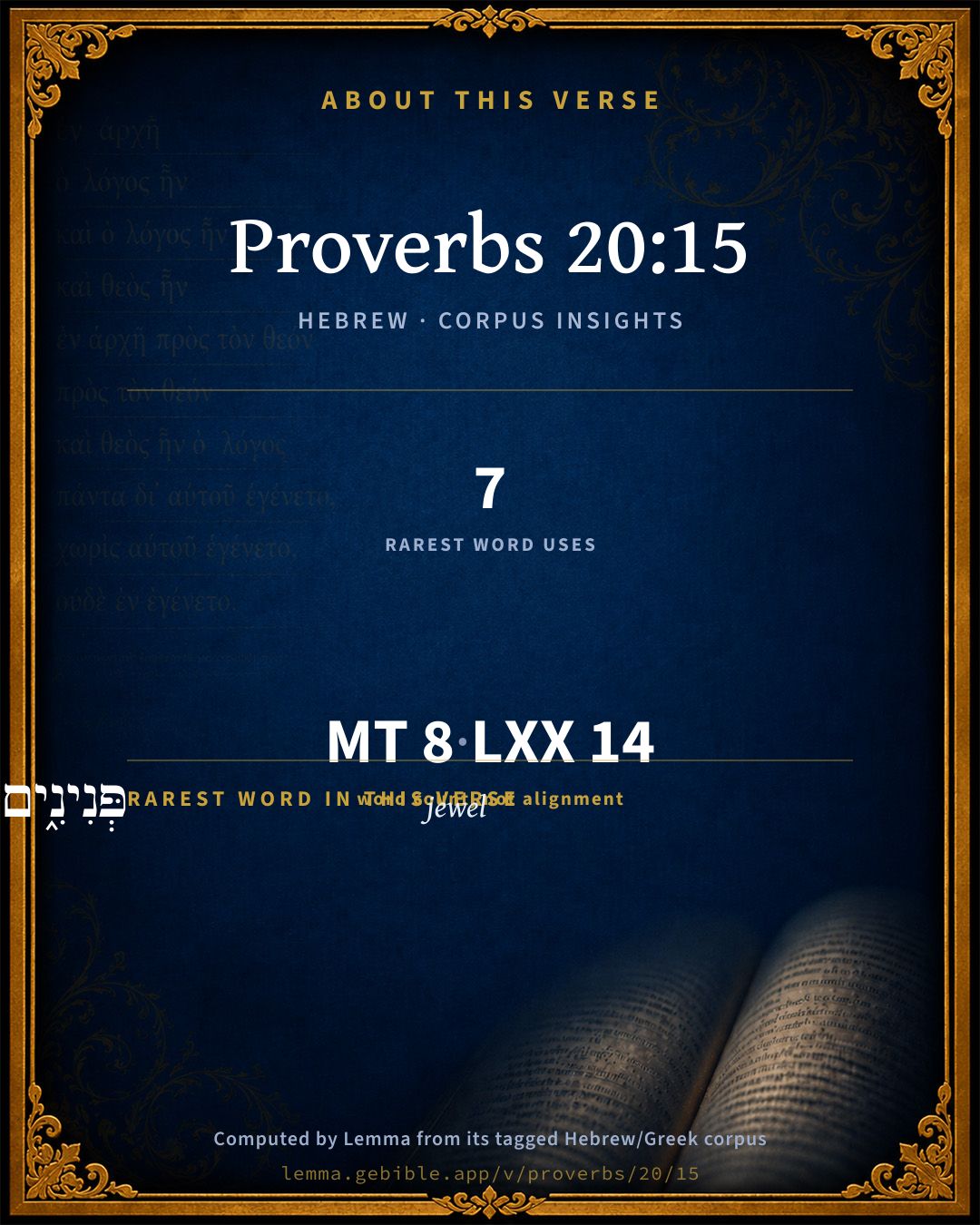
The rarest word here is פְּנִינִ֑ים jewel H6443 — appearing just 7 times in the whole Hebrew Bible.

Shared distinctive vocabulary

פְּנִינִ֑ים jewel H6443 occurs in 6 verses of the Hebrew Bible. Also found in:

Grammatical profile

  • 7 nouns
  • 1 particle

Hebrew & Septuagint length

In the original languages it is 8 Hebrew tokens and 14 Greek tokens — but the two are counted differently (Hebrew bundles its prefixes and suffixes into one token; the Greek is in lemma form), so that isn’t a like-for-like length.

Cross-references

13

Topical passages linked to Proverbs 20:15 in the Treasury of Scripture Knowledge — connected by theme and wording, ordered by reader-vote popularity; previews shown in the World English Bible.

  • Proverbs 8:11 For wisdom is better than rubies. All the things that may be desired can't be compared to it.
  • Proverbs 25:12 As an ear-ring of gold, and an ornament of fine gold, So is a wise reprover to an obedient ear.
  • Proverbs 16:16 How much better it is to get wisdom than gold! Yes, to get understanding is to be chosen rather than silver.
  • Proverbs 16:24 Pleasant words are a honeycomb, Sweet to the soul, and health to the bones.
  • Proverbs 3:15 She is more precious than rubies. None of the things you can desire are to be compared to her.
  • Proverbs 15:7 The lips of the wise spread knowledge; Not so with the heart of fools.
  • Ecclesiastes 12:9–11 Further, because the Preacher was wise, he still taught the people knowledge. Yes, he pondered, sought out, and set in order many proverbs.
  • Romans 10:14–15 How then will they call on him in whom they have not believed? How will they believe in him whom they have not heard? How will they hear without a preacher?
  • Job 28:12–19 "But where shall wisdom be found? Where is the place of understanding?
  • Proverbs 10:20–21 The tongue of the righteous is like choice silver. The heart of the wicked is of little worth.
  • Proverbs 16:21 The wise in heart shall be called prudent. Pleasantness of the lips promotes instruction.
  • Ephesians 4:29 Let no corrupt speech proceed out of your mouth, but such as is good for building up as the need may be, that it may give grace to those who hear.
  • Proverbs 15:23 Joy comes to a man with the reply of his mouth. How good is a word at the right time!

Cross-references courtesy of OpenBible.info (CC BY 4.0).

Hebrew and Greek witnesses Masoretic Hebrew ↔ Greek Septuagint

The same verse in the two great witnesses to the Old Testament, shown verse-for-verse.

These are two independent witnesses, not word-aligned to each other, and the Septuagint is shown in lemma (dictionary) form.

Hebrew Proverbs 20:15 Masoretic · Westminster Leningrad Codex

יֵ֣שׁ זָ֭הָב וְרָב פְּנִינִ֑ים וּכְלִ֥י יְ֝קָ֗ר שִׂפְתֵי דָֽעַת

There is gold and abundance of rubies; But the lips of knowledge are a rare jewel.

World English Bible · Public Domain

Greek LXX Proverbs 20:15 Septuagint · lemma form

παρά κύριος εὐθύνω ὁ διάβημα ἀνήρ θνητός δέ πῶς ἄν νοέω ὁ ὁδός αὐτός

No English rendering of this Greek verse — the small residue in the structurally divergent books.

Hebrew: Westminster Leningrad Codex (CC BY 4.0). Greek: Septuagint (public domain); English from a public-domain English Septuagint. How the Septuagint differs from the Hebrew →

Commentary

Notes on Proverbs 20:15 from classic Christian and Jewish commentators (each source and its license shown beneath its notes). The classic Christian expositions comment on the surrounding passage and are grouped to its opening verse, so a note may address several verses; the Jewish commentaries on the Tanakh (Rashi and others) are per-verse, so they appear only where the commentator wrote on this verse.

Lemma curates 59 commentaries, every one of them public domain or Creative Commons licensed, each selected and text-cleaned for this edition rather than reprinted as found. About our sources →

Trapp's Complete Commentary

John Trapp

Pro 20:15 There is gold, and a multitude of rubies: but the lips of knowledge [are] a precious jewel.

Ver. 15. There is gold and a multitude of rubies.] Quintilian defines an orator, Vir bonus dicendi peritus: A good man, that can deliver himself in good language. Such a master of speech {a} was St Paul, who was therefore by those heathen Lystrians called Mercury, because he was the chief speaker. {Act 14:12} Such afore him was the prophet Isaiah, and our Saviour Christ, who "spake as never man spoke," his enemies themselves being judges. Such after him was Chrysostom, Basil, Nazianzen, famous for their holy eloquence. So were Mr Rogers and Mr Bradford, martyrs; in whom it was hard to say whether there were more force of eloquence and utterance in preaching, or more holiness of life and conversation, saith Mr Foxe. {b} Now if Darius, could say that he preferred one Zopyrus before ten Babylons: and if, when one desired to see Alexander’s treasures and his jewels, he bade his servants show him not αργυριου ταλαντα, but τους φιλους, not his talents of silver, and such other precious things, but his friends; {c} what an invaluable price think we doth the King of heaven set upon such learned scribes, as do out of the good treasure of their hearts throw forth good things for the use of many! {d}

{a} ηγουμενος του λογου.

{b} Acts and Mon., fol. 1782.

{c} Justin., lib i.

{d} Liban., Exemplar. Progym. Chri., i.

John Trapp, A Commentary or Exposition upon All the Books of the Old and New Testament (1647–1656) — public domain. Text from a community e-Sword module.

The Biblical Illustrator

Joseph S. Exell

Pro_20:15

There is gold, and a multitude of rubies.

On the moral end of business

Let me define my meaning in the use of this phrase--the moral end of business. It is not the end for which property should be sought. It is not the moral purpose to be answered by the acquisition, but by the process of acquisition. And again, it is not the end of industry in general--that is a more comprehensive subject--but it is the end of business in particular, of barter, of commerce. The end of business! some one may say; why, the end of business is to obtain property; the end of the process of acquisition is acquisition. I hold that the ultimate end of all business is a moral end. I believe that business--I mean not labour, but barter, traffic--would never have existed if there had been no end but sustenance. The animal races obtain subsistence upon an easier and simpler plan; but for man there is a higher end, and that is moral. The broad grounds of this position I find in the obvious designs of Providence, and in the evident adaptation to this moral end of business itself.

1. There is, then, a design for which all things were made and ordained, going beyond the things themselves. To say that things were made, or that the arrangements and relations of things were ordained, for their own sake, is a proposition without meaning. The world, its structure, productions, laws, and events, have no good nor evil in them--none, but as they produce these results in the experience of living creatures. The end, then, of the inanimate creation is the welfare of the living, and, therefore, especially of the intelligent creation. But the welfare of human beings lies essentially in their moral culture. We are not appointed to pass through this life barely that we may live. We are not impelled, both by disposition and necessity, to buy and sell, barely that we may do it; nor to get gain, barely that we may get it. There is an end in business beyond supply. There is an object in the acquisition of wealth beyond success. There is a final cause of human traffic, and that is virtue. With this view of the moral end of business falls in the constant doctrine of all elevated philosophy and true religion. Life, say the expounders of every creed, is a probation. Now, if anything deserves to be considered as a part of that probation, it is business. Life, say the wise, is a school. But the end of a lesson is that something be learned; and the end of business is, that truth, rectitude, virtue, be learned. This is the ultimate design proposed by Heaven, and it is a design which every wise man, engaged in that calling, will propose to himself. It is no extravagance, therefore, but the simple assertion of a truth, to say to a man so engaged, and to say emphatically, You have an end to gain beyond success, and that is the moral rectitude of your own mind.

2. That business is so exquisitely adapted to accomplish that purpose, is another argument with me to prove that such, in the intention of its Ordainer, was its design. An honest man, a man who sincerely desires to attain to a lofty and unbending uprightness, could scarcely seek a discipline more perfectly fitted to that end than the discipline of trade. For what is trade? It is the constant adjustment of the claims of different parties, a mans self being one of the parties. This competition of rights and interests might not invade the solitary study, or the separate tasks of the workshop, or the labours of the silent field, once a day; but it presses upon the merchant and trader continually. Do you say that it presses too hard? Then, I reply, must the sense of rectitude be made the stronger to meet the trial. Every plea of this nature is an argument for strenuous moral effort. A man must do more than to attain to punctilious honesty in his actions; he must train his whole soul, his judgment, his sentiments and affections, to uprightness, candour, and good-will. I have thus attempted to show that business has an ultimate, moral end--one going beyond the accumulation of property.

3. This may also be shown to be true, not only on the scale of our private affairs, but on the great theatre of history. Commerce has always been an instrument in the hands of Providence for accomplishing nobler ends than promoting the wealth of nations. It has been the grand civiliser of nations. With its earliest birth on the Mediterranean shore, freedom was born. Phoenicia, the merchants of whose cities, Tyre and Sidon, were accounted princes; the Hebrew commonwealth, which carried on a trade through those parts; the Grecian, Carthaginian, and Roman States, were not only the freest, but they were the only free states of antiquity. In the middle ages commerce broke down in Europe, the feudal system, raising up, in the Hanse Towns, throughout Germany, Sweden, and Norway, a body of men who were able to cope with barons and kings, and to wrest from them their free charters and rightful privileges. In England its influence is proverbial; the sheet-anchor, it has long been considered, of her unequalled prosperity and intelligence. Its moral influences are the only ones of which we stand in any doubt, and these, it need not be said, are of unequalled importance. The philanthropist, the Christian, are all bound to watch these influences with the closest attention, and to do all in their power to guard and elevate them. It is upon this point that I wish especially to insist; but there are one or two topics that may previously claim some attention.

(1) If, then, business is a moral dispensation, and its highest end is moral, I shall venture to call in question the commonly supposed desirableness of escaping from it--the idea which prevails with so many of making a fortune in a few years, and afterwards of retiring to a state of leisure. If business really is a scene of worthy employment and of high moral action, I do not see why the moderate pursuit of it should not be laid down in the plan of entire active life; and why, upon this plan, a man should not determine to give only so much time each day to his avocations as would be compatible with such a plan; only so much time, in other words, as will be compatible with the daily enjoyment of life, with reading, society, domestic intercourse, and all the duties of philanthropy and devotion.

(2) Another topic is the rage for speculation. I wish to speak of it now in a particular view--as interfering, that is to say, with the moral end of business. It is not looking to diligence and fidelity for a fair reward, but to change and chance for a fortunate turn. It is drawing away mens minds from the healthful processes of sober industry and attention to business, and leading them to wait in feverish excitement as at the wheel of a lottery. To do business and get gain, honestly and conscientiously, is a good thing. It is useful discipline of the character. I look upon a man who has acquired wealth, in a laudable, conscientious, and generous pursuit of business, not only with a respect far beyond what I can feel for his wealth--for which indeed, abstractly, I can feel none at all--but with the distinct feeling that he has acquired something far more valuable than opulence. But for this discipline of the character, for the reasonableness and rectitude of mind which a regular business intercourse may form, speculation furnishes but a narrow field, if any at all; such speculation, I mean, as has lately created a popular frenzy in this country about the sudden acquisition of property. This insane passion for accumulation, ever ready, when circumstances favour, to seize upon the public mind, is that love of money which is the root of all evil, that covetousness which is idolatry. It springs from an undue, an idolatrous estimate of the value of property. Many are feeling that nothing--nothing will do for them or for their children but wealth; not a good character, not well-trained and well-exerted faculties, not virtue, not the hope of heaven--nothing but wealth. It is their god, and the god of their families. (O. Dewey, D. D.)

The lips of knowledge are a precious Jewel.

The use of the tongue

It is very difficult to control the noble faculty of speech, but it may be controlled. You may bridle it.

I. The power of speech is a great endowment. One of the essential distinctions between us and the mere animal. Expression is thus given to our power of thinking, which is another great endowment. The tongue is the hearts interpreter. Used as it may and ought to be, its influence is luminous as the light and fragrant as the rose. But what mischief it may work!

II. We have great responsibility in the matter of our speaking. All our endowments involve an accountability proportionate to their magnitude and importance, and speech is no exception. The impression seems common that our words are of little importance, and that while actions must be accounted for, speaking is but a voice, and will not be recorded, or appear again to confront us. Every serious person must be sensible how heavily the burden of sins of speech presses on him.

III. God has afforded fulness of instruction in regard to our bearing of this responsibility. The instruction is, for the most part, general in its nature.

1. Truth. Departure from truth is specially condemned. Untruth includes exaggerated statements.

2. Sincerity. Heart and lips must never be at variance.

3. Purity. This excludes levity in speaking of holy things.

4. Love. This will induce to active good.

IV. Speech is capable of control. How is it to be bridled?

1. By right thinking.

2. By watchfulness.

3. By correct habits.

4. By prayer.

He that seemeth to be religious and bridleth not his tongue, that mans religion is vain. (H. Wilkes, D. D.)

The Biblical Illustrator, edited by Joseph S. Exell (c. 1880s–1900s) — public domain. Text from a community e-Sword module.

Joseph Benson's Commentary

Pro 20:15. There is gold, &c. — Namely, in the world, in divers persons’ hands, by whom it is much prized; but the lips of knowledge — Wise speeches, proceeding from a well-informed and upright mind, are a precious jewel — Are of far greater worth, both to him that utters them, and to those that receive and improve them to their own benefit.

Joseph Benson's Commentary on the Old and New Testaments (1811–1818) — public domain. Text from a community e-Sword module.

Matthew Henry's Commentary

The lips of knowledge (a good understanding to guide the lips and a good elocution to diffuse the knowledge) are to be preferred far before gold, and pearl, and rubies; for, 1. They are more rare in themselves, more scarce and hard to be got. There is gold in many a man's pocket that has no grace in his heart. In Solomon's time there was plenty of gold (Kg1 10:21) and abundance of rubies; every body wore them; they were to be bought in every town. But wisdom is a rare thing, a precious jewel; few have it so as to do good with it, nor is it to be purchased of the merchants. 2. They are more enriching to us and more adorning. They make us rich towards God, rich in good works, Ti1 2:9, Ti1 2:10. Most people are fond of gold, and a ruby or two will not serve, they must have a multitude of them, a cabinet of jewels; but he that has the lips of knowledge despises these, because he knows and possesses better things.

Matthew Henry's Commentary on the Whole Bible (1708–1710) — public domain (CC PDM 1.0). Text via the HelloAO Bible API.

Jamieson, Fausset & Brown

Robert Jamieson, A. R. Fausset & David Brown

The contrast denotes the greater value of knowledge (compare Pro 3:14-16).

Jamieson, Fausset & Brown — Commentary Critical and Explanatory on the Whole Bible (1871) — public domain (CC PDM 1.0). Text via the HelloAO Bible API.

Adam Clarke's Commentary

Verse 15. There is gold] Gold is valuable, silver is valuable, and so are jewels; but the teachings of sound knowledge are more valuable than all.

Adam Clarke's Commentary on the Bible (1810–1826) — public domain. Text from a community e-Sword/MySword module.

Ellicott's Commentary for English Readers

(15) Rubies.—See above on Pro_3:15.

Lips of knowledge.—See above on Pro_18:4.

A Bible Commentary for English Readers, edited by Charles John Ellicott (1878–1897) — public domain. Text from a community e-Sword module.

The Cambridge Bible for Schools and Colleges

gen. ed. J. J. S. Perowne

15. rubies] The R.V. retains this word, but refers to Job_28:18, where it gives in the margin, or, red coral, or, pearls. See Pro_3:15, note.

The Cambridge Bible for Schools and Colleges (gen. ed. J. J. S. Perowne; Cambridge University Press, 1878–1918) — public domain. Text from a community e-Sword module.

John Gill's Exposition

There is gold, and a multitude of rubies,.... A man may have a large quantity of either, or of both of thorn, as some men have; for there is much of them in the world, not only in mines and quarries, but in the houses and cabinets of men;

but the lips of knowledge are a precious jewel; knowledge even of things natural, and a gift of elocution to express it by, are a rare jewel, and much more precious than gold and rubies, than a multitude of them; these are not to be mentioned with it, it is not equalled by them, it is greatly superior to them; see Job 28:12; and much more spiritual knowledge, and a capacity of expressing that to the edification of others; and especially Christ, the Wisdom of God, and the knowledge of him, who is more precious than rubies, and all desirable things, in comparison of which all things are loss and dung, Pro 3:14.

John Gill's Exposition of the Whole Bible (1746–1763) — public domain (CC PDM 1.0). Text via the HelloAO Bible API.

Albert Barnes' Notes on the Bible

A precious jewel - literally, “A vessel of preciousness,” i. e., most precious of all are “the lips of knowledge.”

Albert Barnes' Notes on the Bible (1834–1885) — public domain. Text from a community e-Sword/MySword module.

Matthew Poole's English Annotations

There is gold, to wit, in the world, in divers men’s hands, by whom it is highly prized.

But the lips of knowledge are a precious jewel; but wise speeches proceeding from an understanding or honest heart are of far greater worth and use, both to him that uttereth them, and to those that receive and improve them to their own benefit.

Matthew Poole's English Annotations on the Holy Bible (1683–1685) — public domain. Text from a community e-Sword/MySword module.

Whedon's Commentary on the Bible

Daniel D. Whedon

15. Rubies — By some rendered pearls, but later critics prefer red corals.

Precious jewel — A precious vessel, vase, or instrument. The word כלי, (keli,) is of large use in the Hebrew. The proverb implies that lips of knowledge — those communicating valuable knowledge — are rarer than gold or pearls. Possibly it may mean that wisdom, joined with eloquence, can accomplish more than gold or pearls.

Daniel D. Whedon (gen. ed.), Commentary on the Old and New Testaments (1874–1909) — public domain. Text from a community e-Sword module.

The Pulpit Commentary

There is gold, and a multitude of rubies. For peninim, which is rendered "rubies," "pearls," or "coral," see on Pro_3:15. There is gold which is precious, and there is abundance of pearls which are still more valuable. But the lips of knowledge are a precious jewel, and worth more than all. We had the expression, "lips of knowledge," in Pro_14:7; it means lips that utter wisdom. Keli, often translated "jewel" in the Authorized Version, also boars the meaning of "vessel," "utensil." So here the Vulgate, vas pretiosum; and the wise man"s lips are called a vessel because they contain and distribute the wisdom that is within. (On the excellence and value of wisdom, see Pro_3:14, etc; Pro_8:11, etc.) Connecting this with the preceding verse, we are led to the thought of buying, and the Lord"s parable of the merchant seeking goodly pearls, and bartering all his wealth to gain possession of a worthy jewel. (Mat_13:45, etc.)

The Pulpit Commentary (1880–1919), ed. H.D.M. Spence-Jones & Joseph S. Exell — public domain. Text from a community e-Sword module.

John Wesley's Explanatory Notes

The lips - But wise speeches are of far greater worth.

John Wesley, Explanatory Notes Upon the Whole Bible (1754–1765) — public domain. Text via the GEBible commentary corpus.

Keil & Delitzsch

C. F. Keil & F. Delitzsch

15 There is indeed gold, and many pearls;

But a precious treasure are lips full of knowledge.

In order to find a connection between this proverb and that which precedes, we need only be reminded of the parable of the merchantman who sought goodly pearls, Mat 13:45. The proverb rises to a climax: there is gold, and there are pearls in abundance, the one of which has always a higher value than the other; but intelligent lips are above all such jewels - they are a precious treasure, which gold and all pearls cannot equal. In a similar manner the N.T. places the one pearl above the many goodly pearls. So might דעת (chokma) be called the pearl above all pearls (Pro 3:15; Pro 8:11); but the lips as the organ of knowledge are fittingly compared with a precious vessel, a vessel of more precious substance than gold and pearls are.

Keil & Delitzsch — Biblical Commentary on the Old Testament (1861–1891) — public domain (CC PDM 1.0). Text via the HelloAO Bible API. (Old Testament only.)

Bridges on Proverbs

Charles Bridges

This is not the standard of the world. There gold and rubies are far above the lips of knowledge. So the young man made his choice, and preferred his "great possessions" to those gracious words, that arrested the admiration of the multitude.†1 But when "gold is our hope and confidence," it will surely be our ruin.†2 Solomon’s estimate was that of one, to whom "the LORD had given a wise and understanding heart."†3 Gold and precious rubies were abundant in his days†4 Yet all these earthly treasures were as nothing in his eyes in comparison of heavenly teaching. The lips of knowledge were a more precious jewel.†5 It is Divine knowledge only, however, that stands out in this high preeminence. Human wisdom may captivate the imagination, and furnish its measure of useful information. But the words for the most part die away upon the ear. They do not feed the heart. They furnish no comfort to the afflicted, no hope to the desponding, no teaching to the ignorant in "those things that belong to their" everlasting "peace." (Luk 19:42 .) If therefore they be "goodly pearls," at least they are not "the pearl of great price" — that precious jewel, which dims the luster of earth’s most splendid vanities. (Mat 13:45-46 .)

How precious a jewel are the lips of knowledge, when the messenger of the gospel "brings glad tidings of great joy" to the burdened conscience — to him "that is ready to perish!" Truly the very sound of his "feet" is welcome for the sake of his message.†6 Precious also will be the communications of Christian fellowship. Though falling infinitely short of the grace that dwelt in our Divine Master; yet in proportion as we are taught of him, will our "tongues be as choice silver" (Pro 10:20 ), and our "lips will disperse knowledge" (Pro 15:7 ) as a precious jewel, enriching, and adorning with the glory of our heavenly Lord.

Footnotes:

†1 Mat 19:22, with Luk 4:22 .

†2 Job 31:24, with 1Ti 6:9-10 .

†3 1Ki 3:9 .

†4 1Ki 10:27 .

†5 Pro 3:15; Pro 8:10-11, Pro 8:19 ; Pro 16:16 . Job gave the same verdict, Pro 28:12-19 .

†6 Isa 52:7. Rom 10:14-15 . Such was the delight of hanging upon the lips of the golden-mouthed Chrysostom, that the common proverb was — ’Rather let the sun not shine than Chrysostom not preach.’

Charles Bridges, An Exposition of the Book of Proverbs (1846) — public domain. Text from a community e-Sword module.

Kretzmann's Popular Commentary

Paul E. Kretzmann

v. 15. There is gold and a multitude of rubies, or pearls, such trinkets are found in abundance in the world; but the lips of knowledge are a precious jewel, they are rare indeed in the world.

Paul E. Kretzmann, Popular Commentary of the Bible (1921–1924) — public domain. Text from a community e-Sword module.

unfoldingWord translationNotes

Door43 World Missions Community

lips of knowledge are a precious jewel

This speaks of the value of lips of knowledge by comparing them to a precious jewel. AT: "lips of knowledge are as valuable as an expensive jewel" (See: Metaphor)

lips of knowledge

Here "words" are referred to as "lips." AT: "wise words" or "words of knowledge" (See: Metonymy)

Take a garment of one who has put up security for a stranger

When lending money, the lender would take something from the borrower, such as a garment, as a guarantee of repayment. He would return it after the money was repaid. If the borrower was too poor, someone else could give something to the lender as a guarantee for him. The full meaning of this statement can be made clear. AT: "Take a garment as security from the one who guarantees that what a stranger has borrowed will be paid back" (See: Assumed Knowledge and Implicit Information)

puts up security

This is an idiom. It means that someone gives something to a lender as a guarantee that what was borrowed will be paid. AT: "guarantees that what has been borrowed will be paid back" or "promises to pay a loan" (See: Idiom)

hold it in pledge

This is an idiom. To "hold something in pledge" means to hold on to something that someone has given as a pledge, or promise, that he will pay a debt. AT: "hold onto his coat as a guarantee of repayment" (See: Idiom)

translationWords

gold

know

precious

unfoldingWord translationNotes — © Distant Shores Media and the Door43 World Missions Community, licensed CC BY-SA 4.0. Source: git.door43.org/Door43/en_tn.

Lesson kit

Teaching starters — assembled from the data on this page, not authored interpretation. Every prompt links to the verse data it draws on. Edit before teaching.

Proverbs, in the Wisdom, opens this verse with 8 words (8 distinct Hebrew lemmas). Its most distinctive word is pânîyn (“jewel”). A historical commentator’s framing appears above. Read the whole chapter for the surrounding context.

Discussion questions

  1. What does “jewel” (pânîyn) contribute to the verse as a whole?
  2. How does Job 28:18, which shares the word «jewel», read alongside this verse?
  3. These translations render this verse differently. What is at stake in choosing one wording over another?
  4. Compare how Trapp's Complete Commentary and The Biblical Illustrator read this verse. Where do they agree or differ?

Things to notice

Reading settings

Reading text

Shown beneath each verse's original-language words.

Old Testament
Old Testament edition

Read the OT as the Masoretic Hebrew (MT) or the Greek Septuagint (LXX).

English shown for the Greek Septuagint (in the Hebrew ↔ Greek comparison).

Comparing translations? Open the Compare panel on any verse page to stack up to four side by side.