Deuteronomy 10:22

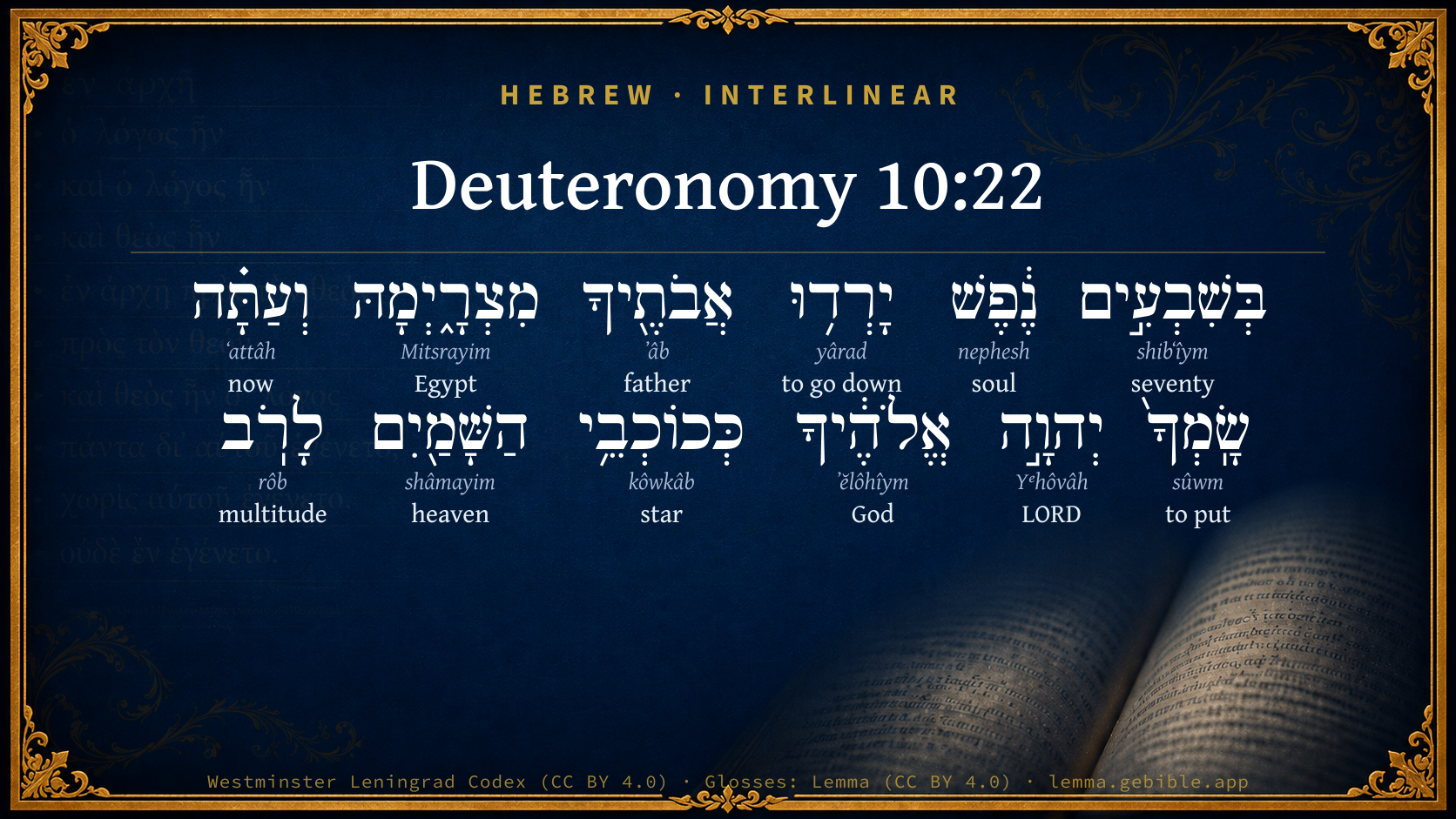
Hebrew (Westminster Leningrad Codex) Deuteronomy 10:22 appears in the Hebrew Old Testament. The text above is from the Westminster Leningrad Codex. Each word links to its Strong’s number, a concise gloss, and parsing drawn from the Open Scriptures Hebrew Bible morphology. Click any word for its full Brown-Driver-Briggs (BDB) entry.
Download image
Cite this verse

Deuteronomy 10:22 (World English Bible). Public Domain. Lemma interlinear Bible study tool, https://lemma.gebible.app/v/deuteronomy/10/22.

Show BibTeX & RIS
BibTeX
RIS
English Translation
Your fathers went down into Egypt with seventy persons; and now Yahweh your God has made you as the stars of the sky for multitude.
World English Bible · Public Domain
Download a study sheet

One document with this verse’s original text, its word-by-word gloss line, the meaning frame, cross-references with their text, attributed commentary, and full source and license credits — printable, and it pastes into notes with its structure intact.

This verse Autodidact and up

Study sheet (.html) Plain text (.txt)

A passage Seminary Student

Up to 50 verses in one chapter. A passage sheet keeps up to 6 commentary sources and 12 cross-references per verse, in the order this page ranks them, and says so on the sheet whenever that leaves anything out. Ask for a single verse and you get the Autodidact verse sheet above.

Everything on this page stays free to read, with no account — the sheet is a download of what is already on screen, not access to it.

Want to remove ads? Support Godless Engineer
Compare translations 3

The same verse in 3 English versions, stacked beneath the original-language interlinear above. Click any original word for its lexicon entry.

Each is an independent rendering of the whole verse — the interlinear is not word-aligned to these translations.

Highlighted words mark where these versions differ — a whole-verse word diff, not a word-by-word alignment.

  • World English Bible Public Domain
    Your fathers went down into Egypt with seventy persons; and now Yahweh your God has made you as the stars of the sky for multitude.
  • King James Version Public Domain
    Thy fathers went down into Egypt with threescore and ten persons; and now the LORD thy God hath made thee as the stars of heaven for multitude.
  • unfoldingWord Literal Text CC BY-SA 4.0
    Your fathers went down into Egypt as 70 souls. And now, Yahweh your God has made you like the stars of the heavens in number.

unfoldingWord Literal Text — © unfoldingWord, licensed CC BY-SA 4.0. Word-aligned USFM3 via Door43 (git.door43.org/unfoldingWord/en_ult).

Versions to compare (up to 4)

3 of 4 selected

Show all 18 translations

Every available English version of this verse, each an independent rendering of the whole verse.

  • World English Bible Public Domain
    Your fathers went down into Egypt with seventy persons; and now Yahweh your God has made you as the stars of the sky for multitude.
  • Berean Standard Bible Public Domain
    Your fathers went down to Egypt, seventy in all, and now the LORD your God has made you as numerous as the stars in the sky.
  • Majority Standard Bible Public Domain
    Your fathers went down to Egypt, seventy in all, and now the LORD your God has made you as numerous as the stars in the sky.
  • King James Version Public Domain
    Thy fathers went down into Egypt with threescore and ten persons; and now the LORD thy God hath made thee as the stars of heaven for multitude.
  • American Standard Version (1901) Public Domain
    Thy fathers went down into Egypt with threescore and ten persons; and now Jehovah thy God hath made thee as the stars of heaven for multitude.
  • Revised Version (1885) Public Domain
    Thy fathers went down into Egypt with threescore and ten persons; and now the LORD thy God hath made thee as the stars of heaven for multitude.
  • Geneva Bible (1599) Public Domain
    Thy fathers went downe into Egypt with seuentie persons, and now the Lord thy God hath made thee, as ye starres of ye heauen in multitude.
  • Douay-Rheims (1899) Public Domain
    In seventy souls thy fathers went down into Egypt: and behold now the Lord thy God hath multiplied thee as the stars of heaven.
  • Young's Literal Translation Public Domain
    with seventy persons did thy fathers go down to Egypt, and now hath Jehovah thy God made thee as stars of the heavens for multitude.
  • Literal Standard Version CC BY-SA 4.0
    Your fathers went down to Egypt with seventy persons, and now your God YHWH has made you as [the] stars of the heavens for multitude.”
  • Unlocked Literal Bible CC BY-SA 4.0
    Your fathers went down into Egypt as seventy persons; now Yahweh your God has made you as many as the stars of the heavens.
  • unfoldingWord Literal Text CC BY-SA 4.0
    Your fathers went down into Egypt as 70 souls. And now, Yahweh your God has made you like the stars of the heavens in number.
  • Darby Bible Public Domain
    With seventy souls thy fathers went down into Egypt; and now Jehovah thy God hath made thee as the stars of heaven for multitude.
  • World Messianic Bible Public Domain
    Your fathers went down into Egypt with seventy persons; and now the LORD your God has made you as the stars of the sky for multitude.
  • Webster's Bible Public Domain
    Thy fathers went down into Egypt with seventy persons; and now the LORD thy God hath made thee as the stars of heaven for multitude.
  • Free Bible Version CC BY-SA 4.0
    When your forefathers went to Egypt there were only seventy of them in total, but now God has increased your numbers so much that there are as many of you as there are stars in the sky.
  • Bible in Basic English Public Domain
    Your fathers went down into Egypt with seventy persons; and now the Lord your God has made you like the stars of heaven in number.
  • JPS Tanakh (1917) Public Domain
    Thy fathers went down into Egypt with threescore and ten persons; and now the LORD thy God hath made thee as the stars of heaven for multitude.

Literal Standard Version (2020), Covenant Press — licensed CC BY-SA 4.0. Text via the HelloAO Bible API (eBible.org). Unlocked Literal Bible (unfoldingWord) — licensed CC BY-SA 4.0. Text via the HelloAO Bible API (eBible.org). unfoldingWord Literal Text — © unfoldingWord, licensed CC BY-SA 4.0. Word-aligned USFM3 via Door43 (git.door43.org/unfoldingWord/en_ult). Free Bible Version, Dr. Jonathan Gallagher — licensed CC BY-SA 4.0. Text via the HelloAO Bible API (eBible.org).

Word by word

More ways to search: Search by grammar → Find every occurrence → Compare this word →

Practice this passage: Drill this verse → Learn its vocabulary →

כְּכוֹכְבֵ֥י
kôwkâb
H3556
“like/as · stars of”
Preposition + Noun, Common, Masculine, Plural, Construct
Part of Speech
Preposition + Noun
Type
Common
Gender
Masculine
Number
Plural
State
Construct
Full BDB Definition

Origin: probably from the same as H3522 (in the sense of rolling) or H3554 (in the sense of blazing)

TWOT: 942a

star - of Messiah, brothers, youth, numerous progeny, personification, God's omniscience (figuratively)
  1. בְּשִׁבְעִ֣ים shibʻîym H7657 “in/at · seventy” Preposition + Adjective, Cardinal number, Both, Plural, Absolute
  2. נֶ֔פֶשׁ nephesh H5315 “soul” Noun, Common, Both, Singular, Absolute
  3. יָרְד֥וּ yârad H3381 “to go down” Verb, Qal, Perfect, 3rd Person, Common, Plural
  4. אֲבֹתֶ֖יךָ ʼâb H1 “fathers · your” Noun, Common, Masculine, Plural, Construct + Suffix, Personal, 2nd Person, Masculine, Singular
  5. מִצְרָ֑יְמָהּ Mitsrayim H4714 “Egypt · toward” Noun, Proper + Suffix, Demonstrative
  6. וְעַתָּ֗ה ʻattâh H6258 “and · now” Conjunction + Adverb
  7. שָֽׂמְךָ֙ sûwm H7760 “to put · you” Verb, Qal, Perfect, 3rd Person, Masculine, Singular + Suffix, Personal, 2nd Person, Masculine, Singular
  8. יְהוָ֣ה Yᵉhôvâh H3068 “LORD” Noun, Proper
  9. אֱלֹהֶ֔יךָ ʼĕlôhîym H430 “God(s) · your” Noun, Common, Masculine, Plural, Construct + Suffix, Personal, 2nd Person, Masculine, Singular
  10. הַשָּׁמַ֖יִם shâmayim H8064 “the · heaven(s)” Particle, Definite Article + Noun, Common, Masculine, Plural, Absolute
  11. לָרֹֽב rôb H7230 “to/for · multitude” Preposition + Noun, Common, Both, Singular, Absolute

About this verse

These counts appear in no published source. They are computed here, from the morphology-tagged text and Lemma’s own curated glosses. What Lemma adds →

12
words
12
distinct lemmas
Pentateuch
section

Shared distinctive vocabulary

כְּכוֹכְבֵ֥י star H3556 occurs in 37 verses of the Hebrew Bible. Also found in:

Grammatical profile

  • 2 verbs
  • 8 nouns
  • 1 adjective
  • 1 adverb

Verb forms

  • יָרְד֥וּ Qal · Perfect
  • שָֽׂמְךָ֙ Qal · Perfect

Hebrew & Septuagint length

In English translation the verse runs 25 words from the Hebrew and 24 from the Septuagint (LXX English) — closely comparable.

A rough comparison of the two English renderings, which tokenize alike — not a word-level alignment.

Word counts can differ between the Hebrew and the Greek without any difference in meaning — e.g. the Hebrew direct-object marker אֵת has no separate Greek word, and Greek often adds the article ὁ.

Cross-references

10

Topical passages linked to Deuteronomy 10:22 in the Treasury of Scripture Knowledge — connected by theme and wording, ordered by reader-vote popularity; previews shown in the World English Bible.

  • Genesis 46:27 The sons of Joseph, who were born to him in Egypt, were two souls. All the souls of the house of Jacob, who came into Egypt, were seventy.
  • Exodus 1:5 All the souls who came out of the Jacob's body were seventy souls, and Joseph was in Egypt already.
  • Genesis 15:5 Yahweh brought him outside, and said, "Look now toward the sky, and count the stars, if you are able to count them." He said to Abram, "So shall your seed be."
  • Deuteronomy 1:10 Yahweh your God has multiplied you, and, behold, you are this day as the stars of the sky for multitude.
  • Deuteronomy 28:62 You shall be left few in number, whereas you were as the stars of the sky for multitude; because you didn't listen to the voice of Yahweh your God.
  • Nehemiah 9:23 Their children also multiplied you as the stars of the sky, and brought them into the land concerning which you did say to their fathers, that they should go in to possess it.
  • Numbers 26:51 These are those who were numbered of the children of Israel, six hundred one thousand seven hundred thirty.
  • Acts 7:14 Joseph sent, and summoned Jacob, his father, and all his relatives, seventy-five souls.
  • Numbers 26:62 Those who were numbered of them were twenty-three thousand, every male from a month old and upward: for they were not numbered among the children of Israel, because there was no inheritance given them among the children of Israel.
  • Hebrews 11:12 Therefore as many as the stars of the sky in multitude, and as innumerable as the sand which is by the sea shore, were fathered by one man, and him as good as dead.

Cross-references courtesy of OpenBible.info (CC BY 4.0).

Hebrew and Greek witnesses Masoretic Hebrew ↔ Greek Septuagint

The same verse in the two great witnesses to the Old Testament, shown verse-for-verse.

These are two independent witnesses, not word-aligned to each other, and the Septuagint is shown in lemma (dictionary) form.

Hebrew Deuteronomy 10:22 Masoretic · Westminster Leningrad Codex

בְּשִׁבְעִ֣ים נֶ֔פֶשׁ יָרְד֥וּ אֲבֹתֶ֖יךָ מִצְרָ֑יְמָהּ וְעַתָּ֗ה שָֽׂמְךָ֙ יְהוָ֣ה אֱלֹהֶ֔יךָ כְּכוֹכְבֵ֥י הַשָּׁמַ֖יִם לָרֹֽב

Your fathers went down into Egypt with seventy persons; and now Yahweh your God has made you as the stars of the sky for multitude.

World English Bible · Public Domain

Greek LXX Deuteronomy 10:22 Septuagint · lemma form

ἐν ἑβδομήκοντα ψυχή καταβαίνω ὁ πατήρ σύ εἰς αἴγυπτος νυνί δέ ποιέω σύ κύριος ὁ θεός σύ ὡσεί ὁ ἄστρον ὁ οὐρανός ὁ πλῆθος

With seventy souls your fathers went down into Egypt; but the Lord your God has made you as the stars of heaven in multitude.

LXX2012 (modern English Septuagint) · Public Domain

On this verse, Haydock's Catholic Bible Commentary discusses the Septuagint’s reading. Read the note in Commentary ↓

Hebrew: Westminster Leningrad Codex (CC BY 4.0). Greek: Septuagint (public domain); English from LXX2012 (modern English Septuagint) (Public Domain). How the Septuagint differs from the Hebrew →

Targum (Aramaic paraphrase)

2

The Targum is the ancient Jewish Aramaic paraphrase of the Hebrew Scriptures — an interpretive translation, not the Hebrew text itself. Onkelos (literal) and Pseudo-Jonathan (expansive) render the Torah, and Jonathan the Prophets. Coverage is partial: where no permissively-licensed English translation exists for a verse, only the Aramaic is shown. This is verse-level text, not a word-by-word alignment to the Hebrew.

  1. Targum Onkelos Torah (Genesis–Deuteronomy)
    בְּשַׁבְעִין נַפְשָׁן נְחָתוּ אֲבָהָתָךְ לְמִצְרָיִם וּכְעַן שַׁוְיָךְ יְיָ אֱלָהָךְ כְּכוֹכְבֵי שְׁמַיָא לְמִסְגֵי

    (no public-domain English translation for this verse)

    Targum Onkelos — Aramaic: “Onkelos Genesis” (public domain); “Onkelos Exodus” (public domain); “Onkelos Leviticus” (public domain); “Onkelos Numbers” (public domain); “Onkelos Deuteronomy” (public domain). English: “Sefaria Community Translation” (CC0 1.0 (public-domain dedication)); “J.W. Etheridge. The Targums of Onkelos and Jonathan Ben Uzziel on the Pentateuch. London: Longmans, Green, 1862” (public domain). Text via Sefaria.

  2. Targum Pseudo-Jonathan Torah (Genesis–Deuteronomy)
    בְּשׁוּבְעִין נַפְשָׁתָא נְחָתוּ אַבְהַתְכוֹן לְמִצְרַיִם וּכְדוֹן שַׁוִינְכוֹן יְיָ אֱלָהָכוֹן הֵי כְּכוֹכְבֵי שְׁמַיָא לְמִסְגֵי

    With seventy souls your fathers went down into Mizraim, and now hath the Lord your God set you as the stars of the heavens for multitude.

    Targum Pseudo-Jonathan — Aramaic: “Targum Jonathan on Genesis” (public domain); “Targum Jonathan on Exodus” (public domain); “Targum Jonathan on Leviticus” (public domain); “Targum Jonathan on Numbers” (public domain); “Targum Jonathan on Deuteronomy” (public domain). English: “The Targum of Jonathan ben Uzziel, trans. J. W. Etheridge, London, 1862” (public domain). Text via Sefaria.

Commentary

Notes on Deuteronomy 10:22 from classic Christian and Jewish commentators (each source and its license shown beneath its notes). The classic Christian expositions comment on the surrounding passage and are grouped to its opening verse, so a note may address several verses; the Jewish commentaries on the Tanakh (Rashi and others) are per-verse, so they appear only where the commentator wrote on this verse.

Lemma curates 59 commentaries, every one of them public domain or Creative Commons licensed, each selected and text-cleaned for this edition rather than reprinted as found. About our sources →

Adam Clarke's Commentary

Verse 22. With threescore and ten persons] And now, from so small a beginning, they were multiplied to more than 600,000 souls; and this indeed in the space of forty years, for the 603,000 which came out of Egypt were at this time all dead but Moses, Joshua, and Caleb. How easily can God increase and multiply, and how easily diminish and bring low! In all things, because of his unlimited power, he can do whatsoever he will; and he will do whatsoever is right.

ON a very important subject in this chapter Dr. Kennicott has the following judicious observations: -

"The book of Deuteronomy contains the several speeches made to the Israelites by Moses just before his death, recapitulating the chief circumstances of their history, from their deliverance out of Egypt to their arrival on the banks of Jordan. What in this book he has recorded as spoken will be best understood by comparing it with what he has recorded as done in the previous history; and this, which is very useful as to the other parts of this book, is absolutely necessary as to the part of the tenth chapter here to be considered.

"The previous circumstances of the history necessary to be here attended to are these: In Exodus, chap. xx., God speaks the ten commandments; in chap. xxiv. Moses, on Mount Sinai, receives the two tables, and is there forty days and nights; in chap. xxv., xxvi, xxvii, God appoints the service of the tabernacle; in chap. xxviii. separates Aaron and his sons for the priest's office, by a statute for ever, to him and his seed after him; in chap. xxx. Moses, incensed at the golden calf, breaks the tables; yet he prays for the people, and God orders him to lead them towards Canaan; in chap. xxxiv. Moses carries up two other tables, and stays again forty days and nights. In Numbers, chap. iii., the tribe of Levi is selected; chap. viii., consecrated; chap. x. and xi. the Israelites march from Sinai on the twentieth day of the second month in the second year; in chap. xiii. spies sent; in chap. xiv. the men are sentenced to die in the wilderness during the forty years; in chap. xviii. the Levites are to have no lot nor large district in Canaan, but to be the Lord's inheritance; in chap. xx. Aaron dies on Mount Hor; lastly, in the complete catalogue of the whole march (chap. xxxiii.) we are told that they went from Moseroth to Bene-jaakan, thence to Hor-hagidgad, to Jotbathah, to Ebronah, to Ezion-gaber, to Zin, (which is Kadesh), and thence to Mount Hor, where Aaron died in the fortieth and last year. In Deuteronomy, chap. ix., Moses tells the Israelites, (De 9:7), that they had been rebels, from Egypt even to Jordan, particularly at Horeb, (De 9:8-29), whilst he was with God, and received the tables at the end of forty days and nights; and that, after breaking the tables, he fasted and interceded for his brethren during a second period of forty days and nights; and this ninth chapter ends with the prayer which he then made. Chapter x. begins thus: 'At that time the Lord said unto me, Hew thee two tables of stone like unto the first, and come up,' c. And from De 10:1 to the end of De 10:5 he describes the second copy of the ten commandments, as written also by God, and deposited by himself in the ark.

"After this we have now four verses, (De 10:6-9), which not only have no kind of connection with the verses before and after them, but also, as they stand in the present Hebrew text, directly contradict that very text and the two first of these verses have not, in our Hebrew text, the least connection with the two last of them. Our Hebrew text, (De 10:6), says that Israel journeyed from Bene-jaakan to Mosera. Whereas that very text in the complete catalogue, (Nu 33:31), says they journeyed from Moseroth to Bene-jaakan. Again: Aaron is here said to have died at Mosera, whereas he died on Mount Hor, the seventh station afterwards; see Nu 33:38. And again: they are here said to go from Bene-jaakan to Mosera, thence to Gudgodah, and thence to Jotbath; whereas the complete catalogue says, Moseroth to Bene-jaakan, thence to Hor-hagidgad, and thence to Jotbathah. But if the marches could possibly be true as they now stand in these two verses, yet what connection can there be between JOTBATH and the SEPARATION OF THE TRIBE OF LEVI? It is very happy that these several difficulties in the Hebrew text are removed by the SAMARITAN Pentateuch: for that text tells us here rightly that the march was from Moseroth to Bene-jaakan; to Hagidgad, to Jotbathah, to Ebronah, to Ezion-gaber, to Zin, (which is Kadesh,) and thence to Mount Hor, where Aaron died. Again: as the regular deduction of these stations ends with Mount Hor and Aaron's death, we have then what we had not before, a regular connection with the two next verses, and the connection is this: That when Aaron, the son of Amram, the son of Kohath, the son of LEVI, died, neither the tribe of Levi nor the priesthood was deserted, but God still supported the latter by maintaining the former; and this, not by allotting that tribe any one large part of Canaan, but separate cities among the other tribes, and by allowing them to live upon those offerings which were made by the other tribes to God himself. These four verses therefore, (De 10:6-9), in the same text, stand thus: (De 10:6), WHEN the children of Israel journeyed from Moseroth, and encamped in Bene-jaakan; from thence they journeyed and encamped at Hagidgad; from thence they journeyed and encamped in Jotbathah, a land of rivers of water: (De 10:7) From thence they journeyed and encamped in Ebronah; in Ezion-gaber; in the wilderness of Zin, which is Kadesh; and then at Mount Hor; And AARON DIED THERE, and there he was buried; and Eleazar his son ministered as priest in his stead. (De 10:8) At that time the Lord HAD separated the tribe of Levi, to bear the ark of the covenant of the Lord, to stand before the Lord, to minister unto him, and to bless in his name unto this day. (De 10:9) Wherefore Levi hath no part nor inheritance with his brethren; the Lord is his inheritance, according as the Lord thy God promised him.

"But however consistent these four verses are now with themselves, it will be still demanded, What connection have they with the fifth verse before them, and with the tenth verse after them? I confess I cannot discover their least pertinency here, because AARON's DEATH and LEVI'S SEPARATION seem totally foreign to the speech of Moses in this place. And this speech without these four verses is a regularly connected admonition from Moses to this purpose: that his brethren were for ever to consider themselves as indebted to him, under God, for the renewal of the two tables, and also to his intercession for rescuing them from destruction. The words are these: (De 10:4,) 'The Lord wrote again the ten commandments, and gave them unto me. (De 10:5) And I came down from the mount, and put the tables in the ark, which I HAD made: - (De 10:10) Thus I stayed in the mount according to the first time, forty days and forty nights: and the Lord hearkened unto me at that time also; the Lord would not destroy thee. (De 10:11) And the Lord said unto me, Arise, take thy journey before the people, that they may go in and possess the land,' c. But then, if these four verses were not at first a part of this chapter, but are evidently interpolated, there arises another inquiry, Whether they are an insertion entirely spurious, or a genuine part of the sacred text, though removed hither out of some other chapter? As they contain nothing singular or peculiar, are of no particular importance, and relate to no subject of disputation, they are not likely to have arisen from fraud or design but, perfectly coinciding in sense with other passages, they may safely be considered as another instance of a large transposition [86 words] in the present text, arising from accident and want of care. And the only remaining question therefore is, Whether we can discover, though not to demonstration, yet with any considerable degree of probability, the original place of these four verses, that so they may be at last restored to that neighbourhood and connection from which they have been, for so many ages, separated?

"It was natural for Moses, in the course of these several speeches to his brethren in Deuteronomy, to embrace the first opportunity of impressing on their memories a matter of such particular importance as the continuation of the priesthood among the Levites after Aaron's death. And the first proper place seems to be in the second chapter, after the first verse. At De 1:19, he speaks of their march from Horeb to Kadesh-barnea, whence they sent the spies into Canaan. He then sets forth their murmurings, and God's sentence that they should die in the wilderness, and he ends the first chapter with their being defeated by the Amorites, their weeping before the Lord, and abiding many days in KADESH, which is KADESH-BARNEA, near Canaan.

"Chap. ii. begins thus: Then we turned, and took our journey into the wilderness by the way of the Red Sea, as the Lord spake unto me: and WE COMPASSED MOUNT SEIR MANY DAYS. Now, the many days, or long time, which they spent in compassing Mount Seir, that is, going round on the south-west coasts of Edom in order to proceed north-east from Edom through Moab to Arnon, must include several of their stations, besides that eminent one at Mount Hor, where Aaron died. And as part of their road, during this long compass, lay through Ezion-gaber, (which was on the eastern tongue of the Red Sea, and the south boundary of Edom,) thence to Zin, (which is KADESH, that is, MERIBAH KADESH,) and thence to Mount Hor, as they marched to the north-east; so it is probable that the five stations preceding that of Ezion-gaber were on the extremity of Mount Seir, to the south-west. And if their first station at entering the south-west borders of Edom, and beginning to compass Mount Seir, was Moseroth, this gives the reason wanted why Moses begins this passage at Moseroth, and ends it with Aaron's death at Mount Hor. And this will discover a proper connection between the four dislocated verses and the context here. - De 1:46: 'So ye abode in Kadesh (Barnea) many days.' De 2:1: 'Then we turned, and took our journey into the wilderness by the way of the Red Sea, as the Lord spake unto me; and WE COMPASSED MOUNT SEIR MANY DAYS.'

"'For the children of Israel journeyed from Moseroth, and pitched in Bene-jaakan: from thence they journeyed and pitched in Hagidgad: from thence they journeyed and pitched in Jotbathah, a land of rivers of water: from thence they journeyed and pitched in Ebronah: from thence they journeyed and pitched in Ezion-gaber: from thence they journeyed and pitched in the wilderness of Zin, which is Kadesh: from thence they journeyed and pitched in Mount Hor, and Aaron died there, and there he was buried; and Eleazar his son ministered as priest in his stead. At that time the Lord had separated the tribe of Levi, to bear the ark of the covenant of the Lord, to stand before the Lord to minister unto him, and to bless in his name unto this day. Wherefore, Levi hath no part nor inheritance with his brethren; the Lord is his inheritance, according as the Lord thy God promised him.'

"And this paragraph being thus inserted at the end of the first verse, the second begins a new paragraph, thus: And the Lord spake unto me, saying, Ye have compassed this mountain long enough; turn you northward - through the east side of Seir (or Edom) towards Moab on the north. See De 2:4-8." - Kennicott's Remarks, p. 74.

These remarks should not be hastily rejected.

Adam Clarke's Commentary on the Bible (1810–1826) — public domain. Text from a community e-Sword/MySword module.

Ellicott's Commentary for English Readers

(22) Thy fathers went down.—The simple and natural form of this allusion conveys a strong impression of the truth of the facts. If the marvellous increase of Israel in the time allowed by the sacred narrative presents a difficulty, we must remember that the Bible consistently represents the multiplication as the fulfilment of a Divine promise, and not purely natural. But the testimony of the First Book of Chronicles must not be overlooked. The genealogy of Judah, given in the second and fourth chapters of that book, discloses a very extensive multiplication, a good deal of which must lie within the period of the sojourning in Egypt. The family of Hezron is particularly to be noticed. Of a certain descendant of Simeon it is written (1Ch_4:27), “And Shimei had sixteen sons and six daughters; but his brethren had not many children, neither did all their family multiply like to the children of Judah.” (!) Modern calculations are perhaps not quite adequate to deal with such a rate of increase as this. (See also the Note on Deu_32:8.)

A Bible Commentary for English Readers, edited by Charles John Ellicott (1878–1897) — public domain. Text from a community e-Sword module.

The Cambridge Bible for Schools and Colleges

gen. ed. J. J. S. Perowne

22. Thy fathers went down, etc.] A.V. and R.V. miss both the emphatic order of the original and an idiom in it. Translate, Seventy persons did thy fathers go down into Egypt, but now, etc. The number is found elsewhere only in P, Gen_46:27, Exo_1:5, and this verse is regarded as derived from P and therefore a late addition to D. Yet this round number may have been a common tradition once found in JE; and indeed P treats it as an accepted fact, to which he has to reconcile his other data. ‘The number 70 is not invented by P, since he puts it together in Gen_46:8-27 only with trouble and difficulty’ (Cornill, Einleitung, 35 f.). There remains, however, the term nephesh for person, very characteristic of, though not confined to, P. With the whole v., cp. Deu_26:5.

made thee as the stars, etc.] See on Deu_1:10.

The Cambridge Bible for Schools and Colleges (gen. ed. J. J. S. Perowne; Cambridge University Press, 1878–1918) — public domain. Text from a community e-Sword module.

John Gill's Exposition

Thy fathers went down into Egypt with seventy persons,.... That is, in all; for there were not seventy besides Jacob and the patriarchs his sons, but with them; see Gen 46:26 and now the Lord thy God hath made thee as the stars of heaven for multitude; as he promised they should be, Gen 15:5.

Next: Deuteronomy Chapter 11

John Gill's Exposition of the Whole Bible (1746–1763) — public domain (CC PDM 1.0). Text via the HelloAO Bible API.

Haydock's Catholic Bible Commentary

Seventy. Some copies of the Septuagint add "five," with St. Stephen. [Acts vii. 14.] See Genesis xlvi. 26. (Calmet)

George Leo Haydock (1774–1849), Haydock's Catholic Family Bible and Commentary, 1859 edition — public domain. Excludes Psalms (Douay-Rheims chapter numbering differs from Protestant) and Deuterocanonical books (Catholic canon only).

Whedon's Commentary on the Bible

Daniel D. Whedon

22. Threescore and ten — A brief statement of the nation’s history. Jehovah their God has multiplied them. Their fathers went down to Egypt from the land to which they are now journeying a little company, and they are become as the stars of heaven for multitude.

Daniel D. Whedon (gen. ed.), Commentary on the Old and New Testaments (1874–1909) — public domain. Text from a community e-Sword module.

The Pulpit Commentary

Among other marvelous acts toward Israel, was one done in Israel itself; they, whoso fathers went down to Egypt only seventy in number, (Gen_46:26, Gen_46:27) had, notwithstanding the cruel oppression to which they were subjected there, grown to a nation numberless as the stars. (cf. Gen_22:17; Deu_1:10; Neh_9:23)

The Pulpit Commentary (1880–1919), ed. H.D.M. Spence-Jones & Joseph S. Exell — public domain. Text from a community e-Sword module.

Keil & Delitzsch

C. F. Keil & F. Delitzsch

One marvel among these great and terrible acts of the Lord as to be seen in Israel itself, which had gone down to Egypt in the persons of its fathers as a family consisting of seventy souls, and now, notwithstanding the oppression it suffered there, had grown into an innumerable nation. So marvellously had the Lord fulfilled His promise in Gen 15:5. By referring to this promise, Moses intended no doubt to recall to the recollection of the people the fact that the bondage of Israel in a foreign land for 400 years had also been foretold (Gen 15:13.). On the seventy souls, see at Gen 46:26-27.

Keil & Delitzsch — Biblical Commentary on the Old Testament (1861–1891) — public domain (CC PDM 1.0). Text via the HelloAO Bible API. (Old Testament only.)

unfoldingWord translationNotes

Door43 World Missions Community

General Information:

Moses continues to speak to the people of Israel as if they are one man, so "you" and "your" are singular. (See: Forms of You)

went down into Egypt

"traveled south to Egypt" or "went to Egypt"

seventy persons

"70 persons" (See: Numbers)

as many as the stars of the heavens

This emphasizes the large number of Israelites that were with Moses. AT: "more than you can count" (See: Simile)

translationWords

ancestor

Egypt

Yahweh

God

heaven

unfoldingWord translationNotes — © Distant Shores Media and the Door43 World Missions Community, licensed CC BY-SA 4.0. Source: git.door43.org/Door43/en_tn.

Lesson kit

Teaching starters — assembled from the data on this page, not authored interpretation. Every prompt links to the verse data it draws on. Edit before teaching.

Deuteronomy, in the Pentateuch, opens this verse with 12 words (12 distinct Hebrew lemmas). Its most distinctive word is kôwkâb (“star”). A historical commentator’s framing appears above. Read the whole chapter for the surrounding context.

Discussion questions

  1. The word kôwkâb carries the sense “star.” How does it shape the verse?
  2. Genesis 1:16 shares the word «star» with this verse. How do the two illuminate each other?
  3. These translations render this verse differently. What is at stake in choosing one wording over another?
  4. The verb «יָרְד֥וּ» is Qal Perfect. How does its form color the action?
  5. Reading how Adam Clarke's Commentary and Ellicott's Commentary for English Readers read this verse, where do the two commentators agree and where do they part?

Things to notice

Reading settings

Reading text

Shown beneath each verse's original-language words.

Old Testament
Old Testament edition

Read the OT as the Masoretic Hebrew (MT) or the Greek Septuagint (LXX).

English shown for the Greek Septuagint (in the Hebrew ↔ Greek comparison).

Comparing translations? Open the Compare panel on any verse page to stack up to four side by side.