
Ezekiel 27:33

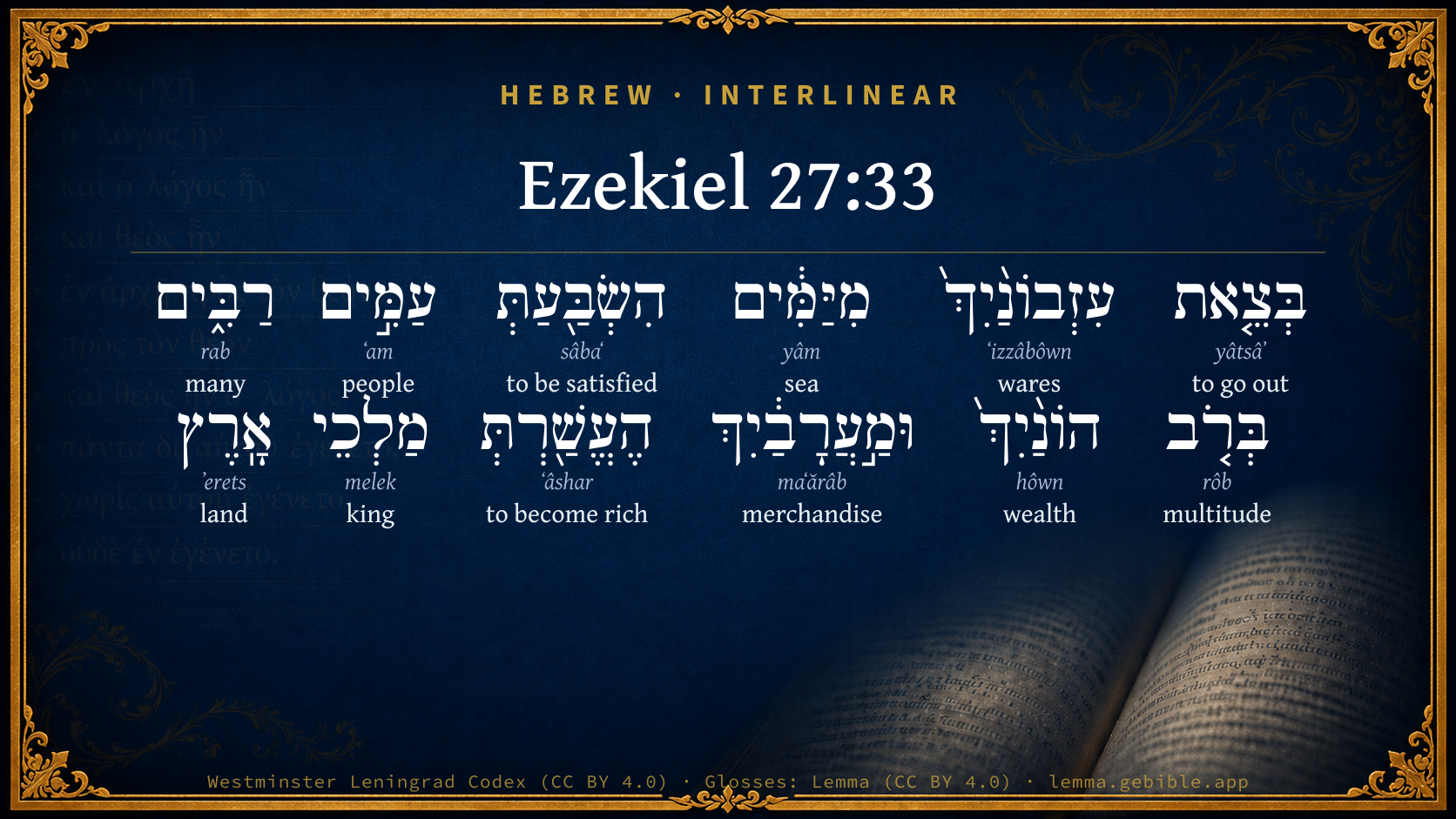
Hebrew (Westminster Leningrad Codex) Ezekiel 27:33 appears in the Hebrew Old Testament. The text above is from the Westminster Leningrad Codex. Each word links to its Strong’s number, a concise gloss, and parsing drawn from the Open Scriptures Hebrew Bible morphology. Click any word for its full Brown-Driver-Briggs (BDB) entry.
Download image
Cite this verse

Ezekiel 27:33 (World English Bible). Public Domain. Lemma interlinear Bible study tool, https://lemma.gebible.app/v/ezekiel/27/33.

Show BibTeX & RIS
BibTeX
RIS
English Translation
When your wares went forth out of the seas, you filled many peoples; you did enrich the kings of the earth with the multitude of your riches and of your merchandise.
World English Bible · Public Domain
Download a study sheet

One document with this verse’s original text, its word-by-word gloss line, the meaning frame, cross-references with their text, attributed commentary, and full source and license credits — printable, and it pastes into notes with its structure intact.

This verse Autodidact and up

Study sheet (.html) Plain text (.txt)

A passage Seminary Student

Up to 50 verses in one chapter. A passage sheet keeps up to 6 commentary sources and 12 cross-references per verse, in the order this page ranks them, and says so on the sheet whenever that leaves anything out. Ask for a single verse and you get the Autodidact verse sheet above.

Everything on this page stays free to read, with no account — the sheet is a download of what is already on screen, not access to it.

Want to remove ads? Support Godless Engineer
Compare translations 3

The same verse in 3 English versions, stacked beneath the original-language interlinear above. Click any original word for its lexicon entry.

Each is an independent rendering of the whole verse — the interlinear is not word-aligned to these translations.

Highlighted words mark where these versions differ — a whole-verse word diff, not a word-by-word alignment.

  • World English Bible Public Domain
    When your wares went forth out of the seas, you filled many peoples; you did enrich the kings of the earth with the multitude of your riches and of your merchandise.
  • King James Version Public Domain
    When thy wares went forth out of the seas, thou filledst many people; thou didst enrich the kings of the earth with the multitude of thy riches and of thy merchandise.
  • unfoldingWord Literal Text CC BY-SA 4.0
    When your merchandise went ashore from the sea, it satisfied many peoples; you enriched the kings of the earth with your great wealth and merchandise!

unfoldingWord Literal Text — © unfoldingWord, licensed CC BY-SA 4.0. Word-aligned USFM3 via Door43 (git.door43.org/unfoldingWord/en_ult).

Versions to compare (up to 4)

3 of 4 selected

Show all 18 translations

Every available English version of this verse, each an independent rendering of the whole verse.

  • World English Bible Public Domain
    When your wares went forth out of the seas, you filled many peoples; you did enrich the kings of the earth with the multitude of your riches and of your merchandise.
  • Berean Standard Bible Public Domain
    When your wares went out to sea, you satisfied many nations. You enriched the kings of the earth with your abundant wealth and merchandise.
  • Majority Standard Bible Public Domain
    When your wares went out to sea, you satisfied many nations. You enriched the kings of the earth with your abundant wealth and merchandise.
  • King James Version Public Domain
    When thy wares went forth out of the seas, thou filledst many people; thou didst enrich the kings of the earth with the multitude of thy riches and of thy merchandise.
  • American Standard Version (1901) Public Domain
    When thy wares went forth out of the seas, thou filledst many peoples; thou didst enrich the kings of the earth with the multitude of thy riches and of thy merchandise.
  • Revised Version (1885) Public Domain
    When thy wares went forth out of the seas, thou filledst many peoples; thou didst enrich the kings of the earth with the multitude of thy riches and of thy merchandise.
  • Geneva Bible (1599) Public Domain
    When thy wares went foorth of the seas, thou filledst many people, and thou diddest enrich the Kings of the earth with the multitude of thy riches and of thy marchandise.
  • Douay-Rheims (1899) Public Domain
    Which by thy merchandise that went from thee by sea didst fill many people: which by the multitude of thy riches, and of thy people didst enrich the kings of the earth.
  • Young's Literal Translation Public Domain
    With the outgoing of thy remnants from the seas, Thou hast filled many peoples, With the abundance of thy riches, and thy merchandise, Thou hast made rich things of earth.
  • Literal Standard Version CC BY-SA 4.0
    With the outgoing of your wares from the seas, || You have filled many peoples, || With the abundance of your riches, and your merchandise, || You have enriched [the] kings of earth.
  • Unlocked Literal Bible CC BY-SA 4.0
    When your merchandise went ashore from the sea, it satisfied many peoples; you enriched the kings of the earth with your great wealth and merchandise!
  • unfoldingWord Literal Text CC BY-SA 4.0
    When your merchandise went ashore from the sea, it satisfied many peoples; you enriched the kings of the earth with your great wealth and merchandise!
  • Darby Bible Public Domain
    When thy wares went forth over the seas, thou filledst many peoples; thou didst enrich the kings of the earth with the abundance of thy substance and of thy merchandise.
  • World Messianic Bible Public Domain
    When your wares came from the seas, you filled many peoples. You enriched the kings of the earth with the multitude of your riches and of your merchandise.
  • Webster's Bible Public Domain
    When thy wares went forth out of the seas, thou filledst many people; thou didst enrich the kings of the earth with the multitude of thy riches and of thy merchandise.
  • Free Bible Version CC BY-SA 4.0
    You made many people happy when they received your goods from far across the sea. You made the kings of the earth rich with all your valuable goods and products.
  • Bible in Basic English Public Domain
    When your goods went out over the seas, you made numbers of peoples full; the wealth of the kings of the earth was increased with your great wealth and all your goods.
  • JPS Tanakh (1917) Public Domain
    When thy wares came forth out of the seas, thou didst fill many peoples; with the multitude of thy riches and of thy merchandise didst thou enrich the kings of the earth.

Literal Standard Version (2020), Covenant Press — licensed CC BY-SA 4.0. Text via the HelloAO Bible API (eBible.org). Unlocked Literal Bible (unfoldingWord) — licensed CC BY-SA 4.0. Text via the HelloAO Bible API (eBible.org). unfoldingWord Literal Text — © unfoldingWord, licensed CC BY-SA 4.0. Word-aligned USFM3 via Door43 (git.door43.org/unfoldingWord/en_ult). Free Bible Version, Dr. Jonathan Gallagher — licensed CC BY-SA 4.0. Text via the HelloAO Bible API (eBible.org).

Word by word

More ways to search: Search by grammar → Find every occurrence → Compare this word →

Practice this passage: Drill this verse → Learn its vocabulary →

עִזְבוֹנַ֨יִךְ֙
ʻizzâbôwn
H5801
“wares · your”
Noun, Common, Masculine, Plural, Construct + Suffix, Personal, 2nd Person, Feminine, Singular
Part of Speech
Noun
Type
Common
Gender
Masculine
Number
Plural
State
Construct
Full BDB Definition

Origin: from H5800 in the sense of letting go (for a price, i.e. selling)

TWOT: 1594b

wares, goods
  1. בְּצֵ֤את yâtsâʼ H3318 “in/at · to go out” Preposition + Verb, Qal, Infinitive Construct
  2. מִיַּמִּ֔ים yâm H3220 “from · seas” Preposition + Noun, Common, Masculine, Plural, Absolute
  3. הִשְׂבַּ֖עַתְּ sâbaʻ H7646 “to be satisfied” Verb, Hiphil, Perfect, 2nd Person, Feminine, Singular
  4. עַמִּ֣ים ʻam H5971 “peoples” Noun, Common, Masculine, Plural, Absolute
  5. רַבִּ֑ים rab H7227 “many” Adjective, Adjective, Masculine, Plural, Absolute
  6. בְּרֹ֤ב rôb H7230 “in/at · multitude of” Preposition + Noun, Common, Both, Singular, Construct
  7. הוֹנַ֨יִךְ֙ hôwn H1952 “wealth · your” Noun, Common, Masculine, Plural, Construct + Suffix, Personal, 2nd Person, Feminine, Singular
  8. וּמַ֣עֲרָבַ֔יִךְ maʻărâb H4627 “and · merchandise · your” Conjunction + Noun, Common, Masculine, Plural, Construct + Suffix, Personal, 2nd Person, Feminine, Singular
  9. הֶעֱשַׁ֖רְתְּ ʻâshar H6238 “to become rich” Verb, Hiphil, Perfect, 2nd Person, Feminine, Singular
  10. מַלְכֵי melek H4428 “kings of” Noun, Common, Masculine, Plural, Construct
  11. אָֽרֶץ ʼerets H776 “land” Noun, Common, Both, Singular, Absolute

About this verse

These counts appear in no published source. They are computed here, from the morphology-tagged text and Lemma’s own curated glosses. What Lemma adds →

12
words
12
distinct lemmas
Prophets
section

Notable vocabulary

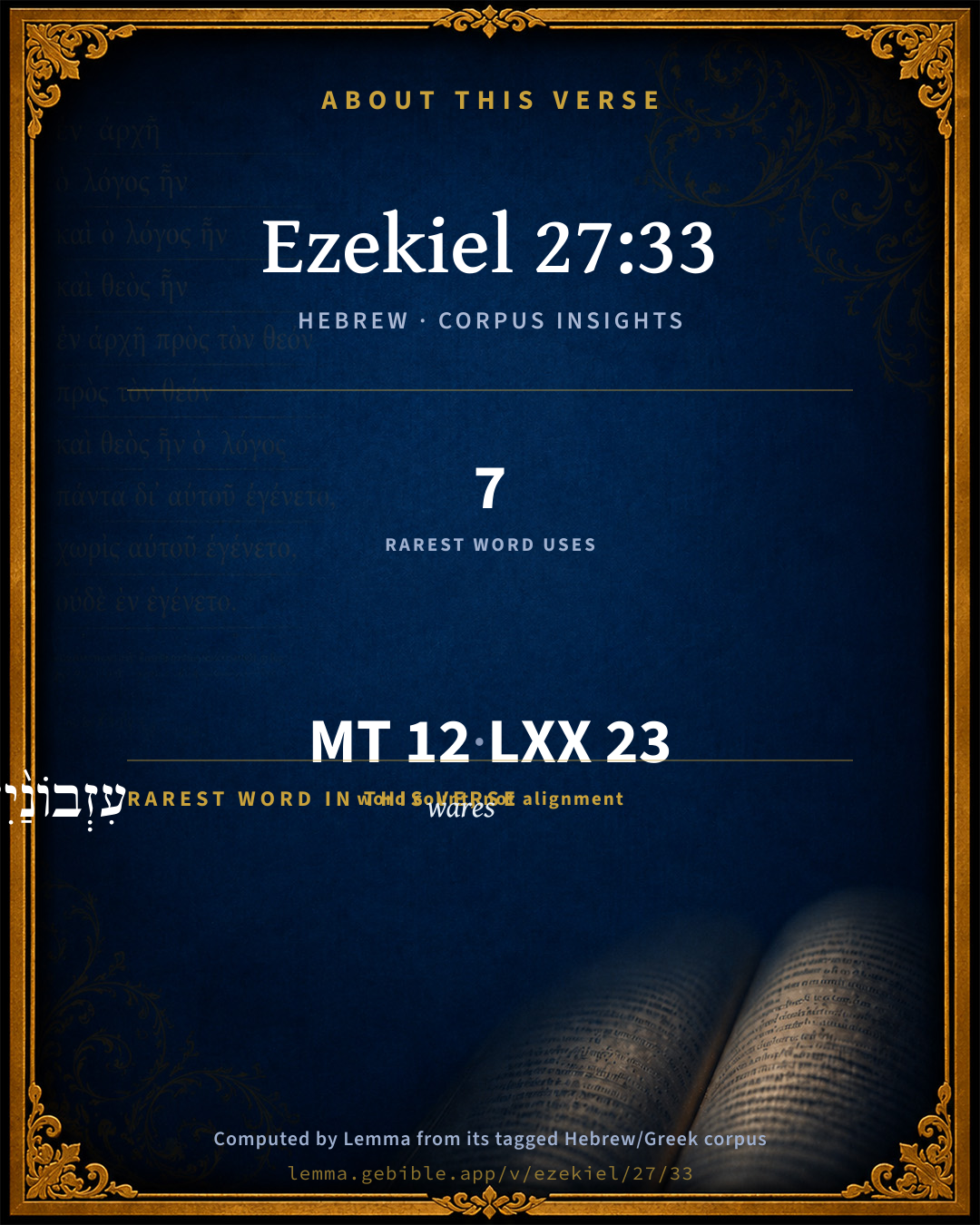
The rarest word here is עִזְבוֹנַ֨יִךְ֙ wares H5801 — appearing just 7 times in the whole Hebrew Bible.

Shared distinctive vocabulary

עִזְבוֹנַ֨יִךְ֙ wares H5801 occurs in 7 verses of the Hebrew Bible. Also found in:

Grammatical profile

  • 3 verbs
  • 8 nouns
  • 1 adjective

Verb forms

  • בְּצֵ֤את Qal · Infinitive Construct
  • הִשְׂבַּ֖עַתְּ Hiphil · Perfect
  • הֶעֱשַׁ֖רְתְּ Hiphil · Perfect

Hebrew & Septuagint length

In English translation the verse runs 31 words from the Hebrew and 33 from the Septuagint (LXX English) — closely comparable.

A rough comparison of the two English renderings, which tokenize alike — not a word-level alignment.

Word counts can differ between the Hebrew and the Greek without any difference in meaning — e.g. the Hebrew direct-object marker אֵת has no separate Greek word, and Greek often adds the article ὁ.

In the original languages it is 12 Hebrew tokens and 23 Greek tokens — but the two are counted differently (Hebrew bundles its prefixes and suffixes into one token; the Greek is in lemma form), so that isn’t a like-for-like length.

Cross-references

8

Topical passages linked to Ezekiel 27:33 in the Treasury of Scripture Knowledge — connected by theme and wording, ordered by reader-vote popularity; previews shown in the World English Bible.

  • Revelation 18:19 They cast dust on their heads, and cried, weeping and mourning, saying, 'Woe, woe, the great city, in which all who had their ships in the sea were made rich by reason of her great wealth!' For in one hour is she made desolate.
  • Isaiah 23:3–8 On great waters the seed of the Shihor, the harvest of the Nile, was her revenue; and she was the market of nations.
  • Ezekiel 27:3 and tell Tyre, you who dwell at the entry of the sea, who are the merchant of the peoples to many isles, thus says the Lord Yahweh: You, Tyre, have said, I am perfect in beauty.
  • Ezekiel 27:12–36 Tarshish was your merchant by reason of the multitude of all kinds of riches; with silver, iron, tin, and lead, they traded for your wares.
  • Ezekiel 28:4–5 by your wisdom and by your understanding you have gotten you riches, and have gotten gold and silver into your treasures;
  • Ezekiel 28:16 By the abundance of your traffic they filled the midst of you with violence, and you have sinned: therefore I have cast you as profane out of the mountain of God; and I have destroyed you, covering cherub, from the midst of the stones of fire.
  • Revelation 18:3 For all the nations have drunk of the wine of the wrath of her sexual immorality, the kings of the earth committed sexual immorality with her, and the merchants of the earth grew rich from the abundance of her luxury."
  • Revelation 18:12–15 merchandise of gold, silver, precious stones, pearls, fine linen, purple, silk, scarlet, all expensive wood, every vessel of ivory, every vessel made of most precious wood, and of brass, and iron, and marble;

Cross-references courtesy of OpenBible.info (CC BY 4.0).

Hebrew and Greek witnesses Masoretic Hebrew ↔ Greek Septuagint

The same verse in the two great witnesses to the Old Testament, shown verse-for-verse.

These are two independent witnesses, not word-aligned to each other, and the Septuagint is shown in lemma (dictionary) form.

Hebrew Ezekiel 27:33 Masoretic · Westminster Leningrad Codex

בְּצֵ֤את עִזְבוֹנַ֨יִךְ֙ מִיַּמִּ֔ים הִשְׂבַּ֖עַתְּ עַמִּ֣ים רַבִּ֑ים בְּרֹ֤ב הוֹנַ֨יִךְ֙ וּמַ֣עֲרָבַ֔יִךְ הֶעֱשַׁ֖רְתְּ מַלְכֵי אָֽרֶץ

When your wares went forth out of the seas, you filled many peoples; you did enrich the kings of the earth with the multitude of your riches and of your merchandise.

World English Bible · Public Domain

Greek LXX Ezekiel 27:33 Septuagint · lemma form

πόσος τις εὑρίσκω μισθός ἀπό ὁ θάλασσα ἐνπίμπλημι ἔθνος ἀπό ὁ πλῆθος σύ καί ἀπό ὁ συμμικτός σύ πλουτίζω πᾶς βασιλεύς ὁ γῆ

How large a reward have you gained from the sea? you have filled nations out of your abundance; and out of your mixed merchandise you have enriched all the kings of the earth.

LXX2012 (modern English Septuagint) · Public Domain

Hebrew: Westminster Leningrad Codex (CC BY 4.0). Greek: Septuagint (public domain); English from LXX2012 (modern English Septuagint) (Public Domain). How the Septuagint differs from the Hebrew →

Targum (Aramaic paraphrase)

1

The Targum is the ancient Jewish Aramaic paraphrase of the Hebrew Scriptures — an interpretive translation, not the Hebrew text itself. Onkelos (literal) and Pseudo-Jonathan (expansive) render the Torah, and Jonathan the Prophets. Coverage is partial: where no permissively-licensed English translation exists for a verse, only the Aramaic is shown. This is verse-level text, not a word-by-word alignment to the Hebrew.

  1. Targum Jonathan Prophets (Joshua–Malachi)
    בְּמִפַּק סְחוֹרְתִּיךְ מִבֵּינֵי עַמְמַיָא שַׂבַעְתְּ עַמְמִין סַגִיאִין בִּסְגֵי עוֹתְרִיךְ וְנִכְסַיִךְ אַעַתַּרְתְּ מַלְכֵי אַרְעָא:

    (no public-domain English translation for this verse)

    Targum Jonathan — Aramaic: “Mikraot Gedolot” (public domain). English: “Sefaria Community Translation” (CC0 1.0 (public-domain dedication)); “London "Chaldee Paraphrase," 1871” (public domain). Text via Sefaria.

Commentary

Notes on Ezekiel 27:33 from classic Christian and Jewish commentators (each source and its license shown beneath its notes). The classic Christian expositions comment on the surrounding passage and are grouped to its opening verse, so a note may address several verses; the Jewish commentaries on the Tanakh (Rashi and others) are per-verse, so they appear only where the commentator wrote on this verse.

Lemma curates 59 commentaries, every one of them public domain or Creative Commons licensed, each selected and text-cleaned for this edition rather than reprinted as found. About our sources →

Trapp's Complete Commentary

John Trapp

Eze 27:33 When thy wares went forth out of the seas, thou filledst many people; thou didst enrich the kings of the earth with the multitude of thy riches and of thy merchandise.

Ver. 33. When thy wars.] Good things are fairest on the back side; the worth of them is best known by the want of them. Our eye seeth not things but at a distance.

John Trapp, A Commentary or Exposition upon All the Books of the Old and New Testament (1647–1656) — public domain. Text from a community e-Sword module.

Joseph Benson's Commentary

Eze 27:33-36. When thy wares, &c. — When thy wares or manufactures were transported through the seas to every part, thou filledst many people — Didst supply the wants, or minister to the luxuries and pleasures, of many nations. Time was when thy wares, those of thy own making, and those that passed through thy hands, were exported to all parts of the world; then thou filledst many people, and didst enrich the kings of the earth and their kingdoms. But in the time when thou shalt be broken — As a ship that is wrecked at sea; thy merchandise and all thy company shall fall — They that used to be enriched by thee, shall be ruined with thee, as is usual in trade. All the inhabitants of the isles shall be astonished — Wondering greatly that ever such a change should be effected, that Tyre should fall. And their kings shall be sore afraid — Sensible how much less able they are to resist the conqueror and defend themselves than thou wast, and not knowing whom he will next attack. They shall be troubled in their countenance — They shall not be able to conceal the discomposure of their minds, but will show it evidently in their countenances. The merchants among the people shall hiss at thee — By way of insult and derision; as men are apt to despise those in adversity, whom they courted and respected in prosperity. The Chaldee Paraphrase renders it, They shall be astonished; and this sense agrees better with the lamentations of the seafaring men, mentioned in the foregoing verses.

The following reflections by Bishop Newton, on the fall of Tyre, are peculiarly worthy of the reader’s attention: “Such hath been the fate of this city, once the most famous in the world for trade and commerce. But trade is a fluctuating thing: it passed from Tyre to Alexandria, from Alexandria to Venice, from Venice to Antwerp, from Antwerp to Amsterdam and London, the English rivalling the Dutch, as the French are now rivalling both. It behooves those who are in possession of it, to take the greatest care that they do not lose it. Liberty is a friend to that, as that is a friend to liberty. But the greatest enemy to both is licentiousness, which tramples upon all law and lawful authority, encourages riots and tumults, promotes drunkenness and debauchery, sticks at nothing to supply its extravagance, practises every art of illicit gain, ruins credit, ruins trade, and will in the end ruin liberty itself. Neither kingdoms nor commonwealths, neither public companies nor private persons, can long carry on a beneficial, flourishing trade without virtue, and what virtue teacheth, sobriety, industry, frugality, modesty, honesty, punctuality, humanity, charity, the love of our country, and the fear of God. The prophets will inform us how the Tyrians lost it; and the like causes will always produce the like effects.”

Joseph Benson's Commentary on the Old and New Testaments (1811–1818) — public domain. Text from a community e-Sword module.

Jamieson, Fausset & Brown

Robert Jamieson, A. R. Fausset & David Brown

out of the seas--brought on shore out of the ships.

filledst--didst supply plentifully with wares.

enrich . . . kings--with the custom dues levied on the wares.

Jamieson, Fausset & Brown — Commentary Critical and Explanatory on the Whole Bible (1871) — public domain (CC PDM 1.0). Text via the HelloAO Bible API.

The Cambridge Bible for Schools and Colleges

gen. ed. J. J. S. Perowne

33. thy wares went forth] i.e. when they were landed from the sea on many shores many peoples were filled, cf. Isa_23:3 (R.V.).

The Cambridge Bible for Schools and Colleges (gen. ed. J. J. S. Perowne; Cambridge University Press, 1878–1918) — public domain. Text from a community e-Sword module.

John Gill's Exposition

In the time when thou shall be broken by the seas in the depths of the waters..... By the Chaldean army, which came upon them like the waves of the sea, Eze 26:3 by which they were overpowered and destroyed; just as a ship on the mighty waters is dashed and broke to pieces by the waves thereof:

thy merchandise, and all thy company in the midst of thee, shall fall; trade shall cease, and the mixed multitude of traders from all parts shall be seen no more; the natives of the place shall perish; mariners and soldiers, and persons of every rank and degree, age, and sex. The Targum renders it,

"all thine armies.''

Abendana suggests that this respects the destruction of Tyre by Alexander the great.

John Gill's Exposition of the Whole Bible (1746–1763) — public domain (CC PDM 1.0). Text via the HelloAO Bible API.

Matthew Poole's English Annotations

Thy wares, brought home from all coasts.

Went forth out of the seas; were landed, brought on shore for the mart.

Thou filledst; there was enough to supply to the full.

Many people; numerous, stately, sumptuous nations, though their prodigality was great, thou furnishedst them, hadst wares rich and stately enough for all of them. Such influence had thy vast trade, that not only meaner men and subjects, but kings themselves, were made more wealthy by it.

Of the earth, i.e. all kings of the known world, or kings of nations far off as well as neighbouring kings.

The multitude of thy riches; the greatness of thy trade, the variety of thy wares brought from all parts were thy own riches, and enriched all thou didst trade with; kings were enriched by customs and tolls paid to them, by the enriching their subjects, who thereby were fitter to pay taxes, or by furnishing their treasuries with all the peculiar treasures of kings, the rare and precious jewels which they, esteem; and since we know some kings did trade too, by this Tyre increased their wealth.

Matthew Poole's English Annotations on the Holy Bible (1683–1685) — public domain. Text from a community e-Sword/MySword module.

John Wesley's Explanatory Notes

Went forth - Were landed. Thou filledst - There was enough to supply to the full.

John Wesley, Explanatory Notes Upon the Whole Bible (1754–1765) — public domain. Text via the GEBible commentary corpus.

Rashi

Rabbi Shlomo Yitzchaki (Rashi)

When your merchandise came out, etc. All this they will lament over you in their lamentation.

Rashi on the Tanakh — English translations: “The Judaica Press complete Tanach with Rashi, translated by A. J. Rosenberg” (CC BY 4.0); “Pentateuch with Rashi's commentary by M. Rosenbaum and A.M. Silbermann, 1929-1934” (public domain); “The Metsudah Tanach series, Lakewood, N.J” (CC BY 4.0); and “The Book of Joshua, Metsudah Publications, 1997” (CC BY 4.0). Text via Sefaria.

Lesson kit

Teaching starters — assembled from the data on this page, not authored interpretation. Every prompt links to the verse data it draws on. Edit before teaching.

Ezekiel, in the Prophets, opens this verse with 12 words (12 distinct Hebrew lemmas). Its most distinctive word is ʻizzâbôwn (“wares”). A historical commentator’s framing appears above. Read the whole chapter for the surrounding context.

Discussion questions

  1. How does “wares” (ʻizzâbôwn) shape what this verse is saying?
  2. Ezekiel 27:12 shares the word «wares» with this verse. How do the two illuminate each other?
  3. These translations render this verse differently. What is at stake in choosing one wording over another?
  4. The verb «בְּצֵ֤את» is Qal Infinitive Construct. How does its form color the action?
  5. Reading how Trapp's Complete Commentary and Joseph Benson's Commentary read this verse, where do the two commentators agree and where do they part?

Things to notice

Reading settings

Reading text

Shown beneath each verse's original-language words.

Old Testament
Old Testament edition

Read the OT as the Masoretic Hebrew (MT) or the Greek Septuagint (LXX).

English shown for the Greek Septuagint (in the Hebrew ↔ Greek comparison).

Comparing translations? Open the Compare panel on any verse page to stack up to four side by side.