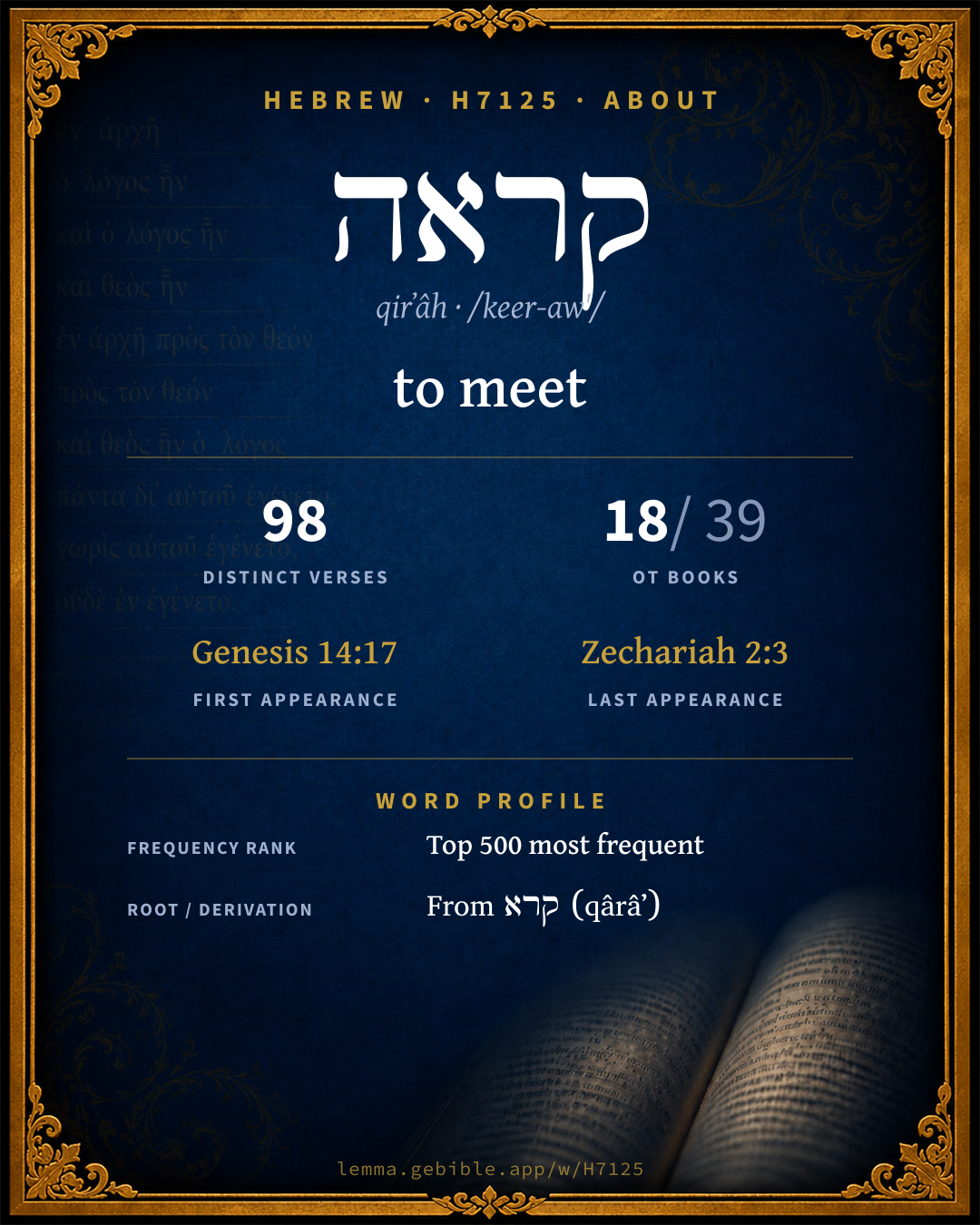
קִרְאָה
to meet
‘to meet’ is one of 3 main senses fuller range ↓
Full lexicon entry — Brown-Driver-Briggs (BDB)
From Brown-Driver-Briggs (BDB)
Where this word appears
Grammar key — what these labels mean
Stem
- Qal
- The basic, simple active stem — the plain form of the verb (“he wrote”). Here: ‘call’
Form
- Infinitive Construct
- A bound verbal noun, frequently with prepositions (“to write / in writing”).
Every verse where H7125 appears — 98 distinct verses across 18 books. Click any verse to open its interlinear word-by-word view. Verse text shown in the World English Bible for context — . Each verse’s Hebrew form is shown with its reference; the English is not keyword-highlighted, since the data carries no word-level English alignment. Use “Compare translations” on any verse to read it across multiple English versions. This concordance covers the Hebrew Bible; Septuagint (Greek Old Testament) occurrences are not indexed here.
Genesis 11 verses
- Genesis 14:17 לִ/קְרָאת/וֹ֒ prep + Qal inf.cs + sfx pers 3ms The king of Sodom went out to meet him, after his return from the slaughter of Chedorlaomer and the kings who were with him, at the valley of Shaveh (the same is the King's Valley).
- Genesis 15:10 לִ/קְרַ֣את prep + Qal inf.cs He took him all these, and divided them in the middle, and laid each half opposite the other; but he didn't divide the birds.
- Genesis 18:2 לִ/קְרָאתָ/ם֙ prep + Qal inf.cs + sfx pers 3mp He lifted up his eyes and looked, and saw that three men stood opposite him. When he saw them, he ran to meet them from the tent door, and bowed himself to the earth,
- Genesis 19:1 לִ/קְרָאתָ֔/ם prep + Qal inf.cs + sfx pers 3mp The two angels came to Sodom at evening. Lot sat in the gate of Sodom. Lot saw them, and rose up to meet them. He bowed himself with his face to the earth,
- Genesis 24:17 לִ/קְרָאתָ֑/הּ prep + Qal inf.cs + sfx pers 3fs The servant ran to meet her, and said, "Please give me a drink, a little water from your pitcher."
- Genesis 24:65 לִ/קְרָאתֵ֔/נוּ prep + Qal inf.cs + sfx pers 1cp She said to the servant, "Who is the man who is walking in the field to meet us?" The servant said, "It is my master." She took her veil, and covered herself.
- Genesis 29:13 לִ/קְרָאת/וֹ֙ prep + Qal inf.cs + sfx pers 3ms It happened, when Laban heard the news of Jacob, his sister's son, that he ran to meet Jacob, and embraced him, and kissed him, and brought him to his house. Jacob told Laban all these things.
- Genesis 30:16 לִ/קְרָאת֗/וֹ prep + Qal inf.cs + sfx pers 3ms Jacob came from the field in the evening, and Leah went out to meet him, and said, "You must come in to me; for I have surely hired you with my son's mandrakes." He lay with her that night.
- Genesis 32:6 לִ/קְרָֽאתְ/ךָ֔ prep + Qal inf.cs + sfx pers 2ms The messengers returned to Jacob, saying, "We came to your brother Esau. Not only that, but he comes to meet you, and four hundred men with him."
- Genesis 33:4 לִ/קְרָאת/וֹ֙ prep + Qal inf.cs + sfx pers 3ms Esau ran to meet him, embraced him, fell on his neck, kissed him, and they wept.
- Genesis 46:29 לִ/קְרַֽאת prep + Qal inf.cs Joseph made ready his chariot, and went up to meet Israel, his father, in Goshen. He presented himself to him, and fell on his neck, and wept on his neck a good while.
Exodus 7 verses
- Exodus 4:14 לִ/קְרָאתֶ֔/ךָ prep + Qal inf.cs + sfx pers 2ms The anger of Yahweh was kindled against Moses, and he said, "What about Aaron, your brother, the Levite? I know that he can speak well. Also, behold, he comes forth to meet you. When he sees you, he will be glad in his heart.
- Exodus 4:27 לִ/קְרַ֥את prep + Qal inf.cs Yahweh said to Aaron, "Go into the wilderness to meet Moses." He went, and met him on God's mountain, and kissed him.
- Exodus 5:20 לִ/קְרָאתָ֑/ם prep + Qal inf.cs + sfx pers 3mp They met Moses and Aaron, who stood in the way, as they came forth from Pharaoh:
- Exodus 7:15 לִ/קְרָאת֖/וֹ prep + Qal inf.cs + sfx pers 3ms Go to Pharaoh in the morning. Behold, he goes out to the water; and you shall stand by the river's bank to meet him; and the rod which was turned to a serpent you shall take in your hand.
- Exodus 14:27 לִ/קְרָאת֑/וֹ prep + Qal inf.cs + sfx pers 3ms Moses stretched out his hand over the sea, and the sea returned to its strength when the morning appeared; and the Egyptians fled against it. Yahweh overthrew the Egyptians in the midst of the sea.
- Exodus 18:7 לִ/קְרַ֣את prep + Qal inf.cs Moses went out to meet his father-in-law, and bowed and kissed him. They asked each other of their welfare, and they came into the tent.
- Exodus 19:17 לִ/קְרַ֥את prep + Qal inf.cs Moses led the people out of the camp to meet God; and they stood at the lower part of the mountain.
Numbers 9 verses
- Numbers 20:18 לִ/קְרָאתֶֽ/ךָ prep + Qal inf.cs + sfx pers 2ms Edom said to him, You shall not pass through me, lest I come out with the sword against you.
- Numbers 20:20 לִ/קְרָאת֔/וֹ prep + Qal inf.cs + sfx pers 3ms He said, You shall not pass through. Edom came out against him with much people, and with a strong hand.
- Numbers 21:23 לִ/קְרַ֤את prep + Qal inf.cs Sihon would not allow Israel to pass through his border: but Sihon gathered all his people together, and went out against Israel into the wilderness, and came to Jahaz; and he fought against Israel.
- Numbers 21:33 לִ/קְרָאתָ֜/ם prep + Qal inf.cs + sfx pers 3mp They turned and went up by the way of Bashan: and Og the king of Bashan went out against them, he and all his people, to battle at Edrei.
- Numbers 22:34 לִ/קְרָאתִ֖/י prep + Qal inf.cs + sfx pers 1cs Balaam said to the angel of Yahweh, I have sinned; for I didn't know that you stood in the way against me: now therefore, if it displease you, I will get me back again.
- Numbers 22:36 לִ/קְרָאת֜/וֹ prep + Qal inf.cs + sfx pers 3ms When Balak heard that Balaam was come, he went out to meet him to the City of Moab, which is on the border of the Arnon, which is in the utmost part of the border.
- Numbers 23:3 לִ/קְרָאתִ֔/י prep + Qal inf.cs + sfx pers 1cs Balaam said to Balak, Stand by your burnt offering, and I will go: perhaps Yahweh will come to meet me; and whatever he shows me I will tell you. He went to a bare height.
- Numbers 24:1 לִ/קְרַ֣את prep + Qal inf.cs When Balaam saw that it pleased Yahweh to bless Israel, he didn't go, as at the other times, to meet with enchantments, but he set his face toward the wilderness.
- Numbers 31:13 לִ/קְרָאתָ֑/ם prep + Qal inf.cs + sfx pers 3mp Moses, and Eleazar the priest, and all the princes of the congregation, went forth to meet them outside of the camp.
Deuteronomy 4 verses
- Deuteronomy 1:44 לִ/קְרַאתְ/כֶ֔ם prep + Qal inf.cs + sfx pers 2mp The Amorites, who lived in that hill-country, came out against you, and chased you, as bees do, and beat you down in Seir, even to Hormah.
- Deuteronomy 2:32 לִ/קְרָאתֵ֜/נוּ prep + Qal inf.cs + sfx pers 1cp Then Sihon came out against us, he and all his people, to battle at Jahaz.
- Deuteronomy 3:1 לִ/קְרָאתֵ֜/נוּ prep + Qal inf.cs + sfx pers 1cp Then we turned, and went up the way to Bashan: and Og the king of Bashan came out against us, he and all his people, to battle at Edrei.
- Deuteronomy 29:7 לִ/קְרָאתֵ֛/נוּ prep + Qal inf.cs + sfx pers 1cp When you came to this place, Sihon the king of Heshbon, and Og the king of Bashan, came out against us to battle, and we struck them:
Joshua 5 verses
- Joshua 8:5 לִ/קְרָאתֵ֨/נוּ֙ prep + Qal inf.cs + sfx pers 1cp and I, and all the people who are with me, will approach to the city. It shall happen, when they come out against us, as at the first, that we will flee before them;
- Joshua 8:14 לִ/קְרַֽאת prep + Qal inf.cs It happened, when the king of Ai saw it, that they hurried and rose up early, and the men of the city went out against Israel to battle, he and all his people, at the time appointed, before the Arabah; but he didn't know that there was an ambush against him behind the city.
- Joshua 8:22 לִ/קְרָאתָ֔/ם prep + Qal inf.cs + sfx pers 3mp The others came forth out of the city against them; so they were in the midst of Israel, some on this side, and some on that side: and they struck them, so that they let none of them remain or escape.
- Joshua 9:11 לִ/קְרָאתָ֑/ם prep + Qal inf.cs + sfx pers 3mp Our elders and all the inhabitants of our country spoke to us, saying, Take provision in your hand for the journey, and go to meet them, and tell them, We are your servants: and now make you a covenant with us.
- Joshua 11:20 לִ/קְרַ֨את prep + Qal inf.cs For it was of Yahweh to harden their hearts, to come against Israel in battle, that he might utterly destroy them, that they might have no favor, but that he might destroy them, as Yahweh commanded Moses.
Judges 11 verses
- Judges 4:18 לִ/קְרַ֣את prep + Qal inf.cs Jael went out to meet Sisera, and said to him, Turn in, my lord, turn in to me; don't be afraid. He came in to her into the tent, and she covered him with a rug.
- Judges 4:22 לִ/קְרָאת֔/וֹ prep + Qal inf.cs + sfx pers 3ms Behold, as Barak pursued Sisera, Jael came out to meet him, and said to him, Come, and I will show you the man whom you seek. He came to her; and, behold, Sisera lay dead, and the tent-pin was in his temples.
- Judges 6:35 לִ/קְרָאתָֽ/ם prep + Qal inf.cs + sfx pers 3mp He sent messengers throughout all Manasseh; and they also were gathered together after him: and he sent messengers to Asher, and to Zebulun, and to Naphtali; and they came up to meet them.
- Judges 7:24 לִ/קְרַ֤את prep + Qal inf.cs Gideon sent messengers throughout all the hill-country of Ephraim, saying, Come down against Midian, and take before them the waters, as far as Beth Barah, even the Jordan. So all the men of Ephraim were gathered together, and took the waters as far as Beth Barah, even the Jordan.
- Judges 11:31 לִ/קְרָאתִ֔/י prep + Qal inf.cs + sfx pers 1cs then it shall be, that whatever comes forth from the doors of my house to meet me, when I return in peace from the children of Ammon, it shall be Yahweh's, and I will offer it up for a burnt offering.
- Judges 11:34 לִ/קְרָאת֔/וֹ prep + Qal inf.cs + sfx pers 3ms Jephthah came to Mizpah to his house; and, behold, his daughter came out to meet him with tambourines and with dances: and she was his only child; besides her he had neither son nor daughter.
- Judges 14:5 לִ/קְרָאתֽ/וֹ prep + Qal inf.cs + sfx pers 3ms Then went Samson down, and his father and his mother, to Timnah, and came to the vineyards of Timnah: and, behold, a young lion roared against him.
- Judges 15:14 לִ/קְרָאת֑/וֹ prep + Qal inf.cs + sfx pers 3ms When he came to Lehi, the Philistines shouted as they met him: and the Spirit of Yahweh came mightily on him, and the ropes that were on his arms became as flax that was burnt with fire, and his bands dropped from off his hands.
- Judges 19:3 לִ/קְרָאתֽ/וֹ prep + Qal inf.cs + sfx pers 3ms Her husband arose, and went after her, to speak kindly to her, to bring her again, having his servant with him, and a couple of donkeys: and she brought him into her father's house; and when the father of the young lady saw him, he rejoiced to meet him.
- Judges 20:25 לִ/קְרָאתָ֥/ם prep + Qal inf.cs + sfx pers 3mp Benjamin went forth against them out of Gibeah the second day, and destroyed down to the ground of the children of Israel again eighteen thousand men; all these drew the sword.
- Judges 20:31 לִ/קְרַ֣את prep + Qal inf.cs The children of Benjamin went out against the people, and were drawn away from the city; and they began to strike and kill of the people, as at other times, in the highways, of which one goes up to Bethel, and the other to Gibeah, in the field, about thirty men of Israel.
2 Samuel 12 verses
- 2 Samuel 6:20 לִ/קְרַ֣את prep + Qal inf.cs Then David returned to bless his household. Michal the daughter of Saul came out to meet David, and said, How glorious was the king of Israel today, who uncovered himself today in the eyes of the handmaids of his servants, as one of the vain fellows shamelessly uncovers himself!
- 2 Samuel 10:5 לִ/קְרָאתָ֔/ם prep + Qal inf.cs + sfx pers 3mp When they told it to David, he sent to meet them; for the men were greatly ashamed. The king said, Wait at Jericho until your beards be grown, and then return.
- 2 Samuel 10:9 לִ/קְרַ֥את prep + Qal inf.cs Now when Joab saw that the battle was set against him before and behind, he chose of all the choice men of Israel, and put them in array against the Syrians:
- 2 Samuel 10:10 לִ/קְרַ֖את prep + Qal inf.cs The rest of the people he committed into the hand of Abishai his brother; and he put them in array against the children of Ammon.
- 2 Samuel 10:17 לִ/קְרַ֣את prep + Qal inf.cs It was told David; and he gathered all Israel together, and passed over the Jordan, and came to Helam. The Syrians set themselves in array against David, and fought with him.
- 2 Samuel 15:32 לִ/קְרָאת/וֹ֙ prep + Qal inf.cs + sfx pers 3ms It happened that when David had come to the top [of the ascent], where God was worshiped, behold, Hushai the Archite came to meet him with his coat torn, and earth on his head.
- 2 Samuel 18:6 לִ/קְרַ֣את prep + Qal inf.cs So the people went out into the field against Israel: and the battle was in the forest of Ephraim.
- 2 Samuel 19:15 לִ/קְרַ֣את prep + Qal inf.cs So the king returned, and came to the Jordan. Judah came to Gilgal, to go to meet the king, to bring the king over the Jordan.
- 2 Samuel 19:16 לִ/קְרַ֖את prep + Qal inf.cs Shimei the son of Gera, the Benjamite, who was of Bahurim, hurried and came down with the men of Judah to meet king David.
- 2 Samuel 19:20 לִ/קְרַ֖את prep + Qal inf.cs For your servant does know that I have sinned: therefore, behold, I am come this day the first of all the house of Joseph to go down to meet my lord the king.
- 2 Samuel 19:24 לִ/קְרַ֣את prep + Qal inf.cs Mephibosheth the son of Saul came down to meet the king; and he had neither dressed his feet, nor trimmed his beard, nor washed his clothes, from the day the king departed until the day he came home in peace.
- 2 Samuel 19:25 לִ/קְרַ֣את prep + Qal inf.cs It happened, when he was come to Jerusalem to meet the king, that the king said to him, Why didn't you go with me, Mephibosheth?
1 Kings 6 verses
- 1 Kings 2:8 לִ/קְרָאתִ/י֙ prep + Qal inf.cs + sfx pers 1cs Behold, there is with you Shimei the son of Gera, the Benjamite, of Bahurim, who cursed me with a grievous curse in the day when I went to Mahanaim; but he came down to meet me at the Jordan, and I swore to him by Yahweh, saying, I will not put you to death with the sword.
- 1 Kings 2:19 לִ/קְרָאתָ֜/הּ prep + Qal inf.cs + sfx pers 3fs Bathsheba therefore went to king Solomon, to speak to him for Adonijah. The king rose up to meet her, and bowed himself to her, and sat down on his throne, and caused a throne to be set for the king's mother; and she sat on his right hand.
- 1 Kings 18:7 לִ/קְרָאת֑/וֹ prep + Qal inf.cs + sfx pers 3ms As Obadiah was in the way, behold, Elijah met him: and he knew him, and fell on his face, and said, Is it you, my lord Elijah?
- 1 Kings 18:16 לִ/קְרַ֥את לִ/קְרַ֥את prep + Qal inf.cs prep + Qal inf.cs So Obadiah went to meet Ahab, and told him; and Ahab went to meet Elijah.
- 1 Kings 20:27 לִ/קְרָאתָ֑/ם prep + Qal inf.cs + sfx pers 3mp The children of Israel were mustered, and were provisioned, and went against them: and the children of Israel encamped before them like two little flocks of kids; but the Syrians filled the country.
- 1 Kings 21:18 לִ/קְרַ֛את prep + Qal inf.cs Arise, go down to meet Ahab king of Israel, who dwells in Samaria: behold, he is in the vineyard of Naboth, where he is gone down to take possession of it.
2 Kings 16 verses
- 2 Kings 1:3 לִ/קְרַ֖את prep + Qal inf.cs But the angel of Yahweh said to Elijah the Tishbite, Arise, go up to meet the messengers of the king of Samaria, and tell them, Is it because there is no God in Israel, that you go to inquire of Baal Zebub, the god of Ekron?
- 2 Kings 1:6 לִ/קְרָאתֵ֗/נוּ prep + Qal inf.cs + sfx pers 1cp They said to him, There came up a man to meet us, and said to us, Go, turn again to the king who sent you, and tell him, Thus says Yahweh, Is it because there is no God in Israel, that you send to inquire of Baal Zebub, the god of Ekron? therefore you shall not come down from the bed where you are gone up, but shall surely die.
- 2 Kings 1:7 לִ/קְרַאתְ/כֶ֑ם prep + Qal inf.cs + sfx pers 2mp He said to them, What manner of man was he who came up to meet you, and told you these words?
- 2 Kings 2:15 לִ/קְרָאת֔/וֹ prep + Qal inf.cs + sfx pers 3ms When the sons of the prophets who were at Jericho over against him saw him, they said, The spirit of Elijah does rest on Elisha. They came to meet him, and bowed themselves to the ground before him.
- 2 Kings 4:26 לִ/קְרָאתָ/הּ֒ prep + Qal inf.cs + sfx pers 3fs please run now to meet her, and ask her, Is it well with you? is it well with your husband? is it well with the child? She answered, It is well.
- 2 Kings 4:31 לִ/קְרָאת/וֹ֙ prep + Qal inf.cs + sfx pers 3ms Gehazi passed on before them, and laid the staff on the face of the child; but there was neither voice, nor hearing. Therefore he returned to meet him, and told him, saying, The child has not awakened.
- 2 Kings 5:21 לִ/קְרָאת֖/וֹ prep + Qal inf.cs + sfx pers 3ms So Gehazi followed after Naaman. When Naaman saw one running after him, he alighted from the chariot to meet him, and said, Is all well?
- 2 Kings 5:26 לִ/קְרָאתֶ֑/ךָ prep + Qal inf.cs + sfx pers 2ms He said to him, Didn't my heart go with you, when the man turned from his chariot to meet you? Is it a time to receive money, and to receive garments, and olive groves and vineyards, and sheep and oxen, and men-servants and maid-servants?
- 2 Kings 8:8 לִ/קְרַ֖את prep + Qal inf.cs The king said to Hazael, Take a present in your hand, and go, meet the man of God, and inquire of Yahweh by him, saying, Shall I recover of this sickness?
- 2 Kings 8:9 לִ/קְרָאת/וֹ֒ prep + Qal inf.cs + sfx pers 3ms So Hazael went to meet him, and took a present with him, even of every good thing of Damascus, forty camels' burden, and came and stood before him, and said, Your son Benhadad king of Syria has sent me to you, saying, Shall I recover of this sickness?
- 2 Kings 9:17 לִ/קְרָאתָ֖/ם prep + Qal inf.cs + sfx pers 3mp Now the watchman was standing on the tower in Jezreel, and he spied the company of Jehu as he came, and said, I see a company. Joram said, Take a horseman, and send to meet them, and let him say, Is it peace?
- 2 Kings 9:18 לִ/קְרָאת֗/וֹ prep + Qal inf.cs + sfx pers 3ms So there went one on horseback to meet him, and said, Thus says the king, Is it peace? Jehu said, What have you to do with peace? turn you behind me. The watchman told, saying, The messenger came to them, but he isn't coming back.
- 2 Kings 9:21 לִ/קְרַ֣את prep + Qal inf.cs Joram said, Make ready. They made ready his chariot. Joram king of Israel and Ahaziah king of Judah went out, each in his chariot, and they went out to meet Jehu, and found him in the portion of Naboth the Jezreelite.
- 2 Kings 10:15 לִ/קְרָאת֜/וֹ prep + Qal inf.cs + sfx pers 3ms When he was departed there, he lighted on Jehonadab the son of Rechab coming to meet him; and he greeted him, and said to him, Is your heart right, as my heart is with your heart? Jehonadab answered, It is. If it be, give me your hand. He gave him his hand; and he took him up to him into the chariot.
- 2 Kings 16:10 לִ֠/קְרַאת prep + Qal inf.cs King Ahaz went to Damascus to meet Tiglath Pileser king of Assyria, and saw the altar that was at Damascus; and king Ahaz sent to Urijah the priest the fashion of the altar, and the pattern of it, according to all the workmanship of it.
- 2 Kings 23:29 לִ/קְרָאת֔/וֹ prep + Qal inf.cs + sfx pers 3ms In his days Pharaoh Necoh king of Egypt went up against the king of Assyria to the river Euphrates: and king Josiah went against him; and [Pharaoh Necoh] killed him at Megiddo, when he had seen him.
1 Chronicles 4 verses
- 1 Chronicles 19:5 לִ/קְרָאתָ֔/ם prep + Qal inf.cs + sfx pers 3mp Then there went certain persons, and told David how the men were served. He sent to meet them; for the men were greatly ashamed. The king said, Stay at Jericho until your beards be grown, and then return.
- 1 Chronicles 19:10 לִ/קְרַ֥את prep + Qal inf.cs Now when Joab saw that the battle was set against him before and behind, he chose of all the choice men of Israel, and put them in array against the Syrians.
- 1 Chronicles 19:11 לִ/קְרַ֖את prep + Qal inf.cs The rest of the people he committed into the hand of Abishai his brother; and they put themselves in array against the children of Ammon.
- 1 Chronicles 19:17 לִ/קְרַ֤את prep + Qal inf.cs It was told David; and he gathered all Israel together, and passed over the Jordan, and came on them, and set the battle in array against them. So when David had put the battle in array against the Syrians, they fought with him.
2 Chronicles 1 verse
Job 1 verse
Psalms 2 verses
Proverbs 2 verses
Isaiah 3 verses
- Isaiah 7:3 לִ/קְרַ֣את prep + Qal inf.cs Then Yahweh said to Isaiah, "Go out now to meet Ahaz, you, and Shearjashub your son, at the end of the conduit of the upper pool, on the highway of the fuller's field.
- Isaiah 14:9 לִ/קְרַ֣את prep + Qal inf.cs Sheol from beneath is moved for you to meet you at your coming; it stirs up the dead for you, even all the chief ones of the earth; it has raised up from their thrones all the kings of the nations.
- Isaiah 21:14 לִ/קְרַ֥את prep + Qal inf.cs To him who was thirsty they brought water; the inhabitants of the land of Tema did meet the fugitives with their bread.
Jeremiah 2 verses
- Jeremiah 41:6 לִ/קְרָאתָ/ם֙ prep + Qal inf.cs + sfx pers 3mp Ishmael the son of Nethaniah went forth from Mizpah to meet them, weeping all along as he went: and it happened, as he met them, he said to them, Come to Gedaliah the son of Ahikam.
- Jeremiah 51:31 לִ/קְרַאת לִ/קְרַ֣את prep + Qal inf.cs prep + Qal inf.cs One post shall run to meet another, and one messenger to met another, to show the king of Babylon that his city is taken on every quarter:
Amos 1 verse
Zechariah 1 verse
About this entry
At a glance — auto-summarized from this page’s data, not written by a person. Every figure links to its source below. This summary describes the numbers; it doesn’t interpret them.
The Hebrew word קראה centers on the idea of “to meet.” The King James Version’s older “against” has given way to “meet” in modern versions, as the renderings breakdown shows. It appears 98 verses across 18 books of the Hebrew Bible, among its moderately common vocabulary. Debuting at Genesis 14:17, it then recurs through the corpus. The lexicon spreads it across several senses; see its full sense range. Dig into 98-verse concordance and the renderings breakdown below.
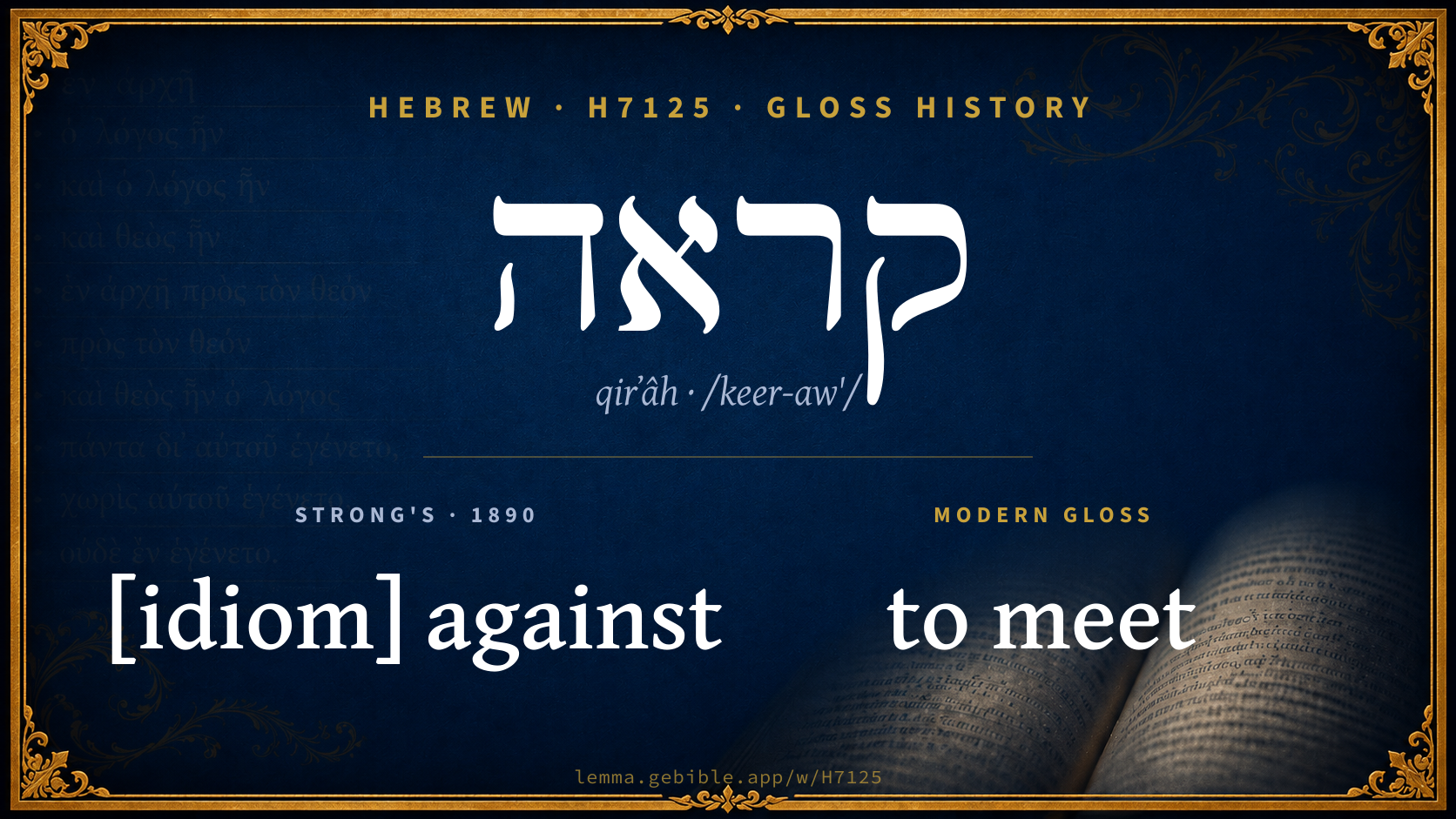
Gloss history
Strong's 1890 vs modern scholarship
About this word
Strong's H7125 catalogs a Hebrew word from the Hebrew Old Testament.
These counts are not copied from any lexicon or concordance. They are computed here, from the morphology-tagged Hebrew Old Testament. What Lemma adds →
- 98
- distinct verses
- The word appears in 98 distinct verses.
- 18 / 39
- OT books
- The word appears in 18 of 39 Old Testament books.
- #425
- by frequency
- Top 500 most frequent Hebrew words (rank 425 of 8,640 Hebrew words by occurrence).
View all 98 occurrences in the concordance →
By section of the Old Testament
By traditional corpus
Conventional, traditional groupings — biblical authorship is debated, so this is a traditional corpus grouping, not an authorship claim. Each share is this word’s portion of its verses in that division of the Hebrew canon. Each figure is a share of the word’s 98 distinct verses.
- Prophets (Nevi'im) 57 verses · 58%
- Torah (Pentateuch) 31 verses · 32%
- Writings (Ketuvim) 10 verses · 10%
How translations render this word
Counts come from each version’s own published word-to-Strong’s tagging or interlinear alignment — an approximate guide to how each version renders this word, not a word-level alignment the data otherwise carries. Because each total is that version’s own tagged count, the per-version totals vary from one another and need not match the appearance or distinct-verse counts above. These counts may also differ from a printed concordance because Lemma counts each distinctly tagged rendering and does not collapse phrase taggings into a single head-word total. This is a fixed set of word-tagged versions (KJV, ASV, BSB, ULT) and does not change with the reading translation you choose elsewhere. Each version’s license is shown beside its name below (and on Sources).
BDB lists this Strong’s number as 2 distinct words (homographs). Each count above pools all of them and is not split by sense — see the Senses section below. A low-frequency rendering may belong to a different one of those words, not the primary meaning.
- King James Version†: Meet 61×, Against 37×, Met 3×
- American Standard Version†: Meet 54×, Against 29×, Against him 2×
- unfoldingWord Literal Text†: Meet 37×, Meet him 21×, Meet them 13×
King James Version Public Domain
Renders H7125 across 121† tagged occurrences — most commonly:
Plus 20 renderings that appear only once — usually multi-word phrases or single function words the recovered tagging swept in, not distinct renderings.
American Standard Version Public Domain
Renders H7125 across 122† tagged occurrences — most commonly:
Plus 29 renderings that appear only once — usually multi-word phrases or single function words the recovered tagging swept in, not distinct renderings.
unfoldingWord Literal Text CC BY-SA 4.0
Renders H7125 across 97† tagged occurrences — most commonly:
Plus 8 renderings that appear only once — usually multi-word phrases or single function words the recovered tagging swept in, not distinct renderings.
45 senses and sub-senses in the full BDB
Hebrew verbs can shift meaning by stem (binyan): Qal is the basic action, Niphal is often passive or reflexive, Piel often intensifies or makes it factitive, and Hiphil is typically causative. The senses below are grouped under the stem BDB assigns to each. This entry also uses Pual (the passive of Piel).
What do BDB’s symbols mean?
BDB uses these scholarly abbreviations:
| Symbol | Meaning |
|---|---|
| 𝔊 | the Septuagint (the ancient Greek translation, LXX) |
| 𝔙 | the Vulgate (the Latin translation) |
| 𝔖 | the Syriac version (the Peshitta) |
| 𝔗 | the Targum (the Aramaic translation) |
| ψ | the Psalms |
| √ | root (the underlying root or stem) |
| ‖ | parallel passage (a synonymous or contrasted parallel) |
| † | the dagger: every passage where the word occurs is cited |
The 45 senses and sub-senses the full Brown-Driver-Briggs lexicon distinguishes for this word, in lexicon order (not ranked by frequency), with BDB’s own verbatim wording and sub-sense lettering. Shown in Hebrew script with BDB’s own scholarly abbreviations. The condensed entry is in the Lexicon Entry tab. See also the Forms in the corpus table below.
קראה I call, proclaim, read (NH id., read aloud, read
Qal
- Pf. ק׳ Gn 11:9 +, 3 fs. consec. וְקָרָאת Is 7:14 (Ges§ 74 g); 2 ms. קָרָאתָ Ju 12:1 +, etc.; Impf. 3 ms. יִקְרָא Gn 2:19 +; sf. יִקְרְאוֹ Je 23:6, -אֵהוּ Is 41:2 +; 1 s. אֶקְרָא Dt 32:3 +, וָאֶקְרָאֶה 1 S 28:15 (Ges§ 48 d NesMarg. 15); 3 fpl. וַתִּקְרֶאנָה Ru 4:17(×2), וַתִּקְרֶאן Nu 25:2; 2 fpl. תִּקְרֶאנָה Ru 1:20, 21, etc.; Imv. ms. קְרָא Ju 7:3 +, sf. קְרָאֵנִי ψ 50:15, etc.; Inf. cstr. קְרֹא 1 S 3:6 +, קְרֹאות (Baer -אֹת) Ju 8:1 (Ges§ 74 h); sf. קָרְאִי ψ 4:2 +, etc.; Pt. act. קוֹרֵא Am 5:8 +, קֹרֵא Je 1:15 +; pl. קֹרִאים ψ 99:6 (Ges§§ 74 i; 75 oo); pass. קָרוּא Est 5:12; pl. קְרוּאִים 1 S 9:22; Ez 23:23, קְרֻאִים 1 S 9:13 +; cstr. קְרוּאֵי Nu 1:16 Qr (Kt קריאי), 26:9 Kt (Qr קְרִיאֵי, v. קָרִיא);— e.g. Genesis 11:9
- 1.
- a. call, cry, utter a loud sound, Ju 9:7; 2 S 18:25 (in v 28 read וַיִּקְרַב We, confirmed by 𝔊L, so Dr and all recent Comm.), Je 4:5 Dn 8:16 (all + אמר), 2 K 7:11 (on text v. Kit Benz), Is 6:4; for help Gn 39:15, 18 (J); of pleading in court Is 59:4 (ב of manner); explicitly בְּקוֹל גָּדוֹל Gn 39:14 (J), 1 K 18:27, 28; 2 K 18:28 = Is 36:13 = 2 Ch 32:18, קוֹל גָּדוֹל Ez 9:1 (+ בְּאָזְנֵי); c. אַחֲרֵי pers. 1 S 20:37 (+ אָמַר), 24:8 (Gi; v 9 van d. H. Baer; + לֵאמֹר), Je 12:6. e.g. Judges 9:7
- b. call, cry, obj. in orat. recta Ju 7:20 1 S 3:4 (read שְׁמוּאֵל שְׁמוּאֵל; 𝔊 Th We Dr Kit Bu HPS), v 6 (cf. 𝔊), v 8 (agst. accents), v 10 (v. שְׁמוּאֵל), 20:38; 2 S 20:16; 2 K 11:14; Je 20:8; Lv 13:45; = utter, speak Je 36:18; of command Gn 45:1 (E). e.g. Judges 7:20
- 2.
- a. call unto some one: אֶל pers. (often + אָמַר; sometimes c. מִן loc.), Gn 3:9; 19:5; Ex 3:4 Is 6:3 + often; c. עַל (for אֶל) of satyrs Is 34:14 (so Vrss Ges CheComm. al. > recent Comm. from ii. קָרָא or קָרָה which (in Qal) always take accus.); unto (אֶל) י׳ (God), in praise †ψ 66:17 1 Ch 4:10, usually for help, Ju 15:18; 1 S 12:17, 18; Ho 7:7 ψ 3:5; 4:4 +, + עַל pers. against Dt 15:9; 24:15; to (ל) י׳ (God) †Jb 12:4 ψ 57:3; 141:1; to (ל) a servant (for service) 2 K 4:36; Jb 19:16, so (ל) 2 S 1:15; call to (ל) one Je 3:4 (+ orat. rect.), La 4:15 (id.), Pr 2:3 (לְבִינָה); subj. י׳ Mi 6:8; Je 35:17. e.g. Genesis 3:9
- b. cry for help, abs., (poet. and late) Zc 7:13; Is 58:9; 65:24; Jb 5:1; 9:16; Pr 21:13 ψ 4:2; 20:10 + 10 times ψψ (147:9 of young ravens); בְּאָזְנֵי Ez 8:18. e.g. Zechariah 7:13
- c. ק׳ בְּשֵׁם י׳ call with name of י׳ (i.e. use it in invocation): Gn 4:26; 12:8; 2 K 5:11; Je 10:25 = ψ 79:6 + 16 times (1 K 18:24 of specif. appeal to י׳ to display his power), + Is 65:1 (v. Pu.); with name of Baal †1 K 18:24, 25, 26. e.g. Genesis 4:26
- d. late, c. acc. dei Is 43:22 ψ 14:4 + 4 times ψψ; abs. ψ 116:2. e.g. Isaiah 43:22
- 3. proclaim:
- a. c. acc. rei procl. Am 4:5; Gn 41:43; Dt 15:2; Je 31:6; Lv 25:10 +; ק׳ צוֹם proclaim a fast 1 K 21:9, 12 Je 36:9 +, ק׳ מוֹעֲדֵי י׳ Lv 23:2, 4; ק׳ sq. orat. rect. Ex 34:6, etc.; sq. ל pers. Je 34:8, 15, 17(×2) Is 61:1, עַל pers. (against, concerning) 1 K 13:4, 32; Je 49:29; La 1:15; proclaim peace to (ל pers.) Ju 21:13; cf. ק׳ אֵלֶיהָ לְשָׁלוֹם Dt 20:10; ק׳ c. acc. cogn. מִקְרָא Is 1:13, הַקְרִיאָה Jon 3:2 (+ אֶל). e.g. Amos 4:5
- b. ק׳ שֵׁם י׳ Dt 32:3 ψ 99:6; so (earlier) ק׳ בְשֵׁם י׳ Ex 33:19; 34:5 (JE); cf. ק׳ בְּשֵׁם יַעֲקֹב Is 44:5 (but read יִקָּרֵא, Lo Che and most). e.g. Deuteronomy 32:3
- c. ק׳ בְּשׁ׳ עֲלֵי ψ 49:12 proclaim (with) name over landed estates, claim possession (Hup Bae); proclaim one’s own name Ru 4:11 = become famous; pt. pass. proclaimed, i.e. renowned Ez 23:23. e.g. Psalms 49:12
- d. abs. make proclamation (sometimes + אָמַר, לֵאמֹר) Ju 7:3; Je 2:2 (בְּאָזְנֵי) Zc 1:14, 17; Jon 3:4; Is 40:3, 6 +, c. עַל concerning Ne 6:7, against 1 K 13:2 Jon 1:2. e.g. Judges 7:3
- 4.
- a. read aloud, often בְּאָזְנֵי, less often לִפְנֵי, c. ב of roll, book Je 36:6, 8, 14; Ne 8:3, 8, 18; 9:3; 2 Ch 34:18, + acc. of words Je 36:8, 10; obj. om. Ex 24:7 (E) Je 36:15; c. acc. of roll, book v 15, 21; 51:63; 2 K 22:10; 2 Ch 34:24, of letter (סֵפֶר), writing 2 K 5:7 Is 29:11, 12; Je 29:29, columns of manuscript Je 36:23; c. acc. of words Jos 8:34, 35; Je 36:6; 51:61; 2 K 23:2 = 2 Ch 34:30, cf. Dt 31:11. e.g. Jeremiah 36:6
- b. read, to oneself, in (ב) a roll, book, Dt 17:19, so of vision written on tablets Hb 2:2; c. acc. of letter (סֵפֶר) 2 K 19:14 = Is 37:14, book 2 K 22:8; abs. Is 34:16. e.g. Deuteronomy 17:19
- c. read, for hear read, 2 K 22:16. e.g. 2 Kings 22:16
- 5. summon: usually
- a. c. ל pers.: Gn 12:18; 20:8, 9; Nu 22:5, 20, 37; Ju 8:1 1 S 3:5, 6, 8(×2) + often (c. 100 times), + ל reflex. 1 K 1:28, 32, + אֶל loc. Ex 19:20, + אֶל pers. 2 S 9:2, + inf. purpose Jos 24:9; Ju 12:1; 14:15; 1 S 28:15, + מִן loc. Ho 11:1 Ju 4:6; + בִּשְׁמֶ֑ךָ Is 45:4 summon by thy name; specif. summon = invite (especially to feast) Ex 34:15 Ju 14:15 (+ inf. purpose) 1 S 16:3 (+ בַּזָּבַ֑ח, read prob. לַזּ׳ v. HPS), v 5 (+ לַזּ׳), 1 K 1:9, 26 + (c. 17 times). e.g. Genesis 12:18
- b. c. אֶל pers. Ex 10:24 Jos 4:4; 10:24 1 K 13:21 + (c. 20 times); אֶל pers. + ל pers. (diff. persons in same relation) Ex 8:21 Je 42:8; = call for (demand to see), c. אֶל pers. 2 K 18:18; c. ל rei = demand, require Pr 18:6 cf. 27:16 (prob. corrupt, v. Toy). e.g. Exodus 10:24
- c. c. acc. pers. Gn 41:8, 14 Ex 2:7 (+ ל pers.), v 7 Am 5:16 (+ אֶל rei), Is 13:3 (ל rei), 1 S 3:16; 22:11 + (c. 33 times), ins. וַיִּקְרָא in this sense also 2 S 15:12 𝔊L We Dr and most; + inf. purpose Nu 24:10, ק׳ מִמִּזְרָח עַיִט Is 46:11; in weakened sense (to bring response, or bring pers. near) Ct 5:6; specif. invite, 1 S 9:24 (but corrupt, v. especially HPS), 1 K 1:9 (also + ל, MT), v 10; 12:20 (+ אֶל loc), Dt 33:19 (acc. loc.); אֲנִי קָרוּא לָהּ Est 5:12, pt. pass. elsewhere pl., invited ones, guests 1 S 9:13, 22 2 S 15:11 1 K 1:41, 49 Zp 1:7 Pr 9:18; invite or summon (acc. pers.) for help, succour, Ho 7:11; usually obj. י׳ (poet. and late) Je 29:12 2 S 22:4, 7 = ψ 18:4, 7 Is 55:6 La 3:57 Jb 27:10 ψ 50:15; 86:5 + 8 times ψψ, acc. שֵׁם י׳ La 3:55; acc. חכמה Pr 1:28. e.g. Genesis 41:8
- d. abs. call, summon Am 7:4 (+ ל rei), Is 22:12 (id.), 1 S 3:5, 6; Zc 7:13; subj. י׳ (God) Is 50:2; 65:12; 66:4; Jb 13:22; 14:15, קְרוּאֵי הָעֵדָה Nu 1:16 Qr (Kt קְרִיאֵי), 26:9 Kt (Qr קְרִיאֵי!). e.g. Amos 7:4
- e. call and commission, appoint, acc. pers., Is 48:15; 49:1, + בְּשֵׁם by name, specifically, Ex 31:2; 35:30 Is 43:1; 45:3. e.g. Isaiah 48:15
- f. call and endow (with privilege) Is 51:2; 54:6; 55:5. e.g. Isaiah 51:2
- 6. call = name:
- a. (eárly and most common usage), call one’s name (שֵׁם) so and so, 2 acc.: of pers. Gn 3:20; 4:25, 26; 5:2, 3, 29 + 34 times Gn, Ex 2:10, 22 Ho 1:4, 6, 9 Is 7:14; 8:3; 9:5 + 10 times (Je 46:17 read קִרְאוּ שֵׁם 𝔊 Gie al.); of places, etc., Gn 4:17; 11:9 + 17 times Gn, Ju 1:17, 26; 2:5; 15:19; 18:29 + 21 times e.g. Genesis 3:20
- b. c. acc. of appellation only, Ez 39:11. e.g. Ezekiel 39:11
- c. acc. pers. vel loc. + acc. appell. Ho 2:18 Dt 3:14 Je 23:6 Is 58:5 Nu 32:41. e.g. Hosea 2:18
- d. acc. pers. + cl. ψ 89:27. e.g. Psalms 89:27
- e. = give name to, acc. appell. + ל pers. (loc., velrei): (1) pers. Ho 2:18; Gn 35:18; 1 S 4:21; Je 3:19; 30:17; 33:16 + 9 times; (2) loc., vel rei, Ju 18:12 2 S 2:16; 5:9; 6:8 Jos 22:34 (name lost, 𝔖 Heb. Codd. ins. עֵד; cf. DiSteuern), Gn 1:5(×2), 8; 2:19(×2) Ex 33:7 + 30 times + Jb 17:14 (ל + sentence incl. name). e.g. Hosea 2:18
- f. c. בְּשֵׁם + ל Is 40:26, cf. 65:11 (שֵׁם אַחֵר), ψ 147:4 (שֵׁמוֹת), Ru 4:17 (שֵׁם + לֵאמֹר), Gn 2:20; 26:18(×2) (all c. שֵׁם). e.g. Isaiah 40:26
- g. c. ל rei + עַל־שֵׁם 2 S 18:18. e.g. 2 Samuel 18:18
- h. call by (ב) names the names (acc.) of cities Nu 32:38; call to (ל) city, + appell., + בִּשְׁמוֹ v 42. e.g. Numbers 32:38
- i. call cities (acc.) בְּשֵׁם, i.e. specify them, Jos 21:9; 1 Ch 6:50 (בְּשֵׁמוֹת). e.g. Joshua 21:9
Niphal
- Pf. 3 ms. נִקְרָא Je 4:20 +, 1 s. נִקְרֵאתִי Est 4:11, etc.; Impf. 3 ms. יִקָּרֵא Gn 2:23 +, וַיִּקָּרֵא Ez 20:29 +, etc.; Pt. נִקְרָא Is 43:7; Je 44:26; pl. נִקְרָאִים Is 48:1 Est 6:1;— e.g. Jeremiah 4:20
- 1. reflex., מֵעִיר הַקֹּדֶשׁ נִק׳ Is 48:2 from the holy city they call themselves. e.g. Isaiah 48:2
- 2. pass. be called:
- a. be proclaimed (cf. Qal 3), of שֵׁם י׳ Je 44:26 (בְּפֶה instr.); of man’s name = be famous Ru 4:14; = be announced Je 4:20. e.g. Jeremiah 44:26
- b. be read aloud (cf. Qal 4): impers. c. ב of book, + בְּאָזְנֵי Ne 13:1; subj. records Est 6:1 (לִפְנֵי). e.g. Nehemiah 13:1
- c. be summoned (cf. Qal 5): Is 31:4 (עַל against); Est 3:12; 4:11(×2); 8:9; †בְּשֵׁם, i.e. specifically, 2:14. e.g. Isaiah 31:4
- d. be named (cf. Qal 6): (1) appell. subj. + ל pers. Gn 2:23 to her shall be called ‘woman,’ 1 S 9:9; Is 32:5; 62:4, 12; Pr 16:21; + ל loc. 2 S 18:18; Is 1:26; 35:8; Je 19:6. (2) וְנִקְרָא שְׁמוֹ וגו׳ Dt 25:10, so Gn 35:10 Dn 10:1; Ez 20:29 (of place); אֶת־שִׁמְךָ Ez 20:29. (3) וְנִקְרְאָה יְרוּשׁ׳ וגו׳ Zc 8:3, so of land Dt 3:13, temple Is 56:7. (4) especially נִקְרָא שֵׁם י׳ עַל, denoting ownership, of pers. Je 15:16, people Dt 28:10; Je 14:9; Am 9:12; Is 63:19; 2 Ch 7:14, ark 2 S 6:2 (del. 2nd שֵׁם 𝔅 We Dr al.), = 1 Ch 13:6 (adding עָלָיו Oettli Kau; > KitHpt שְׁמוֹ שָׁם), temple 1 K 8:43 = 2 Ch 6:33; Je 7:10, 11, 14, 30; 32:34; 34:15, city Je 25:29; Dn 9:18, city + people v 19; so name of man 2 S 12:28, as given to his wife Is 4:1. (5) be called עַל שֵׁם, i.e. reckoned to, Gn 48:6; Is 54:5; 61:6; עַל־שֵׁבֶט 1 Ch 23:14, cf. Ezr 2:61 = Ne 7:63. (6) be called בְּשֵׁם Is 43:7; 48:1. (7) בְּיִצְחָק יִקּ׳ לְךָ זָ֑רַע Gn 21:12, i.e. in (through) יִצ׳ shall seed be reckoned to thee; וְיִקָּרֵא בָהֶם שְׁמִי 48:16 through them shall my name be called, i.e. perpetuated. (8) be named = mentioned, of pers. Is 14:20. (9) subj. שֵׁם Ec 6:10, i.e. thing is known. e.g. Genesis 2:23
Pual
- (Ez and Is 2) Pf. 3 ms. קֹרָא be called, subj. appell. + ל pers. vel rei = be named, Is 48:8 Ez 10:13 (קוֹ׳); וְקֹרָא consec. Is 58:12; 61:3; 62:2 (שֵׁם חָדָשׁ); גּוֹי לֹא קֹרָא בִּשְׁמִי 65:1 (קָרָא or קֹרֵא [Qal 2 c], Vrss Lo Ew Che Di al.); be called and privileged (cf. Qal 5 f), Pt. יִשׂ׳ מְקֹרָאִי 48:12. e.g. Isaiah 48:8
קראה II encounter, befall (‖ form of קָרָה, q.v.
Qal
- Pf.5 3 ms. sf. קְרָאַנִי Je 13:22 Jb 4:2; 3 fs. קָרָאת Dt 31:29; Je 44:23, etc.; Impf.4 3 ms. יִקְרָא Gn 49:1, sf. יִקְרָאֶנּוּ Gn 42:4; 3 fpl. וַתִּקְרֶאנָה Lv 10:19; Ex 1:10 read 3 fs. sf. תִּקְרָאֵנוּ (Sam Vrss Di Ges§ 47 k SoKau Baen); Inf. cstr.121 לִקְרַאת (Ges§ 19 k Ol§ 137), Gn 15:10 +, etc.; Pt. fpl. sf. קֹרְאֹתַיִךְ Is 51:19;— e.g. Jeremiah 13:22
- 1. meet, encounter, only inf. cstr. לִקְרַאת often = prep. toward, against (Köii. 1, 317), almost always c. acc. pers., after vb. of motion, Is 7:3; Gn 19:1; 24:17; Ju 4:18, 22; 1 K 2:8 +; in war, battle, Ju 7:24; 20:25, 31; 1 S 4:1; 1 K 20:27 +, after עָרַךְ 2 S 10:9, 10, 17 +, ψ 35:3 v. I. סגר 2 b; לְחַזֵּק לִבָּם לִק׳ הַמִּלְחָמָה Jos 11:20 to harden their heart to encounter the war with Isr.; after הִנֵּה (without vb. of motion), †1 S 10:10; 2 S 15:32; 16:1; 1 K 18:7; Pr 7:10; in constr. prægn. וַיִּשְׂמַח לִק׳ Ju 19:3 he rejoiced to meet him, + 1 S 6:13 (𝔊 We Dr al.); חרד לִק׳ 1 S 16:4; 21:2; so c. שׁאג Ju 14:5, הריע 15:14, מצא 2 K 10:15, נצב Ex 5:20; 7:15 Nu 22:34, etc.; redund. יִקָּרֶה י׳ לִק׳ Nu 23:3; implic. of helping, Is 21:14 ψ 59:5 (fig.); לִק׳ נְחָשִׁים Nu 24:1 he did not go to encounter (in expectation of) signs of divination; in metaph. Is 14:9, לִק׳ אֱלֹהֶיךָ Am 4:12. e.g. Isaiah 7:3
- 2. fig. befall c. acc. pers., bad sense Gn 42:4, 38; Dt 31:29; Je 13:22; 44:23; Is 51:19; Jb 4:14; Lv 10:19; of war Ex 1:10 (v. supr.); in gen., Gn 49:1. e.g. Genesis 42:4
Niphal
- meet unexpectedly; Pf. 3 ms. נִקְרָא, c. עַל pers. Ex 5:3; Impf. 3 ms. וַיִּקָּרֵא, c. לִפְנֵי pers. 2 S 18:9; Pf. 20:1, c. שָׁם, chanced to be there; Impf. of bird’s nest Dt 22:6 (לִפְנֵי); Inf. abs. נִקְרֹא v. קרה. e.g. Exodus 5:3
Hiphil
- Impf. 2 ms. וַתַּקְרֵא Je 32:23 thou didst cause all this evil to befall them (acc. pers. et rei). e.g. Jeremiah 32:23
Senses from the full Brown-Driver-Briggs lexicon (Brown, Driver, Briggs; Oxford 1906 — public domain), digitized via Sefaria, supplemented by the OpenScriptures HebrewLexicon (CC BY 4.0). Full attribution on Sources.
Word origin
I. vb. call, proclaim, read (NH id., read aloud, read; Ph. קרא call; Arabic قَرَأَ read aloud, recite (the ‘Ḳorʾān’), القُرْآنُ the Ḳorʾān; Aramaic קְרָא, ܩܪܳܐ call, etc., so Old Aramaic קרא, Nab. id., Palm. id., קרה);—
II. vb. encounter, befall (‖ form of קָרָה, q.v.; SI 4 לקרת to meet, opposite; Arabic قَرَأَ, put part to part; Min. קרא set opposite, HomChrest. 127);—
— Brown-Driver-Briggs (Oxford 1906, public domain), digitized via Sefaria, supplemented by the OpenScriptures HebrewLexicon (CC BY 4.0). See Sources.
Derived from קרא (qârâʼ) (H7122) — to meet.
Jastrow Dictionary
A second Hebrew/Aramaic lexicon for comparison, covering Aramaic and post-biblical (Talmudic, Targumic, Midrashic) usage that the biblical-Hebrew BDB does not. Matched by lemma rather than by Strong’s number, so a lemma may carry more than one Jastrow headword (shown separately below), and the entries cover usage well beyond the Bible.
קְרָאָה
- , v. קְרָא II
A Dictionary of the Targumim, the Talmud Babli and Yerushalmi, and the Midrashic Literature (Marcus Jastrow; London, Luzac, 1903) — Public Domain. Digitized via Sefaria. Digitized via Sefaria. Full attribution on Sources.
Forms in the corpus
The 42 distinct written forms H7125 takes in the Hebrew Bible, most frequent first — each parse links to that stem’s occurrences in the concordance. Hebrew forms include their vowel points and cantillation, so a single lemma takes many written forms.
| Form | Parsing | Example | Uses |
|---|---|---|---|
| לִ/קְרַ֣את | Verb, Qal, Infinitive Construct | Exodus 18:7 | 16 |
| לִ/קְרַ֥את | Verb, Qal, Infinitive Construct | Exodus 4:27 | 7 |
| לִ/קְרַ֖את | Verb, Qal, Infinitive Construct | 1 Chronicles 19:11 | 6 |
| לִ/קְרָאת֔/וֹ | Verb, Qal, Infinitive Construct | 2 Kings 2:15 | 5 |
| לִ/קְרָאת/וֹ֙ | Verb, Qal, Infinitive Construct | Genesis 29:13 | 4 |
| לִ/קְרָאת֑/וֹ | Verb, Qal, Infinitive Construct | Exodus 14:27 | 4 |
| לִ/קְרָאתָ֑/ם | Verb, Qal, Infinitive Construct | Exodus 5:20 | 4 |
| לִ/קְרָאתָ֔/ם | Verb, Qal, Infinitive Construct | Genesis 19:1 | 4 |
| לִ/קְרַ֤את | Verb, Qal, Infinitive Construct | 1 Chronicles 19:17 | 3 |
| לִ/קְרַאת | Verb, Qal, Infinitive Construct | Amos 4:12 | 3 |
| לִ/קְרָאת֖/וֹ | Verb, Qal, Infinitive Construct | Exodus 7:15 | 3 |
| לִ/קְרָאתֽ/וֹ | Verb, Qal, Infinitive Construct | Judges 14:5 | 3 |
| לִ/קְרַֽאת | Verb, Qal, Infinitive Construct | Genesis 46:29 | 2 |
| לִ/קְרָאת/וֹ֒ | Verb, Qal, Infinitive Construct | Genesis 14:17 | 2 |
| לִ/קְרָאת֗/וֹ | Verb, Qal, Infinitive Construct | Genesis 30:16 | 2 |
| לִ/קְרָאת֜/וֹ | Verb, Qal, Infinitive Construct | 2 Kings 10:15 | 2 |
| לִ/קְרָאתִ֔/י | Verb, Qal, Infinitive Construct | Judges 11:31 | 2 |
| לִ/קְרָאתֵ֜/נוּ | Verb, Qal, Infinitive Construct | Deuteronomy 2:32 | 2 |
| לִ/קְרָאתֶ֑/ךָ | Verb, Qal, Infinitive Construct | 2 Kings 5:26 | 2 |
| לִ/קְרָאתָ/ם֙ | Verb, Qal, Infinitive Construct | Genesis 18:2 | 2 |
| לִ/קְרַ֛את | Verb, Qal, Infinitive Construct | 1 Kings 21:18 | 1 |
| לִ/קְרַ֨את | Verb, Qal, Infinitive Construct | Joshua 11:20 | 1 |
| לִ/קְרַאתְ/כֶ֑ם | Verb, Qal, Infinitive Construct | 2 Kings 1:7 | 1 |
| לִ/קְרַאתְ/כֶ֔ם | Verb, Qal, Infinitive Construct | Deuteronomy 1:44 | 1 |
| לִ/קְרָֽאתְ/ךָ֔ | Verb, Qal, Infinitive Construct | Genesis 32:6 | 1 |
| לִ/קְרָאתִ/י֙ | Verb, Qal, Infinitive Construct | 1 Kings 2:8 | 1 |
| לִ/קְרָאתִ֖/י | Verb, Qal, Infinitive Construct | Numbers 22:34 | 1 |
| לִ/קְרָאתִ֣/י | Verb, Qal, Infinitive Construct | Psalms 59:4 | 1 |
| לִ/קְרָאתֵ֔/נוּ | Verb, Qal, Infinitive Construct | Genesis 24:65 | 1 |
| לִ/קְרָאתֵ֗/נוּ | Verb, Qal, Infinitive Construct | 2 Kings 1:6 | 1 |
| לִ/קְרָאתֵ֛/נוּ | Verb, Qal, Infinitive Construct | Deuteronomy 29:7 | 1 |
| לִ/קְרָאתֵ֨/נוּ֙ | Verb, Qal, Infinitive Construct | Joshua 8:5 | 1 |
| לִ/קְרָאתֶ֔/ךָ | Verb, Qal, Infinitive Construct | Exodus 4:14 | 1 |
| לִ/קְרָאתֶֽ/ךָ | Verb, Qal, Infinitive Construct | Numbers 20:18 | 1 |
| לִ/קְרָאתָ/הּ֒ | Verb, Qal, Infinitive Construct | 2 Kings 4:26 | 1 |
| לִ/קְרָאתָ֑/הּ | Verb, Qal, Infinitive Construct | Genesis 24:17 | 1 |
| לִ/קְרָאתָ֖/ם | Verb, Qal, Infinitive Construct | 2 Kings 9:17 | 1 |
| לִ/קְרָאתָ֜/הּ | Verb, Qal, Infinitive Construct | 1 Kings 2:19 | 1 |
| לִ/קְרָאתָ֜/ם | Verb, Qal, Infinitive Construct | Numbers 21:33 | 1 |
| לִ/קְרָאתָ֥/ם | Verb, Qal, Infinitive Construct | Judges 20:25 | 1 |
| לִ/קְרָאתָֽ/ם | Verb, Qal, Infinitive Construct | Judges 6:35 | 1 |
| לִ֠/קְרַאת | Verb, Qal, Infinitive Construct | 2 Kings 16:10 | 1 |
Same root — word family
Other BDB entries built from the same root as H7125, grouped by Strong’s listed origin. These share a root / origin per the lexicon — not necessarily a shared meaning. Each links to that word’s own entry.
Derives from
Shares the same root
Compare all same-root words → They share a root, not necessarily a meaning.
Septuagint verse parallels
This word appears in 98 verses that also exist in the Greek Old Testament (Septuagint), out of the 98 Hebrew verses it occurs in. You can read those verses in Greek by switching the Old Testament edition to the Septuagint.
Read these verses in the Septuagint
- Genesis 14:17
- Exodus 4:14
- Numbers 20:18
- Deuteronomy 1:44
- Joshua 8:5
- Judges 4:18
- 2 Samuel 6:20
- 1 Kings 2:8
- 2 Kings 1:3
- 1 Chronicles 19:5
- 2 Chronicles 35:20
- Job 39:21
This is a verse-level parallel only — the same verses exist in both the Hebrew and Greek Old Testaments. No word-level Hebrew↔Greek correspondence is claimed: the data carries no such alignment, so no Greek word is shown as this Hebrew word’s translation. Coverage is not total — the Septuagint omits the deuterocanon and renumbers the Psalms, so some Hebrew verses have no direct Greek parallel.