
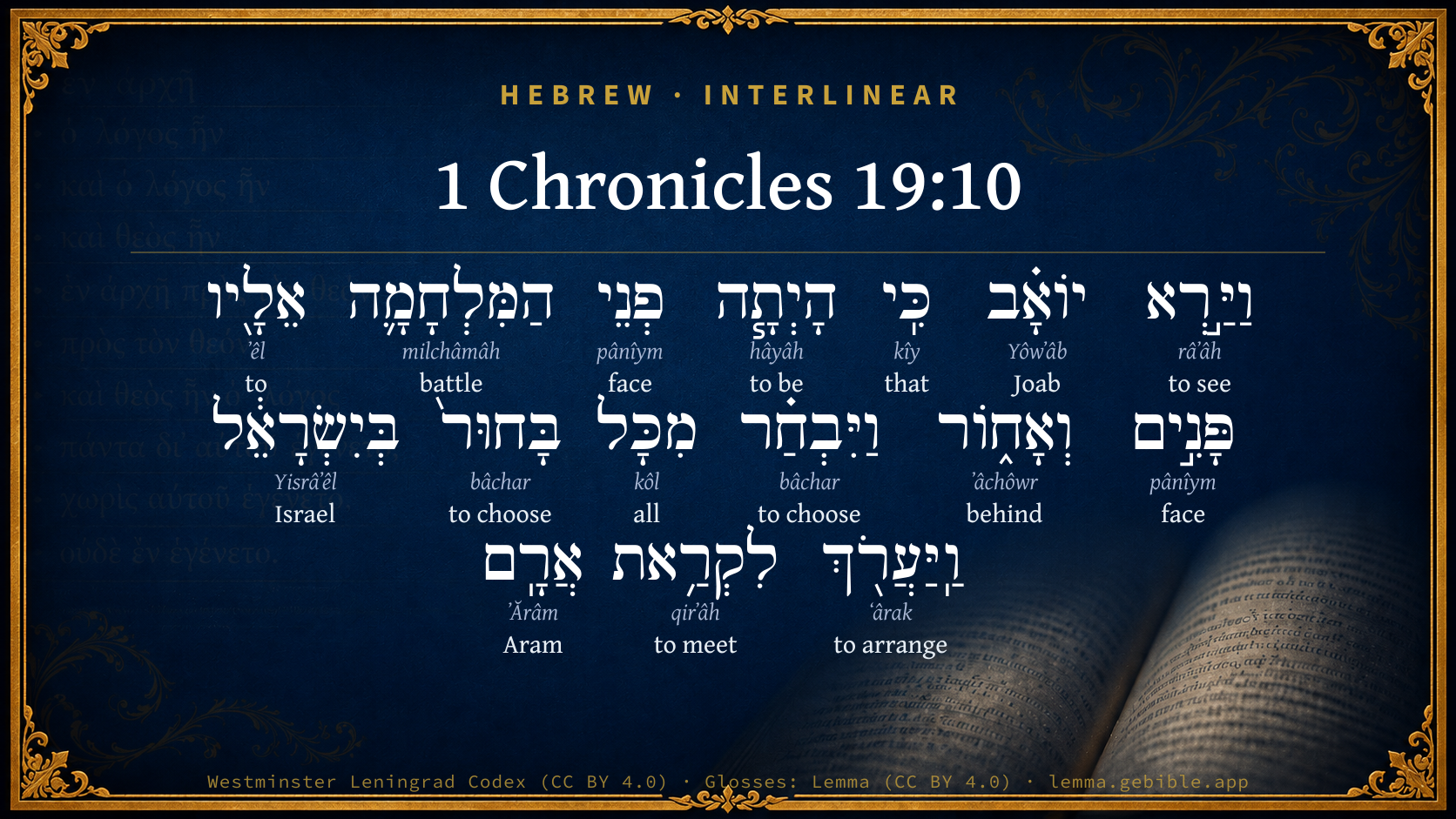
1 Chronicles 19:10

Hebrew (Westminster Leningrad Codex) 1 Chronicles 19:10 appears in the Hebrew Old Testament. The text above is from the Westminster Leningrad Codex. Each word links to its Strong’s number, a concise gloss, and parsing drawn from the Open Scriptures Hebrew Bible morphology. Click any word for its full Brown-Driver-Briggs (BDB) entry.
Download image
Cite this verse

1 Chronicles 19:10 (World English Bible). Public Domain. Lemma interlinear Bible study tool, https://lemma.gebible.app/v/1-chronicles/19/10.

Show BibTeX & RIS
BibTeX
RIS
English Translation
Now when Joab saw that the battle was set against him before and behind, he chose of all the choice men of Israel, and put them in array against the Syrians.
World English Bible · Public Domain
Download a study sheet

One document with this verse’s original text, its word-by-word gloss line, the meaning frame, cross-references with their text, attributed commentary, and full source and license credits — printable, and it pastes into notes with its structure intact.

This verse Autodidact and up

Study sheet (.html) Plain text (.txt)

A passage Seminary Student

Up to 50 verses in one chapter. A passage sheet keeps up to 6 commentary sources and 12 cross-references per verse, in the order this page ranks them, and says so on the sheet whenever that leaves anything out. Ask for a single verse and you get the Autodidact verse sheet above.

Everything on this page stays free to read, with no account — the sheet is a download of what is already on screen, not access to it.

Want to remove ads? Support Godless Engineer
Compare translations 3

The same verse in 3 English versions, stacked beneath the original-language interlinear above. Click any original word for its lexicon entry.

Each is an independent rendering of the whole verse — the interlinear is not word-aligned to these translations.

Highlighted words mark where these versions differ — a whole-verse word diff, not a word-by-word alignment.

  • World English Bible Public Domain
    Now when Joab saw that the battle was set against him before and behind, he chose of all the choice men of Israel, and put them in array against the Syrians.
  • King James Version Public Domain
    Now when Joab saw that the battle was set against him before and behind, he chose out of all the choice of Israel, and put them in array against the Syrians.
  • unfoldingWord Literal Text CC BY-SA 4.0
    And Joab saw that the faces of the battle were against him before and behind, and he chose from all of the chosen of Israel, and he arrayed to meet Aram.

unfoldingWord Literal Text — © unfoldingWord, licensed CC BY-SA 4.0. Word-aligned USFM3 via Door43 (git.door43.org/unfoldingWord/en_ult).

Versions to compare (up to 4)

3 of 4 selected

Show all 18 translations

Every available English version of this verse, each an independent rendering of the whole verse.

  • World English Bible Public Domain
    Now when Joab saw that the battle was set against him before and behind, he chose of all the choice men of Israel, and put them in array against the Syrians.
  • Berean Standard Bible Public Domain
    When Joab saw the battle lines before him and behind him, he selected some of the best men of Israel and arrayed them against the Arameans.
  • Majority Standard Bible Public Domain
    When Joab saw the battle lines before him and behind him, he selected some of the best men of Israel and arrayed them against the Arameans.
  • King James Version Public Domain
    Now when Joab saw that the battle was set against him before and behind, he chose out of all the choice of Israel, and put them in array against the Syrians.
  • American Standard Version (1901) Public Domain
    Now when Joab saw that the battle was set against him before and behind, he chose of all the choice men of Israel, and put them in array against the Syrians.
  • Revised Version (1885) Public Domain
    Now when Joab saw that the battle was set against him before and behind, he chose of all the choice men of Israel, and put them in array against the Syrians.
  • Geneva Bible (1599) Public Domain
    When Ioab saw that the front of the battel was against him before and behinde, then he chose out of all the choyse of Israel, and set him selfe in aray to meete the Aramites.
  • Douay-Rheims (1899) Public Domain
    Wherefore Joab understanding that the battle was set against him before and behind, chose out the bravest men of all Israel, and marched against the Syrians,
  • Young's Literal Translation Public Domain
    And Joab seeth that the front of the battle hath been unto him, before and behind, and he chooseth out of all the choice in Israel, and setteth in array to meet Aram,
  • Literal Standard Version CC BY-SA 4.0
    And Joab sees that the front of the battle has been to him, before and behind, and he chooses out of all the choice in Israel, and sets in array to meet Aram,
  • Unlocked Literal Bible CC BY-SA 4.0
    When Joab saw the battle lines facing him both in front and behind, he chose some of Israel's best fighters and arranged them against the Arameans.
  • unfoldingWord Literal Text CC BY-SA 4.0
    And Joab saw that the faces of the battle were against him before and behind, and he chose from all of the chosen of Israel, and he arrayed to meet Aram.
  • Darby Bible Public Domain
    And Joab saw that the front of the battle was against him before and behind; and he chose out of all the choice men of Israel, and put them in array against the Syrians;
  • World Messianic Bible Public Domain
    Now when Joab saw that the battle was set against him before and behind, he chose some of all the choice men of Israel, and put them in array against the Syrians.
  • Webster's Bible Public Domain
    Now when Joab saw that the battle was set against him before and behind, he selected all the choice of Israel, and put them in array against the Syrians.
  • Free Bible Version CC BY-SA 4.0
    Joab realized he would have to fight both in front of him and behind him, he chose some of Israel's best troops and he took charge of them to lead the attack the Arameans.
  • Bible in Basic English Public Domain
    Now when Joab saw that their forces were in position against him in front and at his back, he took all the best men of Israel, and put them in line against the Aramaeans;
  • JPS Tanakh (1917) Public Domain
    Now when Joab saw that the battle was set against him before and behind, he chose of all the choice men of Israel, and put them in array against the Arameans.

Literal Standard Version (2020), Covenant Press — licensed CC BY-SA 4.0. Text via the HelloAO Bible API (eBible.org). Unlocked Literal Bible (unfoldingWord) — licensed CC BY-SA 4.0. Text via the HelloAO Bible API (eBible.org). unfoldingWord Literal Text — © unfoldingWord, licensed CC BY-SA 4.0. Word-aligned USFM3 via Door43 (git.door43.org/unfoldingWord/en_ult). Free Bible Version, Dr. Jonathan Gallagher — licensed CC BY-SA 4.0. Text via the HelloAO Bible API (eBible.org).

Word by word

More ways to search: Search by grammar → Find every occurrence → Compare this word →

Practice this passage: Drill this verse → Learn its vocabulary →

וְאָח֑וֹר
ʼâchôwr
H268
“and · behind”
Conjunction + Noun, Common, Masculine, Singular, Absolute
Part of Speech
Conjunction + Noun
Type
Common
Gender
Masculine
Number
Singular
State
Absolute
Full BDB Definition

Origin: from H299

TWOT: 68d

the back side, the rear - backwards - hereafter (of time) - behind
  1. וַיַּ֣רְא râʼâh H7200 “and · to see” Conjunction + Verb, Qal, Sequential Imperfect, 3rd Person, Masculine, Singular
  2. יוֹאָ֗ב Yôwʼâb H3097 “Joab” Noun, Proper
  3. כִּֽי kîy H3588 “that” Conjunction
  4. הָיְתָ֧ה hâyâh H1961 “to be” Verb, Qal, Perfect, 3rd Person, Feminine, Singular
  5. פְנֵי pânîym H6440 “face(s) of” Noun, Common, Both, Plural, Construct
  6. הַמִּלְחָמָ֛ה milchâmâh H4421 “the · battle” Particle, Definite Article + Noun, Common, Feminine, Singular, Absolute
  7. אֵלָ֖יו ʼêl H413 “to · him” Preposition + Suffix, Personal, 3rd Person, Masculine, Singular
  8. פָּנִ֣ים pânîym H6440 “face(s)” Noun, Common, Both, Plural, Absolute
  9. וַיִּבְחַ֗ר bâchar H977 “and · to choose” Conjunction + Verb, Qal, Sequential Imperfect, 3rd Person, Masculine, Singular
  10. מִכָּל kôl H3605 “from · all of” Preposition + Noun, Common, Masculine, Singular, Construct
  11. בָּחוּר֙ bâchar H977 “chosen” Verb, Qal, Participle Passive, Masculine, Singular, Absolute
  12. בְּיִשְׂרָאֵ֔ל Yisrâʼêl H3478 “in/at · Israel” Preposition + Noun, Proper
  13. וַֽיַּעֲרֹ֖ךְ ʻârak H6186 “and · to arrange” Conjunction + Verb, Qal, Sequential Imperfect, 3rd Person, Masculine, Singular
  14. לִקְרַ֥את qirʼâh H7125 “to meet” Preposition + Verb, Qal, Infinitive Construct
  15. אֲרָֽם ʼĂrâm H758 “Aram” Noun, Proper

About this verse

These counts appear in no published source. They are computed here, from the morphology-tagged text and Lemma’s own curated glosses. What Lemma adds →

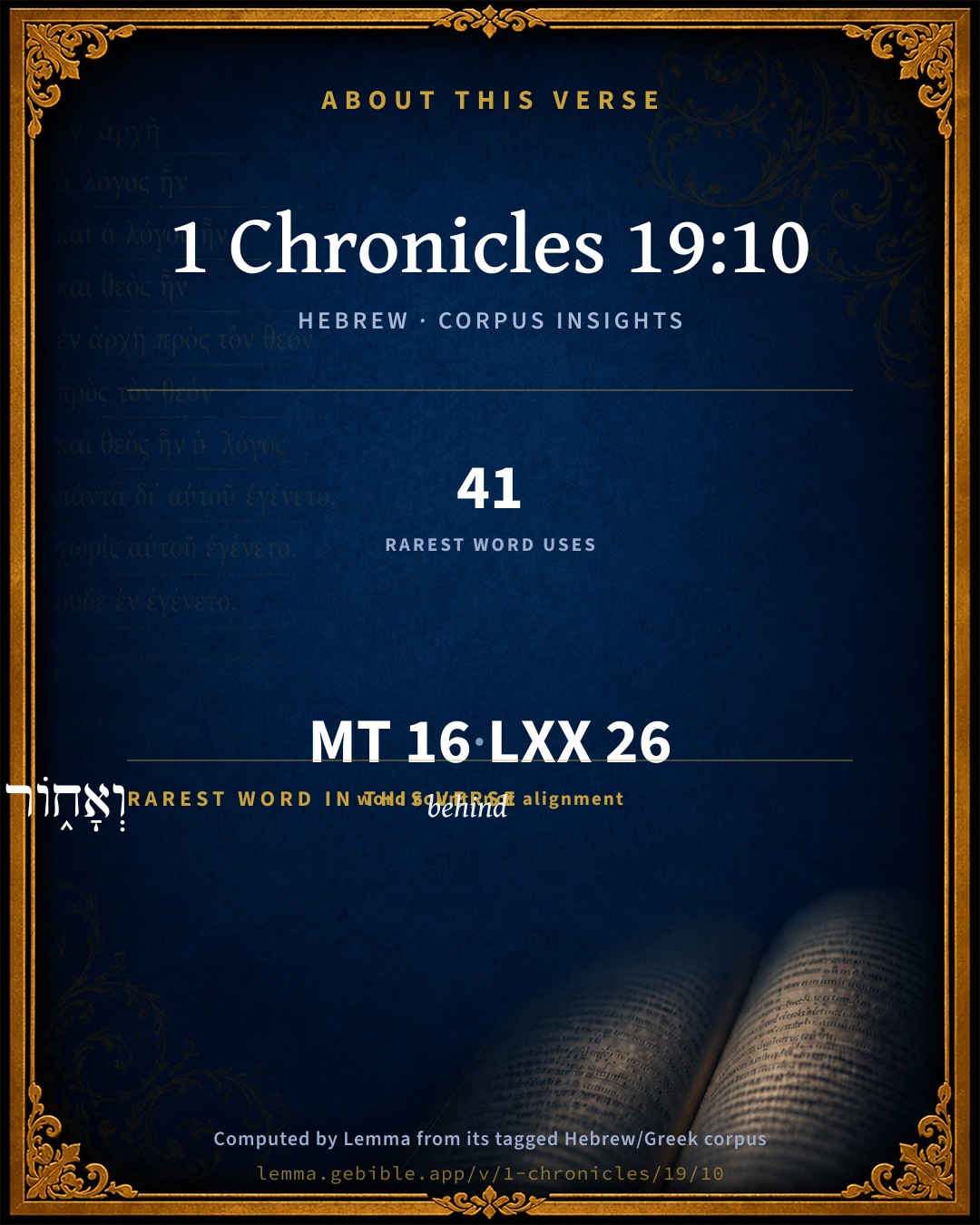
16
words
14
distinct lemmas
Historical
section

Shared distinctive vocabulary

וְאָח֑וֹר behind H268 occurs in 41 verses of the Hebrew Bible. Also found in:

Grammatical profile

  • 6 verbs
  • 8 nouns
  • 1 preposition
  • 1 conjunction

Verb forms

  • וַיַּ֣רְא Qal · Sequential Imperfect
  • הָיְתָ֧ה Qal · Perfect
  • וַיִּבְחַ֗ר Qal · Sequential Imperfect
  • בָּחוּר֙ Qal · Participle Passive
  • וַֽיַּעֲרֹ֖ךְ Qal · Sequential Imperfect
  • לִקְרַ֥את Qal · Infinitive Construct

Repetition

Words recur within this verse — often emphatic in Hebrew:

  • פְנֵי face H6440 ×2
  • וַיִּבְחַ֗ר to choose H977 ×2

Hebrew & Septuagint length

In English translation the verse runs 31 words from the Hebrew and 36 from the Septuagint (LXX English) — closely comparable.

A rough comparison of the two English renderings, which tokenize alike — not a word-level alignment.

Word counts can differ between the Hebrew and the Greek without any difference in meaning — e.g. the Hebrew direct-object marker אֵת has no separate Greek word, and Greek often adds the article ὁ.

In the original languages it is 16 Hebrew tokens and 26 Greek tokens — but the two are counted differently (Hebrew bundles its prefixes and suffixes into one token; the Greek is in lemma form), so that isn’t a like-for-like length.

Cross-references

3

Topical passages linked to 1 Chronicles 19:10 in the Treasury of Scripture Knowledge — connected by theme and wording, ordered by reader-vote popularity; previews shown in the World English Bible.

  • Joshua 8:22 The others came forth out of the city against them; so they were in the midst of Israel, some on this side, and some on that side: and they struck them, so that they let none of them remain or escape.
  • Judges 20:42–43 Therefore they turned their backs before the men of Israel to the way of the wilderness; but the battle followed hard after them; and those who came out of the cities destroyed them in the midst of it.
  • 2 Samuel 10:9–14 Now when Joab saw that the battle was set against him before and behind, he chose of all the choice men of Israel, and put them in array against the Syrians:

Cross-references courtesy of OpenBible.info (CC BY 4.0).

Hebrew and Greek witnesses Masoretic Hebrew ↔ Greek Septuagint

The same verse in the two great witnesses to the Old Testament, shown verse-for-verse.

These are two independent witnesses, not word-aligned to each other, and the Septuagint is shown in lemma (dictionary) form.

Hebrew 1 Chronicles 19:10 Masoretic · Westminster Leningrad Codex

וַיַּ֣רְא יוֹאָ֗ב כִּֽי הָיְתָ֧ה פְנֵי הַמִּלְחָמָ֛ה אֵלָ֖יו פָּנִ֣ים וְאָח֑וֹר וַיִּבְחַ֗ר מִכָּל בָּחוּר֙ בְּיִשְׂרָאֵ֔ל וַֽיַּעֲרֹ֖ךְ לִקְרַ֥את אֲרָֽם

Now when Joab saw that the battle was set against him before and behind, he chose of all the choice men of Israel, and put them in array against the Syrians.

World English Bible · Public Domain

Greek LXX 1 Chronicles 19:10 Septuagint · lemma form

καί ὁράω ιωαβ ὅτι γίγνομαι ἀντιπρόσωπος ὁ πολεμέω πρός αὐτός κατά πρόσωπον καί ἐξόπισθεν καί ἐκλέγω ἐκ πᾶς νεανίας ἐκ ἰσραήλ καί παρατάσσω ἐναντίον ὁ σύρος

And Joab saw that they were fronting him to fight against him before and behind, and he chose some out of all the young men of Israel, and they set themselves in array against the Syrian.

LXX2012 (modern English Septuagint) · Public Domain

Hebrew: Westminster Leningrad Codex (CC BY 4.0). Greek: Septuagint (public domain); English from LXX2012 (modern English Septuagint) (Public Domain). How the Septuagint differs from the Hebrew →

Commentary

Notes on 1 Chronicles 19:10 from classic Christian and Jewish commentators (each source and its license shown beneath its notes). The classic Christian expositions comment on the surrounding passage and are grouped to its opening verse, so a note may address several verses; the Jewish commentaries on the Tanakh (Rashi and others) are per-verse, so they appear only where the commentator wrote on this verse.

Lemma curates 59 commentaries, every one of them public domain or Creative Commons licensed, each selected and text-cleaned for this edition rather than reprinted as found. About our sources →

Ellicott's Commentary for English Readers

(10) The battle was set against him before and behind.—Literally, the front of the battle had become towards him, front and rear. The order of words is different in Samuel, and a preposition added (“on front and on rear”). The Ammonites lay in front of the city, their Aramæan allies at some distance away, in the plain. For Joab to attack either with his entire army would have been to expose his rear to the assault of the other. He therefore divided his forces.

The choice of Israel.—Literally, the chosen or young warriors (singular collective) in Israel (i.e., in the Israelitish army). These Joab himself led against the Aramæans, as the most dangerous enemy, while he sent a detachment, under his brother Abishai, to cope with the Ammonites.

Put them in array.—Rather, set the battle in array, or drew up against . . . (1Ch_19:17; 1Ch_12:33). The same Hebrew phrase recurs in 1Ch_19:11.

A Bible Commentary for English Readers, edited by Charles John Ellicott (1878–1897) — public domain. Text from a community e-Sword module.

The Cambridge Bible for Schools and Colleges

gen. ed. J. J. S. Perowne

10. he chose out of all the choice] R.V. he chose of all the choice men. The Syrians were the more formidable because of the chariots they had; Joab therefore opposed to them the flower of his army.

The Cambridge Bible for Schools and Colleges (gen. ed. J. J. S. Perowne; Cambridge University Press, 1878–1918) — public domain. Text from a community e-Sword module.

The Pulpit Commentary

The meaning in brief of this Terse is that, as Joab found there were practically two enemies, and two armies to face, he avoided the mistake of being shut up between them more than necessary, and divided his own hosts. He took the flower of all, under his own command, to face the Syrians in the field, who were the most formidable of the enemy. The rest he put under his brother Abishai, to face the Ammonites at the gate, i.e. of the city Medeba. The plan succeeded, for if Abishai had only done as much as hold back the Ammonites awhile, so soon as they saw the Syrians break and flee they knew that Joab and his army would be free to "help" Abishai.

Vers. 10-14.

The conditions of success in the battle of life.

When the time shall come that "devout men carry us to our burial," when good men will be forming an estimate of the life we have lived on the earth, will they be able to say of us that we were victors in the strife, or will they have sorrowfully to acknowledge that we were beaten in the battle of life? That will depend on how we are conducting ourselves now. There are three conditions of success.

I FIGHTING ON THE RIGHT SIDE. "Let the Lord do that which is good in his sight," said Joab. Whether we shall win or not depends on whether or not we have God upon our side. If he be for us, who or what can be successful against us? (Rom_8:31; Psa_118:6) And he will be with us if we are on the side of truth, righteousness, freedom, love.

II HAVING A GOOD HEART FOR THE BATTLE. (Ver. 13.) Joab sought to infuse heart into the soldiers he was leading. "Be of good courage, and let us behave ourselves valiantly." He appealed to their patriotism ("for our people") and to their piety ("for the cities of our God"). He could not have touched two more responsive chords than these. We must summon one another, and call upon ourselves to be courageous in the strife before us, mindful of the many reasons we have to do valiantly and well.

(1) The presence and the promised help of God;

(2) the approval of our own conscience, the enjoyment of self-respect;

(3) the crown of joy we shall win if we are able to save souls from death, or lead many along the path of life;

(4) the urgent want of a sin-stricken world that every brave and true man should do his best. The world sorely needs all the witness we can bear, all the help we can bring.

III MAKING A WISE DISPOSITION OF OUR FORCES. Joab owed his victory in part to sagacious generalship. He selected the best soldiers of his army to encounter the strongest troops of the enemy, the Syrians (ver. 10), hoping to be able to repel the less formidable Ammonites by the less soldierly of his own forces (ver. 11). Moreover, he took care to have a reserve in case of need, by arranging that whoever should be first victorious, whether his brother or himself, instead of continuing the pursuit of the flying enemy, should come at once to strengthen the hands of the still-struggling division (ver. 12). This was a most wise arrangement. Many a battle has been decided by the presence or absence of a reserve force. At Naseby the battle was lost to the king because the royalist leader pursued too far, and was gained for the Parliament because its leader returned in time from following the retreating enemy to fall on the rear of the wing which was still engaged. In the battle of life, the event may turn on a wise disposition of our forces. We are so to expend our physical powers and our mental resources that we shall direct our strength to the most difficult tasks, leaving the less serious ones to our weakness, and that we shall always have something in reserve for the critical hour. Especially should we see to it that we have friends to fall back upon in the trying ordeal. "Woe unto him that is alone when he falleth!" happy he who, when he is hard pressed, has the voice and grasp of friendship to sustain him! By

(1) excellency and admirableness of character, by

(2) beauty and attractiveness of spirit, by

(3) generosity of heart and hand, let us secure the sympathy and the support of friends in the hour when victory or defeat is trembling in the balances. C.

The Pulpit Commentary (1880–1919), ed. H.D.M. Spence-Jones & Joseph S. Exell — public domain. Text from a community e-Sword module.

unfoldingWord translationNotes

Door43 World Missions Community

the battle lines ... put them into battle lines

"the enemy soldiers lined up for battle ... arranged his soldiers in lines for battle"

Abishai

This is the name of Joab's brother. (See: How to Translate Names)

translationWords

Israel

Aram

command

Ammon

unfoldingWord translationNotes — © Distant Shores Media and the Door43 World Missions Community, licensed CC BY-SA 4.0. Source: git.door43.org/Door43/en_tn.

Lesson kit

Teaching starters — assembled from the data on this page, not authored interpretation. Every prompt links to the verse data it draws on. Edit before teaching.

1 Chronicles, in the Historical, opens this verse with 16 words (14 distinct Hebrew lemmas). Its most distinctive word is ʼâchôwr (“behind”). A historical commentator’s framing appears above. Read the whole chapter for the surrounding context.

Discussion questions

  1. What does “behind” (ʼâchôwr) contribute to the verse as a whole?
  2. Genesis 49:17 shares the word «behind» with this verse. How do the two illuminate each other?
  3. “face” occurs 2× in this one verse. What is the effect of the repetition?
  4. The translations on this page render this verse differently — a whole-verse word diff, not a word-by-word alignment. What might account for the different wordings?
  5. The verb «וַיַּ֣רְא» is Qal Sequential Imperfect. How does its form color the action?
  6. Reading how Ellicott's Commentary for English Readers and The Cambridge Bible for Schools and Colleges read this verse, where do the two commentators agree and where do they part?

Things to notice

Reading settings

Reading text

Shown beneath each verse's original-language words.

Old Testament
Old Testament edition

Read the OT as the Masoretic Hebrew (MT) or the Greek Septuagint (LXX).

English shown for the Greek Septuagint (in the Hebrew ↔ Greek comparison).

Comparing translations? Open the Compare panel on any verse page to stack up to four side by side.