
Joshua 8:14

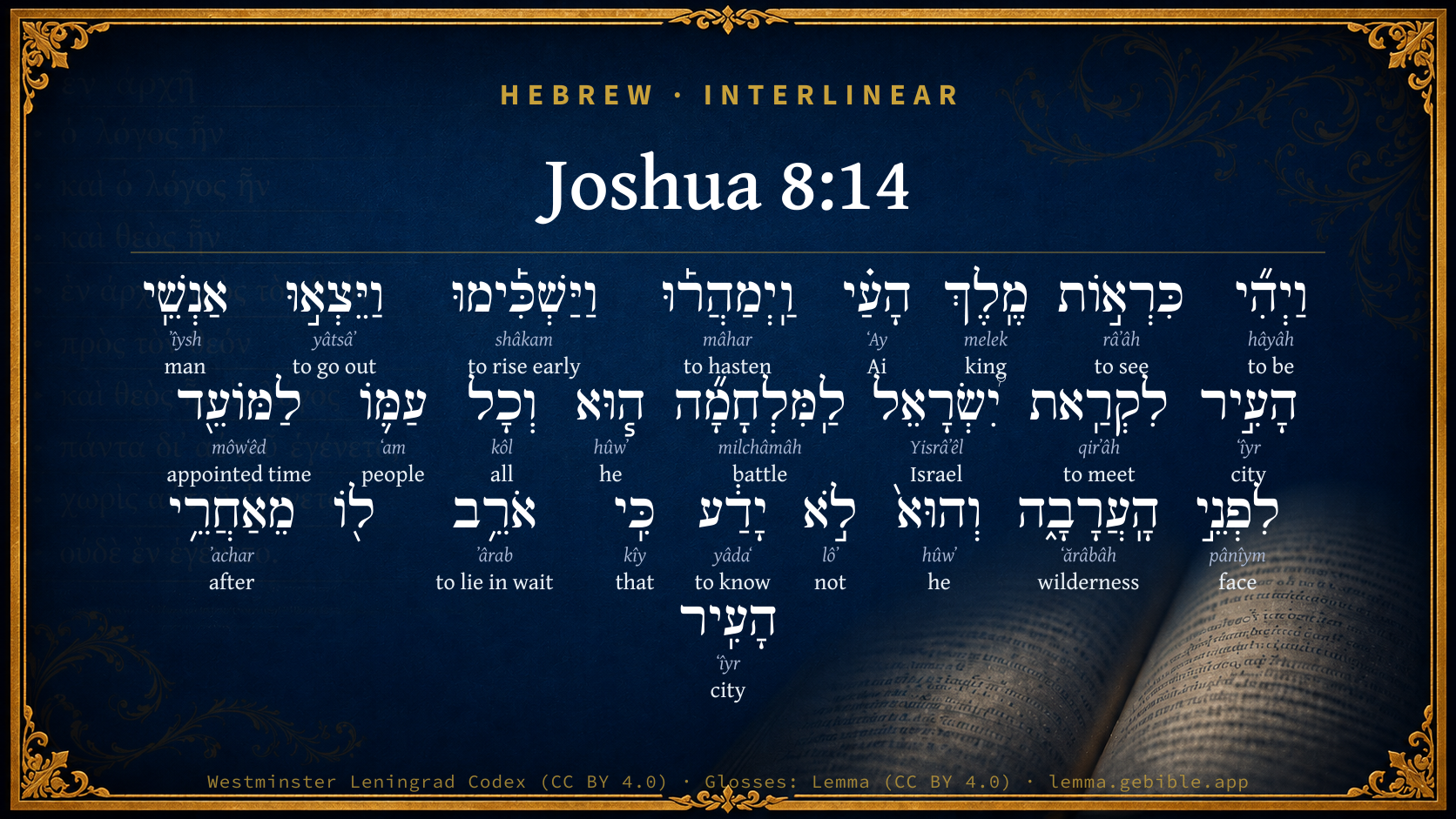
Hebrew (Westminster Leningrad Codex) Joshua 8:14 appears in the Hebrew Old Testament. The text above is from the Westminster Leningrad Codex. Each word links to its Strong’s number, a concise gloss, and parsing drawn from the Open Scriptures Hebrew Bible morphology. Click any word for its full Brown-Driver-Briggs (BDB) entry.
Download image
Cite this verse

Joshua 8:14 (World English Bible). Public Domain. Lemma interlinear Bible study tool, https://lemma.gebible.app/v/joshua/8/14.

Show BibTeX & RIS
BibTeX
RIS
English Translation
It happened, when the king of Ai saw it, that they hurried and rose up early, and the men of the city went out against Israel to battle, he and all his people, at the time appointed, before the Arabah; but he didn't know that there was an ambush against him behind the city.
World English Bible · Public Domain
Download a study sheet

One document with this verse’s original text, its word-by-word gloss line, the meaning frame, cross-references with their text, attributed commentary, and full source and license credits — printable, and it pastes into notes with its structure intact.

This verse Autodidact and up

Study sheet (.html) Plain text (.txt)

A passage Seminary Student

Up to 50 verses in one chapter. A passage sheet keeps up to 6 commentary sources and 12 cross-references per verse, in the order this page ranks them, and says so on the sheet whenever that leaves anything out. Ask for a single verse and you get the Autodidact verse sheet above.

Everything on this page stays free to read, with no account — the sheet is a download of what is already on screen, not access to it.

Want to remove ads? Support Godless Engineer
Compare translations 3

The same verse in 3 English versions, stacked beneath the original-language interlinear above. Click any original word for its lexicon entry.

Each is an independent rendering of the whole verse — the interlinear is not word-aligned to these translations.

Highlighted words mark where these versions differ — a whole-verse word diff, not a word-by-word alignment.

  • World English Bible Public Domain
    It happened, when the king of Ai saw it, that they hurried and rose up early, and the men of the city went out against Israel to battle, he and all his people, at the time appointed, before the Arabah; but he didn't know that there was an ambush against him behind the city.
  • King James Version Public Domain
    And it came to pass, when the king of Ai saw it, that they hasted and rose up early, and the men of the city went out against Israel to battle, he and all his people, at a time appointed, before the plain; but he wist not that there were liers in ambush against him behind the city.
  • unfoldingWord Literal Text CC BY-SA 4.0
    And it happened, as soon as the king of Ai saw, that the men of the city hurried and got up early and went out to meet Israel for battle, he and all his people, at an appointed place to the face of the Arabah. Now he did not know that an ambush against him from behind the city.

unfoldingWord Literal Text — © unfoldingWord, licensed CC BY-SA 4.0. Word-aligned USFM3 via Door43 (git.door43.org/unfoldingWord/en_ult).

Versions to compare (up to 4)

3 of 4 selected

Show all 18 translations

Every available English version of this verse, each an independent rendering of the whole verse.

  • World English Bible Public Domain
    It happened, when the king of Ai saw it, that they hurried and rose up early, and the men of the city went out against Israel to battle, he and all his people, at the time appointed, before the Arabah; but he didn't know that there was an ambush against him behind the city.
  • Berean Standard Bible Public Domain
    When the king of Ai saw the Israelites, he hurried out early in the morning with the men of the city to engage them in battle at an appointed place overlooking the Arabah. But he did not know that an ambush had been set up against him behind the city.
  • Majority Standard Bible Public Domain
    When the king of Ai saw the Israelites, he hurried out early in the morning with the men of the city to engage them in battle at an appointed place overlooking the Arabah. But he did not know that an ambush had been set up against him behind the city.
  • King James Version Public Domain
    And it came to pass, when the king of Ai saw it, that they hasted and rose up early, and the men of the city went out against Israel to battle, he and all his people, at a time appointed, before the plain; but he wist not that there were liers in ambush against him behind the city.
  • American Standard Version (1901) Public Domain
    And it came to pass, when the king of Ai saw it, that they hasted and rose up early, and the men of the city went out against Israel to battle, he and all his people, at the time appointed, before the Arabah; but he knew not that there was an ambush against him behind the city.
  • Revised Version (1885) Public Domain
    And it came to pass, when the king of Ai saw it, that they hasted and rose up early, and the men of the city went out against Israel to battle, he and all his people, at the time appointed, before the Arabah; but he wist not that there was an ambush against him behind the city.
  • Geneva Bible (1599) Public Domain
    And when the King of Ai sawe it, then the men of the citie hasted and rose vp earely, and went out against Israel to battell, hee and all his people at the time appointed, before the plaine: for he knew not that any lay in waite against him on the backeside of the citie.
  • Douay-Rheims (1899) Public Domain
    And when the king of Hai saw this, he made haste in the morning, and went out with all the army of the city, and set it in battle array toward the desert, not knowing that there lay an ambush behind his back.
  • Young's Literal Translation Public Domain
    And it cometh to pass, when the king of Ai seeth `it', that hasten, and rise early, and go out do the men of the city to meet Israel for battle, he and all his people, at the appointed season, at the front of the plain, and he hath not known that an ambush `is' against him, on the rear of the city.
  • Literal Standard Version CC BY-SA 4.0
    And it comes to pass, when the king of Ai sees [it], that he hurries, and rises early, and the men of the city go out to meet Israel for battle, he and all his people, at the appointed time, at the front of the plain, and he has not known that an ambush [is] against him, on the rear of the city.
  • Unlocked Literal Bible CC BY-SA 4.0
    It came about when the king of Ai saw it, he and his army got up early and rushed out to attack Israel at a certain place that was overlooking the Jordan River valley. He did not know that an ambush was waiting to attack from behind the city.
  • unfoldingWord Literal Text CC BY-SA 4.0
    And it happened, as soon as the king of Ai saw, that the men of the city hurried and got up early and went out to meet Israel for battle, he and all his people, at an appointed place to the face of the Arabah. Now he did not know that an ambush against him from behind the city.
  • Darby Bible Public Domain
    And it came to pass when the king of Ai saw it, that the men of the city hasted and rose early, and went out against Israel to battle, he and all his people, at the appointed place before the plain. But he knew not that there was an ambush against him behind the city.
  • World Messianic Bible Public Domain
    When the king of Ai saw it, they hurried and rose up early, and the men of the city went out against Israel to battle, he and all his people, at the time appointed, before the Arabah; but he didn’t know that there was an ambush against him behind the city.
  • Webster's Bible Public Domain
    And it came to pass when the king of Ai saw it, that they hasted and rose early, and the men of the city went out against Israel to battle, he and all his people, at a time appointed, before the plain: but he knew not that there were liers in ambush against him behind the city.
  • Free Bible Version CC BY-SA 4.0
    As soon as the king of Ai saw the situation, he and all his men rushed out early in the morning to attack the Israelites where they had before, at a place overlooking the Jordan valley. He didn't know about the ambush waiting on the other side of the town.
  • Bible in Basic English Public Domain
    Now when the king of Ai saw it, he got up quickly and went out to war against Israel, he and all his people, to the slope going down to the valley; but he had no idea that a secret force was waiting at the back of the town.
  • JPS Tanakh (1917) Public Domain
    And it came to pass, when the king of Ai saw it, that the men of the city hastened and rose up early and went out against Israel to battle, he and all his people, at the time appointed, in front of the Arabah; but he knew not that there was an ambush against him behind the city.

Literal Standard Version (2020), Covenant Press — licensed CC BY-SA 4.0. Text via the HelloAO Bible API (eBible.org). Unlocked Literal Bible (unfoldingWord) — licensed CC BY-SA 4.0. Text via the HelloAO Bible API (eBible.org). unfoldingWord Literal Text — © unfoldingWord, licensed CC BY-SA 4.0. Word-aligned USFM3 via Door43 (git.door43.org/unfoldingWord/en_ult). Free Bible Version, Dr. Jonathan Gallagher — licensed CC BY-SA 4.0. Text via the HelloAO Bible API (eBible.org).

Word by word

More ways to search: Search by grammar → Find every occurrence → Compare this word →

Practice this passage: Drill this verse → Learn its vocabulary →

הָעַ֗י
ʻAy
H5857
“the · Ai”
Particle, Definite Article + Noun, Proper
Part of Speech
Particle + Noun
Type
Proper
Full BDB Definition

Origin: for H5856

TWOT: None

Ai or Aija or Aiath or Hai = "heap of ruins" - a city lying east of Bethel and beside Bethaven near Jericho and the 2nd city taken on the invasion of Canaan - a city of the Ammonites on the east of the Jordan and apparently attached to Heshbon
  1. וַיְהִ֞י hâyâh H1961 “and · to be” Conjunction + Verb, Qal, Sequential Imperfect, 3rd Person, Masculine, Singular
  2. כִּרְא֣וֹת râʼâh H7200 “like/as · to see” Preposition + Verb, Qal, Infinitive Construct
  3. מֶֽלֶךְ melek H4428 “king of” Noun, Common, Masculine, Singular, Construct
  4. וַֽיְמַהֲר֡וּ mâhar H4116 “and · to hasten” Conjunction + Verb, Piel, Sequential Imperfect, 3rd Person, Masculine, Plural
  5. וַיַּשְׁכִּ֡ימוּ shâkam H7925 “and · to rise early” Conjunction + Verb, Hiphil, Sequential Imperfect, 3rd Person, Masculine, Plural
  6. וַיֵּצְא֣וּ yâtsâʼ H3318 “and · to go out” Conjunction + Verb, Qal, Sequential Imperfect, 3rd Person, Masculine, Plural
  7. אַנְשֵֽׁי ʼîysh H376 “men of” Noun, Common, Masculine, Plural, Construct
  8. הָעִ֣יר ʻîyr H5892 “the · city” Particle, Definite Article + Noun, Common, Feminine, Singular, Absolute
  9. לִקְרַֽאת qirʼâh H7125 “to meet” Preposition + Verb, Qal, Infinitive Construct
  10. יִ֠שְׂרָאֵל Yisrâʼêl H3478 “Israel” Noun, Proper
  11. לַֽמִּלְחָמָ֞ה milchâmâh H4421 “to/for the · battle” Preposition, Determined + Noun, Common, Feminine, Singular, Absolute
  12. ה֧וּא hûwʼ H1931 “he” Pronoun, Personal, 3rd Person, Masculine, Singular
  13. וְכָל kôl H3605 “and · all of” Conjunction + Noun, Common, Masculine, Singular, Construct
  14. עַמּ֛וֹ ʻam H5971 “people · his” Noun, Common, Masculine, Singular, Construct + Suffix, Personal, 3rd Person, Masculine, Singular
  15. לַמּוֹעֵ֖ד môwʻêd H4150 “to/for the · appointed time” Preposition, Determined + Noun, Common, Masculine, Singular, Absolute
  16. לִפְנֵ֣י pânîym H6440 “to/for · face(s) of” Preposition + Noun, Common, Both, Plural, Construct
  17. הָֽעֲרָבָ֑ה ʻărâbâh H6160 “the · wilderness” Particle, Definite Article + Noun, Common, Feminine, Singular, Absolute
  18. וְהוּא֙ hûwʼ H1931 “and · he” Conjunction + Pronoun, Personal, 3rd Person, Masculine, Singular
  19. לֹ֣א lôʼ H3808 “not” Particle, Negative
  20. יָדַ֔ע yâdaʻ H3045 “to know” Verb, Qal, Perfect, 3rd Person, Masculine, Singular
  21. כִּֽי kîy H3588 “that” Conjunction
  22. אֹרֵ֥ב ʼârab H693 “lying in wait” Verb, Qal, Participle Active, Masculine, Singular, Absolute
  23. מֵאַחֲרֵ֥י ʼachar H310 “from · after” Preposition + Preposition
  24. הָעִֽיר ʻîyr H5892 “the · city” Particle, Definite Article + Noun, Common, Feminine, Singular, Absolute

About this verse

These counts appear in no published source. They are computed here, from the morphology-tagged text and Lemma’s own curated glosses. What Lemma adds →

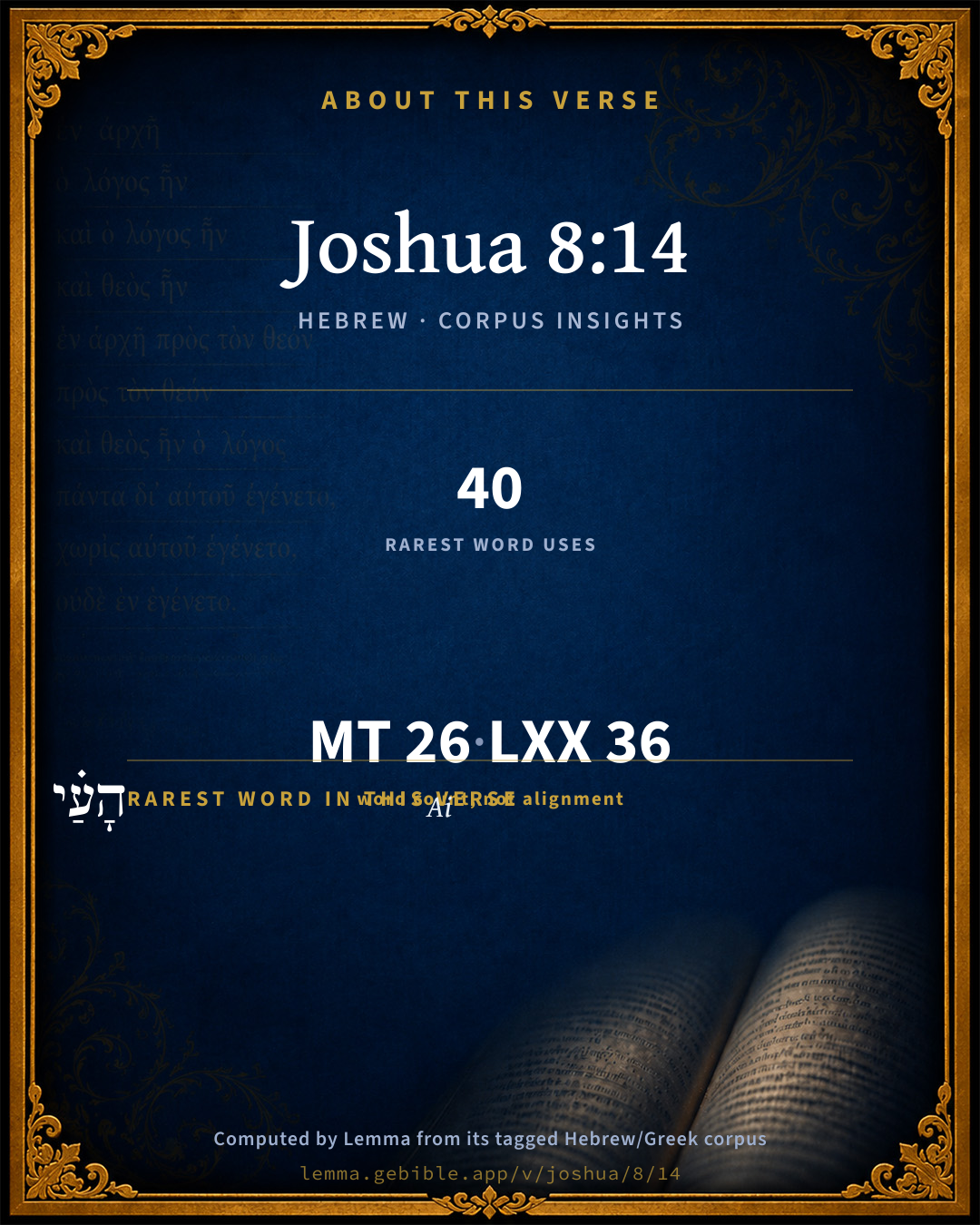
26
words
23
distinct lemmas
Historical
section

Shared distinctive vocabulary

הָעַ֗י Ai H5857 occurs in 34 verses of the Hebrew Bible. Also found in:

Grammatical profile

  • 8 verbs
  • 12 nouns
  • 2 pronouns
  • 2 prepositions
  • 1 conjunction
  • 1 particle

Verb forms

  • וַיְהִ֞י Qal · Sequential Imperfect
  • כִּרְא֣וֹת Qal · Infinitive Construct
  • וַֽיְמַהֲר֡וּ Piel · Sequential Imperfect
  • וַיַּשְׁכִּ֡ימוּ Hiphil · Sequential Imperfect
  • וַיֵּצְא֣וּ Qal · Sequential Imperfect
  • לִקְרַֽאת Qal · Infinitive Construct
  • יָדַ֔ע Qal · Perfect
  • אֹרֵ֥ב Qal · Participle Active

Repetition

Words recur within this verse — often emphatic in Hebrew:

  • הָעִ֣יר city H5892 ×2
  • ה֧וּא he H1931 ×2

Hebrew & Septuagint length

In English translation the verse runs 54 words from the Hebrew and 48 from the Septuagint (LXX English) — closely comparable.

A rough comparison of the two English renderings, which tokenize alike — not a word-level alignment.

Word counts can differ between the Hebrew and the Greek without any difference in meaning — e.g. the Hebrew direct-object marker אֵת has no separate Greek word, and Greek often adds the article ὁ.

In the original languages it is 26 Hebrew tokens and 36 Greek tokens — but the two are counted differently (Hebrew bundles its prefixes and suffixes into one token; the Greek is in lemma form), so that isn’t a like-for-like length.

Cross-references

12

Topical passages linked to Joshua 8:14 in the Treasury of Scripture Knowledge — connected by theme and wording, ordered by reader-vote popularity; previews shown in the World English Bible.

  • Matthew 24:39 and they didn't know until the flood came, and took them all away, so will be the coming of the Son of Man.
  • Deuteronomy 1:1 These are the words which Moses spoke to all Israel beyond the Jordan in the wilderness, in the Arabah over against Suph, between Paran, and Tophel, and Laban, and Hazeroth, and Dizahab.
  • Joshua 8:5 and I, and all the people who are with me, will approach to the city. It shall happen, when they come out against us, as at the first, that we will flee before them;
  • Joshua 8:16 All the people who were in the city were called together to pursue after them: and they pursued after Joshua, and were drawn away from the city.
  • Judges 20:34–36 There came over against Gibeah ten thousand chosen men out of all Israel, and the battle was sore; but they didn't know that evil was close on them.
  • Ecclesiastes 9:12 For man also doesn't know his time. As the fish that are taken in an evil net, and as the birds that are caught in the snare, even so are the sons of men snared in an evil time, when it falls suddenly on them.
  • Isaiah 19:11 The princes of Zoan are utterly foolish; the counsel of the wisest counselors of Pharaoh is become brutish: how do you say to Pharaoh, I am the son of the wise, the son of ancient kings?
  • Isaiah 19:13 The princes of Zoan are become fools, the princes of Memphis are deceived; they have caused Egypt to go astray, who are the corner-stone of her tribes.
  • Daniel 4:31 While the word was in the king's mouth, there fell a voice from the sky, [saying], O king Nebuchadnezzar, to you it is spoken: The kingdom is departed from you:
  • Matthew 24:50 the lord of that servant will come in a day when he doesn't expect it, and in an hour when he doesn't know it,
  • 1 Thessalonians 5:1–3 But concerning the times and the seasons, brothers, you have no need that anything be written to you.
  • 2 Peter 2:3 In covetousness they will exploit you with deceptive words: whose sentence now from of old doesn't linger, and their destruction will not slumber.

Cross-references courtesy of OpenBible.info (CC BY 4.0).

Hebrew and Greek witnesses Masoretic Hebrew ↔ Greek Septuagint

The same verse in the two great witnesses to the Old Testament, shown verse-for-verse.

These are two independent witnesses, not word-aligned to each other, and the Septuagint is shown in lemma (dictionary) form.

Hebrew Joshua 8:14 Masoretic · Westminster Leningrad Codex

וַיְהִ֞י כִּרְא֣וֹת מֶֽלֶךְ הָעַ֗י וַֽיְמַהֲר֡וּ וַיַּשְׁכִּ֡ימוּ וַיֵּצְא֣וּ אַנְשֵֽׁי הָעִ֣יר לִקְרַֽאת יִ֠שְׂרָאֵל לַֽמִּלְחָמָ֞ה ה֧וּא וְכָל עַמּ֛וֹ לַמּוֹעֵ֖ד לִפְנֵ֣י הָֽעֲרָבָ֑ה וְהוּא֙ לֹ֣א יָדַ֔ע כִּֽי אֹרֵ֥ב ל֖וֹ מֵאַחֲרֵ֥י הָעִֽיר

It happened, when the king of Ai saw it, that they hurried and rose up early, and the men of the city went out against Israel to battle, he and all his people, at the time appointed, before the Arabah; but he didn't know that there was an ambush against him behind the city.

World English Bible · Public Domain

Greek LXX Joshua 8:14 Septuagint · lemma form

καί γίγνομαι ὡς ὁράω βασιλεύς γαι σπεύδω καί ἐκἔρχομαι εἰς συνάντησις αὐτός ἐπί εὐθύς εἰς ὁ πόλεμος αὐτός καί πᾶς ὁ λαός ὁ μετά αὐτός καί αὐτός οὐ οἶδα ὅτι ἔνεδρον αὐτός εἰμί ὀπίσω ὁ πόλις

And it came to pass when the king of Gai saw it, he hasted and went out to meet them direct to the battle, he and all the people that were with him: and he knew not that there was an ambuscade formed against him behind the city.

LXX2012 (modern English Septuagint) · Public Domain

On this verse, The Pulpit Commentary discusses the Septuagint’s reading. Read the note in Commentary ↓

Hebrew: Westminster Leningrad Codex (CC BY 4.0). Greek: Septuagint (public domain); English from LXX2012 (modern English Septuagint) (Public Domain). How the Septuagint differs from the Hebrew →

Targum (Aramaic paraphrase)

1

The Targum is the ancient Jewish Aramaic paraphrase of the Hebrew Scriptures — an interpretive translation, not the Hebrew text itself. Onkelos (literal) and Pseudo-Jonathan (expansive) render the Torah, and Jonathan the Prophets. Coverage is partial: where no permissively-licensed English translation exists for a verse, only the Aramaic is shown. This is verse-level text, not a word-by-word alignment to the Hebrew.

  1. Targum Jonathan Prophets (Joshua–Malachi)
    וַהֲוָה כַּד חֲזָא מַלְכָּא דְעַי וְאוֹחִיאוּ וְאַקְדִימוּ וּנְפַקוּ אֱנָשֵׁי קַרְתָּא לִקְדָמוּת יִשְׂרָאֵל לְאַגָחָא קְרָבָא הוּא וְכָל עַמֵיהּ לְזִמְנָא דִמְתַקֵן לֵיהּ לִקְדָם מֵישְׁרָא וְאִינוּן לָא יָדְעִין אֲרֵי כְּמָנָא לְהוֹן מֵאֲחוֹרֵי קַרְתָּא:

    (no public-domain English translation for this verse)

    Targum Jonathan — Aramaic: “Mikraot Gedolot” (public domain). English: “Sefaria Community Translation” (CC0 1.0 (public-domain dedication)); “London "Chaldee Paraphrase," 1871” (public domain). Text via Sefaria.

Commentary

Notes on Joshua 8:14 from classic Christian and Jewish commentators (each source and its license shown beneath its notes). The classic Christian expositions comment on the surrounding passage and are grouped to its opening verse, so a note may address several verses; the Jewish commentaries on the Tanakh (Rashi and others) are per-verse, so they appear only where the commentator wrote on this verse.

Lemma curates 59 commentaries, every one of them public domain or Creative Commons licensed, each selected and text-cleaned for this edition rather than reprinted as found. About our sources →

Trapp's Complete Commentary

John Trapp

Jos 8:14 And it came to pass, when the king of Ai saw [it], that they hasted and rose up early, and the men of the city went out against Israel to battle, he and all his people, at a time appointed, before the plain; but he wist not that [there were] liers in ambush against him behind the city.

Ver. 14. They hasted and rose up early.] Sine dilatione aut deliberatione, consiliove capto, they made more haste than good speed. Warriors should do nothing rashly, Quia in proelio non datur his errare, as Lamachus said, one error is destructive. "Every purpose shall be established by counsel: therefore with good advice make war." {Pro 20:18} {See Trapp on "Pro 20:18"}

But he wist not.] And therefore all too late came in with his fool’s Had I known. Leo cassibus irretitus ait, Si praescivissem.

John Trapp, A Commentary or Exposition upon All the Books of the Old and New Testament (1647–1656) — public domain. Text from a community e-Sword module.

Joseph Benson's Commentary

Jos 8:14. He and all his people — That is, the king of Ai and his men of war, for the rest were left in the city, Jos 8:16. At a time appointed — At a certain hour agreed on between the king and people of Ai, and Bethel too, who were confederate with them in this enterprise. Possibly they might appoint the same hour of the day on which they had fought against Israel with success, looking upon it as a lucky hour. Before the plain — That is, toward, or in sight of that plain or valley in which the Israelites were, that so they might put themselves in battle array. He knew not there were liers in ambush — The former success having made him secure, as is usual in such cases, God also blinding his mind, and infatuating him, as he is wont to do with those who have filled up the measure of their iniquities, and whom, therefore, he purposes to destroy.

Joseph Benson's Commentary on the Old and New Testaments (1811–1818) — public domain. Text from a community e-Sword module.

Tyndale Open Study Notes

Tyndale Open Resources

8:14 The king of Ai . . . and all his army were recklessly eager to repeat their heroics of the previous battle. As Joshua and Israel had learned, such overconfidence is dangerous.

Tyndale Open Study Notes — © Tyndale Open Resources, licensed CC BY-SA 4.0. Text via the HelloAO Bible API.

Jamieson, Fausset & Brown

Robert Jamieson, A. R. Fausset & David Brown

at a time appointed--either an hour concocted between the king and people of Ai and those of Beth-el, who were confederates in this enterprise, or perhaps they had fixed on the same time of day, as they had fought successfully against Israel on the former occasion, deeming it a lucky hour (Jdg 20:38).

but he wist not that there were liers in ambush against him behind the city--It is evident that this king and his subjects were little experienced in war; otherwise they would have sent out scouts to reconnoitre the neighborhood; at all events, they would not have left their town wholly unprotected and open. Perhaps an ambuscade may have been a war stratagem hitherto unknown in that country, and among that people.

Jamieson, Fausset & Brown — Commentary Critical and Explanatory on the Whole Bible (1871) — public domain (CC PDM 1.0). Text via the HelloAO Bible API.

Ellicott's Commentary for English Readers

(14) When the king of Ai saw it. . . . the city went out.—The stratagem succeeded perfectly. Joshua gave them ample time, by his movements in open daylight, to discover what his apparent intentions were, viz., to renew the direct attack upon the city with a larger force. Accordingly, the Canaanites came out before the plain—i.e., in the direction of the plain of Jordan (the Arabah. On this word and Emek and Gai used above, see Stanley, Sinai and Palestine)—intending to drive Joshua down by the way he had come up. And accordingly Joshua and his army fled in that very direction by the way of the Midbar or wilderness—i.e., the mountainous district between Ai and the Jordan valley, and lying in that direction. (Comp. Jos_7:5.)

A Bible Commentary for English Readers, edited by Charles John Ellicott (1878–1897) — public domain. Text from a community e-Sword module.

The Cambridge Bible for Schools and Colleges

gen. ed. J. J. S. Perowne

14. when the king of Ai saw it] It was early on the following morning that the king of Ai discovered the advance of the army against him. The words apply to the forces of Joshua, the ambush was of course hidden from his view. Ai was a “royal” city. Comp. Jos_8:23; Jos_8:29; Jos_10:1; Jos_12:9.

at a time appointed] Rather, at the place appointed, at some spot before agreed upon suitable for marshalling his forces. It was “before the plain,” i.e. before the “ambush,” at the entrance of the depressed tract which runs down to the Jordan valley, probably = “the wilderness of Beth-aven,” Jos_18:12.

he wist not] Comp. Jdg_20:34, “And there came against Gibeah ten thousand chosen men—but they knew not that evil was near them.” For “wist,” see above, ch. Jos_2:4.

The Cambridge Bible for Schools and Colleges (gen. ed. J. J. S. Perowne; Cambridge University Press, 1878–1918) — public domain. Text from a community e-Sword module.

John Gill's Exposition

And it came to pass, when the king of Ai saw it,.... Not the ambush on the west side, but the host or army on the north side, or, however, some of his people gave him notice of it:

that they hasted and rose up early; or made haste to rise out of their beds, on the alarm given of Israel's near approach:

and the men of the city went out against Israel to battle; being raised out of their beds and accoutred with armour, and put into a military order, they marched out with their king at the head of them, to give Israel battle:

he and all his people, at a time appointed, before the plain; which was before the city, the same with the valley mentioned, Jos 8:11; the city was built on an eminence, and this plain or valley lay at the bottom of it; and on an eminence on the other side of the valley the army of Israel was pitched; wherefore the king of Ai and all his men of war went out hither to attack Israel, and this is said to be at an appointed time; it is difficult to say what is meant by it, when they seem to have hurried out as best as they could, as soon as they perceived the Israelites were near them: Ben Gersom and Abarbinel think it was the same time of the day they went out at first, which the king might choose as lucky, being before successful, and to encourage the men, that as they conquered then they should now; which seems not amiss, though perhaps it rather designs an appointed place, as their rendezvous, and where to attack Israel, and where they had been before victorious:

but he wist not that there were liers in ambush against him behind the city; that he knew nothing of, and therefore took no precaution against them to prevent their design.

John Gill's Exposition of the Whole Bible (1746–1763) — public domain (CC PDM 1.0). Text via the HelloAO Bible API.

Albert Barnes' Notes on the Bible

At a time appointed - Rather, “at the place appointed,” i. e. some spot suitable for the drawing up of his men, which had been assigned beforehand. This was “before the plain,” i. e. it was at the entrance of the depressed tract of land which runs down to the Jordan valley, up which lay the route of the Israelites from Gilgal to Ai.

Albert Barnes' Notes on the Bible (1834–1885) — public domain. Text from a community e-Sword/MySword module.

Haydock's Catholic Bible Commentary

Desert of Bethel, fit only for pasturage, chap. xviii. 12.

George Leo Haydock (1774–1849), Haydock's Catholic Family Bible and Commentary, 1859 edition — public domain. Excludes Psalms (Douay-Rheims chapter numbering differs from Protestant) and Deuterocanonical books (Catholic canon only).

Matthew Poole's English Annotations

All his people, to wit, all his men of war, for the rest were left in Ai, Jos 8:16.

At a time appointed; at a certain hour agreed upon between the king and people of Ai, and of Beth-el too, who were their confederates in this enterprise, as it may seem from Jos 8:17. Possibly they might appoint the same hour of the day on which they had fought against Israel with such good success, looking upon it as a lucky hour.

Before the plain, i.e. towards or in sight of that plain or valley in which the Israelites were, that so they might put themselves in battle-array.

He wist not that there were liers in ambush; the former success having made him more careless and secure, as is usual in such cases; God also blinding his mind, and infatuating him, as he useth to do with those which he intends to destroy.

Matthew Poole's English Annotations on the Holy Bible (1683–1685) — public domain. Text from a community e-Sword/MySword module.

Whedon's Commentary on the Bible

Daniel D. Whedon

14. At a time appointed — In Jdg_20:38, the same word is translated an appointed sign. This makes good sense here; but Gesenius and Furst both say that it is here to be rendered, an appointed place in Joshua’s line, upon which the attack was to be made. This place is mentioned immediately afterwards as the plain, that is, the Arabah, the desert, which is spoken of in Jos_8:15 under the name of the wilderness.

[15.

Made as if they were beaten — The original simply reads were beaten. Keil renders it suffered themselves to be beaten.

The wilderness — The eastern slope of the mountains of Judah towards Jericho and the Dead Sea. Captain Wilson says that on the east of Et-Tel “the ground, which at first breaks down rapidly from the great ridge that forms the backbone of Palestine, swells out into a small plain three quarters of a mile broad, before commencing its abrupt descent to the Jordan valley.”] 16. And all the people — That is, all capable of military service. We read in Jos_8:24 that some were killed in the city.

Daniel D. Whedon (gen. ed.), Commentary on the Old and New Testaments (1874–1909) — public domain. Text from a community e-Sword module.

The Pulpit Commentary

When the king of Ai saw it. The particle k here employed signifies immediate action. At a time appointed. Or, at the signal. Keil, following Luther, would prefer at the place appointed, which seems to agree best with what follows. Some copies of the LXX have ep euyeiav . Before the plain. Literally, before, or in sight of; i.e., in the direction of the Arabah. (see above, Jos_3:16)

The Pulpit Commentary (1880–1919), ed. H.D.M. Spence-Jones & Joseph S. Exell — public domain. Text from a community e-Sword module.

John Wesley's Explanatory Notes

His people - Namely, all his men of war, for the rest were left in Ai, ver. 16. At a time appointed - At a certain hour agreed upon between the king and people of Ai, and of Bethel too, who were their confederates in this enterprize, as it may seem from ver. 17. Possibly they might appoint the same hour of the day on which they had fought against Israel with good success, looking upon it as a lucky hour. Before the plain - That is, towards or in sight of that plain or valley in which the Israelites were, that so they might put themselves in battle-array. Against him - The former success having made him secure, as is usual in such cases; God also blinding his mind, and infatuating him, as he useth to do with those whom he intends to destroy.

John Wesley, Explanatory Notes Upon the Whole Bible (1754–1765) — public domain. Text via the GEBible commentary corpus.

Kretzmann's Popular Commentary

Paul E. Kretzmann

Ai Taken and Destroyed

v. 14. And it came to pass, when the king of Ai saw it, that they hasted and rose up early, believing they had only the army to the north of the city to deal with; and the men of the city went out against Israel to battle, he (the king) and all his people, at a time appointed, before the plain, in the only place where a battle in open formation was possible, near the steppes of Beth-aven, east of Bethel; but he wist not that there were liers-in-ambush against him behind the city.

v. 15. And Joshua and all Israel made as if they were beaten before them, they feigned fear and weakness, and fled by the way of the wilderness.

v. 16. And all the people that were in Ai, all the able-bodied men, were called together to pursue after them; and they pursued after Joshua, and were drawn away from the city, leaving the latter altogether unprotected.

v. 17. And there was not a man left in Ai or Bethel, the inhabitants of the latter city having joined the forces of Ai, that went not out after Israel; and they left the city open, and pursued after Israel, thinking that the army of Israel was fleeing in utter and hopeless rout.

v. 18. And the Lord said unto Joshua, Stretch out the spear that is in thy hand toward Ai; for I will give it into thine hand. Joshua was probably occupying some higher point from which he was easily visible, or he may have been mounted and his figure easily distinguishable even at a distance. And Joshua stretched out the spear that he had in his hand toward the city.

v. 19. And the ambush, to whom the outposts had immediately signaled to that effect, arose quickly out of their place, and they ran as soon as he had stretched out his hand; and they entered into the city, whose defenders were all engaged in the pursuit of the Israelites, and took it, and hasted and set the city on fire.

v. 20. And when the men of Ai looked behind them, their attention being drawn in that direction by the behavior of the Israelites, who turned to watch for the signal of the smoke’s rising, they saw, and, behold, the smoke of the city ascended up to heaven, and they had no power to nee this way or that way, they were paralyzed with sudden terror; and the people that fled to the wilderness turned back upon the pursuers. The whole situation of the men of Ai, who now saw before them the enemy, behind them the burning town, is admirably pictured in a few strokes.

v. 21. And when Joshua and all Israel saw that the ambush had taken the city, and that the smoke of the city ascended, for this was the sign for which they had been waiting, then they turned again, and slew the men of Ai.

v. 22. And the other, the Israelites who had lain in ambush, issued out of the city against them; so they were in the midst of Israel, some on this side and some on that side, caught in a trap from which there was no escape. And they, the Israelites, smote them, so that they let none of them remain or escape, the entire army of Ai, together with its allies, being destroyed.

v. 23. And the king of Ai they took alive, and brought him to Joshua, who was to rule regarding his disposal.

v. 24. And it came to pass, when Israel had made an end of slaying all the inhabitants of Ai in the field, in the wilderness, wherein they chased them, and when they were all fallen on the edge of the sword, until they were consumed, that all the Israelites returned unto Ai, and smote it with the edge of the sword, put all its inhabitants to death.

v. 25. And so it was that all that fell that day, both of men and women, were twelve thousand, even all the men of Ai, the adult inhabitants.

v. 26. For Joshua drew not his hand back wherewith he stretched out the spear until he had utterly destroyed all the inhabitants of Ai. This he did according to the universal rule of the ancients, which required the general to hold the signal of battle aloft until he desired the battle to be ended.

v. 27. Only the cattle and the spoil of that city Israel took for a prey unto themselves, according unto the word of the Lord which He commanded Joshua,

v. 28. And Joshua burned Ai, and made it an heap forever, a heap of ashes and broken stones, even a desolation unto this day; its ruins were still visible at the time when the author wrote this account.

v. 29. And the king of Ai he hanged on a tree until eventide, Num 25:4; and as soon as the sun was down, Joshua commanded that they should take his carcass down from the tree, Deu 21:23, and cast it at the entering of the gate of the city, and raise thereon a great heap of stones, that remaineth unto this day. The entire story teaches that we should indeed use all our physical and mental powers in the work given us by the Lord, but that everything depends upon His almighty power and blessing. It is He who must give us the victory in every battle.

Paul E. Kretzmann, Popular Commentary of the Bible (1921–1924) — public domain. Text from a community e-Sword module.

Rashi

Rabbi Shlomo Yitzchaki (Rashi)

At the appointed time. At the time of day they had astrologically predicted previously, saying “at that time we will go out,” for they were sorcerers and diviners.

Rashi on the Tanakh — English translations: “The Judaica Press complete Tanach with Rashi, translated by A. J. Rosenberg” (CC BY 4.0); “Pentateuch with Rashi's commentary by M. Rosenbaum and A.M. Silbermann, 1929-1934” (public domain); “The Metsudah Tanach series, Lakewood, N.J” (CC BY 4.0); and “The Book of Joshua, Metsudah Publications, 1997” (CC BY 4.0). Text via Sefaria.

Lesson kit

Teaching starters — assembled from the data on this page, not authored interpretation. Every prompt links to the verse data it draws on. Edit before teaching.

Joshua, in the Historical, opens this verse with 26 words (23 distinct Hebrew lemmas). Its most distinctive word is ʻAy (“Ai”). A historical commentator’s framing appears above. Read the whole chapter for the surrounding context.

Discussion questions

  1. How does “Ai” (ʻAy) shape what this verse is saying?
  2. How does Genesis 12:8, which shares the word «Ai», read alongside this verse?
  3. What does the repetition of “city” (2× in this one verse) do in this verse?
  4. These translations render this verse differently; the difference is in the English rendering, not the original. What questions does that raise?
  5. «וַיְהִ֞י» is a Qal Sequential Imperfect verb. How does that grammatical form shape the action described?
  6. Compare how Trapp's Complete Commentary and Joseph Benson's Commentary read this verse. Where do they agree or differ?

Things to notice

Reading settings

Reading text

Shown beneath each verse's original-language words.

Old Testament
Old Testament edition

Read the OT as the Masoretic Hebrew (MT) or the Greek Septuagint (LXX).

English shown for the Greek Septuagint (in the Hebrew ↔ Greek comparison).

Comparing translations? Open the Compare panel on any verse page to stack up to four side by side.