
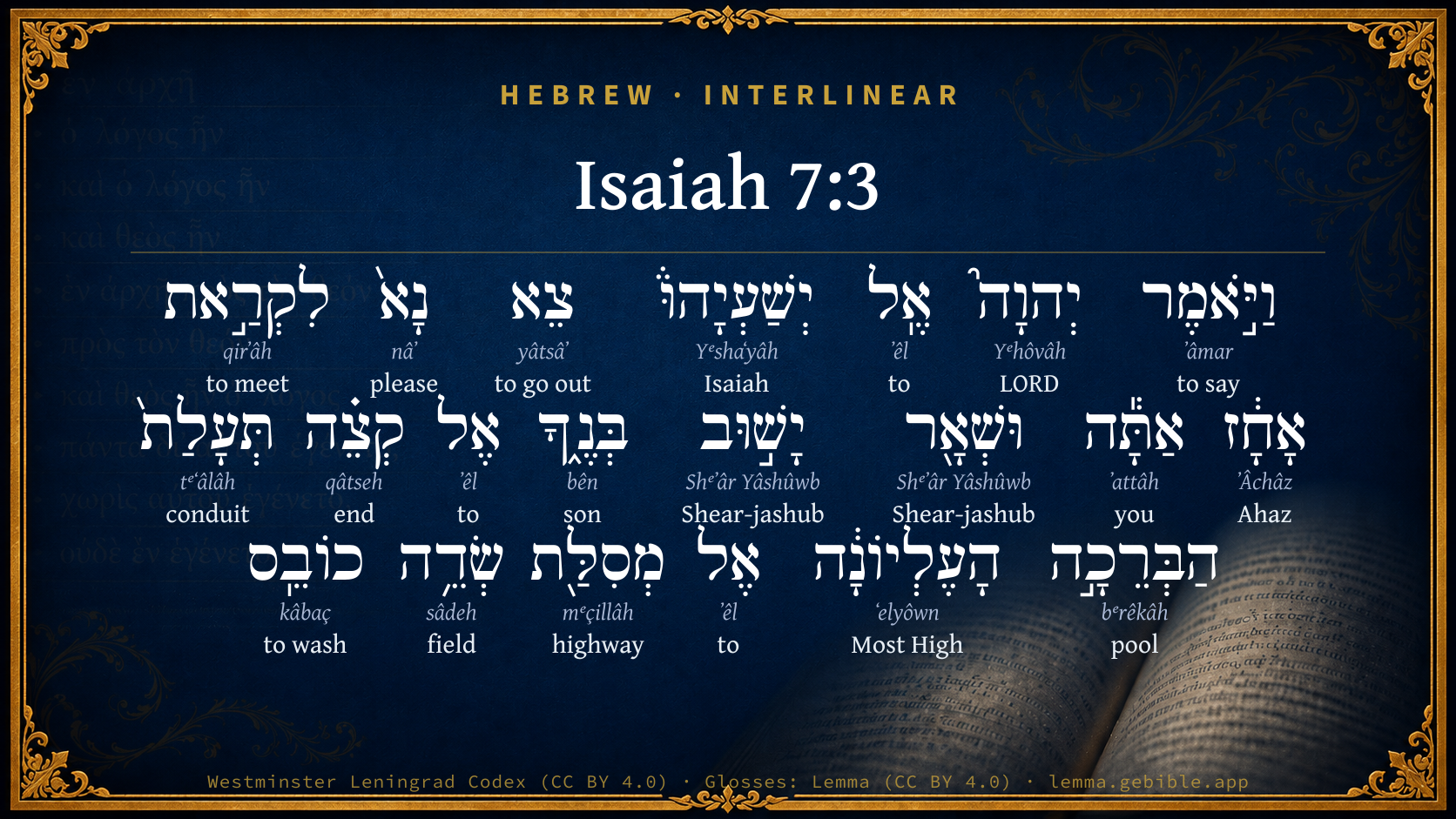
Isaiah 7:3

Hebrew (Westminster Leningrad Codex) Isaiah 7:3 appears in the Hebrew Old Testament. The text above is from the Westminster Leningrad Codex. Each word links to its Strong’s number, a concise gloss, and parsing drawn from the Open Scriptures Hebrew Bible morphology. Click any word for its full Brown-Driver-Briggs (BDB) entry.
Download image
Cite this verse

Isaiah 7:3 (World English Bible). Public Domain. Lemma interlinear Bible study tool, https://lemma.gebible.app/v/isaiah/7/3.

Show BibTeX & RIS
BibTeX
RIS
English Translation
Then Yahweh said to Isaiah, "Go out now to meet Ahaz, you, and Shearjashub your son, at the end of the conduit of the upper pool, on the highway of the fuller's field.
World English Bible · Public Domain
Highlights
  • 1 first appearance in the Hebrew Bible
Full analysis ↓
Download a study sheet

One document with this verse’s original text, its word-by-word gloss line, the meaning frame, cross-references with their text, attributed commentary, and full source and license credits — printable, and it pastes into notes with its structure intact.

This verse Autodidact and up

Study sheet (.html) Plain text (.txt)

A passage Seminary Student

Up to 50 verses in one chapter. A passage sheet keeps up to 6 commentary sources and 12 cross-references per verse, in the order this page ranks them, and says so on the sheet whenever that leaves anything out. Ask for a single verse and you get the Autodidact verse sheet above.

Everything on this page stays free to read, with no account — the sheet is a download of what is already on screen, not access to it.

Want to remove ads? Support Godless Engineer
Compare translations 3

The same verse in 3 English versions, stacked beneath the original-language interlinear above. Click any original word for its lexicon entry.

Each is an independent rendering of the whole verse — the interlinear is not word-aligned to these translations.

Highlighted words mark where these versions differ — a whole-verse word diff, not a word-by-word alignment.

  • World English Bible Public Domain
    Then Yahweh said to Isaiah, "Go out now to meet Ahaz, you, and Shearjashub your son, at the end of the conduit of the upper pool, on the highway of the fuller's field.
  • King James Version Public Domain
    Then said the LORD unto Isaiah, Go forth now to meet Ahaz, thou, and Shearjashub thy son, at the end of the conduit of the upper pool in the highway of the fuller's field;
  • unfoldingWord Literal Text CC BY-SA 4.0
    And Yahweh said to Isaiah, “Go out, please, to meet Ahaz, you and Shear-Jashub your son, at the end of the conduit of the upper pool on the road of the Field of the Washer.

unfoldingWord Literal Text — © unfoldingWord, licensed CC BY-SA 4.0. Word-aligned USFM3 via Door43 (git.door43.org/unfoldingWord/en_ult).

Versions to compare (up to 4)

3 of 4 selected

Show all 18 translations

Every available English version of this verse, each an independent rendering of the whole verse.

  • World English Bible Public Domain
    Then Yahweh said to Isaiah, "Go out now to meet Ahaz, you, and Shearjashub your son, at the end of the conduit of the upper pool, on the highway of the fuller's field.
  • Berean Standard Bible Public Domain
    Then the LORD said to Isaiah, “Go out with your son Shear-jashub to meet Ahaz at the end of the aqueduct that feeds the upper pool, on the road to the Launderer’s Field,
  • Majority Standard Bible Public Domain
    Then the LORD said to Isaiah, “Go out with your son Shear-jashub to meet Ahaz at the end of the aqueduct that feeds the upper pool, on the road to the Launderer’s Field,
  • King James Version Public Domain
    Then said the LORD unto Isaiah, Go forth now to meet Ahaz, thou, and Shearjashub thy son, at the end of the conduit of the upper pool in the highway of the fuller's field;
  • American Standard Version (1901) Public Domain
    Then said Jehovah unto Isaiah, Go forth now to meet Ahaz, thou, and Shear-jashub thy son, at the end of the conduit of the upper pool, in the highway of the fuller's field;
  • Revised Version (1885) Public Domain
    Then said the LORD unto Isaiah, Go forth now to meet Ahaz, thou, and Shear-jashub thy son, at the end of the conduit of the upper pool, in the highway of the fuller’s field;
  • Geneva Bible (1599) Public Domain
    Then sayde the Lord vnto Isaiah, Goe foorth nowe to meete Ahaz (thou and Sheariashub thy sonne) at the ende of the conduit of the vpper poole, in the path of the fullers fielde,
  • Douay-Rheims (1899) Public Domain
    And the Lord said to Isaias: Go forth to meet Achaz, thou and Jasub thy son that is left, to the conduit of the upper pool, a in the way of the fuller's held.
  • Young's Literal Translation Public Domain
    And Jehovah saith unto Isaiah, `Go forth, I pray thee, to meet Ahaz, thou, and Shear-Jashub thy son, unto the end of the conduit of the upper pool, unto the highway of the fuller's field,
  • Literal Standard Version CC BY-SA 4.0
    And YHWH says to Isaiah, “Now go forth to meet Ahaz, you and your son Shear-Jashub, to the end of the conduit of the upper pool, to the highway of the fuller’s field,
  • Unlocked Literal Bible CC BY-SA 4.0
    Then Yahweh said to Isaiah, “Go out with your son Shear-Jashub to meet Ahaz at the end of the conduit of the upper pool, on the road to Launderer's Field.
  • unfoldingWord Literal Text CC BY-SA 4.0
    And Yahweh said to Isaiah, “Go out, please, to meet Ahaz, you and Shear-Jashub your son, at the end of the conduit of the upper pool on the road of the Field of the Washer.
  • Darby Bible Public Domain
    And Jehovah said to Isaiah, Go out now to meet Ahaz, thou and thy son Shear-jashub, at the end of the aqueduct of the upper pool, on the highway of the fuller's field;
  • World Messianic Bible Public Domain
    Then the LORD said to Isaiah, “Go out now to meet Ahaz, you, and Shearjashub your son, at the end of the conduit of the upper pool, on the highway of the fuller’s field.
  • Webster's Bible Public Domain
    Then said the LORD to Isaiah, Go forth now to meet Ahaz, thou, and Shear-jashub thy son, at the end of the conduit of the upper pool in the highway of the fuller's field;
  • Free Bible Version CC BY-SA 4.0
    Then the Lord told Isaiah, “Take your son Shear-jashub with you and go and meet Ahaz. He'll be at the end of the aqueduct of the upper pool, by the road to the laundry field.
  • Bible in Basic English Public Domain
    Then the Lord said to Isaiah, Go out now, you and Shear-jashub, your son, and you will come across Ahaz at the end of the stream flowing from the higher pool, in the highway of the washerman's field;
  • JPS Tanakh (1917) Public Domain
    Then said the LORD unto Isaiah: 'Go forth now to meet Ahaz, thou, and Shear-jashub thy son, at the end of the conduit of the upper pool, in the highway of the fullers' field;

Literal Standard Version (2020), Covenant Press — licensed CC BY-SA 4.0. Text via the HelloAO Bible API (eBible.org). Unlocked Literal Bible (unfoldingWord) — licensed CC BY-SA 4.0. Text via the HelloAO Bible API (eBible.org). unfoldingWord Literal Text — © unfoldingWord, licensed CC BY-SA 4.0. Word-aligned USFM3 via Door43 (git.door43.org/unfoldingWord/en_ult). Free Bible Version, Dr. Jonathan Gallagher — licensed CC BY-SA 4.0. Text via the HelloAO Bible API (eBible.org).

Word by word

More ways to search: Search by grammar → Find every occurrence → Compare this word →

Practice this passage: Drill this verse → Learn its vocabulary →

וּשְׁאָ֖ר
Shᵉʼâr Yâshûwb
H7610
“and · Shear-jashub”
Conjunction + Noun, Proper
Part of Speech
Conjunction + Noun
Type
Proper
Full BDB Definition

Origin: from H7605 and H7725

TWOT: None

Shear-jashub = "a remnant shall return" - a symbolical name for the son of Isaiah the prophet
  1. וַיֹּ֣אמֶר ʼâmar H559 “and · to say” Conjunction + Verb, Qal, Sequential Imperfect, 3rd Person, Masculine, Singular
  2. יְהוָה֮ Yᵉhôvâh H3068 “LORD” Noun, Proper
  3. אֶֽל ʼêl H413 “to” Preposition
  4. יְשַׁעְיָהוּ֒ Yᵉshaʻyâh H3470 “Isaiah” Noun, Proper
  5. צֵא yâtsâʼ H3318 “go out” Verb, Qal, Imperative, 2nd Person, Masculine, Singular
  6. נָא֙ nâʼ H4994 “please” Particle, Exhortation
  7. לִקְרַ֣את qirʼâh H7125 “to meet” Preposition + Verb, Qal, Infinitive Construct
  8. אָחָ֔ז ʼÂchâz H271 “Ahaz” Noun, Proper
  9. אַתָּ֕ה ʼattâh H859 “you” Pronoun, Personal, 2nd Person, Masculine, Singular
  10. יָשׁ֣וּב Shᵉʼâr Yâshûwb H7610 “Shear-jashub” Noun, Proper
  11. בְּנֶ֑ךָ bên H1121 “son · your” Noun, Common, Masculine, Singular, Construct + Suffix, Personal, 2nd Person, Masculine, Singular
  12. אֶל ʼêl H413 “to” Preposition
  13. קְצֵ֗ה qâtseh H7097 “end of” Noun, Common, Both, Singular, Construct
  14. תְּעָלַת֙ tᵉʻâlâh H8585 “conduit of” Noun, Common, Feminine, Singular, Construct
  15. הַבְּרֵכָ֣ה bᵉrêkâh H1295 “the · pool” Particle, Definite Article + Noun, Common, Feminine, Singular, Absolute
  16. הָעֶלְיוֹנָ֔ה ʻelyôwn H5945 “the · Most High” Particle, Definite Article + Adjective, Adjective, Feminine, Singular, Absolute
  17. אֶל ʼêl H413 “to” Preposition
  18. מְסִלַּ֖ת mᵉçillâh H4546 “highway of” Noun, Common, Feminine, Singular, Construct
  19. שְׂדֵ֥ה sâdeh H7704 “field of” Noun, Common, Masculine, Singular, Construct
  20. כוֹבֵֽס kâbaç H3526 “washing” Verb, Qal, Participle Active, Masculine, Singular, Absolute

About this verse

These counts appear in no published source. They are computed here, from the morphology-tagged text and Lemma’s own curated glosses. What Lemma adds →

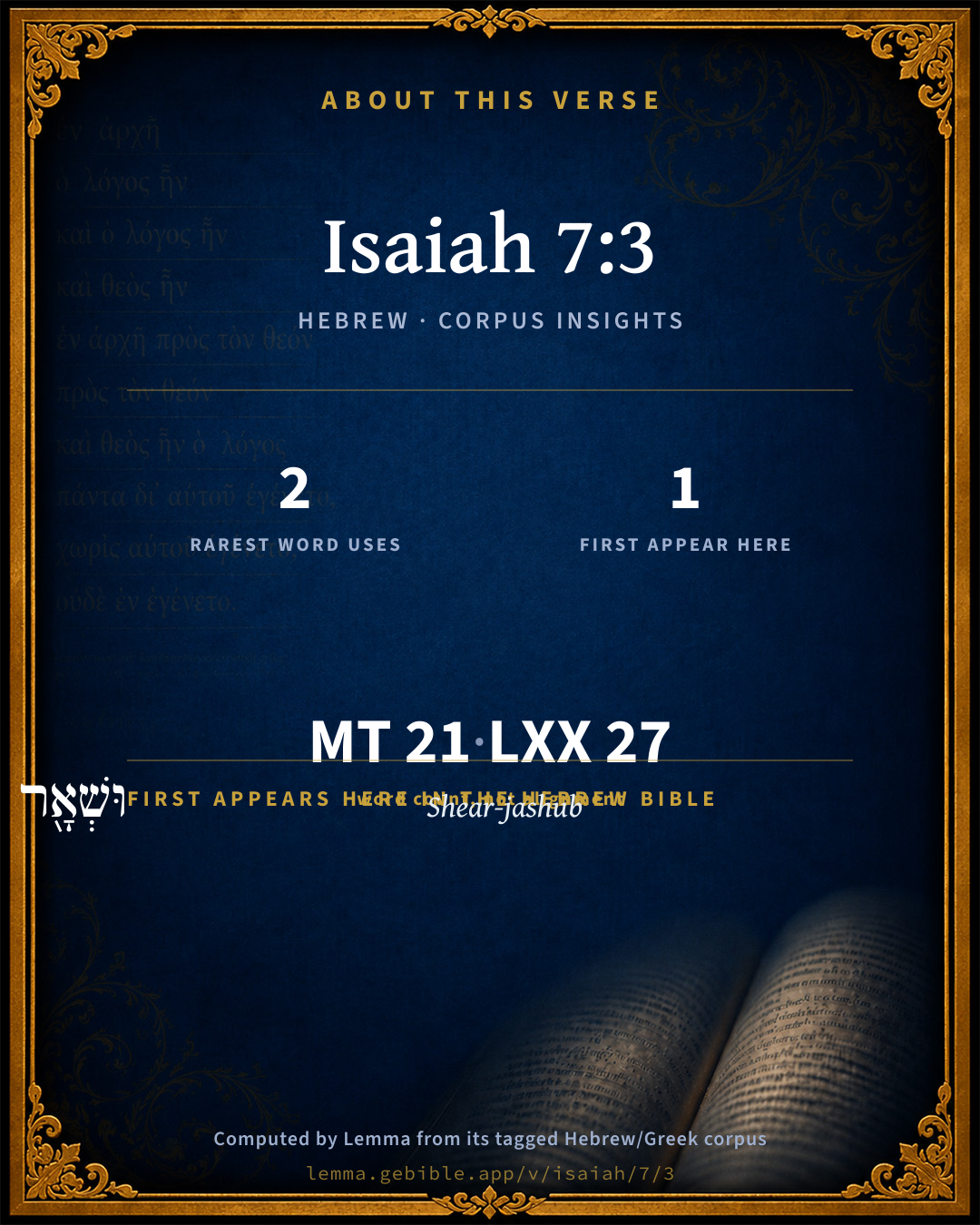
21
words
18
distinct lemmas
Prophets
section

Notable vocabulary

The rarest word here is וּשְׁאָ֖ר Shear-jashub H7610 — appearing just 2 times in the whole Hebrew Bible.

First appearance in Scripture

This word makes its first canonical appearance in the Hebrew Bible here:

  • וּשְׁאָ֖ר Shear-jashub H7610

Grammatical profile

  • 4 verbs
  • 11 nouns
  • 1 adjective
  • 1 pronoun
  • 3 prepositions
  • 1 particle

Verb forms

  • וַיֹּ֣אמֶר Qal · Sequential Imperfect
  • צֵא Qal · Imperative
  • לִקְרַ֣את Qal · Infinitive Construct
  • כוֹבֵֽס Qal · Participle Active

Repetition

Words recur within this verse — often emphatic in Hebrew:

  • וּשְׁאָ֖ר Shear-jashub H7610 ×2
  • אֶֽל to H413 ×3

Hebrew & Septuagint length

In English translation the verse runs 33 words from the Hebrew and 30 from the Septuagint (LXX English) — closely comparable.

A rough comparison of the two English renderings, which tokenize alike — not a word-level alignment.

Word counts can differ between the Hebrew and the Greek without any difference in meaning — e.g. the Hebrew direct-object marker אֵת has no separate Greek word, and Greek often adds the article ὁ.

In the original languages it is 21 Hebrew tokens and 27 Greek tokens — but the two are counted differently (Hebrew bundles its prefixes and suffixes into one token; the Greek is in lemma form), so that isn’t a like-for-like length.

Cross-references

10

Topical passages linked to Isaiah 7:3 in the Treasury of Scripture Knowledge — connected by theme and wording, ordered by reader-vote popularity; previews shown in the World English Bible.

  • 2 Kings 18:17 The king of Assyria sent Tartan and Rabsaris and Rabshakeh from Lachish to king Hezekiah with a great army to Jerusalem. They went up and came to Jerusalem. When they were come up, they came and stood by the conduit of the upper pool, which is in the highway of the fuller's field.
  • Isaiah 36:2 The king of Assyria sent Rabshakeh from Lachish to Jerusalem to king Hezekiah with a great army. He stood by the conduit of the upper pool in the highway of the fuller's field.
  • Romans 9:27 Isaiah cries concerning Israel, "If the number of the children of Israel are as the sand of the sea, It is the remnant who will be saved;
  • Isaiah 6:13 If there are yet a tenth in it, It also shall in turn be eaten up: As a terebinth, and as an oak, whose stock remains, when they are felled; So the holy seed is its stock."
  • Exodus 7:15 Go to Pharaoh in the morning. Behold, he goes out to the water; and you shall stand by the river's bank to meet him; and the rod which was turned to a serpent you shall take in your hand.
  • 2 Kings 20:20 Now the rest of the acts of Hezekiah, and all his might, and how he made the pool, and the conduit, and brought water into the city, aren't they written in the book of the chronicles of the kings of Judah?
  • Isaiah 10:21 A remnant shall return, [even] the remnant of Jacob, to the mighty God.
  • Isaiah 55:7 let the wicked forsake his way, and the unrighteous man his thoughts; and let him return to Yahweh, and he will have mercy on him; and to our God, for he will abundantly pardon.
  • Jeremiah 19:2–3 and go forth to the valley of the son of Hinnom, which is by the entry of the gate Harsith, and proclaim there the words that I shall tell you;
  • Jeremiah 22:1 Thus said Yahweh: Go down to the house of the king of Judah, and speak there this word,

Cross-references courtesy of OpenBible.info (CC BY 4.0).

Hebrew and Greek witnesses Masoretic Hebrew ↔ Greek Septuagint

The same verse in the two great witnesses to the Old Testament, shown verse-for-verse.

These are two independent witnesses, not word-aligned to each other, and the Septuagint is shown in lemma (dictionary) form.

Hebrew Isaiah 7:3 Masoretic · Westminster Leningrad Codex

וַיֹּ֣אמֶר יְהוָה֮ אֶֽל יְשַׁעְיָהוּ֒ צֵא נָא֙ לִקְרַ֣את אָחָ֔ז אַתָּ֕ה וּשְׁאָ֖ר יָשׁ֣וּב בְּנֶ֑ךָ אֶל קְצֵ֗ה תְּעָלַת֙ הַבְּרֵכָ֣ה הָעֶלְיוֹנָ֔ה אֶל מְסִלַּ֖ת שְׂדֵ֥ה כוֹבֵֽס

Then Yahweh said to Isaiah, "Go out now to meet Ahaz, you, and Shearjashub your son, at the end of the conduit of the upper pool, on the highway of the fuller's field.

World English Bible · Public Domain

Greek LXX Isaiah 7:3 Septuagint · lemma form

καί εἶπον κύριος πρός ησαιας ἐκἔρχομαι εἰς συνάντησις αχαζ σύ καί ὁ καταλείπω ιασουβ ὁ υἱός σύ πρός ὁ κολυμβήθρα ὁ ἄνω ὁδός ὁ ἀγρός ὁ γναφεύς

And the Lord said to Esaias, Go forth to meet Achaz, you, and your son Jasub who is left, to the pool of the upper way of the fuller's field.

LXX2012 (modern English Septuagint) · Public Domain

On this verse, Adam Clarke's Commentary discusses the Septuagint’s reading. Read the note in Commentary ↓

Hebrew: Westminster Leningrad Codex (CC BY 4.0). Greek: Septuagint (public domain); English from LXX2012 (modern English Septuagint) (Public Domain). How the Septuagint differs from the Hebrew →

Targum (Aramaic paraphrase)

1

The Targum is the ancient Jewish Aramaic paraphrase of the Hebrew Scriptures — an interpretive translation, not the Hebrew text itself. Onkelos (literal) and Pseudo-Jonathan (expansive) render the Torah, and Jonathan the Prophets. Coverage is partial: where no permissively-licensed English translation exists for a verse, only the Aramaic is shown. This is verse-level text, not a word-by-word alignment to the Hebrew.

  1. Targum Jonathan Prophets (Joshua–Malachi)
    וַאֲמַר יְיָ לִישַׁעְיָה פּוּק כְּעַן לִקֳדָמוּת אָחָז אַתְּ וּשְׁאָר תַּלְמִידָךְ דְלָא חֲטוֹ וּדְתָבוּ מֵחֶטְאָה לִסְיָפֵי מְזִיקַת בְּרֵיכָתָא עִלֵיתָא דִי בְּכֵבַשׁ חֲקַל מַשְׁטַח קְצִירַיָא:

    Then said the Lord unto Isaiah, Go forth now to meet Ahaz, thou and the rest of thy disciples, who have not sinned, and who are turned away from sin, at the end of the conduit of the upper pool, which is by the way of the field of the spreading of the fullers,

    Targum Jonathan — Aramaic: “Mikraot Gedolot” (public domain). English: “Sefaria Community Translation” (CC0 1.0 (public-domain dedication)); “London "Chaldee Paraphrase," 1871” (public domain). Text via Sefaria.

Commentary

Notes on Isaiah 7:3 from classic Christian and Jewish commentators (each source and its license shown beneath its notes). The classic Christian expositions comment on the surrounding passage and are grouped to its opening verse, so a note may address several verses; the Jewish commentaries on the Tanakh (Rashi and others) are per-verse, so they appear only where the commentator wrote on this verse.

Lemma curates 59 commentaries, every one of them public domain or Creative Commons licensed, each selected and text-cleaned for this edition rather than reprinted as found. About our sources →

Trapp's Complete Commentary

John Trapp

Isa 7:3 Then said the LORD unto Isaiah, Go forth now to meet Ahaz, thou, and Shearjashub thy son, at the end of the conduit of the upper pool in the highway of the fuller’s field;

Ver. 3. Then said the Lord unto Isaiah.] Wicked Ahaz shall have a prophet sent him with a promise, if it be but to leave him without excuse. There was also a godly party in the land, whose comfort was aimed at, and for whose sake Shearjashub was also taken along, as carrying comfort in this very name. Portendit enim omnes pios qui divini verbi satu generandi sunt salvos et incolumes fore, divinisque muneribus exornatos.

At the end of the conduit of the upper pool.] Where he is walking and talking about sending to Assyria for help. The place is pointed out for confirmation of the truth of the prophecy. So in the gospel the apostles are foretold where to fetch the ass, where to prepare the passover. This place was without the city, opposite the royal palace, the very same where afterwards Rabshakeh (the fugitive son of our prophet Isaiah, say the Rabbis, but without reason), railed upon the living God. This prophecy here and now delivered, might haply be some support to good Hezekiah under that trial. {2Ki 18:13-37}

Of the fuller’s field.] Fullers must have store of water, and room enough for the dressing and drying of their clothes. Ministers are by an ancient called Fullones animarum, Fullers of men’s souls.

John Trapp, A Commentary or Exposition upon All the Books of the Old and New Testament (1647–1656) — public domain. Text from a community e-Sword module.

Joseph Benson's Commentary

Isa 7:3. Then said the Lord unto Isaiah — This fifth discourse, delivered as immediately from the Lord, which extends from hence to the end of chap. 12., is of a very mixed and various argument. It may be divided into five parts: the first contained in this chapter; the second from Isa 8:1, to Isa 9:7; the third from Isa 9:7, to Isa 10:5; the fourth from Isa 10:5, to the end of that chapter; and the fifth is contained in the eleventh and twelfth chapters. The first part of this prophecy, which foretells the invasion of Judea by the Ephraimites, the Syrians, and Assyrians, contains a kind of introduction to the subsequent prophecies in this discourse. Its design is two-fold; first, to comfort the pious in Jerusalem, amidst this great calamity which threatened their nation, and to testify the singular providence of God toward the house of David, which he had hitherto preserved, and would continue to preserve till the completion of his great design: and, secondly, to upbraid the folly and ingratitude of Ahaz. See Vitringa. Go forth now to meet Ahaz — Here we have an eminent instance of God’s preventing mercy toward one who neither inquired of him, nor sought his help. Thus God is often found of those who seek him not: much more will he be found of those who seek him diligently! And Shear-jashub thy son — Whose very name, signifying, A remnant shall return, carried in it a sign and pledge of the promised deliverance. At the end of the conduit — Whither he probably went to take care about the waters which thence were brought into the city, to secure them to himself, or keep them from the enemy, as Hezekiah afterward did, 2Ch 32:3-4.

Joseph Benson's Commentary on the Old and New Testaments (1811–1818) — public domain. Text from a community e-Sword module.

The Preacher's Complete Homiletical Commentary

Joseph S. Exell (gen. ed.)

ISAIAH’S INTERVIEW WITH AHAZ

Isa_7:3-25. Then said the Lord unto Isaiah, &c.

In this interview of Isaiah with Ahaz we have an instance—

I. Of God’s efforts to turn men from ruinous courses. God is the great Lawgiver, and the Judge before whose bar all impenitent transgressors of His law will have to stand. Absolute inflexibility is necessarily His characteristic in both these capacities. But these are not the only capacities He seeks to sustain to us. It is His ambition to be the Saviour of men from sin and ruin. Consequently, He does not merely lay down His law and stand coldly by, to see whether men will keep it or not. He plies them with inducements to keep it. When He sees them bent on transgression, He endeavours to arrest them in their foolish and fatal purpose. Short of that destruction of the freedom of their will, which would be the destruction also of their responsibility and of their possibilities of virtue, He leaves nothing undone to turn them from the broad road that leads to death [784] By adverse providences, by the strivings of His Holy Spirit, by awakening conscience to an active exercise of its functions, He works upon and in them to will and to do His good pleasure. No sinner has ever gone down to perdition unheeded, unpitied, without attempts to rescue him. Your own experience attests the truth of these statements: you know you had to fight your way through to those transgressions of which you are now ashamed. God’s “preventing grace” is a great fact of which we should take reverent heed, and for which we should give fervent thanks [787]

[784] Augustine, in his Confessions, makes thankful note of the manner in which, in the years of his ungodliness, God had raised up obstacles in his path of sin. When sinful desires raged within him, he says, the means for gratifying them were absent; or when the desires and the means of gratifying them came together, some witness was present to deter him; and when the means were present, and no witnesses stood by to hinder him, the desire to transgress was wanting. He rightly judged that these were no mere accidents or coincidences.

[787] The preventing methods of grace may deservedly pass for some of the prime instances of the divine mercy to men in this world. For though it ought to be owned for an eminent act of grace to restore one actually fallen, yet there are not wanting arguments to persuade, that it is a greater to keep one from falling. Not to break a limb is more desirable than to have it set and healed, though never so skilfully and well. Preservation in this, as in many other cases, being better a great deal than restoration; since after all is done, it is odds but the scar will remain when the wound is cured and the danger over.—South.

II. Of the manner in which sinners, by insincere pretences, resist God’s saving purposes. The stubbornness and insincerity of Ahaz are obvious [790] But in neither of these is he singular. Sinners who are bent on their sins not seldom go on to them under pretexts of righteousness, with which they endeavour to deceive themselves and others. The greatest crime ever committed was done under a pretext of righteousness (Mat_26:65). So has it been with countless crimes since. Let us be on our guard against our own hearts (Jer_17:9; Pro_14:12). Let us not act upon any reason which we do not really believe will bear the scrutiny of God.

[790] Ahaz listened in sullen and incredulous silence; and the prophet resumes—“Ask thee a sign of Jehovah thy God; ask it either in the depth, or in the height above.” But Ahaz, who looked on Jehovah not as his God, but only (like any of his heathen neighbours) as the god of Judæa, and as such inferior to the god of Assyria; and who had determined to apply to the king of Assyria, or perhaps had already applied to him, as a more trustworthy helper than Jehovah, in the present strait; declines to ask a sign, excusing himself by a contrary use of the words of Moses, “Thou shalt not tempt Jehovah.” He refused the sign, because he knew it would confirm the still struggling voice of his conscience; and that voice he had resolved not to obey, since it bid him give up the Assyrian, and trust in Jehovah henceforth.—Strachey.

III. Of the twofold result which always follows such resistance to the divine purposes.

1. The sinner is, ere long, compelled to confess that the counsels he set aside were counsels of truth and wisdom. In less than three years, Ahaz had cause to acknowledge the soundness of the advice to which on this memorable day he refused to listen [793] A typical case.

2. The obstinate sinner is left to the ruin from which he would not permit God to deliver him. There is no salvation by force. God acts upon our will, but He will not save us against our will. Neither shall those who refused to be saved from sin be saved from its consequences. If we choose evil, no act of omnipotence will render the choice harmless (chap. Isa_3:11). Ahaz chose the help of Assyria rather than the help of Jehovah, and with the help of that great and unscrupulous power he had to take its domination and destructiveness (2Ch_28:16; 2Ch_28:20). Again a typical case. The retributive justice of God is a fact of which it behoves us to be heedful.

[793] Within the space of time figuratively indicated by the time necessary for the child of the prophet to become capable of discerning between good and evil,—i.e., in about three years,—Rezin and Pekah were slain, and the fact that they were but “two tails of smoking firebrands” demonstrated. (See 2Ki_15:27-30; 2Ki_16:1-9.)

The Preacher's Complete Homiletical Commentary (gen. ed. Joseph S. Exell; Funk & Wagnalls, c. 1892) — public domain (pre-1929). A full-Bible homiletical/sermon-outline anthology covering 65 of 66 books (2 John is absent from the source module). Text from a community e-Sword module.

Tyndale Open Study Notes

Tyndale Open Resources

7:1–39:8 In this long section of the book, the nation of Israel was confronted with a vision of God, similar to how Isaiah was confronted in ch 6.

7:3 The aqueduct was a place where political negotiations took place later during Hezekiah’s reign (see 36:2).

Tyndale Open Study Notes — © Tyndale Open Resources, licensed CC BY-SA 4.0. Text via the HelloAO Bible API.

Geneva Bible (1599)

Geneva Bible translators

That is to say, the rest shall return, which name Isaiah gave his son, to signify that the rest of the people should return out of their captivity.

Geneva Bible (1599) marginal notes — public domain. Text via Bolls.life.

Jamieson, Fausset & Brown

Robert Jamieson, A. R. Fausset & David Brown

Go forth--out of the city, to the place where Ahaz was superintending the works for defense and the cutting off of the water supply from the enemy, and securing it to the city. So Isa 22:9; Ch2 32:4.

Shearjashub--that is, A remnant shall return (Isa 6:13). His very name Isa 7:14; Isa 8:3 was a standing memorial to Ahaz and the Jews that the nation should not, notwithstanding the general calamity (Isa 7:17-25; Isa 8:6-8), be utterly destroyed (Isa 10:21-22).

conduit--an aqueduct from the pool or reservoir for the supply of the city. At the foot of Zion was Fount Siloah (Isa 8:6; Neh 3:15; Joh 9:7), called also Gihon, on the west of Jerusalem (Ch2 32:30). Two pools were supplied from it, the Upper, or Old (Isa 22:11), or King's (Neh 2:14), and the Lower (Isa 22:9), which received the superfluous waters of the upper. The upper pool is still to be seen, about seven hundred yards from the Jaffa gate. The highway leading to the fullers' field, which was in a position near water for the purposes of washing, previous to drying and bleaching, the cloth, was probably alongside the aqueduct.

Jamieson, Fausset & Brown — Commentary Critical and Explanatory on the Whole Bible (1871) — public domain (CC PDM 1.0). Text via the HelloAO Bible API.

Adam Clarke's Commentary

Verse 3. Now] נא na, is omitted by two MSS., the Septuagint, Syriac, Arabic, and Vulgate.

Adam Clarke's Commentary on the Bible (1810–1826) — public domain. Text from a community e-Sword/MySword module.

Ellicott's Commentary for English Readers

(3) Go forth now to meet Ahaz . . .—At this crisis the prophet, already recognised as such, and gathering his disciples round him (Isa_8:16), is told to deliver a message to the king. He finds him halting between two opinions. He is making a show of resistance, but in reality he is not depending either on the protection of Jehovah, or the courage of his people, but on a plan of his own. Why should he not continue to pay tribute to Assyria, as Uzziah and Menahem (2Ki_15:19) had done, and write to Tiglath-pileser to attack the territories of the invading kings, as he actually did at a later stage in the war (2Ki_15:29)?

Thou and Shear-jashub thy son.—Assuming Isaiah 6 to give the first revelation of the idea of the “remnant,” it would follow that the birth of the son whose name (Remnant returns—the return being both literal and spiritual—i.e., “is converted”), embodied a prophecy, must have followed on that revelation, and he was probably, therefore, at the time a stripling of sixteen or eighteen. It may be noted that Isaiah had in the history of Hosea 1, 2 the example of a prophet who, as his children were born, gave them names which were terribly or hopefully significant. Each child was, as it were, a sign and portent (Isa_8:18). The fact that the mother of his children was herself a prophetess (Isa_8:3), sharing his hopes and fears, gives a yet deeper interest to the fact.

At the end of the conduit . . .—The king was apparently superintending the defensive operations of the siege, probably cutting off the supply of water outside the walls, as Hezekiah afterwards did (2Ch_32:3-4). The “upper pool” has been identified with the Upper Gihon pool (Birket-el-Mamilla) or the “dragon’s well” of Neh_2:13. A lower pool meets us in Isa_22:9. The “fuller’s field” was near En-rogelim (Isa_36:2; 2Sa_17:17).

A Bible Commentary for English Readers, edited by Charles John Ellicott (1878–1897) — public domain. Text from a community e-Sword module.

The Cambridge Bible for Schools and Colleges

gen. ed. J. J. S. Perowne

3. The prophet is instructed to meet Ahaz at a certain point outside the city, taking his son with him for a sign to the king.

Shear-jashub] “Remnant-shall-turn,” i.e. “turn to Jehovah,” not “return from exile” (ch. Isa_10:22). How much the name meant to Ahaz we cannot tell; nor is it clear whether the boy was present to have the incident impressed on his own memory, or to recall to the king’s mind some earlier prophecy of Isaiah in which the name was explained. The latter seems more probable. In any case the name embodies a fundamental idea of Isaiah’s ministry (see on ch. Isa_6:13), and if it conveyed any significance to Ahaz at this time it was a prediction at once of judgment and hope: a remnant shall turn; but only a remnant!

at the end of the conduit … field] On the same spot the Rabshakeh stood 34 years later and delivered Sennacherib’s insulting message to Hezekiah. It seems therefore to have been within earshot of the wall (ch. Isa_36:2, cf. Isa_7:11; 2Ki_18:17; 2Ki_18:26). On what side of the city it is to be sought is as yet a matter of conjecture. (1) The “upper pool” is by many identified with the Birket el-Mamilla (about half a mile to the west of the city), from which a canal leads to reservoirs within the walls. In this case it would be difficult to explain the expression “go out to the end of the conduit,” and besides the distance from the wall is too great. (2) Tradition fixes the site of the Assyrian camp on the north of the city, and here an ancient aqueduct (older than Herod’s temple) has been discovered which pierces the wall to the east of the Damascus gate, and discharges into a large reservoir in the northern quarter of the city. If this reservoir be the “upper pool” the end of its conduit would be the northern extremity of the canal mentioned. (3) A third suggestion is that the “upper pool” like the “lower pool” (ch. Isa_22:9) was in the south of the city and inside the wall. It has been identified with a recently-discovered pool near the present pool of Siloam, and a conduit has also been excavated which carried its surplus water outside the wall, to where the “fuller’s field” is thought to have been. Ahaz was at this anxious moment devoting his personal attention to the water supply of his capital. Operations were apparently in progress either for filling the reservoirs and cisterns within the city, or for stopping the sources that would be accessible to the enemy. In the historic sieges of Jerusalem the assailants always suffered more from scarcity of water than the defenders; and it is not impossible that the precautions taken on this occasion were the reason why the allies “were not able to fight against it.”

The Cambridge Bible for Schools and Colleges (gen. ed. J. J. S. Perowne; Cambridge University Press, 1878–1918) — public domain. Text from a community e-Sword module.

John Gill's Exposition

Then said the Lord unto Isaiah,.... The prophet, the inspired penman of these prophecies, that go by his name; what follows, the Lord said unto him in vision, or by an articulate voice, or by an impulse on his mind:

go forth now to meet Ahaz; the prophet was in the city of Jerusalem, and Ahaz was without, as appears by the place after mentioned, where he was to meet him; perhaps Ahaz was at his country house, which, upon the news brought him of the designs of his enemies, he leaves, and betakes himself to Jerusalem, his metropolis, and fortified city, where he might be more safe; or he had been out to reconnoitre the passes about Jerusalem, and give orders and directions for the strengthening and keeping of them:

thou, and Shearjashub thy son: whose name signifies "the remnant shall return", and who was taken with the prophet, to suggest either that the remnant that were left of the former devastations by those two kings ought to return to the Lord by repentance; or that though the people of Judah should hereafter be carried captive by the Assyrians, yet a remnant should return again. The Targum interprets this not of Isaiah's natural son, but of his disciples; paraphrasing it thus,

"thou, and the rest of thy disciples, who have not sinned, and are turned from sin:''

at the end of the conduit of the upper pool; for there was an upper pool and a lower one; see Isa 22:9 this was outside the city, and is the same place where Rabshakeh afterwards stood, and delivered his blasphemous and terrifying speech, Kg2 18:17,

in the highway of the fuller's field; where they washed and dried their garments, and whitened them; the pool, conduit, and field, being fit for their purpose.

John Gill's Exposition of the Whole Bible (1746–1763) — public domain (CC PDM 1.0). Text via the HelloAO Bible API.

Albert Barnes' Notes on the Bible

Then said the Lord - In regard to the purposes for which Isaiah was sent to meet Ahaz, and the reason why this place was selected, see the Analysis of the chapter.

Thou and Shear-ashub - The meaning of the name “Shear-jashub” is, ‘the remnant shall return.’ The names which Isaiah gave to his sons were significant or emblematic of some important events which were to occur to the Jews. They were for “signs” to the people, and had been given in order to keep before the nation the great truth that God was their protector, and that however much they might suffer or be punished, yet the nation would not be totally destroyed until the great Deliverer should come; see the note at Isa 7:14, and Isa 8:3, note. Why this name was given to this son, or on what occasion, is not certainly known. It is probable, however, that was with reference to the future calamities and captivity of the Jews, denoting that a part of the people would return to the land of their fathers: compare Isa 10:21-22. The name was a remembrancer given by him as a prophet, perhaps, some time before this, that the nation was not to be wholly annihilated - a truth which Isaiah everywhere keeps before them in his prophecies; compare the note at Isa 6:13. “Why” Shear-jashub accompanied Isaiah now is not recorded. It might be as a pledge to Ahaz of the purpose of the Lord, that the people should not be destroyed. Ahaz may have been apprized of the reason why the name was given, and his presence might serve to mitigate his fears.

At the end of the conduit - A “conduit” is a pipe, or other conductor of water. The water flowed from a fountain, but was conducted to different receptacles for the supply of the city.

Of the upper pool - Or the upper receptacle, or pond. Robinson (“Bib. Researches,” i. p. 483) and Pococke (“Descr. of the East,” ii. pp. 25, 26) suppose that the upper and lower pools referred to by Isaiah, were on the west side of the city, the ruins of which now remain. The upper pool is now commonly called by the monks “Gihon,” and by the natives “Birket el Mamilla.” It lies in the basin forming the head of the valley of Hinnom or Gihon, about seven hundred yards west-northwest from the Yafa gate, on the west of Jerusalem. The sides of this pool are built of hewn stones laid in cement, with steps at the corners by which to descend into it. The bottom is level. The dimensions are as follows:

Length (in Eng. Feet) from east to west

316

Breadth at the west end

200

Breadth at the east end

218

Depth at each end

18

There is no water-course, or other visible means, by which water is now brought into this reservoir, but it is probable that it was filled in the rainy seasons by the waters which flowed from the higher ground round about. From this upper pool a part of the water was conveyed into the city to the pool of Hezekiah, lying within the walls, and situated some distance to the northeastward of the Yafa gate. ‘Hezekiah stopped the upper watercourse of Gihon, and brought it straight down to the west side of the city of David;’ 2Ch 32:30; compare the notes at Isa 22:9. This upper pool had a trench or ‘conduit,’ and a considerable part of the waters were allowed to flow through this to the lower pool. The ‘lower pool’ is mentioned in the Old Testament only once, and that by Isaiah Isa 22:9, and there without any hint of its locality. There is now a large lower pool on the western side of Jerusalem, which is not improbably the one intended, and which stands in contrast with the one mentioned here. This pool is called by the Arabs “Birket es-Sultan.” There is, at present, no other pool in the vicinity of Jerusalem to which the description in Isaiah can be well applied. This reservoir is situated in the valley of Hinnom or Gihon, southward from the Yafa gate. Its northern end is nearly upon a line with the southern wall of the city. The pool was formed by throwing strong walls across the bottom of the valley, between which the earth was wholly removed. A road crosses on the causeway at the southern end. The following are the measurements of this pool:

Length (in Eng. Feet) along the middle

592.

Breadth at the north end

245

Breadth at the south end

275

Depth at north end

85

Depth at south end

42

This reservoir was probably filled from the rains, and from the superfluous waters of the upper pool. It is now in ruins. The water from this pool would flow off into the valley of Hinnom, and thence, into the valley of Jehoshaphat or Kedron, or subsequently into the pool of Hezekiah, situated “within” the city; see the notes at Isa 22:9, Isa 22:11. Why Ahaz was at that place, the prophet does not say. It is possible he was examining it, to see whether the fountain could be stopped up, or the water diverted so that it could not be used by the enemy, and so that they could be prevented from maintaining a protracted siege; compare 2Ch 32:4. It is probable that the king had gone to this place attended by many of his counselors, and as this was the main source of the supply of water to the city, a multitude would be there, and Isaiah could have an opportunity not only to deliver his message to Ahaz and his court, but in the presence of a considerable concourse of people, and might thus inspire confidence among the alarmed and dejected inhabitants of the city.

In the highway of the fuller’s field - In the place occupied as a situation on which to spread, or suspend cloth that was bleached, or dyed. This situation would be chosen because much water was needed in bleaching or dyeing cloth. The name ‘highway’ denotes the public path, or road that led to this field. Probably, on one side of this highway was the aqueduct, and on the other the fuller’s field. Of the fuller’s field, Eusebius and Jerome merely say that it was shown in their day in the suburbs of the city. - “Onom.” art. “Ager Fullonis.”

Albert Barnes' Notes on the Bible (1834–1885) — public domain. Text from a community e-Sword/MySword module.

Haydock's Catholic Bible Commentary

Jasub. This name was mysterious: Shear-Jashub means "the rest shall return" from Babylon, or be converted under Ezechias, chap. x. 22. (Calmet) --- Protestants, Go "thou, and Shear-Jashub, thy son, at the end of the conduit," &c. (Haydock)

George Leo Haydock (1774–1849), Haydock's Catholic Family Bible and Commentary, 1859 edition — public domain. Excludes Psalms (Douay-Rheims chapter numbering differs from Protestant) and Deuterocanonical books (Catholic canon only).

Matthew Poole's English Annotations

Go forth now to meet Ahaz, though he do not seek nor send to thee, as he ought. This is an eminent instance of preventing mercy.

Shear-jashub; whose very name carried in it a sign and pledge of the promised deliverance.

At the end of the conduit of the upper pool in the highway of the fuller’s field; whither he probably went to take care about the waters, which thence were brought into the city, either to secure them to himself, or to keep them from the enemy, as Hezekiah afterward did, 2Ch 32:3,4.

Matthew Poole's English Annotations on the Holy Bible (1683–1685) — public domain. Text from a community e-Sword/MySword module.

Whedon's Commentary on the Bible

Daniel D. Whedon

3. Shear-jashub was to go with Isaiah because his name, signifying “a remnant shall return,” like an inscription, was a memento of final salvation for Judah, and it was a message of encouragement for Ahaz that the prophet would bring.

Conduit of the upper pool — “The upper pool” was a water reservoir for city use; and the “conduit” was the pipe or aqueduct by which the water was conveyed to the western side of the city.

See notes on 1Ki_1:33, and 2Ki_18:17. (See opposite map.)

Highway of the fuller’s field — The “field” where, contiguous to the needed water, dyers spread and bleached their cloths, and the “highway” leading to it from the city.

Daniel D. Whedon (gen. ed.), Commentary on the Old and New Testaments (1874–1909) — public domain. Text from a community e-Sword module.

The Pulpit Commentary

Thou, and Shear-Jashub thy son. The name Shear-Jashub, "a remnant shall return," may have been given to Isaiah"s son by revelation, as Ewald thinks it was; or Isaiah may have given it to testify his faith both in the threats and in the promises of which he had been made the mouthpiece. The command to take him with him on the present occasion was probably given on account of his name, that the attention of Ahaz might be called to it. The conduit of the upper pool is mentioned also in 2Ki_18:17. It was probably a subterranean duct which brought water into the city from the high ground outside the Damascus gate. Ahaz may have visited it in order to see that it was made available for his own use, but not for the enemy"s. (comp. 2Ch_32:3, 2Ch_32:4, 30 Isa_22:9, Isa_22:11)

The Pulpit Commentary (1880–1919), ed. H.D.M. Spence-Jones & Joseph S. Exell — public domain. Text from a community e-Sword module.

John Wesley's Explanatory Notes

Thy son - Whose very name carried in it a sign and pledge of the promised deliverance, signifying, The remnant shall return. Fuller's field - Whither he probably went to take care about the waters which thence were brought into the city, to secure them to himself, or keep them from the enemy, as Hezekiah afterward did, 2 Chron. xxxii, 3, 4.

John Wesley, Explanatory Notes Upon the Whole Bible (1754–1765) — public domain. Text via the GEBible commentary corpus.

Keil & Delitzsch

C. F. Keil & F. Delitzsch

In this season of terror Isaiah received the following divine instructions. "Then said Jehovah to Isaiah, Go forth now to meet Ahaz, thou and Shear-jashub thy son, to the end of the aqueduct of the upper pool, to the road of the fuller's field." The fuller's field (sedēh cōbēs) was situated, as we may assume with Robinson, Schultz, and Thenius, against Williams, Krafft, etc., on the western side of the city, where there is still an "upper pool" of great antiquity (Ch2 32:30). Near to this pool the fullers, i.e., the cleaners and thickeners of woollen fabrics, carried on their occupation (Cōbēs, from Câbas, related to Câbash, subigere, which bears the same relation to râchatz as πλύνειν to λούειν). Robinson and his companions saw some people washing clothes at the upper pool when they were there; and, for a considerable distance round, the surface of this favourite washing and bleaching place was covered with things spread out to bleach or dry. The road (mesillâh), which ran past this fuller's field, was the one which leads from the western gate to Joppa. King Ahaz was there, on the west of the city, and outside the fortifications - engaged, no doubt, in making provision for the probable event of Jerusalem being again besieged in a still more threatening manner. Jerusalem received its water supply from the upper Gihon pool, and there, according to Jehovah's directions, Isaiah was to go with his son and meet him. The two together were, as it were, a personified blessing and curse, presenting themselves to the king for him to make his own selection. For the name Sheâr-yâshub (which is erroneously accentuated with tiphchah munach instead of merchah tiphchah, as in Isa 10:22), i.e., the remnant is converted (Isa 10:21-22), was a kind of abbreviation of the divine answer given to the prophet in Isa 6:11-13, and was indeed at once threatening and promising, but in such a way that the curse stood in front and the grace behind. The prophetic name of Isaiah's son was intended to drive the king to Jehovah by force, through the threatening aspect it presented; and the prophetic announcement of Isaiah himself, whose name pointed to salvation, was to allure him to Jehovah with its promising tone.

Keil & Delitzsch — Biblical Commentary on the Old Testament (1861–1891) — public domain (CC PDM 1.0). Text via the HelloAO Bible API. (Old Testament only.)

J. A. Alexander on Isaiah

Joseph Addison Alexander

From this alarm Isaiah is sent to free the king. “And Jehovah said to Isaiah son of Amoz, Go out to meet Ahaz, thou and Shea-jashub thy son, to the end of the conduit of the upper pool, to the highway of the fuller’s field.” The mention of these now obscure localities, although it detracts nothing from the general clearness of the passage, is an incidental proof of authenticity, which no later writer would or could have forged. The upper pool, which has been placed by different writers upon almost every side of Jerusalem, is identified by Robinson and Smith with a large tank at the head of the Valley of Hinnom, about seven hundred yards west-north-west from the Jaffa gate. It is full in the rainy season, and its waters are then conducted by a small rude aqueduct to the vicinity of the gate just mentioned, and so to the Pool of Hezekiah within the walls. This aqueduct is probably the conduit mentioned in the text, and the end of this conduit the point where it enters the city, as appears from the fact, that when Rabshakeh afterwards conferred with the ministers of Hezekiah at this same spot, he was heard by the people on the city wall (Isa 36:2; Isa 36:12). From the same passage it may be inferred that this was a frequented spot, which some suppose to be the reason that Isaiah was directed to it, while others understand the direction as implying that Ahaz was about to fortify the city, or rather to cut off a supply of water from the invaders, as Hezekiah afterwards did when besieged by Sennacherib (2Ch 32:4), an example often followed afterwards, particularly in the sieges of Jerusalem by Pompey, Titus, and Godfrey of Bouillon. The Prophet is therefore commanded to go out, not merely from his house, but from the city, to meet Ahaz, which does not imply that the king was seeking him, or coming to him, but merely specifies the object which he was to seek himself. The Fuller’s Field was of course without the city, and the highway or causeway mentioned may have led either to it or along it, so as to divide it from the aqueduct. The command to take his son with him might be regarded merely as an incidental circumstance, but for the fact that the name Shear-jashub is significant, and as we may suppose it to have been already known, and the people were familiar with the practice of conveying instruction in this form, the very sight of the child would perhaps suggest a prophecy, or recall one previously uttered, or at least prepare the mind for one to come; and accordingly we find in Isa 10:21 this very phrase employed, not as a name, but in its proper sense, ‘a remnant shall return’.

Joseph Addison Alexander, The Prophecies of Isaiah (1846–1847; New York: Scribner, 1870–1878) — public domain. Text from a community e-Sword module.

Scofield Reference Notes

C. I. Scofield

Shearjashub

Meaning, a remnant shall return. Isa 8:3.

The Scofield Reference Bible (1917 edition), notes by C. I. Scofield — public domain. Text from a community e-Sword module.

unfoldingWord translationNotes

Door43 World Missions Community

General Information:

Isaiah writes about what happened to him as if it had happened to someone else.

Shear-Jashub

Translators may also add a footnote that says, "The name Shear-Jashub means 'a remnant will return.'" The meaning may have given hope to Ahaz. (See: How to Translate Names)

at the end of the conduit of the upper pool

"where the water flows out of the tunnel and enters the upper pool"

conduit

man-made ditch or tunnel through which water flows

road

If your language has a word for a road or path that people have made smooth by filling in the low places and lowering the high places, you can use it here.

Launderer's Field

Possible meanings are 1) this is the proper name by which the people called the field or 2) this is the common noun that the people used to talk about the field, "the launderer's field" or "the field where men wash wool" or "the field where women wash clothes." (See: How to Translate Names)

Launderer's Field

A launderer is either 1) a man who washes wool that someone has cut from the sheep, "Wool Washer Field," or 2) a woman who washes dirty clothes, "Clothes Washer Field." (See: How to Translate Names)

Tell him

"Tell Ahaz"

do not be afraid or intimidated by these two smoldering firebrands, by the fierce anger of Rezin and Aram, and of Pekah son of Remaliah

God compares Rezin and Pekah to burning sticks whose fire has gone out and are making smoke now. God is emphasizing that they are not real threats to Judah. This can be stated in active form. AT: "do not let Rezin and Pekah make you afraid; their fierce anger is like a burning stick whose fire has gone out and there is only smoke" (See: Metaphor and Active or Passive)

afraid or intimidated

The words "afraid" and "intimidated" mean the same thing and can be translated as one word. AT: "afraid" (See: Doublet)

translationWords

Yahweh

Isaiah

Ahaz

fear

anger

unfoldingWord translationNotes — © Distant Shores Media and the Door43 World Missions Community, licensed CC BY-SA 4.0. Source: git.door43.org/Door43/en_tn.

Rashi

Rabbi Shlomo Yitzchaki (Rashi)

and Shear yashuv your son The small remnant that will return to Me through you, and they are like your sons.

to the edge of the conduit There you will find him. תְּעָלַת is fosed [a ditch] in O.F.

the upper pool A type of gathering of water that is made for fish.

upper On the incline of the mountain, and there is one below it at its base.

the washer’s field A field in which the washers spread out laundry to dry. So did Jonathan render this. Our Rabbis expounded that Ahaz humbled himself before Isaiah and placed on his head a washer’s utensil, i.e., he inverted a vessel on his head [i.e., a perforated vessel used by the washers, with which they sprinkle water on the clothing].

Rashi on the Tanakh — English translations: “The Judaica Press complete Tanach with Rashi, translated by A. J. Rosenberg” (CC BY 4.0); “Pentateuch with Rashi's commentary by M. Rosenbaum and A.M. Silbermann, 1929-1934” (public domain); “The Metsudah Tanach series, Lakewood, N.J” (CC BY 4.0); and “The Book of Joshua, Metsudah Publications, 1997” (CC BY 4.0). Text via Sefaria.

Ibn Ezra

Rabbi Abraham ibn Ezra

נא Now. Shear Yashub. The name of the prophet’s son, as I shall explain (ver. 14).

בנך Thy son. Those that derive בנך from בינה understanding understand nothing of grammar.

תעלת Ditch (comp. 1 Kings 18:38), where the water is running; while בְרֵכָה pool signifies a gathering of rain water; many derive בְּרֵכָה from בְּרָכָה blessing, its water coming from a blessed place, from heaven.

Ibn Ezra on the Tanakh — English translations: “Sefaria Community Translation” (CC0 1.0 (public-domain dedication)); “Yalkut, Sifsei Chachomim Chumash, Metsudah Publications, 2009” (CC BY 4.0); and “Commentary of Ibn Ezra on Isaiah - trans. by M. Friedlander, 1873” (public domain). Text via Sefaria.

Lesson kit

Teaching starters — assembled from the data on this page, not authored interpretation. Every prompt links to the verse data it draws on. Edit before teaching.

Isaiah, in the Prophets, opens this verse with 21 words (18 distinct Hebrew lemmas). Its most distinctive word is Shᵉʼâr Yâshûwb (“Shear-jashub”). A historical commentator’s framing appears above. Read the whole chapter for the surrounding context.

Discussion questions

  1. The word Shᵉʼâr Yâshûwb carries the sense “Shear-jashub.” How does it shape the verse?
  2. This is the first place “Shear-jashub” appears in Scripture (first appears here). What does its debut here establish?
  3. How does 2 Kings 18:17, which shares this passage’s theme, read alongside this verse?
  4. What does the repetition of “Shear-jashub” (2× in this one verse) do in this verse?
  5. The translations on this page render this verse differently — a whole-verse word diff, not a word-by-word alignment. What might account for the different wordings?
  6. «וַיֹּ֣אמֶר» is a Qal Sequential Imperfect verb. How does that grammatical form shape the action described?
  7. Compare how Trapp's Complete Commentary and Joseph Benson's Commentary read this verse. Where do they agree or differ?

Things to notice

Reading settings

Reading text

Shown beneath each verse's original-language words.

Old Testament
Old Testament edition

Read the OT as the Masoretic Hebrew (MT) or the Greek Septuagint (LXX).

English shown for the Greek Septuagint (in the Hebrew ↔ Greek comparison).

Comparing translations? Open the Compare panel on any verse page to stack up to four side by side.