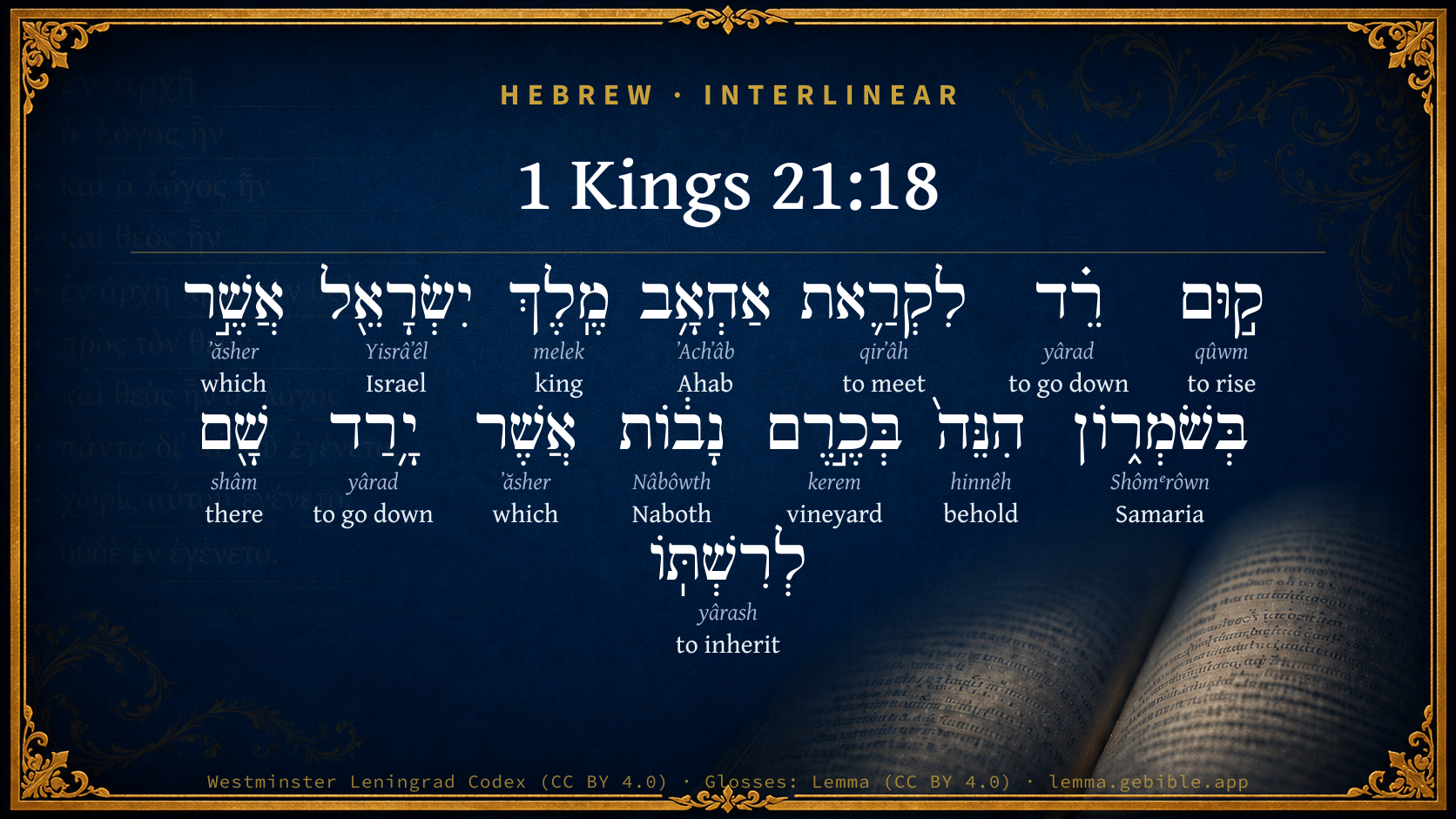
1 Kings 21:18

Hebrew (Westminster Leningrad Codex) 1 Kings 21:18 appears in the Hebrew Old Testament. The text above is from the Westminster Leningrad Codex. Each word links to its Strong’s number, a concise gloss, and parsing drawn from the Open Scriptures Hebrew Bible morphology. Click any word for its full Brown-Driver-Briggs (BDB) entry.
Download image
Cite this verse

1 Kings 21:18 (World English Bible). Public Domain. Lemma interlinear Bible study tool, https://lemma.gebible.app/v/1-kings/21/18.

Show BibTeX & RIS
BibTeX
RIS
English Translation
Arise, go down to meet Ahab king of Israel, who dwells in Samaria: behold, he is in the vineyard of Naboth, where he is gone down to take possession of it.
World English Bible · Public Domain
Download a study sheet

One document with this verse’s original text, its word-by-word gloss line, the meaning frame, cross-references with their text, attributed commentary, and full source and license credits — printable, and it pastes into notes with its structure intact.

This verse Autodidact and up

Study sheet (.html) Plain text (.txt)

A passage Seminary Student

Up to 50 verses in one chapter. A passage sheet keeps up to 6 commentary sources and 12 cross-references per verse, in the order this page ranks them, and says so on the sheet whenever that leaves anything out. Ask for a single verse and you get the Autodidact verse sheet above.

Everything on this page stays free to read, with no account — the sheet is a download of what is already on screen, not access to it.

Want to remove ads? Support Godless Engineer
Compare translations 3

The same verse in 3 English versions, stacked beneath the original-language interlinear above. Click any original word for its lexicon entry.

Each is an independent rendering of the whole verse — the interlinear is not word-aligned to these translations.

Highlighted words mark where these versions differ — a whole-verse word diff, not a word-by-word alignment.

  • World English Bible Public Domain
    Arise, go down to meet Ahab king of Israel, who dwells in Samaria: behold, he is in the vineyard of Naboth, where he is gone down to take possession of it.
  • King James Version Public Domain
    Arise, go down to meet Ahab king of Israel, which is in Samaria: behold, he is in the vineyard of Naboth, whither he is gone down to possess it.
  • unfoldingWord Literal Text CC BY-SA 4.0
    “Arise! Go down to meet Ahab, the king of Israel, who in Samaria. Behold, in the vineyard of Naboth, where he has gone down there to possess it.

unfoldingWord Literal Text — © unfoldingWord, licensed CC BY-SA 4.0. Word-aligned USFM3 via Door43 (git.door43.org/unfoldingWord/en_ult).

Versions to compare (up to 4)

3 of 4 selected

Show all 18 translations

Every available English version of this verse, each an independent rendering of the whole verse.

  • World English Bible Public Domain
    Arise, go down to meet Ahab king of Israel, who dwells in Samaria: behold, he is in the vineyard of Naboth, where he is gone down to take possession of it.
  • Berean Standard Bible Public Domain
    “Get up and go down to meet Ahab king of Israel, who is in Samaria. See, he is in the vineyard of Naboth, of which he has gone to take possession.
  • Majority Standard Bible Public Domain
    “Get up and go down to meet Ahab king of Israel, who is in Samaria. See, he is in the vineyard of Naboth, where he has gone to take possession of it.
  • King James Version Public Domain
    Arise, go down to meet Ahab king of Israel, which is in Samaria: behold, he is in the vineyard of Naboth, whither he is gone down to possess it.
  • American Standard Version (1901) Public Domain
    Arise, go down to meet Ahab king of Israel, who dwelleth in Samaria: behold, he is in the vineyard of Naboth, whither he is gone down to take possession of it.
  • Revised Version (1885) Public Domain
    Arise, go down to meet Ahab king of Israel, which dwelleth in Samaria: behold, he is in the vineyard of Naboth, whither he is gone down to take possession of it.
  • Geneva Bible (1599) Public Domain
    Arise, goe downe to meete Ahab King of Israel, which is in Samaria. loe, he is in the vineyarde of Naboth, whither he is gone downe to take possession of it.
  • Douay-Rheims (1899) Public Domain
    Arise, and go down to meet Achab king of Israel, who is in Samaria: behold he is going down to the vineyard of Naboth, to take possession of it:
  • Young's Literal Translation Public Domain
    `Rise, go down to meet Ahab king of Israel, who `is' in Samaria, -- lo, in the vineyard of Naboth, whither he hath gone down to possess it,
  • Literal Standard Version CC BY-SA 4.0
    “Rise, go down to meet Ahab king of Israel, who [is] in Samaria—behold, in the vineyard of Naboth, to where he has gone down to possess it,
  • Unlocked Literal Bible CC BY-SA 4.0
    “Get up and go meet Ahab king of Israel, who lives in Samaria. He is in the vineyard of Naboth, where he has gone to take possession of it.
  • unfoldingWord Literal Text CC BY-SA 4.0
    “Arise! Go down to meet Ahab, the king of Israel, who in Samaria. Behold, in the vineyard of Naboth, where he has gone down there to possess it.
  • Darby Bible Public Domain
    Arise, go down to meet Ahab king of Israel, who is in Samaria: behold, he is in the vineyard of Naboth, whither he is gone down to take possession of it.
  • World Messianic Bible Public Domain
    “Arise, go down to meet Ahab king of Israel, who dwells in Samaria. Behold, he is in the vineyard of Naboth, where he has gone down to take possession of it.
  • Webster's Bible Public Domain
    Arise, go down to meet Ahab king of Israel, who is in Samaria: behold, he is in the vineyard of Naboth, whither he is gone down to possess it.
  • Free Bible Version CC BY-SA 4.0
    “Go and meet Ahab, king of Israel, in Samaria. He is right now in Naboth's vineyard, where he has gone to claim ownership of it.
  • Bible in Basic English Public Domain
    Go down to Ahab, king of Israel, in Samaria; see, he is in the vine-garden of Naboth the Jezreelite, where he has gone to take it as his heritage.
  • JPS Tanakh (1917) Public Domain
    'Arise, go down to meet Ahab king of Israel, who dwelleth in Samaria; behold, he is in the vineyard of Naboth, whither he is gone down to take possession of it.

Literal Standard Version (2020), Covenant Press — licensed CC BY-SA 4.0. Text via the HelloAO Bible API (eBible.org). Unlocked Literal Bible (unfoldingWord) — licensed CC BY-SA 4.0. Text via the HelloAO Bible API (eBible.org). unfoldingWord Literal Text — © unfoldingWord, licensed CC BY-SA 4.0. Word-aligned USFM3 via Door43 (git.door43.org/unfoldingWord/en_ult). Free Bible Version, Dr. Jonathan Gallagher — licensed CC BY-SA 4.0. Text via the HelloAO Bible API (eBible.org).

Word by word

More ways to search: Search by grammar → Find every occurrence → Compare this word →

Practice this passage: Drill this verse → Learn its vocabulary →

נָב֔וֹת
Nâbôwth
H5022
“Naboth”
Noun, Proper
Part of Speech
Noun
Type
Proper
Full BDB Definition

Origin: from the same as H5011

TWOT: None

Naboth = "fruits" - the vineyard owner of Jezreel who Ahab and Jezebel had killed so that they could have his vineyard
  1. ק֣וּם qûwm H6965 “rise” Verb, Qal, Imperative, 2nd Person, Masculine, Singular
  2. רֵ֗ד yârad H3381 “go down” Verb, Qal, Imperative, 2nd Person, Masculine, Singular
  3. לִקְרַ֛את qirʼâh H7125 “to meet” Preposition + Verb, Qal, Infinitive Construct
  4. אַחְאָ֥ב ʼAchʼâb H256 “Ahab” Noun, Proper
  5. מֶֽלֶךְ melek H4428 “king of” Noun, Common, Masculine, Singular, Construct
  6. יִשְׂרָאֵ֖ל Yisrâʼêl H3478 “Israel” Noun, Proper
  7. אֲשֶׁ֣ר ʼăsher H834 “which” Particle, Relative
  8. בְּשֹׁמְר֑וֹן Shômᵉrôwn H8111 “in/at · Samaria” Preposition + Noun, Proper
  9. הִנֵּה֙ hinnêh H2009 “behold” Particle, Demonstrative
  10. בְּכֶ֣רֶם kerem H3754 “in/at · vineyard of” Preposition + Noun, Common, Both, Singular, Construct
  11. אֲשֶׁר ʼăsher H834 “which” Particle, Relative
  12. יָ֥רַד yârad H3381 “to go down” Verb, Qal, Perfect, 3rd Person, Masculine, Singular
  13. שָׁ֖ם shâm H8033 “there” Adverb
  14. לְרִשְׁתּֽוֹ yârash H3423 “to inherit · him” Preposition + Verb, Qal, Infinitive Construct + Suffix, Personal, 3rd Person, Masculine, Singular

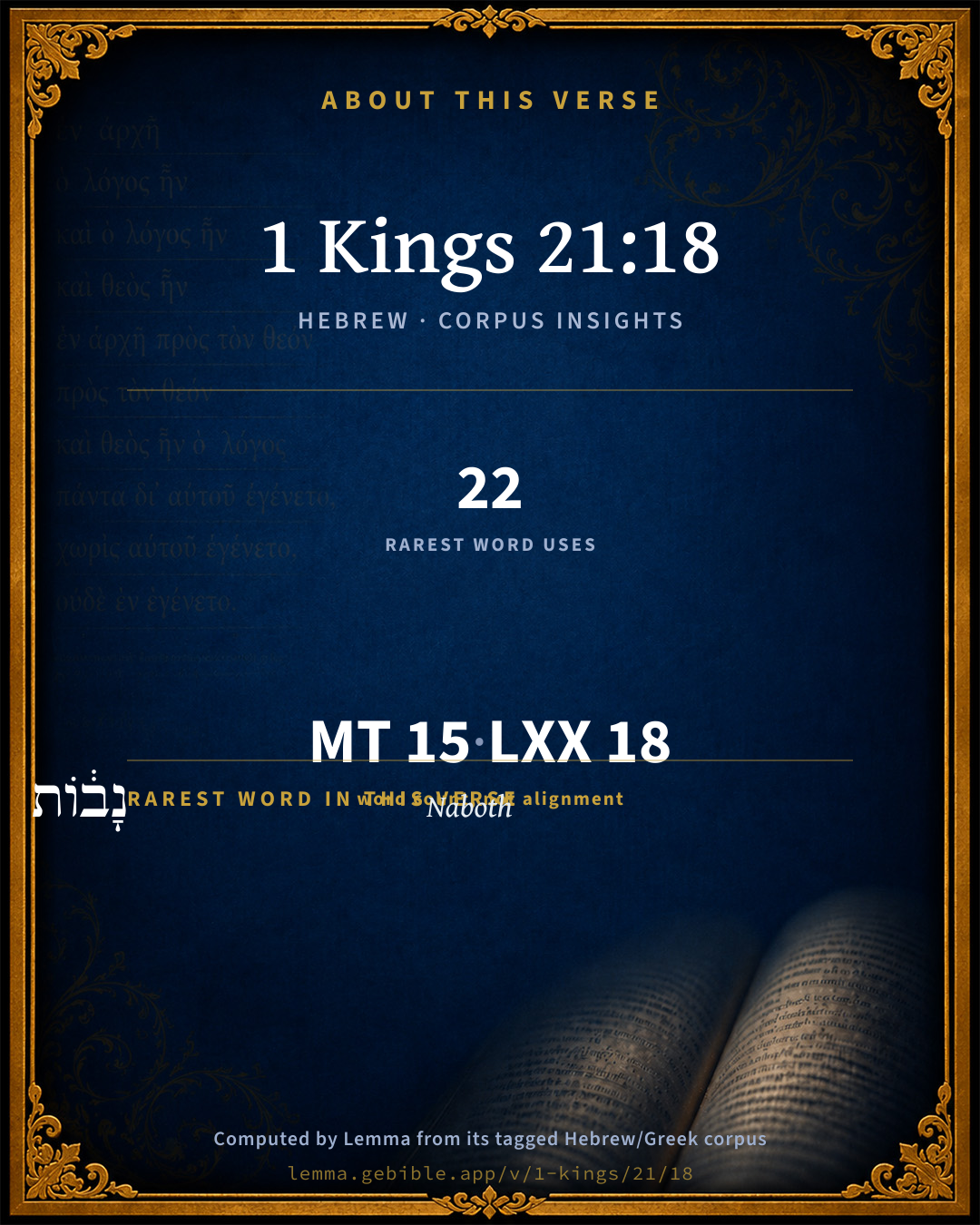
About this verse

These counts appear in no published source. They are computed here, from the morphology-tagged text and Lemma’s own curated glosses. What Lemma adds →

15
words
13
distinct lemmas
Historical
section

Notable vocabulary

The rarest word here is נָב֔וֹת Naboth H5022 — appearing just 22 times in the whole Hebrew Bible.

Shared distinctive vocabulary

נָב֔וֹת Naboth H5022 occurs in 18 verses of the Hebrew Bible. Also found in:

Grammatical profile

  • 5 verbs
  • 6 nouns
  • 1 adverb
  • 3 particles

Verb forms

  • ק֣וּם Qal · Imperative
  • רֵ֗ד Qal · Imperative
  • לִקְרַ֛את Qal · Infinitive Construct
  • יָ֥רַד Qal · Perfect
  • לְרִשְׁתּֽוֹ Qal · Infinitive Construct

Repetition

Words recur within this verse — often emphatic in Hebrew:

  • רֵ֗ד to go down H3381 ×2
  • אֲשֶׁ֣ר which H834 ×2

Hebrew & Septuagint length

In English translation the verse runs 31 words from the Hebrew and 23 from the Septuagint (LXX English) — closely comparable.

A rough comparison of the two English renderings, which tokenize alike — not a word-level alignment.

Word counts can differ between the Hebrew and the Greek without any difference in meaning — e.g. the Hebrew direct-object marker אֵת has no separate Greek word, and Greek often adds the article ὁ.

In the original languages it is 15 Hebrew tokens and 18 Greek tokens — but the two are counted differently (Hebrew bundles its prefixes and suffixes into one token; the Greek is in lemma form), so that isn’t a like-for-like length.

Cross-references

2

Topical passages linked to 1 Kings 21:18 in the Treasury of Scripture Knowledge — connected by theme and wording, ordered by reader-vote popularity; previews shown in the World English Bible.

  • 1 Kings 13:32 For the saying which he cried by the word of Yahweh against the altar in Bethel, and against all the houses of the high places which are in the cities of Samaria, shall surely happen.
  • 2 Chronicles 22:9 He sought Ahaziah, and they caught him (now he was hiding in Samaria), and they brought him to Jehu, and killed him; and they buried him, for they said, He is the son of Jehoshaphat, who sought Yahweh with all his heart. The house of Ahaziah had no power to hold the kingdom.

Cross-references courtesy of OpenBible.info (CC BY 4.0).

Hebrew and Greek witnesses Masoretic Hebrew ↔ Greek Septuagint

The same verse in the two great witnesses to the Old Testament, shown verse-for-verse.

These are two independent witnesses, not word-aligned to each other, and the Septuagint is shown in lemma (dictionary) form.

Hebrew 1 Kings 21:18 Masoretic · Westminster Leningrad Codex

ק֣וּם רֵ֗ד לִקְרַ֛את אַחְאָ֥ב מֶֽלֶךְ יִשְׂרָאֵ֖ל אֲשֶׁ֣ר בְּשֹׁמְר֑וֹן הִנֵּה֙ בְּכֶ֣רֶם נָב֔וֹת אֲשֶׁר יָ֥רַד שָׁ֖ם לְרִשְׁתּֽוֹ

Arise, go down to meet Ahab king of Israel, who dwells in Samaria: behold, he is in the vineyard of Naboth, where he is gone down to take possession of it.

World English Bible · Public Domain

Greek LXX 1 Kings 21:18 Septuagint · lemma form

καί εἶπον αὐτός εἰ εἰς εἰρήνη οὗτος ἐκπορεύομαι συνλαμβάνω αὐτός ζάω καί εἰ εἰς πόλεμος ζάω συνλαμβάνω αὐτός

And he said to them, If they come forth peaceably, take them alive; and if they come forth to war, take them alive:

LXX2012 (modern English Septuagint) · Public Domain

Hebrew: Westminster Leningrad Codex (CC BY 4.0). Greek: Septuagint (public domain); English from LXX2012 (modern English Septuagint) (Public Domain). How the Septuagint differs from the Hebrew →

Targum (Aramaic paraphrase)

1

The Targum is the ancient Jewish Aramaic paraphrase of the Hebrew Scriptures — an interpretive translation, not the Hebrew text itself. Onkelos (literal) and Pseudo-Jonathan (expansive) render the Torah, and Jonathan the Prophets. Coverage is partial: where no permissively-licensed English translation exists for a verse, only the Aramaic is shown. This is verse-level text, not a word-by-word alignment to the Hebrew.

  1. Targum Jonathan Prophets (Joshua–Malachi)
    קוּם חוּת לִקֳדָמוּת אַחְאָב מַלְכָּא דְיִשְׂרָאֵל דִי בְשֹׁמְרוֹן הָא הוּא בְּכַרְמָא דְנָבוֹת דִנְחַת תַּמָן לְמֵירְתֵיהּ:

    (no public-domain English translation for this verse)

    Targum Jonathan — Aramaic: “Mikraot Gedolot” (public domain). English: “Sefaria Community Translation” (CC0 1.0 (public-domain dedication)); “London "Chaldee Paraphrase," 1871” (public domain). Text via Sefaria.

Commentary

Notes on 1 Kings 21:18 from classic Christian and Jewish commentators (each source and its license shown beneath its notes). The classic Christian expositions comment on the surrounding passage and are grouped to its opening verse, so a note may address several verses; the Jewish commentaries on the Tanakh (Rashi and others) are per-verse, so they appear only where the commentator wrote on this verse.

Lemma curates 59 commentaries, every one of them public domain or Creative Commons licensed, each selected and text-cleaned for this edition rather than reprinted as found. About our sources →

Trapp's Complete Commentary

John Trapp

1Ki 21:18 Arise, go down to meet Ahab king of Israel, which [is] in Samaria: behold, [he is] in the vineyard of Naboth, whither he is gone down to possess it.

Ver. 18. Which is in Samaria.] There was Ahab when the message was given in charge to Elias; but in the vineyard at Jezreel when Elias met him.

John Trapp, A Commentary or Exposition upon All the Books of the Old and New Testament (1647–1656) — public domain. Text from a community e-Sword module.

Joseph Benson's Commentary

1Ki 21:18-19. Arise, go to meet Ahab, which is in Samaria — That is, who reigns in Samaria. Behold, he is in the vineyard of Naboth — Or, rather, he will be there by the time thou comest thither. And speak unto him, Hast thou killed and also taken possession? — Thou hast murdered an innocent and righteous man; and, instead of repenting of thy crime, hast added another piece of injustice and violence to it, and art going, confidently and cheerfully, to reap the fruit of thy wickedness. He ascribes Jezebel’s act to Ahab, because Jezebel did it by his connivance, consent, and authority, and for the gratification of his inordinate desire. In the place where dogs licked, &c. — Instead of the place, some would render the original word here used, the manner, and so the sense of the passage will be, As the dogs licked, or, in like manner as they licked Naboth’s blood, even so shall they lick thy blood: mark what I say, even thine. According to this reading, the prophet foretold that this judgment should come upon him, but did not assign the place; accordingly, the dogs licked Ahab’s blood, not in Jezreel, but in Samaria, 1Ki 22:38. If, however, our translation be preferred, it may be observed, 1st, Ahab’s blood was licked by the dogs, if not in the same individual, yet in the same general place, Jezreel being in the territory of Samaria. 2d, This was particularly accomplished in his son Joram, as is affirmed 2Ki 9:25-26, whose blood is not improperly called Ahab’s, children being said to be born of their parents’ blood. The expression, indeed, thy blood, even thine, seems to show that the threatening was at first denounced against Ahab’s person, and designed to be fulfilled in him: but afterward, upon his humiliation, the punishment was in part transferred from him to his son, as is expressed 1Ki 21:29; yet upon Ahab’s returning to sin, as is related in the next chapter, he brought back the curse upon himself, and so it is no wonder that it was in some sort fulfilled in him also.

Joseph Benson's Commentary on the Old and New Testaments (1811–1818) — public domain. Text from a community e-Sword module.

Adam Clarke's Commentary

Verse 18. Go down to meet Ahab] This was the next day after the murder, as we learn from the above quotation, 2Kg 9:26.

Adam Clarke's Commentary on the Bible (1810–1826) — public domain. Text from a community e-Sword/MySword module.

Ellicott's Commentary for English Readers

(18) Which is in Samaria.—These words are almost unmeaning, unless they literally signify that Ahab was then in Samaria, not in Jezreel. To interpret them as simply part of Ahab’s title, or as signifying the country, not the town of Samaria, is to explain them away.

A Bible Commentary for English Readers, edited by Charles John Ellicott (1878–1897) — public domain. Text from a community e-Sword module.

The Cambridge Bible for Schools and Colleges

gen. ed. J. J. S. Perowne

17–29. Elijah meets Ahab and tells him God’s sentence. Ahab repents and the punishment is deferred (Not in Chronicles)

18. which is [R.V. dwelleth] in Samaria] This change is necessary for consistency in the narrative. There is no verb in the original, as will be seen from the italics of A. V. The verbs describing the action first of Ahab and then of Elijah, shew that both had gone down, the one from Samaria, and the other, perhaps, from Carmel, to the city of Jezreel, which lay on lower ground than either.

to possess it] R.V. to take possession of it. Thus it is shewn that the expression is the same as in 1Ki_21:15-16; 1Ki_21:19.

The Cambridge Bible for Schools and Colleges (gen. ed. J. J. S. Perowne; Cambridge University Press, 1878–1918) — public domain. Text from a community e-Sword module.

John Gill's Exposition

And will make thine house like the house of Jeroboam the son of Nebat, and like the house of Baasha the son of Ahijah,.... Two of his predecessors, whose families were utterly destroyed, Kg1 15:29,

for the provocation wherewith thou hast provoked me to anger, and made Israel to sin: not only by his worship of the calves, but of the idols of the Zidonians, particularly Baal, and also of the Amorites, Kg1 21:26.

John Gill's Exposition of the Whole Bible (1746–1763) — public domain (CC PDM 1.0). Text via the HelloAO Bible API.

Matthew Poole's English Annotations

Which is in Samaria; either who now is there, and about to depart thence to Jezreel; or who commonly dwells there.

He is in the vineyard, or rather, he will be; by that time that thou comest thither thou shalt find him there.

Matthew Poole's English Annotations on the Holy Bible (1683–1685) — public domain. Text from a community e-Sword/MySword module.

Whedon's Commentary on the Bible

Daniel D. Whedon

ELIJAH’S PROPHECY AGAINST AHAB, 1Ki_21:17-29.

18. Which is in Samaria — Or, who reigns in Samaria. The words merely designate the seat of Ahab’s government, and his usual place of residence; not that the prophet is to meet Ahab in Samaria, or that Naboth’s vineyard was in Samaria.

Daniel D. Whedon (gen. ed.), Commentary on the Old and New Testaments (1874–1909) — public domain. Text from a community e-Sword module.

The Pulpit Commentary

Arise, go down Bahr hence concludes that Elijah was at this time in a mountain district. But wherever he might be, this word would probably be used of journey to the plain of Esdraelon to meet "The word. 1Sa_17:48 of David going out to meet Goliath (Stanley) But the same word is used (1Sa_18:6) of the women going out to meet Saul, and indeed it is the usual word for all meetings. We cannot hence infer, consequently, that Elijah went forth as if to encounter a foe Ahab king of Israel, which is in Samaria i.e., whose seat is in Samaria; who rules there. There is no need to understand the word of the territory of Samaria: behold, he is in the vineyard of Naboth, whither he is gone down to possess it. The words imply that Elijah found Ahab strode into his presence in the vineyard; not that he was there already when the royal chariot entered it (Stanley).

The Pulpit Commentary (1880–1919), ed. H.D.M. Spence-Jones & Joseph S. Exell — public domain. Text from a community e-Sword module.

Lesson kit

Teaching starters — assembled from the data on this page, not authored interpretation. Every prompt links to the verse data it draws on. Edit before teaching.

1 Kings, in the Historical, opens this verse with 15 words (13 distinct Hebrew lemmas). Its most distinctive word is Nâbôwth (“Naboth”). A historical commentator’s framing appears above. Read the whole chapter for the surrounding context.

Discussion questions

  1. How does “Naboth” (Nâbôwth) shape what this verse is saying?
  2. How does 1 Kings 21:1, which shares the word «Naboth», read alongside this verse?
  3. What does the repetition of “to go down” (2× in this one verse) do in this verse?
  4. These translations render this verse differently; the difference is in the English rendering, not the original. What questions does that raise?
  5. «ק֣וּם» is a Qal Imperative verb. How does that grammatical form shape the action described?
  6. Compare how Trapp's Complete Commentary and Joseph Benson's Commentary read this verse. Where do they agree or differ?

Things to notice

Reading settings

Reading text

Shown beneath each verse's original-language words.

Old Testament
Old Testament edition

Read the OT as the Masoretic Hebrew (MT) or the Greek Septuagint (LXX).

English shown for the Greek Septuagint (in the Hebrew ↔ Greek comparison).

Comparing translations? Open the Compare panel on any verse page to stack up to four side by side.