
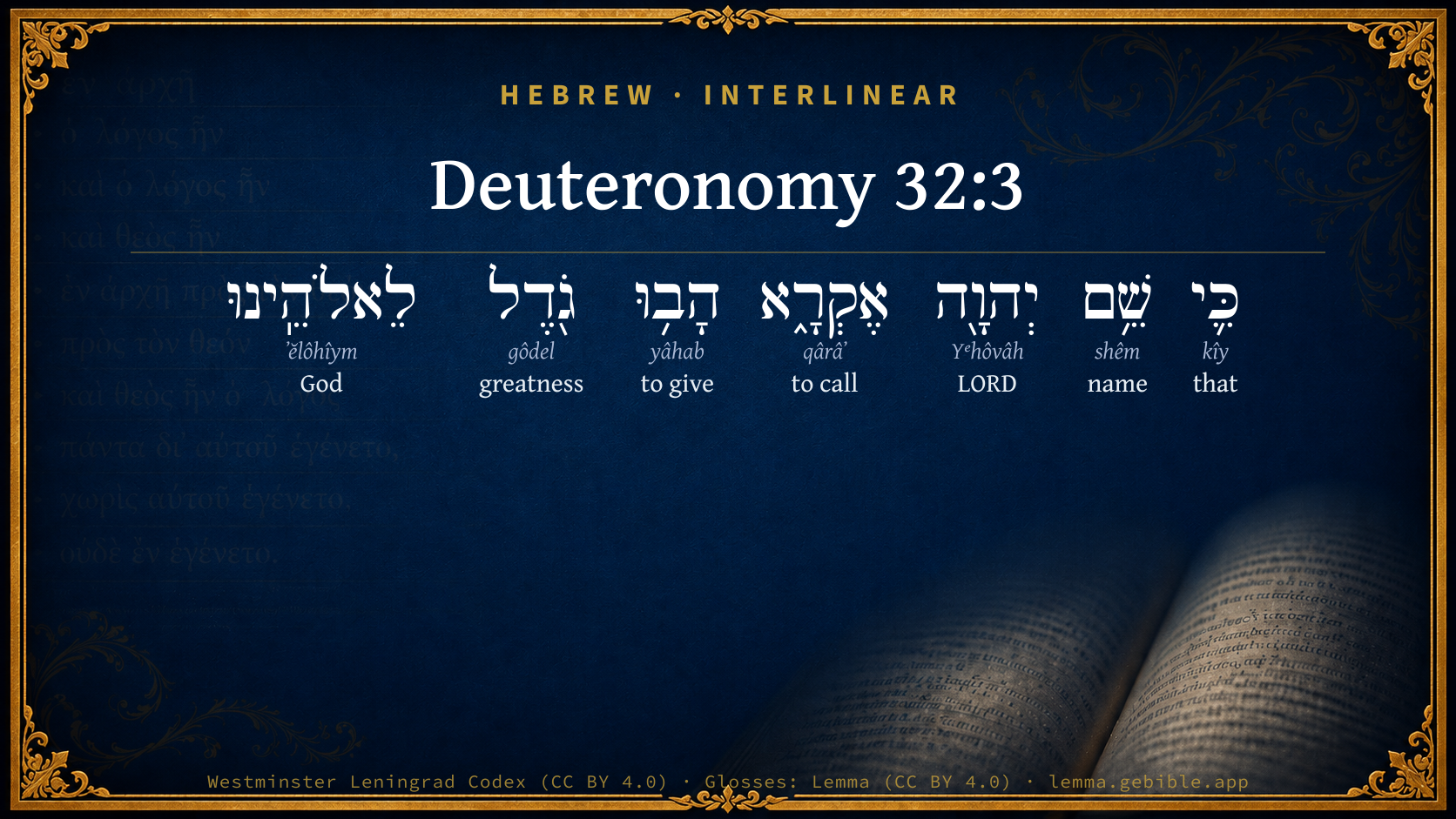
Deuteronomy 32:3

Hebrew (Westminster Leningrad Codex) Deuteronomy 32:3 appears in the Hebrew Old Testament. The text above is from the Westminster Leningrad Codex. Each word links to its Strong’s number, a concise gloss, and parsing drawn from the Open Scriptures Hebrew Bible morphology. Click any word for its full Brown-Driver-Briggs (BDB) entry.
Download image
Cite this verse

Deuteronomy 32:3 (World English Bible). Public Domain. Lemma interlinear Bible study tool, https://lemma.gebible.app/v/deuteronomy/32/3.

Show BibTeX & RIS
BibTeX
RIS
English Translation
For I will proclaim the name of Yahweh: Ascribe greatness to our God.
World English Bible · Public Domain
Download a study sheet

One document with this verse’s original text, its word-by-word gloss line, the meaning frame, cross-references with their text, attributed commentary, and full source and license credits — printable, and it pastes into notes with its structure intact.

This verse Autodidact and up

Study sheet (.html) Plain text (.txt)

A passage Seminary Student

Up to 50 verses in one chapter. A passage sheet keeps up to 6 commentary sources and 12 cross-references per verse, in the order this page ranks them, and says so on the sheet whenever that leaves anything out. Ask for a single verse and you get the Autodidact verse sheet above.

Everything on this page stays free to read, with no account — the sheet is a download of what is already on screen, not access to it.

Want to remove ads? Support Godless Engineer
Compare translations 3

The same verse in 3 English versions, stacked beneath the original-language interlinear above. Click any original word for its lexicon entry.

Each is an independent rendering of the whole verse — the interlinear is not word-aligned to these translations.

Highlighted words mark where these versions differ — a whole-verse word diff, not a word-by-word alignment.

  • World English Bible Public Domain
    For I will proclaim the name of Yahweh: Ascribe greatness to our God.
  • King James Version Public Domain
    Because I will publish the name of the LORD: ascribe ye greatness unto our God.
  • unfoldingWord Literal Text CC BY-SA 4.0
    For the name of Yahweh I proclaim; ascribe greatness to our God!

unfoldingWord Literal Text — © unfoldingWord, licensed CC BY-SA 4.0. Word-aligned USFM3 via Door43 (git.door43.org/unfoldingWord/en_ult).

Versions to compare (up to 4)

3 of 4 selected

Show all 18 translations

Every available English version of this verse, each an independent rendering of the whole verse.

  • World English Bible Public Domain
    For I will proclaim the name of Yahweh: Ascribe greatness to our God.
  • Berean Standard Bible Public Domain
    For I will proclaim the name of the LORD. Ascribe greatness to our God!
  • Majority Standard Bible Public Domain
    For I will proclaim the name of the LORD. Ascribe greatness to our God!
  • King James Version Public Domain
    Because I will publish the name of the LORD: ascribe ye greatness unto our God.
  • American Standard Version (1901) Public Domain
    For I will proclaim the name of Jehovah: Ascribe ye greatness unto our God.
  • Revised Version (1885) Public Domain
    For I will proclaim the name of the LORD: Ascribe ye greatness unto our God.
  • Geneva Bible (1599) Public Domain
    For I will publish the name of the Lord: giue ye glorie vnto our God.
  • Douay-Rheims (1899) Public Domain
    Because I will invoke the name of the Lord: give ye magnificence to our God.
  • Young's Literal Translation Public Domain
    For the Name of Jehovah I proclaim, Ascribe ye greatness to our God!
  • Literal Standard Version CC BY-SA 4.0
    For I proclaim the Name of YHWH; Ascribe greatness to our God!
  • Unlocked Literal Bible CC BY-SA 4.0
    For I will proclaim the name of Yahweh, and ascribe greatness to our God.
  • unfoldingWord Literal Text CC BY-SA 4.0
    For the name of Yahweh I proclaim; ascribe greatness to our God!
  • Darby Bible Public Domain
    For the name of Jehovah will I proclaim: Ascribe greatness unto our God!
  • World Messianic Bible Public Domain
    For I will proclaim the LORD’s name. Ascribe greatness to our God!
  • Webster's Bible Public Domain
    Because I will publish the name of the LORD: ascribe ye greatness to our God.
  • Free Bible Version CC BY-SA 4.0
    I will praise the Lord's character. Tell everyone how great he is!
  • Bible in Basic English Public Domain
    For I will give honour to the name of the Lord: let our God be named great.
  • JPS Tanakh (1917) Public Domain
    For I will proclaim the name of the LORD; ascribe ye greatness unto our God.

Literal Standard Version (2020), Covenant Press — licensed CC BY-SA 4.0. Text via the HelloAO Bible API (eBible.org). Unlocked Literal Bible (unfoldingWord) — licensed CC BY-SA 4.0. Text via the HelloAO Bible API (eBible.org). unfoldingWord Literal Text — © unfoldingWord, licensed CC BY-SA 4.0. Word-aligned USFM3 via Door43 (git.door43.org/unfoldingWord/en_ult). Free Bible Version, Dr. Jonathan Gallagher — licensed CC BY-SA 4.0. Text via the HelloAO Bible API (eBible.org).

Word by word

More ways to search: Search by grammar → Find every occurrence → Compare this word →

Practice this passage: Drill this verse → Learn its vocabulary →

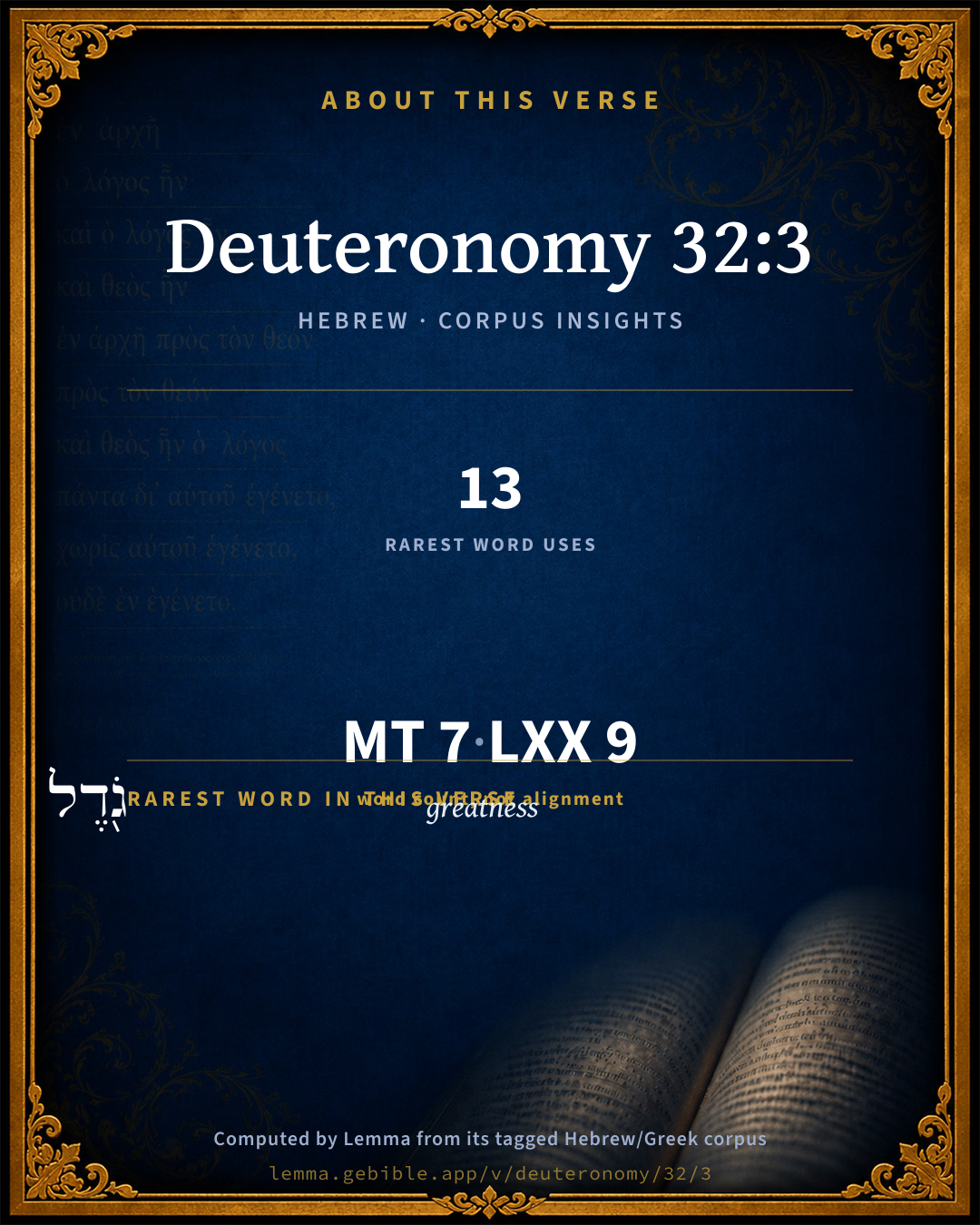
About this verse

These counts appear in no published source. They are computed here, from the morphology-tagged text and Lemma’s own curated glosses. What Lemma adds →

7
words
7
distinct lemmas
Pentateuch
section

Notable vocabulary

The rarest word here is גֹ֖דֶל greatness H1433 — appearing just 13 times in the whole Hebrew Bible.

Shared distinctive vocabulary

גֹ֖דֶל greatness H1433 occurs in 13 verses of the Hebrew Bible. Also found in:

Grammatical profile

  • 2 verbs
  • 4 nouns
  • 1 conjunction

Verb forms

  • אֶקְרָ֑א Qal · Imperfect
  • הָב֥וּ Qal · Imperative

Hebrew & Septuagint length

In English translation the verse runs 13 words from the Hebrew and 16 from the Septuagint (LXX English) — closely comparable.

A rough comparison of the two English renderings, which tokenize alike — not a word-level alignment.

Word counts can differ between the Hebrew and the Greek without any difference in meaning — e.g. the Hebrew direct-object marker אֵת has no separate Greek word, and Greek often adds the article ὁ.

In the original languages it is 7 Hebrew tokens and 9 Greek tokens — but the two are counted differently (Hebrew bundles its prefixes and suffixes into one token; the Greek is in lemma form), so that isn’t a like-for-like length.

Cross-references

20

Topical passages linked to Deuteronomy 32:3 in the Treasury of Scripture Knowledge — connected by theme and wording, ordered by reader-vote popularity; previews shown in the World English Bible.

  • Jeremiah 10:6 There is none like you, Yahweh; you are great, and your name is great in might.
  • Psalms 150:2 Praise him for his mighty acts! Praise him according to his excellent greatness!
  • Deuteronomy 5:24 and you said, Behold, Yahweh our God has shown us his glory and his greatness, and we have heard his voice out of the midst of the fire: we have seen this day that God does speak with man, and he lives.
  • Ephesians 1:19 and what is the exceeding greatness of his power toward us who believe, according to that working of the strength of his might
  • Exodus 6:3 and I appeared to Abraham, to Isaac, and to Jacob, as God Almighty; but by my name Yahweh I was not known to them.
  • Exodus 33:19 He said, "I will make all my goodness pass before you, and will proclaim the name of Yahweh before you. I will be gracious to whom I will be gracious, and will show mercy on whom I will show mercy."
  • Deuteronomy 3:24 Lord Yahweh, you have begun to show your servant your greatness, and your strong hand: for what god is there in heaven or in earth, that can do according to your works, and according to your mighty acts?
  • 1 Chronicles 29:11 Yours, Yahweh, is the greatness, the power, the glory, the victory, and the majesty: for all that is in the heavens and in the earth is yours. Yours is the kingdom, Yahweh, and you are exalted as head above all.
  • Jeremiah 23:6 In his days Judah shall be saved, and Israel shall dwell safely; and this is his name by which he shall be called: Yahweh our righteousness.
  • Matthew 1:23 "Behold, the virgin shall be with child, And shall bring forth a son. They shall call his name Immanuel;" Which is, being interpreted, "God with us."
  • John 17:6 I revealed your name to the people whom you have given me out of the world. They were yours, and you have given them to me. They have kept your word.
  • John 17:26 I made known to them your name, and will make it known; that the love with which you loved me may be in them, and I in them."
  • Exodus 3:13–16 Moses said to God, "Behold, when I come to the children of Israel, and tell them, 'The God of your fathers has sent me to you;' and they ask me, 'What is his name?' What should I tell them?"
  • 1 Chronicles 17:19 Yahweh, for your servant's sake, and according to your own heart, have you worked all this greatness, to make known all [these] great things.
  • Psalms 29:1–2 Ascribe to Yahweh, you sons of the mighty, Ascribe to Yahweh glory and strength.
  • Psalms 89:16–18 In your name they rejoice all day. In your righteousness, they are exalted.
  • Psalms 105:1–5 Give thanks to Yahweh! Call on his name! Make his doings known among the peoples.
  • Exodus 20:24 You shall make an altar of earth for me, and shall sacrifice on it your burnt offerings and your peace-offerings, your sheep and your oxen. In every place where I record my name I will come to you and I will bless you.
  • Exodus 34:5–7 Yahweh descended in the cloud, and stood with him there, and proclaimed the name of Yahweh.
  • Psalms 145:1–10 I will exalt you, my God, the King. I will praise your name forever and ever.

Cross-references courtesy of OpenBible.info (CC BY 4.0).

Hebrew and Greek witnesses Masoretic Hebrew ↔ Greek Septuagint

The same verse in the two great witnesses to the Old Testament, shown verse-for-verse.

These are two independent witnesses, not word-aligned to each other, and the Septuagint is shown in lemma (dictionary) form.

Hebrew Deuteronomy 32:3 Masoretic · Westminster Leningrad Codex

כִּ֛י שֵׁ֥ם יְהוָ֖ה אֶקְרָ֑א הָב֥וּ גֹ֖דֶל לֵאלֹהֵֽינוּ

For I will proclaim the name of Yahweh: Ascribe greatness to our God.

World English Bible · Public Domain

Greek LXX Deuteronomy 32:3 Septuagint · lemma form

ὅτι ὄνομα κύριος καλέω δίδωμι μεγαλωσύνη ὁ θεός ἐγώ

For I have called on the name of the Lord: assign you⌃ greatness to our God.

LXX2012 (modern English Septuagint) · Public Domain

Hebrew: Westminster Leningrad Codex (CC BY 4.0). Greek: Septuagint (public domain); English from LXX2012 (modern English Septuagint) (Public Domain). How the Septuagint differs from the Hebrew →

Targum (Aramaic paraphrase)

2

The Targum is the ancient Jewish Aramaic paraphrase of the Hebrew Scriptures — an interpretive translation, not the Hebrew text itself. Onkelos (literal) and Pseudo-Jonathan (expansive) render the Torah, and Jonathan the Prophets. Coverage is partial: where no permissively-licensed English translation exists for a verse, only the Aramaic is shown. This is verse-level text, not a word-by-word alignment to the Hebrew.

  1. Targum Onkelos Torah (Genesis–Deuteronomy)
    אֲרֵי בִּשְׁמָא דַיְיָ אֲנָא מְצַלֵי הָבוּ רְבוּתָא קֳדָם אֱלָהָנָא

    (no public-domain English translation for this verse)

    Targum Onkelos — Aramaic: “Onkelos Genesis” (public domain); “Onkelos Exodus” (public domain); “Onkelos Leviticus” (public domain); “Onkelos Numbers” (public domain); “Onkelos Deuteronomy” (public domain). English: “Sefaria Community Translation” (CC0 1.0 (public-domain dedication)); “J.W. Etheridge. The Targums of Onkelos and Jonathan Ben Uzziel on the Pentateuch. London: Longmans, Green, 1862” (public domain). Text via Sefaria.

  2. Targum Pseudo-Jonathan Torah (Genesis–Deuteronomy)
    וַוי לְהוֹן לְרַשִׁיעַיָא דִמְדַכְרִין שְׁמָא קַדִישָׁא בְּגִידוּפִין אֲרוּם משֶׁה דַהֲוָה רַבְּהוֹן דְיִשְרָאֵל לָא הֲוָה אֶפְשַׁר לֵיהּ לְמִדְכַּר יַת שְׁמָא קַדִישָׁא עַד דַהֲוָה מְחַנִיךְ פּוּמֵיהּ בְּרֵישׁ שִׁירָתָא בִּתְמַנְיָין וְחַמְשָׁא אָתִין דְהִינוּן עַשְרִין וְחַד מִלִין וּמִן בָּתַר כְּדֵין אָמַר אֲרוּם בִּשְׁמָא דַיְיָ אֲנָא מְצַלֵי וְאַתּוּן עַמָא בֵּית יִשְרָאֵל הָבוּ אִיקַר וּרְבוּתָא קֳדָם אֱלָהָנָא

    Woe to the wicked who make memorial of the Holy Name with blasphemies. Wherefore Mosheh, who was the Doctor of Israel, would not permit himself to pronounce the Holy Name until he had dedicated his mouth at the beginning of his hymn with eighty and five letters, making twenty and one words, and afterwards be spake: In the Name of the Lord I invoke you, O house of Israel, to ascribe glory and greatness before our God.

    Targum Pseudo-Jonathan — Aramaic: “Targum Jonathan on Genesis” (public domain); “Targum Jonathan on Exodus” (public domain); “Targum Jonathan on Leviticus” (public domain); “Targum Jonathan on Numbers” (public domain); “Targum Jonathan on Deuteronomy” (public domain). English: “The Targum of Jonathan ben Uzziel, trans. J. W. Etheridge, London, 1862” (public domain). Text via Sefaria.

Commentary

Notes on Deuteronomy 32:3 from classic Christian and Jewish commentators (each source and its license shown beneath its notes). The classic Christian expositions comment on the surrounding passage and are grouped to its opening verse, so a note may address several verses; the Jewish commentaries on the Tanakh (Rashi and others) are per-verse, so they appear only where the commentator wrote on this verse.

Lemma curates 59 commentaries, every one of them public domain or Creative Commons licensed, each selected and text-cleaned for this edition rather than reprinted as found. About our sources →

Trapp's Complete Commentary

John Trapp

Deu 32:3 Because I will publish the name of the LORD: ascribe ye greatness unto our God.

Ver. 3. Ascribe ye greatness,] i.e., Tremble at his word, and take it to heart. See 1Th 2:13.

John Trapp, A Commentary or Exposition upon All the Books of the Old and New Testament (1647–1656) — public domain. Text from a community e-Sword module.

The Biblical Illustrator

Joseph S. Exell

Deu_32:3

Ascribe ye greatness unto our God.

The greatness of God

I. Our primary concern should be to attempt to realise the greatness of God, however inadequate all our conceptions may be.

1. His underived, independent, and eternal existence. In this His nature stands out in distinction from all created being.

2. The infinitude of His knowledge. There is no evading His glance, no travelling beyond the reach of His omniscience, no baffling His skill, no frustrating His plans, no searching of His understanding.

3. The boundlessness of His power and dominion. Great is the Lord, and of great power. Take the microscope, and all the orders of existence which it reveals are embraced in His providence. Take the telescope, and as worlds on worlds pass before your vision, you only survey other parts of His great and boundless empire.

4. The grandeur of His moral perfections. His holiness is unspotted, the standard and pattern of righteousness to all creatures and to all worlds. His goodness is vast and unutterable. It gave us His unspeakable gift. His faithfulness endureth to all generations, giving stability to the world which He created.

II. The practical lessons enforced in the call to ascribe greatness to our God.

1. Our adoration is a fitting tribute to His greatness and majesty. Whoso offereth praise glorifieth Me. It is the acknowledgment on our part of His natural and moral perfections.

2. It is not only, however, by the direct exercise of adoration that we are to fulfil the exhortation of the text, but by cultivating a humbling impression of the Divine Majesty ever on our hearts. What humility should we, as creatures, cherish in the presence of the greatness of God! What lowliness of spirit should there be in our supplications and pleadings with God! How unseemly is all that is irreverential before Him!

3. Whilst the Divine greatness should humble us, however, it may also inspire us with confidence, if living and walking before Him. What a friend and helper is He to those who loyally serve Him! It is related of one of the greatest of the French preachers that, when called to preach a funeral discourse for Louis XIV before a crowded audience and in the presence of the French Court, he broke the hushed silence of the vast assembly when he entered the pulpit and began to speak, by the exclamation, There is nothing great but God, and then, having nerved himself for his work, addressed himself to his subject. In sorest bereavements He can sustain, and in the solemn void which they have created can make His own presence all the more realisingly felt. Specially let us cherish such confidence in reference to the interests of religion in the world, and look forward to a great future for the Church of God, though earth and hell oppose. (E. T. Prust.)

The Great Supreme

I. A caution. In as much as Moses had said, Ascribe ye greatness unto our God, he intended to hint to us that we ought to ascribe greatness to none else.

1. If I worship a created being, if I seek the intercession of any save the one Person who is ordained to be the Mediator between God and man, the Man Christ Jesus, I do in that degree derogate from the greatness of God.

2. Though we do not bow down and worship images, yet, I am sorry to say, there is scarce a congregation that is free from that error of ascribing greatness to their minister. If souls are converted, how very prone we are to think there is something marvellous in the man. We are but your servants for Christs sake.

3. Pay deference unto authorities as ye should do; but if in aught they swerve, remember your knee must bow to God, and to God alone. If in aught there be anything wrong, though it should have a sovereigns name attached to it, remember one is your Master and King.

4. In the case of those who are in the employ of masters, it is but right that they should render unto their masters that which is their due; but when the master commands that which is wrong, allow me solemnly to caution you against giving to him anything which you are not bound to do. Your master tells you you must break the Sabbath. You do it because he is your master; ye have violated this command, for it is said, Ascribe ye greatness unto God.

5. This text has a bearing upon certain philosophic creeds which I will just hint at. Some men, instead of ascribing greatness to God, ascribe greatness to the laws of nature, and to certain powers and forces which they believe govern the universe. They look up on high; their eyes see the marvellous orbs walking in their mystery along the sky. They say, What stupendous laws are those which govern the universe! And ye will see in their writings that they ascribe everything to law and nothing to God. Now, all this is wrong. Law without God is nothing. God puts force into law, and if God acts by laws in the government of the material universe, yet it is the force of God which moves the worlds along and keeps them in their places. Law without God is nullity. Reject every philosophy that does not ascribe greatness to God, for there is a worm at the root of it, and it yet shall be destroyed.

II. A command.

1. This command comes to the sinner when he first begins seriously to consider his position before God. When you look at your sins ascribe greatness to Gods justice.

2. Let the sinner who is already convinced of thin ascribe greatness to Gods mercy. Further, let me appeal to the Christian, Ascribe ye greatness unto our God. Thou art in trouble; thou art wearied with the hardness of thy journey; thy poverty has got hold of thee. It is a dark night with thee just now; thou seest not thy signs; thou hast no sweet promise to light upon. Ascribe ye greatness unto our God. Great as your troubles are, remember He is greater. And when the devil tempts you to believe that God cannot help you, tell him that you think better of Him than that; you ascribe greatness to the Almighty, and you believe He is great enough to deliver you from all your sorrows. (C. H. Spurgeon.)

The greatness of God

I. Offer a few remarks on the nature of Gods greatness.

1. Greatness is not a distinct attribute of the Divine nature, but an excellency which belongs to all His attributes. Whatever is in God is great. He is great in His wisdom, power, justice, goodness, and truth. There is such a mixture of greatness and goodness in God, that those who know Him best will fear and love Him most; and even devils are constrained to believe and tremble.

2. There is an essential and also a relative greatness in God, a greatness interwoven in the whole of His character, and appearing in all His works. Is He our Father? He is our Father who is in heaven, dwelling in the most exalted state of majesty; demanding our reverence and exciting our highest hopes (Ecc_5:2). Is He a King? He is a great King, the King of kings.

3. The greatness of God is unsearchable and incomprehensible. With increasing knowledge we shall have an increasing sense of our own deficiency.

II. Inquire in what manner we are to ascribe greatness to God.

1. We are to ascribe greatness to our God by acknowledging and declaring His greatness and His glory.

2. In ascribing greatness to the Lord, we are to do it practically; not only with our lips, but in our lives.

3. In approaching to God with reverence and holy fear we ascribe to Him the glory due unto His name, striving against wandering thoughts and vain imaginations, and cherishing a deep sense of our own unworthiness. The higher we rise in our apprehensions of God, the lower we shall fall in our own esteem.

4. By entertaining the most enlarged expectations from God we in effect ascribe greatness to Him. Great faith ought to be exercised towards a great God; nor should we say, Can He pardon? can He help? or can He save? for what can He not do? What wants are so great that He cannot supply? what works so great that He cannot enable us to perform? what burdens so great that He cannot support us under? what dangers so great that He cannot deliver us out of them?

5. If we ascribe greatness to the Lord, that greatness will be to us a matter of joy and gladness, and we shall glory in His holy name.

6. Fearing to offend against God, and dreading His displeasure, are included in the duty prescribed. (B. Beddome, M. A.)

The Biblical Illustrator, edited by Joseph S. Exell (c. 1880s–1900s) — public domain. Text from a community e-Sword module.

Joseph Benson's Commentary

Deu 32:3. I will publish the name of the Lord — His glorious excellences and righteous actions, by which he hath made himself known as a man is known by his name, and by which it will appear both that there is no blame to be laid upon him whatsoever befalls you, and that it is gross madness to forsake such a God for dumb idols. Ascribe ye — As I am about to publish the majesty and glory of God, so do you also acknowledge it.

Joseph Benson's Commentary on the Old and New Testaments (1811–1818) — public domain. Text from a community e-Sword module.

Ellicott's Commentary for English Readers

(3)—“For (or when) it is the Name JEHOVAH that I utter; Give ye greatness to our God.”

A Bible Commentary for English Readers, edited by Charles John Ellicott (1878–1897) — public domain. Text from a community e-Sword module.

The Cambridge Bible for Schools and Colleges

gen. ed. J. J. S. Perowne

3. proclaim the name of Jehovah] See J, Exo_33:19, where name = character and is parallel to glory (Deu_32:18) as above, Deu_26:19, it is parallel to praise and honour. Both ideas, character and renown, are probably included here. Cp. Deu_12:5, Deu_28:58.

give ye greatness unto our God] Cp. Deu_3:24, Psa_29:1 f.

The Cambridge Bible for Schools and Colleges (gen. ed. J. J. S. Perowne; Cambridge University Press, 1878–1918) — public domain. Text from a community e-Sword module.

John Gill's Exposition

Because I will publish the name of the Lord,.... Not call on his name, as some, nor call to the heaven and earth in his name, as others, but proclaim his name, even the same that was proclaimed before Moses, Exo 34:6; and this is to be understood, not of Jehovah the Father, nor of Jehovah the Spirit, but of Jehovah the Son, the rock whose work is perfect, and the rock of salvation, Deu 32:4; and not of any particular name of his, unless any of those mentioned can be thought to be intended; rather his perfections and attributes, or his Gospel, called his name, Act 9:15; though his name may signify no other than himself, who is the sum and substance of the Gospel, and who, in his person, office, grace, and salvation, is to be published and proclaimed, openly and publicly, constantly and faithfully, and his name only; for there is no other under heaven whereby man can be saved:

ascribe ye greatness unto our God; to Christ, the rock of salvation, who is truly God, our God, God in our nature, God manifest in the flesh, and who is the great God, and our Saviour, and therefore greatness is to be ascribed to him: he is great in his person and perfections; his works are great, those of creation and providence, and particularly of redemption and salvation; he is great in his offices, a great Saviour, a great High priest, a great Prophet, a great King, and the great Shepherd of the sheep: those that are called upon to give greatness to him, which is his due, are the heavens and the earth, Deu 32:1; and both have, literally and figuratively considered, bore a testimony to his greatness; the heavens, at his birth a wonderful star appeared, directing the wise men to him; at his death the sun was darkened; at his ascension the heavens were opened and received him, and still retain him; even God in heaven, by a voice from thence, bore witness of him as his beloved Son, in whom he was well pleased; also by raising him from the dead, declaring him to be the Son of God with power, and by exalting him at his right hand as a Saviour, and by the effusion of the Spirit on his apostles, to preach and spread his Gospel; the angels in heaven ascribed greatness to him, by their worship of him when he came into the world, by the declaration they made of him at his incarnation, and by the testimony they bore to his resurrection, and by their subjection to him in all things: the church below, sometimes called heaven, in the book of the Revelation, ascribe all honour, glory, and greatness to him: the earth, the whole terraqueous globe, in it have been displayed the greatness of Christ, the power and glory of his divinity; in the sea by becoming a calm at his word of command, in the rocks by being rent at his death, and will be in both by delivering up the dead in them, at the last day: the inhabitants of the earth, especially the redeemed from among men, ascribe greatness to him, by attributing daily to him all the perfections of the Godhead, and the glory of their salvation: Aben Ezra says, Moses refers to the heavens and the earth, or respects them, and compares with this Psa 19:1.

John Gill's Exposition of the Whole Bible (1746–1763) — public domain (CC PDM 1.0). Text via the HelloAO Bible API.

Haydock's Catholic Bible Commentary

Invoke, or praise. (Vatable) --- Magnificence; admire and fear this greatness. (Calmet) --- The first duty of men is to praise God, the next to confess their sins, ver. 5. (Worthington)

George Leo Haydock (1774–1849), Haydock's Catholic Family Bible and Commentary, 1859 edition — public domain. Excludes Psalms (Douay-Rheims chapter numbering differs from Protestant) and Deuterocanonical books (Catholic canon only).

Matthew Poole's English Annotations

The name of the Lord, i.e. his glorious excellencies and righteous and worthy actions, by which he hath made himself known, as a man is known by his name, and by which it will appear both that there is no blame to be laid upon him, whatsoever befalls you, and that it is gross madness to forsake such a God for dumb idols and mere vanities.

As I am about to publish the great power and majesty and glory of God, so do you also own and acknowledge it, as you have reason to do; or, do you attend to the words which God hath commanded me to speak to you in his name with that diligence, reverence, and godly fear which the presence of so great and glorious a Majesty calls for.

Matthew Poole's English Annotations on the Holy Bible (1683–1685) — public domain. Text from a community e-Sword/MySword module.

Whedon's Commentary on the Bible

Daniel D. Whedon

3. Because I will publish the name of the Lord — Better, I will proclaim the name of Jehovah. The Hebrew word קרא, like the Greek κηρυσσω, means to make a proclamation as a herald or as a prophet. Moses proclaims Jehovah as the nation’s king.

Daniel D. Whedon (gen. ed.), Commentary on the Old and New Testaments (1874–1909) — public domain. Text from a community e-Sword module.

The Pulpit Commentary

I will publish the name of the Lord; literally, I will call, i.e. proclaim, or celebrate, etc. Ascribe ye greatness unto our God. The hearers of the song are summoned to join in the celebration of the Divine majesty. The word rendered" greatness" occurs only in this book, (Deu_3:24 Deu_5:21 Deu_9:26 Deu_11:2) and in Psa_150:2. It is the greatness of God as the Almighty that is here celebrated.

The Pulpit Commentary (1880–1919), ed. H.D.M. Spence-Jones & Joseph S. Exell — public domain. Text from a community e-Sword module.

John Wesley's Explanatory Notes

The name of the Lord - His glorious excellencies and righteous actions, by which he hath made himself known as a man is known by his name, and by which it will appear both that there is no blame to be laid upon him whatsoever befalls you, and that it is gross madness to forsake such a God for dumb idols. Ascribe ye - As I am about to publish the majesty and glory of God, so do you also acknowledge it.

John Wesley, Explanatory Notes Upon the Whole Bible (1754–1765) — public domain. Text via the GEBible commentary corpus.

unfoldingWord translationNotes

Door43 World Missions Community

General Information:

Moses speaks a poetic song to the people of Israel. (See: Parallelism)

proclaim the name of Yahweh

This is an idiom. "tell how good Yahweh is" (See: Idiom)

ascribe greatness to our God

"make sure people know that our God is great"

The Rock

This a proper name that Moses gives to Yahweh, who, like a rock, is strong and able to protect his people. (See: Metaphor)

his work

"everything he does"

all his paths are just

Walking on a path is a metaphor for how a person lives his life. AT: "he does everything in a just way" (See: Metaphor)

He is just and upright

These two words mean basically the same thing and emphasize that Yahweh is fair and does what is right. (See: Doublet)

translationWords

preach

name

Yahweh

God

works

perfect

just

faithful

iniquity

unfoldingWord translationNotes — © Distant Shores Media and the Door43 World Missions Community, licensed CC BY-SA 4.0. Source: git.door43.org/Door43/en_tn.

Rashi

Rabbi Shlomo Yitzchaki (Rashi)

כי שם ה' אקרא WHEN I SHALL CALL THE NAME OF THE LORD [ASCRIBE YE GREATNESS UNTO OUR GOD] — You see, כי is here used in the meaning of “when”, similar to (Leviticus 23:10) “When (כי) ye come into the land”. The meaning is: when I proclaim and mention the Name of the Lord, YE ASCRIBE GREATNESS TO OUR GOD and bless His name. From here they (the Rabbis) derived the law that people make the response, “Blessed be the Name of His glorious Kingdom for ever and ever", after the recital of a Benediction in the Temple (Sifrei Devarim 306:37; Berakhot 21a; Taanit 16b).

Rashi on the Tanakh — English translations: “The Judaica Press complete Tanach with Rashi, translated by A. J. Rosenberg” (CC BY 4.0); “Pentateuch with Rashi's commentary by M. Rosenbaum and A.M. Silbermann, 1929-1934” (public domain); “The Metsudah Tanach series, Lakewood, N.J” (CC BY 4.0); and “The Book of Joshua, Metsudah Publications, 1997” (CC BY 4.0). Text via Sefaria.

Lesson kit

Teaching starters — assembled from the data on this page, not authored interpretation. Every prompt links to the verse data it draws on. Edit before teaching.

Deuteronomy, in the Pentateuch, opens this verse with 7 words (7 distinct Hebrew lemmas). Its most distinctive word is gôdel (“greatness”). A historical commentator’s framing appears above. Read the whole chapter for the surrounding context.

Discussion questions

  1. The word gôdel carries the sense “greatness.” How does it shape the verse?
  2. How does Numbers 14:19, which shares the word «greatness», read alongside this verse?
  3. These translations render this verse differently. What is at stake in choosing one wording over another?
  4. «אֶקְרָ֑א» is a Qal Imperfect verb. How does that grammatical form shape the action described?
  5. Compare how Trapp's Complete Commentary and The Biblical Illustrator read this verse. Where do they agree or differ?

Things to notice

Reading settings

Reading text

Shown beneath each verse's original-language words.

Old Testament
Old Testament edition

Read the OT as the Masoretic Hebrew (MT) or the Greek Septuagint (LXX).

English shown for the Greek Septuagint (in the Hebrew ↔ Greek comparison).

Comparing translations? Open the Compare panel on any verse page to stack up to four side by side.