
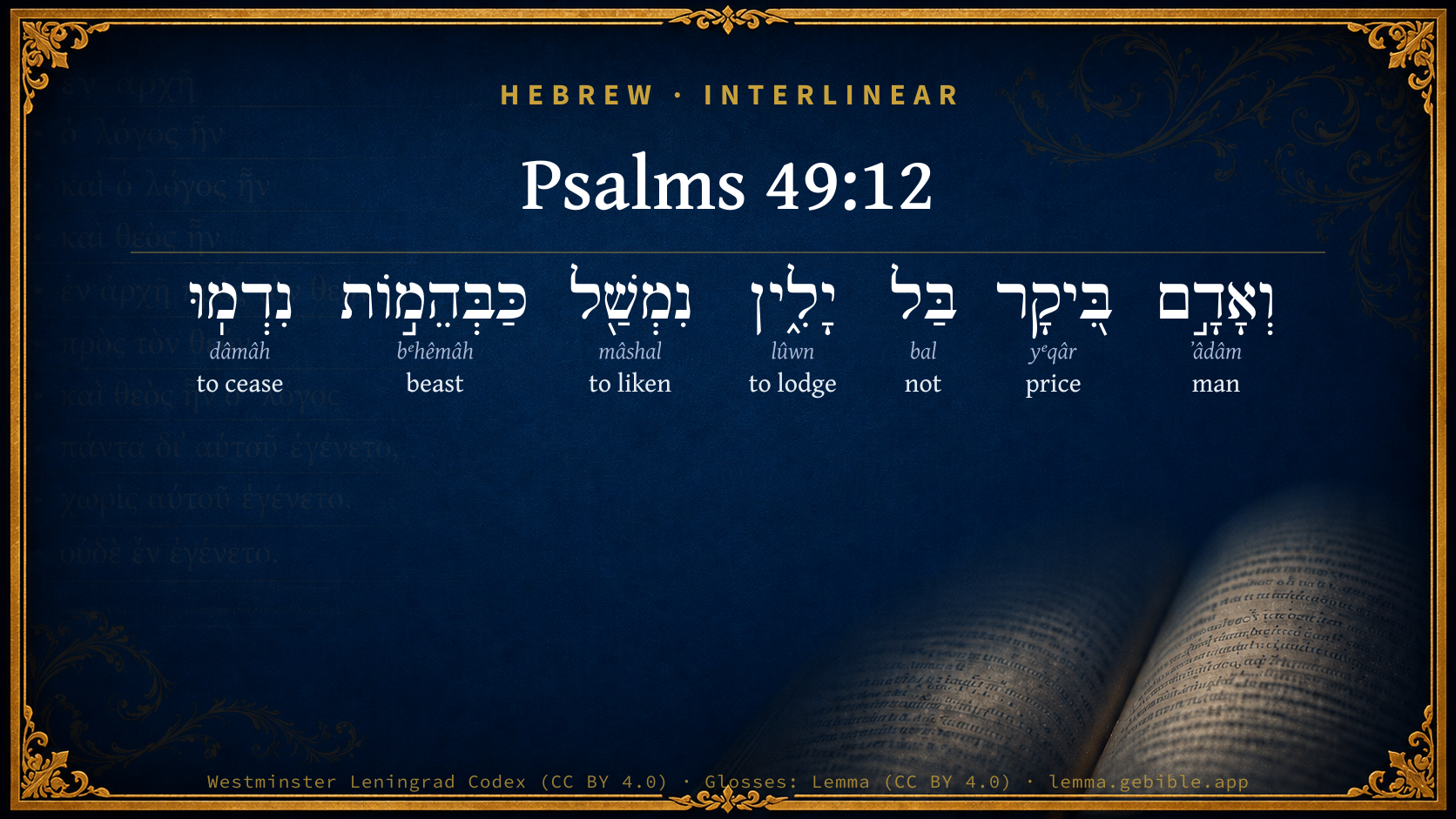
Psalms 49:12

Hebrew (Westminster Leningrad Codex) Psalms 49:12 appears in the Hebrew Old Testament. The text above is from the Westminster Leningrad Codex. Each word links to its Strong’s number, a concise gloss, and parsing drawn from the Open Scriptures Hebrew Bible morphology. Click any word for its full Brown-Driver-Briggs (BDB) entry.
Download image
Cite this verse

Psalms 49:12 (World English Bible). Public Domain. Lemma interlinear Bible study tool, https://lemma.gebible.app/v/psalms/49/12.

Show BibTeX & RIS
BibTeX
RIS
English Translation
But man, despite his riches, doesn't endure. He is like the animals that perish.
World English Bible · Public Domain
Highlights
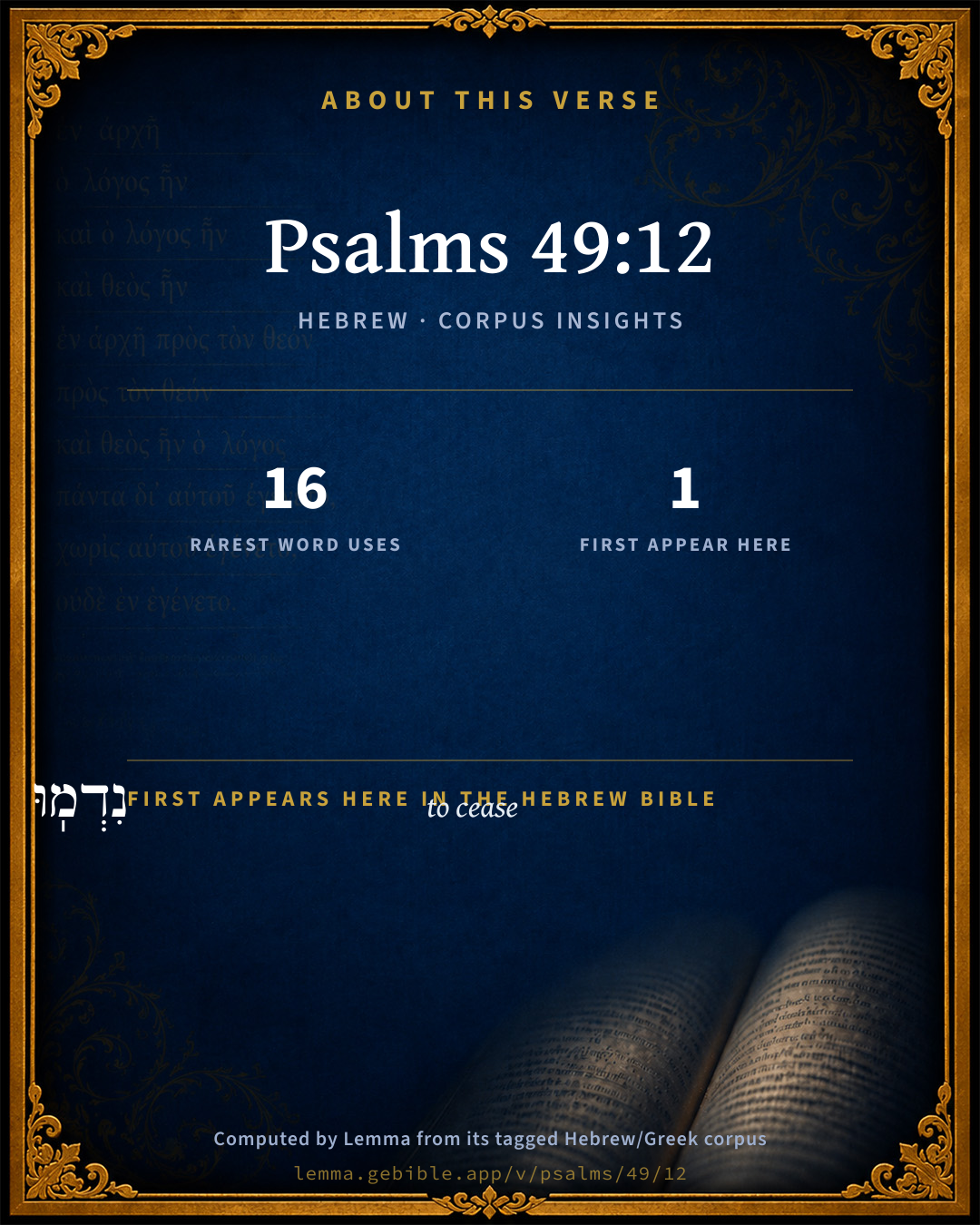
  • 1 first appearance in the Hebrew Bible
Full analysis ↓
Download a study sheet

One document with this verse’s original text, its word-by-word gloss line, the meaning frame, cross-references with their text, attributed commentary, and full source and license credits — printable, and it pastes into notes with its structure intact.

This verse Autodidact and up

Study sheet (.html) Plain text (.txt)

A passage Seminary Student

Up to 50 verses in one chapter. A passage sheet keeps up to 6 commentary sources and 12 cross-references per verse, in the order this page ranks them, and says so on the sheet whenever that leaves anything out. Ask for a single verse and you get the Autodidact verse sheet above.

Everything on this page stays free to read, with no account — the sheet is a download of what is already on screen, not access to it.

Want to remove ads? Support Godless Engineer
Compare translations 3

The same verse in 3 English versions, stacked beneath the original-language interlinear above. Click any original word for its lexicon entry.

Each is an independent rendering of the whole verse — the interlinear is not word-aligned to these translations.

Highlighted words mark where these versions differ — a whole-verse word diff, not a word-by-word alignment.

  • World English Bible Public Domain
    But man, despite his riches, doesn't endure. He is like the animals that perish.
  • King James Version Public Domain
    Nevertheless man being in honour abideth not: he is like the beasts that perish.
  • unfoldingWord Literal Text CC BY-SA 4.0
    But a human does not abide in honor. He is likened to the beasts, they are destroyed.

unfoldingWord Literal Text — © unfoldingWord, licensed CC BY-SA 4.0. Word-aligned USFM3 via Door43 (git.door43.org/unfoldingWord/en_ult).

Versions to compare (up to 4)

3 of 4 selected

Show all 18 translations

Every available English version of this verse, each an independent rendering of the whole verse.

  • World English Bible Public Domain
    But man, despite his riches, doesn't endure. He is like the animals that perish.
  • Berean Standard Bible Public Domain
    But a man, despite his wealth, cannot endure; he is like the beasts that perish.
  • Majority Standard Bible Public Domain
    But a man, despite his wealth, cannot endure; he is like the beasts that perish.
  • King James Version Public Domain
    Nevertheless man being in honour abideth not: he is like the beasts that perish.
  • American Standard Version (1901) Public Domain
    But man `being' in honor abideth not: He is like the beasts that perish.
  • Revised Version (1885) Public Domain
    But man abideth not in honour: he is like the beasts that perish.
  • Geneva Bible (1599) Public Domain
    But man shall not continue in honour: he is like the beastes that die.
  • Douay-Rheims (1899) Public Domain
    and their sepulchres shall be their houses for ever. Their dwelling places to all generations: they have called their lands by their names.
  • Young's Literal Translation Public Domain
    And man in honour doth not remain, He hath been like the beasts, they have been cut off.
  • Literal Standard Version CC BY-SA 4.0
    And man does not remain in honor, || He has been like the beasts, they have been cut off.
  • Unlocked Literal Bible CC BY-SA 4.0
    But man, having wealth, does not remain alive; he is like the beasts that perish.
  • unfoldingWord Literal Text CC BY-SA 4.0
    But a human does not abide in honor. He is likened to the beasts, they are destroyed.
  • Darby Bible Public Domain
    Nevertheless, man being in honour abideth not: he is like the beasts that perish.
  • World Messianic Bible Public Domain
    But man, despite his riches, doesn’t endure. He is like the animals that perish.
  • Webster's Bible Public Domain
    \\49:11\\Their inward thought is, that their houses shall continue for ever, and their dwelling places to all generations; they call their lands after their own names.
  • Free Bible Version CC BY-SA 4.0
    But human beings, for all their fame, don't understand. They die, just like the animals.
  • Bible in Basic English Public Domain
    But man, like the animals, does not go on for ever; he comes to an end like the beasts.
  • JPS Tanakh (1917) Public Domain
    (49-13) But man abideth not in honour; he is like the beasts that perish.

Literal Standard Version (2020), Covenant Press — licensed CC BY-SA 4.0. Text via the HelloAO Bible API (eBible.org). Unlocked Literal Bible (unfoldingWord) — licensed CC BY-SA 4.0. Text via the HelloAO Bible API (eBible.org). unfoldingWord Literal Text — © unfoldingWord, licensed CC BY-SA 4.0. Word-aligned USFM3 via Door43 (git.door43.org/unfoldingWord/en_ult). Free Bible Version, Dr. Jonathan Gallagher — licensed CC BY-SA 4.0. Text via the HelloAO Bible API (eBible.org).

Word by word

More ways to search: Search by grammar → Find every occurrence → Compare this word →

Practice this passage: Drill this verse → Learn its vocabulary →

נִמְשַׁ֖ל
mâshal
H4911
“to liken”
Verb, Niphal, Perfect, 3rd Person, Masculine, Singular
Part of Speech
Verb
Stem
Niphal
Form
Perfect
Person
3rd Person
Gender
Masculine
Number
Singular
Full BDB Definition

Origin: denominative from H4912

TWOT: 1258 , 1258b

to represent, liken, be like - (Niphal) to liken, be like, be similar - (Hiphil) to compare - (Hithpael) to become like - to speak in a proverb, use a proverb, speak in parables, speak in sentences of poetry - (Qal) to use a proverb, speak a parable or proverb - (Piel) to make a parable - maker of parables (participle)
  1. וְאָדָ֣ם ʼâdâm H120 “and · man” Conjunction + Noun, Common, Masculine, Singular, Absolute
  2. בִּ֭יקָר yᵉqâr H3366 “in/at · price” Preposition + Noun, Common, Masculine, Singular, Absolute
  3. בַּל bal H1077 “not” Particle, Negative
  4. יָלִ֑ין lûwn H3885 “to lodge” Verb, Qal, Imperfect, 3rd Person, Masculine, Singular
  5. כַּבְּהֵמ֣וֹת bᵉhêmâh H929 “like/as the · beasts” Preposition, Determined + Noun, Common, Feminine, Plural, Absolute
  6. נִדְמֽוּ dâmâh H1820 “to cease” Verb, Niphal, Perfect, 3rd Person, Common, Plural

About this verse

These counts appear in no published source. They are computed here, from the morphology-tagged text and Lemma’s own curated glosses. What Lemma adds →

7
words
7
distinct lemmas
Wisdom
section

Notable vocabulary

The rarest word here is נִמְשַׁ֖ל to liken H4911 — appearing just 16 times in the whole Hebrew Bible.

First appearance in Scripture

This word makes its first canonical appearance in the Hebrew Bible here:

  • נִדְמֽוּ to cease H1820

Shared distinctive vocabulary

נִמְשַׁ֖ל to liken H4911 occurs in 15 verses of the Hebrew Bible. Also found in:

Grammatical profile

  • 3 verbs
  • 3 nouns
  • 1 particle

Verb forms

  • יָלִ֑ין Qal · Imperfect
  • נִמְשַׁ֖ל Niphal · Perfect
  • נִדְמֽוּ Niphal · Perfect

Hebrew & Septuagint length

In English translation the verse runs 14 words from the Hebrew and 19 from the Septuagint (LXX English) — closely comparable.

A rough comparison of the two English renderings, which tokenize alike — not a word-level alignment.

Word counts can differ between the Hebrew and the Greek without any difference in meaning — e.g. the Hebrew direct-object marker אֵת has no separate Greek word, and Greek often adds the article ὁ.

Cross-references

7

Topical passages linked to Psalms 49:12 in the Treasury of Scripture Knowledge — connected by theme and wording, ordered by reader-vote popularity; previews shown in the World English Bible.

  • Ecclesiastes 3:18–21 I said in my heart, "As for the sons of men, God tests them, so that they may see that they themselves are like animals.
  • Psalms 39:5 Behold, you have made my days handbreadths. My lifetime is as nothing before you. Surely every man stands as a breath." Selah.
  • Psalms 49:20 A man who has riches without understanding, Is like the animals that perish.
  • Psalms 82:7 Nevertheless you shall die like men, And fall like one of the rulers."
  • Ecclesiastes 9:12 For man also doesn't know his time. As the fish that are taken in an evil net, and as the birds that are caught in the snare, even so are the sons of men snared in an evil time, when it falls suddenly on them.
  • James 1:10–11 and the rich, in that he is made humble, because like the flower in the grass, he will pass away.
  • 1 Peter 1:24 For, "All flesh is like grass, And all of man's glory like the flower in the grass. The grass withers, and its flower falls;

Cross-references courtesy of OpenBible.info (CC BY 4.0).

Hebrew and Greek witnesses Masoretic Hebrew ↔ Greek Septuagint

The same verse in the two great witnesses to the Old Testament, shown verse-for-verse.

You’re reading Greek Psalm 48 (Hebrew Psalm 49). The Septuagint counts the superscription, so verse numbers can differ from the Hebrew — chapter-level alignment, not verse-by-verse. Numbering follows Rahlfs.

These are two independent witnesses, not word-aligned to each other, and the Septuagint is shown in lemma (dictionary) form.

Hebrew Psalms 49:12 Masoretic · Westminster Leningrad Codex

וְאָדָ֣ם בִּ֭יקָר בַּל יָלִ֑ין נִמְשַׁ֖ל כַּבְּהֵמ֣וֹת נִדְמֽוּ

But man, despite his riches, doesn't endure. He is like the animals that perish.

World English Bible · Public Domain

Greek LXX Greek Psalm 48:12 Septuagint · lemma form

καί ὁ τάφος αὐτός οἰκία αὐτός εἰς ὁ αἰών σκήνωμα αὐτός εἰς γενεά καί γενεά ἐπικαλέω ὁ ὄνομα αὐτός ἐπί ὁ γαῖα αὐτός

And man being in honor, understands not: he is compared to the senseless cattle, and is like to them.

LXX2012 (modern English Septuagint) · Public Domain

On this verse, Ellicott's Commentary for English Readers discusses the Septuagint’s reading. Read the note in Commentary ↓

Hebrew: Westminster Leningrad Codex (CC BY 4.0). Greek: Septuagint (public domain); English from LXX2012 (modern English Septuagint) (Public Domain). How the Septuagint differs from the Hebrew →

Commentary

Notes on Psalms 49:12 from classic Christian and Jewish commentators (each source and its license shown beneath its notes). The classic Christian expositions comment on the surrounding passage and are grouped to its opening verse, so a note may address several verses; the Jewish commentaries on the Tanakh (Rashi and others) are per-verse, so they appear only where the commentator wrote on this verse.

Lemma curates 59 commentaries, every one of them public domain or Creative Commons licensed, each selected and text-cleaned for this edition rather than reprinted as found. About our sources →

Ellicott's Commentary for English Readers

(12) Abideth not.—This verse gives the kernel and the thought of, as it also serves as a refrain to, the poem, thus vindicating the claim of a lyric tone for this didactic psalm. The reading of the LXX. and Vulg. (“without understanding” instead of “abideth not”), which brings Psa_49:12 into exact correspondence with Psa_49:20, is unquestionably to be adopted. The present text could not really express permanence, the Hebrew verb meaning to lodge temporarily.

The next verse, too, is hardly intelligible, unless we read here—

“Man, though in honour, without understanding,

Is like the beasts; they perish.”

A Bible Commentary for English Readers, edited by Charles John Ellicott (1878–1897) — public domain. Text from a community e-Sword module.

The Cambridge Bible for Schools and Colleges

gen. ed. J. J. S. Perowne

12. If we retain the reading of the Massoretic Text in Psa_49:11, we may render with R.V., But man abideth not in honour.

If the reading graves is adopted, Psa_49:12 sums up the picture:

So man in splendour hath no continuance.

However imposing may be man’s magnificence, it must come to an end. The LXX and Syr. read here, as in Psa_49:20, Man being in honour understandeth not. But refrains are not always identical in form, and the difference in the Heb. text is significant.

that perish] Or, are cut off, a different word from that in Psa_49:10.

The Cambridge Bible for Schools and Colleges (gen. ed. J. J. S. Perowne; Cambridge University Press, 1878–1918) — public domain. Text from a community e-Sword module.

Trapp's Complete Commentary

John Trapp

Psa 49:12 Nevertheless man [being] in honour abideth not: he is like the beasts [that] perish.

Ver. 12. Nevertheless man being in honour abideth not] Howsoever he think to eternalize himself, and be grown never so great, die he must, whether lord or lowly; and die like a beast, a carrion beast (unless he be the better man), but only for this pillow and bolster. At one end of the library at Dublin was a globe, at the other a skeleton; to show, that though a man was lord of all the world, yet he must die, his honour must be laid in the dust. The mortal scythe (saith one) is master of the royal sceptre, and it moweth down the lilies of the crown as well as the grass of the field. Perperam accommodatur hic versiculus, saith another; this verse is not well interpreted of the first man, Adam, to prove that he sinned the same day wherein he was created, and lodged not one night in paradise.

He is like the beasts that perish] Pecoribus, morticinis, saith Junius, the beasts that die of the murrain, and so become carrion, and are good for nothing.

John Trapp, A Commentary or Exposition upon All the Books of the Old and New Testament (1647–1656) — public domain. Text from a community e-Sword module.

The Biblical Illustrator

Joseph S. Exell

Psa_49:12

Nevertheless man being in honour abideth not: he is like the beasts that perish.

The worldlings downfall

I. A carnal man may possibly thrive and prosper, and grow great here on earth (Psa_73:3; Jer_12:1; Job_21:7-10). The Scripture also giveth more light to this doctrine by examples, proving thus much unto us, that even the children of God, such as fear Him, and make conscience of their ways, come often far behind the wicked in outward prosperity. Jacob, the loved, is put forth to keep sheep, and Esau, the hated, goes on hunting. If you look for Joseph, you shall find him in prison; for Daniel, you shall see him in the den.

II. The prosperity of the wicked is not perpetual. He shall not continue in honour; the words are properly, He shall not tarry all night in honour. We are wont to describe a short abode, by lodging in an inn, where a man seldom stayeth in his travel above a night. Now, the continuance of the carnal man in his honour and prosperity shall be far less; the time shall be, as it were, a degree shorter. The truth hereof is fulfilled by two means. For, first, either his prosperity continueth not to him, or else, secondly, he not to his prosperity.

III. The worldly mans death like a beasts. In four things especially.

1. The first is, that he dieth unwillingly. So it is with the beasts. It is in the nature of everything to desire the preservation of itself, and to abhor the contrary. Hereupon in the unreasonable creature there is a kind of struggling and wrestling with death, so that it doth not but by violence yield thereunto. Even so it is with the ungodly, which mindeth only earthly things. His death may be peaceable in show (the natural strength being wasted and abated by some long sickness), and in speech, he may pretend a willingness to depart; but it is impossible that it should be with fulness of inward consent.

2. The second particular wherein this earthly man is like to the dying beasts is this: the carcase of the beast so dying cannot choose but be noisome and unsavoury; the smell is offensive unto every one that passeth by, and the sight unpleasing. So is the dying worldling in Gods sight.

3. The third degree of likeness betwixt the dying beast and the dying worldling is this: the body of a beast, whom such a disease hath quelled, becometh a prey to the fowls of the air, and is torn in pieces by other beasts; Where the carcase is, thither the eagles resort, saith our Saviour. It fareth so with the worldling: for as his goods ill-gotten come many times, through the just judgment of God, to be a prey to others, and to be the spoil of strangers, so his soul is seized upon by the damned spirits, and is presently arraigned before the judgment seat of God.

4. The fourth point of likeness is this: there is no regard had of the death of a brute beast, the remembrance is soon gone. The owner may haply bewail that loss, it being some diminution of iris substance; but otherwise it is a matter which the world passeth by and taketh no notice of. So is the death of the carnal worldling. There may be some sorrow among his own people, who received some outward benefit by his means, and with them his memory may continue. But else there is no miss. (S. Hieron.)

The Biblical Illustrator, edited by Joseph S. Exell (c. 1880s–1900s) — public domain. Text from a community e-Sword module.

Joseph Benson's Commentary

Psa 49:12-13. Nevertheless — Notwithstanding all these fine fancies; man being in honour — Living in all the splendour and glory above mentioned; abideth not — Hebrew, בל ילין, bal jalin, shall not lodge for a night; his continuance in the world is as that of a traveller at an inn, who tarries but, or not even, for a night; “so that, if honour and wealth do not soon leave him, he must soon leave them; and, like the brutes around him, return to his earth, never more to be seen, and little more to be thought of.” All his dreams of perpetuating his name and estate shall be confuted by experience. For “families decay, and are extinguished, as well as individuals, and the world itself is to perish after the same example. That such beings, in such a place, should think of becoming glorious and immortal” is astonishing! — Horne. This their way — Their counsel and contrivance to immortalize their names; or, “their practice of labouring to acquire wealth and greatness, which can be of no service after death, and of endeavouring to perpetuate the possession of the most uncertain things in nature;” is their folly — Though to themselves, and many others, it seems to be wisdom, yet it is apparent madness and folly. Yet their posterity approve their sayings — “It is a folly which, like many others, is both blamed and imitated.” The word פיהם, pihem, translated, their sayings, is literally, their mouth; but is undoubtedly put for the counsels and suggestions which they give to their offspring concerning these matters; the mouth being often put for the words which come out of it.

Joseph Benson's Commentary on the Old and New Testaments (1811–1818) — public domain. Text from a community e-Sword module.

J. A. Alexander on Psalms

Joseph Addison Alexander

13. (Psa 49:12). And man in honour shall not lodge; he is made like to the brutes; they are destroyed. The and at the beginning is equivalent to and yet, or to the simple adversative but. It introduces the contrast of man's real frailty with his imaginary permanence. As if he had said, "Such are the dreams of the rich fool, and (yet) man really," etc. The word translated honour properly means value, price, but is applied precisely like the corresponding Greek word. It here includes all that makes the condition of the rich fool seem desirable, either to his own conceit, or to the envious admiration of his neighbours. In this position he is not to lodge, i.e. remain permanently, or with closer adherence to the strict sense of the verb, continue even for a night, implying that he is to perish before morning. This passage seems to have been present to our Lord's mind, when he uttered the parable of the Rich Fool. Compare especially with the verse before us, Luke xii. 20. Made like, assimilated, not in his origin, but in his end. The point of comparison seems to be their blindness and irrational destitution of all foresight. The word translated brutes may be still more closely rendered beasts, being properly descriptive of the larger quadrupeds. It might even seem in this case to denote specifically cattle or domesticated animals, as those which men are especially accustomed to see suddenly deprived of life. But this limitation of the term is peculiar to prose style, whereas in poetry, when used distinctively, it rather signifies wild beasts. It is better, therefore, to give it here its wider sense of beasts in general, and to explain even these as mere representatives or samples of the whole class, brutes or irrational animals, like whom the rich fool is cut off suddenly and unawares. They are destroyed, or as the word seems to signify originally, silenced, brought to silence, i.e. stilled or hushed in death. By assuming an enallage or sudden change of number, we may construe this verb with the human subject. He (the rich fool) is treated like the brute; (like these) they (the rich fools) are destroyed. A less emphatic but more obvious construction is that which refers it to the brutes themselves. He is made like to the beasts (which) are destroyed (before they are aware).

Joseph Addison Alexander, The Psalms Translated and Explained (1850) — public domain. Text from a community e-Sword module.

Geneva Bible (1599)

Geneva Bible translators

As touching the death of the body.

Geneva Bible (1599) marginal notes — public domain. Text via Bolls.life.

Jamieson, Fausset & Brown

Robert Jamieson, A. R. Fausset & David Brown

Contrasted with this vanity is their frailty. However honored, man

abideth not--literally, "lodgeth not," remains not till morning, but suddenly perishes as (wild) beasts, whose lives are taken without warning.

Jamieson, Fausset & Brown — Commentary Critical and Explanatory on the Whole Bible (1871) — public domain (CC PDM 1.0). Text via the HelloAO Bible API.

Adam Clarke's Commentary

Verse 12. Man being in honour abideth not] However rich, wise, or honourable, they must die; and if they die not with a sure hope of eternal life, they die like beasts. See on Ps 49:20.

Adam Clarke's Commentary on the Bible (1810–1826) — public domain. Text from a community e-Sword/MySword module.

John Calvin's Commentaries

12 And man shall not abide in honor Having exposed the vain and delusory nature of the fancies entertained by the ungodly, he next shows that however fondly they may cherish them, they must experience the same fate with the beasts of the field. It is true that there is a great difference, so far as the soul is concerned, between man and the brute creation; but the Psalmist speaks of things as they appear in this world, and in this respect he was warranted to say of the ungodly that they die as the beasts. His subject does not lead him to speak of the world to come. He is reasoning with the children of this world, who have no respect to another, and no idea of a farther happiness than that which they enjoy here. He accordingly ridicules their folly in conceiving of themselves as privileged with exemption from the ordinary lot of humanity, and warns them that death will soon be near to humble their presumptuous thoughts, and put them on a level with the meanest of the lower creatures. This I prefer to the more ingenious interpretation which some would put upon the words, that they reduced themselves to the level of beasts by not recognising the true dignity of their nature, which consists in the possession of a never-dying soul. The Psalmist’s great aim is to show the vanity of the boasting of the wicked, from the nearness of death, which must join them in one common fate with the beasts of the field. The last word in the verse gives the reason why the ungodly may be compared to the beasts — they perish It matters little whether or not we consider the relative אשר, asher, as understood, and read, that perish

John Calvin's Commentaries (1540-1563) — public domain. Text from the Calvin Translation Society English edition (1840s-50s) via the Christian Classics Ethereal Library (ccel.org). Calvin's coverage is partial (roughly two-thirds of the Bible); uncommented books and verses are honest gaps, never fabricated. The 19th-century editor's footnotes and remarks are omitted so the notes are faithfully Calvin's own voice.

John Gill's Exposition

Nevertheless man being in honour abideth not,.... Or Adam: and some understand this of the first man Adam, who was created and crowned with glory and honour; but it did not abide with him, nor he in that: so some Jewish writers (y) interpret it. But whether the words will admit of this sense or not, the general view of the psalmist, which is to show the inconstancy and instability of worldly honour, may be exemplified in the case of the first man; he was in honour he was created after the image and likeness of God, and so was the glory of God, being his image; he was in friendship with God, as many instances show, and had dominion over all the creatures below; he had much knowledge of God, and communion with him, and was a pure, holy, and upright creature; but he continued not long in this state of honour and glory; "he lodged not a night" (z), as the words may be rendered; see Gen 28:11; and as they are by some, who conclude from hence that Adam fell the same day in which he was created; and which is the sense of the above Jewish writers, who say, he was driven out of paradise the evening of that day; but though he might stand longer, and the word is sometimes used of a longer continuance; see Psa 25:13; yet by the account in Genesis it looks as if he continued in his state of honour but a short time;

he is like the beasts that perish; becoming mortal in his body, and brutish and stupid in his understanding. Or, "he is like the beasts", "they perish", or "are cut off" (a); the word being in the plural number, which shows that not a single individual person is meant, but men in general; or, however, such of the sons of Adam that come to honour; these do not abide long in it, their honour is a very short lived one, sometimes it does not last their lives: they that are in high places are in slippery ones, and are often cast down from the pinnacle of honour in a moment; and if their glory does abide with them throughout the day of life, yet it shall not lodge with them in the night of the grave; thither their glory shall not descend after them, Psa 49:17; and when they die, they perish like the beasts; as they are like them in life, stupid, brutish, and ignorant, so in death; as the beast dies, so do they, Ecc 3:19; as the one dies without any thought of or preparation for death, so do the other; as the one carries nothing along with it, so neither do the other: as beasts that die of themselves, for such are here meant, as Junius well observes, are good for nothing but to be cast into the ditch; so are wicked men, notwithstanding all their riches and honours; yea, it is worse with them than with the beasts, since after death comes judgment, and after that the second death, the wrath of God.

(y) Bereshit Rabba, s. 11. fol. 9. 1. 2. Pirke Eliezer, c. 19. (z) "non pernoctabit", Montanus, Amama; so Ainsworth. (a) "excisi sunt", Montanus.

John Gill's Exposition of the Whole Bible (1746–1763) — public domain (CC PDM 1.0). Text via the HelloAO Bible API.

Albert Barnes' Notes on the Bible

Nevertheless, man being in honor abideth not - No matter to what rank he may rise, no matter how much wealth he may accumulate, no matter how fixed and secure he may seem to make his possessions, he cannot make them permanent and enduring. He must pass away and leave all this to others. The word rendered “abideth” - ילין yālı̂yn - means properly to pass the night; to remain over night; to lodge, as one does for a night; and the idea is, that he is not to lodge or remain permanently in that condition; or, more strictly, he will not lodge there even for a night; that is, he will soon pass away. It is possible that the Saviour had his eye on this passage in the parable of the rich fool, and especially in the declaration, “This night thy soul shall be required of thee,” Luk 12:20.

He is like the beasts that perish - He is like the beasts; they perish. This does not mean that in all respects he is like them, but only in this respect, that he must die as they do; that he cannot by his wealth make himself immortal. He must pass away just as if he were an animal of the inferior creation, and had no power of accumulating wealth, or of laying plans that stretch into the future. The squirrel and the beaver - animals that “lay up” something, or that, like people, have the power of “accumulating,” die just like other animals. So the rich “man.” His intelligence, his high hopes, his far-reaching schemes, make no difference between him and his fellow-men and the brute in regard to death. They all die alike.

Albert Barnes' Notes on the Bible (1834–1885) — public domain. Text from a community e-Sword/MySword module.

Matthew Poole's English Annotations

Notwithstanding all these fine fancies and devices

man being in honour, living in all the splendour and glory above mentioned,

abideth not. The Hebrew word properly signifies to lodge for a night, as Gen 32:21; Jdg 19:10; and thence to abide for a long or considerable time, as Psa 25:13; 55:7; Pro 15:31. All his dreams of perpetuating his name and estate shall vanish and be confuted by experience.

That perish, i.e. that are utterly lost and extinct. So he is in reference to all his wealth and honour, of which he here speaks.

Matthew Poole's English Annotations on the Holy Bible (1683–1685) — public domain. Text from a community e-Sword/MySword module.

The Treasury of David

Charles H. Spurgeon

Ver. 12. Nevertheless man being in honour abideth not. He is but a lodger for the hour, and does not stay a night: even when he dwells in marble halls his notice to quit is written out. Eminence is evermore in imminence of peril. The hero of the hour lasts but for an hour. Sceptres fall from the paralysed hands which once grasped them, and coronets slip away from skulls when the life is departed. He is like the beasts that perish. He is not like the sheep which are preserved of the Great Shepherd, but like the hunted beast which is doomed to die. He lives a brutish life and dies a brutish death. Wallowing in riches, surfeited with pleasure, he is fatted for the slaughter, and dies like the ox in the shambles. Alas! that so noble a creature should use his life so unworthily, and end it so disgracefully. So far as this world is concerned, wherein does the death of many men differ from the death of a dog? They go down

"To the vile dust from whence they sprung,

Unwept, unhonoured, and unsung."

What room is there, then, for fear to the godly when such natural brute beasts assail them? Should they not in patience possess their souls?

We make a break here, because this stanza appears to be the refrain of the song, and as such is repeated in Ps 49:20.

Ver. 12. Man being in honour abideth not. The Rabbins read it thus: "Adam being in honour, lodged not one night." The Hebrew word for abide signifies "to stay or lodge all night." Adam, then, it seems, did not take up one night's lodging in Paradise. Thomas Watson's Body of Divinity.

Ver. 12. (last clause). Wherein the ungodly are like beasts, and wherein different.

Ver. 12. Here is a twofold thwarting or crossing of the purposes of the ungodly worldling.

1. The first is, he shall not be that which he ever wished to be: he shall not continue in honour.

2. The other is this, he shall be that which he never desired to be: he shall be like the beasts that die. He shall miss of that which he sought for, and he shall have that which he looked not for.

S. Hieron.

Psalms 49:13*

Charles H. Spurgeon's The Treasury of David (1869–1885) — public domain. Psalms only. Text from a community e-Sword/MySword module.

Whedon's Commentary on the Bible

Daniel D. Whedon

12. Notwithstanding their impotence to avert, and the futility of their schemes to disguise, the utter desolations of death, they are not won to wisdom.

Abideth not—In Psa_49:20 it reads, “understandeth not,” and which the Septuagint, followed by the Vulgate, Syriac, and Arabic, reads in this place, in order to make the two refrains correspond, but without authority, for variations in refrains are quite common.

Like the beasts— All their attempts to perpetuate their name, and thus maintain an ideal immortality, are abortive, for still they “abide not,” but, like cattle, they die. The resemblance here seems to be not merely in the common fate of mortality, as in Ecc_3:19, “As the one dieth, so dieth the other,… so that a man hath no pre-eminence above a beast,” but in their stupidity as to the life to come, and their not seeing that wealth cannot raise them above this condition. See on Psa_49:20

Daniel D. Whedon (gen. ed.), Commentary on the Old and New Testaments (1874–1909) — public domain. Text from a community e-Sword module.

The Pulpit Commentary

Nevertheless man being in honour abideth not. Against these" inward thoughts" and outward actions, the psalmist simply maintains the ground already taken (ver. 10): "Man, in whatever honour he may be, abideth not has but a short time to live. He is like the beasts that perish. He has no more continuance than many of the beasts; like them, he passes from earth.

The Pulpit Commentary (1880–1919), ed. H.D.M. Spence-Jones & Joseph S. Exell — public domain. Text from a community e-Sword module.

John Wesley's Explanatory Notes

Man - Living in all splendour and glory. Abideth not - All his dreams of perpetuating his name and estate, shall be confuted by experience.

John Wesley, Explanatory Notes Upon the Whole Bible (1754–1765) — public domain. Text via the GEBible commentary corpus.

unfoldingWord translationNotes

Door43 World Missions Community

But man, having wealth

"But man, even if he has wealth"

This, their way, is their folly

The writer speaks of the fate of fools as if it is the destination at the end of the path on which they walk. AT: "This is the fate of those who practice folly" (See: Metaphor)

yet after them

"yet after they die"

translationWords

life

beast

perish

fool

selah

unfoldingWord translationNotes — © Distant Shores Media and the Door43 World Missions Community, licensed CC BY-SA 4.0. Source: git.door43.org/Door43/en_tn.

Rashi

Rabbi Shlomo Yitzchaki (Rashi)

In their heart, their houses are forever Their thoughts are to build for themselves houses that will exist forever.

they call by their names their houses that they build so that they will have a memorial. (Gen. 4:17): “and named the city after his son Enoch.” Antiochus built Antioch; Seleucus built Seleucia.

Rashi on the Tanakh — English translations: “The Judaica Press complete Tanach with Rashi, translated by A. J. Rosenberg” (CC BY 4.0); “Pentateuch with Rashi's commentary by M. Rosenbaum and A.M. Silbermann, 1929-1934” (public domain); “The Metsudah Tanach series, Lakewood, N.J” (CC BY 4.0); and “The Book of Joshua, Metsudah Publications, 1997” (CC BY 4.0). Text via Sefaria.

Lesson kit

Teaching starters — assembled from the data on this page, not authored interpretation. Every prompt links to the verse data it draws on. Edit before teaching.

Psalms, in the Wisdom, opens this verse with 7 words (7 distinct Hebrew lemmas). Its most distinctive word is mâshal (“to liken”). A historical commentator’s framing appears above. Read the whole chapter for the surrounding context.

Discussion questions

  1. The word mâshal carries the sense “to liken.” How does it shape the verse?
  2. The word “to cease” first appears here in Scripture. What is being introduced at this debut?
  3. Numbers 21:27 shares the word «to liken» with this verse. How do the two illuminate each other?
  4. The translations on this page render this verse differently — a whole-verse word diff, not a word-by-word alignment. What might account for the different wordings?
  5. The verb «יָלִ֑ין» is Qal Imperfect. How does its form color the action?
  6. Reading how Ellicott's Commentary for English Readers and The Cambridge Bible for Schools and Colleges read this verse, where do the two commentators agree and where do they part?

Things to notice

Reading settings

Reading text

Shown beneath each verse's original-language words.

Old Testament
Old Testament edition

Read the OT as the Masoretic Hebrew (MT) or the Greek Septuagint (LXX).

English shown for the Greek Septuagint (in the Hebrew ↔ Greek comparison).

Comparing translations? Open the Compare panel on any verse page to stack up to four side by side.