
Proverbs 7:15

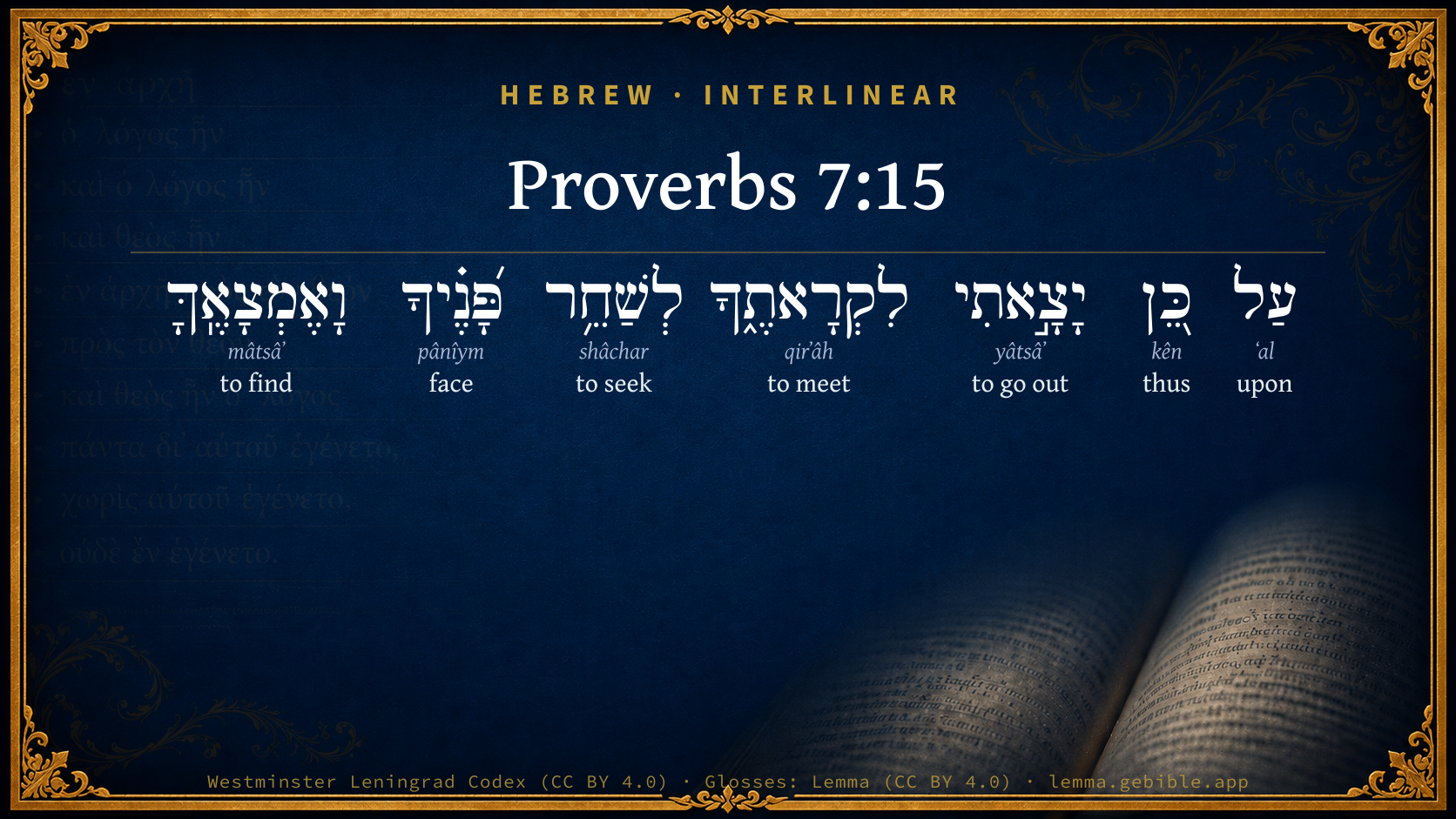
Hebrew (Westminster Leningrad Codex) Proverbs 7:15 appears in the Hebrew Old Testament. The text above is from the Westminster Leningrad Codex. Each word links to its Strong’s number, a concise gloss, and parsing drawn from the Open Scriptures Hebrew Bible morphology. Click any word for its full Brown-Driver-Briggs (BDB) entry.
Download image
Cite this verse

Proverbs 7:15 (World English Bible). Public Domain. Lemma interlinear Bible study tool, https://lemma.gebible.app/v/proverbs/7/15.

Show BibTeX & RIS
BibTeX
RIS
English Translation
Therefore I came out to meet you, To diligently seek your face, And I have found you.
World English Bible · Public Domain
Download a study sheet

One document with this verse’s original text, its word-by-word gloss line, the meaning frame, cross-references with their text, attributed commentary, and full source and license credits — printable, and it pastes into notes with its structure intact.

This verse Autodidact and up

Study sheet (.html) Plain text (.txt)

A passage Seminary Student

Up to 50 verses in one chapter. A passage sheet keeps up to 6 commentary sources and 12 cross-references per verse, in the order this page ranks them, and says so on the sheet whenever that leaves anything out. Ask for a single verse and you get the Autodidact verse sheet above.

Everything on this page stays free to read, with no account — the sheet is a download of what is already on screen, not access to it.

Want to remove ads? Support Godless Engineer
Compare translations 3

The same verse in 3 English versions, stacked beneath the original-language interlinear above. Click any original word for its lexicon entry.

Each is an independent rendering of the whole verse — the interlinear is not word-aligned to these translations.

Highlighted words mark where these versions differ — a whole-verse word diff, not a word-by-word alignment.

  • World English Bible Public Domain
    Therefore I came out to meet you, To diligently seek your face, And I have found you.
  • King James Version Public Domain
    Therefore came I forth to meet thee, diligently to seek thy face, and I have found thee.
  • unfoldingWord Literal Text CC BY-SA 4.0
    Therefore, I came out to meet you, to diligently seek your face, and I found you.

unfoldingWord Literal Text — © unfoldingWord, licensed CC BY-SA 4.0. Word-aligned USFM3 via Door43 (git.door43.org/unfoldingWord/en_ult).

Versions to compare (up to 4)

3 of 4 selected

Show all 18 translations

Every available English version of this verse, each an independent rendering of the whole verse.

  • World English Bible Public Domain
    Therefore I came out to meet you, To diligently seek your face, And I have found you.
  • Berean Standard Bible Public Domain
    So I came out to meet you; I sought you, and I have found you.
  • Majority Standard Bible Public Domain
    So I came out to meet you; I sought you, and I have found you.
  • King James Version Public Domain
    Therefore came I forth to meet thee, diligently to seek thy face, and I have found thee.
  • American Standard Version (1901) Public Domain
    Therefore came I forth to meet thee, Diligently to seek thy face, and I have found thee.
  • Revised Version (1885) Public Domain
    Therefore came I forth to meet thee, diligently to seek thy face, and I have found thee.
  • Geneva Bible (1599) Public Domain
    Therefore came I forth to meete thee, that I might seeke thy face: and I haue found thee.
  • Douay-Rheims (1899) Public Domain
    Therefore I am come out to meet thee, desirous to see thee, and I have found thee.
  • Young's Literal Translation Public Domain
    Therefore I have come forth to meet thee, To seek earnestly thy face, and I find thee.
  • Literal Standard Version CC BY-SA 4.0
    Therefore I have come forth to meet you, || To earnestly seek your face, and I find you.
  • Unlocked Literal Bible CC BY-SA 4.0
    so came I out to meet you, to eagerly seek your face, and I have found you.
  • unfoldingWord Literal Text CC BY-SA 4.0
    Therefore, I came out to meet you, to diligently seek your face, and I found you.
  • Darby Bible Public Domain
    therefore came I forth to meet thee, to seek earnestly thy face, and I have found thee.
  • World Messianic Bible Public Domain
    Therefore I came out to meet you, to diligently seek your face, and I have found you.
  • Webster's Bible Public Domain
    Therefore I came forth to meet thee, diligently to seek thy face, and I have found thee.
  • Free Bible Version CC BY-SA 4.0
    That's why I came out to meet you. I was looking for you and now I've found you!
  • Bible in Basic English Public Domain
    So I came out in the hope of meeting you, looking for you with care, and now I have you.
  • JPS Tanakh (1917) Public Domain
    Therefore came I forth to meet thee, to seek thy face, and I have found thee.

Literal Standard Version (2020), Covenant Press — licensed CC BY-SA 4.0. Text via the HelloAO Bible API (eBible.org). Unlocked Literal Bible (unfoldingWord) — licensed CC BY-SA 4.0. Text via the HelloAO Bible API (eBible.org). unfoldingWord Literal Text — © unfoldingWord, licensed CC BY-SA 4.0. Word-aligned USFM3 via Door43 (git.door43.org/unfoldingWord/en_ult). Free Bible Version, Dr. Jonathan Gallagher — licensed CC BY-SA 4.0. Text via the HelloAO Bible API (eBible.org).

Word by word

More ways to search: Search by grammar → Find every occurrence → Compare this word →

Practice this passage: Drill this verse → Learn its vocabulary →

About this verse

These counts appear in no published source. They are computed here, from the morphology-tagged text and Lemma’s own curated glosses. What Lemma adds →

7
words
7
distinct lemmas
Wisdom
section

Notable vocabulary

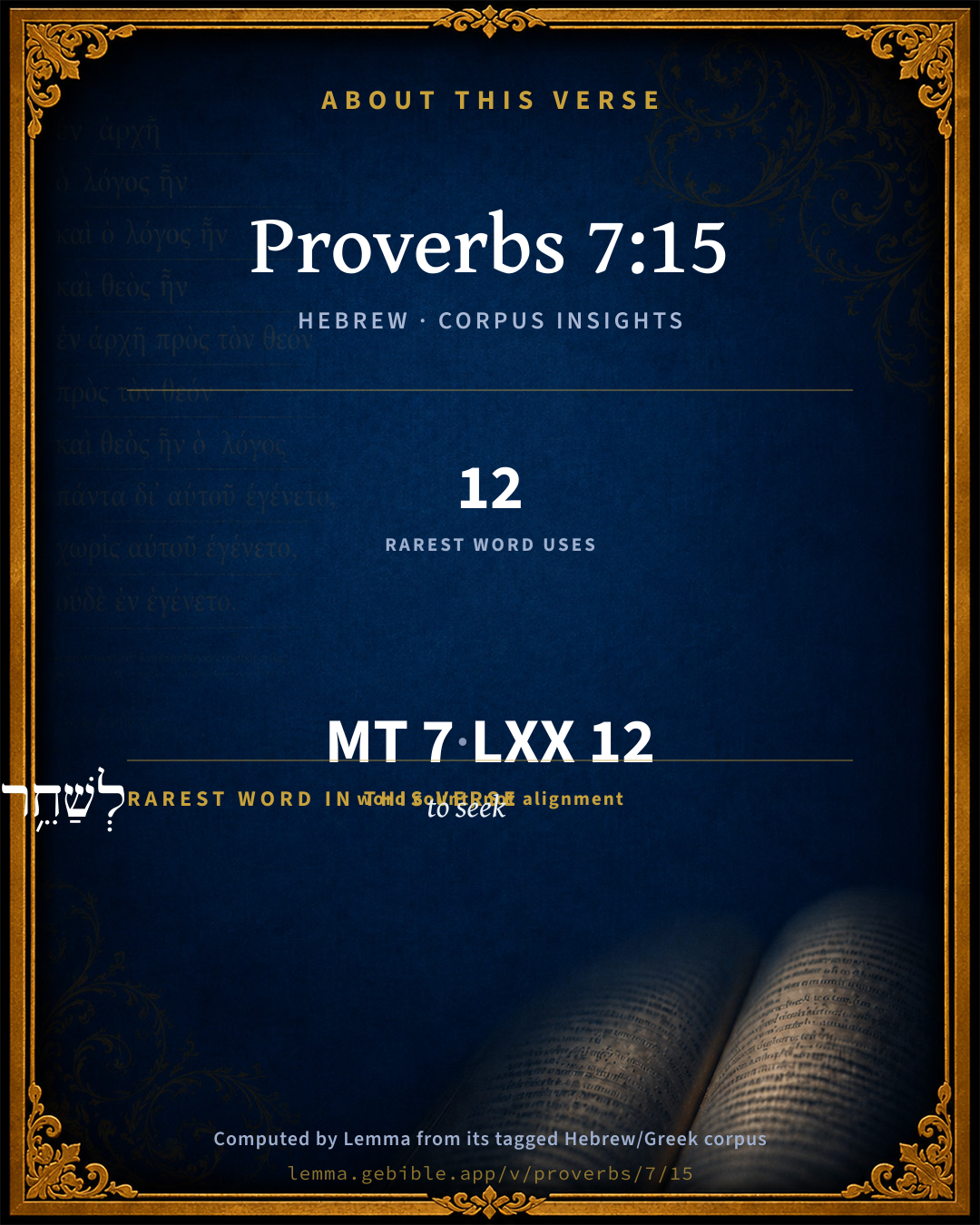
The rarest word here is לְשַׁחֵ֥ר to seek H7836 — appearing just 12 times in the whole Hebrew Bible.

Shared distinctive vocabulary

לְשַׁחֵ֥ר to seek H7836 occurs in 12 verses of the Hebrew Bible. Also found in:

Grammatical profile

  • 4 verbs
  • 1 noun
  • 1 preposition
  • 1 particle

Verb forms

  • יָצָ֣אתִי Qal · Perfect
  • לִקְרָאתֶ֑ךָ Qal · Infinitive Construct
  • לְשַׁחֵ֥ר Piel · Infinitive Construct
  • וָאֶמְצָאֶֽךָּ Qal · Sequential Imperfect

Hebrew & Septuagint length

In English translation the verse runs 17 words from the Hebrew and 15 from the Septuagint (LXX English) — closely comparable.

A rough comparison of the two English renderings, which tokenize alike — not a word-level alignment.

Word counts can differ between the Hebrew and the Greek without any difference in meaning — e.g. the Hebrew direct-object marker אֵת has no separate Greek word, and Greek often adds the article ὁ.

In the original languages it is 7 Hebrew tokens and 12 Greek tokens — but the two are counted differently (Hebrew bundles its prefixes and suffixes into one token; the Greek is in lemma form), so that isn’t a like-for-like length.

Hebrew and Greek witnesses Masoretic Hebrew ↔ Greek Septuagint

The same verse in the two great witnesses to the Old Testament, shown verse-for-verse.

These are two independent witnesses, not word-aligned to each other, and the Septuagint is shown in lemma (dictionary) form.

Hebrew Proverbs 7:15 Masoretic · Westminster Leningrad Codex

עַל כֵּ֭ן יָצָ֣אתִי לִקְרָאתֶ֑ךָ לְשַׁחֵ֥ר פָּ֝נֶ֗יךָ וָאֶמְצָאֶֽךָּ

Therefore I came out to meet you, To diligently seek your face, And I have found you.

World English Bible · Public Domain

Greek LXX Proverbs 7:15 Septuagint · lemma form

ἕνεκα οὗτος ἐκἔρχομαι εἰς συνάντησις σύ ποθέω ὁ σός πρόσωπον εὑρίσκω σύ

therefore I came forth to meet you, desiring your face; and I have found you.

LXX2012 (modern English Septuagint) · Public Domain

Hebrew: Westminster Leningrad Codex (CC BY 4.0). Greek: Septuagint (public domain); English from LXX2012 (modern English Septuagint) (Public Domain). How the Septuagint differs from the Hebrew →

Commentary

Notes on Proverbs 7:15 from classic Christian and Jewish commentators (each source and its license shown beneath its notes). The classic Christian expositions comment on the surrounding passage and are grouped to its opening verse, so a note may address several verses; the Jewish commentaries on the Tanakh (Rashi and others) are per-verse, so they appear only where the commentator wrote on this verse.

Lemma curates 59 commentaries, every one of them public domain or Creative Commons licensed, each selected and text-cleaned for this edition rather than reprinted as found. About our sources →

Trapp's Complete Commentary

John Trapp

Pro 7:15 Therefore came I forth to meet thee, diligently to seek thy face, and I have found thee.

Ver. 15. Therefore came I forth.] As having much good cheer at home, as at all peace offerings they had. Gluttony is the gallery that lustfulness walks through. {a}

Diligently to seek thy face.] Or, Thy person, not thy purse; thee, not thine do I seek. Quis credit? who belives that?

And I have found thee.] By a providence, no doubt; God must have a hand in it, or else it is marvel. "God hath given me my hire," said Leah; "because I have given my maid to my husband." {Gen 30:18} See 1Sa 23:7 Zec 11:5.

{a} Sine cerere et libero friget Venus.

John Trapp, A Commentary or Exposition upon All the Books of the Old and New Testament (1647–1656) — public domain. Text from a community e-Sword module.

Joseph Benson's Commentary

Pro 7:15-20. Therefore came I forth to meet thee — As not being able to take any pleasure in my feast without thy company; and I have found thee — By a happy providence of God complying with my desires, to my great joy, I have found thee speedily and most opportunely. Thus this wicked woman pretended that she came forth on purpose to meet this youth, from a peculiar affection, as if she had had a prior acquaintance and intimacy with him. I have decked my bed, &c. — She desires to inflame his lusts by the mention of the bed, and by its ornaments and perfumes. The good man is not at home — Whom she does not call her husband, lest the mention of that name should awaken his conscience or discretion. He hath taken a bag of money with him — Which is an evidence he designs to go far, and to stay a considerable time; and will come home at the day appointed — Or, at the day of full moon, as Dr. Waterland translates יום הכסא, Houbigant renders the clause, Nor will he return to his house before the full moon. The woman plainly gives this as a reason for removing all apprehensions and fears of detection from the simple youth she is soliciting to destruction.

Joseph Benson's Commentary on the Old and New Testaments (1811–1818) — public domain. Text from a community e-Sword module.

John Gill's Exposition

I have decked my bed with coverings of tapestry,.... Made use of by the ancients (o) for bed clothes: beautiful ornaments, as Gersom; and precious garments, as Jarchi. She had adorned her bed with curtains and clothes, very delightful to the eye, and inviting; and had well corded it, as some interpret it, with cords of fine linen, and all to allure her lovers; she soon discovered her lustful inclinations, what her heart was upon, and says this, and more, to fire the young man's lust, and cause him to follow her: so the church of Rome adorns her places of worship in the most pompous manner; which are the beds in which she commits adultery, Rev 2:22; and also her images to strike the minds of people, and draw them into her idolatrous worship;

with carved works; perhaps the bed's head, tester, and posts, were all carved, and cut out of cedar wood and others, as Gersom observes; though some think: this refers to the variety of work in tapestry, which look like incisions and carvings, or the network, and agnet holes made therein: this may be very well applied to the carved work, and carved images, set up in the Romish churches;

with fine linen of Egypt; the sheets, pillows, and bolsters, made thereof, and so soft to lie upon; which was reckoned the best and finest, though not the strongest. Pliny says (p), of the linen of Egypt, that it had less strength and firmness in it (it being so fine); but bore the best price, and was the most gainful and profitable. The word used is not what is elsewhere met with, even when the linen of Egypt is mentioned, and indeed is nowhere else used: the Targum renders it, an Egyptian covering; and so most of the Oriental versions interpret it of bed coverings of tapestry painted, brought out of Egypt. The word is used in the Chaldee language for cords; and may here signify threads of linen twisted together, or linen cords, with which the harlot's bed was corded, and looked beautiful. Pliny (q) says, there were four sorts of linen in Egypt; Tanitic, Pelusiac, Butic, and Tenterytic; so called from the names and provinces where they were cultivated; and perhaps the Etun of Egypt may be the Tanitic: the fine linen, called "byssus", was brought out of India into Egypt; and is said to grow upon a tree as high as the poplar, and its leaves like a willow (r). Egypt is very properly made mention of in this account; it being one of the names of the city of Rome, of the great city, which is spiritually called Sodom and Egypt, and equal to both for lust and luxury, Rev 11:8.

(o) Vid. Homer. Odyss. 4. c. 299. & Odyss. 7. prope finem. (p) Nat. Hist. l. 19. c. 1. (q) Ibid. (r) Philostrat. Vit. Apollen. l. 2. c. 9.

John Gill's Exposition of the Whole Bible (1746–1763) — public domain (CC PDM 1.0). Text via the HelloAO Bible API.

Matthew Poole's English Annotations

Diligently to seek thy face; as not being able to take any pleasure in my feast without thy company.

I have found thee, by a happy providence of God complying with my desires.

Matthew Poole's English Annotations on the Holy Bible (1683–1685) — public domain. Text from a community e-Sword/MySword module.

Whedon's Commentary on the Bible

Daniel D. Whedon

15. Came I… to meet thee — She either knew who he was, or pretended to do so. She counted herself happy in finding the very man she was seeking!

Daniel D. Whedon (gen. ed.), Commentary on the Old and New Testaments (1874–1909) — public domain. Text from a community e-Sword module.

The Pulpit Commentary

Therefore came I forth to meet thee. As though she would invite the youth to a pious rite, she speaks; she uses religion as a pretext for her proceedings, trying to blind his conscience and to gratify his vanity. Diligently to seek thy face, and I have found thee. (see on Pro_1:28) She tries to persuade her dupe that he is the very lover for whom she was looking, whereas she was ready to take the first that offered. Spiritual writers see in this adulteress a type of the mystery of iniquity, or false doctrine, or the harlot described in Revelation. (Rev_2:20 etc.; Rev_17:1, etc.; Rev_18:9, etc.)

The Pulpit Commentary (1880–1919), ed. H.D.M. Spence-Jones & Joseph S. Exell — public domain. Text from a community e-Sword module.

Rashi

Rabbi Shlomo Yitzchaki (Rashi)

and I have found you In order that I find you.

Rashi on the Tanakh — English translations: “The Judaica Press complete Tanach with Rashi, translated by A. J. Rosenberg” (CC BY 4.0); “Pentateuch with Rashi's commentary by M. Rosenbaum and A.M. Silbermann, 1929-1934” (public domain); “The Metsudah Tanach series, Lakewood, N.J” (CC BY 4.0); and “The Book of Joshua, Metsudah Publications, 1997” (CC BY 4.0). Text via Sefaria.

Lesson kit

Teaching starters — assembled from the data on this page, not authored interpretation. Every prompt links to the verse data it draws on. Edit before teaching.

Proverbs, in the Wisdom, opens this verse with 7 words (7 distinct Hebrew lemmas). Its most distinctive word is shâchar (“to seek”). A historical commentator’s framing appears above. Read the whole chapter for the surrounding context.

Discussion questions

  1. How does “to seek” (shâchar) shape what this verse is saying?
  2. Job 7:21 shares the word «to seek» with this verse. How do the two illuminate each other?
  3. The translations on this page render this verse differently — a whole-verse word diff, not a word-by-word alignment. What might account for the different wordings?
  4. The verb «יָצָ֣אתִי» is Qal Perfect. How does its form color the action?
  5. Reading how Trapp's Complete Commentary and Joseph Benson's Commentary read this verse, where do the two commentators agree and where do they part?

Things to notice

Reading settings

Reading text

Shown beneath each verse's original-language words.

Old Testament
Old Testament edition

Read the OT as the Masoretic Hebrew (MT) or the Greek Septuagint (LXX).

English shown for the Greek Septuagint (in the Hebrew ↔ Greek comparison).

Comparing translations? Open the Compare panel on any verse page to stack up to four side by side.