
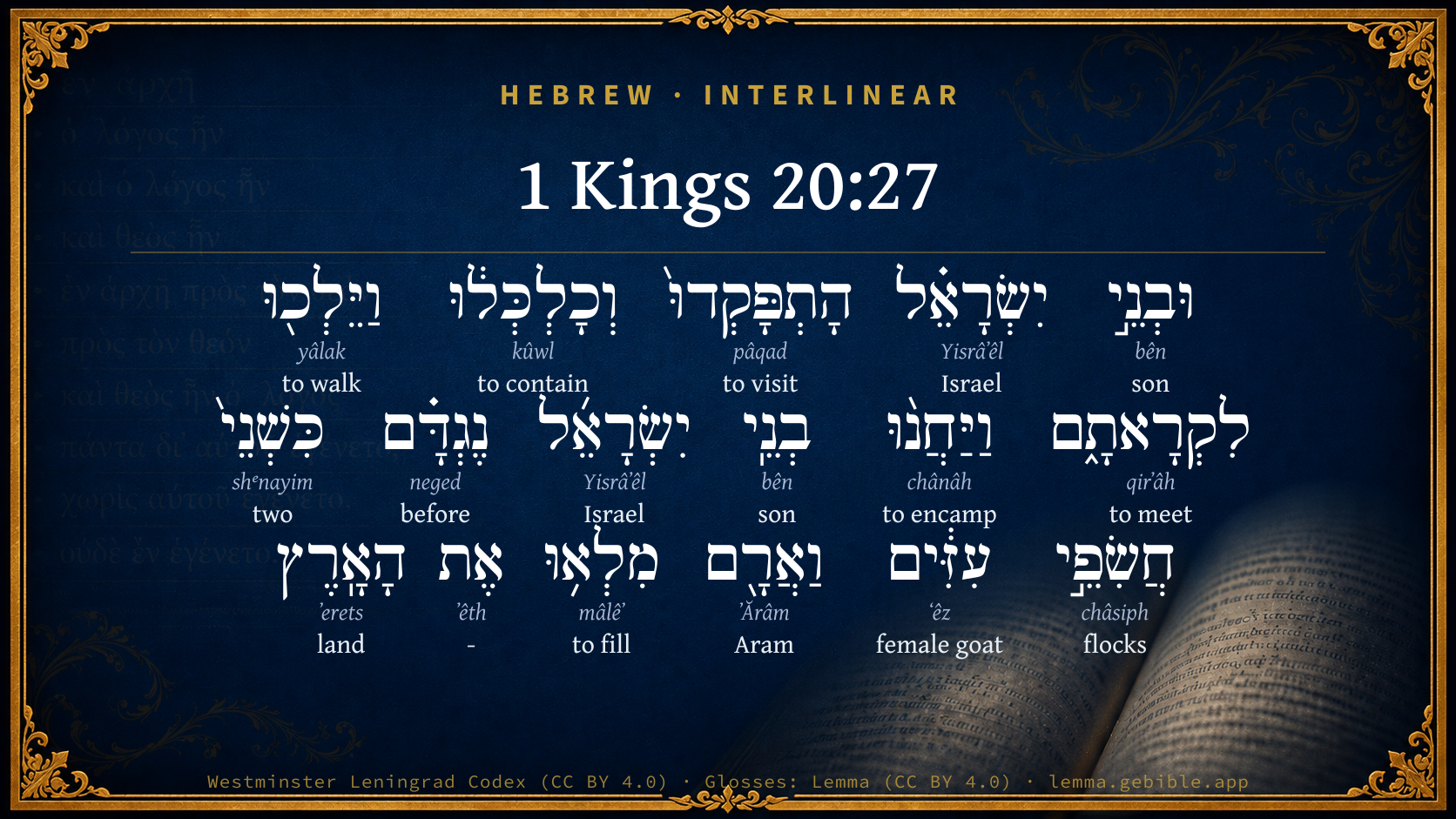
1 Kings 20:27

Hebrew (Westminster Leningrad Codex) 1 Kings 20:27 appears in the Hebrew Old Testament. The text above is from the Westminster Leningrad Codex. Each word links to its Strong’s number, a concise gloss, and parsing drawn from the Open Scriptures Hebrew Bible morphology. Click any word for its full Brown-Driver-Briggs (BDB) entry.
Download image
Cite this verse

1 Kings 20:27 (World English Bible). Public Domain. Lemma interlinear Bible study tool, https://lemma.gebible.app/v/1-kings/20/27.

Show BibTeX & RIS
BibTeX
RIS
English Translation
The children of Israel were mustered, and were provisioned, and went against them: and the children of Israel encamped before them like two little flocks of kids; but the Syrians filled the country.
World English Bible · Public Domain
Highlights Full analysis ↓
Download a study sheet

One document with this verse’s original text, its word-by-word gloss line, the meaning frame, cross-references with their text, attributed commentary, and full source and license credits — printable, and it pastes into notes with its structure intact.

This verse Autodidact and up

Study sheet (.html) Plain text (.txt)

A passage Seminary Student

Up to 50 verses in one chapter. A passage sheet keeps up to 6 commentary sources and 12 cross-references per verse, in the order this page ranks them, and says so on the sheet whenever that leaves anything out. Ask for a single verse and you get the Autodidact verse sheet above.

Everything on this page stays free to read, with no account — the sheet is a download of what is already on screen, not access to it.

Want to remove ads? Support Godless Engineer
Compare translations 3

The same verse in 3 English versions, stacked beneath the original-language interlinear above. Click any original word for its lexicon entry.

Each is an independent rendering of the whole verse — the interlinear is not word-aligned to these translations.

Highlighted words mark where these versions differ — a whole-verse word diff, not a word-by-word alignment.

  • World English Bible Public Domain
    The children of Israel were mustered, and were provisioned, and went against them: and the children of Israel encamped before them like two little flocks of kids; but the Syrians filled the country.
  • King James Version Public Domain
    And the children of Israel were numbered, and were all present, and went against them: and the children of Israel pitched before them like two little flocks of kids; but the Syrians filled the country.
  • unfoldingWord Literal Text CC BY-SA 4.0
    And the sons of Israel were mustered and were sustained, and they went to meet them. And the sons of Israel camped in front of them like two little flocks of goats, but Aram filled the land.

unfoldingWord Literal Text — © unfoldingWord, licensed CC BY-SA 4.0. Word-aligned USFM3 via Door43 (git.door43.org/unfoldingWord/en_ult).

Versions to compare (up to 4)

3 of 4 selected

Show all 18 translations

Every available English version of this verse, each an independent rendering of the whole verse.

  • World English Bible Public Domain
    The children of Israel were mustered, and were provisioned, and went against them: and the children of Israel encamped before them like two little flocks of kids; but the Syrians filled the country.
  • Berean Standard Bible Public Domain
    The Israelites also mobilized, gathered supplies, and marched out to meet them. The Israelites camped before them like two small flocks of goats, while the Arameans covered the countryside.
  • Majority Standard Bible Public Domain
    The Israelites also mobilized, gathered supplies, and marched out to meet them. The Israelites camped before them like two small flocks of goats, while the Arameans covered the countryside.
  • King James Version Public Domain
    And the children of Israel were numbered, and were all present, and went against them: and the children of Israel pitched before them like two little flocks of kids; but the Syrians filled the country.
  • American Standard Version (1901) Public Domain
    And the children of Israel were mustered, and were victualled, and went against them: and the children of Israel encamped before them like two little flocks of kids; but the Syrians filled the country.
  • Revised Version (1885) Public Domain
    And the children of Israel were mustered, and were victualled, and went against them: and the children of Israel encamped before them like two little flocks of kids; but the Syrians filled the country.
  • Geneva Bible (1599) Public Domain
    And the children of Israel were nombred, and were all assembled and went against them, and the children of Israel pitched before them, like two litle flockes of kiddes: but the Aramites filled the countrey.
  • Douay-Rheims (1899) Public Domain
    And the children of Israel were mustered, and taking victuals went out on the other side, and camped over against them, like two little hocks of goats: but the Syrians filled the land.
  • Young's Literal Translation Public Domain
    and the sons of Israel have been inspected, and supported, and go to meet them, and the sons of Israel encamp before them, like two flocks of goats, and the Aramaeans have filled the land.
  • Literal Standard Version CC BY-SA 4.0
    and the sons of Israel have been inspected, and supported, and go to meet them, and the sons of Israel encamp before them, like two flocks of goats, and the Arameans have filled the land.
  • Unlocked Literal Bible CC BY-SA 4.0
    The people of Israel were mustered and supplied to fight against them. The people of Israel camped before them like two little flocks of goats, but the Arameans filled the countryside.
  • unfoldingWord Literal Text CC BY-SA 4.0
    And the sons of Israel were mustered and were sustained, and they went to meet them. And the sons of Israel camped in front of them like two little flocks of goats, but Aram filled the land.
  • Darby Bible Public Domain
    And the children of Israel were numbered and victualled, and they went against them; and the children of Israel encamped before them like two little flocks of goats; but the Syrians filled the land.
  • World Messianic Bible Public Domain
    The children of Israel were mustered and given provisions, and went against them. The children of Israel encamped before them like two little flocks of young goats, but the Syrians filled the country.
  • Webster's Bible Public Domain
    And the children of Israel were numbered, and were all present, and went against them: and the children of Israel encamped before them like two little flocks of kids; but the Syrians filled the country.
  • Free Bible Version CC BY-SA 4.0
    The Israelite army was also called up and provided with supplies. They went to confront the Arameans. But when the Israelites set up their camp opposite the enemy they looked like two little flocks of goats in comparison with the Aramean army that filled the whole land.
  • Bible in Basic English Public Domain
    And the children of Israel got themselves together, and food was made ready and they went against them; the tents of the children of Israel were like two little flocks of goats before them, but all the country was full of the Aramaeans.
  • JPS Tanakh (1917) Public Domain
    And the children of Israel were mustered, and were victualled, and went against them; and the children of Israel encamped before them like two little flocks of kids; but the Arameans filled the country.

Literal Standard Version (2020), Covenant Press — licensed CC BY-SA 4.0. Text via the HelloAO Bible API (eBible.org). Unlocked Literal Bible (unfoldingWord) — licensed CC BY-SA 4.0. Text via the HelloAO Bible API (eBible.org). unfoldingWord Literal Text — © unfoldingWord, licensed CC BY-SA 4.0. Word-aligned USFM3 via Door43 (git.door43.org/unfoldingWord/en_ult). Free Bible Version, Dr. Jonathan Gallagher — licensed CC BY-SA 4.0. Text via the HelloAO Bible API (eBible.org).

Word by word

More ways to search: Search by grammar → Find every occurrence → Compare this word →

Practice this passage: Drill this verse → Learn its vocabulary →

חֲשִׂפֵ֣י
châsiph
H2835
“flocks of”
Noun, Common, Masculine, Plural, Construct
Part of Speech
Noun
Type
Common
Gender
Masculine
Number
Plural
State
Construct
Full BDB Definition

Origin: from H2834

TWOT: 766a

small flocks, little flocks
  1. וּבְנֵ֣י bên H1121 “and · sons of” Conjunction + Noun, Common, Masculine, Plural, Construct
  2. יִשְׂרָאֵ֗ל Yisrâʼêl H3478 “Israel” Noun, Proper
  3. הָתְפָּקְדוּ֙ pâqad H6485 “to visit” Verb, Hothpaal, Perfect, 3rd Person, Common, Plural
  4. וְכָלְכְּל֔וּ kûwl H3557 “and · to contain” Conjunction + Verb, Polpal, Perfect, 3rd Person, Common, Plural
  5. וַיֵּלְכ֖וּ yâlak H3212 “and · to walk” Conjunction + Verb, Qal, Sequential Imperfect, 3rd Person, Masculine, Plural
  6. לִקְרָאתָ֑ם qirʼâh H7125 “to meet · them” Preposition + Verb, Qal, Infinitive Construct + Suffix, Personal, 3rd Person, Masculine, Plural
  7. וַיַּחֲנ֨וּ chânâh H2583 “and · to encamp” Conjunction + Verb, Qal, Sequential Imperfect, 3rd Person, Masculine, Plural
  8. בְנֵֽי bên H1121 “sons of” Noun, Common, Masculine, Plural, Construct
  9. יִשְׂרָאֵ֜ל Yisrâʼêl H3478 “Israel” Noun, Proper
  10. נֶגְדָּ֗ם neged H5048 “before · them” Preposition + Suffix, Personal, 3rd Person, Masculine, Plural
  11. כִּשְׁנֵי֙ shᵉnayim H8147 “like/as · two” Preposition + Adjective, Cardinal number, Masculine, Dual, Construct
  12. עִזִּ֔ים ʻêz H5795 “female goats” Noun, Common, Feminine, Plural, Absolute
  13. וַאֲרָ֖ם ʼĂrâm H758 “and · Aram” Conjunction + Noun, Proper
  14. מִלְא֥וּ mâlêʼ H4390 “to fill” Verb, Piel, Perfect, 3rd Person, Common, Plural
  15. אֶת ʼêth H853 “-” Particle, Direct Object
  16. הָאָֽרֶץ ʼerets H776 “the · land” Particle, Definite Article + Noun, Common, Both, Singular, Absolute

About this verse

These counts appear in no published source. They are computed here, from the morphology-tagged text and Lemma’s own curated glosses. What Lemma adds →

17
words
15
distinct lemmas
Historical
section

Notable vocabulary

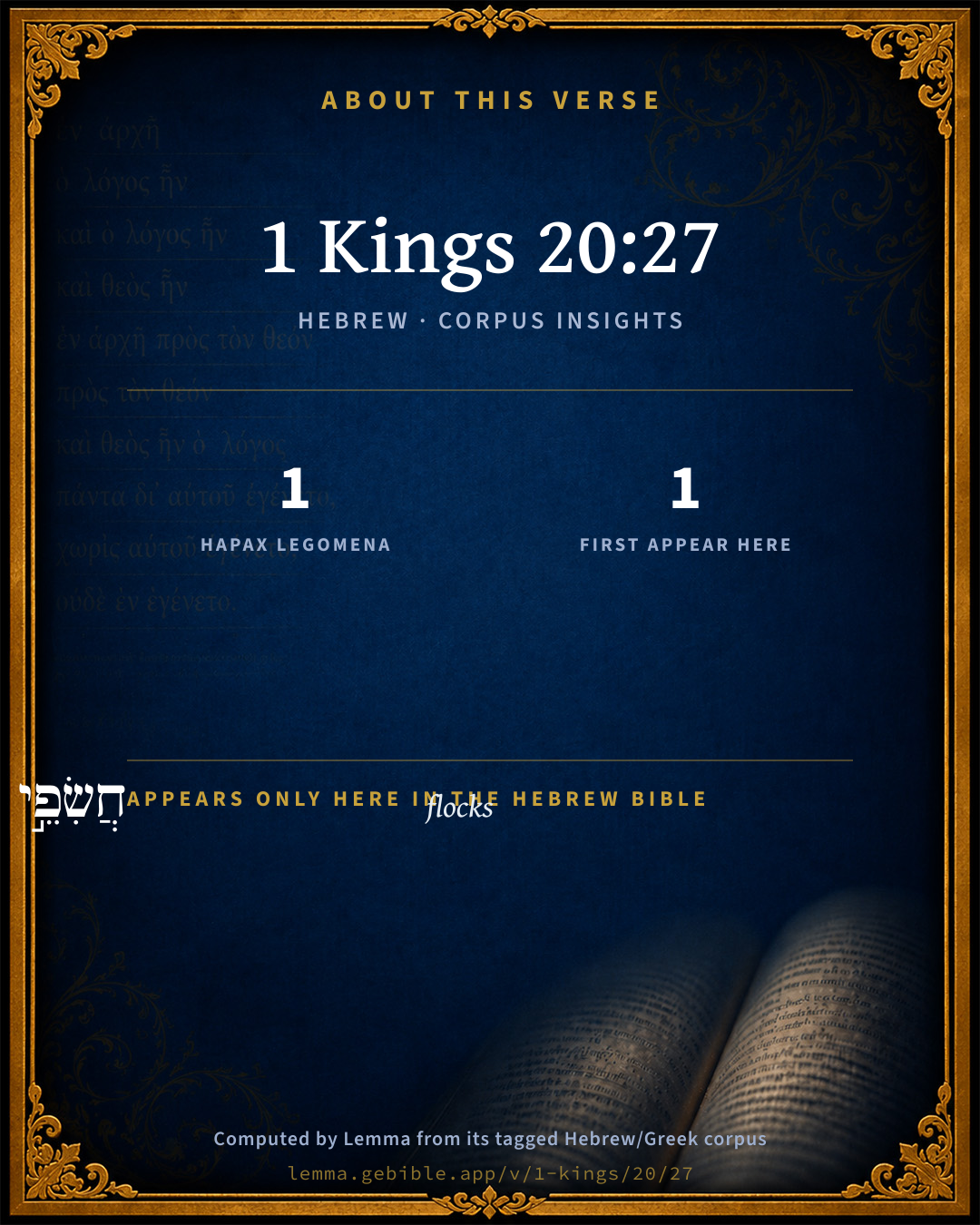
1 hapax legomenon — a word that appears only here in the entire Hebrew Bible:

  • חֲשִׂפֵ֣י flocks H2835

First appearance in Scripture

This word makes its first canonical appearance in the Hebrew Bible here:

  • חֲשִׂפֵ֣י flocks H2835

Shared distinctive vocabulary

וְכָלְכְּל֔וּ to contain H3557 occurs in 36 verses of the Hebrew Bible. Also found in:

Grammatical profile

  • 6 verbs
  • 8 nouns
  • 1 adjective
  • 1 preposition
  • 1 particle

Verb forms

  • הָתְפָּקְדוּ֙ Hothpaal · Perfect
  • וְכָלְכְּל֔וּ Polpal · Perfect
  • וַיֵּלְכ֖וּ Qal · Sequential Imperfect
  • לִקְרָאתָ֑ם Qal · Infinitive Construct
  • וַיַּחֲנ֨וּ Qal · Sequential Imperfect
  • מִלְא֥וּ Piel · Perfect

Repetition

Words recur within this verse — often emphatic in Hebrew:

  • וּבְנֵ֣י son H1121 ×2
  • יִשְׂרָאֵ֗ל Israel H3478 ×2

Hebrew & Septuagint length

In English translation the verse runs 33 words from the Hebrew and 48 from the Septuagint (LXX English) — the Septuagint runs noticeably longer here. See the side-by-side →

A rough comparison of the two English renderings, which tokenize alike — not a word-level alignment.

Word counts can differ between the Hebrew and the Greek without any difference in meaning — e.g. the Hebrew direct-object marker אֵת has no separate Greek word, and Greek often adds the article ὁ.

Cross-references

8

Topical passages linked to 1 Kings 20:27 in the Treasury of Scripture Knowledge — connected by theme and wording, ordered by reader-vote popularity; previews shown in the World English Bible.

  • Judges 6:5 For they came up with their cattle and their tents; they came in as locusts for multitude; both they and their camels were without number: and they came into the land to destroy it.
  • 1 Samuel 13:5–8 The Philistines assembled themselves together to fight with Israel, thirty thousand chariots, and six thousand horsemen, and people as the sand which is on the sea-shore in multitude: and they came up, and encamped in Michmash, eastward of Beth Aven.
  • Deuteronomy 32:30 How should one chase a thousand, Two put ten thousand to flight, Except their Rock had sold them, Yahweh had delivered them up?
  • Joshua 1:11 Pass through the midst of the camp, and command the people, saying, Prepare food; for within three days you are to pass over this Jordan, to go in to possess the land, which Yahweh your God gives you to possess it.
  • Judges 7:8 So the people took food in their hand, and their trumpets; and he sent all the men of Israel every man to his tent, but retained the three hundred men: and the camp of Midian was beneath him in the valley.
  • 1 Samuel 14:2 Saul abode in the uttermost part of Gibeah under the pomegranate tree which is in Migron: and the people who were with him were about six hundred men;
  • 2 Chronicles 32:7–8 Be strong and of good courage, don't be afraid nor dismayed for the king of Assyria, nor for all the multitude who is with him; for there is a greater with us than with him:
  • Ecclesiastes 9:11 I returned, and saw under the sun, that the race is not to the swift, nor the battle to the strong, neither yet bread to the wise, nor yet riches to men of understanding, nor yet favor to men of skill; but time and chance happen to them all.

Cross-references courtesy of OpenBible.info (CC BY 4.0).

Hebrew and Greek witnesses Masoretic Hebrew ↔ Greek Septuagint

The same verse in the two great witnesses to the Old Testament, shown verse-for-verse.

Here the Septuagint runs noticeably longer than the Hebrew — LXX2012 (modern English Septuagint) 48 words vs World English Bible 33. A rough length comparison of the two English translations, not a word-level alignment — read both below.

These are two independent witnesses, not word-aligned to each other, and the Septuagint is shown in lemma (dictionary) form.

Hebrew 1 Kings 20:27 Masoretic · Westminster Leningrad Codex

וּבְנֵ֣י יִשְׂרָאֵ֗ל הָתְפָּקְדוּ֙ וְכָלְכְּל֔וּ וַיֵּלְכ֖וּ לִקְרָאתָ֑ם וַיַּחֲנ֨וּ בְנֵֽי יִשְׂרָאֵ֜ל נֶגְדָּ֗ם כִּשְׁנֵי֙ חֲשִׂפֵ֣י עִזִּ֔ים וַאֲרָ֖ם מִלְא֥וּ אֶת הָאָֽרֶץ

The children of Israel were mustered, and were provisioned, and went against them: and the children of Israel encamped before them like two little flocks of kids; but the Syrians filled the country.

World English Bible · Public Domain

Greek LXX 1 Kings 20:27 Septuagint · lemma form

καί ὑπέρ ὁ λόγος ὡς κατανύσσω αχααβ ἀπό πρόσωπον ὁ κύριος καί πορεύομαι κλαίω καί διαῥήγνυμι ὁ χιτών αὐτός καί ζώννυμι σάκκος ἐπί ὁ σῶμα αὐτός καί νηστεύω καί περιβάλλω σάκκος ἐν ὁ ἡμέρα ὅς πατάσσω ναβουθαι ὁ ιεζραηλίτης

And because of the word, Achaab was pierced with sorrow before the Lord, and he both went weeping, and tore his garment, and girded sackcloth upon his body, and fasted; he put on sackcloth also in the day that he struck Nabuthai the Jezraelite, and went his way.

LXX2012 (modern English Septuagint) · Public Domain

On this verse, The Cambridge Bible for Schools and Colleges discusses the Septuagint’s reading. Read the note in Commentary ↓

Hebrew: Westminster Leningrad Codex (CC BY 4.0). Greek: Septuagint (public domain); English from LXX2012 (modern English Septuagint) (Public Domain). How the Septuagint differs from the Hebrew →

Targum (Aramaic paraphrase)

1

The Targum is the ancient Jewish Aramaic paraphrase of the Hebrew Scriptures — an interpretive translation, not the Hebrew text itself. Onkelos (literal) and Pseudo-Jonathan (expansive) render the Torah, and Jonathan the Prophets. Coverage is partial: where no permissively-licensed English translation exists for a verse, only the Aramaic is shown. This is verse-level text, not a word-by-word alignment to the Hebrew.

  1. Targum Jonathan Prophets (Joshua–Malachi)
    וּבְנֵי יִשְׂרָאֵל אִתְמְנִיאוּ וְאַזְדַמָנוּ וַאֲזָלוּ לְקֳדָמוּתְהוֹן וּשְׁרוֹ בְנֵי יִשְׂרָאֵל לְקִבְלֵהוֹן כִּתְרֵין גִזְרֵי עִזִין וֶאֱנַשׁ אֲרָם מְלִיאוּ יַת אַרְעָא:

    (no public-domain English translation for this verse)

    Targum Jonathan — Aramaic: “Mikraot Gedolot” (public domain). English: “Sefaria Community Translation” (CC0 1.0 (public-domain dedication)); “London "Chaldee Paraphrase," 1871” (public domain). Text via Sefaria.

Commentary

Notes on 1 Kings 20:27 from classic Christian and Jewish commentators (each source and its license shown beneath its notes). The classic Christian expositions comment on the surrounding passage and are grouped to its opening verse, so a note may address several verses; the Jewish commentaries on the Tanakh (Rashi and others) are per-verse, so they appear only where the commentator wrote on this verse.

Lemma curates 59 commentaries, every one of them public domain or Creative Commons licensed, each selected and text-cleaned for this edition rather than reprinted as found. About our sources →

Trapp's Complete Commentary

John Trapp

1Ki 20:27 And the children of Israel were numbered, and were all present, and went against them: and the children of Israel pitched before them like two little flocks of kids; but the Syrians filled the country.

Ver. 27. And were all present.] All the last year’s army that had been so victorious, not a man of them was missing; and that was very much. Ahab had the same promise, and therefore maketh use of the same forces as before.

John Trapp, A Commentary or Exposition upon All the Books of the Old and New Testament (1647–1656) — public domain. Text from a community e-Sword module.

The Biblical Illustrator

Joseph S. Exell

1Ki_20:27

And the children of Israel pitched before them like two little flocks of kids.

--

The coming religion

1. With thirty-three kings intoxicated in one tent this chapter opens. They were allies plotting for the overthrow of the Lords Israel. You know that if a lion roar a flock of kids will shiver and huddle together. One lion could conquer a thousand kids. The fact that throughout Christendom there are hundreds of printing-houses printing the word of God without the omission of a chapter or a verse, proves that the Bible is popular; and the fact that there are more being printed in this decade than any other decade proves that the Bible is increasing in popularity. I go through the courtrooms of the country; wherever I find a judges bench or a clerks desk I find the Bible. By what other book would they take solemn oath? What is very apt to be among the brides presents? The Bible. What is very apt to be put in the trunk of the young man when he starts for city life? The Bible. Voltaire predicted that the Bible during the nineteenth century would become an obsolete book. Well, we are pretty nearly through the nineteenth century, the Bible is not obsolete yet; there is not much prospect of its becoming obsolete; but I have to tell you that the very room in which Voltaire wrote that prediction, some time ago, was crowded from floor to ceiling with Bibles for Switzerland.

2. Our antagonists say that Christianity is falling back in the fact that infidelity is bolder now and more blatant than it ever was. I deny the statement. Infidelity is not near so bold now as it was in the days of our fathers and grandfathers. There were times in this country when men who were openly and above board infidel and antagonistic to Christianity could be elected to high office. Now let some man wishing high position in the State proclaim himself the foe of Christianity and an infidel, how many States of the Union would he carry? How many counties? Infidelity in this day is not half so bold as it used to be. If it comes now it is apt to come under the disguise of rhetoric or moral sentimentality. Do you suppose such things could be enacted now as were enacted in the days of Robespierre, when the wife of one of the prominent citizens was elected to be goddess, and she was carried in a golden chair to a cathedral, and the people bowel down to her as a Divine being, and burned incense before her, she to take the place of the Bible, and of Christianity, and of the Lord Almighty? And while that ceremony was going on in the cathedral, in the chapels, and in the corridors adjoining the cathedral, scenes of drunkenness and debauchery and obscenity were enacted such as the world had never seen. Could such a thing as that transpire now? No, sirs. The police would swoop on it, whether in Paris or New York. Infidelity is not half as bold now as it used to be.

3. But, say our antagonists, Christianity is falling back because science, its chief enemy, is triumphing over it. Now, I deny that there is any war between science and revelation. There is not a fact in science that may not be made to harmonise with the statements of the Bible. Joseph Henry, the leading scientist of America, better known and honoured in the royal societies transatlantic than any other American, lived and died a believer in the religion of Jesus Christ. He knew, Joseph Henry knew, all the facts of geology, and yet believed the Book of Genesis. He knew all the facts of astronomy, and yet believed the Book of Joshua, the sun and moon standing still. Joseph Henry knew all the anatomy of man and fish, and yet believed the Book of Jonah. If the scientists of the day were all agreed, and they came up with solid front to attack our Christianity, perhaps they might make some impression upon it; but they are not agreed. Agassiz saw what we all see, that there are men who talk very wisely who know but very little, and that just as soon as a young scientist finds out the difference between the feelers of a wasp and the horns of a beetle, he begins to patronise the Almighty, and go about talking about culture as though it were spelled c-u-l-c-h-a-r--culchar!

4. But my subject shall no longer be defensive; it must be aggressive. I must show you that instead of Christianity falling back, it is on the march, and that the coming religion of the world is to be the religion of the Lord Jesus Christ ten thousand times intensified. It is to take possession of everything--of all laws, all manners, all customs, all cities, all nations. It is going to be so mighty, as compared with what it has been so much more mighty, that it will seem almost like a new religion. I adopt this theory because Christianity has gone on straight ahead, notwithstanding all the bombardment, and infidelity has not destroyed a church, or crippled a minister, or rooted out one verse of the Bible, and now their ammunition seems to be pretty much exhausted. They cannot get anything new against Christianity, and if Christianity has gone on under the bombardment of centuries, and still continues to advance, may we not conclude that, as the powder and shot of the other side seem to be exhausted, Christianity is going on with more rapid stride? Beside that the rising generation are being saturated with Gospel truth as no other generation by these international series of Sunday-school lessons. Formerly the children were expected to nibble at the little infantile Scripture stories, but now they are taken from Genesis to Revelation, the strongest minds of the country explaining the lessons to the teachers, and the teachers explaining them to the classes, and we are going to have in this country five million youth forestalled for Christianity. Hear it! Hear it! Beside that you must have noticed, if you have talked on these great themes, that they are finding out that while science is grand in secular directions, worldly philosophy grand in secular directions, they cannot give any comfort to a soul in trouble. Talking with men on steamboats and in rail-ears, I find they are coming back to the comfort of the Gospel. They say, Somehow human science dont comfort me when I have any trouble, and I must try something else; and they are trying the Gospel. There is another reason why I believe that the religion of Jesus Christ is going to conquer the world, and that is, the Bible in fifty different places sets forth the idea that Emmanuel is to take possession of this whole world. If He is going to conquer the whole world, that means also this country, the greater including the less. (T. De Witt Talmage, D. D.)

The Biblical Illustrator, edited by Joseph S. Exell (c. 1880s–1900s) — public domain. Text from a community e-Sword module.

Tyndale Open Study Notes

Tyndale Open Resources

20:27-30 Despite the Arameans’ superior numbers, Israel won another outstanding victory by God’s help. All the parties learned that “nothing is impossible with God” (Luke 1:37; see Matt 19:26; Mark 10:27) and that when God is on one’s side, the enemy will retreat (Ps 56:9) with staggering losses (Deut 32:30-31; 2 Kgs 19:32-36). Israel could face the foe fearlessly (Pss 3:6; 27:1-3). • God’s assurance to Israel through the man of God showed that this battle was not just for Israel’s well-being but for the Lord’s glory.

Tyndale Open Study Notes — © Tyndale Open Resources, licensed CC BY-SA 4.0. Text via the HelloAO Bible API.

Geneva Bible (1599)

Geneva Bible translators

All they, which were in the battle of the former year, verse 15.

Geneva Bible (1599) marginal notes — public domain. Text via Bolls.life.

Jamieson, Fausset & Brown

Robert Jamieson, A. R. Fausset & David Brown

like two little flocks of kids--Goats are never seen in large flocks, or scattered, like sheep; and hence the two small but compact divisions of the Israelite force are compared to goats, not sheep. Humanly speaking, that little handful of men would have been overpowered by numbers. But a prophet was sent to the small Israelite army to announce the victory, in order to convince the Syrians that the God of Israel was omnipotent everywhere, in the valley as well as on the hills. And, accordingly, after the two armies had pitched opposite each other for seven days, they came to an open battle. One hundred thousand Syrians lay dead on the field, while the fugitives took refuge in Aphek, and there, crowding on the city walls, they endeavored to make a stand against their pursuers; but the old walls giving way under the incumbent weight, fell and buried twenty-seven thousand in the ruins. Ben-hadad succeeded in extricating himself, and, with his attendants, sought concealment in the city, fleeing from chamber to chamber; or, as some think it, an inner chamber, that is, a harem; but seeing no ultimate means of escape, he was advised to throw himself on the tender mercies of the Israelitish monarch.

Jamieson, Fausset & Brown — Commentary Critical and Explanatory on the Whole Bible (1871) — public domain (CC PDM 1.0). Text via the HelloAO Bible API.

Ellicott's Commentary for English Readers

(27) Were all present.—The marginal reading “were victualled,” or, perhaps, more generally, “were supplied,” with all things necessary for war, seems correct. The comparatively small number of the Israelite forces, even after the great victory of the year before, appears to show that, previous to the siege of Samaria, Ahab had suffered some great defeats, which had broken the strength of Israel.

A Bible Commentary for English Readers, edited by Charles John Ellicott (1878–1897) — public domain. Text from a community e-Sword module.

The Cambridge Bible for Schools and Colleges

gen. ed. J. J. S. Perowne

27. were all present] The R.V. has adopted the marginal rendering of A.V. were victualled. This is the rendering of the Vulg. cibaria exceperunt. The passive form of the verb occurs only here, but the active ‘to supply with victuals’ is found, Gen_45:11; Gen_50:21 and in several other places.

and the children of Israel pitched [R.V. encamped] before them] The R.V. is a very frequent translation of this word, and seems best when there is no object after the verb. When ‘their tents’ or some such expression is supplied, then ‘pitch’ is the more appropriate. The R.V. makes the same change in 1Ki_20:29.

two little flocks] The rendering ‘little flocks’ is from the Vulg. ‘duo parvi greges’. The LXX. has δύο ποίμνια. The Hebrew word does not occur elsewhere.

The Israelite army had adopted a division into two parts, perhaps from the arrangement which had been so successful in the previous attack.

The Cambridge Bible for Schools and Colleges (gen. ed. J. J. S. Perowne; Cambridge University Press, 1878–1918) — public domain. Text from a community e-Sword module.

John Gill's Exposition

And the children of Israel were numbered, and were all present,.... The same as before; the two hundred and thirty two young men of the princes of the provinces, and 7000 of the people, not one was missing:

and went against them; out of Samaria, towards Aphek:

and the children of Israel pitched before them like two little flocks of kids: being few and weak, the two hundred and thirty two young men in one body, and the 7000 in another:

but the Syrians filled the country: with their men, their horses, and their chariots.

John Gill's Exposition of the Whole Bible (1746–1763) — public domain (CC PDM 1.0). Text via the HelloAO Bible API.

Albert Barnes' Notes on the Bible

Were all present - The marginal rendering is adopted by almost all critics.

Like two little flocks of kids - The word translated “little flocks” does not occur elsewhere in Scripture. It seems to mean simply “flocks.” Compare the Septuagint, who render ὡσεί δύο ποίμνια αἰγῶν hōsei duo poimnia aigōn.

Albert Barnes' Notes on the Bible (1834–1885) — public domain. Text from a community e-Sword/MySword module.

Haydock's Catholic Bible Commentary

Victuals. Hebrew also, "they were all present." Chaldean, "ready." Syriac, "in battle array." --- Goats. They were comparatively so contemptible, ver. 15. (Haydock) --- At the same time, Josaphat could muster above a million warriors; for piety makes kingdoms prosper. (Salien)

George Leo Haydock (1774–1849), Haydock's Catholic Family Bible and Commentary, 1859 edition — public domain. Excludes Psalms (Douay-Rheims chapter numbering differs from Protestant) and Deuterocanonical books (Catholic canon only).

Matthew Poole's English Annotations

Were all present, i.e. all the forces of the Israelites were here gathered together to oppose the Syrians; so if these had been conquered, all had been lost.

Went against them; being persuaded and encouraged so to do; partly to invent the mischiefs of a siege in Samaria, and the waste of all the rest of their country; and partly by the remembrance of their former success, and an expectation of the same assistance from God again.

Pitched before them; probably upon some hilly ground, where they might secure themselves, and watch for advantage against their enemies; which may be the reason why the Syrians durst not assault them before the seventh day, 1Ki 20:29.

Like two little flocks of kids, i.e. few, and weak, and heartless; being also for conveniency of fighting, and that they might seem to be more than they were, divided into two bodies.

Matthew Poole's English Annotations on the Holy Bible (1683–1685) — public domain. Text from a community e-Sword/MySword module.

Whedon's Commentary on the Bible

Daniel D. Whedon

27. Were all present — Rather, as in the margin, were victualled, supplied with necessary provisions.

Daniel D. Whedon (gen. ed.), Commentary on the Old and New Testaments (1874–1909) — public domain. Text from a community e-Sword module.

The Pulpit Commentary

And the children of Israel were numbered lit., numbered themselves. Hith-pael, and were all present Rather, and were provided with food, lWK= to nourish. The Alex. LXX inserts kaiqhsan. Vulgate accepetis cibariis. Marg. were victualled. This word of itself suggests that they were at a distance from their capital or other city, and went against them Heb. to meet them: and the children of Israel pitched before them like two little flocks pycij means separate It is rightly translated little flocks" (not "flocks," Rawlinson), because the idea is that of two bands of stragglers separated from the main body of the flock. So the Vulgate, duo parvi greges caprarum; but LXX, duo poimnia agw!n. Ewald thinks the two flocks" points to an an auxiliary fores furnished by Jehoshaphat, fighting with Israel. He also thinks goats are mentioned to convey the exalted position of the camp upon the hills. Flocks of goats as a rule are smaller than those of sheep, the former being more given to straying of kids lit., she-goats. "These flocks pasture mostly on the cliffs, and are smaller than the flocks of sheep" (Bahr); but the Syrians filled the country. The whole plain swarmed with their legions in striking contrast to the two insignificant Bodies of Israelites.

The Pulpit Commentary (1880–1919), ed. H.D.M. Spence-Jones & Joseph S. Exell — public domain. Text from a community e-Sword module.

John Wesley's Explanatory Notes

And went - Being encouraged by the remembrance of their former success, and an expectation of assistance from God again. And pitched - Probably upon some hilly ground, where they might secure themselves, and watch for advantage against their enemies; which may be the reason why the Syrians durst not assault them before the seventh day, ver. 29. Little flocks - Few, and weak, being also for conveniency of fighting, and that they might seem to be more than they were, divided into two bodies.

John Wesley, Explanatory Notes Upon the Whole Bible (1754–1765) — public domain. Text via the GEBible commentary corpus.

Keil & Delitzsch

C. F. Keil & F. Delitzsch

The Israelites, mustered and provided for (כּלכּלוּ: supplied with ammunition and provisions), marched to meet them, and encamped before them "like two little separate flocks of goats" (i.e., severed from the great herd of cattle). They had probably encamped upon slopes of the mountains by the plain of Jezreel, where they looked like two miserable flocks of goats in contrast with the Syrians who filled the land.

Keil & Delitzsch — Biblical Commentary on the Old Testament (1861–1891) — public domain (CC PDM 1.0). Text via the HelloAO Bible API. (Old Testament only.)

Rashi

Rabbi Shlomo Yitzchaki (Rashi)

And provisioned. They armed themselves with supplies for the war; i.e., with weapons and all necessities of war.

And provisioned. They were provisioned.

Like two flocks of goats. [חשפי means] “flocks of goats,” but there is no similar word [in Scripture]. However, Menachem classifies [חשפי] as an expression of revelation, as in, “by uncovering [מחשוף] the white,” [and as in,] “bare [חשפי] a leg.” An expression of “revelation” can be applied to flocks of goats, as in, “who bared [שגלשו] from Mount Gilad,” [i.e.,] when they come down from the mountain, the mountain is bared.

Rashi on the Tanakh — English translations: “The Judaica Press complete Tanach with Rashi, translated by A. J. Rosenberg” (CC BY 4.0); “Pentateuch with Rashi's commentary by M. Rosenbaum and A.M. Silbermann, 1929-1934” (public domain); “The Metsudah Tanach series, Lakewood, N.J” (CC BY 4.0); and “The Book of Joshua, Metsudah Publications, 1997” (CC BY 4.0). Text via Sefaria.

Lesson kit

Teaching starters — assembled from the data on this page, not authored interpretation. Every prompt links to the verse data it draws on. Edit before teaching.

1 Kings, in the Historical, opens this verse with 17 words (15 distinct Hebrew lemmas). Its most distinctive word is châsiph (“flocks”). The Greek Septuagint runs longer here. A historical commentator’s framing appears above. Read the whole chapter for the surrounding context.

Discussion questions

  1. How does “flocks” (châsiph) shape what this verse is saying?
  2. This verse holds 1 word here found nowhere else in the Hebrew Bible. What might the rare word draw attention to?
  3. The word “flocks” first appears here in Scripture. What is being introduced at this debut?
  4. Genesis 45:11 shares the word «to contain» with this verse. How do the two illuminate each other?
  5. “son” occurs 2× in this one verse. What is the effect of the repetition?
  6. Compared with the Hebrew, the Septuagint runs longer here. What questions does that raise?
  7. The translations on this page render this verse differently — a whole-verse word diff, not a word-by-word alignment. What might account for the different wordings?
  8. The verb «הָתְפָּקְדוּ֙» is Hothpaal Perfect. How does its form color the action?

Things to notice

  • 1 word in this verse appears nowhere else in the Hebrew Bible.
  • 1 word makes its first canonical appearance in Scripture here.
  • These translations choose different wording for 21 words in this verse.
  • “son” occurs 2× in this single verse.
  • 15 distinct Hebrew lemmas span 17 words in this verse.

Reading settings

Reading text

Shown beneath each verse's original-language words.

Old Testament
Old Testament edition

Read the OT as the Masoretic Hebrew (MT) or the Greek Septuagint (LXX).

English shown for the Greek Septuagint (in the Hebrew ↔ Greek comparison).

Comparing translations? Open the Compare panel on any verse page to stack up to four side by side.