Jeremiah 4:20

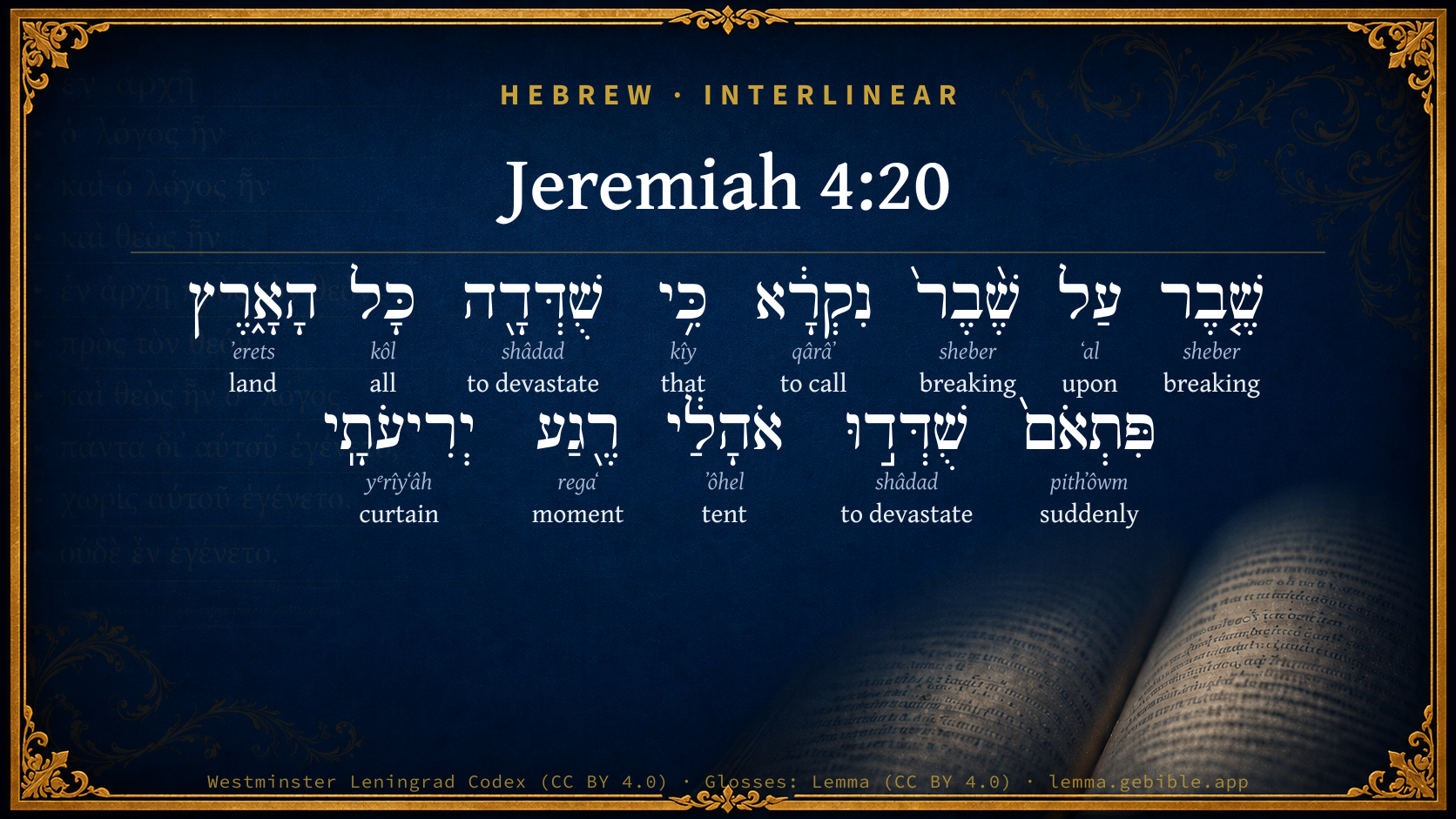
Hebrew (Westminster Leningrad Codex) Jeremiah 4:20 appears in the Hebrew Old Testament. The text above is from the Westminster Leningrad Codex. Each word links to its Strong’s number, a concise gloss, and parsing drawn from the Open Scriptures Hebrew Bible morphology. Click any word for its full Brown-Driver-Briggs (BDB) entry.
Download image
Cite this verse

Jeremiah 4:20 (World English Bible). Public Domain. Lemma interlinear Bible study tool, https://lemma.gebible.app/v/jeremiah/4/20.

Show BibTeX & RIS
BibTeX
RIS
English Translation
Destruction on destruction is cried; for the whole land is laid waste: suddenly are my tents destroyed, [and] my curtains in a moment.
World English Bible · Public Domain
Download a study sheet

One document with this verse’s original text, its word-by-word gloss line, the meaning frame, cross-references with their text, attributed commentary, and full source and license credits — printable, and it pastes into notes with its structure intact.

This verse Autodidact and up

Study sheet (.html) Plain text (.txt)

A passage Seminary Student

Up to 50 verses in one chapter. A passage sheet keeps up to 6 commentary sources and 12 cross-references per verse, in the order this page ranks them, and says so on the sheet whenever that leaves anything out. Ask for a single verse and you get the Autodidact verse sheet above.

Everything on this page stays free to read, with no account — the sheet is a download of what is already on screen, not access to it.

Want to remove ads? Support Godless Engineer
Compare translations 3

The same verse in 3 English versions, stacked beneath the original-language interlinear above. Click any original word for its lexicon entry.

Each is an independent rendering of the whole verse — the interlinear is not word-aligned to these translations.

Highlighted words mark where these versions differ — a whole-verse word diff, not a word-by-word alignment.

  • World English Bible Public Domain
    Destruction on destruction is cried; for the whole land is laid waste: suddenly are my tents destroyed, [and] my curtains in a moment.
  • King James Version Public Domain
    Destruction upon destruction is cried; for the whole land is spoiled: suddenly are my tents spoiled, and my curtains in a moment.
  • unfoldingWord Literal Text CC BY-SA 4.0
    Collapse upon collapse is called out, for all the land is devastated. Suddenly my tents are devastated, in a moment, my curtains!

unfoldingWord Literal Text — © unfoldingWord, licensed CC BY-SA 4.0. Word-aligned USFM3 via Door43 (git.door43.org/unfoldingWord/en_ult).

Versions to compare (up to 4)

3 of 4 selected

Show all 18 translations

Every available English version of this verse, each an independent rendering of the whole verse.

  • World English Bible Public Domain
    Destruction on destruction is cried; for the whole land is laid waste: suddenly are my tents destroyed, [and] my curtains in a moment.
  • Berean Standard Bible Public Domain
    Disaster after disaster is proclaimed, for the whole land is laid waste. My tents are destroyed in an instant, my curtains in a moment.
  • Majority Standard Bible Public Domain
    Disaster after disaster is proclaimed, for the whole land is laid waste. My tents are destroyed in an instant, my curtains in a moment.
  • King James Version Public Domain
    Destruction upon destruction is cried; for the whole land is spoiled: suddenly are my tents spoiled, and my curtains in a moment.
  • American Standard Version (1901) Public Domain
    Destruction upon destruction is cried; for the whole land is laid waste: suddenly are my tents destroyed, `and' my curtains in a moment.
  • Revised Version (1885) Public Domain
    Destruction upon destruction is cried; for the whole land is spoiled: suddenly are my tents spoiled, and my curtains in a moment.
  • Geneva Bible (1599) Public Domain
    Destruction vpon destruction is cryed, for the whole lande is wasted: suddenly are my tents destroyed, and my curtaines in a moment.
  • Douay-Rheims (1899) Public Domain
    Destruction upon destruction is called for, and all the earth is laid waste: my tents are destroyed on a sudden, and my pavilions in a moment.
  • Young's Literal Translation Public Domain
    Destruction on destruction is proclaimed, For spoiled hath been all the land, Suddenly spoiled have been my tents, In a moment -- my curtains.
  • Literal Standard Version CC BY-SA 4.0
    Destruction on destruction is proclaimed, || For all the land has been spoiled, || My tents have suddenly been spoiled, || In a moment—my curtains.
  • Unlocked Literal Bible CC BY-SA 4.0
    Disaster follows after disaster; for all the land lies in ruins. Suddenly my tents are destroyed, my curtains in a moment.
  • unfoldingWord Literal Text CC BY-SA 4.0
    Collapse upon collapse is called out, for all the land is devastated. Suddenly my tents are devastated, in a moment, my curtains!
  • Darby Bible Public Domain
    Destruction upon destruction is proclaimed; for the whole land is wasted: suddenly are my tents laid waste, my curtains, in a moment.
  • World Messianic Bible Public Domain
    Destruction on destruction is decreed, for the whole land is laid waste. Suddenly my tents are destroyed, and my curtains gone in a moment.
  • Webster's Bible Public Domain
    Destruction upon destruction is cried; for the whole land is laid waste; suddenly are my tents ruined, and my curtains in a moment.
  • Free Bible Version CC BY-SA 4.0
    News of one disaster after another comes flooding in, for the whole country is in ruins. My own home is destroyed in a moment, and everything inside.
  • Bible in Basic English Public Domain
    News is given of destruction on destruction; all the land is made waste: suddenly my tents, straight away my curtains, are made waste.
  • JPS Tanakh (1917) Public Domain
    Destruction followeth upon destruction, for the whole land is spoiled; suddenly are my tents spoiled, my curtains in a moment.

Literal Standard Version (2020), Covenant Press — licensed CC BY-SA 4.0. Text via the HelloAO Bible API (eBible.org). Unlocked Literal Bible (unfoldingWord) — licensed CC BY-SA 4.0. Text via the HelloAO Bible API (eBible.org). unfoldingWord Literal Text — © unfoldingWord, licensed CC BY-SA 4.0. Word-aligned USFM3 via Door43 (git.door43.org/unfoldingWord/en_ult). Free Bible Version, Dr. Jonathan Gallagher — licensed CC BY-SA 4.0. Text via the HelloAO Bible API (eBible.org).

Word by word

More ways to search: Search by grammar → Find every occurrence → Compare this word →

Practice this passage: Drill this verse → Learn its vocabulary →

רֶ֖גַע
regaʻ
H7281
“moment”
Noun, Common, Masculine, Singular, Absolute
Part of Speech
Noun
Type
Common
Gender
Masculine
Number
Singular
State
Absolute
Full BDB Definition

Origin: from H7280 a wink (of the eyes), i.e. a very short space of time

TWOT: 2116a

a moment (noun masculine) - for a moment, at one moment...at another moment (adverb) - in a moment (with preposition)
  1. שֶׁ֤בֶר sheber H7667 “breaking” Noun, Common, Masculine, Singular, Absolute
  2. עַל ʻal H5921 “upon” Preposition
  3. שֶׁ֨בֶר֙ sheber H7667 “breaking” Noun, Common, Masculine, Singular, Absolute
  4. נִקְרָ֔א qârâʼ H7121 “to call” Verb, Niphal, Perfect, 3rd Person, Masculine, Singular
  5. כִּ֥י kîy H3588 “that” Conjunction
  6. שֻׁדְּדָ֖ה shâdad H7703 “to devastate” Verb, Pual, Perfect, 3rd Person, Feminine, Singular
  7. כָּל kôl H3605 “all of” Noun, Common, Masculine, Singular, Construct
  8. הָאָ֑רֶץ ʼerets H776 “the · land” Particle, Definite Article + Noun, Common, Both, Singular, Absolute
  9. פִּתְאֹם֙ pithʼôwm H6597 “suddenly” Adverb
  10. שֻׁדְּד֣וּ shâdad H7703 “to devastate” Verb, Pual, Perfect, 3rd Person, Common, Plural
  11. אֹהָלַ֔י ʼôhel H168 “tents · my” Noun, Common, Masculine, Plural, Construct + Suffix, Personal, 1st Person, Common, Singular
  12. יְרִיעֹתָֽי yᵉrîyʻâh H3407 “curtains · my” Noun, Common, Feminine, Plural, Construct + Suffix, Personal, 1st Person, Common, Singular

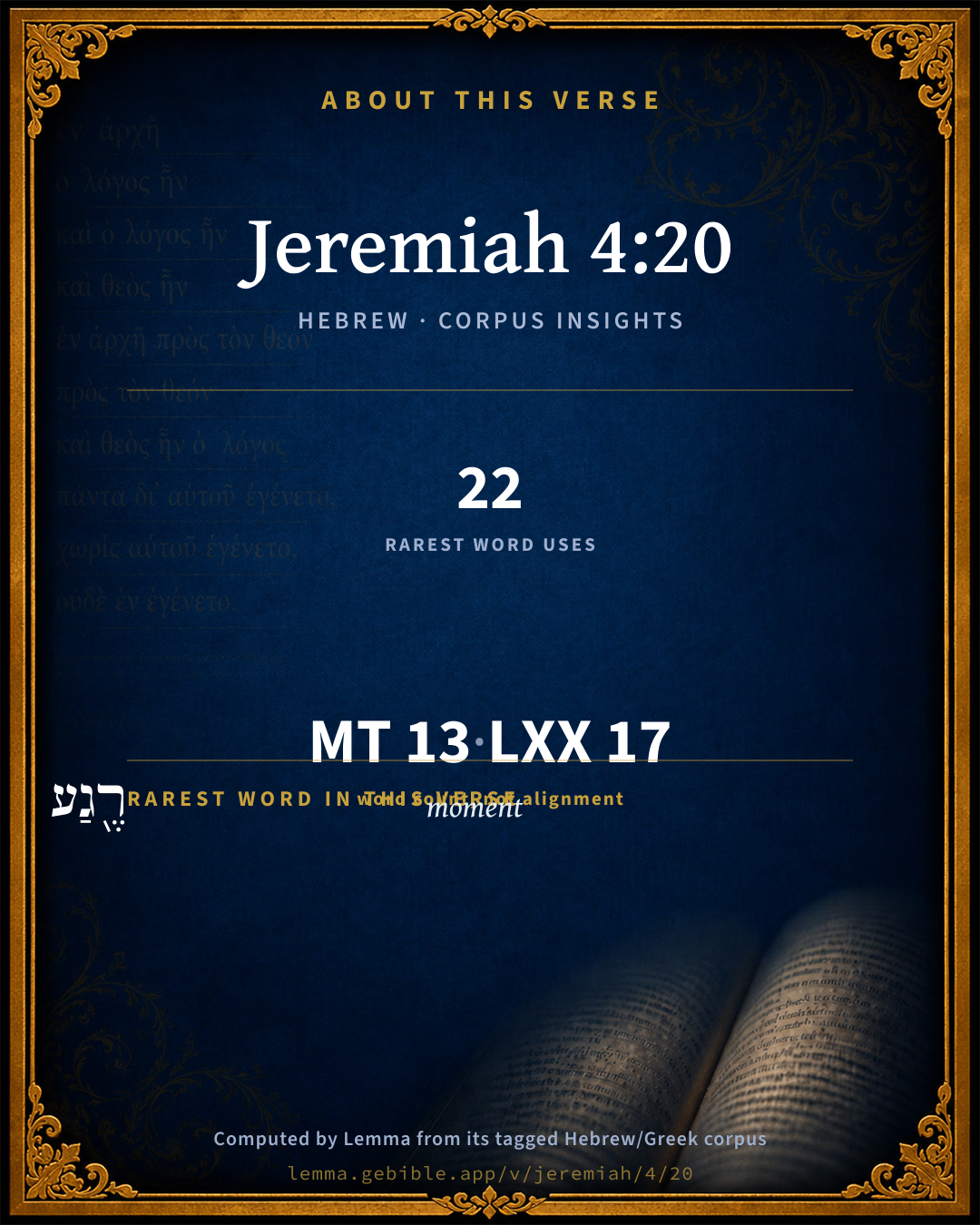
About this verse

These counts appear in no published source. They are computed here, from the morphology-tagged text and Lemma’s own curated glosses. What Lemma adds →

13
words
11
distinct lemmas
Prophets
section

Notable vocabulary

The rarest word here is רֶ֖גַע moment H7281 — appearing just 22 times in the whole Hebrew Bible.

Shared distinctive vocabulary

רֶ֖גַע moment H7281 occurs in 22 verses of the Hebrew Bible. Also found in:

Grammatical profile

  • 3 verbs
  • 7 nouns
  • 1 preposition
  • 1 conjunction
  • 1 adverb

Verb forms

  • נִקְרָ֔א Niphal · Perfect
  • שֻׁדְּדָ֖ה Pual · Perfect
  • שֻׁדְּד֣וּ Pual · Perfect

Repetition

Words recur within this verse — often emphatic in Hebrew:

  • שֶׁ֤בֶר breaking H7667 ×2
  • שֻׁדְּדָ֖ה to devastate H7703 ×2

Hebrew & Septuagint length

In the original languages it is 13 Hebrew tokens and 17 Greek tokens — but the two are counted differently (Hebrew bundles its prefixes and suffixes into one token; the Greek is in lemma form), so that isn’t a like-for-like length.

Cross-references

24

Topical passages linked to Jeremiah 4:20 in the Treasury of Scripture Knowledge — connected by theme and wording, ordered by reader-vote popularity; previews shown in the World English Bible.

  • Psalms 42:7 Deep calls to deep at the noise of your waterfalls. All your waves and your billows have swept over me.
  • Ezekiel 7:25–26 Destruction comes; and they shall seek peace, and there shall be none.
  • Joel 1:15 Alas for the day! For the day of Yahweh is at hand, And it will come as destruction from the Almighty.
  • Matthew 10:28 Don't be afraid of those who kill the body, but are not able to kill the soul. Rather, fear him who is able to destroy both soul and body in Gehenna.
  • 2 Thessalonians 1:9 who will pay the penalty: eternal destruction from the face of the Lord and from the glory of his might,
  • Exodus 33:5 Yahweh said to Moses, "Tell the children of Israel, 'You are a stiff-necked people. If I were to go up into your midst for one moment, I would consume you. Therefore now take off your jewelry from you, that I may know what to do to you."
  • Leviticus 26:18 "'If you in spite of these things will not listen to me, then I will chastise you seven times more for your sins.
  • Leviticus 26:21 "'If you walk contrary to me, and won't listen to me, then I will bring seven times more plagues on you according to your sins.
  • Leviticus 26:24 then I will also walk contrary to you; and I will strike you, even I, seven times for your sins.
  • Isaiah 13:6 Wail; for the day of Yahweh is at hand; as destruction from the Almighty shall it come.
  • Isaiah 33:20 Look on Zion, the city of our solemnities: your eyes shall see Jerusalem a quiet habitation, a tent that shall not be removed, the stakes of it shall never be plucked up, neither shall any of the cords of it be broken.
  • Jeremiah 10:19–20 Woe is me because of my hurt! my wound is grievous: but I said, Truly this is [my] grief, and I must bear it.
  • Jeremiah 17:18 Let them be disappointed who persecute me, but let not me be disappointed; let them be dismayed, but don't let me be dismayed; bring on them the day of evil, and destroy them with double destruction.
  • Lamentations 3:47 Fear and the pit are come on us, devastation and destruction.
  • Ezekiel 14:21 For thus says the Lord Yahweh: How much more when I send my four sore judgments on Jerusalem, the sword, and the famine, and the evil animals, and the pestilence, to cut off from it man and animal!
  • Leviticus 26:28 then I will walk contrary to you in wrath; and I also will chastise you seven times for your sins.
  • Numbers 16:21 Separate yourselves from among this congregation, that I may consume them in a moment.
  • Numbers 16:45 Get away from among this congregation, that I may consume them in a moment. They fell on their faces.
  • Psalms 72:19 Blessed be his glorious name forever! Let the whole earth be filled with his glory! Amen and amen.
  • Isaiah 47:9 but these two things shall come to you in a moment in one day, the loss of children, and widowhood; in their full measure shall they come on you, in the multitude of your sorceries, and the great abundance of your enchantments.
  • Isaiah 54:2 Enlarge the place of your tent, and let them stretch forth the curtains of your habitations; don't spare: lengthen your cords, and strengthen your stakes.
  • Jeremiah 4:6 Set up a standard toward Zion: flee for safety, don't stay; for I will bring evil from the north, and a great destruction.
  • Lamentations 2:6–9 He has violently taken away his tent, as if it were of a garden; he has destroyed his place of assembly: Yahweh has caused solemn assembly and Sabbath to be forgotten in Zion, Has despised in the indignation of his anger the king and the priest.
  • Habakkuk 3:7 I saw the tents of Cushan in affliction. The dwellings of the land of Midian trembled.

Cross-references courtesy of OpenBible.info (CC BY 4.0).

Hebrew and Greek witnesses Masoretic Hebrew ↔ Greek Septuagint

The same verse in the two great witnesses to the Old Testament, shown verse-for-verse.

These are two independent witnesses, not word-aligned to each other, and the Septuagint is shown in lemma (dictionary) form.

Hebrew Jeremiah 4:20 Masoretic · Westminster Leningrad Codex

שֶׁ֤בֶר עַל שֶׁ֨בֶר֙ נִקְרָ֔א כִּ֥י שֻׁדְּדָ֖ה כָּל הָאָ֑רֶץ פִּתְאֹם֙ שֻׁדְּד֣וּ אֹהָלַ֔י רֶ֖גַע יְרִיעֹתָֽי

Destruction on destruction is cried; for the whole land is laid waste: suddenly are my tents destroyed, [and] my curtains in a moment.

World English Bible · Public Domain

Greek LXX Structure differs

In the Septuagint, Jeremiah is about an eighth shorter than the Hebrew and arranges its material differently — the Oracles Against the Nations (Hebrew chapters 46–51) appear in the middle of the Greek book, after 25:13. Because the chapter and verse boundaries do not line up, a verse-for-verse comparison with the Hebrew is not shown.

A verse-for-verse comparison isn’t shown here because the chapters and verses don’t line up. Switch to the LXX edition with the MT / LXX toggle above to read the Greek directly.

Hebrew: Westminster Leningrad Codex (CC BY 4.0). Greek: Septuagint (public domain); English from a public-domain English Septuagint. How the Septuagint differs from the Hebrew →

Targum (Aramaic paraphrase)

1

The Targum is the ancient Jewish Aramaic paraphrase of the Hebrew Scriptures — an interpretive translation, not the Hebrew text itself. Onkelos (literal) and Pseudo-Jonathan (expansive) render the Torah, and Jonathan the Prophets. Coverage is partial: where no permissively-licensed English translation exists for a verse, only the Aramaic is shown. This is verse-level text, not a word-by-word alignment to the Hebrew.

  1. Targum Jonathan Prophets (Joshua–Malachi)
    תְּבָרָא עַל תְּבָרָא יִתְעַרַע אֲרֵי אִתְבְּזִיזַת כָּל אַרְעָא בִּתְכֵּיף חֲרוֹבַת אַרְעִי זְמַן חֲדָא כָּל קִרְוָי:

    (no public-domain English translation for this verse)

    Targum Jonathan — Aramaic: “Mikraot Gedolot” (public domain). English: “Sefaria Community Translation” (CC0 1.0 (public-domain dedication)); “London "Chaldee Paraphrase," 1871” (public domain). Text via Sefaria.

Commentary

Notes on Jeremiah 4:20 from classic Christian and Jewish commentators (each source and its license shown beneath its notes). The classic Christian expositions comment on the surrounding passage and are grouped to its opening verse, so a note may address several verses; the Jewish commentaries on the Tanakh (Rashi and others) are per-verse, so they appear only where the commentator wrote on this verse.

Lemma curates 59 commentaries, every one of them public domain or Creative Commons licensed, each selected and text-cleaned for this edition rather than reprinted as found. About our sources →

Trapp's Complete Commentary

John Trapp

Jer 4:20 Destruction upon destruction is cried; for the whole land is spoiled: suddenly are my tents spoiled, [and] my curtains in a moment.

Ver. 20. Destruction upon destruction.] Fluctus fluctum trudit; one mischief upon another, the sword after famine, captivity after a siege.

For the whole land is spoiled.] Or, Plundered; which word we first heard of in the Swedish wars.

John Trapp, A Commentary or Exposition upon All the Books of the Old and New Testament (1647–1656) — public domain. Text from a community e-Sword module.

The Biblical Illustrator

Joseph S. Exell

Jer_4:20

Suddenly are my tents spoiled, and my curtains in a moment.

Sudden sorrow

Jeremiah was describing the havoc of war, a war which was devastating his country and bringing untold miseries upon the people. How grateful we ought to be that war is not raging in our own land. Blessed be the Lord, who has given centuries of peace to the fertile hills and valleys of His chosen isle. There are, however, in this land, and in all lands, whether at war or peace, many calamities which come suddenly upon the sons of men, concerning which they may bitterly lament, How suddenly are my tents spoiled and my curtains in a moment. This world at its best is not our rest. There is nothing settled below the moon. We call this terra firma, but there is nothing firm upon it; it is tossed to and fro like a troubled sea evermore. We are never for any long time in one stay; change is perpetually operating. Nothing is sure but that which is Divine; nothing is abiding except that which cometh down from heaven.

I. A sudden spoiling happens to human righteousness.

1. Let us look at the history of human righteousness, and begin in the garden of Eden, and lament the fall. Adam in his perfection could not maintain his righteousness, how can you and I, who are imperfect from the very birth, hope to do so?

2. A second instance of this very commonly occurs in the failure of the moralists resolutions. See yonder young people, tutored from their childhood in everything that is good: their character is excellent and admirable, but will it so abide? Will not the enemy despoil their tents?

3. Another liability of human righteousness is one which I must not call a calamity, seeing it is the commencement of the greatest blessing: I mean when the Spirit of God comes to deal with human righteousness, by way of illumination and conviction. Here we can speak of what we know experimentally. How beautiful our righteousness is, and how it flourishes like a comely flower till the Spirit of God blows upon it, and then it withers quite away, like the grass in the hot sirocco. The first lesson of the Holy Ghost to the heart is to lay bare its deceivableness, and to uncover before us its loathsomeness, where we thought that everything was true and acceptable. I would ask all who are under conviction of sin to answer this question, When thou art spoiled, what wilt thou do? May you reply, We know what we will do. We will flee from self to Jesus. Our precious things are removed, and our choice treasure is taken from us; therefore do we take the Lord Jesus to be our all in all.

4. But there will come to all human righteousness one other time of spoiling, if neither of those should happen which I have mentioned before. Remorse will come, and that very probably in the hour of death, if not before.

II. The words of our text are exceedingly applicable to the spoiling of all earthly comforts.

1. Sudden destruction to all our earthly comforts is common to all sorts of men. It may happen to the best as well as to the worst. As darts the hawk upon its prey, so does affliction fall upon the unsuspecting sons of Adam. As the earthquake on a sudden overthrows a city, so does adversity shake the estate of mortals.

2. Sudden trial comes in various forms. Here below nothing is certain but universal uncertainty. One way or another, God knoweth how to bring the rod home to us, and to make us smart till we cry out, How suddenly are my tents spoiled, and my curtains in a moment.

3. Now this might well be expected. Do we wonder when we are suddenly deprived of our earthly comforts? Are they not fleeting things? When they came to us did we receive a lease of them, or were we promised that they should last forever? All that we possess here below is Gods property; He has only loaned it out to us, and what He lends He has a right to take back again. We hold our possessions and our friends, not upon freehold, but upon lease terminable at the Supreme Owners option; do you wonder when the holding ceases?

4. Since these calamities may be expected, let us be prepared for them. How? say you. Why, by holding all earthly things loosely; by having them as though you had them not; by looking at them as fleeting, and never expecting them to abide with you.

5. Let us take care to make good use of our comforts while we possess them. Since they hastily fly by us, let us catch them on the wing, and diligently employ them for Gods glory. Let us commit our all to the custody of God, who is our all in all. Such a blessed thing is faith in God that if the believer should lose everything he possesses here below he would have small cause for sorrow so long as he kept his faith.

6. But let us solemnly remind you that in times when we meet with sudden calamity God is putting you to the test, and trying the love and faith of those who profess to be His people. When thou art spoiled, what writ thou do? You thought you loved God: do you love Him now? You said He was your Father, but that was when He kissed you; is He your Father now that He chastens you?

III. There may come a sudden spoiling of life itself. In a moment prostrated by disease and brought to deaths door, frail man may well cry out, How suddenly are my tents spoiled, and my curtains in a moment!

1. It is by no means unusual for men to die on a sudden.

2. Not one man or woman here has a guarantee that he or she shall live till tomorrow. It is almost a misuse of language to talk about life insurance, for we cannot insure our lives; they must forever remain uninsured as to their continuance here. When thou art spoiled, what wilt thou do? When on a sudden the curtains of our tent shall rend in twain, and the tent pole shall be snapped, and the body shall lie a desolate ruin, what shall we then do? I will tell you what some of us know that we shall do. We know that when the earthly house of this tabernacle is dissolved we have a building of God, a house not made with hands, eternal in the heavens. As poor, guilty sinners we have fled to Christ for refuge, and He is ours, and we know that He will surely keep what we have committed to Him until that day: therefore are we not afraid of all that the spoilers can do. We are not afraid of the spoiler; but, O worldling, when thou art spoiled, what wilt thou do? (C. H. Spurgeon.)

The wailing of the bereaved

I. Our first sorrowful theme is sudden bereavements. Alas! alas! how soon may we be childless; how soon may we be widowed of the dearest objects of our affections! Ah! this were a sad world indeed, if the ties of kindred, of affection, and of friendship all be snapped; and yet it is such a world that they must be sundered, and may be divided at any moment.

1. Let us learn to sit loose by our dearest friends that we have on earth. Let us love them--love them we may, love them we should--but let us always learn to love them as dying things. Oh, build not thy nest on any of these trees, for they are all marked for the axe. See thou the disease of mortality on every cheek, and write not eternal upon the creature of an hour.

2. Take care that thou puttest all thy dear ones into Gods hand. Thou hast put thy soul there, put them there. Thou canst trust them for temporals for thyself, trust thy jewels with Him. Feel that they are not thine own, but that they are Gods loans to thee; loans which may be recalled at any moment--precious benisons of heaven, not entailed upon thee, but of which thou art but a tenant at will.

3. Further, you who are blessed with wife and children and friends, take care that you bless God for them. Sing a song of praise to God who hath blessed you so much more than others.

4. And then permit me to remind you that if these sudden bereavements may come, and there may be a dark chamber in any house in a moment, and the coffin may be in any one of our habitations, let us so act to our kinsfolk and relatives as though we knew they were soon about to die.

II. Sudden death, as we view it more particularly in relation to ourselves. There are a thousand gates to death. How many there be who have fallen dead in the streets! How many sitting in their own homes! Well, our turn must come. Perhaps we shall die falling asleep in our beds after long sickness, but probably we shall be suddenly called in such an hour as we think not to face the realities of eternity. Well, if it be so, if there be a thousand gates to death, if all means and any means may be sufficient to stop the current of our life, if really, after all, spiders webs and bubbles are more substantial things than human life, if we are but a vapour, or a dying taper that soon expires in darkness, what then?

1. Why, first, I say, let us all look upon ourselves as dying men, let us not reckon on tomorrow. Oh! let us not procrastinate; for taken in Satans great net of procrastination, we may wait, and wait, and wait, till time is gone, and the great knell of eternity shall toll our dissolution.

2. And then take care, I pray you, that you who do know Christ not only live as though you meant to die, but live while you live. Oh, what a work we have to do, and how short the time to do it in!

3. And let us learn never to do anything which we should not wish to be found doing if we were to die. We are sometimes asked by young people whether they may go to the theatre, whether they may dance, or whether they may do this or that. You may do anything which you would not be ashamed to be doing when Christ shall come.

III. The sudden change which a sudden death will cause. You see yonder Christian man, he is full of a thousand fears,--he is afraid even of his interest in Christ, he is troubled spiritually, and vexed with temporal cares. You see him cast down and exceeding troubled, his faith but very weak; he steps outside yon door, and there meets him a messenger from God, who smites him to the heart, and he is dead. Can you conceive the change? Death has cured him of his fears, his tears are wiped away once for all from his eyes; and, to his surprise, he stands where he feared he should never be, in the midst of the redeemed of God, in the general assembly and church of the first-born. If he should think of such things, would he not upbraid himself for thinking so much of his trials and of his troubles, and for looking into a future which he was never to see? See yonder man, he can scarcely walk, he has a hundred pains in his body, he is more tried and pained than any man. Death puts his skeleton hand upon him, and he dies. How marvellous the change! No aches now, no casting down of spirit, he then is supremely blest, the decrepit has become perfect, the weak has become strong, the trembling one has become a David, and David has become as the angel of the Lord. But what must be the change to the unconverted man? His joys are over forever. His death is the death of his happiness--his funeral is the funeral of his mirth. (C. H. Spurgeon.)

Wise to do evil.--

Readier to do evil than good

This is a mystery, and yet nothing is more palpable and provable. How easily we learn to go down to hell! What a toil it is in all life to climb, until we get into the meaning of it, and become real mountaineers; then we say, Let us go upward, for we feed upon the very wind, we grow strong by the very exercise; we pant to stand upon the highest pinnacles of nature. But how easy it is not to obey! how easy not to go to church! How delightfully easy to throw off the yoke and to terminate the discipline of life! Employers of labour know this; labourers themselves are well acquainted with it; all schoolmasters and trainers of the young would assent to the proposition instantly and without reserve, and every living man would say, That is true. If that is true, the whole point is yielded. Why should it be true? The direct contrary ought to be the case: it ought to be hard to be crooked and rough and foolish and vain and worldly. It ought to be almost impossible for a man made in the image and likeness of God to drink himself to death, to rob his neighbour, to play the fool, to sleep with the devil. Given creation at the beginning, and it never could occur to the finite intellect as a possibility that man should think one ignoble thought, utter one untrue word, commit himself to one dishonourable policy; the exclamation would be, It is impossible! But we have done it I We have broken all the ten commandments one by one; we have shattered them in their totality; we have run away from God. We have done miracles which have astounded the heavens. (J. Parker, D. D.)

Godlessness is supreme folly

Do you count him a wise man who is wise in anything but in his own proper profession and employment, wise for everybody but himself, who is ingenious to contrive his own misery and to do himself a mischief, but is dull and stupid as to the designing of any real benefit and advantage to himself? Such a one is he who is ingenious in his calling but a bad Christian, for Christianity is more our proper calling and profession than the very trades we live upon; and such is every sinner who is wise to do evil, but to do good has no understanding. (J. Tillotson.)

Piety-the truest wisdom

If any mans head or tongue should grow apace, and all the rest of the body not grow, it would certainly make him a monster; and they are no other that are knowing and talkative Christians, and grow daily in these respects, but not at all in holiness of heart and life, which is the proper growth of the children of God. (H. G. Salter.)

The Biblical Illustrator, edited by Joseph S. Exell (c. 1880s–1900s) — public domain. Text from a community e-Sword module.

Geneva Bible (1599)

Geneva Bible translators

Meaning, the cities, which were as easily cast down as a tent.

Geneva Bible (1599) marginal notes — public domain. Text via Bolls.life.

Jamieson, Fausset & Brown

Robert Jamieson, A. R. Fausset & David Brown

Destruction . . . cried--Breach upon breach is announced (Psa 42:7; Eze 7:26). The war "trumpet" . . . the battle shout . . . the "destructions" . . . the havoc throughout "the whole land" . . . the spoiling of the shepherds "tents" (Jer 10:20; or, "tents" means cities, which should be overthrown as easily as tents [CALVIN]), form a gradation.

Jamieson, Fausset & Brown — Commentary Critical and Explanatory on the Whole Bible (1871) — public domain (CC PDM 1.0). Text via the HelloAO Bible API.

Adam Clarke's Commentary

Verse 20. Destruction upon destruction] Cities burnt, and their inhabitants destroyed.

My tents spoiled] Even the solitary dwellings in the fields and open country do not escape.

Adam Clarke's Commentary on the Bible (1810–1826) — public domain. Text from a community e-Sword/MySword module.

John Calvin's Commentaries

He pursues the same subject, but amplifies the dread by a new circumstance, — that God would heap evils on evils, so that the Jews would in vain hope for an immediate relief. By saying, A calamity upon a calamity, he means that the end of one evil would be the beginning of another. For it is what especially distresses miserable men, when they think that their evils will continue long. They indeed imagined that God would be satisfied with an evil that would be soon over, like a storm or a tempest: and when an alleviation appeared, they would have thought that they had suffered enough and would have returned again to their old ways and derided God as though they had escaped from his hands. For this reason the Prophet declares, that their calamities would for a long time continue, so that no end to them could be hoped for, until the Jews were wholly destroyed. By saying that calamities were called, or summoned, he briefly reminds them, that God would sit on his tribunal, and that after inflicting light punishment on men for their sins, he would add heavier punishment, and that when he found their wickedness incurable, he would proceed to extremities, so as wholly to destroy those who could not be reclaimed. Called then has been distress upon distress: and how was this? Perished has the whole land; and then, my tabernacles have been suddenly destroyed, in an instant destroyed has been my curtains.

It is thought that the Prophet here compares strongly fortified cities to tents and curtains, in order to expose the foolish confidence with which the Jews were proudly filled, thinking that their cities were a sufficient protection from enemies. It is then supposed that the Prophet here deprives them of their vain confidence by calling these cities tents. There are also those who think that he alludes to his own city Anathoth, or to his own manner of life. It is indeed true that Jeremiah speaks often in other places as a shepherd; that is, he uses common and free modes of speaking. It would not then be unnatural to suppose, that he put on the character of a shepherd when he spoke of tents. Both these views may however be combined, — that he used a language common among shepherds, — and that he shews that it was a mere mockery for the Jews to think that they could easily escape, as they had on their borders many fortified cities capable of resisting the attacks of their enemies. But no less suitable view would be this, — That no corner would be safe; for their enemies would penetrate into the most retired places and destroy the smallest cottages, which might be resorted to as hiding — places.

He says suddenly, and in an instant, in order that the Jews might not promise themselves any time for negotiating, and thus procrastinate, and think that they would have time enough to make their peace with God. It follows —

John Calvin's Commentaries (1540-1563) — public domain. Text from the Calvin Translation Society English edition (1840s-50s) via the Christian Classics Ethereal Library (ccel.org). Calvin's coverage is partial (roughly two-thirds of the Bible); uncommented books and verses are honest gaps, never fabricated. The 19th-century editor's footnotes and remarks are omitted so the notes are faithfully Calvin's own voice.

Ellicott's Commentary for English Readers

(20) Destruction upon destruction is cried.—Literally, Breaking upon breaking, or crash upon crash, is reported.

Suddenly are my tents spoiled.—The tent dwelling retained its position even amid the cities and villages of Israel (2Sa_18:17; 1Ki_8:66). The “curtains” are, of course, those of the tent (Isa_54:2). Conspicuous among such survivals of the nomad form of life we find the Rechabites of Jeremiah 35

A Bible Commentary for English Readers, edited by Charles John Ellicott (1878–1897) — public domain. Text from a community e-Sword module.

The Cambridge Bible for Schools and Colleges

gen. ed. J. J. S. Perowne

20. is cried] better, one destruction (lit. breach) meeteth (followeth upon) another. The Hebrew verb is ambiguous.

curtains] tent-hangings. Cp. Jer_10:20; Ca. Jer_1:5; Isa_54:2.

The Cambridge Bible for Schools and Colleges (gen. ed. J. J. S. Perowne; Cambridge University Press, 1878–1918) — public domain. Text from a community e-Sword module.

John Gill's Exposition

Destruction upon destruction is cried;.... Or, "breach upon breach" (g); as soon as one affliction is over, another comes on; and upon the news of one calamity, tidings are brought of another, as in Job's case: it signifies, that distress and troubles would come thick and fast, and that there would be no end of them, until there was an utter destruction, as this phrase signifies, and the following words show. Kimchi interprets it of the destruction of the ten tribes which came first, and of the destruction of Judah that came now.

For the whole land is spoiled, or "wasted" (h); that is, the land of Judea:

suddenly are my tents spoiled, and my curtains in a moment: meaning either the armies of his people, which dwelt in tents, and were destroyed at once; or the cities, towns, and habitations of his countrymen, which he compares to tents, as being easily beat down or overthrown; and so the Targum interprets it of cities; and the prophet seems to intimate that this destruction would reach to Anathoth, where his tent; cottage, and curtains were. So sudden destruction some times comes, when men are crying Peace, peace, Th1 5:3.

(g) "contritio super contritionem", Pagninus, Montanus, Junius & Tremellius. (h) "vastata", V. L. Pagninus, Montanus.

John Gill's Exposition of the Whole Bible (1746–1763) — public domain (CC PDM 1.0). Text via the HelloAO Bible API.

Albert Barnes' Notes on the Bible

Destruction ... - Or, breaking upon breaking Jer 4:6. The news of one breaking, one violent calamity, follows close upon another.

My curtains - The curtains of the tent, put here for the tents themselves. tents were the ordinary habitations of the Israelites.

Albert Barnes' Notes on the Bible (1834–1885) — public domain. Text from a community e-Sword/MySword module.

Haydock's Catholic Bible Commentary

Moment. The cities are destroyed as easily as a tent.

George Leo Haydock (1774–1849), Haydock's Catholic Family Bible and Commentary, 1859 edition — public domain. Excludes Psalms (Douay-Rheims chapter numbering differs from Protestant) and Deuterocanonical books (Catholic canon only).

Matthew Poole's English Annotations

Destruction upon destruction; a further expression of his bitter lamentation, redoubling his complaint; the end of one, but the beginning of another; q.d. worse and worse, Deu 32:23; Eze 7:26; good Josiah slain, and four of his successors carried away or slain, or both, 2Ch 36.

The whole-land is spoiled: this is more particularly described Jer 4:23-26.

Suddenly are my tents spoiled; the enemy makes no more of overthrowing my stately cities and magnificent palaces, sometimes described by tents, Isa 54:2, than if he were plundering of a camp, or overturning of tents made of curtains, Jer 49:29; either alluding to their ancient way of living, Num 24:2,5, or their wilderness condition, when they abode in tents: q.d. We are reduced to as mean a condition as then, and that suddenly, ere we are aware, and it is done with as much ease as overturning a poor shepherd’s cottage, Lam 2:5,6. Jeremiah possibly personating a shepherd, speaks in the shepherd’s style, and may here signify the destruction of their whole country, even all those places and fields where shepherds were wont to pitch their tents.

Matthew Poole's English Annotations on the Holy Bible (1683–1685) — public domain. Text from a community e-Sword/MySword module.

Whedon's Commentary on the Bible

Daniel D. Whedon

20. Tents spoiled… curtains — These terms are used synonymously as corresponding members in the parallelism. Such passages as this indicate that tents were a common, if not the most common, form of Jewish habitations at this time.

Daniel D. Whedon (gen. ed.), Commentary on the Old and New Testaments (1874–1909) — public domain. Text from a community e-Sword module.

The Pulpit Commentary

My tents. Jeremiah uses a similar phrase in Jer_30:18. (scrap. also 2Sa_20:1 1Ki_8:66 1Ki_12:16 Psa_132:3 Isa_29:1, "city where David encamped, i.e. dwelt The expression is evidently a "survival" of the nomadic, tent-dwelling age. (Comp. the parallel phrase, "my curtains," i.e. my tent-curtains; comp. Jer_10:20 Isa_54:2 Son_1:5)

Vers. 20, 30. are my tents spoiled." "When thou art spoiled, what wilt thou do?" A surely coming confession compelling a present serious question.

Note the historic reference of the words to the people to whom the prophet spoke. Applying them in more general sense, let us observe

I THE CONFESSION. "Suddenly," etc. This confession.

1. Not that of the child of God, for his tents cannot be spoiled.

(1) The peace of mind which he enjoys. That rests on the sure basis of what Christ has done for him. The varied disturbing powers of this world cannot touch that. Nothing can separate him from the love of God (Romans 8 at end).

(2) The righteousness which God has given him. That springs from a source, and is sustained by a power, that is supernatural and therefore beyond the power of this world to give or take away.

(3) His most cherished possessions. True, the child of God is subject, like other men, and at times it seems more than other men, to sudden reverses of fortune, to loss, bereavement, and the other manifold sorrows of this life. But though he cannot but lose his earthly treasures, and deeply feel their loss, yet all the while his true treasure remains intact, for it is not here, but yonder. And even when with one hand God takes away his earthly treasures, with the other he so graciously ministers support and consolation that, in the might of a Divine faith and love, he is able to say, "The Lord gave, and the Lord hath taken away; blessed be the Name of the Lord.

(4) His life. That is not capable of being spoiled. If he is called upon suddenly to lay it down, or to give it up amid much pain and distress, he is able to say, as dear old Richard Baxter did when he lay a-dying, and when asked by a friend how he was, Almost well." Yes, the nearer death, the nearer life to the child of God. It is a blessed exchange for him, come how, come when, come where it will Therefore this confession cannot be his. But, as it was in the days of Jeremiah, it is:

2. The confession of the worldling and all those who are living without God. For their tents are suddenly spoiled.

(1) The peace of mind in which they often seem so established. To our eyes they appear not to be troubled, neither to be plagued as other men are (cf. Psalm 37). How easy and unconcerned they are! but the text comes true to them. Remorse may suddenly spoil their tents. Like "Esau, who found no place of repentance, though," etc. The events of God"s providence may be the spoiler; carrying off their riches, striking down their wealth, turning away their friends. Everything may seem to be slipping away from them. And then, oh how true our text is of them then! And the approach of death, with the "fearful looking for of judgment." And should none of these have succeeded in this life to shatter their false trust, how will the dread solemnities of Gods judgment day certainly do this! See the consternation of those on the left-hand side of the Judge, who asked, "When saw we thee," etc.?

(2) The moral rectitude, the credit for righteous character, on which they have stayed their souls. This too may be, will be, suddenly spoiled. Sometimes sudden temptation will do this. Unguarded by any Divine power, the man"s weak resolves give way under unusual pressure, and character is blasted and the good name gone, as m a moment. Transient visions of the Divine holiness, the claims and requirements of God"s Law flashing upon him as did the lightnings from Mount Sinai, such manifestations will reveal the man to himself, and spoil" his self-complacency forever. The light of eternity must do this. Tried by the standard God has given, self-righteousness must give way.

(3) His external prosperity on which his heart was fixed. To have nothing but what this world can give, and to have that suddenly taken away, as it often is, as at death it all must be, whose should this confession be if not his of whom we are speaking?

(4) His life itself, to which he clung so tenaciously, oh, what a wrench that will be when the man to whom this life was all is by the hand of death ruthlessly torn away from it! And oftentimes this is sudden, unlooked for, at such an hour as he thinks not, as he has made up his mind that it will not come. Like him to whom God said, "Thou fool!" These, then, are they from whom this confession bitter lamentation and wail of woe rather should it be called is heard. What agony of heart can be conceived more awful than that of the worldling and the godless, when suddenly their tents are spoiled?" God grant it may not be ours. Note

II THE QUESTION, "What wilt thou do," etc.? Who can tell what the delirium of dismay and despair will drive a man to under such circumstances? See Judas the traitor. Suddenly his tent the hope of his gains was spoiled ," and we know what, in the remorse and despair which fastened upon him, he did. But some will harden themselves still more. Others will plunge into business, pleasure, sin, and there seek to drown the tortures of the mind. It is impossible to forecast what one and another will do, and least of all can they tell themselves. But it is God who asks this question, and that with the gracious intent that we should turn to him for the answer. Let us do so. Perhaps your tents are spoiled already. Before, therefore, you say what you will do, ask of God what thou shouldest do.

1. Is it thy inward peace, the calm and unconcern of thy life, that is spoiled? Then "acquaint thyself with God, and be at peace.

2. Is it thine estimate of thine own righteousness? Do not seek to mend or patch it up in any way (cf. Philippians 3). Seek from Christ the righteousness that is of faith.

3. Is it thine earthly prosperity that is shattered? "Set your affections on things above, and not on things on the earth." Have your treasure for the future in heaven. There, "where neither moth nor rust," etc.

4. Is it thy very life that is being taken from thee? Oh, wait not until this tent is actually spoiled. "To Jesus do thou fly, Swift as the morning light, Lest life"s young golden beams should die, In sudden endless night.

III THE ORDER IN WHICH THIS CONFESSION AND QUESTION ARE PLACED. The question is asked before the spoiling takes place. Like as it is asked, "How shall we escape if we neglect so great salvation?" The intent is that we should, by turning to God and coming within his sure defense, escape that spoiling of our tents which must come on all not within that defense. And so in the other question, which is like unto it, the intent manifestly is that we should not neglect so great salvation. Then let this good will of the Lord be done. Come over amongst those whose tents cannot be spoiled, and away from those upon whom the spoilers shall fall certainly, suddenly, and soon. C.

The Pulpit Commentary (1880–1919), ed. H.D.M. Spence-Jones & Joseph S. Exell — public domain. Text from a community e-Sword module.

John Wesley's Explanatory Notes

Destruction - Good Josiah slain, and four of his successors carried away, or slain. My tents - The enemy makes no more of overthrowing my stately cities, than if he were overturning tents made of curtains.

John Wesley, Explanatory Notes Upon the Whole Bible (1754–1765) — public domain. Text via the GEBible commentary corpus.

Rashi

Rabbi Shlomo Yitzchaki (Rashi)

Destruction upon destruction The destruction of Jerusalem upon the exile of Jeconiah.

in a moment my curtains In a moment my curtains were plundered.

Rashi on the Tanakh — English translations: “The Judaica Press complete Tanach with Rashi, translated by A. J. Rosenberg” (CC BY 4.0); “Pentateuch with Rashi's commentary by M. Rosenbaum and A.M. Silbermann, 1929-1934” (public domain); “The Metsudah Tanach series, Lakewood, N.J” (CC BY 4.0); and “The Book of Joshua, Metsudah Publications, 1997” (CC BY 4.0). Text via Sefaria.

Lesson kit

Teaching starters — assembled from the data on this page, not authored interpretation. Every prompt links to the verse data it draws on. Edit before teaching.

Jeremiah, in the Prophets, opens this verse with 13 words (11 distinct Hebrew lemmas). Its most distinctive word is regaʻ (“moment”). A historical commentator’s framing appears above. Read the whole chapter for the surrounding context.

Discussion questions

  1. How does “moment” (regaʻ) shape what this verse is saying?
  2. How does Exodus 33:5, which shares the word «moment», read alongside this verse?
  3. What does the repetition of “breaking” (2× in this one verse) do in this verse?
  4. These translations render this verse differently; the difference is in the English rendering, not the original. What questions does that raise?
  5. «נִקְרָ֔א» is a Niphal Perfect verb. How does that grammatical form shape the action described?
  6. Compare how Trapp's Complete Commentary and The Biblical Illustrator read this verse. Where do they agree or differ?

Things to notice

Reading settings

Reading text

Shown beneath each verse's original-language words.

Old Testament
Old Testament edition

Read the OT as the Masoretic Hebrew (MT) or the Greek Septuagint (LXX).

English shown for the Greek Septuagint (in the Hebrew ↔ Greek comparison).

Comparing translations? Open the Compare panel on any verse page to stack up to four side by side.