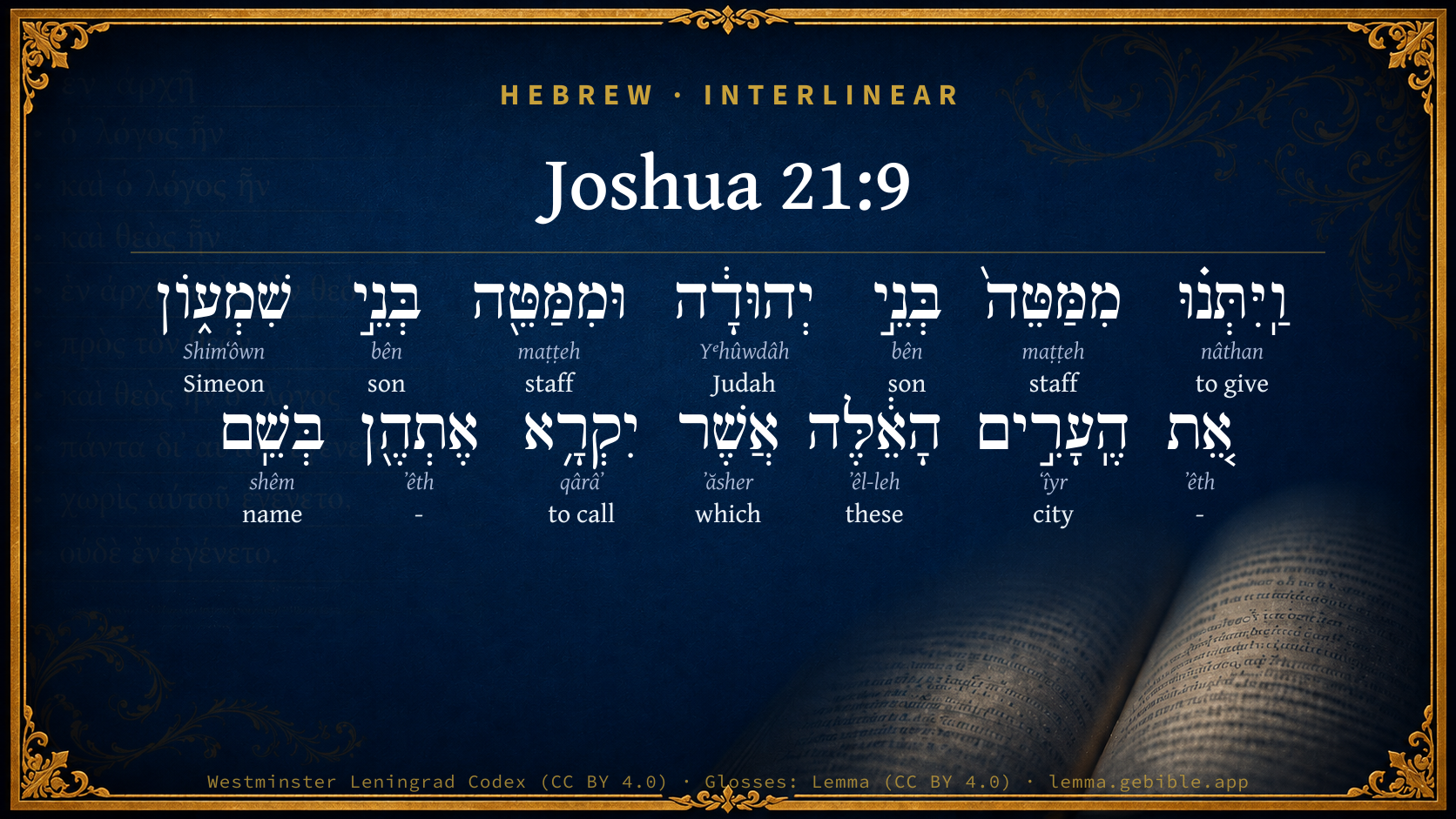
Joshua 21:9

Hebrew (Westminster Leningrad Codex) Joshua 21:9 appears in the Hebrew Old Testament. The text above is from the Westminster Leningrad Codex. Each word links to its Strong’s number, a concise gloss, and parsing drawn from the Open Scriptures Hebrew Bible morphology. Click any word for its full Brown-Driver-Briggs (BDB) entry.
Download image
Cite this verse

Joshua 21:9 (World English Bible). Public Domain. Lemma interlinear Bible study tool, https://lemma.gebible.app/v/joshua/21/9.

Show BibTeX & RIS
BibTeX
RIS
English Translation
They gave out of the tribe of the children of Judah, and out of the tribe of the children of Simeon, these cities which are [here] mentioned by name:
World English Bible · Public Domain
Download a study sheet

One document with this verse’s original text, its word-by-word gloss line, the meaning frame, cross-references with their text, attributed commentary, and full source and license credits — printable, and it pastes into notes with its structure intact.

This verse Autodidact and up

Study sheet (.html) Plain text (.txt)

A passage Seminary Student

Up to 50 verses in one chapter. A passage sheet keeps up to 6 commentary sources and 12 cross-references per verse, in the order this page ranks them, and says so on the sheet whenever that leaves anything out. Ask for a single verse and you get the Autodidact verse sheet above.

Everything on this page stays free to read, with no account — the sheet is a download of what is already on screen, not access to it.

Want to remove ads? Support Godless Engineer
Compare translations 3

The same verse in 3 English versions, stacked beneath the original-language interlinear above. Click any original word for its lexicon entry.

Each is an independent rendering of the whole verse — the interlinear is not word-aligned to these translations.

Highlighted words mark where these versions differ — a whole-verse word diff, not a word-by-word alignment.

  • World English Bible Public Domain
    They gave out of the tribe of the children of Judah, and out of the tribe of the children of Simeon, these cities which are [here] mentioned by name:
  • King James Version Public Domain
    And they gave out of the tribe of the children of Judah, and out of the tribe of the children of Simeon, these cities which are here mentioned by name.
  • unfoldingWord Literal Text CC BY-SA 4.0
    And from the tribe of the sons of Judah and from the tribe of the sons of Simeon they gave these cities, which one calls them by name.

unfoldingWord Literal Text — © unfoldingWord, licensed CC BY-SA 4.0. Word-aligned USFM3 via Door43 (git.door43.org/unfoldingWord/en_ult).

Versions to compare (up to 4)

3 of 4 selected

Show all 18 translations

Every available English version of this verse, each an independent rendering of the whole verse.

  • World English Bible Public Domain
    They gave out of the tribe of the children of Judah, and out of the tribe of the children of Simeon, these cities which are [here] mentioned by name:
  • Berean Standard Bible Public Domain
    From the tribes of Judah and Simeon, they designated these cities by name
  • Majority Standard Bible Public Domain
    From the tribes of Judah and Simeon, they designated these cities by name
  • King James Version Public Domain
    And they gave out of the tribe of the children of Judah, and out of the tribe of the children of Simeon, these cities which are here mentioned by name.
  • American Standard Version (1901) Public Domain
    And they gave out of the tribe of the children of Judah, and out of the tribe of the children of Simeon, these cities which are `here' mentioned by name:
  • Revised Version (1885) Public Domain
    And they gave out of the tribe of the children of Judah, and out of the tribe of the children of Simeon, these cities which are here mentioned by name:
  • Geneva Bible (1599) Public Domain
    And they gaue out of the tribe of the children of Iudah, and out of the tribe of the children of Simeo, these cities which are here named.
  • Douay-Rheims (1899) Public Domain
    Of the tribes of the children of Juda and of Simeon Josue gave cities: whose names are these,
  • Young's Literal Translation Public Domain
    And they give out of the tribe of the sons of Judah, and out of the tribe of the sons of Simeon, these cities which are called by name;
  • Literal Standard Version CC BY-SA 4.0
    And they give out of the tribe of the sons of Judah, and out of the tribe of the sons of Simeon, these cities which are called by name;
  • Unlocked Literal Bible CC BY-SA 4.0
    From the tribes of Judah and Simeon, they assigned land to the following cities, here listed by name.
  • unfoldingWord Literal Text CC BY-SA 4.0
    And from the tribe of the sons of Judah and from the tribe of the sons of Simeon they gave these cities, which one calls them by name.
  • Darby Bible Public Domain
    And they gave out of the tribe of the children of Judah, and out of the tribe of the children of Simeon, these cities which were mentioned by name,
  • World Messianic Bible Public Domain
    They gave out of the tribe of the children of Judah, and out of the tribe of the children of Simeon, these cities which are mentioned by name:
  • Webster's Bible Public Domain
    And they gave out of the tribe of the children of Judah, and out of the tribe of the children of Simeon, these cities which are here mentioned by name,
  • Free Bible Version CC BY-SA 4.0
    They gave from the tribe of Judah and the tribe of Simeon the following towns, specifically named,
  • Bible in Basic English Public Domain
    From the tribes of the children of Judah and the children of Simeon they gave these towns, listed here by name:
  • JPS Tanakh (1917) Public Domain
    And they gave out of the tribe of the children of Judah, and out of the tribe of the children of Simeon, these cities which are here mentioned by name.

Literal Standard Version (2020), Covenant Press — licensed CC BY-SA 4.0. Text via the HelloAO Bible API (eBible.org). Unlocked Literal Bible (unfoldingWord) — licensed CC BY-SA 4.0. Text via the HelloAO Bible API (eBible.org). unfoldingWord Literal Text — © unfoldingWord, licensed CC BY-SA 4.0. Word-aligned USFM3 via Door43 (git.door43.org/unfoldingWord/en_ult). Free Bible Version, Dr. Jonathan Gallagher — licensed CC BY-SA 4.0. Text via the HelloAO Bible API (eBible.org).

Word by word

More ways to search: Search by grammar → Find every occurrence → Compare this word →

Practice this passage: Drill this verse → Learn its vocabulary →

שִׁמְע֑וֹן
Shimʻôwn
H8095
“Simeon”
Noun, Proper
Part of Speech
Noun
Type
Proper
Full BDB Definition

Origin: from H8085

TWOT: None

Simeon or Shimeon = "heard" - the 2nd son of Jacob by his wife Leah and progenitor of the tribe of Simeon - an Israelite of the sons of Bani who had a foreign wife in the time of Ezra
  1. וַֽיִּתְּנ֗וּ nâthan H5414 “and · to give” Conjunction + Verb, Qal, Sequential Imperfect, 3rd Person, Masculine, Plural
  2. מִמַּטֵּה֙ maṭṭeh H4294 “from · staff of” Preposition + Noun, Common, Masculine, Singular, Construct
  3. בְּנֵ֣י bên H1121 “sons of” Noun, Common, Masculine, Plural, Construct
  4. יְהוּדָ֔ה Yᵉhûwdâh H3063 “Judah” Noun, Proper
  5. וּמִמַּטֵּ֖ה maṭṭeh H4294 “and · from · staff of” Conjunction + Preposition + Noun, Common, Masculine, Singular, Construct
  6. בְּנֵ֣י bên H1121 “sons of” Noun, Common, Masculine, Plural, Construct
  7. אֵ֚ת ʼêth H853 “-” Particle, Direct Object
  8. הֶֽעָרִ֣ים ʻîyr H5892 “the · cities” Particle, Definite Article + Noun, Common, Feminine, Plural, Absolute
  9. הָאֵ֔לֶּה ʼêl-leh H428 “the · these” Particle, Definite Article + Pronoun, Demonstrative, Common, Plural
  10. אֲשֶׁר ʼăsher H834 “which” Particle, Relative
  11. יִקְרָ֥א qârâʼ H7121 “to call” Verb, Qal, Imperfect, 3rd Person, Masculine, Singular
  12. אֶתְהֶ֖ן ʼêth H853 “- · them” Particle, Direct Object + Suffix, Personal, 3rd Person, Feminine, Plural
  13. בְּשֵֽׁם shêm H8034 “in/at · name” Preposition + Noun, Common, Masculine, Singular, Absolute

About this verse

These counts appear in no published source. They are computed here, from the morphology-tagged text and Lemma’s own curated glosses. What Lemma adds →

14
words
11
distinct lemmas
Historical
section

Shared distinctive vocabulary

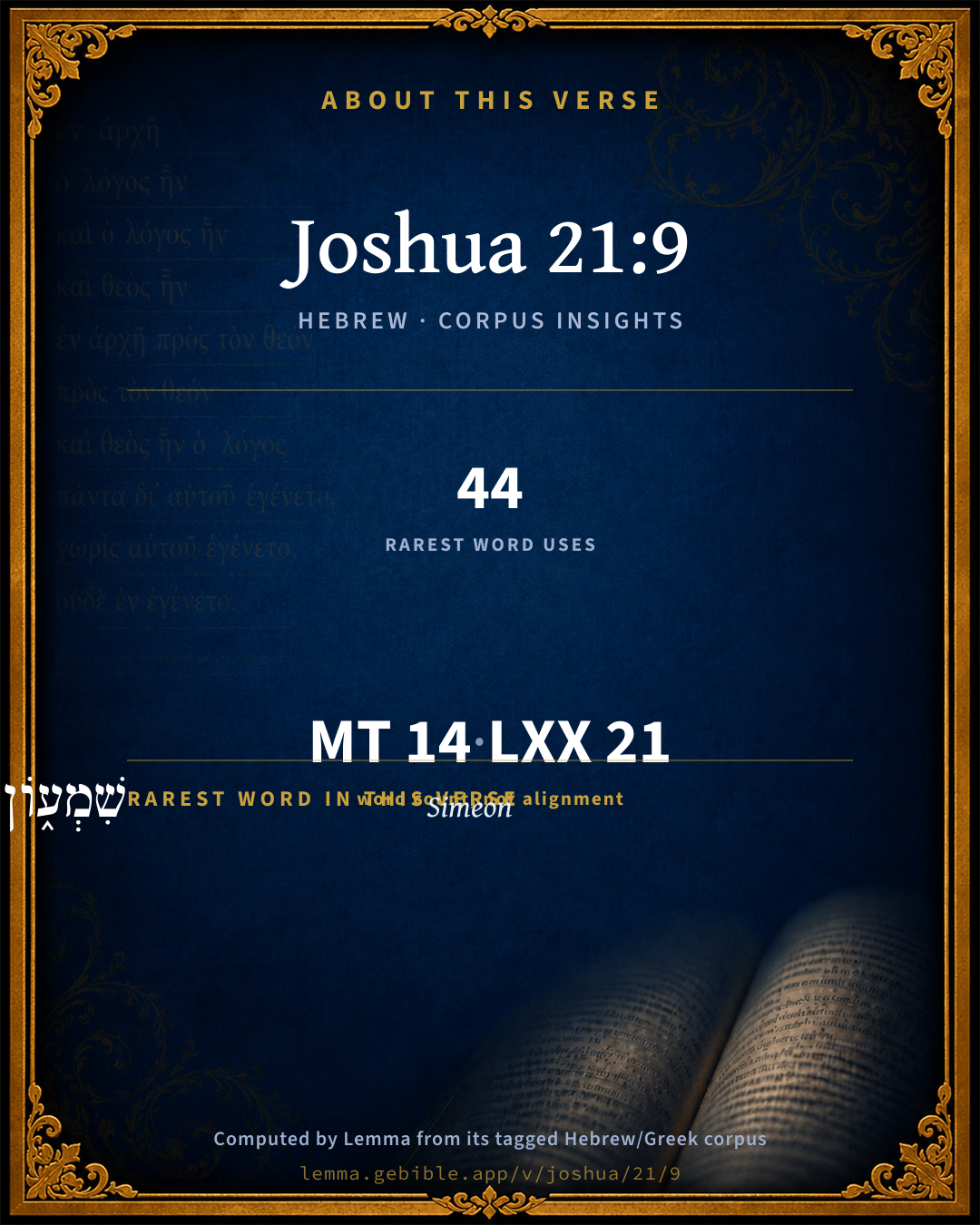
שִׁמְע֑וֹן Simeon H8095 occurs in 39 verses of the Hebrew Bible. Also found in:

Grammatical profile

  • 2 verbs
  • 8 nouns
  • 1 pronoun
  • 3 particles

Verb forms

  • וַֽיִּתְּנ֗וּ Qal · Sequential Imperfect
  • יִקְרָ֥א Qal · Imperfect

Repetition

Words recur within this verse — often emphatic in Hebrew:

  • מִמַּטֵּה֙ staff H4294 ×2
  • בְּנֵ֣י son H1121 ×2

Hebrew & Septuagint length

In English translation the verse runs 29 words from the Hebrew and 33 from the Septuagint (LXX English) — closely comparable.

A rough comparison of the two English renderings, which tokenize alike — not a word-level alignment.

Word counts can differ between the Hebrew and the Greek without any difference in meaning — e.g. the Hebrew direct-object marker אֵת has no separate Greek word, and Greek often adds the article ὁ.

In the original languages it is 14 Hebrew tokens and 21 Greek tokens — but the two are counted differently (Hebrew bundles its prefixes and suffixes into one token; the Greek is in lemma form), so that isn’t a like-for-like length.

Cross-references

2

Topical passages linked to Joshua 21:9 in the Treasury of Scripture Knowledge — connected by theme and wording, ordered by reader-vote popularity; previews shown in the World English Bible.

  • Joshua 21:13–18 To the children of Aaron the priest they gave Hebron with its suburbs, the city of refuge for the manslayer, and Libnah with its suburbs,
  • 1 Chronicles 6:65 They gave by lot out of the tribe of the children of Judah, and out of the tribe of the children of Simeon, and out of the tribe of the children of Benjamin, these cities which are mentioned by name.

Cross-references courtesy of OpenBible.info (CC BY 4.0).

Hebrew and Greek witnesses Masoretic Hebrew ↔ Greek Septuagint

The same verse in the two great witnesses to the Old Testament, shown verse-for-verse.

These are two independent witnesses, not word-aligned to each other, and the Septuagint is shown in lemma (dictionary) form.

Hebrew Joshua 21:9 Masoretic · Westminster Leningrad Codex

וַֽיִּתְּנ֗וּ מִמַּטֵּה֙ בְּנֵ֣י יְהוּדָ֔ה וּמִמַּטֵּ֖ה בְּנֵ֣י שִׁמְע֑וֹן אֵ֚ת הֶֽעָרִ֣ים הָאֵ֔לֶּה אֲשֶׁר יִקְרָ֥א אֶתְהֶ֖ן בְּשֵֽׁם

They gave out of the tribe of the children of Judah, and out of the tribe of the children of Simeon, these cities which are [here] mentioned by name:

World English Bible · Public Domain

Greek LXX Joshua 21:9 Septuagint · lemma form

καί δίδωμι ὁ φυλή υἱός ιουδα καί ὁ φυλή υἱός συμεων καί ἀπό ὁ φυλή υἱός βενιαμίν ὁ πόλις καί ἐπικαλέω

And the tribe of the children of Juda, and the tribe of the children of Symeon, and part of the tribe of the children of Benjamin gave these cities, and they were assigned

LXX2012 (modern English Septuagint) · Public Domain

Hebrew: Westminster Leningrad Codex (CC BY 4.0). Greek: Septuagint (public domain); English from LXX2012 (modern English Septuagint) (Public Domain). How the Septuagint differs from the Hebrew →

Targum (Aramaic paraphrase)

1

The Targum is the ancient Jewish Aramaic paraphrase of the Hebrew Scriptures — an interpretive translation, not the Hebrew text itself. Onkelos (literal) and Pseudo-Jonathan (expansive) render the Torah, and Jonathan the Prophets. Coverage is partial: where no permissively-licensed English translation exists for a verse, only the Aramaic is shown. This is verse-level text, not a word-by-word alignment to the Hebrew.

  1. Targum Jonathan Prophets (Joshua–Malachi)
    וִיהָבוּ מִשִׁבְטָא דִבְנֵי יְהוּדָה וּמִשִׁבְטָא דִבְנֵי שִׁמְעוֹן יַת קִרְוַיָא הָאִלֵין דְאִתְפְּרָשָׁא בִּשְׁמָהָן:

    (no public-domain English translation for this verse)

    Targum Jonathan — Aramaic: “Mikraot Gedolot” (public domain). English: “Sefaria Community Translation” (CC0 1.0 (public-domain dedication)); “London "Chaldee Paraphrase," 1871” (public domain). Text via Sefaria.

Commentary

Notes on Joshua 21:9 from classic Christian and Jewish commentators (each source and its license shown beneath its notes). The classic Christian expositions comment on the surrounding passage and are grouped to its opening verse, so a note may address several verses; the Jewish commentaries on the Tanakh (Rashi and others) are per-verse, so they appear only where the commentator wrote on this verse.

Lemma curates 59 commentaries, every one of them public domain or Creative Commons licensed, each selected and text-cleaned for this edition rather than reprinted as found. About our sources →

Jamieson, Fausset & Brown

Robert Jamieson, A. R. Fausset & David Brown

THE CITIES OF THE PRIESTS. (Jos. 21:9-42)

they gave . . . these cities which are here mentioned by name--It was overruled by the unerring providence of the Divine Lawgiver that the cities of the priests lay within the territories of Judah and Benjamin. This was a provision, the admirable wisdom and propriety of which were fully manifested on the schism that took place in the reign of Rehoboam.

Jamieson, Fausset & Brown — Commentary Critical and Explanatory on the Whole Bible (1871) — public domain (CC PDM 1.0). Text via the HelloAO Bible API.

The Cambridge Bible for Schools and Colleges

gen. ed. J. J. S. Perowne

9–19. The Cities of the Descendants of Aaron

9. And they gave] We have now first a list of the cities of the priests of the line of Aaron.

out of the tribe of the children of Judah] The list now given divides itself into two parts:

(a) The nine cities which the sons of Aaron received in the country of Simeon and Judah (Jos_21:9-16);

(b) The four cities which they received in the country of Benjamin (Jos_21:17-19).

The Cambridge Bible for Schools and Colleges (gen. ed. J. J. S. Perowne; Cambridge University Press, 1878–1918) — public domain. Text from a community e-Sword module.

Joseph Benson's Commentary

Jos 21:9-10. Judah and Simeon — These are mentioned together, because the cities of Simeon lay within Judah’s portion. Families — That is, of the family, the plural number being put for the singular which is not unusual.

Joseph Benson's Commentary on the Old and New Testaments (1811–1818) — public domain. Text from a community e-Sword module.

Keil & Delitzsch

C. F. Keil & F. Delitzsch

Names of the Levitical Towns.

(Note: There is a similar list in 1 Chron 6:54-81, though in some respects differently arranged, and with many variations in the names, and corruptions of different kinds in the text, which show that the author of the Chronicles has inserted an ancient document that was altogether independent of the book before us. Thus in the Chronicles there are only forty-two towns mentioned by name instead of forty-eight, although it is stated in Ch1 6:45. that 13 + 10 + 13 + 12, i.e., forty-eight towns in all, were given up to the Levites. The names omitted are (1) Jutta in Judah; (2) Gibeon in Benjamin; (3 and 4) Ethekeh and Gibbethon in Dan; (5 and 6) and Jokneam and Nahalal in Zebulun (compare Jos 21:16, Jos 21:17, Jos 21:23, Jos 21:34, and Jos 21:35, with Ch1 6:59-60, Ch1 6:68, Ch1 6:77. In some cases also the author of the Chronicles gives different names, though some of them indeed are only different forms of the same name, e.g., Hilen for Holon, Alemeth for Almon, Ashtaroth for Beeshterah, Mashal for Misheal, Hammon for Hammoth-dor, Kirjathaim for Kartan (compare Ch1 6:58, Ch1 6:60, Ch1 6:71, Ch1 6:74, Ch1 6:76, with Jos 21:15, Jos 21:18, Jos 21:27, Jos 21:30, Jos 21:32); or in some cases possibly different names of the same town, e.g., Jokmeam for Kibzaim, and Ramoth for Jarmuth, and Anem for En-gannim (Ch1 6:68, 83, and Jos 21:22, Jos 21:29); whilst some evidently give the true reading, viz., Ashan for Ain, and Bileam for Gath-rimmon (Ch1 6:59, Ch1 6:70; Jos 21:16, Jos 21:26). The majority, however, are faulty readings, viz., Aner for Tanach, Kedesh for Kishon, Hukok for Helkath, Rimmon and Tabor (compare Ch1 6:70, Ch1 6:72, Ch1 6:75, Ch1 6:77, with Jos 21:25, Jos 21:28, Jos 21:31, Jos 21:34-35).)

Jos 21:9-19

The priests' towns: (a) in Judah and Simeon (Jos 21:9-16); (b) in Benjamin (Jos 21:17-19).

Jos 21:9-12

In the tribe of Judah the priests received Kirjath-arba, or Hebron, with the necessary pasturage round about the town (see Num 35:2), whilst the field of the town with the villages belonging to it remained in the hands of Caleb and his family as their possession (Jos 14:12.).

Jos 21:13-16

Jos 21:13 contains a repetition of Jos 21:11, occasioned by the parenthetical remark in Jos 21:12. They also received Libnah in the lowland (see Jos 15:42; Jos 10:29); Jattir (Jos 15:48), Eshtemoah (Jos 15:50), Holon (Jos 15:51), and Debir (Jos 15:15, Jos 15:49; Jos 10:38) on the mountains of Judah; Ain, for which we should read Ashan (Ch1 6:44; cf. Jos 15:42), in the tribe of Simeon (Jos 19:7); Juttah on the mountains (Jos 15:55); and Beth-shemesh in the lowland (Jos 15:10).

Jos 21:17-19

In the tribe of Benjamin they received Gibeon (see Jos 9:3), Geba (Jos 18:24), also Anathoth and Almon, which are missing in the list of the towns of Benjamin (see at Jos 18:24).

Jos 21:20-25

Towns of the Levites. - Jos 21:20-26. The other Kohathites received four towns from the tribe of Ephraim (Jos 21:21, Jos 21:22), four from Dan (Jos 21:23, Jos 21:24), and two from the half tribe of Manasseh on this side of the Jordan (Jos 21:25). From Ephraim they received Shechem (see Jos 17:7), Gezer (Jos 10:33), Kibzaim - for which we find Jockmeam in Ch1 6:68, possibly a different name for the same place, which has not yet been discovered - and Beth-horon, whether Upper or Lower is not stated (see Jos 10:10). From Dan they received Elthekeh and Gibbethon (Jos 19:44), Ajalon and Gath-rimmon (Jos 19:42, Jos 19:45). From half Manasseh they received Taanach (Jos 17:11; Jos 12:21) and Gath-rimmon - eye to the previous verse, for Bileam (Ch1 6:70), i.e., Jibleam (Jos 17:11).

Jos 21:26

Thus they received ten towns in all.

Jos 21:27-33

The Gershonites received two towns from eastern Manasseh: Golan (Jos 20:8; Deu 4:43), and Beeshterah. Beeshterah (contracted from Beth-eshterah, the house of Astarte), called Ashtaroth in Ch1 6:56, may possibly have been the capital of king Og (Ashtaroth-karnaim, Gen 14:5), if not one of the two villages named Astaroth, which are mentioned by Eusebius in the Onom. (s. v. Astharoth-karnaim), and are described by Jerome as duo castella in Batanaea, novem inter se millibus separata inter Adaram et Abilam civitates, though Adara and Abila are too indefinite to determine the situation with any exactness. At any rate, the present Busra on the east of the Hauran cannot be thought of for a moment; for this was called Βόσσορα or Βοσορρά, i.e., בּצרה, in ancient times, as it is at the present day (see 1 Macc. 5:26, and Joseph. Ant. xii. 8, 3), and was corrupted into Bostra by the Greeks and Romans. Nor can it be the present Kul'at Bustra on the north of Banyas upon a shoulder of the Hermon, where there are the ruins of a magnificent building, probably a temple of ancient date (Burckhardt, Syr. pp. 93, 94; Rob. Bibl. Res. pp. 414-15), as Knobel supposes, since the territory of the Israelites did not reach so far north, the land conquered by Joshua merely extending to Baal-gad, i.e., Banyas, at the foot of the Hermon (see Jos 11:17), and the land to the east of the Jordan, or Bashan, only to the Hermon itself, or more correctly, merely to the districts of Geshuri and Maacah at the south-eastern border of the Hermon (see at Deu 3:8, Deu 3:14).

Jos 21:28-29

From Issachar they received four towns: Kishon (Jos 19:20), Dabrath (Jos 19:12), Jarmuth = Remeth (see Jos 19:21), and En-gannim (Jos 19:21, or Anem, Ch1 6:73).

Jos 21:30-31

From Asher they received four towns: Mishal or Masal (Jos 19:26; cf. Ch1 6:74), Abdon (Jos 19:28), Helkath (Jos 19:25, called Hukok in Ch1 6:75, probably a copyist's error), and Rehob (Jos 19:28).

Jos 21:32

From Naphtali they received three towns: Kedesh (Jos 19:37 and Jos 12:22), Hammoth-dor (called Hammath in Jos 19:35, and Hammon in Ch1 6:76), and Kartan (contracted from Kartain for Kirjathaim, Ch1 6:76; like Dothan in Kg2 6:13, from Dothain in Gen 37:17). Kartan is not mentioned among the towns of Naphtali in Jos 19:33.; according to Knobel it may possibly be Katanah, a place with ruins to the north-east of Safed (Van de Velde, Mem. p. 147).

Jos 21:33

They received thirteen towns in all.

Jos 21:34-35

The Merarites received twelve towns. From the tribe of Zebulun they received four: Jokneam (Jos 19:11 : see at Jos 12:22), Kartah and Dimnah,

(Note: Many commentators identify Dimnah with Rimmono in Ch1 6:77, but without sufficient reason; for the next of the Chronicles is no doubt corrupt in this passage, as it has only two names, Rimmono and Tabor, instead of four.)

which are not mentioned among the towns of Zebulun in Jos 19:11., and are unknown, and Nahalal (Jos 19:15).

Jos 21:36-37

From Reuben they received four: Gezer (Jos 20:8 : see Deu 4:43), Jahza, Kedemoth, and Mephaath (Jos 13:18).

(Note: R. Jacob ben Chajim has omitted Jos 21:36 and Jos 21:37 from his Rabbinical Bible of the year 1525 as spurious, upon the authority of Kimchi and the larger Masora; but upon insufficient grounds, as these verses are to be found in many good MSS and old editions of an earlier date than 1525, as well as in all the ancient versions, and could not possibly have been wanting from the very first, since the Merarites received twelve towns, which included the four that belonged to Reuben. In those MSS in which they are wanting, the omission was, no doubt, a copyist's error, occasioned by the homoioteleuto'n (see de Rossi variae lectt. ad h. l., and J. H. Michaelis' Note to his Hebrew Bible).)

Jos 21:38-39

From Gad they received four towns: Ramoth in Gilead, and Mahanaim (see at Jos 13:26), Heshbon (Jos 13:17) and Jaezer (Jos 13:25 : see at Num 21:32).

Jos 21:40-42

They received twelve towns in all. - In Jos 21:41 and Jos 21:42 the list of the Levitical towns is closed with a statement of their total number, and also with the repetition of the remark that "these cities were every one with their suburbs round about them." ום עיר עיר, city city, i.e., every city, with its pasture round about it.

Keil & Delitzsch — Biblical Commentary on the Old Testament (1861–1891) — public domain (CC PDM 1.0). Text via the HelloAO Bible API. (Old Testament only.)

Tyndale Open Study Notes

Tyndale Open Resources

21:9-42 The descendants of Aaron received thirteen cities, the rest of the Kohathite clan received ten, the descendants of Gershon received thirteen, and the Merari clan received twelve. There were a total of forty-eight Levitical cities. Each tribe had four Levitical cities, except Judah had eight, Simeon had one, and Naphtali had three. Six of the Levitical cities were also cities of refuge (20:7-8).

Tyndale Open Study Notes — © Tyndale Open Resources, licensed CC BY-SA 4.0. Text via the HelloAO Bible API.

Matthew Henry's Commentary

We have here a particular account of the cities which were given to the children of Levi out of the several tribes, not only to be occupied and inhabited by them, as tenants to the several tribes in which they lay - no, their interest in them was not dependent and precarious, but to be owned and possessed by them as lords and proprietors, and as having the same title to them that the rest of the tribes had to their cities or lands, as appears by the law which preserved the house in the Levites' cities from being alienated any longer than till the year of jubilee, Lev 25:32, Lev 25:33. Yet it is probable that the Levites having only the cities and suburbs, while the land about pertained to the tribes in which they lay, those of that tribe, for the convenience of occupying that land, might commonly rent houses of the Levites, as they could spare them in their cities, and so live among them as their tenants. Several things may be observed in this account, besides what was observed in the law concerning it, Num. 35.

I. That the Levites were dispersed into all the tribes, and not suffered to live all together in any one part of the country. This would find them all with work, and employ them all for the good of others; for ministers, of all people, must neither be idle nor live to themselves or to one another only. Christ left his twelve disciples together in a body, but left orders that they should in due time disperse themselves, that they might preach the gospel to every creature. The mixing of the Levites thus with the other tribes would be an obligation upon them to walk circumspectly, and as became their sacred function, and to avoid every thing that might disgrace it. Had they lived all together, they would have been tempted to wink at one another's faults, and to excuse one another when they did amiss; but by this means they were made to see the eyes of all Israel upon them, and therefore saw it their concern to walk so as that their ministry might in nothing be blamed nor their high character suffer by their ill carriage.

II. That every tribe of Israel was adorned and enriched with its share of Levites' cities in proportion to its compass, even those that lay most remote. They were all God's people, and therefore they all had Levites among them. 1. To show kindness to, as God appointed them, Deu 12:19; Deu 14:29. They were God's receivers, to whom the people might give their grateful acknowledgments of God's goodness, as the occasion and disposition were. 2. To receive advice and instruction from; when they could not go up to the tabernacle, to consult those who attended there, they might go to a Levites' city, and be taught the good knowledge of the Lord. Thus God set up a candle in every room of his house, to give light to all his family; as those that attended the altar kept the charge of the Lord, to see that no divine appointment was neglected there, so those that were scattered in the country had their charge too, which was to see that no idolatrous superstitious usages were introduced at a distance and to watch for the souls of God's Israel. Thus did God graciously provide for the keeping up of religion among them, and that they might have the word nigh them; yet, blessed be God, we, under the gospel, have it yet nigher, not only Levites in every county, but Levites in every parish, whose office it is still to teach the people knowledge, and to go before them in the things of God.

III. That there were thirteen cities, and those some of the best, appointed for the priests, the sons of Aaron, Jos 21:19. Aaron left but two sons, Eleazar and Ithamar, yet his family was now so much increased, and it was foreseen that it would in process of time grow so numerous, as to replenish all these cities, though a considerable number must of necessity be resident wherever the ark and the altar were. We read in both Testaments of such numbers of priests that we may suppose none of all the families of Israel that came out of Egypt increased afterwards so much as that of Aaron did; and the promise afterwards to the house of Aaron is, God shall increase you more and more, you and your children, Psa 115:12, Psa 115:14. He will raise up a seed to serve him.

IV. That some of the Levites' cities were afterwards famous upon other accounts. Hebron was the city in which David began his reign, and in Manhanaim, another Levites' city (Jos 21:38), he lay, and had his headquarters when he fled from Absalom. The first Israelite that ever wore the title of king (namely, Abimelech, the son of Gideon) reigned in Shechem, another Levites' city, Jos 21:21.

V. That the number of them in all was more than of most of the tribes, except Judah, though the tribe of Levi was one of the least of the tribes, to show how liberal God is, and his people should be, to his ministers; yet the disproportion will not appear so great as at first it seems, if we consider that the Levites had cities only with their suburbs to dwell in, but the rest of the tribes, besides their cities (and those perhaps were many more than are named in the account of their lot), had many unwalled towns and villages which they inhabited, besides country houses.

Upon the whole, it appears that effectual care was taken that the Levites should live both comfortably and usefully: and those, whether ministers or others, for whom Providence has done well, must look upon themselves as obliged thereby to do good, and, according as their capacity and opportunity are, to serve their generation.

Matthew Henry's Commentary on the Whole Bible (1708–1710) — public domain (CC PDM 1.0). Text via the HelloAO Bible API.

John Gill's Exposition

And they gave out of the tribe of the children of Judah,.... Here follows a particular account of the several cities which were given out of each tribe, and first out of this:

and out of the tribe of the children of Simeon; which is joined with that of Judah, because the cities of it lay within it, Jos 19:1,

these cities which are here mentioned by name; Jos 21:13.

John Gill's Exposition of the Whole Bible (1746–1763) — public domain (CC PDM 1.0). Text via the HelloAO Bible API.

Albert Barnes' Notes on the Bible

The thirteen priestly cities (see the marginal references) were all in the tribes of Judah, Simeon, and Benjamin. Thus, as Calvin remarks, God so overruled it that the priestly families were placed upon the spot which He had determined before hand to choose as the site of His temple.

Albert Barnes' Notes on the Bible (1834–1885) — public domain. Text from a community e-Sword/MySword module.

Haydock's Catholic Bible Commentary

CHAPTER XXI.

George Leo Haydock (1774–1849), Haydock's Catholic Family Bible and Commentary, 1859 edition — public domain. Excludes Psalms (Douay-Rheims chapter numbering differs from Protestant) and Deuterocanonical books (Catholic canon only).

Matthew Poole's English Annotations

Judah and

Simeon are mentioned together, because the cities of Simeon lay within Judah’s portion.

Matthew Poole's English Annotations on the Holy Bible (1683–1685) — public domain. Text from a community e-Sword/MySword module.

John Wesley's Explanatory Notes

Judah and Simeon - These are mentioned together, because the cities of Simeon lay within Judah's portion.

John Wesley, Explanatory Notes Upon the Whole Bible (1754–1765) — public domain. Text via the GEBible commentary corpus.

Kretzmann's Popular Commentary

Paul E. Kretzmann

The Cities of the Priests

v. 9. And they gave out of the tribe of the children of Judah and out of the tribe of the children of Simeon, out of the possessions allotted to these tribes, these cities which are here mentioned by name,

v. 10. which the children of Aaron, being of the families of the Kohathites, who were of the children of Levi, had; for theirs was the first lot.

v. 11. And they gave them the city of Arba, the father of Anak, Jos 15:13-14, which city is Hebron, in the hill country of Judah, with the suburbs thereof found about it, the grazing-land for cattle immediately adjoining the city.

v. 12. But the fields of the city, the farm-land, and the villages thereof, the towns tributary to it, gave they to Caleb, the son of Jephunneh, for his possession, Jos 14:12-14.

v. 13. Thus they gave to the children of Aaron, the priest, Hebron with her suburbs, to be a city of refuge for the slayer, for this it was at the same time, Jos 20:7; and Libnah with her suburbs,

v. 14. and Jattir with her suburbs, and Eshtemoa with her suburbs,

v. 15. and Holon with her suburbs, and Debir with her suburbs,

v. 16. and Ain with her suburbs, and Juttah with her suburbs, and Beth-shemesh with her suburbs: nine cities out of those two tribes, all of them being mentioned in the catalog of the cities of Judah and of Simeon, Jos 15:21-62; Jos 19:7.

v. 17. And out of the tribe of Benjamin, Gibeon with her suburbs, a fact which tended to curb any idolatrous notions of its heathen inhabitants, Joshua 9, Geba with her suburbs,

v. 18. Anathoth with her suburbs, and Almon with her suburbs, Jos 18:24-25; 1Ch 6:60: four cities.

v. 19. All the cities of the children of Aaron, the priests, were thirteen cities with their suburbs. Thus the men in charge of the worship in the Jewish Church were provided for with all that they needed to support their body and life, even as it is the will of the Lord today that they who preach the Gospel should live of the Gospel.

Paul E. Kretzmann, Popular Commentary of the Bible (1921–1924) — public domain. Text from a community e-Sword module.

Rashi

Rabbi Shlomo Yitzchaki (Rashi)

That will be mentioned by name. Since he had not mentioned earlier the names of the cities that were given to them, and he enumerates their names later, he therefore states [now], “these cities that will be mentioned by name.”

Rashi on the Tanakh — English translations: “The Judaica Press complete Tanach with Rashi, translated by A. J. Rosenberg” (CC BY 4.0); “Pentateuch with Rashi's commentary by M. Rosenbaum and A.M. Silbermann, 1929-1934” (public domain); “The Metsudah Tanach series, Lakewood, N.J” (CC BY 4.0); and “The Book of Joshua, Metsudah Publications, 1997” (CC BY 4.0). Text via Sefaria.

Lesson kit

Teaching starters — assembled from the data on this page, not authored interpretation. Every prompt links to the verse data it draws on. Edit before teaching.

Joshua, in the Historical, opens this verse with 14 words (11 distinct Hebrew lemmas). Its most distinctive word is Shimʻôwn (“Simeon”). A historical commentator’s framing appears above. Read the whole chapter for the surrounding context.

Discussion questions

  1. The word Shimʻôwn carries the sense “Simeon.” How does it shape the verse?
  2. Genesis 29:33 shares the word «Simeon» with this verse. How do the two illuminate each other?
  3. “staff” occurs 2× in this one verse. What is the effect of the repetition?
  4. These translations render this verse differently. What is at stake in choosing one wording over another?
  5. The verb «וַֽיִּתְּנ֗וּ» is Qal Sequential Imperfect. How does its form color the action?
  6. Reading how Jamieson, Fausset & Brown and The Cambridge Bible for Schools and Colleges read this verse, where do the two commentators agree and where do they part?

Things to notice

Reading settings

Reading text

Shown beneath each verse's original-language words.

Old Testament
Old Testament edition

Read the OT as the Masoretic Hebrew (MT) or the Greek Septuagint (LXX).

English shown for the Greek Septuagint (in the Hebrew ↔ Greek comparison).

Comparing translations? Open the Compare panel on any verse page to stack up to four side by side.