2 Samuel 19:25

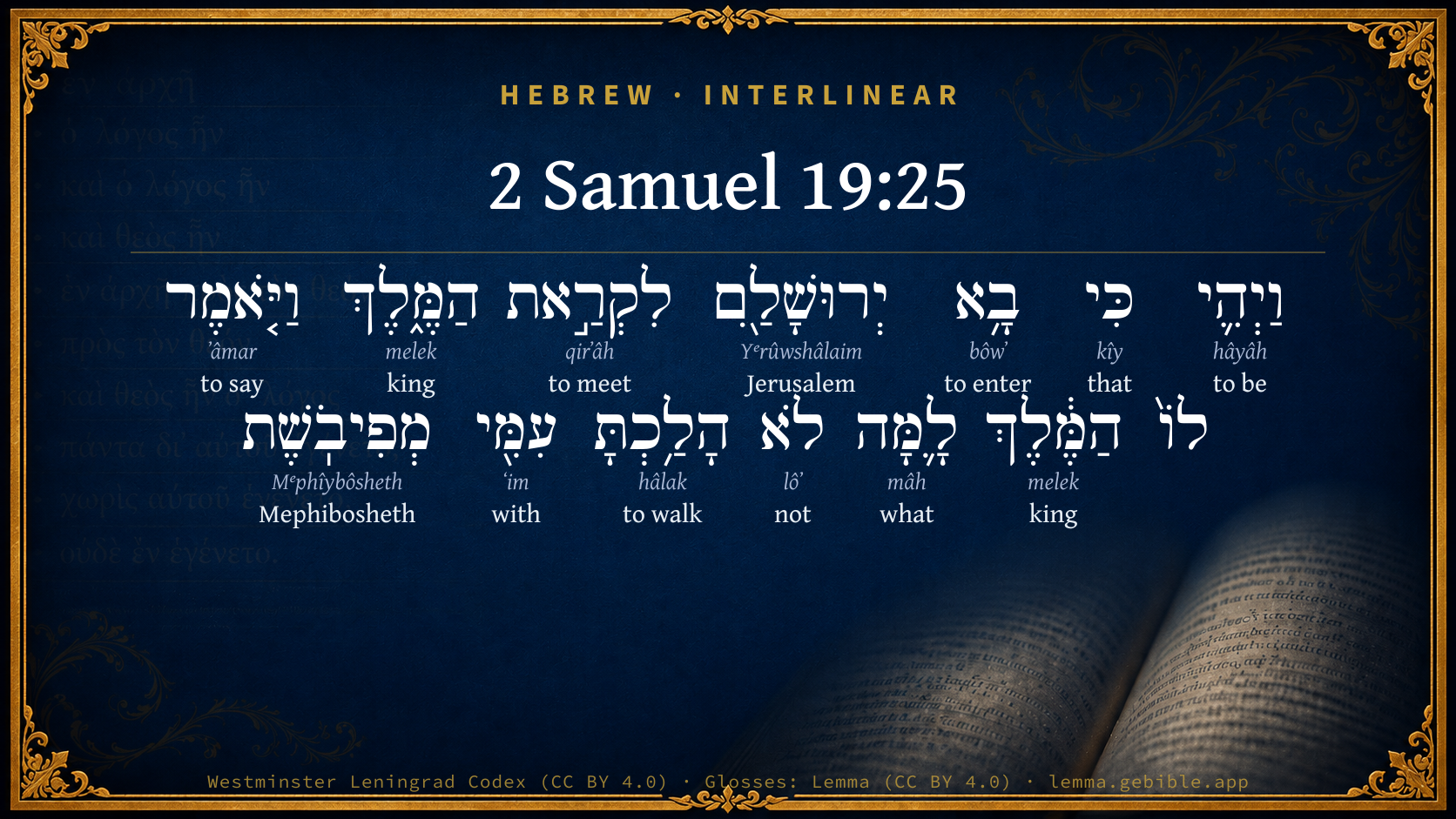
Hebrew (Westminster Leningrad Codex) 2 Samuel 19:25 appears in the Hebrew Old Testament. The text above is from the Westminster Leningrad Codex. Each word links to its Strong’s number, a concise gloss, and parsing drawn from the Open Scriptures Hebrew Bible morphology. Click any word for its full Brown-Driver-Briggs (BDB) entry.
Download image
Cite this verse

2 Samuel 19:25 (World English Bible). Public Domain. Lemma interlinear Bible study tool, https://lemma.gebible.app/v/2-samuel/19/25.

Show BibTeX & RIS
BibTeX
RIS
English Translation
It happened, when he was come to Jerusalem to meet the king, that the king said to him, Why didn't you go with me, Mephibosheth?
World English Bible · Public Domain
Download a study sheet

One document with this verse’s original text, its word-by-word gloss line, the meaning frame, cross-references with their text, attributed commentary, and full source and license credits — printable, and it pastes into notes with its structure intact.

This verse Autodidact and up

Study sheet (.html) Plain text (.txt)

A passage Seminary Student

Up to 50 verses in one chapter. A passage sheet keeps up to 6 commentary sources and 12 cross-references per verse, in the order this page ranks them, and says so on the sheet whenever that leaves anything out. Ask for a single verse and you get the Autodidact verse sheet above.

Everything on this page stays free to read, with no account — the sheet is a download of what is already on screen, not access to it.

Want to remove ads? Support Godless Engineer
Compare translations 3

The same verse in 3 English versions, stacked beneath the original-language interlinear above. Click any original word for its lexicon entry.

Each is an independent rendering of the whole verse — the interlinear is not word-aligned to these translations.

Highlighted words mark where these versions differ — a whole-verse word diff, not a word-by-word alignment.

  • World English Bible Public Domain
    It happened, when he was come to Jerusalem to meet the king, that the king said to him, Why didn't you go with me, Mephibosheth?
  • King James Version Public Domain
    And it came to pass, when he was come to Jerusalem to meet the king, that the king said unto him, Wherefore wentest not thou with me, Mephibosheth?
  • unfoldingWord Literal Text CC BY-SA 4.0
    And it happened that he came Jerusalem to meet the king. And the king said to him, “Why did you not go with me, Mephibosheth?”

unfoldingWord Literal Text — © unfoldingWord, licensed CC BY-SA 4.0. Word-aligned USFM3 via Door43 (git.door43.org/unfoldingWord/en_ult).

Versions to compare (up to 4)

3 of 4 selected

Show all 18 translations

Every available English version of this verse, each an independent rendering of the whole verse.

  • World English Bible Public Domain
    It happened, when he was come to Jerusalem to meet the king, that the king said to him, Why didn't you go with me, Mephibosheth?
  • Berean Standard Bible Public Domain
    And he came from Jerusalem to meet the king, who asked him, “Mephibosheth, why did you not go with me?”
  • Majority Standard Bible Public Domain
    And he came from Jerusalem to meet the king, who asked him, “Mephibosheth, why did you not go with me?”
  • King James Version Public Domain
    And it came to pass, when he was come to Jerusalem to meet the king, that the king said unto him, Wherefore wentest not thou with me, Mephibosheth?
  • American Standard Version (1901) Public Domain
    And it came to pass, when he was come to Jerusalem to meet the king, that the king said unto him, Wherefore wentest not thou with me, Mephibosheth?
  • Revised Version (1885) Public Domain
    And it came to pass, when he was come to Jerusalem to meet the king, that the king said unto him, Wherefore wentest not thou with me, Mephibosheth?
  • Geneva Bible (1599) Public Domain
    And when he was come to Ierusalem, and met the king, the king said vnto him, Wherefore wentest not thou with me, Mephibosheth?
  • Douay-Rheims (1899) Public Domain
    And when he met the king at Jerusalem, the king said to him: Why camest thou not with me, Miphiboseth?
  • Young's Literal Translation Public Domain
    and it cometh to pass, when he hath come to Jerusalem to meet the king, that the king saith to him, `Why didst thou not go with me, Mephibosheth?'
  • Literal Standard Version CC BY-SA 4.0
    and it comes to pass, when he has come to Jerusalem to meet the king, that the king says to him, “Why did you not go with me, Mephibosheth?”
  • Unlocked Literal Bible CC BY-SA 4.0
    So when he came from Jerusalem to meet the king, the king said to him, “Why did you not go with me, Mephibosheth?”
  • unfoldingWord Literal Text CC BY-SA 4.0
    And it happened that he came Jerusalem to meet the king. And the king said to him, “Why did you not go with me, Mephibosheth?”
  • Darby Bible Public Domain
    And as soon as Jerusalem came to meet the king, the king said to him, Why didst thou not go with me, Mephibosheth?
  • World Messianic Bible Public Domain
    When he had come to Jerusalem to meet the king, the king said to him, “Why didn’t you go with me, Mephibosheth?”
  • Webster's Bible Public Domain
    And it came to pass, when he had come to Jerusalem to meet the king, that the king said to him, Why didst thou not go with me, Mephibosheth?
  • Free Bible Version CC BY-SA 4.0
    When he arrived from Jerusalem to meet the king, the king asked him, “Why didn't you come with me, Mephibosheth?”
  • Bible in Basic English Public Domain
    Now when he had come from Jerusalem to see the king, the king said to him, Why did you not come with me, Mephibosheth?
  • JPS Tanakh (1917) Public Domain
    (19-26) And it came to pass, when he was come to Jerusalem to meet the king, that the king said unto him: 'Wherefore wentest not thou with me, Mephibosheth?'

Literal Standard Version (2020), Covenant Press — licensed CC BY-SA 4.0. Text via the HelloAO Bible API (eBible.org). Unlocked Literal Bible (unfoldingWord) — licensed CC BY-SA 4.0. Text via the HelloAO Bible API (eBible.org). unfoldingWord Literal Text — © unfoldingWord, licensed CC BY-SA 4.0. Word-aligned USFM3 via Door43 (git.door43.org/unfoldingWord/en_ult). Free Bible Version, Dr. Jonathan Gallagher — licensed CC BY-SA 4.0. Text via the HelloAO Bible API (eBible.org).

Word by word

More ways to search: Search by grammar → Find every occurrence → Compare this word →

Practice this passage: Drill this verse → Learn its vocabulary →

מְפִיבֹֽשֶׁת
Mᵉphîybôsheth
H4648
“Mephibosheth”
Noun, Proper
Part of Speech
Noun
Type
Proper
Full BDB Definition

Origin: probably from H6284 and H1322

TWOT: None

Mephibosheth = "exterminating the idol" - grandson of Saul and son of Rizpah the daughter of Aiah, Saul's concubine; he and his brother Armoni were among the 7 victims surrendered by David to the Gibeonites to avert a famine - son of Jonathan and grandson of Saul - also 'Merib-baal'
  1. וַיְהִ֛י hâyâh H1961 “and · to be” Conjunction + Verb, Qal, Sequential Imperfect, 3rd Person, Masculine, Singular
  2. כִּי kîy H3588 “that” Conjunction
  3. בָ֥א bôwʼ H935 “to enter” Verb, Qal, Perfect, 3rd Person, Masculine, Singular
  4. יְרוּשָׁלִַ֖ם Yᵉrûwshâlaim H3389 “Jerusalem” Noun, Proper
  5. לִקְרַ֣את qirʼâh H7125 “to meet” Preposition + Verb, Qal, Infinitive Construct
  6. הַמֶּ֑לֶךְ melek H4428 “the · king” Particle, Definite Article + Noun, Common, Masculine, Singular, Absolute
  7. וַיֹּ֤אמֶר ʼâmar H559 “and · to say” Conjunction + Verb, Qal, Sequential Imperfect, 3rd Person, Masculine, Singular
  8. הַמֶּ֔לֶךְ melek H4428 “the · king” Particle, Definite Article + Noun, Common, Masculine, Singular, Absolute
  9. לָ֛מָּה mâh H4100 “to/for · what” Preposition + Particle, Interrogative
  10. לֹא lôʼ H3808 “not” Particle, Negative
  11. הָלַ֥כְתָּ hâlak H1980 “to walk” Verb, Qal, Perfect, 2nd Person, Masculine, Singular
  12. עִמִּ֖י ʻim H5973 “with · me” Preposition + Suffix, Personal, 1st Person, Common, Singular

About this verse

These counts appear in no published source. They are computed here, from the morphology-tagged text and Lemma’s own curated glosses. What Lemma adds →

14
words
12
distinct lemmas
Historical
section

Notable vocabulary

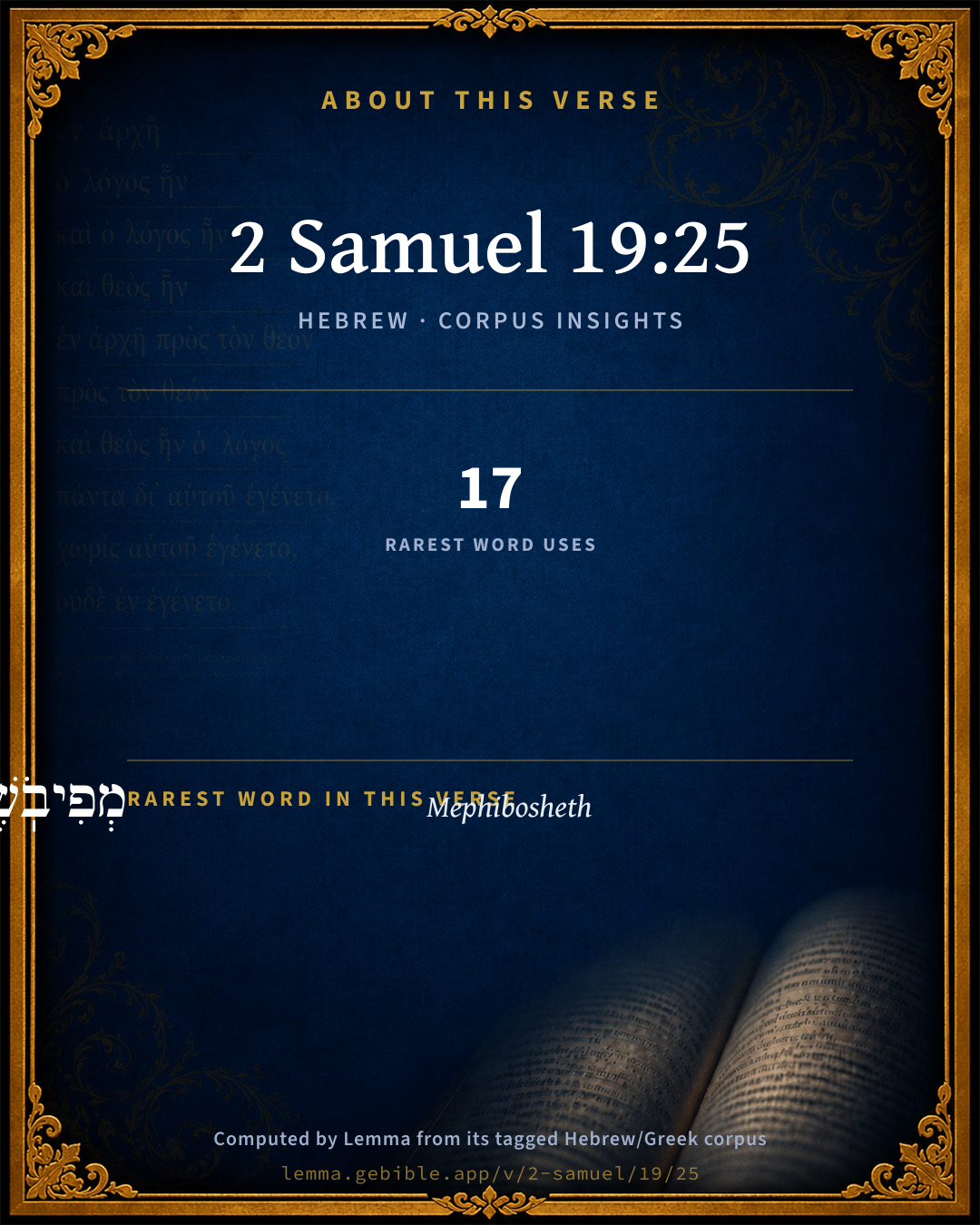
The rarest word here is מְפִיבֹֽשֶׁת Mephibosheth H4648 — appearing just 17 times in the whole Hebrew Bible.

Shared distinctive vocabulary

מְפִיבֹֽשֶׁת Mephibosheth H4648 occurs in 13 verses of the Hebrew Bible. Also found in:

Grammatical profile

  • 5 verbs
  • 4 nouns
  • 2 prepositions
  • 1 conjunction
  • 2 particles

Verb forms

  • וַיְהִ֛י Qal · Sequential Imperfect
  • בָ֥א Qal · Perfect
  • לִקְרַ֣את Qal · Infinitive Construct
  • וַיֹּ֤אמֶר Qal · Sequential Imperfect
  • הָלַ֥כְתָּ Qal · Perfect

Repetition

A word recurs within this verse — often emphatic in Hebrew:

  • הַמֶּ֑לֶךְ king H4428 ×2

Hebrew & Septuagint length

In English translation the verse runs 25 words from the Hebrew and 28 from the Septuagint (LXX English) — closely comparable.

A rough comparison of the two English renderings, which tokenize alike — not a word-level alignment.

Word counts can differ between the Hebrew and the Greek without any difference in meaning — e.g. the Hebrew direct-object marker אֵת has no separate Greek word, and Greek often adds the article ὁ.

Cross-references

1

Topical passages linked to 2 Samuel 19:25 in the Treasury of Scripture Knowledge — connected by theme and wording, ordered by reader-vote popularity; previews shown in the World English Bible.

  • 2 Samuel 16:17 Absalom said to Hushai, Is this your kindness to your friend? Why didn't you go with your friend?

Cross-references courtesy of OpenBible.info (CC BY 4.0).

Hebrew and Greek witnesses Masoretic Hebrew ↔ Greek Septuagint

The same verse in the two great witnesses to the Old Testament, shown verse-for-verse.

These are two independent witnesses, not word-aligned to each other, and the Septuagint is shown in lemma (dictionary) form.

Hebrew 2 Samuel 19:25 Masoretic · Westminster Leningrad Codex

וַיְהִ֛י כִּי בָ֥א יְרוּשָׁלִַ֖ם לִקְרַ֣את הַמֶּ֑לֶךְ וַיֹּ֤אמֶר לוֹ֙ הַמֶּ֔לֶךְ לָ֛מָּה לֹא הָלַ֥כְתָּ עִמִּ֖י מְפִיבֹֽשֶׁת

It happened, when he was come to Jerusalem to meet the king, that the king said to him, Why didn't you go with me, Mephibosheth?

World English Bible · Public Domain

Greek LXX 2 Samuel 19:25 Septuagint · lemma form

καί μεμφιβοσθε υἱός ιωναθαν υἱός σαούλ καταβαίνω εἰς ἀπαντή ὁ βασιλεύς καί οὐ θεραπεύω ὁ πούς αὐτός οὐδέ ὀνυχίζω οὐδέ ποιέω ὁ μύσταξ αὐτός καί ὁ ἱμάτιον αὐτός οὐ πλύνω ἀπό ὁ ἡμέρα ὅς ἀποἔρχομαι ὁ βασιλεύς ἕως ὁ ἡμέρα ὅς αὐτός παραγίγνομαι ἐν εἰρήνη

And it came to pass when he went into Jerusalem to meet the king, that the king said to him, Why did you not go with me, Memphibosthe?

LXX2012 (modern English Septuagint) · Public Domain

Hebrew: Westminster Leningrad Codex (CC BY 4.0). Greek: Septuagint (public domain); English from LXX2012 (modern English Septuagint) (Public Domain). How the Septuagint differs from the Hebrew →

Targum (Aramaic paraphrase)

1

The Targum is the ancient Jewish Aramaic paraphrase of the Hebrew Scriptures — an interpretive translation, not the Hebrew text itself. Onkelos (literal) and Pseudo-Jonathan (expansive) render the Torah, and Jonathan the Prophets. Coverage is partial: where no permissively-licensed English translation exists for a verse, only the Aramaic is shown. This is verse-level text, not a word-by-word alignment to the Hebrew.

  1. Targum Jonathan Prophets (Joshua–Malachi)
    וּמְפִיבֹשֶׁת בַּר שָׁאוּל נְחַת לִקֳדָמוּת מַלְכָּא וְלָא שְׁטַף רַגְלוֹהִי וְלָא סַפֵּר סִפְמֵיהּ וְיַת לְבוּשׁוֹהִי לָא חַוַר לְמִן יוֹמָא דִי גְלָא מַלְכָּא עַד יוֹמָא דַאֲתָא בִשְׁלָם:

    (no public-domain English translation for this verse)

    Targum Jonathan — Aramaic: “Mikraot Gedolot” (public domain). English: “Sefaria Community Translation” (CC0 1.0 (public-domain dedication)); “London "Chaldee Paraphrase," 1871” (public domain). Text via Sefaria.

Commentary

Notes on 2 Samuel 19:25 from classic Christian and Jewish commentators (each source and its license shown beneath its notes). The classic Christian expositions comment on the surrounding passage and are grouped to its opening verse, so a note may address several verses; the Jewish commentaries on the Tanakh (Rashi and others) are per-verse, so they appear only where the commentator wrote on this verse.

Lemma curates 59 commentaries, every one of them public domain or Creative Commons licensed, each selected and text-cleaned for this edition rather than reprinted as found. About our sources →

Trapp's Complete Commentary

John Trapp

2Sa 19:25 And it came to pass, when he was come to Jerusalem to meet the king, that the king said unto him, Wherefore wentest not thou with me, Mephibosheth?

Ver. 25. When he was come to Jerusalem to meet the king.] Or, When Jerusalem went to meet the king, as they did fully and wholly at his return. Mephibosheth went also; not having opportunity through Ziba’s treachery to come sooner.

John Trapp, A Commentary or Exposition upon All the Books of the Old and New Testament (1647–1656) — public domain. Text from a community e-Sword module.

Joseph Benson's Commentary

2Sa 19:25-27. When he was come to Jerusalem to meet the king — He had probably continued near Jerusalem during the king’s absence, and it seems could not go to a distance from it to meet him, as others did, for want of conveniences for his journey: for Ziba had gotten possession of all his lands and goods, and it is not likely that he, who would not provide him an ass to ride on, to accompany the king at his departure, would now be forward to furnish him with one to meet the king, to whom he knew he would complain of him. My servant deceived me — He had ordered an ass to be made ready for him, to carry him to David; instead of which Ziba saddled it for himself, and went with that false story mentioned 2Sa 16:3. My lord the king is as an angel of God — To discern between truth and falsehood, between facts and calumnies. Do, therefore, what is good in thine eyes — I submit myself entirely to thy judgment.

Joseph Benson's Commentary on the Old and New Testaments (1811–1818) — public domain. Text from a community e-Sword module.

Geneva Bible (1599)

Geneva Bible translators

When Mephibosheth being at Jerusalem had met the King.

Geneva Bible (1599) marginal notes — public domain. Text via Bolls.life.

Ellicott's Commentary for English Readers

(25) Wentest not thou with me?—David had heard and believed the story of Mephibosheth’s ingratitude and treachery (2Sa_16:3-4), and his present remonstrance is so gentle and kindly as to show that Mephibosheth’s appearance at once produced an impression, and suggested in David’s mind a doubt of the truth of what Ziba had told him.

A Bible Commentary for English Readers, edited by Charles John Ellicott (1878–1897) — public domain. Text from a community e-Sword module.

The Cambridge Bible for Schools and Colleges

gen. ed. J. J. S. Perowne

25. when he was come to Jerusalem] If the reading is right, the meeting between David and Mephibosheth must have taken place in Jerusalem, and is introduced here out of the strictly chronological order, because of the mention of Ziba in 2Sa_19:17. “Came down” in 2Sa_19:24 must then be explained ‘came down from his house in the highlands of Benjamin near Gibeah to Jerusalem,’ not ‘came down from Jerusalem to the Jordan.’ The conclusion of 2Sa_19:30 agrees with the supposition that Mephibosheth met David in Jerusalem. This is better than rendering when Jerusalem (i.e. the inhabitants of Jerusalem) came, which is forced, or emending from Jerusalem, which is a conjecture supported by no external authority of value.

The Cambridge Bible for Schools and Colleges (gen. ed. J. J. S. Perowne; Cambridge University Press, 1878–1918) — public domain. Text from a community e-Sword module.

John Gill's Exposition

And it came to pass, when he came to Jerusalem to meet the king,.... Perhaps from the place where his estate was; or, as the Arabic version, when he came from Jerusalem, from whence he went a little way to meet the king, as he was coming thither; for it was said he abode at Jerusalem, Sa2 16:3,

that the king said unto him, wherefore wentest not thou with me,

Mephibosheth? when he departed from Jerusalem, being obliged to flee from thence because of Absalom; it is very probable David would never have asked him this question, knowing his lameness, had it not been for the suggestion of Ziba his servant, that he stayed at Jerusalem, hoping that the kingdom of his father would be restored to him, Sa2 16:3.

John Gill's Exposition of the Whole Bible (1746–1763) — public domain (CC PDM 1.0). Text via the HelloAO Bible API.

Haydock's Catholic Bible Commentary

Met. Protestants, "was come to Jerusalem, to meet the king." (Haydock) --- But his usual residence was in the city, where Siba had left him, chap. xvi. 3. We should therefore translate, "And coming to meet the king at his arrival in Jerusalem." (Calmet)

George Leo Haydock (1774–1849), Haydock's Catholic Family Bible and Commentary, 1859 edition — public domain. Excludes Psalms (Douay-Rheims chapter numbering differs from Protestant) and Deuterocanonical books (Catholic canon only).

Matthew Poole's English Annotations

When he was come to Jerusalem; so it is supposed, that Mephibosheth, though he went to meet the king, wanted either courage or fit opportunity to speak to the king till he came to Jerusalem, because of the great multitudes that addressed themselves to the king by the way. Though it might more reasonably be thought that he could not go from Jerusalem to meet the king, as others did, because he wanted conveniences for his journey; for Ziba had gotten all his lands and goods, 2Sa 16:4, and it is not likely that he, who would not provide him an ass to ride on, or to accompany the king at his departure, would now be hasty to furnish him with one to meet the king, to whom he knew he would complain of him. But the words may seem to be better rendered thus, when he went (for so the Hebrew verb signifies, Rth 3:7; Jon 1:3) from (which preposition is oft understood) Jerusalem; for there he was, 2Sa 16:3; and having continued there, as probably he did, (because he wanted an ass to convey him elsewhere, and knew not where to be with more safety,) he could not properly nor truly be said to have come thither to meet the king.

Wherefore wentest not thou with me, as justice and gratitude obliged thee to do?

Matthew Poole's English Annotations on the Holy Bible (1683–1685) — public domain. Text from a community e-Sword/MySword module.

Whedon's Commentary on the Bible

Daniel D. Whedon

25. When he was come to Jerusalem — Rather, When Jerusalem came; that is, the inhabitants of Jerusalem. Mephibosheth’s residence was in the city, (2Sa_9:13,) and at the earliest opportunity he came forth with the inhabitants of Jerusalem to meet the king, who was yet at the Jordan.

Daniel D. Whedon (gen. ed.), Commentary on the Old and New Testaments (1874–1909) — public domain. Text from a community e-Sword module.

The Pulpit Commentary

When he was come to Jerusalem to meet the king. This certainly looks as if the meeting took place at Jerusalem, and apparently when David had reached the royal palace (see ver. 30). But what, then, is meant in ver. 24 by his "going down" to meet the king? If, too, he had been at Jerusalem all the while, how could he come there? Some, therefore, translate, "Then Jerusalem came to meet the king a possible, but not a natural, rendering, nor one that agrees with ver. 30. Others consider that he had withdrawn to his house in the highlands of Benjamin at Gibeah of Saul; but David had given these lands to Ziba, and the crippled Mephibesheth would have met with rough treatment had he endeavoured to contest the ownership. The Arabic Version reads. "when he came from Jerusalem;" but it is not confirmed by any trustworthy authorities. The view of Kimchi is probably right, that Mephibosheth did go down to the Jordan fords to meet David, and certainly his duty required of him no less. He had been slandered and ill used, but the king believed him to be guilty, and regarded him with displeasure. To have remained, therefore, at home when all Judah and half Israel had gone to welcome David back, would have been culpable remissness. And though he was lame, yet the ride was not so long as to be very fatiguing. But he did not rush through the river, as Shimei and his thousand men had done; and when David had crossed, there was too much going on for him to get an audience. He followed, therefore, in David"s suite; but in Jerusalem the meeting actually took place. Thus the verses briefly record different facts: ver. 24 that Mephibosheth went with the vast crowd to welcome the king back; ver. 25 that in due time, in Jerusalem, the explanation was given, and Mephibosheth restored to favour.

The Pulpit Commentary (1880–1919), ed. H.D.M. Spence-Jones & Joseph S. Exell — public domain. Text from a community e-Sword module.

John Wesley's Explanatory Notes

Jerusalem - Probably he had continued near Jerusalem, because he could not go to meet him, as others did.

John Wesley, Explanatory Notes Upon the Whole Bible (1754–1765) — public domain. Text via the GEBible commentary corpus.

Rashi

Rabbi Shlomo Yitzchaki (Rashi)

He had not tended to the hair [between] his legs. Denoting fixing up, the removing of the hair between his legs.

His moustache. Grenon in O.F.

Rashi on the Tanakh — English translations: “The Judaica Press complete Tanach with Rashi, translated by A. J. Rosenberg” (CC BY 4.0); “Pentateuch with Rashi's commentary by M. Rosenbaum and A.M. Silbermann, 1929-1934” (public domain); “The Metsudah Tanach series, Lakewood, N.J” (CC BY 4.0); and “The Book of Joshua, Metsudah Publications, 1997” (CC BY 4.0). Text via Sefaria.

Lesson kit

Teaching starters — assembled from the data on this page, not authored interpretation. Every prompt links to the verse data it draws on. Edit before teaching.

2 Samuel, in the Historical, opens this verse with 14 words (12 distinct Hebrew lemmas). Its most distinctive word is Mᵉphîybôsheth (“Mephibosheth”). A historical commentator’s framing appears above. Read the whole chapter for the surrounding context.

Discussion questions

  1. What does “Mephibosheth” (Mᵉphîybôsheth) contribute to the verse as a whole?
  2. 2 Samuel 4:4 shares the word «Mephibosheth» with this verse. How do the two illuminate each other?
  3. “king” occurs 2× in this one verse. What is the effect of the repetition?
  4. These translations render this verse differently; the difference is in the English rendering, not the original. What questions does that raise?
  5. The verb «וַיְהִ֛י» is Qal Sequential Imperfect. How does its form color the action?
  6. Reading how Trapp's Complete Commentary and Joseph Benson's Commentary read this verse, where do the two commentators agree and where do they part?

Things to notice

Reading settings

Reading text

Shown beneath each verse's original-language words.

Old Testament
Old Testament edition

Read the OT as the Masoretic Hebrew (MT) or the Greek Septuagint (LXX).

English shown for the Greek Septuagint (in the Hebrew ↔ Greek comparison).

Comparing translations? Open the Compare panel on any verse page to stack up to four side by side.