
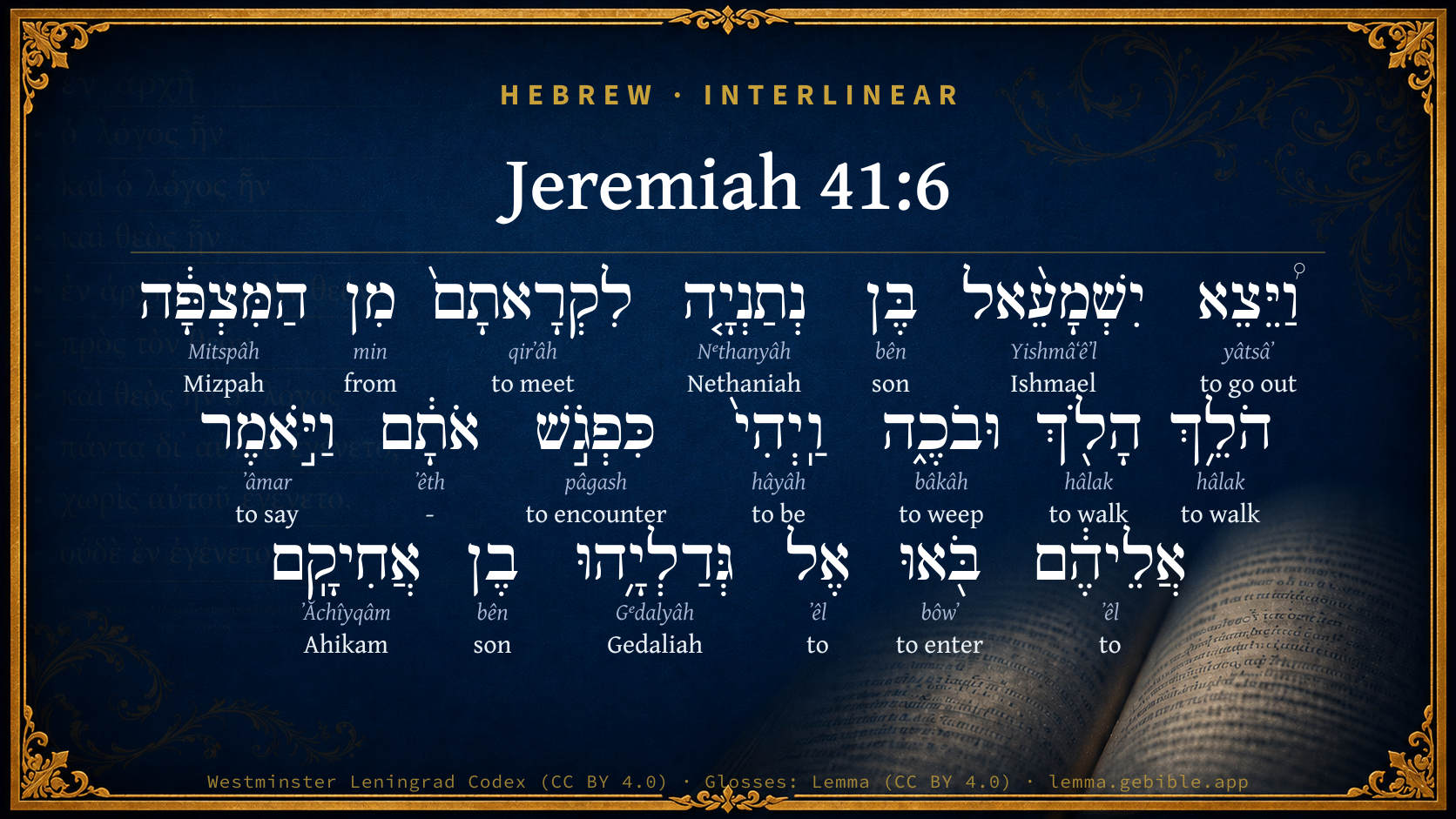
Jeremiah 41:6

Hebrew (Westminster Leningrad Codex) Jeremiah 41:6 appears in the Hebrew Old Testament. The text above is from the Westminster Leningrad Codex. Each word links to its Strong’s number, a concise gloss, and parsing drawn from the Open Scriptures Hebrew Bible morphology. Click any word for its full Brown-Driver-Briggs (BDB) entry.
Download image
Cite this verse

Jeremiah 41:6 (World English Bible). Public Domain. Lemma interlinear Bible study tool, https://lemma.gebible.app/v/jeremiah/41/6.

Show BibTeX & RIS
BibTeX
RIS
English Translation
Ishmael the son of Nethaniah went forth from Mizpah to meet them, weeping all along as he went: and it happened, as he met them, he said to them, Come to Gedaliah the son of Ahikam.
World English Bible · Public Domain
Download a study sheet

One document with this verse’s original text, its word-by-word gloss line, the meaning frame, cross-references with their text, attributed commentary, and full source and license credits — printable, and it pastes into notes with its structure intact.

This verse Autodidact and up

Study sheet (.html) Plain text (.txt)

A passage Seminary Student

Up to 50 verses in one chapter. A passage sheet keeps up to 6 commentary sources and 12 cross-references per verse, in the order this page ranks them, and says so on the sheet whenever that leaves anything out. Ask for a single verse and you get the Autodidact verse sheet above.

Everything on this page stays free to read, with no account — the sheet is a download of what is already on screen, not access to it.

Want to remove ads? Support Godless Engineer
Compare translations 3

The same verse in 3 English versions, stacked beneath the original-language interlinear above. Click any original word for its lexicon entry.

Each is an independent rendering of the whole verse — the interlinear is not word-aligned to these translations.

Highlighted words mark where these versions differ — a whole-verse word diff, not a word-by-word alignment.

  • World English Bible Public Domain
    Ishmael the son of Nethaniah went forth from Mizpah to meet them, weeping all along as he went: and it happened, as he met them, he said to them, Come to Gedaliah the son of Ahikam.
  • King James Version Public Domain
    And Ishmael the son of Nethaniah went forth from Mizpah to meet them, weeping all along as he went: and it came to pass, as he met them, he said unto them, Come to Gedaliah the son of Ahikam.
  • unfoldingWord Literal Text CC BY-SA 4.0
    So Ishmael son of Nethaniah went out from Mizpah to meet them as they went, walking and weeping. Then it happened that as he encountered them, he said to them, “Come to Gedaliah son of Ahikam!”

unfoldingWord Literal Text — © unfoldingWord, licensed CC BY-SA 4.0. Word-aligned USFM3 via Door43 (git.door43.org/unfoldingWord/en_ult).

Versions to compare (up to 4)

3 of 4 selected

Show all 18 translations

Every available English version of this verse, each an independent rendering of the whole verse.

  • World English Bible Public Domain
    Ishmael the son of Nethaniah went forth from Mizpah to meet them, weeping all along as he went: and it happened, as he met them, he said to them, Come to Gedaliah the son of Ahikam.
  • Berean Standard Bible Public Domain
    And Ishmael son of Nethaniah went out from Mizpah to meet them, weeping as he went. When Ishmael encountered the men, he said, “Come to Gedaliah son of Ahikam.”
  • Majority Standard Bible Public Domain
    And Ishmael son of Nethaniah went out from Mizpah to meet them, weeping as he went. When Ishmael encountered the men, he said, “Come to Gedaliah son of Ahikam.”
  • King James Version Public Domain
    And Ishmael the son of Nethaniah went forth from Mizpah to meet them, weeping all along as he went: and it came to pass, as he met them, he said unto them, Come to Gedaliah the son of Ahikam.
  • American Standard Version (1901) Public Domain
    And Ishmael the son of Nethaniah went forth from Mizpah to meet them, weeping all along as he went: and it came to pass, as he met them, he said unto them, Come to Gedaliah the son of Ahikam.
  • Revised Version (1885) Public Domain
    And Ishmael the son of Nethaniah went forth from Mizpah to meet them, weeping all along as he went: and it came to pass, as he met them, he said unto them, Come to Gedaliah the son of Ahikam.
  • Geneva Bible (1599) Public Domain
    And Ishmael the sonne of Nethaniah went forth from Mizpah to meete them, weeping as he went: and when he met them, he said vnto them, Come to Gedaliah the sonne of Ahikam.
  • Douay-Rheims (1899) Public Domain
    And Ismahel the son of Nathanias went forth from Masphath to meet them, weeping all along as he went: and when he had met them, he said to them: Come to Godolias, the son of Ahicam.
  • Young's Literal Translation Public Domain
    And Ishmael son of Nethaniah goeth forth to meet them, from Mizpah, going on and weeping, and it cometh to pass, at meeting them, that he saith unto them, `Come in unto Gedaliah son of Ahikam.'
  • Literal Standard Version CC BY-SA 4.0
    And Ishmael son of Nethaniah goes forth to meet them, from Mizpah, going on and weeping, and it comes to pass, at meeting them, that he says to them, “Come to Gedaliah son of Ahikam.”
  • Unlocked Literal Bible CC BY-SA 4.0
    So Ishmael son of Nethaniah went out from Mizpah to meet them as they went, walking and weeping. Then it happened that as he encountered them, he said to them, “Come to Gedaliah son of Ahikam!”
  • unfoldingWord Literal Text CC BY-SA 4.0
    So Ishmael son of Nethaniah went out from Mizpah to meet them as they went, walking and weeping. Then it happened that as he encountered them, he said to them, “Come to Gedaliah son of Ahikam!”
  • Darby Bible Public Domain
    And Ishmael the son of Nethaniah went forth from Mizpah to meet them, weeping all along as he went; and it came to pass when he met them, he said unto them, Come to Gedaliah the son of Ahikam.
  • World Messianic Bible Public Domain
    Ishmael the son of Nethaniah went out from Mizpah to meet them, weeping all along as he went, and as he met them, he said to them, “Come to Gedaliah the son of Ahikam.”
  • Webster's Bible Public Domain
    And Ishmael the son of Nethaniah went forth from Mizpah to meet them, weeping all along as he went: and it came to pass, as he met them, he said to them, Come to Gedaliah the son of Ahikam.
  • Free Bible Version CC BY-SA 4.0
    Ishmael came out to meet them from Mizpah, weeping as he went along. When Ishmael met the men, he said, “Come and see what's happened to Gedaliah son of Ahikam!”
  • Bible in Basic English Public Domain
    And Ishmael, the son of Nethaniah, went out from Mizpah with the purpose of meeting them, weeping on his way: and it came about that when he was face to face with them he said, Come to Gedaliah, the son of Ahikam.
  • JPS Tanakh (1917) Public Domain
    And Ishmael the son of Nethaniah went forth from Mizpah to meet them, weeping all along as he went; and it came to pass, as he met them, he said unto them: 'Come to Gedaliah the son of Ahikam.'

Literal Standard Version (2020), Covenant Press — licensed CC BY-SA 4.0. Text via the HelloAO Bible API (eBible.org). Unlocked Literal Bible (unfoldingWord) — licensed CC BY-SA 4.0. Text via the HelloAO Bible API (eBible.org). unfoldingWord Literal Text — © unfoldingWord, licensed CC BY-SA 4.0. Word-aligned USFM3 via Door43 (git.door43.org/unfoldingWord/en_ult). Free Bible Version, Dr. Jonathan Gallagher — licensed CC BY-SA 4.0. Text via the HelloAO Bible API (eBible.org).

Word by word

More ways to search: Search by grammar → Find every occurrence → Compare this word →

Practice this passage: Drill this verse → Learn its vocabulary →

כִּפְגֹ֣שׁ
pâgash
H6298
“like/as · to encounter”
Preposition + Verb, Qal, Infinitive Construct
Part of Speech
Preposition + Verb
Stem
Qal
Form
Infinitive Construct
Full BDB Definition

Origin: a primitive root

TWOT: 1733

to meet, join, encounter - (Qal) to meet, encounter - (Niphal) to meet together, meet each other - (Piel) to meet, encounter
  1. וַ֠יֵּצֵא yâtsâʼ H3318 “and · to go out” Conjunction + Verb, Qal, Sequential Imperfect, 3rd Person, Masculine, Singular
  2. יִשְׁמָעֵ֨אל Yishmâʻêʼl H3458 “Ishmael” Noun, Proper
  3. בֶּן bên H1121 “son of” Noun, Common, Masculine, Singular, Construct
  4. נְתַנְיָ֤ה Nᵉthanyâh H5418 “Nethaniah” Noun, Proper
  5. לִקְרָאתָם֙ qirʼâh H7125 “to meet · them” Preposition + Verb, Qal, Infinitive Construct + Suffix, Personal, 3rd Person, Masculine, Plural
  6. מִן min H4480 “from” Preposition
  7. הַמִּצְפָּ֔ה Mitspâh H4709 “the · Mizpah” Particle, Definite Article + Noun, Proper
  8. הֹלֵ֥ךְ hâlak H1980 “walking” Verb, Qal, Participle Active, Masculine, Singular, Absolute
  9. הָלֹ֖ךְ hâlak H1980 “to walk” Verb, Qal, Infinitive Absolute
  10. וּבֹכֶ֑ה bâkâh H1058 “and · weeping” Conjunction + Verb, Qal, Participle Active, Masculine, Singular, Absolute
  11. וַֽיְהִי֙ hâyâh H1961 “and · to be” Conjunction + Verb, Qal, Sequential Imperfect, 3rd Person, Masculine, Singular
  12. אֹתָ֔ם ʼêth H853 “- · them” Particle, Direct Object + Suffix, Personal, 3rd Person, Masculine, Plural
  13. וַיֹּ֣אמֶר ʼâmar H559 “and · to say” Conjunction + Verb, Qal, Sequential Imperfect, 3rd Person, Masculine, Singular
  14. אֲלֵיהֶ֔ם ʼêl H413 “to · them” Preposition + Suffix, Personal, 3rd Person, Masculine, Plural
  15. בֹּ֖אוּ bôwʼ H935 “enter” Verb, Qal, Imperative, 2nd Person, Masculine, Plural
  16. אֶל ʼêl H413 “to” Preposition
  17. גְּדַלְיָ֥הוּ Gᵉdalyâh H1436 “Gedaliah” Noun, Proper
  18. בֶן bên H1121 “son of” Noun, Common, Masculine, Singular, Construct
  19. אֲחִיקָֽם ʼĂchîyqâm H296 “Ahikam” Noun, Proper

About this verse

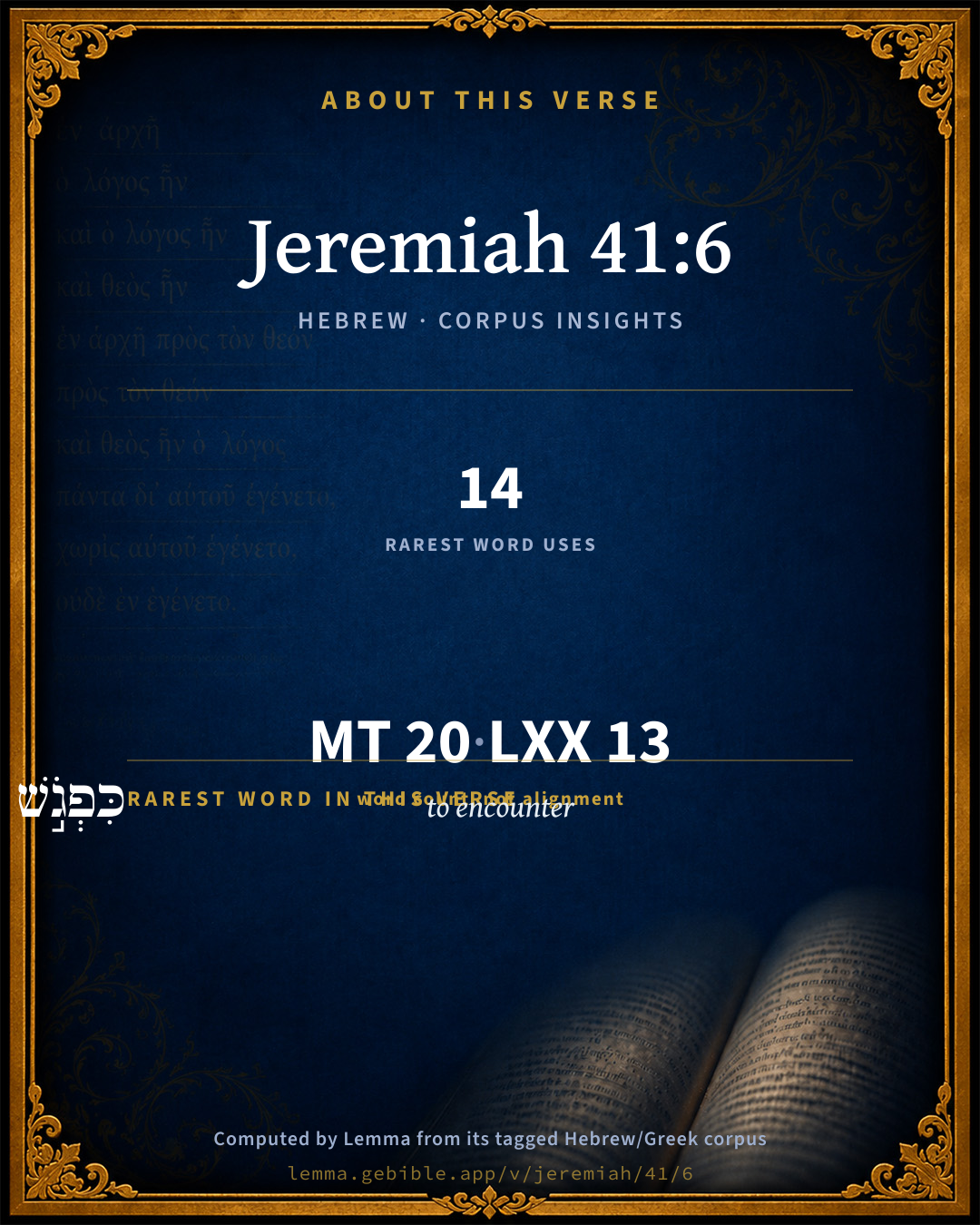
These counts appear in no published source. They are computed here, from the morphology-tagged text and Lemma’s own curated glosses. What Lemma adds →

20
words
17
distinct lemmas
Prophets
section

Notable vocabulary

The rarest word here is כִּפְגֹ֣שׁ to encounter H6298 — appearing just 14 times in the whole Hebrew Bible.

Shared distinctive vocabulary

כִּפְגֹ֣שׁ to encounter H6298 occurs in 14 verses of the Hebrew Bible. Also found in:

Grammatical profile

  • 9 verbs
  • 7 nouns
  • 3 prepositions
  • 1 particle

Verb forms

  • וַ֠יֵּצֵא Qal · Sequential Imperfect
  • לִקְרָאתָם֙ Qal · Infinitive Construct
  • הֹלֵ֥ךְ Qal · Participle Active
  • הָלֹ֖ךְ Qal · Infinitive Absolute
  • וּבֹכֶ֑ה Qal · Participle Active
  • וַֽיְהִי֙ Qal · Sequential Imperfect
  • כִּפְגֹ֣שׁ Qal · Infinitive Construct
  • וַיֹּ֣אמֶר Qal · Sequential Imperfect
  • בֹּ֖אוּ Qal · Imperative

Repetition

Words recur within this verse — often emphatic in Hebrew:

  • בֶּן son H1121 ×2
  • הֹלֵ֥ךְ to walk H1980 ×2
  • אֲלֵיהֶ֔ם to H413 ×2

Hebrew & Septuagint length

In the original languages it is 20 Hebrew tokens and 13 Greek tokens — but the two are counted differently (Hebrew bundles its prefixes and suffixes into one token; the Greek is in lemma form), so that isn’t a like-for-like length.

Cross-references

4

Topical passages linked to Jeremiah 41:6 in the Treasury of Scripture Knowledge — connected by theme and wording, ordered by reader-vote popularity; previews shown in the World English Bible.

  • 2 Samuel 3:16 Her husband went with her, weeping as he went, and followed her to Bahurim. Then said Abner to him, Go, return: and he returned.
  • Jeremiah 50:4 In those days, and in that time, says Yahweh, the children of Israel shall come, they and the children of Judah together; they shall go on their way weeping, and shall seek Yahweh their God.
  • 2 Samuel 1:2–16 it happened on the third day, that behold, a man came out of the camp from Saul, with his clothes torn, and earth on his head: and so it was, when he came to David, that he fell to the earth, and did obeisance.
  • Proverbs 26:23–26 Like silver dross on an earthen vessel Are the lips of a fervent one with an evil heart.

Cross-references courtesy of OpenBible.info (CC BY 4.0).

Hebrew and Greek witnesses Masoretic Hebrew ↔ Greek Septuagint

The same verse in the two great witnesses to the Old Testament, shown verse-for-verse.

These are two independent witnesses, not word-aligned to each other, and the Septuagint is shown in lemma (dictionary) form.

Hebrew Jeremiah 41:6 Masoretic · Westminster Leningrad Codex

וַ֠יֵּצֵא יִשְׁמָעֵ֨אל בֶּן נְתַנְיָ֤ה לִקְרָאתָם֙ מִן הַמִּצְפָּ֔ה הֹלֵ֥ךְ הָלֹ֖ךְ וּבֹכֶ֑ה וַֽיְהִי֙ כִּפְגֹ֣שׁ אֹתָ֔ם וַיֹּ֣אמֶר אֲלֵיהֶ֔ם בֹּ֖אוּ אֶל גְּדַלְיָ֥הוּ בֶן אֲחִיקָֽם

Ishmael the son of Nethaniah went forth from Mizpah to meet them, weeping all along as he went: and it happened, as he met them, he said to them, Come to Gedaliah the son of Ahikam.

World English Bible · Public Domain

Greek LXX Structure differs

In the Septuagint, Jeremiah is about an eighth shorter than the Hebrew and arranges its material differently — the Oracles Against the Nations (Hebrew chapters 46–51) appear in the middle of the Greek book, after 25:13. Because the chapter and verse boundaries do not line up, a verse-for-verse comparison with the Hebrew is not shown.

A verse-for-verse comparison isn’t shown here because the chapters and verses don’t line up. Switch to the LXX edition with the MT / LXX toggle above to read the Greek directly.

On this verse, Joseph Benson's Commentary discusses the Septuagint’s reading. Read the note in Commentary ↓

Hebrew: Westminster Leningrad Codex (CC BY 4.0). Greek: Septuagint (public domain); English from a public-domain English Septuagint. How the Septuagint differs from the Hebrew →

Targum (Aramaic paraphrase)

1

The Targum is the ancient Jewish Aramaic paraphrase of the Hebrew Scriptures — an interpretive translation, not the Hebrew text itself. Onkelos (literal) and Pseudo-Jonathan (expansive) render the Torah, and Jonathan the Prophets. Coverage is partial: where no permissively-licensed English translation exists for a verse, only the Aramaic is shown. This is verse-level text, not a word-by-word alignment to the Hebrew.

  1. Targum Jonathan Prophets (Joshua–Malachi)
    וּנְפַק יִשְׁמָעֵאל בַּר נְתַנְיָה לָקֳדָמוּתְהוֹן מִן מִצְפַּיָא אֱזֵיל מֵיזַל וּבָכֵי וַהֲוָה כַּד עֲרַע יַתְהוֹן וַאֲמַר לְהוֹן עוּלוּ לְוַת גְדַלְיָהוּ בַּר אֲחִיקָם:

    (no public-domain English translation for this verse)

    Targum Jonathan — Aramaic: “Mikraot Gedolot” (public domain). English: “Sefaria Community Translation” (CC0 1.0 (public-domain dedication)); “London "Chaldee Paraphrase," 1871” (public domain). Text via Sefaria.

Commentary

Notes on Jeremiah 41:6 from classic Christian and Jewish commentators (each source and its license shown beneath its notes). The classic Christian expositions comment on the surrounding passage and are grouped to its opening verse, so a note may address several verses; the Jewish commentaries on the Tanakh (Rashi and others) are per-verse, so they appear only where the commentator wrote on this verse.

Lemma curates 59 commentaries, every one of them public domain or Creative Commons licensed, each selected and text-cleaned for this edition rather than reprinted as found. About our sources →

Trapp's Complete Commentary

John Trapp

Jer 41:6 And Ishmael the son of Nethaniah went forth from Mizpah to meet them, weeping all along as he went: and it came to pass, as he met them, he said unto them, Come to Gedaliah the son of Ahikam.

Ver. 6. And Ishmael came forth of Mizpah to meet them.] This was another manner of meeting than that at Mizpah in Samuel’s days. {1Sa 7:3-6} O tempora! O mores!

Weeping all along as he went.] Oh deep dissimulation and crocodile’s tears! {a} That creature, having killed some living beast, lieth upon the dead body, washeth the head thereof with her warm tears, which she afterwards devoureth together with the body. Tears, saith the author of the Turkish History, {b} speaking of Andronicus, another Ishmael, by nature were ordained to express the heaviness of the heart, flowing from the eyes as showers of rain from the clouds. In good men the most certain signs of greatest grief and sure testimonies of inward torment; but in Andronicus you are not so. You proceed of joy, you promise not to the distressed pity or compassion, but death and destruction. How many men’s eyes have you put out! How many have you drowned! How many have you devoured! Thus he; and much more to like purpose.

Come to Gedaliah the son of Ahikam.] This he saith fraudulently, like Sinon in the poet, that he might fish and find out how they stood affected to Gedaliah, whom he so deadly hated, that he slaughtered these poor folk for once owning him, or owing him any service.

{a} Vide pessimum ingenium: luget ut lugentes perdat. - Oecolamp.

{b} Turkish History, fol. 56.

John Trapp, A Commentary or Exposition upon All the Books of the Old and New Testament (1647–1656) — public domain. Text from a community e-Sword module.

Joseph Benson's Commentary

Jer 41:6-8. And Ishmael went forth to meet them, weeping all along as he went — As if he sympathized with them, and bewailed, as they did, the desolations of Jerusalem. He appears to have been a complete hypocrite. As he met them he said, Come to Gedaliah — He invites them to the new governor for protection, as if he had been one of his courtiers and friends, and by these arts conceals his bloody design against them. And when they came into the midst of the city — Whence they could not easily escape; Ishmael slew them — Though they had given him no provocation, and indeed, as it seems, were entire strangers to him. And, no doubt, he took the offerings they had brought, and converted them to his own use: for he that did not hesitate to commit such a murder certainly would not scruple to commit sacrilege. And cast them into the midst of the pit — The words, and cast them, are not in the Hebrew, which is literally, slew them in the midst of the pit. So also the LXX., εσφαξεν αυτους εις το φρεαρ. The Complutensian edition, however, supplies και ενεβαλεν, and cast them, which accords with the reading of the Syriac. The Vulgate renders the clause, interfecit eos Ismael circa medium laci: Ishmael slew them about the middle of the lake, or, pool; and Blaney reads, Ishmael massacred them at the pit. He and the men that were with him — Hired, it seems, to assist him in this bloody work. But ten men were found that said, Slay us not, for we have treasures, &c. — He slew seventy of them, but the remaining ten pleading for their lives, and urging that they had estates in the country of corn, oil, and honey, his covetousness prevailed over his cruelty, and he spared their lives, to become master of their property.

Joseph Benson's Commentary on the Old and New Testaments (1811–1818) — public domain. Text from a community e-Sword module.

Geneva Bible (1599)

Geneva Bible translators

For his death was kept secret, and he feigned that he lament for the destruction of Jerusalem, and the Temple: but after slew them when they seemed to favor Gedaliah.

Geneva Bible (1599) marginal notes — public domain. Text via Bolls.life.

Jamieson, Fausset & Brown

Robert Jamieson, A. R. Fausset & David Brown

weeping--pretending to weep, as they did, for the ruin of the temple.

Come to Gedaliah--as if he was one of Gedaliah's retinue.

Jamieson, Fausset & Brown — Commentary Critical and Explanatory on the Whole Bible (1871) — public domain (CC PDM 1.0). Text via the HelloAO Bible API.

Adam Clarke's Commentary

Verse 6. Weeping all along as he went] This felonious hypocrite pretended that he also was deeply afflicted, and wished to bear them company in their sorrow.

Come to Gedaliah] He will appoint you vineyards and fields.

Adam Clarke's Commentary on the Bible (1810–1826) — public domain. Text from a community e-Sword/MySword module.

Ellicott's Commentary for English Readers

(6) Weeping all along as he went.—The treacherous prince met them as sharing in their grief. He does not tell them of the murder; but assuming that they have heard of Gedaliah’s appointment as Satrap, invites them to come and see him, as being now within the bounds of his jurisdiction. The LXX., it may be noted, represents the pilgrims, and not Ishmael, as weeping.

A Bible Commentary for English Readers, edited by Charles John Ellicott (1878–1897) — public domain. Text from a community e-Sword module.

The Cambridge Bible for Schools and Colleges

gen. ed. J. J. S. Perowne

6. weeping all along] so as to feign equal concern with them for the fate of the Temple, and thus put them off their guard.

Come to Gedaliah] probably as governor, to whom therefore they should shew respect and offer greeting.

The Cambridge Bible for Schools and Colleges (gen. ed. J. J. S. Perowne; Cambridge University Press, 1878–1918) — public domain. Text from a community e-Sword module.

John Gill's Exposition

And Ishmael the son of Nethaniah went forth to Mizpah to meet them,.... Hearing there was such a number of men upon the road to Jerusalem, in such a habit, and upon such a design, he thought it advisable to go out and meet them, and stop them, and decoy them into the city, and there destroy them; lest, if they should have got any hint of what had been done by him, they should spread it, and raise the country upon him, before he had executed his whole design:

weeping all along as he went; pretending equal concern for the destruction of the land, city, and temple, as they had:

and it came to pass, as he met them; when he came up to them, and some discourse had passed between them:

he said unto them, come to Gedaliah the son of Ahikam; as if he was alive, and for whom he had a great respect, and whose character was well known to these men; and thought that this would be an inducement to come along with him: this he said either to try them, whether they had heard anything upon the road of the death of him; or as an argument to come into the city, suggesting the governor would gladly receive, and liberally entertain them. This looks as if their design was not to come to Mizpah, but to go on their way to Jerusalem, had they not been met with by him, and had he not thus solicited them.

John Gill's Exposition of the Whole Bible (1746–1763) — public domain (CC PDM 1.0). Text via the HelloAO Bible API.

Albert Barnes' Notes on the Bible

Ishmael’s conduct seems to have been dictated by the malicious desire utterly to frustrate Gedaliah’s work.

Weeping - By this artifice he lured them into Mizpah. The Septuagint: “as they were ... weeping.”

Albert Barnes' Notes on the Bible (1834–1885) — public domain. Text from a community e-Sword/MySword module.

Haydock's Catholic Bible Commentary

He. Septuagint, "they." Yet Hebrew intimates that Ismahel feigned tears. (Calmet) --- He did not weep sincerely. (Worthington)

George Leo Haydock (1774–1849), Haydock's Catholic Family Bible and Commentary, 1859 edition — public domain. Excludes Psalms (Douay-Rheims chapter numbering differs from Protestant) and Deuterocanonical books (Catholic canon only).

Matthew Poole's English Annotations

He cometh out weeping, the better to deceive them into his trap, that they might believe he was as they equally affected with God’s dispensations, and inviteth them to the new governor for protection, as if he had been one of his courtiers and friends: by those arts he concealeth his bloody design against them.

Matthew Poole's English Annotations on the Holy Bible (1683–1685) — public domain. Text from a community e-Sword/MySword module.

Whedon's Commentary on the Bible

Daniel D. Whedon

6. Weeping all along as he went — Literally, going to go and weep — weeping continually. The idea is well expressed in our version. He simulated grief for the same purpose for which the Indian lies in ambush.

Daniel D. Whedon (gen. ed.), Commentary on the Old and New Testaments (1874–1909) — public domain. Text from a community e-Sword module.

The Pulpit Commentary

Weeping all along as he went. To testify his sympathy with their grief. But the reading of the Septuagint is more natural, "As they were going along and weeping."

The Pulpit Commentary (1880–1919), ed. H.D.M. Spence-Jones & Joseph S. Exell — public domain. Text from a community e-Sword module.

Keil & Delitzsch

C. F. Keil & F. Delitzsch

Ishmael went out from Mizpah to meet these men, always weeping as he went (הלך הלך וּבכה, cf. Ges. 131, ab; Ew. 280, b). If they came from Ephraim by way of Gibeon (el Jb), the road on to Jerusalem passed close by Mizpah. When Ishmael met them, he asked them to come to Gedaliah (to Mizpah). But when they had entered the city, "Ishmael slew them into the midst of the pit" (which was there), i.e., killed them and cast their corpses into the pit.

Keil & Delitzsch — Biblical Commentary on the Old Testament (1861–1891) — public domain (CC PDM 1.0). Text via the HelloAO Bible API. (Old Testament only.)

unfoldingWord translationNotes

Door43 World Missions Community

to meet them

"to meet the 80 men"

Then it happened

This phrase is used here to mark where the action starts. If your language has a way for doing this, you could consider using it here.

It came about that

This phrase is used here to mark an important event in the story. If your language has a way for doing this, you could consider using it here.

Ishmael son of Nethaniah slaughtered them and threw them into a pit, he and the men who were with him

It is stated it in Jeremiah 41:8 that Ishmael and his men did not kill all 80 men. You can state here that they killed most of the 80 men. AT: "Ishmael son of Nethaniah, and the men who were with him, killed most of the 80 men and threw them into a pit"

translationWords

slaughter

pit

unfoldingWord translationNotes — © Distant Shores Media and the Door43 World Missions Community, licensed CC BY-SA 4.0. Source: git.door43.org/Door43/en_tn.

Lesson kit

Teaching starters — assembled from the data on this page, not authored interpretation. Every prompt links to the verse data it draws on. Edit before teaching.

Jeremiah, in the Prophets, opens this verse with 20 words (17 distinct Hebrew lemmas). Its most distinctive word is pâgash (“to encounter”). A historical commentator’s framing appears above. Read the whole chapter for the surrounding context.

Discussion questions

  1. What does “to encounter” (pâgash) contribute to the verse as a whole?
  2. Genesis 32:17 shares the word «to encounter» with this verse. How do the two illuminate each other?
  3. “son” occurs 2× in this one verse. What is the effect of the repetition?
  4. The translations on this page render this verse differently — a whole-verse word diff, not a word-by-word alignment. What might account for the different wordings?
  5. The verb «וַ֠יֵּצֵא» is Qal Sequential Imperfect. How does its form color the action?
  6. Reading how Trapp's Complete Commentary and Joseph Benson's Commentary read this verse, where do the two commentators agree and where do they part?

Things to notice

Reading settings

Reading text

Shown beneath each verse's original-language words.

Old Testament
Old Testament edition

Read the OT as the Masoretic Hebrew (MT) or the Greek Septuagint (LXX).

English shown for the Greek Septuagint (in the Hebrew ↔ Greek comparison).

Comparing translations? Open the Compare panel on any verse page to stack up to four side by side.