Zechariah 7:13

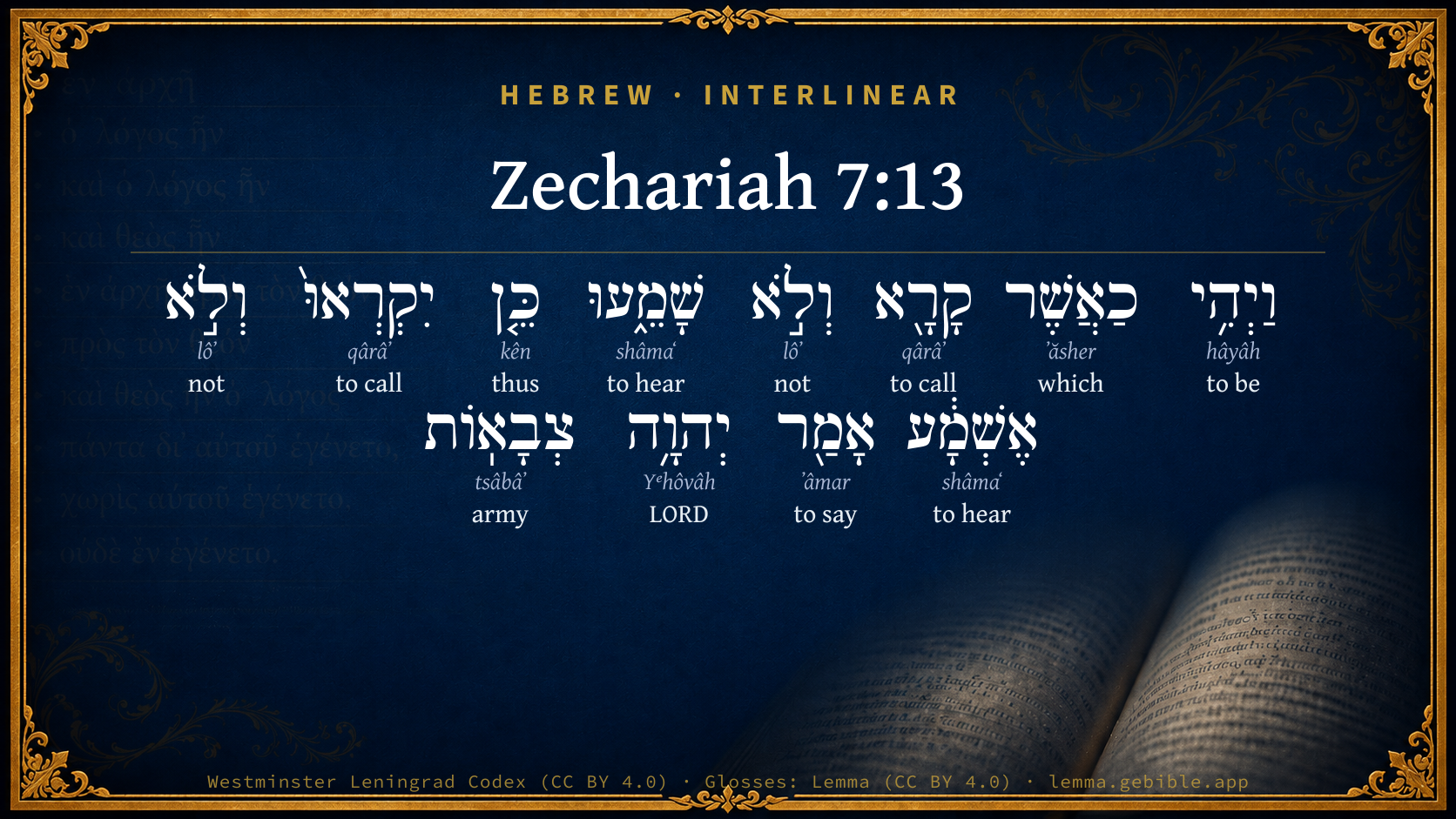
Hebrew (Westminster Leningrad Codex) Zechariah 7:13 appears in the Hebrew Old Testament. The text above is from the Westminster Leningrad Codex. Each word links to its Strong’s number, a concise gloss, and parsing drawn from the Open Scriptures Hebrew Bible morphology. Click any word for its full Brown-Driver-Briggs (BDB) entry.
Download image
Cite this verse

Zechariah 7:13 (World English Bible). Public Domain. Lemma interlinear Bible study tool, https://lemma.gebible.app/v/zechariah/7/13.

Show BibTeX & RIS
BibTeX
RIS
English Translation
It has come to pass that, as he called, and they refused to listen, so they will call, and I will not listen," said Yahweh of Hosts;
World English Bible · Public Domain
Download a study sheet

One document with this verse’s original text, its word-by-word gloss line, the meaning frame, cross-references with their text, attributed commentary, and full source and license credits — printable, and it pastes into notes with its structure intact.

This verse Autodidact and up

Study sheet (.html) Plain text (.txt)

A passage Seminary Student

Up to 50 verses in one chapter. A passage sheet keeps up to 6 commentary sources and 12 cross-references per verse, in the order this page ranks them, and says so on the sheet whenever that leaves anything out. Ask for a single verse and you get the Autodidact verse sheet above.

Everything on this page stays free to read, with no account — the sheet is a download of what is already on screen, not access to it.

Want to remove ads? Support Godless Engineer
Compare translations 3

The same verse in 3 English versions, stacked beneath the original-language interlinear above. Click any original word for its lexicon entry.

Each is an independent rendering of the whole verse — the interlinear is not word-aligned to these translations.

Highlighted words mark where these versions differ — a whole-verse word diff, not a word-by-word alignment.

  • World English Bible Public Domain
    It has come to pass that, as he called, and they refused to listen, so they will call, and I will not listen," said Yahweh of Hosts;
  • King James Version Public Domain
    Therefore it is come to pass, that as he cried, and they would not hear; so they cried, and I would not hear, saith the LORD of hosts:
  • unfoldingWord Literal Text CC BY-SA 4.0
    And it happened, just as he called and they did not listen, thus they will call and I will not listen”—said Yahweh of Armies—

unfoldingWord Literal Text — © unfoldingWord, licensed CC BY-SA 4.0. Word-aligned USFM3 via Door43 (git.door43.org/unfoldingWord/en_ult).

Versions to compare (up to 4)

3 of 4 selected

Show all 18 translations

Every available English version of this verse, each an independent rendering of the whole verse.

  • World English Bible Public Domain
    It has come to pass that, as he called, and they refused to listen, so they will call, and I will not listen," said Yahweh of Hosts;
  • Berean Standard Bible Public Domain
    And just as I had called and they would not listen, so when they called I would not listen, says the LORD of Hosts.
  • Majority Standard Bible Public Domain
    And just as I had called and they would not listen, so when they called I would not listen, says the LORD of Hosts.
  • King James Version Public Domain
    Therefore it is come to pass, that as he cried, and they would not hear; so they cried, and I would not hear, saith the LORD of hosts:
  • American Standard Version (1901) Public Domain
    And it is come to pass that, as he cried, and they would not hear, so they shall cry, and I will not hear, said Jehovah of hosts;
  • Revised Version (1885) Public Domain
    And it came to pass that, as he cried, and they would not hear; so they shall cry, and I will not hear, said the LORD of hosts;
  • Geneva Bible (1599) Public Domain
    Therefore it is come to passe, that as he cried, and they would not heare, so they cried, and I would not heare, sayth the Lord of hostes.
  • Douay-Rheims (1899) Public Domain
    And it came to pass that as he spoke, and they heard not: so shall they cry, and I will not hear, saith the Lord of hosts.
  • Young's Literal Translation Public Domain
    And it cometh to pass, as He called, And they have not hearkened, So do they call, and I do not hearken, Said Jehovah of Hosts.
  • Literal Standard Version CC BY-SA 4.0
    And it comes to pass, as He called, || And they have not listened, || So they call, and I do not listen,” said YHWH of Hosts.
  • Unlocked Literal Bible CC BY-SA 4.0
    It happened that when he called, they did not listen. In the same way,” said Yahweh of hosts, “they will call out to me, but I will not listen.
  • unfoldingWord Literal Text CC BY-SA 4.0
    And it happened, just as he called and they did not listen, thus they will call and I will not listen”—said Yahweh of Armies—
  • Darby Bible Public Domain
    And it came to pass, like as he called, and they would not hear, so they called, and I would not hear, saith Jehovah of hosts;
  • World Messianic Bible Public Domain
    It has come to pass that, as he called and they refused to listen, so they will call and I will not listen,” said the LORD of Hosts;
  • Webster's Bible Public Domain
    Therefore it is come to pass, that as he cried, and they would not hear; so they cried, and I would not hear, saith the LORD of hosts:
  • Free Bible Version CC BY-SA 4.0
    So since they didn't listen when I called out to them, I wouldn't listen when they called out to me, says the Lord Almighty.
  • Bible in Basic English Public Domain
    And it came about that as they would not give ear to his voice, so I would not give ear to their voice, says the Lord of armies:
  • JPS Tanakh (1917) Public Domain
    And it came to pass that, as He called, and they would not hear; so they shall call, and I will not hear, said the LORD of hosts;

Literal Standard Version (2020), Covenant Press — licensed CC BY-SA 4.0. Text via the HelloAO Bible API (eBible.org). Unlocked Literal Bible (unfoldingWord) — licensed CC BY-SA 4.0. Text via the HelloAO Bible API (eBible.org). unfoldingWord Literal Text — © unfoldingWord, licensed CC BY-SA 4.0. Word-aligned USFM3 via Door43 (git.door43.org/unfoldingWord/en_ult). Free Bible Version, Dr. Jonathan Gallagher — licensed CC BY-SA 4.0. Text via the HelloAO Bible API (eBible.org).

Word by word

More ways to search: Search by grammar → Find every occurrence → Compare this word →

Practice this passage: Drill this verse → Learn its vocabulary →

צְבָאֽוֹת
tsâbâʼ
H6635
“armies”
Noun, Common, Both, Plural, Absolute
Part of Speech
Noun
Type
Common
Gender
Both
Number
Plural
State
Absolute
Full BDB Definition

Origin: from H6633

TWOT: 1865a , 1865b

that which goes forth, army, war, warfare, host - army, host - host (of organised army) - host (of angels) - of sun, moon, and stars - of whole creation - war, warfare, service, go out to war - service
  1. וַיְהִ֥י hâyâh H1961 “and · to be” Conjunction + Verb, Qal, Sequential Imperfect, 3rd Person, Masculine, Singular
  2. כַאֲשֶׁר ʼăsher H834 “like/as · which” Preposition + Particle, Relative
  3. קָרָ֖א qârâʼ H7121 “to call” Verb, Qal, Perfect, 3rd Person, Masculine, Singular
  4. וְלֹ֣א lôʼ H3808 “and · not” Conjunction + Particle, Negative
  5. שָׁמֵ֑עוּ shâmaʻ H8085 “to hear” Verb, Qal, Perfect, 3rd Person, Common, Plural
  6. כֵּ֤ן kên H3651 “thus” Particle, Demonstrative
  7. יִקְרְאוּ֙ qârâʼ H7121 “to call” Verb, Qal, Imperfect, 3rd Person, Masculine, Plural
  8. וְלֹ֣א lôʼ H3808 “and · not” Conjunction + Particle, Negative
  9. אֶשְׁמָ֔ע shâmaʻ H8085 “to hear” Verb, Qal, Imperfect, 1st Person, Common, Singular
  10. אָמַ֖ר ʼâmar H559 “to say” Verb, Qal, Perfect, 3rd Person, Masculine, Singular
  11. יְהוָ֥ה Yᵉhôvâh H3068 “LORD” Noun, Proper

About this verse

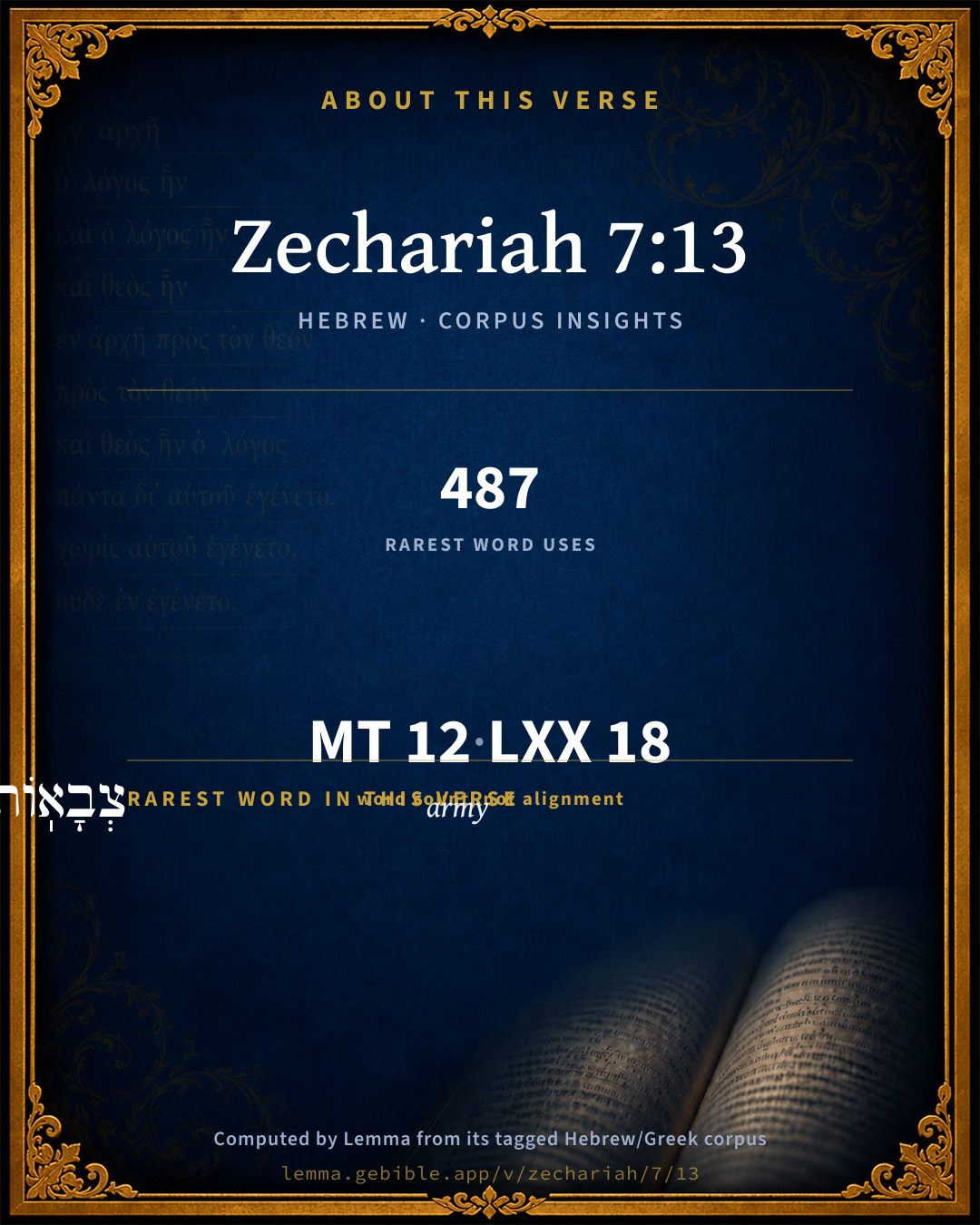
These counts appear in no published source. They are computed here, from the morphology-tagged text and Lemma’s own curated glosses. What Lemma adds →

12
words
9
distinct lemmas
Prophets
section

Grammatical profile

  • 6 verbs
  • 2 nouns
  • 4 particles

Verb forms

  • וַיְהִ֥י Qal · Sequential Imperfect
  • קָרָ֖א Qal · Perfect
  • שָׁמֵ֑עוּ Qal · Perfect
  • יִקְרְאוּ֙ Qal · Imperfect
  • אֶשְׁמָ֔ע Qal · Imperfect
  • אָמַ֖ר Qal · Perfect

Repetition

Words recur within this verse — often emphatic in Hebrew:

  • קָרָ֖א to call H7121 ×2
  • שָׁמֵ֑עוּ to hear H8085 ×2
  • וְלֹ֣א not H3808 ×2

Hebrew & Septuagint length

In English translation the verse runs 27 words from the Hebrew and 27 from the Septuagint (LXX English) — the same length.

A rough comparison of the two English renderings, which tokenize alike — not a word-level alignment.

Word counts can differ between the Hebrew and the Greek without any difference in meaning — e.g. the Hebrew direct-object marker אֵת has no separate Greek word, and Greek often adds the article ὁ.

In the original languages it is 12 Hebrew tokens and 18 Greek tokens — but the two are counted differently (Hebrew bundles its prefixes and suffixes into one token; the Greek is in lemma form), so that isn’t a like-for-like length.

Cross-references

17

Topical passages linked to Zechariah 7:13 in the Treasury of Scripture Knowledge — connected by theme and wording, ordered by reader-vote popularity; previews shown in the World English Bible.

  • Proverbs 1:24–28 Because I have called, and you have refused; I have stretched out my hand, and no one has paid attention;
  • Isaiah 1:15 When you spread forth your hands, I will hide my eyes from you; Yes, when you make many prayers, I will not hear. Your hands are full of blood.
  • Jeremiah 14:12 When they fast, I will not hear their cry; and when they offer burnt offering and meal-offering, I will not accept them; but I will consume them by the sword, and by the famine, and by the pestilence.
  • Jeremiah 11:11 Therefore thus says Yahweh, Behold, I will bring evil on them, which they shall not be able to escape; and they shall cry to me, but I will not listen to them.
  • Micah 3:4 Then they will cry to Yahweh, But he will not answer them. Yes, he will hide his face from them at that time, Because they made their deeds evil."
  • Psalms 81:8–12 "Hear, my people, and I will testify to you, Israel, if you would listen to me!
  • Proverbs 28:9 He who turns away his ear from hearing the law, Even his prayer is an abomination.
  • Jeremiah 6:16–17 Thus says Yahweh, Stand you in the ways and see, and ask for the old paths, where is the good way; and walk therein, and you shall find rest for your souls: but they said, We will not walk [therein].
  • Luke 19:42–44 saying, "If you, even you, had known today the things which belong to your peace! But now, they are hidden from your eyes.
  • James 4:3 You ask, and don't receive, because you ask with wrong motives, so that you may spend it for your pleasures.
  • Proverbs 21:13 Whoever stops his ears at the cry of the poor, He will also cry out, but shall not be heard.
  • Isaiah 50:2 Why, when I came, was there no man? when I called, was there none to answer? Is my hand shortened at all, that it can't redeem? or have I no power to deliver? Behold, at my rebuke I dry up the sea, I make the rivers a wilderness: their fish stink, because there is no water, and die for thirst.
  • Ezekiel 14:3 Son of man, these men have taken their idols into their heart, and put the stumbling block of their iniquity before their face: should I be inquired of at all by them?
  • Ezekiel 20:3 Son of man, speak to the elders of Israel, and tell them, Thus says the Lord Yahweh: Is it to inquire of me that you have come? As I live, says the Lord Yahweh, I will not be inquired of by you.
  • Matthew 25:11–12 Afterward the other virgins also came, saying, 'Lord, Lord, open to us.'
  • Luke 13:25 When once the master of the house has risen up, and has shut the door, and you begin to stand outside, and to knock at the door, saying, 'Lord, Lord, open to us!' then he will answer and tell you, 'I don't know you or where you come from.'
  • Luke 13:34–35 "Jerusalem, Jerusalem, that kills the prophets, and stones those who are sent to her! How often I wanted to gather your children together, like a hen gathers her own brood under her wings, and you refused!

Cross-references courtesy of OpenBible.info (CC BY 4.0).

Hebrew and Greek witnesses Masoretic Hebrew ↔ Greek Septuagint

The same verse in the two great witnesses to the Old Testament, shown verse-for-verse.

These are two independent witnesses, not word-aligned to each other, and the Septuagint is shown in lemma (dictionary) form.

Hebrew Zechariah 7:13 Masoretic · Westminster Leningrad Codex

וַיְהִ֥י כַאֲשֶׁר קָרָ֖א וְלֹ֣א שָׁמֵ֑עוּ כֵּ֤ן יִקְרְאוּ֙ וְלֹ֣א אֶשְׁמָ֔ע אָמַ֖ר יְהוָ֥ה צְבָאֽוֹת

It has come to pass that, as he called, and they refused to listen, so they will call, and I will not listen," said Yahweh of Hosts;

World English Bible · Public Domain

Greek LXX Zechariah 7:13 Septuagint · lemma form

καί εἰμί ὅς τρόπος εἶπον καί οὐ εἰςἀκούω αὐτός οὕτως κράζω καί οὐ μή εἰςἀκούω λέγω κύριος παντοκράτωρ

And it shall come to pass, that as he spoke, and they listened not, so they shall cry, and I will not listen, says the Lord Almighty.

LXX2012 (modern English Septuagint) · Public Domain

On this verse, Ellicott's Commentary for English Readers discusses the Septuagint’s reading. Read the note in Commentary ↓

Hebrew: Westminster Leningrad Codex (CC BY 4.0). Greek: Septuagint (public domain); English from LXX2012 (modern English Septuagint) (Public Domain). How the Septuagint differs from the Hebrew →

Targum (Aramaic paraphrase)

1

The Targum is the ancient Jewish Aramaic paraphrase of the Hebrew Scriptures — an interpretive translation, not the Hebrew text itself. Onkelos (literal) and Pseudo-Jonathan (expansive) render the Torah, and Jonathan the Prophets. Coverage is partial: where no permissively-licensed English translation exists for a verse, only the Aramaic is shown. This is verse-level text, not a word-by-word alignment to the Hebrew.

  1. Targum Jonathan Prophets (Joshua–Malachi)
    וִיהֵי כְמָא דְאִתְנַבִּיאוּ לְהוֹן נְבִיַיָא וְלָא קַבִּילוּ כֵּן יְצַלוֹן קֳדָמַי וְלָא אֲקַבֵּיל אֲמַר יְיָ צְבָאוֹת:

    (no public-domain English translation for this verse)

    Targum Jonathan — Aramaic: “Mikraot Gedolot” (public domain). English: “Sefaria Community Translation” (CC0 1.0 (public-domain dedication)); “London "Chaldee Paraphrase," 1871” (public domain). Text via Sefaria.

Commentary

Notes on Zechariah 7:13 from classic Christian and Jewish commentators (each source and its license shown beneath its notes). The classic Christian expositions comment on the surrounding passage and are grouped to its opening verse, so a note may address several verses; the Jewish commentaries on the Tanakh (Rashi and others) are per-verse, so they appear only where the commentator wrote on this verse.

Lemma curates 59 commentaries, every one of them public domain or Creative Commons licensed, each selected and text-cleaned for this edition rather than reprinted as found. About our sources →

Trapp's Complete Commentary

John Trapp

Zec 7:13 Therefore it is come to pass, [that] as he cried, and they would not hear; so they cried, and I would not hear, saith the LORD of hosts:

Ver. 13. Therefore it is come to pass] By a most just and equal retaliation. Distributive justice requireth that men should be punished according to the nature and kind of their offences. "The backslider in heart shall be filled with his own ways," Pro 14:14. As he makes a match with mischief, so he shall have his belly full of it; he hath sold himself to do wickedness, and he shall be sure to have his payment. With the froward God will show himself froward, Psa 18:26, he will be as cross as they are, for the hearts of them. If they turn the deaf ear to him, he will do as much for them another time. They shall call and cry for help till their hearts and sides ache, but all in vain; he will not come at them. If they pull away the shoulder, he will pull away their supporters, and they shall be "overthrown in stony places," Psa 141:6. If they harden their hearts he will harden his hand, and hasten their destruction. This shall they have of God’s hand, they "shall lie down in sorrow," Isa 50:11.

John Trapp, A Commentary or Exposition upon All the Books of the Old and New Testament (1647–1656) — public domain. Text from a community e-Sword module.

The Biblical Illustrator

Joseph S. Exell

Zec_7:13

I would not hear, saith the Lord of hosts

God refusing to hear prayer

I.

The negligence of men.

1. They do not hear the dispensations of God in His providence.

2. They do not hear the invitations of God by His servants.

3. They do not hear the commands of God in His Word.

II. The judgment of God.

1. He will not hear the cry of the lost, as expressive of regret.

2. He will not hear the cry of the lost, as expressive of disappointment.

3. He will not hear the cry of the lost, as expressive of fear.

4. He will not hear the cry of the lost, as expressive of despair. (G. Brooks.)

The Biblical Illustrator, edited by Joseph S. Exell (c. 1880s–1900s) — public domain. Text from a community e-Sword module.

Joseph Benson's Commentary

Zec 7:13-14. Therefore — On this very account; as he cried — As I, by my Spirit in my prophets, called, warned, entreated, and urged them to repent, obey, and live, but they would not; so they cried — In their deep distress, and amidst their overwhelming calamities; and I would not hear — Would not answer, or regard their prayer. But I scattered them — Cast them out of their habitations, and dispersed them through distant countries; with a whirlwind — Suddenly and irresistibly; among all the nations — All the heathen, that hated them and their ways. Thus the land — Once flowing with milk and honey; once full of cities, men, and cattle; was desolate after them — Became waste as a wilderness after they were cast out; that no man passed through — An entire riddance was not only made of its inhabitants, but the very highways were desolate, so that none passed and repassed: and that which was before a pleasant land, became a mere desert.

Joseph Benson's Commentary on the Old and New Testaments (1811–1818) — public domain. Text from a community e-Sword module.

Keil & Delitzsch

C. F. Keil & F. Delitzsch

This wrath is described in Zac 7:13, Zac 7:14. Zac 7:13. "It came to pass: as he cried and they did not hear, so will they cry and I shall not hear, said Jehovah of hosts. Zac 7:14. And I will scatter them with a whirlwind over all nations, who did not know them, and the land is laid waste behind them, so that no one passes to and fro. And thus they made the choice land a desert." The form of the address changes in Zac 7:13. Whereas in the protasis the prophet is still speaking of Jehovah in the third person, in the apodosis he introduces Jehovah as speaking (so will they cry, and I, etc.) and announcing the punishment, which He will inflict upon the rebellious and has already inflicted in their captivity. This address of God is continued in Zac 7:14 as far as וּמשּׁב. The opinion, that the address terminates with לא ידעוּם, and that והארץ commences the account of the accomplishment of the purpose to punish, is not so much at variance with the circumstance, that in that case the last two clauses of Zac 7:14 would say essentially the same thing, as with the fact that והארץ וגו cannot, from its very form, be taken as an account of the accomplishment of the divine purpose. The perfect nâshammâh in this clause does not preclude our connecting it with the preceding one, but is used to set forth the devastation as a completed fact: the land will be (not become) waste. The infliction of the punishment is expressed in Zac 7:13 in the form of a divine talio. As they have not hearkened to the word of God, so will God, when they call upon Him, namely in distress (cf. Hos 5:15), also not hear (cf. Jer 11:11), but whirl them like a tempest over the nations. The form אסערם is the first pers. imperf. piel for אסערם or אסערם, and Aramaic (cf. Ges. 52, 2, Anm. 2). On the nations whom they do not know, and who will therefore have no pity and compassion upon them, compare Jer 22:28; Jer 16:13. מעבר וּמשּׁב (cf. Zac 9:8), that not one goes to and fro in the desolate land; lit., goes away from a place and returns again (cf. Exo 32:27). In the clause ויּשׂימוּ וגו the result of the stiff-necked obstinacy of the fathers is briefly stated: They have made the choice land a desert ('erets chemdâh, as in Jer 3:19 and Psa 106:24), so that they have brought upon the land all the calamity which is now bewailed upon the fast-days.

Keil & Delitzsch — Biblical Commentary on the Old Testament (1861–1891) — public domain (CC PDM 1.0). Text via the HelloAO Bible API. (Old Testament only.)

Jamieson, Fausset & Brown

Robert Jamieson, A. R. Fausset & David Brown

he cried--by His prophets.

they cried--in their calamities.

I . . . not hear--retribution in kind (Pro 1:24-26; Isa 1:15; Mic 3:4).

Jamieson, Fausset & Brown — Commentary Critical and Explanatory on the Whole Bible (1871) — public domain (CC PDM 1.0). Text via the HelloAO Bible API.

John Calvin's Commentaries

The Prophet sets forth more fully the dreadfulness of this punishment — that they in vain groaned and complained, for God was deaf to their complaints and cryings. When God in some measure fulminates and becomes soon reconciled, he does not seem to be greatly incensed, but when the miserable whom he afflicts by his hand, avail nothing by their entreaties and prayers, it then appears evident that God is in no common degree offended. This then is what the Prophet meant by saying, that they were not heard by God when they cried.

But we must notice what is said of their perverseness; for he says, that God had called, and that he was not heard by them. Now it cannot be deemed an unjust reward, that God should punish the contempt of his word; for how great is the honor by which he favors miserable wretches, when he invites them to himself, and most expressly invites them? When, therefore, the calling of God is thus rejected and despised, do not they who are so refractory deserve what the Prophet declares here — that they would have to cry in vain, as God would be deaf to their groanings?

As to the words, the change of person may embarrass the unlettered, but it is a mode of speaking common to the Prophets, for they assume the person of God in order to gain more authority to their doctrine; and they spoke sometimes in the third and sometimes in the first person: when in the first God himself speaks, and when in the third it is in the character of ministers, who declare and deliver, as it were from hand to hand, what had been committed to them by God. Hence the Prophet in the first clause speaks as God’s minister; he afterwards assumes his person, as though he were God himself. But this, as it has been said, was done with regard to the word delivered. It was, that as he called and they heard not, etc. Who called? It is not right to apply this, as some do, to the Prophet; he, therefore, charges here the Jews, no doubt, with the sin of turning a deaf ear to God’s word. So, he says, they shall call, and I will not hear. It might have been said, “so they shall call, and the Lord will not hear.” There is in the meaning, as we see, nothing obscure or ambiguous.

The import of the whole then is, that God had not threatened in vain by his ancient Prophets; but that as he had denounced vengeance by the mouth of Isaiah, so it had been executed on the Jews, for they had without effect cried, and found God a severe judge, whose voice they had previously despised. We indeed know, that it is a truth often repeated, that the ungodly are not heard by God; nay, that their prayers are abominable; for they profane God’s name by an impure heart and mouth whenever they flee to him, as they approach him without faith and repentance. We then learn from these words, that those who perversely despise God’s word deservedly rot in their own calamities; for it is by no means right or reasonable that the Lord should be ready to hear the crying of those who turn a deaf ear to his voice. It follows —

John Calvin's Commentaries (1540-1563) — public domain. Text from the Calvin Translation Society English edition (1840s-50s) via the Christian Classics Ethereal Library (ccel.org). Calvin's coverage is partial (roughly two-thirds of the Bible); uncommented books and verses are honest gaps, never fabricated. The 19th-century editor's footnotes and remarks are omitted so the notes are faithfully Calvin's own voice.

Ellicott's Commentary for English Readers

(13) Therefore it is come to pass.—LXX., wrongly, καὶ ἔσται, the consequence of which mistake is that the following verbs are also put incorrectly in the future. (For the phraseology comp. Mic_3:4; Jer_11:11; Jer_14:12.)

A Bible Commentary for English Readers, edited by Charles John Ellicott (1878–1897) — public domain. Text from a community e-Sword module.

Albert Barnes' Notes on the Bible

And it came to pass - that is, this which God had said, “As He cried and they heard not, so shall they cry and I will not hear, saith the Lord of hosts.” God had often said this. “It shall be too late to cry for mercy, when it is the time of justice.” So Wisdom had said by Solomon; “then, that is, when distress and anguish cometh upon them, they shall call upon Me, but I will not answer; they shall seek Me early, and they shall not find Me” Pro 1:27-28. So by Isaiah, “When ye spread forth your hands, I will hide Mine eyes from you; yea, when ye make many prayers, I will not hear; your hands are full of bloods” Isa 1:15. So by Hosea, Hos 5:6, by Micah Mic 3:4, by Jeremiah Jer 11:14; Jer 14:12. It was one message which was verilied in every day of chastisement, “there will be a ‘too late;’” not a final “too late,” until the end of ends comes, but a “too late” for them, a “too late” to avert that particular judgment of God, whereby the sinner’s earthly trial and future were changed permanently .

Albert Barnes' Notes on the Bible (1834–1885) — public domain. Text from a community e-Sword/MySword module.

Haydock's Catholic Bible Commentary

So shall. It seems the past time would be preferable; as Theodoret, St. Cyril, &c., understand it. (Calmet) --- Yet the Jews, whom the prophet addressed, were also reprehensible; and they or their posterity felt the effects of God’s indignation, when he scattered them throughout the world, as we see at present. Septuagint have the future; but Protestants the past tense, "they cried," &c. (Haydock)

George Leo Haydock (1774–1849), Haydock's Catholic Family Bible and Commentary, 1859 edition — public domain. Excludes Psalms (Douay-Rheims chapter numbering differs from Protestant) and Deuterocanonical books (Catholic canon only).

Matthew Poole's English Annotations

Therefore it is come to pass; this is the very cause, and it is just too.

As he cried; my Spirit by the prophets called, warned, entreated, and urged them to repent, obey, and live, but they would not; so they cried, by fasting and howling in their deep but chosen distress, in the miseries they fell under after Gedaliah’s death, yet

I would not hear, saith the Lord of hosts. Is it not most just I should disregard their tears for Gedaliah, when after his death they pretended to inquire that they might obey my word, Jer 42:2,3,5,6, yet then they gave my prophet the lie, and contemptuously resolved to do contrary to my word by him, Jer 43:4? Thus you know my resentments of your fasts held on with your sins, saith the Lord.

Matthew Poole's English Annotations on the Holy Bible (1683–1685) — public domain. Text from a community e-Sword/MySword module.

The Pulpit Commentary

As he cried. As the Lord called to them by the prophets. Just retri-button fell upon them. (Pro_1:24, etc.; Isa_65:12, 13 66:4) So they cried, and I would not hear; rather, so they shall cry, and I will not hear. God will be deaf to their cry, and will give them up to their own ways. (Jer_2:28) In the protasis Jehovah is spoken of in the third person, in the apodosis he speaks in the first.

The Pulpit Commentary (1880–1919), ed. H.D.M. Spence-Jones & Joseph S. Exell — public domain. Text from a community e-Sword module.

unfoldingWord translationNotes

Door43 World Missions Community

I will scatter them with a whirlwind

Yahweh speaks of how he will scatter the people as if a whirlwind were scattering everything in its path. AT: "I will scatter them as a whirlwind scatters things" (See: Metaphor)

whirlwind

a strong wind that spins very quickly as it moves and can cause damage

delightful land

"pleasant land" or "fruitful land"

translationWords

call

nation

desolate

waste

unfoldingWord translationNotes — © Distant Shores Media and the Door43 World Missions Community, licensed CC BY-SA 4.0. Source: git.door43.org/Door43/en_tn.

Rashi

Rabbi Shlomo Yitzchaki (Rashi)

And it came about; as He called and they did not hearken the Lord said concerning them in those days: So shall they call and I will not hearken.

Rashi on the Tanakh — English translations: “The Judaica Press complete Tanach with Rashi, translated by A. J. Rosenberg” (CC BY 4.0); “Pentateuch with Rashi's commentary by M. Rosenbaum and A.M. Silbermann, 1929-1934” (public domain); “The Metsudah Tanach series, Lakewood, N.J” (CC BY 4.0); and “The Book of Joshua, Metsudah Publications, 1997” (CC BY 4.0). Text via Sefaria.

Lesson kit

Teaching starters — assembled from the data on this page, not authored interpretation. Every prompt links to the verse data it draws on. Edit before teaching.

Zechariah, in the Prophets, opens this verse with 12 words (9 distinct Hebrew lemmas). Its most distinctive word is tsâbâʼ (“army”). A historical commentator’s framing appears above. Read the whole chapter for the surrounding context.

Discussion questions

  1. What does “army” (tsâbâʼ) contribute to the verse as a whole?
  2. Proverbs 1:24–28 shares this passage’s theme. How do the two illuminate each other?
  3. “to call” occurs 2× in this one verse. What is the effect of the repetition?
  4. These translations render this verse differently; the difference is in the English rendering, not the original. What questions does that raise?
  5. The verb «וַיְהִ֥י» is Qal Sequential Imperfect. How does its form color the action?
  6. Reading how Trapp's Complete Commentary and The Biblical Illustrator read this verse, where do the two commentators agree and where do they part?

Things to notice

Reading settings

Reading text

Shown beneath each verse's original-language words.

Old Testament
Old Testament edition

Read the OT as the Masoretic Hebrew (MT) or the Greek Septuagint (LXX).

English shown for the Greek Septuagint (in the Hebrew ↔ Greek comparison).

Comparing translations? Open the Compare panel on any verse page to stack up to four side by side.