Exodus 4:27

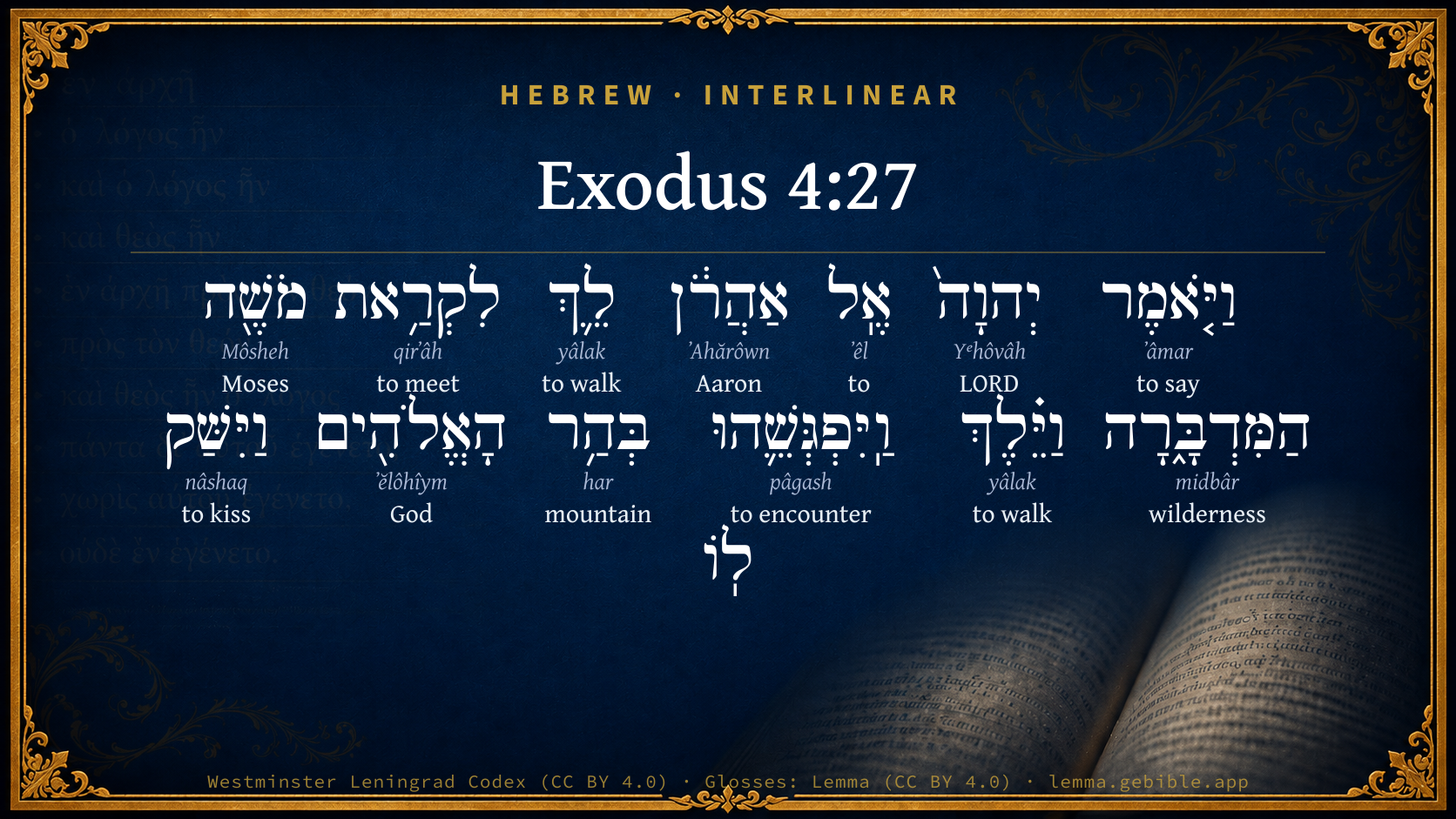
Hebrew (Westminster Leningrad Codex) Exodus 4:27 appears in the Hebrew Old Testament. The text above is from the Westminster Leningrad Codex. Each word links to its Strong’s number, a concise gloss, and parsing drawn from the Open Scriptures Hebrew Bible morphology. Click any word for its full Brown-Driver-Briggs (BDB) entry.
Download image
Cite this verse

Exodus 4:27 (World English Bible). Public Domain. Lemma interlinear Bible study tool, https://lemma.gebible.app/v/exodus/4/27.

Show BibTeX & RIS
BibTeX
RIS
English Translation
Yahweh said to Aaron, "Go into the wilderness to meet Moses." He went, and met him on God's mountain, and kissed him.
World English Bible · Public Domain
Download a study sheet

One document with this verse’s original text, its word-by-word gloss line, the meaning frame, cross-references with their text, attributed commentary, and full source and license credits — printable, and it pastes into notes with its structure intact.

This verse Autodidact and up

Study sheet (.html) Plain text (.txt)

A passage Seminary Student

Up to 50 verses in one chapter. A passage sheet keeps up to 6 commentary sources and 12 cross-references per verse, in the order this page ranks them, and says so on the sheet whenever that leaves anything out. Ask for a single verse and you get the Autodidact verse sheet above.

Everything on this page stays free to read, with no account — the sheet is a download of what is already on screen, not access to it.

Want to remove ads? Support Godless Engineer
Compare translations 3

The same verse in 3 English versions, stacked beneath the original-language interlinear above. Click any original word for its lexicon entry.

Each is an independent rendering of the whole verse — the interlinear is not word-aligned to these translations.

Highlighted words mark where these versions differ — a whole-verse word diff, not a word-by-word alignment.

  • World English Bible Public Domain
    Yahweh said to Aaron, "Go into the wilderness to meet Moses." He went, and met him on God's mountain, and kissed him.
  • King James Version Public Domain
    And the LORD said to Aaron, Go into the wilderness to meet Moses. And he went, and met him in the mount of God, and kissed him.
  • unfoldingWord Literal Text CC BY-SA 4.0
    And Yahweh said to Aaron, “Go into the wilderness to meet Moses.” And he went, and he met him at the mountain of God, and he kissed him.

unfoldingWord Literal Text — © unfoldingWord, licensed CC BY-SA 4.0. Word-aligned USFM3 via Door43 (git.door43.org/unfoldingWord/en_ult).

Versions to compare (up to 4)

3 of 4 selected

Show all 18 translations

Every available English version of this verse, each an independent rendering of the whole verse.

  • World English Bible Public Domain
    Yahweh said to Aaron, "Go into the wilderness to meet Moses." He went, and met him on God's mountain, and kissed him.
  • Berean Standard Bible Public Domain
    Meanwhile, the LORD had said to Aaron, “Go and meet Moses in the wilderness.” So he went and met Moses at the mountain of God and kissed him.
  • Majority Standard Bible Public Domain
    Meanwhile, the LORD had said to Aaron, “Go and meet Moses in the wilderness.” So he went and met Moses at the mountain of God and kissed him.
  • King James Version Public Domain
    And the LORD said to Aaron, Go into the wilderness to meet Moses. And he went, and met him in the mount of God, and kissed him.
  • American Standard Version (1901) Public Domain
    And Jehovah said to Aaron, Go into the wilderness to meet Moses. And he went, and met him in the mountain of God, and kissed him.
  • Revised Version (1885) Public Domain
    And the LORD said to Aaron, Go into the wilderness to meet Moses. And he went, and met him in the mountain of God, and kissed him.
  • Geneva Bible (1599) Public Domain
    Then the Lord saide vnto Aaron, Goe meete Moses in the wildernesse. And he went and mette him in the Mount of God, and kissed him.
  • Douay-Rheims (1899) Public Domain
    And the Lord said to Aaron: Go into the desert to meet Moses. And he went forth to meet him in the mountain of God, and kissed him.
  • Young's Literal Translation Public Domain
    And Jehovah saith unto Aaron, `Go to meet Moses into the wilderness;' and he goeth, and meeteth him in the mount of God, and kisseth him,
  • Literal Standard Version CC BY-SA 4.0
    And YHWH says to Aaron, “Go into the wilderness to meet Moses”; and he goes, and meets him on the mountain of God, and kisses him,
  • Unlocked Literal Bible CC BY-SA 4.0
    Yahweh said to Aaron, “Go into the wilderness to meet Moses.” Aaron went, met him at the mountain of God, and kissed him.
  • unfoldingWord Literal Text CC BY-SA 4.0
    And Yahweh said to Aaron, “Go into the wilderness to meet Moses.” And he went, and he met him at the mountain of God, and he kissed him.
  • Darby Bible Public Domain
    And Jehovah said to Aaron, Go into the wilderness to meet Moses. And he went, and met him on the mountain of God, and kissed him.
  • World Messianic Bible Public Domain
    The LORD said to Aaron, “Go into the wilderness to meet Moses.” He went, and met him on God’s mountain, and kissed him.
  • Webster's Bible Public Domain
    And the LORD said to Aaron, Go into the wilderness to meet Moses. And he went, and met him in the mount of God, and kissed him.
  • Free Bible Version CC BY-SA 4.0
    The Lord had told Aaron, “Go and meet Moses in the desert.” So Aaron went and met Moses at the mountain of God and greeted him with a kiss.
  • Bible in Basic English Public Domain
    And the Lord said to Aaron, Go into the waste land and you will see Moses. So he went and came across Moses at the mountain of God, and gave him a kiss.
  • JPS Tanakh (1917) Public Domain
    And the LORD said to Aaron: 'Go into the wilderness to meet Moses.' And he went, and met him in the mountain of God, and kissed him.

Literal Standard Version (2020), Covenant Press — licensed CC BY-SA 4.0. Text via the HelloAO Bible API (eBible.org). Unlocked Literal Bible (unfoldingWord) — licensed CC BY-SA 4.0. Text via the HelloAO Bible API (eBible.org). unfoldingWord Literal Text — © unfoldingWord, licensed CC BY-SA 4.0. Word-aligned USFM3 via Door43 (git.door43.org/unfoldingWord/en_ult). Free Bible Version, Dr. Jonathan Gallagher — licensed CC BY-SA 4.0. Text via the HelloAO Bible API (eBible.org).

Word by word

More ways to search: Search by grammar → Find every occurrence → Compare this word →

Practice this passage: Drill this verse → Learn its vocabulary →

וַֽיִּפְגְּשֵׁ֛הוּ
pâgash
H6298
“and · to encounter · him”
Conjunction + Verb, Qal, Sequential Imperfect, 3rd Person, Masculine, Singular + Suffix, Personal, 3rd Person, Masculine, Singular
Part of Speech
Conjunction + Verb
Stem
Qal
Form
Sequential Imperfect
Person
3rd Person
Gender
Masculine
Number
Singular
Full BDB Definition

Origin: a primitive root

TWOT: 1733

to meet, join, encounter - (Qal) to meet, encounter - (Niphal) to meet together, meet each other - (Piel) to meet, encounter
  1. וַיֹּ֤אמֶר ʼâmar H559 “and · to say” Conjunction + Verb, Qal, Sequential Imperfect, 3rd Person, Masculine, Singular
  2. יְהוָה֙ Yᵉhôvâh H3068 “LORD” Noun, Proper
  3. אֶֽל ʼêl H413 “to” Preposition
  4. אַהֲרֹ֔ן ʼAhărôwn H175 “Aaron” Noun, Proper
  5. לֵ֛ךְ yâlak H3212 “walk” Verb, Qal, Imperative, 2nd Person, Masculine, Singular
  6. לִקְרַ֥את qirʼâh H7125 “to meet” Preposition + Verb, Qal, Infinitive Construct
  7. מֹשֶׁ֖ה Môsheh H4872 “Moses” Noun, Proper
  8. הַמִּדְבָּ֑רָה midbâr H4057 “the · wilderness · toward” Particle, Definite Article + Noun, Common, Masculine, Singular, Absolute + Suffix, Demonstrative
  9. וַיֵּ֗לֶךְ yâlak H3212 “and · to walk” Conjunction + Verb, Qal, Sequential Imperfect, 3rd Person, Masculine, Singular
  10. בְּהַ֥ר har H2022 “in/at · mountain of” Preposition + Noun, Common, Masculine, Singular, Construct
  11. הָאֱלֹהִ֖ים ʼĕlôhîym H430 “the · God(s)” Particle, Definite Article + Noun, Common, Masculine, Plural, Absolute
  12. וַיִּשַּׁק nâshaq H5401 “and · to kiss” Conjunction + Verb, Qal, Sequential Imperfect, 3rd Person, Masculine, Singular

About this verse

These counts appear in no published source. They are computed here, from the morphology-tagged text and Lemma’s own curated glosses. What Lemma adds →

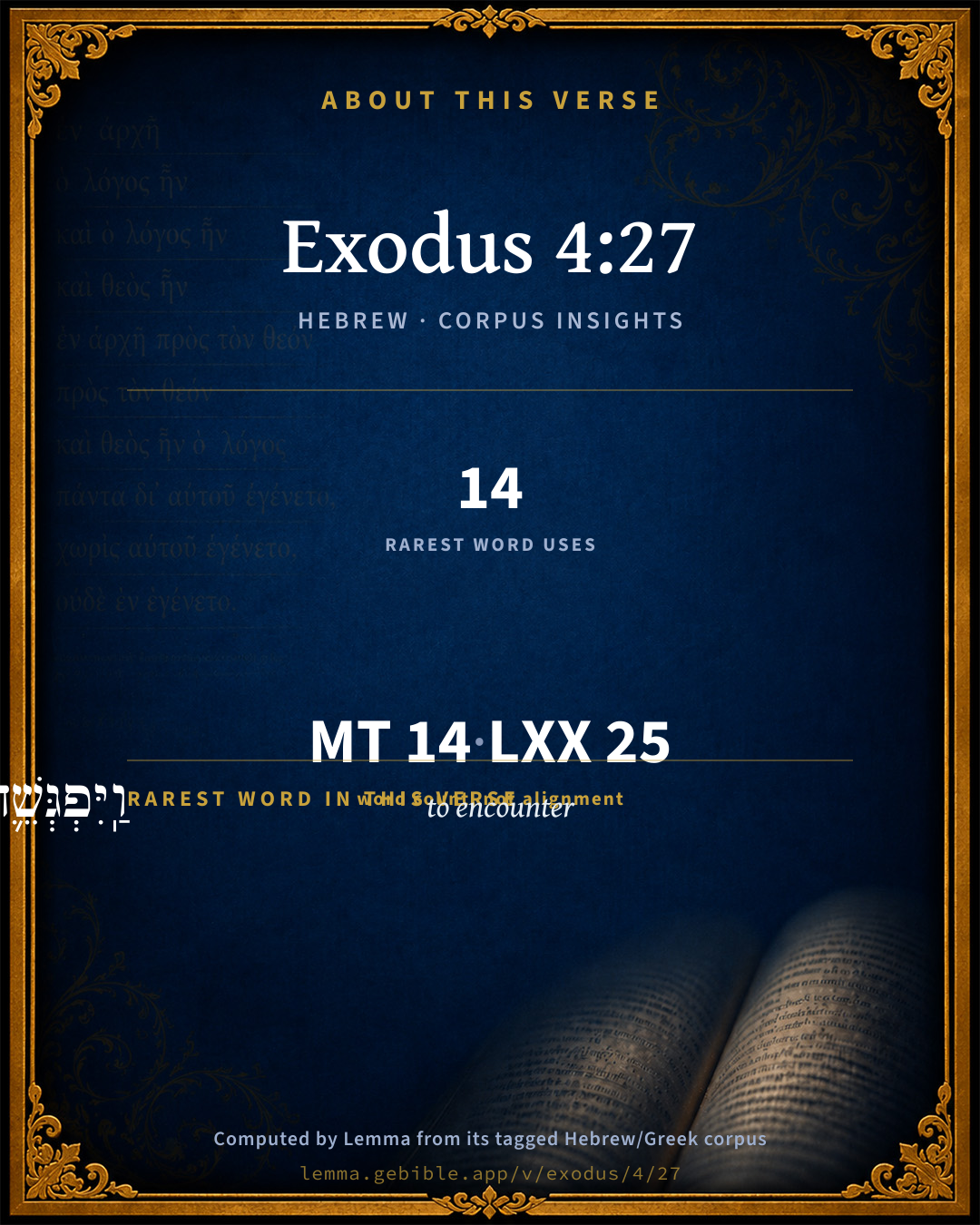
14
words
12
distinct lemmas
Pentateuch
section

Notable vocabulary

The rarest word here is וַֽיִּפְגְּשֵׁ֛הוּ to encounter H6298 — appearing just 14 times in the whole Hebrew Bible.

Shared distinctive vocabulary

וַֽיִּפְגְּשֵׁ֛הוּ to encounter H6298 occurs in 14 verses of the Hebrew Bible. Also found in:

Grammatical profile

  • 6 verbs
  • 6 nouns
  • 2 prepositions

Verb forms

  • וַיֹּ֤אמֶר Qal · Sequential Imperfect
  • לֵ֛ךְ Qal · Imperative
  • לִקְרַ֥את Qal · Infinitive Construct
  • וַיֵּ֗לֶךְ Qal · Sequential Imperfect
  • וַֽיִּפְגְּשֵׁ֛הוּ Qal · Sequential Imperfect
  • וַיִּשַּׁק Qal · Sequential Imperfect

Repetition

A word recurs within this verse — often emphatic in Hebrew:

  • לֵ֛ךְ to walk H3212 ×2

Hebrew & Septuagint length

In English translation the verse runs 22 words from the Hebrew and 29 from the Septuagint (LXX English) — closely comparable.

A rough comparison of the two English renderings, which tokenize alike — not a word-level alignment.

Word counts can differ between the Hebrew and the Greek without any difference in meaning — e.g. the Hebrew direct-object marker אֵת has no separate Greek word, and Greek often adds the article ὁ.

In the original languages it is 14 Hebrew tokens and 25 Greek tokens — but the two are counted differently (Hebrew bundles its prefixes and suffixes into one token; the Greek is in lemma form), so that isn’t a like-for-like length.

Cross-references

10

Topical passages linked to Exodus 4:27 in the Treasury of Scripture Knowledge — connected by theme and wording, ordered by reader-vote popularity; previews shown in the World English Bible.

  • Exodus 3:1 Now Moses was keeping the flock of Jethro, his father-in-law, the priest of Midian, and he led the flock to the back of the wilderness, and came to God's mountain, to Horeb.
  • Genesis 29:11 Jacob kissed Rachel, and lifted up his voice, and wept.
  • Exodus 4:14–16 The anger of Yahweh was kindled against Moses, and he said, "What about Aaron, your brother, the Levite? I know that he can speak well. Also, behold, he comes forth to meet you. When he sees you, he will be glad in his heart.
  • Exodus 19:3 Moses went up to God, and Yahweh called to him out of the mountain, saying, "This is what you shall tell the house of Jacob, and tell the children of Israel:
  • Exodus 20:18 All the people perceived the thunderings, the lightnings, the sound of the trumpet, and the mountain smoking. When the people saw it, they trembled, and stayed at a distance.
  • Exodus 24:15–17 Moses went up on the mountain, and the cloud covered the mountain.
  • 1 Kings 19:8 He arose, and ate and drink, and went in the strength of that food forty days and forty nights to Horeb the Mount of God.
  • Ecclesiastes 4:9 Two are better than one, because they have a good reward for their labor.
  • Acts 10:5–6 Now send men to Joppa, and get Simon, who is surnamed Peter.
  • Acts 10:20 But arise, get down, and go with them, doubting nothing; for I have sent them."

Cross-references courtesy of OpenBible.info (CC BY 4.0).

Hebrew and Greek witnesses Masoretic Hebrew ↔ Greek Septuagint

The same verse in the two great witnesses to the Old Testament, shown verse-for-verse.

These are two independent witnesses, not word-aligned to each other, and the Septuagint is shown in lemma (dictionary) form.

Hebrew Exodus 4:27 Masoretic · Westminster Leningrad Codex

וַיֹּ֤אמֶר יְהוָה֙ אֶֽל אַהֲרֹ֔ן לֵ֛ךְ לִקְרַ֥את מֹשֶׁ֖ה הַמִּדְבָּ֑רָה וַיֵּ֗לֶךְ וַֽיִּפְגְּשֵׁ֛הוּ בְּהַ֥ר הָאֱלֹהִ֖ים וַיִּשַּׁק לֽוֹ

Yahweh said to Aaron, "Go into the wilderness to meet Moses." He went, and met him on God's mountain, and kissed him.

World English Bible · Public Domain

Greek LXX Exodus 4:27 Septuagint · lemma form

εἶπον δέ κύριος πρός ααρων πορεύομαι εἰς συνάντησις μωυσῆς εἰς ὁ ἔρημος καί πορεύομαι καί συνἀντάω αὐτός ἐν ὁ ὄρος ὁ θεός καί καταφιλέω ἀλλήλω

And the Lord said to Aaron, Go into the wilderness to meet Moses; and he went and met him in the mount of God, and they kissed each other.

LXX2012 (modern English Septuagint) · Public Domain

Hebrew: Westminster Leningrad Codex (CC BY 4.0). Greek: Septuagint (public domain); English from LXX2012 (modern English Septuagint) (Public Domain). How the Septuagint differs from the Hebrew →

Targum (Aramaic paraphrase)

2

The Targum is the ancient Jewish Aramaic paraphrase of the Hebrew Scriptures — an interpretive translation, not the Hebrew text itself. Onkelos (literal) and Pseudo-Jonathan (expansive) render the Torah, and Jonathan the Prophets. Coverage is partial: where no permissively-licensed English translation exists for a verse, only the Aramaic is shown. This is verse-level text, not a word-by-word alignment to the Hebrew.

  1. Targum Onkelos Torah (Genesis–Deuteronomy)
    וַאֲמַר יְיָ לְאַהֲרֹן אֱזֵיל לְקַדָמוּת משֶׁה לְמַדְבְּרָא וַאֲזַל וְעַרְעֵהּ בְּטוּרָא דְאִתְגְלֵי עֲלוֹהִי יְקָרָא דַיְיָ וּנְשַׁק לֵהּ:

    (no public-domain English translation for this verse)

    Targum Onkelos — Aramaic: “Onkelos Genesis” (public domain); “Onkelos Exodus” (public domain); “Onkelos Leviticus” (public domain); “Onkelos Numbers” (public domain); “Onkelos Deuteronomy” (public domain). English: “Sefaria Community Translation” (CC0 1.0 (public-domain dedication)); “J.W. Etheridge. The Targums of Onkelos and Jonathan Ben Uzziel on the Pentateuch. London: Longmans, Green, 1862” (public domain). Text via Sefaria.

  2. Targum Pseudo-Jonathan Torah (Genesis–Deuteronomy)
    וַאֲמַר יְיָ לְאַהֲרן אִיזֵיל לְקַדְמוּת משֶׁה לְמַדְבְּרָא וַאֲזַל וְאַרְעֵיהּ בְּטַוְורָא דְאִתְגְלֵי עֲלוֹי יְקָרָא דַיְיָ וּנְשֵׁיק לֵיהּ

    And the Lord had said to Aharon, Go and meet Mosheh in the desert. And he came and met him at the mountain where was revealed the glory of the Lord, and he embraced him.

    Targum Pseudo-Jonathan — Aramaic: “Targum Jonathan on Genesis” (public domain); “Targum Jonathan on Exodus” (public domain); “Targum Jonathan on Leviticus” (public domain); “Targum Jonathan on Numbers” (public domain); “Targum Jonathan on Deuteronomy” (public domain). English: “The Targum of Jonathan ben Uzziel, trans. J. W. Etheridge, London, 1862” (public domain). Text via Sefaria.

Commentary

Notes on Exodus 4:27 from classic Christian and Jewish commentators (each source and its license shown beneath its notes). The classic Christian expositions comment on the surrounding passage and are grouped to its opening verse, so a note may address several verses; the Jewish commentaries on the Tanakh (Rashi and others) are per-verse, so they appear only where the commentator wrote on this verse.

Lemma curates 59 commentaries, every one of them public domain or Creative Commons licensed, each selected and text-cleaned for this edition rather than reprinted as found. About our sources →

Trapp's Complete Commentary

John Trapp

Exo 4:27 And the LORD said to Aaron, Go into the wilderness to meet Moses. And he went, and met him in the mount of God, and kissed him.

Ver. 27. And the Lord said unto Aaron.] To this religious family rather than to any other, God appeareth: which mercy is remembered, 1Sa 2:27.

Met him in the mount of God.] His wife either had left him, or was sent back by him to her father. God supplies that comfort by the coming of Aaron.

John Trapp, A Commentary or Exposition upon All the Books of the Old and New Testament (1647–1656) — public domain. Text from a community e-Sword module.

The Biblical Illustrator

Joseph S. Exell

Exo_4:27

Go into the wilderness to meet Moses.

Family relationships

I. The brotherhood and affection subsisting between the different members of Gods family. This is twofold. Gods people stand in a twofold relation to one another, as--

(1) natural and--

(2) spiritual men.

II. Notice the breaches of intercourse brought about in this world between those members of Gods family who have seen and known one another in the flesh.

1. Many interruptions of intercourse are brought about by providential arrangements.

2. All direct communication between brethren in the Lord is cut off by death.

III. Consider the need of and consequent yearning after each others society and assistance which, while parted, the members of Gods family experience. The need is based upon, and flows from, their spiritual constitution in one body. We are, in the design of God, constituent parts of a whole, and we are continually evincing our consciousness of this truth.

IV. Consider the blissful reunion of the sundered members of Gods family in the realms of glory. There shall be a day when all the yearnings of the Christians heart after the society of his brethren shall be satisfied to the full, when his joy shall receive its entire complement in his recognition of and intercommunication with those whom he has known and loved in the Lord. (Dean Goulburn.)

Moses and Aaron

I. God brought the leaders together. A strange place for their meeting, and a strange scene.

II. God brought his leaders to his people. God may be obliged to prepare His leaders as well as His people. Moses was not ready for his work until he was eighty years old. How much of Gods work may be waiting for His leaders! Pray for leaders set apart in the Mount of God; but pray, too, for elders to gather about them. And pray again for a people ready to be led. Everything must stay until so much is attained,--a consecrated ministry, a consecrated eldership, a consecrated church.

III. God brought his leaders before pharaoh. Gods enemies must be subdued if they reject the Divine message. But first He will thoroughly apply gentle methods. (G. R. Leavitt.)

Moses and Aaron

I. Aarons commission.

1. Its reason suggestive to the reluctant servant (Exo_4:1-14).

2. The fact suggestive of the Divine condescension and forbearance.

II. Aarons obedience.

1. Prompt.

2. Sincere.

III. Moses and Aaron carrying out the Divine command.

1. They observed their respective places.

2. Their reception by the people (Exo_4:31).

IV. The interview between Moses, Aaron, and Pharaoh.

1. The reasonableness of the request.

2. The unreasonableness and haughtiness of the reply.

Lessons:

1. To analyze the Divine motive, in the use of all these human instrumentalities, is fraught with most helpful and instructive suggestions.

2. The unwisdom of hesitancy, in accepting a clearly-indicated call of God, is here seen.

3. The modesty and judiciousness with which the request of Moses and Aaron was couched, suggest the carefulness which soul-winners should exercise.

4. In the haughtiness of Pharaoh we discover the preliminary step to his fall. (D. C. Hughes, M. A.)

Lessons

1. God joineth His seconds to His firsts, as He seeth need for redemption of His Church.

2. The same Jehovah only fits and calls His first and second instruments for His works. All from God.

3. God may call the elder after the younger brother, and subject him.

4. God can bring brethren together which were as lost one to another.

5. Motion and place and work, God points out to His instruments of salvation.

6. God makes the deserts places for deliverers to meet in for His Churchs good.

7. Gods call to meeting of instruments is to teach them their respective work.

8. Hearts which God toucheth are ready for obedience to Gods call.

9. The mount of God, and God in the mount, is best for His servants to meet about His work.

10. Nature and grace teach men to give signs of love and loyalty to Gods substitutes below (Exo_4:27).

11. It is just for supreme powers to open their commissions from God to inferiors.

12. Gods words alone are to be declared, which He speaks to His servants, and are to be spoken by them.

13. Mission and commission of Gods ministers must appear both from God.

14. Gods wonderful works as well as gracious works must be showed at His command.

15. Joint ambassadors of the Churchs deliverance need to know Gods words and works (Exo_4:28). (G. Hughes, B. D.)

The two brothers

I. As educated by different methods.

II. As meeting after a long separation.

1. The meeting was providential.

2. The meeting had a moral and national significance.

3. The meeting was welcome to the brothers.

III. As uniting in a grand enterprise. Brothers should unitedly place themselves in a line with the providence of God.

IV. As entering upon an important future. All the casual meetings of life are important in their bearing upon present work and future destiny.

V. As reflecting commendation upon their family. Sons honour their parents when they undertake an enterprise for the good of men. Brothers cannot be better united than in the cause of God. (J. S. Exell, M. A.)

The meeting of two brothers

I. It was in a strange place. Some men are only brotherly before the crowd, in privacy or solitude they are social despots. The wilderness will test our affection.

II. It was characterized by warmth of affection. They kissed each other. Brothers do not often act thus in these days. They think it unmanly to do so. The age is cold at heart. It is a token of courage as well as love that a brother will thus greet his brother. But let the kiss be accompanied by kindly attentions, otherwise it is a mockery.

III. It was the occasion for religious talk and consultation. No better topic than this. (J. S. Exell, M. A.)

Christian brothers

1. Called by God to work.

2. Joined by God in work.

3. Conversing together about work.

4. Learning their respective work. (J. S. Exell, M. A.)

Providential arrangements

But admire the manner in which God governs the things of this world and of His Church. When it pleases Him to save a soul, or call a servant, He causes all persons and all events to work together for this end, and in a way already determined. As a skilful general sends each division of his army, without the knowledge of the others, to assemble on the same field of battle, so the Lord sends His servants who are fighting the good fight, to the place and at the time where they ought to meet. It was thus that He sent Peter to Cornelius, Ananias to Paul, Philip to the eunuch. It is thus that in our time He sends missionaries to heathen lands. It was thus that He caused Farel and Calvin to meet at Geneva, that they might help each other, and form a friendship that lasted during their lives, and greatly contributed to the success of their work. How this thought enlightens, strengthens, comforts, and rejoices those who are engaged serving God. (Prof. Gaussen.)

The two brothers

The history of Moses and Aaron appearing together at the court of Pharaoh, the one working miracles and the other as his spokesman, may have given rise to the traditions of the Greeks and Romans, in which Jupiter and Mercury, both of them Egyptian deities worshipped at Hammon and Thoth, are described visiting the earth in a similar relationship. The latter was represented with the caduceus, a rod twisted about with serpents, and was the god of speech or eloquence. To such traditions the saying of the people of Lystra may be referred, when Paul had healed the cripple (Act_14:11). (T. S. Millington.)

Moses and Aaron; or, the use of association

True greatness is modest. It is a false greatness that magnifies its own powers, and disparages the strength of opposing forces. One of the penalties of greatness is isolation. It removes the man from common aids and sympathies, and sets him by himself. Greatness is lonely. This isolation Moses was beginning to feel, while the task before him grew awful, and swelled into a frightful magnitude. Solitude, and that isolation which is worse than solitude--separation from the insight and sympathy of men around us--is weakening. Moses grew weak and drew back. Thinkers are not always speakers, nor speakers thinkers. Nay, thought in its very striving after accuracy and exactness, is apt to be a hindrance of fluency. Moses could think and act, but he could not speak. He was a greater man than his brother, but his brother was a better speaker. He could excogitate the ideas, and his brother could put them into words for him. God is economical in His bestowments, and seldom heaps His manifold favours on one man. Cromwell, whether a good or a bad man, was certainly a great man; yet out of his tangled utterances it was hard to come at his meaning. Here, then, the want was supplied, and with it, as appears in the subsequent history, a much broader surface of want besides; for God is, able to do exceeding abundantly above all that we ask or think, and is wont to give more than either we desire or deserve. The abundance of His mercy will not be kept within the narrow bounds our mean conceptions set to it. Moses, in the guise of an Egyptian, and as the son of Pharaohs daughter, had learned to recognize and love his brother Aaron under Amrams roof; they had been nurtured for uses of which neither of them dreamed. How much of this provision for a secret future is there in the lives of men. What important effects to the end of life may flow from the seemingly casual associations and intimacies of childhood I This companionship at once delivered Moses from his solitude, the isolation of peculiarity, by raising up for him a co-worker, to stand with him on the same elevated plane above the mass of the people, and aid him in bearing cares on which none but one so commissioned might presume to intrude. Here, then, was unity with subordination, and harmony with distribution and diversity; and thus the apparatus of action for the great enterprise was complete. See here the good of association. See how it raised Moses out of the ague of despondency that overtook him when the object of his long desire had at last come within his grasp; how it warmed his powers into resolute endeavour, and shed a benign influence upon his subsequent labours and sufferings. So Jonathan, Sauls son arose, and went to David in the wood, and strengthened his hand in God. So, too, our blessed Lord thought of this principle and acted upon it, and stamped it with the seal of His infallible wisdom, when He sent out His disciples two by two, making but six missions, where an earthly wisdom would have thought it better economy to make twelve. And the great St. Paul had always with him Barnabas, or Mark, or Luke, or Gaius, or Epaphroditus in his missionary travels and labours. Let us remember that in the Divine household we are knit together into one fellowship, and are to learn to be mutually considerate and helpful, and bear each others burdens, as every one members one of another. Gods work, our work, will be done more easily, pleasantly, effectually. See here, too, the good of subordination. Aaron was always with Moses, his shadow or second self; but Moses always was head. If both had been heads the machinery would not have worked so kindly, smoothly, and comfortably. Nothing does well with two heads. (R. A. Hallam, D. D.)

The Biblical Illustrator, edited by Joseph S. Exell (c. 1880s–1900s) — public domain. Text from a community e-Sword module.

Joseph Benson's Commentary

Exo 4:27-28. He met him in the mount of God — Almost as soon as he had set out. For while Moses had met with many delays, through his family, Aaron had made great haste. And, no doubt, his coming was a great encouragement to Moses. Moses told Aaron all — Those that are fellow- servants to God, in the same work, should use a mutual freedom, and endeavour rightly and fully to understand one another.

Joseph Benson's Commentary on the Old and New Testaments (1811–1818) — public domain. Text from a community e-Sword module.

The Preacher's Complete Homiletical Commentary

Joseph S. Exell (gen. ed.)

MAIN HOMILETICS OF THE PARAGRAPH.—Exo_4:27-28

THE MEETING OF TWO BROTHERS

I. It was in a strange place. The wilderness would not be a very favourable place for the meeting of these two brothers It would be wild and lonely. But brotherly affection is not dependent upon time and place; it can turn a wilderness into a father’s hearth; it can make the dessert blossom as the rose The friendship of these brothers was real Some men are only brotherly before the crowd; in privacy or solitude they are social despots The wilderness will test our affection.

II. It was characterised by warmth of affection. They kissed each other. Brothers do not often act in these days. They think it unmanly to do so. The age is cold at heart. It is a token of courage as well as love that a brother will thus greet his brother. But let the kiss be accompanied by kindly attentions, otherwise it is a mockery

III. It was the occasion for religious talk and consultation. “And Moses told Aaron all the words of the Lord who had sent him, and all the signs which He had commanded him.” No doubt a word was passed about their aged parents, about the memories of youth; but the chief theme was their future mission. It is well for brothers to converse together about the work and words of God. All other themes are of minor import.

SUGGESTIVE COMMENTS ON THE VERSES

Exo_4:27-28. Christian Brothers:—

1. Called by God to work.

2. Joined by God in work.

3. Conversing together about work.

4. Learning their respective work.

God may call the elder brother after the younger.

God can bring brethren together which were as lost to one another.

God makes the desert a place to meet in for the deliverers of His Church.

It is best for brothers to meet at the mount of God

It is just for Supreme Powers to open their commission from God to inferiors.

God’s wonderful works as well as His gracious works must be showed at His command.

The Preacher's Complete Homiletical Commentary (gen. ed. Joseph S. Exell; Funk & Wagnalls, c. 1892) — public domain (pre-1929). A full-Bible homiletical/sermon-outline anthology covering 65 of 66 books (2 John is absent from the source module). Text from a community e-Sword module.

Tyndale Open Study Notes

Tyndale Open Resources

4:27 Aaron’s coming to meet Moses is the first recorded confirmation of God’s promises (see 4:14). • mountain of God: A reference to Mount Sinai.

Tyndale Open Study Notes — © Tyndale Open Resources, licensed CC BY-SA 4.0. Text via the HelloAO Bible API.

Geneva Bible (1599)

Geneva Bible translators

Or, Horeb.

Geneva Bible (1599) marginal notes — public domain. Text via Bolls.life.

Jamieson, Fausset & Brown

Robert Jamieson, A. R. Fausset & David Brown

Aaron met him in the mount of God, and kissed him--After a separation of forty years, their meeting would be mutually happy. Similar are the salutations of Arab friends when they meet in the desert still; conspicuous is the kiss on each side of the head.

Jamieson, Fausset & Brown — Commentary Critical and Explanatory on the Whole Bible (1871) — public domain (CC PDM 1.0). Text via the HelloAO Bible API.

Adam Clarke's Commentary

Verse 27. The Lord said to Aaron] See Ex 4:14. By some secret but powerful movement on Aaron's mind, or by some voice or angelic ministry, he was now directed to go and meet his brother Moses; and so correctly was the information given to both, that they arrived at the same time on the sacred mountain.

Adam Clarke's Commentary on the Bible (1810–1826) — public domain. Text from a community e-Sword/MySword module.

Ellicott's Commentary for English Readers

(27) Go into the wilderness.-Either the directions given to Aaron were more definite than this, or they were supplemented by Divine guidance. He went and met Moses on “the mount of God,” i.e., in the Sinaitic region. Without Divine guidance, he would naturally have sought him in Midian.

Kissed him.—Comp. Gen_33:4; Gen_45:14-15. In the East, men closely related still kiss on meeting, as they did in Moses’ time, and in the days of Herodotus (i. 134).

A Bible Commentary for English Readers, edited by Charles John Ellicott (1878–1897) — public domain. Text from a community e-Sword module.

The Cambridge Bible for Schools and Colleges

gen. ed. J. J. S. Perowne

27. Aaron (cf. v. 14) coming from Egypt by Divine command to it Moses, finds him in the ‘mountain of God,’ Horeb (Exo_3:1). The verse is the continuation of vv. 17, 18, 20b. The ‘wilderness’ meant may be either the one beyond Horeb (Exo_3:1), or the wilderness between Horeb and Egypt.

27–31. Moses and Aaron together communicate their commission to the people in Egypt, and are readily believed by them.

The Cambridge Bible for Schools and Colleges (gen. ed. J. J. S. Perowne; Cambridge University Press, 1878–1918) — public domain. Text from a community e-Sword module.

John Gill's Exposition

And Moses told Aaron all the words of the Lord, who had sent him,.... He declared his mission and commission from God, and gave him the particulars of what was to be said both to the people of Israel and to the king of Egypt; and this he did, because Aaron was to be his spokesman unto them:

and all the signs which he had commanded him; to do, first before the children of Israel, and then before Pharaoh; before the one to obtain credit of them, as being sent of God, and before the other to get leave of him for the departure of Israel out of Egypt.

John Gill's Exposition of the Whole Bible (1746–1763) — public domain (CC PDM 1.0). Text via the HelloAO Bible API.

Haydock's Catholic Bible Commentary

Of God. Horeb, where both brothers met, after Sephora was returned to her father.

George Leo Haydock (1774–1849), Haydock's Catholic Family Bible and Commentary, 1859 edition — public domain. Excludes Psalms (Douay-Rheims chapter numbering differs from Protestant) and Deuterocanonical books (Catholic canon only).

The Pulpit Commentary

Vers. 27, 28. The scene suddenly shifts. Moses is left in the wilderness to recover his strength and make such arrangements with respect to his wife and children as he thinks best under the circumstances. We are carried away to Egypt and introduced to Aaron, Moses" elder brother, of whom we have only heard previously that he could "speak well," and was to assist Moses as spokesman in his enterprise. (Exo_4:14-16) We now find God revealing himself to Aaron also, and directing his movements, as he had those of Moses. Aaron had perhaps already formed the design of visiting his brother (see ver. 14), and would have sought him in Midian but for the direction now given him. That direction was probably more definite than is expressed in the text, and enabled him to set forth confidently, without the fear of missing his brother. At any rate, under God"s guidance he went and met him in the Sinaitic district. The joy of meeting is briefly described in the single phrase "he kissed him." The meeting was followed by a full explanation, on the part of Moses, both of the nature of his own mission and of the part which Aaron was to take in it.

Go into the wilderness. It is scarcely possible that this can have been the whole of the direction given, since the wilderness extended from the shores of the Mediterranean to the extreme point of the Sinaitic peninsula. The sacred writers study brevity, and leave much to be supplied by the common-sense of the reader. He went and met him in the mount of God. Compare above, Exo_3:1, which shows that Horeb is meant. Horeb seems to have been the name for the entire mountain region, of which Sinai was a part. Kissed him. So Esau kissed Jacob after their long separation, (Gen_33:4) and Joseph, Benjamin and his other brethren. (Gen_45:14, Gen_45:15) In the East men are more demonstrative than with us. Aaron"s kiss showed the gladness that was in his heart (supra, ver. 14).

Ver. 27. God does not stint his help when he visits man.

It might have seemed that God had now done enough to set on foot the deliverance of his people. He had appeared to Moses, overcome his reluctance to be leader, given him the power of working some great miracles, and allowed him to devolve a portion of his duties upon his brother; Moses was on his way to Egypt to carry out his commission, and Aaron was minded to go forth to meet and greet him. Humanly speaking, nothing more was needed for the initiation of the work. But God, who "seeth not as man seeth," does not stint his arm when he has taken a business in hand. It would expedite matters if Aaron were to be directed where to meet Moses, and the two brothers were to have their conference at once, and arrange their course of proceedings. So Aaron is visited, probably by an angel, and sent to meet Moses, and told where he will find him; and by these means the meeting is brought about with all speed, Aaron enlightened as to his duties, and plans arranged to be put in act as soon as Egypt is reached. The two brothers gain the advantage of sweet companionship some days or weeks earlier than they would have done if left to themselves, and their first interview with Pharaoh is advanced correspondingly. And as with his miraculous, so with his ordinary help. God does not stint it. His grace is ever sufficient for men. He gives them all that they can possibly need, and more than they would ever think of asking. He loves to pour out his blessings abundantly on those that are true to him; makes "all things work together for their good;" goes out of his way to procure advantages for them; loads them with his favours.

HOMILIES BY J. ORR Vers. 27, 28. A meeting of brothers.

1. By Divine appointment (cf. ver. 14).

2. In a sacred place.

3. As cooperators in a good work.

4. With affection.

5. To exchange experiences. J.O.

The Pulpit Commentary (1880–1919), ed. H.D.M. Spence-Jones & Joseph S. Exell — public domain. Text from a community e-Sword module.

John Wesley's Explanatory Notes

In the mount of God - That is, the place where God had met with him.

John Wesley, Explanatory Notes Upon the Whole Bible (1754–1765) — public domain. Text via the GEBible commentary corpus.

Kretzmann's Popular Commentary

Paul E. Kretzmann

Moses and Aaron before the people

v. 27. And the Lord said to Aaron, Go into the wilderness to meet Moses. This showed that the favor of the Lord had once more turned to Moses. His wife was not in full accord with him and his belief at that time, but Aaron’s coming would be a great comfort to him. And he went, and met him in the mount of God, on Mount Horeb, and kissed him, this cordial greeting being all the more natural since the brothers had not seen each other for about forty years.

v. 28. And Moses told Aaron all the words of the Lord, who had sent him, and all the signs which He had commanded him. Aaron thus became familiar with the situation just as the Lord had presented it to Moses.

v. 29. And Moses and Aaron went and gathered together all the elders of the children of Israel, as the Lord had commanded, Exo 3:16;

v. 30. and Aaron spake all the words which the Lord had spoken unto Moses, and did the signs in the sight of the people.

v. 31. And the people believed, they were convinced by the words of Aaron, as they were substantiated by the miraculous signs given to Moses. And when they heard that the Lord had visited the children of Israel, that He had investigated their condition in the land of their bondage, and that He had looked upon their affliction, their distressing burdens, then they bowed their heads and worshiped. The promise of the patriarchs was still alive in their hearts, they took new hope for the future, and they thanked God for the prospect of a speedy deliverance. This new hope at the same time welded the people together into one organization by making them conscious once more of their position. Thus the believers will ever accept all the promises of God in His Word with a thankful heart and place their confidence in Him without wavering.

Paul E. Kretzmann, Popular Commentary of the Bible (1921–1924) — public domain. Text from a community e-Sword module.

unfoldingWord translationNotes

Door43 World Missions Community

Yahweh said to Aaron

You may want to add a word that marks the beginning of a new part of the story, as the UDB does with the word "Meanwhile."

at the mountain of God

This may have been the mountain at Sinai, but the text does not include that information.

he had sent him to say

The word "he" refers to Yahweh, and "him" refers to Moses.

translationWords

Yahweh

Aaron

desert

kiss

sign

command

unfoldingWord translationNotes — © Distant Shores Media and the Door43 World Missions Community, licensed CC BY-SA 4.0. Source: git.door43.org/Door43/en_tn.

Ramban (Nachmanides)

Rabbi Moshe ben Nachman (Ramban / Nachmanides)

AND HE MET HIM IN THE MOUNTAIN OF G-D. Thus you learn that Mount Sinai is between Midian and Egypt.

AND HE KISSED HIM. Aaron kissed Moses, for Moses the humble one treated his older brother with respect. For this reason, it does not say that they kissed each other.

Ramban (Nachmanides) on the Tanakh — English translation: “Commentary on the Torah by Ramban (Nachmanides). Translated and annotated by Charles B. Chavel. New York, Shilo Pub. House, 1971-1976” (CC BY 4.0). Text via Sefaria.

Lesson kit

Teaching starters — assembled from the data on this page, not authored interpretation. Every prompt links to the verse data it draws on. Edit before teaching.

Exodus, in the Pentateuch, opens this verse with 14 words (12 distinct Hebrew lemmas). Its most distinctive word is pâgash (“to encounter”). A historical commentator’s framing appears above. Read the whole chapter for the surrounding context.

Discussion questions

  1. How does “to encounter” (pâgash) shape what this verse is saying?
  2. How does Genesis 32:17, which shares the word «to encounter», read alongside this verse?
  3. What does the repetition of “to walk” (2× in this one verse) do in this verse?
  4. The translations on this page render this verse differently — a whole-verse word diff, not a word-by-word alignment. What might account for the different wordings?
  5. «וַיֹּ֤אמֶר» is a Qal Sequential Imperfect verb. How does that grammatical form shape the action described?
  6. Compare how Trapp's Complete Commentary and The Biblical Illustrator read this verse. Where do they agree or differ?

Things to notice

Reading settings

Reading text

Shown beneath each verse's original-language words.

Old Testament
Old Testament edition

Read the OT as the Masoretic Hebrew (MT) or the Greek Septuagint (LXX).

English shown for the Greek Septuagint (in the Hebrew ↔ Greek comparison).

Comparing translations? Open the Compare panel on any verse page to stack up to four side by side.